Cultivating Resilience: An Interview with Dr. Nasser Abufarha
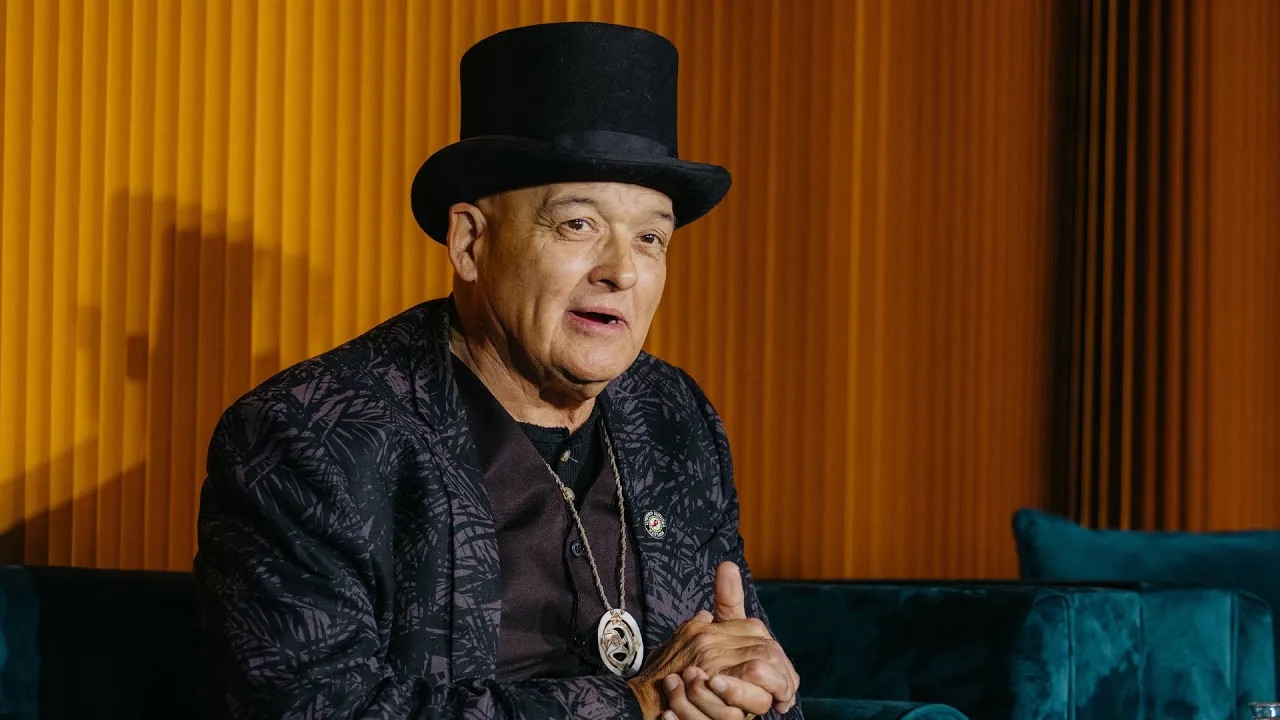
Dr. Nasser Abufarha, a Palestinian-American anthropologist, social entrepreneur, and author, founded the Palestine Fair Trade Association and Canaan Fair Trade, which have revolutionized the fair-trade olive oil industry and significantly impacted Palestinian agriculture and trade. His efforts have uplifted farming communities, integrated fair-trade practices, and promoted Palestinian products globally. His work also extends to various social and environmental causes, contributing significantly to the Palestinian community’s development. Nasser’s work is the subject of a new, award-winning documentary film, Land of Canaan, which we will be screening on December 2nd in Berkeley, CA.
Bioneers senior producer, J.P. Harpignies interviewed Nasser on October 22nd, 2026. This is an edited version of the transcript of that conversation.
J.P. HARPIGNIES: Nasser, thank you so much for doing this. We really appreciate it. Unfortunately, I really wish this weren’t the case, but given what’s been happening during the olive harvest season on the West Bank, with brutal attacks by Israeli settlers on Palestinian farmers and their families that have been in the news so prominently around the world, before we do a deeper exploration of your work for the past 25 years, I have to ask you what the situation is like there on the ground right now and how this current wave of attacks is affecting your work and your network of growers. Why, just yesterday, the guy who’s about to be my congressman, Brad Lander, who was there to offer support to the farmers got arrested in the olive groves.
NASSER: That’s wonderful that he’s here. It’s not wonderful that he got arrested.
This year in particular, settler violence increased in our area because there are about 18 to 19 settlements being planned between Nablus and Jenin in the north, and this is our primary olive country for Canaan Palestine. And this is not only settler violence, it’s the Israeli army paving the way for the settlers to take the land, and protecting them to do the damage that they do and harassment that they do on the farms and on farmers.
And more serious is that for many parcels, for large swathes of land of olive country, farmers and village councils receive orders from the army not to access these lands, or they can’t get permission to access these lands, or there are strict restrictions of how many days, what days you can go, and sometimes restrictions to one day, which, as a hands-on kind of cultivation in the hills, a family of five can do maybe twenty trees in a day. That’s less than a half-acre, so, since an average farm for our farmers is about 12 to 15 acres, obviously you can only do so much in a day.
JP: What percentage of the farmers involved in your network are being affected directly? And what would you say the percentage of the reduction in production might be as a result?
NASSER: In terms of the volume of olives that we will be missing, I would say about one-third.
JP: Wow.
NASSER: Yeah, about 30 percent, because there are a few key villages: Ali Sila lost access to about 6,000 dunams through being denied access, Anin about 11,000, Arraba about 10,000, and Yabbad about 8,000. A thousand dunam is roughly a hundred hectares. (Editor’s note: a dunam corresponds to roughly a quarter of an acre).
JP: Let’s revisit this current situation later because it’s obviously critically important, but let’s jump into the history of the project. You organized close to 2,500 families in over 50 villages into a functional network, which seems incredibly difficult to begin with, but given the nearly century-long history of conflict in the region, how did you manage to navigate the logistical difficulties of the occupation, of the violence, which, though it’s getting worse, has been there a long time? How were you able to set up this extraordinary network under these extremely challenging conditions?
NASSER: Well, I mean, first of all, I started because there was a dire need. I started the project in 2003. It started as an idea. I was doing research in Palestine and walking around in the West Bank, and I found the farmers’ olive oil prices were plummeting. There had been three years of Intifada from 2000 until 2003, and there were no markets, surpluses were piling up, and people were losing interest in even cultivating one more harvest since the past two harvests hadn’t been able to be sold.
So, that’s when I came up with the idea of trying to develop a fair-trade system for their products. They’re already growing organically in the first place. They’re traditional farmers, and you can’t even get mechanical tractors up in those very hilly olive groves, so you already can’t use machinery. It was already a very pristine organic farming population, but I sought to organize the farmers under a fair-trade designation first, to be able to access markets.
We were making a big promise to the farmers because we proposed to buy their harvest. Obviously at the beginning, I was just doing workshops, but after the workshops, we were able to make one purchase in the fall of 2004, and we paid twice as much as the going rate, a 100-plus percent increase of the current price at the time. We wanted to have a jumpstart, to stimulate interest and help spread the word.
And then we started calculating what the right price would be (that would help the farmers but make it a successful business), and the next year we started establishing standards and setting up local organizations, etc., and in 2005, we had the first Palestine Fair Trade Association network. We had organized 13 villages out of the workshops that we had done. And I started talking about the fact that there are companies and consumers out there in U.S., in Europe, who are willing to pay based on what is viable for the farmer to carry on, so they won’t be hostages to the market price. I gave them the example of colonial products – sugar and coffee –and what happened to them when they were able to be sold in a fair-trade situation, and how the Fair-Trade Movement started in churches and made its way into the larger market, and so on.
It was intriguing to the farmers, but they wondered: “Can we trust this guy?” Obviously, everybody wants to sell at a higher price, at a more sustainable price, but they were cautious. With time, buyers started coming back into Palestine and exchanging with the farmers, and we were finding markets abroad and buying products, paying way beyond the market price. Then people started understanding it was for real.
And also, we had to have accountability. it’s mostly family farms, so there aren’t really lots of labor rights issues or anything like that we had to negotiate, but we had to set up some “fair crop-sharing” because some farmers did not own their land. They would give a share to the landowner and they would take a share, but we had to organize this relationship with contracts that spelled out the rights of the farmers in the equation, so they were getting their benefits, and it was fair all around. And this can be tricky because the olive crop is cyclic. One year can be bountiful, one year weak, so we have to work out a system so the farmers don’t get exploited in weaker years.
At the beginning we didn’t have the FLO, Fairtrade International, certification (Editor’s note: Fairtrade International, formerly known as FLO, or Fairtrade Labelling Organizations International, is a global non-profit organization headquartered in Bonn, Germany, that sets the standards and strategic direction for the international Fairtrade system). The FLO didn’t know if there was a market for fair-trade olive oil and weren’t willing to invest in developing standards for something that did not have a clear market value. So we took it upon ourselves. We first studied how FLO set their standards, and we studied our community’s practice, and we set up our own standards and put them on our website, and using those standards, we started recruiting markets in the U.S. and Canada, and then in Europe and the UK. Finally, in 2009, Fairtrade International sent a delegation to develop standards in Palestine, and they did, and we were the first to certify, so we have their official certification.
JP: That’s great. But what about the logistical issues of transport and crossing borders? Because now I think you export to 14 countries, if I’m not mistaken.
NASSER: Yes.
JP: So, what are the logistics? Because we, on the outside, hear about checkpoints everywhere. What are the logistical difficulties of getting the olive oil to market?
NASSER: Yes, our problems are mainly logistical. Let me break it down into different levels. The hardest challenge is faced by the farmers, in accessing the land. Those who are in close proximity to settlements or worse, whose land is targeted for settlements or for acquisition by the army and then allocation to the settlers, face the hardest challenges, and we can’t do much to mitigate those problems ourselves.
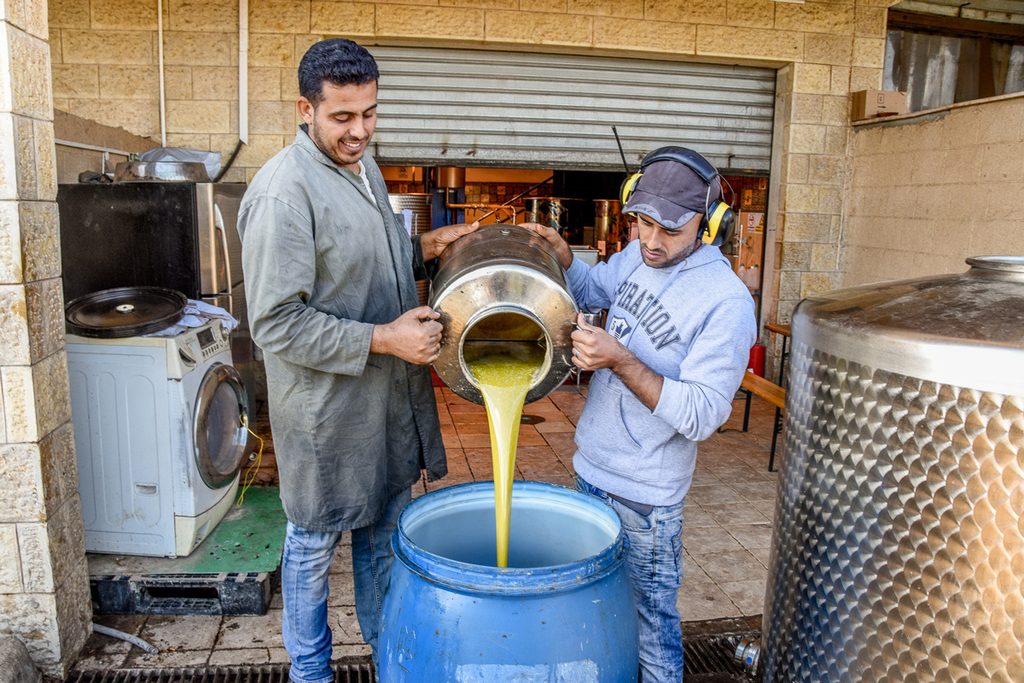
But going around checkpoints and managing the collection of the olive oil and all that, those are challenges that we engage with. We pull the olive oil from the presses and take it to our storage facility in the Jenin area and put it into stainless steel tanks. We’ve built the infrastructure. Olive oil is like a fruit. It’s like wine. It needs to be cared for and it needs to be protected from oxidation, and you need filtration to take the sediments out after a week or so, and it needs to be stored at the right temperature.
So, we do tastings at the olive presses in the fields, do initial sorting, and then map the tasting profile of each batch, and keep the oils with similar-tasting profiles together, and then, as I said, we maintain them at the proper temperature in those stainless-steel tanks. We also add nitrogen injections in the tanks so there is no oxidation on the surface of the olive oil. All of this is beyond the capacity of small family farms. By consolidating and then aggregating a big enough quantity, we are then able to ship to big clients, such as Whole Foods or Dr. Bronner’s Magic Soaps, or some other large buyers.
We set up a system that we call an internal control system that does multiple things. It includes assuring that quality standards, fair trade standards and most of the time, organic standards are all met. We organize workshops to teach the farmers how to meet these standards, and there are spot checks and audits for every plot and every farmer year-round, and there are monitors at the presses who monitor the quality and after that, tasters who separate the oil into different batches based on their quality of the oil. The higher quality oil gets pressed first, and the lower quality oils get pressed toward the end. We have over 30 presses in the program that we contract with as an association to press for our farmers.
JP: But what about where you ship? Do you have to cross checkpoints?
NASSER: Yeah, it can be delicate. Sometimes there are checkpoints that are closed, roads that are closed, and then we have to go around and around, and sometimes even our employees have to sleep at farmers’ homes because it’s risky to come back at night. Farmers come home after five to the press, after they have finished collecting olives that day, so a lot of that pressing takes place at night. We try to finish around midnight, and then the trucks need to come to Burqin, where our facility is. Sometimes they make it, and sometimes they don’t make it, based on the logistical conditions of the day.
Now we use phones to navigate. Taxi drivers have a network you can tap into that shows the conditions of the roads and which checkpoints have been closed. And now there are a lot of gates on the roads. They closed the roads with gates, metal yellow gates to try to prevent the harvest.
The other part is taking it to port, and that’s more purely logistical, involving things that we can usually account for. The only problem with it is that the regulations and the rules change all the time without notice. We send the oil on semi-trucks that have to cross into Israel and go to Haifa to an Israeli warehouse where they stuff it in a container for us and load it onto a ship, but sometimes, it’s turned back. The guards at the checkpoint say the load is stacked wrong, or there’s too much on one truck, etc., and they keep changing the rules on a moment’s notice. It’s up to each officer how much trouble he wants to give you, and sometimes the trucks have to drive 90 minutes back to our facility and redistribute the load or reorganize it the way the officer told them to, and then try again. These are the sorts of things we need to have contingency plans for, that we have to factor in our time and costs, to make sure we can get our products out, but, normally, actual exporting overseas is not a problem. Once it gets to Haifa, we have an Israeli brokerage that gets it shipped out and that handles our paperwork. We don’t have to go to the port ourselves.
JP: I see. Let’s back up a little bit. I’d like to ask about your personal story. How did you, as the son of a farming family in Palestine, wind up coming to the U.S. and getting a doctorate in anthropology? And when did you become aware of fair trade and organics, and regenerative agriculture? Tell us a little bit about yourself and your own trajectory.
NASSER: Sure. I grew up in the Jenin area and helped my father on the farm. I was the youngest of eleven, so most of my siblings had left the family home by the time I was in my youth, and my dad only had me in the last four years in the family, so he depended on me a lot on the farm. And I was happy farming too. I loved farming with my family.
I ended up going to Canada by chance. In 1983, a guy recruited us in Jordan, but I didn’t like where I landed. I didn’t find the educational opportunities I was promised. We had been misinformed, so I ended up coming to the U.S. I applied for the U.S. and went to Detroit, Michigan and attended Wayne State University.
I did computer science at the beginning, and I came back in 1989, in the midst of the first Intifada. There wasn’t much that I could actually do in Palestine at the time, and I felt I needed to go back to the U.S. because being in Detroit, I thought I hadn’t gotten my full American experience.
So, I went back and moved from Detroit to Madison, Wisconsin to go to college there, and that’s where I learned about fair trade. I studied anthropology, hoping it would help me understand more about the conflict back home. This was the time of the so-called peace process after the Oslo Accords, but I never had belief it would succeed because it was a process that sought to have reconciliation without resolution, and that actually packed more agony than hope to the Palestinians. By 2000, it was already collapsing.
But that’s the time I started working for my Ph.D., and the study of anthropology helped me see that there were a lot of common elements in traditional and sustainable farming cultures: the responsibility to the environment, the awareness of having stewardship of one’s community, land, and the entire ecosystem. That’s how I grew up, but people don’t know this side of Palestine, and even many Palestinians today don’t know it anymore or don’t know that many people around the world think these things are important, so I thought there was a natural alliance that Palestinian farmers could form with these fair trade and organic movements. I thought that at some point I wanted to be able to make those bridges between Palestinian farming communities and these environmental and social justice movements around the world.
JP: Well, you certainly achieved incredible things under very difficult circumstances. One other thing I read is that, besides olive oil, you’ve begun expanding into a seed exchange and reintroducing ancient heritage seed varieties of a number of plants, including wheat, lentils, chickpeas, fava beans, clover, and drought-resistant almond trees. What is the status of that? Are you developing those products for internal use in Palestine or are you thinking of the export market for some of these products as well?
NASSER: This is something that we developed and we have made great advances in, especially in wheat and other grains, to establish more resilience for the farmers, and more food sustenance and food sovereignty. We have propagated an indigenous land race wheat from Palestine and showed the farmers that it’s viable and produces seeds that can sprout every year, while when they buy seeds from the Israeli seed company, they can plant the wheat two years, but the third year, they have to go back to the company and buy a fresh batch.
The yield has been good in our varieties. There is one wheat variety in which the yield is lower, but it grows tall, and the hay makes up the difference in animal feed. All in all, they are producing similar amounts of wheat as before, but the indigenous wheat is a lot more nutritious. It doesn’t seem to trigger reactions in those who are sensitive to gluten. People who have gluten intolerance tolerate this kind of wheat, so it must be something that the original varieties have, some structure. I don’t claim that we did the scientific research to validate these claims, but at least that is the reception from the consumers.
And farmers love it. Our goal was to propagate these varieties. We had a program in which we gave wheat seeds to the farmers during the seeding season, and instead of collecting payment from them, we took deposit checks that would only be cashed after their harvest, but just as security since farmers bring back the same amount of seeds. The idea was to put this wheat back in the hands of the farming community, and now, after a few years, we don’t have to extend any credit or sell them seeds because they have the seeds from their own wheat harvests, and they can sell and trade seeds of different varieties with each other.
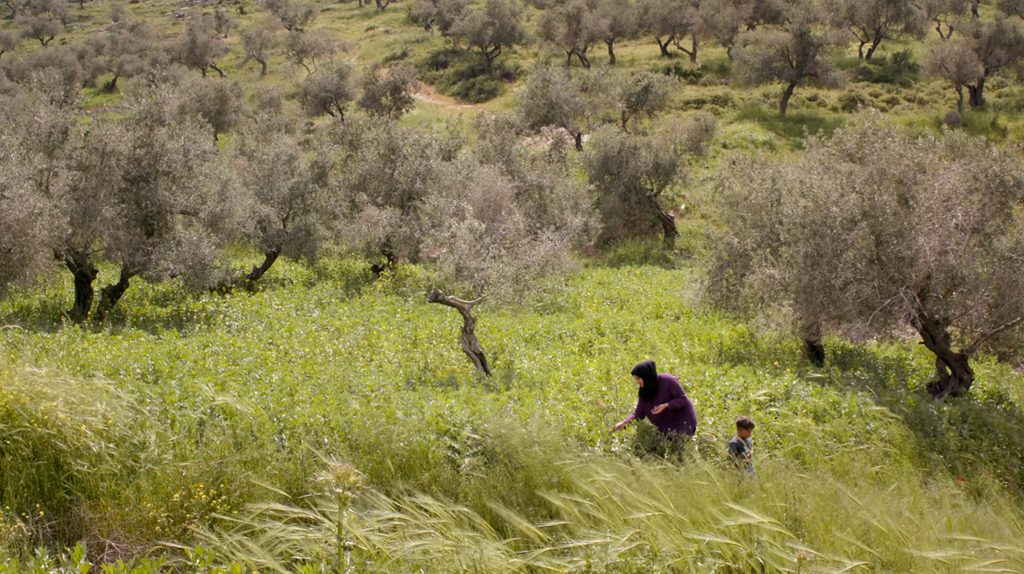
At the same time, to comply with the ROC, the Regenerative Organic Certification, we sought to strengthen the nitrogen fixation of the land by encouraging the planting between the olive trees of fava beans, lentils, peas, and clover. And we thought we’d kill two birds with one stone, as they say, by using these land race legumes as nitrogen-fixating cover crops but also propagating them and making them available to generate extra income in the farming communities. We are doing what we did with the wheat: we distribute about three to four tons of these different seeds every planting season in the winter to the farmers, and we ask to get reimbursed once the crops are in, but once again, after a while they have their own seed supply. Also, these crops help feed their animals, because most farmers have sheep or goats as well.
JP: This must also really help the nutritional content of the diet of the communities. Right?
NASSER: Absolutely. Absolutely, because these crops increase the quantity of plant-based proteins in the diet but they also increase the amount of animal-based protein, because they are producing more animal feed on their farms. It really helps build the farmers’ resilience, and it also diversifies their income streams.
JP: Another thing I’d like to dive into a little bit more is what makes the types of olives that you’re growing unique compared to olive crops in other parts of the world, and also what the cultural and spiritual significance of olive trees in Palestinian culture is. A lot of the recent settler and army violence seems specifically focused on the olive tree harvest. Part of it is that they just want the land, but is there a sort of an attack on the culture itself, on the essence of the culture?
NASSER: I think that at the beginning they just wanted the land. It’s definitely a land grab, but the way it is being laid out this year, in particular, it’s become an attack on the culture. They started understanding the significance of the olive grove to Palestine and to Palestinians, the significance of the olive tree to our cultural identity and cultural heritage, and they’re mounting an assault on it. And it’s not just the settlers. I would say it’s the state, because a lot of this involves planning at the government level. Settlers go into the countryside after the way has been cleared for them by the state, and they are protected by the army.
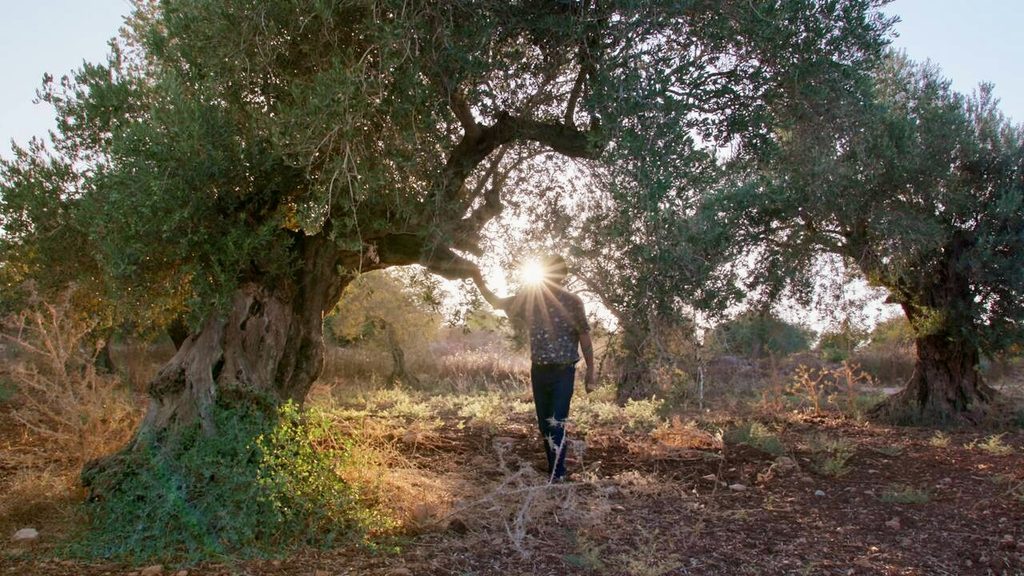
But the beauty of this story is this cultural heritage in Palestine. It’s the Mediterranean. This is the indigenous home of the olive tree, so we have a wide range of wild olive trees. We have two cultivars that comprise about 95 percent of our olive trees in Palestine. One is called Souri and one is called Nabali. We graft these olive tree cultivars on the wild root stock. We start with a wild olive pit to start the tree, and then the next year we graft it with one of these two varieties because they are such amazing, resilient varieties. Some of these olive trees are between 1,000 to 5,000 years old, there on the hillsides still producing fruit, so if you have an olive tree that lives thousands of years, obviously we don’t want to change it.
I want to talk a little bit about the ecology. These trees are planted on the hillside, in shallow soil in between limestone, and the olive root system is horizontal. The limestone provides for moisture retention. It holds moisture, and the olive tree’s roots penetrate between the cracks. The limestone is not like granite; it has cracks and it’s easier to penetrate, so the olive tree’s roots make their way through the somewhat porous limestone and find water. This allows them to be drought resistant in the hot summertime.
Also, the hilly terrain forces the farming to be extensive rather than intensive, so on an acre, you have about 50 trees rather than 150 or 200 trees. That allows for air flow, for biodiversity, for other vegetation to thrive, for ample sunlight, and for wildlife as well. All of this helps nurture an environment that is conducive to good trees.
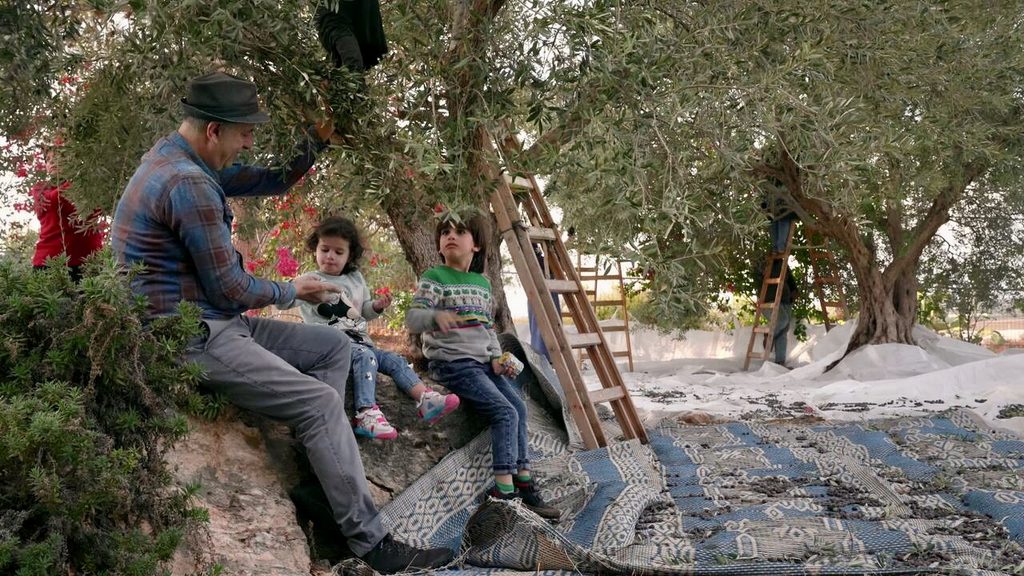
Plus, there is a spiritual and cultural side. People have a relationship with the olive trees. They are often seen as part of the family, part of the ancient family, the extended family across time. It’s a homestead that comes from past generations and is meant to be passed down to future generations. We have a saying: “Past generations have planted, so we are eating; and we plant so the future generations will eat.” These varieties take about 15 years to mature, so when we plant, we’re planting for the next generation. We are cultivating what the past generation left for us and benefiting from it, but we must reciprocate by planting more for our descendants.
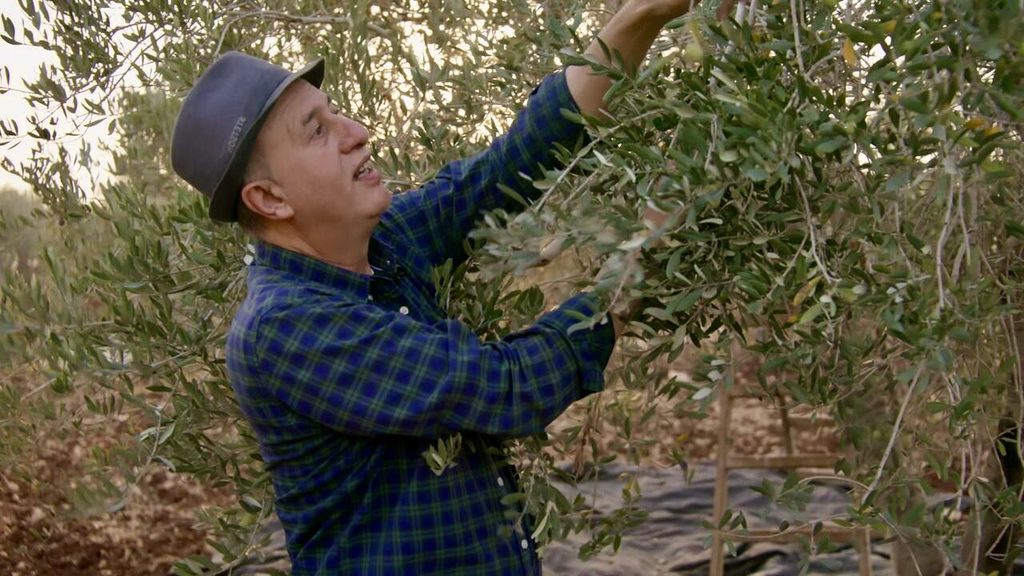
It’s the community that does the harvest, and the olive trees are literally considered part of the family. Just like my mom used to sing to the goat when she milked her, and my grandma used to sing to the cow when she was making milk, I see women singing to the olive trees as they are milking them, because the way they cultivate, it’s like milking.
JP: That’s beautiful.
NASSER: Yeah. The olive tree is seen as a mother, just like any other mother.
JP: Let’s talk a little bit about the film about your work, Land of Canaan, a very deeply moving, beautiful film that came out recently, and that won a number of awards, including the Audience Choice and the Seeds of Hope awards during Climate Week here in New York in September. It’s fantastic that you’re getting that exposure, but have you noticed any specific results of the film in terms of increased sales for your olive oil, or increased interest? How has the film itself, so far, impacted your life and your work?
NASSER: Well, I’m sure there is. I mean, we have an increase in sales in general this time of the year, but I’m sure the film is contributing to it. The film is still in the festival run, and that reception has been amazing. Everybody so far loves the film, loves the message, and loves the discovery of seeing Palestinian culture, because normally Palestinians are represented in a political context rather than seeing the living Palestine, and the film shows this living culture of Palestine that is both ancient and modern. The reception of the film has gone very well, both in the U.S. and in Europe. Everywhere we go, we get a lot of interest during the question-and-answer period after the film. It’s the first time many of them are seeing Palestine in this light and finding out about Palestinian agriculture and land stewardship. People are learning a lot from it.
JP: Yeah, it’s great. I certainly learned a lot from seeing the film, and we’re very happy we’re going to be showing it in Berkeley in December.
NASSER: Yes, I’m looking forward to it. I will be there.
JP: That’s great. Maybe a few last questions. Let’s return to the situation as it exists now. Two things: What is your vision of the future and where you’d like to see this project go? And you mentioned that about one-third of the land and the farmers you work with are being affected this year by this intensification of violence: Where do you see this all going?
NASSER: We’re hopeful some change will happen after the elections, I mean, that at least this government doesn’t continue, so it can’t continue with this level of a harassment campaign, but we’re cultivating. I don’t think settlers can actually cultivate the olives. They’re just terrorizing the farmers to try to stop them from cultivating the olives, but olives are going to be there, and we’ll cultivate them. Farmers watch where the army is and where the settlers are, and they go back from a different road and cultivate. It’s not like we’re going to give up on our olives.
We are losing some olive trees destroyed by the army. Those are uprooted and will no longer be there, but we’re also planting more olives at the same time. But, as I told you, it takes 15 years to bring a tree to maturation, so I’d say it’s a battle. I’m not denying it’s a battle, and what’s hurting is that the harvest time is supposed to be a spiritual and joyous time, and all this is taking some of the joy out of our community and adding some fear, so this year it’s a mix of fear and joy when they cultivate.
The other day, last Saturday, my own brother was given only a day to cultivate his olives, so he and his family had to rush to cultivate just the olives closest to the road, but the army came in the evening and tried to take the olives away from him. He was smart enough to have hidden all the sacks, and he was so happy and joyful that he was able to get 16 tins of about 16 kilos each that day.
The anticipation of the olive harvest is a year-long wait. People enjoy the aroma, the fresh taste of the olives, and the whole harvest process, but this harvest has been very hard and a lot of our olive harvest has been stopped or stolen or destroyed, or farmers have to harvest before the olives are fully mature, and that lowers the yield and the quality.
But the whole West Bank is one olive orchard, really. We have close to nine or ten million olive trees, probably. And in our project alone, we have planted about 600,000 trees over the years. Every year, we plant another 60 to 70,000 olive trees with the farmers. This is our culture. It’s an Indigenous culture that’s not going to disappear. We’re going to continue to do it because we love to do it. We love our olives, and we find it directly relates to our conception of what Palestine is. What makes Palestine special to us is this land and what it has to offer us, and how we enjoy it in our cuisine and in our relationship to it, so as long as the olives are there, we are there, and as long as we are here, the olives are here too.
JP: That is a fantastic way to end this, I think. Congratulations on this really amazing project, and the film is really beautiful. I can also say, having purchased the olive oil after having seen the film, that it’s the best olive oil that I’ve ever tasted, so I stocked up. We deeply admire your resilience and fortitude, Nasser, and we fervently hope for an end to the oppression and violence being perpetrated on Palestine.
NASSER: We hope for more support from international communities. We want this film to help us build partners for our farmers across the world from like-minded people, like-hearted people, people who care about the environment, care about social and economic justice. I think they will find beautiful partnerships and friends in Palestine.
JP: Thanks so much, Nasser. Thank you.
NASSER: Thank you, Sir. Goodnight.