Saving Democracy Means Ending Extreme Inequality
Labor organizer Saru Jayaraman makes a clarion call to action: support workers across the United States who are saying there’s always been an affordability crisis and are asking politicians what has democracy done for me lately? Addressing inequality worse than the infamous Gilded Age requires ensuring living wages for all.
Featuring

Saru Jayaraman (JD, Yale, MPP Harvard), an academic at UC Berkeley and a renowned labor activist, is President of One Fair Wage, which organizes to raise wages and end sub-minimum wages nationwide. She is author of: Behind the Kitchen Door; Forked: A New Standard for American Dining; and One Fair Wage: Ending Subminimum Pay in America.
Credits
- Executive Producer: Kenny Ausubel
- Written by: Kenny Ausubel
- Senior Producer and Station Relations: Stephanie Welch
- Associate Producer and Program Engineer: Emily Harris
- Host and Consulting Producer: Neil Harvey
Resources
Take This Job and Shove It: The Great Resignation or The Great Revolt? | Bioneers Podcast
Saru Jayaraman – What has Democracy Done For Me Lately? Engaging Working People in the Fight to Save Democracy | Bioneers 2026 Keynote
Saru Jayaraman – The Great Revolution: What A Worker Power Moment Can Mean for Climate Justice | Bioneers 2023 Keynote
A Dime a Day: The Impact of the Miller/Harking Minimum Wage Proposal on the Price of Food
‘Give Me a Chance to Survive’: Workers, Employers Dread Deportations’ Effect on Health Care | Labor Notes
This is an episode of the Bioneers: Revolution from the Heart of Nature series. Visit the radio and podcast homepage to find out how to hear the program on your local station and how to subscribe to the podcast.
Subscribe to the Bioneers: Revolution from The Heart of Nature podcast







Transcript
Neil Harvey (Host): In his book Goliath’s Curse, researcher Luke Kemp at Cambridge University looks at the rise and collapse of over 400 societies over the past 5,000 years. At the center of every collapse is extreme inequality caused by wealth extraction by the one percent. As inequality spikes, these increasingly hollowed-out societies become acutely vulnerable to shocks, collapses and rebellions.
Fast-forward to Peak Inequality in the U.S. in 2026. The Goliath wealth pump has been cranking at warp speed to extract the biggest wealth transfer in history from bottom to top. They want to have their cake and eat yours too.
The world’s 12 richest billionaires have more wealth than the poorest half of humanity. The top one percent control $58 trillion in assets, more than the combined GDPs of the U.S. and China. That’s more than enough to eliminate global poverty 22 times over.
About three to five giant corporations dominate around 80% of almost every industry and marketplace. About 60% of rising costs since the pandemic can be attributed to corporate “greedflation.” “All that the market will bear,” as the Robber Barons fondly put it.
While basic living costs balloon, savage policies are shredding the social safety net and workers’ rights, hurling people into economic free fall. Labor’s share of income is the lowest since the Great Depression.
But when the mass immiseration becomes this extreme, people fight back against Goliath.
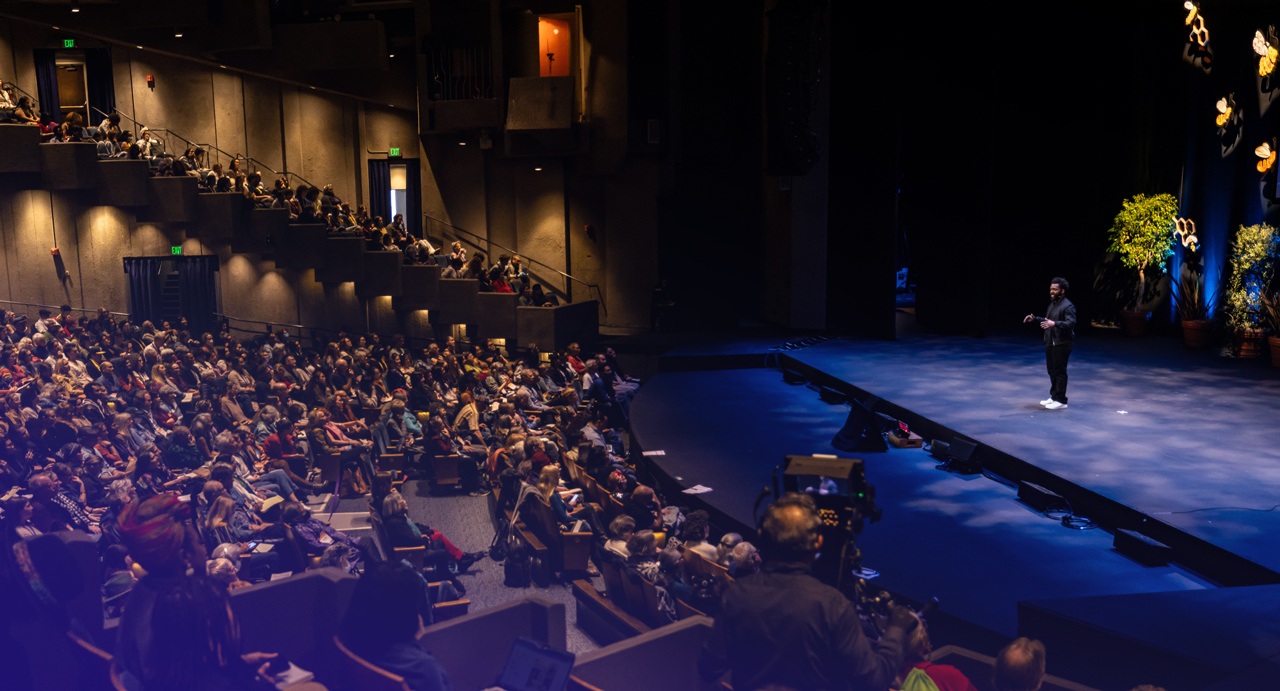
This is the terrain where labor organizer Saru Jayaraman takes her stand. As founder and president of One Fair Wage, a national organization of over 300,000 restaurant and service workers, 1000 restaurant owners, and organizations, she leads campaigns to raise wages and end all subminimum wages nationwide. She spoke at a Bioneers conference.
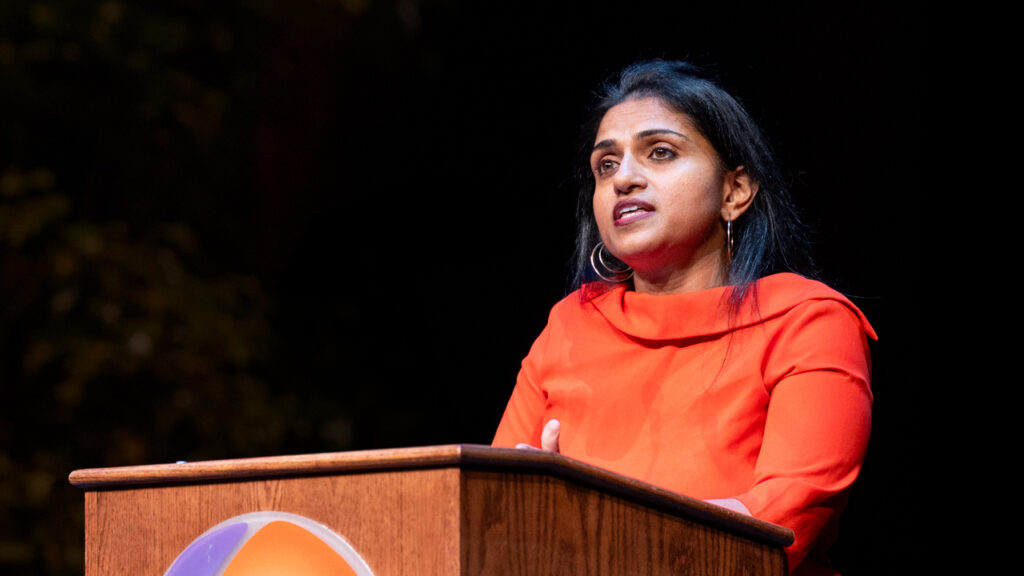
Saru Jayaraman (SJ): I have been organizing for 25 years and represent an industry, the restaurant industry, which is 13.6 million people in the United States who work in the lowest wage jobs in the United States. The largest employer of women and people of color, and youth and immigrants, and pretty much all of us, gets to pay $2.13 an hour in 2026.
When half of America cannot afford to feed themselves, their families to survive, they also cannot engage politically, and as long as they are paid the wages they are paid, as long as they’re working three jobs instead of one, and as long as they do not see any reason to vote because the people in power, the people who run all represent the antithesis of everything they need and stand for. [APPLAUSE]
So I’ve been sharing this and facing a lot of push-back. In 2024, when we were trying to raise money to put wage increases on the ballot in key states like Arizona and Michigan, donors told me that’s cute, you’re trying to raise wages. We’re trying to save democracy. And I had a really hard time trying to explain to people that raising wages is saving democracy. [APPLAUSE] It is the same thing, because there is no world in which democracy can function with these incredibly high levels of inequality. And I’m sad to say we haven’t heeded the warnings that working people have been trying to tell us for so long. We’re in a moment when working people either stayed home or went the other way because we didn’t listen; we didn’t pay attention; we did not say your lives matter.
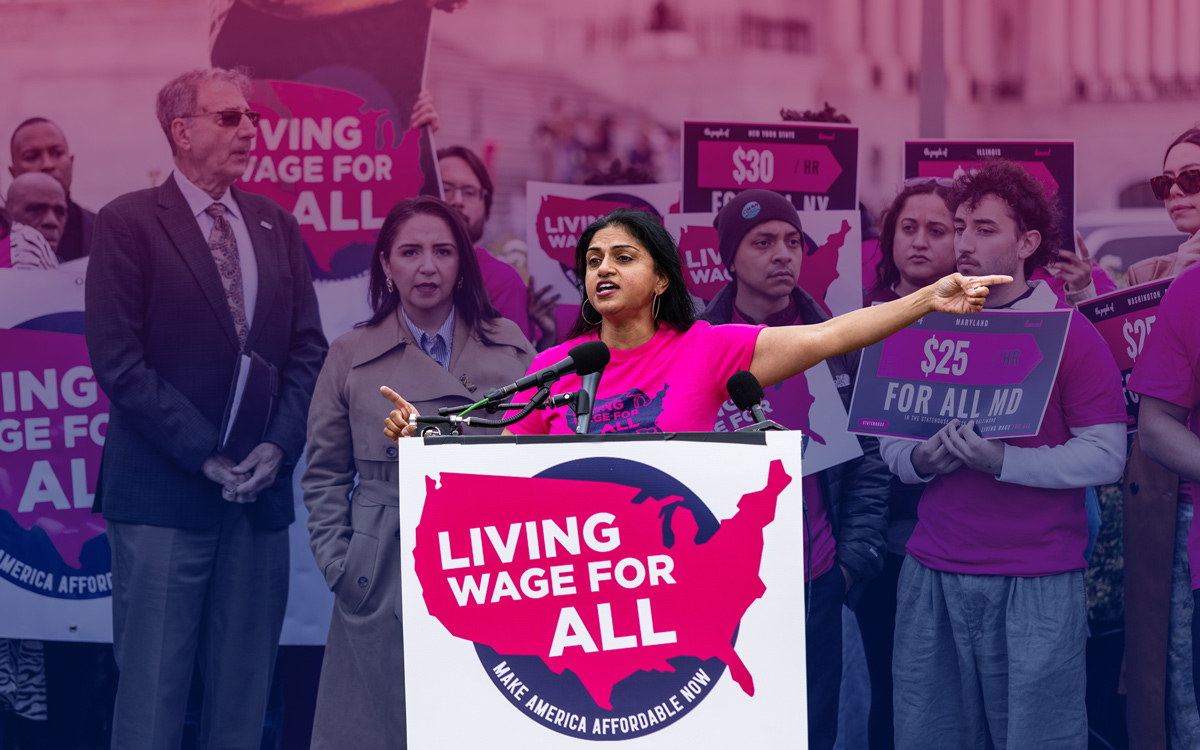
Host: Saru and her organization are traveling around the country, organizing meetings and rallies with the Living Wage for All Coalition. In every state, workers are joining and telling their stories…
Johannah: My name is Johannah Alabi. I am a CN certified nursing assistant from Connecticut. I dedicate 15 years to this work caring for those who cannot care for themselves. But today I stand before you not just as a CNA, but someone who is struggling… I have 2 fulltime jobs over 80 hours a week just to make ends meet. I do not have a day off. I make under $25 an hour at both jobs even with my experience. I work endlessly to provide for my kids, but we just make it. My wages cover food and roof over our head. But there’s nothing left over for savings or for emergency. Caregivers are working 60, 70, 80, even 100 hours a week to make ends meet. This is not sustainable. This is not respect. That is not care. It’s time for $25 an hour minimum wage for all. Thank you so much! [CHANTING]
Silvy: My name is Silvy, I’m from Bridgeport Connecticut. I’ve been bartending since 2018. I work hard, I work long hours, sometimes up to 13 hours a day. My base pay is $8 an hour, which is $8 less than the Connecticut state minimum wage. It hasn’t changed since the cost of living has skyrocketed. Service workers are often grouped under unskilled labor and we are told that our work isn’t valued much. And when profit is the dominant interest at large, it will only be service workers who are paid less than they’re worth. I ask that we are paid the full minimum wage plus tips. We are human beings who deserve to be paid a living wage! No less than $25 an hour. Thank you!
Host: There’s not a single state, city or county where a full-time worker making the minimum wage can afford a modest two-bedroom rental. Roughly half of Americans can’t afford a thousand-dollar emergency. Poverty is now the fourth leading cause of death.
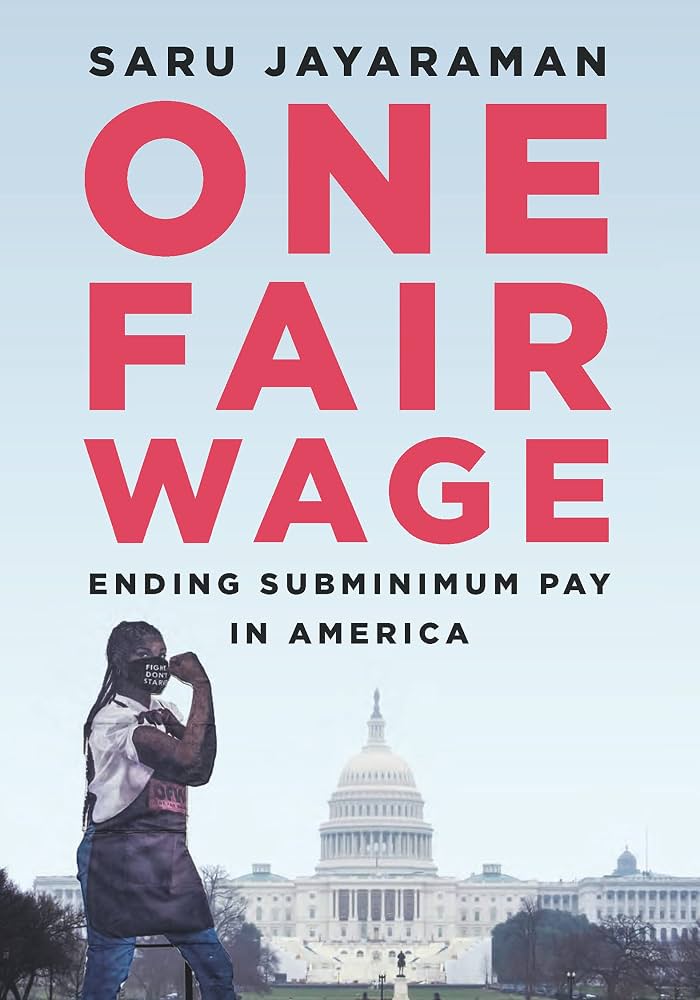
As director of the Food Labor Research Center at UC Berkeley, Saru witnesses the real-world human costs of these chilling statistics every day. She’s authored several books, including One Fair Wage: Ending Subminimum Pay in America. She’s working with over 100 labor and community organizations on a Living Wage for All campaign to address the twin affordability and democracy crises.
She knows that the affordability crisis is actually a billionaire crisis, which in turn is a democracy crisis. The most unequal countries are seven times more likely to experience democratic backsliding or autocracy.
Raising wages is not a left-right issue – it’s a top and bottom issue. Meanwhile, she says, both major political parties play a cynical game of political football that sidesteps tackling the imperative for a living wage.
SJ: We were struck by a series of USA Today articles that came out documenting a rumor video that the right had been circulating among MAGA voters saying that Donald Trump had already raised the federal minimum wage to $25 an hour. The videos were so popular and gained so much attention among right-wing voters.
Now, we all know it’s a lie, and they lie all day. No big deal. That’s not the news here. The news here is that they didn’t say Donald Trump raised the wage to 15 or 17 or 20. They said he raised it to $25 an hour, which is the least you need to live anywhere in the United States of America right now. The MIT Living Wage calculator says the cheapest county in the U.S. is McLennan County, Texas, and you need $25 to survive. So they picked the very number that affects all of us, including MAGA voters.
When I saw these articles, I said we have a five-alarm fire. The right is talking about 25 and agitating their base about 25, and the left is stuck on 17, some places 15. And I gotta tell you, this is why people hate us. People hate us because they see us negotiating against ourselves before we even get to the room. [APPLAUSE] They see us arguing for half a loaf.
Even as I’ve started talking, I’m sure there are people in the room who, some part of their brain is saying, “What about small business?” “What about will the economy survive?” “Can we manage 25?” And I’m not blaming you. That is what you have been fed your entire lives. But we negotiate against ourselves before we even tell working people we are fighting for you; we are fighting for the full loaf, not half a loaf. We know what it takes, and it’s no less than 25. So it is time for a living wage for all, a floor of 25. Let higher cost regions go to 30 and higher.
So we polled across red, blue and purple districts – overwhelmingly popular. And I gotta tell you, people are so angry right now. If you tell them we can’t raise the wage, prices will go up, they say, “What are you talking about? Prices have already gone up!” The only price that hasn’t gone up is the price of human beings.
We have to give people some sense of hope that a different future is on the horizon, one in which they can survive, and, yes, maybe thrive.
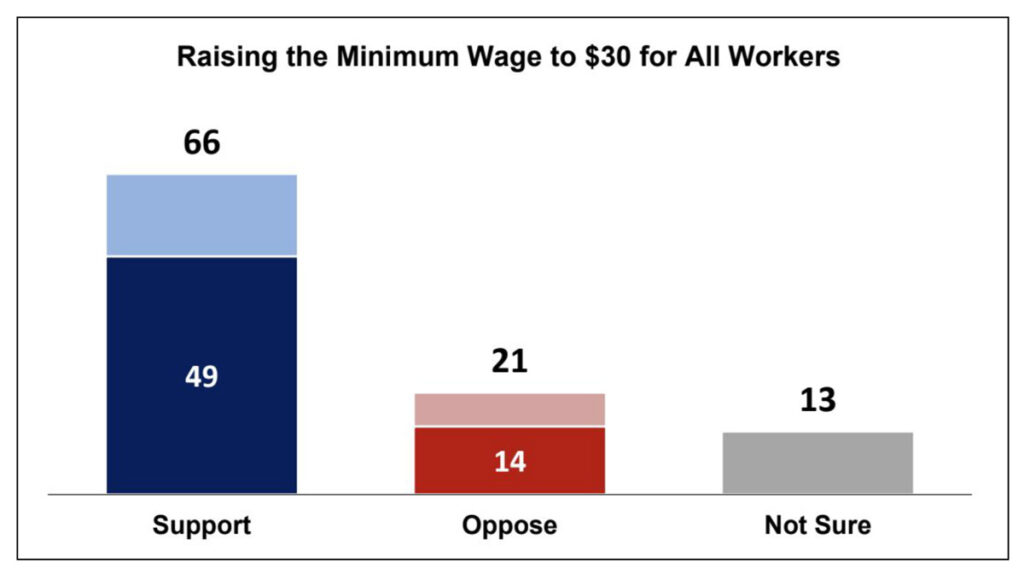
Host: Taxpayers are subsidizing wages because companies refuse to pay a living wage or provide enough hours. Saru Jayaraman says that while it’s clear a living wage is essential for people to survive and thrive, the general focus of politicians has been only on reducing costs and inflation.
SJ: There’s so much talk about affordability, but most of it is “bring costs down”, “freeze the rent”, “affordable childcare”, “affordable healthcare”. Nobody is saying those things aren’t essential, critical, important and there is no world in which we achieve affordability by simply bringing costs down.
Look at inflation over the last 75 years. It has never come down. It has never gone backwards. Do you know that now half of Americans earn less than $25 an hour? Half of America earns less than what it costs to live in the cheapest place in the United States of America. So half of America thinks maybe things are okay, and half of America has been in a five-alarm fire for a very long time.
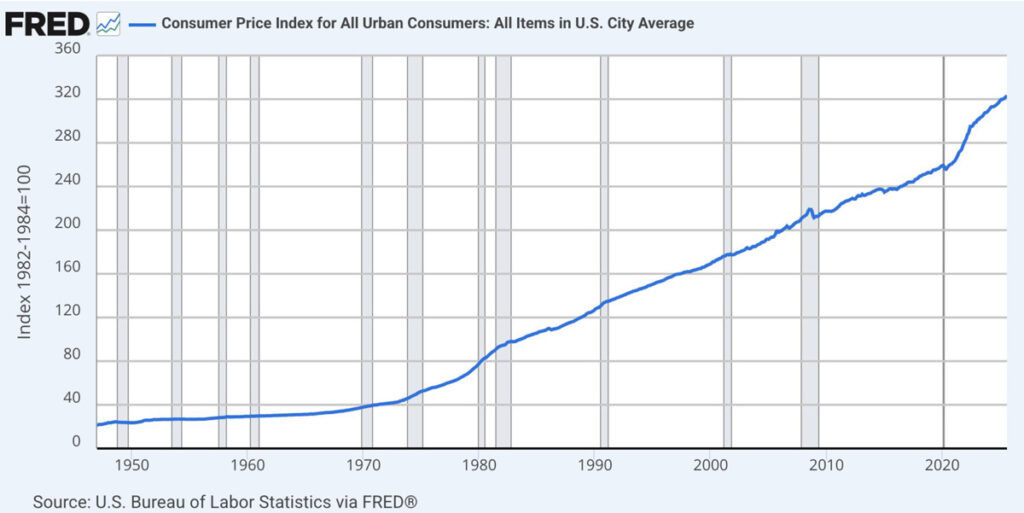
And if you look at the last six years in particular since the pandemic, it is double or triple the level of inflation of the last 75 years. So this is not the stagflation of the ‘70s. This is not anything we have ever experienced as a country. This is unprecedented. Unprecedented affordability crisis means an unprecedented democracy crisis, means unprecedented crisis, period.
I have heard from so many older people: I am so sad to say that the young people in my life will never leave the house. Because they can never afford to! And that’s a funny thing and a heartbreaking thing because the California budget office just reported recently that a new trend we’re seeing among minimum wage workers is that young people are deciding never to have children because they can’t afford to; they can’t imagine a life where they could actually afford their own place and have their own children. How heartbreaking is it that we are denying the next generation the ability to have kids?
Host: Saru says that ensuring a living wage for everyone is a popular policy, but big business often discourages that support by repeating the false claim that raising wages will hurt small businesses.
SJ: It’s, you know, fair game and exciting and popular for everybody to say billionaires, trillionaires. I think there’s still this reverence for small business over people that is used by the billionaires and the trillionaires and the corporations to get even the most progressive people on our side to shy away from raising wages.
And so, let us push our representatives, even our best friends, to say this cannot be a one-sided conversation. It has to be about prices and paychecks. It has to be about, yes, bringing costs down or freezing them, but life will never be affordable unless people have enough money in their pockets.
Host: We’ll hear more from Saru Jayaraman when we return.
I’m Neil Harvey. You’re listening to the Bioneers: Revolution from the Heart of Nature.

Host: Extreme concentration of wealth leads to extreme concentration of power. In 2024, just a hundred billionaire families poured two billion dollars into U.S. federal elections. That’s about a 160-fold increase since the Supreme Court passed Citizens United in 2010, allowing unlimited dark money to be poured into elections. A billionaire is 4,000 times more likely to run for office than a regular citizen. Few policies pass that they don’t want.
The National Restaurant Association – the extremely powerful corporate lobby that’s often referred to as “the other NRA” – continues to wage class war on restaurant workers by swaying state and federal policy. It came about in 1919 with the express intent of being able to hire newly freed Black women after Emancipation, not pay them, and have them live only on tips. That is the origin story of the miniscule $2.13 an hour wage for restaurant workers today.
SJ: Since 1938, when FDR first – created the first federal minimum wage in the United States, you have to know that the opposition has used the exact same arguments over and over again for a century – “prices will go up, jobs will be lost, people will lose hours, small businesses will close, and the economy will tank”. Right? Whole industries will collapse. Same thing over and over and over and over again.
Your restaurant didn’t need to raise prices, they just did. And, you know, the National Restaurant Association’s own data shows there’s a natural closure of about 20 percent of all restaurants every year, but when the wages go up, they’ll pull those restaurants in particular and say, look, they closed because of this.
Prices have not actually gone up that dramatically each time we’ve raised the wage. In fact, I did a study with another professor here at UC Davis, and the title of the study was—at the time, this was way back when we were doing Fight for 15 and all the same arguments came up, prices are going to go up, jobs will be lost, blah, blah, blah, and we—the title of this study was A Dime a Day, because we studied—if you gave every worker in the food system, from farm workers up to restaurant workers $15 an hour, how much more would it cost the average consumer, and the answer was a dime a day. It’s not a dollar to dollar increase, y’all.
Our calculation is it’s about, at most, at 10 percent over many years. None of the wage increases, none of the bills we’re moving raise the wage overnight. We can afford that, especially we can afford that if we’re earning enough to consume.
Host: Saru says it’s well documented that countless initiatives across the country to create living wage policies have been stymied by the same tactics of disinformation, intimidation, and fear that the National Restaurant Association has deployed for decades. Even minor wage increases in Blue states have often been rolled back – by both political parties.
SJ: We’ll have hearings in blue states, very Trifecta blue states – Colorado, Maryland, New York – and the restaurant association will require all workers to attend a pre-shift meeting, and tell them, listen, the legislators are trying to take your tips away. Right? When the law is: Let’s raise the wage to a full minimum wage with tips on top. “The legislators are trying to take your tips away, so we’re going to shut down the restaurant, pay you all $15 an hour”, which, by the way, they could never afford to pay normally, because they normally pay $3 in the very blue state of Maryland. $2 in the very blue state of New Mexico. You know? Most of the country, it’s 2, and 3, and 4. And they’re like, you know, this law is about taking your tips away, so we’re going to shut down the restaurant, pay all of you. Come, come—you know, and then it’s 75 or 100 workers getting up one by one: “Please don’t take my tips away.”
And we do everything in our power to get workers to come to say, “No, I need a raise!”, which the overwhelming majority, of course, of workers want. But those workers are working three jobs and terrified of showing up with their name and their face, and their employers see it. So democracy doesn’t work when the majority of people are unable or terrified to come speak up. And then a minority of people are paid to come speak for their bosses. Right?
And the Democrats, I don’t believe they’re this dumb. Maybe they’re this dumb. But their response is, oh, we can’t do this because workers don’t want it. And I really believe it’s a good excuse, or maybe they are that dumb to be taken in by what we call an AstroTurf campaign, right, Fake grassroots campaign.
But that’s been my experience of democracy, is Democrats blocking wage increases because of the restaurant association, rolling back—Do you know in 2025, as the affordability crisis became the thing that everybody understood, it was Democrats, who for the first time in United States history, rolled back workers’ wages, cut them in half in Michigan, in Colorado, in DC, in Chicago. I could say state after state. Republicans would never touch this with a ten-foot pole, because turning back workers’ wages they would always consider to be political suicide. Democrats thought it was okay because we have not created the consequences for those Democrats.
Do you know what the Republican stand on minimum wage is? It’s not leave it where it is. I mean, I’ve debated them on The New York Times podcast. Their stance is there should not be a minimum wage. The free market should take care of wages. They never negotiate—Do you think they sit in a room with policy wonks and say, “What’s acceptable? What’s feasible? What’s palatable?” before they come out and say there shouldn’t be a minimum wage? No. They don’t care. They will say exactly what they need and want.
So this has been my experience of democracy. What would it look like in a real democracy? In a real democracy, workers would be able to have one job instead of three. They could show up en masse and say, oh, take your hands off our wages. If we can make it a big deal in the policy arena, then we see workers who’ve been afraid start to talk about it with one another. If you are alone in a workplace and you’re like, we deserve $30, and nobody else is talking about $30, it becomes really, really hard. But if it’s on the television and everybody’s talking about it, suddenly it becomes something we can talk about. “You know? Let’s talk about it. Do you think we’re worth $30, first of all? Hell yeah, we’re worth $30.” They could overpower any lies or AstroTurf campaign, and they would be listened to. That’s what democracy would look like; that’s why it would be important.
Host: More and more people are seeing the reason they’re sicker, poorer, and chronically insecure is the giant sucking sound of the Goliath wealth pump.
It doesn’t have to be this way. Congress could make policy changes, like an embarrassingly modest wealth tax on millionaires and billionaires, which would raise an annual estimated $414 billion for social programs and fighting poverty. Remember, from WWII until 1980, the top marginal tax rate in the U.S. was 81%.
But the most effective, lasting change comes from the grassroots. Saru Jayaraman calls for a bold, proactive vision that unites working people across the country and that addresses their key concern: the cost of living.
SJ: I know there’s a lot to be unhappy about, I know there’s a lot to cry about, there’s a lot to be angry about, there’s a lot to defend. Yet if all we do is defense, we will lose.
But I have to tell you in terms of democracy, I have been hearing so often from our members across the country, if I ask them, ‘Come to Saturday’s rally, No Kings; help us save democracy,’ they’ll say, “Save democracy? I earn $3. I work three jobs. What has democracy done for me lately?”
And I have asked workers: What would you do? What would you do if you actually had the capacity to engage in the democratic process? If you had one job instead of three, if you could engage politically, what would you work on? Do you know what they tell me time and time again? They say the climate crisis.
Working people live in the communities that are most impacted by environmental crisis. So of course they care, but they do not have the capacity, again, nor do they see people in power doing or speaking to anything that represents them or resonates with them, or frankly addresses the top need they have, which is the cost of living.
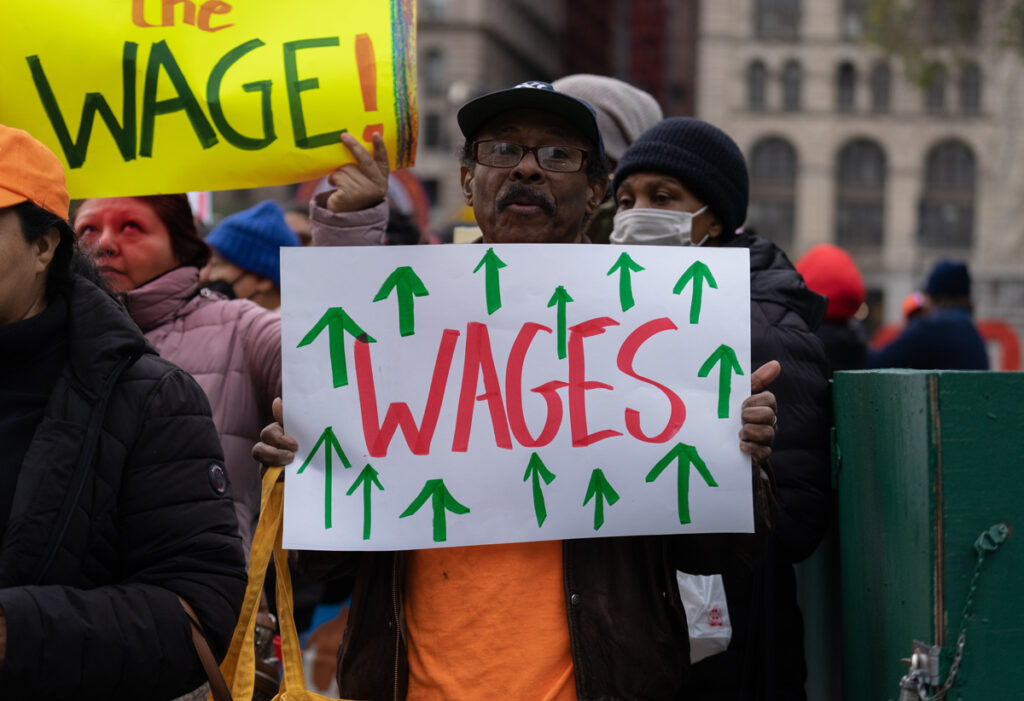
As sad as this moment is, there’s a moment of opportunity where the pendulum could swing in the exact opposite direction. And yes, they would have time to engage on the issue they said they would engage on if they had capacity, which is the climate crisis.
What’s so hopeful to me is that when I travel the country, I’m in Michigan, Pennsylvania, or even the South, every red, blue, and purple district, the one thing I find working people across the political spectrum can agree on is if you work, you deserve to earn enough to feed your family, to have a roof over your head, maybe even to take a vacation. What a concept.
But I really want to ask you to join me in stopping this notion of “saving democracy”. It’s not working. It didn’t work in 2024. The messages we were told – “you’re wrong, the economy is working; you’re wrong, there’s so much that we’ve done, we’re just not messaging it right.” No! No! You know what the best message is for working people? Delivering. Delivering on the things that allow them to survive and thrive and live.
So that is why I feel such deep urgency to work with you to deliver, to deliver on wage increases that will put more money in peoples’ pockets, that will give people a sense of hope. And, yes, together, building a different future in which all of us can thrive. Thank you. [APPLAUSE]
Host: Saru Jayaraman, “Saving Democracy Means Ending Extreme Inequality.”