Restoring Nature’s Infrastructure for the Climate Emergency
Brett KenCairn, Founding Director of the Center for Regenerative Solutions says a radical redirection of climate solutions is imperative if we have any chance of solving the climate emergency. The key is to look to nature’s own solutions to restore natural systems to their formidable capacity for self-healing.
This is an episode of Nature’s Genius, a Bioneers podcast series exploring how the sentient symphony of life holds the solutions we need to balance human civilization with living systems. Visit the series page to learn more.
Featuring
Brett KenCairn, founding Director of the Center for Regenerative Solutions and Senior Division Manager for Nature-based Climate Solutions for the City of Boulder’s Climate Initiatives Department, has throughout his career supported community-based initiatives across the western U.S., particularly in rural, Native American, and other marginalized communities.
Credits
- Executive Producer: Kenny Ausubel
- Written by: Kenny Ausubel
- Senior Producer and Station Relations: Stephanie Welch
- Associate Producer and Program Engineer: Emily Harris
- Host and Consulting Producer: Neil Harvey
- Graphic Design: Megan Howe
Resources
Brett KenCairn – Nature-based Climate Solutions—Centering Life to Heal the Planet | Bioneers 2026 Keynote
Subscribe to the Bioneers: Revolution from The Heart of Nature podcast







Transcript
Neil Harvey (Host): In the 1970s, the renowned scientists James Lovelock and Lynn Margulis proposed the Gaia Hypothesis. Their then radical theory suggested that just as our bodies know how to regulate themselves it’s actually the entire jazz symphony of all living things that self-regulates Earth’s conditions. This kind of super-organism makes the physical environment hospitable to life in an exquisitely dynamic balance.
Lynn Margulis presented the Gaia Hypothesis to NASA employees back in 1984.
Neil Harvey (Host): In the 1970s, the renowned scientists James Lovelock and Lynn Margulis proposed the Gaia Hypothesis. Their then radical theory suggested that just as our bodies know how to regulate themselves it’s actually the entire jazz symphony of all living things that self-regulates Earth’s conditions. This kind of super-organism makes the physical environment hospitable to life in an exquisitely dynamic balance.
Lynn Margulis (Archive): I want to give you a sense of a massive revolution in our thinking that has come across during the last about 20 years. In the early 60s scientists were asked to develop a life detection apparatus that is how can you tell the planet has life on it.
And what I want to tell you is the thinking, much of it directed by a colleague of mine named James Lovelock, and the Gaia hypothesis states that the troposphere, the lower atmosphere of the Earth, is very different from what it would be if it were at chemical equilibrium. Gas composition of the lower atmosphere, the temperature, the oxidation state, that these aspects of lower atmosphere are modified by the presence of living organisms in such a way as to regulate the atmosphere to keep these aspects within a range suitable for life on the surface. It says therefore that the lower atmosphere is not a passive environment but it’s an actively modulated environment for life on the surface. And given this hypothesis, it says that the Earth as a planet is profoundly different from our sister planets – that is Mars on one hand, and Venus on the other – and the differences have to be understood as a product of life.
Host: As Margulis summed it up, “Earth is a symbiotic planet.” Think of it as a vast hospitality enterprise – or in the eternal words of Janine Benyus, “What life does is to create conditions conducive to life.”
In the ensuing decades, scientific data have steadily validated the Gaia theory, and put the climate crisis in a very different light.
Brett KenCairn, Founding Director of the Center for Regenerative Solutions, says it’s the regeneration of these dynamically interdependent living systems that’s the golden key to solving the climate crisis. He proposes that it will simultaneously solve a vast array of other crises – from building a thriving, equitable restoration economy – to dramatically reducing the immigration crisis which is increasingly compounded by swelling numbers of desperate climate refugees.
So how do we get from here to there? Brett KenCairn spoke at a Bioneers conference…
Brett KenCairn (BK): Good morning. Buenos dias! Yá’át’ééh. It’s so good to see you. It’s so good to be with all of you. I want to start with a thanks to this place, this remarkable, beautiful place, and to all the keepers of this place who’ve been here for generations, making it so.
I come from Boulder, Colorado, a community that has a unique relationship to climate change. As some of you may know, we have eleven federal research labs in Boulder, Colorado, one of them that National Climate and Atmospheric Research Station was established in Boulder in 1967. And my community takes climate science really seriously, probably because we have 3,000 climate scientists, literally, that live in our community. There’s a sort of inside joke in Boulder that we have more climate scientists than we have therapists and personal trainers. So you’ve been to Boulder. [LAUGHTER] I guess you get my joke. Thank you. [LAUGHTER]
But no, we have been very serious about this for a long time. And, in fact, Boulder was one of the first communities in the world, when our federal government did not sign onto the first international agreements to reduce emissions, we said we will. And we committed to actually achieving climate emissions reductions as a community. And then we started agitating and working with other communities around the country, and we started building a movement around the world.
When I joined in 2013 to help write the next generation of our climate action plans, I was given the opportunity, the great honor, to work with teams all over the world – Helsinki and Stockholm, and Rio and Sydney, and New York and Seattle and Toronto. It was such an exuberant time.
But I need to tell you that many of those cities are quietly withdrawing from this work now, and that there is a sense of despair and hopelessness, actually, in many of us who’ve been doing this work, because we know that our strategy is failing. And, in fact, what I’ve come to understand is that it has been doomed to failure from the very beginning because it was based on a false premise and a half truth. That premise was that it was just about technology, it was just about machines, it was just about the sources of energy, and if we just changed those sources, if we built more wind farms and we put in more solar, and then we had new machines, new machines, and more electric vehicles, more heat pumps, that we’d solve this problem.
That was the half truth, because the other half of this truth is something that we have known for over 50 years. In fact, if you go back into the times when we were first starting to come together as a world community to talk about climate change in the ‘70s, the World Meteorological Organization meeting in 1979, the first papers that were coming out, they all noted that climate change had two legs. Yes, one of those legs was that we were increasingly emitting carbon emissions from fossil fuel – and nothing I’m saying today is intended to actually diminish the importance of that work – but those times that—we knew that there was a second leg, and that second leg was the degradation of the land, the desecration of living systems.
Because, as it turns out, the atmosphere is not a geochemical machine that’s run by CO2 in and CO2 out. It’s a life-mediated dynamic. Life created our atmosphere for us, for life. And the degradation of these living systems is what’s been driving the instability in that system. And we knew that.
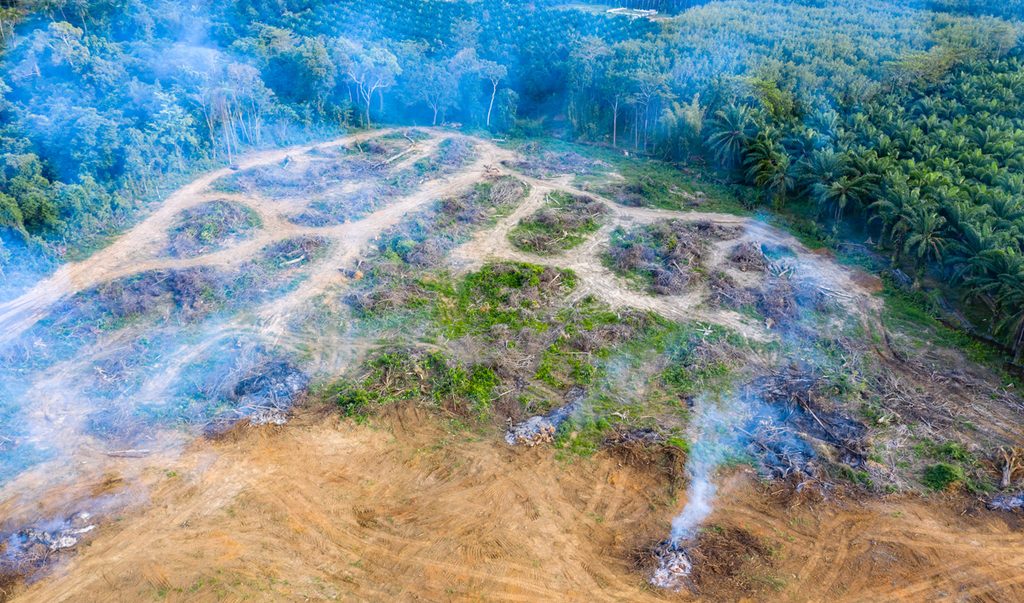
And in fact, when the world came together in the ‘90s for the Rio Earth Summit, we knew that there were three existential threats that we had to plan for. Yes, climate was one, and we created the convention on climate change – the IPCC that we’ve heard so much about. But there were two other conventions created in that Rio Earth Summit. Do you know what they were? Biodiversity. But can you tell me the third? [AUDIENCE RESPONDS] Yes. Yes. It was originally supposed to be called the convention on land degradation, but it wasn’t actually sexy enough, so they called it the convention on combating desertification.
And unfortunately, that led us to believe that, oh, well that’s only a problem in Africa. Right? I can show you places right outside of Boulder that are desertifying right now. Because we understood back then that it was also about land degradation.
But then we started to forget. And there are some reasons why we forgot and why we chose to just narrow this down to being about carbon, and those are important things to know about. It’s time for us to actually change our strategies, because there is no hope in the strategy that we’ve been using.
Host: Brett KenCairn suggests that the mischief started with a famous graph. One line tracked the rise in atmospheric CO2 that began to spike in the 1700s. The other line tracked the burning of fossil fuels with the advent of the Industrial Revolution. The two lines come together and match. It’s easy to read the picture as causation – the proverbial smoking gun – or in this case, the smoking stack.
A logical conclusion, he says, is that technology is the cause. Therefore the solution is to change the technology, which is appealing to technologists and financiers.
Here’s where the false premise and half-truth come into the picture. Mounting scientific data are revealing the paramount importance of the second leg of the climate stool: large-scale, long-term land degradation.
A 2017 study by Jonathan Sanderman and others looked at soil loss over the last 12,000 years. For about the first 10,000 years, there was very little soil loss. Then about the time of the first empires and the widespread adoption of large-scale agriculture, about 3 – 4000 BC, soil loss increased, and then spiked dramatically over the past 100 years. The study concludes that about a quarter to a third of all the excess carbon in the atmosphere has not come from burning fossil fuels, but from burning out soils. And that’s just the destruction caused by agriculture.

BK: So…by the way, it’s not just about the carbon, because, of course, what happens when you lose the soils? You lose the capacity of the living systems to hold water. And what have the elders been telling us for generations. It’s about the water.
And we’ve also forgotten that—you know that the most predominant greenhouse gas that’s causing global warming? It’s not CO2, actually, it’s water. And so as we have degraded the land, we’ve also released a huge amount of the water that was in the land into the atmosphere, and that compounds climate change too.
This was the Great Plains, one of the most incredible ecological systems on the planet, which in the course of just ten years, we plowed 30 million acres of it. And we know how that turned out. And I’ll come back to that.
But that wasn’t just in the United States. We were doing this all over the place. And while we thought it was just about industry and about burning fossil fuels, no, it was about all of this. It was about the degradation of the living world.
Climate change swallowed the rest of our environmental awareness. Right? Over the last 20 years, have we been talking about anything else? We should have been talking about this, because part of what we see now is it was about this land degradation process, and the scale of that is just immense. In fact, the UN estimates that something like 70 percent of the terrestrial world is actually degraded. Last year, a report came out that said about half of the biological capability of the planet has been compromised.
And when you look at this from a variety of different angles, what I think, to just sum it up, it’s like this: We’re living on a planet that’s operating at half of its basic photosynthetic capability. In the science terms, the net primary productivity. We don’t even know what it’s like to live on this planet when it was at its full potential, although we do have the stories. We’ve been told the stories.
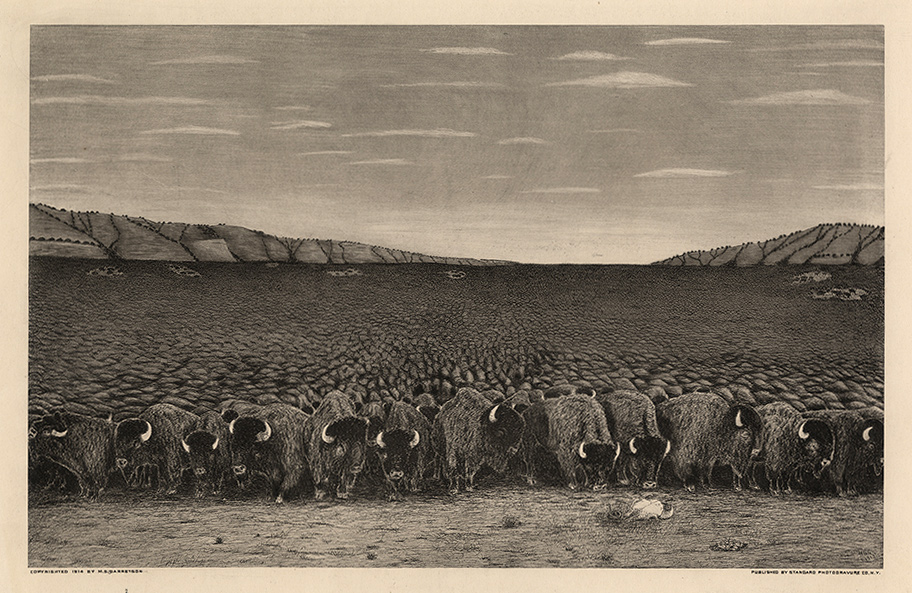
Remember the stories about the carrier pigeons, that when they would take flight, the sky would become dark? That the rivers were so full of salmon that you could walk across them. These are not metaphors. That you could stand on the Plains and you could look in any direction for miles and it was moving because of millions of buffalo. That’s what the planet looked like when it was operating at its full capability. And that’s what we have to bring back. That is the only legitimate hope that we have right now to solve the climate crisis. [APPLAUSE]
Host: When we return, Brett KenCairn illustrates some of the next steps it’s going to take to solve the climate emergency by restoring nature’s infrastructure – and ourselves with it.
I’m Neil Harvey. You’re listening to the Bioneers: Revolution from the Heart of Nature.
You can hear more about nature-based solutions, in other episodes of our Nature’s Genius Series. How the return of beavers can help restore Planet Water, or how urban forests can help address the parallel crises of climate change and wealth inequality. Visit bioneers.org/radio to subscribe to our podcast.
Brett KenCairn says restoring nature’s infrastructure is key to solving the climate crisis. But with 70% of the land so severely degraded today, it’s easy to despair.
BK: There were other times when it seemed hopeless. If you haven’t watched the documentaries of the Dust Bowl era, you need to do that. And you need to imagine what it must have been like to be on the Great Plains when we lived out the consequences of having plowed 30 million acres and turning it into one species of wheat, and then the dust storms started. And first it was just a few each year, and then it was like dozens. And they talk about how these walls of dust coming at you that were miles high, felt like hell descending on you. It must have felt hopeless then.
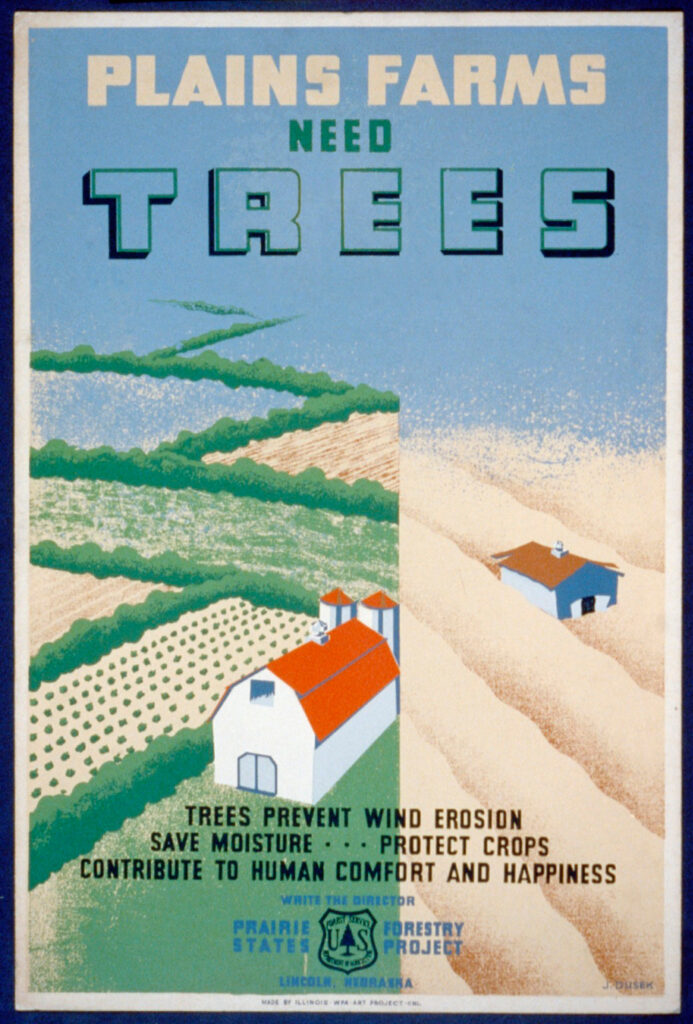
But we lived in a time then where we believed in ourselves, where we felt like we could do something about that, that we could go back and start to be with the land again. And we put millions of us back to work on the land. We were making a living putting the world back together, and guess what? We did. In the course of just a decade, we actually stopped the destruction. And within another decade, we started putting it back together. We have done this.
And just to say that the scale of work that we did together at that time, absolutely remarkable – planted billions and billions of plants, built hundreds of miles, thousands of miles of contours and Check dams. This is the simple but important work that now needs to be done again.
Host: Natural systems have the ability to regain and sustain the Goldilocks balance necessary for a livable planet – for both people and the diverse web of life that we’re shredding. And communities around the world are showing they’re fully capable of collectively rising to the occasion.
One stunning example was featured in the film “Hope in a Changing Climate”, directed by John Liu. In 1995, Liu began documenting the stories of the land and people in the birthplace of Chinese civilization–the Loess Plateau. Originally the Loess Plateau was flat, but thousands of years of erosion exacerbated by agricultural exploitation carved deep gullies and canyons that were stripped of vegetation, causing dust storms to blow clear around the world.
For over a decade, Liu focused his camera on China’s innovative attempt to reverse this degradation and restore the birthplace of their culture.
John Liu: So they had to make physical interventions in order to change the kinetic energy of the water as it flowed away. What they did was they blocked the flow of the runoff so that more water would infiltrate. That rapidly became a biophysical intervention. So, you see a tremendous transition, what was essentially a completely devegetated and totally dysfunctional ecosystem is brought to a state where it has the ability, then, to infiltrate water during rainfall, and then it also has the ability to survive periods of drought because you’re maintaining moisture in the biomass and in the soils, plants are respirating, you have a completely different relative humidity. If you can build up a canopy, either a grass canopy or a tree canopy, then you have a microclimate below the canopy.
So, what was a totally brown, actually in this case yellow—they call it the yellow earth— it’s transformed into a green landscape, and it’s green in the ecological land, and it’s also green in the agricultural land because they use much more agroforestry, a mixture of perennial and annual crops rather than simply monocultures of annual crops.
So in the Loess Plateau, you actually saw huge increases in productivity and in income by reducing the area in cultivation; so releasing 55 or 60% of the land to nature massively increased productivity.
Host: The Chinese government made an econometric decision to pay people to replant the degraded land, which helped to accelerate restoration and allow communities to base their livelihoods on a revitalized ecosystem.
John Liu: The fact is these places degrade because we don’t value the functional ecosystems. We value the products and extraction higher than the functional ecosystems. So if you valued the ecosystem function higher than the production and consumption that we extract from those systems, you get higher production, because if you collapse those ecosystems you get nothing. So the functional ecosystems are renewable and accumulative and abundant
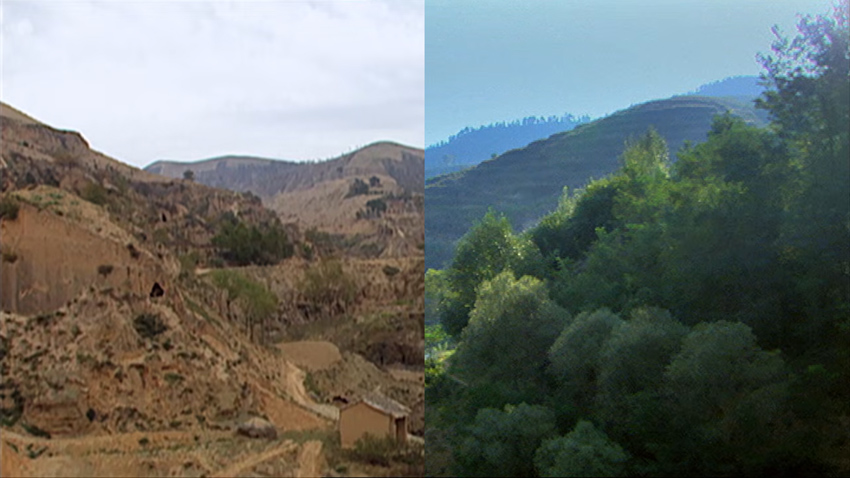
Host: There are more and more success stories like the restoration of the Loess Plateau. Brett KenCairn says it simply takes committed action like that to help ecosystems heal themselves.
BK: If you haven’t followed the work of Andrew Millison, who’s been documenting what’s happening in Asia and Africa right now, it’s absolutely remarkable how they’re changing. They’re not only recovering land, they’re changing the climate. Or the work of Didi Pershouse and Walter Jehne with the natural farming movement in India – 800,000 small farmers doing natural farming are not only recovering the land, they’re changing their local climates.
And finally, I would just talk about back in our Great Plains, I heard a presentation recently from Elizabeth Heilman from Wichita State where she was talking about that parts of Kansas have now adopted regenerative agriculture at such a scale – like 70 percent of a county has now put their land back into living cover, and full, deep-rooted systems. And you know what they’re seeing? They’re changing the weather patterns. [AUDIENCE RESPONDS] Yes. And they even now believe that we know what the minimum scale of action is, at landscape scales, to be able to change climate. Yes. We can do this. We have done this. We are doing this right now.
But it’s not just going to be because we change consciousness or, you know, that we did more education, or that we put together a new comms campaign for the planet. [LAUGHTER] It’s going to be because we change the economy. We have to make it possible to make a living repairing the planet. And we need every gathering like Bioneers, whether it’s the Society of Ecological Restoration or any other to have a part, a track in that, about how we build an economy that repairs the world, because that’s what it’s going to come down to. [APPLAUSE]
Host: Part of the elegance of employing regenerative nature-based solutions is that they “solve for pattern.” That is – they address and solve multiple crises at once – and they don’t create new crises.
But at this late date, switching over to renewable energy isn’t going to do the trick. We’re already in the atmospheric red zone and we need to rapidly draw down large amounts of carbon out of the atmosphere to make the planet livable once again for life as we’ve known it.
This is exactly what Gaia knows how to do. Some studies suggest that a big enough global initiative could make this goal a reality in as little as 20 years.

BK: If we just restored about a third of the degraded areas of the planet, we would stabilize climate, and, by the way, reverse biodiversity loss, and oh, and it’s a matter of fact according to the World Economic Forum, we would create 190 million jobs, and three-and-a-half trillion dollars in economic activity. That’s the future we have to demand.
We have to prepare and plan for this, just like in the ‘30s. When things start to unravel, as they will, it’s too late if you don’t have your plans together. Right? we actually have to have proven and tested the things that we say we should do. So pilot and—Get out there now. Get these things underway. We have to create partnerships at every level, across your back fence, between your jurisdictions, between your countries, and we have to learn fast and figure out how we’re going to propagate this quickly. And finally, we have to remember this is going to be a political process. I know it’s much more fun to talk about whales and growing things, and all those things – I like that too – but it’s a political process. [APPLAUSE]
Host: The famed politician Tip O’Neill once said that, “All politics is local.” All ecology is also local. Very local.
Regenerative nature-based solutions build from the bottom up and they’re custom-fitted to revitalize local communities and their bioregions. In fact, one of the most strategically effective places to start making real change on the ground is at the County level – like Brett KenCairn’s Boulder County.
BK: How do we remove the barriers for participation in our communities? We have to de-professionalize land stewardship. [APPLAUSE] This is not complicated work. We can all do this, but when it’s only the professionals that get to do this, of course nobody can participate.
So we learned this lesson in my own community where we were trying to work with our schools to create new living landscapes that could shelter and protect our schools, and the school district was like, that’s great, but I can’t take care of them. We realized we weren’t going to go anywhere with this project unless we figured this out. And so, for one thing, by the way, put away volunteerism. That was a 20th century concept. We have to recognize that our community members’ time and their expertise deserve to be paid for. [APPLAUSE]
And…And it’s not sufficient, but it’s enough to say that, for some people, if we could even just fund them for 10 to 15 hours a month of work at $25 or $30 an hour, they can keep those basic systems going. We can keep the trees watered. We can mulch them. We can care for the plants. We can keep these landscapes going. That’s enough.
We’re going to field 12 land stewards. We’ve created a program in our community called the Community Land Stewards, and we’re piloting this notion of stipending people who are getting trained and assigned to community places. And I believe that we can actually ultimately put hundreds of people in our community to work that way.
Second, we do need to actually build an infrastructure for implementing this at scale. So we’ve started contractor training programs, especially for our small, local and minority contractors, to say how do we wildfire resilient landscaping; how do we do rain garden development; how do we do biodiversity protection. And then we, as the public sector, start putting out small contracts, and we start seeding that capacity.
And finally, we do have to figure out how we’re going to fund this at scale. So as part of the Center for Regenerative Solutions, we’re working with the Trust for Public Land and their amazing conservation finance team, which quietly, over the last 25 years, has helped local communities generate billions of dollars of local investment through things like tax initiatives and bond measures, where we could actually get 20, or 30, or $40 million into local projects. And that’s what we need to be doing across the country, and we’re going to do that. So join in. We can make this happen. [APPLAUSE]
So I’ll close now to just say this– learn how to grow something. Start with something you love – a flower, a medicinal plant, a food plant, doesn’t matter. But grow something. And then figure out how to grow that in a neighborhood of plants that like to grow together. And then figure out how that little neighborhood of plants actually fits into a larger community. And before you know it, you’ll find that you’ve been brought into a larger community that’s really happy to have you, and it will help you find that way.
Thank you. Ahéhee’. [APPLAUSE]
Host: Brett KenCairn … “Restoring Nature’s Infrastructure for the Climate Emergency”