Are Neurons Overrated? Rethinking Consciousness with Michael Pollan
What does it mean to be conscious — and who, exactly, gets to claim it?
In A World Appears, Michael Pollan takes readers on a sweeping exploration of one of science’s greatest mysteries: how subjective experience arises, and what it reveals about our place in the living world. Blending neuroscience, philosophy, plant biology, psychology, literature, and psychedelic science, Pollan traces the emerging edges of consciousness research, where long-held assumptions about mind, matter, and intelligence are being quietly upended.
The excerpt below invites us into one of the book’s most provocative frontiers: the growing body of research suggesting that intelligence — and perhaps even consciousness — may not belong exclusively to animals with brains. By exploring the work of plant neurobiologists who are studying cognition and problem-solving in plants, Pollan challenges us to reconsider the boundaries we draw between humans and the rest of nature and what those boundaries say about ourselves.
Are Neurons Overrated?
In Martin Amis’s 1995 novel, The Information, we meet a character who aspires to write The History of Increasing Humiliation, a treatise chronicling the gradual dethronement of humankind from its position at the center of the universe, beginning with Copernicus. “Every century we get smaller,” Amis writes. Next came Darwin, who brought us the humbling news that we are the product of the same natural laws that created nonhuman animals. In the last century, the formerly sharp lines separating humans from other animals—our monopolies on language, reasoning, toolmaking, culture, self-recognition, and consciousness—have been blurred, one after another, as science has granted these capabilities to our fellow animals.
Calvo and his colleagues in plant neurobiology are writing the next chapter in “The History of Increasing Humiliation.” Their project entails breaking down the walls between the kingdoms of plants and animals, and it is proceeding not only experiment by experiment but also term by term, beginning with intelligence and culminating with consciousness, that supposed pinnacle of what it means to be human.
Calvo is more equivocal on the question of plant consciousness than his Italian colleague Stefano Mancuso. A plant scientist at the University of Florence, Mancuso is perhaps the field’s most impassioned spokesman for the plant point of view. A slight, bearded Calabrian in his sixties, he comes across more like a humanities professor than a scientist. His somewhat grandly named International Laboratory of Plant Neurobiology, a few miles outside Florence, occupies a modest suite of labs and offices in a low-slung modern building on campus. Here, a handful of collaborators and graduate students perform the experiments Mancuso dreams up to test the intelligence and possible consciousness of plants.
When he gave me a tour of the labs a few years ago, he showed me maize plants, grown under lights, that were being trained to ignore shadows; a poplar sapling hooked up to a galvanometer to measure its electrical response to environmental stressors; and a chamber in which a PTR-TOF—an advanced type of mass spectrometer—continuously reads all the volatile compounds emitted by a succession of plants, from poplars and tobacco plants to peppers and olive trees. Plants emit volatile chemicals for a range of purposes: to signal distress, to alert neighboring plants to threats, to thwart or poison herbivores, and possibly even to soothe themselves (many plants emit ethylene, an anesthetic gas, for reasons not well understood).
“We are making a dictionary of each species’ chemical vocabulary,” Mancuso explained. He estimates that a plant has three thousand molecules in its vocabulary, while, he pointed out with a smile, “the average student has only seven hundred words.”

When I asked Mancuso for an example of an experiment that unequivocally demonstrates plant intelligence, he sent me an astonishing video tracking the root of a corn plant as it navigated a maze where a quantity of ammonium nitrate fertilizer had been hidden in a far corner.
“This is the standard way to measure intelligence in animals,” he said. “You put a mouse in a maze and measure the time it takes to find the cheese or the number of wrong decisions taken. Here, I prepared a maze adapted for roots with a cheese equivalent—ammonium nitrate.”
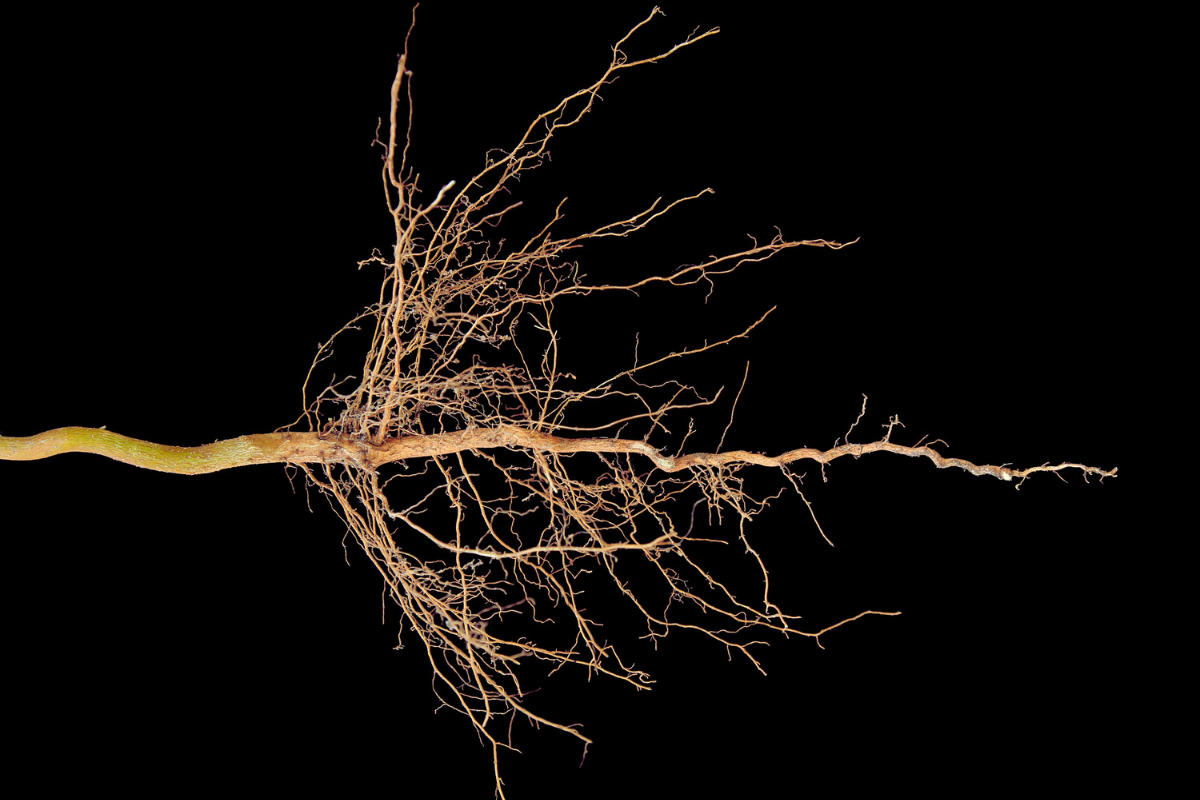
I clicked open the video and watched as the white tip of the plant’s taproot wormed its way down through the maze, turning this way, then that, finding the most direct path to the prize.
“If the root were a mouse or a dog or you,” Mancuso told me, “there would be no doubt that you or the dog or the mouse are intelligent.”
Early in our conversations, I asked Mancuso to define intelligence.
“I define it very simply,” he said. “Intelligence is the ability to solve problems.”
This is a basic biological function, Mancuso believes, found throughout the natural world, though there is no reason to believe it should manifest the same way in plants as it does in people. As with reproduction, another basic biological function, different species have hit on very different ways to achieve the same result. Consciousness, he believes, is no different: a basic biological function that can take many different forms.
In place of a brain, Mancuso explained, what we should be “looking for [in plants] is a distributed sort of intelligence, as we see in the swarming of birds.” In a flock, each bird has to follow only a few simple rules, such as maintaining a prescribed distance from its neighbor, yet the collective effect of a great many birds executing a simple algorithm is a complex and supremely well-coordinated behavior. Mancuso’s hypothesis is that something similar is at work in plants, with their thousands of root tips playing the role of the individual birds—gathering and assessing information from the environment and responding in local but coordinated ways that benefit the entire organism.
The more I read about roots, the brainier they seemed. In addition to sensing gravity, moisture, light, pressure, and hardness, root tips can also sense volume, nitrogen, phosphorus, salt, microbes, various toxins, and chemical signals from neighboring plants and fungi. Roots about to encounter an impenetrable obstacle or a toxic substance change course before they make contact with it. They will seek out a buried pipe through which water is flowing, even if the exterior of the pipe is dry, suggesting that they can somehow “hear” the sound of flowing water. Roots can tell whether those nearby are self or other and, if other, kin or stranger. Normally, plants compete for root space with other plants, but when researchers put four closely related Great Lakes sea rockets (Cakile edentula) in the same pot, the plants curbed their usual competitive behavior, sharing territory rather than seeking to take it over.
Somehow, plants gather all this information about their environment and then “decide”—some scientists deploy the scare quotes, indicating metaphor at work; others drop them—in precisely what direction to deploy their roots or leaves. Once the definition of behavior expands to include such things as a shift in the trajectory of a root, a reallocation of resources, and the emission of a powerful chemical (actions either invisible to an animal or so slow as to be imperceptible), plants begin to look like much more active agents, responding to environmental cues in ways subtler or more flexible than the word instinct would suggest. To plant neurobiologists, the intelligence exhibited by plants in the face of so many different and constantly shifting environmental variables indicates that something more than genetics is driving their behavior—something more like a mind. Yet in the absence of a nervous system, how can that possibly be?
“Neurons perhaps are overrated,” Mancuso told me. “They’re really just excitable cells.” Plants have their own excitable cells, many of them in a region just behind the root tip. Here, Mancuso and his frequent collaborator, František Baluška, a cell biologist and plant physiologist at the University of Bonn, have detected unusually high levels of electrical activity and oxygen consumption, as we might find in neurons. In a series of papers, they’ve hypothesized that this so-called transition zone may be the locus of the “root brain” first proposed by Darwin. (The idea remains unproven and controversial.)
That plants do all they do without brains—what Scottish plant neurobiologist Anthony Trewavas calls their “mindless mastery”—raises questions about how our brains do what they do. When I asked Mancuso about memory in plants, which his laboratory has demonstrated through experiments with Mimosa pudica, the sensitive plant of Gagliano’s study, he speculated about the role of calcium channels and bioelectric fields. He reminded me that mystery still surrounds the question of where and how memories are stored in human brains. “It could be the same sort of machinery.”
The hypothesis that intelligent behavior in plants may emerge from a distributed network of cells exchanging signals might sound far-fetched, but the theory that intelligence, or consciousness, emerges from a distributed network of neurons is not so different. Most neuroscientists would agree that brains, when considered as wholes, function as command centers for most animals, but within the brain, there is no command post; rather, one finds a leaderless network. So the sense we get when we try to imagine what might govern a plant—the sense that there is no there there, no wizard behind the curtain pulling the levers—may apply equally well to our brains. The singular self that we experience as real and imagine to be located somewhere behind our eyes, deep inside our skull, actually has no known physical address in our gray matter.
Posted with permission from A World Appears by Michael Pollan (Penguin Press, 2026).