A Double Bass, a Hydrophone, and a Conversation With Whales
For bassist and composer Garth Stevenson, improvisation is not just a musical practice. It’s a way of listening deeply enough to search for connection across species. Over the last two decades, Stevenson has explored music as a form of interspecies encounter, creating improvised performances in forests, on remote coastlines, and even underwater with whales. Rather than trying to mimic animal communication, he’s interested in something more elusive: the possibility that music can create moments of connection between beings that experience the world in fundamentally different ways.
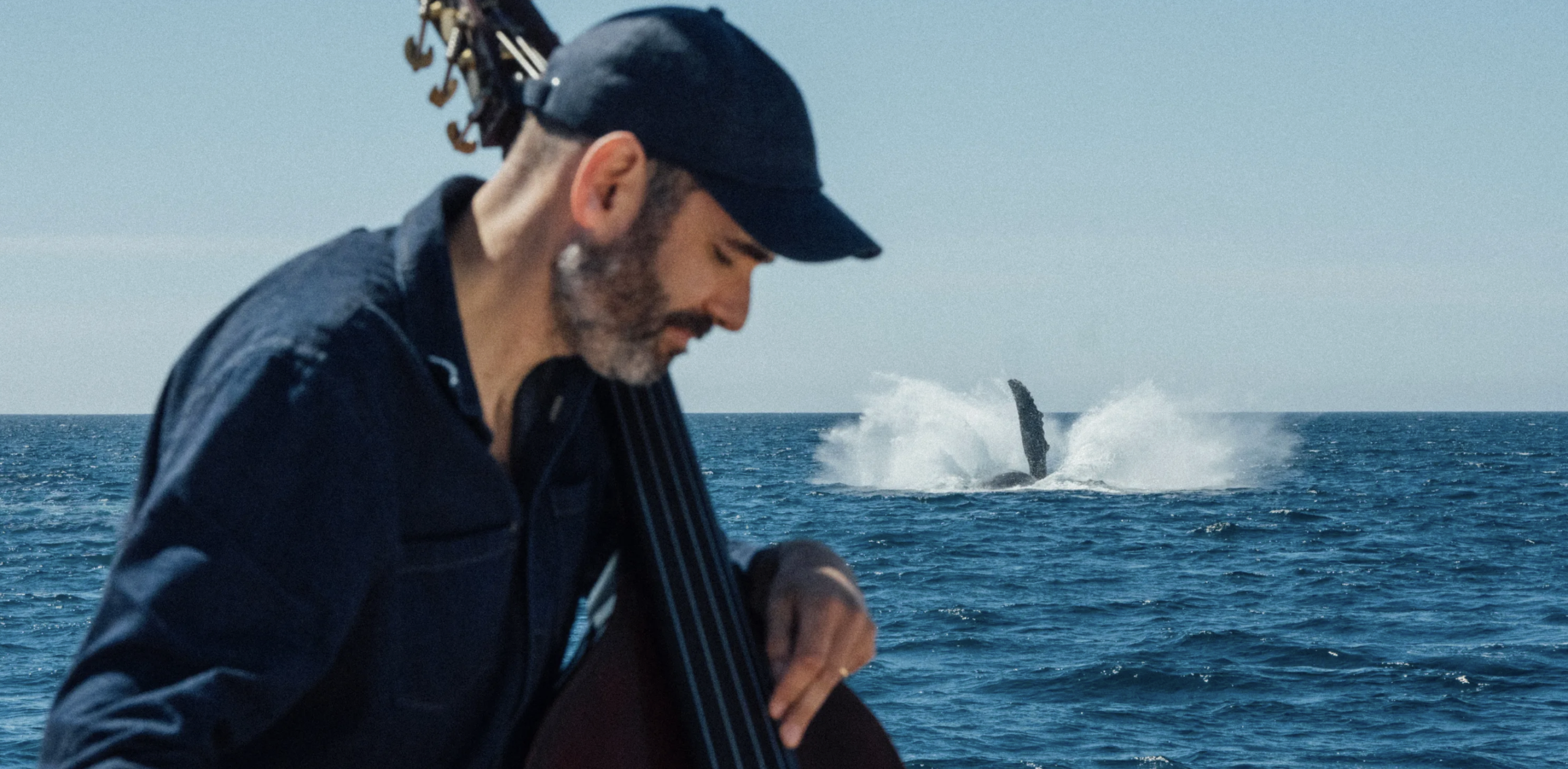
Stevenson, who is especially known for creating music in direct relationship with the natural world, first traveled to Antarctica in 2010 with legendary whale biologist Roger Payne, where he learned to imitate whale calls on his double bass and attracted a dozen sei whales to their icebreaker. More recently, during a 2025 trip to Baja California documented by Andy Mann, Stevenson performed underwater music for humpback whales while listening to their vocalizations through hydrophones.
The following is an edited excerpt from Stevenson’s remarks during a conversation at the 2026 Bioneers Conference, adapted from the original transcript. Watch his performance at the Conference here.
GARTH STEVENSON:
I grew up in British Columbia. My family spent a lot of time in the outdoors going on some pretty extreme camping trips, and that really became the foundation of a part of my soul. I had an amazing experience kayaking as a teenager: A humpback whale came up out of the water right in front of us, with all these fish trying to escape its mouth, and then went back under. Then it just kind of followed us around the bay for an hour. It really imprinted on me. I had seen whales before, but this felt special and kind of spiritual.

After high school, I went to the Berklee College of Music in Boston. When I got there, my connection to the natural world kind of collapsed. I spent most of my time in practice rooms — and if you’ve never seen music school practice rooms, imagine a hallway lined with a hundred tiny telephone booths, each with someone practicing their own thing. Walking down the hallway sounded like the score of a horror movie: saxophone, bagpipes, upright bass, drums — none of it listening to each other.
I really wanted to find a quieter place to play. I discovered Walden Pond just outside of Boston, and I started taking my bass there every day and hiking to the far end of the lake. I worked on the music that I was practicing at school, which was mostly jazz at that time. After doing that for about a week, the music just didn’t sound right. There were birds singing and the wind blowing up in the tree canopy … and I was trying to learn a bee-bop melody on my bass. I asked myself what music would sound right at this location on a given day, and that slowly started changing the way I approached playing the bass. I began to spend a lot more time listening and finding the gaps in the sounds of nature for the notes to sneak in.
I’ve been doing that since 2002. Every new location teaches me something different. Sometimes when I’m playing out in nature, animals will come by. I was playing for a group of people outside once, and we had a giant bear come down and circle around us.
I’ve noticed that when I’m out in the woods listening to music with other people, the sounds of nature afterward, especially the interactions between birds, feel much more vivid and alive. It’s hard to tell whether we simply weren’t paying attention before, or whether the orchestra of nature briefly adapted itself to the music.

I’ve spent most of my music career playing with other humans, and a lot of that music has been improvised. In many of the bands I’ve played with, we improvised entire concerts. It’s very different from playing music you already know because it requires a deeper kind of listening — not just, “Oh, you’re playing a C, so I’ll play a C.” You can mimic each other, but that gets old pretty quickly.
What I’ve found is that when you close your eyes and improvise with another musician, you can almost see right into their soul. You can sense how they’re feeling that day. And sometimes, something really special happens that I still can’t fully explain. It’s the same feeling I’ve experienced in other profound moments in life — watching a beautiful sunset, witnessing a child being born, or playing music for a friend who was dying of cancer.
Over the years, I learned how to imitate whale calls — mostly humpback calls — pretty accurately. That was cool, but it was really just a baseline attempt to connect with them. Whales have been around for millions of years, and I’m sure that when they heard me playing, they immediately knew I was not a whale. If they could speak our language, they’d probably say, “Go spend another million years on whale Duolingo, then come back and try again.”
When I played for humpback whales in Mexico, my bass was connected to an underwater speaker that amplified what I was playing. I also had hydrophones monitoring the incoming sound so I could hear the whales in return. After making that initial “hello,” showing them I could kind of play whale calls, I started sharing some of my own human music.
I wasn’t listening to see whether they were matching my notes. What I was searching for was the same feeling I sometimes experience while improvising with other musicians: a sense of connection that goes beyond imitation. The connection I’m looking for with animals through music isn’t about obvious mimicry. It’s something deeper than that.
A really interesting experience I had was playing for around 40 turtles being treated in a veterinary hospital. Every turtle had its own tank, and I was set up at one end of the room. All the turtles swam as close to the front of their tanks as they could to get nearer to the source of the music. I also played for penguins and seals out in different places in Antarctica. But the most powerful experiences have been with whales, including most recently in Baja California in Mexico.
One of the reasons I was in Mexico was to support an organization called FOMARES, which is working to create a 200,000-square-kilometer marine protected area around Southern Baja. Mexico’s Minister of the Environment attended one of the concerts I performed there, and later that night, after I had returned to the boat where I was sleeping, another boat pulled alongside ours. It was him.

He said, “I want to hear the whales.”
I had no idea what kind of sounds they might be making at night, but we dropped the hydrophones into the water. The whales sounded so beautiful that he became visibly emotional.
We recorded the sounds, and there was this echo to them, a kind of natural reverb. I’ve spent so much of my life tweaking delays and reverbs that I immediately became curious about where it was coming from. When I looked at a map, I saw all these underwater canyons nearby. The sound we were hearing was the whales’ voices bouncing off the canyon walls. The whales were using reverb long before humans ever did.
Over the years, I’ve realized that whether you’re a human, a whale, or even a lawnmower, we all have to follow the same rules of sound and physics. In the end, it’s all frequencies moving through the world.
Some animals can see far more colors than we can. We can’t even imagine what they’re experiencing. Others can hear frequencies far above or below our range. Humpback whales are interesting because their vocal range overlaps pretty well with human hearing. Even so, I had to approach the experience knowing I couldn’t fully understand what the whales were sensing. Whatever it is I’m chasing in those moments feels almost like another kind of sense — something humans may still possess, but that has faded over time. Maybe it was much stronger thousands of years ago.
We humans are animals too, and we’re very curious with our ears. Whales, who’ve developed their hearing and singing to such an amazing level, are probably curious too.
Out in nature, there are all these competing frequencies. Birds are competing with cicadas. Every species may subtly adapt the notes they sing to fit into a larger symphony. Blue whales, for example, sing so low they’re almost beyond human hearing, and researchers have found that after ship propellers began filling the oceans with low-frequency noise, blue whales lowered their pitch even further so they could still communicate.
When I was listening to the whales in Baja, I wasn’t trying to isolate individual calls anymore. I was trying to hear the whole thing together. Maybe seven whales, maybe ten — all these little dots of sound bouncing around like instruments in an orchestra. I wasn’t expecting whales to copy my notes any more than I would copy theirs. Maybe the connection was happening somewhere else. Maybe it was in the way our rhythms and tones were interlocking as part of a larger composition.