The Village We Lost: Rebuilding Maternal Care From Gaza to Oakland
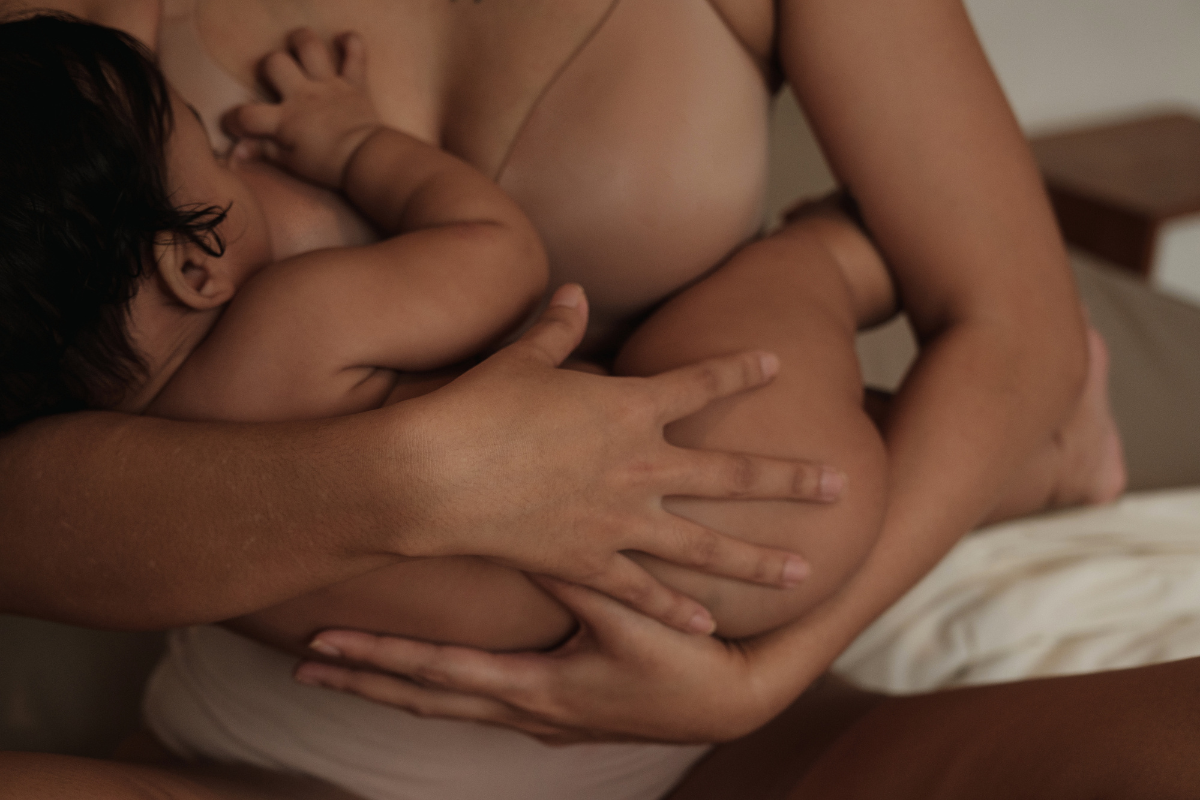
Across the world, mothers and children are absorbing the sharpest edges of humanitarian catastrophe — in Gaza, in Sudan, in conflict zones where medical infrastructure has collapsed entirely. And here in the United States, the crisis wears a different face but is no less urgent: Black women are three times more likely to die from pregnancy-related causes than white women, a disparity that has held steady for decades despite the country’s wealth and medical resources.
These are not separate emergencies. They are the same failure, showing up at different scales — systems that were never built to protect the most vulnerable, and the people stepping in, often without pay or institutional backing, to hold the line anyway.
The following conversation brings together four women doing that work from radically different vantage points: Brandi Gates-Burgess, founder of Breast Friends Lactation and Support Services, who has spent her career closing the breastfeeding gap in Black communities across the Bay Area; Sandra Adler Killen, an ER and pediatric nurse who has deployed to Gaza three times to train local clinicians in infant nutrition and lactation care amid famine and mass casualty; and Dr. Cindy Nelly, a global health consultant and midwife who has spent 25 years building health systems in conflict zones from Rwanda to the Democratic Republic of Congo to Gaza. They were brought together by Sandra, and guided in conversation by journalist Tiffany McElroy.
What emerges is not a comparison of suffering, but something more like a shared diagnosis of what happens when the people closest to a crisis aren’t the ones being listened to, and what changes when they finally are.
What follows is an edited excerpt of a conversation recorded at the Bioneers 2026 conference.
TIFFANY: My first question is for all of you: why did you choose to get into the specific work you’re doing right now? Brandi, let’s start with you.
BRANDI: Black women are least likely to breastfeed their babies. There are enormous health disparities behind that fact, and it’s what drew me into this work.
I was 21, in college at UC Riverside, when I had my daughter. I breastfed her because I was a broke college student — but once I learned how critical breastfeeding is to Black maternal health, and how much it reduces infant mortality, I knew I had to get the word out. I changed my major to sociology so I could understand how these outcomes were shaping Black birth in this country.
The numbers are what convinced me this was my life’s work: Black women and birthing people are three times more likely to die in childbirth than any other race or ethnicity. If we can get Black families to breastfeed for at least six months, it changes the health trajectory of an entire community — lower rates of diabetes, asthma, allergies, obesity, breast cancer. Once I understood that, the mission became simple: We support each other, and we get moms breastfeeding for at least six months.
In 2023, I launched Breast Friends Lactation to bring that support to low-income families in the Bay Area, specifically pairing them with lactation consultants who look like them and understand what it means to navigate motherhood as a Black woman in America. We’ve been at it ever since, and we’re booked solid.
SANDRA: Nursing is actually my fifth career. I came to it late — I became a nurse at 50, after working in several very different fields, because I wanted to dedicate myself to this work. I worked as an ER nurse and a postpartum nurse, and I’d always wanted to do lactation support. I breastfed my own two children and saw firsthand the health benefits, the bonding, how emotionally powerful it was. So I became an IBCLC, just like Brandi.
For many years now, I’ve done international humanitarian work, first in Syria and Lebanon with refugee populations, and for the last two years in Gaza, training neonatologists, pediatricians, OB/GYNs, midwives, doctors, and nurses to deliver this kind of support in some of the most challenging environments imaginable.
CINDY: My own path, I’ll admit, wasn’t especially altruistic at the start. I began traveling early, and as someone very privileged to be able to do that, I started noticing the disparities around me. I wanted to keep traveling, but I wanted it to mean something — to give something back to the communities I was moving through. If I don’t have a plane ticket in hand, I get anxious. I just need to be on the road.
Then I had my daughter at 23. I chose a midwife without really thinking about why, but my great-grandmother had been a midwife, and somehow, through whatever force that is, maternal lineage, I knew that was how I needed to give birth. My first career had actually been in environmental science, but in that moment of giving birth, with that connection to my midwife, I realized: This is what I want to do.
As healthcare providers, we have incredible privilege. We’re present with people during the most painful, and sometimes the most joyful, most intimate moments of their lives. When else do we get that? It’s sacred. We can find that connection with trees, with plants, with nature — but connecting human to human in such a vulnerable space is powerful in a different way.
TIFFANY: In so many systems, especially healthcare, it feels like the most vulnerable end up working against the odds the system creates. Brandi, can you talk about why breastfeeding matters so much in the Black community, and what the barriers are? And then Sandy and Cindy, I’d love to hear why breastfeeding matters even amid everything going on in conflict zones.
BRANDI: Breastfeeding is a safety net for every baby. Every baby deserves their birthing parent’s milk — it’s uniquely designed for that specific baby. Throughout pregnancy, the body is creating the optimal food for that particular child. We do families a disservice when we say formula is just as good. I tell my clients: Formula is good if a baby doesn’t have a mother. But if they have one, that baby should be fed her milk, because it’s built specifically for them.
That said, there are real barriers here in America — not just for Black families, but for everyone. One is our reflex toward medical intervention at every step. We’ve forgotten what normal newborn behavior and weight loss actually look like, so we over-supplement early on. That first month is critical for establishing milk supply for the entire breastfeeding journey. If it’s not established properly, families end up needing donor milk or formula to make up the gap.

Another barrier is that we have no paid maternity leave. We live in a country where you can’t legally separate a puppy from its mother before eight weeks, but we tell a woman her body isn’t healed and she still has to return to work at six. During COVID, we proved this doesn’t have to be the case. People were paid to stay home. If we can do that, we can provide six months of paid maternity leave. Instead, in the U.S., many people don’t even get six weeks; some go back after two.
Formula companies also heavily target Black and Brown families. We already have high cesarean rates, and when someone feels like their body “failed” at birth, that insecurity carries over into feeding. So when a formula ad shows up on Instagram or TikTok asking, “Is your baby getting enough?”, it lands. That’s how formula gets introduced, along with the early risks that come with it: allergens, digestive issues, and more.
These barriers hit the Black community hardest, but really, all women and birthing people in America face them — the lack of paid leave, and the early, unnecessary push toward formula.
SANDRA: I’ll speak to Gaza specifically. Many of you already know, from the news, what’s transpired there — periods of starvation, no food, no medical supplies. Add in environmental factors like asbestos and munitions exposure, plus malnutrition, stress, and PTSD, and it’s a perfect storm for infant mortality and morbidity.
Culturally, families have their own traditions and religious practices around infant feeding. I’m not Muslim myself, but I’ve learned a great deal about Islamic tradition, including that Muhammad called for breastfeeding for two years, long before Western medical bodies caught up with that same recommendation. I use that with the families I work with, because there’s often a fear that their milk isn’t good enough, or that they’ll pass on toxins to their baby. We’re seeing high rates of cleft lip and palate, congenital birth defects, prematurity, and extremely low birth weight.
When aid does get in, one of the first things allowed through is formula in massive quantities. I believe that’s not an accident. Poorer health outcomes follow. I’d go so far as to say that using formula this way is itself a strategy of this genocide.
I’ve worked with well-meaning clinicians and surgeons who hear formula is needed and bring it in their luggage — and I have had to tell them, directly, not to. Their intent is to place a can of formula at every mother’s bedside immediately after delivery. But once formula is introduced, milk supply drops and health outcomes worsen. I had to work directly with hospital directors at al-Aqsa Hospital, Al-Shifa Hospital, and facilities in Gaza City to stop well-meaning charities from distributing formula this way. Formula is medicine. We use it when it’s medically necessary, not as a default.
CINDY: You can’t talk about formula without talking about water. Globally, one in four health centers lacks access to clean water — water that’s often used to mix formula.
That’s before you even get to displacement camps or rural areas.
And this isn’t only a Global South problem. In the U.S., we have water deserts — over two million people without access to safe water. Combine unsafe water with formula feeding, and you get the full range of illnesses that come with it. Those two issues are inseparable.
But there’s real hope, too. Milk banks are one of the most incredible developments I’ve seen. There’s one in Gaza. I saw it firsthand in the NICU, and the team there was rightly proud of what they’d built. A milk bank is where a mother with an abundant supply, or one who has lost her baby, continues pumping and donates that milk to other infants who need it.
CINDY: Domestically, we face this too. At the tertiary care hospital where I work — where we take care of the sickest of the sick babies, many requiring surgery and immediate intervention — we have a milk bank, but more barriers than systems to support it.
Policy around safe milk banking in the U.S. is something we need to take seriously. And globally, there’s a tendency to assume that in places facing poverty or crisis, something like a milk bank is too ambitious, even a privilege. It’s not — it’s fundamental. In fact, we have a lot to learn from systems already in place. I think of Pumwani, in Africa, which delivers over 20,000 babies a year and has an incredible milk bank system. That’s a model worth studying, not underestimating.
TIFFANY: Brandi, tell us about your nonprofit. How do you get women excited about breastfeeding, and what connections do you help them make?
BRANDI: My nonprofit is Breast Friends Lactation and Support Services. We now run eight support groups throughout the Bay Area — in Richmond, Concord, Pittsburg, West Oakland, Fruitvale, San Leandro, San Francisco, and Rancho Cordova — providing in-home lactation support for Black and Brown families. We have four lactation consultants who go directly into people’s homes. If a client reaches out, they don’t even need to see a doctor first. We bring everything with us: a scale, pillows, formula if it’s needed for weight issues, nipple shields, feeding tubes, syringes, ice packs. It’s basically a lactation office in a suitcase.
We also run a peer support program built on a workforce development model: We take mothers from the community who’ve successfully breastfed for a year — our goal for every family — and train them through the USDA’s Loving Support peer counselor model, which includes 20 hours of lactation-specific education. They go on to work as peer counselors themselves.
We’re entirely grant- and donation-funded. Our peer counselors call clients weekly for the first eight weeks to make sure breastfeeding gets off to a strong start, and even if a client doesn’t pick up, we send text check-ins — “Congratulations, you made it through the first two weeks. Your baby may start feeding more frequently, so this is a great time for skin-to-skin contact” — so they’re still getting guidance either way.
We also run a “latchline,” our version of a breastfeeding warmline, available by call or text every day from 7am to 7pm, and a NICU support group for families with babies in intensive care. And we train birth workers directly — doulas, nurses, pediatricians, midwives — because they don’t always have the lactation-specific knowledge to catch red flags early. Instead of a provider saying, “Your baby’s losing weight, here’s some formula,” we want them saying, “Let’s get you to a lactation consultant and start pumping” before jumping straight to supplementation.
Our groups are open to the whole community, but they’re intentionally tailored to Black families, because our goal is to increase Black breastfeeding rates specifically — creating a safe space that’s led mother to mother, peer to peer.
Most recently, we launched DABS — Dads About Breastfeeding — a support group from the father’s perspective, led by my husband, who I had trained as a peer counselor. Dads often feel left out of the feeding journey, so DABS gives them a space to learn how to safely handle breast milk, assemble pumps, and support bottle-feeding — moving them from “I don’t know, he seems hungry, feed him more” to actually being part of the process. We launched it in October, and it’s already working well.
TIFFANY: Cindy, can you tell us about your work in the field? Brandi walked us through her work with clients — I’m curious what your day-to-day looks like.
CINDY: I’ve spent the last six years working internationally. While most people were home during COVID, I wasn’t. I worked in over four countries during that time, building healthcare infrastructure at a senior level for the federal government, the WHO, and the UN.
My work now is focused on systems, specifically, where they’re broken.
It’s easy to celebrate rescuing people from crisis, whether it’s Katrina or Gaza, any conflict or natural disaster. But why do we keep having to rescue people in the first place? Why does that keep being the model, and where does it break down?
There’s a concept in global health called the Humanitarian Development Nexus. On one side, you have humanitarians — the “cowboys,” as they’re sometimes known, myself included at various points, working with organizations like MSF. We rush in and put a bandage on the hemorrhage. On the other side, you have development actors — organizations like USAID — implementing, or trying to implement, long-term policy and infrastructure. The problem is these two groups rarely coordinate. And the biggest failure, in my experience, is that neither group reliably listens to the people on the ground.
That’s the work I’m focused on now: How do we build systems that actually lead from the ground up? In Gaza, the Ministry of Health had produced a new maternal health protocol — remarkable, given it happened during a war. But it hadn’t been implemented. When I arrived, I spent the first two days doing nothing but listening. I didn’t rush in to deliver babies; that wasn’t my role. I just listened to the providers.
One issue that came up repeatedly was episiotomies — the surgical incision made during childbirth, cutting the perineal tissue between the vagina and anus. The new protocol said doctors shouldn’t be performing them routinely; the evidence doesn’t support it as standard practice. But every first-time mother was still getting one.
Think about what that means in context: A woman has this incision, then returns to a tent, sharing a bathroom with 300 other people. The tissue breaks down. Infection sets in. There are long-term consequences. I’ve seen this pattern before, in the DRC, in cases involving sexual violence. It’s not unique to Gaza; it’s a practice still happening in the U.S. too, despite decades of evidence against it.
The point is: Gaza’s government had already put out a policy ready to change this, during a war, no less — and plenty of people had come to help, but no one had taken the time to actually listen and act on it. Just by listening first, I was able to help the incredible providers already on the ground solve a problem they were already trying to solve, rather than showing up with outside ideas about what needed to change.
I still get texts from providers there — “Another first-time mom, no episiotomy.” The physicians were remarkably open; they just hadn’t had support in changing the practice.

SANDRA: I want to share something specific about my practice. The first time I went to Gaza, I was part of a team doing mass casualty support — treating gunshot wounds and explosion injuries — working out of tents in the Al-Mawasi area, near Khan Yunis. We became one of the medical points of care for that community: primary care, wound dressing changes, mothers giving birth, mothers with mastitis, babies with hypoglycemia. When those cases came in, I could help. I had the training. The local clinicians started asking, “Can you teach us this? We know nothing about it.”
So I put together a training proposal. I was fortunate that an NGO brought me on, because very few international humanitarian healthcare workers are allowed into Gaza — I believe it’s down to around 10 a week now, and since the war with Iran, even fewer, sometimes just one entry a week. Many people get denied.
My work is about capacity building. I go in, I listen, and I ask what they want to be trained in. Then I build that plan and teach with the goal of making myself obsolete. I’m not a white woman coming in with answers. I ask: What do you need? What do you want? I’ll educate you, keep coming back as long as you want me to. And when there’s peace, I’ll come back simply to visit.
CINDY: That’s exactly why I came when you asked me to. It sounds obvious, put that way, but you’d be surprised how many people go into this work with a different agenda entirely.
TIFFANY: I can imagine. What does the future of maternal health and reproductive care look like to each of you, and where do you find hope, given everything going on right now?
CINDY: Just recently, Representative Adams introduced what’s known as the Momnibus legislation — a reintroduction of a bill aimed directly at the fact that Black women in this country face three times the maternal mortality rate of other groups. Even in the middle of everything happening politically right now, people are still putting forward legislation to address that.
There’s also a push through the International Confederation of Midwives to train a million more midwives worldwide. Midwives, nurses, and IBCLCs are critical frontline infrastructure. The estimate is that expanding access to them, along with community health workers, could reduce maternal and child mortality by 67%. That’s a campaign worth joining.
Even in the darkest moments, grassroots organizations keep pushing good work forward. Those are two efforts close to my heart, especially working in the Southeast. I still don’t understand why we aren’t listening to Black and Brown mothers, or why we haven’t built a workforce of midwives, nurses, and IBCLCs that actually reflects the people giving birth. That’s on us — on me, too, as someone in this field.
BRANDI: There’s a bill right now — AB 2160 — that would let lactation consultants bill for our services like any other healthcare provider. That would matter enormously, because this work is so often unpaid; it’s done purely out of passion. Getting reimbursed for these services would make organizations like Breast Friends far more sustainable.
There’s still so much work to do in reproductive justice, and I don’t know how quickly things will change. But my hope is built on initiatives like these — more midwives, more lactation consultants, more community members stepping in, professional or not. I tell people all the time:
My dream is that you won’t need me. That we build a village again, where this knowledge — how to breastfeed, how to care for our babies — is just something we know and share with each other, the way it always used to be. My hope is that I put myself out of a job, because everyone already knows how.
SANDRA: When I was in Syria and Lebanon in 2023, working with internally displaced people and refugees — Palestinian and Syrian — women who weren’t nurses, midwives, or doctors, women who worked in building administration, would come up to me and ask if they could just sit in on my trainings. When I asked why, they’d say: “I just want to be the person in my camp that moms can come to for support.”
That’s what this comes down to. Whether it’s advocating for these bills, or being that person in your own community — it’s us. Change happens over time. It’s not a hundred-yard dash; it’s a marathon. We stay committed, we don’t give up, and we remember that even two minutes today, 20 minutes in three weeks, two hours next month, adds up. That sustained effort is what changes things.