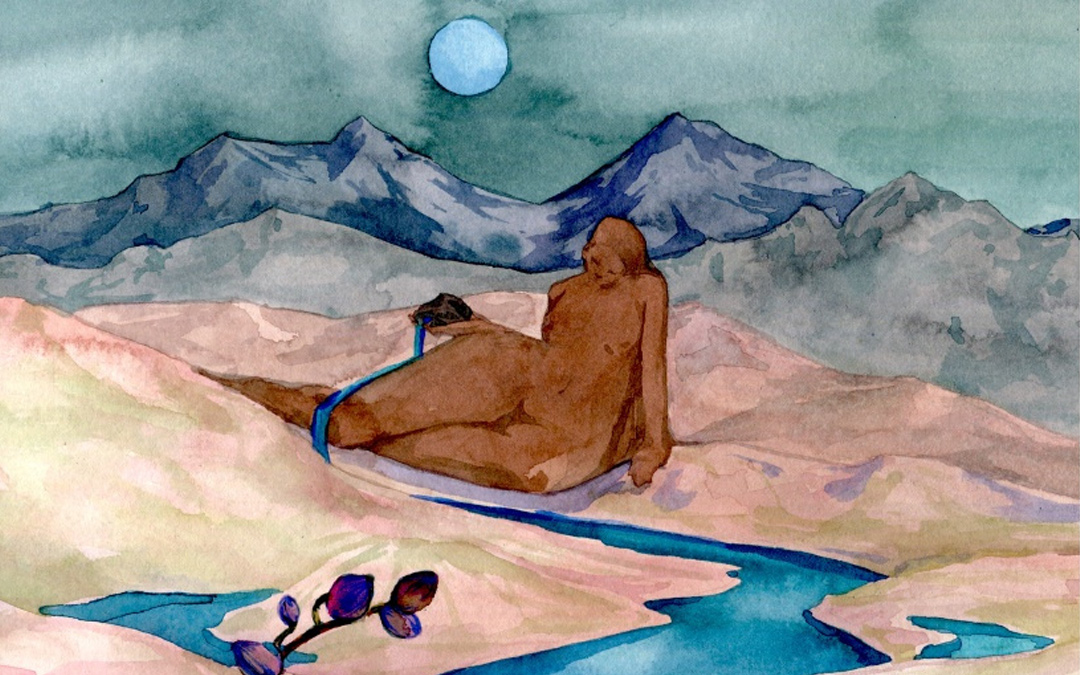
Speaking with Youth who are Speaking for the Voiceless: A Conversation with Jasmine Smith
An introduction from Britt Gondolfi, Bioneers Indigeneity Special Programs Coordinator
I first met Jasmine Smith in her ancestral homeland, the Great Smoky Mountains, along the banks of the Long Person, the Cherokee name for the river and stream system that has sustained the Cherokee people for millennia. We were camping streamside at a Protecting Mother Earth gathering hosted by the Indigenous Environmental Network. Over several days, we attended workshops and strategic visioning sessions together, learning directly from tribes working to protect and preserve our precious planet.
When Jasmine took the stage at an open mic, her powerful poem about the legacy of Cherokee women carried the audience 20 generations back and 7 generations forward, leaving them on their feet for a standing ovation. My 7-year-old was so moved by the Indigenous teen on stage that she found the courage to share an impromptu song of her own. That moment captured one of Jasmine’s great gifts: lifting up, inspiring, and empowering other young Indigenous women to speak up and join in.
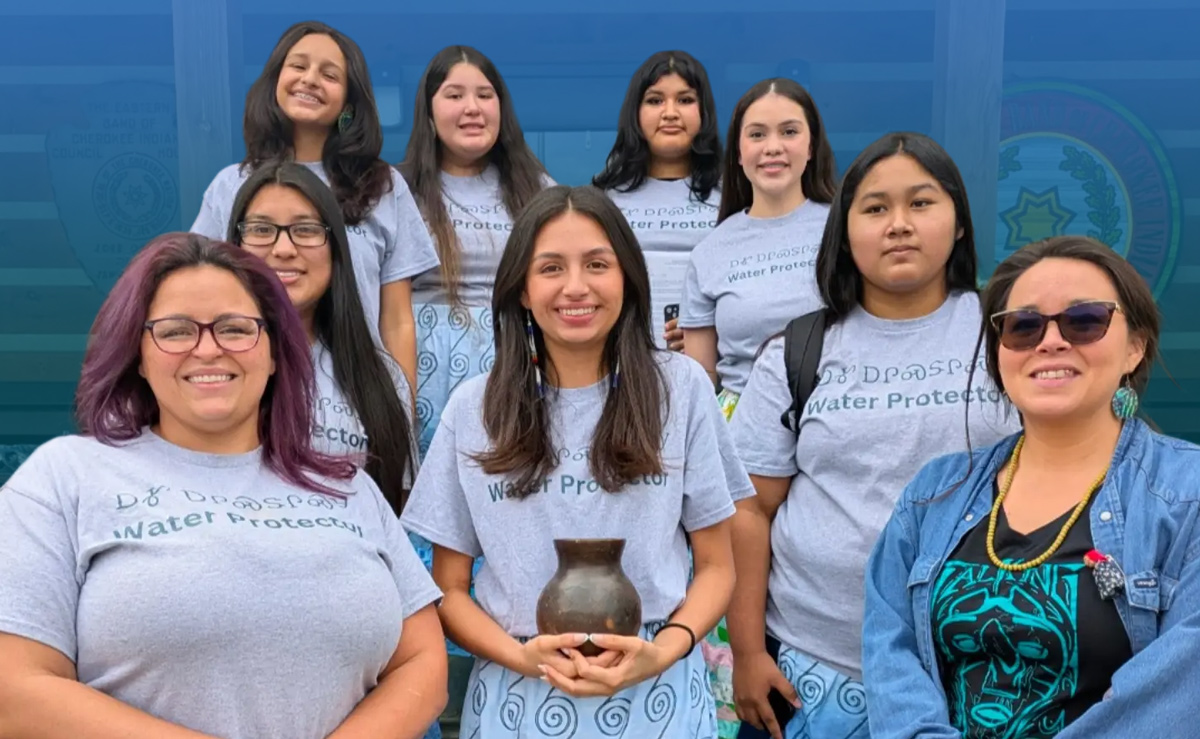
At 16, she founded a junior chapter of the North American Indian Women’s Association so young women in her tribe could build a support network of sisters and aunties and get organized. After taking Bioneers’ Indigenizing the Law course, Jasmine connected her organization of Indigenous teenage girls with our Native Youth Ambassador Program. With grit, determination, brilliance, ferocious faith, and guidance from elders, parents, and mentors, these young women helped pass the first-of-its-kind Rights of the Long Person Resolution in the Eastern Band of Cherokee Council. The resolution created a task force and inspired the council to initiate efforts to undam a section of the Long Person on the Ewa River.
In this conversation, Jasmine shares the journey behind that work, the power of young Indigenous women organizing together, and what it means to indigenize the law by speaking for “that which cannot speak for itself.”
What follows is an edited excerpt of a conversation recorded at the Bioneers 2026 conference.

BRITT: Would you share how you decided to start the NAIWA Daughters, and who NAIWA (North American Indian Women’s Association) Daughters are?
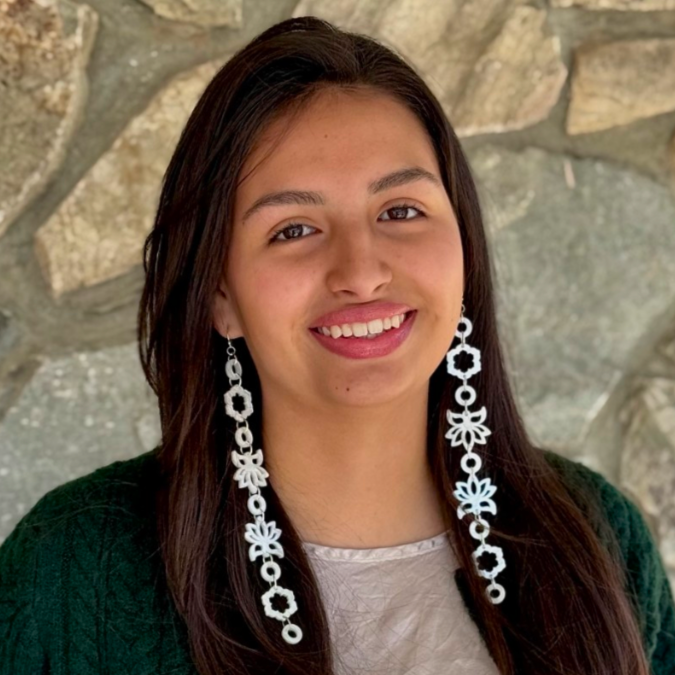
JASMINE: NAIWA is a nonprofit within our tribe with elder women members. They’re known for their cooking, but we always wanted to bridge the gap and have youth talk to our elders more. I remember the day we went in there; we were talking about creating this pilot program and building that partnership. I was so nervous talking to our elders about it. Now we’ve built those relationships, and they’re supporting our work, and we’re supporting theirs.
My third great-grandma, Ruth Littlejohn, is a very big pillar within our community. She helped found our fire station and raised money for our housing program. She’s a very impactful and strong woman. She and Ethylene Conseen and another woman they knew got together to create a network of Indigenous women across Turtle Island, and that’s when they started NAIWA. It grew from the Cherokee chapter into a national nonprofit.
NAIWA Daughters is also contributing and partnering with national NAIWA more. We’ve attended several national conferences, and this year, the national organization is coming back to the homelands. They’re having their conference in Cherokee, and we’re planning that and will host youth caucuses for the first time in a long time. They originally had youth as part of it, but it kind of dwindled away after my great-grandma passed away. So we’re getting to bring that back to our homelands.
My second great aunt is the treasurer for our chapter, and for the national nonprofit. We have four generations within NAIWA this year. So my aunt, my grandma, my mom, my sister, and me. We have four generations on our homelands, affecting change and starting youth caucuses. So it’s a really historic moment, and it’s part of our family and lineage.
BRITT: You’ve talked about patriarchy and the importance of Indigenous women having a platform and a place of leadership in the community. This is a very wise and grounded awareness to carry. How old were you when you started the NAIWA Daughters? How old are you now, and how did you get to this place of understanding?
JASMINE: I started NAIWA when I was 11, and this understanding of how Indigenous women lead goes back to our ancestral ways. As a community, we understood that women were pillars and lifegivers, and we honored them, but we were an egalitarian community. So everyone was equal, but we honored women for what they did for our community and how they gave life. Without them, we wouldn’t be here. That’s something that they passed down through generations.
Coming from a family that has such strong matrilineal women and matriarchs, it’s kind of in my DNA to lead. And harnessing this in NAIWA Daughters was an outlet for that, and it fostered that environment. And through, I think, intergenerational trauma, our community’s looking at how we can reconnect with those ancestral values.
It reflects within our tribe. I grew up not having seen Indigenous women within our tribal leadership. And now, since the ‘90s, we’ve had four women on our tribal council. It was an honor bringing our resolution for Rights of Nature into the chambers, and there were already four women on the council supporting us. It was great, because it wasn’t like we were talking to a bunch of men. We got to see women who looked like us in those seats, and they have really been empowering, supporting us.
We’ve always seen, at least in my family, women taking leadership. And my mom’s someone I always look up to because she always takes that leadership role. And she does so much, but she does it the right way, and understanding when we do anything, we have to do it under a certain set of values. So it kind of goes back to those values of how we live and how we interpret things, and just a way of being.
BRITT: You all originally started with a Rights of Nature initiative for the Eastern hellbender salamander. Will you walk us through the journey and thought process, and how you ended up narrowing your focus to this immense water body? And share a bit about the Cherokee history of the Long Person?
It all ties back to our water. We are water. Water is life. We couldn’t do any advocacy for land without talking about water. You can’t talk about Cherokee people without talking about water.
JASMINE: Yes, Long Person’s what we call our waterways. Its head begins in the mountains, and its feet travel to the sea. That’s over roughly 800 miles. This is a personal connection for me because my Cherokee name’s Agasga, meaning “rain”. So when you’re a baby, in our community you’re introduced to water. And for us, traditionally, we went to water and had ceremony sometimes seven times a day. It was a daily routine to have that relationship.
The journey to create the resolution all started when we were tubing down the river, and we would have to stop all the time because tourists would stack rocks, which disrupts the ecosystem and the homes of the juwa, the hellbender salamander. We got so frustrated, we wanted to do something about it. So we started conversations, and thought, “what if we made a resolution that says you can’t do this?” Then we talked about advocating for the land. We didn’t really know about Rights of Nature efforts until we met you. We understood this isn’t a new concept, it’s a cultural concept, something we’ve done since time immemorial, advocating for nature, and being a voice for the voiceless.
We submitted a public comment, and that was one of our biggest community events. We had over 60 youth participants and adults come in just one night, planned out the public comment, wrote it as a community, and advocated for the juwa. We even had a survey about how many of the adults here had seen a juwa, and three or four raised their hands. Then we asked the youth, and nobody raised their hand. That’s a connection point that we’re losing because our waters have been unclean, and the hellbender has always been an ecological count, a mark, for us. What we say is that if the water flows over its back five times, it’s clean enough to drink. And what is it telling us when the juwa’s going endangered, and it’s going extinct? The juwa has been around since the dinosaurs. It survived all of that, and it’s starting to be endangered now. So what are we doing, as humans, for it to be going extinct? It’s a cultural loss as well.
This resolution has opened many doors for other projects, like the dam project. We’re working on undamming one of the big parts of our Long Person, and reconnecting the sicklefin redhorse fish with the juwa. They haven’t been in connection for almost 101 years.
But it all ties back to our water. We are water. Water is life. We couldn’t do any advocacy for land without talking about water. You can’t talk about Cherokee people without talking about water. You can’t talk about our homelands without water, because it is the center of Cherokee. If you look at where we lived traditionally, it was always in a water bend, and the importance of water to us has always been there.
BRITT: Take us back to that day in the council chambers. There were thousands of people watching online, and the room was packed. Feelings, memories, what did it feel like that day?
JASMINE: We started the Rights of Nature process 18 months before, and we kept asking: What’s it going to be like on Council day? Over those 18 months, I created scenarios in my head: Am I going to do this, am I going to do that? When it came to writing my speech and talking to Council, one of the things I really wanted to say is that we can’t flex sovereignty if we aren’t going to our ancestral roots and decolonizing our legal systems. In my speech, I talk about how we can’t be Cherokee without our land, and if we don’t pass this resolution, are we really upholding those Cherokee values, and is this a priority for our tribe?
The river is right beside our tribal council, so before even going into the chambers, we started with a water ceremony and brought the Long Person into the conversation in a pot that was made by a beloved woman. We had to make sure that we were doing this the right way, and with intentionality by having Long Person, because we couldn’t have had that conversation without it in the room.
Within our group, we were trying to figure out who was going to cry first, and we all thought it would be our mentor, Kim, and it was me first. I tried not to get emotional, but even now, any time I talk about it, I do, because it was such a significant moment.
Having community support was the biggest thing, prioritizing this in our tribe. NAIWA were there supporting us. Having my elders there, government leaders, tribal council leaders taking time out of their day to come support this. We saw that other people saw the value in this program, and what we’re doing to help mold these Indigenous women into being the future leaders of our tribe. And it felt right. It was a full circle moment.
It was very hot in the room, and people there were talking about how you could just feel the ancestors there. One of our council women, Shennelle Feather, talked about how we get to honor and reconnect with our Long Person, our relative, and have that relationship go to a deeper level. That’s something we haven’t had in a very long time. So through the Long Person Resolution, we’re reconnecting with our ancestors. And having that relationship and advocating for things that don’t always have a voice. So being a voice for the voiceless.
So that’s kind of what the day was like. I was happy to see my fellow Indigenous young leaders speaking up and advocating and making change. And I’m always so proud of them. I never envisioned us doing this, but it was almost like our ancestors entrusted this to us, a calling to restore ancestral ways, and to heal intergenerational trauma.
BRITT: That’s beautiful. I watched it remotely. I was crying my eyes out. Other allies were texting me; they were all crying. I had jokingly said that obviously we’re honoring water here, because water is flowing out of all of us watching what was happening in this Council Room. So it was so beautiful to see y’all carry the Long Person in that beautiful pottery made by this beloved woman. It was only right, I think, that tears fell because we’re water. And so by recognizing the Long Person as a rights-bearing entity but also relative, it’s like it’s honoring the water in us and in the ecosystem and in the spirit of that person.
So what was it like to be a teenager going to your tribal council and telling them: I want you to pass this law.
JASMINE: It was not an easy process. We had separate meetings with tribal council members to gain their support, and meetings with the chief to talk about how this would affect our fishing department, and how it would affect other fish and wildlife, and how our tribe operates, and tubing companies. And yes, all those things are so important, but talking about that – it’s almost as if we’re forgetting the real importance of the resolution and advocating for Long Person, because it hasn’t had an advocate in so long.
We realized we had to get community input, and get the community behind it to get it over the finish line. Educating the community was hard, but beautiful at the same time, because they reconnected to a cultural concept that we’ve always had, and it empowered them. And a big success was making our Rights of Nature T-shirts, and having it say “Water Protector” in Cherokee and in English. So when anyone wears the T-shirt, they’re a water protector too, just by wearing that T-shirt and empowering our community members to affect change.
So with the survey, we got those responses that showed we had pretty much full support, which was a big factor in our tribe’s support. Because at the end of the day, they’re supposed to be there for their community. And when we showed them that, it was really, really hard for them to say no. It was healing for the tribal council and just for our tribe in general because this was the first resolution in our tribe that doesn’t look at water as something to be owned or profited from, and giving rights back, and having this resolution in places like our visitor center, and some of our biggest achievements as a tribe. It was a lot of work, but it’s so rewarding to know our waters are protected.
Now we’re looking at what specific laws we need to protect the Long Person. One of the things my mom always jokes about is that if you need anything done, let the youth handle it.
BRITT: That’s incredible. I love what you said in your presentation, that, you know, this is not a new legal concept. And you brought in that traditional value of doing good. I think for many people in the Rights of Nature movement, there’s this idea of this hot, new legal, environmental movement, and that it’s brand new in 2008 in Ecuador, in the constitutional amendment, but I think the real truth of the matter is this is old.
Right relationship, reciprocity, seeing oneself as a part of the ecosystem, not separate from it, not allowing people to poison the well and kill all the animals and ruin the food and the air. I mean, there were laws before there were the current governments that are operating in this territory now. People think that everyone was just running around wild, but there were laws and value systems, and that’s how you have thousands of years of continuous culture; that’s how you have thousands of years of language and practice and spirituality; that’s how people survive where they’re placed for thousands of years is because there are rules. And what I find so powerful and so beautiful and inspiring is that y’all are the youngest leaders in your community, but you’re bringing forward some of the oldest rules.
Would you share a bit about the Cherokee value system and principles of doing good? What did you learn about Cherokee values in the process of bringing about this good work? And for people that aren’t familiar with Cherokee, if you could help them understand the rules that you all live by.
One of my favorite things about our language that I find so fascinating is that you see how our values are built into just the way we communicate, and understanding relationship and reciprocity, and all of those components. Two examples are how in Cherokee “root”, in direct translation, means “to help”. And for basket, whenever you’re talking about making a basket, you never say, “I made a basket,” you always say, “I mended wood to sculpt this object.” It’s that understanding that we utilize these things but it’s a relationship we have with them, and respecting that.
JASMINE: That’s actually how we start our resolution off, we list the Cherokee values that correlate with the resolution itself. And that’s what we try to encompass in everything we do, as a tribe, as NAIWA Daughters, and just as people. And understanding that everything we do reflects our ancestors’ sacrifices. It’s also things like meeting people, making connections, supporting one another. Those are all Cherokee concepts. And it’s the little things that amount to the big successes. And without partnerships, conversations, and reciprocity, work and relationships, we wouldn’t have been able to get this resolution going and finished.
Throughout this process, we made sure to uphold those values with everything. When we’re talking to elders, we make sure we’re listening more than talking, and soaking up the knowledge, sitting in space with them. Talking to educators and attorneys in this process, how can we make sure that our words are translated into legal government systems today?
One of my favorite things about our language that I find so fascinating is that you see how our values are built into just the way we communicate, and understanding relationship and reciprocity, and all of those components. Two examples are how in Cherokee “root”, in direct translation, means “to help”. And for basket, whenever you’re talking about making a basket, you never say, “I made a basket,” you always say, “I mended wood to sculpt this object.” It’s that understanding that we utilize these things but it’s a relationship we have with them, and respecting that, so anything we do, every time we speak our language, throughout this process, it’s going back to those values. And everything we do we need to do the right way.
We really learned that through this process, and doing anything with NAIWA Daughters, making sure our projects instill those values. That’s one of the things the girls were talking about when we first started, is why doesn’t our tribe already have these things built into our constitution, and have them as the basis of our tribe? This is what the youth are supposed to be doing today, this is our job. We get to bring these values back and be the leaders that we need today, and be the future leaders our tribe needs.

BRITT: That’s beautiful. What’s next for you all?
JASMINE: What’s next, specifically for Rights of Nature, is the dam project. We have this resolution put in place; it lays the foundation for anything environmental, anything talking about land or water, we can always refer back to this. It’s great to know that because we’ve effectively made it possible for so many other projects. That’s one of the bigger things coming up for NAIWA Daughters. But outside of our priority projects, we’re speaking at conferences on Rights of Nature, and empowering other youth.
BRITT: What is your call to action or advice or counsel, especially for young people? You were inspired by a group of young people who did something in their tribe; you went home, you made it uniquely yours and did it in your way, and have had beautiful outcomes already would be your message to youth in Indian Country.
JASMINE: Sitting with the Mashpee NEA and learning about their efforts for the rights of the herring was so helpful, having those conversations and understanding, what to expect if something happens, what’s your counter. But it also creates a community, a network of Rights of Nature advocates. That’s one of the things that we really wanted to voice, is while NAIWA Daughters is doing work, we’re always open to supporting youth and giving guidance, and helping out, because Rights of Nature is so important; we want to support other tribes.
What I love about having conversations with youth and empowering them is that they can always do it better than we did. My advice for youth is never, never give up on the work, because you’re not just advocating for other youth now; you’re advocating for youth in the future.
Community is one of the biggest things. If it’s hard, creating a network and making relations makes it so much easier. Garner support. We had support from people who weren’t even from or non-Native companies and organizations. If their values are the same as ours, and they want to partner, creating a network of supporters outside of the tribe is really helpful when we’re talking about sovereignty and having people in the community that can support and uphold the work.
It’s important to advocate for our waterways, and to effectively make Mother Nature whole and healthy all together, we have to create these networks. It’s good here, but it also has to be good here, and over there. We’re doing it for not my sixth grandchild, but my great, great, great, great, great, great-grandchild that I’ll never meet. Knowing that I made a difference and made their life better. You do it to honor your ancestors, because they made sacrifices for you to be where you are, and you have to do the same for future generations.
Honestly, it gives me chills sometimes just talking about it, because before the Long Person Resolution, I had an innate connection with water, but now it’s different. It’s more of a “I see you, and you see me” deeper relationship, and knowing you’ve protected me for so long, I’m going to give back in a time when you need it. It’s understanding if your ancestor speaks to you and you get this feeling to keep going. That was really our fuel to do this, and understanding that it’s meant to be and it just takes time.