Beyond the Page: How Bay Nature Connects People to Place

Bioneers | Published: January 5, 2026 Environmental EducationMedia Article
Environmental change doesn’t begin with policy or technology alone. It begins with attention — with the stories we tell, the places we come to know, and the communities we choose to stay connected to.
For 25 years, Bay Nature has been doing exactly that work in the San Francisco Bay Area: helping local people understand, experience, and care for the natural world through deeply reported environmental journalism and place-based engagement. Founded as an independent, nonprofit publication and still rooted in print, Bay Nature occupies a unique position in the region’s environmental ecosystem — not just reporting on the work of scientists, conservationists, and civic leaders, but actively connecting them. As Executive Director and Publisher Wes Radez puts it, Bay Nature serves as “a reminder of why a lot of people are drawn to this work in the first place.”
That connective role has become more complex in recent years, as independent media organizations navigate a rapidly shifting information landscape and increasing economic pressure. Bay Nature, which reaches thousands of highly engaged members across the region, has spent the past several years asking a fundamental question Radez returns to often: How does a small, independent publisher survive and thrive in an increasingly hostile media environment while continuing to produce high-quality journalism?
The answer, it turns out, has less to do with chasing trends than with deep listening. Since joining Bay Nature in 2022, Radez has helped guide the organization through a period of reflection and reinvention — one that treats journalism not as a product alone, but as a living relationship between people, place, and shared curiosity.
In the conversation that follows, Radez reflects on Bay Nature’s evolving role as a regional media hub, what it’s learned by listening closely to its community, and how place-based journalism can help move people from overwhelm to connection, engagement, and hope.
Bioneers: What does building a nature community look like in a diverse region like the Bay Area?
Wes Radez, Executive Director/Publisher of Bay Nature: From a storytelling perspective, it’s really important that we support a wide range of perspectives — and that those stories are told by the people who hold them. That means providing agency, platform, and support so stories aren’t told on behalf of communities, but from within them. Whether we’re centering Indigenous voices, amplifying rural perspectives from the Central Valley, or highlighting lived experiences that don’t always get space in environmental media, the goal is to help as many people as possible see themselves and their stories reflected in our pages.
From a community standpoint, we take the idea of “meeting people where they are” quite literally. The Bay Area stretches from Santa Rosa to Santa Cruz, across ten counties, and while there are shared values that connect people across that region, the way environmental issues show up can look very different depending on where you live. Someone in Berkeley is going to experience and think about these issues differently than someone in Redwood City or farther out.
In the process of spending so much time meeting our community face to face, it’s been really striking to notice that when people come together at our events, even if they’ve never met before, there’s often an immediate sense of belonging. Within minutes, people feel at home because of shared values and shared curiosity.
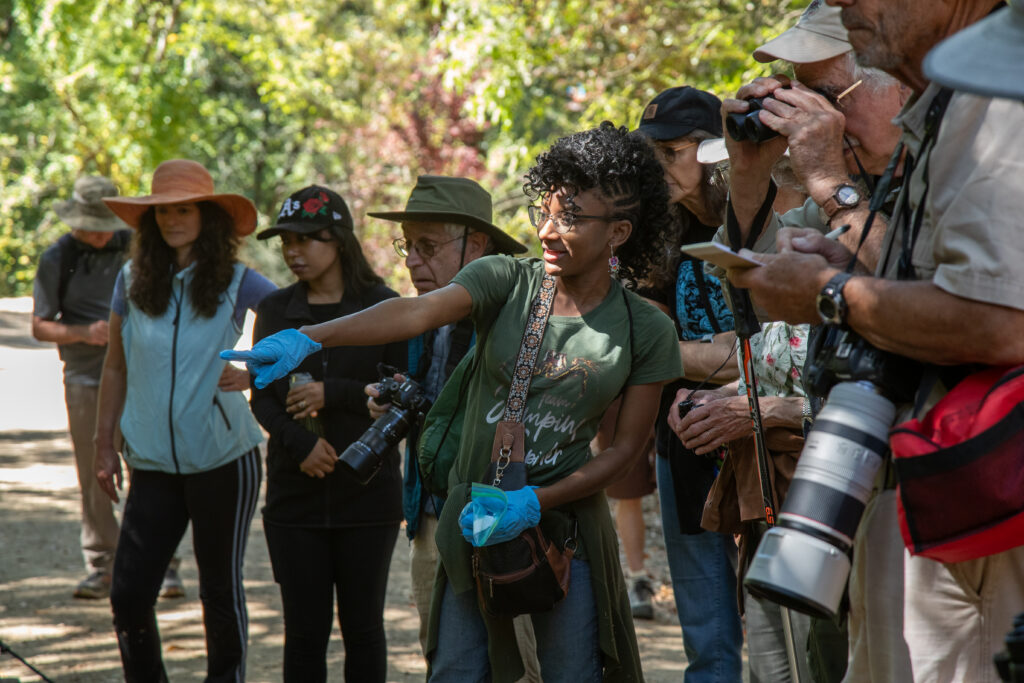
That’s why creating consistent, place-based opportunities to gather — whether through talks, hikes, or field experiences tied to our journalism — has become such an important part of how we think about community. It’s where stories move off the page and into relationship.
Bioneers: Tell us more about how Bay Nature has adapted to survive and grow in a challenging media landscape.
Wes: I joke that magazine publishing wasn’t in great shape when Bay Nature was founded 25 years ago, and it hasn’t exactly improved since.
During the pandemic, we saw what many organizations saw: a big upswell in interest in the outdoors. People were hiking, reading, and engaging with environmental content in new ways, and all of our metrics were moving up and to the right. Then, as the world reopened in 2020 and 2021, it was like watching the tide roll back out. Engagement dropped, and like many small organizations, we were left with very little room for error.
I joined Bay Nature in late 2022, and the initial charge from the board was to help the organization find a more sustainable path forward. We responded by doing a lot of listening: audience surveys, focus groups, and countless one-on-one conversations. I’ve spent the past few years traveling across the region, meeting people face-to-face and really trying to understand what Bay Nature means to them.
Two insights came through very clearly. The first was that people wanted much more active engagement with Bay Nature. They didn’t just want to read stories; they wanted to hike with us, visit the places we covered, talk directly with scientists and researchers, and experience the work in real life. There was a sense that we had been leaving people at the water’s edge, and they wanted to go further.
The second insight was that our audience already saw themselves as a community, even before we fully understood ourselves that way. People would tell me they’d been “members” for years. Internally, we still thought of them as subscribers or readers, but they felt a much deeper sense of belonging. Recognizing that shift from audience to community became a turning point for the organization.
Bioneers: How did Bay Nature change its model based on what you learned from your community?
Wes: Those insights led us, in January of 2024, to launch a new membership program. For $40 a year, members receive the four quarterly issues of our magazine that we’ve been publishing for decades, along with access to an entirely new events program designed to bring our journalism to life.
What that’s looked like in practice has been a really dramatic shift. Starting essentially from zero, we produced more than 80 events in the past year. And nearly every one of those events connects directly back to a piece of our reporting. It gives people a way to go deeper into the stories, to meet the writers, the scientists, and the experts behind the work, and to experience these places and issues together.
Because the events happen so frequently, something else has started to happen, too: people get to know one another. We get to know them. Over time, through those repeated interactions, real relationships form. What began as reading a story turns into shared experience, and that shared experience becomes community.
Bioneers: Which stories or experiences have resonated most with the Bay Nature community recently?
Wes: One of the most joyful things about this question is that there really isn’t a single answer. There are as many responses as there are members of our community. You can pick almost any environmental topic out of a hat, and on a Tuesday afternoon, we’ll have 100 people show up eager to learn — whether it’s about monarch butterflies, birding, mushrooms, or marine life. What we’ve learned is that Bay Nature is really a constellation of small, deeply engaged micro-communities, each with its own interests and passions.
On a more personal level, one of the things I’m proudest of right now is our journalism itself. For the second year in a row, Bay Nature won multiple Excellence in Journalism awards from the Northern California chapter of the Society of Professional Journalists. What made that especially meaningful is that the awards went to some of our youngest reporters.
We run a journalism fellowship program in partnership with the Schmidt Family Foundation, and after the past two years, every fellow who’s come through the program has gone on to continue their career as an award-winning journalist. At a time when journalism needs strong on-ramps more than ever, being able to support emerging writers and send them out into the world with that kind of foundation is incredibly gratifying.
Bioneers: How does Bay Nature help people move from environmental overwhelm to engagement or hope?
Wes: I think it starts by making big, global issues feel as local, personal, and manageable as possible. Climate change and biodiversity loss can feel overwhelming very quickly. But when you bring the focus closer to home, people begin to see where they actually have agency.
A good example is a recent series we did on local native bees. Their habitats are changing in a warming world, and it would be easy to throw up your hands and feel helpless about that. Instead, through a combination of reporting and field-based events, we brought people right down to the level of their own backyards, showing how small changes they could make at home could meaningfully improve conditions for these insects. It took something enormous and abstract and made it tangible and actionable.
The other piece is trust in journalism itself. We’re not an advocacy organization, but we are very aware that we serve a community of people who care deeply and are already engaged in change. We lay out the facts, tell the story clearly and impartially, and then let people and organizations decide how to act on that information. We are reminded that people will protect what they love, and they will love what they understand. Good storytelling is one of the best ways to build that understanding.
It’s incredibly gratifying to see our journalism travel beyond our pages — showing up in grant applications, city council presentations, and policy discussions. While we’re not advocates ourselves, it’s powerful to see information used as an instrument for real-world change. That’s where hope starts to take root.
Bioneers: Has Bay Nature changed how you personally experience the Bay Area?
Wes: Absolutely. For me, the biggest shift has come from spending so much time out in the field: traveling across the region, meeting with community members, and seeing these places up close. As I move through the Bay Area, I find the built environment almost melting away. What comes into focus instead is how present the natural world really is.
Everything we write about — the issues we cover, the actions we highlight — it’s all right there. It’s at the edge of the highway, around the next bend in a country road, in people’s backyards. None of it is abstract or far away. Bay Nature is a deeply local organization, and our journalism reflects that. What we’re writing about is the lived reality of this place.
Experiencing that through my own eyes has reinforced how powerful community-based reporting can be. It’s not just about telling stories. It’s about helping people see what’s already in front of them, and understanding their relationship to it in a new way.
Become a Bay Nature Member to receive quarterly issues of Bay Nature magazine online and mailed to your home, plus live educational talks and naturalist-led hikes that bring its stories to life. Learn more at baynature.org.