Eastern Band of Cherokee Indians Pass Historic Youth-Led Rights of Nature Resolution
Bioneers | Published: January 22, 2026 IndigeneityRestoring Ecosystems Article
At the Eastern Band of Cherokee Tribal Council meeting on January 8, 2026, the Council read and unanimously passed a historic resolution affirming the rights of the stream system in the Great Smoky Mountains, known to the Cherokee as “the Longperson”.

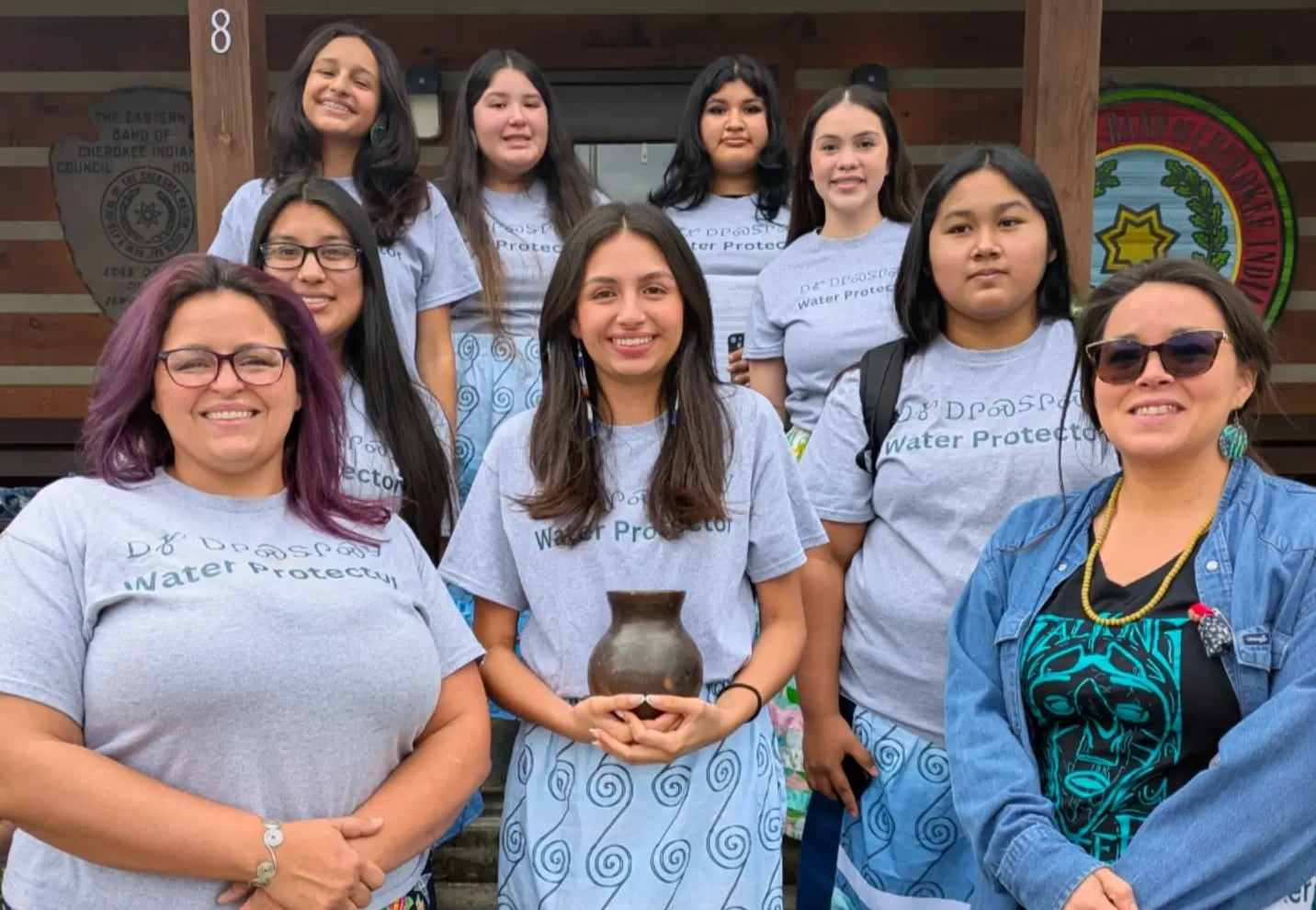
The Council chamber, an intimate wood-planked room with a horseshoe-shaped table of Council members, was filled with a long line of young Cherokee women representing the NAIWA Daughters (North American Indian Women’s Association). They stood before the podium, ready to testify in support of the resolution they had written to bring before the Council.
Holding two handmade traditional pottery vessels, the young women reminded the Council that the water of the Longperson was one of their relatives. “Before we begin, we wanted to acknowledge that we cannot have this discussion without our relative, Longperson, present. Held in two vessels created by the hands of two beloved women, these waters were borrowed from the headwaters in the National Park, and will be returned to the Oconaluftee River in a water ceremony following the session.”
The youth spoke about the challenges of witnessing the simultaneous erosion of culture and the decimation of the natural world. Jasmine Smith, NAIWA Daughter Co-Founder and Chairwoman, urged the Council to vote on the resolution and to trust the youth, who understand what is at stake. She encouraged them to vote with future generations in mind — those who will look back and wonder how their Ancestors treated the water system: as property or as something sacred.
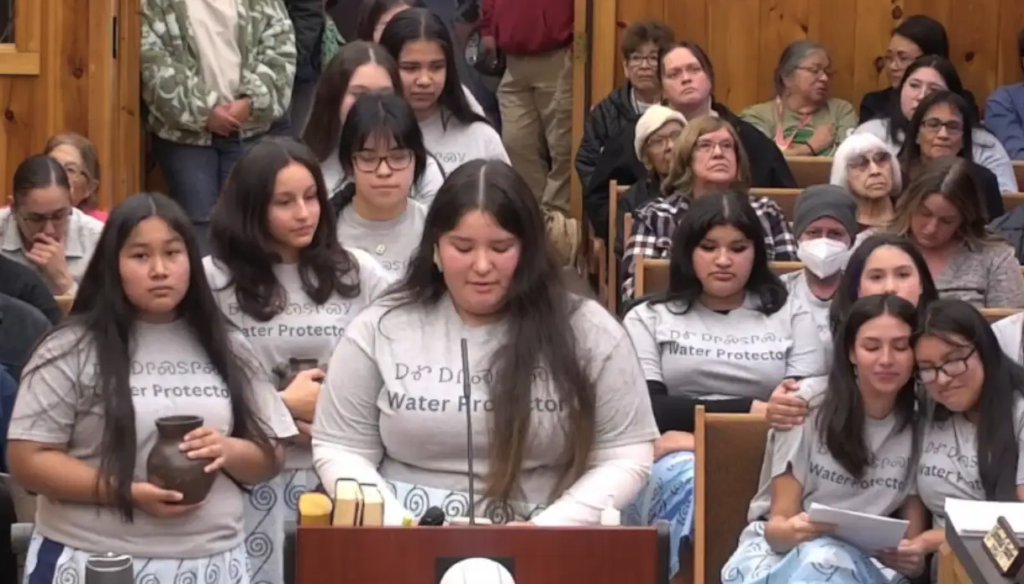
“Our Ancestors knew that the land and the water are not resources. They are ancient relatives. They understood that when the river suffers, our people suffer. When the land is harmed, our nation is harmed. They understood that without the sacred balance that sustained them, without our land, who are we as Cherokee people? When we forget the land, we forget ourselves. But we stand here today because we refuse to let our people forget. Our Ancestors fought for these places. They protected them. They advocated long before advocacy had a name. They stood beside these rivers and called them Longperson. They prayed for us before we existed. And when we speak today, we do not speak alone. We speak with the fire of every Ancestor who has walked before us. We speak with the strength carried in our DNA. Because this resolution is not just policy. It is an act of remembering who we are as Cherokee people in a commitment to protect what our Ancestors entrusted to us.”
Kyndra Postoak, Rights of Nature Project Lead for NAIWA Daughters, asked “Do we see nature as something we own, or do we view it as something we have the responsibility to protect?” This question to the Council summarized one reason the rights of nature movement is gaining momentum across the globe, as humanity grapples with the disastrous outcomes of treating nature as property.
To many attendees, the Council meeting was a testament to the power of youth organizing with a vision for a new legal paradigm—one where Nature is represented by humans who affirm and guard her rights to survive and thrive once again.
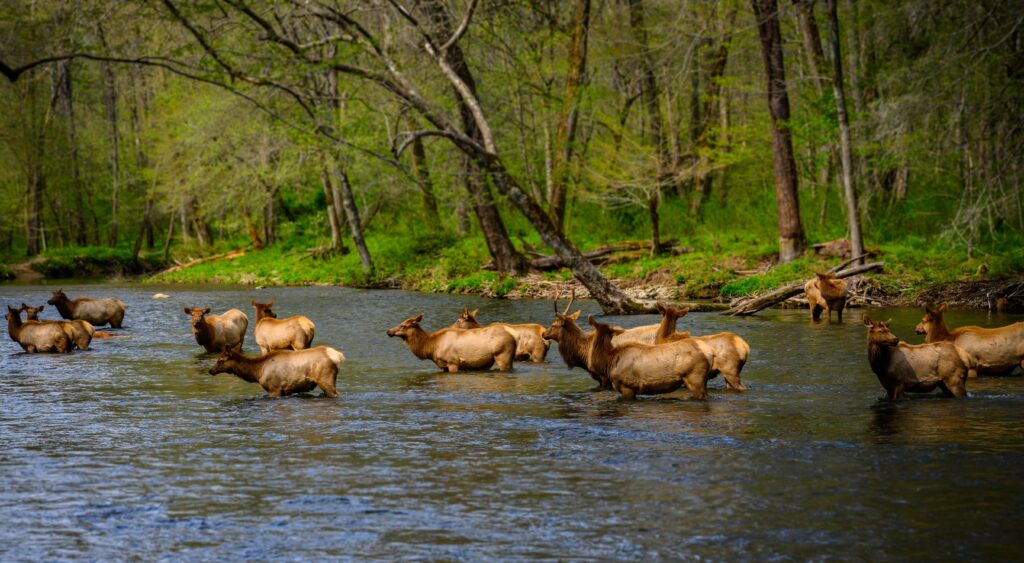
The Longperson stream system in the Great Smoky Mountains is the longest river system east of the Mississippi and permeates the ancestral territory of the Eastern Band of Cherokee people. The relationship between the Cherokee people and the river system is as old as the river itself. The resolution codifies the relationship of reciprocity between the Cherokee and its water relative, while affirming the tribal nation’s sovereignty and the Rights of the Longperson.
The rights of nature resolution is significant for the vast scale of the ecosystem it aims to protect and for the youth of the advocates who are bringing this legal framework to life. The resolution acknowledges the Longperson as having five rights:
- The right to exist, persist, and regenerate its vital cycles, structures, functions, and processes free from negative human disturbance, alteration, or destruction.
- The right to maintain and restore its natural state and integrity, including the right to be free from pollution, contamination, non-native invasive species, and other environmental degradation.
- The right to serve as a home and habitat for non-human relatives, consistent with the ecological relationships established through time.
- The right to access and maintain free-flowing conditions, including protection from damming, obstruction, or any alteration that impedes the natural flow of water.
- The right to be protected by the Eastern Band of Cherokee under the laws, customs, and traditions of the Eastern Band of Cherokee, and to have its rights enforced by the appropriate authorities.
Guided by Elders, Native American Youth are Rewriting America’s Legal Future
This is the second rights of nature resolution drafted and introduced by high school and middle school students. In 2023, a Mashpee Wampanoag youth group, named the Mashpee Native Environmental Ambassadors, presented a Rights of the Herring Resolution, which their Council passed unanimously. This resolution calls for the Tribal Nation to restore and indigenize the streams in Mashpee to ensure the herring’s survival.
Representatives from the NAIWA Daughters of the Eastern Band of Cherokee Indians (EBCI) were inspired by Mashpee’s work and felt a similar affection for the Tsuwa (Eastern Hellbender Salamander) as the Mashpee felt for the herring. Initially, NAIWA Daughters advocated for Tsuwa rights and protections within the U.S. federal system to secure endangered species status. After consulting with elders and cultural leaders in their community, they decided to turn to their tribal nation’s system to ensure success. In alignment with community support, NAIWA Daughters determined that the foundational EBCI rights of nature resolution should focus on the foundational relative:water. The Longperson’s waters sustain the entire ecosystem that supports not only the Tsuwa, but also all their human and non-human relatives.
In her testimony, NAIWA Daughter Kyndra Postoak stated: “Nature has intrinsic value. Every river, forest, mountain, and creature has a right to exist in balance and dignity. Humans are a part of that balance, not above it. Our communities, culture, and lives depend on healthy, thriving ecosystems. Protecting nature means protecting our children’s future, our identities, and the traditions rooted in the land. This belief is reflected in the work of NAIWA daughters, who actively stand up for the protection of waterways through advocacy, education, and community action.
“We work to defend rivers and streams from pollution and misuse, recognizing water as a living relative rather than something to be owned or exploited. These young ladies’ efforts highlight the deep cultural and spiritual connection between water and Indigenous communities, reminding us that clean, protected waterways are essential not only for ecosystems but for human life, health, and heritage as well. By embracing the rights of nature, we commit to stewardship, to nurture, defend, and restore our relationship with the land and water rather than exploiting or destroying them. The works of groups like NAIWA Daughters show that protecting nature is not just an environmental responsibility, but a moral one. It is an act of respect, persistence, and hope for future generations who deserve a world where rivers still flow clean, and life remains in balance.”
This resolution for the rights of nature wasn’t created overnight. For 18 months, the NAIWA Daughters held community consultation dinners to gather feedback and learn from elders. They tabled at Cherokee events and conducted input surveys to stand beside their resolution. The young women advocated, door-to-door, with Council members to share the heart and purpose of their resolution. When a tribal election occurred, they repeated the process all over again. They gained the support of several Tribal Council members and collaborated with organizations advancing rights of nature policies. They also conducted cleanups and water ceremonies across the country and held sessions with native and non-native allies, culminating in the Council work session to ensure full Council support.
Unanimous Vote for the Rights of the Longperson
When item 18 came up on the docket on January 8th, the entire room recognized the immense heart, soul, and effort the young women had invested in the law and its historic implications. Attendees commented that the room was hot and heavy when the NAIWA daughters gave their testimony. Some said they could feel the presence of Ancestors in the room.
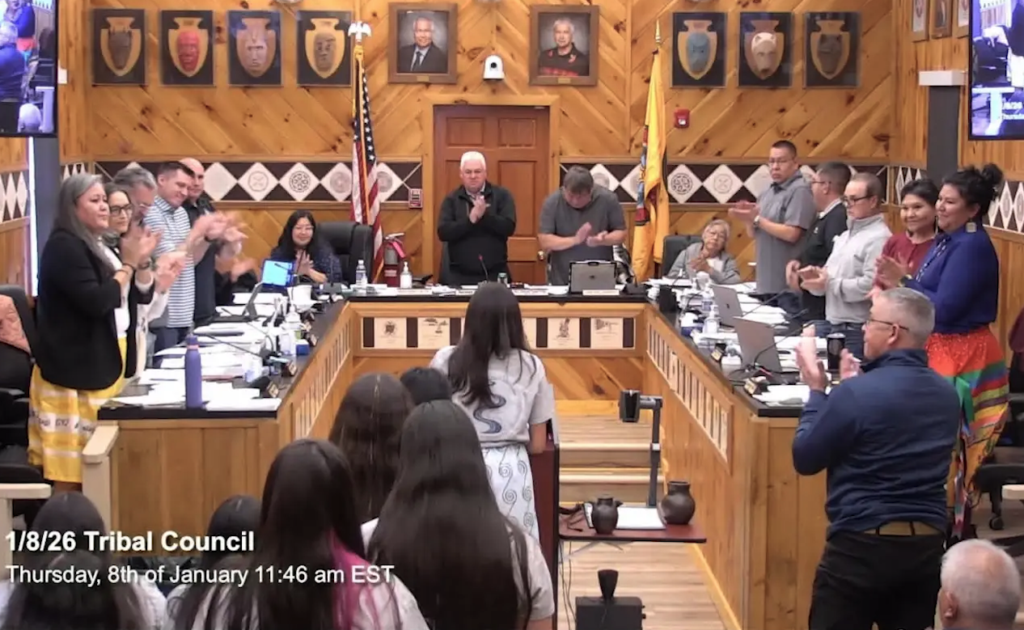
The Council unanimously voted yes with a standing vote and a round of applause. The NAIWA Daughters presented them with gifts of gratitude, shirts and stickers that proudly read “Water Protector” in Cherokee and English across the front.
Drawing on ancestral teachings and a history predating the establishment of the U.S., the young advocates reminded everyone in the Council chamber that passing the resolution helps to revitalize Indigenous law and order—a legal model in which nature is regarded as relative and protected from harm.
Grant Wilson, Executive Director of the Earth Law Center, celebrated the Council’s vote. “This historic resolution holds a mirror to the Cherokee understanding that the Longperson is a sacred, living relative — not mere property — and translates this relationship into a powerful legal framework. The Rights of the Longperson is also another profound example of how Indigenous youth and women are leading the way toward the Rights of Nature and intergenerational justice worldwide… As the global community increasingly recognizes Nature’s rights —now established in hundreds of jurisdictions worldwide — those with the deepest cultural and spiritual connections to the land are often the ones best equipped to give Nature a voice.”
Casey Camp Horinek is an elder of the Ponca Nation of Oklahoma, and advisor to Movement Rights, an organization advocating for the rights of nature movement. She thanked the Eastern Band of Cherokee for upholding their traditional ways and for the care they have taken of the Longperson since time immemorial. “We believe this resolution will only strengthen your leadership and guardianship for generations to come. As you may know, owing to global Indigenous leadership, the Rights of Nature is now the fastest-growing environmental justice movement worldwide, with laws in over 40 countries. In passing this resolution, the Eastern Band of Cherokee will join a growing number of Indigenous peoples leading a profound shift in our collective human relationship with the natural world. “
The NAIWA Daughters were clear that they will not let their efforts end with this resolution. They are working with the Tribal Council to create a task force to assess the river’s health and lead policy initiatives that implement the spirit and purpose of this resolution as binding code and law.
They will share their story and efforts to advance the Rights of Nature movement in Indian Country by presenting their work at the next National NAIWA Daughters convergence. Their goal is to inspire Indigenous young women leaders across Turtle Island. Jasmine Smith, Chair of the EBCI NAIWA Daughters, will also be speaking at the 2026 Bioneers Conference Indigenous Forum.
To follow the NAIWA Daughters’ work, you can follow them on Facebook. Contact them at naiwadaughters@gmail.com