Global Indigenous Women Led Movements For Climate Justice
Although they receive less than 1% of climate funding, women-led climate justice grassroots projects are generating cascading benefits, from greater gender and economic equity and less gender violence to improved biodiversity and ecosystems’ health. Simultaneously, the centrality to many Indigenous peoples’ cultures of traditional relationships to place and to honoring all of life as sacred are a tremendous resource in strengthening efforts to protect and renew biodiversity and water resources.
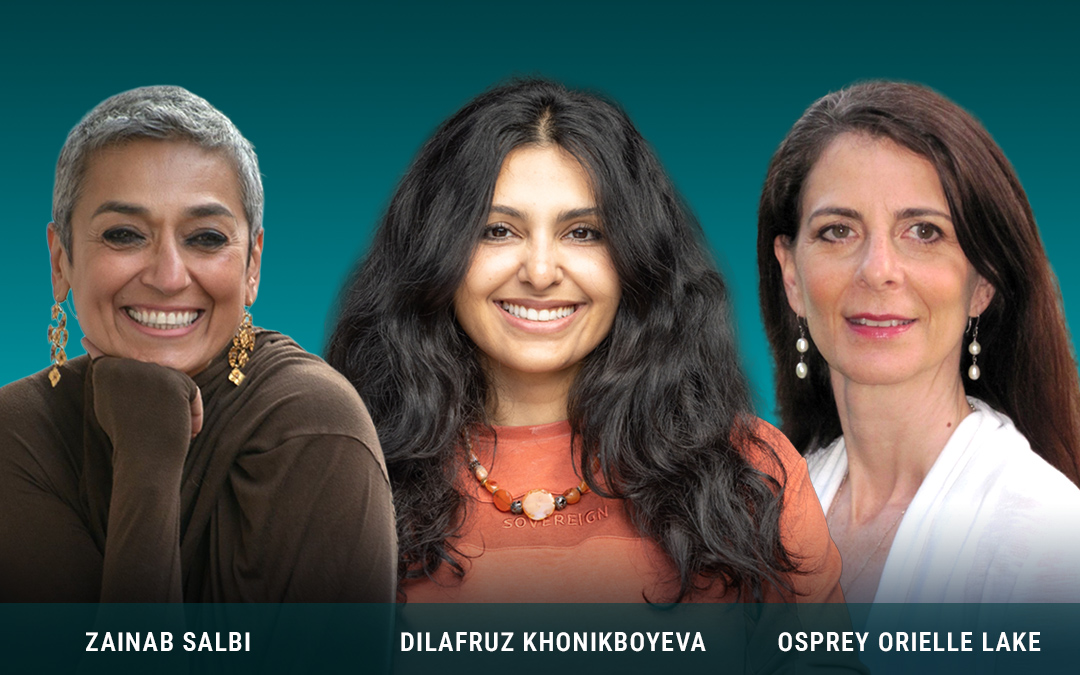
Listen to this excerpt of a conversation exploring what these two vastly under-resourced constituencies have to offer in the quest to co-create regenerative landscapes and futures. With Dilafruz Khonikboyeva, Executive Director of Home Planet Fund; Osprey Orielle Lake, founder and Executive Director of Women’s Earth and Climate Action Network (WECAN); and Zainab Salbi, co-founder of Daughters for Earth.
Transcript (edited)
OSPREY ORIELLE LAKE: We are at a crossroads. I feel like many of us have known this moment was coming. It’s been building, and building, and building, and now we’re at an apex point of a transformational moment for society. Things are getting terribly, terribly worse, but this is also the crack in the system that we also know needed to happen, because we cannot continue to live the way we have been with each other or with our precious planet.
We are seeing the end result of patriarchal institutions, and this is core to the reason we’re in these interlocking crises. We cannot separate out the long history of patriarchy and the violence against women and the violence against the land. Those things are intertwined. When we desecrate the female in any capacity, we can see the end result. Whether you want to look at the economy, and the extractive economy, if you want to look at what is happening with racism, if you want to look at what’s happening with colonization, it is based on these systems of supremacy and othering, and not belonging. And so we’re here to address that, and what are women doing in this space?
There’s something called the Women’s Political Empowerment Index, which is all over the world, country by country, observing and taking studies on how women have agency in their country; if they’re involved in political office, how they’re doing in their economic structures. It just measures women’s agency in many spheres. Not that carbon emission reductions are the most important thing, but interestingly, with just a one unit increase in the Women’s Political Empowerment Index, we see an 11.51 decrease in carbon emissions per country, which is vast. And it’s a really important study because intervening in the climate crisis is not about carbon emission reductions, but it just shows what happens when women have power in their communities. It’s one of the most undervalued, misunderstood pieces of information we need to have right now: when you insert women’s leadership, how radically systems change, talking about these different islands.
A lot of that is being guided by women’s leadership, feminist values, feminist analysis, and I think it’s really important to lift that up. That’s where a lot of the transformation is taking place, because of this relational way of working.
A lot of times we see women in communities doing this leadership that is often not well-funded, under-acknowledged. And people say, well that’s just a small community project. They’re doing food security, they’re growing some trees, and they’re taking care of their community. That’s just one project. How does that save the planet? And it’s completely opposite to how many women’s groups view these things, which is, actually, when you add up all these different projects that are localized – where people are living well and we’re transforming the land, economy, relationships, taking power, building egalitarian spaces – when you add them up, it’s gigantic. And it is in opposition to this corporate ideology where you have to have these huge hierarchical structures where governments and corporations and financial institutions are making tons of money, but not the people on the ground.
So we’re really working to reclaim that narrative, that we don’t need that. We need our own communities to work well, and women on the ground are doing that, and it needs to be seen as a vast solution.
DILAFRUZ KHONIKBOYEVA: Home Planet Fund is an Indigenous fund that is run by an Indigenous woman. The Board and Staff are also Indigenous from the communities in which we work.
When we talk about funding to Indigenous people, what I hear a lot is actually a lot of excitement, to be really honest. Right? Because stats – I know no one cares about them, but I’m going to say them anyway – Indigenous people are 6 percent of the global population. They oversee 80 percent of the biodiversity, at least, of the world, and 50 percent of endangered animals. That’s not by accident.
We work in the Tongass, which is the largest temperate rainforest. It’s in Alaska, in the southeast. We work in the South Pacific on terrestrial and marine land areas. We work in East Africa in the grasslands across Tanzania, Kenya, Uganda. And then we work in Central Asia at the glaciers and the glacial watersheds with regenerative ag.
My favorite thing that I like to do is tell people we work in Afghanistan, because I love seeing the rotation of faces, where it’s horror, and then disbelief, and then interest, and then horror again. Some of the questions I get are: Well, why are these women choosing to stay there? Like if you’re funding Indigenous people, 1) we didn’t know Indigenous people exist in Afghanistan. Plot twist: 80 percent of Indigenous people are in Asia. But 2) there’s this fundamental misunderstanding that as Indigenous people, for example, I’m Pamiri, which means we name ourselves for the mountains where we come from. My core identity is innately tied to the lands and waters I come from. It took everything, and a lot of coaxing, to have us leave that land. It took many years of civil war. It took so much, and I want to relate that to how, for people to leave their land is like cutting off one of your limbs, is what we say in my language. Right?
So, for example, in Afghanistan, people are like, well, women’s work didn’t work in Afghanistan for lots of reasons. Right? My personal theory is that we were imposing a very globalized Western view of what feminism or women’s leadership looked like, and we wanted to see a photo and like a copy/paste of that in that context. What I’m seeing now is women who hold very traditional and non-traditional roles who are able to lead because of traditional spaces they have, and build out economic freedoms and voice and physical freedoms for themselves in their context, on their land, while feeding their families. So when we give people the resources and the space to do things in their way, they’re able to build out the growth that they want and not make it echo a femininity that we only see as one “hegemonous”, global way.
The other example I’ll really quickly give is in Kenya. There’s a wonderful woman named Rosemary. She and this local village of Maasai women convinced their husbands and the male elders to give them a plot of land. In a Maasai culture, their whole wealth is in the cattle, but goats are women’s work, so men don’t touch goats, and any money you make from it goes to women. And it’s actually such a brilliant way to utilize the culture to make money. So these women got this plot of land. They did a lot of biodiversity on it. They have turned it into an eco-hostel for people, and they take care of their goats on it. And because the land and the goats are owned by the women, the men have to be invited to the land to come. And so they found their own ways of subverting their culture and giving themselves power, and really renegotiating within their context. Right?
One of the most amazing things is there was one elder who was responsible for the female genital mutilation, which is a big problem in Maasai communities. Rosemary worked with her over many years, and she was teaching beading, right, as a way for women to make money separate from their husbands. And one of the most beautiful stories she told me, “I love this land. I love what I’ve done here, but the hands that used to hurt our daughters have now put down the knife and picked up the beads.” And so through her own way, in a way that I don’t believe outsiders could have done, she stopped female genital mutilation in these villages on this land. That is what localized women’s leadership means. It doesn’t mean us imposing, it means that we allow them to take the necessary steps. Sometimes it’s zig-zaggy, sometimes it’s straight out, but if we let them decide what their version of femininity and indigeneity looks like, it is durable, it is healing, and it is the pluralism that this world needs.
ZAINAB SALBI: Indeed, everyone celebrates Indigenous leaderships and women’s leadership. Women are getting 0.2 percent of all philanthropic funding that is going to climate, and Indigenous people are getting 1 percent or less than 1 percent. So show me the money, to quote Jerry Maguire, if I remember correctly. Show me the money. I’m done talking and celebrating, we are still in women’s month. I always tell people, ‘Please don’t celebrate us. We are done with the celebration. Show me the money.’ You know?
Because I have to take advantage of a room full of amazing people, we are in Code Red right now, as it relates to women, and Indigenous people, and anybody who’s interested in climate. In Code Red, 5 governments cut their money out of international aid. The UN says 95 percent of women’s organizations are going to close within the year. We are dealing with women’s organizations on the ground who are closing. Violence against women has increased in rates I have not seen in my lifetime. And believe me, I worked in conflicts for 35 years. It’s so tremendous, I never thought women leaders in the environmental movement would be threatened for their life, but they are threatened, and they’re going through violence I have not seen before.
As someone from different parts of the world, I get news all the time that this person got killed, this person got killed, it’s too much. So we can bitch and moan about how bad it is, but this is the time of action.
And here’s the thing: Before our actions, when we are here, it’s always show me the money, which is real because we really need to make sure that we hold their back. They are doing the real work. They are bringing systems change. We are too, and they are equally important, if not more important, because they are creating change in relationship with something fundamental that, I think with all our work and all our consciousness, is really hard to do in cities, which is the different relationship with nature. And as good as we are, you live in the city, you lost that connection. They’re bringing about an existential, spiritual change, in my opinion, and that is the relationship with nature, these communities. Right?
How do we all shift even in our communications from transactional relationships even within each other to regenerative relationships where every person in here really has a contribution, because they are doing all the work despite their circumstances, not because of it. They need every support possible. Yes, the money makes a difference, but so are the voices, and so is their reiteration of what they are contributing.
Like we also have to shift and be advocates of that shift within our own systems, the systems that we are living in. Because they need us to show up, and because this is Code Red in our history, in my opinion. That means it’s the most exciting time to be alive. Because every drop matters, every action matters, every word matters in this moment. And what a privilege that we are the liminal leaders that are holding this space in between, what a privilege that we are the edgewalkers that are taking the risk, and are okay with the risk, because the only way we can get out of this moment is to take risk, and to experiment, and to look at what are the new systems. And to create new systems, you actually have to trust them, and trust the context that they are in.
Let’s trust what’s possible, because the possible is there and it’s proven, actually. We just have to shift our own attitude in more trusting and more money and more actions on our end as well.
OSPREY ORIELLE LAKE: The assault right now is increasing, because as we are seeing polarization and the wealthy elite are consolidating their power – white supremacist leadership, just call it out – the attack becomes more severe, which means we all need to collect together much better than we ever have. We really need to be together and be in our networks, and work together, because it’s a very, very tenuous time.
I just came back last week from the UN Commission on the Status of Women. I go to those conferences all the time. I’ve never seen it be that severe, the threats to funding, the increase in the violence, the consideration that the UN is even running out of funds, which is one of the few multilateral spaces that we have, what will happen to women’s rights. I mean, this is such a critical moment. Like this is our moment. If you are on the sidelines, it’s time to get off the sideline and be in your community and work with people.
We really need to protect the Indigenous women land defenders because they’re on the frontlines, literally putting their bodies on the line, protecting the last of the biodiversity, the last of the forests, the last of the waters. I can’t stress enough the difference between us being in the city, and supporting those activities, and people who are literally waking up in the morning because their water’s being destroyed or their forest is going to be cut down.
And so, there are some really strong policies that are now being enacted and possible, especially in Latin America around the Escazú Agreement, and different things that are being pushed by grassroots movements to protect women land defenders. It’s one of the most critical things we could be doing because that relationship between the violence against the land and the women, and what’s left of nature are all intertwined.
ZAINAB SALBI: We recently issued a report, a random study of women leaders, and the only common denominator is they are women led and they are nature-centric, basically. And what we saw is the way they’re going about their leadership is actually addressing the livelihood of the community, the local economics of the communities, all of these things that I mentioned earlier, but there’s all these unintended consequences which are very exciting, including women and girls saying: I want to be like that as well; I want to be a defender of the forest, or I want to protect the dolphins, or I want to protect the pangolins; or, oh, there’s money and there’s live concession? What we’re finding out is what we’re calling the ripple effects of women’s leadership, and this is just by the fact that they are controlling the decisions and the money, and the money management of it. All these other consequences that are happening from it.
DILAFRUZ KHONIKBOYEVA: I’m going to say something that is going to—I’m going to get eye rolls, and you’re going to think I’m really naive. I think that any two people, despite where they are in their politics, in their views, even in war on opposing sides can find the middle. And I’m going to say I’m not naive, because I lived through a civil war as a child. I have spent too much of my time in academics around civil war. I have worked in that context, and there’s a theory around it, it’s called rational actor theory, and it’s that as war or anything is happening to you and around you, you still have to sleep, you still have to eat, you still have to think about your practical decisions.
So I have found in my personal life, to be honest, when I can’t take the news or even what’s happening in my own community, frankly, I focus on the day to day, like what can I do today; what can I do now; what can I do sitting in relationship with amazing organizations and people around me.
I think at the core of Home Planet Fund, that’s kind of what was built in innately; I don’t need you to have my politics. I don’t need you to know what my politics are. I don’t need you to believe in indigeneity even, frankly, as a term because my own people sometimes don’t even self-label as “indigenous”, because they’re like: What is that? We know who we are. We don’t know what that weird random term is. Right? I just need you to fundamentally believe 1) we have an impact on the Earth, and 2) we should make a positive impact on the Earth. If you can meet me there, I believe we can foster a good relationship. And I believe together, we can foster good change.
So instead of thinking about the academics or the larger scale, I’m honestly so tired. I’m so tired and I have seen so much good work happen where people don’t label and don’t self-identify, they just sit there in community and do good work.
These are not small, little, tiny, fringe, cutesy projects that women and Indigenous people are doing, because, again, it’s cutesy or it’s small or it’s naive. We’ve been around for nearly four years. We work in one percent of the Earth’s lands and waters – one percent. That is not because I do that, that is because there are Indigenous people who are working in community. It doesn’t matter how they identify politically, socially, economically. They are doing it because that’s what right relationship and healing and spirituality looks like to them. And they were doing it, frankly, before we resourced them. Right? But when we resourced them, it went faster year after year. It grew. It went deeper.
And so I don’t know that we need large-scale, homogeneous breakdowns or buildups, I actually just want us to sit in community and do good things, and sit in right relationship. I feel like that’s all my heart desires, and that’s all I’m seeing these days. And it’s so beautiful to be in that space.
ZAINAB SALBI: I think we need radical collaboration, and we need to unlearn some of the systems that enable us to even succeed, and perhaps learn new pathways. The women’s movement has always operated from a psychology of scarcity, because we always did get the breadcrumbs, and that breadcrumbs have just gotten even less. Right? And if I may dare, in that politics of scarcity, we loved each other as sisters, but we also competed with each other and feared for the money. If you haven’t figured that out, I’m very practical, like, you know? And we right now require this radical collaboration of even assessing the structures and the systems that we are in, and perhaps not defending the structures and the systems that we are in, but making sure that the ones that we exist to support not only survive, but thrive.
In other words, sometimes we get in our way, because I have to defend Daughters for Earth, and she has to defend her fund, and she has to defend her organization. And we care about our brand and our legitimacy and all of these things, and then we lose the very thing that we were actually created for, which is there, the unseen, in front of us here today. So it really requires us to also shatter the system from within our own system. Right? And requires us to ask hard questions, uncomfortable questions. Not only how do we make our work more efficient, not only how do we cut our costs, not only how do we radically collaborate so we ensure we’ve got their back. So that’s one thing that is going on in me.
I so believe in it, and we’ve talked that talk, but we didn’t walk it all the time. If I am to be extremely honest. Right? And we were not rewarded for collaboration either, for those who are familiar with the NGO sector, not always it was rewarded. Right? But now, it’s “F the system”, because the system is not working, so we have to be radical in our collaboration, and in our having honest conversations and honest discussions and practical ones, because we are in Code Red, one.
The second thing is, I have that longing in me for community and for belonging, and this time is also questioning all of that. You know? Especially—I will say everyone in my life is questioning that, how small we are, how relevant we are, this is bigger than all of us, da, da, da…all of that. You know? And it has different ways on us, it depends on our identities. Right?
So what’s for me is most important in terms of how that goes is really, it’s a sense of belonging. And when I die or when any of you die, we should have given it our all. And that’s the future I want. We’re not going to know what’s the future, but we’ve got to show up in every single fucking way right now. Really. You know, we may succeed or we may not. Hopefully, Inshallah, we will succeed. But the only way we know is if we give it our all.
So I have a tattoo on my back. It’s the hummingbird. Right? And because the hummingbird is the symbol for Daughters for Earth, and I said, ‘This is how much I believe, and so I’m going to tattoo it.’ So I have no choice but to do it. Really. You know? And it’s the hummingbird. It’s based on the fable of Wangarĩ Maathai, who was a Nobel laureate, and who tells the story, it’s an African fable, of a forest fire and all the animals panicked and escaped except for the tiny hummingbird, who rushed to the local river, took a drop of water and rushed to the fire, and dropped it on top of the fire, and kept on going back and forth, back and forth, back and forth. And all the other animals criticized the hummingbird. “You’re so small. Your beak is so small. Your drop of water is so small.” And she looked at them and said, “But I’m doing everything possible to turn off the fire. Why don’t you join me?” And with that, she inspired other other animals, and they turned off the fire.
Now here’s the thing: This is not Wangarĩ — the hummingbird is a very special bird. It has the biggest heart-to-body ratio of any other species in the world – big heart. It has different spiritual meanings. The Basque region believes it’s a messenger between heaven and here. So when you see a hummingbird, make a wish, it will take it to the heavens. And it flies in all directions, sideways and backward as well. And it flies for 12 hours straight! I honestly did not believe this fact. But it does fly 12 hours across the ocean. So never doubt your drop of water. Right? Oh, and it kills. If you fuck with a hummingbird, it kills you. Really! So do not underestimate the power of us, and every drop that we are putting in.
So I don’t know where the future lay, but I want to embody the hummingbird in all of its characteristics. Right? Because that’s the only choice we each have.