How the Chicken Crossed the Road to Build a Regenerative Food System
Bioneers | Published: March 11, 2026 Food and Farming Podcasts
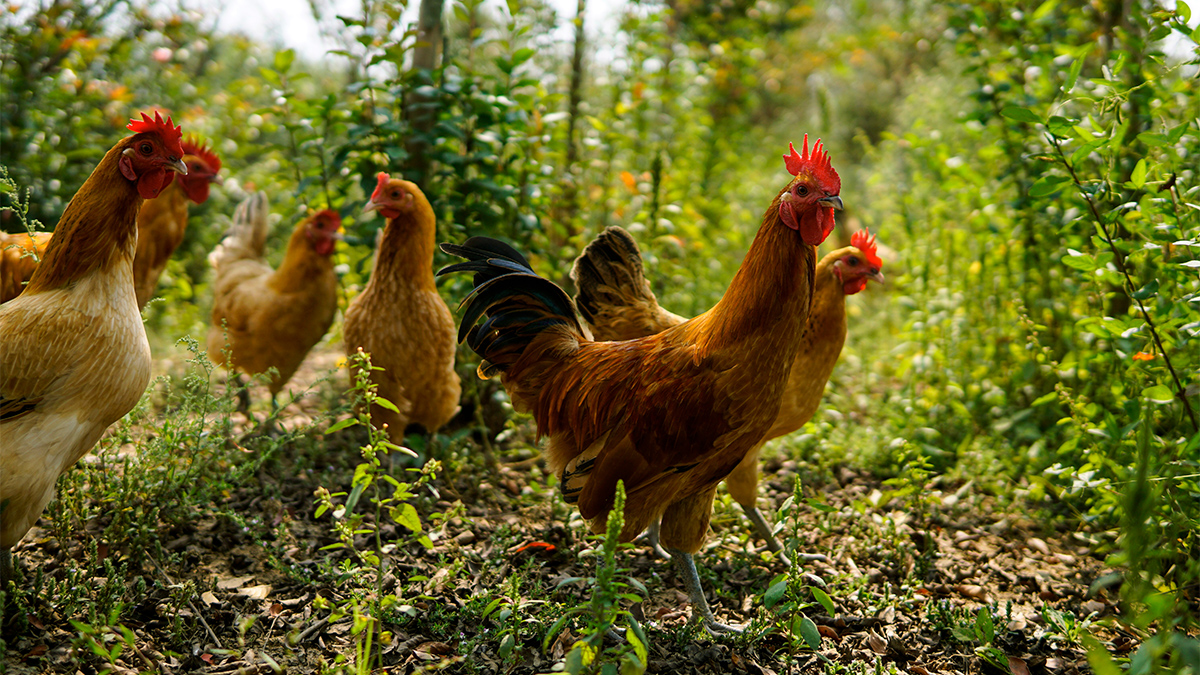
Visionary agricultural innovator Reginaldo Haslett-Marroquin unearths a startling natural-world template for building a global movement that puts the chicken at the heart of bioregional food systems. These Poultry-Centered Regenerative Agroforestry farms can both renew the land and ultimately support the hundreds of millions of small farmers who produce 70% of the world’s food.
This is an episode of Nature’s Genius, a Bioneers podcast series exploring how the sentient symphony of life holds the solutions we need to balance human civilization with living systems. Visit the series page to learn more.
Featuring
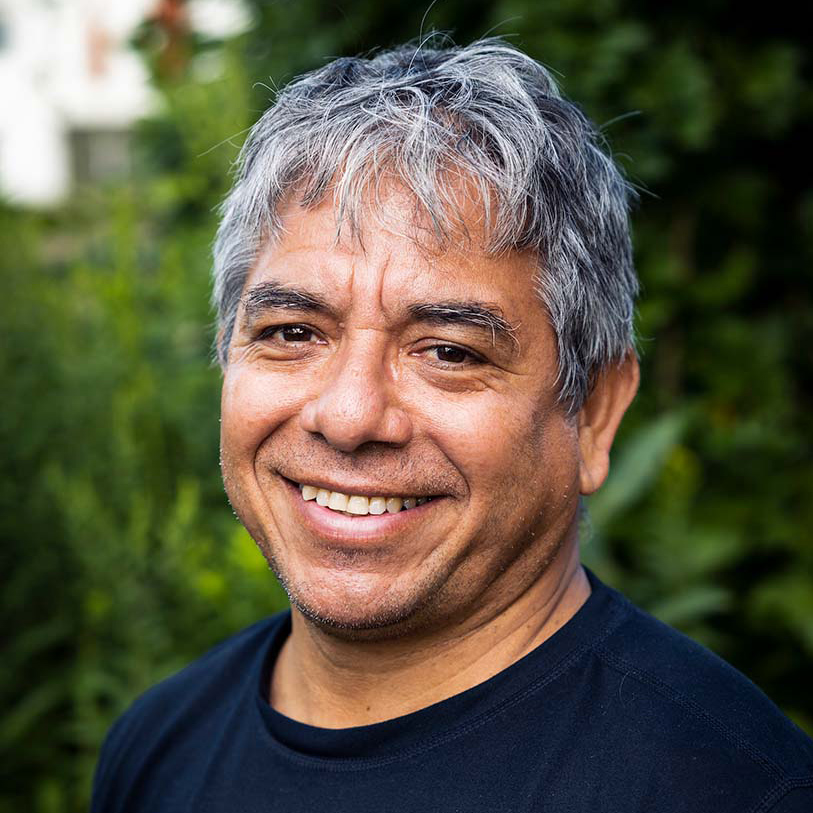
Reginaldo Haslett-Marroquin, is an award-winning agroecology innovator, co-founder and CEO of Tree-Range® Farms, a pioneer of the “Poultry-Centered Regenerative Agriculture System,” founder of the Regenerative Agriculture Alliance, and owner of Salvatierra Farms LLC, a 63-acre regenerative poultry farm in Northfield, MN.
Credits
- Executive Producer: Kenny Ausubel
- Written by: Kenny Ausubel
- Senior Producer and Station Relations: Stephanie Welch
- Producer: Teo Grossman
- Associate Producer: Emily Harris
- Host and Consulting Producer: Neil Harvey
- Production Assistance: Mika Anami
- Production Assistance: Arty Mangan
- Interview Recording Engineer: Ray Day
This limited series was produced as part of the Bioneers: Revolution from the Heart of Nature radio and podcast series. Visit the homepage to find out how to hear the program on your local station.
Subscribe to the Bioneers: Revolution from The Heart of Nature podcast







Transcript
Neil Harvey (Host): Why did the chicken cross the road?
If you pose that timeless riddle to the agricultural innovator Reginaldo Haslett-Marroquin, he might say something like this:
The chicken crossed the road to fulfill its ancestral blueprint to escape from predators in the shady multi-tiered canopy of shrubs and nut trees where it first originated as a jungle fowl, and where it can safely eat and contribute to the circles of energy flows that fertilize and regenerate the landscape – just by living out its natural lifeways.
Reginaldo says that this natural-world template provides the foundation for a bottom-up economic system big enough to challenge the ecologically and economically extractive monopoly of industrial agribusiness. The model supports the vision of democratic ownership and cooperative governance of bioregional food systems. One critical design criterion was that the system must fit within the farm blueprints of the nearly 700 million small farmers who produce up to 70% of the world’s food on land averaging 60 acres.
Instead, today they live like indentured servants in a system that demands cheap, fast food and is controlled by giant global corporations. All of this comes at the expense of real nourishment and resilience coupled with the destruction of the very ecosystems on which we depend to feed the world.
So how does the chicken get us to this other side?
From Reginaldo Haslett-Marroquin’s youth in Guatemala, agriculture seemed to be his destiny. He spoke at a Bioneers conference.
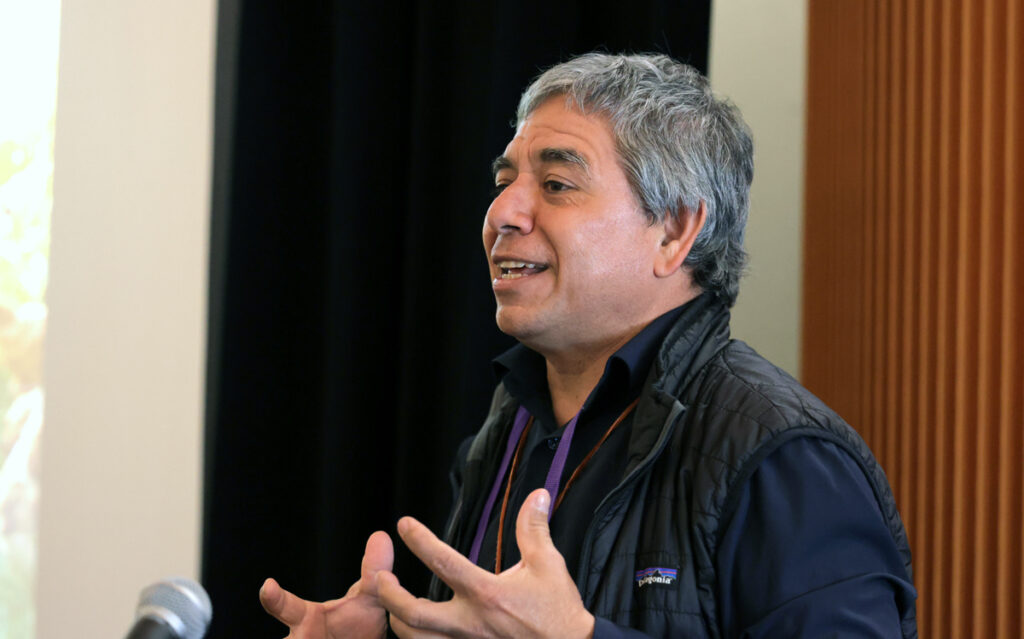
Reginaldo Haslett-Marroquin (RHM): I was 4 years old when the civil war started in Guatemala. We moved to the northern rainforest at that time. The militarization of the country really limited a lot of what we could do, and so we were literally confined to going to the school, which was also heavily militarized. Going back home, and then going to the forest, about an hour and a half away, where we grew our crops. And that really was my childhood—going to school and doing those things, and in the middle, playing soccer and doing all the things that kids do with the dream of going to the Escuela Nacional Central de Agricultura, the National School of Agriculture.
And so I worked since I was like 13 or so, I worked really hard. This was a scholarship-based boarding school. It was funded by the military a long time before any of the war started. And it was literally a public school dedicated to agriculture, and very strict, and very famous, coveted place where if you graduated from that school, you literally had a—you know, came to occupy this new space in the country because you would be respected, you had the knowledge, you got the—all of those things.
And so I really—I liked agriculture. I was also involved in it, but I wanted to conclude in there. That really where my life circled around that.
Host: After graduating from the esteemed Central National School of Agriculture, Reginaldo continued his studies at San Carlos University in Guatemala and then in Minnesota, where he has lived since 1993.
Throughout his life, he has focused on cultivating what he calls “the Indigenous intellect.”
RHM: I have always felt like I’m one of the wealthiest people on the planet, and I mean it not the way we understand wealth, necessarily, but from the perspective of, am living to the optimal potential that the geo-evolutionary blueprint of the Earth gave me to live with? Am I using everything I was made with? And if that’s true, then you are one of the wealthiest people on the planet. All the money in the world won’t do that for you. It can only be done from within.
I was raised to think beyond the immediate concerns. And one of the fascinating things that that does to your mind is that you learn to see things as a whole.
Systems, like in the U.S., if you look at the food and agriculture and beverage, is somewhere around 9-point-something trillion dollars. At the top there’s like 10 sectors that control 90, 95 percent of everything. Tyson alone controls 75 percent of the poultry in this country, Cargill 90 percent of the grain or something like that. That means like, how the heck did we get there to begin with? Well, we got there because we gave up ownership, control, and governance of the—one of the most important things in our planetary survival systems, which is food, water, and those things that are essential to our bodies to live. That is the foundation.

So I get to the U.S., and there’s this mass scale system. I studied it very thoroughly as a system—looked at every part that makes it – beef; pork; poultry, so you’ve got turkey, chickens and eggs; dairy, you’ve got the cows out there; grain sector; corn and soybeans dominating it; and then you’ve got other sectors. You’ve got fruits and vegetables, and all of these are within a very large pyramid. And within that context, we also have this mass accumulation of ownership, control and governance because it’s all part of that top. Right?
On the bottom of it is over 32 million people who provide everything that the pyramid needs to create that illusion that we call cheap food, and also to create the illusion that this is what’s feeding the world.
Now that lie is really right in your face if you use the Indigenous intellect, you see it straight up. There’s nothing hiding it. What we call the Indigenous intellect – which is formed through the innate intelligence we are born with, aggregating, observation, storytelling, listening, and telling them and experiencing life, and doing it in a real way. That’s what creates the Indigenous intellect. When you use that Indigenous intellect, you can be self-assured you’re on the right path.
Host: Reginaldo says the first thing to understand is that life on Earth is about flows of energy that come from nature and the cosmos. Those circles of continuous creation regenerate and renew life, creating conditions conducive to life.
RHM: As farmers, we are probably in the best place to understand that everything is energy, and all we do on a farm is– steward, cherish, manage, work with, relate to, however you want to call it. We are really relating to this space we call a farm, which lives inside a larger regional ecosystem, which lives among hundreds of thousands, millions of ecosystems across the planet, altogether forming the planetary ecosystem.
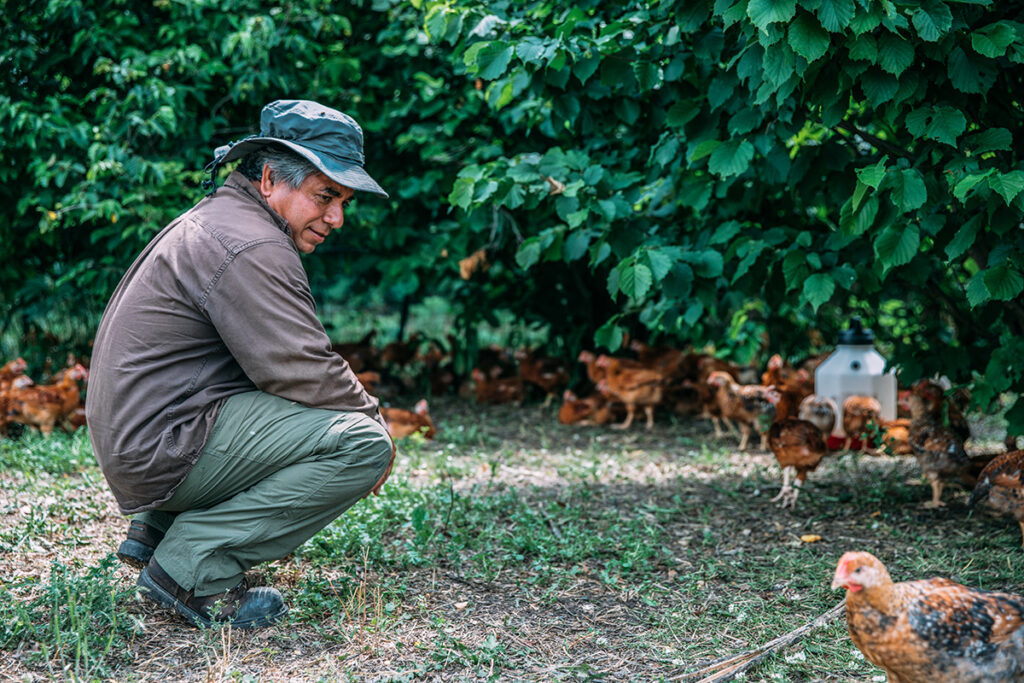
Now back to the farm where we go and maybe raise a chicken, plant a carrot, whatever we do, all we are doing is watching and hopefully caring for the biophysics and the chemistry that is going to get involved so that life can express itself in a different way. And at the end of the day, that is energy that, through the living processes, becomes expressed in the form of a carrot, a chicken, an egg, whatever it is. We don’t produce anything; we simply steward the processes by which that-that energy is transformed. That energy is only edible to us in a little blink of an eye of the processes of energy transformation, which is when we harvest it. That apple became an apple. We harvest, eat it, and it’s gone again.
Host: At the base of these energy flows is photosynthesis, nature’s magic trick of capturing sunlight to create life and make food. Plants absorb light and use it as an energy source to combine atmospheric carbon and hydrogen from water to form carbohydrates to feed the plant. Some of that carbon is sent into the soil where it builds soil health, creates climate stability, and feeds more carbon-based life forms.
On the farm, animals are essential to the regenerative process. Reginaldo compares their role to a planetary digestive tract.
RHM: It’s pretty much every species that depends on that photosynthesis in order to take—you know, get food, fiber, protein, minerals, whatever it needs, whether it’s bison eating the grasses or antelopes eating the leaves in the grass in the, you know, high plains, or whatever animal—literally the output of photosynthesis needs to go into a chewing, a biting, chewing, digestive mechanism before it—that energy can be turned into molecularly appropriate levels of energy that the microbes, the fungus, and everything else in the soil below are able to biophysically and chemically process so that it becomes again this source of energy for photosynthesis.
And so from the three of those, the animal is the more important. Photosynthesis without animals is just a lot of carbon sitting there.
Host: After a decade of R&D, Reginaldo founded the Regenerative Agricultural Alliance in 2018 with a clear strategic goal: to create a regenerative systems change model for one sector of land-based agriculture that could precipitate both an ecological and social transformation. That model is grounded in poultry farming, referred to as Poultry-Centered Regenerative Agroforestry, or PCRA.
Chickens are ubiquitous globally and fit in most cultures and ecologies. Their short lives, economic cycle, and ability to provide healthy protein of eggs and meat can impactfully address global hunger and rural poverty. The model is scalable to become a coordinated system of large-scale networks of small farms and infrastructure.
According to the United Nations, there are over 700 million farms globally that operate on under 60 acres – and every one of them could integrate poultry into their operations. Because this small-farm sector delivers 70 percent of the world’s food, it offers high-leverage systemic opportunities – from abundant healthy food production and regenerative land management to social and economic equity for the farmers and the larger food infrastructure.
At the base of the PCRA model is the return of the domesticated chicken to its ancestral blueprint. So naturally, Reginaldo and his colleagues looked back at the lifeways of its ancestor: the jungle fowl from Southeast Asia’s rainforests.
RHM: So jungle fowl, if you were into something regenerative, ask the species. Ask the oats, ask the trees, ask the chickens, ask and listen, and learn to learn so you may acquire the right knowledge to do things with the Indigenous intellect as opposed to just the stuff that we have been forced to memorize during the process of domestication we have gone through that we call education. It’s good for knowledge and facts, not very good for education. It’s very good for domestication, and so we are domesticated. And so we’ve got to un-domesticate ourselves, decolonize our minds, and decolonize knowledge and methodology so that then we can properly use all of this amazing stuff we went to school for.
So, jungle, ancestral, ancient chicken doesn’t like the outside, can’t be in an open area with sun. It goes toward the trees for the shade. You know, you take all of that profile, and now you can start saying, alright, so if I take the chicken, and my goal is to return it to its ancestral blueprint so that it will optimize energy transformation as a foundation.
Host: When we return, Reginaldo refines the chicken’s ancestral blueprint to create a “greenprint” for transforming agriculture into a cycle of regeneration and equity…
To learn more about how restorative food systems can be a source of community wealth building, right livelihood, and health for people and land, you can subscribe to the Bioneers Food Web newsletter at bioneers.org

Host: Alongside the Regenerative Agriculture Alliance team, Reginaldo designed a sophisticated shrub and tree canopy system that incorporates all the ancestral elements for a symbiotic and regenerative habitat for chickens to thrive.
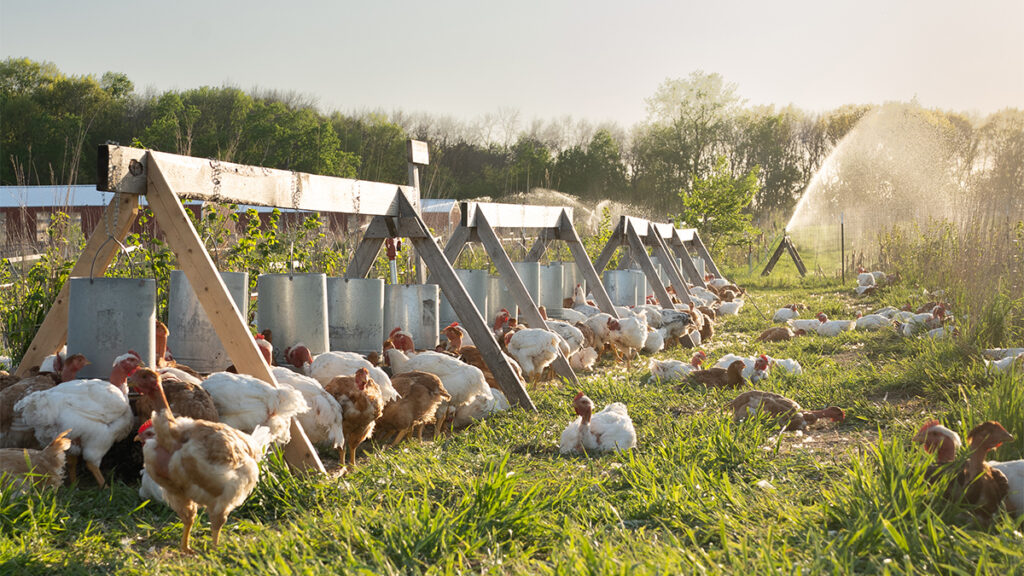
First, they start chicks in a barn where they get protection from heat, cold, wind, and predators. A month later, the chickens are put in a rotating paddock system where they range on the land, safely enclosed. The paddocks mimic their ancestral habitat, the jungle, with multi-layered stories. Then the team selects the botanical and vegetable species specifically for the nitrogen-cycling capacity, and they customize the plants to each unique place and conditions.
In this metaphor, Reginaldo Haslett-Marroquin explains how the intelligence of nature and coevolution provide multiple benefits for both plants and animals. The innovation in this model mimics ancestral blueprints by bringing together domesticated chickens and Hazelnut trees.
RHM: And sometimes, many thousands, hundreds of thousands of years ago, the chickens and the hazelnuts had a gathering, and they discussed their symbiotic relationship, and the hazelnut said, I need a lot of nitrogen to produce nuts because, for the most part, my nuts are always empty because I don’t have enough.
And the chicken said, well, listen, when the hawks come around, and the eagles and stuff, they get me very easily because the canopies here are kind of shrubbery and not very good.
So the hazelnut said, you know what? Instead of like the European cousins that created these trunks and became trees, we’re not going to do that, we’re going to be shrubs. And so they started to develop these shrubs. And we will make sure that as we do that, no hawk, no eagle, no predator that will eat you can perch on top. We’ll make it multi-layered so that we can create 100 percent cover and nothing can see you.. And that’s what they did!
Host: Following the ancestral blueprint, the whole becomes far greater than the sum of the parts.
RHM: And guess what happens when the chickens are out there having a good time and a hawk comes by, and he goes like, oh! And he runs under the tree. Well, as they scare them and all that, just like other species, they poop. And that’s what the tree wants.
So when you ask the tree, and you do some research, you find out that they can take 350 to 400 pounds of nitrogen per acre. Their roots can actually travel seven-and-a-half feet in each direction, 12 feet up and 12 feet down, creating this mass-scale network for capturing energy and transforming it into this absolutely nutrient-dense, superb food.
Take a sample of our hazelnuts now that we have raised them with chickens for 15 years. The list of nutrients is endless. And that’s because the chickens are there. Without the chickens, for example, we don’t have chickens in some of the experimental plots, the hazelnuts are producing half as many, and 35 percent of the nuts are empty. And with the chickens, they are producing twice as many hazelnuts. They are heavier because they got more dense, more nutrients and all that. And only five percent are empty.
And when the hazelnut weevil came and started boring holes into the nuts, the scientists that were working with us said, oh, these are all the recipes that we can use to control the weevils. I said, no, no, no, no, no, no. We can’t control the weevil. The weevil will control itself. Let’s just give it time. Two years later, a mass scale population of these black-and-yellow spiders rose up, and now we have weevils, spiders and everything, and only about five to ten percent damage. It’s not a problem as long as you don’t make it a problem.
Host: Reginaldo says that once you apply the Indigenous intellect, nature’s principles guide the way for how to grow a production system that optimizes regenerative energies.
The farms that produce the Tree Range Chicken brand grow plants to attract vital pollinators. They cultivate the healthy garlic that chickens love. They grow beans using only on-farm inputs, such as chicken manure mixed with organic matter. Now the economics are ready to branch off the farm into the supply chain and the larger food system.
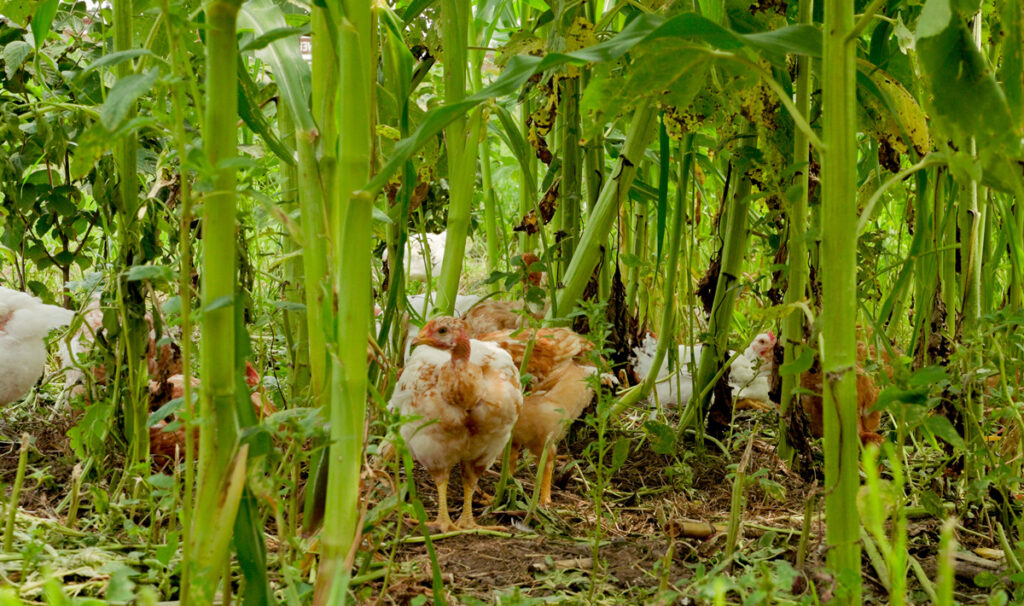
RHM: We are starting to do it now at a significant scale, significant scale that we can take a whole farm and fertilize it with this in one year, so that is all the input that they need. And so those are outputs of the system – valuable economically.
Hazelnuts – we have been producing hazelnuts now for five years. About 7,000 new trees are about to enter into production, and every year we are planting thousands every fall and spring. We’ve got our own nurseries now. We tested 250 vegetables to see if they will grow 100 percent with just these inputs, nothing else, not even insecticides or herbicides or anything, just this mix that we are talking about. And have successfully achieved results.
We measure everything, of course. I mean, if you don’t measure, you can’t manage. The best bean plant for black beans came out of Nicaragua national Central University – 100 beans on average per plant, about 30 pods, 35 inches high, planted about eight inches apart, 36 between rows. Okay? These beans came out of the same germplasm or genome. We’re now harvesting plants with up to 75 pods, over 250 beans per plant.
And it is 100 percent with no other input than the feed that came into the chicken, that came through the chicken, that became poop, that was mixed with organic matter that went into the bean field. We already invested in that input.
And now that we added grain producers to the ecosystem of enterprises, now it’s just starting to circulate in regions instead of just the farm. Now we can start talking about systems change.
Host: Reginaldo and his team steadily refine economical methods of raising the chickens. Those numbers must and do respect the ecological boundaries of the land and forage so that they regenerate. The regimen employs crop rotation and perennial cover crops. A basic unit of farmland is increments of 1.5 acres – a small-but-mighty challenge to the agribusiness imperative of “get big or get out.”
Reginaldo says the model can be adapted for any community based on factors such as climate and what plant species are native to the area. In his native Guatemala where the model is spreading, the protocols include bananas, yucca, yams, and a dozen other forest species that enhance productivity. They must also fit local market demand, provide food security, and renew perennial cover to the land.
To compete with agribusiness, the decentralized system has to be able to grow big enough. Today, an expanding network of over 40 farms is raising chickens in alignment with the Poultry-Centered Regenerative Agroforestry blueprint. The chicken from many of these farms is brought to market under the Tree-Range® Chicken brand, providing the backbone for a regional system-change throughout the Midwest.
RHM: Building the farm, the unit, the farm, all of those, is not sufficient. If you want to achieve some system level outcomes, you’ve got to start thinking bigger than that. So we launched a nonprofit. It’s called the Regenerative Agriculture Alliance, so we could coordinate curriculum, training, development, training teams, training farmers, further doing research and development, and all of that. We are now one of the leading institutions globally doing this kind of work.
With the nonprofit in place, then we went over and bought a poultry processing facility in Iowa because we needed a poultry processing facility. And then after that, we launched a brand. It’s called Tree-Range Chicken, and that brand is under Tree-Range Farms. You can look it up. You can buy it anywhere in the country. It’s distributed for us by 99 counties out of Iowa.
With all of these pieces in place, we launched a transportation company that is within the ecosystem that takes the chickens from the farms to the plant. We are about to make a decision on whether we build our own freezing warehouses now, out of Alberta Lea or Rochester, one of these places. We entered into partnership with the state. They finance the development of the concept[?] for industrial development park.
Every time we do this, more chickens are produced, more people are eating this kind of chicken, more farmers are involved, more of this ecosystem is formed, and more acreage and change keeps happening. That is how we chip at the bottom of the pyramid. We’re well known even though economically we’re not really that large. We barely sold $1 million worth of chicken. But we have moved over $10 million of resources and there is over 34 million of property, plants, and equipment in the system.
So the ecosystem as a whole includes up to 20 enterprise sectors. One of them is the production of chicken on the farm. There are processing facilities now that we are developing for further processing, so bringing in grinding and mixing. We’ll be bringing oil extraction for the hazelnuts, elixirs and medicine for the elderberries, cough syrup. I mean, garlic salt, because garlic and chickens go together so perfectly. If you look at the profile of nutrient demands from garlic and the nutrient profile that supplies the chicken, it’s like 1:1.
So once we do this, then we start thinking about regions so that we can then take back the ownership, control and governance of at least one sector.
If we can do this, then every other sector can be done the same way. And if other sectors are doing the same thing, along with us, all we have to do at a certain point is come together, and that is a real coup. That’s the kind of coup I would like to see in my lifetime.
Host: Balancing environmental, financial, and social well-being is a core holistic management principle. Regeneration, with all of its environmental and climate benefits, also needs to elevate the people who work the land.
RHM: We start with the farmer. If the farmer doesn’t get a margin, it isn’t worth it. It is the blood of the system. If we can’t codify that properly, forget about the rest of it. And so we did that first. And from there we built the margins for the other operations to at least break even.
In this world, we don’t have to create profit in the way the extractive, colonizing linear mind understands profit. For there to be profit in the traditional way we understand it, somebody’s got to give it up. You’ve got to take it from someone. But in the context of quality of life and regeneration, why would I need a profit if I pay myself well, I cover all my expenses, I have a community, I’ve got food, shelter, and all of that was paid for as part of the process. What is the meaning of profit in that context? And this is the ancestral Indigenous way of thinking and relating, and this is why, especially the U.S., tried to obliterate the Indigenous communities across the world, because they—an Indigenous mindset is—you can’t colonize it. There’s no space for it.
Host: The final goal of the system is ambitious: to produce and distribute 440 million meat chickens or around 5% of the market, Reginaldo believes a tipping point can be reached at around 1% of the market. From there, the system can accelerate and reach scale.
As Chief Systems and Strategy Innovation Officer, Reginaldo is turning his attention to the people who are still connected to the land and committed to protecting and regenerating it – hundreds of millions of small farmers the world over, as well as the 370 million Indigenous people who still occupy a fifth of the total global landmass. He believes they are our best hope.
What Reginaldo describes is a direct challenge to the ferociously profit-hungry pyramid of industrial agribusiness.
So how does the chicken cross THIS road?
RHM: This is how governance structure resembles our ancestral community-based systems where you place all the stakeholders in the circle. They are the guardians of the system. In this case, you could use the poultry producers. Or you put the poultry producers in one section, the grain producers in another, the investors in another, customers in another, and you make it about everyone. You can do whatever you want with this. The diagram is a mental construct of how we’re supposed to organize governance.
And then each one of those affinity groups elects representatives, and then those representatives become concentrically part of our permanent governing structure.
So… I hope that you won’t walk away thinking what we do is chickens. Chicken is the center of a large-scale, fully developed, systemically structured discipline, launched and managed, scientifically verifiable process by which we can change systems.
We can’t recruit you; we can’t do anything except be there when you’re ready. And that is the best way to build an insurgency. It’s completely voluntary, it’s completely self-driven, it’s completely about passion…Circles need to birth out of each region for us to make this change happen.
Host: Reginaldo Haslett Marroquin, “How the Chicken Crossed the Road to Build a Regenerative Food System”.