Interview with Storyteller Grayhawk Perkins
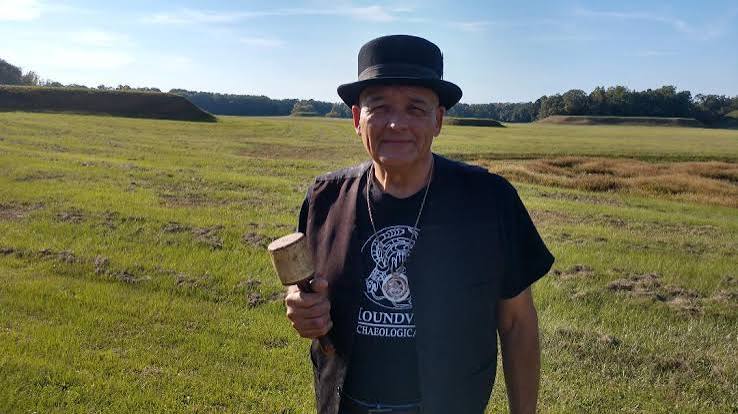
Grayhawk Perkins is a renowned storyteller, musician, language keeper, carpenter, and educator. For 35 years, he has taught students in New Orleans the importance of writing, storytelling, and understanding the history, culture, and people of Southeast Louisiana. He has curated and run the Native American Village Stage at the New Orleans Jazz and Heritage Festival for 50 years.
Grayhawk has also shared his gifts and knowledge with the Audubon Nature Center, the Louisiana State Park, and the Smithsonian Museum. His band, “The Grayhawk Band,” blends New Orleans jazz and Mobilian language. They were invited to Paris to perform at Musée de l’Homme (the Louvre’s sister museum) when the Saints played. Grayhawk Perkins has touched countless lives through his art, music, and dedication to preserving language and culture.
Bioneers’ Britt Gondolfi sat with Grayhawk to learn what he believes young people and elders need from each other in these critical times. He spoke to the importance of intergenerational movement-building and shared insights about his latest book, Native American Folktales.
BRITT: Tell me about the book that you just wrote. Why did you write it?
GRAYHAWK: Well, people think that Native American stories, all our stories, were in the past, 100 years old, 1,000 years old, whatever, and it’s not true. You know? We need to write about the past, but we also need to write about the present and the future.
A lot of stories were written years and years ago; they sat down, and they looked at things like the birds and the animals, and looked at the characteristics of these creatures,and they wrote stories about these animals. Every story that’s written about an animal, if you break it down – you know, crawfish and opossum and the raccoon – there are people with those characteristics.
I want people to know the characteristics of those animals and why Native Americans pick animal names. Why? Because certain people have characteristics of those animals.
If I call someone a worm, that means they’re self-centered. They feed off of other people. So a person that’s a worm person feeds off of others. A worm doesn’t need anybody. They don’t even need another animal to reproduce. You know? They’re very self-centered and they feed off of the dead. They feed off of other things.
A mouse person? In a European sense, they call them meek and mild. But a mouse is not. It’s very arrogant. It’s very greedy. And it’s very near-sighted. And if a person is very near-sighted, greedy and self-centered, they’re a mouse person. So they would be called a mouse.
The bear is family-oriented, very protective. So the bear story I got in there shows how protective the mama was to that baby. Even though the baby did something that was wrong, she did not hurt that baby or get angry at that baby. She hugged that baby and loved that baby.
I wrote about the opossum, how it’s very trusting, but sometimes being so trusting, you wind up being too trusting and you wind up getting hurt. So that’s an opossum person.
Then the raccoon person is the one that’s very jealous, very arrogant.
So each one, if you look at each story, you go, wow, I know somebody like that, or I’m like that. You know? It’s not just a fairy tale book. It’s not just folklore. It goes a lot deeper than that. And Native American stories were meant to be that way, each story means something.
There wasn’t really a crawfish big enough to help build the Earth, but the story shows that something that small can build a chimney that big. Size don’t mean everything. Sometimes the smallest things can be very powerful. You know?
So I wanted to write a book that when you finish reading it, you go back and read it again, and each time you read it, you get something new out of each story. You realize there was a lot more than just the raccoon or the deer. Or the deer and the rabbit. That rabbit was very arrogant. He thought he was better than anything because he was given a gift. But the deer kept saying, “You abuse that gift, you’re going to wind up losing it.” In real life, if people abuse a certain thing, they end up losing it and never get it back.
Some people made it and some people didn’t make it in some of these stories. Why didn’t they make it? Because they didn’t listen. The hardship happened because they didn’t pay attention. They went through life so fast, like the ant pile story. The young man figured that out that all these times he’d been passing these areas, never once did he see the things he passed every day until his grandmother got him to look for that ant pile, and he slowed down. So it shows how if you go through life too fast, you miss a lot of things that you’re looking for. That’s the stuff that I want to pass on to other people.
It’s no different than Lewis Carroll wrote about Alice in Wonderland, talking about the things that were going on in Parliament, things that were going on with government at that time. He did it as a storybook, as a children’s book, but it wasn’t just for children. It was political.Sometimes you have to write it that way. You know?
My book is no different than Aesop, no different than Brothers Grimm. They were writing about things that were going on at that time, and I’m doing the same thing. And it’s only the first book, because there are about 100 more animals I’ve got to write about.
We need to write about the past. We also need to write about the present and the future, and have stories that are written down that future generations can say: These are our stories. These are Houma stories. Why do we have the egret feathers? Why do we have the blue heron feathers? What about the owl?
Every story that I write personally, that comes out of my head, that’s a Houma story. You know? No different than the person that wrote those stories back 300, 400, 500 years ago. We have not stopped. We still need to write.
That’s why I wrote the book, not only to have our kids have something to say is ours, it’s Houma, but also to encourage the next generation to say: Don’t stop. When I stop (living), you don’t stop. Keep it going. That’s why I really would love to have classes to teach young Native people, to get that mindset of, you’re responsible for stories that are going to be told in the future.
Not all stories come from ancestors 1,000 years ago. They’re also going to come from us right now. We don’t stop. We have to just keep going.

BRITT: So we should all keep creating…
GRAYHAWK: Keep creating and keep looking at what’s going on around us and picking those things out.
I notice that as I write all these stories, I get to be a better person because I’m writing about things that maybe I experienced and I was at one time, and I’m not that anymore because of me writing and reviewing the stories, and going, wow, I don’t want to be that. You know?
So it’s just not a children’s book. I have people who are 80 years old and sat down and read the book from cover to cover and go, “God, that was me,” or “That’s me,” or “I know someone like that.”
BRITT: Do you have any message that you’d like to share with our youth and elders that are going to be gathering in New Orleans about the purpose of bringing together youth and elders?
GRAYHAWK: Well, I think my message is: Elders, you need to spend more time with the young. And the young: you need to sit and listen to the elders, and just pay attention to the elders a little bit more. Not all elders have earned to be elders.
No matter how old you get, don’t think you know everything. I learn from young people all the time, and I always did. Even my first, second, third, fourth graders – every day I learn something from them. The day you think you know everything, dig a hole and crawl in and die, because there’s not going to be a day you can say “I know everything.”
So let those kids know. And so elders and youth need to get together and learn together, to share. And if we do that together, how can anybody beat us? How can any of us ever get depressed? How can any of us ever feel like failures if we have that unity and we work together like that? There’s no way none of us can be a failure.
But if we separate each other, like we’re doing, the women away from the men, the men away from the women, children away from the elders, we’re weak when we do that. But if we all work together as a team, we can’t be beat.
And us being at this conference, I want those elders not just coming there to teach, but also as an elder to watch and look at those children and see what they’re doing, and how they’re acting, and what they’re reacting to, and say, “What can I contribute to make their life better?” And those kids realize that those elders over there, “What can I learn from them that’s going to make my life easier that they’ve been through?”
BRITT: And what can we do together?
GRAYHAWK: Yeah, what can we do together to support each other? Because if an elder is sitting there and feels: “What am I here for? What can I contribute?” And they start getting depressed and nobody comes to them anymore, to even talk, then that person gets to the point where they don’t interact with anybody anymore, wouldn’t you lose it? And then one day, you’re 40 or 50 years old and “My god, I wish I would have sat with him.”
But I can’t say that, because I did it, from day one. For every elder or any person that I was able to sit with, I sat and I listened, and I learned.
They need to know that. Not just sit on the computer all day, not sit on their phone all day, but they need personal interaction. You know? That’s my message.