Listening Is Not Neutral: New Ethical Guardrails for Animal Communication Technologies
Bioneers | Published: December 18, 2025 JusticeNature, Culture and Spirit Article
In recent years, scientists have begun using artificial intelligence to analyze animal communication at a previously impossible scale and level of precision. Machine learning models are being trained on thousands of whale vocalizations. Bioacoustic tools are parsing bird calls, rodent ultrasounds, and the complex signals exchanged by bees, dolphins, and elephants. What once required years of human observation can now happen in months or even days.
For the Bioneers community, this moment is not theoretical. Over many years, Bioneers has been honored to host and collaborate with researchers, legal scholars, and artists grappling with what it means to listen to the more-than-human world with care. In 2025, that work came into sharp focus when César Rodríguez-Garavito, founding director of the NYU More-Than-Human Life (MOTH) Program, joined Project CETI founder David Gruber on the Bioneers stage to explore both the promise and the peril of emerging animal communication technologies.
This emerging field of “nonhuman animal communication technologies” is often described in terms of its tantalizing promise. Researchers point to new insights into animal behavior, improved conservation strategies, and the possibility of understanding other species on their own terms. In a moment defined by ecological crisis, the idea of learning to listen more carefully to the living world carries obvious appeal.
But listening to and decoding other species’ communications, especially when mediated by powerful technologies, is not a neutral act.
As these tools advance, they raise difficult questions about power, responsibility, and restraint. What does it mean to translate another species’ communication through human-built systems? When does listening become surveillance, interference, or extraction? And how do we ensure that technologies developed in the name of care do not ultimately deepen harm?
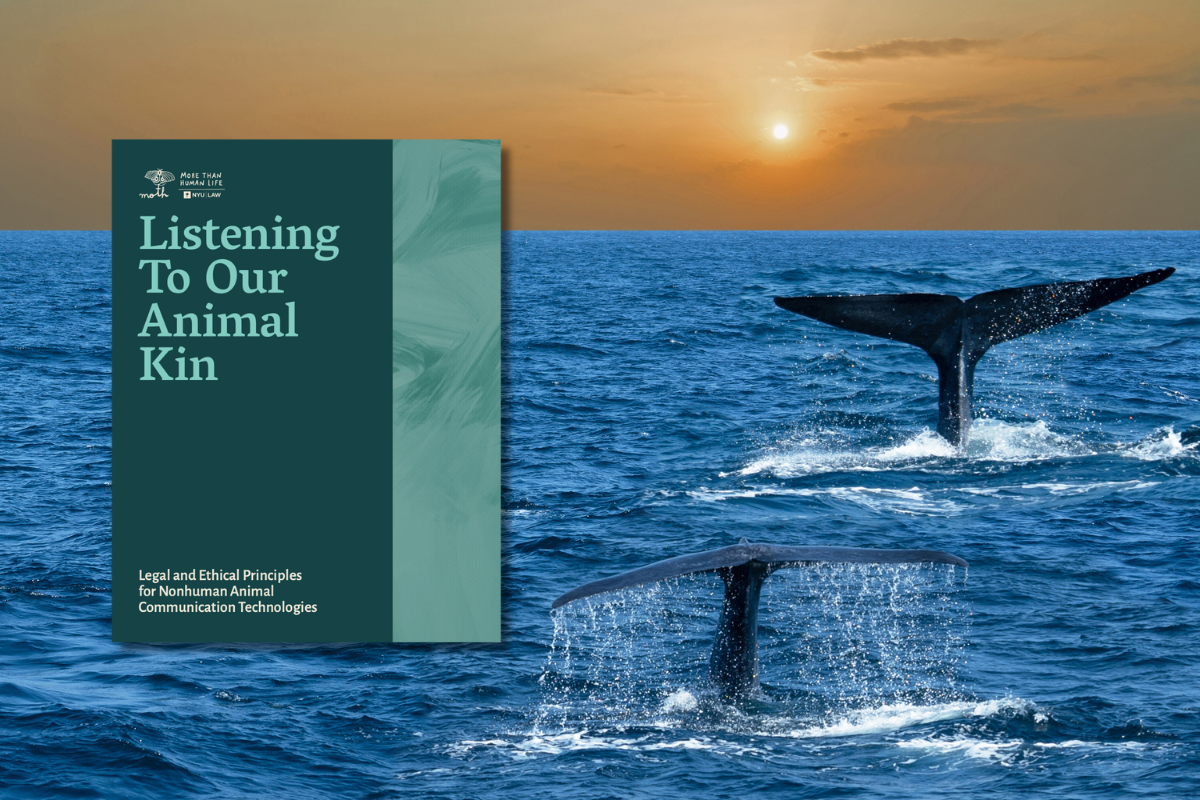
A new report from the NYU More-Than-Human Life (MOTH) Program suggests that the future of nonhuman animal communication technologies needs to be shaped as much by ethical considerations as by technical capabilities. At stake is not just how much we can learn about other species but whether we are prepared to engage them as kin, rather than resources, in a rapidly changing world.
What Are Nonhuman Animal Communication Technologies?
Nonhuman animal communication technologies — often shortened to NACTs — are tools designed to record, analyze, and sometimes respond to the ways other animals communicate. They draw on artificial intelligence, machine learning, and advanced computing to detect patterns in animal sounds, movements, and behaviors that would be difficult or impossible for humans to recognize on our own.
In practice, this can mean training AI models on thousands of whale vocalizations, analyzing ultrasonic calls made by rodents, or studying how birds or bees signal to one another within complex social systems. Most current efforts focus on listening rather than “talking back”: collecting large datasets and using computational tools to better understand how animals communicate with each other in the wild.
At present, the vast majority of NACTs are still in the research phase, developed and used by interdisciplinary scientific teams, but the field is expanding quickly. As interest grows, so does the possibility that these technologies could move beyond carefully controlled research settings into consumer-facing apps that claim to translate pets’ emotions, or into commercial and even military applications that use animals as sources of data, labor, or surveillance.
That distinction matters. The ethical questions raised by careful scientific listening are not the same as those raised by commodification, mass deployment, or use by untrained or nefarious actors. Understanding where and how these technologies are applied may determine whether they deepen our relationship with the more-than-human world or further exploit it.

The Overlooked Risks of “Listening”
The idea of listening to other species carries an intuitive sense of care, but as the MOTH report makes clear, listening through powerful technologies can introduce new forms of harm, especially when those tools are deployed without strong ethical guardrails, and the risks extend far beyond individual animals into the fabric of entire ecosystems.
Physical harms are often the most visible. Collecting data can involve tagging, sampling, or repeated human proximity, all of which can cause injury, exhaustion, or stress. Even noninvasive tools such as microphones or underwater playback devices can contribute to noise pollution, disrupting animals’ ability to navigate, hunt, or communicate. At larger scales, these risks multiply. If NACTs are commercialized or widely deployed, untrained users or military actors could use them to harass, exploit, or weaponize animals, turning living beings into tools for dubious human ends.
Less visible, but no less serious, are mental and emotional harms. Animals subjected to constant monitoring may experience chronic stress or confusion, particularly if unfamiliar sounds or signals are introduced into their environments. Attempts at “talking back” carry their own dangers: Hearing what seems like the voice of a fellow whale, bird, or dolphin — only to discover it originates from humans — could cause fear, disorientation, or grief. The report also raises a profound concern about privacy: What does it mean to extract and store intimate details of animals’ lives when they cannot consent or understand how that data will be used?
Beyond individuals, NACTs can produce relational harms by disrupting social bonds and collective behaviors. Many species rely on communication to coordinate migration, care for young, share knowledge, and maintain kinship networks. Interference, whether through noise, surveillance, or behavioral manipulation, can fracture these systems, weakening communities in ways that are difficult to detect until damage is already done.
Finally, there are ecological harms. Because species are embedded in complex, interdependent systems, disturbances rarely stop at a single animal or group. Disrupted communication can alter predator-prey relationships, migration routes, and reproductive success, triggering ripple effects that cascade across ecosystems. In a time of accelerating biodiversity loss, even small interventions can have outsized consequences.
A Deeper Ethical Shift: From Domination to Kinship
At its core, the debate over nonhuman animal communication technologies is not just about risk mitigation; it’s about worldview. The MOTH report invites a fundamental ethical shift, seeing animals not as data sources or experimental subjects, but as beings with their own lives, relationships, and intrinsic value.
This perspective moves away from anthropocentrism, which places human needs, knowledge, and convenience at the center of decision-making, and toward ecocentrism, which recognizes humans as participants in a wider web of life. From this vantage point, the goal of listening is not mastery or control, but relationship. Listening becomes an act of humility — an acknowledgment that other species communicate in ways shaped by senses, social structures, and intelligences very different from our own.
That distinction is important because technologies are never neutral. Tools designed to “translate” animal communication risk flattening rich, contextual forms of expression into human categories of meaning. When we prioritize what sounds familiar or intelligible to us, we may inadvertently privilege certain species, behaviors, or signals while ignoring or misinterpreting others. In the worst cases, translation becomes a form of extraction: pulling meaning out of animals to serve human curiosity, profit, or power.
The report argues instead for an ethic of kinship — one that asks humans to meet other species where they are, rather than demanding they speak in ways we recognize. This approach does not reject science or technology. It insists that innovation be guided by care, restraint, and respect for the autonomy of the more-than-human world. In a time of ecological unraveling, how we choose to listen may matter as much as what we hear.
Guardrails, Not Brakes: The PEPP Framework
The MOTH report is careful to make one thing clear: It is not an argument against technology. It does not call for halting research or abandoning innovation. Instead, it offers guardrails: ethical and legal principles designed to ensure that new tools meant to help us listen do not end up causing harm.
At the center of the report is the PEPP Framework, a set of principles organized around four core commitments: Prepare, Engage, Prevent, and Protect. Together, they form a values-based approach to the design and use of nonhuman animal communication technologies.
To prepare means grounding research in rigorous scientific design and strong ethical governance before technologies are deployed. To engage means consulting widely — not only with scientists and engineers, but with Indigenous knowledge holders, conservation experts, and others whose relationships with nonhuman life offer essential insight. To prevent harm requires taking precaution seriously, especially in the face of uncertainty, and placing the burden of justification on those introducing risk. And to protect means centering the autonomy, dignity, and best interests of animals themselves.
Across these pillars runs a consistent thread: transparency, accountability, and responsibility. The framework emphasizes that harms should be anticipated where possible, monitored continuously, and urgently addressed when they occur. In doing so, it reframes ethics not as an obstacle to discovery, but as a condition for research that truly serves life — human and more-than-human alike.
Why This Conversation Extends Beyond Researchers
While most nonhuman animal communication technologies are still being developed within scientific research settings, their implications extend far beyond the lab. Once tools exist, they rarely remain confined to their original context.
Funders influence which projects scale and which safeguards are prioritized. Tech companies shape how tools are packaged, marketed, and deployed. Conservation groups may adopt these technologies in the field, sometimes under pressure to act quickly in the face of ecological collapse. Policymakers determine whether meaningful oversight exists or whether a regulatory vacuum persists. And the public, increasingly exposed to simplified or sensationalized versions of “animal translation,” helps determine what becomes normalized, celebrated, or questioned.
The MOTH report argues that without shared standards, these technologies could spread faster than our collective ability to assess their consequences. Consumer apps, commercial ventures, or military uses could emerge long before ethical norms are firmly in place. Decisions made now about governance, accountability, and restraint will shape how widely and how responsibly these tools are used in the future.
In that sense, the question is not whether nonhuman animal communication technologies will affect the wider world, but whether we choose to guide that impact intentionally.
What It Would Mean to Truly Listen
Listening, the report suggests, is not simply a technical achievement. It is a moral practice.
To truly listen to other species may require slowing down rather than rushing ahead, resisting the urge to translate everything into human terms, and accepting that not all knowledge is ours to extract or use. It asks us to recognize that restraint can be a form of respect, and that responsibility grows alongside capability.
At a time when human activity already overwhelms much of the living world, learning to listen differently — with care, humility, and kinship — may be one of the most consequential choices we face. Not because it gives us more control over nature, but because it reminds us that we are part of it.
If these technologies are to help us reconnect with our animal kin, they must be guided by an ethic that honors relationship over domination and listening over mastery.