Making the Invisible Visible: Photographing Native Bees with Krystle Hickman
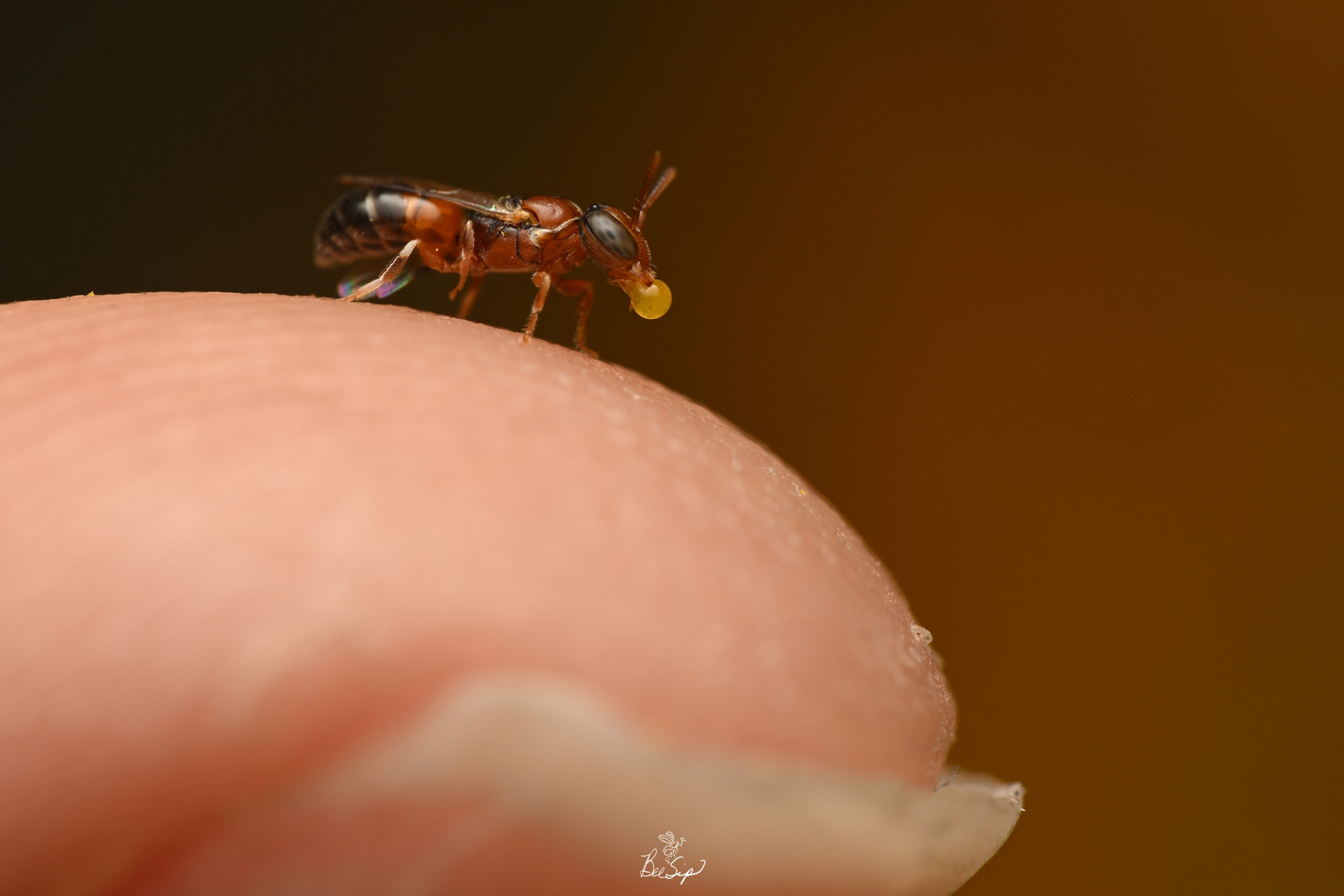
Bioneers | Published: January 14, 2026 ArtEnvironmental EducationFood and FarmingNature, Culture and SpiritRestoring Ecosystems Article
Bees are often talked about as a single, familiar species involved in pollination and threatened with decline due to environmental threats, but that shorthand obscures a far more complex reality. American non-native honeybees, which most people think of as “bees,” comprise only a few species, while there are, in fact, more than 20,000 species of wild bees worldwide, most of which are solitary, highly specialized, and deeply tied to specific plants and ecosystems. As climate change, habitat loss, and land-use decisions reshape those ecosystems, many of these native bees are quietly disappearing — often without being noticed at all.
Through photography, observation, and community science, Krystle Hickman has made it her work to change that. Based in Southern California, Hickman documents native bees in gardens, wildlands, and post-fire landscapes, capturing images that are both scientifically useful and visually arresting. In this conversation, she reflects on how she came to focus on native bees, what careful attention has revealed about their lives, and why supporting whole ecosystems — not just individual species — is essential for their future.
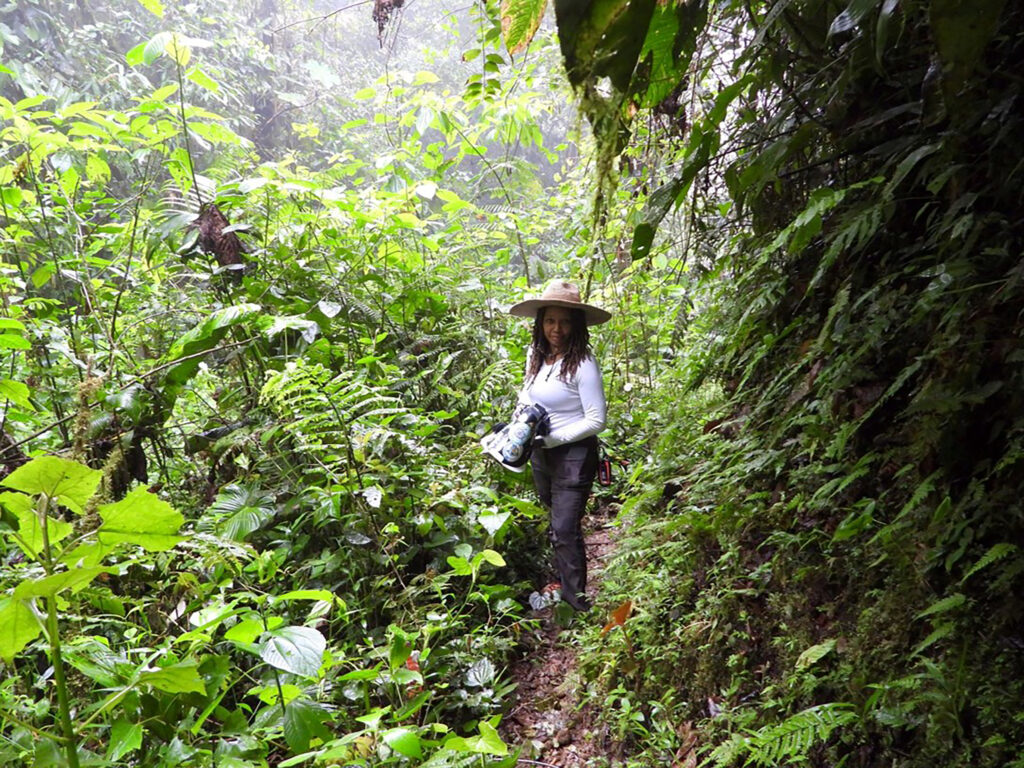
Bioneers: How did you get interested in photographing bees?
Krystle Hickman: It actually started with a misunderstanding. I saw a quote attributed to Einstein, “If the bee disappeared off the surface of the Earth, man would only have four years left to live,” and assumed it was real — and that it was about honeybees. Wanting to help, I went out and started photographing them.
Then, by accident, I photographed a bee I didn’t recognize. Beekeepers couldn’t identify it, so I posted it in a group with entomologists and melittologists. That’s when everything shifted. They told me it was a native bee, and they also corrected a lot of what I thought I knew. The quote wasn’t real, and honeybees weren’t the most at risk. Native bees were.
That completely reframed my work. I stopped focusing on honeybees and began documenting native bees instead, first in local gardens and then across Southern California. When I later captured the first known photographs of a living representative of a native bee species long thought lost — and documented behaviors that had never been observed before — I realized this could be more than a hobby. It was a real scientific contribution.
Not long after, I was invited to speak at a conference. At the time, I was working in finance, and I had to choose between staying at my job or following this work. I chose the conference, and from there, everything grew.
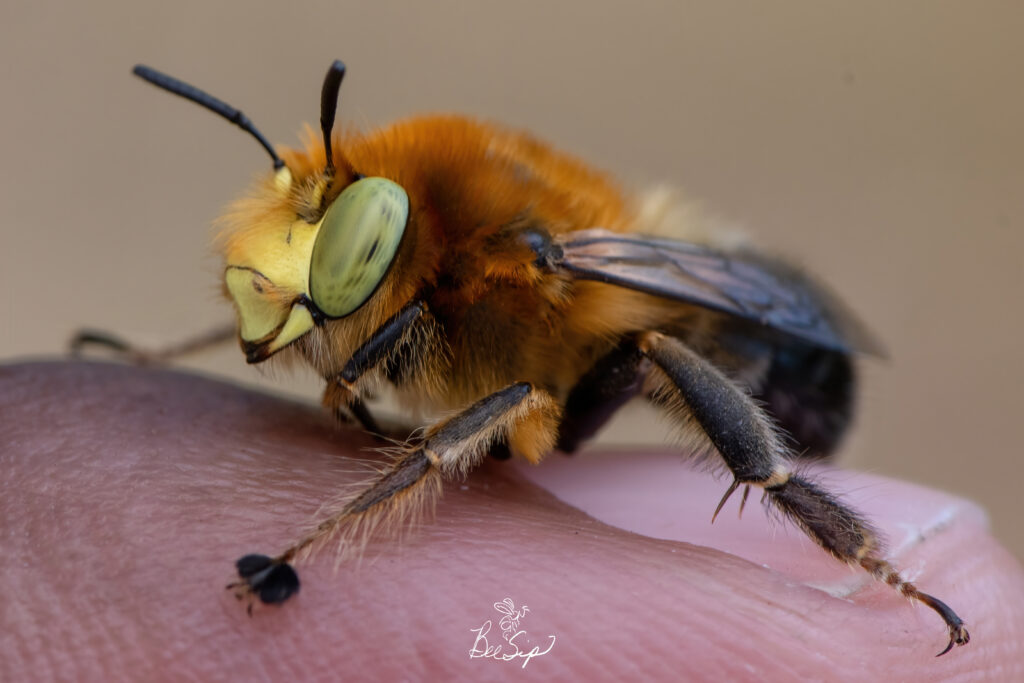
Bioneers: You describe yourself as an artist, photographer, and community scientist. How do those identities come together in your work with native bees?
Krystle: It’s kind of funny because they were originally supposed to be completely separate things, but being an artist really helps me take photos that people want to look at — images that feel beautiful and compelling. At the same time, being a community scientist and conservation photographer means I’ve learned how to photograph bees in ways that are useful for scientific identification.
So I’m trying to hold both of those things at once: creating images that draw in people who might not think of themselves as scientists, while also producing photographs that melittologists and other community scientists can actually use. A lot of these bees are tiny, easily overlooked, and rarely seen. My hope is that by making them visible and showing them as something worth paying attention to, more people will feel curious enough to get involved in community science themselves.
Bioneers: What do you wish more people understood about native bees?
Krystle: The first thing is just how many of them there are. Globally, there are over 20,000 species of bees, and honeybees only make up about eight of those. That’s roughly 0.04% of all bee species. So a lot of the information people hear about “bees” actually applies to a very small fraction of them.
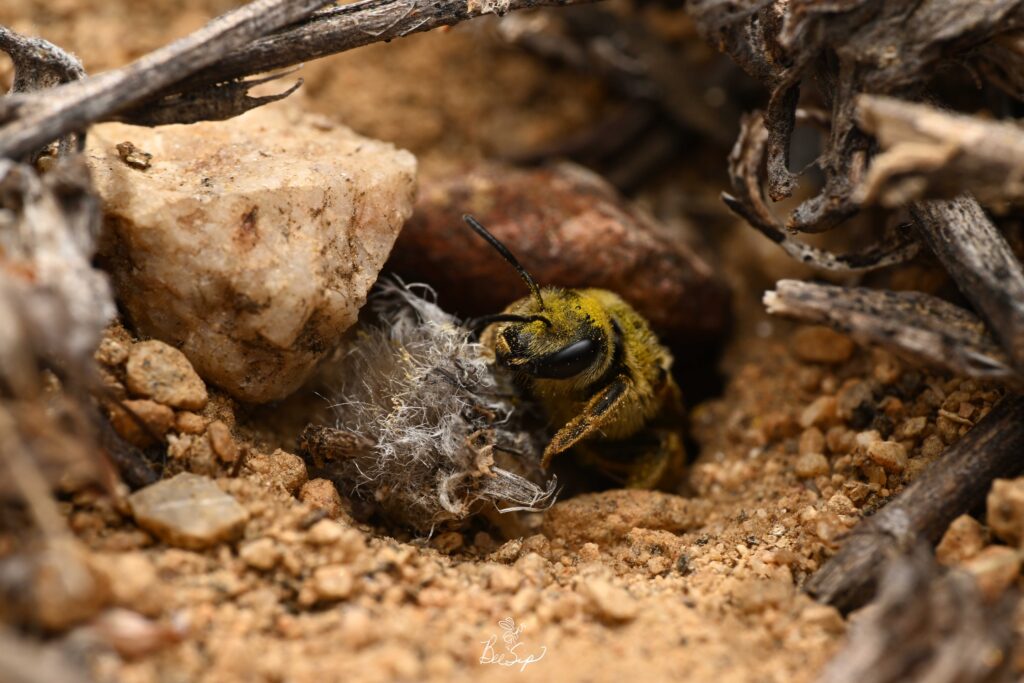
Most native bees live completely different lives from the ones we’re used to hearing about. About 90% are solitary — they don’t live in colonies or make honey. Many of them nest in the ground, and many are highly specialized, meaning they rely on specific plants or ecosystems. You can go from one ecosystem to another and find entirely different bees adapted to those places.
Native bees are also important indicator species. Changes in their populations — whether they’re increasing, declining, or disappearing — can tell us a lot about the health of an ecosystem and how it’s changing over time. When native bees start to struggle, it’s often a sign that something deeper is happening with the land itself.
For me, identification is part of how people start to care. Once you realize how diverse these bees are — how different they look, behave, and live — it becomes more than just “saving bees” in a general sense. It becomes about paying attention, noticing patterns, and understanding relationships.
Bioneers: There’s growing conversation about how efforts to support honeybees can sometimes create challenges for native bees. Can you explain what’s actually happening there?
Krystle: A lot of what we’re seeing comes down to ecological imbalance, especially in landscapes that humans have heavily altered.
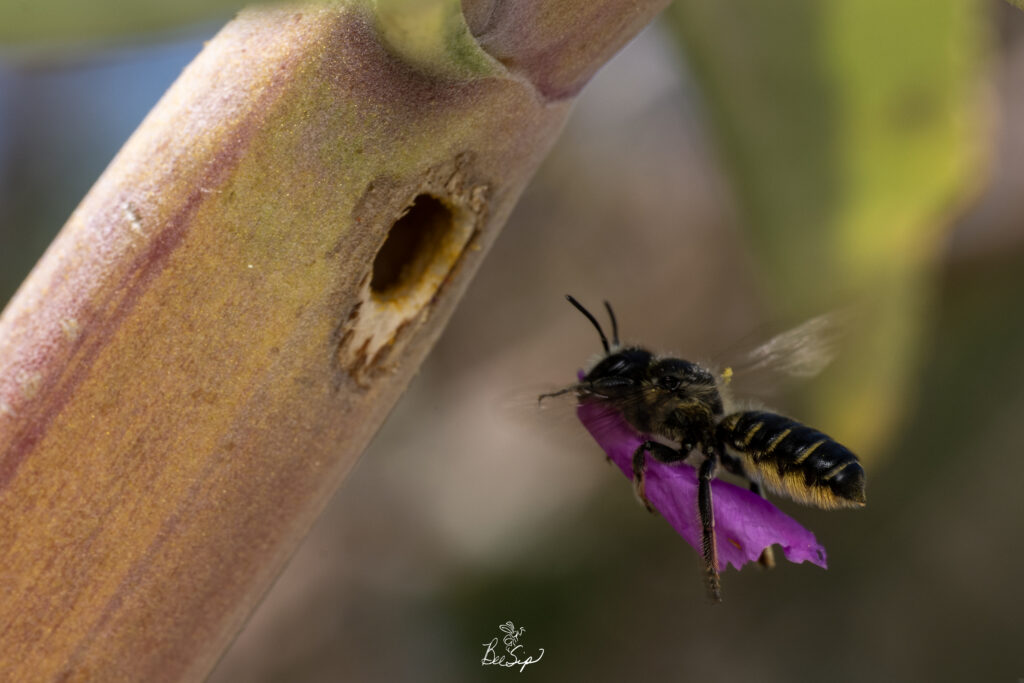
One of the clearer examples is disease transmission. Honeybees can carry things like deformed wing virus, which they often get from mites in managed colonies. Sometimes honeybees don’t show strong symptoms, but they can still spread the virus when they visit flowers. Native bees, such as bumblebees, can then pick up contaminated pollen and bring it back to their nests, where it affects the developing bees. We’re starting to see impacts from that spillover.
There’s also competition for resources, which becomes especially intense during drought years. Honeybees have several advantages that let them outcompete native pollinators. They can forage earlier in the morning and later into the evening, and many of the honeybees in the U.S. are a mix of European and African subspecies, which means they can tolerate extreme heat — even temperatures over 100 degrees. They also swarm. When they find a good food source, they recruit many more bees to that same patch of flowers very quickly.
Native bees don’t work that way. Most are solitary, many are specialists, and they often rely on very specific plants. So when honeybees dominate an area, especially when resources are scarce, native pollinators can get pushed out simply because there’s not enough left.
What this really points to is the need to focus on systems. Habitat diversity, land management, and restoring native ecosystems matter much more than singling out one species. When ecosystems are healthy and complex, native bees have a fighting chance to thrive alongside everything else.
Bioneers: What’s something you’ve learned about bees specifically because you slowed down enough to photograph them?
Krystle: They have routines. Once you spend enough time watching them, you start to realize they’re incredibly predictable in the best way.
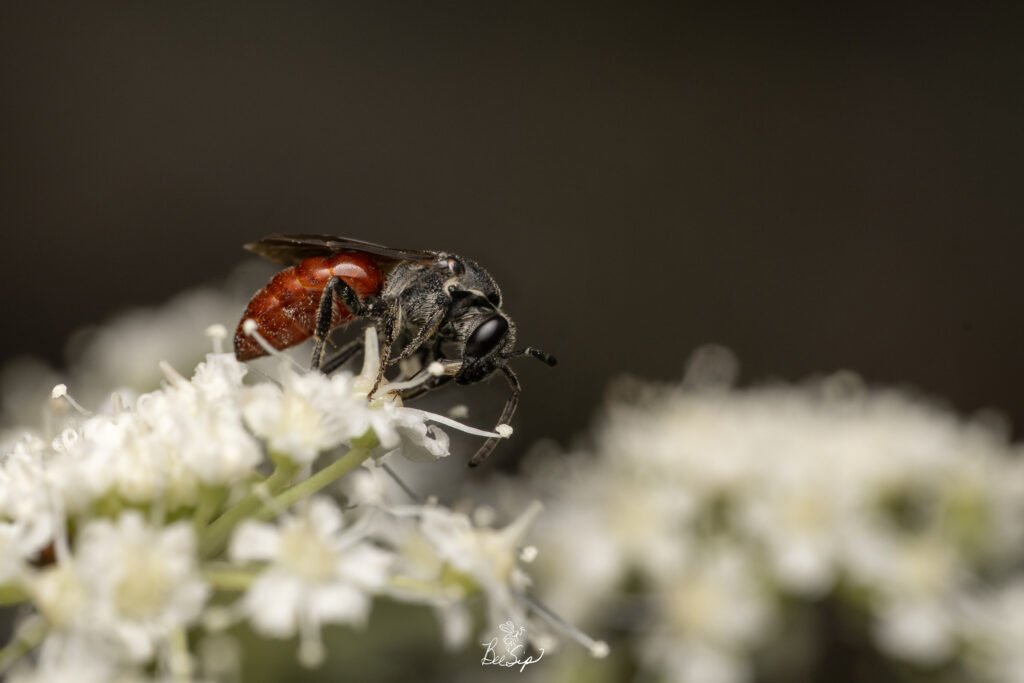
Male bees, in particular, are pretty easy to understand. They’re mostly motivated by eating and mating. They’ll sleep on plants, often right near where females visit, and you can find them at dusk and dawn. If you’re in an area and you see males sleeping nearby, you can usually assume there are female bees around too. What’s really interesting is that they often return to the same sleeping spot night after night.
They also have what I think of as a commute. They’ll take the same route from flower to flower, repeating it over and over again. If you pay attention long enough, you can predict where they’re going to land next. I’ll sometimes choose a flower that looks especially photogenic and just wait, knowing they’ll come back.
Female bees are motivated by something different. They’re focused on collecting pollen for their developing young and nectar for themselves. When you watch them on a plant with multiple blooms, like a salvia, you start to notice patterns in how they move — circling flowers in a certain order, repeating the same sequence each time. Over time, that repetition becomes really clear.
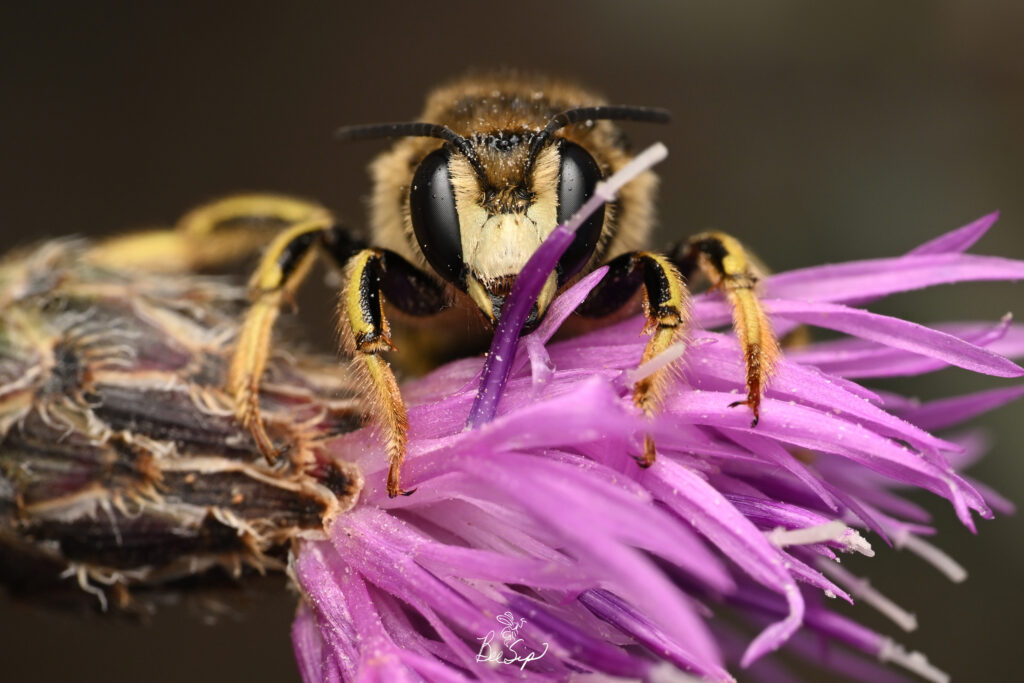
They also start to recognize you. Native bees can be skittish at first, but if you spend enough time in the same place, they get used to your presence. I’ve even noticed behavioral cues that help with identification. There are two genera — Habropoda and Anthophora — that look very similar, and traditionally, you tell them apart by wing venation. But I’ve found that if you stare at a female Anthophora long enough, she’ll actually stare back at you. That behavior has helped me differentiate them every single time so far.
You also see learning happening over a season. Bumblebees and other buzz-pollinating bees vibrate at specific frequencies to release pollen from certain flowers, like tomatoes. Early in the season, they’re not very good at it. But if you keep watching, they get better. They develop skills. Seeing that progression — watching bees learn and improve — is just as fascinating to me as photographing them.

Bioneers: You’ve talked about witnessing native bees return after wildfire, and more broadly about how climate change is reshaping their lives. What has seeing all of that up close changed for you?
Krystle: It’s been really reassuring, but also clarifying. One of the clearest examples for me was a friend’s backyard in a chaparral area that she had rewilded with native plants. She wasn’t doing it specifically for bees — she just loved those plants — but once that ecosystem was in place, everything followed. Birds showed up. Pollinators showed up. Predatory insects showed up. It became a healthy, biodiverse system that mirrored native chaparral.
Chaparral ecosystems are built to withstand fire, and many of the species that live in them are too. A lot of native bees are ground nesters, so when fire moves through, it often passes right over them. When the plants return and the flowers bloom again, the bees come back as well. Watching that cycle unfold really shifted how I think about resilience.
At the same time, climate change is disrupting the timing of everything. Bees are tightly linked to plant cycles — there are fire followers, rain followers — and when those rhythms get thrown off, you see ripple effects. In some years, invasive plants like mustard or certain grasses show up in huge numbers and crowd out native plants, and when native plants don’t emerge, native bee diversity drops.
I am seeing some generalist bees adapt faster, even starting to use plants they normally wouldn’t. But the pace of change right now is intense. We’re dealing with climate whiplash — drought and fire one year, heavy rain and early super blooms the next. We’re watching adaptation happen in real time, but we’re also seeing how destabilizing constant disruption can be.
What it reinforces for me is that saving bees isn’t about protecting a single species. It’s about supporting whole ecosystems. When systems are diverse and intact, they have a much better chance of absorbing disturbance and recovering.
Bioneers: There’s a lot of advice out there about how to help pollinators, and some of it can be confusing. Are there common things you see people doing that are well-intentioned, but not actually helpful for native bees?
Krystle: A lot of the confusion comes from the fact that many “bee-friendly” practices are designed for honeybees, not native bees.
For example, people are often told to leave out water for bees. That can help honeybees, but native bees usually get all the moisture they need from nectar or dew. Adding water stations can actually attract more honeybees and increase competition. Another issue is pesticide use. Spraying at night is sometimes recommended because honeybees are in their hives, but native bees often sleep in plants or nest in the ground, so they can end up more exposed.
What I’ve seen, especially in farming contexts, is that building healthy native habitat reduces the need for inputs altogether. When farmers integrate things like hedgerows and preserved wild areas, a diversity of native pollinators shows up, pest populations are naturally controlled, and yields often improve. Complexity creates resilience — when ecosystems are allowed to function, they start taking care of themselves.
Bioneers: For people who don’t have access to wild landscapes — maybe just a small yard or even a few plants — what’s the most meaningful way they can support native pollinators?
Krystle: Planting native plants is the single most powerful thing people can do. And I always tell people that nature doesn’t have to be somewhere you travel to — it can literally be in your own backyard.
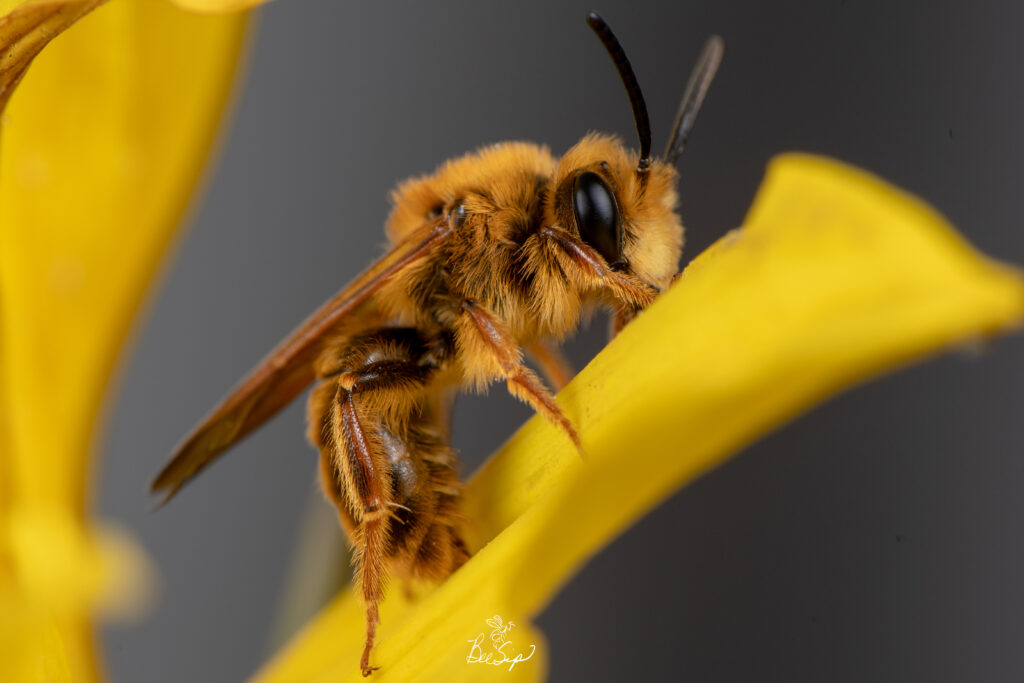
There are native bees that will show up in residential spaces if the right plants are there. One of the bees I feature in my book, the California poppy fairy bee, is a poppy specialist. If you plant poppies, there’s a chance that bee could show up in your yard. And what’s amazing about that species is that, as far as I know, no one has ever documented one of its burrows. So if you had those plants and took the time to look around carefully, you could actually be the first person to make a scientific contribution just by observing what’s happening in your own space.
With tools like iNaturalist and the cameras we all carry in our pockets, participation is more accessible than ever. You don’t need formal training or expensive equipment. You just need curiosity, patience, and a willingness to pay attention. When people start noticing what’s living alongside them, that awareness alone can lead to real care and protection.

Bioneers: Is there anything you want to make sure people take away from your work — especially those who might not see themselves as “scientists”?
Krystle: I think it’s really important to remember that anyone can be a scientist. A lot of people hear that word and picture someone in a lab coat, working in a sterile environment, but science can also be you out in your backyard with a camera or a phone, paying attention to what’s around you.
Observation itself is a contribution. Documenting what you see, noticing patterns, and sharing that information can actually help build knowledge, especially for species that are understudied or easily overlooked. You don’t need formal credentials to care, and you don’t need permission to participate.
Curiosity is often where care begins. When people take the time to notice the living world around them, they start to feel responsible for it. And that kind of attention is one of the most powerful tools we have.
All photos by Krystle Hickman.