The Native American LandBack Movement Reaches Urban America
Bioneers | Published: November 1, 2025 IndigeneityRestoring Ecosystems Podcasts
Corrina Gould is a celebrated activist of the First Peoples of the Bay Area and a leader in the LandBack Movement. She has helped forge a model for returning stolen land to Native American Tribes and restoring sacred sites in a defiant act of remembrance and resistance against cultural erasure.
Featuring

Corrina Gould, born and raised in the village of Huchiun (now known as Berkeley CA), is the Tribal Chair for the Confederated Villages of Lisjan Nation and co-founded and is the Lead Organizer for Indian People Organizing for Change, a small Native-run organization; as well as of the Sogorea Te’ Land Trust, an urban Indigenous women-led organization within her ancestral territory.
Credits
- Executive Producer: Kenny Ausubel
- Written by: Britny Cordera and Kenny Ausubel
- Senior Producer and Station Relations: Stephanie Welch
- Associate Producer: Emily Harris
- Producer: Teo Grossman
- Host and Consulting Producer: Neil Harvey
- Additional audio recordings courtesy of the Sacred Land Film Project at the Earth Island Institute and Stewie G
- Music provided by: Nagamo Publishing and APM
Resources
Landback: Restoring People, Place and Purpose
A conversation with Cara Romero, Corrina Gould, PennElys Droz, and Kawenniiosta Jock
Corrina Gould – Resilience and Rematriation | Bioneers 2025
California Genocide and Resilience and Returning to What Was Lost and Stolen with Corrina Gould | Indigeneity Conversations Podcast Series
This is an episode of the Bioneers: Revolution from the Heart of Nature series. Visit the radio and podcast homepage to find out how to hear the program on your local station and how to subscribe to the podcast.
Subscribe to the Bioneers: Revolution from The Heart of Nature podcast







Transcript
Neil Harvey (Host): LandBack is a Native-led movement that has existed, really, since European colonists first forcefully began seizing lands from Indigenous peoples who have inhabited and continue to care for them since time immemorial.
In the wake of centuries of land theft and broken treaties, the Landback movement has been garnering recognition and support as a way to repair these injustices and to heal the country’s relationships with its First Peoples.
Many of the lands that were illegally stolen and remain unceded are not by accident–often in the most wealthy, and expensive real estate in the country. It was also no accident that many California tribes’ treaties were never ratified, and so the tribes were not only decimated but also did not gain federal recognition with sovereign nation-to-nation status.
Unratified treaties impede a tribe’s nationhood as a self-governing entity. This continues to be used to prevent Native peoples from gathering freely and living on sacred lands. Defending these sacred sites is difficult for California tribes that do not have federal recognition.
This is the case with Corrina Gould’s tribe, the Confederated Villages of Lisjan/Ohlone, located in the San Francisco Bay Area.
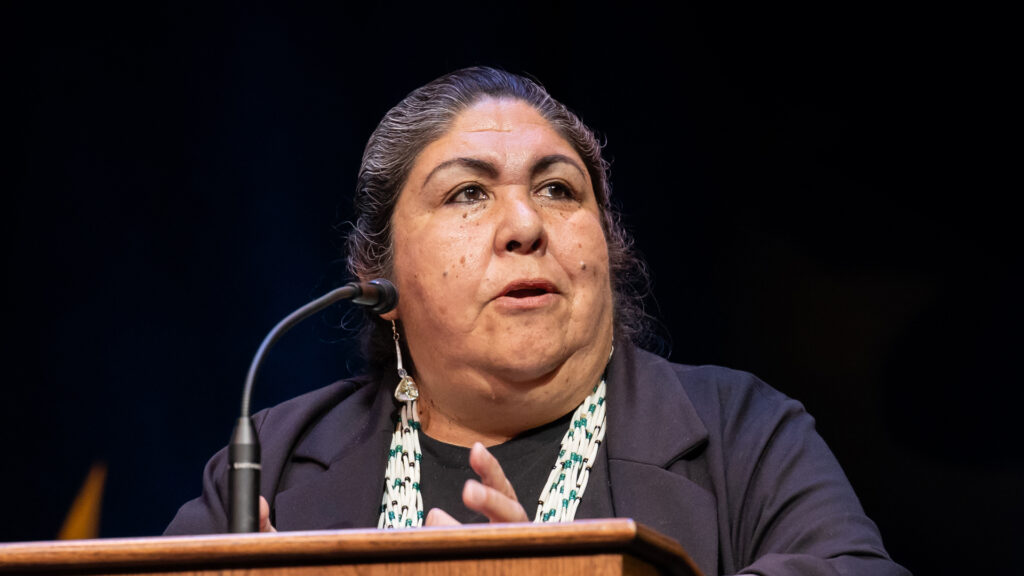
Corinna Gould spoke at a Bioneers Conference…
Corrina Gould (CG): I am often asked to come and do a land acknowledgement, and that’s always interesting to me. Right? Because land acknowledgements didn’t start here for a while. I mean, just a short while ago, right? But when we do land acknowledgements, it’s really about building reciprocity. It has to come with action items. It cannot just be words that we say and wrote. Many of us grew up saying the Pledge of Allegiance, and we can say it by rote but don’t remember what those words mean. And so the same cannot be true for land acknowledgements..
We cannot say ‘Welcome to this territory of Huchiun, the territory that embraced my ancestors, that we were created upon, that we were born to these lands and waters, that we have faced three waves of genocide and thank you very much. And so next on the agenda…’ [LAUGHTER] We can’t do that. Right?
So in this kind of way, it’s a weird kind of acknowledgement of this land, this land that we are asking people to come in to be good guests, to be good guests on our land so that we can be good hosts, that as Indigenous people, we are supposed to take care of people that come into our territories, gift them and have good times together, make sure that they get to the other side or back home safely. And yet, over all this time of colonization, we’ve not been able to be the good hosts that we’re supposed to be. And then we’re asked to do land acknowledgements.
Host: Corrina Gould is a celebrated leader and activist of the First Peoples of the Bay Area. As a leader in the Land Back movement, she’s committed to Indigenous sovereignty, cultural resurgence, and helping all people come into good relations with the land. The ancestral village sites of the Confederated Villages of Lisjan — some over 5,000 years old – are scattered across what’s now called the East Bay.
As the tribal chair of the Confederated Villages of Lisjan, she co-founded the Sogorea Te’ Land Trust with Johnella La Rose, a Shoshone Bannock activist. The intertribal, women-led, Indigenous urban land Trust works to rematriate stolen Ohlone land. Unlike “repatriation,” which centers on legal return, rematriation is about restoring sacred balance to heal the relationship between people and land, especially through the leadership and ceremony of Indigenous women.
CG: Tuushtak is our sacred mountain that we are born to. We are born to this mountain through a creation story of our own. We are the Lisjan people born to that waterway, and my ancestors have been here since the beginning of time. They were actually created at the top of this mountain.
This mountain, for thousands and thousands of years, was the sacred place that only our most sacred beings would go to the top and offer ceremony to. In a very short time, after people came here on that first wave, they were chasing my ancestors. And at the bottom of this mountain, they got lost, or they couldn’t find them, and they thought they’d disappeared. This is one of the stories that’s told, at least, that this place went from the place of creation of all things that are here in these lands to being called Mount Diablo, Devil’s Mountain.
People came from different places—Spanish came and Mexican ranchers came, and the current occupation of the United States government. And when people came here, other people, they didn’t bother to ask the Indigenous people, “How should we live on this land? How do we come in right relationship with the waters? How do we ensure that everything, every being, survives for the next seven generations?” Instead, they named things after themselves, or changed the names of things that have been here for thousands of years. Made people forget the language that was spoken on these lands, forced them into slavery. People died of many different diseases.

Host: The story of California’s Native Peoples is not only one of dispossession. It’s also one of survival, resistance, and deep relational knowledge to each other and the land. Even without federal recognition, Corrina, the Sogorea Te’ Land Trust and the Native women she’s worked with for decades have built a movement to return land not just in title, but in spirit.
CG: And so this land back movement, it was trying to figure out how to get 9,000 ancestors home from U.C. Berkeley. And the hundreds and hundreds of ancestral remains that are in universities and museums and other places in the Bay Area. And as a non-federally recognized tribe, what does that look like when you have been erased from your own place of origin?
Over 25 years ago, we started to do work in the Bay Area about bringing recognition to the generic term of Ohlone, that we were still here, and that we walked to shell mounds in the Bay Area starting in 2005, and we walked from Vallejo down to San Jose and up to San Francisco with hundreds of people from all walks of life, stopping at these different burial sites of our ancestors that were under railroad tracks and parking lots and schools and bars and streets. And we laid down prayers for our ancestors, asking them to remember us as we were remembering them.
Host: Some of the most important sacred sites for Corrina’s tribe are traditional burial grounds of the Ohlone people called Shell Mounds. Her ancestors created these as monuments, burying their people in the land and covering them with soil and shells, sometimes as tall as three stories high.
Corrina Gould co-founded the grassroots organization Indian People Organizing for Change, which works to defend and preserve sacred Ohlone shell mounds.
CG (Speaking at West Berkeley Shellmound, 2021): We do not stand here as Lasjon people alone. We stand here with all of you who have made your homes on our lands…
Host: Since 2005, Native women in the Bay Area have led the annual Shellmound Prayer Walk. Covering nearly 280 miles, the pilgrimage is rooted in prayer, but it’s also an act of reclaiming history, a call to honor ancestors whose stories were nearly erased.
CG (Speaking at West Berkeley Shellmound, 2021): This is living in reciprocity, this is rematriation, this is what it looks like to live in community, This is what it looks like for our people to stand together against oppressions of all kinds. We are here to take down the walls, we are not defeated…
Host: One of the most sacred sites on the walk is the Sogorea Te’ shellmound in Vallejo. The shellmound was flattened in the early 1900s by private landowners. Over time, the land changed hands until it was designated for public park development.
In 2010, the City of Vallejo approved a $1.5 million development plan whose construction would cap the remaining shellmound under a layer of soil.
Groups including Indian People Organizing for Change, Sacred Sites Protection, and Rights of Indigenous Tribes pushed back. They wanted the shellmound and the wetlands around it to remain undisturbed. They called for the right of Native peoples to pray for and with their ancestors on this sacred land. Out of this struggle came the birth of the Sogorea Te’ Land Trust.
CG: We did this work all on our own, without a nonprofit, out of our own pockets, really. Then in 2011, those who live in the Bay Area may remember that the City of Vallejo actually filed for bankruptcy. And when they filed bankruptcy, there were two shellmounds that were along the Carquinez Strait, the last 13 acres of open space on that place, a place that connects our bay to our rivers to the place where our salmon come up and our salmon go back into the ocean; this place that had been a place that my ancestors had held as one of the last strongholds before they got pulled into Mission Dolores in San Francisco.
For 109 days we held that site with the sacred fire that was lit. And people from all walks of life came and put down prayers at that fire, hoping to save it from a destruction that was going to happen, because although the City of Vallejo had filed bankruptcy, they gave the park district $30,000 worth of permits for free in order to destroy that site.
And so we made a callout, because we had done these walks, because people understood what shellmounds were now, because they understood that we were still alive, they came and they stayed with us, and we created a village there. And we were surrounded by Coast Guard and police, and it was an interesting time.

But that land changed us. It made us somebody different. We remember what it was like to be human beings and to live in community again, and to acknowledge each other and to share food and prayer with one another on a daily basis, to put down prayers every morning together and at night, and to hold strong together.
And on day 99, two federally recognized tribes stepped in. It was not their territory, but they stepped in and they created the first cultural easement between two federally recognized tribes, a park district and a city that saved that land from being developed forever. [CHEER] It was because of that. Yep. [APPLAUSE]
But it was because we stood strong. It was because we were the ones that said that site needed to be protected. If we had not stood our ground, that land would be destroyed today. That place, Sogorea Te’, that village site, is the place that still holds that sacredness to us, that we continue to go and have ceremony for our salmon there, joined by many other people, including my good friend from the Winnemen Wintu, the spiritual leader and chief, Caleen Sisk. And we’ve been doing run for salmons up and down, from Shasta down to the ocean, and the ocean up to Shasta, going on eight years now.
Host: By this time, the idea of Landback was spreading in unanticipated ways. Inspired by taking part in the seismic Standing Rock pipeline protests, young people at an organic nursery in East Oakland called Planting Justice offered a quarter-acre of their land to Sogorea Te’.
CG: And when we looked at this quarter acre of land, it had transmissions on it and pieces of concrete, and all of this stuff. Right? And we said, yes, we would take back this land on a couple of conditions. We would pay Johnella’s salary for a year so she could make relationships with those people that were working that land; that we would clean up that land together, and that we would see how far it got, and if those relationships were good.
And so we did. Over the first year, we cleaned up that space. And my ancestors, I think that they—They always tell me these funny things in different ways. That piece of land is right along the Lisjan Creek, who we are named after – our waterway. It’s a half-mile walk from my house. And underneath the 880 freeway, it’s under fill. About a half a block away, one of our shellmounds were destroyed in order for them to put that freeway up. And so I know where that land sits is a place that my ancestors that had a village site for thousands of years, and that they were bringing it back to us in this totally different way.
Host: Sogorea Te’ innovated by creating an agreement with the nonprofit to be able to use the land rather than buy it. The group has since gone on to create several more such arrangements, as well as actual purchases.
CG: And we recently were the first non-federally recognized tribe in California to receive almost five acres of land back from a city, the City of Oakland. [APPLAUSE]
So landback comes in a lot of different ways when you’re doing this in your own territories and you’re not federally recognized, and you’re using a nonprofit in order to do it. But I always say that if you open up your imagination, and people come with a good idea, that you say yes– we figure out how we do that kind of work together.
Host: When we return, we’ll visit the West Berkeley Shellmound—believed to be the first Ohlone village along the Bay shoreline. It looks like just a parking lot today, but beneath the asphalt is a 5,000-year-old sacred site. Once again, developers had their eyes on it. But Corrina Gould and her community stood their ground.
You’re listening to the Bioneers: Revolution from the Heart of Nature.
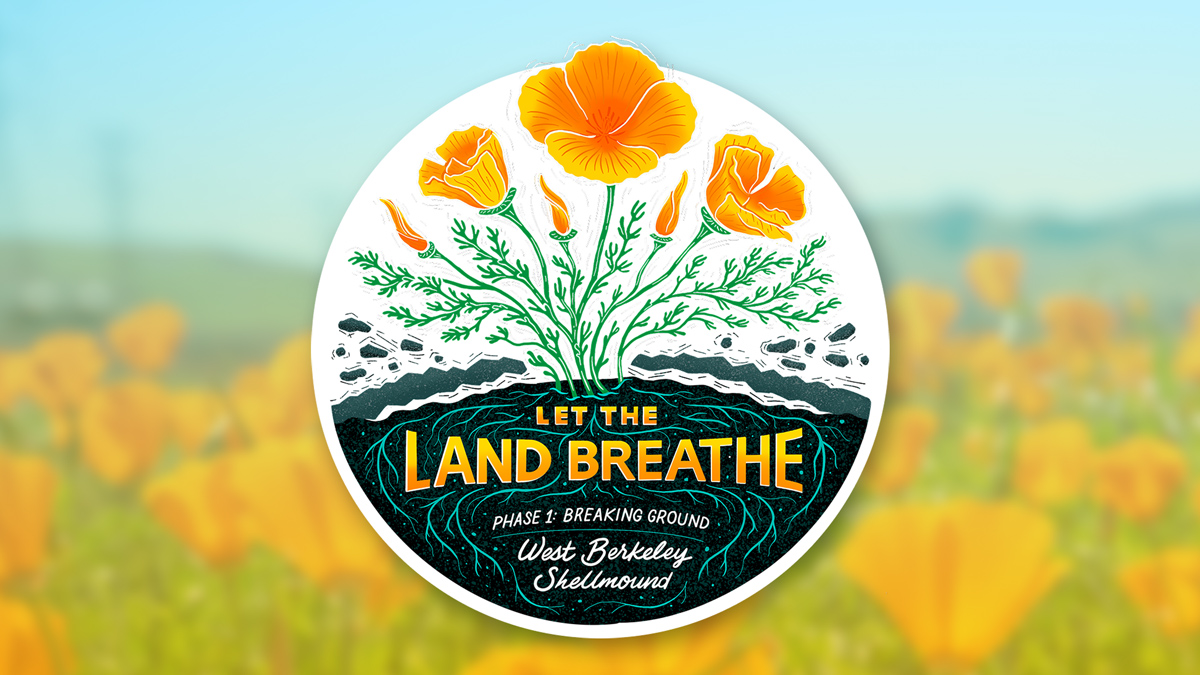
Host: The West Berkeley Shellmound near the shore of the San Francisco Bay was one of the largest, oldest, and most sacred sites in the Bay Area. Built over thousands of years by Ohlone ancestors, it stood at 20 feet within a vibrant fishing village and was a place of ceremony and a burial ground. But over time, settlers moved in and destroyed the Shellmound. By 1950, what was left of the site was covered in concrete. A proposed 5-story condominium and retail complex would dig 10 feet underground to construct a parking garage.
Corrina Gould has been part of the long struggle to protect and restore this last undeveloped portion of Ohlone ancient village sites.
CG: People from all walks of life came together and began to speak against a development happening on this 2.2 acres of land that would have continued the erasure of the Lisjan people.
Christians, and Jews, and Muslims, Buddhists, Tibetan chanters, Marshallese singers and dancers, Hawaiian singers and dancers, Korean drummers, and Aztec dancers. And we prayed.
We had people that were elders that held the street– a thousand grandmothers. I had two Native women lawyers that walked into developers with me, and oh my god, if you could see their faces when we walked in. [LAUGHTER] We kept zoning boards up until 2 a.m. [APPLAUSE]

We had over 1800 letters against the first drafting environmental Impact Report, and the developers had three. [LAUGHTER] When they backed out, this woman, Dana Ellsworth, decided that she was going to continue this project, and we continued to have ceremony there.
We showed up and we won in the lower courts, and we lost in appeals court. That owner put up a six-foot fence with barbed wire around it, stopping us from going inside our sacred site for the first time in millennia. But that didn’t stop us.
Host: After eight years of tireless organizing, protests, prayer walks, and legal battles, the Sogorea Te’ Land Trust secured the West Berkeley Shellmound in what’s now recognized as the most significant urban Land Back victory in California history. The Trust secured a $20 million Shuumi Land Tax contribution from a family foundation, providing the bulk of funds needed for the City of Berkeley to purchase the land. The City then adopted an ordinance authorizing the acquisition and transfer of the land to the Trust, which will hold it on behalf of the Confederated Villages of Lisjan.
CG: We’re creating something way bigger than ourselves, this imagining this place of opening a creek again where water should always flow free. For us to be able to open it up and to sing to that water again in the way it should be sung to. To allow children to laugh and play in water like that is good for the water and it’s good for human beings. Water’s alive. To allow us to put our feet on the ground and to dance the way we’re supposed to dance is an amazing thing. For 200 years we haven’t been able to do that in our own territory.
To create a mound that’s possible, a mound that is either the one we imagine now, or to recreate a shell mound so that people can actually see what these were like. To find a place to re-inter our ancestors, to give dignity back to those ancestors, but also to the people that are living today. And not just the Ohlone People, but it gives dignity back to everyone that lives in our territory now. That’s the importance of doing this work, the importance of a new vision that’s there that we can bring people to. Where do you take people that come here, people from all over the world, and talk about who the Ohlone people are? Berkeley could be the first place. It was the first place my ancestors put that village, and so it should be the first place that stands up for those ancestors as well.
And we came up with a dream, a dream of freeing the West Berkeley Shellmound, and in doing that, she freed us. We were able to imagine having ceremony on this land, to building up and never disturbing what’s underneath, to creating a cultural center that could be there for every fourth grade child that has to learn about my ancestors, to not just learn about the history, but the resiliency of our people. [APPLAUSE]
Host: There’ve been other significant landback transfers throughout Turtle Island.
In 2020, the Supreme Court handed down a historic decision that nearly half of Oklahoma – a whopping 3 million acres – in fact belongs to Muscogee Creek Nation. That same year, a 1,200-acre ranch was returned to the Esselen tribe in Big Sur in California.
By 2025, California had allocated $107 million to ancestral land return that has facilitated the transfer of over 30,000 acres of land back to tribes. Well over half of California’s State Parks- covering 1.6 million acres – are governed by co-management and co-stewardship agreements with Native American tribes.
These are astonishing advancements for what was once an unthinkable idea.
CG: So let’s figure out how do we work together in reciprocity. Think back to where you live. Who are the First Nation people on whose land you live on? What is their real name? What is the language that they speak? What do they stand for? And how can you support that work that they’re doing? How do we say thank you and please? How do we ask permission? How do we not touch things that are not ours? These very basic things. [APPLAUSE]
These very basic things that we teach all of our children and our grandchildren how to be in good relation with their friends and their grandparents, and when you go to their homes, this is what we ask people to do. And this is what we’re asking for folks to do, to come in right relationship.
When we come in right relationships, when we work with Indigenous leadership, when we begin to see what our responsibilities are to the lands and waters and airs that we live, work and play on, we’re able to create magic. This is a time of great turning in the world. We are seeing this idea of land back, there’s this consciousness that’s happening, that people understand that settler colonialism has hurt this world, that capitalism is killing our Mother Earth. [APPLAUSE]
We’ve seen a lot of things happen in history, but we have seen that people can come together and stand, and that when we fall backwards, when we listen to our ancestors, when we listen to the direction of Indigenous people, when we follow rematriation and Indigenous women’s work, that we can remember who we are as human beings, that we can pray for the next seven generations to have fresh water to drink, that they could have fresh air to breathe, that they could have good soil to grow food and medicines, and that we create a relationship with fire again so that we are not afraid.
Thank you, all relatives, for being here today. [APPLAUSE]
Host: Corrina Gould… “The Native American LandBack Movement Reaches Urban America”
