The Orchid’s Deal: Beauty, Deception, and Survival
Bioneers | Published: March 24, 2026 Intelligence in NatureNature, Culture and Spirit Article
Lead Photo: TheAlphaWolf, CC BY-SA 3.0, via Wikimedia Commons
We tend to think of flowers as decoration — something to admire, arrange, or pass along as a gesture. But beneath their beauty lies a far stranger and more consequential story.
In this excerpt from How Flowers Made Our World, biologist and writer David George Haskell invites us into the intimate, often surprising relationships that flowers form with the living world around them. Through the lens of the cranefly orchid, we begin to see flowers not as passive ornaments, but as active participants in complex ecological exchanges — shaping behavior, forging alliances, and, at times, exploiting the very creatures they depend on.
What emerges is a deeper understanding of life as a web of connection — one where even the smallest bloom carries the imprint of evolution, cooperation, and survival.
The following excerpt is published with permission from How Flowers Made Our World by David George Haskell (Viking, 2026).
Orchids first evolved 112 million years ago, and the family now contains about twenty‑eight thousand species, making the orchids the most species‑diverse plant family on the planet, although the aster and sunflower family is a close second or, by some counts, slightly more diverse. For comparison, there are fewer than seven thousand species of mammal. Each orchid species is a unique twine of plant, pollinator, and fungus. It is this closeness of relationship that fuels the orchids’ diversity. In many species, the bonds are mutualistic. Almost all newly germinated orchids, for example, are entirely dependent on fungi for their food, a radical departure from the sunlight‑fueled growth of most young plants. Orchid pollination is often highly specialized, using miniaturized and intricate sexual parts to work with a handful of pollinating insects or sometimes a single pollen‑ferrying species. It is tempting to find in these connections an allegory about the harmony and generous reciprocity of nature. But other orchid species undermine the parable. Relationships take many forms. Some orchids have embraced illusion and thievery with gusto, parasitizing fungi and duping pollinators. But whether parasitic or mutualistic, orchid relationships are always intense. They have taken novelist E. M. Forster’s exhortation “Only connect!” to extreme and sometimes twisted ends.
~~~
As autumn progresses and most plants in the forests of the eastern United States fall into slumber, the cranefly orchid wakes. As falling tree leaves presage winter, we get an unexpected glimpse of new life. A pointy‑tipped oval leaf pushes through the downed oak and maple leaves. The orchid’s leaf is pleated and its top surface is a dark matte green, the color and size of a spinach leaf. Bend down and flip the leaf and you’ll get a surprise. The underside is uniformly purple, sometimes as light as lavender but usually dark plum. The purple pigment salves the burn of frost inside the leaf. In a few individuals, the top of the leaf is spotted with purple. In others, the whole leaf is dark eggplant, one of the most striking and beautiful winter sights in these forests.
Autumn seems an odd time to unfurl a leaf, but the summer tree canopy here is thick. At midsummer, only meager greenish light trickles through. Many wildflowers emerge in early spring, then rush through their life cycles before the tree buds open. Cranefly orchid is hardier. It grows through the winter, then dies back as the spring wildflowers reach their peak. With little competition, the orchid leaf feasts whenever the sun is out and the temperatures edge above freezing.
The cranefly orchid rests all its hopes on one leaf. This precious solar panel is well defended. Microscopic spikes of calcium crystals are scattered throughout. Purple pigment makes the leaf hard for deer to see. As it sips on weak sunlight, the leaf sends food to a buried stem. In late spring, the leaf dies then quickly rots. Hidden in the soil, the stem waits out early summer, its tissues swollen with starch.
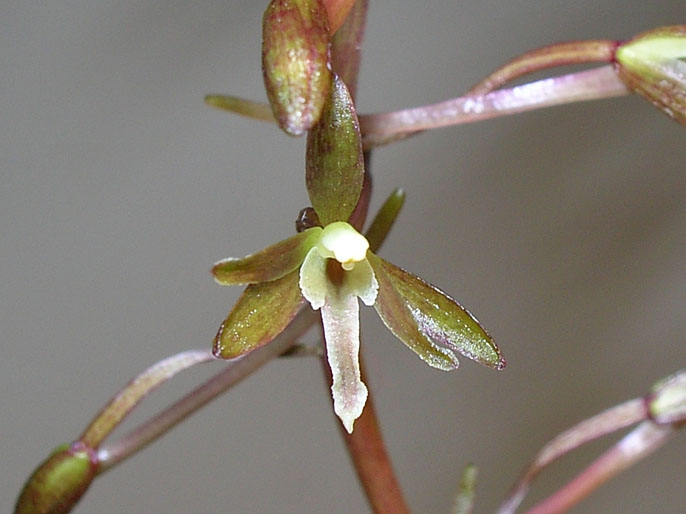
Sometime after the summer solstice, usually in July, a leafless stalk lances up. Straw thin, but as high as my calf, the stalk is first tinged with green and purple, then matures to the color of old hay. Flowers—sometimes two dozen or more—grow from the sides of the stalk, regularly spaced all along the top half. They look like half‑crushed leggy insects hanging in a spider’s web. Seen through a magnifying lens, the flowers sprout seven brownish‑yellow skinny petallike projections and a long, slender nectar tube. The projections are twisted and squashed to one side. The overall effect is like a wounded cranefly, its legs akimbo, hence the orchid’s name.
Against a backdrop of summer foliage, the flower stalks are easy to miss. To find them, it is easiest to note where the winter leaf grows, then return in summer to find the bloom. The flower might be inconspicuous to us, but not to owlet moths. For these small dusk‑and night‑flying moths, the blooms are an aromatic delight. A delight, that is, until the flower partly blinds them.
At night, the cranefly orchid bloom emits an aroma like a mild daffodil flower, so gentle that it is hard for my nose to distinguish from the smell of the dead leaves on the forest floor. When a cruising owlet moth picks up the scent, though, the signal comes through loud and clear. The moth flutters down and uncoils a long proboscis. Ah, sweetness. The throat of the flower leads to the backward‑pointing spur full of nectar. The moth pushes forward, slurping deeper. Bump! One of the moth’s eyes hits something very sticky. Orchid superglue gloms the eye. The moth pulls away and a pair of pollen sacs pop loose from their hiding place in the flower’s roof. The pollen sacs are cemented to one of the moth’s eyes.

The surfaces of moth eyes are smooth and hard, good places for glue, unlike the fuzz of scales that covers the rest of their bodies. The cranefly orchid’s strange asymmetry, petals twisted to the side, evolved to hit the eye square‑on. The arrangement works, at least from the orchid’s perspective, because one‑eyed moths keep searching for flowers.
Pollen sacs are first covered by a prophylactic cap that falls off after about thirty minutes. The cap prevents self‑fertilization. Such “selfing” yields inbred offspring, although many plants, including the cranefly orchid, will eventually self‑fertilize if they can find no other pollen. Once the cap is off and the moth finds another flower, pollen sacs get stuck onto a sticky stigma as the moth drinks. Half of the flowers twist left and half twist right. When moths visit a second flower, the pollen sac has a fifty‑fifty chance of finding a stigma with the same twist.
The moths’ love of orchid blooms partly blinds them. Photographer Ken Childs has recorded on his farm in Tennessee moths with half a dozen or more pollen sacs glued to each eye. When I’ve poked a toothpick into orchid flowers—including a few cranefly orchids—I’ve found the sticky pollen‑delivering pad extraordinarily annoying. It has a gummy texture and will not let go. I try wiping it away with another toothpick and both get gooped, even after several hours. The orchid is unquestionably harming its pollinator by dimming moth vision.
Although the cranefly orchid stalk can hold two or three dozen flowers, on average only about seven mature into fruit pods. These swell through the late summer until they are bean sized. The energy and material needed to grow these fruits depletes the plants’ underground stores. For every fruit grown in late summer, the leaf that appears in autumn is 2 percent smaller. Heavy fruiting causes the plant to skip flowering for a year.
In autumn, the stalk and fruits dry out, turning the light tan color of bleached fallen oak leaves, a great match for the leaf litter. On dry days, the fruit pods split, revealing shockingly small seeds. Through a magnifying lens I count thousands in a single pod. Like nearly all other orchid species, the cranefly orchid takes a minimalist approach to childcare. Each seed contains an embryo and nothing else. No droplets of nutritious oil, no starchy reserves, no protein packs. Just a ball of embryonic cells enclosed in a minuscule balloon‑like seed coat. The gentlest touch of wind carries these mini zeppelins aloft.
When the flyers land, only those that alight on fungus‑filled downed branches or tree stumps will live. Like all other orchids, germinating cranefly orchids draw their food not from the sun, but from fungi. The orchid babies welcome webs of fungal strands into their tiny bodies, then nurse on this inner network. Every orchid species has its own taste in fungus helpers, and cranefly orchids need wood‑digesting fungi, usually found in abundance on fallen trees. In this way, parts of giant fallen trees are, via fungi, resurrected as minuscule orchids. This dependence of orchid on fungus can last for many years. When the orchids finally get large enough to grow leaves, they may repay the fungi with sugars, although by then the original nurses may have been replaced in the orchids’ tissues by other fungus species.
Cranefly orchids are living headstones. Wherever we encounter them, we know we’re at the gravesite of a fallen tree or branch. The downed wood may be gone, but the orchids let us peer back in time and know that we’re in a healthy forest, one with a history of life‑giving rot. Decaying wood provides food and sustenance to many: orchids, fungi, salamanders, small rodents, and many invertebrate animals. A forest newly grown back from pasture or one intensively managed for timber lacks a history of fallen wood. Cranefly orchids reveal this past.
The curious life cycle of the cranefly orchid is built, in all its parts, on specialization. This is true of all orchids. They thrive by focusing. Orchid seeds are as small as a plant seed can be. But, with the help of fungi, orchid seeds explore wherever the wind takes them. Orchid flowers are also stripped down. Although their petals are often showy, usually with a distinctive swollen lower lip, the female and male parts of the flower are miniaturized and fused into a central column. The pollen of most orchids, like the cranefly orchid, is bundled into two compact sacs, delivered to insects on a sticky arm.
Orchids thus take the bisexuality of ancestral early flowers to the next level, shedding and receiving pollen from the same compact structure. Their sleek flowers waste no pollen. In addition, the column‑inside‑petals design allows evolution to sculpt each orchid species’ flower to the shape and aesthetic tastes of a small number of insect species. This allows orchids to develop specialized, tight relationships with insects.
Orchids are the anti‑magnolias. Magnolias offer generous all‑you‑can‑eat pollen buffets from open cups to any passing animal. Orchids invite only VIP insects to their blooms, often a single species of insect, then entrust these visitors with small parcels of elegantly wrapped pollen.