The Quest to Decode Whale-speak
Bioneers | Published: March 26, 2026 Intelligence in Nature Podcasts
When members of Project CETI (the Cetacean Translation Initiative) witnessed the birth of a sperm whale, they observed a breathtaking scene of cooperation and communication that few humans on earth have ever seen. The extraordinary experience was both a scientific milestone as well as one more strand in the web of sperm whale culture that this innovative project is studying.
The Project CETI team leverages world-leading technology and science in a quest to understand nonhuman animal communication. At the same time, the scientists leading the project are keeping an ethical throughline, placing the health and well being of whales at the center of the effort. As we get tantalizingly closer to truly communicating with other species, the question becomes not only whether we can, but whether we should – and what the implications are if we do.
This is an episode of Nature’s Genius, a Bioneers podcast series exploring how the sentient symphony of life holds the solutions we need to balance human civilization with living systems. Visit the series page to learn more.
Featuring

David Gruber is the Founder & President of Project CETI (Cetacean Translation Initiative), a nonprofit, interdisciplinary scientific and conservation initiative on a mission to listen to and translate the communication of sperm whales. He is a Distinguished Professor of Biology and Environmental Sciences at the City University of New York, Baruch College & The CUNY Graduate Center.
Credits
- Executive Producer: Kenny Ausubel
- Written by: Cathy Edwards and Kenny Ausubel
- Producer: Cathy Edwards
- Producer: Teo Grossman
- Senior Producer and Station Relations: Stephanie Welch
- Associate Producer: Emily Harris
- Host and Consulting Producer: Neil Harvey
- Production Assistance: Mika Anami
- Interview Recording Engineers: Rod Akil at KPFA and Bill Siegmund, Digital Island Studios, LLC
This limited series was produced as part of the Bioneers: Revolution from the Heart of Nature radio and podcast series. Visit the homepage to find out how to hear the program on your local station.
Subscribe to the Bioneers: Revolution from The Heart of Nature podcast







Transcript
Neil Harvey (Host): In this episode, we meet David Gruber, founder and president of Project CETI: the Cetacean Translation Initiative.
The name deliberately echoes the groundbreaking SETI Institute – the Search for Extraterrestrial Intelligence. Both share a dream of communicating with intelligent life beyond the human species. Rather than searching deep space, Project CETI’s quest is the depths of the oceans on Planet Earth.
I’m Neil Harvey. This is “The Quest to Decode Whale-speak”.
As the Coast Salish Chief Dan George wrote: “If you talk to the animals, they will talk with you and you will know each other.”
Indigenous traditions such as those of the Coast Salish are closely attuned to hearing beyond human boundaries. Yet talking, and listening, to other animals is a shared experience across humanity—intuitive to anyone who has ever conversed with their pet. Within the Western scientific tradition, researchers have struck up conversations with chimps and parrots, while revealing language-like qualities in bee dances and meerkat calls.
However, faithfully translating other animals’ communication is a formidable endeavor – as is the question of whether it really constitutes language. Other animals’ perceptual worlds are radically different from ours. So, naturally, their communication is also profoundly different, which presents a mind-bending challenge to interspecies translation. Project CETI’s mission to crack the code of sperm whale communication is monumentally ambitious.
[SPERM WHALE CLICKS]
David Gruber and the CETI team study whales near the island of Dominica in the Caribbean. This is how they sound…
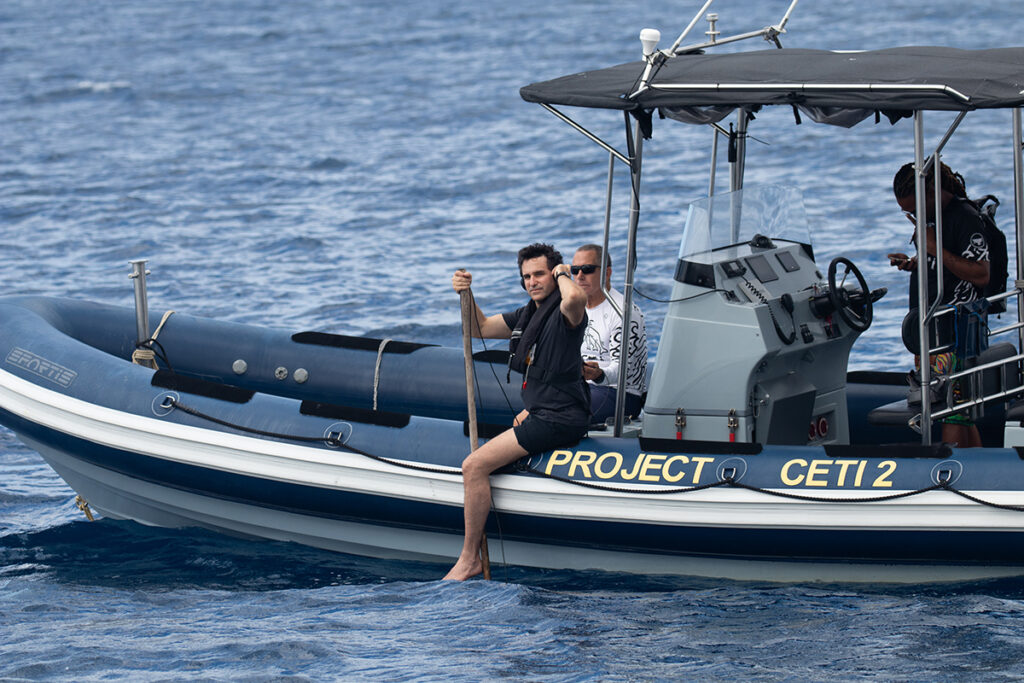
David Gruber (DG): [AUDIO PLAYING] [CLICKS] They’re so social, living in families of grandmothers, mothers and kids, matrilineal populations in Dominica where there’s about 200 sperm whales that are almost there year-round.
We set up a 20-kilometer by 20-kilometer underwater listening/recording studio in Dominica. How we’ve kind of dreamed this up, is like, humans have invented all the technology, that we could do this; we could translate sperm whale language. And I think it reminded us all of when people started to look at the moon and be like, you know, can we go there? And they’re like “F=ma”, you know, they’re like, yeah, well you’ve gotta shoot the rocket, and then I’m going to get out and walk around it. It turns out there’s not that much to do on the moon. [LAUGHTER] So we’ve not been back that much.
But here, is like sperm whales! We live on a planet with sperm whales, and there’s still a couple hundred thousand of them. And they’re communicating in ways that are fantastic.
And going back to like Carl Sagan, you know: “Is it possible that the intelligence of cetaceans is channeled into the equivalent of epic poetry, history, and elaborate codes of social interaction? Are whales and dolphins like human Homers before the invention of writing, telling of great deeds done by, in the depths of and far reaches of the sea?” Like just these beautiful quotes. Like who knows?
Host: Whales loom large in our imaginations: their self-evident intelligence seems at once familiar and foreign. They have the biggest brains of any animal on Earth, and a humbling evolutionary history: Their ancestors went from the land into the sea nearly 50 million years ago.
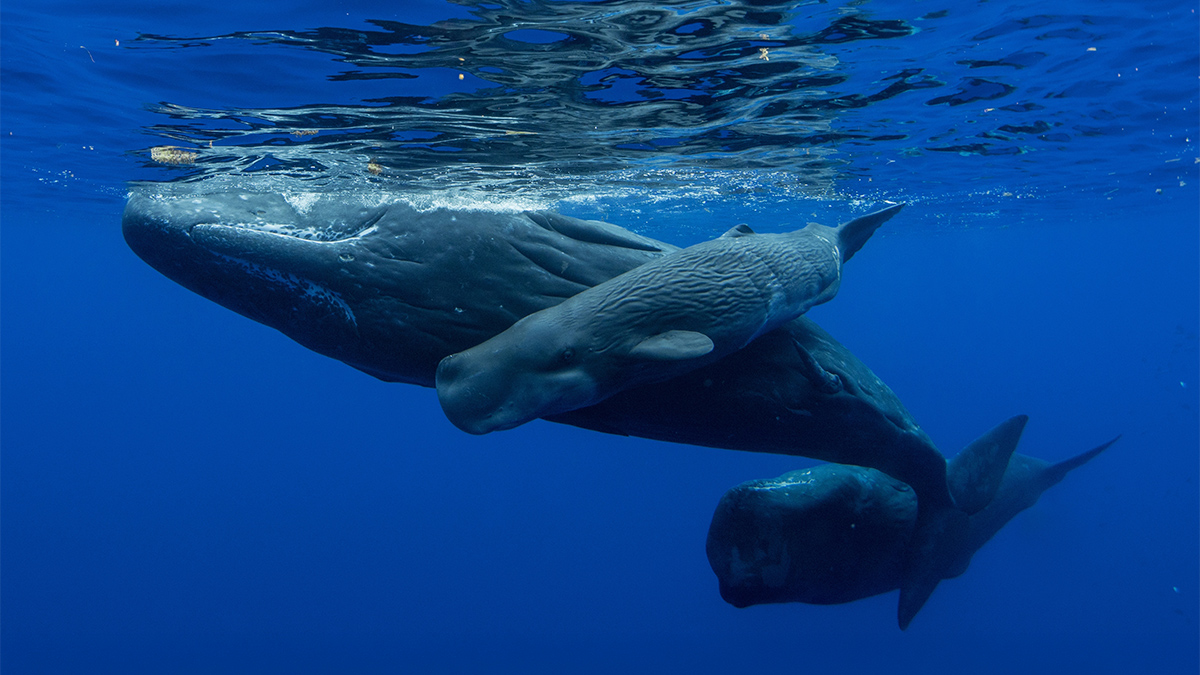
Sperm whales themselves have been around for about 20 million years – that’s eons before any human ancestor walked upright. Over those unfathomable timescales, they’ve evolved an extraordinary capacity for complex communication. They seem to talk to each other in a kind of whale morse code: sequences of clicks known as “codas” that repeat and overlap.
[WHALE CLICKS]
Though these codas sound nothing like human language, we do have some things in common with sperm whales. Like us, whales have rich social lives, with unique cultures that vary between groups. And like us, they’re mammals who learn to communicate by imitating the intricate sound patterns of their elders.
DG: All life came from the ocean; we’re almost like little bodies of seawater trapped in skin. There’s this group of relatives that went back in and started, you know, about 50 million years ago, this Pakicetus, this wolf-like thing that went back into the ocean, and the nose rolled over the head and became a blow hole, and the skin had to change. So it’s like when you’re in the bathtub too long, they needed to fix that. [LAUGHTER] And their blood changed so that they can dive for a mile and they could hold their breath for over an hour, which I don’t—I mean, that’s like yogi central. You know? These guys are OG karmic masters of breath work. [LAUGHTER]
And thinking about the nostrils rolling over the head, one of the nostrils becoming a blow hole, but then if you hold a whale skeleton, you’ll see there’s still the other small nostril that is being used, and they kind of snap this air back and forth.
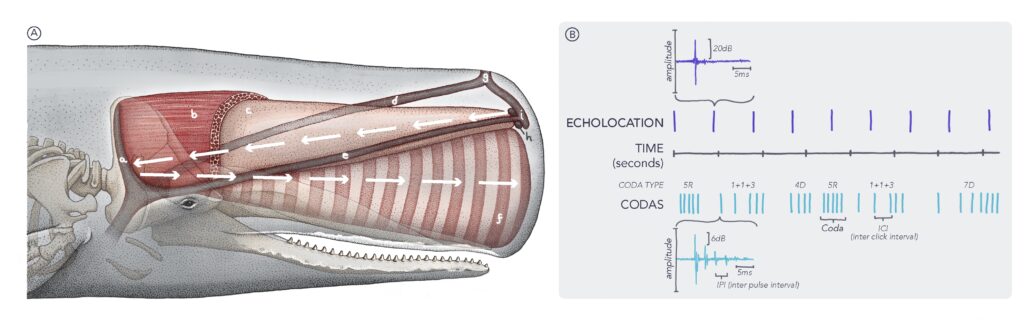
Host: Biologists believe sperm whales’ sound is produced by snapping this air along the right nasal cavity, which has twists and turns. It winds through a series of air sacs, spermaceti oil and fatty tissue to a pair of ‘phonic lips’ at the front of the head. This complex journey, they think, allows the whale to amplify and focus sound, giving it a vast sonic repertoire.
DG: Whales are living in this like deeply sonic world. Huge part of their brain is dedicated to sound processing, and echolocation is such a major feature of how they’re navigating living their lives, how they’re even producing the sound in their head and magnifying that sound to incredibly loud—They could produce it almost twice as loud as an airplane taking off. And they could focus it on very tiny fish or they can kind of have the sound permeate outward. They can even click right into each others’ heads using bone conduction.
Just phenomenal, the way in which sperm whales hear the world, and it would be equivalent to like us describing how our eyeballs work. To say, well, I open my eye and I see all these things, and I can sense depth. You know? It’s likely that their way of hearing echoes returning, and it gets processed in their lower jaw, similar to us describing how our eyeballs work.
Host: Whales’ sonic skills are essential for navigating ocean life. They sing different types of clicks for long-range sonar, for close-range hunting, and for socializing.
DG: There’s the echolocating, when they’re using it to kind of almost see in the dark, and you’ll hear them when they go down, it’s like click, click, click, click. And then as they’re getting closer to food, it’ll go faster, faster, faster, then you hear a gulp. [LAUGHTER] They’re very good at eating squid.
But they’re also—at the surface, they communicate with these codas, which in Dominica, the one that you hear all the time is just like click, click, click-click-click, the 1, 1, 3.
There’s actually regional dialects. So among the clans of whales in Dominica, each clan, even though they’re living in the same place, has a specific dialect, like it could be British and Scottish-type accents that are among them. [LAUGHTER]
[WHALE CLICKS AND SOUND OF OCEAN]
Host: David’s colleague, marine biologist Shane Gero, has been observing the Dominica whales for 20 years. It was Shane’s work that revealed the unique codas that signal group membership, or cultural belonging.
Deciphering yet more meanings within this complex system of clicks and pauses needs diverse facets of expertise – from the mechanics of underwater recording to a deep knowledge of whale behavior, to the computational codebreaking required to unscramble the click patterns. The immensity of the project enthralled David Gruber.
DG: Oceanography is a very interdisciplinary field of working, understanding the physics of the ocean, the geology, the chemistry. And so I kind of came to this project taking on many, many different, increasingly complex interdisciplinary science projects.
For instance, I was working on a project to build a shark eye camera. We needed to put together a team of camera designers and optometrists that could study the eye of the shark, and divers that could dive with the shark. And we made this camera that sees a specific type of shark. And then we were able to make first order approximations of how that shark is able to see the world.
So seeing from the perspective is one of the really big themes of my work. And the other theme that we were really working on is gentle robotics and being as gentle as possible when studying life. So this project kind of brought everything together. Rather than seeing from the perspective of the shark, we’re hearing from the perspective of whales.
Host: Seeing from another being’s perspective requires imagination, care and empathy – and in Project CETI’s case, cutting-edge technology.
In the past decade, machine-learning systems have become remarkably adept at translating between languages.
Algorithmic tools excel at finding patterns in large data sets – for example, all the words that exist online. That’s what trains large language models like ChatGPT.
[WHALE CLICKS]
Could similar tools find hidden patterns, maybe even language-like words and grammars, in the click codas of sperm whales?
It seemed possible—if they had enough data, which, in this case, meant thousands and thousands more recordings of those codas. Recording them was the first challenge…
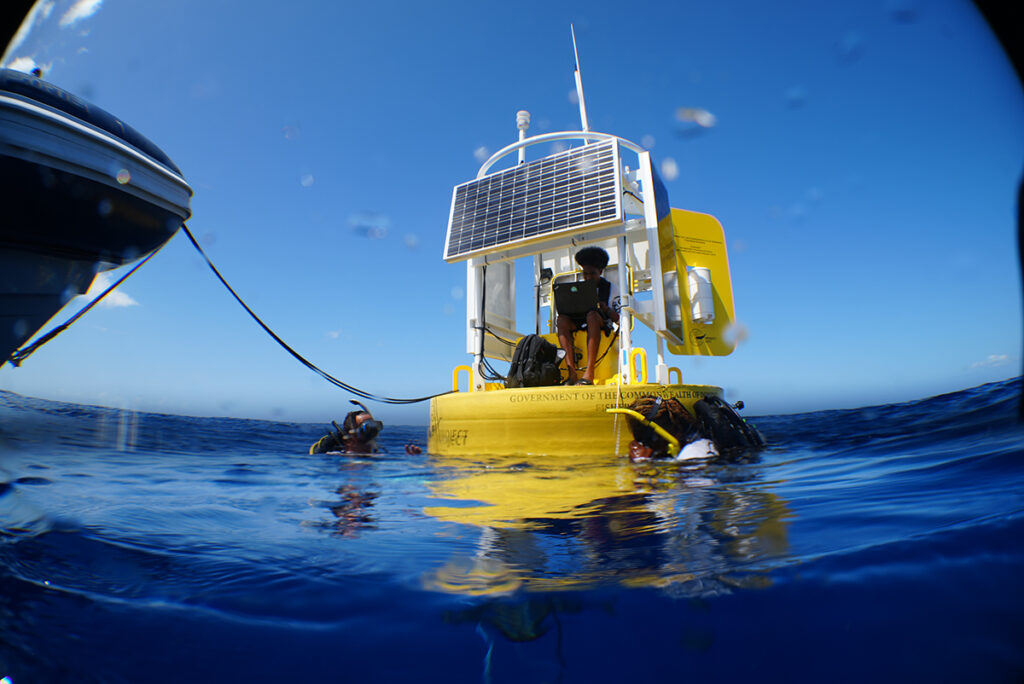
DG: It’s not like you can just go to the store out there and be like, “I’d like some whale listening tech,” you know? [LAUGHTER] So we have to design everything ourselves. So we’re making all the listening apparatus that’ll go into the project.
So there’s eight different disciplines in Project CETI. We have a machine learning team, and a robotics team, a natural language processing team, a network science team, marine biology team, underwater acoustic team. This all pieces together in this effort, and we’re almost getting close to the point where the word language could possibly fall as being a human-only thing.
Over these past five years, we’ve been understanding the basics of their communication system, and at the same time, we’ve been building up our data set. The reason like ChatGPT is getting so good is it digested the entire Internet—every book that’s ever been written—and was able to learn kind of where words are placed with each other. Like you might see woman and queen, or man and king, you know, next to each other. So once you put this together with billions of data points—we call them tokens—the machine learning can get good at predicting what will be the next piece. And they’re doing so by looking for patterns in multi-dimensional space. So that’s kind of why the more and more data you throw at these, the better it is, is finding elements and patterns that maybe humans couldn’t detect on our own.
Host: The process of gathering the data, however, was deeply human. In contrast to the robotic efficiency of large language models, recording the whales was an emotional voyage.
DG: So we’re going to be playing now two different sounds—which one would you be more likely to die for. [LAUGHTER]
Number one…[CLICKING NOISES IN WATER]
Alright. Number two…
[WHALE SONGS]
Host: Perhaps you recognise this second sound. It’s on the biggest-selling nature album of all time: Songs of the Humpback Whale, recorded by legendary biologist Roger Payne.
The album’s release in 1970 resonated powerfully with the public. The songs awakened many millions to humpback whales’ extraordinary intelligence and culture. They inspired the Save the Whales movement, one of the iconic conservation successes. It led to a global moratorium on commercial whaling.
[SPERM WHALE CLICKS]
These, on the other hand, are the clicks of the sperm whale. They may not carry the same visceral impact as humpback whale songs, yet they hold a spellbinding promise: not only hearing whales, but understanding them, too.
And these particular clicks tell a powerful story. We’ll find out more after the break.
If you’d like to learn more about the extraordinary intelligence of life inherent in fungi, plants and animals, the Bioneers Earthlings newsletter delves into stories and research that promise to reshape your perception of our fellow Earthlings – and point toward a profound shift in how we all inhabit this planet together. You can subscribe at bioneers.org/earthlings

[WHALE BIRTH CLICKS]
Host: These sperm whale codas were recorded during a magical moment that David Gruber and the Project CETI team witnessed in 2023.
DG: We were out there doing our normal thing of finding the whales and recording them, and we saw these 11 whales, and it was very odd, they were kind of just going up and down and up and down, and they weren’t diving. And about two hours later, there was a bunch of thrashing, and then there was blood in the water. And I think at that moment, you know, we thought there was some shark attack or something terrible might have been happening.
And then we saw that there was like a tiny little whale head amongst the ruckus, and there was this little baby whale, and we just realized that we were watching a whale birth. And literally, the whales started swimming right towards our boat, holding the baby above water. Inches from us we watched this baby whale go right past us.
As the baby came out, the fluke was folded, so the baby was unable to swim. And it took, you know, several hours for the kind of fluke to unfold so the newborn had the capability of swimming on its own. And in the process, all the other female whales were going under it, and lifting it, and twirling it.
And then there was another moment of collective terror, where we saw a group of pilot whales rolling in. Pilot whales could be aggressive to sperm whales, and there’s several reports of this. And we watched them kind of coming in slowly, and nothing really bad was happening.
And then we look over at the horizon, and there’s like 200 Fraser dolphins. They almost look like little pinwheels. And now there’s this scene out there, right in front of our boat, with hundreds of whales, all amongst these 11 whales that are holding the newborn above water, all kind of moving around.
Host: It was a breathtaking scene of cooperation and communication, engaging the baby whale’s family, the wider group of sperm whales, and even other cetacean species.
The Project CETI team were astounded by their luck in witnessing such a significant event, and being able to record it in great detail.
Then came the enormous task of organizing and analyzing six hours of data.
DG: It took us more than two years to design it and almost go frame by frame through the six hours. Some of the beautiful things that have come out is we found that the grandmother, the mother, and a mother’s daughter were all there, present. So we’re able to look at the role, the doula-type roles, that each whale played in this unit.
But what’s also interesting is this unit is separated between kin and non kin. And they took turns in diads, two by two, whales holding the baby like a ballet of two at a time, between the kin and the non kin. So it represents one of the most empathetic, collective examples of a mammal entering the world beyond maybe humans.
And I think back now of the story of the evolution by cetaceans going back into the water and delivering a thousand-pound baby. The baby is actually negatively buoyant. So the baby would sink to the bottom. So the sociality of whales, they needed to collaborate to hold the baby to ensure its survival. So they needed this collective communication.
Host: Studying this whale birth gave Project CETI a remarkable insight into sperm whale culture – as well as their communication system.
DG: We’ve been analysing this data now for two years, and looking at the acoustics of it underwater, and some new codas that were spoken during this. And then we also did an evolutionary analysis that’s able to show that likely this process of a mammal giving birth in the water is something that dates back around 35 million years.
And, you know, that brings up the profundity of—was their vocalizations necessary to coordinate this? Are these vocalizations something that we can now start calling language? And if so, do sperm whales have a language older than human language? Like it’s kind of raising these really profound questions that are making us question…how superior of a communication system we-we think we have.
[WHALE BIRTH CLICKS]
Host: During and after the birth, the whales exchanged copious complex codas. The multiple overlapping sequences are challenging to tease out, and they provide a treasure trove of data for translation.
In these and other recordings, the scientists have uncovered a rich palette of variation and nuance. They use musical terms like “rubato” and “ornamentation” to describe how the messages vary in speed, rhythm, and sonic flourishes. Gradually, some meanings may come into focus.
DG: What we recently did is show more of like a phonetic alphabet in the clicks, not just click, click, click-click-click. It could be like click-click, click-click-click—so tempo, and rubato, and rhythm, and ornamentation were playing significant roles in the context of their communication.
So one of the key parts now of being able to translate what sperm whales are saying is we need to be able to ground the symbols. Like we have all these vocalizations. We’re seeing there’s complexity. We’re seeing the kind of nuances of their alphabets. There’s a linguist on the team, Gašper Beguš, and he’s able to show now that there’s vowel-like features in sperm whales. But then, knowing there’s incredible complexity to their voices, but what are they saying still?
So at this stage now, we’re beginning to kind of parse out some of the first words, like diving. There’s a conversation, whale A is saying something to whale B, and then eventually they’ll make a decision to dive. And if you have hundreds and hundreds of those, you could just look at the vocalizations and say, that’s where they’re going to dive; that’s where they’re going to dive; that’s where they’re going to dive. And that would be a sperm whale language model. We have a kind ChatGPT 1 for sperm whale, is what it is.
Host: Creating this rudimentary dictionary of “whale-speak” requires painstaking work. It’s not just a matter of applying human language models to whale codas. The team is training its own computer models from scratch, homing in on the sperm whales’ unique communication traits.
DG: In the beginning of this project, some people would just be like, AI, animals, just throw them together. But all this AI is just designed for us. And what you really need to do is kind of like, yeah, which tools are going to work and which aren’t?
And the musical elements came from people on the team with backgrounds in both linguistics, and natural language processing, to be able to kind of look carefully at these smaller sized data sets and look for patterns. And once we kind of see some of the first patterns, then we can train the computer to look for them again.
Like tempo, rubato, ornamentation, really these early models were done a lot by hand and careful looking. And we still can’t understand other animals’ communication without the humans who have spent their whole lives looking carefully and listening. You know it’s kind of like, in Darwin’s sense of, the eyeballs are like the biologist’s best instrument because everything starts with just looking and observing.
Host: Deciphering what sperm whales may be saying requires a thorough understanding of their biology, their behavior, and their perceptual worlds. To try to comprehend their conversation requires trying to imagine what it’s like to be them.
Scientists with deep knowledge of other life forms have similar goals to decode the communication of elephants, moths, plants and fungi.
This is an era of rapid discoveries about the realities of other-than-human-life. At the same time, AI is turbo-charging breakthroughs in many areas of science. In this context, talking to other species feels tantalizingly possible.
Yet there are also grave risks. Rather than ushering in a golden era of interspecies understanding, new insights into whales’ worlds could also be used in harmful ways, along with precipitating yet another intolerable invasion of their lifeways.
To mitigate potential harms, Project CETI values the ethical implications of their research on par with the research itself. What are the moral and ethical risks? What’s in the whales’ best interests?
DG: Even the suction cups that we’re designing are inspired by sucker fish so that they don’t hurt the whales. We have a philosophy on the team of not to draw a single drop of blood.
And we always ask ourselves: Is this work in benefit of the whale? We’re at the intersect of animal, and then we’re also in groups with the AI crowd, and it’s a really intense place to be.
But all these new technologies now are slowly going to be applied to animals, and it could be beautiful. AI combined with bio acoustics can allow us to hear and interpret things that our Old-World primate weird little ears that we have don’t necessarily pick up. So this world of wonder and possibility and connectivity awaits, but how we do it is important.
Host: Working with the More than Human Life program at the NYU School of Law, CETI drew up 18 principles for using these technologies to study animal communication. By proceeding with care and precaution, they are committed to minimizing harms – while growing our empathy for other life. The hope is that this intrinsic biophilia – this instinctual bond that life has for life – will guide us to respect and protect the ineffably complex symphony of living beings.
So, suppose we can we dream up ways to speak to beings whose perceptual worlds are so wildly different from our own. If the whales were to respond, what do they have to say? And will we heed their call?
DG: The whales are more in danger right now, if you look at the ship traffic going across the ocean, it’s terrifying, and they are getting hit a lot. And then also imagine the idea if you had a jackhammer playing in your house all the time. You’d be very annoyed, and they’d probably want to sue as well.
And I guess the real fear is that what if we can deeply translate and we hear, but then we choose not to act. That’s going to be a real moment for us as a species, if we can actually really meaningfully translate and then we choose to turn that off. I mean I love the fact that it’s making us think of these things. But I think almost all science fiction is very dystopian. So I think because we are talking about this early, is there a possible pro-topian? And even just think about it before the future just comes to us.
Host: Even in best-case scenarios, a quest as ambitious as interspecies communication is bound to bring mistakes, misunderstandings, and unforeseen consequences. Now that AI is irreversibly out of the bag, thinking through how to use it ethically with whales and other organisms is crucial.
In truth, humanity has an ancient and sacred relationship with whales. For example, the whale is revered in Polynesian culture, whose navigators crossed vast oceans with extraordinary skill and knowledge thousands of years ago with no GPS.
David wonders whether human voyagers might have even learned navigation from the whales, who, like us, pass their knowledge across generations.
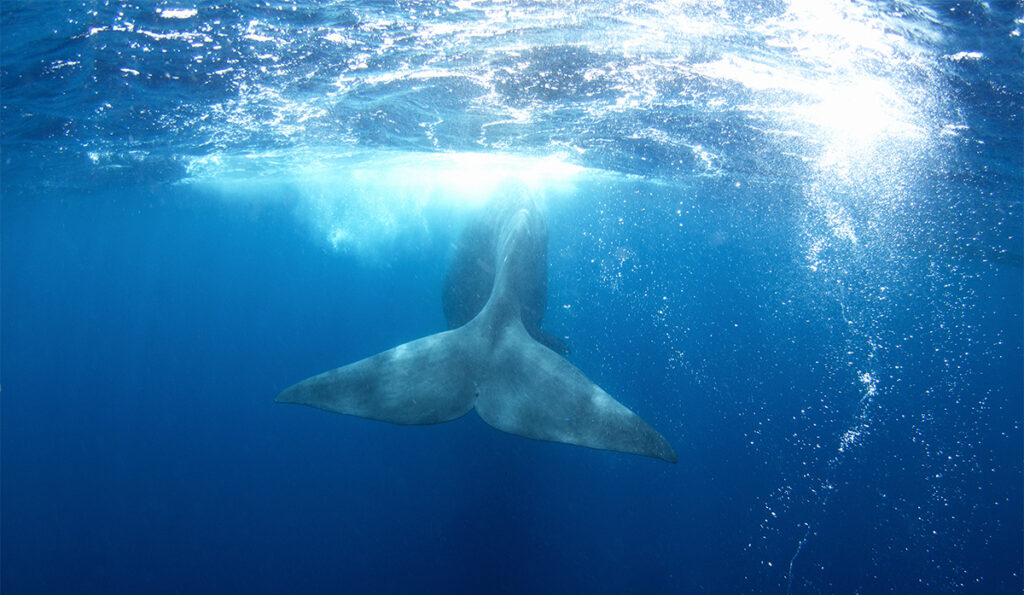
DG: Some whales could be over 200 years old, so by living in three generations, there’s so much knowledge that could be passed within three generations but then even more than that, like the navigators were just passing this on and on.
If being able to cross the ocean played such a big deal for human evolution, that story of the first human to like build a little canoe and go all the way across, and the knowledge of the navigators wasn’t even written; it was mainly just passed verbally around, just using dead reckoning and navigating by the stars, and being able to kind of use all these features.
But then I was like, well, if we look at the tract of cetaceans, they had to do a similar thing, because they’re also mammals that were just semi-aquatic. So there’s a parallel story of whales being a semi-aquatic thing that was getting chased into the water. But then, you know, going a little further out, and a little further out, and a little further out, and then one day being like, you know, I’m not even going to come in to go to sleep. I’m just going to sleep out here tonight. [LAUGHTER] You know? And then like one day, you know, I think I could go a little further out, and then like, you know… So being able to cross the ocean was a big deal for the first whale.
And then we began looking in the science record of, like, can the cetaceans use stars to navigate? And there’s like one study of a harbor seal that does show using stars to navigate. Like everything—We think that we’re inventing it, but it’s already been invented, and there could be this moment when humans were learning this information from the whales. So we’re looking for some of this in written records. But all these crazy ideas; half these are hypotheses, completely untested.
Host: There’s so much that remains a mystery, and likely always will. Humility is our constant companion. Perhaps we’ll never know whether whale language contains the equivalent of epic poetry and history, as Carl Sagan speculated.
But as science fiction gradually becomes science fact, the promise of forging closer ties with our underwater kin could inspire us for generations to come to respect, protect, and cherish the intricate web of life.
DG: I’ve only studied animals my whole life — every animal that I work with is like a series of mysteries and magnificence, like jellyfish and corals. I so deeply love jellyfish, and corals and anemones. But when it moved to whales it was like, whales just really reach almost everybody. We can get in a taxicab right now and just start talking about whales, and what they’re doing, and about whale dreams and…they are magnificent.
There’s a level of complexity in what they’re saying that is far beyond what I imagined at the beginning of this project. And I think probably, at the end of my life we’re not going to get to the end of this, this is like an intergenerational translation exercise, because the amount of mysteries is so huge that it’s far beyond what we will be able to do in this… on our time here on Earth.
Host: David Gruber, “The Quest to Decode Whale-speak”