When the Forest Breathes: Suzanne Simard on Regeneration and Relationship
Bioneers | Published: March 3, 2026 Nature, Culture and SpiritRestoring Ecosystems Article
Forests are not collections of individual trees. They are living communities shaped by cooperation, memory, and cycles of renewal that stretch across generations.
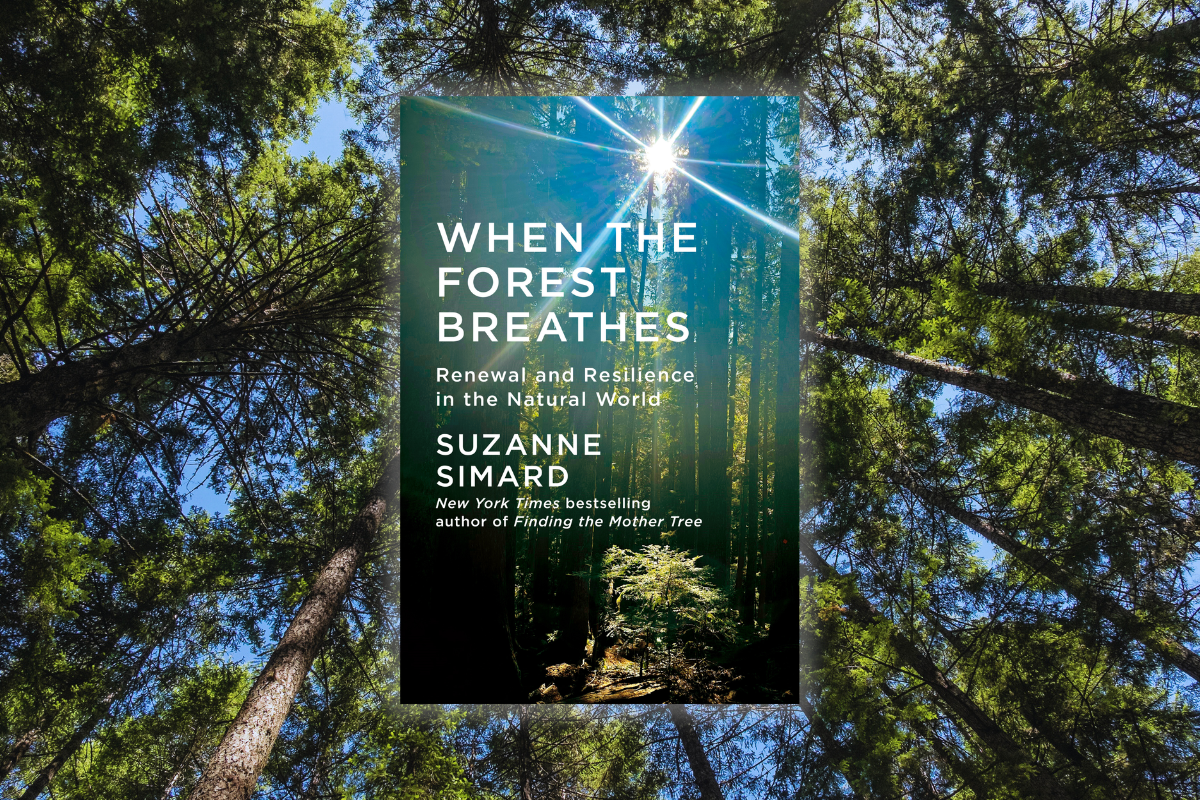
In her new book, When the Forest Breathes, forest ecologist Suzanne Simard deepens the groundbreaking work that transformed our understanding of forest ecosystems. Expanding on the research she first brought to wide public attention in Finding the Mother Tree, Simard offers both a scientific and personal vision for how forests regenerate and what is lost when we disrupt the relationships that sustain them.
Drawing from decades of research, as well as close collaboration with Indigenous communities whose stewardship practices long recognized forest interdependence, Simard challenges the industrial model of forestry that treats trees as isolated competitors. Instead, she reveals a dynamic system in which older trees support younger ones, nutrients and information move through underground fungal networks, and kinship influences growth, resilience, and survival.
The excerpt below brings us into a striking thread of this research: the discovery that Douglas fir seedlings recognize and benefit from growing near their relatives. Through the work of her former graduate student, Simard illuminates how trees adjust their behavior based on who surrounds them, reshaping how we understand competition, cooperation, and regeneration in forest systems.
At a moment when wildfires, drought, and extractive practices threaten forests worldwide, this passage underscores the book’s central insight: that resilience is rooted in relationship.
After making Mum coffee and toast, I walked home, where Amanda and Eva were waiting to celebrate the publication of Amanda’s first paper. They’d brought a six-pack of Amanda’s favorite ale and a bag of chips, and Eva had brought her new border collie pup, Tia. For as long as I’d known her, Eva had been dreaming of getting a dog. But a graduate student’s life is anything but stable, so she’d made herself wait until the conditions were right. Now she and Tia were inseparable.
Amanda had been keeping a grueling schedule. Just back from playing baseball in Japan, she was heading to Golden to collect more soil carbon data before the snow flew. The ground was almost frozen and the days were getting short.
“I’m really proud of you, Amanda. It’s not easy juggling all this,” I said, as I poured the midday beer into three tall glasses.
“Oh, it’s nothing,” she said, her cheeks dimpling. Her walnut-brown hair was tied up in a bun, nothing fancy, but ready for action.
“I have it pretty easy,” she added. “Other people are doing much more than me.”
I hid a smile. I was pretty sure this wasn’t true. I poked her.
“I don’t know anyone else who got their master’s and their PhD while playing baseball in the world championships,” I pointed out.
“Yeah! Cheers, Amanda!” Eva said. From her place at Eva’s feet, Tia looked up to see what all the fuss was about.
We held up our glasses, swigged our beers.
I thought back to celebrating my own first discovery with my doctoral adviser, David Perry. After finding that carbon-13 and carbon-14 transmitted between birch and fir, we’d shared a glass of whiskey in his office. I recalled how excited we’d been at the finding that the two species were trading photosynthetic carbon back and forth in a reciprocal relationship, and that a greater amount of carbon flowed from nutrient-rich paper birch to the more acidic Douglas fir, especially when the fir was shaded. This was the first sign that the trees were in direct communication through underground channels, forming a robust, interdependent network.

Despite her humility, I knew Amanda was pleased to be celebrating this moment. It had taken her a decade to complete her graduate studies—from her twentieth year to her thirtieth—and we were finally toasting her first dispatches to the world. In her new publication, Amanda reported her clearest, most profound finding: interior Douglas fir seedlings were larger and had more foliage when growing in the neighborhood of kin Douglas fir seedlings rather than strangers. It didn’t matter if those strangers were other Douglas firs, or some other species entirely.
This finding alone was astounding. It meant that trees recognized other trees that were their relatives and benefited from growing near them. This complemented Amanda’s earlier master’s research. She’d found that seedlings establishing next to older kin rather than strangers not only had more productive traits, but greater mycorrhizal colonization rates, presumably because they had access to the established mycorrhizal network of the older sibling.
The older trees, with more resources, were connecting with and nurturing their younger siblings.
These discoveries were breathtaking. Not only did they fly in the face of modern forestry practices, but they corresponded with thousands of years of Indigenous knowledge on the importance of kinship among living beings.
Over the previous three decades, a common forestry practice in the dry Douglas fir forests had been clearcutting followed by planting. This was done to generate more profit and reduce planting costs, speed up rotations, and reduce uncertainty compared with selective harvests reliant on natural generation. That’s why the companies were clearcutting the Douglas fir forests in Nlaka’pamux territory, Dave Walkem’s ancestral home. These tree farming practices meant the next forest could be cut faster and more money could be made sooner.
Getting rid of the old trees, they believed, also reduced risk of wildfire and the spread of bark beetles. The mother trees were thus sent to the mills, and new seedlots of seedlings were planted to replace them. But these planted trees fared poorly in the arid environments, often succumbing to heat, drought, or frost. Nursery-grown trees were bred for rapid growth and straight trunks, rather than belowground traits or adaptive cues enhanced in the presence of relatives that could increase survival. Perhaps because of this, their rooting responses were not finely attuned enough to cope with extreme drought in June, or their needles were too sparse to withstand a sudden frost in July. Natural regeneration around parent trees, with their locally adapted seeds, adaptive cues to relatives, and guerrilla root systems, was proving more successful.
But there was even more to this story. Amanda wanted to know how kin selection played out in more diverse forests, such as those in Prince George, where she’d grown up. There, she’d seen Douglas fir growing alongside lodgepole pine, spruce, and aspen. Could a tree’s neighbors—their species, density, or even the soil in which they grew—affect how well Douglas fir related to its own kin?
As pitcher and captain of her team, Amanda knew that camaraderie affected the performance of all the players. Just like she did in our lab, she would boost the morale of the group, and this increased cooperation while working together on one another’s projects in the woods or in the greenhouse. Her natural intuition led her to ask questions about how the whole forest influenced kin relationships.
Amanda designed her experiments to look deeply into what diversity in the forest meant to relationships among kindred trees. She planted Douglas fir seedlings in mixed neighborhoods of kin seedlings, stranger seedlings, and a different species altogether, lodgepole pine. She found that the trees were able to adjust their behaviors based on the complexity of their quarters. Even in mixed stands, kin seedlings preferred to grow near kin, but they performed better in the neighborhood of lodgepole pine than around other Douglas firs that were unrelated to them. They responded to neighbor identity by adjusting their mycorrhizal status, slenderness, foliage, and fine root allocation. In these mixed stands, the kin seedlings were able to integrate their complex environments and respond in different ways to enhance their performance.
This made sense—interactions between kin depended on who their neighbors were. In this case, the pines were smaller than the firs and less competitive, and this enabled kin to thrive in their siblings’ presence.
From When the Forest Breathes © 2026 by Suzanne Simard. Excerpted by permission of Alfred A. Knopf, a division of Penguin Random House LLC. All rights reserved. No part of this excerpt may be reproduced or reprinted without permission in writing from the publisher.