Challenging Oppression at Its Deepest Roots
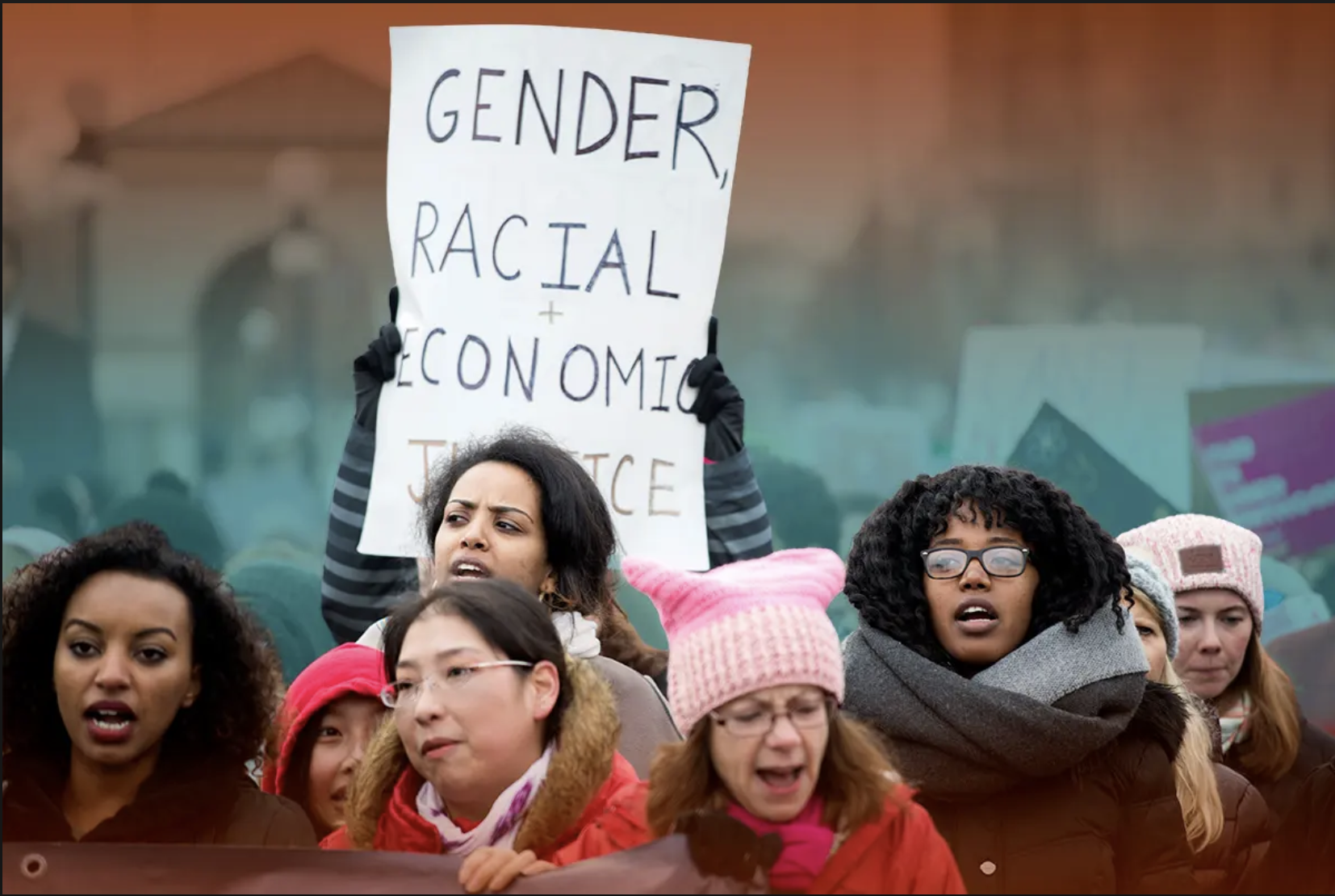
At this time of judicial and political backlash in response to feminist gains in women’s rights and deeply disturbing misogyny in public discourse, we are pleased to be able to feature this recent interview with Anna Malaika Tubbs upon the publication of her book Erased: What American Patriarchy Has Hidden From Us. Tubbs combines academic research revealing the historical roots of our predicament with her personal experience to tell stories of freedom fighters, both past and present. She reminds us that we’ve been developing the tools necessary to dismantle this patriarchal system all along – our intuition, courage, ancient wisdom, and power – and that these tools are still within our reach.
Anna is a New York Times best-selling author and multi-disciplinary expert on current and historical understandings of race, gender and equity, with a PhD in sociology and a Master’s in multi-disciplinary gender studies from the University of Cambridge, in addition to a Bachelor’s in medical anthropology from Stanford.
She translates her academic knowledge into stories that are clear and engaging. Her articles have been published by Time magazine, New York magazine, CNN, Motherly, the Huffington Post, Harriet, The Guardian, Darling magazine and Blavity.
This conversation was incisively hosted by Lisa Rudman, Development and Partnership Director at the San Francisco Public Press, a nonprofit, noncommercial news organization that publishes independent public-interest journalism.
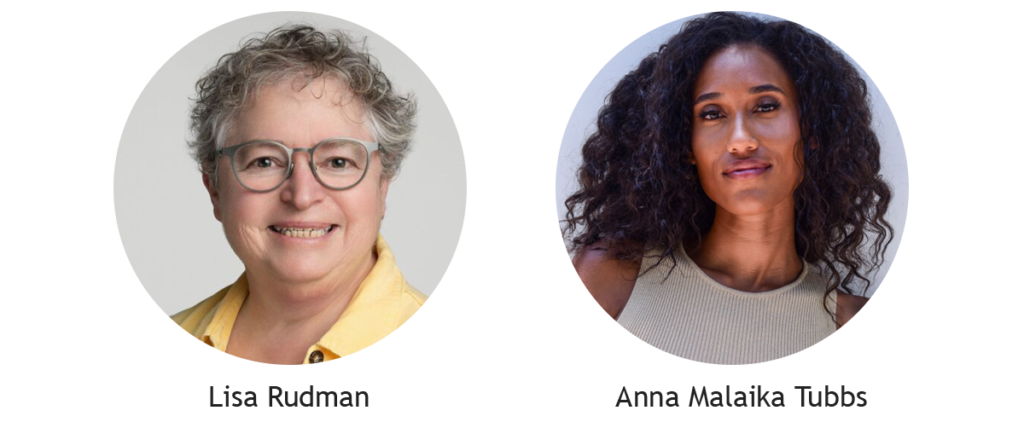
Lisa Rudman: Our conversation is titled “Challenging Oppression at Its Deep Roots”. Do you want to start by introducing yourself?
Anna Malaika Tubbs: I’m somebody who cares about telling stories that others try to erase and bury. And I care deeply about bringing people together around a celebration of difference, and understanding each other, and not in a way where we have to say we’re all the same or that we all agree with each other, but in a way that says we have something to learn from each other.
I often speak about how I grew up, who my parents were. If anybody’s read my first book, you know that I believe that our stories don’t just start with ourselves but with the legacies we’re carrying, our ancestors, and definitely, of course, our parents. And the places that raised us. So I lived all over the world growing up. My parents were lawyers, and they prioritized travel. They wanted us to see as much of the world as possible so that we could get firsthand experience.
So we lived in Dubai, Estonia, Sweden, Mexico, Azerbaijan. My dad is from Ghana, so I’d go back and forth from Ghana. I became very aware of the power of storytellers through this. One very specific story is that I learned about the Mexican-American War when I was in Mexico. Then when I moved back to the States as a teenager, I learned about it again, and I was laughing in class, and my teacher thought this is very strange – we’re talking about war, why are you laughing. And I said, well, it’s just interesting because the heroes of this story here are very different than the ones that I heard there. And it’s so obvious to you at that point how powerful the storyteller is.
I think that’s one of the reasons I wanted to become a storyteller, because there weren’t enough storytellers who were being elevated. We have so many storytellers who are Black women, but they’re not getting the attention that they deserve. I knew that with the kind of opportunities that were opening up for me to go to Stanford, to go to Cambridge, that I was going to use those opportunities and elevate these stories.
Lisa: I know a lot of people may have read your earlier book about three mothers, which then leads into your own mother, can you tell us about that?
Anna: My first book, baby, I will always talk about. It was called The Three Mothers: How the Mothers of MLK Jr, Malcolm X, and James Baldwin Shaped a Nation. In that book, for those who haven’t read it, I show that each of these women did what their sons became famous for long before their sons were even a thought in their mind. It came out in 2021, and everybody who reads that book feels this kind of sense of shock. How is it possible that after everything that’s been written about these incredible men up until 2021, that it took a PhD candidate at the time to tell us that we were missing this big piece of the puzzle? And why is it that these women were erased?
The reason I wanted to write that book, for one, I had an incredible mother. She was a lawyer who advocated for women’s rights in the U.S. as well as abroad, hence why we moved so much. In every single one of the places where we lived, she spoke about how women were being treated, but very specifically how mothers were being treated. In her opinion, everything could relate back to the treatment of motherhood in any nation. We can clap for that, absolutely. She believed that if mothers were given the support they deserved, if mothers were given the protection that they deserved, the appreciation that they deserved, that you would see these very positive ripple effects throughout any community or society, nation, and that the opposite was also true. If mothers were not appreciated, if policy was not in place to support them, that you would see ripple effects and cycles of injustice. Spoiler alert, she didn’t think that the U.S. did very well.
So I was always aware of the power and the influence of mothers, before I became a mother myself. Then, when I was starting my PhD, I read Margot Lee Shetterly’s book called Hidden Figures, which went on to become, obviously, this incredible film. I was so inspired by it, in a way where I was very angry that this was the first time I was hearing these women’s stories. The strategy behind erasing them from our common knowledge wasn’t a mistake. It wasn’t an accident. It was on purpose to keep us from knowing that Black women were some of the brains behind NASA. So I said: I’m going to be somebody who writes a hidden figures type book, and I’m going to combine this with my passion for elevating the stories of mothers, Black mothers.
Then I thought, how many people can I get to come to this book? So, I know there are some writers who do something about MLK, Jr., people are going to read that; that’ll be really interesting. So what about MLK’s mother? Has anybody done anything on this incredible woman? And no. So that was interesting. I thought, wow, that’s wild that that book hasn’t been written. But then I thought, in this hidden figures vein, maybe I can have a conversation between more than one person, with maybe two, maybe three. Malcolm X’s mother felt like a great next.
Alberta King is MLK, Jr.’s mother. Louise Little is Malcolm X’s mother. And then I wanted a third, because if we only ever have two of anything, this kind of binary trap, we often see them as opposites of each other. So someone maybe who has kids, often if there’s only two kids, people will say something like, oh, this is the social one and this is the shy one. And you think, well, there’s a lot more to our identities than these two things, but for some reason, our brains, the way they work, if there’s only two, we paint them as opposites. So I knew in this book I was going to introduce a third, and I decided on James Baldwin. His mother was Berdis Baldwin. But that’s how I wrote that first book.
Their famous sons were all born within five years of one another. So it beautifully came together, and led to Erased. Because when people read it, when they felt that sense of shock, when they wanted to know how it was possible that we had lost their stories and nobody had written this before me, my answer was, on one hand, very simple – it’s patriarchy. On the other hand, I thought, in the U.S., we don’t talk about our patriarchy very often, to be honest. Americans love to talk about other people’s patriarchies. It’s like one of our favorite things to do. Wow, women are so oppressed over there, or if I said all the places that I lived, let’s say Dubai, like, I hear it’s really tough over there for women. I just find that really interesting because the U.S. is not great for women, and we’re not aware, I think, that we live in a patriarchy, and we keep getting surprised by it.
And the last thing I’ll say before we get to the next question is that when I had the idea to write this, mainly because of the questions I was being asked, about how we lost our knowledge on these three mothers, Roe v. Wade was overturned. Again, there was kind of this sense of shock across the nation. People were asking “How did this happen? Not in the United States! I don’t understand how this happened.” Even though, when President Trump appointed three Supreme Court justices – three – he said I’m going to overturn Roe v. Wade. Yet there were so many people who were shocked by it. It just felt like this signal to me. Okay, most people don’t understand that we live in a patriarchy. So I want to write the go-to book for understanding how this nation was set up.
Lisa: After you wrote Three Mothers, then every subsequent piece that was written about those three great men, they refer to the mothers now. Right? (laughter)
Anna: No, which is interesting. Patriarchy rears its ugly head again. The Three Mothers – not to toot my own horn, but it’s done very well, it’s sold over 100,000 copies. Yet, several of the books that have come out since then that are about these men don’t include my research. It’s just a clear sign, really, of the persistence of this issue. Even though the book is well-researched, well-reviewed, and well-read, the men (mostly) who write these books continue with this notion of a self-made man and this figure who popped out of nowhere, fully formed. They don’t think that my work is worth including. It’s largely because I’m a young Black woman. I think they may not see my work as worthy.
I think we should continue to celebrate these men, and my celebration of the mothers is not an erasure of the sons, it’s actually even more love of the sons, because we understand them better. But at this point, if I hear of a book that comes out about these sons, if I’m not in the bibliography, it’s just not a well-researched book, so I don’t read it.
Lisa: You made a distinction earlier, you said that in America, we like to talk about patriarchy everywhere else. You talk about the brand of American patriarchy. Can you define what you mean by those words together, and each word separately?
Anna: I love defining it, it’s one of my favorite things to do. When I want to talk about American patriarchy, it’s not because I think that it’s the worst patriarchy in the world. I’m really not in the business of ranking patriarchies. They’re all bad, we’ll just say that. But I think that we haven’t spoken as much about patriarchy in the U.S. From what I’ve observed and studied, patriarchy operates differently in each place it exists.
So our definition of patriarchy has often been reduced to this notion that it’s about men against women. That’s not the definition of patriarchy. It’s actually about how we define who gets to be human in any nation, and that changes from place to place. So patriarchy in the U.S. is different from patriarchy in India. It’s different from patriarchy in France.
In the U.S., I point to the founding fathers, and that doesn’t mean that they created patriarchy. Obviously, they’re taking from the monarchy, etc. But when we’re looking at each nation, we can really point to the leaders who chose patriarchy. So we have to remember patriarchy is not divine, it’s not the “natural order”. It wasn’t our first way of organizing ourselves. Indigenous people organized themselves very differently. There still may have been some elements of patriarchy, but it was different from what we’re seeing right now.
Let’s all go back to 1776 when the founding fathers win the Revolutionary War, which was a surprise to everybody. They were the underdogs. No one was really expecting them to win. Many of them were young men. They are very fearful that this revolutionary spirit is going to spread across this new nation, because they’re also oppressing a lot of people who they needed to help them win the War. So they’re oppressing the women in their lives, they’re certainly oppressing Indigenous People, they’re certainly oppressing people who are enslaved – Black people, they’re oppressing poor people, poor farmers, especially. They’re afraid of what would happen if that revolution spreads.
So the period of time between writing the Declaration of Independence, winning the Revolutionary War, and then writing the Constitution, we see several rebellions taking place. One of them, the most famous, was Shay’s Rebellion. It’s what makes the leaders want to write the Constitution, because they’re worried that they couldn’t actually quell this rebellion fast enough, and they want to form a national military, mainly inspired by a local conflict, not an international one. So they’re motivated to write the Constitution and decide who is going to get to have power in this nation. This is when we choose patriarchy, or they do. They say that they want to create a republic of men.
So the Constitution tells us that they are the ones that are going to get to own land. They are the ones that are going to get to vote. There’s a lot of other things they’re going to get to do, but these are two of the primary ones. They, on purpose, leave out women. We see in the letters that they write to their mothers or to their wives, to their daughters, that women should not participate politically. They do not want that to happen.
Now this is not just a sign of the times, because there are other countries that are choosing differently. In fact, in France even while women couldn’t vote, they had Parisian salons where they talk about politics and voice their opinions. At the very least, they’re allowed to talk about it. Thomas Jefferson says that this is going to ruin France. And so he says, in particular in the United States, we will not repeat the mistakes of the French. So they’re aware there are other ways and other things that they could choose. They choose a republic of men.
They define women as those who are simply meant to reproduce the power of men through children. So this is where we get the binary in the United States, of a man that’s recognized, and a woman that’s recognized. Clearly that’s leaving out a lot of people who they’re not recognizing as neither man nor woman, so they create a problematic binary. But then we have, in the Constitution, clauses to protect the institution of slavery. So they’re not including Black people in the definition that’s already limited of man and woman. They’re not including the Indigenous populations. They’re not including immigrants from that point forward, because many of them were immigrants. They’re not really including poor white people either. They make it up to the states to decide if people who don’t own property can vote. It was really important to some of the founding fathers that it would only be people who owned property who would be allowed to participate.
So then all these people who are excluded from the notion of man and woman are told: You’re not going to be treated as human beings, however, you may someday be treated as human beings if you assimilate to the two groups that are recognized. And if you do your part to protect this social order, then one day you might be able to ascend this made-up ladder of humanity. And that’s where the trick of so many people who are not included in it fully still support it, protect it, because they think someday they’ll be able to get there.
And so all of American history can really be summarized by 1) a group of people who loved that social order, who thought this is the way that this nation needs to be organized, who said that that was democracy, but it’s not democracy, because democracy means that power is vested in all of the people. So we’ve not actually experienced that. So what we’ve actually experienced is American patriarchy.
But then you have the other part of American history which were all the people who were not included but who did not fall for the trick, and who said: This is not good enough, this is not democracy; we can get closer to democracy. The more that we include people, then we will be closer to that ideal, and that has been the tug of war of American history ever since.
Lisa: To your point about these structures and systems are not accidental, they get set up to give power and privilege to certain people. How do you see, then, the structures and systems of white supremacy and racism interlocking with American patriarchy? Because even though this book is defining American patriarchy, and systems of white supremacy, but also gender binaryism —those are all systems—I was going to say genderism. Is that a word? It’s more than sexism. It’s really about everything underneath that umbrella. So how do you see those systems interlocking and working? And maybe there’s a story from the book that you want to refer to.
Anna: Yes. So I see American patriarchy encompassing all of those -isms, because if you’re saying that people who are enslaved are not counting as man or woman, that’s how we’re furthering the justification of racism in the United States. If you’re saying that people who don’t own land cannot participate, that’s where we have classism. If we’re saying that in order for us to be human we must be man or woman, of course, you’re leaving out people who are non-binary, and you’re very specifically erasing many Indigenous belief systems that did recognize people beyond this gender binary. All of it kind of stems from first telling us that you either have to be a man or a woman. In a way, we’ve all been told that we’re fighting for our right to be gendered in the United States, that gender becomes our path to humanity. But not just gender, it’s white elite gender. That’s why American patriarchy is really unique. That’s the difference.
In the example that I gave earlier, where the founding fathers are saying we are the ones who get to have power, we are the ones who get to have status, and the women in our lives are solely meant to reproduce that status through children, if we look instead at Black women at the time who are enslaved, the law was saying that their children were not children but were somebody else’s property, and that no matter how a Black woman came to have children – and we know horrific ways in which this has happened – that child would always carry the status of the mother. So this is a direct opposite definition than what they’re showing of the white male.
This is why, in many ways historically, Black women have been seen as the antithesis of that power. But what I argue is that, actually, having been so separated from it, is the power that Black women hold, because if you were told by law you’re not a human being, your children are not human beings, in fact, you’re somebody else’s property, Black women don’t go, oh, well, if the law says it, it must be true. Instead, you immediately wake up to the con, and you say this is BS, this is made up and therefore I need to make up something else; I need to create new systems; I need to reclaim systems before patriarchy; and I need to make this nation worthy of me, worthy of my children. That is how progress has happened in the United States. That’s how change has happened. Those who loved the original social order didn’t wake up one day and say: I feel like giving people their rights today. You know? I’ve changed my mind. They deserve their rights. No. It’s been that those who did not have those rights guaranteed to them, they grabbed it with their hands, they fought, they bled, they sacrificed. They made it so that we made it to where we are today.
So when we’re having even conversations right now, where so many people are saying this is the worst it’s ever been, we don’t know what to do, that is just a complete misunderstanding of American history, quite frankly. This is a continuation of the pattern, and now we’re being called to fight like those who had to redefine and make new systems, and claim those rights and protect them.
Lisa: Should we talk about examples of that kind of resistance? Both historically and now, how do you see the role of white women, of upholding these systems while both benefiting and getting screwed over by the systems at the same time? There’s a complexity in that.
Anna: Oh wow. That’s so fun. So white women… And I will say it first, too. My mom was a white woman, so I’m also going to talk about the allyship of white women, but first I want to talk about the problematic part. A lot of people ask this question: Why are white women voting for Trump? Why are they protecting this? This is not in their best interests, and they’re voting against themselves. But if you understand American patriarchy, you understand that actually, in a lot of ways, they’re not, in their minds, voting against their interests, because in American patriarchy, they’re at least recognized, they’re seen. If we’re looking at the scale that I described, and you have the white elite man, and then you have the wife connected to him who has a role to play – you can talk about tradwives if we want to – she has a role to play in reproducing the power of that man. And we see that everyone else doesn’t get any of this recognition. That person is saying I kind of would like to have some proximity to this power.
So, similar to what I was saying earlier around how Black women were cast so far away from that power, that they see it very clearly; they’re not trying to fall for the trick, those who have any proximity to the power can be fooled.
Lisa: A little more erased for them?
Anna: Yes, they can be closer to it. They want to replicate it, they want to protect it, they want to play their role in it. So I talk a lot in the book about women who participated in the Ku Klux Klan, women who participated in the riots on January 6th. This is not brand new. In fact, they’re carrying forward a tradition.
But, that’s not all white women. And so in the book I also talk about allyship. I talk a lot about my mom, in particular—it’s something that I took for granted because she’s my mom. I wasn’t really even thinking of her, obviously, in the sense of an ally, but the more I had conversations with people who struggled with allyship and what it means to be an ally, I realized that there was a lot that they could learn from my mom, because my mom never said to me that she knew, because she was a woman too, what it would be like to be a Black woman. Never. In fact, she said, “I don’t know what that is like, but I will do my part to learn; I will walk alongside you.” And similar to what I was saying earlier about Black mothers, she said, “I will do what I need to do to make this world worthy of you, my child.” And that’s allyship. So even if it doesn’t—you don’t feel like you know exactly that experience, you have to see what it means to change this world for all of us to be included.
Lisa: And you don’t need to be stuck, if I can say, in the essentialism of who you are. You need to recognize that. You might feel guilty for a couple minutes, but guilt is not really motivating emotion, doesn’t really get you into change. But then you can decide where you want to be in relationship to struggle. And really, it’s beautiful what you said about your mother saying my relationship is to change the world to deserve you. Your mom is throughout this book. And it’s also part of your craft as a writer. You get to choose how you want to—and it might mean you have to give up some stuff to move away from that proximity to power, and to join with people who you know are really fighting for the new world.
Anna: Yes. And the thing is, it’s this trick of power and what that means. Right? Everybody’s losing in this system. It’s hurting everybody. It’s hurting those who were supposed to be the primary beneficiaries. I talk a lot in the book about how even white men who seem to have it all, if they are not aware of the trick of this system, they’re actually experiencing really high levels of depression, drug dependency. Elon Musk is an example. He’s not born American, but you don’t have to be to be an American patriarch. He has everything, all the money, all the things, and then when that news stories comes out that he’s on drugs the entire time, that’s not surprising. This man looks unwell.
So, I just think that people don’t realize there’s a lot of pain, no matter where you fall in this system. That’s where those who have kind of woken up to the trick, to the con, choose allyship, choose let’s stop trying to ascend this ladder, it’s made up; the system isn’t working; let’s try to change the system versus let me try to thrive within it.
Lisa: Yes. Collectively seeing where liberation is as opposed to individually navigating a way. You used the term “breaking free”, and when you’re talking about men – and I’m thinking about young men in my life, an 11-year-old grandson specifically. We want to talk about what we can do and how to actually work together. But I know that you have some more to say about men particularly, and fear, how fear motivates a certain amount of staying stuck in what’s not really even good for any humans.
Anna: Yes. I think that anything that comes from fear and insecurity is going to lead to control. It’s going to lead to having to silence parts of yourself that keep you from being vulnerable, that keep you from being an actual human being. And then in terms of the layers of how we start to break free from this, I think the first layer is it happens on a personal level. This book is deeply personal for a reason. I want the reader to also really see how it’s operating in your own life, first of all, how are you speaking about yourself to yourself. For many of us, we really have internalized the notion of I am supposed to be quiet, I am supposed to be in the background, I am supposed to allow somebody to talk to me any kind of way. Or we’ve internalized I’m supposed to dominate, people are supposed to listen to me, if I like somebody, they better like me back. So what’s going on internally? That’s going to be really important as a step. And all of this can happen simultaneously, it doesn’t have to be one at a time. But internal work is really important.
The second part is in our relationships, how we may be replicating American patriarchy, whether that’s in our friendships, whether that’s in romantic relationships, certainly within parenting. I talk a lot about this in parenting, where if we look at our children and we’re thinking, actually, I need to just tell you how the world works right now, and you need to fit into that; or are asking them something June Jordan said is that when a child is born, the world begins again. And if we look at children in that way, instead we think what world are they carrying, what beautiful new world are they carrying, and how do I protect that as much as possible? That would be the opposite of American patriarchy. But if we’re saying to them: This is how things work, and this is how you need to do it, and this is the box you need to fit in, that’s one way we’re replicating it. So then we need to analyze it on that relationship level.
The third level is really one of the most important. This is the community level. This is where we see new systems forming all the time. This is actually where change happens always first, is at the community level. It doesn’t happen nationally first. It always happens where a neighbor sees a mother who needs help with childcare, and they help; where a person says, “It doesn’t make sense that children don’t have food,” and let’s say the Black Panther Party, they make free meal systems. Right? These are where we see the models of what the world could look like. If we look at American history and we look at Black American history in particular, the Black church was one example. The good parts have been meeting the community needs and creating a nation within a nation. It’s why so many of the powerful orators in American history have come from Black church, because that was one of the first places where they were allowed to speak as human beings, and be taken seriously. Right? So it’s not a coincidence that the tradition of Malcolm X, even, and MLK, Jr., and Sojourner Truth, and so many others, was from Black church, because they were creating systems within the United States.
That’s when you actually start to see something take hold on a national level, because people have been able to see it operating. And so they then advocate for that on a political or policy level. And that’s a fourth layer of change.
So, yes, it can feel very daunting when you’re coming up against American patriarchy because it’s in everything that we do. It’s in all of our experiences. It’s in all of our systems. Every law that came out of this vision of insecurity, the medical system, why Black women are dying at such high rates when they go in to give birth, all of it comes back to this. None of us are going to solve this on our own. It’s not going to be one person who brings the solution to everything, but if we recognize that we’re a part of a larger team of people in this tug of war, and we recognize the needs of those around us, and we recognize that we actually have the power to always create something new in every single one of our interactions, you can start right away.
The final part is when people say We don’t know what to do right now; this is so scary. I’m not minimizing how scary it is, I agree. It’s one of the scary times. But this is when you really learn how people have done this in the past. What did they create together in order to achieve change, in order for us to have many years of, honestly, privilege that we’ve forgotten what it means to be brave. This is the time to study them. We know how to live differently every single day. We have the tools, we have the stories. If we’re not doing so, that’s just our choice.