From Fear to Power: Building a Movement for Immigrant Justice
Fear and division have become defining forces in the lives of many immigrant communities — but they are not the whole story. Cristina Jiménez Moreta has spent her life working to transform that reality, drawing on her own experience growing up undocumented and her years of organizing to build collective power.
A co-founder of United We Dream, the largest immigrant youth-led organization in the country, she has helped lead some of the most influential campaigns for immigrant justice in recent history. In this keynote, she reflects on the role of community, courage, and organizing in shaping a more inclusive future.
This is an edited transcript from Bioneers 2026.
Cristina Jiménez Moreta:
I am proud to be here as someone who was formerly undocumented. My parents, Fausto and Ligia, immigrated from Ecuador, fleeing poverty and political turmoil — like so many others in our country’s history — in search of a better life for our family. We settled in Queens, New York, in 1998.
I’m a community organizer, and right now I lead Shared Future, a new initiative building a movement in support of immigrants and a shared vision of what unites us as Americans.
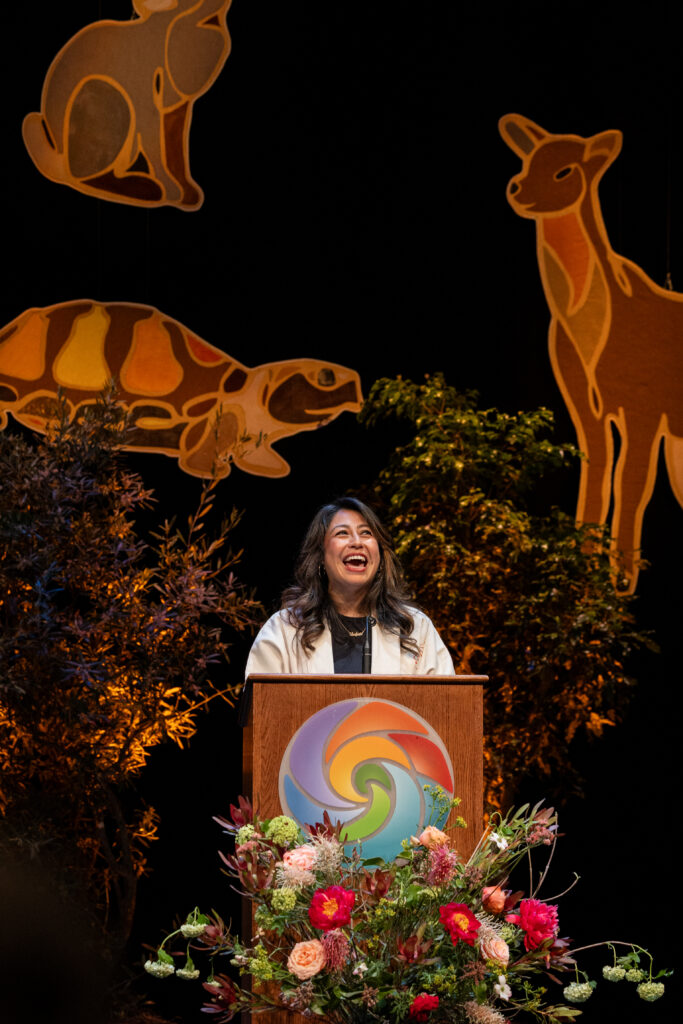
Before this, and before becoming a mom, I was a young organizer working alongside high school and college students to build the immigrant youth movement. Together, we helped grow United We Dream into a catalyst for one of the most powerful and inspiring movements of the past 20 years.
But even before I could build a movement, lead an organization, or call myself a community organizer, I’ll tell you the truth: I was a young undocumented person growing up in Queens, in a small studio apartment, living with the constant fear that one day my parents, my brother, or I could be taken by deportation agents and disappear.
Today, that same fear, uncertainty, and division are gripping millions of people across this country. What once felt normal has been turned upside down. And all around us, it can feel overwhelming — like it’s too much, and like there’s not much we can do about it.
I don’t need to remind you what’s happening. We’ve seen it on our phones, on TV, in Minneapolis, Los Angeles, Chicago, and communities across the country. We’re seeing aggressive immigration enforcement, families living in fear, and people afraid to go to work or send their kids to school. At the same time, everyday Americans are making courageous choices to stand up for their neighbors.
This is a new level of fear spreading around us. But I invite you to be clear-eyed about it, because without facing the truth of what’s happening, we won’t be able to find a way forward together.
And I want to remind you of this: despite all the pain and all the harm we’ve witnessed, history — and my own experience organizing in communities across the country — shows that the way through is by building community and collective power.
I’ll share why I believe this, because I grew up knowing what home felt like. Home was in Ecuador, with my abuela, making noodle soup in Quito on chilly evenings in the Andes.
But when I was 13, my family had to flee political turmoil. I left behind not just a place, but a sense of belonging. My parents didn’t have much, but they had love and courage. Guided by that, they did something incredibly hard: They left everything behind and came to this country in 1998.
Growing up in New York City, in a place where I didn’t know the language or the culture, I quickly learned to feel ashamed — ashamed of not speaking English, ashamed of being an immigrant, ashamed of my skin, my Indigenous features, ashamed of who I was.
I was undocumented, living in fear, and still trying to fulfill my parents’ dream that I would be the first in our family to go to college. I did everything I was told to do: worked hard in school, did community service, checked all the boxes.
Then 9/11 happened. And in that painful moment for our country, everything changed for families like mine, and for Muslim and immigrant communities across the country. Policies shifted. Immigrants were treated as threats to national security. In many places, including New York, undocumented students lost the ability to access higher education. People like my dad, who worked in construction, lost the right to drive.
One day, my dad was traveling between New York and New Jersey for work, crossing the George Washington Bridge. He was given the wrong change at the toll booth and tried to go back to fix it — an ordinary, honest mistake. But when you’re an immigrant, even something small can make you a target. As he turned back, a police car pulled him over. The officer asked for his license. My dad told him it was expired. That was enough. He was asked to step out of the car and taken to a local police station.
I got a call from him. He said, “I’m allowed one phone call. Mija, ayúdame.” Help me.
I told him to stay calm, to remember his rights — to remain silent, to not sign anything. Then I asked to speak to the officer and told him we knew my dad’s rights and that a lawyer was on the way. Right after that, I texted a network of organizers: “My dad needs help. This is where he is.” Within minutes, people responded. A lawyer was already on the way.
I share this story because I don’t know what happened to that police officer. What I do know is that he released my dad with a $150 ticket for driving without a license. And the only reason that happened is because we had a community behind us — people who had my back, who taught me my rights, and who gave me the courage to speak up in that moment.
That’s the kind of courage I want to share with you today. Because courage is a choice.
Undocumented people like me take real risks when we speak out and share our stories. So imagine what’s possible for those who aren’t in that same vulnerable position. Across the country, young people found courage in each other — fighting deportations, supporting one another through school, and committing to build something bigger than ourselves.
That’s how we built United We Dream. And that’s how I learned that in isolation, we lose. Alone, any one of us can be targeted, silenced, or pushed aside. But in community, we show up for each other. In community, no one has to face it alone.
I want to share this: The way we won DACA (Deferred Action for Childhood Arrivals) was by building community. We reminded each other we weren’t alone. We helped each other find our voices. And we took action together to fight for what was right.
I never imagined we would build a movement. I never imagined that years later we would be sitting across from policymakers and people in the White House, winning protections for more than 600,000 people. But we kept organizing.

I know that right now can feel uncertain. It can feel like we don’t know what comes next, or whether change is even possible. But I’m here to tell you that it is.
We’ve seen what’s possible in places like Minneapolis, where people believed in solidarity and built power together. We’re seeing it in Los Angeles and in communities across the country responding to increased immigration enforcement.
And there is a role for everyone here. This is not just about undocumented people or immigrants. All of us have a role, especially those of us with protections that others don’t have.
What’s inspiring is that people are already showing what that looks like. In some places, people are putting their bodies on the line. In others, they’re supporting neighbors in quieter but just as meaningful ways — buying groceries for families who are afraid to leave their homes, driving children to and from school, stepping in wherever help is needed.
In cities like New York and Chicago, people are building community defense networks through group chats, text chains, and rapid response systems. There are so many ways to show up.
There is a role for all of us.
I want you to see that our organizing isn’t just building hope, it’s also shifting public opinion. It’s making ICE and deportation deeply unpopular. Together, we built a mass movement that says no to ICE.
And I want to be clear: This administration wants us to believe they’re targeting people who pose a threat to our communities. But they are the ones creating fear in our communities. And people know that.
Look at what people are actually worried about: the cost of living, paying their bills, taking care of their families. Not these manufactured fears about immigrants. More and more, people are recognizing that the chaos we’re seeing is part of a strategy.
It’s a strategy to divide us. To use immigration as a scapegoat so we don’t pay attention to the real sources of harm: corporations exploiting workers and the planet, and an administration using immigrants to advance a more authoritarian vision of this country.
But people are waking up. They’re seeing through the lies. We know that lack of healthcare, underfunded schools, and economic struggle are not caused by immigrants. And even some who once supported this administration are starting to question what they’ve been told.
I’ll share one brief story. I’ve spoken with evangelical communities across the country who have told me, “We were raised conservative. We even supported this administration. But now we see what’s happening.” In fact, this week, many of them are launching a fast for immigrants and justice.
Across the country, communities — including U.S. citizens — are recognizing that this is not the future we want. And they’ve shared this message:
We are people connected by family, community, and faith. We refuse to turn away from injustice. We show up for one another. We organize with courage and compassion. And we turn our pain into power to build a future where dignity is the norm.
We won’t be divided. We have an opportunity to build a shared future — a multiracial democracy that includes all of us.
Sí se puede. Yes, we can.