Organic Valley Goes 100% Renewable through Community Solar

By Laurie Guevara-Stone

This article originally appeared on the Rocky Mountain Institute’s website. The Rocky Mountain Institute transforms global energy use to create a clean, prosperous, and secure low-carbon future.

Almost 30 years ago, seven organic farmers from the U.S. Midwest, unhappy with the state of American agriculture, decided to band together and form a cooperative to continue farming sustainably. Today, the Organic Valley agricultural cooperative, headquartered in La Farge, Wisconsin, is made up of over 2,000 farmers in 36 states. And the cooperative just became part of a unique community-solar partnership that will allow it to become the largest food company in the world to source 100 percent of its electricity from renewable energy.

Organic Valley is a founding member of the Climate Collaborative, a group of 133 natural and organic food companies committed to reversing climate change. At the Climate Collaborative’s Climate Day event in March 2017, Organic Valley committed to procure 100 percent of its electricity from renewable energy by 2019.

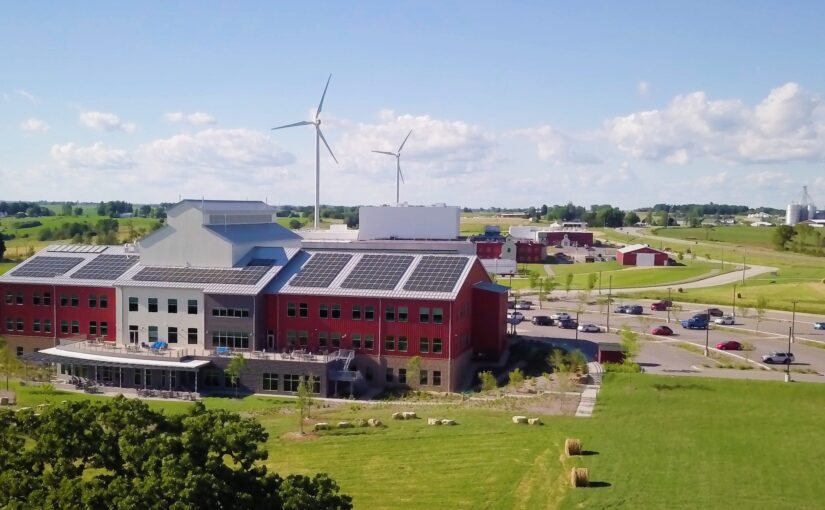
Renewable energy is not new to Organic Valley. In 2012, the company invested in the installation of a 5 megawatt (MW) wind farm next to its distribution center in Cashton, Wisconsin. Organic Valley also has rooftop solar arrays on many of its buildings. However, with the growth of the company over the past few years, these installations only covered about 50 percent of its energy needs. To get to 100 percent, Organic Valley initially set out to build a 1 to 5 MW solar array with a power purchase agreement (PPA) as a pilot project. However, Wisconsin is a regulated market, making a PPA more difficult. According to Stanley Minnick, energy services manager at Organic Valley, “Once we realized how difficult it would be to have a direct power purchase agreement, we knew we would need to scale up and partner with more communities to achieve our goal. It was important for us to see new installations near our facilities and many of our farmers in the Midwest.”

A Unique Partnership

That’s when the company reached out to OneEnergy Renewables, a developer of community- and utility-scale solar energy projects and a member of Rocky Mountain Institute’s Business Renewables Center. “Since Wisconsin is a regulated utility market, it became pretty clear early on that this was going to need to be a creative partnership,” said Eric Udelhofen, director of Midwest development at OneEnergy. So, OneEnergy started outreach to the Upper Midwest Municipal Energy Group (UMMEG)—a municipal joint action agency that provides a range of services to its 15 municipal members in Wisconsin, Iowa, and Minnesota—and the three companies created a community solar partnership. The Organic Valley–UMMEG partnership will develop roughly 12 MW of solar for Organic Valley facilities, and will support the addition of more solar in other nearby communities, bringing the total of new solar installations to about 29 MW. Not only will it allow Organic Valley to reach its 100 percent renewably powered goal, but it will also increase solar energy use in the state by 15 percent.

OneEnergy located the project sites within Organic Valley’s member communities, all of which are within 100 miles of their Cashton facilities. By working with its local utilities in a community solar approach, Organic Valley fulfilled its 100 percent commitment with 12 MW of solar projects, and the partnership has allowed for 17 MW of additional solar to be built out—the equivalent of powering roughly 3,000 homes.

It took only 13 months to get all the systems under contract. OneEnergy had such success in garnering local support so quickly because of the trust between the communities and the local business. According to Rachit Kansal, an associate in RMI’s Business Renewables Center, “Organic Valley is a grassroots organization, with deep roots in the local community. This gives them a significant amount of trust and thus, when they brought something to the table that they thought would benefit the community, the community listened.”

Organic Valley has agreed to purchase all the renewable energy certificates (RECs) from those systems for the life of the projects. “We’re not just doing a year-to-year contract,” according to Minnick. “We’re making a long-term commitment.” UMMEG has a 25-year power purchase agreement with the project, and Organic Valley will continue to buy electricity from the utilities as it has in the past.

Community Benefits

This unique partnership is bringing benefits beyond clean energy to the local communities. “The rural communities in which the projects will be located are not only hedging against a rise in energy prices, but will see utility bill savings from day one,” says Udelhofen.

The projects also create economic activity and show a commitment to sustainability. “These communities like the idea of attracting young people and appealing to the next generation of folks who are thinking about where their energy and food come from,” says Minnick. “The communities look to these projects and hope they’ll bring in more people who want to call these rural towns home.”

The fact that the arrays are smaller and spread out throughout different communities in which Organic Valley members farm is important on many levels. “Community-scale solar is the right size for municipal utilities that want to capture the benefits of local solar on their distribution grids where interconnection capacity is limited,” according to Joseph Goodman, manager of RMI’s Shine™ community-scale solar program. “Such small utilities often operate electric grids in rural areas where community-scale solar can now provide economic value and enhance resiliency while meeting member demand.”

Jonathan Reinbold, head of sustainability at Organic Valley, stresses the importance of the local aspect of the solar projects. “Organic Valley is catalyzing new solar in the region. We’re fulfilling the expectations that our consumers have in sustainable energy and food production. It’s not only good for us and our consumers, but also good for the communities, good for the residents, and good for the utilities.”

Pollinator-friendly Solar

Organic Valley’s commitment to animals and the planet also led them to adopt pollinator-friendly solar standards. Just this year, the bumblebee was declared an endangered species. To combat the bumblebee decline, Minnesota became the first state to establish a solar standard that encourages developers to plant wildflowers and native plants next to the solar arrays to make them more appealing to pollinators. The flowering plants and grasses next to the solar arrays producing electricity for Organic Valley will create as much bee and butterfly habitat as if 30,000 families were to each plant six-by-twelve-foot pollinator gardens. “By providing pollinator-friendly habitat with our solar arrays we’re taking local to the next level,” says Bill Eddie, CEO of OneEnergy.

Cooperation Is Key

The partnership between the customer (Organic Valley), a project developer (OneEnergy), and the utilities themselves (UMMEG) was key to helping Organic Valley reach its 100 percent renewable electricity goal. “This is a great example of what can be done when a large customer works closely with its utility to complete its goals,” says Eddie. “Instead of going around their utility through onsite projects or large complicated wholesale transactions, more businesses are trying to figure out what they can do with their local utilities, and municipal utilities have more latitude in what they can do to meet customer demands.”

Minnick agrees and believes they are lucky to work with such forward-thinking utilities. “The municipal utilities in Wisconsin have a lot of flexibility that an investor-owned utility does not. At the end of the day, they’re always going to be looking out for their customers. Municipal utilities should look at this not just as a feel-good story, but also as a way to save money for their rate payers and constituents.”

This article originally appeared on the Rocky Mountain Institute’s website. The Rocky Mountain Institute transforms global energy use to create a clean, prosperous, and secure low-carbon future.

In Wine Country, Agricultural Communities Measure Wildfire Tolls

By Rocco Pallin

This piece was originally published on the Food Tank website. Food Tank is a nonprofit organization focused on building a global community for safe, healthy, nourished eaters.

Unprecedented wildfires broke out in California’s Napa Valley early last month. One of the fires has been considered among the deadliest in the state’s history. Raging for more than a week and reaching 90-percent containment two weeks after ignition, the fires collectively destroyed a reported 8,400 structures and burned 220,000 acres in California wine country.

The long-term implications for agriculture are uncertain, but experts and government officials report that smoke-taint, job loss, and elevated housing prices for seasonal and other agricultural workers are among the immediate concerns.

With long-term drought having recently ended and the dry summer season coming to a close, Cal Fire director Ken Pimlott told the Los Angeles Times in an interview that vegetation was ready to burn. Strong winds, with gusts up to 70 miles per hour, are credited with downing power lines and accelerating the spread of the fires once they had begun.

As several vineyards sustained damage, the fires may have long-term effects on wine production. The Napa Valley, with 45,000 acres of land cultivated for grape production, represents 0.4 percent of the world’s wine production, according to the nonprofit trade association Napa Valley Vintners. It also employs 100,000 workers.

In addition to world-renowned grape production, which accounts for nearly all of the region’s crop worth each year, the Napa Valley and surrounding areas produce commercial vegetables, fruits, flowers, and livestock.

Renata Brillinger, Executive Director of the California Climate and Agriculture Network, reported on initial estimates from early media reports of agricultural damage in Sonoma County, where she lives. She notes that livestock—which values about US$245 million in Sonoma County—took an immediate hit from the fires, with ranchers “facing challenges with evacuating animals and in some cases losses of herds.”

Brillinger calls the area’s grasslands “well-adapted to cycles of fires like these,” noting that the productivity of rangeland could rebound this winter, the fires having burned away built-up thatch and allowing for new growth. She worries, however, of the potential of heavy rainfall to cause significant erosion, resulting in loss of nutrients in the soil and subsequent decline in grass production on grazing land.

The Napa Valley Vintners, as well as Brillinger, reported that 90 percent of Napa County’s grapes were picked and processed before the fire broke out. As of October 12, a report by The University of California Agricultural Issues Center (AIC) stated that fire had “mainly burned grass land and wooded area, especially on the hillsides with little vineyard acreage.” Vineyard land was somewhat protected because it is often at the floor of the valleys, researcher James Lapsley and Professor Daniel Sumner write in the report. Because of their relative safety, fire fighting crews even use vineyards strategically as “rally points.”

Lapsley and Sumner also expect that much of what remains of this year’s grape harvest will be picked, although at reduced value due to smoke taint, meaning that work opportunity for harvest workers will not disappear. However, seasonal workers have struggled while the fires burned and in the aftermath, with road closures making access to the vineyards difficult. Some of these workers were turned away from previously scheduled work during the fires because of dangerous conditions and limited accessibility of vineyards, resulting in a week or more without income.

“A bigger problem for farm workers is that the fires have exacerbated an already difficult and expensive housing situation,” Lapsley and Sumner explain, who are concerned that any rent increase in the area will cause difficulty for farmworkers.

One vineyard worker, Marisol Paniagua, told NPR that she questions whether her family will be able to afford staying in the area. Workers and grape growers alike worry that “the lack of jobs and the destruction of affordable homes due to the fires could force people to move elsewhere.”

The destruction of affordable housing and subsequent rising housing prices will be detrimental particularly for the immigrant labor force, which accounts for most of wine country’s workforce. It will also be costly to winemakers. California has suffered a shortage of agricultural workers for several years. Labor economist Philip Martin says the shortage of labor due to high—and escalating—living costs in the region will also slow rebuilding.

Federal assistance is available for workers who substantially lost work hours or lost jobs due to the fire. Undocumented workers, however, are not eligible to receive these Disaster Unemployment Assistance funds.

The fire also hit the emerging cannabis industry hard. Sonoma and Mendocino counties, with as many as 9,000 marijuana farms, have experienced “likely hundreds of millions of dollars in crop damage and loss,” the San Francisco Chronicle reported in the days after the fire erupted. Parts of Santa Rosa, referred to as “the epicenter of the modern legal pot economy in California” by chair of Sonoma County Growers Alliance Tawnie Logan, were leveled by fire.

Logan noted in an interview with the Chronicle that growers, who have difficulty getting crop and fire insurance, will be unable “to recover the millions in anticipated revenue they just lost.” Cannabis producers are not eligible for assistance from the U.S. Department of Agriculture (USDA) or the Food and Drug Administration (FDA) that may be available to some vineyards and winemakers.

Climate scientist Daniel Swain of University of California, Los Angeles, says a wet winter and “this summer’s record-breaking heat” contributed to the fires’ quick ignition and spread. The wet winter allowed for brush and grass to grow enormously, and the hot summer temperatures had a drying effect. Swain added that “we know there’s a long-term trend toward warmer and hotter summers.”

This year’s wildfires to date have burned about 90 percent as much acreage as the record acreage burned in 2015 across the U.S., and the fires have already broken a record for government spending on wildfire fighting. U.S. Secretary of Agriculture Sonny Perdue says, “Forest Service spending on fire suppression in recent years has gone from 15 percent of the budget to 55 percent—or maybe even more.” Perdue emphasized that limited funding requires that the Forest Service borrow money from other programs, like forest maintenance and fire prevention programs, to use for fire suppression, making it difficult to “get ahead of the curve on fighting fires.”

This piece was originally published on the Food Tank website. Food Tank is a nonprofit organization focused on building a global community for safe, healthy, nourished eaters.

Thomas Van Dyck – Traction: The Clean Energy Revolution

The exponential market growth of clean energy and the concurrent decline of fossil fuels foretell a radically different energy future. It’s much closer than most people realize. Thomas Van Dyck, acclaimed socially responsible investment pathfinder and activist co-founder of the Divest-Invest movement, shows how the clean energy transformation is gaining inexorable momentum with big business and governments worldwide. While technological advances have already made clean energy cost-competitive, Thomas shows how we can accelerate the transition and overcome the desperate last stand of the fossil fuel political-industrial complex.

Introduction by Kenny Ausubel, Bioneers CEO and founder.

This speech was given at the 2017 National Bioneers Conference. To learn more about Thomas Van Dyck visit As You Sow. To learn more about Divestmnet, visit Go Fossil Free

Saru Jayaraman – We the People: Workers Rising for Fair Wages

Before the 2016 election, workers were already rising up all over the country and have continued to do so even more now, joining the campaign for “One Fair Wage,” demanding higher wages and the elimination of lower wages for tipped workers. The movement helped torpedo Trump’s first Secretary of Labor nominee and is ramping up the fight for a $15/hour national minimum wage. Innovative, award-winning labor leader Saru Jayaraman says that, if we join together, we can end economic inequality in America. Director of the Food Labor Research Center at UC Berkeley, Saru co-founded the Restaurant Opportunities Centers United, which has more than 25,000 worker members, 200 employer partners, and thousands of consumer members in a dozen states nationwide.

Introduction by Nina Simons, Bioneers Co-Founder.

This speech was given at the 2017 National Bioneers Conference. To learn more about Saru Jayaraman and to get involved in her campaigns, visit Restaurant Opportunities Centers United.

See related videos in our Green New Deal Media Collection.

Youth Leadership Keynote: DJ CAVEM

Truly one-of-a-kind, Denver-based “conscious” emcee, father of Eco-HipHop, vegan chef, organic gardener, educator, food justice and eco activist, graffiti artist, and male midwife Ietef, aka DJ Cavem shares his vision of nurturing vibrant health and heightened awareness in our inner cities and beyond.

This speech was given at the 2017 National Bioneers Conference.

Carl Safina – We Are Not Alone: What Animals Think and Feel

Does my dog really love me? Carl Safina, the world-renowned ecologist, author and expert on animal consciousness, reveals that we’re discovering many non-human minds are far more similar to ours than previously thought. They possess self-awareness, empathy and communication skills. They imitate, teach, and grieve; they know who their friends (and enemies) are. They seek status. Their lives may follow the arc of a career. Relationships define them, as relationships define us. This intimate journey into the heart of nature inspires us, even more, to protect wildlife habitats and assure the animals’ survival.

Introduction by Joshua Fouts, Bioneers Executive Director.

This speech was given at the 2017 National Bioneers Conference.

Explore our Intelligence in Nature media collection >>

Kenny Ausubel – “Turdulent” Times: A Hero’s Journey

Bioneers Founder and CEO Kenny Ausubel address the audience at the 2017 Bioneers Conference.

Read the transcript here.

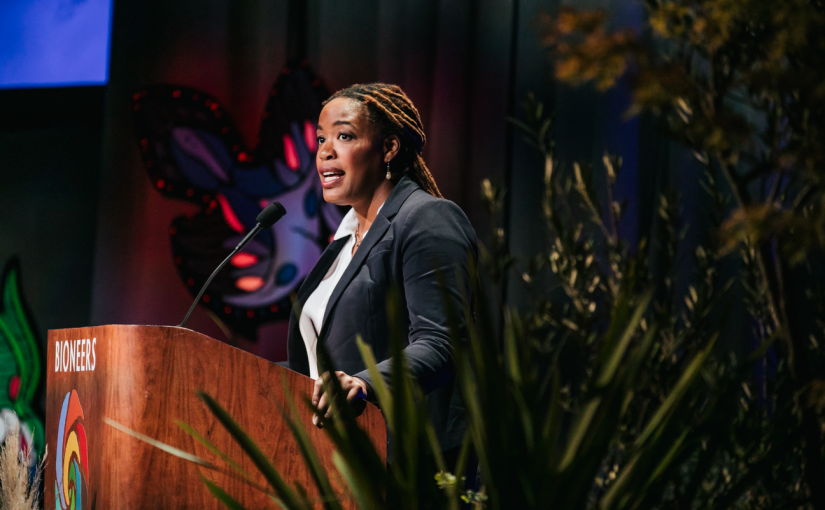
Heather McGhee: A New “We The People” For a Sustainable Future

Heather McGhee, Distinguished Senior Fellow at Demos, a public policy organization working for an America where we all have an equal say in our democracy and an equal chance in our economy, depicts how deep democracy is the only solution to the crises of inequality and climate change, and how the changing demos — people — of America can rise to meet this moment. A thought leader on the national stage, Heather, among her many accomplishments, helped shape key provisions of the now threatened Dodd-Frank Wall Street Reform and Consumer Protection Act.

Introduction by Nina Simons, Bioneers Co-Founder.

This speech was given at the 2017 National Bioneers Conference.

Learn more about Heather McGhee and her work at Demos by visiting www.demos.org.

See related media in our Green New Deal Media Collection.

Destiny Arts Youth Performance Company

The Destiny Arts Youth Performance Company (DAYPC), a program of Destiny Arts Center, an Oakland-based violence prevention/arts education nonprofit, is a multicultural group of teens that creates original performance art combining hip-hop, dance, theater, martial arts, song, and rap. The company has performed locally and nationally since 1993 and has been the subject of two documentary films. DAYPC’s artistic directors are Sarah Crowell & Rashidi Omari.

Cory Doctorow: The Fight for a Free, Fair and Open Internet

According to journalist, blogger, creative commons advocate, Electronic Frontier Foundation Fellow, and award-winning science fiction author Cory Doctorow, the fight for a free, fair and open Internet isn’t the most important fight on the planet, but you can’t win any of the other major battles without it. Although the internet is the nervous system of the 21st century, so far we have misunderstood and mismanaged it and made it susceptible to capture by the powerful and corrupt. Cory will share his strategies to reclaim the global lifeline that should belong to all of us.

Introduction by Joshua Fouts, Bioneers Executive Director.

This speech was given at the 2017 National Bioneers Conference.

Learn more about Cory Doctorow and his work and campaigns.

Youth Leadership Keynote: Naelyn Pike

This luminous 17-year-old Chiricahua Apache changemaker from San Carlos, AZ, co-leads the Apache Stronghold group to defend her people’s sacred sites, tribal sovereignty, culture and language.

Introduction by Alexis Bunten, Bioneers Indigeneity Program Manager.

This speech was given at the 2017 National Bioneers Conference.

See more from ourIndigeneity Program and Youth Leadership and Education Program.