Saru Jayaraman: How Restaurant Workers Are Inheriting a Legacy of Slavery in the U.S.

Saru Jayaraman is Co-Director of the Restaurant Opportunities Centers United (ROC); Director of the Food Labor Research Center at UC, Berkeley; and author of Behind the Kitchen Door and Forked: A New Standard for American Dining. She co-founded ROC after 9/11 with displaced World Trade Center workers. It now has more than 25,000 worker members, 200 employer partners, and several thousand consumer-members in a dozen states nationwide.

Jayaraman has become one of the most prominent voices in the national conversation about restaurant workers’ rights and the tipping economy, which has become increasingly problematic and immoral. (Learn more about Jayaraman and her mission to end “modern-day slavery.”) She took the stage at Bioneers 2017 to deliver a passionate keynote about this broken system and promote One Fair Wage, a campaign working to “pass legislation in cities and states that will require the restaurant industry to pay all its employees at least the regular minimum wage.”

Watch Jayaraman’s keynote and read excerpts from the transcript below.

Excerpted Transcript of Jayaraman’s Keynote:

The restaurant industry right now is the second-largest and absolute fastest-growing sector of the U.S. economy. It’s over 12 million workers. One in 11 American workers currently works in this industry. One in two of us in this room and in the United States has worked in this industry at some point in their lifetimes. So many of us have worked in this industry. Every one of us eats out. In fact, as Americans, we are eating out in ever-increasing numbers. We just made world history last year, becoming the first nation on Earth in which we spend more money on eating out than we do on food eaten inside the home. So the industry just continues to explode.

There’s no sign of it being replaced by technology any time soon. Robots are not taking over these jobs. It’s not going anywhere, and yet despite its growth, despite its size, despite the fact we’ve all worked in it, despite the fact that we all touch it every day, it continues to be the absolute lowest-paying employer in the United States. Every year, the Department of Labor puts out the list of the ten lowest-paying jobs, and every year, seven of the 10 lowest-paying jobs are restaurant jobs.

—

It turns out that tipping as a practice did not originate in the United States. It originated in feudal Europe. If you ever read Jane Austen or you watch Downton Abbey or you ever see period pieces, you will see occasional references to tipping. It was noblesse oblige, something that an aristocrat gave to a subservient—something on top of a wage, by the way—because serfs and vassals in feudal Europe actually received wages, and tips were gratuities on top: noblesse oblige.

Well, this idea came to the States in the 1850s and 1860s, and when it came, there was massive populous rejection of the idea as undemocratic, un-American, a vestige of the feudal system. That movement, which was so successful and spread to Europe and succeeded in getting rid of tipping in a lot of Europe, here in the United States was squashed by the Restaurant Association: the early industry lobby, which found that tipping was a beautiful way to hire newly freed slaves and continue the legacy of slavery by not paying them anything at all and letting them live on customer tips.

At the turn of the 19th century, a majority of tipped workers in the country were black former slaves. They were actually given a $0 wage, and that was codified into the very first minimum wage law that passed in 1938, as part of the New Deal, which said that tipped workers would get a $0 wage from their employer as long as tips brought them to the full minimum wage. We went from $0 in 1938 to a whopping $2.13 an hour, which is the current federal minimum wage for tipped workers in United States in 2017. It ranges between $2 and $7 in 43 states in the United States. California is only one of seven states that has gotten rid of this legacy of slavery. But 43 states persist in asking employers to pay $2 and $3 and $4 an hour. New Mexico is $2.13. Colorado is $4-something. Pennsylvania is $2.85. D.C. is $2.77. Massachusetts is $3. It is a shame. It is a shame in the United States that anybody is being paid $2 and $3 an hour.

—

Every time I speak to an audience like this, a woman comes up to me and says, “You know, I’m now a union organizer or corporate lawyer, an IBM executive—I’ve been sexually harassed later in my career or even recently, and I didn’t do anything about it because it was never as bad as it was when I was a young woman working in restaurants.”

We did research on these seven states—California, Oregon, Washington, Nevada, Minnesota, Montana, and Alaska—that got rid of this system decades ago. We found that those seven states are faring better on every measure than the 43 states with lower wages for tipped workers: higher restaurant sales per capita, higher job growth in the restaurant industry, higher rates of tipping. People actually tip better in these states. And [they even have] half the rate of sexual harassment as the rest of the country.

So in all of this talk about solutions for what we are seeing as an epidemic of male power and disgusting behavior, I have a solution: Pay most of the women in America an actual wage. Pay them a wage. How hard is that?

If this is the largest employer of women, then force this industry to pay them an actual wage.

—

Why should anybody care? Why should you care? Maybe some of us are right that first we have to save the Earth before we think of anything else. First we have to make sure that humans can survive on this planet before we think of anything else. Maybe first we put everything else aside and focus all our energy on stopping climate catastrophe because it’s moving so fast and we don’t have much time. Of course, even I can see that. And yet, I think that there is a real problem if we aren’t simultaneously thinking about saving the Earth and our ability to survive, and also thinking about, if we survive, if we save the Earth, what kind of life do we want for the people who make it? Do we want to make it past this period of disaster into a world of haves and have nots?

—

Here are some reasons why I think we should care.

First of all, it is these low-wage workers who are the frontline survivors and disaster recipients of climate catastrophe. They are the ones bearing the brunt.

Second of all, if we want to build any kind of political power going into the future to stop climate change, to stop corporations from doing what they’re doing, if half the country is suffering with just making it from day to day and we don’t think about addressing their needs—at least listening to them and working with them—we’re not going to have the political power to stop the corporations from doing what they are doing.

And that’s the third reason: These are the same corporations that are killing the Earth, that are killing the environment, that are also killing workers. We have common targets.

But ultimately, we can’t survive—there will be no organic products or sustainable products of any kind—if people can’t consume. And fundamentally, these people are not just consumers, they are humans, and so are you, and I know you care not just about the Earth, but about equity. Fundamentally, you want us not just to survive through climate catastrophe, but thrive, live.

Ultimately it is this question: Who gets to decide whether we continue this legacy of slavery? We said no 200 years ago because slavery was inhumane. Why are we saying okay now? Who gets to decide how a woman is treated in the workplace? Is it a trade lobby? Is it corporations? Is it the other NRA? Or is it we, the people?

Bioneers Co-Founders Travel to Japan to Accept Goi Peace Award

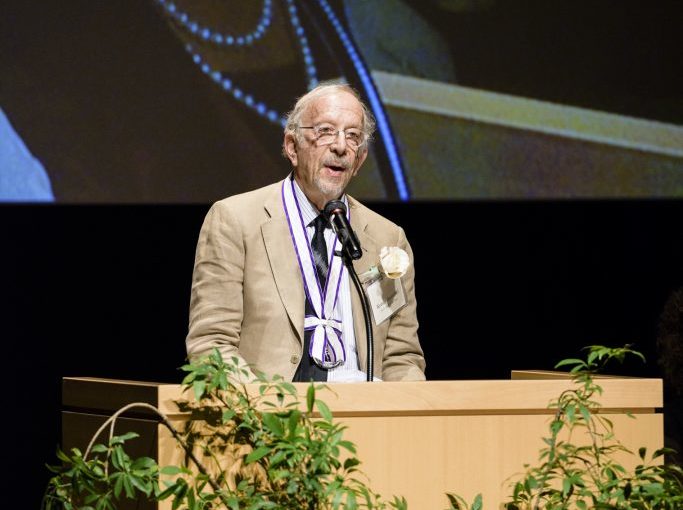
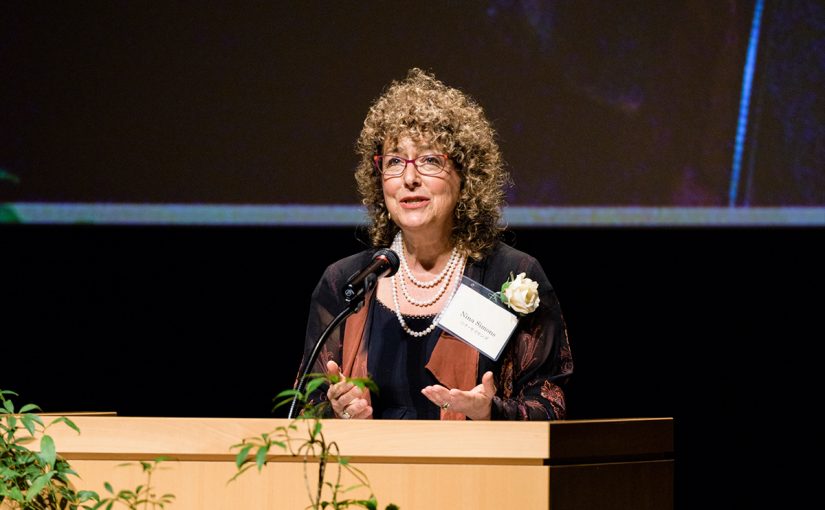
On November 25, Bioneers co-founders Nina Simons and Kenny Ausubel were honored to receive the prestigious Goi Peace Award. Awarded annually by the Goi Peace Foundation in Japan, Simons and Ausubel join the ranks of other great thoughtleaders, including Bill Gates, scientist James Lovelock, Nigerian pro-democracy activist Hafsat Abiola-Costello, and Deepak Chopra.

The Goi Peace Award exists to highlight individuals and organizations in various fields that have made outstanding contributions toward the realization of a peaceful and harmonious world. They are selected not only in recognition of their past achievements, but for their ongoing contribution to building a better future.

Simons and Ausubel return home to the U.S. this week, humbled and overwhelmed with gratitude after accepting this incredible award on behalf of the Bioneers community.

Below, watch the Goi Peace Award ceremony, listen to Simons and Ausubel speak at the forum, and get a glimpse into their beautiful time in Japan. All photos and videos are courtesy of the Goi Peace Foundation.

You can read the complete transcripts of Kenny Ausubel’s remarks here and Nina Simon’s remarks here.

Goi Peace Award Ceremony

Photos:

Video:

https://youtu.be/sVnXBq4SPDc

Talk Session With Nina Simons and Kenny Ausubel

Photos:

Video:

Gathering of Young Leaders for Peace

Sightseeing in Japan

“The Bioneers: Revolution from the Heart of Nature,” Kenny Ausubel’s Remarks at the 2017 Goi Peace Awards

[Editors Note: Following are Kenny Ausubel’s remarks as delivered as 2017 honoree of the Goi Peace Foundation with Bioneers co-founder Nina Simons. You can see the video of the remarks here.]

The Bioneers: Revolution from the Heart of Nature

Anata no shō o omedetō gozaimus. (“As to your award, there is honorable praise, I am your goza mat.”)

I accept this great honor on behalf of the Bioneers community. That’s what Bioneers is about: a community of leadership in a time when we are all called upon to be leaders.

Today’s “wicked problems” are far too big and complex for any one person to solve. In this time, leadership arises in and from community. As it is in nature, there may be dazzling soloists, but in the end, it’s all about the symphony.

But Bioneers did not begin as a community. I will share our creation story.

Bioneers originated in 1990 in a Japanese-style hot tub facility called Ten Thousand Wave high in the mountains above Santa Fe, New Mexico, near where I live. I was visiting with a friend and investor in Seeds of Change, the organic seed company I had just started. The company’s mission was to help revive agricultural biodiversity because diversity is the very fabric of nature. It’s nature’s fail-safe mechanism against extinctions, its source of innovation and regeneration.

I was enthusing to my friend about all these amazing people I’d been finding who had devised authentic solutions to many of the world’s most major crises. It had long been clear the world was on a collision course with nature – and with each other. I wanted to do something about it. So as a citizen and a journalist, I had been looking around to learn who might be out in the world developing real solutions.

One by one, I began finding breakthrough social and scientific innovators with both visionary and practical solutions. I started to see common threads. First, they were all systems thinkers. They recognized the interconnection of disparate issues and they developed “solve-the-whole problem” approaches.

Second, they looked to nature – not as physical resource, but as model, mentor and metric. The solutions in nature surpass our conception of what’s even possible. There’s nothing like having 3.8 billion years of research and development at your back.

So I was in the hot tub celebrating these visionary innovators – “Bioneers” I called them – and I was complaining about how nobody had ever heard of them. If only the world knew, it would leverage the pressure for change.

My friend said, “Why don’t you have a conference?” I had never been to a conference and it sounded really boring. I just kept talking about these bioneers until he stopped me in mid-sentence and said, “Kenny, I’m giving you $10,000 – have a conference.” That’s how Bioneers began.

I quickly shared the idea with Nina Simons, who by then was serving as Marketing Director for the Seeds of Change company. Nina and I had connected in early 1987 when a mutual friend invited us both to dinner. We quickly fell in love and began working together immediately on the movie I was then completing. Nina had a background in film and theater, and she was a natural communicator. She loved the idea of a conference and offered to produce it with me.

As communicators, we knew from the beginning that we had to get these voices of the Bioneers out into the world. But what it took us years to understand was that connecting people with each other and connecting otherwise isolated work across diverse issues was equally important.

Out of that grew the Bioneers community – a diverse networks of networks. The annual conference grew from 250 people to over 3,000 every year, along with a lot of media we produce.

Fast-forward 28 years. Many of these ideas and practices are now entering the mainstream, or beginning to influence mainstream thinking.

As Bioneers has shown since 1990, the solutions are largely present, or we know what directions to head in. As the state of the world has plunged from urgency to emergency, we can move from breakdown to breakthrough.

We can shift our course to re-imagine how to live on Earth in ways that honor the web of life, each other and future generations. The coming years will be the most important in the history of human civilization. This is the decisive window to make the shift, and it’s happening.

Around the world in diverse fields of endeavor, social and scientific innovators such as the bioneers have been developing and demonstrating far better technological, economic, social, and political models. Human creativity focused on problem solving is eclipsing the mythology of despair.

This shift also inspires a change of heart that honors the intrinsic value of all life and of our human diversity.

This Age of Nature calls for a new social contract of interdependence. Taking care of nature means taking care of people — and taking care of people means taking care of nature. It’s a revolution from the heart of nature and the human heart.

Fortunately nature has a profound capacity for healing, and we are learning how to work with nature to heal nature and our human communities. Resilience is the grail — enhancing our ability to adapt to dramatic change and design our ways of living for the long haul.

Bioneers gathers and cross-pollinates a unique network of networks to engage people to implement these large-scale shifts. We connect diverse issues, movements, cultures, and people from many backgrounds and walks of life. We’re cultivating a global wisdom culture with an expanded sense of kinship that embraces our human diversity and celebrates the oneness of life’s diversity.

We’re working to rapidly spread, adapt and scale the abundant models and solutions that already exist. It’s bottom up and top down — all hands on deck to generate the biggest and fastest economic, industrial, political and cultural transformation in history.

It comes down to growing the national and global movement of movements that are working for 100% clean energy, ecological agriculture, green design, biomimicry, watershed restoration, social and economic justice, racial and gender justice, and democratic governance.

I’d like to share a few stories.

Paul Stamets is the quintessential bioneer who has looked to the natural world for guidance. His work developing fungi-based “mycotechnology” has shown the astonishing breakthroughs contained in nature’s operating instructions.

Fungi are some of the fundamental decomposers, digesters, and recyclers of the food web that regenerate life. We also know that mushrooms can be powerful medicines for human health. Paul long wondered as an ecologist if his beloved fungi could also perhaps be medicines for restoring the land.

In a succession of experiments and demonstrations, he has shown that mushrooms can purify soil contaminated with diesel oil. They digest and transform the oil, leaving virtually no trace in the soil or the flesh of the mushrooms. This bioremediation of soil occurs rapidly in a matter of weeks and months – not years.

But after they do their job, Stamets’ mushrooms then showed how nature heals and restores itself. As the mushrooms decayed, worms and maggots appeared and ate them. Birds came to eat the insects and worms. The birds carried seeds on their feathers and plants grew. Within a matter of weeks, the formerly contaminated dead dirt turned into a thriving oasis of life.

Just imagine if we applied this mycotechnology to decontaminating chemically farmed farmlands on large scales. Or to brownfields and toxic sites. And instead of hazmat teams and engineers, you need gardeners.

As word spread about Stamets’s magical mushrooms, he received a call from the Department of Defense. The US government has the world’s largest stockpiles of chemical weapons, and they’re decaying. The military had no good way to get dispose of them without dispersing them into the environment. Could his mushrooms help remediate them?

Sure enough, two varieties of mushrooms completely metabolized and transformed Sarin nerve gas, among the most lethal and durable toxins on the planet. As the mycologist told the military, one of the active strains is native to the Pacific Northwest old-growth forest that’s threatened by logging. Protecting our national forests, he said, is a matter of national security.

Paul has made other breakthroughs now, including an apparent solution to the bee colony collapse disorder that threatens agriculture.

There are hundreds and thousands of such examples today among the Bioneers community.

For all the chatter about the Age of Information, what we’re really entering is the Age of Nature. After all, we didn’t invent nature. Nature invented us. Nature bats last, the saying goes. Even more importantly, it’s her playing field. We would be wise to learn the ground rules and how to play by them.

In the words of Janine Benyus, “What life does is create conditions conducive to life.” That’s quite a mission statement. Of course, for millennia, indigenous peoples, the world’s original bioneers, have held exactly this Gaian view. It’s all alive. It’s all connected. It’s all intelligent. It’s all relatives.

Biomimicry is the design revolution that naturalist, author and bioneer Janine Benyus calls “innovation inspired by nature.” It starts with the understanding that as human beings, we are nature. It’s the illusion of separation that is our civilization’s fundamental systems error.

Benyus describes “Life’s Principles” in this way.

Nature runs on current sunlight. Nature banks on diversity. Nature rewards cooperation. Nature builds from the bottom up. Nature recycles everything. Life creates conditions conducive to life.

Today the design science of biomimicry is spreading rapidly even among big companies as we learn how to mimic nature’s genius in our technologies, industries, economies, and even our social systems. From spiral designs that mimic nature and reduce energy consumption by 60%, to spider webs that show how to make glass that deters birds from crashing into windows, to Namibian beetles that show how to collect moisture from the air to collect water in arid regions, to flocks of geese who take turns as the lead goose to share the stress of leadership – it’s a genuine revolution in our thinking.

But the challenge we face today is not primarily technological. It’s a human crisis: the endgame of a civilization at war with the natural world and with ourselves.

We are all prisoners of war, and it is not a winnable war.

To succeed, we’re called upon to cooperate on a grand scale. It requires the equivalent of a wartime mobilization, yet its purpose is precisely the opposite: to create peace – with the land, each other, and ourselves.

How do we get through this alive? We are not the first to ask that question.

The late Seneca historian John Mohawk, who was a Bioneers Board member and my mentor, reminded us that the Iroquois Confederacy of Indian nations was forged out of cataclysmic war. He told the story this way.

There was an individual born among the Hurons in the Great Lakes region of North America who grew up in a society that was each against all. Blood feuds left not only villages fighting villages, but individual households fighting individual households. Violence ruled the day. Not unlike the twenty-first century, it was a time of absolute horror and degradation of the human soul.

A young man not yet twenty had an insight. He said violence is a really bad idea. He went to the people, and he stated, “You have to stop these cycles of violence.” The cycles of violence were embedded deep in the laws and customs of the Indian peoples. They were about revenge, for real and imagined injuries.

This young man, who became known as the Peacemaker, said that war makes people crazy. When people are at war, they’re not thinking clearly.

His argument was this: “We don’t need to live this way. We have the power in our collective minds to create a world in which people do not use violence, but rather use thinking.” He went from village to village and persuaded people that we must have a pact against violence.

Of course, when you walk into a village and say, “We have to put down our weapons of war and have peace,” they’re going to say, “Not till the other guys do.” To which you say, “Okay, let’s go talk to the other guys.” Until someone says, “Can’t talk to them. They’re all crazy.”

So the Peacemaker responded, “When you tell yourself your enemy can’t think, you destroy your own power to make peace with him. In order to use our minds to solve problems, we have to first acknowledge that the people on the other side of the negotiation probably want their people to live, and probably want a lot of the same things you do.”

So it starts by looking for common ground with the enemy.

People said, “We’re at war with these people because they’ve harmed us. They’ve done wrong to us.”

The Peacemaker replied that the pursuit of peace is not merely the pursuit of the absence of violence. Peace is never achieved until justice is achieved. Justice is not achieved until everyone’s interests are addressed.

So, he said, you will never actually finish addressing everyone’s issues. You can’t achieve peace unless it’s accompanied by constant striving to address justice. It means your job will never end.

The Peacemaker said we have to build an institution to represent this. He brought together the chiefs of the nations, and they formed the Iroquois Confederacy. Its highly sophisticated governance became one of the inspirations for the American Constitution and democracy.

The Peacemaker did not say we’d kill each other off with weapons. He said that in the end, unless we achieve peace among ourselves, the people of the planet will be eliminated.

To get through this keyhole of human evolution, we‘re going to have to face and heal the deep wounds in our societies and in ourselves. How?

Bioneer Ed Tick is a psychotherapist who began working in the 1970s with Vietnam veterans who suffered from post-traumatic stress disorder (PTSD). Most of them were taking multiple drugs to suppress the personal hell haunting their lives.

Tick realized that PTSD was not about stress; it was about trauma. He learned that the Greek word travma actually meant a puncture, a hole, a wound. For the Greeks, it was also a spiritual wound: a hole in the soul.

Tick began taking vets back to the scene of their trauma, to face and embrace their former enemies – to seek redemption in forgiveness. They began to heal the wounds to their souls. Knowing the horror, now they try to talk people out of war. They became true warriors.

On one of these truth and reconciliation journeys to Vietnam, Ed Tick and the veterans visited My Lai. Today My Lai is a beautiful peace garden like Hiroshima where people from all over the world come to learn. Before that, it was the infamous scene of the slaughter of an unarmed village by US soldiers.

At My Lai, Tick and the vets met a woman of seventy-five, the only member of her family to survive the dreadful massacre. She lost her husband, her parents, and all her children. These are Ed Tick’s words:

She expressed her terrible pain at living. I said to her, “Grandmother, we’re so sorry for you and your losses. How do you feel about us Americans coming to visit you and see this place when we took so much from you?”

She said: “My pain doesn’t matter. It is so important that you come.”

And I said, “Grandmother, I can understand that ‘thank you.’ But how do you feel about our veterans coming back? Maybe they were here. Maybe they took the lives of your family or other Vietnamese people.”

She said: “Oh no, no. You misunderstand. It is most important that your veterans come back here, so that I can take their hands and look into their eyes, and forgive them and help them heal.”

There is a place in Vietnam called Marble Mountain. It’s very sacred. There is an ancient Buddhist temple in it. The Viet Cong used it as a field hospital. The US bombed it twice. But the temple is still intact and it wears its scars. Outside that temple on Marble Mountain, there is a simple wooden sign that proclaims in both Vietnamese and English these words, a Buddhist precept:

Hatreds never cease by hatreds in this world.

By love they cease.

This is an ancient law.

The wounds we’re inflicting on the Earth and on each other are the same wound.

Blessed are the peacemakers.


“Healing at the Intersections: Environment and Social Justice Conjoin at Bioneers,” Nina Simon’s Remarks at the 2017 Goi Peace Awards

Editors Note: Following are Nina Simon’s remarks as delivered as 2017 honoree of the Goi Peace Foundation with Bioneers co-founder Kenny Ausubel. 

First, I must express my deepest gratitude to the Goi Peace Foundation, for honoring both of us, and Bioneers, with this award. We accept this honor with humility, and on behalf of the large and extended community of those visionaries that Kenny, back in 1990, coined a term to describe: “Bioneers.”

There’s something mysterious about a made-up word like Bioneers. Perhaps it’s like music or love, in that each of us may find our own ways of relating to it.

What we mean now by Bioneers is scientific, political and social innovators, activists, cultural bridge-builders and leaders from many walks of life and fields of endeavor who are collaboratively contributing to the great global ecological and social and cultural transformation now underway.

It is an enormous validation that you here at the Goi Peace Foundation, who have done so much to promote world peace, and are based halfway around the globe from the U.S., have heard of Bioneers and perceive value in our work. Thank you.

In accepting this honor, I wish to offer some reflections about what I think makes Bioneers a unique enterprise. On the physical plane, it’s a relatively small non-profit organization, but one that has developed into a key nexus point for many diverse but intersecting social movements.

We seek to go beyond the idea of sustainability as a goal. Merely sustaining ecosystems and communities, at their current rate of degradation, loss and suffering, we find too timid as an ultimate goal.

We aim for a human footprint that is regenerative for all of life. We seek the restoration of health and vitality to natural systems and human communities by combining the best of ancient wisdom with the leading edge of contemporary “whole systems” approaches.

At the heart of this notion is the idea that we humans need to be humble, to become students of nature’s extraordinarily sophisticated design genius.

One of the foundations of our worldview is that, as in the natural world where the most diverse ecosystems are the most resilient and vital, the human enterprise also is healthiest when it is characterized by high degrees of diversity.

In our work, therefore, we have always sought to highlight a broad array of innovative approaches to solving problems, presented from differing perspectives, disciplines, generations and cultures, including a very strong emphasis on honoring the wisdom of indigenous, “first peoples’ and of their long-lived traditional ecological wisdom.

Here in Japan, you have been able to maintain far more of a connection to your ancestral wisdom about respecting and working with nature than we have in North America, so I think we have much to learn from you in that regard.

At a conference in 1994, the physicist, ecologist and activist Vandana Shiva from India offered some crucial distinctions between a “bioneer” and a pioneer. She warned that rapid scientific innovations intended to improve upon biology through agriculture posed tremendous risks.

Aggressive scientists and corporations seeking to profit from poorly-conceived genetic manipulation will look very like the European pioneers. They thought that every land they conquered was empty of people, so they saw no need to respect any pre-existing rights.

Those who we have called bioneers, on the other hand, recognize that every step we take is on a full earth populated by a tremendous variety of species and many other people.

The pioneer ‘empty land’ ethic,” Vandana noted “leads to violence against species and to genocide. The colonizing pioneer mind assumes there are no limits to be respected, no ecological limits, no ethical limits, no limits to greed or accumulation, no limits to inequality.”

Whereas authentic bioneers, she said, “know that limits are the first law of nature, encoded in the ecological processes that make life possible. Limits of the nutrient cycle in soil, limits of the water cycle. The limits set by the intrinsic right of diverse species to exist set limits on our actions, if we genuinely respect other beings.

Ethical limits are what make us human. To be sustainable, a society must live within those limits.”

Vandana spoke of a Hindi word that means “We are one earth family,” or the “democracy of life.”

She explained that “to bioneers, it means not just diverse human cultures, but all beings. The mountains and the rivers are beings too. We bioneers respect all the beings, large and small,

without a hierarchy of superiority and inferiority, because everything has a part to play ecologically in the web of life, even if we do not fully understand how.”

Being a bioneer also means appreciating that, just as the web of life is interconnected and interdependent, so too are all the issues we face.

It became increasingly clear to me that there could no longer be any perceived separation between people and the “environment.” We are a part of nature, not apart from it. Our bodies are made of the same elements, the same DNA as plants, fungi and animals.

We are all connected, both biologically and spiritually. Since the earth is a closed loop, the cup of tea you drink today may have once been Cleopatra’s bathwater.

What we do to the earth, we do to ourselves. When we harm ourselves and other people, we damage the earth. Therefore, being a bioneer must include pursuing social justice and equity for all humans as well as protecting species and ecosystems.

For the first ten years or so, I used the term “bioneer”to describe the people on stage, the presenters we invited to speak, Innovators who offered brilliant new approaches and practical models of ecological or social restoration.

I was unaware of my own internalized hierarchy, but all that changed when the late J.L. Chestnut spoke in 2001.

He was a renowned attorney and legendary Civil Rights activist since the brutal struggles in the U.S. South of the 1950s, and my definition of a bioneer expanded into something larger.

He was telling the story of winning the largest class action lawsuit in the history of America – against the US Governmentfor institutional racism against black farmers in the Southeastern U.S. It was a powerful talk, and he did something I’d never heard before. He began to use the word ‘bioneer’ to address everyone in the room.

He noted that the progress that’s being made, slowly but surely, to bring our country toward racial and social justice and true democracy was due in part to the efforts of “You bioneers, dedicated progressive people like you.”

He went on to say: “I raise these concerns to you because fighting on behalf of women, on behalf of minority people of color, fighting on behalf of the environment and the planet are all one big battle. We bioneers know (he said) that violence, greed, racism, unchecked materialism, and abuse of this planet and the nature in and on it is its own form of terrorism. And will eventually destroy us if we don’t first put an end to it.”

It was a revelatory moment for me. Suddenly, the word didn’t just describe the visionary speakers on stage, but applied to us all. Not only the presenters, but every man, woman and child present, hearing our podcasts or seeing our videos, or anyone working toward healing our relationship with Earth in thousands of different ways.

All our contributions, all our collective creativity and imagination were needed to remake this world. We were all bioneers, if we chose to be. We each had a role to play.

As J.L. Chestnut said, the way that we have treated women, people of color, Indigenous people and the Earth are all just different octaves of the same legacy. We all – regardless of our many differences – bear scars from a culture that was founded on conquest, exploitation and oppression.

I began to see that we are all, in varying ways, responding to often-unconscious influences and implicit biases from a legacy of disrespect and violence that manifests on all levels of society – from the personal, emotional and physical to the economic, political and environmental.

Thankfully, we also know the power of community and connection, and we are gifted with a capacity for self-reflection and choice. Each time we relate caringly, meeting others where they are or on common ground, instead of reinforcing separation, we begin to help heal and restore our social landscape.

Each time we renew ourselves in nature, sensing with our full bodies, hearts and intuitions the repair and guidance she so abundantly offers, we help the healing happen.

Over the years, Bioneers has evolved greatly, prompted in part by this understanding.

We hope to educate, inspire and ignite engaged action and leadership, while identifying and illuminating many of the most promising solutions and strategies.

By juxtaposing seemingly disparate issue areas, and mingling them with arts and ceremony, we help reveal how all issues are part of one dynamic, inter-related living system, which embeds us within the context of the living world.

We all need each other to make the large-scale changes we face. Relationships of authentic cooperation, collaboration and community will become absolutely critical in the years ahead, because we are facing immense challenges.

Bridging our differences respectfully will determine whether and how we may succeed at shifting human civilization from our current ecologically suicidal trajectory.

In the past several years, I have realized that for me to be able to help create effective change “out there” in the world, I must also work on seeing – and then changing – myself.

There have been many ways in which I have internalized the unresolved wounds and blind spots of our U.S. culture, from gender bias to racial injustice. I am trying hard to reconcile them to make peace within myself.

As I’ve searched for insights to help me in this quest, I’ve come to feel that – while racial divides still rupture our societies (and the discrimination and wounding that so many minority people experience each day horrifies me) – the biases that privilege the masculine over the feminine create at least as great an unconscious barrier to equity and peace among people around the world as faith, race or cultural differences.

In recent years, studies have shown that globally, gender is the bias most deeply embedded in the human psyche.

Like most or many women, I’ve experienced thousands of moments of feeling diminished, threatened or intimidated because of my gender.

Inwardly, I also see ways I’ve unconsciously acquired some learned beliefs about women, and limited my own options and pathways as a result.

I realize that gender and race are only two of the many ways we diminish each other and ourselves. Nearly all of us have experienced feeling slighted or disrespected somewhere – whether for our ethnicity, age, size, sexual preference, ability, class or appearance.

While I am inspired to see that much progress has occurred in some of these areas, we have far more work to do to heal the wounds that separate us.

I believe that investing in the leadership of women – and restoring the ‘feminine’ to a place of equilibrium with the ‘masculine’ throughout all of our lived experience as individuals, as well as in our institutions and culture – are essential to the global transformation that we, as a species, are being called to make, in order to shift our course to a life-affirming future on Earth.

Around the globe, we see clearly that wherever the rights, opportunities and safety of women improve, benefits result for all areas of society. As women’s leadership and gender equity increase, so too do economic prosperity, public health, education, peace and the security of nations.

As women’s education and reproductive rights improve globally, they will also have significant effects in curbing population growth, drawing down carbon and slowing climate change.

Since we’ve inherited some skewed stereotypes about what the masculine and feminine really mean, I’d suggest we seek to identify and reclaim healthy identities that can welcome a full array of our human capacities, regardless of what our physical gender identity might be.

And, because we all contain masculine and feminine within us, this is ultimately about restoring our human wholeness. About practicing listening and not-knowing, more often than asserting that we know the answers. About evolving from power over to power with and power to co-create change.

It’s about trusting that leadership is often better shared, and that win-win solutions frequently exist, if we seek them out patiently, practicing mutual respect, patience and trust. As indigenous peoples of Central America say, “the bird of humanity has been trying to fly for far too long with only one wing.”

May we have the humility to listen for guidance from the land,

from our ancestors, and from our bodies and hearts,

as well as our minds, dreams and intuition.

May we find the collective vision, courage and will

to decolonize our minds and hearts,

reclaiming a balance of feminine & masculine,

of receptive and active, of yin and yang in equal measure

that flow through us each and all.

May our partnership with mother Earth, Gaia,

and the sweet and salty waters that flow in her veins,

the winds and clouds that caress and bathe her,

and the fires that cleanse and restore her vitality,

and our kinship with all the creatures large and small

who share this magnificent home

become our devotional, long-term relationship practice.

May this lead us collectively toward a world

that’s re-infused with a sense of the sacred,

where the future children of all species live and flourish in peace,

and where restorative justice, peace, health and regeneration thrive.

May it be so. Thank you.

Machine Bias

By Julia Angwin, Jeff Larson, Surya Mattu and Lauren Kirchner, ProPublica

This story was originally published by ProPublica.

ON A SPRING AFTERNOON IN 2014, Brisha Borden was running late to pick up her god-sister from school when she spotted an unlocked kid’s blue Huffy bicycle and a silver Razor scooter. Borden and a friend grabbed the bike and scooter and tried to ride them down the street in the Fort Lauderdale suburb of Coral Springs.

Just as the 18-year-old girls were realizing they were too big for the tiny conveyances — which belonged to a 6-year-old boy — a woman came running after them saying, “That’s my kid’s stuff.” Borden and her friend immediately dropped the bike and scooter and walked away.
But it was too late — a neighbor who witnessed the heist had already called the police. Borden and her friend were arrested and charged with burglary and petty theft for the items, which were valued at a total of $80.

Compare their crime with a similar one: The previous summer, 41-year-old Vernon Prater was picked up for shoplifting $86.35 worth of tools from a nearby Home Depot store.

Prater was the more seasoned criminal. He had already been convicted of armed robbery and attempted armed robbery, for which he served five years in prison, in addition to another armed robbery charge. Borden had a record, too, but it was for misdemeanors committed when she was a juvenile.

Yet something odd happened when Borden and Prater were booked into jail: A computer program spat out a score predicting the likelihood of each committing a future crime. Borden — who is black — was rated a high risk. Prater — who is white — was rated a low risk.

Two years later, we know the computer algorithm got it exactly backward. Borden has not been charged with any new crimes. Prater is serving an eight-year prison term for subsequently breaking into a warehouse and stealing thousands of dollars’ worth of electronics.

Scores like this — known as risk assessments — are increasingly common in courtrooms across the nation.

They are used to inform decisions about who can be set free at every stage of the criminal justice system, from assigning bond amounts — as is the case in Fort Lauderdale — to even more fundamental decisions about defendants’ freedom. In Arizona, Colorado, Delaware, Kentucky, Louisiana, Oklahoma, Virginia, Washington and Wisconsin, the results of such assessments are given to judges during criminal sentencing.

Rating a defendant’s risk of future crime is often done in conjunction with an evaluation of a defendant’s rehabilitation needs. The Justice Department’s National Institute of Corrections now encourages the use of such combined assessments at every stage of the criminal justice process. And a landmark sentencing reform bill currently pending in Congress would mandate the use of such assessments in federal prisons.

In 2014, then U.S. Attorney General Eric Holder warned that the risk scores might be injecting bias into the courts. He called for the U.S. Sentencing Commission to study their use. “Although these measures were crafted with the best of intentions, I am concerned that they inadvertently undermine our efforts to ensure individualized and equal justice,” he said, adding, “they may exacerbate unwarranted and unjust disparities that are already far too common in our criminal justice system and in our society.”

The sentencing commission did not, however, launch a study of risk scores. So ProPublica did, as part of a larger examination of the powerful, largely hidden effect of algorithms in American life.

We obtained the risk scores assigned to more than 7,000 people arrested in Broward County, Florida, in 2013 and 2014 and checked to see how many were charged with new crimes over the next two years, the same benchmark used by the creators of the algorithm.

The score proved remarkably unreliable in forecasting violent crime: Only 20 percent of the people predicted to commit violent crimes actually went on to do so.

When a full range of crimes were taken into account — including misdemeanors such as driving with an expired license — the algorithm was somewhat more accurate than a coin flip. Of those deemed likely to re-offend, 61 percent were arrested for any subsequent crimes within two years.

We also turned up significant racial disparities, just as Holder feared. In forecasting who would re-offend, the algorithm made mistakes with black and white defendants at roughly the same rate but in very different ways.

  • The formula was particularly likely to falsely flag black defendants as future criminals, wrongly labeling them this way at almost twice the rate as white defendants.
  • White defendants were mislabeled as low risk more often than black defendants.

Could this disparity be explained by defendants’ prior crimes or the type of crimes they were arrested for? No. We ran a statistical test that isolated the effect of race from criminal history and recidivism, as well as from defendants’ age and gender. Black defendants were still 77 percent more likely to be pegged as at higher risk of committing a future violent crime and 45 percent more likely to be predicted to commit a future crime of any kind. (Read our analysis.)

The algorithm used to create the Florida risk scores is a product of a for-profit company, Northpointe. The company disputes our analysis.

In a letter, it criticized ProPublica’s methodology and defended the accuracy of its test: “Northpointe does not agree that the results of your analysis, or the claims being made based upon that analysis, are correct or that they accurately reflect the outcomes from the application of the model.”

Northpointe’s software is among the most widely used assessment tools in the country. The company does not publicly disclose the calculations used to arrive at defendants’ risk scores, so it is not possible for either defendants or the public to see what might be driving the disparity. (On Sunday, Northpointe gave ProPublica the basics of its future-crime formula — which includes factors such as education levels, and whether a defendant has a job. It did not share the specific calculations, which it said are proprietary.)

Northpointe’s core product is a set of scores derived from 137 questions that are either answered by defendants or pulled from criminal records. Race is not one of the questions. The survey asks defendants such things as: “Was one of your parents ever sent to jail or prison?” “How many of your friends/acquaintances are taking drugs illegally?” and “How often did you get in fights while at school?” The questionnaire also asks people to agree or disagree with statements such as “A hungry person has a right to steal” and “If people make me angry or lose my temper, I can be dangerous.”

The appeal of risk scores is obvious: The United States locks up far more people than any other country, a disproportionate number of them black. For more than two centuries, the key decisions in the legal process, from pretrial release to sentencing to parole, have been in the hands of human beings guided by their instincts and personal biases.

If computers could accurately predict which defendants were likely to commit new crimes, the criminal justice system could be fairer and more selective about who is incarcerated and for how long. The trick, of course, is to make sure the computer gets it right. If it’s wrong in one direction, a dangerous criminal could go free. If it’s wrong in another direction, it could result in someone unfairly receiving a harsher sentence or waiting longer for parole than is appropriate.

The first time Paul Zilly heard of his score — and realized how much was riding on it — was during his sentencing hearing on Feb. 15, 2013, in court in Barron County, Wisconsin. Zilly had been convicted of stealing a push lawnmower and some tools. The prosecutor recommended a year in county jail and follow-up supervision that could help Zilly with “staying on the right path.” His lawyer agreed to a plea deal.

But Judge James Babler had seen Zilly’s scores. Northpointe’s software had rated Zilly as a high risk for future violent crime and a medium risk for general recidivism. “When I look at the risk assessment,” Babler said in court, “it is about as bad as it could be.”

Then Babler overturned the plea deal that had been agreed on by the prosecution and defense and imposed two years in state prison and three years of supervision.


CRIMINOLOGISTS HAVE LONG TRIED to predict which criminals are more dangerous before deciding whether they should be released. Race, nationality and skin color were often used in making such predictions until about the 1970s, when it became politically unacceptable, according to a survey of risk assessment tools by Columbia University law professor Bernard Harcourt.CRIMINOLOGISTS HAVE LONG TRIED to predict which criminals are more dangerous before deciding whether they should be released. Race, nationality and skin color were often used in making such predictions until about the 1970s, when it became politically unacceptable, according to a survey of risk assessment tools by Columbia University law professor Bernard Harcourt.

In the 1980s, as a crime wave engulfed the nation, lawmakers made it much harder for judges and parole boards to exercise discretion in making such decisions. States and the federal government began instituting mandatory sentences and, in some cases, abolished parole, making it less important to evaluate individual offenders.

But as states struggle to pay for swelling prison and jail populations, forecasting criminal risk has made a comeback.

Dozens of risk assessments are being used across the nation — some created by for-profit companies such as Northpointe and others by nonprofit organizations. (One tool being used in states including Kentucky and Arizona, called the Public Safety Assessment, was developed by the Laura and John Arnold Foundation, which also is a funder of ProPublica.)

There have been few independent studies of these criminal risk assessments. In 2013, researchers Sarah Desmarais and Jay Singh examined 19 different risk methodologies used in the United States and found that “in most cases, validity had only been examined in one or two studies” and that “frequently, those investigations were completed by the same people who developed the instrument.”

Their analysis of the research through 2012 found that the tools “were moderate at best in terms of predictive validity,” Desmarais said in an interview. And she could not find any substantial set of studies conducted in the United States that examined whether risk scores were racially biased. “The data do not exist,” she said.

Since then, there have been some attempts to explore racial disparities in risk scores. One 2016 study examined the validity of a risk assessment tool, not Northpointe’s, used to make probation decisions for about 35,000 federal convicts. The researchers, Jennifer Skeem at University of California, Berkeley, and Christopher T. Lowenkamp from the Administrative Office of the U.S. Courts, found that blacks did get a higher average score but concluded the differences were not attributable to bias.

The increasing use of risk scores is controversial and has garnered media coverage, including articles by the Associated Press, and the Marshall Project and FiveThirtyEight last year.

Most modern risk tools were originally designed to provide judges with insight into the types of treatment that an individual might need — from drug treatment to mental health counseling.

“What it tells the judge is that if I put you on probation, I’m going to need to give you a lot of services or you’re probably going to fail,” said Edward Latessa, a University of Cincinnati professor who is the author of a risk assessment tool that is used in Ohio and several other states.

But being judged ineligible for alternative treatment — particularly during a sentencing hearing — can translate into incarceration. Defendants rarely have an opportunity to challenge their assessments. The results are usually shared with the defendant’s attorney, but the calculations that transformed the underlying data into a score are rarely revealed.

“Risk assessments should be impermissible unless both parties get to see all the data that go into them,” said Christopher Slobogin, director of the criminal justice program at Vanderbilt Law School. “It should be an open, full-court adversarial proceeding.”

Proponents of risk scores argue they can be used to reduce the rate of incarceration. In 2002, Virginia became one of the first states to begin using a risk assessment tool in the sentencing of nonviolent felony offenders statewide. In 2014, Virginia judges using the tool sent nearly half of those defendants to alternatives to prison, according to a state sentencing commission report. Since 2005, the state’s prison population growth has slowed to 5 percent from a rate of 31 percent the previous decade.

In some jurisdictions, such as Napa County, California, the probation department uses risk assessments to suggest to the judge an appropriate probation or treatment plan for individuals being sentenced. Napa County Superior Court Judge Mark Boessenecker said he finds the recommendations helpful. “We have a dearth of good treatment programs, so filling a slot in a program with someone who doesn’t need it is foolish,” he said.

However, Boessenecker, who trains other judges around the state in evidence-based sentencing, cautions his colleagues that the score doesn’t necessarily reveal whether a person is dangerous or if they should go to prison.

“A guy who has molested a small child every day for a year could still come out as a low risk because he probably has a job,” Boessenecker said. “Meanwhile, a drunk guy will look high risk because he’s homeless. These risk factors don’t tell you whether the guy ought to go to prison or not; the risk factors tell you more about what the probation conditions ought to be.”

Sometimes, the scores make little sense even to defendants.

James Rivelli, a 54-year old Hollywood, Florida, man, was arrested two years ago for shoplifting seven boxes of Crest Whitestrips from a CVS drugstore. Despite a criminal record that included aggravated assault, multiple thefts and felony drug trafficking, the Northpointe algorithm classified him as being at a low risk of reoffending.

“I am surprised it is so low,” Rivelli said when told by a reporter he had been rated a 3 out of a possible 10. “I spent five years in state prison in Massachusetts. But I guess they don’t count that here in Broward County.” In fact, criminal records from across the nation are supposed to be included in risk assessments.

Less than a year later, he was charged with two felony counts for shoplifting about $1,000 worth of tools from Home Depot. He said his crimes were fueled by drug addiction and that he is now sober.


NORTHPOINTE WAS FOUNDED in 1989 by Tim Brennan, then a professor of statistics at the University of Colorado, and Dave Wells, who was running a corrections program in Traverse City, Michigan.

Wells had built a prisoner classification system for his jail. “It was a beautiful piece of work,” Brennan said in an interview conducted before ProPublica had completed its analysis. Brennan and Wells shared a love for what Brennan called “quantitative taxonomy” — the measurement of personality traits such as intelligence, extroversion and introversion. The two decided to build a risk assessment score for the corrections industry.

Brennan wanted to improve on a leading risk assessment score, the LSI, or Level of Service Inventory, which had been developed in Canada. “I found a fair amount of weakness in the LSI,” Brennan said. He wanted a tool that addressed the major theories about the causes of crime.

Brennan and Wells named their product the Correctional Offender Management Profiling for Alternative Sanctions, or COMPAS. It assesses not just risk but also nearly two dozen so-called “criminogenic needs” that relate to the major theories of criminality, including “criminal personality,” “social isolation,” “substance abuse” and “residence/stability.” Defendants are ranked low, medium or high risk in each category.

As often happens with risk assessment tools, many jurisdictions have adopted Northpointe’s software before rigorously testing whether it works. New York State, for instance, started using the tool to assess people on probation in a pilot project in 2001 and rolled it out to the rest of the state’s probation departments — except New York City — by 2010. The state didn’t publish a comprehensive statistical evaluation of the tool until 2012. The study of more than 16,000 probationers found the tool was 71 percent accurate, but it did not evaluate racial differences.

A spokeswoman for the New York state division of criminal justice services said the study did not examine race because it only sought to test whether the tool had been properly calibrated to fit New York’s probation population. She also said judges in nearly all New York counties are given defendants’ Northpointe assessments during sentencing.

In 2009, Brennan and two colleagues published a validation studyco that found that Northpointe’s risk of recidivism score had an accuracy rate of 68 percent in a sample of 2,328 people. Their study also found that the score was slightly less predictive for black men than white men — 67 percent versus 69 percent. It did not examine racial disparities beyond that, including whether some groups were more likely to be wrongly labeled higher risk.

Brennan said it is difficult to construct a score that doesn’t include items that can be correlated with race — such as poverty, joblessness and social marginalization. “If those are omitted from your risk assessment, accuracy goes down,” he said.

In 2011, Brennan and Wells sold Northpointe to Toronto-based conglomerate Constellation Software for an undisclosed sum.

Wisconsin has been among the most eager and expansive users of Northpointe’s risk assessment tool in sentencing decisions. In 2012, the Wisconsin Department of Corrections launched the use of the software throughout the state. It is used at each step in the prison system, from sentencing to parole.In a 2012 presentation, corrections official Jared Hoy described the system as a “giant correctional pinball machine” in which correctional officers could use the scores at every “decision point.”

Wisconsin has not yet completed a statistical validation study of the tool and has not said when one might be released. State corrections officials declined repeated requests to comment for this article.

Some Wisconsin counties use other risk assessment tools at arrest to determine if a defendant is too risky for pretrial release. Once a defendant is convicted of a felony anywhere in the state, the Department of Corrections attaches Northpointe’s assessment to the confidential presentence report given to judges, according to Hoy’s presentation.

In theory, judges are not supposed to give longer sentences to defendants with higher risk scores. Rather, they are supposed to use the tests primarily to determine which defendants are eligible for probation or treatment programs.

But judges have cited scores in their sentencing decisions. In August 2013, Judge Scott Horne in La Crosse County, Wisconsin, declared that defendant Eric Loomis had been “identified, through the COMPAS assessment, as an individual who is at high risk to the community.” The judge then imposed a sentence of eight years and six months in prison.

Loomis, who was charged with driving a stolen vehicle and fleeing from police, is challenging the use of the score at sentencing as a violation of his due process rights. The state has defended Horne’s use of the score with the argument that judges can consider the score in addition to other factors. It has also stopped including scores in presentencing reports until the state Supreme Court decides the case.

“The risk score alone should not determine the sentence of an offender,” Wisconsin Assistant Attorney General Christine Remington said last month during state Supreme Court arguments in the Loomis case. “We don’t want courts to say, this person in front of me is a 10 on COMPAS as far as risk, and therefore I’m going to give him the maximum sentence.”

That is almost exactly what happened to Zilly, the 48-year-old construction worker sent to prison for stealing a push lawnmower and some tools he intended to sell for parts. Zilly has long struggled with a meth habit. In 2012, he had been working toward recovery with the help of a Christian pastor when he relapsed and committed the thefts.

After Zilly was scored as a high risk for violent recidivism and sent to prison, a public defender appealed the sentence and called the score’s creator, Brennan, as a witness.

Brennan testified that he didn’t design his software to be used in sentencing. “I wanted to stay away from the courts,” Brennan said, explaining that his focus was on reducing crime rather than punishment. “But as time went on I started realizing that so many decisions are made, you know, in the courts. So I gradually softened on whether this could be used in the courts or not.”

Still, Brennan testified, “I don’t like the idea myself of COMPAS being the sole evidence that a decision would be based upon.”

After Brennan’s testimony, Judge Babler reduced Zilly’s sentence, from two years in prison to 18 months. “Had I not had the COMPAS, I believe it would likely be that I would have given one year, six months,” the judge said at an appeals hearing on Nov. 14, 2013.

Zilly said the score didn’t take into account all the changes he was making in his life — his conversion to Christianity, his struggle to quit using drugs and his efforts to be more available for his son. “Not that I’m innocent, but I just believe people do change.”


FLORIDA’S BROWARD COUNTY, where Brisha Borden stole the Huffy bike and was scored as high risk, does not use risk assessments in sentencing. “We don’t think the [risk assessment] factors have any bearing on a sentence,” said David Scharf, executive director of community programs for the Broward County Sheriff’s Office in Fort Lauderdale.

Broward County has, however, adopted the score in pretrial hearings, in the hope of addressing jail overcrowding. A court-appointed monitor has overseen Broward County’s jails since 1994 as a result of the settlement of a lawsuit brought by inmates in the 1970s. Even now, years later, the Broward County jail system is often more than 85 percent full, Scharf said.

In 2008, the sheriff’s office decided that instead of building another jail, it would begin using Northpointe’s risk scores to help identify which defendants were low risk enough to be released on bail pending trial. Since then, nearly everyone arrested in Broward has been scored soon after being booked. (People charged with murder and other capital crimes are not scored because they are not eligible for pretrial release.)

The scores are provided to the judges who decide which defendants can be released from jail. “My feeling is that if they don’t need them to be in jail, let’s get them out of there,” Scharf said.

Scharf said the county chose Northpointe’s software over other tools because it was easy to use and produced “simple yet effective charts and graphs for judicial review.” He said the system costs about $22,000 a year.

In 2010, researchers at Florida State University examined the use of Northpointe’s system in Broward County over a 12-month period and concluded that its predictive accuracy was “equivalent” in assessing defendants of different races. Like others, they did not examine whether different races were classified differently as low or high risk.

Scharf said the county would review ProPublica’s findings. “We’ll really look at them up close,” he said.

Broward County Judge John Hurley, who oversees most of the pretrial release hearings, said the scores were helpful when he was a new judge, but now that he has experience he prefers to rely on his own judgment. “I haven’t relied on COMPAS in a couple years,” he said.

Hurley said he relies on factors including a person’s prior criminal record, the type of crime committed, ties to the community, and their history of failing to appear at court proceedings.

ProPublica’s analysis reveals that higher Northpointe scores are slightly correlated with longer pretrial incarceration in Broward County. But there are many reasons that could be true other than judges being swayed by the scores — people with higher risk scores may also be poorer and have difficulty paying bond, for example.

Most crimes are presented to the judge with a recommended bond amount, but he or she can adjust the amount. Hurley said he often releases first-time or low-level offenders without any bond at all.

However, in the case of Borden and her friend Sade Jones, the teenage girls who stole a kid’s bike and scooter, Hurley raised the bond amount for each girl from the recommended $0 to $1,000 each.

Hurley said he has no recollection of the case and cannot recall if the scores influenced his decision.

The girls spent two nights in jail before being released on bond.

“We literally sat there and cried” the whole time they were in jail, Jones recalled. The girls were kept in the same cell. Otherwise, Jones said, “I would have gone crazy.” Borden declined repeated requests to comment for this article.

Jones, who had never been arrested before, was rated a medium risk. She completed probation and got the felony burglary charge reduced to misdemeanor trespassing, but she has still struggled to find work.

“I went to McDonald’s and a dollar store, and they all said no because of my background,” she said. “It’s all kind of difficult and unnecessary.”

 

A Dish to Share: How Bioneers Thought-Leadership was a Key Ingredient in Acclaimed Food Writer Michael Pollan’s Recipe for Impact

If you have even a passing interest in food, you’ve heard of Michael Pollan. The award-winning, best-selling author, longtime contributor to the New York Times Magazine, frequent Bioneers speaker, and star of the current Netflix documentary series Cooked, Pollan has been part of the national conversation about where food, nature and culture intersect for the past 25 years.

What even the biggest foodie may not know is that winding throughout his illustrious, impactful career has been Pollan’s connection with Bioneers, a thought-leadership incubator that breeds and bolsters some of the planet’s biggest movements and most visionary thinkers.

Inspired Pairings

Although it’s hard to identify a seminal moment in Pollan’s remarkable career, it was his 2006 book, The Omnivore’s Dilemma—named one of the year’s 10 best books of 2006 by both the New York Times and the Washington Post and winner of the James Beard Award, among many others—that launched him to national and international acclaim. Pollan wrote in the introduction to the book, “If we could see what lies on the far side of the increasingly high walls of our industrial agriculture, we would surely change the way we eat.” The Omnivore’s Dilemma sold millions of copies, helped millions of us understand our agricultural economies and supported a major and ongoing shift towards a desperately needed “alternative food economy.” And it was Pollan’s relationship with Bioneers that sparked one of the critical connections that made that book possible. In fact, Pollan credits his relationship with Bioneers co-founders Kenny Ausubel and Nina Simons, and through them connections to the Bioneers community, with helping set direction throughout his whole career.

“My conversations with Kenny and Nina have produced crucial introductions and leads that have in some cases sent my own research onto entirely new paths,” Pollan says. “For example, when I began researching the food system for…The Omnivore’s Dilemma, it was Kenny who first told me about a visionary animal farmer in the Shenandoah Valley, Joel Salatin, who became a central figure in that book, and has since emerged as one of the most influential farmers in America. This is how innovation sometimes enters a culture.”

A Secret Ingredient

For more than three decades, Simons and Ausubel have led Bioneers, now known for its knack in providing a platform from which some of the world’s most inspirational minds and change agents are able to speak and connect. “For the past quarter century, Bioneers has gathered together some of the world’s most visionary thinkers on the human implication in nature (and vice versa),” Pollan says. “I have had the privilege of speaking there on several occasions, and every time I leave thinking I learned more than I taught. At Bioneers, I met for the first time people like Paul Stamets and Wade Davis, who have come to figure largely in my own own work.”

When they added Pollan to the list of visionaries within the Bioneers community, Kenny and Nina were on the mark again. Named a 2010 Time “most influential person,” and a 2009 Newsweek top 10 “new thought leader,” Pollan may be among Bioneers’ most famous family members. It’s been a relationship of mutual admiration. “Bioneers is one of the key incubators for innovation in the area of biology, a medium by which small and fringe-y developments are identified and nourished and then introduced to the mainstream,” Pollan says.

Nina Simons – We’re All Alone, Together

Bioneers Co-Founder Nina Simons explores the divide and connection between caring for yourself and serving others.

This speech was given at the 2013 Bioneers Annual Conference.

Andy Lipkis – Engaging Nature and Community to Protect and Heal

The Founder of TreePeople (when he was just 17!), Andy Lipkis is one of the nation’s great leaders of community-based urban environmental initiatives. For the past decades, he has led a highly successful and visionary integrated watershed management process in Los Angeles that resulted in the first major urban Department of the Watershed. Andy will share cutting-edge efforts in cities that integrate urban forests and natural ecosystems with wise human engineering to reverse climate damage and make communities stronger, healthier, happier and wealthier.

This speech was given at the 2010 Bioneers National Conference.

Find out more about Andy Lipkis and how you can engage with his campaigns and efforts by visiting TreePeople.

Restaurant Industry Must Ramp Up Efforts Against Sexual Harassment

By Eva Perroni

This piece was originally published on the Food Tank website. Food Tank is a nonprofit organization focused on building a global community for safe, healthy, nourished eaters.

An investigation by the newspaper Times-Picayune has revealed allegations of sexual misconduct and harassment at the Besh Restaurant Group (BRG), formerly headed by celebrity chef and New Orleans restaurateur John Besh. During an eight-month investigation, 25 current and former female employees claimed to have experienced sexual harassment while working at a number of BRG restaurants, with Besh being accused of engaging in a “long-term unwelcome sexual relationship” with a young employee.

Besh has since stepped down from all BRG operations, with long-term employee Shannon White taking up the Chief Executive Officer position. “John has decided to step down from all aspects of operations and to provide his full focus on his family,” White said in a written statement, which also reveals that the company’s sexual harassment policy is being updated. Further measures have been taken to address the claims, including an independent investigation, establishment of an employee advisory committee, and “ramped-up efforts in sexual harassment training.”

Several chefs have since publicly commented on the allegations made against Besh and the culture of harassment in the restaurant industry.

“I don’t know the facts of the case or anything with the Besh company, but the fact that it’s a company this size and that there was not a credible avenue, no trustworthy credible office or institution in this big company for women to report or to complain with any confidence that their complaints would be addressed, this is, it’s an indictment of the system,” celebrity chef and television personality Anthony Bourdain told Slate.

Celebrity chef José Andrés highlighted the need for a change in restaurant culture on Twitter. “Need to make sure [the] restaurant industry is actively leading the way. Respect, dignity, [and] humanity is non-negotiable.”

The allegations against Besh come at a time when more women have been speaking out about sexual harassment within the restaurant industry. Recent sexual harassment lawsuits have been filed against other prominent chefs, including Corey Lee and Julian Medina. Publican chef Cosmo Goss and Antonio Molina, general manager of Publican Anker in Chicago, were recently fired for failing to take disciplinary action after an inappropriate photo of a female employee was circulated among staff without her permission.

According to a study by worker advocacy group Restaurant Opportunities Center United (ROC), the restaurant industry promotes a “sexualized environment” that negatively affects the majority of female employees. The study reports that 80 percent of female restaurant employees experience on-the-job harassment from coworkers, with 66 percent of women experiencing high levels of harassment from supervisors. The problem also extends to male employees, with approximately 50 percent of male employees reporting they have “experienced some form of sexual harassment” from managers.

Another report by Hart Research Associates that specifically addresses the fast-food industry, reveals that 40 percent of women experience “unwanted sexual behavior” at work, with 28 percent reporting “multiple incidents of harassment.” According to the report, “harassment tends to be underreported through official channels, with many women left trying to address the situation on their own.”

The restaurant industry is the single-largest source of sexual-harassment charges filed by women with the U.S. Equal Employment Opportunity Commission. According to ROC’s report, current complaint-based models commonly used to address sexual harassment in the workplace have failed restaurant workers. Policymakers, employers, restaurant workers, and customers must all work together to address and dismantle the industry’s culture of harassment and build safer, healthier workplaces.

This piece was originally published on the Food Tank website. Food Tank is a nonprofit organization focused on building a global community for safe, healthy, nourished eaters.

Ericka Huggins – Tapestry of Humanity | Bioneers 2016 Short Clips Series

Watch the full talk here.

Ericka Huggins, the renowned former Black Panther, political prisoner, human rights activist – and educator, poet, and professor of Sociology and African American Studies at Merritt College in Oakland – has for 35 advocated for “restorative justice” and the role of spiritual practice in sustaining activism and promoting social change. Grounded in her belief in the greatness of the human heart, Ericka says each one of us has the ability to look there for the answers to questions about the future of our world. Personal transformation is necessary to achieve social transformation.

This speech was given at the 2016 National Bioneers Conference.

Stay in touch via Facebook and follow us on Twitter.

How to “Indigenize” Thanksgiving

There are a few things that I believe are human universals, or the aspects of being human that are present across all cultures, no matter where we come from. Among them are showing gratitude, sharing food, and making meaning together through storytelling. These things are why I love Thanksgiving.

But let’s be real. Thanksgiving is a problematic holiday built on deliberate lies and the ongoing genocide of millions of Native American peoples. Until last year, I was always bothered by the fake history underpinning one of America’s most cherished holidays—you know, the story about how the Pilgrims invited the Indians to share a harvest feast. Trust me, you’ll never hear a Native American say, “You know what I love about this time of year? The heartwarming Thanksgiving story I learned in grade school.”

Let’s deconstruct the The First Thanksgiving painting above: I see a half-naked Indian man wearing a plains Indian-style headdress, sitting on the floor with the dogs, being fed by a a fully clothed settler woman, while the white men stand up in a domineering semi-circle around the Natives. What is the message this painting conveys?

So, in today’s blog, I’d like to share some ideas for how we can transform Thanksgiving, and how we can “Indigenize” it, no matter who we are, in ways that are culturally respectful to Native Americans. This will be a longish blog, but I promise to keep it interesting.

If you don’t want to read any further, check out what I recommended in last year’s blog, 3 Ways to Decolonize Thanksgiving, which are to:

This year, I’ve been thinking about how I can build upon this framework, to make Thanksgiving even more of a recognition of the real relationships between Native Americans, recent immigrants, and descendants of earlier settlers in a specific place—in short, how to Indigenize Thanksgiving.

How NOT to “Indigenize” Thanksgiving

Why I wanted to Indigenize Thanksgiving

Read all the way through this blog to learn about 3 ways to Indigenize Thanksgiving. To preview, they are:

  • Acknowledge First Peoples
  • Eat Indigenous Foods
  • Learn Local History

Last Sunday, I hosted the Second Annual “Decolonize” or “Indigenous Thanksgiving” feast. Before I get into how my co-hosts and I Indigenized Thanksgiving this year, I want to share the origins of this new tradition in my life.

For me, Thanksgiving always triggered thoughts of the genocide of millions of Native peoples, which is important to remember, but also psychologically damaging when it feels like the majority of Americans celebrate a holiday, unaware that Thanksgiving is a day of mourning for many Native Americans. (Check out the awesome video below of Native people reacting to the word “Thanksgiving” to better understand the complicated and fraught relationship Native peoples have with Thanksgiving.)

I am no longer bothered by the fake history. Instead, since the Bioneers Indigeneity Program co-hosted the first annual “Decolonize Thanksgiving” feast in New York City with incredibly talented puppet artist and environmental educator Heather Henson, I’ve felt empowered to change it.

Psst: Indigenous scholars Waziyatawin and Michael Yellow Bird define Colonization as “the process that is perpetuated after the initial control over Indigenous Peoples is achieved through invasion and conquest.” So, decolonization is “the meaningful and active resistance to the forces of colonialism that perpetuate the subjugation and/or exploitation of our minds, bodies, and lands.” To me, “decolonization” is the process of undoing the structures of oppression that have been used to subjugate Indigenous Peoples. For example, if we have been coerced by the food commodities programs to eat processed foods, we “decolonize” by eating a more traditional, healthy diet. If we have been forced to hate our languages and identities due to the generations of assimilative boarding schools, to “decolonize” would be to re-learn our languages and to be proud of who we are. For more, check out this great scholarly work, “Decolonization is not a metaphor,” by Eve Tuck and K. Wayne Yang)

Along with our guests, Heather and I “decolonized” Thanksgiving by honoring the true history of the Wampanoag territory/Plymouth, Massachusetts, eating foods indigenous to North America, and engaging in honest dialogue around the truth of America’s treatment of Native peoples. I now know that many other people from all different backgrounds have the same problem with the Thanksgiving Myth and want to incorporate new traditions to fix what’s wrong with the holiday.

Decolonize Thanksgiving 2016 was such an incredible experience that I wanted to bring it to where I live in Monterey, California, close to Bioneers’ headquarters in San Francisco. Along with Patricia Hamilton, who helps people record their life stories through “Keepers of Our Culture,” the Bioneers Indigeneity Program hosted the second annual “Decolonize Thanksgiving” feast on Sunday, November 19, at the Youth Center in Pacific Grove, California. We invited friends of Bioneers and locals to join us in this year’s celebration.

In planning the Second Annual Decolonize Thanksgiving, I wanted to keep all the elements that made last year’s event such a success, and build on them. I wanted to open the event with objects and activities that would connect guests to place and local Native cultures.

I wanted to eat not just foods Indigenous to North America, but also those made of the same ingredients that the Ohlone peoples would have eaten.

I also longed to know the real story of what happened during the California Indian genocide—in the place I am grateful to live now—from the descendants of the people who survived it.

Finally, I wanted this event to be a family affair, just like feasts and potlucks I grew up with in Alaska, with children present to make this a part of their future traditions.

Louis Trevino (Rumsen Ohlone) and Kouslaa Kessler Mata (Northern Chumash and Yokut) smile at snacking kids while the Ohlone ingredients are prepared into a modern-day feast at Decolonize Thanksgiving 2017.

Rooting Thanksgiving in Place

Admittedly, part of my reasoning for hosting the event on the Monterey Peninsula was selfish. When I moved to the Monterey Peninsula in 2010, I was struck by how much it reminded me of coastal Alaska, where I spent all my summers from my childhood well into my twenties. I immediately noticed the same humpback whales, harbor seals, and otters that I grew up with on the ocean. In the Pacific Grove, I saw the ghosts of unknown Aleut ancestors of mine, paddling skin kayaks through the misty coastal waters.

I grew up with stories of the Russians colonizing the Aleuts, forcing them to go as far away as California to hunt sea otters, which they sold to China to fund their empire over a hundred years before the sale of Alaska to the United States in 1867. Russians used to refer to sea otter pelts as “black gold” because they were worth more than their weight in gold in 18th century trading prices. That colonial history connected me to this place.

The most powerful way to begin to decolonize a place is to acknowledge the living descendants of the first peoples. When I moved to Monterey, it seemed to be conspicuously missing an outwardly visible, living Native American population. I knew that the California mission system killed the vast majority of the Peninsula’s original inhabitants. I recently read an estimation that up to 80% of those who entered the missions died in them under the forced-labor and disease-ridden conditions. But, I also knew there are survivors among us. Some of the descendants who weren’t killed or removed probably had to move elsewhere due to expensive housing prices here. Others may simply live a private life.

I often take walks in Fort Ord, behind my house. I look at the vegetation, see the quail and wild turkeys, signs of mountain lions and coyote scat, and I think about the people who used to live among the plants and animals. I wonder what they ate, and think about how much knowledge they must have had about the healing and medicinal qualities of the sages and other indigenous plants. I feel guilty for not knowing the names of the plants, and which ones are edible or medicinal, as I do up North.

Step 1 to Indigenizing Thanksgiving: Acknowledge First Peoples

I wanted to know the original peoples of this beautiful and abundant place. It took a little research and asking around, but I finally learned who the Indigenous People of Monterey Peninsula are. They are the Rumsen, within a larger linguistic and cultural group called Ohlone. Beyond books, beyond archaeology and museums, I wanted to meet the living descendants of the Rumsen Ohlone People and invite them as the most important guests to the Second Annual Decolonize Thanksgiving.

It was equally important to me to invite 5th-generation settler Californians and recent newcomers to our dinner, so that we could engage in dialogue and learn from each other. Our attendees included first-generation immigrants, settler-descendents, and Native peoples representing ten different tribes, seven of them California Indian tribes.

Unless you are already a part of this group, I’m not suggesting that Indigenizing Thanksgiving means that you have to find and invite members of your local Native American community to your dinner. In fact, please don’t do this. It’s called “tokenism,” which is a form of racism.

Instead, you should learn the name of the Native Peoples of the place you live, and acknowledge that you are in their ancestral territory. In your opening words to the Thanksgiving meal, you might make it a new tradition to say something like the following:

“We are thankful to live on the Monterey Peninsula, the ancestral territory of the Rumsen Ohlone peoples.”

Step 2 to Indigenizing Thanksgiving: Eat Indigenous Foods

I recently met an incredibly inspiring Rumsen Ohlone man at the Bioneers Conference, Louis Trevino (Rumsen Ohlone). Louis and his partner, Vincent Medina (Chochenyo Ohlone) recently founded mak-‘amham, an Ohlone catering company, which means “Our Food” in the Chochenyo Language. Together, Louis and Vincent have reconnected with their ancestral foods for healing and spiritual well-being.

Of course, I had to invite Louis and Vincent to cater our meal, and they delivered tremendously, serving up sweet and savory food combinations from simple pairings of six ingredients or less that make up the signature, pre-contact Ohlone palate. We ate:

  • himmen (first): Pureed native dandilio, bisque cooked in a savory duck broth with bay laurel
  • ‘uṭṭin (second): crispy duck breast cooked with bay laurel and light honey glaze served with blackberry dipping sauce cooked with locally gathered herbs and honey; rich amaranth seed “stuffing” slowly cooked with local mushrooms and walnuts in a mushroom broth; sautéed local mushrooms – chanterelles + oyster mushrooms cooked with bay laurel + sea salt; sorrel, purslane and watercress salad with huckleberries, blackberries, walnuts, pine nuts, popped amaranth seeds served with an elderberry + walnut oil dressing
  • kaphan (third): acorn flour brownies topped with walnuts and sea salt
Mouthwatering sorrel, purslane and watercress salad with huckleberries, blackberries, walnuts, pine nuts, popped amaranth seeds served with an elderberry + walnut oil dressing.

Our meal was just as delicious as it looks, deeply connecting us all to the message carried through their food:

“…It is our hope to create beautiful Ohlone cuisine that allows us to be a little closer to those before us, and to honor the legacy we inherit from them. Our primary goal is always the wellness and decolonization of our Ohlone communities. We also hope to educate non-Indian people about who we are, as the Indigenous people of the East Bay and Carmel Valley. We hope to dispel negative stereotypes through actively demonstrating the vibrancy and beauty of Ohlone culture, and especially the deep + living connections we have to our homelands. We hope to raise awareness to people who are not indigenous to California what the true culture and cuisine of this beautiful and ancient place really is.”

I recognize that serving foods Indigenous to where you live can be a daunting research task. However, there are some foods that are Indigenous to North America, such as turkey and “the 3 sisters” that you will probably be serving anyway. You can learn about the significance of the 3 sisters to Native Americans in this presentation by Kiowa chef, Lois Ellen Frank, given at the Bioneers Conference. I guarantee that knowing the cultural significance and meaning of these foods to place will increase your enjoyment, fulfillment and well-being connected to the Thanksgiving meal.

Step 3 to Indigenizing Thanksgiving: Learn Local History

The final step to Indigenizing Thanksgiving is to learn the real story of the place that you live. If you live in America, this inevitably means learning about the processes of genocide and colonization. This knowledge can be painful to learn, but it is critically important to know true history so that it cannot be repeated. At Bioneers, we have taken on this responsibility for 28 years. In 2008, we organized a panel on the topic of California Indian Genocide: Truth and Recognition, as part of our responsibility to ensure that all Californians know the history of the state where our headquarters are located.

Val Lopes, Chairman of the Amah Mutsun Tribal Band, discusses the three waves of genocide and colonization by the Spanish, Mexicans, and Americans California Indians suffered.

We showcased a preview of the video of this panel at Decolonize Thanksgiving 2017, and had a deep and meaningful conversation about what we learned, lead by our California Indian guests, who bravely volunteered to share the difficult truths that have deeply and personally affected their families. This video will be released by the new year, but until then, please visit the Bioneers Indigeneity Playlist for videos of speeches by Native American leaders that cannot be found anywhere else.

I also asked Louis Trevino, as a member of the local Rumsen Tribe, to offer a historical reading about the history of Monterey. He shared the words of Isabel Meadows, the last fluent speaker of the Rumsen language, who worked tirelessly to preserve her cultural traditions despite surviving what is probably the worst holocaust among all Native American groups.

Here’s an excerpt of Isabel Meadow’s words as shared by Louis Trevino:

“When the Americans came, Sargent ran them off when he bought the land there. And they had to leave, and from there they were piled up along the river encamped, and from there the Indian people scattered… And so they were thrown out among the other people only to seek out a life as the poorest, and they were exposed then to all kinds of vices and to drinking… Some died of sadness, and others went out, they scattered wherever… many died from smallpox, and from measles as well, not knowing how to take care of those diseases… They drank from sadness because they were thrown out… And many people died as a result of drinking whiskey and wine, dying faster as a result of drunkenness and the sorrow that they had been thrown out despite being the first people of Carmel… And now there are almost no pure people of Carmel, neither our language, because of so much that has been suffered, compounded by the forces of the Mexicans and then the whites. I hope that one of the rich people of Carmel will buy for them a good piece of land even just to live, to put the Rancheria like before, to revive the language, and to make story again in the world.”

We were all deeply moved by Isabel’s words first spoken 80 years ago, and a moving discussion followed. Honoring what really happened in Monterey made us sad, but at the same time, we felt hopeful that Louis and Vincent, as young tribal knowledge bearers and future leaders, have dedicated themselves to keeping their languages, foods and traditions alive. And many of the guests publicly acknowledged and thanked them.

Of equal importance, Decolonize Thanksgiving ignited important conversations on the Monterey Peninsula around the erasure of the real history of this place. We closed the event inspired to share Native American stories of Pacific Grove more widely with present-day residents who, according to census data, identify as 78% white, and 0.3% Native American.

What’s Next for Decolonize Thanksgiving

Our co-host, Patricia Hamilton, and I committed to collaborating with our California Indian guests to share their stories in the second edition of the volume, Life in Pacific Grove, of which we will publish a sister-book about the oral histories of Monterey Native Peoples. All stories will be told and vetted by local California Indians, and shared respectfully and appropriately according to tribal protocols to serve as an important resource for future generations of descendants of the First Peoples of this place, and Pacific Grove residents.

This historical event was made possible by Bioneers, friends and donors to the Bioneers Indigeneity Program, Vincent and Louis of mak-‘amham, Keepers of Our Culture, and our incredible guests, with an extra special thank you to Cornelia Holden of Mindful Warrior. We can’t wait to do it again next year!

See more from our Indigeneity Program >>

Bioneers Restorative Food Systems Program Promotes Equitable, Healthy Food Systems—With Your Help

Life is complicated. But the source of life is rather simple—sunlight. We can thank the brilliant evolution of the plant kingdom for being uniquely able to turn sunlight into nutrition for its own sustenance, to feed the symbiotic soil microfauna and ultimately to sacrifice themselves to feed animals and people.

There is a magnificent and logical dynamic to nature as is expressed in this Aldo Leopold quote, “Land is not merely soil, it is a fountain of energy flowing through a circuit of soils, plants and animals.” From a biomimicry perspective, humanity’s efforts would be better focused on understanding the way of nature and designing how we can mimic such brilliance to meet the needs of society without sacrificing the future.

It is astounding how the industrial food system has ignored nature’s evolved wisdom and pushed ecological harmony to the brink, driven by greed, control, and a disregard for other species. The immune response to that pathology comes in the form of ecological agriculture and local food systems. People are making the connection between what they put in their mouths and how that promotes or degenerates human health. But to take it one important step further, we need to understand how what we eat affects our most precious inheritance, the natural environment. Can we eat in a way that can help restore the resources—air, water, soil, biodiversity—that agriculture is dependent on?

That is the question that the Bioneers Restorative Food Systems Program (RFS) works to answer by promoting exemplary models of ecological agriculture and showing how creative visionary people have rolled up their sleeves and put into operation food systems that are ecologically regenerative, equitable and healthy.

Restorative Food Systems at Bioneers 2017

At the 2017 Bioneers conference a number of creative visionaries shared their work and breakthrough ideas on how to restructure the dominant exploitive food system to one that is healthy, climate and environmentally friendly, and serves people over profits.

In the International Agroecology workshop, Florence Reed, founder of Sustainable Harvest International (SHI), shared how SHI transitions slash and burn farmers in Central America to organic and agroecology methods. 200–500 million mostly-poor farmers worldwide practice slash and burn agriculture, which has been used for thousands of years and is associated with greenhouse gas emissions and air and water pollution. SHI has helped farmers heal local ecosystems, increase biodiversity and has given subsistence farmers a significant boost in income.

The Downtown Eastside of Vancouver—the poorest zip code in Canada, rife with prostitution, rampant drug abuse, AIDS and mental illness—is where master farmer Michael Ableman has developed the largest urban farm in North America, a total of thirteen acres, including a one-acre mixed orchard, that supplies top Vancouver restaurants while providing honorable work for down-and-out people trying to overcome severe challenges. Michael’s mix of social entrepreneurship teaches homeless folks the skills to grow gourmet organic vegetables while he maintains a level of compassion. If a worker doesn’t show up for a week due to their addiction, the question when they return is not “where were you” but rather “how are you?”

I’ve long been an admirer of permaculture, but had been unable to find a scaled-up permaculture agricultural production model until I met Mark Shephard. Mark has “redesigned agriculture in nature’s image” by developing silvo-pasture and a perennial polyculture agro-forest that creates fertility, sequesters carbon and ecologically restores his 106 acres and the surrounding ecosystem.

The generosity of plants is evident by their abundant reproductive gift of seeds, which have been stewarded for millennia by small farmers and placed into the public domain to benefit all humanity. But the leviathans of agribusiness want to monopolize the essence of life and treat it mechanistically by altering its genes in risky ways.

The Seed Exchange at Bioneers brings together hundreds of grass-root seed savers to promote the tradition of seed stewardship and sharing, and to respect the fact that, as Seed Exchange host Emigdio Ballon, Director of the Tesuque Tribal Farm, says, “Seeds are alive.”

Seed Exchange at Bioneers 2017 Gathering. Photo by Republic of Light

What do seeds sunshine, plants and photosynthesis have in common? Many things actually, but one critical cohort is carbon. Carbon is the building block of life and yet, due to modern western culture’s hubris, it has been perilously mismanaged presenting humanity’s most epic challenge—how can we stabilize a dangerously out-of-whack climate? As permaculturists like to say, the problem is the solution.

John Wick and Calla Rose Ostrander of The Marin Carbon Project, at a Bioneers keynote presentation, shared how they, with the help of local ranchers and UC Berkeley researchers, are learning about the enormous potential to sequester carbon from the atmosphere, where it is creating climate chaos, and store it the soil where it has multiple benefits—like water retention for drought resistance, increased fertility and better yields. The math is favorable, soil, which has lost enormous quantities of carbon due to industrial farming practices, has a carbon deficit and therefore an immense capacity to sequester and hold carbon and if done on a massive global scale could help turn the clock back on climate change.

This is so profound that the RFS program produced a one-day intensive focused on carbon farming at the Stemple Creek Ranch in Marin where a carbon farming plan is being implemented. We heard from ranchers, food system activists, policy advocates and researchers on the latest findings and best practices of using carbon as an organizing principle to produce food, restore local ecosystems and mitigate global climate change.

These are some of the inspiring, practical examples of how creatively working with nature can build a restorative food system that can nourish people and create a healthy and ecologically harmonious environment.

In order to keep Bioneers’ Restorative Food Systems Program alive and thriving, we rely on the generous support of our community. Please consider helping us get a jump start on the new year.