Weighing the Underground: Toby Kiers on the New Science of Fungal Networks
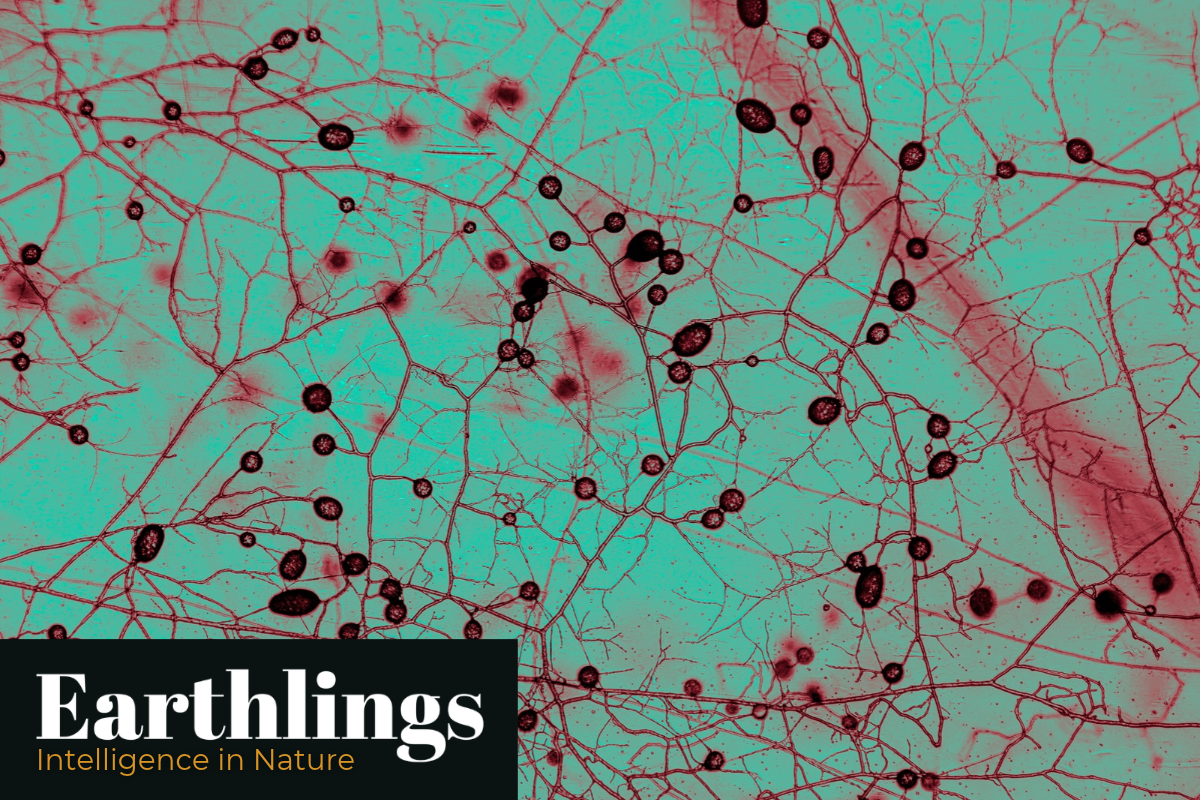
Mycorrhizal fungi radiate out from plant roots, forming dense networks underground. If you laid every thread of an arbuscular mycorrhizal fungal network end to end, scientists predict, the distance would stretch from Earth to the sun about a billion times. These fungal networks run beneath nearly every step we take, feeding most of the world’s plants and moving vast amounts of carbon into the soil. Yet until recently, scientists couldn’t say how much of it there was, let alone watch it at work.
Bioneers audiences may remember Dr. Toby Kiers from the 2024 Bioneers conference, where she and Merlin Sheldrake shared footage from her lab of fungal networks trading carbon and nutrients in real time. Since then, the work of making the underground visible has moved fast.
In June, SPUN, the Society for the Protection of Underground Networks, which Kiers cofounded, published a study in Science with an international team of collaborators, along with an interactive map, offering the first real estimate of how vast Earth’s fungal networks are. And a separate recent study by another team of scientists captured fungal networks inside intact soil in 3D for the first time.
We caught up with Toby Kiers, a professor of evolutionary biology at VU Amsterdam and the Executive Director and Chief Scientist at SPUN, to hear what these new views are revealing, why fungi belong in conservation policy, and what people can do to protect the networks beneath their feet.
BIONEERS: Researchers recently imaged fungal networks inside intact soil in 3D for the first time. Why does that matter?
TOBY KIERS: It’s very exciting, because it means we can look at intact soils. That’s really pushing the frontier, because most soils are almost impossible to image. They’re dark, they’re dense, and they’re very hard to explore visually.
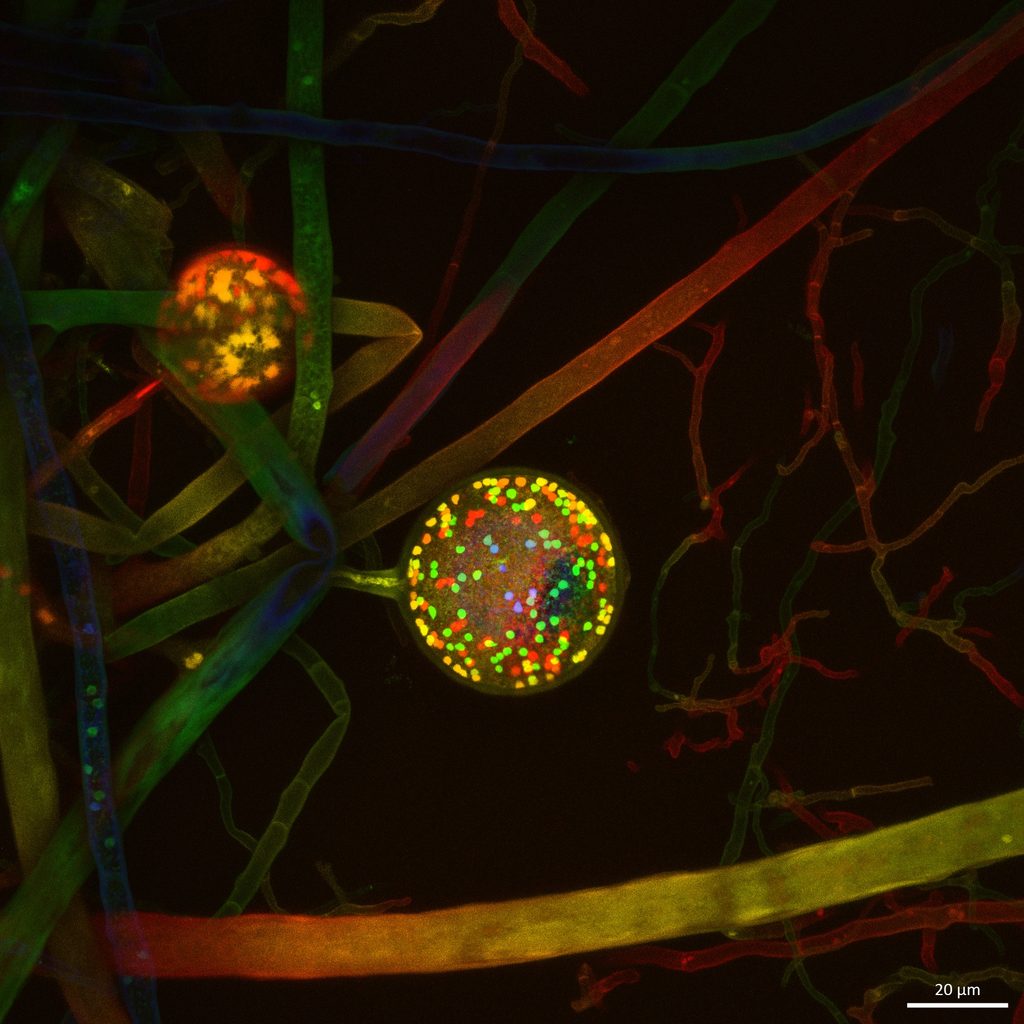
A lot of our work has focused on growing fungal networks in what’s called transparent soil, a material you can see and image through. This technique lets us understand how the networks grow, and we can use these datasets to build very high-resolution maps of their architecture. Probably most importantly, it lets us see the flows inside the fungi, because we’re working with living systems. We can follow networks over time and space and get a clear sense of how nutrients move through them.
This new approach by another team of scientists is exciting because it gives us high-resolution images of fungi in real soil, in their natural setting. But the samples have to be fixed, which means they’re no longer living, so you can’t track them over time. It’s a very specific snapshot. Each method has its own advantages, and the most exciting frontier will be bringing the two together.
We don’t yet know whether fungi behave differently in real soils, and fungal behavior is what we care about most. It drives how much carbon moves through mycorrhizal networks. How does a fungus build its body? How fast does carbon move through it? We want to understand those behaviors at the micron scale, smaller than a millimeter, because those tiny decisions scale up to global processes: how much carbon gets drawn down, in which parts of the world, at what temperatures, under what conditions. As Merlin Sheldrake says, “Billions of decisions spill out over continents,” and these shape the climate cycle.
BIONEERS: In June, SPUN and its collaborators published a study in Science that mapped fungal networks across the planet, and imaging was central to that work. What did you set out to learn?
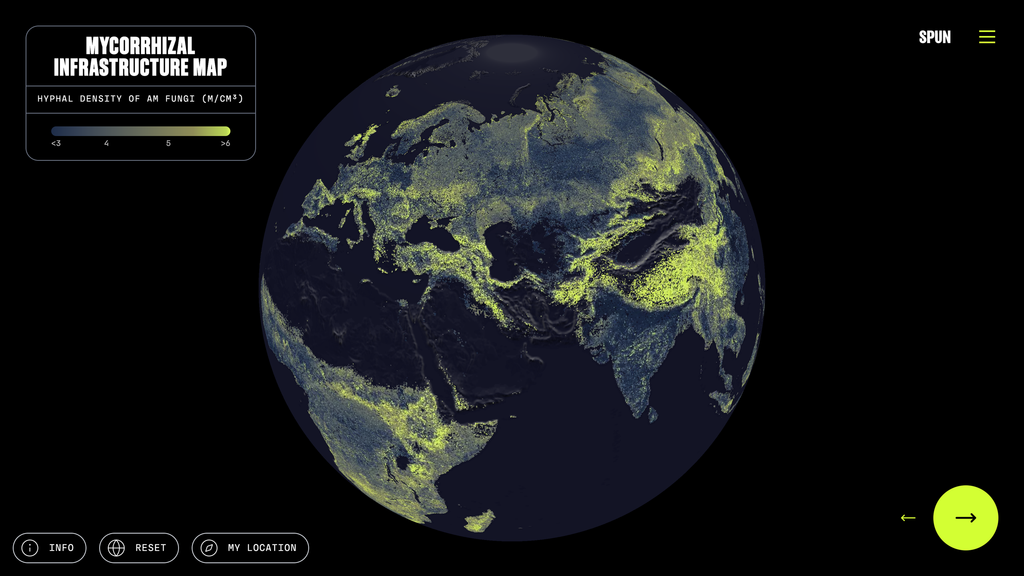
TOBY KIERS: We were mapping the density and biomass of these networks across the Earth. Maybe even more importantly, we worked with a data visualization artist to build a 3D model of what this looks like across the planet, so people can explore the infrastructure of mycorrhizal networks and see where they live.
Density is the length of the fungal networks in the soil. But people who care about the role of fungi in the climate want to know not just length but biomass: How much these networks weigh and how much carbon they contain. To move from length to biomass, you have to understand the physical body of the fungi, such as the radius of each hyphal thread. Nobody had measured the radii of mycorrhizal fungi across different parts of the network, and across different species. So we used robotic imaging to take about 300,000 measurements of hyphae, which let us build a model to predict fungal biomass across the Earth. That imaging happens at AMOLF, the biophysics institute in the Netherlands where I collaborate with Dr. Tom Shimizu.
Imagine you’re counting trees. You can count the number of trees in a forest, but until you know their girth, you don’t know how much living material is there. It’s the same with fungi. We could measure how long the networks are, but until we understood their circumference, we couldn’t know how much living biomass they held.
It turned out to be more than we thought: about 300 million tons in just one type of mycorrhizal fungi, called arbuscular mycorrhizal fungi. That’s three to six times the weight of every human on Earth.
BIONEERS: Do all fungal networks behave the same way?
TOBY KIERS: That’s what we’re working on now, and the answer is no. This is the beauty of why fungal conservation is so important: Fungal species are very different in how they behave. Some networks grow very slowly but very densely. Others are very good at growing fast and reaching many plant roots, but they create sparse networks. All of that leads to different outcomes for the climate and for the soil.
You can imagine that very dense networks are good at aggregating soil and holding it together. The fast-growing ones can colonize many plant roots quickly and provide them with nutrients, but they don’t necessarily hold the soil together.
So our work uses robotic imaging to understand fungal traits. Think about animals. They have very different traits: Some can fly, some can dig, and that leads to very different outcomes for an ecosystem. It’s the same with fungi. They’re just smaller. Some are very good at cleaning pollutants out of soils. Some are very good at protecting plants from extreme drought in deserts. We’re trying to understand these traits and behaviors in the lab so we can understand how they function in nature.
BIONEERS: Beyond the scientific community, who most needs this information?
TOBY KIERS: One of our big goals is to get this information to the decision-makers shaping biodiversity policy right now, including at the UN biodiversity conferences held under the Convention on Biological Diversity. The convention has set targets like 30 by 30, which aims to protect 30 percent of the planet’s land and water by 2030. Fungi are essential to meeting those targets, but right now they’re being overlooked.
We’re taking this science and making underground biodiversity visible with data. That data can help guide what gets protected, and it can help countries use this biodiversity for future restoration. We know native plants need native fungi to survive. So it’s a two-step process: First we have to protect these fungi, and then we help countries use that fungal diversity to restore their degraded lands.
Are there places where this work is especially urgent right now?
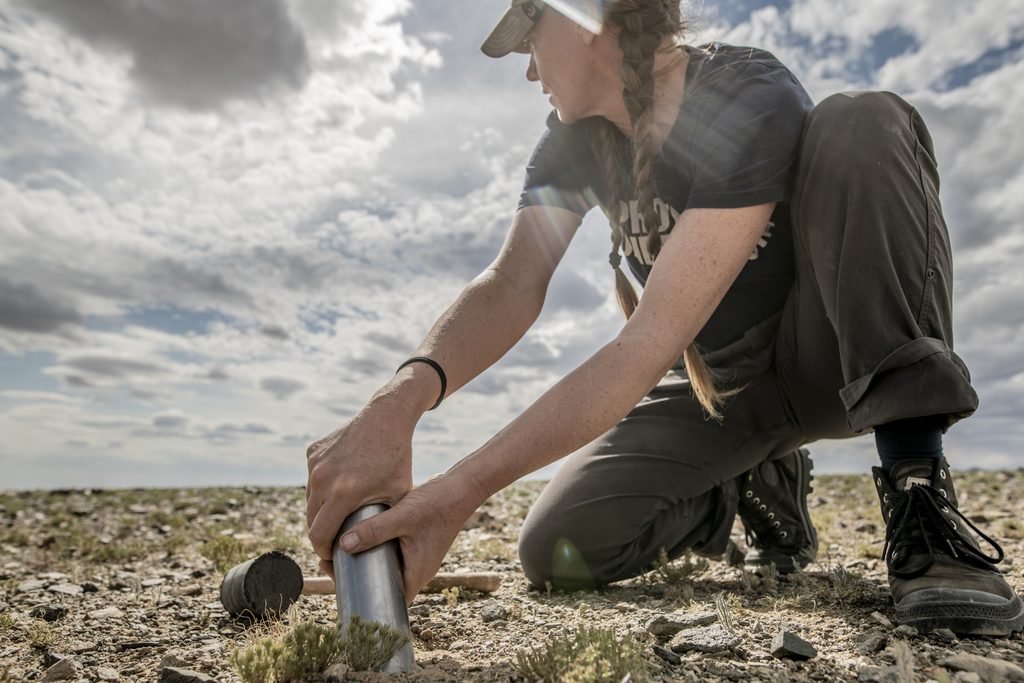
TOBY KIERS: We’re doing a lot of work in Mongolia right now, especially in the Gobi Desert. Most people tend to think of fungi as living in old woodlands and damp forests. But these networks are incredibly important in habitats that face extreme temperatures, both very cold and very hot, and that are very dry. The Gobi is home to a lot of endemic fungi, meaning locally adapted, rare species found nowhere else on Earth. Our aim is to work with the Mongolian government to set aside and protect this underground biodiversity, so it can serve as a kind of living library for future restoration as desertification increases across southern Mongolia.
We’re also asking what role fungi play in restoration in Denmark, where farmland is being returned to wetlands and forest, and in the UK, where there’s a push to restore temperate rainforest.
BIONEERS: What about the general public? Most people have never thought about what’s happening under their feet.
TOBY KIERS: That was one of the reasons we started SPUN: to get fungi into the minds and hearts of the public. It’s hard with biodiversity you can’t see; that’s invisible. So a lot of what we do is work with scientists and local communities around the world who are mapping these networks. We give them cameras and ask, “What does it look like in your local ecosystem?” Then we share that content so people can understand what it’s like to be what we call an “underground astronaut,” someone exploring this frontier underground, and what they’re seeing.
More and more people are realizing there’s a whole world underground. Visualization techniques like 3D imaging and the robotic imaging we do give people a different sense of it. They can flip someone’s perspective, turning something they take for granted, or think they already know, into something full of wonder and surprise, and full of solutions to the problems facing the world today.
VIDEO: Flow of carbon labeled with Nile Red inside of arbuscular mycorrhizal fungal networks. Credit: Rachael Cargill, Loreto Oyarte Galvez; Courtesy: SPUN
BIONEERS: Is there anything people can do to support the health of fungi, say, in their own backyards?
TOBY KIERS: Yes. Native plants are very important. Native plants need native fungi, and native fungi need native plants, so planting natives in local habitats really matters. So does keeping the soil covered with living vegetation. People don’t always realize that fungi need carbon from plants. If there’s no plant cover at all, not even a cover crop on an agricultural field, the fungi suffer. They do best with native vegetation.
They also do best where there isn’t a lot of concrete. Even in cities, people can help by advocating for things like green roofs. Urban environments are quite hard for fungi, but any park or living roof can act as a safe space where fungi can reproduce and keep spreading. Together, these living spaces can almost act as a pathway that lets fungi make it through a city. Concrete, on the other hand, is really hard on them. It essentially suffocates these living systems.
BIONEERS: What excites you most in your work right now?
TOBY KIERS: What excites me most is the idea of how fungi process information. Fungi experience the world very differently than we do. They have billions of growing tips that act simultaneously as sensors throughout their environment, and they process information in ways very different from those of a brain and nervous system. So I’m very interested in this decentralized way of processing information, and what that looks like from a fungal perspective.
One thing we ask a lot, especially in the lab, is: What is it like to be you? How is it different to experience the world as a network that’s growing in many different environments at once, and how do you navigate all of those challenges? A lot of our robotic imaging work is trying to answer those questions.