Food Justice from the Local to the Global: A Conversation with Raj Patel and Leah Penniman
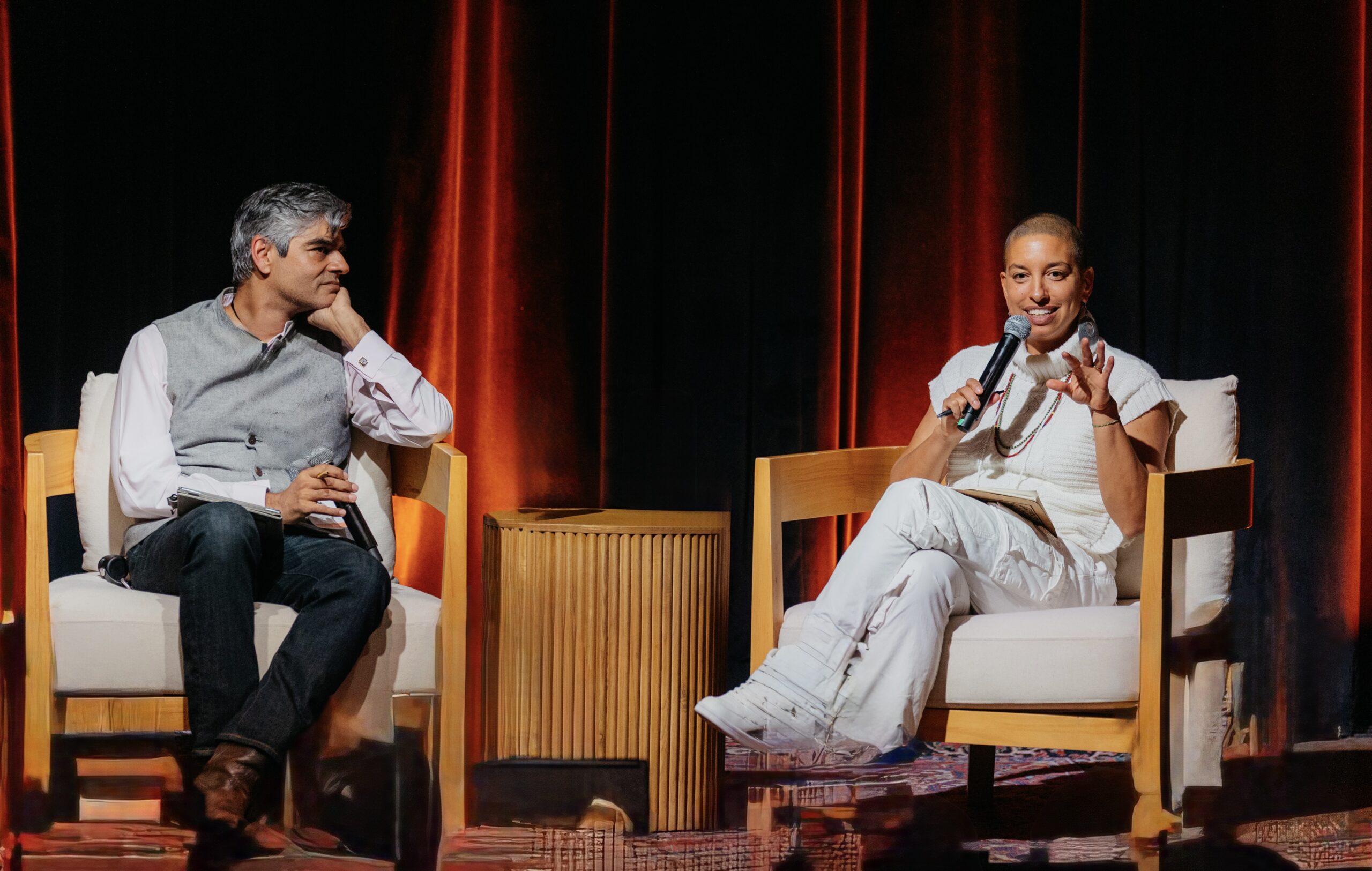
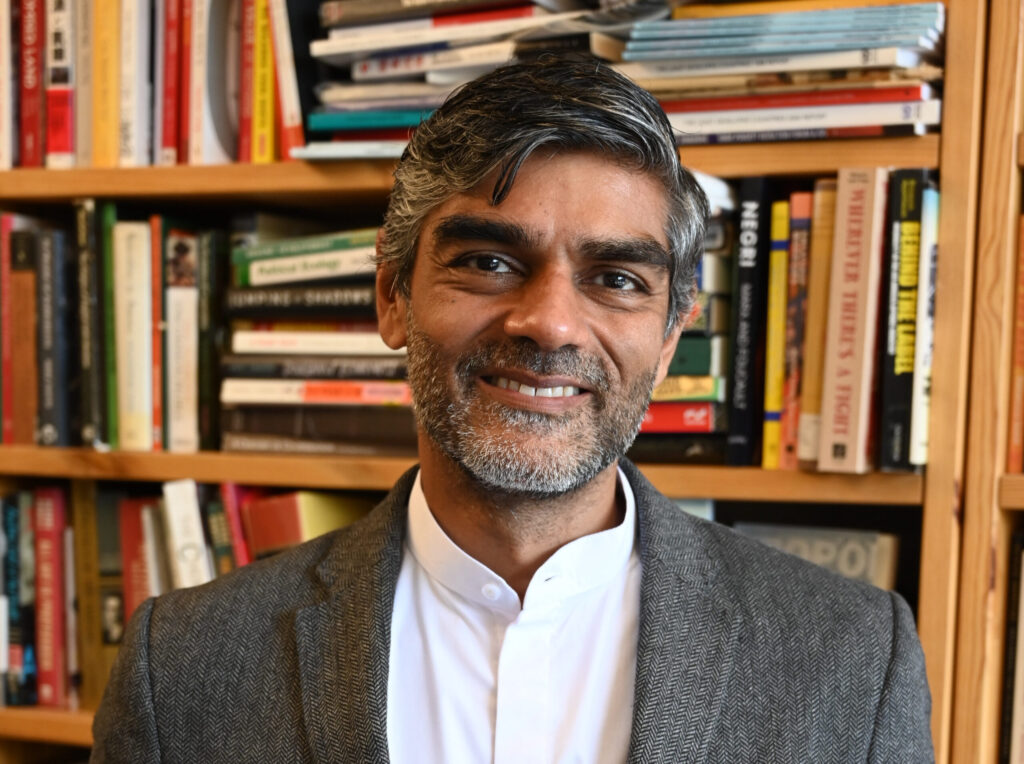
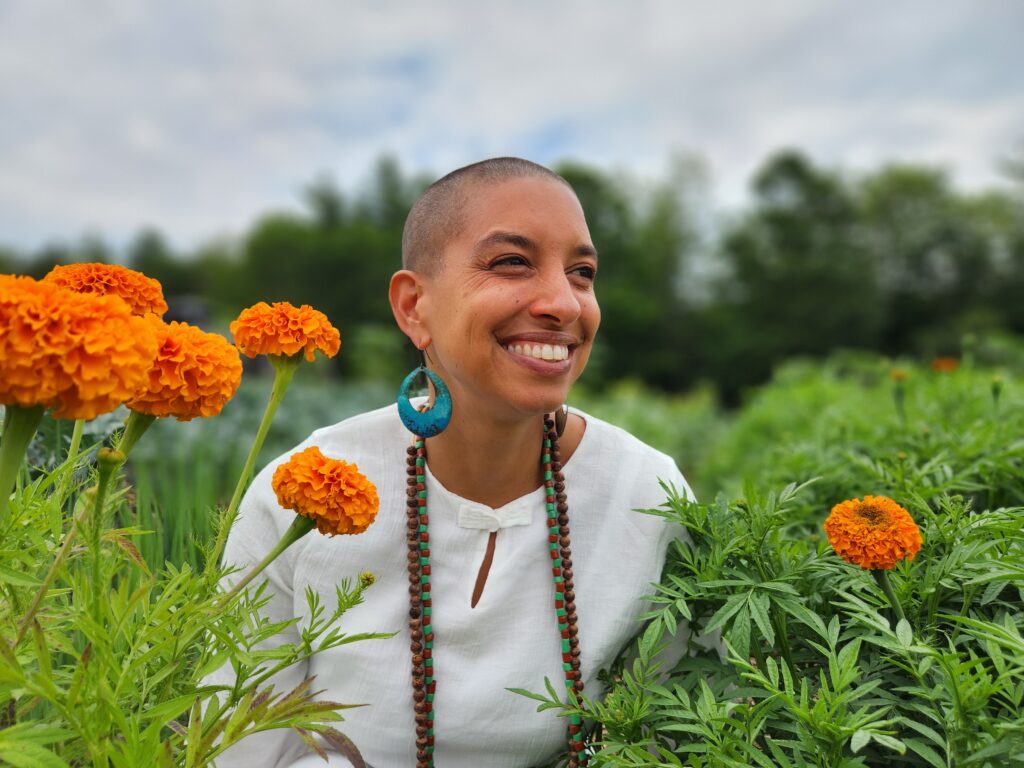
At our recent annual Conference, Bioneers brought together two ground breaking figures in the struggle for an equitable and healthy food system. One working on the global architectures of that system and the other a hands on farmer and educator exemplifying how solidarity can empower dispossessed communities to reclaim their food sovereignty. Raj Patel is one of the world’s experts on sustainable food system, and a tireless activist against neocolonial and extractive agriculture, Leah Penniman is the visionary founder of Soul Fire Farms and the author of Farming While Black. The conversation was moderated by Naomi Starkman founder and former Editor-in-chief of Civil Eats, the award winning nonprofit newsroom focused on the US food system. The following is an edited excerpt of that conversation.
NAOMI: We are living in a time of multiple crises. How do we understand what the polycrisis means for us?
RAJ: The idea of polycrisis is that it appears that there’s a whole bunch of very bad things happening at the same time: the climate crisis, the rise of authoritarianism, the pandemic disease, catastrophic weather events, and a range of things that are a series of unfortunate events. That is, I think, a misunderstanding of the structural forces that are driving all of these events.
Capitalism has always managed to patch up problems by extracting in new places, and finding new frontiers to open up. You see this process even happening now, where Elon Musk, for example, has a new frontier in low Earth orbit. He’s created a new space that’s monetized and is now his zone to be able to extract wealth from. He’s the king of low Earth orbit [with his company Space X], and he will be for a while. But there’s only so much deferring and fixing that can happen.
Now, what we’re seeing is what happens when there’s no more cheapening of the world that can be done, and the climate crisis is not just bad, but getting worse. There was a terrifying paper in the Reviews of Geophysics two weeks ago that shows that the rate of climate change is going up; the world is not just heating, it’s heating up faster than we thought it was.
On top of that, of course, we are seeing rising authoritarianism. The far right capturing our media, our means of attention. All of this is not an accident but precisely an outcome of a series of crises in capitalism that have been brewing for a while.
When you hear polycrisis, sometimes you will hear a narrative that it’s just a really bad time, but it’s going to get better. But unfortunately you need a clear-eyed structural analysis to understand that, in fact, movements on the frontlines that are taking on the crisis understand this to be the outcome of decades, even centuries of capitalist accumulation. If you understand that, then you can understand why the imagination of what needs to come next is so radical, and in which lots of post-capitalist experiments are happening.
One of the things that you need if you’re going to imagine a better world is a rocket fuel of joy. That’s why protests like the No Kings marches matter, even though at times they get criticized for not having a focused political agenda, while white supremacist organizations are undermining the state.
But a protest, when it’s done right, is how we meet and intersect and listen to one another by meeting people who are not necessarily in our normal circle. I have to declare a preference here. I met my wife on a protest.
NAOMI: This might be the moment for Leah to talk about strategic optimism.
LEAH: I would like to bring Wendell Berry into the conversation. One of my favorite poems is the “Mad Farmer Liberation Front Manifesto.” Please read it if you have not, there are many quotable lines. The one that is relevant to this conversation is “Be joyful, though you have considered all the facts.”
At Soul Fire Farm, the way we situate our work as Afro-Indigenous regenerative agriculturalists is by feeding the community and training farmers. We’re builders. We’re building these institutions that inhabit the values we wish to see in the new world. But that can’t be the only strategy.
I like the image of butterfly with each of its four wings representing aspects of transformative social justice: build, resist, reform, and heal with kinship at its center. Resist includes protests and civil disobedience. Reform is getting involved in the electoral politics and public education, and then heal. So we build, resist, reform, and heal with kincentricity at its center which fuels of our love, our connection, our Ubuntu, “I am because you are.” That helps us to envision a post-capitalist society.
I agree with Raj about the insanity of the growth imperative of a three percent compound growth on a finite planet is literally insane, and it is colonial, it is white supremacist, it is dualist, and the only way that we’re going to survive on this planet is in reciprocity with all the other beings that live here.
NAOMI: My daughter is now 23, but when she was 19 or so, we had the talk, and it’s not the talk you’re thinking. It was the climate catastrophe talk. If any parents have had to try to convince their child it’s worth going on with their hopes and dreams in this catastrophe, it’s a really hard. It’s much harder than the birds and the bees talk.
My daughter, bless her heart, was challenging me about optimism. What we decided together is something that we call strategic optimism.
If you decide to be a pessimist, then the rational behavior would be some sort of hedonistic nihilism. You would be like let me accumulate as much as I can in the near term, bump everybody else; I’m just going to get mine because everything’s about to go up in flames. No long-term planning, no altruism, no generosity, no compassion. That’s sort of the logical extreme of this pessimistic, nihilistic viewpoint.
If on the other hand you choose optimism as a practice – not as a feeling but as a practice – then your attitude is I’m going to get up today and I’m going to plant this crop, I’m going to feed my community, I’m going to sequester carbon in the soil, I’m going to look out for my neighbor. Maybe there is only an infinitesimal chance we will win. But in the meantime, today I can alleviate suffering for some beings in my immediate community, and tomorrow I can alleviate some more. And maybe, just maybe we can alleviate enough suffering that we’ll all survive together.
But if we don’t do that, there’s absolutely no hope. So we’ve decided in our family that this strategic optimism is our practice. It’s our discipline. The way that you get up and you take your vitamins, or you go on a run, or you brush your teeth. You get up and you decide to do whatever step it is on whatever wing of the butterfly you have access to help build that world that we want to see.
We talk about food justice. We talk about equity. We talk about sovereignty. We talk about accessibility. A lot of the practices at Soul Fire Farm are not only about those three, but are also about weaving in Black and Indigenous wisdom, and ancestral wisdom into the land, and teaching people to become their own sacred farmers on other lands.
LEAH: I love the term sacred farmer. I would like to bring the ancestors into the room. Fannie Lou Hamer organized the Mississippi Freedom Democratic Party. She was sick and tired of being sick and tired. She was radicalized as a sharecropper. She was only 6 years old when she noticed that the landowner was setting the scales incorrectly to undervalue the cotton harvest and not pay the Black laborers their fair due. That kept them indebted and in extreme poverty so they couldn’t leave the plantation. As a child her first act of civil disobedience was to fix the scales.
Later in her life, when she was an organizer during the Civil Rights movement, she learned that many sharecroppers were being kicked off their land for registering to vote, for joining a protest, signing a petition, or joining the NAACP. She would have organizing meetings in her house, and as a farmer, she canned food that she grew. Radical youth would ask, “Mama Hamer, why you wasting your time canning these peaches and stuff?” Her answer was, “Child, if you have 400 quarts of greens and gumbo soup canned for the winter, no one can push you around or tell you what to say or do.”
So she organized the Freedom Farm Cooperative, where 500 sharecroppers who had lost their land co-owned the land. They were doing all kinds of beautiful mutual aid.
So Fannie Lou Hamer is our inspiration at Soul Fire Farm. To realize the idea that to free ourselves we must feed ourselves, we have to make sure that our agriculture is locally rooted, it’s regenerative, it’s tied to our heritage, and it’s in our hands.
There were 16 million Black farmers in the early 1900s. Most of them were kicked off their land by white supremacists, literally pushed off their land and lynched. The U.S. Department of Agriculture selectively gave loans to white farmers, causing bankruptcy among Black farmers. TIAA – Teachers Insurance and Annuity Association – and other investment firms unscrupulously grab up Black owned land, which is vulnerable because a lot of Black farmers don’t have access to lawyers and don’t leave wills.
So the rising generation of Black and Brown farmers is landless, they have no capital, and are just a few generations away from the red clays of Georgia – with its traumatic association with the forced removal of Cherokee people and the slave labor of African descended people. We say the land was the scene of the crime, but the land was never the criminal. Now a beautiful rising generation of people who are the color of soil are ready to reclaim that right to belong to the earth, to have agency in the food system, and are recognizing that regenerative agriculture was invented by Indigenous and Black people.
Dr. George Washington Carver is literally the godfather of regenerative agriculture. He worked with farmers when he was at Tuskegee University from 1890 to 1940 promoting cover crops, compost and crop rotation. Dr. Carver made sure that the soil health was the foundation of farming practices. He had a whole generation of Black farmers doing regenerative agriculture before Rodale came onto the scene in the 1940s.
We can look back to the Ovambo people of Namibia with their raised beds and the people of Liberia with their African dark earth, and the polycultures of Nigeria. That’s the kind of agriculture that we’re doing. We feed our community, no cost, door-step delivery. We train thousands of Black and Brown farmers in person on the farm through a 50-hour course, and then they go off and they do their sacred farming all across Turtle Island and, beyond.
The theory of change involves practices like sewing of seeds, of being trans-local, and locally adapted. Providing land-based mutual aid, in which the farm becomes a hub for feeding folks, for gathering, for organizing, a safe haven, a kind of aboveground railroad. The land becomes the scene of the revolution, just as it was in the Civil Rights movement. Black farmers were the ones who housed, fed and clothed and protected the freedom riders. If there were no Black farmers, there wouldn’t have been a Civil Rights movement. You think the Freedom Riders stayed at the Hyatt? No, they went to a Black farmer’s house. That’s where they hid. That’s how they stayed alive. As Malcolm X said, “Land is the basis of all revolution, all freedom, all justice.”
NAOMI: Thank you for all of your work. I just have to ask, how your work has been impacted by the current administration.
LEAH: It sucks. But we’re not stopping, I would say one of the more heartbreaking things, is that we had a major legislative victory with the Inflation Reduction Act under the Biden administration. They actually folded in a provision for Black farmers that we had fought for for over a decade. Historically, the USDA had discriminated against Black farmers. There was a landmark Civil Rights settlement called Pigford v. Glickman in 1999 that offered a very small amount to each of the farmers who had lost their land, but it wasn’t nearly enough. We needed full debt forgiveness for these farmers.
So we helped, along with farmers across the country, to introduce legislation, the Justice for Black Farmers Act, which was led by Senator Cory Booker. It was debated and I got to speak to Congress. It was crazy. They were actually listening to Black people. I could hardly believe what was happening.
A 5 billion dollar provision for the debt relief went into the Inflation Reduction Act, and was passed; payments were going out. And now they stopped.
The Disadvantaged Farmers and Ranchers Training grant is gone. All of the socially disadvantaged farmers programs are gone. People bought things based on contracts that were made, now the contracted money has evaporated. So it’s a shit show. It’s really, really rough.
We’re doing our best to piece together mutual aid networks. Susu is a Caribbean lending society. We’re trying to put together a national susu to try to stop the bleeding, so we don’t lose any more land. But now all the funders are skittish. Their attitude is, Black people were cool in 2020, but they’re not cool anymore. Don’t you do any programs for white farmers? I’m like, are you kidding me? The white farmers receive over 90% of the USDA funds. We absolutely need to support Indigenous and Black folks in getting through these times, and to continue the work.
NAOMI: Raj, when the government starts to clamp down, what are the models that you’ve seen that have been successful? Where can we look for inspiration in places perhaps in this country, historically, as Leah has been sharing with us, but also around the world?
RAJ: One of the places I have been very inspired by is Arkansas. I was just traveling through Arkansas for a book that I just finished that weaves together the history of all the things that have happened in Arkansas, ranging from Indigenous dispossession to the Elaine Race massacre [1919 massacre in which as many as several hundred Black tenant farmers, who were organizing against abuses were murdered], the site of the largest race massacre in U.S. history, to the rise of Walmart also in Arkansas.
One of the movements that I particularly was taken by is the Southern Tenants Farmers Union. The origins of this are germane to us now because in 1928, the Mississippi flooded and grew to 60 to 100 miles wide, depending on where you were. It was a catastrophe. The cleanup was a billion dollars back then. It was a huge expense, but of course, Black farmers saw none of that money. In fact, it was that event that flipped Black farmers’ voting allegiance from Republican to Democrat.
It was the failure of the federal response to a catastrophe that politicized people. It wasn’t the event, it wasn’t the flood. It was the government’s failure afterwards. This is important for our mobilizing in this moment, because in that moment, there was socialist organizing happening throughout the South, and the Southern Tenants Farmers Union was a site of social organizing where white and Black tenant farmers together organized despite the attempts of white supremacists to sew racial division. It turned out that white and Black tenant farmers had much more in common with each other than they did with the white bourgeoisie.
That is a moment that we can learn from particularly as we see the betrayals of the white working class and the absence of any dividend of white supremacy for white working class people. This is a moment to be able to split what appears to be a fairly firm hegemonic block into its constituent parts and to recruit. It is something to think about because this is a moment in which government failure writ large is a recruiting ground for a genuine grounded working class transformation.
But it depends on us using the language of recognition, mutuality, solidarity and socialism. It doesn’t happen because we’re just all going to get along and kumbaya our way out of this. You need a materialist analysis, otherwise people don’t see one another and recognize that we have much more in common than the white supremacists would have us believe.
Elsewhere in the world, there are movements that have managed to lay foundations that are paying off right now. One of my favorites is in India in the state of Andhra Pradesh. There are descendants of organizations that started off as women’s literacy groups, and that have survived the scourge of Hindu supremacy. It’s not an accident that Narendra Modi and Donald Trump were best buds in his first term I’m thinking of an event in Texas called Howdy, Modi, which was the only event that Trump came to where he was not the star. Trump opened for Modi in a stadium in Houston, and then Trump buggered off and everyone cheered for Modi because there’s a whole phalanx of rightwing desis [Indian Americans], who are part of the South Asian diaspora who believe in Hindu supremacy.
In India, Hindu supremacy is nasty and vile, and there have been people who have fought back against that, particularly in Andhra Pradesh where there is a system of farming that was originally coded as Hindu natural farming, but has been reclaimed as the world’s largest agroecological transition. More agroecological farmers have been spawned in Andhra Pradesh than anywhere else, where over two million farmers are currently agroecological farmers. And by 2035, six million farmers will be agroecological farmers.
India is hostage to fossil fuels, particularly through the Gulf of Hormuz, and hostage to fossil fuel based fertilizers which are scarce and expensive due to the US/Iran war. One of the ways to avoid using fertilizer is to farm agroecologically. They’ve set up systems so that farmers wean themselves off fertilizer, so they don’t pay the high cost of fertilizer and can start making money.
It’s predominantly women and Adivasi [people indigenous to an area], and low-cost farmers. That has happened despite the scourge of Hindu supremacy because these movements have been robust and understood how to experiment and how to protect oneself against divisive racial rhetorics.
NAOMI: Raj, you’ve written about the difference between food security and food sovereignty Would you explain that.
RAJ: The idea of food security is a way of depoliticizing the word hunger, because it renders hunger into something that’s tractable for the state. Food security is when you have sufficient access to foods to be able to lead a healthy life. But you can be food secure in prison. The idea of food security says nothing about power.
The term food sovereignty was coined by La Via Campesina in the early ‘90s, and launched in 1995 at the World Food Summit in Rome. The idea of food sovereignty is about reclaiming power from the World Trade Organization and the World Bank. Food sovereignty is about a community’s right to be able to end hunger and define its own food policy.
What that means is that communities have to decide what food sovereignty is by studying and discussing it. La Via Campesina decided that food sovereignty was dependent on an end to all forms of violence against women. The idea being that if this is about communities’ right to decide what food policy is, then everyone has to be equal, and the biggest obstacle to that, as identified by La Via Campesina, was patriarchy and that needs to be fought against.
Particularly now, given the revelations about Cesar Chavez, that dialectic is sharp and vital to remember: food sovereignty is about a radical naming of inequality of power and a redressing of it.
NAOMI: Leah, the matriarchy is a big part of your practice. Would you talk about your work on farms in Haiti and Dominican Republic, and how that may relate to the matriarchy and the patriarchy.
We don’t really have an agroecological movement in this country. We don’t have a politicized agricultural alternative community. It’s happening in smaller ways in which people are being trained how be farmers, as well as how to be the next generation of political leaders.
LEAH: When we talk about deconstructing the patriarchy, our model is not one of franchising; the other farms I work on are not our farms. We intentionally have a de-growth framework. We are aiming towards our own irrelevance. We have no interest in pushing our survival on anybody. We are part of mycelial network.
The farms in our network are all women-led, as is our farm. We only have two men on our staff of 22 (those poor guys). Altair Rodriguez runs an organic family farm in the Dominican Republic called La Finca Tierra Negra in the area that was the training ground for the militia against the Trujillo regime. Trujillo burned down the farm of Altair’s great grandfather and killed many family members. She revived the farm out of the ashes. It’s an agroecological farm growing coffee and 22 other crops. They are constantly producing fruits and medicines and work with Haitian migrants and Dominican women.
We have a sister farm amongst my homeland of Ayiti (Haiti) on the Western side of the island, outside of Léogâne, where one-third of the community was killed in an earthquake in 2010. We did so much grief work there. Out of the ashes of that earthquake, we planted thousands of fruit trees, moringa trees, and had woman-led seed exchanges. We helped reforest the hillsides that were denuded by the French as part of their extortion and punishment of our beautiful revolutionary island.
On the Caribbean island of Vieques is the Maroon Farm. In an effort led by women, they cleaned the soil that the U.S. military destroyed. They are providing food security by feeding the entire island. We also work with farmers in Sierra Norte in Oaxaca, Mexico.
All of these farms are incredible. We spend our winters doing solidarity brigades. We raise money, we bring resources, we bring skilled people to do projects that they want to do, not ones that we pretend we know that they should do. We do consciousness raising. We do political education. We’re all members of La Via Campesina. We study together and we plan and strategize together.
Something that I’ve noticed in the past ten years especially in the Caribbean, is people used to identify with colonial borders that have been imposed by the French, English and Spanish, but there has been a revival of Taíno and Arawak identity. At food sovereignty conferences by and for Taíno and Arawak Black women, the perspective has changed to “we’re one people; what is this BS they’ve been trying to convince us of? We have enough food. We have the best soil. There’s food all year round; let’s feed our people.”
NAOMI: Raj, in this very strange post-neoliberal world that we are entering into, there might be some hope that there could be some transformation. Do you think in this time of seemingly endless uncertainty and confounding ways that there might be some potential for optimism?
RAJ: There’s nothing guaranteed. Often at this stage of the conversation, it turns to “if only we do this, this and this, everything’s going to be fine.” No, because that’s an unreasonable way of understanding the world. In Brazil, for instance, under the first Lula administration, there were some victories. For example, in the food system, there were certain laws about being able to get food, one example was the Popular restaurant initiative, supported by the government that offered very cheap healthy meals. Here in the U.S. now most food is eaten outside the home, and to have public restaurants is a way to have dignity for the working class.
Then under the Bolsonaro administration, that was ground into dirt. And most of the public restaurants now are roach motels. But now under the second Lula administration, they have a program for cozinhas solidárias, or solidarity kitchens. The government will pay people to open a licensed kitchen and make local food available to the public. There are still some public restaurants, but the zones in which organizing happens have moved into these spaces of social gathering in the solidarity kitchens.
What does that have to do with hope? Well, this is precisely the dialectical process. We won something under the first Lula administration, then the fascists came and then destroyed it. Now we rebuild with something else. The engine for hope is always the social movements. One of the engines for getting rid of Bolsonaro was his abject failure in dealing with the massive floods that Brazil had experienced a couple of years back. Again, the failure of a government to be able to respond to the climate crisis is an engine for the kinds of radical care that our movements are in the business of providing.
What I see that as the fulcrum of hope is the recognition that movements are already providing care. And, there’s nothing inherently leftwing about that. If you followed what happened after the hurricane Helene that tore through North Carolina, there were neo-Nazis on horseback, providing aid and media and solidarity. The far right are doing it as well, and that’s the terrain on which we struggle, we need to recognize it. They get a move in this world as well. They get to redefine the terms of climate change. They get to have a say about how climate change needs to be met with yet more racist exclusion. Our recruiting has to be stronger. We have to organize better, and there’s no guarantee we’ll win, but there’s everything to fight for.
NAOMI: The examples that Raj gave of the Popular restaurants and solidarity kitchens in Brazil makes me think of the concept of food commons. Leah, how do food commons come into your work?
LEAH: What unifies nonviolent strategies is the idea of ubuntu – “I am because you are” – of kinship. It’s an indigenous concept of animism or non-duality, this idea that I am the mountain, the mountain is me; I’m not a defender of the river, I am the river. The pre-enclosure concept that you could own a person or the land, is absolute insanity. You mean to say we’re going to take Mother Earth and put some lines on her and this part is going to be mine, and I have the right to exclude everyone, even if they starve? Insanity.
The idea of the commons is a reclamation of our sanity to humble ourselves below our big siblings who are the hawks, and the rivers, and the sequoias. They were on the scene before us; we came later, and are younger and less wise. So we need to defer to those who have figured out how to live in relationship and harmony. They understand that if there’s some sugar, some photosynthate coming into the forest ecosystem, that it will be shared amongst kin and non-kin. If there is a pest coming in and there’s a warning that needs to be distributed, everyone’s going to get the warning, not just the people I like or the cute ones, but everybody’s going to get it. The air is to be shared, the water is to be shared. When we signed papers for our farm we immediately got to work figuring out how to put it in a cooperative, which is a Western legal approximation of an indigenous commons.
The land has veto power over the people in our cooperative. We gave our pro bono student lawyers the challenge of giving the legal right for the land to have veto power. The local indigenous Mohican people need to have it too. We became the first cooperative in New York state to do a culture respect easement with Indigenous people, and also the first in New York state to do the Rights of Nature with our co-op.
So our little 80 acres is somewhat of a commons, but we want to spread this idea. Food is for everybody. Water’s for everybody. The land is for everybody.