The Path to Good Health is Made of Soil

Mary Purdy, an integrative and eco-minded Registered Dietary Nutritionist, is the former Managing Director of the Nutrient Density Initiative. Her work integrates personal well-being and ecological health. As a dietary educator, she connects the dots between farming practices, food systems and individual health. Mary is also an adjunct faculty at the Master’s Program in Sustainable Food Systems at The Culinary Institute of America. She is a podcaster and author of “Serving the Broccoli Gods” and “The Microbiome Diet Reset.” This article is an edited transcript of her talk at a recent Bioneers Conference.
The concept of One Health states that humans and our health are inextricably connected to the health of the environment, of our fellow animals, of bees, birds, and are interdependent. The cornerstone of those relationships is the soil. Currently, the industrial way that we are producing food is contributing to greenhouse gases and biodiversity loss. It is using enormous amounts of land, using and contaminating freshwater, contributing to eutrophication which is killing our marine life, eroding our soil, and is a leading cause of soil contamination and air pollution. We’re losing habitats for people and animals. And a lot of this is disproportionately affecting BIPOC and marginalized populations.
Along with all of that collateral damage, the food system is producing, in large proportion, foods that don’t support health and well-being. Half of all Americans are diabetic or prediabetic. About 40% of Americans will be diagnosed with cancer and one third of teenagers are prediabetic. Needless to say, we have a serious health crisis on our hands.
The majority of calories come from ultra processed foods, which sometimes is the only food accessible or affordable to people. A large chunk of the protein that we consume comes from industrial processed animals. Agriculture uses over one billion pounds of pesticides every single year, and we have increased the use of synthetic fertilizer 800 percent compared to 50 to 75 years ago. If we want to change this system, we should look at corporate farms and large agribusinesses that promote the practices that degrade our environment and make us suffer.
But I don’t want to blame the farmers. I want to honor and uplift them. Farmers are doing incredible work and getting paid very little money for it. But the question is: “Why have we been farming this way?” The main reason is that yield is emphasized over quality of food. There’s a reliance on government subsidies that incentivize farmers to continue to use industrial practices. There’s security in using agrochemicals which have been in use for a long time. There’s a lack of time, resources, and education.
The current system does not provide the basic minimum nutritional needs of vitamins A, C, E, D, K or minerals. We’re not getting enough fiber. We’re not getting enough omega 3 fatty acids. We’re definitely not getting enough polyphenols to help support our health and well-being.
Why is this? Because food grown in the industrial system is less nutritious, in other words the food is not nutrient dense. The Nutrient Density Initiative defines nutrient-dense foods as foods that are rich in the vitamins, minerals, fiber, healthy fats, and polyphenols that research has shown to be beneficial for human health. And that these foods are also free of ingredients that we know degrade our health – agrochemicals, pesticides, additives, etc. All of these nutritional qualities are absolutely influenced by the way that we grow our food and the agricultural practices that are used.
Nutrients drive every chemical reaction in your body. The production of neurotransmitters in your brain and your gut are driven by nutrients. The creation and function of your immune system is driven by nutrients. The synthesis of your liver that is trying to neutralize all the toxins that regularly come into your body are driven by nutrients. So our brain and our body are functioning in accordance with the nutritional value of that food that we give it.
We are what we eat, kind of. The idea that food is our medicine isn’t always true, although it should be. The USDA has documented a significant decline in the nutritional quality of food over the past 50 years. There are up to 25 to 50 percent less vitamins and minerals, depending on the crop, than there were 5 decades ago. There are lower levels of polyphenols and omega 3 fatty acids in a lot of the foods that should be high in them. The science is really clear about this.
Food and nutrition start in the soil; 95 percent of our food is grown or raised on soil. When the soil is healthy, humans tend to be healthier. Soil health and fertility directly influence the nutritional quality of food. Healthy soils provide those essential nutrients. Soils are the medium in which food is grown and determines the quality and flavor of food. So when nutrition is deficient in the soil, there is less uptake by the plant of those nutrients.
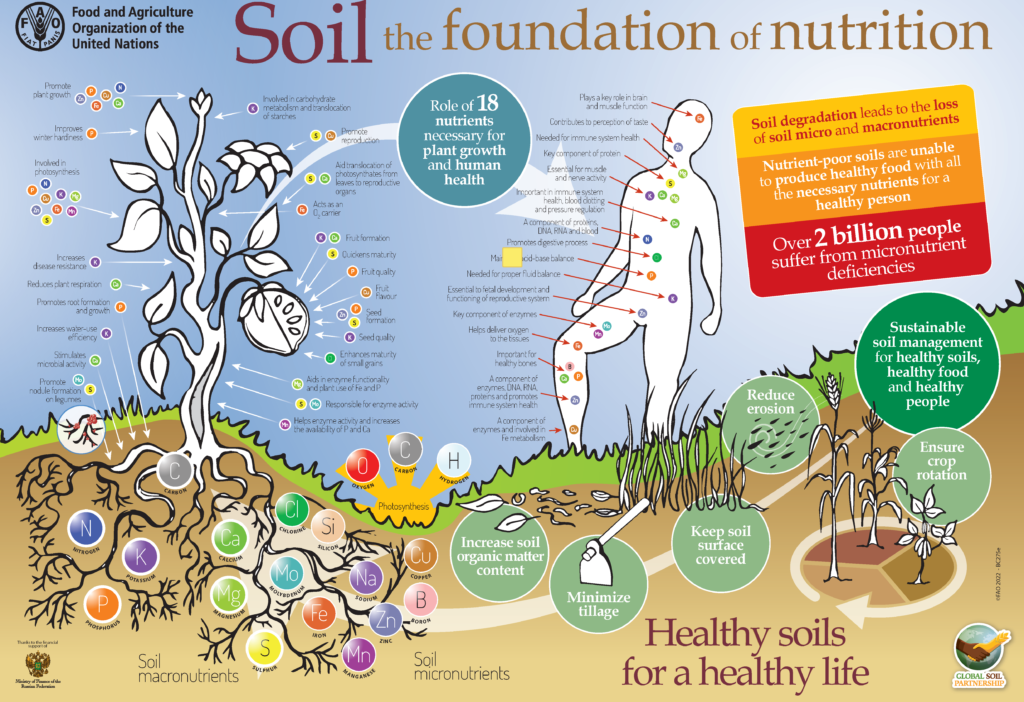
So, what is healthy soil? There are different definitions. I will characterize three. The first one is having a diverse community of a large number of microorganisms in the soil. Second is soil organic matter, which is made up of decomposed plants and animals that provide living plants with nutrition. And lastly, it is a well-developed structure so the soil is able to withstand floods, droughts and erosion by retaining water. Good soil structure also allows plant roots to reach deep into the soil and gather more nutrients.
Soil health is not only one of the strongest pathways to improve the quality of nutrition, but it also increases soil’s capacity to sequester carbon and support healthier ecosystems.
The plant is not acting alone. Plants depend on soil microbes for their health. There’s a wonderful symbiotic relationship with the plant and soil microorganisms. The plant’s roots only go so far, so plants need help. The microbes provide that help by bringing minerals and other nutrients to the root zone in exchange for carbohydrates that the plants provide to the microbes. Beneficial microbes suppress the pathogenic microbes that we don’t want in the soil. And they are key for helping the plant synthesize the compounds called polyphenols, which have wonderful antioxidant properties and also provide flavor to the plants.
Polyphenols have a really positive influence on human health. When we don’t get enough polyphenols, people become more susceptible to all different kinds of diseases.
Additionally, polyphenols are a prebiotic feeding the beneficial microbes in our gut. Flavonoids are a type of polyphenol and flavones are a class of flavonoids that contribute to aroma and flavor. There is a strong connection between flavor and nutrition.
When we eat a carrot or a piece of spinach that has not been excessively washed or heated, along with it, you are ingesting some of the microorganisms from the plant’s microbiome which helps support our gut microbiome.
But when synthetic fertilizers are used to grow crops, that hinders the formation of the plant’s roots going further down into the ground to take up nutrients. Additionally, when we use synthetic chemical fertilizers year-after-year, there is a depletion of nutrients in the soil. Microbial diversity is reduced. It reduces phytochemical production, as well as things like vitamin C and trace minerals in plants. Chemical fertilizers are also bad for the environment. They run off of the farm into waterways contaminating drinking water.
And then there’s pesticides. Pesticides also reduce the soil microbial diversity. When people get exposed to pesticides, whether that’s direct exposure or from residues, there’s a higher incidence of endocrine disruption issues, cardiovascular, and neurodegenerative diseases. A lot of farmers are struggling with Parkinson’s disease. Birth defects, respiratory illnesses, cancers are also caused by pesticides. Needless to say, farm workers are on the front lines of exposure to toxic chemicals. So there’s a serious environmental injustice issue around pesticides.
Pesticides are having a negative impact on the human gut microbiome and inhibit phytochemical synthesis. A plant under stress normally creates phytochemical compounds as an immune response to protect themselves when it is exposed to things like pests, predators and adverse weather conditions. When we eat the plant, we get the benefit of the phytochemicals which make our immune system strong as well. However, if a pesticide is used to protect the plant, the plant doesn’t have to produce those immune-enhancing compounds.
Phytochemicals, which is the family name for different polyphenols, are associated with better cardiovascular health, better brain health, better blood sugar balance, improved lung function, better immune health, less incidents of cancer, as well as a healthier and diverse gut microbiome.
In contrast to an industrial chemical approach to farming, there are practices – whether we call them regenerative, conservation, organic, common sense, or traditional – that build the health of the soil and, as a result, grow more nutritious crops: reducing the disturbance to the soil by using low or no tillage, having a lot of biodiversity on the farm or garden, keeping the ground covered with cover crops or mulch, using compost, rotating crops, eliminating chemicals, and integrating livestock into the fields. It’s not just about using one or two of these practices, it is the whole suite that increases soil health and grows more nutritious crops.
And the good thing is that they also have planetary benefits. When we garden or farm, whether it is large scale or small scale, we are helping to elevate the ability of the soil to sequester carbon, which is key for the climate crisis. These practices also help provide pollinator habitats and reduce environmental harm in general.
There’s a huge variation between the nutrient density of plants that come from different farming systems, but in general, when we see more of these agroecological practices in play, we see higher levels of vitamins, minerals, beta carotene, etc. and lower levels of heavy metals.
The Nutrient Density Initiative works with Edacious, a nutrition analysis food lab. We had a number of our members, who use these practices, send in samples of their produce and meat products and had Edacious compare them to the conventional versions of the same product.
Peaches tested from Frog Hollow Farm had over 200% higher vitamin C compared to the conventional peaches, much higher iron levels, much higher alpha carotene, and a number of other vitamins and minerals were much higher. While we may not be able to say definitively that we will always get the same results, data like this suggests a link between the positive benefits of soil health and the nutritional density of plants.
The regeneratively grown citrus that we tested had higher amounts of flavones, and higher total value antioxidant levels when compared to conventionally grown samples.
We also looked at dairy. An Alexandre Family Farms dairy product, when compared to a conventional product, had a much more favorable omega 6 to 3 ratio which is very important for inflammation and other immune functions. It also had higher protein and higher levels of certain nutrients such as calcium, B2, and phosphorus.
The Rodale Institute did a side-by-side trial comparing butternut squashes grown conventionally and with regenerative methods and found that regenerative butternut squash had higher total polyphenols, and higher levels of carotenoid levels.
We conducted a pilot protein project. Nutrient Density Initiative members sent in chicken and beef products, and once again compared them to conventionally grown counterparts. We found higher amounts of omega 3s, lower amounts of overall fat including saturated fat, more balanced omega 6 to 3 ratios, more protein per serving, and no heavy metals detected in the products raised with the regenerative practices.
These are small trials, there’s always going to be variation depending on environment, depending on species or varietal of food, etc. I want to make sure that, at this point, I am not making grandiose claims, but that data we have collected so far is clearly demonstrating that when the soil is healthy, we’re going to produce crops with higher nutritional density.
So when and if possible, we can be citizen eaters. Support organic and regenerative farmers who are using the practices that I mentioned, let your grocer know that you want nutritious food, choose minimally processed food, if you can. Let your politicians know food nutrition is an issue you care about. Ask them to support a Farm Bill that actually protects soil health and biodiversity, and rewards the farmers for doing regenerative practices.