With some 400,000 species, beetles are among the largest and most successful groups of organisms on earth, making up one-fifth of all plant and animal species. No other animals exhibit such a dazzling range of size, form, and color. Mostly small, sturdy, and compact, beetles are incredibly well-equipped to find food, reproduce, and avoid predators. Additionally, their collective roles as herbivores, hunters, and recyclers are critical to the sustainability of terrestrial ecosystems. In “The Lives of Beetles: A Natural History of Coleoptera,” beetle expert Arthur Evans presents an inviting and comprehensive introduction to the fascinating lives of the world’s beetles. In the below excerpt, learn about the varied and surprising defense strategies of beetles, from click beetles’ acrobatic maneuvers to bombardier beetles’ boiling bursts of caustic gas.
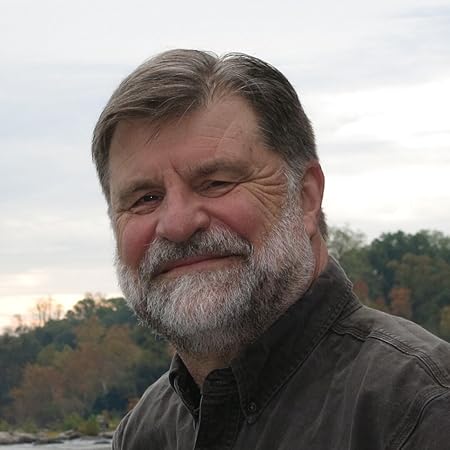
Arthur V. Evans is an entomologist, educator, photographer, radio broadcaster, and video producer. His many books include “Beetles of Western North America” and “Beetles of Eastern North America” (both Princeton). He lives in Richmond, Virginia.
Spiders, ants, robber flies, and other beetles rank high among their invertebrate predators. To avoid becoming prey, most beetles rely on morphological and behavioral adaptations.
Predation by birds and other diurnal predators is likely to have played a dominant role in the evolution of cryptic and aposematic (see page 54) coloration in beetles, while the stridulatory, chemical, and non-aposematic defenses of nocturnal species are especially effective deterrents against mammalian, amphibian, and invertebrate predators.
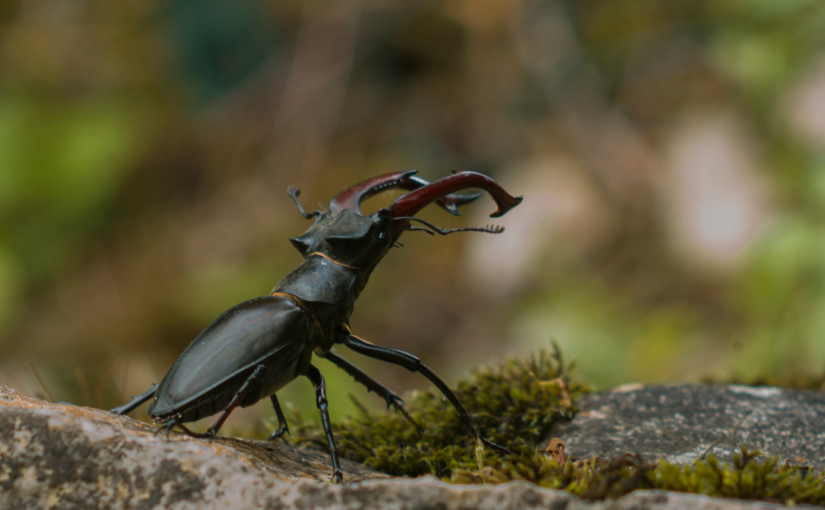
[photo caption] The powerful and oversized mandibles of male European stag beetles (Lucanus cervus) are used in battles with rival males, as well as for defense.
[photo caption] The prosternal spine of the eyed click beetle Alaus oculatus (Elateridae) forms part of a mousetrap-like spring and latch system. This system is used to right themselves when they fall on their backs. The sudden release of energy from the latch launches smaller species into the air at accelerations 100x greater than that experienced by astronauts during a rocket launch.
STRUCTURAL AND BEHAVIORAL DEFENSES
A beetle’s first line of defense is its thick and tough exoskeleton. Hister beetles (Histeridae) possess smooth, hard exoskeletons and can hold their appendages tightly against their bodies—all of which make it difficult for predators to attack and capture them. For larger species such as longhorn beetles (Cerambycidae), stag beetles (Lucanidae), and scarabs (Scarabaeidae), size alone — backed up by strong mandibles, horns, powerful legs, and sharp claws — may be enough to discourage all but the hungriest of predators.
In addition to biting mouthparts, many tiger (Cicindelidae) and ground (Carabidae) beetles have long, slender cursorial legs that are adapted for outrunning predators. Adult flea beetles (Chrysomelidae) use their muscular, jumping hind legs to catapult themselves out of harm’s way.
When on their backs, click beetles (Elateridae) can right themselves by flipping into the air with an audible click, by contracting their ventral muscles to latch a peg on their prosternal spine to an opposing lip on the mesosternum. Pressure builds and the surrounding softer cuticle is loaded with elastic energy, just like compressing a spring. The peg is soon released when it snaps past the lip, releasing a huge amount of energy that abruptly launches the beetle into the air at accelerations about 300 times that of gravity.
Modified body shapes are considered defensive adaptations, too. The carapaces of tortoise beetles (Chrysomelidae) have broadly flanged margins that shield their appendages from ants and other predators. When attacked, they simply hunker down and remain steadfast on their food plant, aided by the sticky pads under their tarsi. Some Hybosoridae and Leiodidae can quickly roll up into a ball, with their appendages carefully tucked away, and remain motionless for extended periods of time.
[photo caption] When attacked by ants and other predators, tortoise beetles (Chrysomelidae) tightly press their broadly flanged pronotal and elytral margins against the surface of a leaf, thus protecting their legs and underside.
Thanatosis, or death feigning, is employed by hide beetles (Trogidae), some darkling beetles (Tenebrionidae), zopherid beetles (Zopheridae), weevils (Curculionidae), and others. When disturbed, these beetles “play possum” by pulling their legs and antennae up tightly against their bodies and remaining still. Most small predators quickly lose interest in these beetles and move on to more suitable prey.
CHEMICAL DEFENSES
The defensive chemical compounds of beetles are produced by glands or extracted from ingested foodstuffs and stored in special chambers or in the blood (hemolymph). Ground beetles and predaceous diving beetles (Dytiscidae) possess specialized thoracic and abdominal organs that produce aldehydes, esters, hydrocarbons, phenols, and quinones, as well as various acids. For example, bombardier beetles in the genus Brachinus (Carabidae) can produce small, boiling clouds of caustic hydrogen peroxide gas mixed with hydroquinones and various enzymes that literally explode from their bodies with an audible pop. This potent cocktail is delivered with considerable accuracy through an anal turret. Burying and carrion beetles (Silphidae) emit oily defensive anal secretions that reek of ammonia. Many rove beetles (Staphylinidae) and darkling beetles have eversible anal glands that disperse a wide range of defensive substances. Stink beetles in the genus Eleodes (Tenebrionidae) characteristically lower their heads while raising the tip of their abdomens high just prior to releasing their noxious loads.
[photo caption] When attacked, bombardier beetles in the genus Brachinus (Carabidae) can eject boiling hot clouds of noxious compounds from an anal turret.
[photo caption] Red milkweed beetles (Tetraopes tetrophthalmus) limit their exposure to the plant’s toxins by first chewing through the leaf’s midrib; this bleeds off the latex sap before they begin to feed.
[photo caption] Paederus beetles (Staphylinidae) do not utilize reflex bleeding as a defense mechanism. The beetle’s toxin, pederin, is only released if the beetles are rubbed or crushed on human skin.
While many species protect themselves via camouflage and other cryptic behaviors, others are decidedly conspicuous and stand out among their surroundings. Soldier beetles (Cantharidae), lady beetles (Coccinellidae), fireflies (Lampyridae), net-winged beetles (Lycidae), and blister beetles (Meloidae) are typically sluggish and chemically defended insects that warn potential predators of their foul smell and taste by sporting bright, contrasting colors. Such bold and conspicuous markings that repel experienced predators are called aposematic colors. Bioluminescence in fireflies is also a form of aposematism.
Some beetles co-opt the chemical defenses of their food plants. Boldly marked species of Tetraopes (Cerambycidae) feed only on milkweeds, the leaves of which contain paralytic toxins known as cardenolides. Undeterred, Tetraopes larvae consume milkweed roots and sequester the plant’s toxin in tissues that eventually develop into elytra. Adults eat leaves of milkweed, but they limit the amount of the plant’s toxin they ingest by first chewing through the midrib at the base of the leaf to bleed off its toxic and milky latex.
When crushed or rubbed against the skin, some female Paederus rove beetles (Staphylinidae) release pederin, an incredibly toxic compound. Paederus relies on endosymbiotic Pseudomonas bacteria for the production of pederin. Exposure to pederin, variously known as Paederus or linear dermatitis, spider lick, and Nairobi fly dermatitis, results in a slight rash to severe blistering.
Lady beetles and blister beetles discharge bright orange or yellow hemolymph containing noxious chemicals from their leg joints, a behavior known as reflex bleeding. Lady beetles produce bitter alkaloids that function as a feeding deterrent. Blister beetles exude cantharidin, an incredibly caustic compound that also functions as a powerful feeding deterrent. Lacking their own chemical defenses, male antlike beetles (Anthicidae) obtain cantharidin from dead or dying blister beetles for their own protection and to attract mates. While copulating, the males transfer cantharidin to the female, who then confers this defensive chemical compound to her offspring.
[photo caption] Fungus weevils (Anthribidae), such as Platystomos albinus from Europe eastward through Caucasus and Asia Minor to western Siberia and Mongolia, are masters of camouflage. Their colorings allow them to almost disappear amongst the lichens and fungi living on the tree bark.
CAMOUFLAGE, MIMICRY, AND MIMESIS
Somber-colored longhorn and fungus (Anthribidae) beetles, mottled in various shades of browns, grays, and greens, are effectively camouflaged against the lichen-encrusted bark of trees. Relatively large and seemingly conspicuous species possess disruptive color patterns and/or highly reflective surfaces that, while resting on their food plants, make them look decidedly less beetle-like to predators.
Thought previously to be involved primarily with sexual selection, researchers now postulate that iridescence functions in some beetles as a form of aposematism, while in others it is actually a form of camouflage. For example, the elytra of many beetles are packed with minute dimple-like punctures that reflect light differently from the surrounding surface. From a distance, these tiny bright points of iridescence, combined with a different quality of light reflected off the rest of the elytral surface, produce dull greens and browns that help them to blend in with their surroundings.
BEE AND WASP MIMICS
[photo caption] Lacking defenses of their own, some beetles mimic the appearance or behavior of harmful or otherwise noxious species of insects, an adaptation known as Batesian mimicry. The boldly marked and fuzzy body of Trichius gallicus zonatus, a chafer (Scarabaeidae) from Sardinia and North Africa, as well as other similarly marked jewel (Buprestidae), bumble bee scarab (Glaphyridae), and longhorn (Cerambycidae) beetles, all strongly resemble those of stinging insects, a ruse that is further reinforced by their bee- or wasp-like movements.
Boldly marked checkered beetles (Cleridae) jerkily running along the tree limbs strongly resemble stinging ants or wingless wasps known as velvet ants. But stinging insects are not the only models for beetles seeking protection. Some species of click beetles (Elateridae) and longhorn beetles (Cerambycidae), along with various moths and cockroaches, mimic distasteful fireflies (Lampyridae), soldier (Cantharidae), and net-winged beetles (Lycidae).
Müllerian mimicry involves two or more defended species inhabiting the same region that share similar aposematic markings. Predators quickly learn to avoid them, thus protecting all similar-looking species. Although best known in butterflies, Müllerian mimicry complexes do occur in beetles, especially among boldly marked and chemically defended net-winged beetles that include similarly colored and unpalatable moths.
Eyespots and sudden flashes of color may startle or confuse would-be predators. The outsized eyespots of eyed click beetles (Elateridae) are thought to momentarily confuse or startle predators, but this hypothesis has yet to be rigorously tested. When buried head first in a flower, the bold eyespots on the backsides of Trichiotinus beetles (Scarabaeidae) may suggest the face of a stinging wasp. Dull-colored jewel and tiger beetles often reveal possibly startling flashes of bright iridescent colors when they lift their elytra to take flight.
Mimesis is a form of mimicry where an organism resembles an inanimate or neutral object from the point of view of a predator. Small and chunky warty leaf beetles (Chrysomelidae) are presumably overlooked by predators and insect collectors alike because of their strong resemblance to caterpillar feces. Hide beetles (Trogidae) and minute, mud-loving beetles (Georissidae) are frequently encrusted with dirt or mud and resemble pebbles or small earthen clods, while some Gymnopholus weevils have plants and fungi growing on their backs.
[photo caption] Trichodes alvearius, a checkered beetle (Cleridae) widely distributed across Europe and north Africa, relies on its bold markings, or aposematic coloration, to discourage attacks by predators. They are thought to be part of a mimicry ring that includes toxic blister beetles (Meloidae) and burnet moths (Zygaenidae).
[photo caption] It has long been suggested that the oversized eyespots of Alaus oculatus, an eyed click beetle that is widespread in eastern North America, might startle or confuse predators, but this hypothesis has yet to be carefully tested.
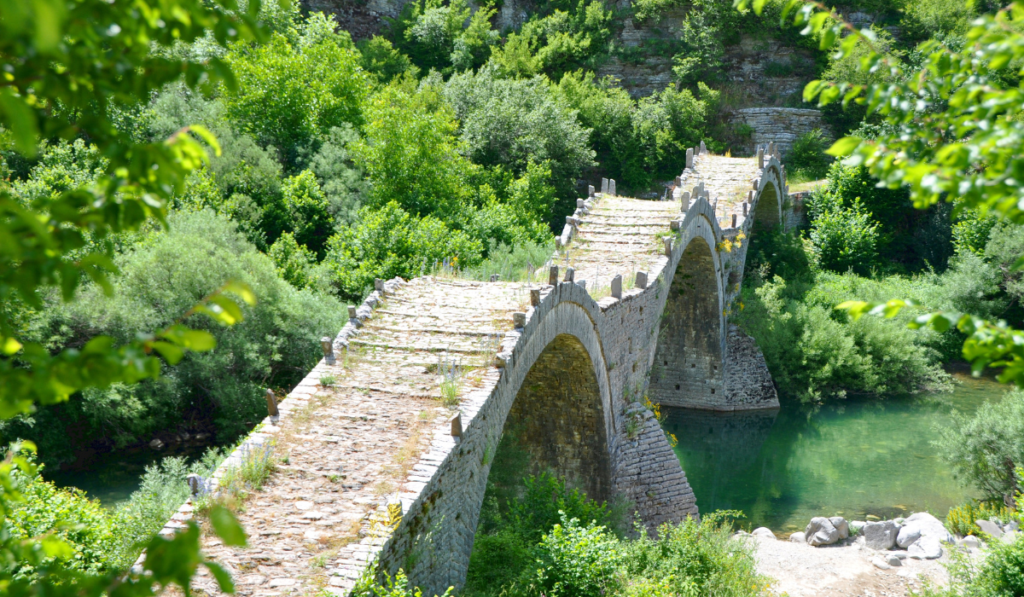
How do we create connection in a world where political forces profit from division, and “belonging” feels, for many, like a distant ideal? In this thought-provoking conversation, civil rights scholar john a. powell discusses how the concept of “bridging” can create curiosity and understanding when authoritarian political leaders are increasingly seeking the opposite. Instead of “othering,” which frames people as threats, or “breaking,” which excludes them, powell discusses how bridging can help us better communicate and create a world where we all belong.
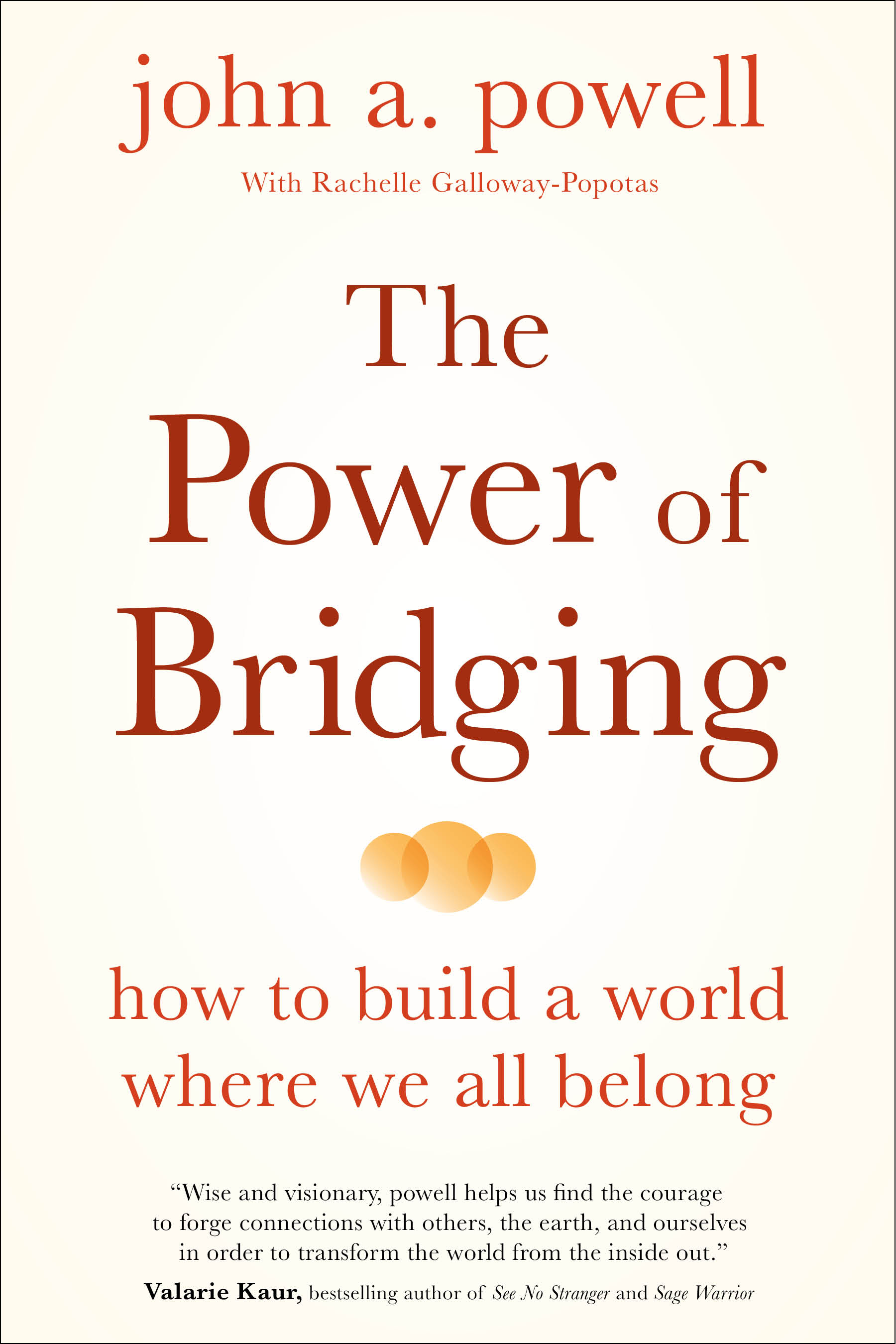
john a. powell is a renowned scholar and longtime activist and thought leader in the areas of civil rights, structural racism, housing, constitutional law, equality, and democracy. He is the Director of the Othering & Belonging Institute at UC, Berkeley, where he holds the Robert D. Haas Chancellor’s Chair in Equity and Inclusion and is a Professor of Law, Ethnic Studies, and African American Studies. He is the author of several books, including, most recently, “The Power of Bridging: How To Build A World Where We All Belong,” (with Rachelle Galloway-Popotas) which came out this month. Read an excerpt from “The Power of Bridging” here.
Bioneers: Could you begin by discussing how “bridging” differs from traditional approaches to conflict resolution or dialogue?
john a. powell: Conflict resolution, as the name suggests, is resolving conflict, but that’s not the purpose of bridging. There are different levels of bridging, and the conflict may persist. Some of it is instrumental, in trying to get a person to see something or understand something, but at a deeper level, bridging is really about listening deeply to someone, listening to their story. Listen with your heart to their humanity. There’s a South African word called sawubona, which means “I see you.” Basically, bridging is about seeing the other person as a human being, not as someone to be persuaded. Bridging doesn’t mean you agree with someone. It doesn’t mean the conflict has all gone away, but it’s an opening to see their humanity and to share humanity.
Bridging is about seeing the other person as a human being, not as someone to be persuaded. Bridging doesn’t mean you agree with someone.
Bioneers: What attitudes or perspective does one need to cultivate to bridge effectively?
powell: There are a number of efforts now, including my book, regarding how to bridge. There’s not one way. It also depends if you’re bridging with an individual, group or institution — or even yourself. What’s helpful, though, is openness, a certain curiosity. To really want to know someone’s story. As I said, it’s not argumentation; it’s not “tell me something so I can demonstrate to you how you’re wrong.” I sometimes say right and wrong is about the mind, about ego. Bridging is about connection, about the heart. It’s connecting at the heart level. It’s really just asking, what’s this person’s story? How do they approach life? What’s important to them? How do they suffer? That kind of curiosity and openness is key.
There are also different kinds of bridges, long bridges and short bridges. Because a bridge is short doesn’t mean it’s easy, and we can’t bridge all the time. It’s an aspiration, right? Sometimes we’re too hurt; sometimes we’re too angry. Bridging doesn’t mean you’re not hurt or angry, or that you agree with someone, but it’s an orientation. This is where we’re trying to get to. We know that breaking and othering don’t work. Bridging has to be not simply what we do, but who we are. We’re really trying not to dominate each other or the Earth but to live in harmony. In that sense, the concepts are consistent with many great spiritual, religious and moral teachings. It’s just putting a pin in it and being explicit about it right now. That’s the best way we get justice. That’s where we deal with inequality.
Bioneers: What role can stories play in helping people connect across differences?
powell: Most of the differences we actually focus on are stories themselves. If we have a rigid story, if we have a single story, and we don’t realize it’s a story, it makes it hard to bridge. In reality, we have multiple stories and multiple identities. The idea is to hold our story loosely, not abandon it, but to hold it among many stories and among the many stories of others. One of Bob Marley’s songs has a line, to paraphrase him, that says, “Every person thinks their burden is the heaviest.” So we know our own stories, we know our own suffering, but we don’t know the stories of others. Sometimes we think everybody should be concerned about our story, but we’re not concerned about anybody else’s story. Again, it’s not saying I’m abandoning my story, but I realize that I have a story and you have a story. I suffer and you suffer, and we’re constantly making new stories. So part of bridging is an invitation not only to listen to the other person’s story and share my story with them, but also possibly to make a new story.
If we have a rigid story, if we have a single story, and we don’t realize it’s a story, it makes it hard to bridge. In reality, we have multiple stories and multiple identities.
Bioneers: In the book, you emphasize belonging as a fundamental need. How does this relate to longstanding efforts to address systemic inequities and historical injustices?
powell: Especially in a rich country like the United States, poverty is an expression of not belonging. It’s not being held in deep regard. It’s not being seen as a full human being. It’s not being seen as worthy. When (Ronald) Reagan was president, he talked about the truly deserving poor and the undeserving poor, and so the stories with inequity persist in what sociologist Charles Tilly called “durable inequality.” It always has this story with it, and the story can be “those people” — already the other. They’re not me, it’s those people that are undeserving. They’re trying to cheat us, they’re trying to take our jobs, they’re lazy, and, of course, we shouldn’t share with them. The people we share with are family, people who are “good people.” The thing about “those people” is we actually don’t know their story. The “other” is a flat representation of a person. What do we know about a homeless person? Do we know what kind of vegetables they like? Do we know what they were doing before they were homeless? Do we know if they have any children? Do we know if they ever had a broken heart? Part of bridging and part of listening to each other’s stories is to see the complexity of humanity, which invites a belonging. We all belong. We’re not singular.
The thing about “those people” is we actually don’t know their story.
I frequently say we’re literally born physically attached, not only conceptually, but physically attached to another human being. There’s all this research now about how mushrooms and plants are all interconnected. We’re also connected. We don’t survive, we don’t thrive, we don’t grow, unless we’re connected. Belonging, as Maslow suggested, is one of our basic human needs. Some of his students say it’s more basic than food and safety because if we don’t belong, we don’t get food and safety. It shows up everywhere. Look at isolation; it’s the equivalent of smoking two packs of cigarettes a day. It’s associated with depression and suicide. I was just in India, where I was speaking to people from 20 different countries. Virtually every country and every culture has some expression of belonging. It’s just so fundamental. We’ve named it, but belonging is not new. It’s in the Christian faith, Buddhism, Islam, Jainism. It’s in the golden rule and in every major expression of moral codes, but almost all of those expressions have belonging with othering. Christians have the sinner, Muslims have the infidel, the civilized have the barbarian. We create belonging, but we create a categorical other at the same time. What we’re saying is belonging without othering; there is no other. The other is an illusion. The other is a story we tell.
Bioneers: How do you recommend individuals or groups navigate the challenges of discourse across deeply entrenched political or ideological divides?
powell: You asked about inequality earlier. Part of what we think about inequality is you’re unequal in terms of your belongingness — not just in your income or your education — so society doesn’t owe you anything. The most important thing a society or community extends to its members is belonging and participation. Everything goes from there, or is, of course, denied by that. We’re in a world now where there’s a lot of breaking and othering, and not just at the individual level. It’s at the group level, the institutional level, the structural level, the national level. We’ve weaponized it, and so that makes it hard, right? Because we have whole nation-states saying “these people” don’t belong. Fill in the gap. It could be these people who are transgender, as we’ve seen in the last election. Or people who are brown, people who are white, people who have an accent, people who don’t have kids. The process of othering is a sociological process, so we can make it up. There’s no natural other. Once we make it up, though, the effects of othering are quite real. Once it’s there, it’s hard to see it. It’s hard to see race as a story. It’s hard to see money as a story. When you’re living in the midst of that story, where the story is about everybody being other, and we’re creating smaller and smaller “wes,” it’s easy to get caught in that, but it’s important to remember that everyone belongs.
The process of othering is a sociological process, so we can make it up. There’s no natural other. Once we make it up, though, the effects of othering are quite real.
How do we begin to first hold on to that and then practice it? How do we make sure our institutions reflect that? We’ve done some work in that regard. When we think of something like the American Disabilities Act, which says that if people are going to belong, they have to be able to get into the building — we actually say “designed for belonging.” If people are visually impaired or speak a different language, they belong. Some people will get confused and say, “Well, you’re in America, you should speak English.” Everyone has characteristics that can be used to say they’re other.
There are other areas where we’ve started doing what we need to do. Think of Title IX in sports, saying women and girls should have the same rights as boys and men. Think of religion. We say someone shouldn’t be discriminated against because they’re Catholic, Protestant, Jewish, atheist. That’s an expression of belonging. It’s saying that even if you have these behaviors, these characteristics, you still belong. Your life still counts. Think of countries like Canada, which have eliminated the death penalty, saying, even if you’ve done something terrible or despicable, you’re still a human being. You still belong. We can practice it at different levels, and sometimes, because we’re individually oriented, we think about it just interpersonally, which is important, but it’s only part of the story.
We have to think about whether our institutions, our cultures and our structures are promoting or denying belonging. There are hundreds of examples. For example, structures are not neutral. In the 50s and 60s, our porches were all in the front, so the community naturally moved in and out of each other’s lives. Walk down the street and you see Miss so-and-so having lemonade, and she’d ask you about your kids. At some point we started building patios in the back, so now we don’t see each other. When there are cracks or breaks in the container of the things holding us, then no one feels like they belong. Everyone feels other. That’s what’s happening now. A lot of the othering and breaking that’s happening is actually breaking to belong. Some people talk about how they’re afraid the other would destroy their belongingness. The Proud Boy says, referring to a Nazi trope, the Jews will not replace us. It’s not real, but it’s fear of the other and not belonging that creates breaking.
Bioneers: How would you recommend people address that fear of certain “others,” which, in some cases, is encouraged by the institutions or governments?
powell: Part of it is stories. There’s external reality, what people call objective reality, and there’s internal or subjective reality, and what gets missed in that formulation is meaning, which is made by stories. So, yes, the United States is a more diverse country now. What does that mean? Does it mean that white people should be afraid? Does it mean that Mexicans are coming to get us? Does it mean that Haitians are eating our cats? The meaning is what’s important. Stories are how we propagate meaning, and stories are overly represented by leadership. When we don’t understand what’s happening in the world, we look to influencers, stories, culture and religion. Trump and other people who have a large platform (provide meaning). So, part of the solution we can do ourselves, by not participating in breaking stories and stories about the other and instead being curious. But we also need leaders to do it. We also need our institutions to do it. We need to put a symbolic stake in the ground that everybody belongs.
Stories are how we propagate meaning, and stories are overly represented by leadership.
We’ve done that before. Think about this: In the late 1700s, Thomas Jefferson, who was a slaveholder, helped pen the words in our founding document that all people are created equal. How can he say that when he has hundreds of people enslaved? Yet, some historians have said that’s the most consequential phrase in U.S. history. It orients us in a certain way. It gives us something to move toward or aspire toward. It gives us a way of evaluating our current actions. We’re rethinking it now, but for the most part, the country has grappled with some concept of equality that Jefferson would be shocked by — a Black, Asian woman running for president. (Martin Luther) King said the moral arc of the universe is long but it bends toward justice. It doesn’t bend by itself. We bend it. Sometimes it bends toward justice, sometimes it bends toward injustice. Belonging and bridging is a way to bend it not just toward justice but toward belonging. It really is a long arc; 500 years ago, the whole world was basically enslaved. We have a long way to go, but we’ve come a long way. The book is not trying to be pollyanneish, and just say that everything’s fine. It’s not. We have work to do, but this is the work.
(Martin Luther) King said the moral arc of the universe is long but it bends toward justice. It doesn’t bend by itself. We bend it.
Bioneers: Why do you feel bridging is particularly urgent given the current polarized political climate?
powell: Because breaking and othering have been weaponized. We’re starting to believe those stories, and they’re being shouted from the highest halls of power in our country — that some people don’t belong. Think about the Middle East. The fight about the Middle East is about who belongs there. That’s what war oftentimes is about: who belongs? Think about fights in Europe for years, or think about segregation. Segregation is an expression of saying some people belong, some don’t. Think about anti-miscegenation laws, which were prominent in the United States until 1967, which said two people of a different race are not allowed to marry. We’ve had this anxiety for years, and we thought we had wrestled it to the ground. Now it’s actually being validated by the most powerful people in society, from Elon Musk to Donald Trump. It’s become seductive. It’s become okay to sort of flirt with this solution, and it’s extremely dangerous.
Bioneers: Is there something that gives you hope now amid all this conflict and the institutional and governmental othering that is happening?
powell: I don’t really organize around despair or hope, but if I were to, I would say people (give me hope). In many ways, even the breaking and othering that’s happening, if you scratch the surface, it’s a cry for belonging. It’s a distorted cry; they’re being fed the wrong thing, but people are desperate and part of it is the world keeps changing, and more and more of us feel like we don’t belong. But the solution is not, therefore, to attack each other. The solution is not to turn on each other but to turn toward each other, and I think we’re capable of doing that. There’s great work happening, even in the midst of these difficult times.
The last thing I’ll leave you with is this. I talked about the Declaration of Independence claiming equality at the time that enslavement was at its zenith in the United States. When people think about the early 1950s and the United States, they think about Rosa Parks, the Reverend Doctor King and the Civil Rights Movement. They don’t think about (U.S. Sen. Joseph) McCarthy. They don’t think about the House Un-American Activities Committee. They don’t think about the FBI locking people up and spying on people. Those events were happening at the same time, and yet, when we think back on the 50s, most of us don’t think about McCarthy. We think about the rays of hope that were happening at the same time as McCarthyism. At the same time that our government was turning on people, the Civil Rights Movement was being born. In some ways, that’s where we are today. There’ll be rays of hope in this darkness, and I’m hoping that they will sprout to something huge, so that 30 years from now, this sort of authoritarian-othering impulse would just be a blip, and we’ll be at a different place.
We don’t want to live in a society in turmoil. In the US, 93 percent of people want to reduce divisiveness, and 86 percent believe it’s possible to disagree in a healthy way. Yet with increasing political and social fragmentation, many of us don’t know how to move past our differences. Civil rights scholar john a. powell presents an actionable path through “bridging” that helps us communicate, coexist, and imagine a new story for our shared future where we all belong.
Edited and developed with the Othering & Belonging Institute’s Rachelle Galloway-Popotas, powell’s research-backed guide offers a framework for building cohesion and solidarity between disparate beliefs and groups. He defines key concepts such as “othering,” which primes us to see people as a threat; “breaking,” which excludes people or sees them as threatening our belonging; and finally “bridging,” which fosters acceptance both of those we might have othered and even aspects of ourselves. He shares personal reflections as well as practices to help you begin bridging wherever you are — in your community, friendships, family, workplace, and even those with whom you might never have imagined you could find common ground. He calls upon us not just to engage with bridging but to become bridgers.
This book is about four key concepts paired in tension with each other: belonging and bridging and othering and breaking. I’ll go into much greater detail to define each of these and how they are interrelated, but let me offer some brief introductions now to what I mean by these four words.
I believe many of our most vexing social problems share a common structure that is not often revealed when we are just looking at single issues. I believe that the concept of othering, or seeing people not only as different but as less deserving and not of equal dignity as us, allows us to more clearly perceive the underlying structure of many of the problems we are facing, whether we call those problems racism, nationalism, homophobia, or cancel culture.
Breaking is othering in action. When we engage in breaking, we deny the full stories, complexities, and even sometimes the humanity of those we consider other.
Breaking is othering in action. When we engage in breaking, we deny the full stories, complexities, and even sometimes the humanity of those we consider other. Their suffering does not count as much as ours. While othering is about one’s status in relationship to different groups, breaking is the practice that undergirds othering.
The solutions that I want to offer to othering and breaking are belonging and bridging.
Belonging serves as an aspiration and orientation in the world. A world built on belonging means one must have what is necessary to cocreate and participate in making the world one lives in. Belonging means agency for all members of society. It is closely associated with dignity and being seen. While in a sense we already belong, it is still important that we are acknowledged as belonging and that we acknowledge the belonging of others.
At a foundational, and I would say spiritual, level, belonging also means that there is no other. Whose life is unimportant? Who does not matter? Show me the person not made of stardust. Not only do we all count, but we are all connected. We all belong.
Who does not matter? Show me the person not made of stardust. Not only do we all count, but we are all connected. We all belong.
And yet that is not our daily experience. We are situated differently from others. We see the world differently from others. How am I to be my brother’s and sister’s keeper when they see the world so differently than I do? Maybe they even reject the idea that they are my brother or sister. There are many practices, like in my father’s church, willing to embrace the notion that all the members belong but not the nonmembers — not the Chinese people, or the eleven year-old who questioned the rules of belonging. Othering may seem natural and even inevitable. It is neither. But we must do something in a world where we practice not seeing the humanity in the other.
This is where bridging comes in.
Bridging is both a practice and a position. “Can I become a bridge?” I may ask myself. And this immediately calls up other questions — “Do I want to bridge?” Or “Why should I?”
By definition, if someone is other, there is apparently a distance between us. Why don’t I just leave it at that? Maybe they are more than different — maybe they are a threat. Should I bridge or should I protect myself from this other?
We live in a world full of fractures and one where polarization, division from one another, and isolating ourselves are becoming increasingly normalized. We live in a world where fear is often more visible than love or hope.
But it does not have to be that way. In our effort to protect ourselves in what feels like a dystopian world, to close ourselves off from one another, we are likely to inflict even more pain and add fuel to the fire of the very world we want to avoid.
In our effort to protect ourselves in what feels like a dystopian world, to close ourselves off from one another, we are likely to inflict even more pain and add fuel to the fire of the very world we want to avoid.
This book suggests there is another way. This book hopes to acknowledge and reclaim our ability to see one another. And to live with one another.
Where there is an apparent other, there is the need to explore how to bridge. This book is about belonging without othering despite the claim that the world demands something else. This book is an invitation to reject a future organized around fear and death, and instead to organize and call into being a world where we recognize and live into our connection with one another, the earth, and ourselves. It is known that we share much DNA with apes. What is less discussed is that we also share DNA with all of life. To live into this reality of interbeing is the challenge.
This is not an easy task, and there will be many reasons to think and do otherwise. And yet, life demands life, and I believe bridging is one of our most important ways to see and celebrate one another and ourselves.
…
The Urgency of Bridging
Why do I believe (and I do believe) this work of bridging is urgent? Because we are living right now in a world where there is a great deal of fragmentation. This is often framed as polarization and sometimes as isolation, or both. While these three dynamics are related, I believe fragmentation is a better way of understanding and addressing our current state.
Polarization is usually defined by two sides diverging in roughly symmetrical ways, with the implication being that to solve polarization everyone can moderate their positions and meet in a perceived middle. That may sound appealing, but often it is not the correct solution. What about a case where one side embraces steps to avert impending disaster while the other is not only entrenched in inaction but denies there is even an issue? Not all instances of groups diverging should or even can be resolved by negotiating a middle position.
I prefer the term fragmentation to describe the widespread dynamic of retreat into groups that are mutually averse to and distrustful of each other. To address fragmentation, we must also understand and address power and contexts of different groups, while at the same time anchoring our efforts in values that include all people.
Social division, fragmentation, and isolation are all global issues and are a threat to the health of democracy and the planet. We should be careful in both analysis and language about them. (I write more about fragmentation in the book Racing to Justice.)
Fragmentation and distrust are on the rise. In the US, the gap between how positively individuals feel toward others of their own political party versus members of the opposing political party has grown steadily since the early 1990s. By 2020, animosity toward the opposing political party was at its highest point in decades, as measured by a public opinion survey tool called the “feeling thermometer,” which asks Americans to rate how warm or cold they feel toward different groups, including those in different political parties.
The less we meaningfully interact across differences — the less we stay open to bridging — the more likely that such stories become a reality.
In 2022, an NBC News survey showed that 80 percent of people with political affiliations believed the other party “poses a threat that if not stopped will destroy America as we know it.” This was shown to be in part because Americans exaggerate how different they are from supporters of the other party, and therefore they carry in their heads distorted and flattened stories of one another. The less we meaningfully interact across differences — the less we stay open to bridging — the more likely that such stories become a reality.
There is distrust not just of the apparent other but of each other, even those we may think of as members of our group. This is some times expressed in terms of social isolation and loneliness. The British government noted loneliness as a national problem and appointed a minister of loneliness to help address it. The US Surgeon General has issued warnings that we are in an epidemic of loneliness.
People are experiencing not just increased loneliness but also anger, hopelessness, and little faith in institutions. A 2023 survey from the Public Religion Research Institute (PRRI) found that more than three-quarters of Americans believe that our democracy is at risk in the 2024 US presidential election. And 38 percent agreed with the statement that “because things have gotten so far off track, true American patriots may have to resort to violence in order to save our country,” the highest rate of support for political violence in the eight surveys PRRI has conducted since 2021.
All over the world, an increasing number of people are facing the future with a mix of anxiety, fear, and trepidation. These feelings are a breeding ground for authoritarianism and worse. Peace-building organizations globally are being challenged to reconsider their values and their approach as wars in Ukraine, Sudan, and Gaza rage on. Even those who may conceptually support building bridges between different groups worry it may be a luxury we cannot afford in this environment.
So why are war and othering increasing now, and why all over the world?
One reason is because the world is changing rapidly, and rapid change puts us under enormous pressure, straining our ability to adapt. Today’s accelerated changes are happening across critical areas that have enormous impact on all of us — climate crisis, technological advances, economic shifts, the COVID pandemic, and altering demographics all portend a different world. The speed of these changes will not likely slow down.
These dynamics are raising Darwinian narratives, such as who will survive and who will fit in this emerging new world. While the reference to Darwin might seem abstract, the experience is anything but. We frequently respond to the challenge of change by finding a target to assuage our anxiety. And too often that target becomes the other. It can be the racial other, the immigrant other, the trans other. As Darwin discussed survival of the fittest, he appeared to be discussing traits and species. The application and use in social discourse may not align completely with Darwinian theory of the survival of the fittest, but that will not likely have much impact on either the discussion or the underlying anxiety.
The changes may be scary, or they may be something we believe we want. But they all point to a world where we will all be called upon to change. What is most fearful is the possibility that my group, and I, will not belong in this new world.
There are indeed changes coming. The future, somewhat like the past, is complex, only more so. The changes may be scary, or they may be something we believe we want. But they all point to a world where we will all be called upon to change. What is most fearful is the possibility that my group, and I, will not belong in this new world.
Even if we don’t want to change, change is inevitable. It might be good, bad, both, and neither. But life does not exist without change. The change could be slow enough that we don’t notice it, but when change is too fast, it may appear to threaten our current way of being. Our sense of threat may feel even more troubling when we begin to allow the belief that the unwelcome change is being caused by an other.
People are navigating these changes without much help from leaders and without stories that can support them in meeting the moment with something other than fear. Changing US immigration policies or leaving the European Union is not likely to address the issue of climate or demographic changes. And people are not likely to invest in serious solutions for any number of causes unless such solutions speak to some real concerns that impact their daily lives. The energy we see around book bans in schools suggests that it might be easier to get people excited about what their children are reading or not reading than about issues like climate change or artificial intelligence, which might feel more removed and abstract.
The collective anxiety that we are experiencing due to the pace of change in the world today can be met with fear and more anxiety, or it can be met by creating opportunities to turn toward one another and build a larger we that can face the future together.
The collective anxiety that we are experiencing due to the pace of change in the world today can be met with fear and more anxiety, or it can be met by creating opportunities to turn toward one another and build a larger we that can face the future together.
I believe bridging is one such opportunity.
Bridging is a powerful way to address fragmentation and create a shared story for our future. I believe understanding the threats of othering and the orientation of belonging will help us meet the future with the urgency we need.
Maps have the power to do more than guide us—they can tell stories, reveal hidden histories, and inspire deeper connections to the natural world. For cartographer and artist Daniel Coe, this storytelling is at the heart of his work. As the graphics editor for the Washington Geological Survey, Daniel creates stunning visualizations that not only aid in understanding natural hazards and geology but also uncover the dynamic beauty of landscapes, particularly rivers.
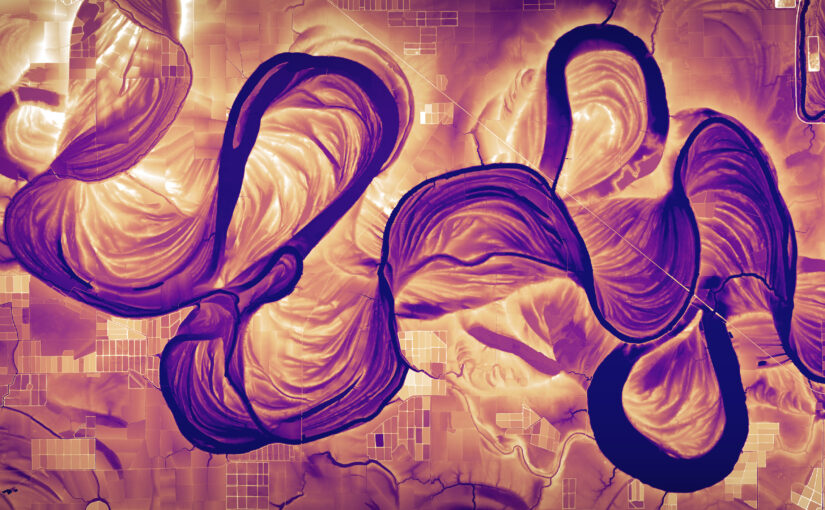
Daniel’s innovative use of LiDAR data has captured attention far beyond the world of geology. His vibrant, multilayered river maps—including one featured in the Bioneers 2025 key art—blend science and art, inviting us to see the rivers around us in ways we never have before. With a background that includes work with the Oregon Department of Geology and Mineral Industries, contributions to the Atlas of Design, and collaborations with artists and scientists alike, Daniel brings a unique perspective to his craft.
In this conversation with Bioneers President Teo Grossman, Daniel shares insights into his creative process, his passion for rivers, and how his LiDAR-based images provide a deeper sense of time and place.
TEO: I’d love to start by asking how you describe what you do.
DANIEL: I work as a graphics editor for the Washington Geological Survey, so basically anything visual that our survey produces, I usually have a hand in. Most often, that’s in the form of maps. My main role is as a cartographer.
I love maps. I love making maps. I love getting creative with maps. At the Survey, we deal with a lot of natural hazards, like landslides, earthquakes—mapping things like that. We also map the geology of the state and are the center point for collecting LiDAR data in Washington.
I also began to make lidar river images outside of Washington in the past several years. This river series grew out of a desire to learn how to use different software and to have a project that has no creative restraints. I can do whatever I want. I can make bright, crazy colors. They don’t have to mean anything. It’s just me following my creative intuition.
I’ve gotten a bit obsessed. I love being around rivers, on rivers, floating rivers. It’s so neat what you can see with this data. It’s showing rivers in ways they’ve never been seen before, which is super exciting to me. It’s satisfying to make them for my own purposes, but it’s also satisfying that other people appreciate them, learn from them, and gain a better appreciation for the rivers where they live through them.
Image of the Lena River Delta in Russia, derived from a high-resolution stereo digital elevation model. Artist: Daniel Coe
TEO: A lot of people might not be familiar with LiDAR. Could you explain what it is and what kind of results it produces?
DANIEL: LiDAR stands for light detection and ranging. It’s a technology that uses a high-tech laser range finder to collect three-dimensional information.
The kind of LiDAR that I use is generally collected from an airplane. They fly a small airplane over the ground, and there’s an instrument that shoots lots of pulses of light at the ground. That reflects back up to a sensor. We can take that information, all of those points where the light hits the ground or a tree or a house, and collect them into what is called a LiDAR point cloud. We can create three-dimensional models of the Earth with a point cloud; surfaces that have all the trees, houses, and buildings included. However, the interesting thing, from my perspective, is that we can remove all of that stuff on the surface and only view the bare ground. That’s really powerful for seeing different types of landforms, but it’s most interesting to me for seeing floodplains. We can see where rivers have meandered in the past. We can see subtle changes in elevation and topography, which often capture really old stream meanders, sometimes hundreds or thousands of years old.
TEO: When we look at the river images Bioneers is using, what exactly are we seeing?
DANIEL: The colors in the images represent elevation in different ways. Often I’ll start with a gradient that goes from a light color to a dark color. The light color usually represents the river surface, and then everything that gets darker progressively represents elevations that are higher above the river. When you represent the landscape in that way, you can often see around the river the places where it flowed in the past that are at a slightly higher elevation.
It produces this really interesting effect. You have this static image, but it also represents the river in multiple dimensions, like the dimension of time. I often see other things in these channels, like trees or lightning or smoke. They often evoke other sorts of forms of nature. There are even some analogs with the human body, especially in river deltas, where everything spreads out into multiple channels. A fractal nature emerges, a repeated pattern over different scales.
TEO: It’s a reminder that we have our own internal biological hydrology that mirrors the external world in some ways. This blend of scientific data and artistic expression is fascinating. Do you get feedback from scientists about the utility of these images?
DANIEL: I get a ton of feedback from geomorphologists on the usefulness and the beauty of them. You can see all sorts of things in these images—in a big river system like the Mississippi River, you can see where rivers have been leveed because those elevations are a little higher, so they often produce darker lines. That’s also a really good jumping-off point for talking about how rivers have been constrained by humans.
TEO: It really is evocative when you consider the challenges that humans have in managing landscapes. A lot of the environmental issues we deal with really boil down to humanity’s lack of ability to think in terms of time frames outside of our own. As a species, we’ve evolved to be adaptable, and we adjust to a “new normal” frighteningly quickly.
DANIEL: One thing about geology in general, but also about these images, is they give you that deeper sense of time. It can be humbling to think about, “This river has been moving all over for thousands of years, and I’ve only been here for a tiny portion of that time.” Yet, as humans, we have this outsized influence. We can put a dam on a river or hem in a river with levees. There are societal benefits to some of those things, but is the trade-off and the cost to that overall ecosystem worth it? I think it puts our relatively short lives in a better perspective in relation to the rest of the Earth.
TEO: I saw that one of your images is featured as the internal jacket cover for Robert Macfarlane’s new book “Is A River Alive.”
DANIEL: I’m super excited about that. I’ve been looking forward to that book. The concept is about the personhood of a river. These images really show how the river is alive because it’s moving all over the place. It kind of has its own will, so to speak.
TEO: Are there other artists and image-makers doing similar work that you admire?
DANIEL: There’s an artist named Brad Johnson who does amazing work with LiDAR data. He uses point clouds and animates them in this really interesting way that brings out the nature of geology in different places. He does really incredible installations. He also creates animations that are choreographed with live music. It’s just a really powerful way to experience that sort of data.
TEO: Are there other maps that, as a cartographer, you really admire?
DANIEL: There are tons. Historically speaking, there are maps by Marie Tharp, who helped push the idea of plate tectonics. She mapped the undersea ridges in many of the oceans, and she partnered with cartographer and painter, Heinrich Berann, to create these absolutely beautiful maps. They were published in National Geographic. I remember looking at my parents’ old National Geographics as a kid and seeing these beautiful maps and just being blown away by them.
TEO: The work you do is really spectacular and I’m sure that kid pouring over old maps would be thrilled with how things turned out, decades later.
DANIEL: Definitely. Hopefully there’s somebody out there who’s seeing these right now and thinking, “Ooh, that’s cool, I want to do something like that when I grow up.” That would be the most satisfying thing ever.
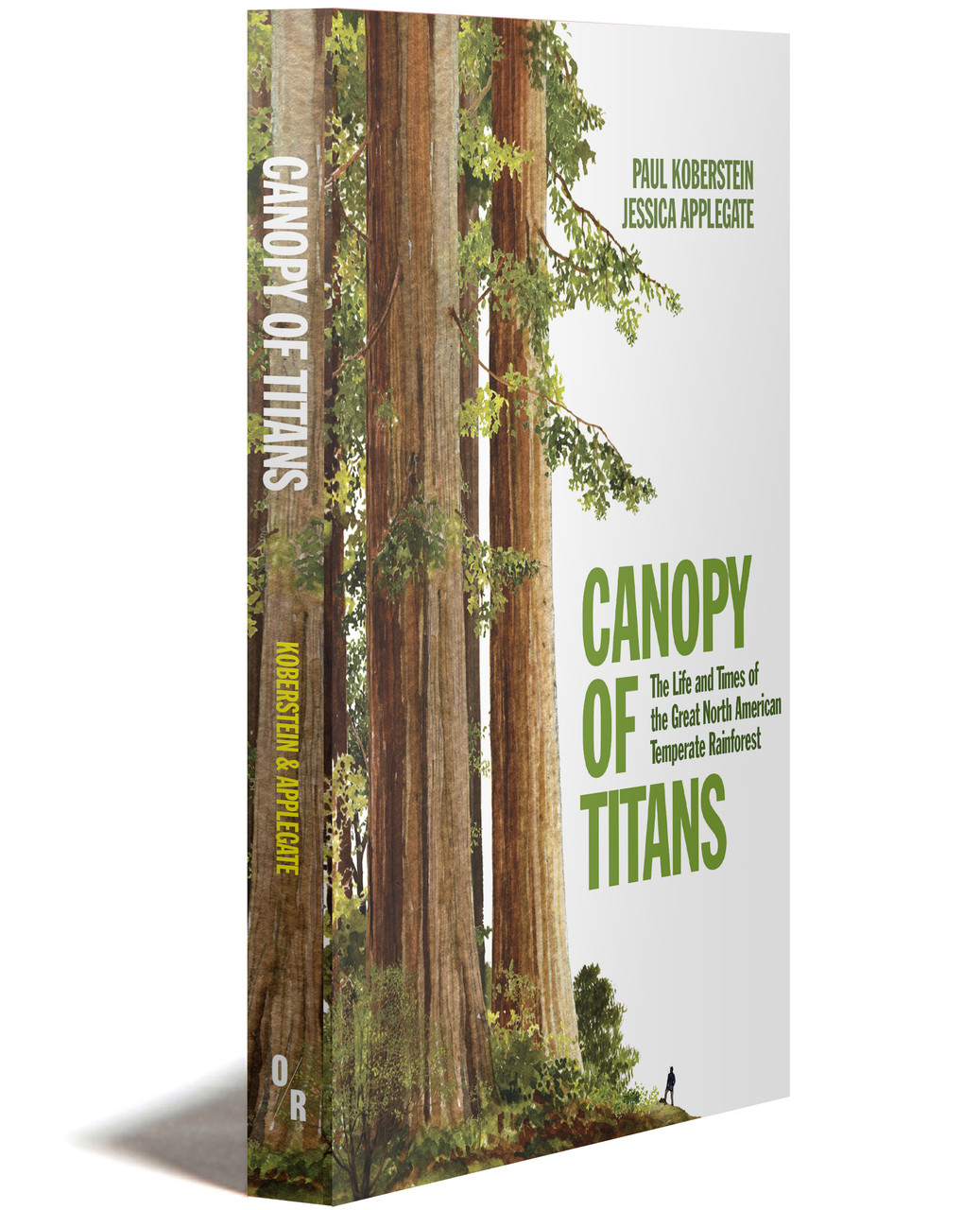
In “Canopy of Titans,” environmental journalists Paul Koberstein and Jessica Applegate examine the global importance of the Pacific Coastal Temperate Rainforest that stretches from Northern California to Alaska. Drawing on years of on-the-ground reporting, Koberstein and Applegate pull back the curtain on policies of governmental bodies that have seriously diminished the rainforest’s capacity to store carbon, and uncover industry practices that have led to the destruction of swaths of a major ecological resource. Additionally, using an environmental justice perspective, “Canopy of Titans” shines a light on the Indigenous communities that have lived in the rainforest for millennia, and the impact forest policies have had on their lives. Their urgent and authoritative account sets out the threats facing a vital environmental resource and celebrates the beauty and complexity of one of the world’s great forests.
Paul Koberstein is the editor of Cascadia Times, which he co-founded in 1995. He was previously a staff writer for The Oregonian and for Willamette Week. In 2016 he won the Bruce Baer Award given annually to an Oregon journalist for excellence in investigative journalism and, in 2004, the John B. Oakes Award for the most distinguished environmental journalism in the United States.
Jessica Applegate is managing editor and photographer for Cascadia Times. A lifelong environmental activist, she works with special needs young children and is a founding member of Eastside Portland Air Coalition, a grassroots group that spurred creation of statewide air toxics regulatory overhaul, Cleaner Air Oregon.
The following is an excerpt from “Canopy of Titans,” by Paul Koberstein and Jessica Applegate, published by OR Books, 2023, and has been reprinted with permission.
Where the Forest has no Name
Fifty miles north of San Francisco’s Golden Gate Bridge, you enter the world’s largest temperate rainforest, an inspiring cathedral of ancient redwood, Douglas-fir, and Sitka spruce, the tallest trees on Earth. If you travel the entire length of the rainforest, you will end up 2,500 miles away, on the far western side of the Gulf of Alaska.
Don’t look for any signs marking an entrance to the rainforest. There aren’t any. What’s more, the rainforest has no official name, according to the National Geographic Names Information System database. So, what should we call it? We asked James Meacham, a professor of geology at the University of Oregon and an author of the Atlas of Oregon.
“Great question,” he told us. “I don’t have a definitive answer for you.”
There is no shortage of suggestions, however. At various times, people have called the temperate rainforest Salmon Nation, the Rainforests of Home, the Northeast Pacific coastal temperate rainforest, the Pacific Rain Forest, the Cascadian Raincoast Forest, or the Northwest Coast Cultural Area. None of the names have stuck.
Don’t look for any signs marking an entrance to the rainforest. There aren’t any.
Indigenous nations living in the rainforest for millennia had names for many of the places within the temperate rainforest but no name for it as a whole. The Oregonian newspaper often refers to the rainforest as “Northwest Forests,” a plain vanilla handle you could attach to just about any old stand of trees in the region. The distinguished environmental newspaper High Country News has used something almost as generic: “The ecosystem that runs from Northern California to the Tongass National Forest in Alaska.” That’s like identifying the Amazon, the world’s greatest tropical rainforest, simply as an “ecosystem running from the Andes to the Atlantic,” and leaving it at that.
All these names are technically accurate, but where’s the inspiration? The name we use in this book is “Pacific coastal temperate rainforest.” Outside a small cadre of scientists, no one calls it that. We admit: this name is boring, too. We just aren’t sold on any of the alternatives.
Settlers arriving in the temperate rainforest during the 19th century attached names to everything, including seven national parks: Redwood, Crater Lake, Mount Rainier, Olympic, North Cascades, Glacier Bay, and Kenai Fjords. Canadians also attached memorable names to their special places: Tweedsmuir, Strathcona, Pacific Rim, Clayoquot Sound, and the Great Bear Rainforest. Even individual trees were named Hyperion, Stratospheric Giant, Del Norte Titan, Illuvatar, Kootchy Creek Giant, Cougar Flat Sentinel, Carmanah Giant, Nooksack Giant, Big Lonely Doug, Doerner Fir, and Goat Marsh Giant. Most of these trees are over 300 feet tall, the height of the Statue of Liberty, or taller. Hyperion, the tallest tree in the world, exceeds 380 feet. The tallest tree in history, so far as we know, may have been Nooksack Giant, a 465-foot-tall Douglas-fir in Washington’s Whatcom County that was logged in 1897. In the arboreal race for the sky, the runner-up might have been another Douglas-fir, the Lynn Valley Tree, a 415-foot monster in Vancouver, B.C., that was cut down in 1902.
Before Europeans began colonizing the West in the nineteenth century, the Pacific coastal temperate rainforest was fully stocked with carbon in gigantic trees, large accumulations of dead wood, and rich, loamy soils interspersed with some burnt areas. Today, most old growth, generally defined as a forest older than 175–250 years, is gone.
Some of the giant trees of the past were taller than the giants of today, but there’s no record of them, other than Nooksack Giant and the Lynn Valley Tree. As you journey deeper into the temperate rainforest, you will see large, ugly, empty wastelands enveloping the hillsides where monstrous trees once stood. These are clear-cuts. Clear-cut logging rips almost every tree in sight off the land, all at once. Compared with less intensive forms of logging, like selective harvests, clear-cutting saves the logging companies time, effort, and money. Corporate accountants approve, even if the tree-hugging public does not.
Clear-cutting drains most of the forest’s carbon. After a forest is clear-cut, a little less than half of the carbon—leaves, branches, stumps, and roots—remains in the forest. The rest of the carbon remains embedded in the harvested logs and eventually will become stored in manufactured wood products like lumber, plywood, and toilet paper. As these products decay slowly over time, their carbon will also return to the air. While it’s alive, the tree continues to sequester carbon. Wood products are dead and sequester nothing more. After each clear-cut, that part of the forest transforms immediately from a carbon sink to a carbon polluter. Even if quickly replanted, the clear-cut forest won’t sequester any significant amount of carbon again for many years. As Suzanne Simard, a University of British Columbia professor of ecology, points out, clear-cutting destroys much more than just trees. Simard, author of the insightful book Finding the Mother Tree: Discovering the Wisdom of the Forest, explains that each clear-cut drives out a hundred species from the area, reduces the forest’s ability to retain water, and removes the top few feet of soil and humus. Typically, a forest stores at least half its carbon in the soil. Repeated clear-cutting can release up to 90 percent of this carbon back into the air, she says.
Not long after clear-cutting the trees, loggers often set fire to the slash—the dead leftover branches, leaves, needles, and unmerchantable downed logs. These slash fires emit carbon while killing soil microbes, plant roots, and seeds. Then, the loggers summon a helicopter to shower the ground with herbicides, spelling death to the forest’s remaining understory, and replant the now-bare ground with rows of saplings. Again and again, every forty years, they repeat the destructive cycle of clear-cutting, spraying, burning, and replanting. This is how industrial forestry destroys natural forests and, as we document in this book, wrecks the climate as well.
Until thirty years ago, ecologists paid little attention to the rainforests that border the continents in the temperate latitudes. Instead, they focused on protecting the exotic, but vastly different, rainforests in the tropics, the planet’s hot zone between the Tropic of Cancer and the Tropic of Capricorn, with the Equator drawn down the middle. Temperate rainforests exist in the cooler zones outside the tropics, in both the northern and southern hemispheres. Temperate rainforests are home to a large number of species, but tropical rainforests harbor ten times more.
On rare occasions, ecologists mention temperate rainforests in their scientific papers, and they usually refer to them as “high-latitude rainforests.” That changed in 1991 when Paul Alaback, an ecologist at a Forest Service research station in Juneau, took a closer look. He noticed that forests in Southeast Alaska were much like forests in British Columbia and Washington and even bore a striking resemblance to rainforests in the Patagonia region of southern Chile.
Alaback realized he had discovered a special, often overlooked type of ecosystem: the temperate rainforest.
Alaback realized he had discovered a special, often overlooked type of ecosystem: the temperate rainforest. In a paper published in a Chilean journal, Alaback was the first to define temperate rainforests. They are close to an ocean, cool in summer, very wet year-round, and far from the tropics.
Almost all temperate rainforests exist in just seven regions of the world: the northern Pacific Coast of North America; eastern British Columbia; eastern Canada; Japan; Patagonia; northern Europe; and Australasia (southern Australia, Tasmania, and New Zealand), according to Oregon ecologist Dominick DellaSala. In his 2011 book Temperate and Boreal Rainforests of the World, DellaSala calculates that about eighty million hectares of temperate rainforest still remain on Earth. The Pacific coastal temperate rainforest makes up a little more than one-third of that total, and by far is the largest.
In 1995, Ecotrust, a non-governmental organization based in Portland, published The Rain Forests of Home: An Atlas of People and Place, the first detailed maps of the rainforest. Two years later, Ecotrust produced a companion book, The Rain Forests of Home: Profile of a North American Bioregion, an anthology of essays about this “new” temperate rainforest. Spencer Beebe, Ecotrust’s founder, told us Rainforests of Home and the companion atlas were inspired by a visit to Alaback’s research station in Juneau, where he spotted a rainforest map on a wall. Alaback divided the temperate rainforest into two narrow belts: a western belt tracking the coastline from California to Alaska, extending some fifty miles inland, and another belt one hundred miles further inland tracking the crest of the Cascade Mountains. The two belts merge north of Vancouver, B.C. Alaback further divided the rainforest into four subzones south to north: warm, seasonal, perhumid and subtropical. Ten million people live in the gentle lowlands separating the two belts in Vancouver, Seattle, Tacoma, Portland, Eugene, and Medford.
The anthology begins with a stunning description of the vast, forested landscape:
“Stretching from the redwoods of California to the vast stands of spruce and hemlock on Kodiak Island, Alaska, the coastal temperate rain forests of North America are characterized by an unparalleled interaction between land and sea. The marine, estuarine, and terrestrial components combine to create some of the most diverse and productive ecosystems in the temperate zone.”
The book said only half of the world’s original coastal temperate rainforests still remain. By comparison, Norwegian ecologists estimate only one-third of the world’s tropical rainforests in existence in 2001 still stand.
It asserted that temperate rainforests play a crucial role in mitigating human-caused climate change, and no forest is more valuable to the climate than this one.
Ecotrust noted the Pacific coastal temperate rainforest’s vast potential to store carbon. It asserted that temperate rainforests play a crucial role in mitigating human-caused climate change, and no forest is more valuable to the climate than this one. They based this statement on a paper written in 1990 by Mark Harmon of Oregon State University and other ecologists. They reported that logging in the rainforest “has been a significant source of carbon in the atmosphere.” Harmon’s team determined that logging twelve million acres of ancient rainforests in Oregon, Washington, and Northern California over the previous century sent up more than one gigaton of carbon into the atmosphere, an enormous amount. The old forests were subsequently replanted with tree farms. Harmon calculated it would take at least 200 years for the tree farms to recapture the lost carbon.
The urgent need for a shift to clean, sustainable technologies is the most important challenge of our time, probably the most crucial our species has ever faced. In this session some trailblazing women leaders in this domain share their projects, their thoughts on where we stand in the race to a clean and equitable transition, and the challenges they face in what has for far too long been a male-populated sector. Hosted by Sara Fuentes, President of Smart Waste, and Chairwoman of Women in Cleantech and Sustainability. With: Emily Teitsworth, Executive Director of the Honnold Foundation; Charlotte Michaluk, award-winning young scientist and engineer; Kellie Macpherson, Executive Vice President of Compliance & Risk at Radian Generation; Kirthika Padmanabhan, Co-Pilot at X, the moonshot factory. (Hosted by Women in Cleantech and Sustainability)
SARA: I would like to ask everybody on the panel: Please describe a major milestone that changed the trajectory of your career in clean tech. And I want to start off with you, Emily.
EMILY: Well, I’m probably the latest addition to the clean tech industry on the panel, so a little bit of an outlier. But I would say a milestone really is, for me, joining the industry. My background is in gender equity work, public health, and sustainability. As I started to look around and wanted to get more into work on energy and environment and climate, the opportunity with the Honnold Foundation came up, it was not something that I had envisioned as part of my future but was one of those moments where I saw the role and it looked like the job description was written for me. So, I decided to take a chance. I’m happy to say that I am part of the clean tech industry.
To draw a kind of lesson from that, you don’t necessarily have to be an engineer or a scientist to be a part of this industry. There’s need for executive leadership and marketing and strategy and design, and all these other skill sets that you can bring to this work. I’ve been most happy in my career when I was able to take a left turn and try something totally new. Joining this industry and being welcomed by people who’ve been here a long time has been a huge milestone. And I’m really excited to stay.
KELLIE: Similar to you, I joined the renewable space in 2013, coming from traditional generation and the utility space. I did a specialized type of compliance that, at one point, there was less than a hundred people in the U.S. that did it, and less than 10 women when I joined this space. I was really fortunate to come into the renewable space and see that the culture was different, and that gender parity was important. I’ve worked for some amazing people that always empowered me and wanted to see me be successful. That’s made such a difference for me.
I worked for this amazing chief legal officer when I first came into the renewable space who told me how to write an email better, and nitpicked—you know, told me to dress better, and all of these things, and told me how to have presence in the room, and how to use my voice in the room, and just really mentored me there. Then from there, I’ve worked for amazing people who see the value that I bring to the table. That’s been really important to me.
SARA: Thank you for those insights. I have to say that sometimes when we’re in our trajectory, when we get critical feedback, we get to apply it as a form of kindness.
CHARLOTTE: Yeah, I would say a really pivotal moment was when I first toured the Woods Hole Oceanographic Institution and got to see the submersibles. I was really amazed by how carefully designed technology can take us so far to better understand the natural world, and how to improve its conditions. But also, more particularly, how they dealt with those space constraints at such an intense level, really inspired me to consider more deeply the space constraints in my work with cargo ships, where space is of a high premium, and really was a fundamental moment for understanding the concept of leveraging density of functionality and being able to make sustainable technologies more desirable or more economically feasible by leveraging and leaning into the space constraint.
SARA: Out of the mouth of babes, right? Kirthika?
KIRTHIKA: Hi everyone. For me, a big milestone was really moving after 10 years from a very comfortable job in Google. While it was a demanding job, it still provided me a lot of comfort, but I kept wanting to move into climate tech, but there was this voice that I didn’t know anything about climate tech. While I could describe many milestones here, the reason I’m talking about this is many people along the way said who cares, just join; you have some talent that will become useful once you’re in the job, and just take risks. So, I took the risk, left my comfort zone, and started working at a startup, knowing that I may not have a job at the end of six months, and that’s really the pivotal moment, taking myself out of the comfort zone and having people around who were encouraging that.
SARA: When I think about milestones, I recently celebrated one—becoming chairwoman of this organization. I started off as a volunteer, not knowing absolutely anything about clean technology. I didn’t even know what it meant. I really was just curious about networking, and I was fond of Lisa Ann. So, I thought, wow, I can learn something from these people.
Think about how oftentimes you start something just out of curiosity, and then it leads you to a path that is going to be impactful. It takes us to this other concept and this idea around women and the absence of women. So, what is the ladies’ advice for maintaining a presence, an executive presence, in this type of conflict? Because it is something for us to share about. I would like to start with you, Kirthika.
CONFLICT
KIRTHIKA: Sure. When it comes to conflict, one easy way to handle it is play to your strength and know what you can give. What value can you add to the situation, as opposed to trying to figure out why is the other person not agreeing. Right? So, I would say stand tall with your credibility, and stand your ground to elevate that executive presence. It’s hard but be open to the fact that all of us have some talent that can bring that credibility to where we are. Standing the ground will really help in those situations.
SARA: What do you have to add to that, Kellie?
KELLIE: Well, I think it’s really important, the work you do before the conflict and after the conflict. Right? It’s the relationships; it’s the getting to know the executive team, the leaders on your team, being close to your people. Right? Having those relationships, so then when you get to those moments of conflict, you don’t want to shut down, you don’t want to be quiet, you don’t feel overwhelmed by the situation. Right? But you’re in this place where you’ve made partners, and you have relationships with people. I think that helps charging through conflict when it’s very uncomfortable. You know, there’s a lot of us that don’t enjoy conflict. Right? And so, if we put in the work ahead of time in those relationships it’s so important.
Then after the conflict—conflict isn’t just a moment. Right? There’s follow-up, and then there’s the mending the relationship, and there’s the figuring out how to move forward, and what’s best for your business, your nonprofit, your company. What is best there and how do we all fit together there? So, looking at it holistically and not just a moment in time is going to serve you so much better in the long run.
SARA: That’s well said. Thank you for sharing.
EMILY: Yeah, I would say I think both of your answers touched on what I was thinking, and that’s really about bringing emotional intelligence into leadership, and I think that’s something that’s not unique to women, but I see it as more women come into positions of leadership, that becomes more part of this.
And thinking about leadership more as horizontal. So could you have a co-CEO or co-executive director, and share decision-making in a way that—our vision of what a leader is really outdated at this point, the sole, older, white man who’s leading the charge and making all the decisions—it never really worked, but it certainly doesn’t work now. And so, we all have the opportunity to redefine what leadership could look like.
A lot of my work as a funder of local community-based organizations is building the pipeline for solar and clean tech, and helping people who maybe wouldn’t see themselves in those roles take on those leadership positions. So, I think it’s like redefining what leadership is and then helping ensure that there are a lot of different voices in the room when it comes to making those leadership decisions.
SARA: Definitely shifting the mindset.
CHARLOTTE: One thing that has been helpful for me to remember is keeping in the front of the mind the goal, which is often a bigger goal than oneself when we’re talking about things like sustainability. And it can make any insecurities or self-doubts, or interpersonal conflicts seem a lot less significant when putting it in that larger scale.
SELF DOUBT
SARA: You bring up the point to my next question. Minimizing self-doubt and calming that internal and external negativity—this moment where you look at another woman in the eyes and you know that they understand that sense of fear that you may feel, or the sense of anxiety from some masculine energy that was unexpected. Sometimes we can understand this, and it’s unspoken.
Share with us in the room, how we minimize this self-doubt, and how we calm ourselves. I often ground myself and I ask for my ancestors to support me, and that’s something that I do in private. At the same time, I also solicit support from some of the ladies that are in the room. It’s critical to solicit support and it took some time for me to allow myself to do that.
CHARLOTTE: One thing that I was thinking about when it comes to self-doubt is how there is a spectrum of a healthy amount of self-doubt. Encouraging more authentic connections and being able to open up and share some doubt that could be helpful, for example, in a research process. Thinking about the credibility of data could be valuable. But also recognizing the difference between the results versus doubt of the inner person and the inner person’s capability.
KELLIE: I spent a lot of time being the only woman in the room working in the utility space and the energy space, especially on the regulator side, not on the renewable energy side. Something I’ve had to really learn is that my voice is important, and my voice sounds different. Even just truly my voice, I’ve had people say, How old are you, you sound like you’re 18 on the phone. You know? And okay, I’m going to find my voice. But my voice sounds different, and that’s important. I build teams differently as a woman, and that’s important. We’re successful because of the different ways that I see things.
But I think most important is to really understand that as we’re looking to achieve gender parity, and we’re looking at this energy transformation on the grid, and what the world’s going to look like in 2030, the world needs every single one of your voices. Right? Whoever you are, your voice is so important. I think you have to find a place inside of you to have confidence to speak from that place and to know I may not fit in in this moment, but the world needs that voice, and the world needs who you are. We’re not going to get there without everybody. So, I think you’ve got to come from that place, and you’ve got to know that you are so important to where we’re headed.
SARA: Yes, everyone’s voice. Kirthika?
KIRTHIKA: When I’m in doubt, I usually ask my mom over there. That’s the same as listening to another voice. When your voice is shaky, it’s good to listen to others—so my mom, coaches, friends, allies—it’s always good to listen to others and digest it and see where you want to be. I think that’s step one.
Step two is to be ready to fail. Open yourself up to fail because the lack of trying is really the failure. Be okay to fail, and then over time you get used to this squashing the self-doubt.
EMILY: I could co-sign all of those. But coming back to what you said, Charlotte, courage is not the absence of fear. Right? It’s acting, even though you do feel fear. A micro example of how that shows up in my work, I work with a very young workforce and a young team, and so one of the areas that women especially get tripped up and feel a lot of fear around is salary negotiation and promotion and that kind of thing. I’m pretty easygoing when it comes to people I work with, and I also know that people – especially early career people that work with me – are not necessarily always going to be in this same role, and so I make them practice asking for a raise, and providing comps, and coach them through that process so they have an opportunity of learning how to do that in a friendly environment. They might feel fear, but then when they actually go into an environment where they have a boss who’s not so receptive, you can push through that fear and make the ask and move up in that way.
SARA: I love role playing, especially around money. So, when we think about women and issues related to environmental and social injustices, there’s this modern feminist thought process around reframing leadership. We’re in a patriarchal thought process, and our society’s been built upon this thought process. My thought is to not to dismantle, but to introduce a matriarchal thought process. America’s built on a capitalistic, patriarchal society. But the climate crisis is something that affects us as humans, and it’s because of some of the ways that we think. We have tragically created our own problem, but it is not our fate. How do we maintain the interest around this concept of the matriarchal is different?
ECONOMICS
KIRTHIKA: I want to start with some facts, because everyone in the world, in a capitalistic world, cares about the bottom line. Let’s talk about how women can impact the bottom line.
In developing markets—take Africa, India, many such developing countries—half of the agricultural population or people who do agriculture are women. When provided with the same resources as men, U.N. has showed that the yield from these women increases by at least 20 to 30%. So, for those who are capitalistic and bottom-line minded, which is also needed, let’s talk about these facts to them. For those who are a little more philosophical, let’s talk about the other side of this, which is if women were given the same opportunity and they increased the yield by 20 to 30%, this would reduce world hunger by maybe 27%? For those of us who care about the world, let’s talk about these facts. So, I think this is one way I would approach the problem.
CHARLOTTE: I think it’s really important you brought up the economic angle, because I was thinking in terms of maintaining interest in a topic like this, it’s really important to keep approaching it from different angles. Some might appeal to different demographics more than others, but finding new and creative ways to pull insight just to show how broad of an impact there is when there isn’t this gender equity.
KELLIE: I think it’s interesting, we were talking about some facts the other day in our mentorship group women in clean tech, and talking about how a lot of the most effective nonprofits were bringing solar and water to places across the world, and that the most successful ones are run by women. I think so much of that has to do with this different perspective. Right?
When you look at successful Fortune 500 companies, which ones are led by women, and which of those women are turning around and pulling women out behind them and lending that voice to it, because there is a different perspective that’s important. I really like what you said about how we’re not trying to create opposition, either. That’s the thing, those women who built those clean water nonprofits and are doing great work across the world, they’re doing that hand-in-hand with great CEOs and great business leaders that are funding them and coming alongside them. Opposition doesn’t do us any favors, and we’re not going to be successful there. We’ve got to find a way to work hand-in-hand with women as we accomplish big, huge things.
EMILY: I have a little bit of a hot take. I fully agree, and especially, Kirthika, what you said, you have to speak the language of the current paradigm, right, and that is economics. That’s numbers. But also, I have an in-house Gen Z stepdaughter, 16. One of the things I love about the current generation is that there’s a lot of conversation about abolishing the gender binary and moving beyond that. So, I think it’s not necessarily moving from patriarchy to matriarchy. Right? It’s being comfortable being in the space of like we don’t know what’s coming next and we’re going to build it together.
For me, that’s something I draw a lot of inspiration from. Yes, we have to speak the language of who’s in power, unfortunately, and at the same time, some nugget that I got at a conference years ago was efficiency is not the friend of equity. It’s something that’s really stuck with me because patriarchy and the conversation about, let’s say, the transition to renewables is about efficiency and how fast we can do it. But really, what’s going to serve us is taking the time to make sure everybody is served by that transition. I think in some ways it is more of a matriarchal value, but I also think that we’re in a space where we have the opportunity to even go beyond that and create something totally new.
SARA: Sometimes when we talk about things like this, it might seem a little doom and gloom, and so my intention is always to be a beacon of hope and to have a way of looking forward. What keeps us motivated and optimistic about the clean technology and the green technology industry? I want to state the obvious for me—I’m optimistic that someone like myself gets to be in a position that I’m in because I get to give a perspective for not only all of our corporate members and individual members internationally, but also the women that I’m able to set an example for. That’s something I’m grateful for, and that I get to look forward to in the clean tech space. I want to kick it off with you, Charlotte. What do you look forward to?
OPPORTUNITIES
CHARLOTTE: One thing that keeps me optimistic and hopeful about clean tech is when I look around and see the technology that we’ve already developed. We’ve been to the bottom of the ocean. We’ve been beyond the Earth. It really shows that when we concentrate our resources and our focus onto something, we can achieve what was previously seen as unimaginable or unachievable.
An example of that is in the 1960s, during the Apollo program, we were able to reach the moon, but that took around 4% of U.S. spending, and I think that shows that when we can really focus on how we use our resources, how we use our brain power and our technology, we can really achieve something that was unimaginable.
SARA: Big, big impact, big thinking. Right? What about you, Emily?
EMILY: I’m lucky that my role in the industry is to find and fund early-stage solutions using solar energy. I get to bask in positivity and forward thinking all the time. I don’t take that for granted because I’m aware that there’s a lot of doom and gloom in this space.
The thing I’m really excited about right now is we are working with a network of Indigenous-led organizations in the U.S. using solar and doing workforce development with young people in their communities. There is one organization called Native Renewables. It’s in the Navajo and Hopi Nations. They are a women-led organization, locally founded, and they have incredible workforce development training for young people who’ve never had a pathway into the renewable energy or clean tech industry. And so, for me, looking ahead and seeing them as the next generation of leaders in this is always super motivating and inspiring.
SARA: I love hearing that. We need more of that. What about you, Kellie?
KELLIE: At Radian, we spend every day trying to fulfill the promise or renewables. Right? We’re making sure these assets we’re building, that we’re making this promise to the world that we’re going to have grid transformation that can actually be reliable. We’re working on these assets every day to fulfill that promise.
I can’t wait to turn around in 10 years and say all of the naysayers about renewable energy, and folks saying that the grid can’t be 100% renewable, that it can’t be clean—I can’t wait to show them and prove them wrong. That motivates me every single day, because I know that we can be a reliable grid with that transformation. I know we will get there, and we will figure it out, to your point, Charlotte, about all the amazing things that we’ve done. Right? This is easy-peasy compared to some of the things you mentioned, but that makes me really excited. You know? Challenge accepted, world; let’s go figure it out.
SARA: We definitely have a lot of challenges ahead of us, and one thing I’m fascinated about around women in clean tech and sustainability is one of our objectives around being a thought leader and giving that thought leadership and voice access to the community. What are your thoughts?
KIRTHIKA: The passion towards the mission is the easy sell when it comes to climate tech. Whether you want to bring more people into climate tech, whether you want to encourage women to get into climate tech, talk about the mission. It’s very easy for people to get passionate about it. I also think about it as small acts are done by billions of people in the world, you can transform the world. So, challenge accepted.
SARA: We have a big challenge ahead of us. Now, in terms of encouragement and direction, something stuck with me: women are hired for what they have done, and men are hired for what they can become. Women must have a proven record, but men do not. When we think about encouragement, I want to be able to avoid the biases. And so, in terms of lack of affirmation and encouragement for us to go forward and having women in these roles, I want to ask how important is diversity at these positions that we are in?
DIVERSITY
EMILY: Very, very important. Going back to the last question and who is in positions of leadership and who’s making decisions, we don’t know what it looks like to have equitable decision making or diversity and representation in leadership. Somebody else broke the glass ceiling for me, and so I think it’s our responsibility, when we attain these leadership positions, to open that up more broadly and to do the same for others.
We’re just now starting to see the potential for that, and this idea of different models of leadership, and ways of making decisions are the key piece of that. Part of that is also just making our organizations and our companies friendly to women, to parents, to people who are facing other challenges in life.
One tangible thing we do that I really encourage, and I think has helped retain and grow our pipeline of leadership and diverse leadership, is last year we shifted to a four-day work week. The fifth day is flexible. And it was a pretty tough thing to convince like my board of directors to go for it. There’s a lot of evidence, but we had to fight for it a little bit, and it’s been hugely successful, and it enables me, as a mom, to be able to stay in my position of leadership and to make that manageable. It is something that allows other people to feel like they have a pathway and a future in leadership in the role.
I always try to think up here around leadership and representation, but often it’s very tangible steps and operationalizing equity that makes the difference when it comes to diversity in leadership.
SARA: Yes. Operationalizing equity is something I wish we had courses on, that they had already outlined pathways on, and so definitely much needed insights and lessons learned from companies that are doing these things. Once again, this is why we’re having these types of conversations, and knowing that there’s hope out there, knowing there are people that are doing and thinking about these things, that are making it a reality. Share with me a little bit about your idea around diversity, Charlotte, and within these roles.
CHARLOTTE: From an engineering perspective, we’re thinking about criteria and constraints throughout the design process. When there is a limited supply of like diversity, it adds another constraint who people can collaborate with and what type of information or perspectives we can pull into the design process. So that stands out to me.
With my own work, I love to pull inspiration from nature and incorporate biomimicry into my designs. That’s even going a step further with the diversity making it into a species. If we see how effective biomimicry is, and how that diversity of sources of knowledge – bring biology into the engineering – we could definitely see that even just on a human-to-human level how important and influential that could be.
SARA: The thoughts of how simple nature brings healing, how you let your food be your medicine and your medicine be your food; how we find so many solutions that are right in front of us oftentimes. I appreciate you reminding of these things, Charlotte. Kirthika?
KIRTHIKA: First of all, Emily, are you hiring? I wish more companies did that. Most of us at some point have done some sort of bias training, but how many of us actually remember every sort of bias, right? If we bring accountability in action to your point of operationalizing equity, that is some hope here, because let’s say your organization or your team or your community has a decision-making meeting, a very simple actionable thing is to have a round-robin appointment of one person as the bias buster. This way, everybody gets to experience the hot seat, gets to learn by doing, and also we get the most important thing, which is equity, done. So hopefully, if you take away a small little action from today is find bias busters in each of your group and rotate it; make them do it.
SARA: We like bias busters, and we will definitely try to find some. I’ve had to admit things such as being biased, and walking into a room, feeling alone and often not knowing how I’m going to be accepted. It’s important that we be gracious with ourselves, as well. I think sometimes we get into this combative world where we forget that it’s okay to be gracious, and with other humans, to have a level of grace. We understand that we like healthy boundaries as well, so I’m not telling you not to have healthy boundaries, because we like those too.
AUDIENCE QUESTION: I used to be science teacher but started working for Microsoft when pandemic hit. Hard to even get job interview for internal positions I was interested in. What is your advice for women who want to get into the industry?
KIRTHIKA: I’m an example of someone who’s an engineer, went onto the business side with no experience in sales or marketing or anything, and tried convincing interviewers in every interview I ever had that I cannot do this job, but someone took a chance. I think it’s a good thing to not take the jobs that are not even giving you a chance and take the ones who are ready to give you a chance because every one of us brings something to the picture, and in fact, that diverse perspective will help teams. You can have a neurosurgeon in climate tech—honestly, they might bring a very different perspective to a problem you’re trying to solve. So first, don’t worry about the fact that you don’t have experience.
Second, there are a lot of climate tech startups that need people. So, if you’re ready to roll up your sleeves and learn something completely new that you have no idea whether it’s going to succeed or not, I think there are opportunities on that front.
And the last thing I would say is be okay with the fact that you’re going to struggle a little bit, initially, putting yourself in an uncomfortable zone. I think you’ve already done that by going from high school teaching to Microsoft, so you know how to do it.
KELLIE: Well, first of all, we have this awesome job board at Women in Clean Tech and Sustainability, so plug into this community. I know for myself and a lot of the other women in clean tech, members here in the room, we didn’t have the renewable experience, but we had a network of people. We had that person that opened the door for us. We’re all happy to open a door for you. Maybe they’re not seeing or appreciating the things that you bring to the table, and it sounds like it’s time for the next evolution in your career. There’s a community here, and we’d love to have you join us.
SARA: I’ll say one thing too, for you, around pivoting into a career. I majored in early childhood development, and I worked with at-risk youth and special needs children. Then I transitioned into financial services and became a broker. Then I got into environmental services, and then in a global pandemic started my business. So sometimes all the things that you do will lead you up to where you’re supposed to be, if that makes sense.
AUDIENCE QUESTION: Has working with Gen Z people changed your perspective in clean tech?
EMILY: Yeah, absolutely. That’s a great question. Like Sara, I’ve had like several different careers. I was a wrangler on a horse ranch. I worked in public health. Worked doing outdoor education. I would say I’ve been lucky to always work with young people in various roles. When I joined the clean tech world a few years ago, a lack of diversity in representation across all different like axes, and especially youth in leadership was very apparent coming from these other roles and different experiences that I’ve had.
My role – because we’re a funder of other organizations – is finding organizations that are youth serving and youth led, and helping them develop solutions using solar energy. My team is a millennial/Gen Z split of people that I actually work with, but a lot of the organizations that we work with are really focused on young people’s needs.
To add to the complexity, a lot of those organizations are outside the U.S. So what young people are saying and what they need here versus in rural South India or in the Amazon in Brazil is really different. I think the principle is really about listening and respecting that leadership and that voice, and not just saying, okay, you’ll eventually get to a position of leadership, but finding opportunities for them to actually be leaders.
I don’t know if that answers your question, but, yeah, I think age is clearly just a number, and the more we listen—a lot of my responses are very focused on very tangible operational things, but that’s where my mind always goes. One example in my organization, for example, we have a weekly staff meeting, and every month, who facilitates that and who takes notes rotates. So, I’m the executive director, but this month I’m the notetaker. I think that kind of like equity and humility in leadership is very micro, but a lot of those micro practices can elevate young people in their positions. Our youngest staff member is the facilitator this month, and that is not clean tech specific, but I think that’s one thing that values leadership across age groups.
AUDIENCE QUESTION: I struggle with trying to prove myself to male leaders and leading like men. How to lead as a woman who leads differently from a man, and how do you find courage to do that?
SARA: First and foremost, let’s not be fooled by appearances. I say that because I’ve got a big personality, I’ve got a big body, so I’m not afraid. Right? So there’s this perception of Sara, that Sara’s not afraid. But there’s also a little Sara. There’s this little Sara inside, and she’s a little girl, and she’s afraid of unsolved mysteries. So I look at every person as a person. They don’t have any more power over me unless I give it to them, and the human approach is the respectable approach.
One thing I was taught to do was to demand respect. There are times where us, we, they will have to. And we will find ourselves in a position where we have allyship in those moments, and you won’t know who that person is in that moment, but you will be thankful because I find my in a position like that in this room, and you will find out who that is in that moment. And I’m going to pray that for you, that will happen.
KELLIE: I think you’ve got to think about what’s coming into your head. Right? And what you’re feeding yourself, and what you’re feeding your mindset, because that’s important. You don’t want to take your mindset from these random people in the room. You want to find the mentors and the people that have things that are going to impact you, and that are going to give you the strength and the perspective you need to stand in that room and say, hey, you know what, I’m a little loud; I’m fun; I want to be kind to people; I want to laugh. I want to be authentic to who I am. You know? I don’t want to change just because I’m in a room of engineers. You know?
I was in a room yesterday with some top regulators in the U.S., and I brought bagels because that’s who I am. I was like, I’m going to show up with the bagels, and I’m going to be nice, and I’m going to ask you about your kids, and I’m going to want to know about you as a person, because that’s my value to contribute to people. I put good things in my mind that help me to continue to show up as myself every day. And I think that’s important.
KIRTHIKA: I don’t know how many of you believe in this concept or its reality, but for many it’s a concept, that each of us have a masculine energy and a feminine energy. And I’m trying to bring us back to clean tech here. I think feminine energy is good for clean tech because we’re trying to care for the planet, we’re trying to nurture, we’re trying to solve, we’re trying to really show up in that energy, and it doesn’t matter what our gender definition is, we all can lean into that energy. So, to your question, I think leaning into that part of the energy that is needed for the situation is totally okay. I think leaning into your masculine energy for a certain situation is also totally okay.
KELLIE: It’s funny, too, I am curious if you find this. I find you have to lean into the masculine energy when you have other executive women in the room versus men, which is always a really unique dynamic we really didn’t talk about. But that’s really true. You know? And I think that goes back to being confident in who you are and what your voice sounds like, and being okay with operating at a different energy, because that’s what’s needed in the room. So, yeah, super interesting.
AUDIENCE QUESTION: What other things besides clean tech are you engaged in?
EMILY: My answer ties back to the four-day work week. Just going to put in more plugs for that. [LAUGHTER] I’m a writer. I have a full-time job, and I have three kids and step-kids who are 3, 10 and 16. I do not get a lot of time to myself. Having a four-day work week and a flexible schedule allowed me to finish writing a book of poetry this year. [APPLAUSE] So, completely unrelated to my job and it’s unbelievably fulfilling to be able to do that. And I think nurturing those other sides of you that are not your professional self, that’s what I love doing.
KELLIE: I got a new hobby two years ago when my 11-year-old daughter—she was 9 at the time—decided that she wanted to quit competitive gymnastics and ride horses. I own four horses and two dogs, and I spend a lot of time rodeoing. I’m going to skedaddle out of here, and I’ll be at the high school rodeo all weekend with my daughters, so that’s kind of fun. I really enjoy cooking, and I really enjoy hanging out with friends.
SARA: I absolutely love flowers. My favorite flower is a lily. And I like to grow them. I also absolutely love to eat. [LAUGHTER] I am also a caregiver. I take care of my uncle, who’s special needs. I spend a lot of time with my family, we’re really close. I live around the corner from my grandma. She’s 85 years old. So when I have problems, I call her. I’m like, “Abuelita,” and I’ll say something to her and she’s like, okay, and then she’ll give me some coaching and I’ll be on my merry way.
KIRTHIKA: I like volunteering. I also like to watch Netflix.
SARA: HBO. Charlotte?
CHARLOTTE: I’m so enchanted by fiber arts, and what’s really exciting is when a lot of the hobbies can come together, and you can synthesize a whole new activity or new perspective out of all the different activities you do. That can be really fulfilling. I would also recommend pursuing interests independently, but also seeing how you can combine them and create something that feels more even personalized and impactful in a different way.
It’s that time of year again. The leaves have turned and the air is frosty in the homelands of the Wampanoag Peoples, who first welcomed the Pilgrims. As Thanksgiving approaches, some people think of it as a holiday to express gratitude, and others think of it as a day of mourning.
Over the years we have produced several articles and created original curriculum to help people understand the complexity of Thanksgiving. We invite you to explore our Decolonizing Thanksgiving collection to learn more and gain some ideas about how you might celebrate (or not) Thanksgiving this year.
The descendants of the Wampanoag who shared the fateful feast in 1621 with the Pilgrims are still here. They still eat their traditional foods and practice their cultures. They have protected — and continue to protect — their lands and waters for at least 12,000 years. The Indigeneity Program has been partnering with the Mashpee Wampanoag since 2021, invited by Tribal citizen Danielle Greendeer, and lead author of Keepunumuk Weeachumun’s Thanksgiving Story with Alexis Bunten, Co-Director of the Indigeneity Program.
N8hkumuhs, Maple and Quill, featured in, “Keepunumuk:Weeâchumun’s Thanksgiving Story
Mashpee Wampanoag Tribal citizens wanted to learn more about how the Rights of Nature can be a tool to continue to steward their homelands and hosted our team to present a Rights of Nature workshop. This workshop led to the establishment of a youth group who call themselves, “Native Environmental Ambassadors.” Through a series of meetings and intertribal convenings, these youth wrote a resolution to protect “the Rights of Herring,” a keystone species in the Eastern seaboard. The Resolution was unanimously passed by their Tribal Council.
Since then, the Native Environmental Ambassadors have presented their story, inspiring others to know that anyone can organize to protect nature. You can learn more about their story by watching their presentation at Bioneers’ first Rights of Nature Intertribal gathering in 2023. To directly support the Mashpee NEA’s organizing efforts, you can donate here.
Bioneers has championed the Indigenous Rights of Nature campaign since 2017. We’ve conducted legal research, created guides, and presented at countless events across Indian Country to provide Tribes with information and capacity building skills to pass Rights of Nature laws.
Over the past 11 months, the Native Youth Ambassadors presented their story in the Indigenous Forum; we launched an online “Indigenize the Law” course via the Bioneers Learning platform; and we scaled the Youth Ambassador program to serve four additional Indigenous Youth groups with mini-grants, educational materials, personnel support, and travel scholarships to the 2025 Bioneers conference.
You can learn more about the Indigenous Rights of Nature movement by checking out these resources:
What better way to bring truth and reconciliation to this time of year than to decolonize your Thanksgiving and support the Indigenous Rights of Nature Movement? If you feel inspired by our work to share cutting-edge ideas and champion a revolutionary movement for nature, please donate to support this programming. For more information about our Rights of Nature Initiative, you can email rightsofnature@bioneers.org.
This year, we are so grateful to you for being a part of the Bioneers community.
—The Bioneers Indigeneity Team
Upcoming Bioneers Learning Courses
We’re so excited to share this new season of Bioneers Learning courses! We’ve designed this season of both live and asynchronous courses for leaders like you — those who seek empathetic, intersectional conversations with leading activists and experts on the issues you are passionate about. Together, we will reimagine philanthropy, learn to harness nature’s timeless strategies to drive social transformation and build emotional resilience for frontline activism.
Thicket: Navigating Emotional Resilience in the Face of Climate Change | Jan. 13-March 3, 2025 | Presented by the Climate Emotional Resilience Institute, this eight-week experiential program provides practical tools, emotional resilience training, and community support to help those on the frontlines of climate work stay grounded and engaged.
Decolonizing Philanthropic Practice | Jan. 30-March 6, 2025 | In this transformative journey to reimagine philanthropy, explore how your relationship with money and inherited belief systems shape the ways you give back.
Reweaving the Dream of Our Future: How to Tell Powerful Stories to Change the World | April 10-May 1, 2025 | This course is designed for those who feel called to harness the power of storytelling to inspire personal and collective change. Together, we will explore how to be effective storytellers and how to communicate a vision of what’s possible.
EveryWoman’s Leadership: Cultivating Ourselves for Full-Spectrum Flourishing | April 16-May 7, 2025 | Guided by Bioneers co-founder Nina Simons, this four-week experiential program invites women, female-identifying individuals, and allies into a transformative space to cultivate inner awareness, relational intelligence, and clarity of purpose.
Biomimicry for Social Innovation: Nature’s Lessons for Movement Leaders | May 13-June 3, 2025 | This four-week experiential course reveals how biomimicry—a practice that draws on the genius of ecosystems—can inform leadership, partnership building, and decision-making for lasting, regenerative change.
The Four Sacred Gifts: Indigenous Wisdom for Modern Times | Self-Paced | Discover how the Four Sacred Gifts of forgiving the unforgivable, unity, healing, and hope in action provide us with a path to our most grounded, loving, healed, and generous selves.
Regenerative Agriculture: Nourishing the Soil, Healing the Planet | Self-Paced | Be enlightened on the practical applications and impressive potential that regenerative agriculture has to revive healthy landscapes; contribute to human and animal health; create an equitable food system; and help heal the climate.
Highlights from the recent course “Indigenizing the Law: Tribal Sovereignty & the Rights of Nature”, hosted by Britt Gondolfi, featuring Casey Camp-Horinek, Frank Bibeau, Samuel Genshaw III, Juliette Jackson, Thomas Linzey, Raynell Morris and Samantha Skenandore.
Tribal Sovereignty has been under attack by the Federal government, the court system, and the States since the country’s inception. Every year, new cases threaten the legal status of Tribes and their right to self-govern. In addition to the attacks on sovereignty, persistent ecological threats and undesirable developments are encroaching on Indian Country. Our current laws and legal precedents put Tribal Nations in a constant defensive position, protecting the natural world and their right to self-determination. Between these two battles, for sovereignty and the planet, the Rights of Nature movement presents an opportunity and strategy to take an affirmative stance for both. This course examines the prominent cases, laws, and legal theories that make up “Federal Indian Law” while exploring the intersections between the movements for Native Sovereignty and the Rights of Nature. It covers the legal history that brought us to the mess we are in while positing what might happen if Tribes across the country asserted their rights to self-determination and the Rights of Nature.
Visit bioneerslearning.org to browse future courses.
The Mashpee Wampanoag have had a relationship with the Herring for time immemorial. Due to development, runoff, and water management systems, the Herring are in trouble, with only 5% of the ancestral population still alive. The Mashpee youth took note and then took action. They formed a cohort, Native Environmental Ambassadors, to advocate for the Rights of Herring in their community. They drafted a Rights of Herring Resolution acknowledging the Herring’s crisis and identified several contributing factors: motor boats, pollution, and “fish ladders.” The resolution passed unanimously, and the youth hosted a Declaration Day, inviting local municipal and state officials. The youth continued to galvanize their community to indigenize the law and speak for the Herring through community events, social media, and their Rights of Herring Resolution.
This event took place in the Fall of 2023. Featuring: Jyrzie Alves, Amaya Balbuena, Talia Landry, Ciara Oakley Robbins, Isaiah Peters, Jacelle Steiding. Moderated by Britt Gondolfi, Rights of Nature Program Coordinator. To learn more about the Rights of Nature movement, visit https://bioneers.org/rights-of-nature/
Why pay attention to baby animals? From egg to tadpole, chick to fledgling, they offer scientists a window into questions of immense importance: How do genes influence health? Which environmental factors support ― or obstruct ― life? Entire ecosystems rest on the survival of animal babies. At any given moment, babies represent the majority of animal life on Earth.
In her book “Nursery Earth,” marine biologist and researcher Danna Staaf explores what scientists know about these tiny, hidden lives, revealing some of nature’s strangest workings: A salamander embryo breathes with the help of algae inside its cells. The young grub of a Goliath beetle dwarfs its parents. The spotted beak of a parasitic baby bird tricks adults of other species into feeding it.
In a conversation with Bioneers, Staaf said she was motivated to write “Nursery Earth” in part because she wanted people to realize that baby animals are not just miniature versions of their full-grown counterparts but instead their own, distinct creatures.
“I wanted people to see that babies are not just incomplete adults,” Staaf said. “They’re adapted to doing different things, to thriving in their own environment.”
Caterpillars, the larval stage of butterflies and moths, offer an obvious example. But even before their dramatic metamorphosis, these insects are changing and adapting. In this excerpt from “Nursery Earth,” learn about the amazing capabilities — from mimicking bird droppings and snakes to shooting their feces 40 times the length of their bodies — that caterpillars employ to survive this precarious stage in their life.
Staaf has a doctoral degree in biology from Stanford University, where she studied baby squid. She is the author of several books, including “The Lives of Octopuses and Their Relatives: A Natural History of Cephalopods,” “Monarchs of the Sea,” “The Lady and the Octopus” and “Nursery Earth.” Hear more from Staaf about what shapes and motivates her work in this Q&A with Bioneers.
The following is an excerpt from “Nursery Earth” by Danna Staaf (The Experiment, June 2023).
The bizarre behavioral and developmental adaptations of caterpillars
“It’s not easy being a caterpillar,” says the ecologist Martha Weiss of Georgetown University. “Lots of people want to eat you, and lots of people want to lay their eggs inside of your body.”
If you’re thinking the latter part of that statement sounds like a reference to parasitoid wasps, then you are absolutely correct. After decades of studying caterpillars, Weiss says she isn’t surprised if half the ones she collects in the wild turn out to be parasitized by wasps or flies. When they pupate, “instead of one butterfly, you get a thousand wasps.” It’s even possible for the parasitoids to parasitize each other inside the caterpillar. “It’s a turducken of larval development happening at once,” Weiss tells me, rather gleefully.
Although caterpillars are insects and technically have a hard exoskeleton, it’s so thin and flexible it doesn’t offer much protection from predators. However, some caterpillars have adapted it into an unusual defense. They have to molt as they grow, shedding the old skin (each molt marks a new instar, or phase of larval development). Many insect larvae hold on to their old molts in order to deter predators, and I agree it is quite a deterrent. I would not eat a mad hatterpillar, which stacks its old heads atop its current one, no more than I would eat a golden tortoise beetle larva, which carries its feces as well as its old skins on a structure called an anal fork.
I would not eat a mad hatterpillar, which stacks its old heads atop its current one, no more than I would eat a golden tortoise beetle larva, which carries its feces as well as its old skins on a structure called an anal fork.
Other larvae cycle through a variety of predator-repelling tactics as they grow. The caterpillars of two swallowtail species at first resemble bird droppings, in mottled white and brown. After a couple of molts, they switch to mimicking snakes, vivid green with large imitation eyes. “You can’t be bird poop if you’re three inches long, but you can be a nice snake if you’re three inches long,” explains Weiss. These fake snakes even change their behavior, puffing up their shoulders and flicking out a pretend “snake tongue” to really sell the disguise.
Although Weiss is well versed in the world’s diversity of caterpillars, she has devoted her career to one species in particular: the silver-spotted skipper. With characteristic dry humor, she says, “Nobody knows more about silver-spotted skippers than I do. Not many people know or care about silver-spotted skippers, so I’m not giving myself too great an accolade there.”
Weiss’s work on this species has revealed fascinating adaptive characteristics. It is one of a few caterpillars that engineer shelters for itself from both the surrounding foliage and its own extruded silk. At each instar, a skipper caterpillar produces the same precise leaf shelter as other caterpillars in the same instar. They make the same cuts, the same folds, the same stitches with silk to hold the shelter’s shape. They spend most of their time resting in this shelter, periodically emerging to eat and to expel their feces. And they don’t just poop on the leaf or hang their butt over the edge and poop on the ground. No, they shoot their poop with incredible force over a distance that can be forty times their own length. This defensive maneuver avoids bringing their little house to the attention of predators who might see or smell an accumulation of waste nearby.
After studying silver-spotted skippers for twenty years, Weiss is always ready to help new students learn to identify the five instars of caterpillar development. But she found these entomologists-in-training repeatedly coming to her with one particular problem: how to determine if certain caterpillars were in the third or fourth instar. “It always made me feel kind of incompetent when I would look at these, and I couldn’t really tell what was going on,” she says.
Finally, one of the scientists in the lab who was tracking the individual development of caterpillars day by day discovered the existence of an extra instar. Some of these caterpillars were going through a “third-and-a-half” instar, bigger than the third but smaller than the fourth. This extra instar only shows up in stressful conditions, when food or weather aren’t optimal. But just because it’s conditional doesn’t mean it’s uncommon—there are times when over half the caterpillars on a given plant will exhibit the extra growth stage.
Weiss takes this experience as a crucial reminder that we limit our understanding when we hold on too tightly to what we think we know.
Weiss takes this experience as a crucial reminder that we limit our understanding when we hold on too tightly to what we think we know. Textbooks and published papers had all described five instars in silver-spotted skippers, so when Weiss and her students saw caterpillars in the extra instar, they kept “trying to mash them into one box or another.” Many aspects of this caterpillar’s biology are precise, rigid, and predictable. Each leaf-and-silk shelter is produced in narrow tolerances as though on an assembly line; each propulsive poo travels farther from the shelter the older and larger the larva becomes. These adaptations help protect skipper caterpillars from predators. The flexibility of their development is a different kind of adaptation, a baked-in capacity to cope with other kinds of environmental stress. It reminds us that adaptation isn’t something that happened in the past and is now finished—adaptation can be flexible and ongoing.
How can we truly conceptualize air, an invisible mixture of gases that is at once nothing and everything? In his essay, “On the Poetics and Mathematics of Air,” transdisciplinary artist and scholar Andrew S. Yang reflects on both the intangible and physical characteristics of the air that makes up Earth’s atmosphere. “Air is at once distantly external and intimately internal — an extended vault of atmosphere above us and just as equally a quiet sigh within us,” Yang writes. Through words and numbers, Yang attempts to take a true measure of the air that surrounds and sustains us and what it means for our world when it is polluted.
Andrew S. Yang works across the visual arts and natural sciences to explore our ecological entanglements at a time of profound planetary change. He received his B.S. in Chemistry/Molecular Biology from Juniata College, an M.F.A. in Visual Arts from the Lesley University College of Art and Design, and a Ph.D. in Biology from Duke University. His projects have been exhibited from Oklahoma to Yokohama, including the 14th Istanbul Biennial, the Museum of Contemporary Art Chicago, the Spencer Museum of Art, and the Smithsonian Museum of Natural History. His research and writing can be found in publications such as Leonardo, Art Journal, Biological Theory and Current Biology.
The essay, “On the Poetics and Mathematics of Air,” is an excerpt from volume two, “Air,” of the five-volume anthology series “Elementals.” From the Center for Humans & Nature, publisher of the award-winning anthology series “Kinship,” “Elementals” brings together essays, poetry, and stories that illuminate the dynamic relationships between people and place, human and nonhuman life, mind and the material world, and the living energies that make all life possible. Inspired by the four material elements, the “Elementals” series asks: What can the vital forces of Earth, Air, Water, and Fire teach us about being human in a more-than-human world?
On the Poetics and Mathematics of Air
Air is equivocal. It quavers between the significantly ethereal and elusively substantial. Air is really there, but not really there—it is physical but more or less intangible. When air is recognized as something, it is almost always as a medium in which other things happen like clouds, pollen, contagion, or music. Consider Bashō—
Spring air— woven moon and plum scent1
The air is the aroma that it carries forth and the moon that it suspends like a bright round button. The air is an invisible vehicle and substrate.
This past summer, the air stung. Doing yard work outdoors made me hoarse; I coughed a little, then coughed more. The noon sky was dusky and the sun oddly orange, akin to a persimmon on a gray blanket. Micron-sized soot was traveling by air across thousands of miles, coming from the wildfires that seared Canadian forests in conflagration. Consider Issa—
forming the year’s first sky… tea smoke2
He reminds us that fire does more than inhabit air—and in fact builds it. The air’s oxygen feeds the flames, and those flames transform black spruce and fir into hundreds of millions of tons of carbon that remake an ever-hotter atmosphere.
•••
It is graduation day at Harvard University, and students in caps and gowns walk with aplomb. A person stops a few of them and hands each a seed:
Interviewer: Hold on to that for a second. Imagine that I planted that in the ground and a tree grew. And here is a piece of that tree [the graduate is then handed a heavy log]. Now, where did all that stuff come from?
The graduates offer a variety of answers—water, soil, minerals, and nutrients from the ground.
Interviewer: Now, what would you say to someone who said to you that most of the weight of a tree came from the carbon dioxide in the air?
Graduate A: I would say I have no idea, I would have to think about that.
Graduate B: I would say that is very disturbing, and wonder how that could happen.
Graduate A: That would be hard to believe because carbon dioxide is, well, it’s a gas, and it doesn’t seem intuitive that you can take on mass by taking in a gas.
“It is a very strange idea,” reflects the narrator, “that somehow the air which they view as nothing, as weightless, as insubstantial somehow makes a tree, a giant tree, that weighs several tons.”3
Every breath these graduates exhaled was carbon dioxide, from which the Canadian spruce and fir grew their big, flammable bodies. This is a puzzle for aesthetics—how to conjure sensation and comprehensibility from an invisible that is everywhere. The air is heavy with our aspirations, but more and more it feels like we are earthlings without an Earth. How can the intangible everything become more than nothing?
•••
The atmosphere is not a perfume, it has no taste of the distillation, it is odorless, It is for my mouth forever, I am in love with it, …I am mad for it to be in contact with me. The smoke of my own breath, …My respiration and inspiration, the beating of my heart, the passing of blood and air through my lungs
Walt Whitman, Song of Myself4
There is no air without Earth. The Cambridge and the Oxford dictionaries converge on almost identical definitions of air: the mixture of gases that surrounds the earth and that we breathe.5 But in capturing air as both a geophysical phenomenon (that we recognize as sky or space) and an embodied engagement (that we experience as breath), a duality emerges. Air is at once distantly external and intimately internal—an extended vault of atmosphere above us and just as equally a quiet sigh within us. It isn’t obvious how to make sense of the Janus-faced disjunct of an air that is here and there but somehow nowhere in between.
Add to this the fact that at this moment you are likely inhaling a molecule of Walt Whitman’s last breath, taken on March 26, 1892, in Camden, New Jersey. It is as preposterous and unnerving as it is true.6 Poetry can have that quality, as can physics; there is a seductive wonder in sharing the smoke of Whitman’s own breath across a century, just as there is a sublimity to one among his last 25 sextillion molecules of respiration circulating in the troposphere for generations, only to enter your body right now.7
It feels impossible to make full sense of Whitman’s physical breath becoming our own, just as we are unable to properly reckon the continuum of the air teeming between the edge of outer space and our nostrils (much less the innumerable bubbles roiling in the oceans or trapped miles deep in Antarctic ice). One might think of air as a hyperobject—something that the literary scholar Timothy Morton has proposed to describe entities that are “massively distributed in time and space as to transcend spatiotemporal specificity” and evade direct sensation.8 However, if we take the earthliness of air seriously—how it is held tight to the planet by its gravity, disappearing at an altitude of some one hundred kilometers—it turns out to be quite local, the thin skin of a blue marble.9
Air may be less a hyperobject and more a basis for what Immanuel Kant called the mathematical sublime. The sublime emerges when nature’s raw power and scale exceed comprehension by our senses or our imagination. The mathematical sublime, in contrast, is generated through our intellectual abilities, which, through math and measurement, can tame overwhelming magnitudes by representing them numerically.10 In this way, our “super-sensible faculty” of reason can subdue the fathomless and unify phenomena that appear to be in disparate contradiction otherwise. The false dichotomy of sky and breath can dissolve into a seamless atmosphere, while 25 sextillion molecules of air transfigure from an insensible plentitude into a conceivable magnitude. We can even conclude that there are more molecules of air in a single breath than breaths of air held within Earth’s atmosphere. What is both exceedingly small and extremely numerous becomes comprehensible, and maybe even more bewildering in that sublimity.11
The false dichotomy of sky and breath can dissolve into a seamless atmosphere, while 25 sextillion molecules of air transfigure from an insensible plentitude into a conceivable magnitude.
Consider how for every million molecules of air in the atmosphere right now, only 416 of them are carbon dioxide—in scientific parlance, 416 parts per million (ppm). This minute and closely monitored quantity is a measure of our climate past and future, its continuous increase over the past 250 years a consequence of our unremitting combustion of wood, coal, and oil. If we can conjure calculations to represent any magnitude that nature has to offer, then the pleasure of the mathematical sublime arises from subduing the insensible vastness of scale through reason, creating domesticated versions of unruly realities. As a consequence, parts per million has become the underwhelming currency of potential climate catastrophe, a minuscule measurement that highlights the enormous potency of carbon dioxide in one sense while diminishing it in another.
Whether it is viral pandemics or dark matter or global warming, we wrestle with the paradox that phenomenal immensities are generated by the diffuse, diminutive, and often imperceptible. Perhaps 416 parts per million represents a kind of enigmatic sublime, as persistently unassuming as it is profound. Our aesthetics struggle, understandings wobble.
We do so much with an air of unknowing. The atmosphere is not a perfume, but neither is it arithmetic. What is left but to try to catch our breath?
notes 1. Lucien Stryk, On Love and Barley: Haiku of Basho (New York: Viking Penguin, 1985), 31. 2. David G. Lanoue, “Haiku of Kobayashi Issa,” http://haikuguy.com/issa/search.php. 3. Annenberg Learner, “Lessons from Thin Air,” 1997, https://www.learner.org/series/minds-of-our-own/2-lessons-from-thin-air/. 4. Walt Whitman, “Song of Myself ” (1892 version), Poetry Foundation, https://www.poetryfoundation.org/poems/45477/song-of-myself-1892-version. 5. Cambridge Dictionary Online, s.v. “air,” https://dictionary.cambridge.org/dictionary/english/air. 6. The calculation and conclusion are based on a classic physics example often called Caesar’s last breath. It is an example of a Fermi problem, named after the physicist Enrico Fermi, who frequently used mathematics to quickly estimate complex questions. The physical principles and calculations just as easily apply to Walt Whitman or any number of people, and not just last breaths. An explanation of the calculation can be found here: “Only a Breath Away aka ‘Caesar’s Last Breath,’” A View from the Back of the Envelope (blog), http://www.vendian.org/envelope/dir2/ breath.html. 7. James Lloyd, “Are We Really Breathing Caesar’s Last Breath?” BBC Science Focus, July 12, 2017, https://www.sciencefocus.com/planet-earth/are-we-really-breathing-caesars-last-breath. 8. Timothy Morton, The Ecological Thought (Cambridge, MA: MIT Press, 2010), 130. 9. “The blue marble” refers to a photograph of Earth that was taken on December 7, 1972, twenty-one thousand miles from the surface, by the crew of Apollo 17 on their mission to the moon. In it, Earth is photographed in its totality, “floating” in the darkness of space and offering a profound sense of locality to the Earth and everything upon it. 10. Kant describes the mathematical sublime starting off as “a feeling of displeasure, arising from the inadequacy of imagination in the aesthetic estimation of magnitude,” which then turns into a sense of sublime satisfaction that “awakens the feeling of a supersensible faculty in us.” See James Creed Meredith, Kant’s Critique of Aesthetic Judgment (Oxford: Clarendon Press, 1911), 33; and Immanuel Kant, Critique of the Power of Judgment, trans. P. Guyer and E. Matthews (Cambridge: Cambridge University Press, 2000), 134. 11. Kant argued that “the sublime is that in comparison with which everything else is small” and thus “absolutely great.” Immanuel Kant, Critique of the Power of Judgment, trans. J. H. Bernard (New York: Hafner Press, 1951), 87. The absolutely great is most often thought of in terms of three-dimensional size; however, we should consider size as a matter of abundance as well, since the key for the mathematical sublime would appear to be the estimation of any magnitude that is otherwise insensible to our aesthetic capacities, be that large, small, or numerous.
This essay by Andrew S. Yang has been reprinted with permission from “Air,” volume two of the five-volume anthology “Elementals,” published by the Center for Humans and Nature, 2024.
We are in for a long haul. The election results and their implications for our collective work and societal values do not come as a complete surprise, but the reality of what we are facing is challenging to comprehend. Many of us have been preparing, in a variety of ways, for this moment, and it will take tremendous fortitude and collective resilience to continue pushing back against the reactive forces currently at the political helm.
The work you all do is what drives Bioneers as an organization. Moving forward, we will continue to endeavor to reflect the grit, brilliance, and innovation of this community back to itself through these newsletters. As Sarah Crowell, co-founder of the legendary Destiny Arts Center, said from the Bioneers stage, “The way we’ll hold it together is to hold it—together.”
Learning how to reflect, regroup and reconnect in times of crisis may, to activists, seem secondary to taking action, but without maintaining our inner balance and remaining connected to our communities and the natural world (the very reasons we do this work in the first place), we will be far less effective. This week, we look to actual leaders for inspiration, exploring how exemplary contemporary activists honor their personal well-being and draw strength from nature and their communities.
Krista Tippett, the host of the poignant and popular podcast “On Being” is interviewed by her friend, philanthropist/activist Azita Ardakani, in an intimate and fascinating conversation. Bioneers co-founder Nina Simons reflects on how we can find healing and strength together even in the face of today’s pressing crises. And activists Claudia Peña and Erin Matariki Carr discuss the power of creative expression in helping us reconnect to the Earth and to each other.
Want more news like this? Sign up for the Bioneers Pulse to receive the latest news from the Bioneers community straight to your inbox.
How, Then, Might We Live? On Being—An Intimate Interview with Krista Tippett
After accomplished stints as a journalist, author and diplomat, and studying theology at Yale Divinity School, Krista Tippett was struck by a significant gap in the media landscape—a lack of deep, intelligent conversations to explore the spiritual, ethical and moral aspects of human life. What began as a national public radio show in 2003 evolved into the multiple award-winning podcast “On Being,” described as “wisdom to replenish and orient in a tender, tumultuous time to be alive.”
Gifted with insatiable curiosity, profound relational intelligence, a poetic sensibility, and an ability to unearth revelatory ideas to live by, Krista creates spaces where wisdom can emerge. She has hosted luminaries as disparate as Mary Oliver, Thich Nhat Hahn, Isabel Wilkerson and Desmond Tutu, among many more. In this rare intimate conversation with her friend, strategist, philanthropist and activist Azita Ardakani, they delve deeply into the core themes that have been Krista’s guiding passions.
Bioneers co-founder Nina Simons, author of “Nature, Culture & The Sacred: A Woman Listens for Leadership,” acknowledges the unusually intense anguish and pain underlying the pressing crises we currently face. Amid an avalanche of asks, needs and calls to action, she admits to often experiencing grief, frustration and despair, but she shares how she has been able to find healing and hope in cultivating diverse relationships, in community engagement and in opening her senses to the wider web of life. “Conservation biologists tell us that ecosystems with the largest diversity of species have the greatest resilience to regenerate after trauma,” Simons says. “That has been a guiding value at the heart of Bioneers since it began: that the whole is far greater than the sum of its parts.” Watch Simons’ talk from the 2024 Bioneers conference below or read the transcript.
Claudia Peña and Erin Matariki Carr on Reconnecting with the Earth and Each Other
Under the weight of colonization, hyper-capitalism and unaddressed trauma, many of us have forgotten how to play our part in the orchestra of the natural world. Watch a conversation between two remarkable activists and legal practitioners from different continents, working in different communities, but who happen to share a belief in the power of creative expression to help us reconnect to the entire web of life. Claudia Peña, Executive Director of the artist collective For Freedoms and Co-Director of the Center for Justice at UCLA, and Erin Matariki Carr, a leading Indigenous legal scholar and Rights of Nature activist in Aotearoa (New Zealand), offer ways we can all reconnect deeply to the natural world.
10 Ways to Be Prepared and Grounded Now That Trump Has Won
From Waging Nonviolence
In the face of Trump’s recent win, grounding ourselves to avoid fear, isolation, and burnout will be crucial. This article, written by Daniel Hunter, Global Trainings Manager for 350.org, shares practical steps to counter authoritarianism’s chaos, including building inner resilience, nurturing trusted connections, and embracing strategic resistance. Rather than yielding to anger or despair, it encourages constructive paths—like finding supportive communities, focusing on impactful actions, and envisioning positive alternatives.
SPECIAL COURSE OFFER — Cultivating Inner Resilience: Embrace the Power of Emotions
Emotions are often misunderstood—seen as obstacles rather than profound sources of insight, healing, and energy. But emotions hold the keys to sharper thinking, deeper empathy, and a truer connection to ourselves and others. Bioneers Learning is offering a 50% discount on our upcoming course, “Honoring Your Emotional Ecosystem,” led by renowned emotions and empathy expert Karla McLaren. Join us for a journey that reveals how embracing our emotional landscape can guide us through these complex times with greater strength and wisdom. Use the link below to get your discount.