As we step into what could prove to be a very challenging new year against the backdrop of the truly existential climate and ecological crisis and a highly unstable geopolitical context, how do we transcend despair and cultivate resilience and hope to be able to continue our urgent quests for a sane future? In this edition of The Pulse, we explore this quest for resilience in the face of the pressing challenges we face.
We’ll hear from some leading figures offering pathways toward hope, from trauma psychotherapist Eva Jahn’s journey into the burgeoning field of climate psychology, to Krista Tippett and Christina Figueres on turning hope into action, and the legendary Joanna Macy on how to reconnect deeply with our planet.
Want more news like this? Sign up for the Bioneers Pulse to receive the latest news from the Bioneers community straight to your inbox.
Exploring the Emergence of Climate Psychology: Understanding, Coping, and Acting Effectively in a Changing World
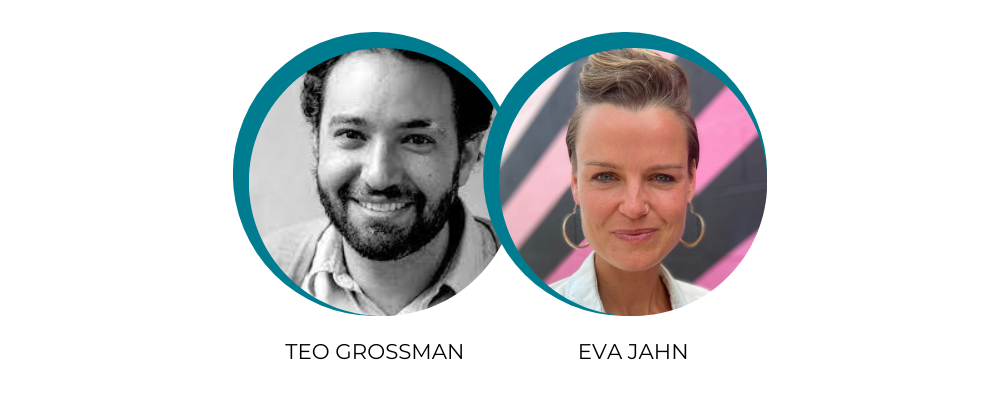
Climate psychology is an emerging field at the nexus of human psychology and the environmental crisis. It seeks to help us understand the psychological barriers that depress our energy and hinder our positive action in society. Trauma psychotherapist Eva Jahn began exploring this field after noticing emotional gaps in climate activism and the pain Earth’s turmoil was inflicting most intensely on the most marginalized communities. In dialogue with Bioneers President Teo Grossman, Eva explores the psychological challenges raised by the climate crisis, highlighting coping strategies that permit us to maintain emotional well-being while still working effectively to improve the world.
Choosing Hope: Reshaping Our Relationship with the Planet
How do we navigate the profound emotional trauma triggered by the environmental emergency and political paralysis in order to move beyond despair and cultivate resilience and hope so we can continue to work effectively to solve our collective problems?
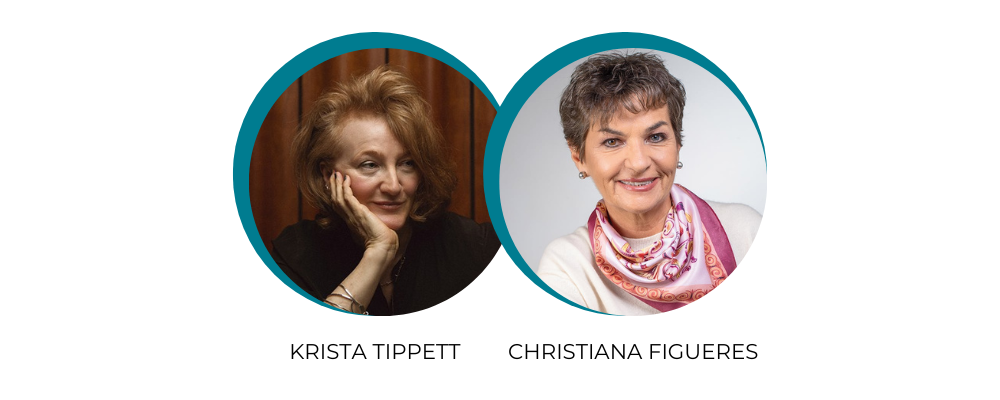
Krista Tippett, a Peabody Award-winning broadcaster, National Humanities medalist and New York Times bestselling author, hosts On Being, a podcast that explores what it means to be human (and will be in conversation at the 2024 Bioneers Conference). Read an excerpt from the episode “Ecological Hope, and Spiritual Evolution,” in which Tippet discusses finding hope and turning it into action with Christiana Figueres, who was Executive Secretary of the United Nations Framework Convention on Climate Change from 2010-2016.
It is more important now than ever that we connect and scale brilliant social movements to enact the kinds of breakthrough solutions we’ve cultivated at Bioneers for decades. We have an abundance of these solutions related to the biosphere, equity, justice, and democracy already on the table or in play. To enact them, we need peak movements. We need you.
We invite you to connect with the Bioneers community of leadership in this time when we’re all called upon to be leaders. The best way to predict the future is to create it.
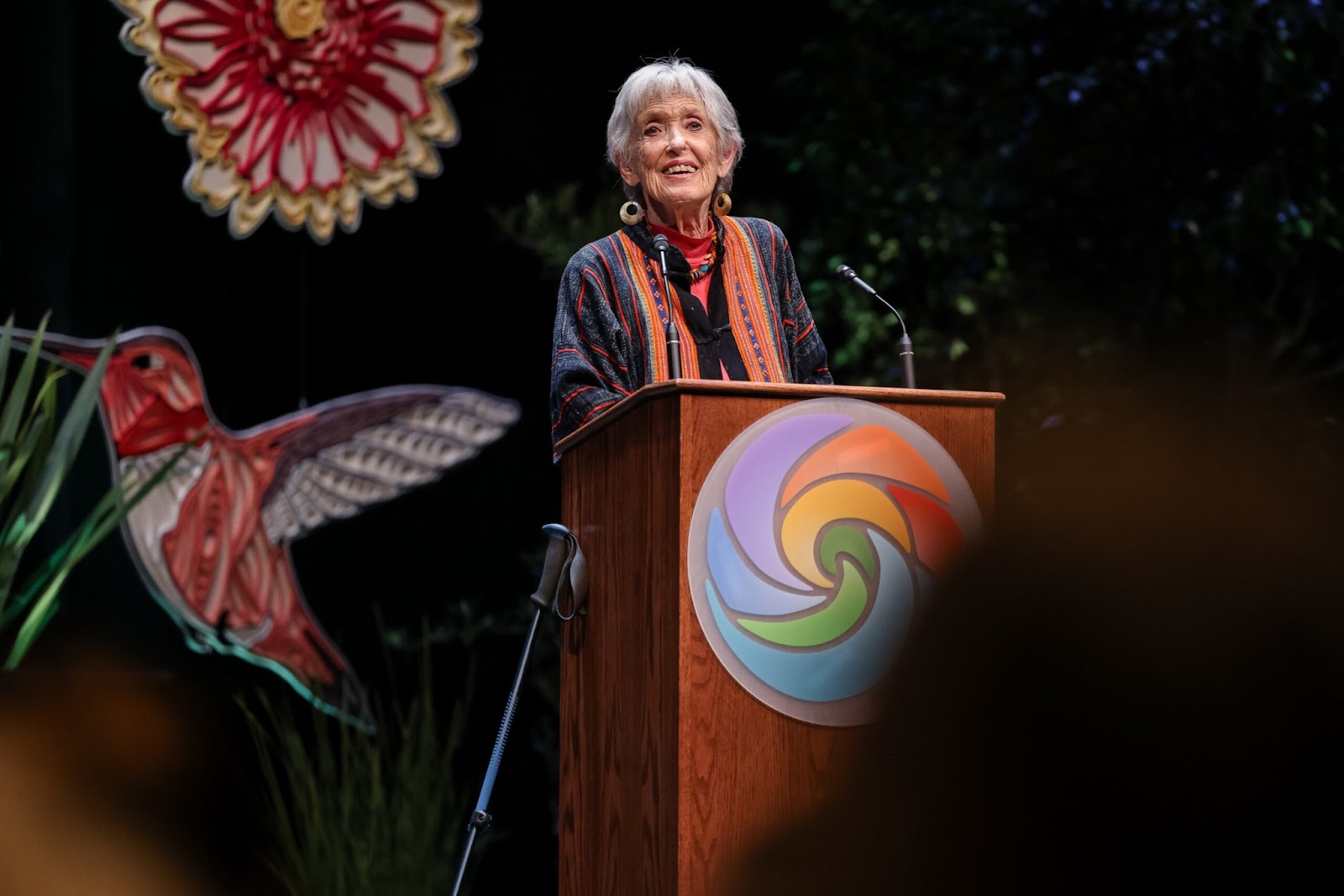
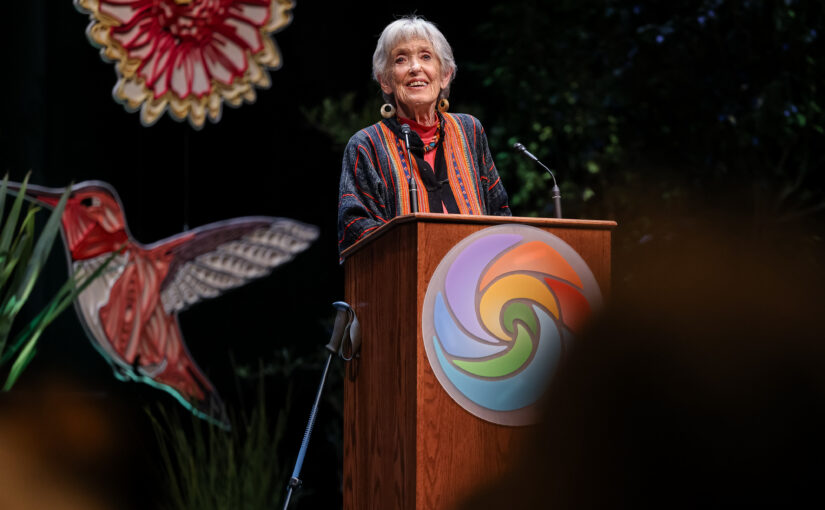
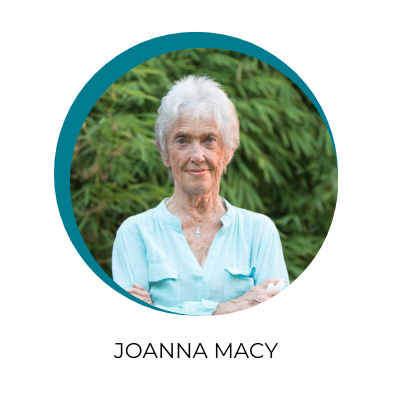
Our existence is intrinsically linked to the vibrant pulse of the Earth, says the beloved and highly influential author and activist Joanna Macy. With unwavering conviction, Macy invites us to acknowledge our profound connection to the planet we call home. Her impassioned words echo the undeniable reality that every atom of our being and every breath we take are intertwined with the living fabric of Earth itself.
Read an edited excerpt from the transcript of Joanna Macy’s 2023 Bioneers keynote address.
Upcoming Bioneers Learning Courses & Community Conversations
Through engaging courses and conversations led by some of the world’s foremost movement leaders, Bioneers Learning and Community Conversations equip engaged citizens and professionals like you with the knowledge, tools, resources, and networks to initiate or deepen your engagement, leading to real change in your life and community.
The Four Sacred Gifts: Indigenous Wisdom for Modern Times | Self-Paced | Discover how the Four Sacred Gifts of forgiving the unforgivable, unity, healing, and hope in action provide us with a path to our most grounded, loving, healed, and generous selves.
Regenerative Agriculture: Nourishing the Soil, Healing the Planet | Self-Paced | Be enlightened on the practical applications and impressive potential that regenerative agriculture has to revive healthy landscapes; contribute to human and animal health; create an equitable food system; and help heal the climate.
Climate psychology, a burgeoning field born from the intersection of human psychology and our changing environment, has seen recent growth driven by heightened climate awareness and a need to understand the psychological barriers hindering action. Eva Jahn, a seasoned trauma psychotherapist, joined this field after witnessing emotional voids in climate activism and the resonance between Earth’s violence and violence against marginalized bodies. Co-founding initiatives like the Climate Emotional Resilience Institute, she supports clients navigating climate distress, as well as the public through trainings and forums, empowering individuals and communities.
In a dialogue with Bioneers President Teo Grossman, Eva delves into the psychological complexities individuals face amidst climate crises. She addresses the parental challenge of balancing climate awareness and hopeful action for children. Her vision sees climate psychology fostering shifts in consciousness, resilience, and collective action toward a more harmonious relationship with our planet.
Teo Grossman: Climate psychology is a fairly nascent field, emerging as a part of the profession alongside our increasing intellectual awareness and physical experience of a changing climate. Would you be able to give a little more background on the emergence of this field of study and treatment?
Eva Jahn: Yes, of course. I would say that the field may have had its origin with psychoanalyst Harold Searles, who wrote in 1960 about the significant role of the “non-human environment,” as he called it, in the psychological life of humans and the implications of their disconnection with nature. He also introduced the psychoanalytic idea that some may ignore environmental degradation to keep their own idealized childhood intact and that others with less ideal childhoods may have less investment in preserving that early fantasy or believing that they can disconnect from the more-than-human world. As much as some analytically trained psychotherapists may take that idea into account in their current work with climate distress, the field really aims not to pathologize any of the feelings that arise. I mean, how can we pathologize a normal, healthy response to an actual threat? Shouldn’t we be expected to grieve, to experience fear, to be angry when part of the world that we love is dying?
Ecopsychology is another influence that started the dialogue between Psychology and Ecology around the early 1990’s with Theodore Roszak’s book The Voice Of The Earth and comes from the premise that each one of us comes from the Earth and is part of the Earth. But of course, none of these are original thoughts as Indigenous peoples have embodied and lived from and in that place of connection with the more-than-human world throughout time.
But climate psychology as a field really emerged only recently with the growing acceptance of climate change and an interest in studying psychological processes that may interfere with people taking action. Many analytically-minded people, such as Donna Orange, Elizabeth Allured, and Sally Weintrobe, are leading the way and helping us understand the dynamics around dissociation, narcissism, denial, and how our resistance towards knowing plays a big role in it. How is it that we can see and care about what is happening in this world as well as not see and not care at the same time?
Climate Psychology is now considered more as an umbrella discipline including a range of many subfields such as disaster work, social justice, clinical work that includes group and individual treatment, peer support, clinical research, acute disaster and frontline responses, supporting the climate movement and really anyone on the frontline through emotional resilience trainings, writing curriculum to support schools and universities, and so on. We have climate psychologists who are working with national and local governments and NGOs as well as the United Nations and corporations in addition to the clinical work with individuals or small groups.
TG: How did you come to this work?
EJ: As a psychotherapist specializing in trauma, I have worked in the field of gender-based violence, including sexual assault and domestic violence, for a long time. As faculty for the International Center for Mental Health & Human Rights, I was co-facilitating trauma and resiliency groups for communities on the frontline of war. My partner works in climate activism, and we have spent much time in that world together. I have witnessed many friends needing to take a step back from climate work because of burnout. I think a combination of watching the lack of emotional support in the movement, my own complex feelings towards this crisis, and the direct correlation between enacted violence on female bodies and the earth really sparked a passion to intentionally bring this work more into my practice as well as wider spaces.
As my psychotherapy clients began increasingly talking about climate anxiety, existential dread, and a fear of bringing children into this world or feeling alone in their experience with climate distress, my colleague Elizabeth Driscoll from the International Center and I started to offer online climate emotional resilience groups and trainings to support the navigation of all these complex feelings of climate distress and create community support. I became an active member of our mother ship, as I like to call it, the Climate Psychology Alliance, and received a climate psychology certificate from CIIS. I then later co-founded CERI, the Climate Emotional Resilience Institute, to meet the growing requests for training, workshops, and talks around the intersection of mental health and climate change and to create a small collaborative community of professionals to support activists, medical providers, educators, researchers, public servants and others confronting climate change in their work and beyond with emotional resilience so they can continue to go out and do the work.
TG: I understand you’ve worked with a wide range of individuals and even institutions and organizations, from scientists to government agencies to front-line activists. Can you share the range of concerns folks have and the approach that climate psychology brings to these situations?
EJ: I think one way to answer this question is to bring in Finnish climate psychologist Panu Pihkala’s work talking about the psychological awakening process to crisis. As we are moving from unknowing to semi-consciousness to awakening to shock, humans, whose brains are not very well set up to deal with uncertainty in the first place, may experience complex feelings and try to cope with those feelings, including trying to make them go away again. So one way to cope might be jumping into action – full speed. We may grieve and retreat from the world for a while. We may get angry, fearful, and rageful. Experience existential dread or disenfranchised grief. Feel guilt or shame. We may want to distance ourselves from the knowing, even fall back into the comfort of denial for a while to avoid that new created consciousness.
Panu says that distancing ourselves from the climate crisis is actually a crucial part of coexisting with it. Not dissociation, which is a mostly unconscious coping strategy where the individual is not in control. Distancing is a choice that you can make at times to create space for yourself. Susi Moser calls it “functional denial” – those necessary breaks from grieving, from action. To take a breath. To allow yourself to retreat. To not absorb every climate change news article that comes your way, but to recharge. We are in this for the long haul, so we need to make this work sustainable.
One thing that I see over and over, especially with the climate activists and scientists I work with, is burnout. Slowing down and taking a moment for oneself to rest and recover feels almost impossible when we breathe in the urgency of this crisis all the time. Climate psychologist Caroline Hickman introduced the terms internal and external activism. Too much external activism creates burnout, and too much internal activism may lead you to retreat from the important work in the world. So we need to find a balance between the two. We need to titrate. To be able to move back and forth between taking in difficult information and suffering and calming ourselves. And the way we do that is we listen. We lean in and pay attention to our nervous system: It will tell you when something starts to be too much. Deciding between the need to continue or the need to retreat is often tricky, as both are needed.
TG: You and I are both parents of small children. One of the challenges I face, both as a professional engaged in climate-related work and as a person living on the planet at this moment in time, is how to support my children to be informed without becoming overwhelmed and despondent. I know one of the leaders in this field, Leslie Davenport(who will also be joining us at Bioneers this year), has written an entire book on this subject. I realize this is an enormous question, and it’s different family by family and child by child, but I’m interested in the parental struggle to balance information and hope, criticism and action.
EJ: That’s a great question and such a personal one too. And yes, Leslie can speak to it in so much more detail. I think with any parenting approach, we start with ourselves first. Asking: ‘How do I, as a parent, feel when I read disturbing news about the extinction of animals? Do I allow my grief to arise, or do I try to push it down? Does it make me anxious to even think about approaching this topic with my child? What other barriers do I identify within myself that may prevent me from talking to my child about the crisis?’ Maybe if I let myself get close to imagining my children’s pain, it’s almost too unbearable to tolerate. I may worry that I could exacerbate my child’s feelings if I bring it up.
The truth is that we protect our children by talking to them about the scary stuff and making an effort to hear them out and understand it from their perspective. Daniel Siegel, who has written many books on parenting, says that acknowledging and naming our feelings helps us make them less scary. We name them to tame them. But as parents, we have to be ready to receive our child’s feelings with a regulated nervous system. When both sides are dysregulated, it’s very hard to find connections, and it may send the message to your child that this can’t be talked about.
Once you have a regulated connection with each other, you can introduce climate change through children’s books and leave plenty of space for questions. You can ask them if they have heard about it before. Dreamt about it. Maybe in their school. You can share that it sometimes feels scary to you too. And then you can look at ways together on how to take better care of the Earth. You can choose a particular issue together that you both feel passionate about.
Depending on your child’s age, you can study it together, read books, and then make space for feelings to arise and listen actively and openly when your child approaches you with concerns. And then link an action to that issue. I personally have taken my child to many demonstrations and rallies, and we create protest art for it. Or you could create little pamphlets and help your child to talk to your neighbors about it. The list is endless. Just follow your child’s interests. One thing I want to say about hope, which in itself can be its own question, is that the type of hope we are looking to pass on to our children and need for ourselves is not what Lauren Berlant may call cruel optimism. The one that lets us off the hook by luring us into a false sense of comfort that everything will turn out ok in the end. Instead we are looking for a hope that is grounded and engaged. Where we are not convinced the future is going to be great at all, but we are still going to apply ourselves toward the best outcome we can get. It’s engaging because we are writing ourselves and our children into the story as an active participant.
TG: What are you excited by as this field continues to grow? What brings you hope?
EJ: Joanna Macy talks about the three dimensions necessary to create the change we need.
1. Holding Actions
2. Structural Change
3. Shift in Consciousness
As it stands right now, I believe that the field of climate psychology can and should show up in all of these dimensions, but especially to provide a necessary foundation for that third dimension. To stand in collaborative communion next to all the other traditions and values, new and ancient, that have been shared over so many generations: in songs, and prayers, and demonstrator’s signs and banners. In the climate emotional resilience groups and workshops I run, I have witnessed so much beauty, compassion, and connection when people come together and share and allow themselves to be vulnerable. People feel less alone in their fight against climate change as it can feel a lonely road for many at times.
Lin Yutang says: “Hope is like a road in the country, there was never a road, but when many people walk on it, the road comes into existence.” I think that gives me hope. Movements give me hope. My family gives me hope. My engaged community. Witnessing the resilience of our Earth gives me hope. Seeing people excited, engaged, creative, and passionate about climate change gives me hope. Hope, as so many of these complex feelings such as fear, compassion, outrage can all be a means to an end. They all motivate and can move us towards imagining and creating the future we want to see. Joanna Macy talks about the Great Turning. The story of the emergence of new and creative human responses that are going to enable a transition to a life-sustaining society where we join together to act for the sake of life on earth. And even though I go through phases of despair and anger at outrageous human behavior and may lose faith at times in our capacity to create change on a global level, this story provides a refuge for me. And then I choose to turn towards seeing beauty again, as we all are surrounded by it all the time. And that is the backpocket radical hope I try to stay in relationship with.
Our existence is intrinsically linked to the vibrant pulse of the Earth, says author and activist Joanna Macy. With an unwavering conviction, Macy invites us to acknowledge our profound connection to the planet we call home. Her impassioned words echo the undeniable reality that every atom of our being, every breath we take, is intertwined with the living fabric of Earth itself.
Following is an edited excerpt from the transcript of Joanna Macy’s 2023 Bioneers keynote address.
When I think of what makes me tick, I think about the fact that our Earth is alive. And we know it.
Everything in my body and yours is made of this Earth. And I can tell you with some authority that you didn’t come from anywhere else.
You can speak for Earth right now. I know a lot of places where you need to talk about it. We’ve got everything we need and everything our bodies need out of this Earth, and it’s alive.
We don’t need to make a profit from the Earth. Could it be possible that with the supreme danger of climate catastrophe facing us, we could outgrow capitalism? We can’t save our Earth without shaking off capitalism. Every day of your life from this moment on can be another way of learning that and celebrating coming back to life.
When you take stock, we’ve been doing some pretty crazy things as a species. We think we’re so fine; we’re standing on our hind legs and have these mouths and opposable thumbs. But look what we’ve done.
So I’m going to suggest what you can do to save the world. The way for you to have a happy life and keep the planet intact is to be glad you’re alive.
Imagine being alive, made of everything from this particular planet; to have this thermostat, totally appropriate to what you want to feel. Being alive with a heart, with eyes that can see, with lungs that can breathe. It’s incredible, the way we’re put together, with legs that can walk, hands that can shake, eyes that can learn to read.
How do we navigate the profound emotional landscape triggered by environmental degradation, move beyond despair, and cultivate resilience and hope to mobilize meaningful action in the face of an urgent need for ecological transformation?
Krista Tippett is a Peabody Award-winning broadcaster, a National Humanities Medalist, and a New York Times bestselling author. She hosts On Being, a podcast that explores what it means to be human.
In the episode “Ecological Hope, and Spiritual Evolution,” Tippet discusses finding hope and turning it into action with Christiana Figueres, who was Executive Secretary of the United Nations Framework Convention on Climate Change from 2010-2016, and is known as the powerhouse who made the 2015 Paris Agreement possible.
Following is an excerpt from the transcript of that conversation.
Krista Tippett: In the world in which I was born, and maybe you, too, the weather was the stuff of small talk. The seasons of the year were the underlay of planting and harvesting food that nourishes and fuels our bodies, of course. But seasons have also been the very mundane, predictable rhythm of our days and our lives. Now, the loss of seasons as we knew them, the loss of storms as we knew to navigate them, is an experience we are all sharing in all the places we inhabit and love. This is closer to home than every fight we have about climate and the science around it, the meaning of it. We feel this in our bodies, the young among us most keenly. It leads some of us to those fights and some of us to retreat within, overwhelmed.
My guest today is the exuberant and mighty Costa Rican diplomat Christiana Figueres. She has, as much as anyone alive on the planet right now, has felt that overwhelm and stepped into service. She is a most eloquent articulater — both of the grief that we feel and must allow to bind us to each other, and what she sees as a spiritual evolution the natural world is calling us to. If you have wondered how to keep hope alive amidst a thousand reasons to despair; if you are ready to take your despair as fuel — intrigued by the idea of stepping into love as a way to stepping into service, and open to immediate realities of abundance and regeneration — this conversation is for you.
I’m Krista Tippett, and this is On Being.
Christiana Figueres was Executive Secretary of the United Nations Framework Convention on Climate Change from 2010 to 2016 and is known as the powerhouse who made the 2015 Paris Agreement possible, in which 195 nations worked with their wildly diverse conditions and points of view on the what and the when and the why and yet made commitments in service of our hurting planet and the future of humanity. She spoke to me from her home in Costa Rica.
…
Tippett: I want to talk about the new generations, because this is also something very much on your heart, and you’re in a relationship and a dialogue with this very understandable despair and grief that I think younger people really feel in their bodies, more consciously perhaps, than older people.
But one of the moves I see them making is claiming joy. And claiming an abundance of relationship, and community, where it is to be found. And insisting on knowing what they love, and on being attentive to beauty wherever it is to be found. Also — and I want to use this word — as “fuel” for the hard, hard work that is ours to do.
Figueres: Yes. So true, so true. That intentional cultivating of a mind of love and joy is so critical to our personal resilience, to our personal regeneration, to our personal agency, to our capacity to engage. It’s just a sine qua non. Without it, there is no capacity to engage in a positive manner, in a constructive manner, in a transformational manner with anything outside ourselves. It just isn’t.
And so the more young and not-so-young people realize that yes, we are at a very deeply painful moment in the history of this planet and of human evolution, and that we can either succumb to that, or we can use that, as you say, as fuel. We can use that to intentionally decide that we’re going to stand up. Using the depth of the pain to root us so that we’re not swayed by the wind. Use it to root us in our determination to do everything for a better world, not just for us, but for generations to come, Krista.
And that’s the piece that I don’t think that we have very clear yet. Whatever we’re doing over the next seven years, and this is no Latin American exaggeration, whatever we do over the next seven years is really going to determine the quality of life on this planet for generations to come. Hence the alarm clock.
This is an alarm clock. It’s an alarm clock about speed and scale, but it’s also an alarm clock about quality of mind — as you say, cultivating the mind of love and joy.
Tippett: And that our love for this planet, and for the beauty that’s around us, and the places we come from — that that is as much a motivator as what we have to fight.
I watched you at an event at TED in Scotland. And I wish we could spend about an hour talking about that, and we can’t. But it was very moving. You ended up very expertly leading a panel on which there was the CEO of Shell Oil. And then a young woman who was carrying her pain and letting that pain into the room and also expressing her difficulty at being on a panel with the CEO of Shell and…
Figueres: Her anger, is what I would say.
Tippett: …her anger, and her intolerance of, that we are at this point. And with the participation of powerful, powerful places. And I will say, also, that I could see this CEO really being present and thinking and wanting to be responsive.
But what I watched you do — and I’m driving to this because I think you can do this also for everybody who’s going to be listening to this across time and space, and I felt like you, yourself, had been on this trajectory of understanding that this was something you needed to invoke — is just inviting everyone on that panel and everyone in that room to stand before the loss and the grief, and let that pain itself be some of the connective tissue across these differences. If nothing else, that we share.
Figueres: Exactly, exactly. So just for correctness, it’s the former CEO of Shell, because he is no longer CEO. But the case still stands. The more radical conversation, if you will, was the one between, as you say, the former Shell CEO and the young activist, who spoke and acted out of deep pain, anger, blaming, all of which is completely justified.
And then, all of a sudden, almost literally threw herself off the stage onto the shoulders of her colleagues that were waiting for her. It was quite a dramatic moment. It was quite a traumatic moment. Because there we were, with the pain and the trauma of years right on stage in front of us.
And what I did not want to occur was for the audience to divide itself up in, “Which of these two points of view am I going to support? Am I going to support the Shell CEO, because we have a whole bunch of corporates in the room who think that X, Y, Z? Or am I going to support the very eloquent climate activists because Shell has to be blamed and shamed?”
So what I did not want is for the audience to fall into that simplistic division between what all of us think is what is right and what is wrong. And I wanted to keep everyone in their own pain. Because we all have the pain. Every single one of us, no matter what, we have this pain because we are aware of the loss that we are witnessing. So I did call for everyone to take a moment, breathe, and get into the pain. And avoid the immediate blame and shame. Because that is where we would’ve gone very quickly.
Now fast-forward, Krista. How moving was it for me that just a few weeks ago, we held a retreat in Plum Village in France for climate activists and climate leaders who seek to find better ways to manage their emotions, and to be grounded in their emotions so that they can act from a deeper sense without having to just react, right?
So get away from the fight, flight, freeze, to much more of a grounded, clean action. How moving for me was it, that that very climate activist who threw herself off of stage came to that retreat with most of those young people who were waiting for her there, and held her, and then they marched out? Most of them came to this retreat. How moving was that for me?
And the fact that after six days of really intensive study of the Dharma teachings, but more than anything, intensive digging into self and into the pain, and learning how to turn the pain into strength, how moving was it for me that these young people emerged transformed — recommitted to continue to working on climate change from a space of possibility, and love, and joy? Honestly, long time since I have felt so much gratitude for the power of these teachings.
Tippett: I sense that — so there’s that. And also, I hear you saying in your writing and in your speaking: Do not give up on people. Do not give up on — this language, even, of climate denier. That’s a label, and that’s a drama in our midst. But to me it’s just another side of, again, we all feel the disarray and the disrepair of our natural world, of which we are part, in our bodies. And whether that’s at the level of awareness or not, we’ve had different ways of responding to that same fear. And you say: Don’t give up on climate deniers. Again, I hate the label. I feel like the people you’re really impatient with are people who are making a choice to be indifferent.
Figueres: Indifferent. Yes. So true. That’s the piece that I really — ooh — I really have to extend my compassion to an extent that — I’m not quite there yet — to people who are indifferent. How can you be indifferent? How can you be indifferent to everything that we’re witnessing today? That’s the piece that I have — Yes, you have identified very well. I have a very hard time.
Tippett: Well, and this can be subtle as well. Because it can be — and I am going to say I fall into this, too — is it can be, “Well, it’s just all over anyway.” Just, there’s news as we’re speaking, and this same news will recur that the ice melting in the Antarctic is much, it’s happening at a much more rapid pace than was once thought. And so what we’re calling indifference can just be a resignation, which feels itself to care, but can’t care anymore. So it’s complex. It’s as complex as we are.
Figueres: Well, is it? Is it? We just talked a little while ago about self-fulfilling prophecies. So if we say it’s all over anyway, and we really stand in that “reality,” then we actually will create that reality. Then it will be over anyway. And that’s the choice. That’s the piece, Krista. This is a choice. It’s a choice of attitude. It’s a choice of mindset. It’s a choice of thought. It’s a choice of words and narratives and actions. It’s a choice. It’s a daily choice. So yes, of course the easy thing is to go, “Well, it’s too late anyway. Bye.” Hello? Really? Is that the way? For those people who take that, I just wonder, how are they going to answer their grandchildren’s questions, “What did you do?” All our grandchildren will be asking us, “What did you do?” And everyone is going to have to answer that question, “What did you do?” Because nobody can say, “I didn’t know.” Nobody can say that anymore.
Tippett: Not anymore.
Figueres: My parents could say that. But my generation cannot say that anymore. So the question that we have to get ready for, and that is already being asked by many young people to their parents is, “What did you do?”
Tippett: You said at one point that it is the nature of evolution, that is the nature of this world, the way it works, that creatures are constantly adapting, that the environment is constantly evolving, that we as well as other creatures are constantly adapting to the environment. And that is the nature of vitality and the conditions of our time. You use this language of “exponential curves.” Our world is on so many exponential curves. The natural world is on so many exponential curves. As you say also, the possibilities for very new realities are also on exponential curves. But that’s ongoing. It’s not realized. It’s not visible. It’s not the dominant story yet.
Figueres: Correct.
Tippett: And it is hard. It is hard for us as creatures to live with this kind of uncertainty. It’s very challenging at a physiological as well as a spiritual level. But I don’t know. I guess I’m kind of ending up circling back to where we started. In your book The Future We Choose, you have 10, are they actions?
Figueres: Yeah.
Tippett: And the first one is still, it’s a thought action. It is, “Let Go of the Old World,” which sounds so massive. But I think — I want you to talk about how that is a beginning, and how that can be a beginning, a step, a step, an action in and of itself.
Figueres: Yeah. “Let Go of the Old World” is actually, now that I think about it a little bit more, it’s almost like a funny invitation, because the old world is gone anyway. And so what’s the point of hanging on to something that has already gone by?
Tippett: But that’s what we do. That’s what we do.
Figueres: But that’s what we do. I know, but we have to laugh at ourselves that we do that, Krista, because it makes absolutely no sense. It makes no sense. And when we understand that everything is in constant change, when we understand that we have — if there is anything that is certain, it’s uncertainty. If there’s anything that is permanent, it is the reality of impermanence. Everything in our lives.
Tippett: But we structure our lives to be in denial and to push that back.
Figueres: I know. Yes.
Tippett: We feel like that’s our power.
Figueres: I know. How funny is that? You have to see that with a sense of humor. The fact that we know that everything is in constant change. You and I are not the same people when we started this conversation. I certainly am not the same person as yesterday, et cetera, et cetera, et cetera. Our relationships change. Everything changes all the time. The world is changing all the time.
And so we’re in constant flux and constant uncertainty. The past has passed. We can’t do anything about it. The future, we cannot really guarantee. We can try to influence it for the best and for good, but we can’t really control it. So I think there’s a heavy dose of humility here to understand that the past is gone, the future is uncontrollable, we don’t know where things will go. We have to be able to develop that muscle. It’s the muscular capacity to understand that we are in constant sway, in constant uncertainty, and have the humility to truly, deeply, deeply know. We don’t know how it will go. We have all kinds of scientific projections and predictions, and that’s science. But let’s not confuse the map with the territory. That’s the map. We don’t really know what the territory is. We don’t know how — for sure, for certain, we don’t know how it will go, because for one thing, it’ll depend a lot on what we do.
But in the meantime, the question that is most important for me is: How do I want to be in the meantime? How do I want to turn up in the world in the meantime? During the time that I’m here, which is a blink in the history of 4.5 billion years of this planet. We are here as a blink. What kind of a blink do we want to be? Who do I want to be? How do I want to turn up in the world? The answer to that question does not guarantee any success or any achievement, but it does influence the direction that we move in.
Biomimicry, the art and science of emulating nature’s time-tested designs and processes, holds the promise of a sustainable future where human inventions harmonize with the natural world’s delicate balance. It’s a field that not only sparks curiosity but also ignites a sense of responsibility, urging us to understand, appreciate, and integrate the wisdom of our fellow species into our own creations. Biomimicry has been a core principle of Bioneers for decades, with dozens of talks and several collaborative projects developed to further the concept and discipline.
At the forefront of this endeavor is AskNature, a groundbreaking platform from the Biomimicry Institute. AskNature houses a wealth of information meticulously curated to illuminate the intricate workings of organisms alongside information about existing and potential human innovations based on this knowledge.
As chief editor of AskNature, Andrew Howley is a passionate advocate for bridging the gap between nature’s wonders and human ingenuity. Bioneers spoke to Howley about AskNature’s evolution, exploring how it has grown into a vibrant hub where scientific inquiry, creative expression, and ecological wisdom converge.
Bioneers: Let’s start at the beginning. Tell us about the history of AskNature.
Andrew Howley: AskNature was created by the Biomimicry Institute in 2007 with the vision of creating a platform where people could access information about how organisms function and innovations they inspired. The goal was to present this information in an accessible way, using terminology relevant to those seeking to apply nature’s principles in human innovations, designs, or systems. A dedicated team curated content from dozens of scientific journals as well as popular science books from figures such as David Attenborough. Over the years, the platform has expanded significantly, growing to more than 2,000 pages.
Around 2020, AskNature underwent a major transformation, both visually and in terms of content style. The team decided to move beyond excerpts from papers and books, aiming for thoughtful, original pieces designed specifically for the biomimicry audience. Professional science writers were brought in to craft and refine these pieces, updating existing ones and creating new content. The focus remained on ensuring relevance and accessibility for all readers.
Now, with the abilities of AI and large language models, we’re training these tools to be able to translate relevant information from any scientific paper into an accessible AskNature format. That will empower our writers and editors to provide an even greater amount of knowledge about how organisms function, accessible to anyone interested in learning from them how to better design our world.
Bioneers: Is there a specific intended audience for that information?
Howley: Physical designers represent a specific and impactful audience, as they can directly apply biomimicry principles to create cleaner, more sustainable products that millions of people then use, but the scope of biomimicry extends far beyond just this group.
Biomimicry is essentially a unique perspective, altering how we perceive the world and our interactions with it. It encompasses not only observing the natural world but also understanding our place within it and the role we can play as part of the larger natural ecosystem. In this broader context, AskNature becomes relevant to everyone.
Regardless of the specific area in which they wish to apply these principles, be it design, technology, or any other field, the goal is to empower individuals to easily access relevant information, comprehend it, and apply it effectively.
Bioneers: Why does AskNature believe that nature is the best teacher?
Howley: Biomimicry, at its core, is about learning from the way nature works. And nature works in a lot of different ways that can be relevant for all kinds of intentions. The essence of the biomimicry movement lies in fostering a harmonious relationship between human activity and the natural world. Disharmony in this relationship leads to conflicts and suffering for both people and nature, evident on both small and large scales. The best way for humans to learn how to be in harmony with the rest of nature is to see how the rest of nature works in harmony with itself.
It’s important to recognize that humans are a part of nature too. That teaches us humility, but it’s also super exhilarating. Nature has done amazing things over 3.8 billion years of evolution — including making humans. We’re part of this. Not by accident and not begrudgingly. Nature made us, and it made us who we are. We’re curious, we’re adventurous, and we’re industrious. All of these things are what nature has created in us as a species. It’s not inherently good or bad. It’s all about how we use it. And if we integrate our being well with the rest of nature, we can not only fit in but also be a really positive aspect of it.
Consider the transformative impact of beavers on ecosystems — they enhance diversity and resilience, allowing more species to thrive. Similarly, humans have the potential to positively influence their surroundings, as evidenced by Indigenous communities’ historical practices. Examples include small-scale fire management, which prevented large-scale destructive fires, and intentional cultivation in the Amazon, shaping the region’s diverse plant life. When we use what nature has given us well, we can be a really positive force for life on this planet.
Bioneers: What are some of your favorite or most fascinating innovations or designs that are based on biomimicry?
Howley: What’s amazing is that every year there are new examples. One of the projects of the Biomimicry Institute is the Ray of Hope Prize, sponsored by the Ray C. Anderson Foundation. That initiative brings in hundreds of applications from entrepreneurs and innovators around the world demonstrating their biomimetic efforts and their new innovations and approaches. [Editor’s note: the first Ray of Hope Prize launched on the main stage of the 2016 Bioneers Conference.]
One that I particularly love is the use of structural color. Pigments are how we generally think of adding color — a molecule that reflects a certain bandwidth of light. But these are friable, and they wear out. Often, they’re toxic. But throughout nature, there’s something called structural color. At the nanoscale texturing of the material, lightwave scale nooks and crannies that direct the light in certain ways produce the appearance of color. Not only can these structures and textures produce individual colors, they can also create really cool effects.
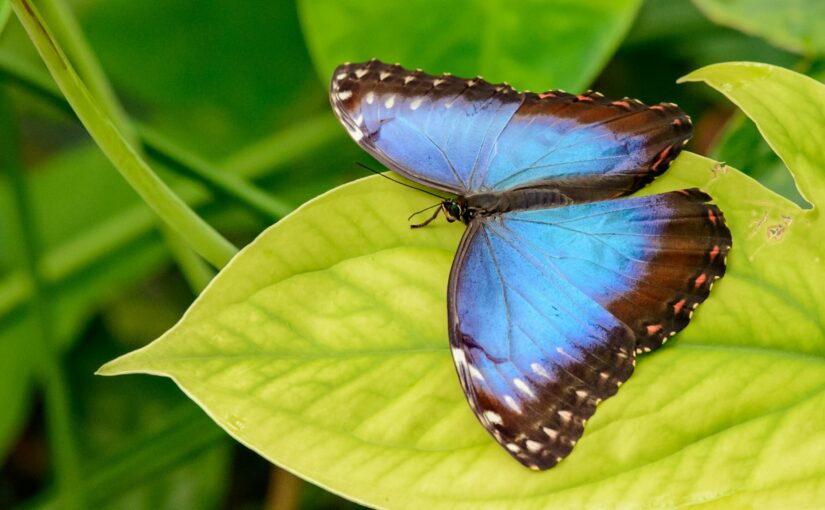
Where we’re often most familiar with structural color in nature is the shimmery, changing colors of a pigeon’s neck feathers. Or the really bright blue of the Blue Morpho butterfly. Cypris Materials has adapted structural color into paints that, instead of using toxic pigments that will eventually fade, contain permanently fixed light transmitters that produce color in a much more sustainable and adaptable way.
Another example is concrete. The process of making concrete is one of the most carbon-intensive industries. But in nature or with other organisms, cement production is actually carbon sequestering. Coral reefs are an example: Tiny animals that take in carbon dioxide or carbon from the water and fix it into the substrate of their cement that creates the coral reef, locking in the carbon. ECOncrete uses an admix and texturing to attract and support organisms that in turn add new natural concretions, protecting and strengthening the human-made structure.
Bioneers: AskNature provides an index of a lot of natural adaptations or strategies that present the potential for biomimicry. Is there one that comes to mind that you find particularly fascinating or promising?
Howley: All of them. Everything is out there, and everything can happen. While it’s wonderful to see the innovations that are already out there and the technologies that are being applied, the thing that most excites me is that AskNature has 300 innovation pages and 1,700 strategy pages. So there are a lot more innovations that can come. There is a sense of endless possibility. New strategies are coming out every day, and people are really working on this.
Bioneers: What’s next for AskNature?
Howley: Next is scale. Since it launched, AskNature has built up about 2,000 pages. That’s an amazing amount of information and also nowhere near all the information in the world. As I mentioned, we’re training an AI model to be able to more automatically create drafts of AskNature content from new research. As things are discovered and published, they could be added to the site rapidly in almost real-time, which would make so much more information available. That entails going wider with the sources that we’ve been using, but we also want to expand our sources.
So far, we have been using only published research in English from peer-reviewed science publications, which is great but only a subset of human knowledge. We know that there’s a lot of knowledge of organisms that is held in local communities throughout the world, in varying ecosystems. These understandings haven’t been analyzed the same way or published or publicized. We would love for AskNature to become a platform where Indigenous communities who want to share their knowledge about the workings of our fellow species can do so in a way that is going to reach people and help provide guidance for humans as we try to navigate our place within nature in a more harmonious way.
Bioneers: Do you know yet what that platform would look like?
Howley: Broadly, we imagine it as a way to further extend AskNature. The way that we would work with different communities would be totally responsive to their needs and interests because that’s one of the most important things in building up relationships between the international scientific community and Indigenous communities. There’s a lot of misuse of people and their property and their identity. There’s a lot of repair work that needs to be done there and a lot of sensitivity and humility that needs to be had, recognizing that just because you’re a well-intentioned scientific organization doesn’t mean you’re inherently going to end up doing good. You have to really be responsive. So we’re at the stage of reaching out to individuals and communities, inviting them into the process, and finding the forms of expression and engagement that would be helpful for them within the context of the whole global effort to build more sustainable human engagement.
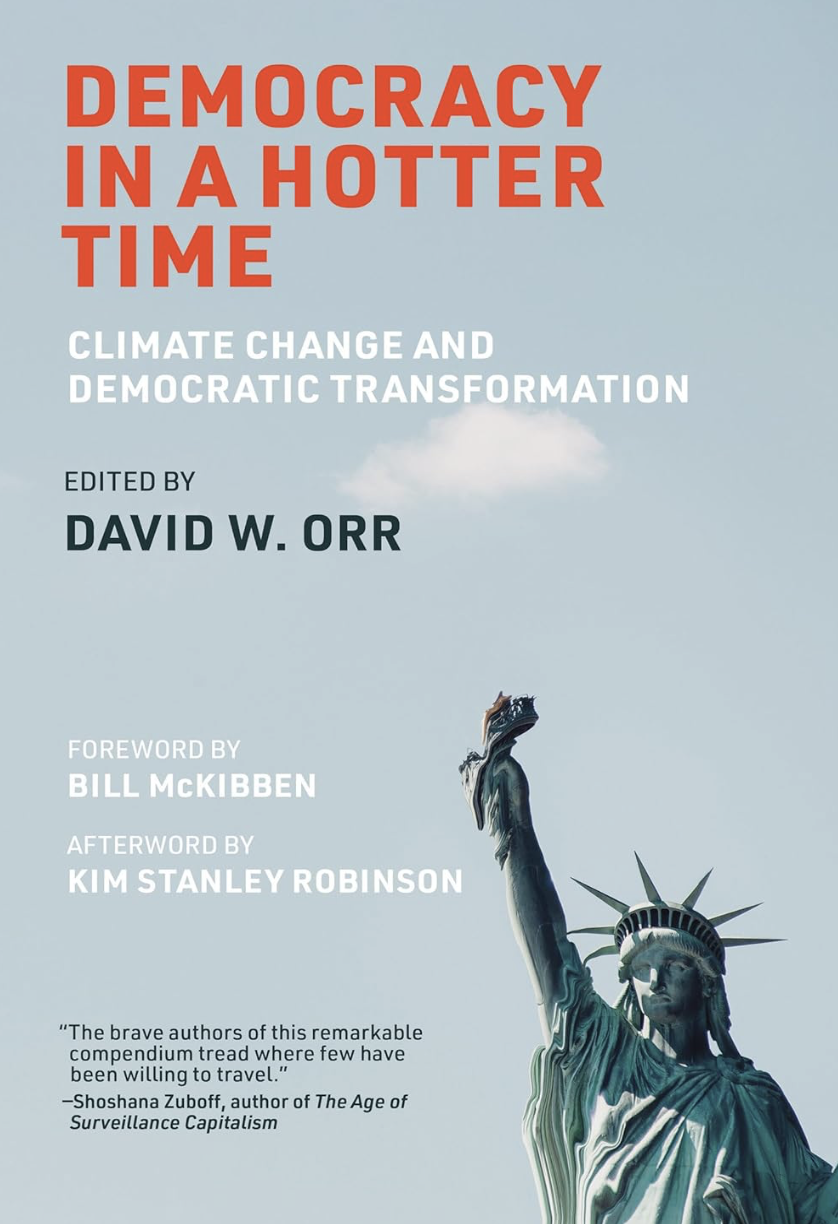
Democracy in a Hotter Time calls for reforming democratic institutions as a prerequisite for avoiding climate chaos and adapting governance to how Earth works as a physical system. To survive in the “long emergency” ahead, we must reform and strengthen democratic institutions, making them assets rather than liabilities. Edited by David Orr and rated one of Nature’s “best science picks,” this vital collection of essays proposes a new political order that will not only help humanity survive but also enable us to thrive in the transition to a post-fossil fuel world.
Purchase Democracy in a Hotter Time: Climate Change and Democratic Transformationhere.
Introduction, by David Orr
In 1770, Tom Paine, thirty-three, was teaching school in Lewes, England; newly married Thomas Jefferson was building Monticello; and nineteen-year-old James Madison was a student at Princeton. The convergence of ideas, people, circumstance, and serendipity we call the American Revolution was still in the future. By 1800—thirty years later—these men had written some of the most brilliant reflections on government ever. The Colonies had declared their independence, won a war against the mightiest army in Europe, conceived a new constitutional order, launched a bold experiment in large-scale democracy, elected George Washington as the first president, and peacefully transferred power from one faction to another. Against all odds, they had imagined and launched the first modern democracy. Imperfect though it was, the fledgling nation had the capacity for self-repair evolving toward “a more perfect union.” Sojourner Truth, in that year of 1800, was three years old. Our challenge, similarly, requires us to begin the world anew, conceiving and building a fair, decent, and effective democracy, this time better fitted to a planet with an ecosphere.
This book is a scouting expedition to that possible future and a speculative inquiry about the transition to a more durable, fair, and resilient democracy, and what that will require of us. We are close either to a precipice or to a historic turning point, and for a brief time, the choice is ours to make. But let’s begin with where we are now.
In the summer of 2022, temperature in London reached 40°C (104°F); record heat, drought, and fire scorched 60 percent of Europe and much of China; New Delhi registered 45°C. Water levels in Lake Mead dropped to 27 percent of capacity and are still falling. The Great Salt Lake was shrinking fast. But much of Pakistan was flooded by unprecedented monsoon rains. The frequency and intensity of heat waves and heavy rainfall worldwide continued to increase. In dry regions, drought and wildfire intensified. The Greenland ice sheet melted faster than ever recorded. The century-long rise in global sea level was accelerating, and ocean temperatures continued to increase. The National Oceanic and Atmospheric Administration recorded 419 ppm CO2 in the atmosphere. Changing reality made it necessary to invent words like “pyrocumulonimbus” to describe never-before-seen things such as the massive columns of smoke and heat rising from western US fires into the stratosphere, creating their own weather systems below. All of this and more was happening with a global warming of 1.9°F (1.1°C) above the late-nineteenth-century average, exceeding the highest temperatures recorded in at least two thousand and possibly more than a hundred thousand years. Even assuming current policies to restrain emissions are fully implemented, we are heading toward a possible 5.4°F (3°C) rise by the end of the century, double the 1.5°C (2.7°F) red-line of “dangerous interference with the climate system” set at the UN Climate Change Conference, COP21, in 2015. After that, who knows. We do know, however, that at some point along the gradient of rising temperature, everything changes. First sporadically, as now, then as a constantly shifting “new normal,” and finally as a series of self-amplifying runaway cascades. There is no safe haven anywhere from effects of rising heat on ecosystems, societies, economies, political systems, and even our own health and morale. In Naomi Klein’s words, it is “an everything issue” unprecedented in its velocity, scale, and duration. It is also an everywhere issue. I wish—we all wish—it were otherwise, but it is not.
On the other hand, there are reasons to hope that long-overdue change is finally happening. In August, Congress passed the first major climate legislation in US history. The costs of renewable energy and improved efficiency continue to decline and are increasingly competitive with energy from fossil fuels and nuclear power almost everywhere. Sizeable majorities of the public support action on climate change and adoption of renewable energy. Business and finance are moving mostly in the right direction because the liabilities of “green” investments are lower and profits higher. Buildings and entire cities are being designed to be carbon neutral, driven by market demand, better technology, superior design, and more comprehensive building standards and international codes. And New York and two other states have amended their constitutions to include the right to “clean air and water and a healthful environment.” Whether all this is too little, too late, time will tell. Had we acted earlier, the hole we’ve dug would not be nearly so deep, but even after the first authoritative warnings decades ago, we kept digging. It did not have to be this way.
By the mid-1980s there was more than enough scientific evidence for the United States to lead a worldwide transition to energy efficiency, renewable energy, and ecologically smarter design of economies, cities, transportation, farms, and factories. We were warned, repeatedly, in ever greater detail, but did not act, committing “the greatest dereliction of civic responsibility in the history of the Republic.” In other words, we squandered whatever margin of safety we might once have had. Our failure to meet the challenge early on, when it would have been much easier, cannot be excused by a lack of technology or even by economics, since efficiency, renewable energy, and superior design have long been cheaper, faster, and more resilient than the alternatives and without the incalculable costs of climate chaos. The cause, rather, is political. Our fossil-fuel- and corporate-dominated democracy seems to have stalled out; our institutions corrupted by too much unaccountable money and elected officials with too much ambition and too little integrity; our various media by too much venom, too little concern for the common good. Now, in an ongoing right-wing insurrection, we are vexed and troubled, still struggling to solve even the most basic problems, includ-ing climate change, that threaten our own survival.
In short, we face two related existential crises: a global crisis of rapid climate change and potentially lethal threats to democracy. We believe these are related, and because people have an unalienable and hard-won right to choose how they are governed and to what ends, democracy is worth fighting for. We believe, further, that a more robust democracy would be a more effective, fair, and durable way to organize the transition to a post-fossil-fuel world than any possible alternative. And there’s the rub: democracy as it exists may not survive for long on a rapidly warming Earth, but on the other hand, as James Hansen says, “We cannot fix the climate until we first fix democracy.” Fixing democracy, however, requires fundamental improvements that, among other things, protect the written and unwritten rules that contain our political disputes and provide greater political equality, economic justice, and protection of the rights of future generations. It also requires improving government and governance by calibrating law, regulation, policy, taxation, administration, and behavior to how the Earth works, as a complex physical system with feedback loops and long gaps between causes and effects. Our predicament is compounded because some fraction of CO2 remains in the atmosphere for more than a millennium, rendering our plight a “long emergency” measured in the time required to stabilize the climate system and restore the Earth’s energy balance. Accordingly, we should study long-lived institutions, cultures, economies, and political systems for what we might learn about how to render our own more durable, decent, and fair over the long haul. Effective responses to both crises will require systems thinking, long time horizons, and the capacity to “solve for pattern.”
Rapid climate change, in short, “presents the most profound challenge ever to have confronted human social, political and economic systems.” As such, it is first and foremost a political and moral crisis, not one solely of technology or economics, as important as those obviously are.
The climate crisis comes at a particularly bad time. Authoritarianism is advancing here and elsewhere. Authoritarian governments sometimes move faster than democracies but have a dismal record on climate, environment, and human rights issues. Governments run solely by experts might possibly deploy technological and scientific expertise more surely than democracies, but they would have no monopoly on wisdom about wher and how to apply technology for what purpose, or when to stop. For these and many other reasons, we will bet on “we the people” and our collective capacity to strengthen, expand, and reinvent the institutions of democracy at all levels in the time available to meet new challenges posed by a warming climate. But it won’t be easy.
Novelist Amitav Ghosh puts it this way: “Climate change represents, in its very nature, an unresolvable problem for modern nations in terms of their biopolitical mission and the practices of governance that are associated with it.” Modern democracy, in particular, grew out of what historian Walter Prescott Webb once described as “the Great Frontier,” the opening of the Americas to European migration. The changed ratios of people to land, minerals, and forests for a time relieved demographic stress in an overcrowded Europe. The resulting affluence, he thought, made democracy possible by reducing scarcity and improving quality of life. Increased wealth sanded down some of our rougher edges, but the sheer rush of pell-mell capitalism also gave license for the genocide of Native peoples, slavery, Jim Crow laws, inequality, and ecological ruin. Our “biopolitics,” in other words, made climate change a predictable outcome of a system built on exploitation of people and nature alike and powered by fossil fuels. But as the ratio of natural resources to people becomes tighter, the struggles over the fair distribution of what’s left will become more bitter and eventually could be fatal to democracy.
Our predicament is rather like an engine failure on a fire truck speeding to a five-alarm emergency. Even as we address the global bonfire driving climate chaos, we will also have to divert our attention to repair the machinery by which we do the public business of voting, legislating, administering, taxing, subsidizing, regulating, and judging. But the machinery of government, rickety though it was, did not break down. It was sabotaged. The neoliberal movement, spawned by Frederick Hayek, Milton Friedman, and others in the late 1940s, proposed to throw sand in the gears and deflate the tires of the New Deal “administrative state” and then denounce government as hopelessly inefficient and markets magically otherwise. They intended to replace government built in large part as a countervailing power to offset that of robber barons, rogue capitalists, and footloose corporations with that of that mythical never-seen creature called a free market. Their success required both Ayn Rand-ian zealotry and amnesia—the great forgetting of the darker aspects of American history that needed sunlight and healing. They succeeded all too well in shrinking our imagination about what good government could be and what it could do while making short-term market share the lodestar of public policy and law. Lewis Powell’s 1971 memo, circulated in the US Chamber of Commerce, called for a corporate counterattack against the New Deal and progressive policies, including civil rights, environmental protection, social equity, public health, education, political accountability, and transparency. Conservative foundations, and others, spent lavishly to create “think tanks” to give a patina of legitimacy to libertarianism and protect use of “dark” money in election campaigns as a form of free speech. They spent even more to create a right-wing media universe centered on FOX “news,” whose business plan aims to keep people tuned in by distraction and anger, appealing to the part of the brain neuroscientists call the amygdala—the ancient reptilian brainstem where ghouls of fear and inchoate violence lurk in the shadows. The predictable results included aflood of unaccountable money, growing inequality, gerrymandered electoral districts, restrictions on voting rights, and an eruption of cynicism, mendacity, and nihilism, all of which exacerbated a widening gap between rural and urban voters that in turn helped to elect a rogue president who, among his other offenses, organized a coup to overturn a legitimate election and undermine the electoral system. If that were not enough, a theocratic majority on the Supreme Court, supported by a militant Christian nationalist movement, intends to impose its pre-Enlightenment predilections on twenty-first-century Americans. The war against American democracy could not have happened at a worse time.
All the while, carbon emissions are rapidly changing Earth into a different and less hospitable planet for humans. Even in the rosiest scenarios imaginable, a warming climate driving more capricious weather will destabilize governments and increase conflicts over water, food, and land, stressing global supply chains and international institutions to the breaking point. It could be worse, but without concerted preventative action, it is not likely to be better. In either case, governing will become more difficult at all levels because of increasing climate-driven weather disasters, the difficulty of making systemic solutions necessary to manage multiple problems without causing new ones, and intensifying conflicts between rich and poor.
One thing more: the US Constitution rigorously protects private property but not what we hold in common and in trust, such as climate stability and biological diversity. It does not acknowledge our dependence on ecological systems with complex feedback loops and cause and effect separated in space and time. It does not protect future generations who will live with the consequences we leave behind—Jefferson’s “remote tyranny,” across generations.
In sum, there is no plausible resolution for the convergence of crises in the “long emergency” that does not include healing our uncivil civic culture and reforming our politics, policies, governing institutions, and laws to accord with Earth systems and a larger sense of solidarity and self-interest that includes our posterity. Our best and, I believe, our only authentic hope is in a renewed commitment to repair and fundamentally improve democratic institutions and governments at all levels. It won’t be easy to do, but much easier than not doing it. Democracy has always demanded a great deal from citizens. Now it requires learning how to be dual citizens in a political system and in an ecological community and knowing why these are inseparable. We must learn—perhaps relearn—the arts of tolerance, neighborliness, ecological competence, and the kind of patriotism that shifts loyalties from “I,” “me,” and “mine” to “we,” “ours,” and “us,” including posterity and other species. I imagine that in some future time we will be judged not just by our technological prowess, but by our skill in the arts of effective, wise, and accountable government—a democracy undergirded by a civically smarter and more supportive citizenry and provisioned by a better-thought-out and more carefully designed technology in an economy harmonized to the carrying capacity of Earth’s various ecosystems and grounded in vibrant and diverse and resilient local communities.
Yale political scientist Hélène Landemore, here and in her book Open Democracy, argues persuasively that we have underestimated our collective intelligence and political competence. She argues that good reasons exist to extend the scope and reach of democracy and find better ways to educate and engage citizens. With Congress deadlocked, the Republican Party mired in quicksand, a politicized Supreme Court, and overburdened government agencies, it is a very good time to enlist the creativity, talents, patriotism, and practical skills of 333 million Americans whose common future is in jeopardy. Writing in 1919, W. E. B. Du Bois put it this way: “The real argument for democracy is . . . that in the people we have the source of that endless life and unbounded wisdom which the rulers of men must have, . . . a mighty reservoir of experience, knowledge, beauty, love, and deed.” The challenge is how to harness the great power and intelligence latent in that untapped reservoir to build a just, inclusive, and sustainable world powered by sunlight.
Visions are easy to dream but hard to implement. If that better, more inclusive, and effective democracy is to grow and flourish, and if we are to be reconciled to the Earth, those more expansive and necessary visions must live in the minds and lives of our youth. For that reason, among others, educational institutions are on the front lines in the battle for democracy and a habitable Earth. Every graduate from every school, college, or university should know how the Earth works as a physical system. They should understand the civic foundations of democracy. They should come into adulthood with a sense of authentic hope in a world still rich in possibilities. For those who teach and administer, it is time to ask, what is education for, especially now? It is time to rethink the enterprise called “research” and better deploy our intelligence and compassion to meet human needs for food, shelter, health care, education, conviviality, safety, and energy.
***
Finally, a word about what this book is and is not: it is a “scouting expedition” intended to describe some of the salient features of the topography ahead. There are four features that we dare not ignore. First, it is imperative to “dis- invent fire” and make a rapid transition to efficiency, renewable energy, and better design of nearly everything. Second, we must reckon with the limits posed by the topography of the centuries ahead. As acknowledged in John Wesley Powell’s 1879 proposal to tailor settlement in the “arid regions” of the US West to the fact of water scarcity, we will confront a series of unmovable limits imposed by climate, ecology, water, thermodynamics, and our own fallibilities. One way or another decisions will be made about the scale of the human enterprise relative to the ecosphere, the just distribution of costs and benefits within and across generations, and what we owe to posterity. Third, the transition ahead is both political, having to do with “who gets what, when, and how,” and moral, having to do with matters of fairness and decency. I see no plausible way to reach that better future without significantly improving our politics, what Vaclav Havel calls “living in truth.” Finally, we must better understand ourselves and what we’ve become shaped by, a culture of consumption that is ravaging the ecosphere, and what we might yet become, with foresight and a bit of help from the angels of our better nature.
This is not, however, primarily a book about policy or recent developments in energy technology or the sins of capitalism, as important as those are. The focus is upstream, on the political and governmental institutions where decisions about policy, technology, and the economy are made, or not. It is, rather, a conjecture from various perspectives about the human response to rapid climate destabilization, and possibilities for improving democratic institutions and civic culture to meet the stresses ahead. Implicit throughout are questions of whether democracy can survive through the turbulent years ahead and become an asset in a transition to a future much better than that in prospect. And our focus is mostly on the United States, in large part because of its greater influence in causing the problem and its greater potential to launch the systemic changes necessary to a decent human future.
The contributors worked at the intersection of a conundrum that sets short-term, fragmented, incremental changes against the need for faster systemic change. We know how to do things in small steps, but the goal should be to take small steps that lead to systemic change with as little disruption as possible. They also worked at the intersection of a five-alarm crisis and an engrained habit of “generally not getting overly excited about anything,” what Naomi Klein calls “the fetish of centrism.” That creates a related communications conundrum. While bombs were falling on London in 1940, for example, Winston Churchill offered the British people only “blood, toil, tears, and sweat,” not a lecture on the joys of urban renewal. On the otherhand, Jack Nicholson’s character Colonel Nathan Jessup in A Few Good Men famously blurted out to a tense courtroom, “You can’t handle the truth.” It all depends. In tough situations, Mark Twain advised that one should tell the truth because it will amaze your friends and confound your enemies. In our circumstances, however, how do we tell the truth without also inducing despair and fatalism? But even in the best scenarios, the temperature of the Earth will rise steadily in the foreseeable future and the resulting weather will be increasingly chaotic, causing immense suffering and losses that did not have to be.
Michael Oppenheimer’s overview of the facts about climate change and long-term implications of a warming Earth sets the stage for the chapters that follow, including his “and yet” expression of faith that we will rise to the challenge. Part I deals with the complexities of democracy and its potential. Frances Moore Lappé argues that unseen possibilities exist “as we bust the myths about democracy being out of reach,” if we can summon the imagination and courage to do “what we thought we could not.” Hélène Landemore focuses on the prospects for “open democracy” that build on our capacities as citizens working in better-designed forums and formats. Daniel Lindvall addresses the capacity of democracies to protect the right of future generations to a habitable Earth. In other words, we have possibilities grounded in our history, and in our capacities for learning, creativity, and empathy.
Part II examines a few of the many roadblocks on the road to democratic renewal and new challenges, of which there are many. Some of these are longstanding structural and procedural problems embedded in the Constitution and our history. Some owe to the very nature of politics in a democracy, which is to say tribalism and human cussedness. William Barber’s opening calls us to seize the moment to transform not only how our society is powered but how we deploy political and economic power to “secure a future for us all, . . . the best that our collective humanity has to offer.” For a society buffeted by uncontrolled technology, David Guston proposes “no innovation without representation,” reminiscent of the commonsense precaution to “look before you leap.” The point is that the market alone is a bad way to deploy complex technologies that affect health, environment, and civility in ways that we often fail to anticipate. Holly Buck’s essay focuses on the “outrage-industrial complex” that has “supercharged” our animosities and warped our “conceptions of democracy.” The solutions require us to understand and restructure “our media environment . . . [to] support our common humanity.” Finally, Fritz Mayer addresses the thorny issues that plague the politics of climate change in an anarchic world of sovereign states where consensus and self-interest collide.
Part III focuses on issues of policy and law. Bill Becker’s analysis of American democracy indicates that we have broken through gridlock before. This time, however, is more demanding: we must surmount “narrow tribalism, manufactured outrage, the absence of a unifying national vision, and the loss of fundamental values.” Lincoln’s “angels of our better nature” wait in the wings. Ann Florini, Gordon LaForge, and Anne-Marie Slaughter propose to better deploy nongovernmental organizations, corporations, finance, and business, building on the imaginative use of self-interest beyond the realm of government to advance the public good. Katrina Kuh and James May analyze the “constitutional silence on the environment” and “judicial abdication” on matters of environment and climate—that is, human survival. Remedy will require an “open-eyed reckoning with how and why the constitutional status quo is failing” and, presumably, jurists and judges who understand the relationships among Earth systems science, jurisprudence, and the human prospect. Batting cleanup in this part, Stan Cox assesses the state of our ignorance relative to what’s knowable and what’s not on a warming planet where the climate is “becoming less predictable year by year.” The prognosis, if not quite desperate, is not quite not desperate, either. “We and future generations,” he writes, “will face the need for profound adaptation” much of which will depend on work at the local level in neighborhoods and communities, which is, I think, good news.
Finally, because our difficulties and perplexities mostly begin with how we think and what we think about, part IV deals with the effort to improve thinking through that complicated process, education. Michael Crow, president of Arizona State University, and his coauthor William Dabars describe the “fifth wave” university response to climate change and the necessary combination of learning, innovation, and forbearance essential for a decent future. The five-alarm nature of climate chaos requires revising curriculum, research, and innovation throughout higher education and changing requirements for graduation so that every student in every field knows what planet they’re on, how it works, and why such things are important for our public life and for their own lives and careers. Wellington (“Duke”) Reiter’s chapter describes the Ten Across initiative, which joins the ten major cities along US Highway 10 from Jacksonville to Los Angeles as a “proving ground for the most critical issues of our time.” It is also an example of the creativity and innovation possible in well-led and imaginative universities. Finally, Richard Louv, author of Last Child in the Woods and the founder of Children and Nature Network, describes the importance of the experience of nature early in childhood and how that opens the democratic vista rooted in a “deep emotional attachment to the nature around us.” The sense of connections early in childhood, by which I mean the awareness that we are kin to all that ever was, is now, and ever will be is the emotional bedrock for a democratic order and those otherwise elusive habits of heart that defy mere reason.
A scouting expedition does not yield a detailed map with GPS precision. But, like the explorations of John Wesley Powell in the Southwest or the Lewis and Clark Expedition (1804–1806), we’ve covered what we consider to be the most important features of the complex, chaotic, and surprising world ahead. There is, however, much more to be said. Here we’ve emphasized the need to join a lucid understanding of biophysical reality with how we do the public business fairly, competently, democratically, and with foresight.
As we stand on the brink of a new year, we’re deeply appreciative of the support from our vibrant community. We’re grateful for all of you: innovators, leaders, engaged activists and practical dreamers who fuel our mission. Your support serves as the bedrock upon which we continue to build, empowering us to highlight and amplify impactful projects and narratives.
In this newsletter, we’re excited to spotlight some of the compelling stories and groundbreaking projects that resonated with our community in 2023.
We’re eagerly anticipating another year filled with inspiration and action, and we’re excited to have you alongside us on this journey.
Want more news like this? Sign up for the Bioneers Pulse to receive the latest news from the Bioneers community straight to your inbox.
Top Bioneers Articles of 2023
Until fairly recently, the dominant view among scientists was that non-human animals didn’t manifest real intelligence and certainly didn’t live in dynamic cultures. But those ideas have been entirely demolished in recent years. Several examples of sophisticated decision-making, tool usage, emotional richness, and complex social organization in species have come to light.
In this edited conversation led by journalist Kate Golden, we hear from two major figures in this burgeoning scientific and societal renaissance, Carl Safina and Shane Gero, about what we know and what we might be able to learn from studying sperm whales.
Architect Katrina Spade invented human composting after learning about the “mortality composting” practices used on some farms. She has worked tirelessly to bring the process to the world, first getting a human composting bill passed in Washington state, then founding Recompose, a Public Benefit Corporation based in Seattle and the world’s first human composting company. Recompose started accepting bodies for human composting in December 2020.
“We’re in a dark place as a global civilization. But the beavers are an amazing ray of light in some ways. They are one of history’s great conservation success stories.” – Ben Goldfarb
In an interview with Ben Goldfarb, author of Eager: The Surprising Secret Life of Beavers and Why They Matter, we explore the historical extent of beavers in North America and the dramatic transformation of the entire landscape as a result of the truly barbaric fur trade that led to colonization of the interior of the continent and the near extinction of the species.
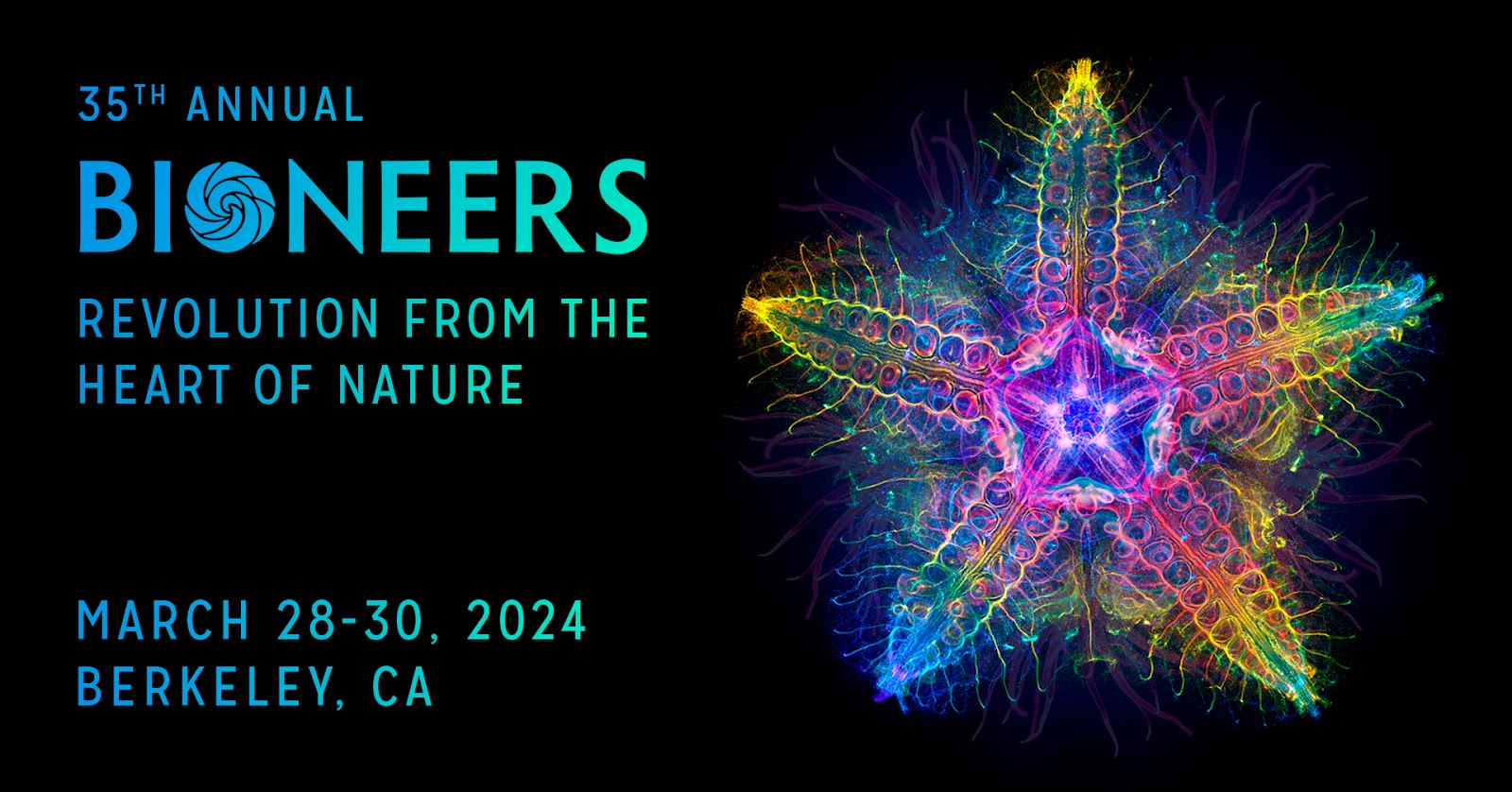
Registration for Bioneers 2024 is now open! Our 35th-anniversary conference promises an opportunity to share what we’ve learned, link arms, nourish our hearts and vision, and align ourselves to prevail for the long haul.
We invite you to connect with the Bioneers community of leadership in this time when we’re all called upon to be leaders. The best way to predict the future is to create it. See you at Berkeley Bioneers 2024!
In this moment of radical transformation, shifting the societal pronoun from “me, me, me” to “we” may be the single most transformational pivot we can make in order for anything else to work. Our destiny is ultimately collective. How can we overcome corrosive divisions and separations that are tearing us apart and create a world where everyone belongs?
In this podcast episode, we dip into a deep conversation on this topic between Angela Glover Blackwell and john a. powell, two long-time friends and leaders in a quest toward building a multicultural democracy.
The influences of Africans and Black Americans on food and agriculture is rooted in ancestral African knowledge and traditions of shared labor, worker co-ops and botanical polycultures.
In this episode, we hear from Karen Washington and Bryant Terry on how Black Food culture is weaving the threads of a rich African agricultural heritage with the liberation of economics from an extractive corporate food oligarchy. The results can be health, conviviality, community wealth, and the power of self-determination.
Have you ever asked yourself why someone would invent a way to keep food fresh that would one day litter large swaths of the landscape and release toxic substances after its short disposable life? Master green chemists and educators John Warner and Amy Cannon say all that is changing — by necessity and by design. The radical growth of green chemistry is showing we can have good chemistry with the Earth by emulating nature’s green chemistry and still thrive and prosper.
As one of our most clear-eyed explorers of such topics as plant intelligence and how we feed ourselves, Michael Pollan shares his luminous insights from what began as an investigative reportage of psychedelics. This research became a very personal journey into the mystery of consciousness and the nature of spirituality at a time when only a shift in human consciousness can alter the trajectory of our societies.
The duet OLOX, which combines Zarina Kopyrina’s ancient, traditional Siberian shamanic music with modern sounds, has performed around the world, from Burning Man to the Kremlin to Iceland to the Arctic. Zarina is passionately engaged with activism and advocacy for the rights and lands of far northern Indigenous peoples.
In this video, Dallas Goldtooth of the Native American comedy troupe The 1491s uses humor to subvert the narrative of what it means to be a native person in the world right now. The 1491s is an intertribal group of comedians who regularly satirize and parody many aspects of Indian life.
“I realized that it doesn’t take a bunch of people to make a change, it can just be a little group that can make a difference.”
The Bioneers Indigeneity Program hosted a historic Rights of Nature gathering in Southern California. With over 230 participants representing 79 Tribes, participants were taken through a series of activities designed to support them in identifying the links between Tribal activism, Traditional Ecological Knowledge, and Rights of Nature.
The world around us is alive. It’s smart too. Bioneers is pleased to present Earthlings, a biweekly newsletter exploring the extraordinary intelligence of life inherent in animals, plants, and fungi. In each issue, we delve into captivating stories and research that promise to reshape your perception of your fellow Earthlings – and point toward a profound shift in how we all might inhabit this planet together.
Looking to the past, the present and the future, the “Dreaming Out Loud” mini-series engages with pivotal moments and transformative figures in Black culture. Against the backdrop of a country that does not offer certain folks humanizing love, these stories traverse the beauty of Black minds as they dare to dream out loud and resist domination for a future of radical possibility.
At Bioneers 2023, we were welcomed with open arms to a new location by thousands of new friends. We heard from extraordinary leaders who are – as Kim Stanley Robinson says – doing real work.
Enjoy and share this collection of media from the 2023 Bioneers Conference, including videos of keynote presentations, performances, and more.
When you support Bioneers, you’re supporting an entire community of diverse leadership striving for breakthrough solutions to the great challenges facing humanity.
Suzanne Simard, a professor of forest ecology at University of British Columbia, author of Finding The Mother Tree: Discovering the Wisdom of the Forest and founder of the Mother Tree Project , grew up in the cedar and hemlock inland rainforests of British Columbia in a family of loggers, a dangerous occupation, in which many of her family members were seriously injured. For a while, she also worked in the logging industry until her distress at rapacious clear-cutting set her on a different course. That association with the forest was Suzanne’s entrée into a world that aroused her fascination and curiosity with soil, plants, trees, and forest ecosystems. Her intrigue in the forests ultimately led to a breakthrough scientific discovery dubbed the “Wood Wide Web” by Nature magazine that revealed the symbiotic biological exchanges and communication between forest species via underground mycelial networks. Dr. Simard had to fight through a male-dominated culture in her field to have that discovery taken seriously, but now her brilliant work is being increasingly accepted and has profoundly changed the way we understand forest ecosystems. Bioneers Restorative Food Systems Director, Arty Mangan, interviewed Suzanne Simard at a Bioneers Conference.
ARTY MANGAN: Suzanne, as a doctoral student, you discovered something about the forest that radically upset the status quo. That discovery challenged the dominant idea that the relentless competition for resources was invariably the primary driver underlying the behavior of all living species. What did you find, and how was that discovery received by the scientific community?
SUZANNE SIMARD: I realized that our forest management practices were very destructive. We were trying to turn our old growth forests into plantations on the assumption that we needed to manage the native plants as weeds so that they wouldn’t compete with the marketable conifers. By managing the forests to reduce biodiversity, we were inviting all kinds of distress. Trees were getting infected by pathogens and insect infestations. They seemed to grow well at first, but I could see that they were not going to become healthy trees in the future, and that these forests looked so different than the native old-growth forests that they were replacing.
This led me to look below ground to try to figure out what we were disconnecting. I wasn’t the first person to discover that some mycorrhizal fungi can be symbiotically helpful to trees, that they take photosynthate from trees and use it to grow their mycelium that runs through the soil and simultaneously gather nutrients and water that they bring back to the trees in exchange for that photosynthate. This symbiosis was ubiquitous in our forests; all of our trees depended on it for their lives. The first person to publish on this was David Read in the United Kingdom, and other people were also looking at the likelihood that trees were connected below ground, but it wasn’t common knowledge. I wondered whether the underlying problem with our forests was that we were disconnecting these mycorrhizas that could actually link trees and plants together.
So, I spent decades of my career on that, and I’m still continuing to try to understand these connections in the soil. It really is a “wood wide web,” a sort of internet below ground with a remarkable density of connections. There are thousands of kilometers, even under a square meter of soil, of fungi linking all these plants together. There are avenues of communication from plant to plant, tree to tree.
Deciduous trees such as paper birch and aspen were being killed with herbicides because they were perceived as competitors to the conifers, but in my Ph.D. research, I found that birch and Douglas fir were actually linked together by mycelial webs below ground and were sharing carbon, nitrogen and water back and forth between them, sometimes even very quickly. There is a rapid communication going on. It took us years to figure out how quick it is. These resources, carbon, water and so on, are moving within minutes, hours, over days, years, and it’s a back-and-forth exchange.
Also, the more shade that these so-called weeds were casting on the coveted conifers that were the marketable wood, the more they actually shared carbon with the conifers. So, it led me to realize that we were looking at forests from such a very narrow point of view. Trees and plants are in a sophisticated relationship with each other, and they communicate in very sophisticated ways. Yes, they definitely do compete with each other, but they also collaborate, and it works to their advantage. It actually provides them with vigor and health. Trees are fitter when they grow in biodiverse communities than when they grow alone, but the forest management practices of reducing biodiversity were resulting in less healthy trees and forests.
There was intense backlash to my findings, mostly because there is a huge chemical industry that profits when chemicals are used to exterminate native plants in forests. It was really about money, and it’s not an easy task to dismantle an entrenched system and structure. I still haven’t done that. There’s an enormous infrastructure and way of doing things built around this belief that competition between species is the only driving force in forests: the development and use of herbicides, how we plant trees, how we work with the plants around them, how we space them apart, how long we let them grow, etc. All of that machinery is put in place in support of the idea that trees just compete with each other. But in fact, that’s not the case. They have very sophisticated ways of communication and interacting that includes collaboration as well.
ARTY: You come from a family of forest loggers who selectively logged the forest and who at least had some sense of overall forest health. Today, devastating forestry practices clear-cut large swaths of forest using huge pieces of equipment weighing as much as 60,000 pounds that are brutally efficient in felling and processing trees. Viewing videos of those feller-buncher machines in action, I felt as though I were witnessing acts of brutal violence. What is the effect of clear-cuts on mycelial networks and on surrounding ecosystems?
SUZANNE: This is something that we’re looking at more and more carefully. Traditional forestry practices started out with horse-logging and hand-falling, so the impact was mostly pretty minimal. Growing up in a family of horse-loggers, I saw the forest as a regenerative place and forestry as a regenerative practice. When my great-grandfather and grandfather and dad would take out individual trees, the forest went through a succession phase. It regenerated very easily. The forest seemed to me to be a very healthy and vibrant place.
But when I became a forester in the 70s and 80s, I realized that wasn’t how forestry was being done. It had become a massive industrial money-making business. Of course, my family was trying to make a livelihood, but it wasn’t a corporate endeavor to make as much money as possible by exploiting forests on a massive scale.
And it kept getting more destructive. Hand-falling gave way to more mechanized falling, then the use of feller-bunchers, and now they use things called “hoe chuckers” that can move up steep slopes and get to places where even 20 years they couldn’t get to. Some of these hoe chuckers even operate at night without people in them. These robots that go in and harvest trees in places that used to be impossible to get to.
Let me give you an idea of the impact of this sort of industrialized logging. I’ve done a lot of research on it, especially as part of the Mother Tree Project, and what we’ve found is this huge loss of the most fertile topsoil from the forest floor. The forest floor is extremely important because it’s where most of the nutrients are contained and where most soil biology occurs. Organic material is mixed in with mineral soil, and it looks very black or dark. It’s full of life, of a whole web of organisms that are working together.
What we found in the Mother Tree Project and verified through many observations in looking at these logging practices is that, in our interior forests, these mechanized harvesting systems are causing the loss of about 60% of the carbon from the forest floor, and this is a big increase from earlier analyses of forest floor loss even just a decade ago. It’s largely because our mechanization and our machinery has changed. Back then, using rubber tire skidders and so on, we were only losing about 30%, so we’ve doubled the losses of soil fertility.
I was on a field trip in the old growth forests in the coast regions with the Kwakwaka’wakw people, which is a nation on the eastern side of Vancouver Island. Next to that was a forest that had been hand-felled 130 years ago, and, about 100 meters away, another piece of forest that had been logged a second time, so in that area the old growth forests had been logged and the second growth logged again. It was now third growth. In the old growth portion, the forest floor is about a meter deep. Right next door in the 130-year-old hand felled forest soil, it was only 50 centimeters, so, even from that old conventional harvesting, half of the forest floor had been lost. In the third growth stand, the forest floor was down to four centimeters. This is an enormous loss.
And just to put it in context at a national scale, Canada contains 25% of the world’s soil carbon, so the country has a global responsibility to be looking after these forests in a better way than what’s going on right now if it wants to be a responsible actor re: climate change.
ARTY: One aspect of your work is that it exposes the deep problems that result from our attempt to industrialize living systems, and some of the language you use, such as “mother trees” and “communication among trees,” seems to point more toward traditional Indigenous knowledge than to contemporary scientific nomenclature, and you once said that the Coast Salish were more scientific in their approach than we are. Can you explain that?
SUZANNE: The coastal nations of the Pacific Northwest, including the Coast Salish, the Nuchatlaht, the Kwakwaka’wakw, the Heiltsuk, the Haida, the Tsimshian, and the Tlingit – all the way up and down the coast– have lived there for thousands of years. On Haida Gwaii, some estimates say that the Haida people were there for 14,000 years. More conservative estimates are that they were there since glaciation, about 10,000 years. Over those thousands of years living on the land, through a process of trying things, observing, adapting, changing, they developed very sophisticated methodologies for stewarding that land they knew so well. It was, of course, in their best interest to look after the land, to respect it, because the land gave back. Those Indigenous cultures’ worldview is that we are all connected, that people are part of the land and the land is part of us.
The ancient land-based wisdom worked well. Many of those societies were very prosperous and developed remarkable culture and art. One example of this is their relationship with salmon. Along the north coast, where I’m from in British Columbia, the people depend on salmon, and they also depend on cedar, which they view as the tree of life. They work very carefully to maintain salmon populations. They use fishing technologies that allowed them to monitor the salmon populations.
From time immemorial, they built tidal traps that have walls made of stone placed under the tide, and during spawning season when the tide comes in and out, the salmon get trapped behind the walls, so they could passively but effectively fish for salmon, but they always knew which ones were the big mother fish, and they let those big mothers migrate upstream and spawn in their natal streams. The mothers, the big old fecund females, laid big eggs that made big fry and created a big healthy salmon population that was sustainable year after year. The carcasses of many of those salmon were carried into the forest and eaten by bears and wolves, and whatever was remaining decayed into the forest floor and was taken up by the trees as nutrients. It provided a crucial natural fertilizer for the trees.
The cedar tree, the tree of life, was very important culturally for all of these nations in that it provided food, shelter, clothing, mats, and boxes. It was very much a part of their lives. They were caring for the trees at the same time that they were looking after the salmon that were basically fertilizing these forests. It was an extremely effective circular flow that involved wisely cooperating with natural systems to guarantee that your people had their needs amply met but that the underlying ecology stayed vital.
The well fertilized trees would grow big and protective and provided wealth. They also shaded the streams for the salmon fry, which would then go back out to the ocean to carry out the rest of their life cycle. In this way, by monitoring the fish, by selecting the big mothers so that they could go upstream to spawn, they actually enhanced the salmon populations. They were working together with their resources by monitoring and watching and adjusting. Now, if that’s not science, I don’t know what is.
Then colonization came and took over that salmon fisheries practices, and Western science was applied to the harvest. Well, we know what happened to the salmon populations since then because the supposedly “scientific” methods weren’t based on thousands of years of observation of and attunement to what was happening in the salmon runs. That’s why I call the Indigenous way a more sophisticated science. It’s based on a lot more knowledge, care, and adaptation.
These connections are sacred. The connections between people, salmon, trees, wolves, bears, eagles, waters, forests, oceans are sacred relationships that need to be maintained because once they’re broken, then the systems unravel. The indigenous people knew that, and we’re seeing this great unraveling now, expressed in catastrophic loss of biodiversity and in the ravages of climate change.
In a world where personal identity often intersects with societal expectations, Nina Simons offers a refreshing perspective on embracing our true selves. She has a new way of looking at ourselves, and our identities that she believes will be valuable for anyone.
In this Q&A with Nina Simons, Co-Founder and Chief Relationship Office of Bioneers, we learn how her gender informs her leadership style. Sign up for the upcoming “EveryWoman’s Leadership: Cultivating Ourselves for Full-Spectrum Flourishing” Bioneers Learning course to gain insights on the most effective ways to trust your inner guidance.
Why is the topic of “EveryWoman’s Leadership: Cultivating Ourselves for Full-Spectrum Flourishing” important for people to learn about right now?
Nina Simons
Nina Simons: Because in this time of convergent and existential crises, when so many of us are feeling called to serve what we most love, we need all of our creativity and capacities to respond in ways that are whole, human, joyful, and effective (regardless of temporary gender assignment).
We all carry culturally embedded messaging and biases that don’t serve our best intentions. They often keep us small. This course is designed to help us see and shed what no longer serves, strengthen our best offerings, those gifts that are uniquely ours to bring, and because my life has taught me that together, we can accelerate each others’ growth and flourishing.
How did your career relating to your upcoming Bioneers Learning course begin?
NS: My journey began with the realization of how much my gender was influencing my vision for myself and my life. Over the past 20-30 years, I’ve studied and explored how leadership is being collectively and collaboratively reinvented. I’ve been inspired by hundreds of leaders who are diverse in every way. Co-facilitating groups of women in immersive residential pieces of training, I’ve learned the joys and challenges of mutual mentorship.
What is one piece of research that you find particularly fascinating that relates to your upcoming Bioneers Learning course? Why?
NS: My research and that of the authors of The Athena Doctrine have shown me how we’ve inherited a model of leadership that is getting in our way. Based on their meta-surveys, 66% of the global respondents agreed that the world would be safer, healthier, and better if more people led like women. Our inherited model has us prioritize mental ways of knowing over all else, excluding most of our emotional, intuitive, spiritual, and embodied guidance, all of which we need for informed responses to the world we meet.
Tell us why people reading this should sign up for your course.
NS: Being in a beloved community of practice with others who are committed can support our best selves to meet this time effectively and joyfully. Engaging with embodied and reflective practices together can result in feeling emboldened, encouraged, and inspired to more fully inhabit your own vision for who you feel called to become.
Perhaps November was selected for Native American Heritage Month because it coincides with the Thanksgiving Holiday, one of the main events in which children come to understand who we are as Americans. As Native mothers, we know that Thanksgiving is fraught with exposing our kids to stereotypes about Native Peoples. (To learn more about these stereotypes, see this webisode our team created for PBS Learning media). Our team at Bioneers has been working together to unpack what Thanksgiving means and how we can all be part of transforming it into a holiday that celebrates all our histories. Check out the resources we have developed here (and share them widely)!
This annual Decolonizing Thanksgiving newsletter is a tradition grounded in Bioneers’ longstanding commitment to supporting a transformative understanding of the holiday’s significance for all Americans.
In this newsletter, we’re sharing an interview with IlluminNative founder Crystal Echo Hawk, tips on how to celebrate the real history of Thanksgiving with your whole family, and an interactive map to help you figure out whose ancestral territories you’re living on.
Join us in exploring this collection of content and tools focused on decolonizing Thanksgiving.
Sincerely,
Alexis Bunten Indigeneity Program Co-Director
Want more news like this? Sign up for the Bioneers Pulse to receive the latest news from the Bioneers community straight to your inbox.
Reshaping Narratives: Native Voices Reclaim Representation in Media and Society
“As Native Peoples, we’ve all carried this duality: We feel very much unseen and unheard in society. We feel very invisible. But at the same time, if we are visible, then we’re just caricatures. We’re the stereotypes. We’re some other sort of representation that is not of our own making.” – Crystal Echo Hawk
Crystal Echo Hawk’s leadership with IllumiNative has been a staunch advocate for a broader public understanding of the damages that one-sided media has caused our Native communities, evidencing it with groundbreaking public data, and explaining it in a way that everyone can understand.
This is a story about Native Peoples as we are changing the ways that we are seen today, but there is also a broader lesson to learn about how the media depicts and vilifies underexposed and misunderstood populations who are discriminated against.
In 2016, Bioneers made a commitment to recognize and share the truth of what Thanksgiving means for Native Americans and all Americans.
On this page, you can find resources to learn more about what it means to decolonize Thanksgiving, from articles to videos and curriculum. Join the movement to celebrate the real history of Thanksgiving, start conversations with your family and friends, and create new traditions.
With Thanksgiving around the corner, millions of families across the country are preparing to celebrate one of the more loved holidays on the calendar. Most look forward to the day as a time to take a break, be with family, and enjoy a meal together in the spirit of gratitude, but for many Native Americans, Thanksgiving is a national day of mourning over the genocide that took place throughout America. Here are some ideas for new traditions you can include at your Thanksgiving this year to better honor the Native Americans, immigrants, and their descendants who contribute to our country’s diversity.
‘Keepunumuk’: Teaching Children the True Story of Thanksgiving
“For children who read this book as their first exposure to Thanksgiving, Keepunumuk will shape their baseline understanding of the Wampanoag peoples and all Native Americans by extension.” — Alexis Bunten (Unangan and Yup’ik), co-author of Keepunumuk and co-director of the Bioneers Indigeneity Program.
In 2022, Charlesbridge Press published Keepunumuk: Weeâchumun’s Thanksgiving Story to transform the story of this holiday that so many Americans take for granted. This children’s book creates a new story that puts Native peoples and nature at its heart. Two children from the Wampanoag tribe learn how Weeâchumun (corn) persuaded the First Peoples to help the newcomers (the Pilgrims) survive in their new home.
Watch a reading of the book by the authors for first- and second-graders via Politics and Prose Bookstore in Washington, D.C., here, and learn more about the book itself here.
Whose Ancestral Territories Are You Living On?
A fundamental task for non-Indigenous people who want to be better allied with Indigenous people is to learn whose land they are currently living on. Identifying the Nation native to the land you live on can foster gratitude, humility and open doors to learning more about the history of colonial dispossession.
Bioneers Learning Online Education Technical Producer | Bioneers is seeking an Online Education Technical Producer contractor to work with us to provide technical support and expertise for our online learning platform, Bioneers Learning. Learn more.
Radio Producer/Writer | Bioneers is looking for a producer-writer to work with us to create a 4-episode limited audio series related to the topics of Intelligence in Nature and Nature-based Solutions. Learn more.
Perhaps November was selected for Native American Heritage Month because it coincides with the Thanksgiving Holiday, one of the main events in which children come to understand who we are as Americans. As Native mothers, we know that Thanksgiving is fraught with exposing our kids to stereotypes about Native Peoples. (To learn more about these stereotypes, see this webisode our team created for PBS Learning media). Our team at Bioneers have been working together to unpack what Thanksgiving means and how we can all be a part of transforming it into a holiday that celebrates all our histories. Check out the resources we have developed here (and share them widely)!
Over the past few decades, Native American/American Indian/Alaska Natives have been fighting to represent ourselves in the media to combat negative stereotypes. Recently, we have made great strides with Indigenous-produced movies, television, radio and podcasts. This is particularly poignant for myself, as my grandmother was featured as an uncredited “Eskimo” in 1920s Hollywood films, during a fascination with the “arctic” as a “last frontier.”
Crystal Echo Hawk’s leadership with IllumiNative has been a staunch advocate for a broader public understanding of the damages that one-sided media has caused our Native communities, evidencing it with groundbreaking public data, and explaining it in a way that everyone can understand.
This is a story about Native Peoples as we are changing the ways that we are seen today, but there is also a broader lesson to learn about how the media depicts and vilifies underexposed and misunderstood populations who are discriminated against. For Thanksgiving this year, I hope that all Americans can focus on this teaching.
The following conversation between Crystal and Bioneers Indigeneity Program Co-Director Cara Romero is taken from the first episode of the Indigeneity Conversations podcast series.
-Alexis Bunten, Indigeneity Program Co-Director
Crystal Echo Hawk, IllumiNative: As Native Peoples, we’ve all carried this duality: We feel very much unseen and unheard in society. We feel very invisible. But at the same time, if we are visible, then we’re just caricatures. We’re the stereotypes. We’re some other sort of representation that is not of our own making.
I remember, as a little girl, I would run home after school and turn on cartoons. I’ll never forget this cartoon I saw, I think it was Bugs Bunny and Elmer Fudd. It was a Wild West sort of episode. All of a sudden, this very stereotypical Indian man with a big red nose comes lumbering across the screen. He was wearing a banner that said “Vanishing American.” He walked across the screen, and he disappeared; he faded to black.
I remember being in third grade, and just internalizing that. I never forgot that feeling. What caused me to found Reclaiming Native Truth was as a mother, watching my daughter be bullied because we had given her a traditional Dakota name. It led to her almost taking her life and having a lot of struggles. I felt like enough is enough. So many of us as mothers and fathers and aunties feel this in our professional lives and in our personal lives — the impacts that our lack of representation and misrepresentation have on our people and our children. That was the catalyst for everything that I’m doing right now.
Cara Romero, Bioneers: I have a similar way of stepping into the work, and probably a not-uncommon story of being raised both on the reservation and in an urban setting. When I first stepped out of the reservation setting, there was definitely a culture shock. We have an understanding and a very private way of knowing and relating to each other within our communities. When we step outside of our communities, it’s really shocking how people perceive us, and how very little they know about what it is to be a contemporary North American indigenous person.
I internalized so many of those things as well, Crystal. I went through school often exhausted from trying to explain the truth about where I’m from, which is a lesser-known tribe in California … about how we all look different and how all of our traditions are different.
Then I went on to university, where I was a liberal arts major in Houston studying anthropology. In the university setting, we were taught as bygone, that we were relics of the past.
I realized instantly that through photography, and through media, a picture was worth a thousand words. Maybe, just maybe, I could use this to become a photo documentarian of modern Native Peoples, to use this skill to communicate to people all the intricacies of our cultures, of how alive and how beautiful we are.
Crystal, I think the mascot issue really stands out for me as something that is changing in my lifetime. I have so much respect for everybody who’s been fighting this issue for decades. I remember stepping into tribal college at the Institute of American Indian Arts, and one of the other Native students was wearing an Atlanta Braves hat. I remember it very clearly because Char Teters called him out in class. She was one of the early activists who was fighting for Change the Name. It was a little bit of a scene, but she was explaining to him all the things that we were just talking about, how we really internalized this oppression.
Crystal: You know, this is a movement that’s been going on for decades, particularly with the Washington football team. It’s been led by elders like Suzan Shown Harjo, Amanda Blackhorse, and thousands of other Native Peoples who have been organizing.
One of the biggest targets of all has been the Washington NFL team, which was formerly known as the R-word. The R-word is the N-word. It’s a dictionary-defined racial slur. There are really racist Native sports mascots that show up in all professional sports, but they’re prolific through K-12 schools as well.
It’s not just the logos and the imagery, or the dictionary-defined slur that was the Washington NFL team. It’s the fan behavior. There are chants from rival teams and sports fans, things like “Kill the Indians.” What we found in our research was that this type of behavior promotes discrimination and bias against our people. It’s the red face. And redface is blackface.
Thankfully, this country has moved to a point where it understands that blackface is wrong. We’ve watched people lose their jobs. Yet somehow, redface is okay. The way that the mascot debate has been framed in this country has made it seem like a matter of public opinion. That Washington Post poll said that 500 self-identified Native people think it’s all okay. Or maybe somebody found a Native person to come to the football game, and it all looks good. They act like it’s a matter of opinion. And it’s not—that’s the wrong question, the wrong framing. It’s about harm.
When studies were done with Native children and Native young adults, they found that exposure to not only that imagery but everything around it increases suicidal ideation, depression, and anxiety. This is science speaking. This isn’t just a question of political science. This is actually showing that this causes harm to our children. They found that Native young adults struggle to even see a future for themselves. This imagery depressed their ability to see the future.
So when we look at our skyrocketing rates of suicide and the high rates of depression and the things that our people are struggling with, particularly our children, this becomes a matter of protecting our children from harm. This is what science is telling us.
What we’ve found through our research is that this level of representation promotes bias and discrimination against our people. It’s important that we smash those toxic stereotypes.
I think on one level, we all knew that. We’ve been talking about that and living it in our lives for so long. But now we actually have data and evidence to show it. Dr. Stephanie Fryberg researched the profound nature of our invisibility and how it has been institutionalized and perpetuated in big systems in this country. Big systems like popular culture.
That entails everything from sports mascots to TV to film to museums to the role of media and the role of K-12 education. These are perpetuating our erasure and our invisibility, and that is – as Dr. Fryberg says – the modern form of racism against Native Americans today.
Part of our work at IllumiNative has not only been about advocacy with sports teams and schools and the media. It’s also educating our own people about the harm that these representations have, and that this isn’t a conversation that should be minimized and cast aside for public opinion or political correctness.
Cara: I think what we’re seeing evolve with all of the contemporary media work is this better future, where we’re able to choose accurate representations of ourselves. And that’s so powerful.
Crystal: Absolutely. The thing that we learned from the Reclaiming Native Truth project is that there’s such immense power in data.
A big part of our work has been taking that research to Hollywood, for example, and meeting with the heads of the biggest studios out there and educating their leadership about the importance of representation. They shouldn’t just check a diversity equity inclusion box. They should be no longer advancing harm by our erasure or by our misrepresentation.
We were also able to show them through our research that 78% of Americans want to know more about Native Peoples. That 78% figure represents audience demand. That has begun to speak volumes to people within the entertainment industry, and also in media and newsrooms, now that they understand there’s more of an audience for our stories and our issues and what we think.
We have done what feels like hundreds of presentations over the last two years. What we found is that when we educate our allies, I would say probably 85% of the people I talk to are like, “I didn’t know.” Once you walk them through how these big systems work and how they interact within these systems, inadvertently sometimes, most people are like, “I didn’t know,” and “How do I change this?”
It’s been about the power of education and their understanding that they not only need to wake up and own that, but their guilt around it isn’t helpful to us. What’s helpful is for them to partner with us, create platforms, and turn over the mic, so to speak, to Native Peoples. We don’t need non-Native Peoples to come in and save us. We need them to be a partner in dismantling these systems that not only harm Native people but harm all of us. We need them to go within the institutions and systems that they’re operating in, and say, “How are we culpable here? How does Native representation show up and not show up?” And that means everything from governance structures on boards of directors to staff in leadership to how they’re talking to and about Native Peoples.
Cara: Crystal, what do you feel like has changed during your lifetime?
Crystal: I think about these high points from over the last couple of years: having our first Native US poet laureate, with Joy Harjo being named; Wes Studi being the first Native American male actor to receive an Oscar; the McGirt decision; the Supreme Court ruling that affirmed the Muscogee Creek Nation’s treaty rights, and its reservation; seeing big court victories for NO DAPL; looking at the exposure that was generated at the stand taken at Mt. Rushmore this summer and the way the LandBack movement has emerged from that. It was amazing watching that weekend of the Fourth of July, it was beautiful. There was nothing but a sea of Native faces speaking out on critical issues, from mascots to our treaty rights. It’s been exciting to see how much of that is changing. One of the biggest things is that in 2018 we elected the first two Native American women to Congress.
It’s really about how we are building power. Our representation as contemporary Native Peoples and the way it’s showing up in different facets is huge. Those two women being elected has been transformative. It shows how important that aspect of our representation is. But it’s fairly recent. We’ve been battling invisibility and misrepresentation pretty fiercely, and we still are, but to see the pace of change is really extraordinary.
Leseliey Welch and Indra Lusero, parents and birth justice advocates, are helping to lead a movement to create community birth centers across the nation. To help address the maternal and infant mortality crisis, they’re realizing a vision where midwives are the leaders in care in a reclamation of the normal physiologic process of birth. They say birth centers provide racially and culturally reverent care founded in safety, love and trust.
Leseliey Welch, MPH, MBA, is Co-founder of Birth Detroit (Detroit’s first freestanding birth center) and Birth Center Equity, a mom and a tireless advocate for work that makes communities stronger, healthier and more free.
Credits
Executive Producer: Kenny Ausubel
Written by: Kenny Ausubel
Senior Producer and Station Relations: Stephanie Welch
Host and Consulting Producer: Neil Harvey
Program Engineer and Music Supervisor: Emily Harris
This is an episode of the Bioneers: Revolution from the Heart of Nature series. Visit the radio and podcast homepage to find out how to hear the program on your local station and how to subscribe to the podcast.
Subscribe to the Bioneers: Revolution from The Heart of Nature podcast
Transcript
Host: In this episode, we visit with Leseliey Welch and Indra Lusero, parents and birth justice advocates who are helping lead a movement to create community birth centers across the nation. To help address today’s dire maternal and infant mortality crisis – including the most negatively impacted communities of people of color and LGBTQ people – they’re realizing a vision where midwives are the leaders in care in a reclamation of the normal physiologic process of birth. They say birth centers provide racially and culturally reverent care that’s founded in safety, love and trust.
I’m Neil Harvey. This is “Midwifing a Movement: Community Birth Centers and the Care Economy”.
Leseliey Welch(LW): I want to invite you to picture a different way in birth. And the invitation is to imagine a world where birth is safe, sacred, loving and celebrated for everyone. Imagine giving birth with midwives in a community birth center designed in response to the dreams, hopes, and needs of the community it calls home.
Host: Leseliey Welch is co-founder and CEO of Birth Detroit, which will be the first midwifery-led birth center in Detroit. She shared her vision at a Bioneers conference…
LW: You walk through the door so happy to be able to receive care at a community birth center right in your neighborhood. You, your partner and your children are greeted by name, maybe even with warm hugs. You are asked how you are doing and you can tell that the person asking genuinely cares. They offer you water, tea, snacks, and you settle into a cozy sofa. There are shelves of birth, nutrition, breastfeeding and parenting books for you to borrow, and a little toy nook in which your little ones can play.
In the examine room, you feel at home with the warm colors and cozy furniture. Your partner even feels they belong here too, with posters celebrating Black and Brown fathers and disabled, queer and trans bodies. Your midwife greets you and you remember how relieved you felt the first time you met, knowing that they were from your community. They welcome your whole family to the visit. Your kids listen to the baby and see them on the ultrasound. Your midwife asks you about how you’ve been feeling physically and emotionally, what you’ve been eating and how much rest you’ve been getting. They talk with the whole family about ways to connect with the baby and how to support you. It’s unlike any medical care appointment you have ever had, and when it’s time to go, you almost don’t want to leave.
Leseliey Welch speaking at a Bioneers 2023 panel with Indra Lusero
When you go into labor, there’s no frantic rush to the hospital. Your partner calls the midwife, the midwife reminds you what active labor looks and feels like, and how to know when it’s time to come into the birth center. Hours later, you’re on your way. You walk into your birth suite and breathe a sigh of relief. Your midwife is there and they have prepared for your birth journey. You feel loved knowing that you can labor where and how you feel called to. Your power playlist comes through the speakers while you move and sway and breathe. You walk some. You sit on the toilet for a time. (Y’all know that’s comfortable if you’ve had a baby.) And then you move to the birthing tub.
Your partner whispers reminders of your beauty, your strength, your power. A familiar scent wafts from the kitchen where family is warming food they prepared for you earlier. Your kids are playing in the living room of the birth center. And labor is hard work, yet your surroundings are soft and gentle. You feel seen, heard, honored and supported, letting go of any concerns that you can’t do this.
You feel your baby’s head emerge. The midwife’s eyes are reassuring. You change positions at will, responding to the knowing in your body. The surges come with more intensity. You may burrow into your partner’s chest. The newest member of your family arrives Earth-side in this sacred container of love, and everyone and everything is forever changed.
Host: Leseliey Welch has long held this vision for community birth centers. As co-founder and CEO of Birth Center Equity, she helps lead the national initiative to help Black, Indigenous and people of color overcome the barriers to opening holistic birth centers in their communities, which are the most negatively impacted by the maternal and infant mortality crisis.
As a Black mother and queer person, she knows from experience what a difference specific kinds of care can make – including making the difference between life and death…
LW: I am doing the work that both breaks and bursts open my heart. I know the joy and grief of pregnancy and childbirth. I’ve had a pre-term baby myself. I’ve spent time in NICU with my baby myself. And I have had a loss. I have grieved a loss. I have had a rainbow baby, born on their due date and barely made it to the hospital. And I’ve also been present with my family when my nephew was born and passed away the same day – born too small, too soon. And at that time, I worked at the city health department in maternal child health, and I would later read his name on the list of infants we lost that year. Right?
And so I share that not to ground us in grief, right, I want us to center on vision, but I also want to honor the grief and loss that comes with our birth experiences, and that the visioning is joyful but it can also sometimes feel painful when we know that our births were nothing like that vision. Right? And so every day I work toward that vision because it’s the vision I wish my brother and sister-in-law had; it’s the vision that would be the reason my nephew is still here; and it’s the vision we all deserve.
Indra Lusero (IL): So about 22 years and two or three weeks ago, having completed the childbirth preparation courses at the local hospital, I, nonetheless, knew that something was missing. And I was not the gestational parent of my oldest son to arrive at this place of him being about 38 weeks gestated, we had already been through countless experiences of being othered and excluded from healthcare; we were told that we couldn’t have a family in this way; we couldn’t do this. So we were already at this place that people told us we couldn’t be.
Host: As a queer Latinx person, Indra Lusero’s experience reflects the kinds of judgment, bias and othering that queer couples routinely face during the profoundly intimate and vulnerable journey of giving birth.
Lusero is the founder and Director of Elephant Circle, a Colorado-based organization that also works nationally on reproductive justice.
Indra Lusero speaking at a Bioneers 2023 panel
Inspiration for the name came from how elephants give birth in the wild. The whole herd circles around the laboring elephant. They stay for the duration – connected, emoting, supportive. At this sacred and vulnerable moment of emergence, the elephants form a circle of protection and defense.
Indra believes that’s what humans need to do too.
IL: And I had this sense that there was basically a soul missing from this care that we had been so far receiving. I didn’t know what to do about that fact, I just knew it. I ended up just asking people, “Isn’t there something else? I feel like there should be something else. Isn’t there something more here?” Fortunately, I was connected with a woman who’s a midwife in the community who met with my partner of the time and I for like an hour, just free, sharing with us this alternative vision.
At that time, my partner wasn’t able to make the leap mentally to planning for a home birth after having planned this whole gestation for a hospital birth, so this midwife agreed to be our doula and go into the hospital with us, undeniably and totally transforming that experience. I am 100% confident that it would have been totally different if we hadn’t made that connection.
Host: The context for the rise of birth centers is the scandalous national maternal health crisis. Among developed countries, the U.S. has triple the infant and maternal mortality rates. And it’s only been getting worse. Between 1999 and 2019, the number of U.S. women who died within a year of pregnancy doubled.
Poverty and race play a key role. Women face a 60 to 100% greater risk of death in counties with middle and high poverty rates. Black women are three times more likely to die from pregnancy-related causes than white women. Indigenous women are also at far graver risk.
Lack of access to quality health care can also be deadly. Half of all U.S. counties don’t even have an OBGYN. And a third to half of mothers die in the first three months after delivery — when hospitals seldom follow up beyond perhaps one in-office visit at 6 weeks postpartum.
Studies show that having access to quality health care would prevent 40% of all maternal deaths, regardless of race or socio-economic background.
LW: Survival should be the least of what we expect and hope for. The idea that we meet and speak to mamas who are so afraid of having their babies and have even been in conversation with a mama who was just saying, “I just didn’t want to die,” like that is horrific.
And the fact that there are elements of hospital care that are unsafe for many of us, not just Black and Brown people, and that feeling safe, being heard, feeling valued, having a comprehensive care experience, having greater respect and autonomy, all of those things impact our outcomes.
And so we should aspire to safe quality loving care for every birthing person, and I would also say that one of the things that we lift up and believe at Birth Center Equity is that birth centers are part and parcel of the answer to the maternal health crisis in our communities.
Host: There’s abundant evidence that one key to better birth outcomes for parent and child is the involvement of midwives from the beginning of pregnancy to several months after birth.
More on that when we return, and how the burgeoning birth center movement is working to close the gap on racial and cultural inequities – how helping people of color and LGBTQ people open birth centers creates better outcomes for everyone.
I’m Neil Harvey. You’re listening to The Bioneers…
Host: Birth centers offer a fundamentally different paradigm anchored in preventative care. And Indra Lusero says that midwifery care provides the safest and most positive experience for a person giving birth.
IL: Starting with doulas, they’re the non-clinical support providers. They’re there for the laboring person to provide emotional, physical support, encouragement, education, a sense of this is what’s going to happen.
In contrast to the midwife, who is a clinical provider. I think of midwifery as the original perinatal care provider, so preceding even the profession of medicine. People have always had midwives. Humans need assistance during childbirth partly because of our big heads, but also upright position. That, in particular, makes it such that humans can’t totally handle birth alone, like some mammals. And so that’s the role that midwives have played.
LW: When we think about our care systems, midwives as specialists in normal physiological birth, as trained healthcare professionals, have been devalued. And what we know from a public health perspective is that midwifery-led care results in a better experience and better birth outcomes, and is what we call “value-based care” or a very efficient use of resources for the value that midwives add.
Host: Leseliey Welch… According to data from Maternal Mortality Review Committees, including midwives in the healthcare system could prevent more than 80% of maternal and infant deaths.
In the U.K., where midwives deliver more than half of babies, the mortality rate for mothers is more than three times lower than in the U.S.
Along with reducing both maternal and infant mortality, midwifery-led care results in fewer preterm births, fewer low-weight babies, and greater rates of breastfeeding.
Given that the benefits of midwifery are well documented, why aren’t midwives playing a central role in the birth process in the U.S.?
As Leseliey Welch and Indra Lusero point out, starting a century ago, the medical profession launched a deliberate national campaign to eliminate midwives entirely.
IL: Midwives were framed as a problem. But the problem that midwives posed to doctors of that era, in particular, was the fact that women and women of color and women of low socioeconomic status, and immigrant women, could serve people in the perinatal period and do it well, challenged the prestige of white male doctors who wanted to also work in that realm. I mean, there’s literally quotes from doctors of that era talking about the profession of obstetrics can never rise to its place in society while there are these midwives. So the goal was to eliminate midwifery.
LW: You’ll also find campaigns that were highly racialized, that undermined Black midwifery in particular, describing Black midwives as unclean and uneducated, and ignorant. And so it was a political, cultural, multi-layered.
IL: Yep, multilayered.It really coincided with this historical moment too. It was, you know, the beginning of the Jim Crow era. It was the beginning of the Reorganization Act in terms of federal Indian law and policy, and eugenics had informed a lot of the preeminent scholars and thinkers of the day too. So there was this idea that society could be improved through reproduction, and managing reproduction of society was like the key to advancing society. So that’s also where eliminating a form of perinatal care was part of that strategy.
LW: And so when you have this deliberate undermining and shift, then you simultaneously have a cultural shift to the medicalization of childbirth. Right? Because in order to keep birthing people coming into hospitals to have their babies, we had to be convinced it was the safest place to have our babies. And from an evidence-based perspective, that is actually untrue.
Host: Still, to this day, the campaign against midwives continues.
IL: I consult with midwives across the country who are facing specific either policy barriers or legal barriers, like they’re being investigated, their professional license is being challenged, or sometimes they’re being criminally investigated, for things that are just about them being midwives. We’re not talking about fraud, we’re not talking about criminal behavior, we’re just talking about them being midwives. That’s happening.
Host: The rise of the profit-driven medical-industrial complex in the 1920s ushered in the medicalization of birth. It launched a relentless campaign to eliminate midwives and home births. By 1940, the number of in-hospital births rose to 40%. By 1955, it reached 99% where it continues to hover today.
With the average cost of U.S. maternity care at nearly $19,000, Uncle Sam spends far more on maternity care than numerous countries with much better outcomes. By contrast, the cost in a birth center is generally half or less.
As a case in point, 32% of in-hospital births are C-sections, which are both expensive and profitable. While C-sections put mothers at risk for a host of complications, studies show the involvement of midwives reduces C-sections to about 6%.
As professionally trained and certified providers, midwives are equipped to identify problems before they become emergencies. When necessary or appropriate, midwives help coordinate and manage next-level care. Hospitals are critically necessary for precisely such instances, and for those who simply feel safer there.
Meanwhile, birth centers are growing in popularity. They’ve even attracted venture capitalists, as Indra Lusero discovered herself.
IL: Part of how Elephant Circle got involved in creating this network of birth centers is because a venture capitalist had started a birth center, and closed it, decided to close it; gave folks 30 days’ notice, and they were like, we’re out of this business; it didn’t have the profit margins that they wanted. So because it was such a treasured community resource, and Elephant Circle already does—we mainly do– policy work in this area, we wanted to help see if we could save this community resource.
Now that’s what we’re doing, and I think it does challenge and shift the economics. We’ve been curious, when folks like these venture capitalists say that it doesn’t have the profit margins they want, what are they really talking about? Because we know that it brings value, and we know that it’s as model that can pay for itself.
Host: The vision of birth centers that Leseliey Welch and Indra Lusero have been midwifing is emergent. According to the National Institutes of Health, between 2004–2017, home births increased by 77% and the number of birth center births more than doubled.
The approximately 400 U.S. community birth centers today were largely started and are owned by midwives. Because midwifery is devalued at large, there are structural barriers around payment systems, such as reduced Medicaid and insurance reimbursements, making it doubly hard to stay afloat.
White midwives own the great majority of birth centers, which is where the Birth Center Equity comes in. By 2023, the network involved 38 Black, Indigenous and people of color leaders who operate 14 birth centers and are working actively to open 24 more.
If just 1% of the population shifted to birth centers or home births, it would save $187 million, according to a study by the National Partnership for Women and Families. Birth Center Equity says those resources could be reallocated to opening and supporting more birth centers, while helping provide a sustainable business model.
Leseliey Welch says another systemic barrier is addressing the postpartum first 3 months after delivery generally excluded or underserved by hospitals.
LW: The baby comes out and everybody goes away, in terms of the care that our systems provide. And in that period of time, we need support and caring and help and advice, and love, and somebody to cook food, and somebody to wash dishes and wash clothes, and hold the baby while you take a shower, and all of those things. So one of the things that taking birth out of communities has done is also take the community out of birth in a lot of ways. Because birth, historically, in many of our cultures, it was a family experience and a community experience.
IL: Everybody knew what their role was when that happened in the community, and everybody had a role. At Elephant Circle, we’re now developing a network of birth centers in Colorado, and we envision offering things in these centers like mental health services that are integrated, that people could come and get those services even if they didn’t give birth there. Also things like legal services to sort of reduce some of the stresses and anxieties that families experience; for this idea of—these centers can really improve public health. They can be kind of centers of community wellness.
LW: Yes. When you’re coming to these spaces, you don’t have to wonder if you’re going to get a provider that is going to respect your gender or your attraction orientation, or your race or religion, because you’re coming to a space that is dedicated to providing care. In our case, our values are safety, love, trust and justice. That’s our long vision for what birth centers can be the anchor for in community. We know what better looks like and better is in the best interest of everyone.
My hope is that, you know, the tides will turn and we will see a shift to a day when birth becomes a true, moral, ethical, economic and political priority, where we really invest in what the beginning looks like.
Host: Leseliey Welch and Indra Lusero, bridging reality and hope to reclaim tradition and midwife a care economy with the best of all worlds…
Keep Your Finger on the Pulse
Our bi-weekly newsletter provides insights into the people, projects, and organizations creating lasting change in the world.