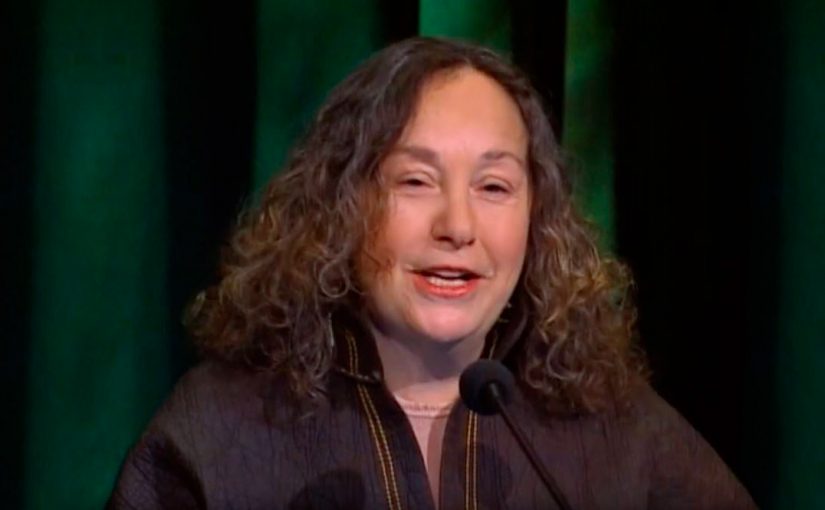
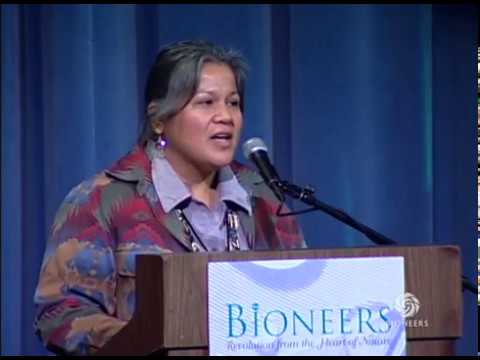
Charlotte Brody was Executive Director for Commonweal when she delivered this talk in 2007. A seasoned organizer for civil rights, women’s rights, workers’ rights peace and environmental health since 1964, she explores how chemicals are creating disease and disorders, and how solutions are being innovated to regain health and democracy.
To learn more about Charlotte Brody, visit the BlueGreen Alliance, where she serves as Vice President of Health Initiatives: https://www.bluegreenalliance.org/
This speech was presented at the 2007 Bioneers National Conference.
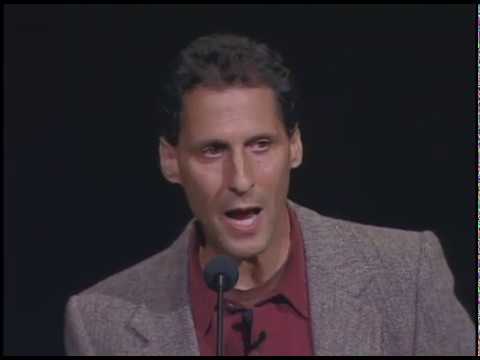
Using stories and pictures, Michael Ableman, co-founder of the Center for Urban Agriculture at Fairview Gardens and author/photograph er of From the Good Earth and the new Fields of Plenty, takes us to visit some of the most innovative individuals growing food today -master farmers, food artisans, and those using their farms as platforms for social and ecological change.
This speech was presented at the 2005 Bioneers National Conference.
Katsi Cook is a traditional Mohawk healer, midwife, and environmental health researcher working to restore midwifery and herbalism in indigenous communities. She has extensively documented effects of toxic pollutants on the Iroquois Six Nations tribes.
This speech was presented at the 1999 Bioneers National Conference.
Following is an excerpt from Bioneers Co-Founder Nina Simons’ book Nature, Culture & the Sacred (Green Fire Press, 2018).
Terry Tempest Williams may seem at first glance to be a paradoxical figure — part desert mystic and defender of wildlands and creatures who is comfortable alone deep in the wilderness; part scientist and scholar with a highly refined literary and artistic sensibility; and a woman strongly tied to her family’s deep roots and Mormon religious heritage in Utah, and yet also a modern dissident and sophisticated, cosmopolitan citizen of the world. As such, she perfectly illustrates that amazing weaving of factors that makes for a transformative leader, in my view.
I am honored to also call Terry a beloved sister, friend and teacher, and she’s helped me understand a new relationship to paradox: she’s taught me to eschew either/or solutions, to find ways to dance with and celebrate apparent contradiction, rather than being seduced by some effort to resolve it. In embracing all those parts of herself, she’s blazed a pathway for each of us to celebrate our own inherent diversity.
She’s most often thought of as one of America’s greatest
nature writers, and though her work defies comparison, she belongs in the illustrious
company of John Muir, Aldo Leopold, Rachel Carson, Gary Snyder, Barry Lopez,
Annie Dillard, and Henry David Thoreau. She has won many of the most
prestigious literary awards, but her writing explores and illuminates so much
of the human condition that it transcends any categorization.
Her writing poetically and soulfully traverses the domains
of love, family, activism, religion, art, nature and the quest for healing and
meaning. Witnessing how many passions and ways of being Terry weaves together
into coherent narratives has given me greater permission to navigate multiple
domains and systems at a time. Because of course, it’s all one system.
She has long been recognized as one of our greatest
defenders of wildlands and passionate advocates for peace, environmental and
social justice, and freedom of speech. Her activism has taken many forms, from
acts of civil disobedience on a nuclear test site to marching in the streets to
testifying about women’s health before Congress, to doing something only she
could pull off: quoting Mormon scriptures to explain the wild desert’s
spiritual essence to a room full of stunned Republicans.
What is most inspiring to me about Terry is her essence, her
being, her awakened presence, the penetrating authenticity and inquiry she
brings to every encounter and conversation. This is a woman who is emotional,
vulnerable, passionate and ferociously engaged, but she is so deeply centered,
so attuned, so refined, so devoid of any reactivity or malice, and radiates
such intense dignity and purity of soul that her words have the potential to
reach deeply into even hardened human hearts. From Refuge to Leap, and from Finding Beauty in a Broken World to When Women Were Birds, her books never
fail to illuminate the invisible web that connects the world anew for me.
The podcast transcribed below and hosted by Bioneers Everywoman’s Leadership program, was a conversation between Terry and me that took place in July 2012. In it we explored how women find voice, as well as the relationship between inner, reflective work and outer, activist work. Our conversation braids together so many threads and themes that have arisen throughout this book previously, pointing to essential aspects of leading from the feminine, including the practice of relationship intelligence, deep listening and the power of emotions and grieving. I hope you’ll find yourself resonant with it, and may even find some new wrinkles or clues that help illuminate your path forward.
Nina Simons: Terry, I am thrilled to be able to talk with you about some of the ideas in your beautiful book When Women Were Birds, and to visit with you as someone who has been a really profound influence and role model and mentor for me in my life in finding my own voice.
Terry Tempest
Williams: Nina, I can say the same back to you. You continue to mentor me
about what women’s leadership from the heart looks like, sounds like, feels
like. I will just honor you.
NS: Thanks for
that. Hard to receive from someone I love and respect as I do you, but I hope
it is getting easier as I practice. For me, what I have realized is that
finding my voice has been directly connected to finding my own sense of
purpose, or assignment, or that unique set of instructions that feel like they
are mine to do. I was so moved by a quote in your book, Terry, where you wrote
that your mother Diane said: “There are two important days in a women’s life.
The day she is born and the day she finds out why.”
As I’ve witnessed the arc of your last fifteen years or so,
it struck me that perhaps, like me, your sense of assignment keeps unfolding.
It is not like it lands fully blown in your lap and you suddenly know what you
are born to do. For me, it is more like crossing a river, where I step on a
stepping stone and I know that is the right place for me to step but I can’t see
the next step until I am fully there. My instructions keep emerging over time.
I wonder whether you will be willing to share any reflections you might have on
your instructions and unique purpose.
TTW: That is so interesting that you shared those words, instruction and purpose. And honestly Nina, I don’t think about that. What I am aware of is what I love, what I have lost, and what I have tried to reclaim. For me it is very simple: it’s a question of really being present in the moment. If we are present in the moment, then we know what to do.
NS: Well, then let me offer you a reflection on one of the things that I feel I have learned from you and keep learning from you: how to bring all the parts of myself into full presence in the moment. When I reflect back over your last several books, it seems that in each book you share something about what guided you into that exploration of presence.
In Finding Beauty in a
Broken World you talk about how you asked the ocean for some words. What I
notice about you, Terry, is that you seem to be very good at listening for
guidance from somewhere either deep inside yourself or in the natural world or
both. I wonder if you have any idea how you learned to listen so well.
Terry Tempest Williams
TTW: I remember after September 11th, you and I talked about this. I was in Washington DC when the twin towers were struck, when the Pentagon was hit. I witnessed people running across the White House lawn and I was with a group of photographers at the Copland Gallery and we found ourselves stunned as I know everyone was. The next thing I knew, we were in a cab in gridlock and the cab driver turned around and asked, “Where would you like to go?” I realized there was no place to go. We were there.
That next year I made a conscious commitment to speak the
truth as I saw it. I realized there are many forms of terrorism and
environmental degradation. But during that year I realized my voice, my
critique, had become as brittle and as hollow as those as I was opposing.
It was at that point that I went to the ocean. I addressed
the ocean spirit, however we define that, and I said, “Give me one wild word,
and I promise I will follow.” So perhaps you are correct in using that word
instruction, because the word that came back to me, the word that I heard in my
own heart was “mosaic.” It became a seven-year journey, following what mosaic
is, how do we take those pieces that are broken and make something new,
something whole.
With this book, When Women Were Birds, you know what I was listening to? I was listening to the very real fact of my uncertainty about my own mortality, realizing that I had turned 54, the same age my mother was when she died. I really was looking back and remembering what I had chosen to deny, that my mother left me all her journals before she died and all her journals were blank. And so the book becomes a reflection and meditation, a deep listening, to what that emptiness might have meant.
Nina Simons
NS: What inspires
me in you is the way that you listen both for the ocean, for the spirit of the
natural world, as well as for what’s most alive and questioning and wondering
and burning in yourself.
TTW: I think it
is about survival, don’t you? I mean, both of us are in very privileged
positions but life is not easy. If we are interested in an evolution, a
revolution of the spirit, then I think it demands that we ask these hard
questions and that we stay with them. That we don’t avert our gaze, that we sit
with the uncertainty. Revelations do come, but not without a cost, not without
patience, and not without compassion for ourselves and for those that we live
closest with.
NS: I agree, and
I find for myself that the older I become and the more aware I am of my own
mortality, the more burning the questions become. As I age, the more my desire
to fully manifest the artwork of my life or the assignment that my soul was
given in its fullness burns in me. Because we live in a time of so much
transformation, and so much loss and so much suffering, I feel called to bring
my “all” in response to that. I also feel an increasing need to not shrink away
from what most frightens me. I think you’ve modeled that for me.
TTW: You know, I
think of my grandfather when he said, every day counts. I was just in Madison,
Wisconsin on the eve of the Scott Walker election recall. There was such angst
on both sides about what would happen. Mat Rothschild, the editor of The Progressive, is a friend of mine. We
ended up that morning at dawn going out to Picnic Point Nature Preserve and we
watched birds. I cannot tell you the glory of the moment when, as we were
talking politics, wondering what was going to happen, suddenly we heard this
incredible prehistoric call. We both smiled and a sand hill crane flew right
over us, we could have touched his or her legs. You know, you think, “Nine
million years of perfection just graced us,” and it really does put things into
perspective.
NS: Yeah, it sure
does. I am curious to lean toward the reconciliation of paradox because just as
you were saying, Terry, part what prompted you to write When Women Were Birds was the legacy of your mother’s journals and
how her voice was reflected in the emptiness of words on those pages. I find
myself so drawn to the inquiry of how we unlock from paradoxical duality.
For me, one of the most important capacities we can look to
develop is how we connect across difference. And you have modeled that for me,
Terry, in so many ways, from adopting a grown man from Rwanda as your son, to
studying prairie dogs up close and personal for weeks. You model it by helping
us understand their world by going inside it and writing about what you
learned. I am curious about any thoughts you may have about how we connect
across difference and the value of it in this time.
TTW: Nina, I am
struck by the words “reconcile” and “paradox,” and I am not sure that I ever
reconcile anything. I think I embrace paradox. I grew up on the edge of Great
Salt Lake, a body of water in the American West that nobody can drink because
it is salt water. So, I think I am very comfortable with paradox.
I grew up in the Mormon church, which is very patriarchal,
and yet all the women around me were unbelievably powerful. You know, paradox.
It is true, Brooke and I are childless by choice and suddenly, at 50 years old,
I find myself adopting Willy into our family and re-defining what family looks
like. You know, I am not Willy’s mother and he is not my son and yet he has
allowed me to be a mother. To understand what it’s like to have your complete
heart soul, mind embodied by another person out of regard, and love, and care
and often times, confusion.
I gravitate towards what I have loved. I think I am most
interested in what is other than myself. I know who I am, and I am much more
interested in who you are and what this world around us feels like, looks like,
tastes like; what it is like to touch. I think it is my curiosity that keeps
moving me forward.
NS: Of course. As
another woman who is childless by choice, you have helped me understand that
whether or not we have biological children, we all, and I suspect regardless of
our gender, we all can have the essence of parenting and mothering and loving
another person so much that they become a part of our being.
TTW: I think that
is right. I was having a conversation this morning with a dear friend of
Brooke’s over coffee. How do we expand? How do we amp up our frequency? I can
speak this language with you.
I am very well aware of the desert. When we first moved to
Castle Valley from Salt Lake City, Utah, five hours South, it took me several
years to feel that my body was in frequency with the desert because the
vibration in the desert is so high.
You know this from living in Santa Fe, Nina; very little is
hidden. You are living in this very erosional landscape and it is asking of you
to be bare-bone and exposed. I keep thinking with all the changes that are
happening on the planet right now, with all that we are asked to take in, how
do we keep expanding and allow ourselves greater porosity, so that we don’t
shut down, so that we don’t become numb, so that we can continue to engage.
That is the question that I am living with. At times, it feels like it is too
much and yet as you say, I want to be of use. I want to be alive, awake, and
alert to that which surrounds me.
NS: For me, that
requires that I keep giving myself the permission to feel as deeply as I do,
because I am mindful that we live in a culture where that permission is
somewhat rare. And as a woman, I have often felt derided or ridiculed for being
emotional. What I am learning is that actually that love is the source of my
strength, and my wisdom, and my power. And that in order to celebrate life —
which I really think is part of why all human beings are here on the planet at
this time — we have to allow ourselves to feel the loss and the pain of
witnessing as what we love is diminished and threatened.
TTW: I so agree.
Such power in what you are saying. What kind of human being we would be if we
were not feeling this grief, if we weren’t being emotional about the lives and
the life before us.
I was thinking about abuse and I believe that we really are
in an abusive relationship with the feminine, however we define it — whether it
is emotion, truth-telling, anger or understanding, or maybe silence — the
feminine in all its diversity. I often find that we are minimized, trivialized,
invalidated, we are discounted — that makes for craziness. So often, what I
feel inside is not mirrored on the outside, and that makes me crazy.
And when we are talking about voice, we really do have to
stand in the center of authenticity and realize, “No, this is what I am
feeling. And, no, I will not allow you to minimize my thoughts or my actions.
And, no, I will not allow you to discount me.”
We cannot do it alone and yet we try to do it alone. That is
why I think community is very important and this is why I so appreciate what
you have put together with your program. We cannot do it alone. I so appreciate
what you have done with Everywoman’s Leadership and Cultivating Women’s
Leadership because it shows that there is a community of women and this is what
leadership from the heart looks like. It gives all of us the courage to follow
our instincts and our intuition.
NS: I find myself
feeling increasingly supported in the awareness that what the feminine offers
us is the capacity to flex with changing conditions. To live with uncertainty.
If there is a key to cultivating our whole humanity and our voice and our
leadership, it has something to do with how we stay connected, and how we live
with uncertainty. So, I wonder if you have any thoughts about that because you have
lived with so much, Terry.
TTW: Nina, I
think a lot about Wangari Maathai, who passed on too soon, on September 26,
2011. I think about the uncertainty that she lived. As an African woman, as a
woman in Kenya, in a very patriarchal society, what was certain for her was
that women were carrying the environmental crisis on their backs and that an
environmental crisis is an economic crisis, is ultimately a crisis of social
justice. That was certain to her. She saw it, she felt it, she witnessed it.
What was certain for her was that women could change the
course of their lives and what was certain for her was the faith of a single
seed. I love that and now, you know, how many millions of trees have been
planted because of her love and her capacity to grieve for what we were doing
to the planet?
Again, it is that paradox. What is certain, what do we know
and what is uncertain and what we will never know? You know, none of us knows
how long we are going to live. That is the first great uncertainty but we know
that we’re alive, that is a certain thing. You and I are speaking to each
other. So again, it is a dance, this balance, this scale. And I love how even
the brush of a feather can tip that balance. So, I want to live with that
feather.
NS: It is so
beautiful because it is the power of the small and the particular to make big
change…
TTW: Truly.
NS: What you are
saying gets us back to the dance of paradox. I am reminded that nature’s way of
resolving paradox is a spiral. That when you pour cold milk into hot tea, the
difference in their temperatures gets resolved by a spiral, whether you stir it
or not. Just the liquid does that. When the seaweeds are dancing in the ocean
current, they spiral in order to be resilient. It is a dance, not a marriage,
or a reconciliation.
TTW: I love that.
You know, there is spiral all around us. Perhaps that is the nature of paradox.
I went out with Willy and his friends to the spiral jetty out on the shores of
Great Salt Lake and it struck me how profound that form and that metaphor is to
progress, to evolution, to revolution.
NS: I also find
myself wanting to appreciate what Wangari did, which was that she kept speaking
even though she knew it meant incurring wrath and anger and violence to
herself…
TTW: Even being
separated from her children and hoping that they would understand and forgive
her for what she was taking on. Again, that word “courage.” As she often would
say, it was not courage, it was just what needed to be done. Recently, I was
talking with a student of mine about the definition of courage. She said, and I
love this: to her, courage is sustained focus. For her courage is that. Don’t
you love that?
NS: It’s
beautiful. Because what we appreciate appreciates. I recently attended a
memorial service for a dear friend and a remarkable activist who died too young
and I found myself so aware that like you, she brought celebration to the fight
for justice. Always. I noticed as I was speaking at her memorial, how rare that
is, because the fight can so often engender bitterness and anger and we can
shut down because it is so hard. And the beauty and the power of staying
connected to what you love, even as you are putting your body, your voice and
your heart into helping to ignite change, is something I admire so much.
TTW: Yes. I just
was at Dartmouth for the last three months. One of the most special days was
being on the Dartmouth Green during the Powwow. Dartmouth was one of the first
colleges in the country to honor Native people and Native American students.
This was the 40th Powwow they have held on the Green. For two days I sat next
to the singers and I just felt their drum beat going up my spine. In all the
celebration of shell dancers, the jingle dancers, it was so thrilling, and yet,
again the paradox, you don’t know but you imagine the difficulties of the lives
on the reservations. Having worked in Navajo Country, I know this is America’s
hidden wound that we have never fully acknowledged, and yet, when I think about
the deepest humor I have experienced, it’s been from my Indian friends. And,
when I think about the really dark humor with my own family, it’s come out when
we were facing the death of a loved one. Again, it’s about survival, and we all
have these evolutionary skills. I think rituals — singing, celebration, dancing
— all these things help us move in that spiral of what it means to be human.
Often, we seem to be caught in a downward spiral, an entropy of work and scale.
Lately, all I hear is: we need to work to scale or scale up, and I just keep
thinking really, can we just scale down? I just do not understand that. I just
find myself wanting to get quieter and quieter and smaller and smaller.
NS: [Laughter]
Well, and your book invited me into a meditation in such a beautiful way
because I want to be slower and stiller, and you know, it is the blur of
fastness and pressure and too muchness and busy-ness, that causes me to miss
the particularity and the beauty and sacredness and the humor that you are
talking about.
TTW: And then we
end up being tired, and angry and resentful and we have all been there. More
and more, I just want to be still. I also think about Robert Pinsky when he
says “motion can be a place too.” But my mother always talked about being the
nest behind the waterfall. How do we find that core of stillness in our heart
so that we can, again using your words, fully appreciate where we are here and
now.
I think it is tied to voice and to paradox. When I was
writing When Women Were Birds, I
thought I was writing a book about voice, about how we as women speak to the
truth of our times, to our own authentic nature. But what I have written, Nina,
is a book of silences and stillness and I think one begets the other. Again it
is that balance of space and time and scale.
NS: Well, I find
myself aware that the need for silence is also a marker of the imbalance
between the feminine and masculine in our culture and in all of us. I was just
speaking to a friend the other night about the unfinished wounding in the
conquest of this land. The huge destruction that has been wrought on Native
peoples all over the world and also the wounds of slavery, of sexism, racism
and ageism. How do we encourage and invite the healing that can come from
naming and ritually pouring our love into addressing all those wounds? I see
them as fractals of the same tear in our relational fabric.
TTW: Again, love
is not the secret. Pain is. And why are we so fearful of that? Because I really
believe if we embrace our pain we can move beyond that. Again, I am scratching
my head. Here we have a president that we have supported and admired, Barack
Obama, and I will certainly be voting for him again. But with a community of
people we have been trying to embrace the Arctic to preserve this reservoir for
our spirit, and yet it is Barack Obama and his administration that has opened
up the Arctic for oil and gas drilling. They have opened the door to Shell.
Just last week in The
New York Times, they were talking about how Shell has been very sensitive
to the Native American people when in truth, I have an Alaska Native student
who has been working with her father to stop drilling in the Arctic, to stop
drilling in the Arctic Ocean. They are buying off Native Americans with trucks
with boats and anything else you can imagine. So, what do we do? I keep
thinking, do we lay our bodies down? Is it the time for direct action and yet
how do we still proceed with calm and understanding? I don’t know what the answers
are. And that is the paradox where I find myself torn, by my anger and by my
love, and sometimes I think they are the same thing. So, what do we fight for,
and what do we accept?
NS: Yes and how
do we recognize that not only our pain deters us but our shame and complicity
as well.
TTW: The only way
I can reconcile the paradoxes of action and contemplation — and I’ll use that
word “reconcile now — is in discernment. To me the power of discernment is most
potently rendered in our own communities, on our home ground with our own
people. That is where it is the toughest to speak truthfully because we cannot
walk away from our friends and family.
NS: What you’re
naming so beautifully is the complementary wholeness that is created by
combining contemplation with action, and that unless they are met in full
measure, it is not the full humanness that I aspire to.
Terry, you’ve said that you “do not believe we can look for
leadership beyond ourselves.” Can you talk a little about what that means to
you in both your personal and professional work and how you maintain the
connection between the two?
TTW: It is such a
good question. I am going to refer it back to you Nina.
NS: [Laughing] It
is such a hard question and such a good question. What’s clear to me is that
the landscape that I can be the most responsible for is the one that lives
within me. I need to keep challenging myself, I have to keep finding the spaces
that scare me and the places that I have anger and actually lean into them so
that I can find ways to bring myself into congruence.
I keep crafting myself inwardly as if there is a social
sculpture in my own life that is me, and I am the only one that can make this
artwork come out the way I hope and intend it. When I began to understand the
extent of harm as a result of the invisibility of racial injustice to many
people of privilege in this country, I began to realize that even though it
terrified me to talk about it, I actually had to push myself towards that edge
and find ways to challenge myself to step into it.
For me, weaving the boundary of personal and professional,
the inner and the outer and the activist, feels like to me like it is the work
of my life. And I observe you traversing that ground with quite a bit of grace.
So, what do you think?
TTW: I have been
very aware that my view of leadership is not the same as the traditional view
of leadership: the kind with one powerful person at the top, who we follow.
That is not the kind of leadership I am interested in. I’m interested in: What
does leadership of the heart look like? What does leadership rising out of the
community look like?
I think the Occupy movement has showed us an organic form of
leadership where each voice has its own strengths and radiance. That takes
time. We’re used to top-down decisions, we’re used to saying a leader is
decisive and doesn’t care what other people think. I am interested in a circle
of leadership, in spiral leadership, in organic leadership that emerges out of community.
I’m also wondering, Nina, about how we can lead ourselves
forward in courageous ways that sustain us and the people that we love. It
takes self-reflection and accountability. If we want our country to change, we
have to be asking how we change ourselves. The quote that you read from goes on
to say that if I want my country to change, how do I change myself.
I was interested in a review of When Women Were Birds that appeared in Christian Review that the
reviewer, male, said, “This woman must have written this book while looking in
the mirror and mistook indulgence for literature.” I mean, that is pretty
harsh. It’s interesting that if a man is self-reflecting, culturally we view
that as wisdom, but if a woman is self-reflecting then we view it as self-indulgence.
So, I think that goes back to those traditional models of what we imagine
leadership and wisdom to look like, the all-knowing or the all-questioning. And
I would rather exist in the questions.
NS: Terry, I
wonder how you navigate the challenge of balancing your service to the world
with adequate self-care? I am so motivated by my love and I think because we as
women have so much cultural conditioning that tells us to equate our value with
what we can give, or how well we serve others, it is easy to give more than we
can replenish.
I just find myself actually relying on the wisdom and love
and reflection of friends and sisters who encourage me to take time off, who
remind me of the value of stillness and self-care. I keep telling myself that
we are in a marathon here, this is not a sprint. If I want to bring myself with
this much passion, presence, and commitment, I have to take care of the
instrument, myself. I need to find ways to ritualize and practice and
strengthen my capacity to care for myself at the same time. What about you
Terry?
TTW: I agree with you, Nina. We’ve all been there. I’m thinking a lot about source. What is the source of our joy, what is the source of our pain, what is the source of our strength? And each of us answers that differently, I’m sure. For me, my source is my solitude, my marriage, my community of sisters and friends. My ultimate source is in nature — birds, plants, lying on the ground as barefoot and as exposed as I can be on the hot sand in the desert or walking in the forest barefoot, with that soft, yielding soil underfoot. Just water, ocean, shell. So again, it’s discernment, it’s assessment, it’s all the things we have been talking about, each in our own way and in our own time, with the gifts that are ours.
Republished with permission from Bioneers Co-Founder Nina Simons’ book Nature, Culture & the Sacred (Green Fire Press, 2018).
This year, we’re celebrating Women’s History Month with a record number of women in Congress. Historically male-dominated fields, from politics to business to tech, are shifting to pull their ecosystems more in-line with the general population. Women continue to break through ceilings in the workforce, but empowering women goes beyond the professional. It starts with the personal.
Sisterhood transcends boundaries of land and language, but the unique, lived experiences that inform it can look a lot different around the world. Kimberlé Crenshaw, a civil rights advocate and law professor, developed the concept of intersectionality, which she describes as “a way of thinking about identity and its relationship to power.” It illustrates how the interconnection of personal identities can layer political, economic and social disadvantages. Learning from women of various backgrounds provides invaluable solutions to resisting injustice for all, especially as society moves toward a more equitable future for both men and women.
Watch the five empowering lectures from women below to learn how they use their own spaces in society to incite change, and how you can too.
Patrisse Cullors, a Los Angeles-based artist and activist, is one of the most influential movement builders of our era as one of the three original co-founders of Black Lives Matter. In this talk, she explores the contributions women have made to the movement for Black lives, and some of the issues the movement aims to change: institutional racism, mass incarceration and high rates of maternal mortality in African-American communities.
World Pulse founder Jensine Larsen and Sister Zeph, an award-winning Pakistani digital crusader for girls’ education, illustrate how their global network is harnessing the power of digital communication into a powerful force for change by connecting women from more than 190 countries – including those reaching out using Internet cafés and cell phones from remote rural areas and conflict zones. Jensine shares her personal journey building World Pulse from a vision into a network now impacting over two million lives. She and Sister Zeph show us how we can participate in this soulful digital revolution to unleash the true feminine intelligence of the planet.
Workers have been rising up all over the country to join the campaign for “One Fair Wage,” and demand higher wages and the elimination of lower wages for tipped workers. Innovative, award-winning labor leader Saru Jayaraman says that, if we join together, we can end economic inequality in America. Director of the Food Labor Research Center at UC Berkeley, Saru co-founded the Restaurant Opportunities Centers United, which has more than 25,000 worker members, 200 employer partners, and thousands of consumer members in a dozen states nationwide.
Drawing on her lifetime of social justice activism, Fania Davis depicts the essence of Restorative Justice, an emerging approach that seeks to move us from an ethic of separation, domination and extreme individualism to one of collaboration, partnership and interrelatedness. Rooted in Indigenous views of justice and healing, this rapidly expanding global movement invites us to make a radical shift from either-or, right-wrong, and us-versus-them ways of thinking. It seeks to midwife an evolutionary shift beyond domination, discord and devastation toward healing, wholeness and holiness with one another and all creation.
A mother and member of the Mandan Hidatsa Arikara nation of North Dakota, Kandi Mosset is known worldwide for her involvement on the frontlines of the protests at Standing Rock.Mosset is passionate about bringing visibility to the impacts of climate change and environmental injustice, specifically those affecting Indigenous communities throughout the world. This is her keynote speech on defending indigenous lands and communities from the negative impacts of the fossil fuel industry.
For thirty years, Bioneers has acted as a seed head for the game-changing social and scientific vision, knowledge and practices advancing the great transformation to a restored world.
Worldviews create worlds. Our civilizational crossroads reflects a crisis of consciousness. Everything’s going to change, and the only question is how.
In this essay from his book, Perspective on Indigenous Issues (GCILL, 2018, written with Galena Vladi, Libby Roderick, Sumner Macleish and Sharon (Shay) Sloan), Merculieff offers Elder wisdom as a guide to solving modern challenges. He describes how reversals of traditional knowledge in Western society, like prioritizing science over spirituality and mind over heart, can cause isolation from the wider world of which we are a part. But by reflecting on our connectedness to self, life and all creation, Merculieff shows how getting out of our heads and centering ourselves can help us focus on making dreams of peace a reality.
I had a fully traditional Unangan (Aleut) upbringing, as the entire village raised me. I had to spend equal time with the men, the women, the Elders, and my peers. For thirty years I worked 17 hours a day, six days a week. I have never experienced ‘burnout’ as it is called in Western society. What kept me centered and “in the flow” came from what my people gave me.
The Unangan people are taught to live according to laws that have guided their thoughts and behavior for millennia. Examples of these laws include reciprocity with all living things, humility, respect for all life, honoring Elder wisdom, giving without expectation of a return to self, thinking of others first, and more. Such spiritual principles for living did not come from logic or thought but from a much deeper source of wisdom, which our Unangan culture referred to as the ‘heart.’ When Unangan Elders speak of the ‘heart’, they do not mean mere feelings, even positive and compassionate ones, but of a deeper portal of profound interconnectedness and awareness that exists between humans and all living things. Centering oneself there results in humble, wise, connected ways of being and acting in the world. To access it, you must ‘drop out’ of the relentless thinking that typically occupies the Western mind. Indigenous peoples have cultivated access to this heart source as part of a deep experience and awareness of the profound interdependence between the natural and human worlds.
If heeded, this portal provides the inner information that keep us in “right relationship” with all of life, thus ensuring our long-term survival and wellbeing, individually and collectively. When guidance or information comes from the heart, it can be relied upon and has impeccable integrity, whereas our fallible thought processes regularly deceive us.
Listening to the heart gives us access to an even deeper source of wisdom, “the Womb at the Center of the Universe.” A true story that took place on my home of St. Paul Island in the Bering Sea off the western coast of Alaska helps illustrate this point. When I was sixteen, I lamented the loss of the traditional mask-making artistry at the center of thousands of years of Unangan ceremony. I sought out Aggey, an 88-year-old Elder, whose grandfather had been the community’s last shaman. I shared my sadness at the loss of the masks. Speaking in Unangan Tunuu (Aleut language), Aggey told me that the knowledge had never been lost. To rediscover it, I should go to the seashore, pick up a stick and rock from along the shoreline, and beat them in concert with the rhythm of the ocean, wind, and grasses, and the sounds of the fur seals. “Get out of the head and center yourself,” Aggey said, “then set your intention and wait.”
I had known how to get “out of my head” since I was six years old. As one of the last Unangan to experience a true traditional upbringing, I could walk the three miles from the village out to the bird cliffs even as a very young child. There, I could be amid the tens of thousands of migratory seabirds that came to the island to breed: thick-billed and common murres, red and black-legged kittiwakes, tufted and horned puffins, least auklets, crested auklets, pelagic cormorants, red-faced cormorants, fulmars, and seagulls. I noticed how thousands of birds darted diagonally, up and down, left to right, and right to left, flying at different speeds and in different directions simultaneously without ever even clipping another’s wing. In my six-year-old mind, I decided that the only difference between those birds and myself was that they existed in a vast field of awareness rather than an intellectual thought process, although I did not use such words at the time. I wanted to be like a bird, so, after months of effort, I developed the capacity to maintain this state of “awareness without thinking” for several hours at a time. That was when the magic happened: I could sense many things I’d never experienced before, and my world expanded enormously.
I applied what I’d learned from the birds to what the Elder told me. Sitting on the beach, I centered myself. Without thought, I went into my heart, set my intention and waited, trusting that the answers would come. Setting intention without thought means to set the intention at the cellular level of the body. After several hours, a small black dot appeared in my mind’s eye. The dot increased until, suddenly, over a hundred ceremonial masks poured out of the black dot of my mind’s eye and into my awareness. Mask after mask appeared, each with a completely unique design I’d never seen before. Afterwards, I wondered if I had imagined the entire thing. I shared this experience with Elder Aggey. The Elder’s response was, “exumnakoxt laakaiyah,” Unangan for “good boy.” “You touched the womb at the center of the universe,” Aggey told me. “That is where we get our teachings from.” From then on, I understood how Unangan people received their spiritual instructions for living, principles that had helped them sustain their communities for thousands of years. The “Womb at the Center of the Universe” was and is a source of creativity and creation for all people.
Ilarion (Larry) Merculieff
Humans are trying to deal with these issues with the mind alone and not the heart. The heart tells us to focus on making our dreams of peace and harmony a reality; the mind keeps us focused on the problems. Indigenous Elders ask the question: “What are you choosing to focus on? Are you choosing to focus on that which you are trying to move away from or that which you are trying to move towards?” Because, they say, what we choose to focus on becomes our primary reality. If we choose to become emotionally attached to that which we are trying to move away from – for example, if we become attached on an emotional and intellectual level to “winning the fight” against pollution and climate change – we may unintentionally perpetuate the violence we are committed to transforming. From the standpoint of the Elders, violence involves any actions, thoughts, feelings, or words that consciously or unconsciously sets one person against another, regardless of how well intentioned we are. According to Indigenous Elders, if we feel, think, or act without compassion, understanding, empathy, and love, we contribute to that which we are trying to move away from. There may be short term gains, but no real long-term solutions. Instead, we must take the same bold actions to protect that which we depend upon and love, but do so from a place of positive vision, intention and compassion. The Indigenous Elders say that nothing is created outside of ourselves until it is created inside ourselves first.
The Indigenous Elders say we have reversed the laws for living. In the past, we used to contemplate the mysteries of death; now we contemplate the mysteries of life, probing ever more deeply into life’s mysteries with our technologies and research. The Elders know that, even more important than a scientific understanding of how the world works is a spiritual understanding of human limits and our proper place within the web of creation. They say we need to contemplate the mysteries of death to fully live in the NOW with humility and respect for all living things. They say that in the past we honored feminine energies and capacities in the world (exhibited by both men and women, and by Mother Earth herself), while now we almost exclusively honor the Masculine. We used to respect the Elders and now we excessively venerate youth. We traditionally prioritized process, but today we fixate on goals and outcomes. From an Indigenous standpoint, proper process always produces results that exceed individual expectations. In the past, we focused on wisdom and knowledge and never separated the two; now, we focus on knowledge alone. The Elders know that knowledge without the wisdom to apply it correctly is useless if not dangerous. We used to experience the depth and richness of silence in our lives; now there is noise everywhere. We used to engage in genuine interaction with a wide range of people within our communities; now we live alone or in single family units with limited interaction beyond the nuclear family. This isolation destroys relationships, contributes to mental and emotional problems, and separates us from the wider world of which we are a part. And the most important reversal is that now the mind tells the heart what to do, instead of the mind following the heart.
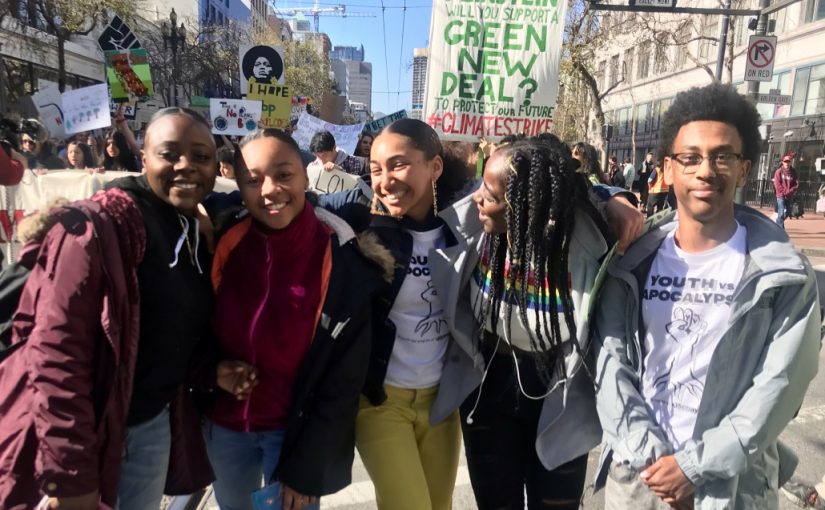
A few weeks ago a group of young people, including myself, stood in front of Senator Diane Feinstein to ask for her help in saving our future. These young people, representing Earth Guardians,Youth vs. ApocalypseandSunrise Movement, were told that we were too young to understand the ways of the world and would not accomplish anything with our persistence. Feinstein claimed there was not enough money to enact the Green New Deal and that she knew the right way to get things done.
Youth speaking with Diane Feinstein
This encounter not only highlighted the lack of willpower in our current governing bodies, it also emphasized the vast chasm between how those in power choose to view climate change, and how those in frontline communities, especially youth, have no choice but to see the dire implications of how this changing planet will affect our futures.
Global and national governing bodies still seem to only see the abstract concept of climate change as it relates to our economic systems – capping CO2 emissions, mitigating pollution, more renewable energy, etc. Climate change is so much bigger than economics, peoples’ lives and homes are at risk. Our collective home is at risk. As Bioneer Heather McGee said recently on Meet the Press, “There is no higher responsibility of anyone with any kind of political power right now than to try to stop a global catastrophe that’s not happening in three generations. It’s happening now.”
Young people will not wait for old-world politics to keep moving chess pieces around. We don’t have the time. We have twelve years, if that. We went to Feinstein’s office because we know that our future, and the futures of those that come after us, are at stake. And we know we cannot do it without standing together across race, class, gender and borders. We know we need to speak up for economic justice and against environmental racism when we talk about solutions to climate change. The Green New Deal, initially put together by Sunrise and proposed by Sen. Markey and Rep. Ocasio-Cortez, is the only legislation on the table that not only addresses climate change, but also creates good jobs and addresses inequality in our current socioeconomic system.
Youth are building new models for social movements, ones that include self-care to avoid burnout, caring for each other because this is the beloved community we are stepping into the world with and caring for our earth because she gives us life. From Parkland to Sweden to Oakland to India and Brazil, young people are no longer sitting back and waiting for older generations to make the change we know needs to happen. The activists of this next generation will need to be fearless and resilient. They will need to rely on one one another, and lead with intersectionality and solidarity.
Inspired by Greta Thunberg’s strike that began in August of 2018 outside of the Swedish Parliament, on March 15th over 1.4 million youth in 123 countries around the world participated in a Global Climate Strike. Bioneers joined some of our youth partners at the Bay Area Climate Strike where over 1000 young people participated in the march led by Youth vs. Apocalypse.
Poppy, a Native American high school student offering a blessing
The speakers began with a Native American high school student named Poppy who honored the Native stewards of the land. The following line-up of youth speakers ranged in age from 10-16 and represented the diverse backgrounds of people that live in the Bay Area. Many of these youth centralized their experience as youth of color growing up in Oakland. One young woman named Hannah Estrada voiced, “In order to go forward ethically, we need to acknowledge the generations of communities of color who have suffered from pollution. Living and growing up in polluted communities has brought us [all] here. Sometimes we forget that communities of color have been living like this for years.”
Toward the end of the day, youth leader Isha Clarke identified that there were a lot of white faces in the audience and followed up by saying, “Thank you for being here, we need you as allies, and for this movement to be intersectional we need to centralize the voices of native youth and youth of color. We also need you to show up for racial justice and economic justice in your communities.”
Isha Clarke of Youth vs. Apocalypse
Youth today, across a spectrum of backgrounds, recognize the ways in which communities are being marginalized and hurt by outdated political systems, exploitative economics and social constructs that divide us from seeing our shared humanity. They see how important it is to have diverse leaders speaking from their own experiences, calling in others who have historically felt left out of the conversation.
As Edna Chavez stated in her 2018 keynote at Bioneers,” We need to focus on changing the underlying conditions that foster violence and trauma in the first place…People need to listen to us, this is our moment as young people. As black and brown youth leaders, we need to use our voices to be more inclusive in these conversations, to share our stories, to reclaim our power, and most importantly to hold policy makers accountable…Those in power need to remember that we are the future.”
For more day to day updates and pictures about what the Bioneers Youth Leadership Program and our partners are doing, follow us on instagram @bioneersyouthleaders
In recent months, the Green New Deal proposal has been front-and-center in conversations surrounding climate change. Based on several decades’ worth of ideas, the idea found its way into the mainstream thanks to the phenomenal efforts of the next generation of leadership along with yet one more round of highly publicized climate reports indicating an extremely urgent need for widespread climate action. For all the talk about a Green New Deal, however, much of the actual detail remains to be developed (learn more about the Green New Deal here).
Vien Truong, former President of the DreamCorps, has worked tirelessly to bring equity, social justice and climate justice to the frontlines of the environmental movement and public policy. Prior to her role at Green For All, Truong was a central force in the effort to put environmental justice at the center of California’s groundbreaking climate policy mechanisms and cap-and-trade funding.
Vien Truong at Bioneers
Bioneers’
Teo Grossman spoke with Truong about the potential future of the Green New Deal
proposal and how California’s climate action can serve as a template for
national progress.
TEO GROSSMAN, Senior Director of Programs & Research for Bioneers: Starting with the basics, what is the Green New Deal and why do we need it?
VIEN TRUONG, President of DreamCorps: The Green New Deal is an idea that’s been in the dialogue in the public realm for over a decade now, but it was refreshed recently with the Sunrise Movement in collaboration and with the leadership of Congresswoman Alexandria Ocasio-Cortez, whom I love, and Senator Markey. Both the Congresswoman and the Senator have introduced peer resolutions in the House and the Senate to get us moving toward an aggressive climate change plan meeting the science targets that we need in the next 10 years. That resolution has already the support and the sponsorship of over 100 people, which is great. So it’s growing in the national realm, and in the national dialogue.
We want to
make sure that we continue to move that dialogue forward to meet the moment
with a plan that grows the support necessary to realize the promises in the
Green New Deal resolution.
GROSSMAN: The preamble to the Green New Deal legislation introduced by Ocasio Cortez and Markley specifically highlights the inequitable distribution of economic, social and environmental impacts resulting from climate change. You’ve obviously been focused on these realities for much of your career – how big of a deal is it to see what the bill collectively labels “vulnerable and frontline communities” called out in this way in proposed federal legislation?
TRUONG: It’s heartwarming and reassuring. It tells us the kind of leadership that is behind this work. For too long, when we talked about climate change solutions, low-income communities and communities of color, who really are at the frontlines of the problems, were left out of the conversation. But you really can’t address a problem if you won’t even acknowledge it. By having the communities cited first and foremost in this conversation has been amazing and reassuring that this is a priority for the leaders behind it.
I’m in
Oakland, California, and when I look out the window here, I see West Oakland,
where I grew up. For us, growing up in a community that has been surrounded on
all sides by freeways and highways, we’ve been so close and proximate to the
problems, literally breathing in the tail pipe pollutions. We have been deeply
concerned and increasingly scared about what’s going on and how we’ve been left
out of the conversation, even when directly impacted.
For
instance, in West Oakland, you’re three times more likely to get cancer than
anywhere else in the Bay Area. You’re five times more likely to have asthma
than in other areas. The disease rates are so much higher than average that we now
have a better prediction of your life expectancy based on your ZIP code than
your genetic code.
That is made
worse by realizing that the pollution problem is aggravated by poverty issues.
This is an area that has been deeply underinvested in. The school system has
been neglected for far too long. We have inconsistent, inadequate access to
healthy foods and healthcare. When you put those two things together, it’s no
wonder we’re now seeing a proliferation of tent cities in the community here. We’re
seeing a proliferation of people who are working and can’t even afford the cost
of living. In fact, in the Bay Area and in California, we have the highest
levels of poverty because of the gap between the cost of living and the
disproportionate amount of costs we are burdened with to be able to have a
quality life. We live all of those realities on a daily basis, and I think that
has made us feel more righteously indignant about the inability of our elected
leaders to address and solve the issues in our communities with us.
So to have
the leaders in Congress and the Senate recognize these issues, and with
community-based organizations helping to lead this charge, it has been
heartwarming and reassuring.
GROSSMAN: In many ways, the policy work that has taken place in California since the early 2000s could serve as a sort of blueprint for a national Green New Deal. You were certainly instrumental in the implementation of some key components of California’s leading-edge climate policy. What are the differences between what has happened in California in the past two decades and the proposed national Green New Deal and what can we learn from work already underway at state and regional levels?
TRUONG: I think California has been a clear leader nationally in setting strong environmental targets. From AB-32, which was passed in 2006, getting us on a path toward 1990 levels of pollution by 2020, which we’re on target to meet; to passing SB-100, which gets the state and the energy systems to 100 percent renewable by 2045; to policies that have been part of leading toward the largest investments of funds to low-income communities to green up; to the most ambitious charge for the transportation sector to electrify and green up as fast as possible; to really investing in communities to build and create their own vision, and then supporting that vision with investments from both the private and the public sector.
It has been reassuring to see that even as the federal government steps backward, we have seen states and leaders in California stepping forward. The results speak for themselves. California has gone from the eighth largest economy to now the fifth largest economy in the world. Based on what we’ve seen, all of this scaremongering in the national conversation pointing to job loss and economic ramifications is unfounded. Actually the reverse has been evidenced in truth. We have seen the economy grow, and more jobs have been created because of California’s doubling down on climate policies. Businesses have risen because they now have consistent, transparent and committed language that allows for them to build and plan, and to invest in their work being responsible not only to their employees and to the shareholders, but also to the planet and to the environment.
California is
one of the largest states with one of the largest economies, and it has been
able to demonstrate that these policies do well, by doing better. We can now
let the federal levels and other states know that this is possible, and that
they can also step up and—I would say not even try to meet California, but try to beat
California. As much as I love California, this is the time when I think we need
people to actually be better than we are here.
GROSSMAN: There’s a bit of a paradox that I’ve been struggling with regarding where solutions need to come from. In many ways, it’s the federal and large-scale systems that are broken and have gotten us to this point. They’re brittle, not particularly nimble, unresponsive to rapid changes and, by definition, are large, centralized bureaucracies. Much of the innovation and pathways forward in a time of climate crisis are coming from smaller scales, highlighting the need for different, more resilient systems – decentralized smart grids, local food economies, water systems that aren’t reliant on pumping water over mountains. How do we reconcile the need for something on the scale of a wartime mobilization that only a federal actor can bring when so much of what we need is going to be built and implemented at a local, regional or state level?
TRUONG: It’s not a surprise to anyone that in order for us to reach the scale and promise of the Green New Deal, we’ve got to have buy-in from people and groups beyond the federal government. Even having support on the state and local levels isn’t enough. We’ve got to have the top-down and the bottom-up work.
Top down, we
need the federal government to direct the energy systems, the utilities and the
power plants, to double down and keep protection around clean air and clean
water. We’ve got to make sure we’re creating a fair playing field across the
country to create and enforce fuel efficiency standards for car manufacturers.
There are so many things that the federal government can and must do for us to rise
to what the UN’s Intergovernmental Panel on Climate Change says we need in
order to meet our targets in the next 12 years. It’s a lot of demands, and it’s
necessary.
At the same
time, in order for us to get anything passed at the federal level right now, we
need Senate buy-in, which is Republican-dominated, and we need our president to
sign off on the law. Right now, that is very unlikely on any ambitious climate
policy. In order for us to wait for Senate and presidential buy-in, as well as to
get a plan in place and implemented, it’s going to take at least half the time
that the scientists have told us we have to dramatically reduce pollution. We
need to do it within 12 years. We don’t have that amount of time to wait for
the federal government to really step up and do the work.
That means that
right now we need a bottom-up strategy. We need cities to work toward investing
in renewables at the local level and to support the workforce development needed
to make that happen. Cities need to help green up their municipalities, green
up their utilities, their schools, and their hospitals. We need the states to
commit to strong targets.
In order for
us to meet the transformation that we need in the Green New Deal, we’ve got to
have the top-down and the bottom-up strategies: the federal level working to
help transform and create the platform needed, and also the localities and the
states to do the same.
GROSSMAN: I detest the political horse race type coverage of the Green New Deal (long on political speculation, short on relevant policy details) but given you have some experience getting unexpected legislation through a major governing body, I am curious what you think needs to happen to see it through? Considering your experience with coalition building and working to craft legislation, what are the important steps you feel can bring about the bold actions that are needed? How do we avoid getting bogged down in conflict among various stakeholders?
TRUONG: I’ve continued to grapple with that question in my work. I’m the youngest of 11 kids, and I feel like I was born in a circus, like I was born to build coalitions, because I just saw a whole lot of siblings fighting over everything. I grew up in Oakland during the crack years, and it was a time when there were a lot of gangs, there was a lot of trouble, and I saw a lot of fights in schools. Being in a home and in a community and in a space where there was always fighting taught me that I hate fighting. I always want to be focused on what we’re trying to accomplish
When people
are fighting and shouting and they can’t hear each other, it’s the people who
are the most vulnerable and who are most in need of support that are left
behind. They’re forgotten and neglected. They’re the ones who suffer because we
cannot get our acts together.
That
experience as I was growing up is now many times worse on a national scale with
our political and elected leaders. While the left and the right have been
fighting, we have seen criminal justice problems slip between the cracks, and
we have seen our planet burning up. California literally saw Paradise burned to
the ground. Meanwhile, we still see people shouting over each other trying to
get air time.
The Dream Corps and I have been focused on the solutions that we need at this moment. Who do we need to work with in order to make those solutions happen? Who’s ready to actually throw down and make some change? Because if we don’t, we’re going to see these continued problems in our communities. I’m going to see my family members losing 12 years of their lives because of the increased amounts of pollution and poverty. Those things are going to continue without end because people are fighting with each other, and I just can’t have it. I just can’t deal with it anymore. I’m done with it.
At the Dream Corps, we have been working to build partnerships with unlikely allies. For instance, last year we were able to help pass the First Step Act, which The New York Times said was the biggest criminal justice reform bill in a generation. That has led to giving more rights to incarcerated women, to unlocking and freeing people who have done their time and served their penalties, and are now able to rejoin communities much earlier than they had expected. We have been able to hold events in all 50 states calling for a day of empathy to support people who have been affected by the criminal justice system. People who are now moving forward with empathy, saying “Instead of fighting against each other, how do we fight with each other for a better future for all?”
We at Green
For All have realized that this climate change conversation has been seen as a
white conversation for too long, even while African Americans, Latinos, and
Asian Americans are more directly impacted by these issues. Survey after survey
is saying that these populations care even more because we are breathing in the
polluted air and drinking the polluted water. Our team is making sure that
we’re growing the community of people who realize their right to sit at the
table of these conversations and to shape solutions.
For instance, we’re calling all artists to be part of this as part of our #fuelchange work. We’re having artists, hip-hop musicians and poets contribute to sharing the word about why climate change and tail-pipe emissions actually matter to us, and why and how we can be part of creating solutions.
We’ve been
partnering with a bunch of amazing folks across the country. At the end of the
day, if you’re tired of fighting and trying to shout at each other, you’re
tired of the bickering and animosity and just want to work with other people
who share your values, your solutions, and want to do something good in the
world, we want to be one of the homes where you can find some of your peers to
do that.
GROSSMAN: Is there anything else that you want to share with the community here in terms of the work Green For All is doing?
TRUONG: One thing we haven’t talked about yet is business. I’ve just come back from a few conversations with big and small businesses, and I think that there’s a bit of heartburn around businesses’ part in the Green New Deal. There’s been a profound lack of their voices, and I think that’s on both sides. We can do better at inviting business voices to be part of the conversation, and we need businesses to step up and take leadership around how they can help realize the dream of this Green New Deal.
When I’m in
these conversations with my friends in the environmental sector and the social
justice community space, there is some justified suspicion around big
businesses. For far too long, we have doubled down and over-invested in
businesses that have contributed to getting us into this mess. And there’s a
belief that if they got us into this mess, they can’t get us out of it. But I
think that even though that’s a justified concern, it’s over-attributed.
Right now,
we have a lot of businesses that are actually trying to do good and to do
better — from having stronger emissions targets, to hiring people that can
diversify their voices and perspectives, to committing to their communities. We
have seen businesses continue to green up their supply chains and continue to
diversify the contrast they have to low-income communities. There are a lot of
businesses that are trying to do better, but they can benefit from activists
and leaders helping them figure out how they can go even further.
For folks who want to hear more examples, some of our friends at GreenBiz.com are chronicling the journey of businesses that have been trying to do better for a long time. I think we need their help. Nonprofits can only go so far. Leaders at the federal and state and local levels can only go so far.
Right now, when
we have this scale of a pollution and poverty problem, when we’re dealing with the
reality of 12 years left to deal with dramatically reducing pollution, we need
businesses that have access to capital, that have access to supply chains, that
have access to business acumen, that have access to shaping and influencing
policymakers in ways others may not have, we need to work with businesses to
meet the promise of this Green New Deal. I implore for us to make sure that we
are not forgetting important sectors and important partners that can help us
realize this goal.
I also want
to note that my support and push to make sure businesses are at the table does
not mean we should have unmitigated support for businesses just because they
stamp green on their labels. There’s a lot of greenwashing out there; a lot of
businesses want to capitalize on this new consumer demand for better business
models and better business systems, and they slap on a green sticker and think
that’s enough. That’s not enough. We want to make sure businesses have strong
targets, strong regulations around hiring from the community, and that they’re paying
workers a good wage and making sure that they can actually afford to live in
their communities.
I am done with waiting for other people lead the conversation. Now it is our time. And in order for this to happen, we need all in.
The late Terence McKenna was one of the most extraordinary personalities ever associated with visionary plants. One of the most gifted orators of the late 20th Century, he was a fascinatingly paradoxical figure: an absolutely charming but somewhat misanthropic mystic, a blindingly erudite genius who never achieved mainstream recognition, and a down-to-earth guy who advanced a range of astonishing prophetic scenarios. He brought verve and excitement to this field, and, since his tragic death in 2000, things have never been quite the same. Quite simply put, there will never be another like him. In this 1993 talk he initially delved into what was for him not his usual area of primary focus—our planetary environmental crisis, but in the end, Terence linked, in his inimitable voice, the fate of the biosphere to visionary plant use. Because time is so short, he argued, we need radically powerful means to communicate with the intelligence of the natural world because there has never been a time when hearing what that intelligence is trying to communicate has been more crucial, and sacred plants with long histories of shamanic use are, he argued, while not free of risks, the best tools for that job.