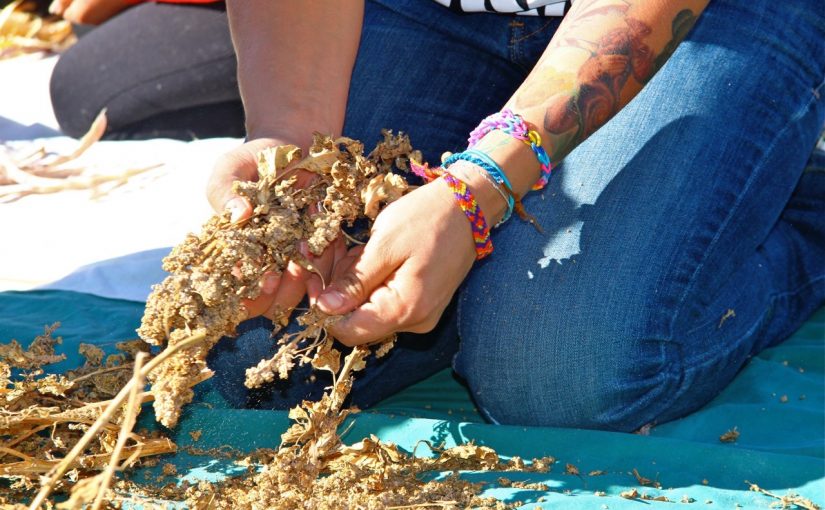
“All the traditional seeds are like brothers and sisters. It was mostly the women who kept the seeds. My mother told me she had to trade seeds with my “Tia” in Ohkay Owingeh because every five years we have to keep rotating the seeds to invigorate them with other seed sources from the different waters: Rio Embudo, Rio Grande, Rio Santa Cruz, Rio Chama.”… Estevan Arrellano, New Mexican historian
Seed saving was once a central part of people’s cultural lives and an essential aspect of food security. Even though most people may not think much about seeds anymore, they still play a profound role in our lives. Plants are arguably the keystone kingdom of life, given their unique ability to photosynthesize the sun’s energy into vital carbohydrates, which in turn feed animals, people and microbes.
Seeds from food crops embody the evolutionary genetic information of thousands of years of adaptation. Season after season, they dynamically respond to environmental conditions. Protected within the seed coat, lying dormant are the plant embryo and the stored nutrients the mother plant has provided to ensure the greatest opportunity for success of the next generation. When conditions – soil temperature, day length and moisture – are right, the seedling emerges and thrives on those stored nutrients until it has the capacity to gather nourishment from the surrounding environment through the development of new roots.”
THE GENESIS OF AGRICULTURE The genesis of agriculture involved farmers selecting and saving seeds from plants that had the characteristics they most desire, such as flavor, stature, and resistance to drought. 10,000 years ago, the first farmers gathered seed heads from wild grasses in the Middle East, grew them out and selected and bred for what has evolved into modern day wheat varieties.
The cultural story differs with each plant, but the process is essentially the same. The dynamic legacy of seeds nurtured by the symbiotic relationship between people and plants has traditionally been driven by farmer-based knowledge and skills.
SEED MONOPOLY Unfortunately, we now have a troubling loss of diversity and monopolistic control of the most fundamental source of our food. Perverse patent laws allow corporations to own life-forms through their genetically engineered seeds, and three chemical companies now control more than 60% of the seed market. Governments around the world have approved these mergers, leaving no way for citizens to sue or break them up. Even more disturbing is the fact that these companies continue to buy up seeds and then “shelve” them as a way to eliminate competition, further limiting the diversity of seeds that farmers can buy and plant.
Before 1924, the USDA sent their employees around the world to find seeds that fit eco-niches in the U.S. and then gave the seeds to farmers for free through their local representatives. But big business saw seeds as a potential commodity and, throughout the 20th century, pushed farmers into the system we have today.
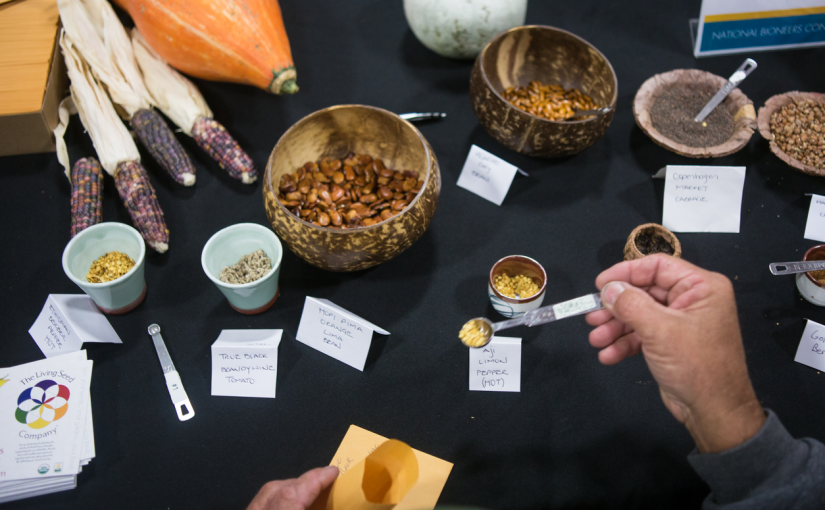
SEED DEMOCRACY A new seed democracy is more important than ever. Each year at the Bioneers Conference hundreds of people gather to exchange seeds they have saved. This simple act helps to adapt seeds to the local environment, preserve biodiversity and maintain some measure of democratic control over seeds in the face of global monopolization of this precious resource. In contrast to global seed monopolization, the seed exchange is a sharing community of grassroots gardeners and small farmers who are carrying on the thousands-year-old tradition of exchanging open-pollinated seeds. Saving seeds advances local food sovereignty and extends the legacy of participation in the co-evolution of people and plants.
Since the birth of agriculture, saving seeds has been basically second nature for most of humanity. In our modern world, however, many of us aren’t even minimally conversant in the act of growing and harvesting our own food, let alone well versed in how to select and save seeds. Luckily, there are resources in our community we can turn to for guidance. In this transcribed conversation from a workshop at the Bioneers Conference, three expert seed savers share their best practices and discuss the implications and deeper meaning of seed saving in the modern era.
John Navazio, Senior Scientist for the Organic Seed Alliance and a Plant Breeding and Seed Specialist for Washington State University Extension.
Matthew Dillon, Director of Agricultural Policy & Programs for Clif Bar & Company and the cultivator for Seed Matters, an initiative of Clif Bar Family Foundation
SARAH McCAMANT: Know Your Seed, and know what you’re planting.
Sara McCamant
Make a label and remember what it is. You need to know whether it’s a hybrid or an open-pollinated variety, because when you save seed from hybrids, they do not grow true the next year. You’re going to get some other version, and probably end up trying to figure out why your Sun Gold tomato doesn’t look like a Sun Gold tomato the next year because it was a hybrid. So you’re looking for open-pollinated varieties.
Hybrids either say “great new hybrid” in their description, or they say F1, which means it’s the first generation of a cross. People do save seeds from hybrids, but I’m not going to encourage that because it is a breeding project, trying to stabilize a new variety and bring it back to being open-pollinated. John, how do you describe open pollinated?
JOHN NAVAZIO: Really, in botanical terms, it means that it’s freely allowed to pollinate with other plants of that same variety within that group of plants that you’re growing when you’re growing them. So in some cases we have “selfers”, which are actually selfing, but it essentially means that it’s not a controlled pollination, which is often what the seed companies are doing, especially with hybrids.
John Navazio
Essentially we’re talking today about annual and biannual plants. Annuals are very easy to think of because they complete their entire reproductive cycle, their complete life cycle, within one season. So you plant them in the spring, they go through summer, they flower, they make seed, and then all annuals die at the end of one growing season.
As a seed saver with annuals, the thing to think about is how much variation is there in the time of flowering between the varieties of a crop. We’re based in Washington State, almost to the Canadian border, and we work with northern farmers all the way to northern Alberta, Maine and Quebec. So time to flowering and then being able to plant that crop early enough so it fully matures seed is very crucial. And even for you here in paradise, here in California, where you have a much more lengthy season, there are still some things that I’m sure do not fully mature in this climate. So that’s one of the things you have to be conscious of before you get into full blown seed saving.
And in some cases you need to be conscious of, gee, I have a lettuce, but I don’t want it to flower too early; I want it to be in the vegetative stage for long enough. So you start to play with the timing of this crop in its vegetative versus reproductive stage. It gives me a nice lettuce for a few weeks of harvest before it flowers, and then still matures in time to give you a full satisfying seed crop.
Matthew Dillon
MATTHEW DILLON: I want to add that it’s not just about the seed crop being able to get to maturity, it’s also about being able to harvest the seed crop before the rains come in. Brassicas, kales, broccolis, mustards, lettuce, and spinach are all dry-seeded crops as opposed to wet-seeded crops like tomatoes, cucumbers, melons that you’re harvesting from the flesh of a fruit. In dry-seeded crops you not only want maturity, you want to make sure that you’re going to be able to get that seed off the plant before moisture puts that seed at risk of fungal diseases, or of even sprouting on the plant. Sometimes lettuce that starts to seed will sprout while it’s still in the flower head. So it’s not just about maturity before cold comes, it’s also about maturity and harvestability before adverse weather sets in.
JOHN NAVAZIO: Let’s go ahead and define biennials. Biennial means two seasons of growth to complete the life cycle. It’s amazing how many garden plants are biennials. The great advantage of being a biennial from the plant’s perspective is that it stores sugars in one form or another during the first season of the life cycle, so that then when the second season comes, it can put all of that stored energy into a large amount of seed. Swiss chard, for example, stores a lot of food in their leaves; cabbage is another example of that. Biennials, on a plant-for-plant basis, tend to produce much more seed than the annuals do because of this effective plant strategy.
So the defining thing about biennials that many people growing them don’t really realize is that they require something called “vernalization”, which means it takes 8-10 weeks of temperatures at or below 50 degrees before they flower. Many of these plants evolved in semi-temperate or sub-tropical regions where in winter they can survive being outside without being completely frozen, as would happen in further north regions of temperate zones. They survive during the winter, but they go through enough cold so it essentially signals to the plant that it is safe for them to start growing again and go into the reproductive phase. So when you have biennials that flower during the first season of growth, you should never save seeds from biennials that flower during the first season. It means they’re prematurely flowering.
Even in San Juan Bautista the other day, we were in a Swiss chard trial where plants had been planted in late June and some of them were flowering. Very undesirable. Don’t think, Ah, this is great, I don’t have to go through all that waiting all winter and going through vernalization, I can get my seed now. You will be selecting for an annual cycle on that plant.
Cabbage is one member of the brassica oleracea species – cabbage, broccoli, cauliflower, kohlrabi, kale, collards. So when you grow biennials, you must consider how well they do vegetatively in the first year, because you want it to be a good quality cabbage or a good quality beet, carrot. And then you think about how well it stores over winters in your climate. Many of you here in California can just leave these crops out in the field during the winter and they will flower successfully the next year, and won’t get frozen out. But we often do selection in carrots for how well they store, because where I live we often have to store our carrot roots for four and a half or five months.
Then it’s important to look at how well they do as a flowering crop the next year. A lot of people abandon looking at plants for how much vigor health and general overall health during the flowering stages. They don’t think about that.
Then, in some of the OSA seed guides that are coming out you’ll see we describe the optimum over wintering size. That would take a whole class just to talk about. You don’t want a carrot that’s too big or too small to go through winter. There are optimum sizes for all of these crops.
MATTHEW DILLON: Experiment. That’s how we got here in the first place. You as the seed saver experiment with what works in your garden, on your farm, in your system, and through all of this information, if it’s sometimes getting a little technical, just keep that in mind. The only mistake you can make is not trying at all.
SARAH McCAMANT: Yeah, though I made some pretty bad mistakes.
JOHN NAVAZIO: I bet I’ve made more mistakes than you have.
SARAH McCAMANT: It’s just sad when you lose something that you really liked by a bad mistake.
JOHN NAVAZIO: But then you learn your lesson even better.
SARAH McCAMANT: Right. Like putting some wet seed in and it all rotted. We put this as number 2, because one of the things that I discovered that was really different being a seed saver than a gardener was that I needed to be able to pass information along and track it all the way through. This means that your labels can’t fade, you actually need to remember what you planted. When you save it, you need to make sure the bags are labeled. You need to track and record, and the more information the better. So you’re tracking information like health and vigor of the plants, when are they mature, how long does it take for them to germinate. The more information you track, the better seed saver you’ll be, and the more information you can pass on as you share the seed with other people. Just labeling and tracking information is such a different thing when you go from gardener to seed saver, and really getting systems to record that information that isn’t out in the garden. Let me tell you how many labels fade, maps, little notebooks where you write descriptions — make sure they’re out of the garden. It’s something you keep track of through the whole process, because you lose labels every step of the way if you aren’t careful.
We have some envelopes and labels here for seed projects, and you can see we recommend: common names, Latin names, did you keep it isolated, did you select for vigor, a good description of the plant, what year – that’s really important – when was the seed saved? Because if you start seed saving and you don’t write the year, then all of a sudden you have three jars of kale and you’re like, “I don’t know which one is the freshest.” All of that information is very key, so save information, not just seed.
MATTHEW DILLON: You’re not just saving information about the technical aspects, the dates to maturity and everything Sarah mentioned, but it’s also important as a seed saver to save the story of where you got the seed. Even if you don’t know much, even “I just got this from my friend Bill and he didn’t tell me much information but it’s Bill’s favorite bean, and this is what I do know”. And you start to pass that down generation to generation as well.
We don’t always have the exact story. In fact, we rarely have the exact story about any of the heirlooms we pass on. There are many different iterations of seed stories out there for each variety, but I think it’s important to keep that weave alive, keep that heritage alive and to strengthen it each generation by collecting our own stories.
SARAH McCAMANT: When we hold the story, we feel more responsibility to carry it on. I worked on a farm years ago in Santa Cruz owned by Mary Sagorini[ph], a 95-year-old Italian woman, and took care of her orchard. She gave me some bean seed, and I just called it Mary Sagorini’s bean seed. All of a sudden you feel that responsibility. It’s not Blue Lake 724 or whatever. There’s a name and a person, and the more you create what we call seed culture, seed connections, the more likely you are actually going to care for that. We need to bring it back and make it have meaning in our lives.
So the third one is watch for is cross-pollination, which is when we start getting more technical. This is the place that separates beginning seed savers from more advanced seed savers. We always tell everyone to start with the easy ones we call self-pollinators – lettuce, beans, peas, tomatoes – because you don’t have to worry that much about cross pollination with those.
When you move into the more difficult ones, what makes it more difficult is that you have to be aware of pollination and make sure that you’re not getting two varieties crossing and ending up with something different. You have to understand how things pollinate and what they pollinate with. That’s where it gets much more technical and you need books if you’re not already a biologist or scientist who’s been working with this, and where it can give you a little information.
We created this chart, because it talks about how they pollinate. There are different types, self-pollinated, wind pollinated, insect pollinated. And I’m going to let John take it from here on that.
JOHN NAVAZIO: In selfers, “self” means self-pollinated, versus wind or insects, which are always cross-pollination mechanisms.
Self-pollinated systems essentially have a mechanism to cause selfing most of the time, not always. This is biology, folks. There are always exceptions, always a chance of crossing. That’s an evolutionary mechanism built into them to cross a small amount of the time, to mix up the genetics, and to basically incorporate the best genes from other members of that population. So remember that. It’s not 100% all the time.
They always have perfect flowers, which just means both male and female sexual parts. And the pollination and fertilization occurs in two different mechanisms. The first is – if you want the $5 word – is cleistogamous, petals that remain closed throughout the entire flowering process. Essentially, they are restricting insect pollination in that way, even though they’re showy flowers.
How does that work? Some of the Fabaceae, also called legumes, are very showy, but they remained closed. Well actually they’re still attracting insects that are crossing them at a small rate in any given generation.
And then there are other examples. There are self-pollinated plants in the Asteraceae – lettuce and chicories are the most notable – and even though they have open flowers, the pollination and subsequent fertilization that creates the seed happens before the flower opens. So even though blue-flowered chicories are beautiful and open fairly early in the day, that pollination has happened long before they opened, sometimes the day before, and that’s why they can still be selfers.
In cross-pollinated systems there’s always some kind of biological mechanism to assist in crossing. Showy flowers and wind are important – showy flowers, insects; wind for wind pollinated. You’ll have basically separation of male and female sexual parts in different flowers, which means like in squash, you have separate male and female flowers. Easy. You also in some cases have separate male and female plants like in spinach.
Self-incompatibility, just remember, it exists. There are certain crops that just will not receive their own pollen, even though they have perfect flowers. Dichogamy, a temporal separation of sexual parts, and you’ll actually have, like in carrots, where the female part of the flower is fertile before the male, before the anthers shed their pollen. So then the bees and the hover flies and the wasps that are crawling all over your carrots are easily crossing, because on any one flower they’re landing on, there’ll be this separation where they’re not pollinating and recognize pollen at exactly the same moment.
All you need to know is: Is it a crosser? And do I have to worry about cross pollination? How much separation?
SARAH McCAMANT: Let’s talk a little bit more about what you can do if you want to grow plants that are cross pollinators. One is that you can just grow one variety and then make sure, for all the gardeners, that you are watching what your neighbors are growing, because a lot of these can cross pollinate up to a mile. The wind-pollinated crops they recommend a mile isolation from other varieties going to seed.
Some of it you can do by hand pollination. So you can grow squash and actually take control of when and how they pollinate, and you cover the flowers so nothing else can pollinate. Those are techniques that a lot of books describe.
Sometimes you can separate them by time. You can do two varieties of sometimes that would normally cross, but you plant one a little earlier, or two corns, where maybe one’s a 90-day and one’s a 110-day, and so they’re actually going to drop their pollen at different times.
So there are different ways you can control pollination, and deal with cross pollination or not. The simplest one is to just grow one variety and figure out who else around you is growing and make sure they’re not growing something that’s going to cross. That’s the main way I’ve always done it in my garden. But it is tricky, because there are pretty large distances you have to control, and that’s what makes home gardeners get a little overwhelmed with this. “Well I don’t know what everyone else is growing around me.” And then you have to look at other ways of controlling it.
If you go to Seed Savers Exchange, they grow hundreds and hundreds of varieties of things on their farm. They have cages that they build to keep insects out, and they control the pollination, like putting insects in. So there are different ways. The book Seed to Seed actually has some really good techniques for that.
If you start with the easy ones, you don’t have to worry about that. It’s a really good entry point. I call them the entry drugs. You get hooked on it, and then you decide you’re willing to do the harder stuff because it’s so much fun. I think the best entry drug of all seed saving is beans. Some people say tomatoes, because there’s such tomato love in this culture, and heirloom tomatoes are so amazing. This is kind of fun. But beans are even easier, and beans are so beautiful. You grow them and you have these little brown shells that look kind of ugly out there in the fall garden. You gather them all and bring them in, and you start breaking them open, and they’re so beautiful. You can run your hands through them and then you’re hooked.
You do have to worry a little bit about pollination with beans. I just got my first bean cross this year. They do recommend separating two different beans by 10 to 15 feet at least, because you do get some crossing every once in a while.
JOHN NAVAZIO: It can be as much as 4% in some places. The ancestral homeland of beans in North and South America, crossing can be up to 10 – 12%, because the insects that co-evolved with beans are there in their ancestral homeland.
Also, as you get deeper into seed saving, learn more about the history of your crop: What kind of climate it came from, conditions. It will be a real insight into that crop and how its reproductive mechanisms work.
Even if you look at the minimum separation distances, it’s always nice to have a physical barrier between. If you want to do three or four beans because you get totally hooked on beans, then you can grow rows of corn between your beans, or three rows of corn between two bean varieties, or a row of sunflowers, things like that. That will really cut down on that outcrossing.
SARAH McCAMANT: Right. And people say, “Well what’s wrong if I got a little crossing?” There isn’t anything wrong, and actually it can lead you to be a plant breeder when you start seeing some interesting crossing. When most people save seed and grow it the next year, they want it to grow true to type. But if you want to play with it, there’s no reason not to, though it’s good to save some of the seed as true to type so you’re keeping one clean variety.
The next thing I find the most problematic for small growers and gardeners is this: Consider that numbers really count in plant populations. What we’re talking about is there are certain population sizes that are recommended for really getting good quality seed. It goes back to the pollination issue, which is that plants that cross-pollinate. Why do they cross-pollinate? It’s actually a mechanism to increase vigor and overall health of the plant by getting pollen from other plants, and it increases and develops stronger plants. So when you save seeds from small populations, you’re kind of bottlenecking the genes, and narrowing the diversity and the strength of that plant.
On our chart is something called population size, number of plants, and what is recommended. We actually looked for lower numbers in some places based on experience and looking at all the books and guessing. So some of the numbers are going to be different than what John would recommend to farmers. They may be lower, based on, for example, you really can grow arugula with smaller plants than 100, but the books probably say 100. You say, “What the minimum for corn? 100 plants?” Well, they actually recommend 200 plants. We put 100 just so we would get you to do it. Or broccoli, what do we have in broccoli? It’s 40, which is also a smaller number. But that’s kind of intimidating to most home gardeners.
And so that’s where I say do it in a community scale. That’s what we did up in Sebastopol, is we realized that for the numbers it would be hard for most home gardeners to do. We set up a seed garden. All the seed that we grow there goes into our community seed bank. We grow large quantities there. We do our corn there. Every year we do one type of corn, we do 200 plants. It’s something most of us couldn’t do in our own homes, and we’re able to do those kind of population sizes that are good for increased vigor.
If you get those lower population sizes, what you get with a lot of plants is something called in-breeding depression, which means that you’re just getting too narrow of parents. You’re breeding too much your cousin.
JOHN NAVAZIO: You’re marrying your cousin.
SARAH McCAMANT: Right. You’re marrying your cousin. That’s exactly what it is. So you’re always trying to keep the family ties a little broader. You want to marry the people across the street.
MATTHEW DILLON: When you have in-breeding depression, you can save seed from 10 kale plants, and if you plant those seeds, you might not see anything at all in the next generation. So you’re like, “What are these guys talking about, 100 plants? I saved seed off 10 kale plants and everything’s fine.” If you continue to save seed off of 10 kale plants, generation after generation, you will start to see initially problems with reproductive vigor. You’ll start to see mutations in flowers, it’ll start producing less seed, you’ll have more difficulties with just getting flowers to set in different types of crops. Reproduction’s usually one of the first places that you notice in-breeding depression, which kind of makes sense. The plant’s saying, “I don’t want to keep breeding like this; it’s not working for me.” It’s the plants trying to find the solution to a bad situation.
JOHN NAVAZIO: Yes, it is. And as Sarah said, it’s like my sister or my cousin doesn’t look that cute anymore. There is a continuum in all of this. Nothing is etched in granite, folks, when it comes to biological systems. There’s flux and flow in it. There’s no definitive number. If you see 40 on that sheet and you get 38, it’s okay. 42 is better. But what we’re trying to do here is show you there’s a biological continuum.
The wind-pollinated crops need a further distance. And we often say up to two miles with corn because, especially now with the GM corn, we want to make sure people don’t get GM genes in. But Chenopodiaceae or Amaranthaceae on this chart, beets, spinach, they have wind pollen that will travel several miles under certain conditions.
The other thing is when you’re isolating plants, do you ever have 100% assured isolation, where there’s not going to be any crossing? No. And this is the other thing the books lead you to believe. Oh, one mile, it’s absolutely pure, no crossing’s going to occur. It doesn’t exist. The only place you’re going to get perfect isolation is if you go to the moon and grow it on the moon in some module or something.
These are biological systems. There’s always the minimum isolation distance. You can see it grows over time. Peppers cross at a much higher rate than peas do, so we’ve moved them along the criteria. That also means that you need a higher number. The more they cross naturally, the higher number of plants you need. Why? Because of everything that Sarah very nicely just described. They’re yearning for that variation for maintaining the variation that’s in a natural population. Whereas once peas were inbred a long time ago, probably a lot of the peas died out and some of them survived.
SARAH McCAMANT: So the last two tips on this sheet: One is choose ideal plants for ideal seed. This is something that everyone has to realize as they get into seed saving, is that you actually become a plant breeder whether you want to or not. What you save seed from means that you are either saving qualities you like or qualities that you don’t like. It’s called selection. You look for plants that have the best qualities, and that are healthy. The number one thing is you don’t ever really want to save seed from plants that are unhealthy. There are some diseases that can pass from seed to seed. We don’t want to get into the specifics of those, but you can make sure you’re not doing that by never saving seed from unhealthy plants.
The other reason is, if you save seed from unhealthy plants, it means you’re saving seed from plants that are more likely to get sick, so you’re selecting for disease instead of selecting for health. That’s the thing you have to remember is every step of the way you’re selecting for some type, so you want to select for health.
We do a lot of lettuce in our seed garden, and we’re always selecting for slow to bolt. So don’t save seed from the lettuce that bolts first. “Oops, oh I guess I won’t eat that, I’ll save seed from that.” Well then you’re selecting for plants that bolt, and that’s probably the biggest thing with lettuce is you don’t want plants to go right to seed the minute it gets hot.
Te last is about saving the seed once it’s dry. Every seed you have to process differently. We’re not going to get into that. But when you have the final seed, you want to make sure it’s fully dry, and then you want to store in what’s cool, dark, and dry. There’s little ways you can tell whether it’s dry enough or cool enough.
I say glass jars are the number one way to keep moisture out. There are other ways, but it’s really better to have an even temperature than temperatures that go up and down. It would be better to have it at 65 continually than for it to be 32 and then go up to 90 and then back to 32.
Dark/light, you’re going to lessen the lifetime of that seed if it’s out in the light, both getting moist and dry, if it’s changing humidity and it’s changing temperatures.
MATTHEW DILLON: There’s a lot of variation in how long seeds last. Generally, it depends upon the oil content of the seed to some degree, but with crops like parsnips, the seed doesn’t last very long. If you can get your parsnip seed to last three or four years, you’re doing really well. Sometimes it only lasts a year or two. Whereas other crops like beans or corn, you can certainly get your seed to last for 10, 12 years. I’ve had tomato seed that’s lasted for over 10 years, easily. So it depends. Don’t feel bad if you grow a crop and the seed viability and germination drops immediately after three years. It happens.
It can also be not just the way you stored it, but it could be something that happened during the actual growth and maturation and development of the seed, something you didn’t see or you couldn’t control.
What are the roles of educational institutions in the era of climate change? Dr. Anthony Cortese, Co-founder and Senior Fellow of the Crane Institute of Sustainability and the Intentional Endowments Network, is a groundbreaking leader in transforming higher education, will survey some of the most promising developments in education, and what still needs to happen. Founder of Second Nature, supporting senior college and university leaders in making healthy, just and sustainable living the foundation of all learning and practice in higher education, he’s a principal organizer of the American College & University Presidents’ Climate Commitment, as well as co-founder of the Association for the Advancement of Sustainability in Higher Education (AASHE).
This speech was presented at the 2010 Bioneers National Conference.
Elizabeth Kapu’uwailani Lindsey, Ph.D. is an award-winning filmmaker and anthropologist committed to ethnographic rescue and the conservation of vanishing indigenous knowledge and tradition. Indigenous science and TEK have a key role to play in planetary restoration. The first female National Geographic Fellow and a descendant of Hawaiian chiefs, English seafarers and Chinese merchants, she was raised by Hawaiian elders who prophesied her role as a steward of ancestral wisdom. She will describe her 2010 186-day expedition by amphibian seaplane to access some of the world’s most fragile environmental and cultural regions, and present her findings about the interrelatedness of poverty, education, cultural survival, biodiversity and health.
This speech was presented at the 2010 Bioneers National Conference.
Introduced by Bryony Schwan, former Executive Director of the Biomimicry Institute.
This leading figure in the global green architecture movement challenges us to imagine and demand buildings that operate as elegantly and efficiently as the living structures nature creates. as Ceo of Cascadia Green building Council, author of the living building challenge and co-creator of pharos (the most advanced building material rating system in North America), he shows breathtaking examples from the worldwide challenge underway to design buildings that meet or exceed nature’s ecosystem services.
This speech was presented at the 2009 Bioneers National Conference.
This inspiring Brower youth award winner and national campus campaign coordinator for the Environmental Justice and Climate Change Initiative describes how the Youth Climate movement is creating a more unified and inclusive environmental movement for the 21st century.
This speech was presented at the 2009 Bioneers National Conference.
Over the past three decades, there have been a litany of efforts to address and tackle global climate change. These include a host of keep-it-in-the-ground campaigns, tactics and strategies to try to keep oil, gas and coal in the ground, as well as grass roots activist campaigns against carbon majors: ExxonMobil, Shell and Chevron, among others.
More recently, however, environmental groups have started to look in another direction to address this global dilemma: the courts. These efforts are using litigation to address climate change and the devastating effects it’s caused and continues to wreak on our planet and humankind. During this fascinating panel from the 2018 Bioneers Conference, attorney Kate Sears, Marin County, CA, elected supervisor and chair of Marin Clean Energy, Abigail Dillen, President of Earthjustice, and Coreal Riday-White, community engagement manager for the environmental nonprofit Our Children’s Trust, joined Sierra editor-in-chief Jason Mark to outline and discuss the innovative and promising litigation taking place at local, state and national levels right now.
JASON MARK: Kate, let’s talk about this lawsuit filed by Marin County and San Mateo County, and a bunch of other jurisdictions against some of the major carbon polluters seeking to recover damages from climate change-related effects. Why did you and the other members of the board of supervisors make the decision to sue ExxonMobil and Chevron?
Kate Sears
KATE SEARS: In July 2017, the County of Marin, the County of San Mateo, and the City of Imperial Beach were the first three jurisdictions to file lawsuits against members of the oil, coal, and gas industries. Focusing on Marin, as I represent Southern Marin, I’ve been very engaged as a country supervisor in addressing sea level rise. We are already very well aware of the impacts of sea level rise here in Marin. In one of our areas, a little north of Sausalito as you would go north on 101 to go into Mill Valley, there’s a park and ride. It’s one of only two ways into our largest town in Southern Marin. It now floods over 30 times a year from king tides. This is not even storms. This is blue sky flooding.
We have the advantage, really, of having our feet wet, and knowing that climate change and sea level rise are a reality, but we wanted to learn more. So a couple of years ago we started doing a sea level rise vulnerability assessment for our entire county. It was a collaboration between our county and our city and our towns, to really look at different scenarios going forward of the anticipated impact of sea level rise in our county. And it’s tremendous.
We have an analysis of coastal Marin with water on both sides. Sea level rise is a really serious issue for us. We looked at all of the assets that are impacted, and will be even more impacted as we go forward in time with different scenarios, and realized that we have serious trouble ahead.
As an elected official, I think about what we’re going to do about that, and who’s going to pay for it. We got the opportunity with pro-bono representation from a fabulous firm to bring this lawsuit against the fossil fuel industry in state court. It’s basically established legal claims of nuisance and liability, and strict liability, product design, and trespass.
Marin County faces serious danger if sea levels continue to rise.
There are reasons that I, as a former lawyer and a litigator, liked this opportunity. One is the state of the science and how much it’s developed, and our ability to attribute the amount of greenhouse gas emissions to each of these defendants. Mind you, these 24 defendants taken together, their impact is about 20% of all greenhouse gas emissions worldwide. So that was important to me, really having a strong scientific basis for the lawsuit.
Here’s a quote from an Exxon study from 1979: “The present trend of fossil fuel consumption will cause dramatic environmental effects before the year 2050.” Another report from 1982 said once the effects are measurable, they might not be reversible, and little could be done to correct the situation in the short term. These industries have very sophisticated engineers. They have experts that are doing these reports and advising them.
So what did the industry do? In some instances they took steps to improve the adaptability and the sustainability of their own oil-drilling platforms in anticipation of the impact of sea level rise. Did they go public with this information? Did they go to any elected official and share this information? No, they didn’t. Instead what they did was spend millions of dollars on a misinformation campaign.
We feel that these are a group of defendants that knowingly created damage in our community, and they should have to pay for what they’ve done. This lawsuit is about getting damages for the harm caused by the conduct of these oil, gas, and coal companies. We’re not trying to legislate climate change. This is an old-fashioned kind of case that seeks damages, so we have a fund of money to protect our residents and do what we need to do to plan for our future in a responsible way.
JASON: And to put this in some broader context, there are also lawsuits from cities and counties in Colorado, King County, WA, the State of Rhode Island, the City of Baltimore….
KATE: Thank you for raising that. As I mentioned, the three of us were the first that went out there in our group, also represented by our same group of lawyers. We now have the City of Richmond, the City and County of Santa Cruz, the City of Baltimore, and the State of Rhode Island. And then there are the lawsuits that were filed by other entities, like King County.
JASON: Abby, I’d love to ask you while still keeping it accessible for a lay audience, if you can put this in context of a First Nation’s community in Alaska—Kivalina. They filed a case against Murphy Oil, an offshore drilling company in the Gulf of Mexico after hurricane Katrina. Is there anything to your mind that makes this litigation different or perhaps increases the chance of success? Has anything changed since that first round of climate litigation about 10 years ago was filed?
Abigail Dillen
ABIGAIL DILLEN: I would say that one of the biggest differences between the litigations that are going forward now as opposed to Kivalina and some of the first efforts is that the science has advanced so much. It’s possible now to do what climate scientists are calling a sort of a “forensic analysis.” When you look at the bleaching of the Great Barrier Reef, or you look at the flooding in Louisiana or the impacts of hurricane Sandy, you can determine and you can meet a legal standard that this is more likely the result of climate change than not. In fact, we know by a factor of 100 that this incident was made more likely by climate change.
That gets to the legal issue of causation. If you can prove that the emissions of a large group of what we’re calling the “carbon majors”—essentially oil, gas, and coal companies—have contributed a large share of global emissions, and then you can link those emissions to actual damage, you can quantify that damage in dollars. Then you start having something that looks like a much more conventional tort suit, holding actors accountable for behaviors that have caused damage that’s quantifiable.
The real question is really a philosophical question in my view. Are the courts ready to look at the behavior of the carbon majors as culpable? What Judge Alsup, the federal district court judge in the San Francisco case, and the judge in New York were asking for was briefing on the whole history of industrialization, and asking a question fundamentally: Who’s culpable for this damage? I think their sense is that we’ve all participated in the benefits of a fossil fuel economy and that the court is not the right place to determine who should pay for the negative consequences.
In my view, what that misses is the affirmative choice by these fossil fuel companies to hide the ball, to create a disinformation campaign. No other country is debating the existence of climate change, only the United States. And that alone is having significant impacts on us.
Exxon has adapted its infrastructure to weather the effects of climate change, but should the company have to pay for the damage caused by its public misinformation?
These cases are really pushing the envelope. Win or lose, they are properly in the courts, and they draw on fundamental principles that our society agrees upon. They are putting climate science on trial, and it’s a place where facts can be heard, where facts matter.
JASON: I do want to point out, the federal district court of San Francisco also was asking the plaintiffs and the defendants to balance new harms against benefits. And that’s the tough thing: grappling, for lots of the public, with how we all get benefits out of fossil fuels.
KATE: Judge Alsup clearly hadn’t been paying attention to climate change because he did do a whole workshop to get himself informed—good for him—but he was looking at the wrong question. We’ve had products and litigation in the past. Think of asbestos. Think of tobacco. We’ve had products that the manufacturers knew were damaging. We have a court system that can deal with tort liability, that can deal with impacts that are the result of these products. The question really is different, and you layer on top of that, like tobacco, the intentional misinformation and misrepresentation, and spreading of doubt.
We were glad that we had Chhabria, US District Judge for the Northern District of California, who said this is about damages that are created by a company and by their conduct, and this is an issue that can be adjudicated by the courts, and it belongs back in state court. But it creates challenges for lawyers and judges and lay people in remembering which conversation is the most appropriate to what’s in front of you at the time.
JASON: So these cases are suing the carbon majors, but Coreal, your case is much different. Let’s talk about Our Children’s Trust and the claims being made by your 21 young plaintiffs.
Coreal Riday-White
COREAL RIDAY-WHITE: In a lot of ways, it’s kind of the flip side of the cases against the carbon majors. Whereas those are seeking damages and focusing on adaptation to damage that’s already happened and we know is going to happen, our case is not seeking damages. It’s focused on remediation. Our case is about trying to slow the emission of greenhouse gases and sequester the CO2 that’s already up there, that’s making for this climate chaos we’re starting to see. The fundamental basis behind it is that the government, as the sovereign authority that has control over the essential natural resources we all need to live and that are protected under the Public Trust Doctrine, like our air and our water and our seas, they have a duty to make sure that those essential natural resources are not so depleted that the next generation can’t have them.
On top of that in the Juliana case, what’s also at issue is the plaintiffs have brought a claim under the Fifth Amendment, saying that they have a right to life, liberty, and property without undue influence or loss. The government cannot come in and take away your life or your freedom or your land without getting due process of the law. These plaintiffs are claiming that their government, through all the actions they’ve taken over the last 70 years, have caused a crisis that is now taking away their freedom, eating away at their property and building on the land, and will for future generations threaten their lives. The government has a duty to not violate those fundamental rights. That’s another difference in terms of the cases. Corporations might not owe you that duty, but the government does.
Some of the similarities, though, are about knowledge. We have documents that show that well before we had an EPA, the executive branch of this government had their scientists going out and researching what this burning of fossil fuels, what this CO2 culmination in the atmosphere, was going to mean for the future. In a 1965 report, commissioned by President Johnson, the scientists came back and said at this rate, if we keep on burning fossil fuels the way we are, there will be 25% more carbon dioxide in the atmosphere by the year 2000. And if that happens, we’ll see marked changes in the atmosphere and the weather that we cannot control from the local level. With the benefit of hindsight, we can go back and look at what the CO2 levels were in the atmosphere in 1965 and what they were in 2000, and they were almost exactly 25% more. The scientists knew what they were talking about.
In 1969, a report said that sea levels will rise by 8 to 10 feet by the year 2100 at this rate. A 1970 report said that the issue of the atmosphere and climate “may well determine whether man perishes or survives.” That’s the White House scientists. It’s not us.
JASON: And Lyndon Johnson mentioned it in the State of the Union address in ’65 or ’66, right?
COREAL: Yeah. They read these reports. They knew it. And yet they still continue to base our energy system on the burning of fossil fuels. They continue to permit the expansion of a fossil fuel-based system. They continue to subsidize the industry, give tax breaks to the industry, lease our publicly owned land to the excavation and development of fossil fuels, including off the seashore. Each one of those takes the government saying yes, let’s do that. That’s an action—that’s not an inaction.
The United States is responsible for a full one-quarter of all the CO2 emissions in the atmosphere. We’ve done more to cause this crisis than any other country, and we’re still emitting a lot. Maybe we’re not number one anymore, but we’re one of the very top emitters, even still. And clearly with the current administration, those policies are only regressing.
Scientists in the U.S. have been predicting the climate catastrophe we’re facing today since the 1960s.
But this case is not in response to the current administration. The named defendants originally were President Barack Obama and the heads of his certain agencies, the EPA, Department of Energy, Transportation, Defense. Trump and his administration just inherited it when they came into power. So in that sense it is not political. Most importantly, what it’s asking for is just the court to order the executive branch to create and implement what we call a climate recovery plan, a plan based on what the scientists say we need to do to get back on track, to get climate stability by the end of this century.
JASON: Why is it important for you all to enlist and to work with young people as your plaintiffs?
COREAL: Levi was 8 when we filed. He’s 11 now, and he’s so money! Sometimes our detractors will say that we’re just using these kids, or there’s kind of a front. And let me tell you, we are not. These kids know what’s at stake. They’ve done the least to cause this crisis, and they’re the ones that are going to be affected by it the most.
One of the claims that they brought is an equal protection claim under the Fifth Amendment, wherein it says that all of our laws should be applied equally to all citizens. Their claim is these current policies and laws you have are not being applied equally when you guys are the ones benefiting from them and we’re the ones that are going to have to pay for them.
JASON: Abby, when the case was first filed, a lot of attorneys thought it was quixotic and that it was a pretty big pass to make these claims under equal protection and invoke the Public Trust Doctrine. What has been your sense of it?
ABIGAIL: Well, there were many skeptics of the novel ways that this case pushes the law, and people wondered about how a remedy could be fashioned. I think it was a brilliant stroke to make this a case on behalf of young people, even putting aside the international equal protection claims. Even the skeptics recognized the moral force of the case, and recognized its place as a tool to elevate and educate, and to give these young people voice. Regardless of how people may have felt about the ultimate merits and chances in court, I think overwhelmingly the feeling has been that this is an amazing act of courage, and who can’t be with these young people with their incredibly righteous cause?
I will say that reading Federal Oregon magistrate Judge Aiken’s initial decision rejecting the first motions to dismiss, the government was the most skeptical of all. I think they viewed this case as one that they could easily get dismissed. And so this Magistrate Judge’s opinion was very closely awaited and watched, and the day it came out, we were having a meeting of our trustees, and it’s not our case, and I had just a talk to give to our litigation committee, and I was going to talk about all of our work, but I felt that her decision was so astonishing and consequential in its recognition of a federal trust, a due process claim. It was so incredible to have a judge really internalize the stakes and to say, I’m not going to leave this to the other branches; I think these kids are properly before the court. And so it was a stunning decision.
Earthjustice has been a little bit involved on the edges as this case has moved toward trial and discovery. You can imagine the federal government’s reaction—it’s been like a disbelief. They have made Hail Mary moves to the Ninth Circuit Court of Appeals and to the Supreme Court to stay this case. So far they’ve been unsuccessful. They have another such bid before the Supreme Court now. We’ll see. The composition of the court has changed since their last unsuccessful effort.
To be fair to the skeptics, this is the kind of case that is likely to command the Supreme Court’s attention. It’s likely to command the attention of Congress to the extent it’s successful. And so I think the ultimate outcomes are subjected to tough politics.
JASON: So Coreal, you’re scheduled to start trial on October 29, 2018. So what is the latest? [Editor’s note: this trial is currently scheduled to begin in summer of 2019.]
COREAL: As Abby said, the defendants really don’t want to go to trial. Our lead attorney Julia Olson, who’s the founder and chief legal counsel of Our Children’s Trust, had a great line at the March for Science this year: “We’re giving science its day in court, where facts are facts and alternative facts are perjury.” Again, legal, reasonable legal minds could probably differ on a lot of that stuff, but I really do believe they just don’t want the testimony. We have some of the world’s most recognized experts that are working pro bono for these youth plaintiffs, including Dr. James Hansen and Nobel prize winner, Joseph Stiglitz, an oceanographer, people from mental and physical health fields. These experts are going to lay out what’s happening and what’s going to happen in such clarity. And the evidence we have about government knowledge is not something I think they want to see the light of day.
JASON: So we got into the particulars of these case(s), but let’s step back and see the forest for the trees: How do these cases help in the larger effort for climate justice for a stable, global atmosphere?
KATE: Litigation is something that’s important because we want to get money to help address the needs and the safety of our communities. But public education, getting everyone involved, and making sure that we’re talking and we’re educated about climate change, and we’re changing our practices and we’re doing everything we can to push others, and companies and businesses to change their practices is hugely important—doing that both on the adaptation and the mitigation side.
We need to be doing everything that we can in any possible way we can think about it, because as we all know, change is happening much more quickly than we anticipated. We have to be engaged in all different ways. There will never be enough money to solve or to really address the adaptation needs that we have to address the impacts of sea level rise and climate change. Our lawsuit is about sea level rise, but as we all know, that’s only one aspect of climate change, and for those of you who are Californians, you know about the intense fires that we’ve had. We’re seeing climate change impacts all over the country—all over the world. We have so much to deal with to try to make our society and our culture and our communities truly adaptable. But the urgency is palpable now.
JASON: Don’t these cases serve as public education vehicles?
ABIGAIL: For sure. I think that’s perhaps most important when it comes to deceit. The New York Attorney General’s office has thought about this litigation and the powers they have under New York statute to force companies to disclose what they’re up to. What they are doing with the kind of discovery of information that’s helped with the Exxon Knew campaign is to erode the social capital of companies like Exxon and Shell and Chevron.
When I was growing up, my association with Exxon was that they sponsored Masterpiece Theatre. The myth in our country is that these are the biggest contributors to American prosperity in history. This administration would like to bring that narrative back.
The other thing I would say is that investors are getting awfully nervous. It’s making the whole fossil fuels sector so nervous that you’re starting to see, in my view, very premature deals floated on the Hill, saying, “Sure. We would love to pay a carbon fee, but we want to be insulated for any liability for anything we’ve ever done in the history of the world.”
KATE: We have a lot of really tremendous activists in our community who have really done great work of trying to get carbon fees and really do a bipartisan effort. The problem is the Republicans are on board with that because one of the things that they want is a waiver of liability. You really need to pay attention to this, because it’s being sold as, “Well, the carbon tax is going to solve the problems, so you don’t need the litigation anyway.” That’s as far from the truth as you can possibly get.
JASON: Coreal, I want to just come back to this question about your case as a public education vehicle, but also an organizing vehicle. You guys have sparked a lot of media and grassroots attention. I know that before this administrative stay was announced, the Sierra Club student coalition is having solidarity rallies at federal courthouses across the country.
COREAL: Both of these cases really allow us all to grapple with the many issues that are at play. There’s of course the intergenerational issue. There’s the reframing of how we see industry and how we see government, and how each decision they make—and even kind of more broadly than that—how each decision all of us makes has an impact, one way or another. Either we’re making a decision that’s taking a destructive action or a corrective action. And I think that this case helps us reframe that in a way.
I think it’s also a chance to really engage civically for everybody, but especially for youth, saying this is what I want my future to look like. That’s pretty cool. And then the idea of like what is a fundamental right, and what is it that we hold dear as a nation? Starting to reframe the issue in a way that helps us look at all the small things but also think about the bigger things in a moral context and a legal context is powerful.
JASON: So we’ve talked about these sort of marquee cases, but there’s lots of other stuff happening. There’s just enforcement of the Clean Water Act, enforcement of the Clean Air Act, Endangered Species Act. When Earthjustice is in the case of, say, fighting the Mountain Valley pipeline or the Atlantic Coast pipeline, those are not always necessarily explicitly climate action cases, but they are advancing the interests of climate justice, right?
ABIGAIL: Yeah. In close partnership with the Sierra Club, we have been using all of the laws we have on the books—the Clean Air Act, the Clean Water Act, our federal waste statutes—to force our coal-fired power sector to clean up and stop making money off all of the pollution that it has imposed upon us.
As climate-change-related disasters, such as wildfires, become more prevalent and predictable, insurance companies may pull back on coverage.
When we started this work in the early 2000s, our major utilities were set to build a whole new generation of coal-fired power plants. We knew that we had to stop that if we were going to have any chance of combating climate change because they were the biggest polluters in the country. They still are the biggest polluters in the world. And we were successful in stopping a rush to build new coal-fired power plants—and then we realized we had to get to the existing coal fleet. And at that point, it was a little like Our Children’s Trust in the beginning, the sense that the Sierra Club, Earthjustice and others could do anything about coal in this country just seemed crazy to most people.
We had existing clean air health-driven regulation to try to start getting these standards for air, water, and waste. And we had some consent decrees that the Obama administration forced them to finally institute for the most polluting industry in our country. What that created was a set of obligations to clean up on the scale of hundreds of millions of dollars that finally put the choice to big utilities like Duke and Southern Company, and AMP and First Energy: Are you going to invest hundreds of millions of dollars in this old polluting facility or are you finally going to shut it down?
What we’re seeing is a wave of retirements of coal plants, except in states where the utility says, “Yes, I want to pay $100 million because I can put those costs onto captive rate payers, and I’ll get a rate of return on that investment.” That’s the case in much of the Midwest. That’s where lawyers have come in again, where we can go into public utility commissions. We don’t have a national energy policy. We have a state-by-state policy that is defined in these public utility commissions that operate like courts of law where you and I, as people who pay electricity bills, have the right to intervene as parties. Once we’re there, we can depose utility executives about what the basis for their assumption that an investment in coal or gas in California, for instance, is better than an investment in renewables. We can make motions.
What we’re able to do as lawyers is go in and say, We’re going to bust up this clubby show. We’re going to present our experts. We’re going to show you that clean energy is actually cheaper than retrofitting that old coal plant. Clean energy’s actually cheaper now than investing in a new gas plant. And we’re having success in places like Indiana and Kentucky, in making that case for clean energy.
As we’re using all of that work to shift the profile of our energy mix toward cleaner energy, that’s when we can start saying, Okay, let’s start electrifying transportation because we’re on track to cleaning up the power sector. Let’s get gas out of our buildings and start electrifying the buildings too.
Audience member: Do insurance companies pay out to those affected by disasters caused by climate change, and are they working on any strategies to be part of a solution?
KATE: As part of being a county supervisor, I also serve on the Bay Conservation and Development Commission. We’ve been looking at sea level rise issues for the San Francisco Bay for the last five years. One of the subcommittees we have is Financing the Future, and it’s been an exercise in frustration. But one of the industries that we’ve met with several times is the insurance industry.
They have said to us in meetings that they never insure what they know will happen. So as these megastorms happen more often, as the science and the predictions get better, that’s actually going to provide tools for the insurance industry to not provide insurance where we might want to see it. There are some people who are more hopeful than I and will say that the industry will be in transition and create new products and try to figure out ways to fund this problem—but I’m not seeing the kinds of development there that are positive for what we want to achieve. I think the securities markets are much more interesting, actually, and there are international re-insurance companies, some of the majors, who have been looking at climate change issues for quite a while now and are working on trying to develop new products to create funding streams for climate change adaptation.
JASON: I heard a good line the other day. I had an interview with Sheldon Whitehouse, the Senator for Rhode Island who’s been a leader on climate. He said climate change is going to get real for the financial markets when sea level rise intrudes on the horizon of a 30-year mortgage. In some places that’s going to be like next year. When it doesn’t make sense to get a mortgage on a home because you can’t get any insurance for it, that is really going to get people’s attention….
Audience member: What can we do in our own communities to prevent fossil fuel companies from expanding or emitting carbon dioxide into the atmosphere?
ABIGAIL: I’m thinking about the legal strategies you may have. In all of our states, we have under-enforcement of our laws, and if there is a facility that’s really going rogue in terms of the pollution it’s imposing on neighboring communities, it’s vulnerable to a lawsuit.
KATE: I think acting to stop pollution and finding out where there is pollution is tremendously important. But also trying to find allies and really develop renewable energy production and create these alternatives so people aren’t stuck just going to a utility that is getting power from a dirty energy provider, and that there is in fact that choice in your community can have an incredible impact.
COREAL: I’ll just add, remember that you can work with the law too. We support youth that sue their governments, but we also support youth that work with their governments at a local level to shape their own city ordinances. We call it the Youth Climate Action Now campaign, and it’s been great. Several cities in Oregon have tried it. They’ve actually gotten their city code to change to mandate reductions in fossil fuel use. So it starts by going to city council meetings and testifying, and it’s scary at first but it’s crazy empowering. Then you start to get one-on-one meetings with your city councilors and you start to talk about the policies. You put a face to it, and you tell a story, and then they get invested in it.
As public banking gains momentum across the country, policymakers in California and Washington state are vying to form the nation’s second state-owned bank, following in the footsteps of the highly successful Bank of North Dakota, founded in 1919. The race is extremely close, with state bank bills now passing their first round of committee hearings in both states’ senates.
In California, the story begins in 2011, when then-Assemblyman Ben Hueso filed his first bill to explore the creation of a state bank. The bill, which was for a blue-ribbon committee to do a feasibility study, sailed through both legislative houses and seemed to be a go. That is, until Gov. Jerry Brown vetoed it, not on grounds that he disapproved of the concept, but because he said we did not need another blue-ribbon committee. The state had a banking committee that could review the matter in-house. Needless to say, nothing was heard of the proposal after that.
So when now-Sen. Hueso filed SB 528 earlier this year, he went straight for setting up a state bank. The details could be worked out during the two to three years it would take to get a master account from the Federal Reserve, by a commission drawn from in-house staff that had access to the data and understood the issues.
Sen. Hueso also went for the low hanging fruit—a proposal to turn an existing state institution, the California Infrastructure and Development Bank (or “IBank”), into a depository bank that could leverage its capital into multiple loans. By turning the $400 million IBank currently has for loans into bank capital, it could lend $4 billion, backed by demand deposits from the local governments that are its clients. The IBank has a 15-year record of success; experienced staff and detailed procedures already in place; low-risk customers, consisting solely of government entities; and low-interest loans for infrastructure and development that are in such high demand that requests are 30 times current capacity.
The time is also right for bringing the bill, as a growing public banking movement is picking up momentum across the U.S. Over 25 public bank bills are currently active, and dozens of groups are promoting the idea. Advocates include a highly motivated generation of young millennials, who are only too aware that the old system is not working for them and a new direction is needed.
Banks now create most of our money supply and need to be made public utilities, following the stellar precedent of the Bank of North Dakota, which makes below-market loans for local communities and businesses while turning a profit for the state. The Bank of North Dakota was founded in 1919 in response to a farmers’ revolt against out-of-state banks that were foreclosing unfairly on their farms. Since then it has evolved into a $7.4 billion bank that is reported to be even more profitable than JPMorgan Chase and Goldman Sachs, although its mandate is not actually to make a profit but simply to serve the interests of local North Dakota communities. Along with hundreds of public banks worldwide, it has demonstrated what can be done by cutting out private shareholders and middlemen and mobilizing public revenues to serve the public interest.
The time is right politically to adopt that model. The newly elected California governor, Gavin Newsom, has expressed strong interest both in a state-owned bank and in the IBank approach. In Los Angeles, the City Council brought a measure for a city-owned bank that won 44% of the vote in November, and City Council President Herb Wesson has stated that the measure will be brought again. Where there is the political will, policymakers generally find a way.
Advocates in eight Golden State cities have formed the California Public Banking Alliance, which co-sponsored another public banking bill filed just last month. Introduced by Assembly Members David Chiu and Miguel Santiago, Assembly Bill 857 would enable the chartering of public banks by local California governments. The bill, which has broad grassroots support, would “authorize the lending of public credit to public banks and authorize public ownership of stock in public banks for the purpose of achieving cost savings, strengthening local economies, supporting community economic development, and addressing infrastructure and housing needs for localities.”
The first hearing on Hueso’s Senate Bill 528 was held in Sacramento last week before the Senate Committee on Governance and Finance, where it passed. The bill goes next to the Senate Banking Committee. With momentum growing, California could be the first state in the 21st century to form its own bank; but it is getting heavy competition in that race from Washington State.
Washington’s Public Bank Movement: The Virtues of Persistence
Like Sen. Hueso, Washington State Sen. Bob Hasegawa filed his first bill for a state-owned bank nearly a decade ago. The measure is now in its fifth iteration. Along the way, his Senate State Banking Caucus has acquired 23 members, just three votes short of a senate majority.
As Sen. Patty Kuderer explained at an informational forum held by the Caucus in October, their bills kept getting stalled with the same questions and concerns, and they saw that a different approach was needed; so in 2017, they advised the state to hire professional banking consultants to address the concerns and to draft a business plan that would “move the concept forward from the theoretical to the concrete, so that legislators would have a solid idea of what they would eventually be voting on.” They could bypass the studies and go straight to a business plan that laid out the nuts and bolts.
The maneuver worked. Senate Bill 6375 was the first public banking bill to be advanced out of the policy committee with bipartisan support. In another bill, SB 6032-Supplemental Budget, the fiscal Ways and Means Committee committed $480,000 to assessing risk and developing a business plan for the effort. The form of the proposed bank was also modified: A bank that simply would have received the state’s tax funds as deposits evolved into a “co-op” that would be open to membership not just by the state but by all “political subdivisions that have a tax base.”
Opening the co-op bank’s membership would allow it to generate substantially more credit than could be made from the state’s revenues alone, since it would have the ability to hold as deposits the combined revenues of cities, counties, ports and utility districts, as well as of the state itself. Those entities would also be able to borrow at below-market rates from the co-op bank and to leverage the tax dollars they collected. The concept was similar to that being advanced in California’s SB 528, which would allow the IBank to expand its lending capacity to local governments by taking the demand deposits of those same governments and affiliated public entities.
The Washington State business plan is due no later than June 30, 2019, and legislators expect to vote on the bill no later than 2020.
Whenever it happens, says Sen. Hasegawa, “I see a public bank as almost inevitable because of the current financial structures we’re required to live under.” State infrastructure needs are huge, and the existing funding options—raising taxes, cutting services and increasing debt levels—have been exhausted. Newly-created credit directed into local communities by publicly-owned banks can provide the additional funding that local governments critically need.
Whichever state wins the race for the next state bank, the implications are huge. A century after the very successful Bank of North Dakota proved the model, the time has finally come to apply it across the country.
A rare interview with Jeremy Narby and the late Francis Huxley, legendary anthropologists in conversation with Bioneers Radio Host and consulting producer Neil Harvey. The interview took place at a Bioneers conference in 2002.
Ralph Metzner famously helped launch the “psychedelics revolution” along with Timothy Leary and Richard Alpert (later known as Ram Dass) at Harvard in the early 1960s. He subsequently grew into one of the most penetrating authors on many facets of human consciousness. He was less widely known than Timothy Leary or Ram Dass but, perhaps more than anyone, he took that early enthusiasm for psychedelics as a starting point to launch into an in-depth and highly original exploration of the world’s rich variety of esoteric traditions. Metzner passed away on March 14.
Ralph spoke at Bioneers on a number of occasions (see below) and was always a delightful presence. His eyes always sparkled with a mesmerizing, joyous playfulness. He radiated both a deep calm centeredness and self-awareness, and a subtle but powerful, fiery, awakened aliveness. He was never predictable. If he felt the moment demanded it, he would toss out his notes and speak from his heart, often in truly surprising ways.
Ralph was a major figure in both the underground and public spheres and was a generous mentor and guide to many people. I did not know him well, but I was honored to have worked with him a little bit, and I found him to be invariably impeccable in all his interactions, a delight to be around, and a truly original thinker.
Ralph Metzner lives on in countless ways, not least through his many classic books, including The Psychedelic Experience; The Unfolding Self: Varieties of Transformative Experience; Green Psychology: Transforming our Relationship to the Earth; Opening to Inner Light: The Transformation of Human Nature and Consciousness; The Six Pathways of Destiny; The Ecology of Consciousness; and many others; and through the work of an organization he co-founded, The Green Earth Foundation (https://www.greenearthfound.org/).
We at Bioneers are deeply grateful that our paths intersected with this lovely and brilliant man.
As Bioneers rolls into our 30th Anniversary Conference, it’s a bittersweet moment. On the one hand, we’re so grateful Bioneers exists to meet this fateful moment of peril and promise. Bioneers arose to become a unique communications and media platform for diverse voices with a grounded vision for creating a restored and just world.
Bioneers has also served as a trellis on which this visionary movement of movements has grown and grown together around authentic “solve-the-whole problem” solutions. Bioneers remains singular by exemplifying the true interdependence of people and nature, while reflecting the innumerable facets of the jewel of restoration and human ingenuity.
Today there’s a genuine awakening worldwide that reflects the values, principles and practices the Bioneers community has been evolving for three decades and more. Receptivity has never been higher. Everything’s going to change, and the only question is how. Bioneers is well positioned to influence consciousness and the course of events.
On the other hand, 30 years out from 1990, the world is going off a cliff. At the core is a crisis of democracy: the radical disconnect between the world the vast majority of peoples want and the world corporations and their captured governments have hijacked. We know the climate crisis and the crisis of inequality are the same crisis. We know the crisis of our separation from nature and our separation from each other are the same crisis.
Worldviews create worlds, and we know a crisis of consciousness underlies the civilizational crisis. Changing the story changes the world. And today, changing the story also means changing the archaic, unjust and just plain dumb systems themselves.
For our 30th Anniversary Conference, “Seeding the Field: Growing Transformative Movements,” we’re assembling a visionary program reflecting the decades of transformative solutions and trail-blazing pathways the Bioneers have so brilliantly developed to actually perform the extreme makeover that’s both possible and imperative at this civilizational crossroads.
Never has our shared work been more important. Never has it been more vital that we come together around the council fire to share what we know, link arms, fill our hearts and vision, and align ourselves to grow these transformative movements and change the game. As Sarah Crowell says, “The way we’ll hold it together is to hold it – together.
An idea whose time has come is unstoppable. Please join with us to help realize 30 years of transformative solutions and make the Revolution from the Heart of Nature and the Human Heart. As David Orr says, “Hope is a verb with its sleeves rolled up.”