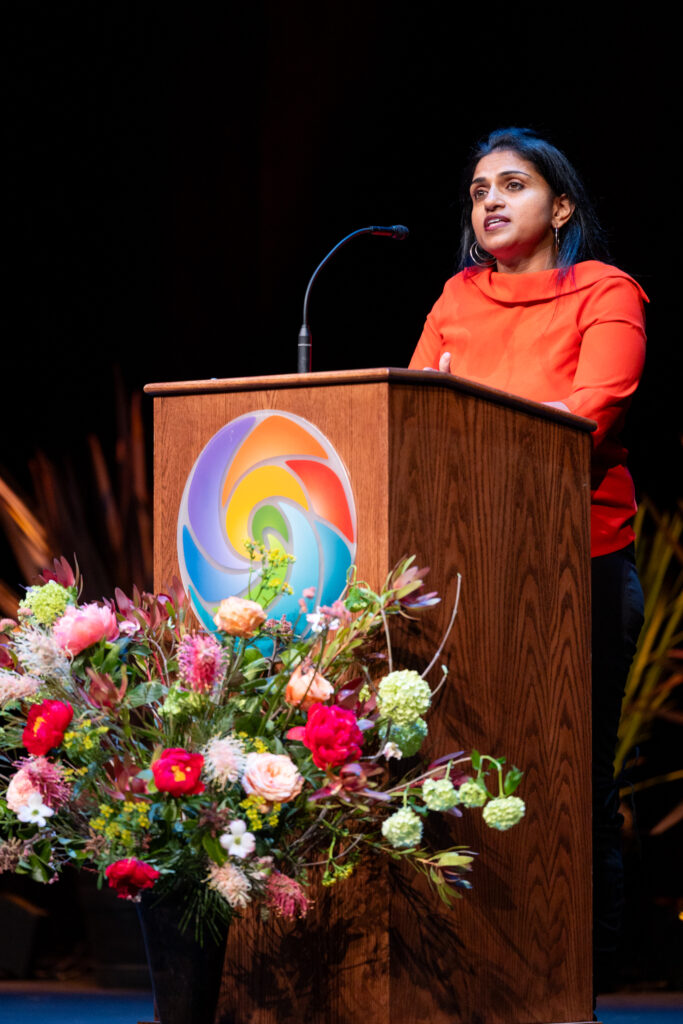
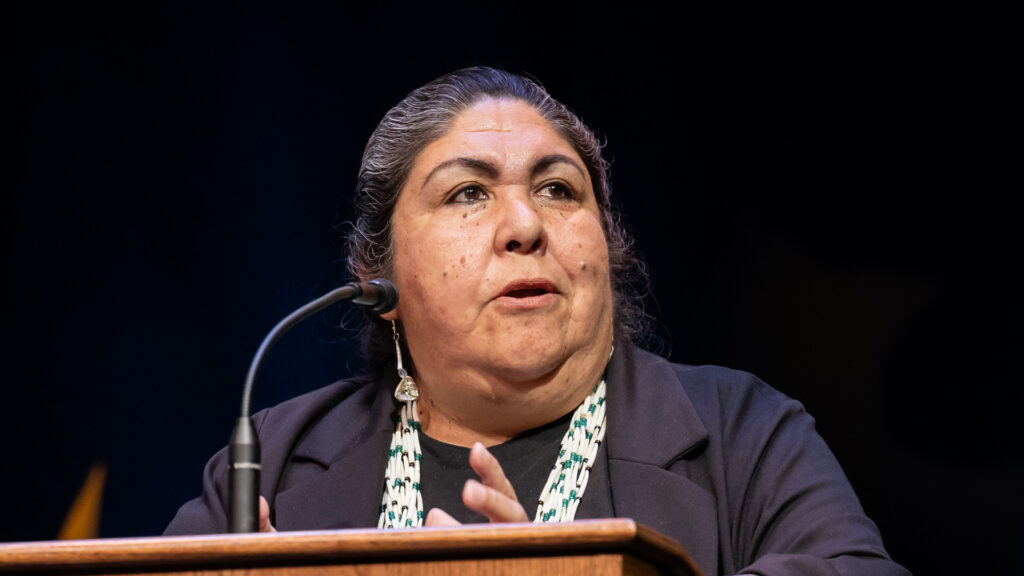
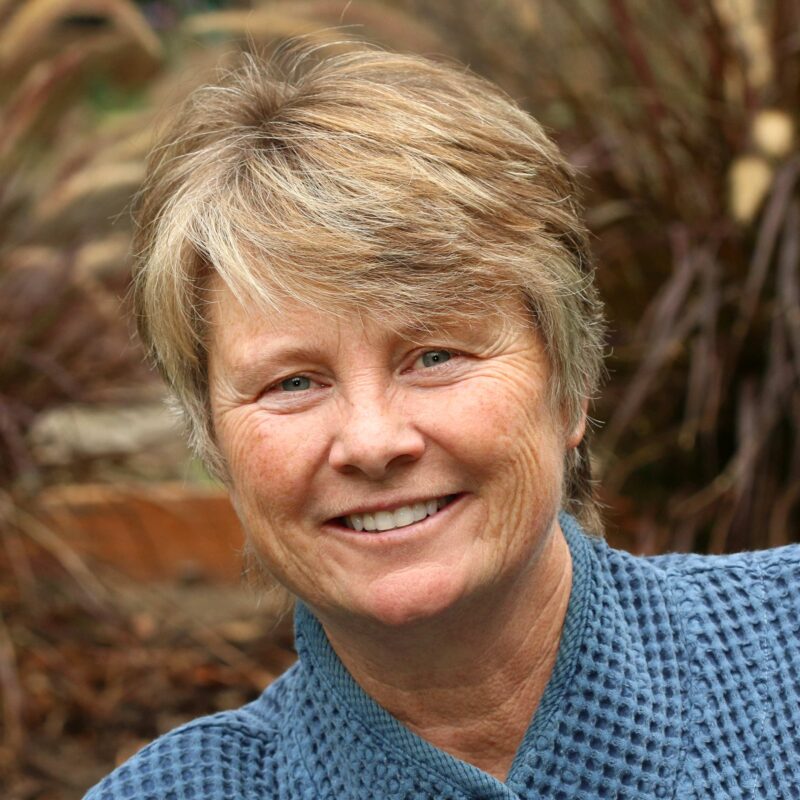
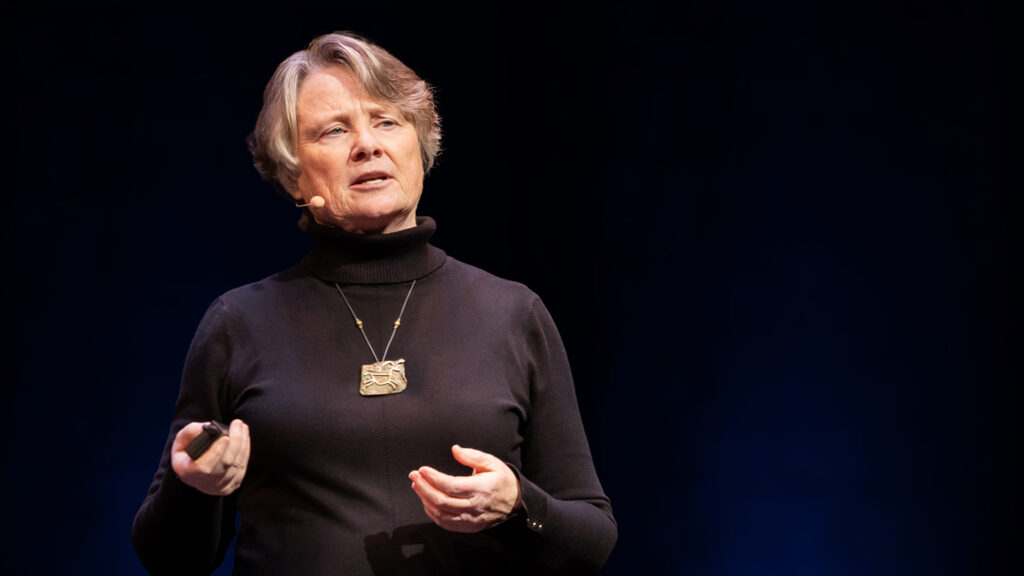
Fear and division have become defining forces in the lives of many immigrant communities — but they are not the whole story. Cristina Jiménez Moreta has spent her life working to transform that reality, drawing on her own experience growing up undocumented and her years of organizing to build collective power.
A co-founder of United We Dream, the largest immigrant youth-led organization in the country, she has helped lead some of the most influential campaigns for immigrant justice in recent history. In this keynote, she reflects on the role of community, courage, and organizing in shaping a more inclusive future.
This is an edited transcript from Bioneers 2026.
Cristina Jiménez Moreta:
I am proud to be here as someone who was formerly undocumented. My parents, Fausto and Ligia, immigrated from Ecuador, fleeing poverty and political turmoil — like so many others in our country’s history — in search of a better life for our family. We settled in Queens, New York, in 1998.
I’m a community organizer, and right now I lead Shared Future, a new initiative building a movement in support of immigrants and a shared vision of what unites us as Americans.
Before this, and before becoming a mom, I was a young organizer working alongside high school and college students to build the immigrant youth movement. Together, we helped grow United We Dream into a catalyst for one of the most powerful and inspiring movements of the past 20 years.
But even before I could build a movement, lead an organization, or call myself a community organizer, I’ll tell you the truth: I was a young undocumented person growing up in Queens, in a small studio apartment, living with the constant fear that one day my parents, my brother, or I could be taken by deportation agents and disappear.
Today, that same fear, uncertainty, and division are gripping millions of people across this country. What once felt normal has been turned upside down. And all around us, it can feel overwhelming — like it’s too much, and like there’s not much we can do about it.
I don’t need to remind you what’s happening. We’ve seen it on our phones, on TV, in Minneapolis, Los Angeles, Chicago, and communities across the country. We’re seeing aggressive immigration enforcement, families living in fear, and people afraid to go to work or send their kids to school. At the same time, everyday Americans are making courageous choices to stand up for their neighbors.
This is a new level of fear spreading around us. But I invite you to be clear-eyed about it, because without facing the truth of what’s happening, we won’t be able to find a way forward together.
And I want to remind you of this: despite all the pain and all the harm we’ve witnessed, history — and my own experience organizing in communities across the country — shows that the way through is by building community and collective power.
I’ll share why I believe this, because I grew up knowing what home felt like. Home was in Ecuador, with my abuela, making noodle soup in Quito on chilly evenings in the Andes.
But when I was 13, my family had to flee political turmoil. I left behind not just a place, but a sense of belonging. My parents didn’t have much, but they had love and courage. Guided by that, they did something incredibly hard: They left everything behind and came to this country in 1998.
Growing up in New York City, in a place where I didn’t know the language or the culture, I quickly learned to feel ashamed — ashamed of not speaking English, ashamed of being an immigrant, ashamed of my skin, my Indigenous features, ashamed of who I was.
I was undocumented, living in fear, and still trying to fulfill my parents’ dream that I would be the first in our family to go to college. I did everything I was told to do: worked hard in school, did community service, checked all the boxes.
Then 9/11 happened. And in that painful moment for our country, everything changed for families like mine, and for Muslim and immigrant communities across the country. Policies shifted. Immigrants were treated as threats to national security. In many places, including New York, undocumented students lost the ability to access higher education. People like my dad, who worked in construction, lost the right to drive.
One day, my dad was traveling between New York and New Jersey for work, crossing the George Washington Bridge. He was given the wrong change at the toll booth and tried to go back to fix it — an ordinary, honest mistake. But when you’re an immigrant, even something small can make you a target. As he turned back, a police car pulled him over. The officer asked for his license. My dad told him it was expired. That was enough. He was asked to step out of the car and taken to a local police station.
I got a call from him. He said, “I’m allowed one phone call. Mija, ayúdame.” Help me.
I told him to stay calm, to remember his rights — to remain silent, to not sign anything. Then I asked to speak to the officer and told him we knew my dad’s rights and that a lawyer was on the way. Right after that, I texted a network of organizers: “My dad needs help. This is where he is.” Within minutes, people responded. A lawyer was already on the way.
I share this story because I don’t know what happened to that police officer. What I do know is that he released my dad with a $150 ticket for driving without a license. And the only reason that happened is because we had a community behind us — people who had my back, who taught me my rights, and who gave me the courage to speak up in that moment.
That’s the kind of courage I want to share with you today. Because courage is a choice.
Undocumented people like me take real risks when we speak out and share our stories. So imagine what’s possible for those who aren’t in that same vulnerable position. Across the country, young people found courage in each other — fighting deportations, supporting one another through school, and committing to build something bigger than ourselves.
That’s how we built United We Dream. And that’s how I learned that in isolation, we lose. Alone, any one of us can be targeted, silenced, or pushed aside. But in community, we show up for each other. In community, no one has to face it alone.
I want to share this: The way we won DACA (Deferred Action for Childhood Arrivals) was by building community. We reminded each other we weren’t alone. We helped each other find our voices. And we took action together to fight for what was right.
I never imagined we would build a movement. I never imagined that years later we would be sitting across from policymakers and people in the White House, winning protections for more than 600,000 people. But we kept organizing.
I know that right now can feel uncertain. It can feel like we don’t know what comes next, or whether change is even possible. But I’m here to tell you that it is.
We’ve seen what’s possible in places like Minneapolis, where people believed in solidarity and built power together. We’re seeing it in Los Angeles and in communities across the country responding to increased immigration enforcement.
And there is a role for everyone here. This is not just about undocumented people or immigrants. All of us have a role, especially those of us with protections that others don’t have.
What’s inspiring is that people are already showing what that looks like. In some places, people are putting their bodies on the line. In others, they’re supporting neighbors in quieter but just as meaningful ways — buying groceries for families who are afraid to leave their homes, driving children to and from school, stepping in wherever help is needed.
In cities like New York and Chicago, people are building community defense networks through group chats, text chains, and rapid response systems. There are so many ways to show up.
There is a role for all of us.
I want you to see that our organizing isn’t just building hope, it’s also shifting public opinion. It’s making ICE and deportation deeply unpopular. Together, we built a mass movement that says no to ICE.
And I want to be clear: This administration wants us to believe they’re targeting people who pose a threat to our communities. But they are the ones creating fear in our communities. And people know that.
Look at what people are actually worried about: the cost of living, paying their bills, taking care of their families. Not these manufactured fears about immigrants. More and more, people are recognizing that the chaos we’re seeing is part of a strategy.
It’s a strategy to divide us. To use immigration as a scapegoat so we don’t pay attention to the real sources of harm: corporations exploiting workers and the planet, and an administration using immigrants to advance a more authoritarian vision of this country.
But people are waking up. They’re seeing through the lies. We know that lack of healthcare, underfunded schools, and economic struggle are not caused by immigrants. And even some who once supported this administration are starting to question what they’ve been told.
I’ll share one brief story. I’ve spoken with evangelical communities across the country who have told me, “We were raised conservative. We even supported this administration. But now we see what’s happening.” In fact, this week, many of them are launching a fast for immigrants and justice.
Across the country, communities — including U.S. citizens — are recognizing that this is not the future we want. And they’ve shared this message:
We are people connected by family, community, and faith. We refuse to turn away from injustice. We show up for one another. We organize with courage and compassion. And we turn our pain into power to build a future where dignity is the norm.
We won’t be divided. We have an opportunity to build a shared future — a multiracial democracy that includes all of us.
We often talk about climate change as a problem of carbon emissions rising and the technologies needed to bring them down. But that framing leaves out something fundamental.
Brett KenCairn, founding director of the Center for Regenerative Solutions and a longtime leader in community-based climate initiatives, has spent decades advancing nature-based solutions grounded in land restoration and local action. In his keynote at Bioneers 2026, he reframes the crisis as one rooted not only in emissions, but in the widespread degradation of living systems — and points toward restoration as a path forward.
This is an edited transcript of his talk.
Brett KenCairn:
I come from Boulder, Colorado, a community with a unique relationship to climate change. We have 11 federal research labs, including the National Center for Atmospheric Research, established there in 1967. Our community takes climate science seriously, probably because around 3,000 climate scientists actually live there. There’s a bit of an inside joke in Boulder that we have more climate scientists than therapists and personal trainers.
Boulder was also one of the first communities in the world to step up when our federal government chose not to sign onto early international agreements to reduce emissions. We said we would. We committed to reducing emissions as a community, and then we started organizing — working with other cities across the country and helping build a broader global movement.
When I joined in 2013 to help shape the next generation of our climate action plans, I was given the opportunity to collaborate with teams all over the world: Helsinki, Stockholm, Rio, Sydney, New York, Seattle, Toronto. It was an exuberant time.
But many of those cities are now quietly stepping back from this work. There’s a real sense of despair and hopelessness among many of us who’ve been at it for years, because we can see that our strategy isn’t working.
What I’ve come to understand is that it was doomed from the beginning, built on a false premise and a half-truth. The premise was that this problem was purely about technology — about machines, about energy sources. That if we just changed those sources — built more wind farms, installed more solar, deployed more electric vehicles and heat pumps — we could solve it.
That’s the half-truth.
Climate Change Has Two Drivers
The other half is something we’ve known for more than 50 years. If you go back to the early days of global climate conversations in the 1970s, they all pointed to the same thing: Climate change has two legs. Yes, one of those legs is fossil fuel emissions. Nothing I’m saying diminishes the importance of reducing them. But even then, we knew there was a second leg: the degradation of land, the desecration of living systems.
Because the atmosphere isn’t just a geochemical machine governed by CO₂ in and CO₂ out. It’s a life-mediated system. Life created our atmosphere — for life. And the breakdown of these living systems is what’s been driving instability within them.
When the world came together in the 1990s at the Rio Earth Summit, we understood that there were three existential threats we needed to address. Climate was one, and we created the Convention on Climate Change — the IPCC we’ve heard so much about.
But there were two other conventions established at that summit. Biodiversity was one. The other was meant to be called the Convention on Land Degradation, but that didn’t sound compelling enough, so it became the Convention to Combat Desertification. Unfortunately, that framing led many of us to think, well, that’s a problem somewhere else; maybe Africa, but not here.
But I can show you places right outside Boulder that are desertifying right now. Because even then, we understood that this crisis was also about land degradation.
But then we started to forget. We need to understand why we made those choices. But what I will say is this: It’s time to change our strategy, because the one we’ve been using doesn’t offer much hope.
Let me summarize this in a way that might feel familiar.
If I asked many of you what’s causing climate change and how we solve it, you’d probably describe it something like this: Over the past few centuries, carbon dioxide levels in the atmosphere have been rising. And as fossil fuel use has increased, emissions have risen right alongside it.
Those two trends line up so closely that it feels obvious, like clear cause and effect. It’s easy to say: There’s your answer. The smoking gun — or in this case, the smoking stack.
When you understand climate change through that relationship, it naturally leads you to believe the solutions are technological. And if you’re a financier, if you like technology, that’s a very appealing frame to work within.
But we’re starting to learn that there’s another driver here. The science is finally beginning to catch up.
A 2017 report by Jonathan Sanderman and others looked at soil loss over the past 12,000 years. For most of that time, soil loss was minimal. But with the rise of early empires and the expansion of agriculture, you start to see it increase. And then, in the last century, it accelerates dramatically.
What Sanderman and his colleagues found is striking: Somewhere between a quarter and a third of the excess carbon in the atmosphere didn’t come from burning fossil fuels. It came from the loss of soil carbon — from degrading the land itself. And it’s not just about carbon.
When we lose soil, we also lose the capacity of living systems to hold water. We’ve forgotten that the most abundant greenhouse gas driving warming isn’t CO₂. It’s water vapor. So as we degrade the land, we’re not only releasing carbon, we’re also releasing vast amounts of water that would otherwise be held in healthy ecosystems. And that, too, intensifies climate instability.
There’s another relationship here, too: how fossil fuels, used through machinery, have reshaped the land itself. You don’t have to look far to see it. Just look at our own backyards. Take the Great Plains, once one of the most extraordinary ecological systems on the planet. In the span of just 10 years, we plowed up 30 million acres.
And it wasn’t just in the United States. This was happening all over the world. So while we’ve told ourselves the story that climate change is about industry and fossil fuel combustion, it’s also about the widespread degradation of the living world.
And the scale of it is immense.
The UN estimates that around 70% of the Earth’s terrestrial systems are degraded. A report last year suggested that roughly half of the planet’s biological capacity has already been compromised.
We’re living on a planet operating at roughly half its basic photosynthetic capacity — what scientists call “net primary productivity.” We don’t even know what it feels like to live on a fully functioning planet anymore. Although we’ve heard the stories.
We’ve Recovered Before, and We Can Again
Remember the stories about the passenger pigeons? Wow, when they took flight, the sky would go dark? That the rivers were so full of salmon you could walk across them? That you could stand on the Plains, look in any direction for miles, and see the land moving with millions of buffalo?
That’s what this planet looked like when it was operating at its full capacity. And that’s what we have to bring back. It’s the only real hope we have to address the climate crisis.
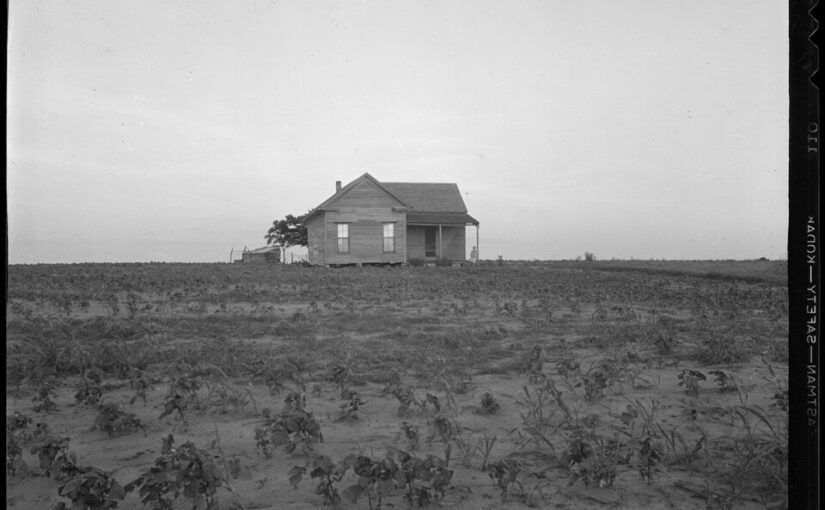
Now, it can feel hopeless. But there have been other moments when it felt that way. If you haven’t watched documentaries about the Dust Bowl, you should. Try to imagine what it was like on the Great Plains after we plowed up 30 million acres and turned it into a monoculture of wheat, and then the dust storms began. At first, just a few each year. Then dozens. People describe walls of dust, miles high, rolling toward them — like hell itself descending. It must have felt hopeless.
But we lived in a time when we still believed we could do something about it. When we believed we could return to the land and repair what we had broken. Millions of people went back to work restoring it. We made a living putting the world back together. And we did it.
In the span of a decade, we stopped the destruction. Within another decade, we began to restore what had been lost.
What happened during the Dust Bowl affected nearly a third of this country, but it also showed what’s possible at scale. The work people did together was extraordinary. Billions of plants were put back into the ground. Thousands of miles of contouring and check dams were built. It was simple, practical work, but deeply impactful. And it’s exactly the kind of work we need to be doing again.
I recently heard a presentation from Elizabeth Heilman at Wichita State. She shared that in parts of Kansas, regenerative agriculture has now been adopted at a remarkable scale — something like 70% of a county has returned its land to living cover, to deep-rooted systems. Do you know what they’re seeing? They’re changing weather patterns.
We can do this. We’ve done this. We are doing this right now.
The Real Shift: An Economy That Repairs the Planet
This won’t happen just because we shift consciousness, or do more education, or launch another communications campaign for the planet. It will happen because we change the economy. We have to make it possible to make a living repairing the planet.
There’s promising research showing that if we restored just a third of degraded land globally, we could stabilize the climate while also reversing biodiversity loss. And according to the World Economic Forum, that kind of effort could generate 190 million jobs and $3.5 trillion in economic activity.
That’s the future we need to demand. So where do we start?
First, we have to prepare and plan, just like in the 1930s. When systems begin to unravel, it’s too late to start from scratch.
Second, we need to test and prove what works. Pilot these approaches now. Get them underway.
Third, we need partnerships at every level — across neighborhoods, jurisdictions, countries. And we have to learn quickly and scale what works.
And finally, we have to remember: This is a political process. I know it’s more fun to talk about whales and growing things — I like that too — but this is political.
Yes, this is daunting. I know, especially for younger leaders, it can feel overwhelming. But you can start now.
In my own community, we’re starting with a simple idea: Remove the barriers to participation. We have to de-professionalize land stewardship. This isn’t complicated work. It’s something many of us can do. But when only professionals are allowed to participate, most people are left out.
First, we need to move beyond volunteerism. That was a 20th-century model. People’s time and knowledge deserve to be paid. Even modest support — 10 to 15 hours a month at a living wage — can sustain these systems. Water the trees, mulch, care for the plants. That’s enough to keep things going.
Second, we need the infrastructure to do this at scale. We’re training local contractors, especially small and minority-owned businesses, in things like wildfire-resilient landscaping, rain gardens, and biodiversity restoration. Then the public sector can seed that capacity through small contracts.
Third, we need to fund this work at scale. Through partnerships, we’ve seen how communities can generate tens of millions of dollars through local funding measures to invest in restoration.
That’s what we need to be doing everywhere. And we can. So join in.
Start by growing something. A flower, a medicinal plant, food. Then learn how it grows alongside other plants — what it needs, what it supports. And then start to see how that small system fits into something larger. Before long, you’ll find yourself part of a much bigger community — one that’s ready to welcome you and help you find your way.
What does it take for people to meaningfully participate in democracy? For millions of workers, the answer starts with something basic: being able to afford to live.
Saru Jayaraman, President of One Fair Wage, has spent decades organizing restaurant workers and advocating for fair wages across the country. In her keynote at Bioneers 2026, she made the case that economic justice is not separate from democracy or climate action, but foundational to both.
This is an edited transcript of her talk.
Saru Jayaraman:
For 25 years, I’ve been organizing and representing workers in the restaurant industry. It employs 13.6 million people in the United States, many in the lowest-wage jobs in the country.
In past talks at Bioneers, I’ve shared that the subminimum wage for tipped workers was $2.13 an hour. Still today, in 2026, the largest employer of women, people of color, youth, immigrants, and really so many of us can legally pay just $2.13 an hour.
I’ve said again and again that when so much of America cannot afford to feed themselves or their families, they also cannot engage politically. There is no way people can take on issues like the climate crisis when they are working three jobs instead of one, and when those in power represent the opposite of what they need.
As I’ve continued to share this, I’ve faced a lot of pushback. In 2024, when we were raising money to put wage increases on the ballot in states like Arizona and Michigan, donors told me, “That’s cute. You’re trying to raise wages. We’re trying to save democracy.”
But raising wages is saving democracy.
Despite these repeated warnings, we’ve landed in a crisis that has been building for a long time. One clear example: Trump campaigned on and delivered “no tax on tips,” even though two-thirds of tipped workers don’t earn enough to pay federal income tax. But he at least recognized these workers as worth speaking to.
When that happened, I urged Kamala to engage this audience as well. The answer was no, again and again.
In the last election, many tipped workers either stayed home or shifted their support elsewhere. Not because they didn’t care, but because they felt unseen. We didn’t speak to them. We didn’t say, “Your lives matter.”
What the whole “no tax on tips” moment revealed is this: When you leave people out, you do it at your own peril. When large groups of people are excluded, they become vulnerable to being co-opted by the right.
In April of last year, a series of articles in USA Today documented a rumor spreading among MAGA voters that Trump had already raised the federal minimum wage to $25 an hour. The videos were widely shared and gained significant traction among right-wing audiences.
Now, we all know it’s a lie. That’s not the news. The news is that they didn’t claim he raised wages to $15, or $17, or even $20. They said $25 an hour: the minimum needed to live anywhere in the United States right now. They chose the number that reflects people’s lived reality, including their own base. And it resonated.
We have a five-alarm fire. The right is talking about $25 and energizing their base around it, while the left is stuck arguing for $17, or in some places, still $15. I’ll be blunt. This is why people are frustrated with us. They see us negotiating against ourselves before we even enter the room. They see us settling for half a loaf.
When we saw this, we organized an emergency convening in Los Angeles in June, bringing together 140 labor and community leaders from 15 states. The message was clear. It’s time to move beyond the Fight for $15. It’s time to demand a living wage for all, with a national floor of $25.
Since that gathering, we’ve launched campaigns, bills, and ballot measures in dozens of states calling for $25 across the board, and $30 in higher-cost areas. Several counties have already taken action.
Within our own movement, there was hesitation. “$25? That’s too high. $30? Impossible.” So we polled it across red, blue, and purple districts. The result was overwhelming support. And when we tested the opposition’s messaging, that this would raise prices, cost jobs, or hurt small businesses, support actually increased.
People are angry. If you tell them wages can’t go up because prices will rise, they respond, “What are you talking about? Prices have already gone up.”
The only thing that hasn’t increased is the value of human labor.
There’s so much talk about affordability, but most of it centers on bringing costs down. There is no world in which affordability comes from bringing costs down alone. Inflation over the last 75 years has never meaningfully reversed. The only way to make life more affordable for half of working Americans, and it is half who earn less than $25, is to increase wages.
This unprecedented affordability crisis is also a democracy crisis. And that makes this a moment of real consequence.
I know there’s a lot to be unhappy about. There’s a lot to defend. But if all we do is play defense, we will lose. We need a proactive vision that is bold, that shows people we are fighting. And it has to focus on the issue they keep telling us matters most, the cost of living.
We’re in a moment of real opportunity. The pendulum could swing toward a world where people work one job instead of three, where they can thrive instead of just survive, where they have time with their kids, and the capacity to engage with the issues they care about, including the climate crisis.
I believe we can achieve this because fair wages is one of the few issues working people across the political spectrum can agree on.
Introduction by Nina Simons, Bioneers Co-founder and Chief Relationship Strategist.
Terry Tempest Williams, one of our nation’s living literary treasures and a guiding light for many of us regarding ethics and citizenship, shares how she emerged from a dream during the pandemic in 2020 with a renewed vow she had forgotten. In this time of political and climate chaos, as we seek beauty and cohesion wherever we can find its glimmer, Terry focused on “The Glorians,” the overlooked presences—animal, plant, memory, moment—that reveal our shared vulnerability and interconnectedness with the natural world and how they can inspire us to carry forward with grace. “The Glorians are reaching out to us,” she writes,” inviting us to dream a new world into being.”
This talk was delivered at the 2026 Bioneers Conference.
Terry Tempest Williams, a writer, educator, and environmental activist known for her lyrical and impassioned prose, is the author of over twenty creative nonfiction books including the environmental literature classic, Refuge – An Unnatural History of Family and Place, and: The Open Space of Democracy, Finding Beauty in a Broken World, When Women Were Birds, and Erosion – Essays of Undoing. Her most recent book is the The Glorians – Visitations from the Holy Ordinary (spring ’26). A Recipient of Guggenheim and Lannan literary fellowships, Ms. Williams’ work has appeared widely, including in The New York Times, The New Yorker, The Progressive, and Orion, and has been translated worldwide. A member of the American Academy of Arts and Letters, she is currently Writer-in-Residence at the Harvard Divinity School.
In a recent conversation with Bioneers co-founder Nina Simons, Terry Tempest Williams reflects more personally on the inner terrain behind her work — art, activism, spirituality, and the discipline of staying open. She speaks to grief as a form of love, to community as a site of imagination, and to the quiet but radical act of not looking away. As she describes it, “finding beauty in a broken world is creating beauty in the world we find.”
In this podcast episode, Terry Tempest Williams asks: How do we find the strength to not look away at all that is breaking our hearts? Hands on the earth, we remember where the source of our authentic power comes from.
Terry Tempest Williams is one of the most celebrated and revered American nature writers. She integrates the musicality of a poet with the passion and purpose of an activist. Terry is also an award-winning conservationist, a fierce defender of her beloved Southwestern desert landscapes.
She has authored over 20 books that are translated worldwide. Her most recent book is The Glorians: Visitations from the Holy Ordinary.
Bioneers co-founder Nina Simons, author of Nature, Culture and the Sacred: A Woman Listens for Leadership, engaged with Terry at a Bioneers conference in a wide ranging conversation between two old friends.
Featuring
Terry Tempest Williams, a writer, educator, and environmental activist known for her lyrical and impassioned prose, is the author of over twenty creative nonfiction books. Her work has appeared widely, including in The New York Times, The New Yorker, The Progressive, and Orion, and has been translated worldwide. Her most recent book is the The Glorians – Visitations from the Holy Ordinary (spring ’26).
Credits
Executive Producer: Kenny Ausubel
Written by: Kenny Ausubel
Producer: Teo Grossman
Senior Producer and Station Relations: Stephanie Welch
Associate Producer and Show Engineer: Emily Harris
This is an episode of the Bioneers: Revolution from the Heart of Nature series. Visit the radio and podcast homepage to find out how to hear the program on your local station and how to subscribe to the podcast.
Subscribe to the Bioneers: Revolution from The Heart of Nature podcast
Transcript
Neil Harvey (Host): Standing in the lineage of the greatest nature writers, the acclaimed author, naturalist and activist Terry Tempest Williams links her deepest inner experiences with the state of the web of life. She plumbs connections: art and ecology – women and politics – democracy and social healing – wild lands and First Peoples – family and faith.
I’m Neil Harvey. This is “A Conversation with Terry Tempest Williams”
Terry Tempest Williams is one of the most celebrated and revered American nature writers. She integrates the musicality of a poet with the passion and purpose of an activist. Her tender personal reflections and intimate insights as a naturalist braid together with her keen political and spiritual insight in a voice that feels most at home in the liminal – in the space between words.
Her work and her life encompass many dimensions beyond writing. As a socially and politically engaged artist, Terry is also an award-winning conservationist, a fierce defender of her beloved Southwestern desert landscapes. She’s done everything from civil disobedience to testifying before Congress on women’s health issues, to buying gas leases to prevent the desecration of pristine and sacred lands.
She has authored over 20 books that are translated worldwide, including the masterwork Refuge: An Unnatural History of Family and Place. Her most recent book is The Glorians: Visitations from the Holy Ordinary.
Terry has received numerous prestigious literary awards, and her long academic career recently included serving as writer- in-residence at Harvard Divinity School.
Terry Tempest Williams spoke at a recent Bioneers conference, where Bioneers co-founder Nina Simons, author of Nature, Culture and the Sacred: A Woman Listens for Leadership, engaged with her in a free-range conversation between two old friends.
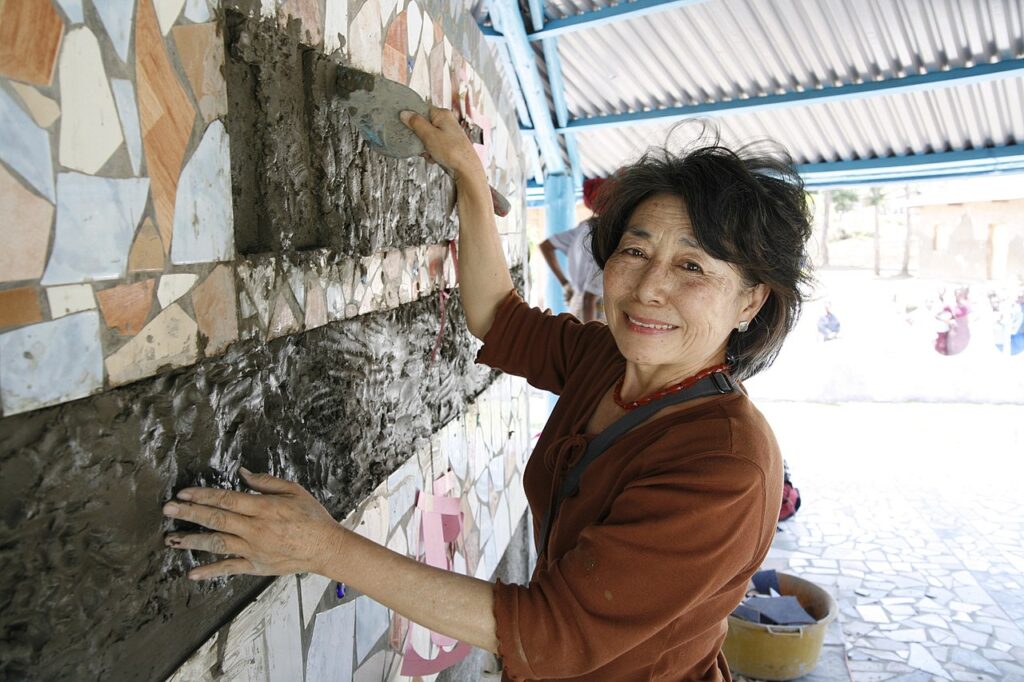
Nina began by asking Terry to describe the story from her book Finding Beauty in a Broken World chronicling her experience making social healing mosaics in Rwanda with the artist Lily Yeh.
Nina Simons(NS): In Finding Beauty in a Broken World, you share the story of Lily Yeh’s work with barefoot artists, helping create healing places in Rwanda and globally through engaged community art creation. And in both her work and your own, my sense is that you each elevate art to a place where its healing capacity for people, society and culture is amplified in community. You wrote that finding beauty in a broken world is creating beauty in the world you find. So now, when the need to transform our culture and society is at an all-time high, and since artists often foresee the future, I wonder if you have any thoughts about the role of artists in times like this, and what you might suggest to artists whose catalytic capacity is so vital, though so often undervalued in this society.
Terry Tempest Williams(TTW): How many of you know the work of Lily Yeh? She’s a phenomenal artist. She’s now 85, almost to be 86 years old, Asian, born in Taiwan, in China, her family. I met her in 2001, after I realized September 11th, my rhetoric had become as brittle as the opposition. And I had forgotten my poetry.
And I remember being in Maine. We were at a family place. And it was high tide. I went out to a rocky point and I said prayers. And basically said to the sea: Give me one wild word and I promise I will follow. And the word that came back to me after listening was mosaic. And I thought, oh no, my life is now going to be relegated to breaking my mother’s dishes and making bad picture frames. You know? I was—I did not understand mosaic.
And I did some research, and Lily Yeh, her name came up. She started the Village of Arts and Humanities just outside Philly, in a very tough neighborhood. And I went on a pilgrimage to meet her. And she really changed my life and showed me the aisle of angels made of mosaics, the safehouses of mosaics, how…her colleague who was—had been a former drug dealer, became a master mosaicist. And they made these beautiful murals, and it—her work has been one of placemaking around the world.
She later came to Salt Lake to do a mural in one of the poorer neighborhoods that had been invisible to the community. It became highly visible with the Latina and Latino communities. And then she said, “I need to talk to you.” And she said, “Will you come with me as a barefoot artist to Rwanda?” And I said no. My brother had just died a month earlier, and I said I cannot. I did not want to be in any more death. I cannot go. And Nina, she just stared at me. And then I heard myself, and I realized if I said no, I would be saying no to my spiritual life and growth, and I heard myself say yes. And another life-changing moment.
And, I have to tell you, here’s another lesson I learned from her. Very conscientious, you know, if I’ve got a job, I will take it seriously. So knowing we were going to go to Rwanda, I got a map, looked where it was, what it was next to. I read over 60 books, everything I could get my hands on – novels, non-fiction, government reports – went to the Library of Congress, looked at all the maps – fire maps, water maps, war maps – just to get it in my mind. And she called me and she said, “I just want to know how you’re preparing.” And so I gave her this whole list, told her what I just told you. And I said but I just don’t feel like I’m getting anywhere, but I’ve got more books to read. And I said, ‘How are you preparing?’ And there’s this long silence, and she said, “I’m meditating.” And I quit reading. And just sat with that. So she’s a real teacher.
And I think that’s what art does for us, it bypasses rhetoric and pierces the heart, and the heart is really, I think, where all change resides.
And I saw…the power of art, to go into communities…numb with grief, dead with grief, the bones of these women’s children were buried under trees that were still there, that they were carrying in the folds of their skirts. But when Lily got the paint out and the children took over and painted their houses – turquoise, yellow, red, animals – something lifted. And what it led to was the creation of a genocide memorial, where these women – and most of them were women – could bury their beloveds in a place of dignity. And that was Lily.
NS: You know that conversation about Rwanda leads me to ask you, as we are both women who are childless by choice, about your decision to adopt a son, and how that’s changing you.
TTW: My hair’s white. [LAUGHTER] Louis Gakumba is our son. He was our translator in Rwanda. And so, again, Lily. You know?
I think being a mother at 50, as you say, childless by choice… it has brought me to my knees, and I mean in the most beautiful ways, for both Brooke and me. And Louis has been our teacher. It’s been hard. I knew nothing. I still know nothing. I am a grandmother. I have two grandchildren – we do – Malka who is 8, and Shayja who is 7. Shayja loves birds. I love him. He’s constantly calling about what he sees.
Malka, I will share this with you, since you asked how’s it changing me… When she was 5, she said to me, “Do you think I’m too black?” And I said, ‘Malka, you are beautiful.’ And I said, ‘Why do you think that?’ And she gave me her reasons. And I said, ‘Let’s look at all the beautiful Black women.’ And we looked online, and she said, “She’s black like me. She’s black like me. She’s black like me.” And then she said, “Will you show me your body?” And I have to tell you, it was the scariest thing I’ve ever done in my life, was take off my clothes in front of a 5-year old. And turn around. And then, as I am standing before my granddaughter, she says, “What color is your heart?” And I said, ‘The same color as yours.’ And we’ve never had that discussion again.
And the other day, three years later, she said, “Te Te Terry, don’t you think I’m beautiful? And I just said, ‘You are so beautiful.’ And so I think it’s what we learn together.
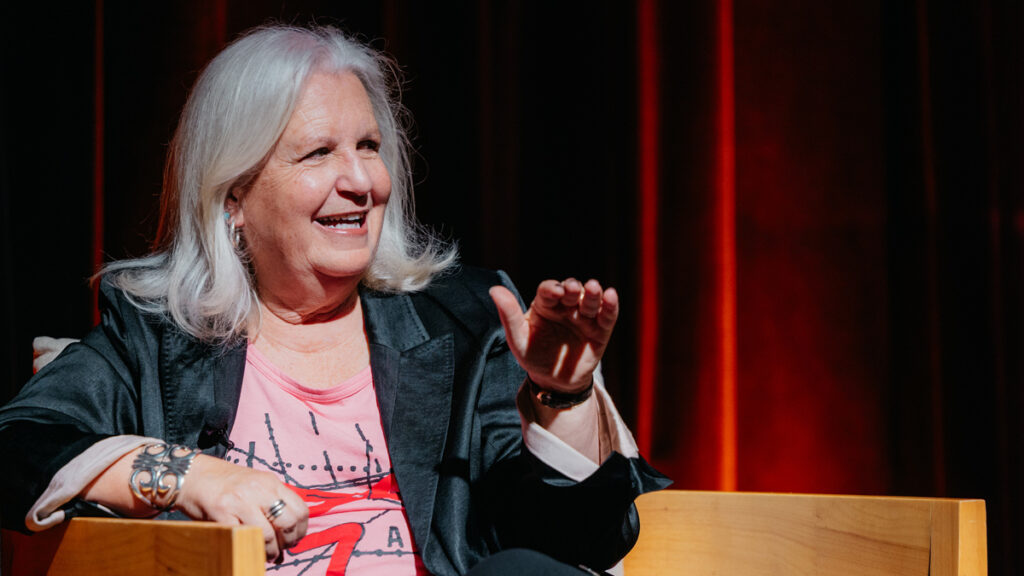
Terry Tempest Williams at Bioneers 2026. Photo: Boris Zharkov
Shayja, the other day, we were up in Shenandoah, and he’s staring at me. You know? And I think, okay, this’ll come out. And he goes, “If only you were a little tanner.” And I just—you know, so we are learning about interracial family together, and it’s a beautiful thing. And Louis just wrote his memoir. It’s tough, it’s beautiful, and he said I want my children to know where they come from. And I want them to know who my ancestors are and—so we’re learning.
And my father, who would tell you in this audience, was a true racist. And he is now 92, and he and Louis are closer than I can ever tell you. And it was on a plane from Denver to Salt Lake, and Dad and Louis were sitting together on the exit row, and a flight attendant said, “Yes, yes, yes.” And when Louis said yes, she said, “Get out, you don’t speak English.” And my father stood up and said, “Apologize. He speaks six languages. He’s smarter than anyone on this plane.” And she said, “Get out.” And my father stood up and said, “This plane will not fly until you apologize.”
And when dad came home, I called him to see if they’d gotten home, and the flight attendant let things go, apologized. When I called my father, he was crying. And he said Terry, “I knew racism from the inside out. I never knew racism from the outside in.” And that night, he had a stroke. And I think it was such a shock that he literally was rewired. And it was Louis who took him to the emergency room, sat with him all night, and held his hand. No one holds my father’s hand. So it’s those kinds of changes, Nina. Aside from love and joy and… I’m grateful.
Host: When we return, Terry Tempest Williams and Nina Simons explore how to marry contradictions, being species-fluid, and feeding a spider.
I’m Neil Harvey. You’re listening to the Bioneers: Revolution from the Heart of Nature.
Host: If you’d like to see and hear more from Terry Tempest Williams, you can visit bioneers.org
Let’s drop back into the kitchen table conversation with Terry Tempest Williams and Nina Simons.
NS: Well, years ago, we had a conversation where you spoke of feeling drawn to marrying apparent contradictions. And it landed in me in a big way. And—
TTW: In what way?
NS: Well, in that every time I found myself encountering an apparent contradiction, I thought of you, and I thought, Huh, what does it mean to try to marry these things that seem so polarized. And…it was long before there was so much interest in non-binary gendered identities, and I found it a useful practice, to see how I could imagine them dancing together. Do you still find that resonant for you?
TTW: Every day.
NS: Yeah. [LAUGHS]
TTW: You know, living around Great Salt Lake, and living long enough to have seen her in her historic high, and now at her historic low, in retreat – and I don’t see it as retreat in the military retreat. I see it as a retreat as one goes on retreat or retreat in meditation or retreat in reflection. And I feel she’s inviting us to do the same.
So here is a saline lake that theoretically is dying, and alongside her death will be the death of the Wasatch Front – 2.5 million people if we do nothing. Not to mention the livelihood of 12 million birds. Right now, I have never seen Great Salt Lake so vibrant. I have never seen the Salt Lake area more alive with concern, with creative thinking, with young people, with artists, the Mormon Church. Great Salt Lake now has a new ally – Donald Trump. I don’t know how to deal with that, the paradox, because if I’m saying all hands on deck, that means Donald Trump’s hands too. And then I think, are we losing the lake even as we’re trying to save the lake?
I watch people who are saying it’s not called Great Salt Lake anymore, it’s theLake. There are those that are saying this is America’s lake… I see them neutering her. And the Native people have said our Sacred Mother Lake. This is how we know her, this is how we want her dressed. I see the tribes not being brought to the table as sovereign nations, as sovereign governments. So it’s this, that and all of it.
And the Wilson’s phalarope, which is now an endangered species, we’ve filed a petition for that species protection. The scientists on one hand say we have five years, seven years. The percentage of a saline lake ever being saved is zero.
But now, the governor, who’s on board, saying the deadline is 2034, which is the Winter Olympics. So that’s not the lake’s deadline. That’s not the phalarope’s deadline. So how do we juggle all of these things? It’s a paradox that feels like a hologram. And, yet, Great Salt Lake is directing us.
And I think, again, what we were talking about today. If we are present, we’ll know what to do. If we’re listening to the lake, we will hear what she has to say. And, again, the elders, the different tribes, are leading the way, in my mind, and with integrity and a spiritual depth that I’m not seeing elsewhere.
NS: I feel a tremendous connection with you and your writing through the way that you speak to and embody a quality of the feminine in your work. And the “feminine” I want to say, with quotes, because it’s such a weird word, and it’s been so malformed in our culture. And I think of When Women Were Birds. And I’ve recently begun studying the Tao Te Ching, and especially Ursula Le Guin’s version of it.
TTW: I love that.
NS: Which is so wonderful. And it’s reminding me of a long fascination that I’ve had with this quality that’s beyond binary genderism that’s about how one way of seeing how we’ve gone so wrong is the imbalance of the yin and the yang in all of us – in our culture, in our—you know, economy, in our education, in everything. I find myself reaching to expand the gender dialogue to encompass everyone and everything, and the archetypal necessity of rebalancing our inner framework. I wonder if you have any thoughts about that.
TTW: Just for the record, I’m thinking do I dare say this. You know? [LAUGHTER] I won’t have the right language, and I’m sure I will say it wrong and offend someone. But there was a moment in one of my classes, and we were—you know, the students write essays and braided essays, and gender pronouns, all of that comes up, and it’s important, and we’re all learning. And we’ve had some really powerful conversations in terms of what stories do we tell, what’s private, what’s personal, what about families, all of those. And we had an incredible conversation about queerness. And I said, ‘I think I’m queer.’ And you could have heard a pin drop. You know? And they go, “What do you mean?” And I said, ‘Well, we’ve been talking about being gender fluid. I feel I’m species fluid.’ And they got so excited. [LAUGHTER] You know? But I feel that. You know?
And I remember in An Unspoken Hunger, I talked about pansexuality in The Yellowstone: An Erotics of Place, and mentioned bison. And, you know, I think we’re so limited in terms of what we are capable of, in terms of our understanding different genders, in terms of understanding different species, and yet, if we can open ourselves and really be present with whomever we’re with, I think there is a depth of reciprocity and responsibility and empathy that is transferred. And I feel that again and again and again in the natural world. Call it serendipitous, call it the erotics of place, call it species—being species fluid.
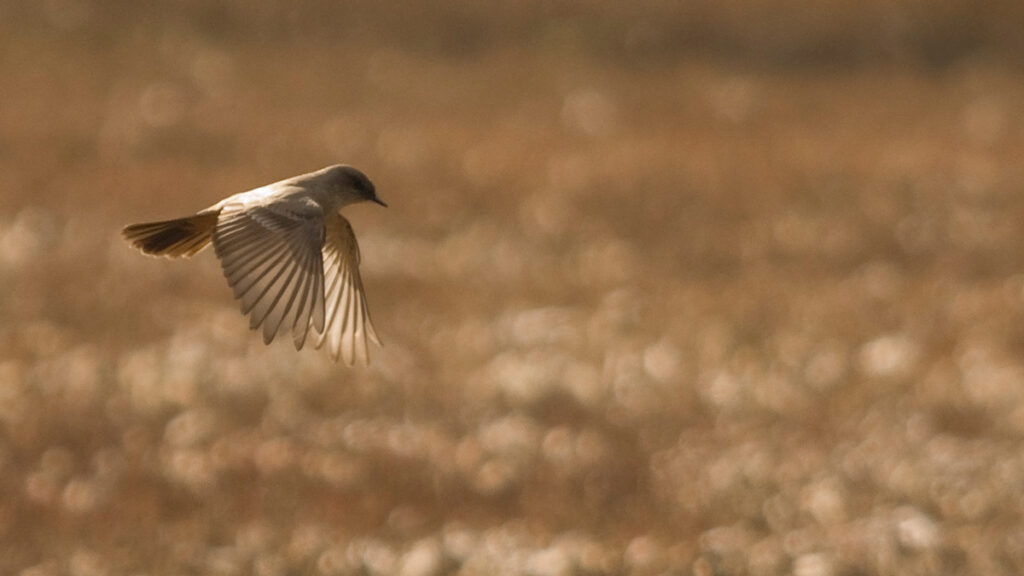
Talking to a person on the phone about the Say’s phoebes, that they were so beautiful. And I said, ‘I just love them.’ And then one jumped on my head. You know? And you just think, they know, you know? We’ve all had this experience.
And it seems to me that the ultimate act of anthropomorphism is to assume that other species don’t feel, don’t communicate, don’t live and love and grieve. The exceptionalism that we have, I think, is so limiting, whether it’s our own view of gender, whether it’s our own view of the natural world, whether it’s our own view of ourselves.
So how do we keep expanding? How do we live and love with our hearts wide open, even in brokenness?
Host: The deeper story where the sacred dwells, where anything is possible.
As one of our generation’s greatest storytellers, Terry Tempest Williams engages with the world around her by building bridges between the human and other-than-human worlds.
In an excerpt from her recent book, The Glorians, she returns to the landscape she calls home, the Red Rock desert of Utah. She writes about what she calls “visitations from the holy ordinary,” moments and experiences that draw her deeper into relationship with the pulsing, thriving life that surrounds us all.
TTW: This is from The Glorians.
“‘I came from a family of repairers,’ the artist Louise Bourgeois once said, ‘The spider is a repairer. If you bash into the web of a spider, she doesn’t get mad. She weaves and repairs it.’
When I think of black widows in the desert, I wonder if this is true. Their webs are messy and hidden, not at all elegant like the orb weavers’ circular webs that spiral outward in summer fields of goldenrod. Black widows offer a warning. When their web is touched, it crackles like a witch, inspiring panic. The chaotic nest is a morgue of tightly wrapped victims that have had their blood sucked out of them, heightening the red hourglass on the female’s shiny black body.
Here in the Red Rock desert, they are everywhere – in between rocks, nestled in cliffs, and inhabiting our homes. Best to check coat pockets, behind pillows, and inside shoes. We have learned to live with them.
One summer, we had a large female, her abdomen the size of a Costco blueberry.” I wish I’d used a different metaphor. [LAUGHTER] “The size of a Costco blueberry, who lived behind our armoire in our bedroom. Brooke was out of town and I was about to leave for a longer period of time, so I left him a yellow sticky note attached to the wall close to where she would often come out to feed, and wrote: Please take care of her. X X X, T.
When Brooke returned home, he saw the note, and instead of understanding my message to mean please take her outside, he took it to mean please feed her. Which is exactly what he did for weeks. When I returned home, her abdomen was the size of a grape. [LAUGHTER]
The summer progressed, and one night, I was home alone again. It was hot and I couldn’t sleep. Rather than fight it, I decided I would listen to a group of soundscapes a friend had recently sent me as a stay against loneliness and heat-induced insomnia. One recording was from the Arctic in Alaska, one was from the rainforest in Costa Rica, and one was from Arizona Sonoran Desert. I listened to the Arctic. I didn’t think there was anything on it. I turned on the bedroom light and listened more closely. If one can hear cold, it was a faint growl. I changed CDs.
This time, I sat up with a low-wattage lamp. The rain intensified, and without thought, I started having an anxiety attack thinking there might be another flash flood, until I realized that it sounded, to my desert ear, like exactly that, a flash flood. I was two for two with no relief for loneliness or hope of a lullaby.
The final recording was of the Sonoran Desert, with giant saguaros on the cover. I placed the CD in the machine and returned to my chair. It was perfect. The familiar sounds of crickets, bat wings, and the pinpoint peeps, a band of coyotes and some insects I did not recognize. Just then, a shadow appeared on the wall. [LAUGHTER] I turned to see the black widow drawn from her hiding place by sounds of the desert night she inhabits. I was not startled, but welcomed her presence.
I sat in my chair. She was poised on the edge of her web. Together in soft light, we listened to night sounds from the Sonoran, a woman and a spider, comfortable with each other’s company.”
Thank you. Thank you so much. And let’s thank Nina for everything. [APPLAUSE]
NS: Thank you, all. Thank you, Terry, so very much. [APPLAUSE]
Host: “A Conversation with Terry Tempest Williams.”
Introduction by Cara Romero, Executive Director, Bioneers and Director, Indigeneity Program.
Now in his 50th year working as a media creator, actor and musician, Gary Farmer has been a groundbreaking figure in prying open doors for Indigenous contributors to the performing arts, helping found a magazine and radio and TV networks in Canada highlighting Native creators and voices, as well as appearing in many TV series and several legendary films including Powwow Highway, Dead Man and Smoke Signals. Gary explores why it is more important than ever for Native people to control their own narratives, in an era in which our collective survival will depend on our learning to put the Earth first. It is time for Turtle Island TV!
This talk was delivered at the 2026 Bioneers Conference.
Gary Farmer, an actor and musician born on Six Nations land along the Grand River, Ohsweken, Ontario, is widely recognized as a groundbreaking figure in the development of Indigenous media in Canada. The founding Director of Aboriginal Voices Radio Network, he was also the Publisher of Aboriginal Voices Magazine from 1993 to 2003. As an actor Gary has been nominated for three Independent Spirit Awards for Best Supporting Male Actor in: Powwow Highway, Dead Man, and Smoke Signals, and, most recently, he is a regular on two popular television series—Resident Alien and Reservation Dogs.
A Bioneers podcast series that features deep and engaging conversations with Native culture bearers, scholars, movement leaders, and non-Native allies on the most important issues and solutions in Indian Country.
Explore powerful films that celebrate resilience, culture, and community, and consider hosting a screening to bring these stories to your own community.
Introduction by Dacher Keltner, Distinguished Professor of Psychology at UC Berkeley.
Michael Pollan, one of the nation’s most influential non-fiction writers and investigative journalists, is the author of nine previous bestselling books, including How to Change Your Mind; In Defense of Food; The Omnivore’s Dilemma; and The Botany of Desire. He traces his six-year quest to solve the greatest mystery in nature: how, and why, are we conscious? That Odyssey, which he describes in his newest book, A World Appears: A Journey into Consciousness, is an enthralling tale that begins in a brain lab in Seattle, and ends, of all places, in a cave in the mountains of New Mexico, where he discovers that explaining consciousness may be less important than learning to practice it, fully, in our everyday lives.
This talk was delivered at the 2026 Bioneers Conference.
Michael Pollan is a writer, teacher and activist. His most recent book, A World Appears: A Journey into Consciousness, was published earlier this year. He is the author of nine previous books, including: This is Your Mind on Plants, How to Change Your Mind, Cooked, Food Rules, In Defense of Food, The Omnivore’s Dilemma, and The Botany of Desire, all bestsellers. Pollan has taught writing at Harvard and UC Berkeley and has been a Guggenheim and Radcliffe Fellow. In 2010 Time Magazine named him one of the 100 most influential people in the world.
In this podcast episode, Michael Pollan embraces the mystery at the heart of the great mystery of life: What is the nature of consciousness? And how can we understand consciousness when our only tool is our own consciousness? Joined by interviewer and UC Berkeley Psychology Professor Dacher Keltner.
In this Bioneers 2018 keynote talk, Michael Pollan shares his luminous insights from what began as investigative reportage and became a very personal interior journey into the mystery of consciousness and the nature of spirituality at this perilous moment when only a shift in human consciousness can alter the deadly trajectory of our societies.
Two brilliant visionaries, Michael Pollan and Monica Gagliano, engage in a conversation hosted by J.P. Harpignies, Bioneers Senior Producer of Conference and Special Projects.
Introduction by Kenny Ausubel, Bioneers Co-Founder and CEO.
A large coalition of labor and community organizations has launched a national “Living Wage for All” campaign, a bold push to address the affordability crisis, a centerpiece of which is raising the minimum wage closer to the actual cost of living (at least $25 nationwide and $30 in higher-cost regions) for all workers, with no exceptions. This is of course worth doing simply for the sake of fairness and justice, so that all of us can make ends meet and lead dignified lives, but it’s even more critically important in this dangerous historical moment. Many working people, feeling betrayed by elites, have concluded that our system of government hasn’t worked for them, and some have been seduced by far-right “fake populism.” According to Saru Jayaraman, President of One Fair Wage, one of the most effective, tireless advocates for working people in the nation, we can rally many working people to the urgent defense against plundering kleptocratic authoritarianism, but only if we demonstrate to them that democracy is worth saving by insisting on making it responsive to their economic struggles. This effort could very well be the key element in any strategy that will permit us to successfully resist the oligarchic coup now underway.
Saru Jayaraman (JD, Yale, MPP Harvard), an academic at UC Berkeley and a renowned labor activist, is President of One Fair Wage, which organizes to raise wages and end sub-minimum wages nationwide. She has won numerous awards for her activism, including being named: one of CNN’s “Top10 Visionary Women,” a White House Champion of Change, a James Beard Foundation Leadership Award winner, and a San Francisco Chronicle ‘Visionary of the Year.’ Saru, who is interviewed and cited frequently in major media outlets, is author of: Behind the Kitchen Door; Forked: A New Standard for American Dining; and One Fair Wage: Ending Subminimum Pay in America.
In this podcast episode, Saru Jayaraman takes us inside one of the fiercest labor struggles to challenge a mighty oligarchy: The food, beverage and restaurant industry. Workers are walking off the job and refusing historically low wages. She says if “we the people” stand with workers as they face this powerful lobby, they can win.
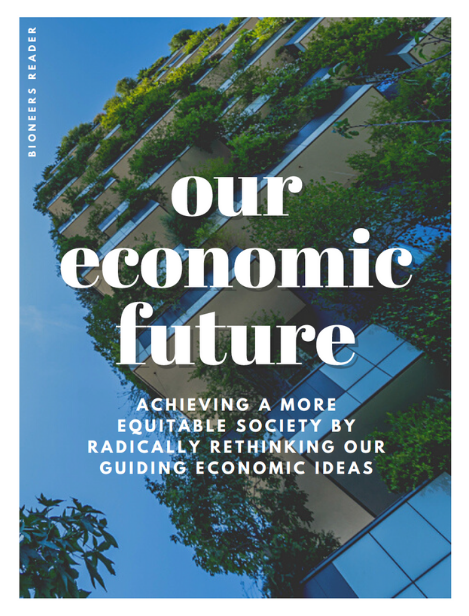
This Bioneers Reader is a collection of pieces presenting wisdom from leading figures in progressive economic thought and action, all dealing with strategies to radically restructure our ever more inequitable, racist and environmentally devastating economic system.
Corrina Gould (Confederated Villages of Lisjan) is a celebrated activist and a leader of the LandBack Movement in the Bay Area. She has helped forge a model for returning stolen land to Native American Tribes and restoring sacred sites in a revolutionary act of remembrance and resistance against cultural erasure.
Featuring
Corrina Gould, born and raised in the village of Huchiun (now known as the East Bay), is the Tribal Chair for the Confederated Villages of Lisjan Nation and both co-founder and Lead Organizer for Indian People Organizing for Change, a small Native-run organization; as well as of the Sogorea Te’ Land Trust, an urban Indigenous women-led organization within her ancestral territory.
Credits
Executive Producer: Kenny Ausubel
Written by: Britny Cordera and Kenny Ausubel
Senior Producer and Station Relations: Stephanie Welch
Associate Producer: Emily Harris
Producer: Teo Grossman
Host and Consulting Producer: Neil Harvey
Additional audio recordings courtesy of the Sacred Land Film Project at the Earth Island Institute and Stewie G
This is an episode of the Bioneers: Revolution from the Heart of Nature series. Visit the radio and podcast homepage to find out how to hear the program on your local station and how to subscribe to the podcast.
Subscribe to the Bioneers: Revolution from The Heart of Nature podcast
Transcript
Neil Harvey (Host): LandBack is a Native-led movement that has existed, really, since European colonists first forcefully began seizing lands from Indigenous peoples who have inhabited and continue to care for them since time immemorial.
In the wake of centuries of land theft and broken treaties, the Landback movement has been garnering recognition and support as a way to repair these injustices and to heal the country’s relationships with its First Peoples.
Many of the lands that were illegally stolen and remain unceded are not by accident–often in the most wealthy, and expensive real estate in the country. It was also no accident that many California tribes’ treaties were never ratified, and so the tribes were not only decimated but also did not gain federal recognition with sovereign nation-to-nation status.
Unratified treaties impede a tribe’s nationhood as a self-governing entity. This continues to be used to prevent Native peoples from gathering freely and living on sacred lands. Defending these sacred sites is difficult for California tribes that do not have federal recognition.
This is the case with Corrina Gould’s tribe, the Confederated Villages of Lisjan/Ohlone, located in the San Francisco Bay Area.
Corinna Gould spoke at a Bioneers Conference…
Corrina Gould(CG): I am often asked to come and do a land acknowledgement, and that’s always interesting to me. Right? Because land acknowledgements didn’t start here for a while. I mean, just a short while ago, right? But when we do land acknowledgements, it’s really about building reciprocity. It has to come with action items. It cannot just be words that we say and wrote. Many of us grew up saying the Pledge of Allegiance, and we can say it by rote but don’t remember what those words mean. And so the same cannot be true for land acknowledgements..
We cannot say ‘Welcome to this territory of Huchiun, the territory that embraced my ancestors, that we were created upon, that we were born to these lands and waters, that we have faced three waves of genocide and thank you very much. And so next on the agenda…’ [LAUGHTER] We can’t do that. Right?
Corrina Gould speaking at Bioneers 2025. Photo by Nikki Ritcher
So in this kind of way, it’s a weird kind of acknowledgement of this land, this land that we are asking people to come in to be good guests, to be good guests on our land so that we can be good hosts, that as Indigenous people, we are supposed to take care of people that come into our territories, gift them and have good times together, make sure that they get to the other side or back home safely. And yet, over all this time of colonization, we’ve not been able to be the good hosts that we’re supposed to be. And then we’re asked to do land acknowledgements.
Host: Corrina Gould is a celebrated leader and activist of the First Peoples of the Bay Area. As a leader in the Land Back movement, she’s committed to Indigenous sovereignty, cultural resurgence, and helping all people come into good relations with the land. The ancestral village sites of the Confederated Villages of Lisjan — some over 5,000 years old – are scattered across what’s now called the East Bay.
As the tribal chair of the Confederated Villages of Lisjan, she co-founded the Sogorea Te’ Land Trust with Johnella La Rose, a Shoshone Bannock activist. The intertribal, women-led, Indigenous urban land Trust works to rematriate stolen Ohlone land. Unlike “repatriation,” which centers on legal return, rematriation is about restoring sacred balance to heal the relationship between people and land, especially through the leadership and ceremony of Indigenous women.
CG: Tuushtak is our sacred mountain that we are born to. We are born to this mountain through a creation story of our own. We are the Lisjan people born to that waterway, and my ancestors have been here since the beginning of time. They were actually created at the top of this mountain.
This mountain, for thousands and thousands of years, was the sacred place that only our most sacred beings would go to the top and offer ceremony to. In a very short time, after people came here on that first wave, they were chasing my ancestors. And at the bottom of this mountain, they got lost, or they couldn’t find them, and they thought they’d disappeared. This is one of the stories that’s told, at least, that this place went from the place of creation of all things that are here in these lands to being called Mount Diablo, Devil’s Mountain.
People came from different places—Spanish came and Mexican ranchers came, and the current occupation of the United States government. And when people came here, other people, they didn’t bother to ask the Indigenous people, “How should we live on this land? How do we come in right relationship with the waters? How do we ensure that everything, every being, survives for the next seven generations?” Instead, they named things after themselves, or changed the names of things that have been here for thousands of years. Made people forget the language that was spoken on these lands, forced them into slavery. People died of many different diseases.
Host: The story of California’s Native Peoples is not only one of dispossession. It’s also one of survival, resistance, and deep relational knowledge to each other and the land. Even without federal recognition, Corrina, the Sogorea Te’ Land Trust and the Native women she’s worked with for decades have built a movement to return land not just in title, but in spirit.
CG: And so this land back movement, it was trying to figure out how to get 9,000 ancestors home from U.C. Berkeley. And the hundreds and hundreds of ancestral remains that are in universities and museums and other places in the Bay Area. And as a non-federally recognized tribe, what does that look like when you have been erased from your own place of origin?
Over 25 years ago, we started to do work in the Bay Area about bringing recognition to the generic term of Ohlone, that we were still here, and that we walked to shell mounds in the Bay Area starting in 2005, and we walked from Vallejo down to San Jose and up to San Francisco with hundreds of people from all walks of life, stopping at these different burial sites of our ancestors that were under railroad tracks and parking lots and schools and bars and streets. And we laid down prayers for our ancestors, asking them to remember us as we were remembering them.
Host: Some of the most important sacred sites for Corrina’s tribe are traditional burial grounds of the Ohlone people called Shell Mounds. Her ancestors created these as monuments, burying their people in the land and covering them with soil and shells, sometimes as tall as three stories high.
Corrina Gould co-founded the grassroots organization Indian People Organizing for Change, which works to defend and preserve sacred Ohlone shell mounds.
Video by Stewie G
CG (Speaking at West Berkeley Shellmound, 2021): We do not stand here as Lasjon people alone. We stand here with all of you who have made your homes on our lands…
Host: Since 2005, Native women in the Bay Area have led the annual Shellmound Prayer Walk. Covering nearly 280 miles, the pilgrimage is rooted in prayer, but it’s also an act of reclaiming history, a call to honor ancestors whose stories were nearly erased.
CG (Speaking at West Berkeley Shellmound, 2021): This is living in reciprocity, this is rematriation, this is what it looks like to live in community, This is what it looks like for our people to stand together against oppressions of all kinds. We are here to take down the walls, we are not defeated…
Host: One of the most sacred sites on the walk is the Sogorea Te’ shellmound in Vallejo. The shellmound was flattened in the early 1900s by private landowners. Over time, the land changed hands until it was designated for public park development.
In 2010, the City of Vallejo approved a $1.5 million development plan whose construction would cap the remaining shellmound under a layer of soil.
Groups including Indian People Organizing for Change, Sacred Sites Protection, and Rights of Indigenous Tribes pushed back. They wanted the shellmound and the wetlands around it to remain undisturbed. They called for the right of Native peoples to pray for and with their ancestors on this sacred land. Out of this struggle came the birth of the Sogorea Te’ Land Trust.
CG: We did this work all on our own, without a nonprofit, out of our own pockets, really. Then in 2011, those who live in the Bay Area may remember that the City of Vallejo actually filed for bankruptcy. And when they filed bankruptcy, there were two shellmounds that were along the Carquinez Strait, the last 13 acres of open space on that place, a place that connects our bay to our rivers to the place where our salmon come up and our salmon go back into the ocean; this place that had been a place that my ancestors had held as one of the last strongholds before they got pulled into Mission Dolores in San Francisco.
For 109 days we held that site with the sacred fire that was lit. And people from all walks of life came and put down prayers at that fire, hoping to save it from a destruction that was going to happen, because although the City of Vallejo had filed bankruptcy, they gave the park district $30,000 worth of permits for free in order to destroy that site.
And so we made a callout, because we had done these walks, because people understood what shellmounds were now, because they understood that we were still alive, they came and they stayed with us, and we created a village there. And we were surrounded by Coast Guard and police, and it was an interesting time.
But that land changed us. It made us somebody different. We remember what it was like to be human beings and to live in community again, and to acknowledge each other and to share food and prayer with one another on a daily basis, to put down prayers every morning together and at night, and to hold strong together.
And on day 99, two federally recognized tribes stepped in. It was not their territory, but they stepped in and they created the first cultural easement between two federally recognized tribes, a park district and a city that saved that land from being developed forever. [CHEER] It was because of that. Yep. [APPLAUSE]
But it was because we stood strong. It was because we were the ones that said that site needed to be protected. If we had not stood our ground, that land would be destroyed today. That place, Sogorea Te’, that village site, is the place that still holds that sacredness to us, that we continue to go and have ceremony for our salmon there, joined by many other people, including my good friend from the Winnemen Wintu, the spiritual leader and chief, Caleen Sisk. And we’ve been doing run for salmons up and down, from Shasta down to the ocean, and the ocean up to Shasta, going on eight years now.
Host: By this time, the idea of Landback was spreading in unanticipated ways. Inspired by taking part in the seismic Standing Rock pipeline protests, young people at an organic nursery in East Oakland called Planting Justice offered a quarter-acre of their land to Sogorea Te’.
CG: And when we looked at this quarter acre of land, it had transmissions on it and pieces of concrete, and all of this stuff. Right? And we said, yes, we would take back this land on a couple of conditions. We would pay Johnella’s salary for a year so she could make relationships with those people that were working that land; that we would clean up that land together, and that we would see how far it got, and if those relationships were good.
And so we did. Over the first year, we cleaned up that space. And my ancestors, I think that they—They always tell me these funny things in different ways. That piece of land is right along the Lisjan Creek, who we are named after – our waterway. It’s a half-mile walk from my house. And underneath the 880 freeway, it’s under fill. About a half a block away, one of our shellmounds were destroyed in order for them to put that freeway up. And so I know where that land sits is a place that my ancestors that had a village site for thousands of years, and that they were bringing it back to us in this totally different way.
Host: Sogorea Te’ innovated by creating an agreement with the nonprofit to be able to use the land rather than buy it. The group has since gone on to create several more such arrangements, as well as actual purchases.
CG: And we recently were the first non-federally recognized tribe in California to receive almost five acres of land back from a city, the City of Oakland. [APPLAUSE]
So landback comes in a lot of different ways when you’re doing this in your own territories and you’re not federally recognized, and you’re using a nonprofit in order to do it. But I always say that if you open up your imagination, and people come with a good idea, that you say yes– we figure out how we do that kind of work together.
Host: When we return, we’ll visit the West Berkeley Shellmound—believed to be the first Ohlone village along the Bay shoreline. It looks like just a parking lot today, but beneath the asphalt is a 5,000-year-old sacred site. Once again, developers had their eyes on it. But Corrina Gould and her community stood their ground.
You’re listening to the Bioneers: Revolution from the Heart of Nature.
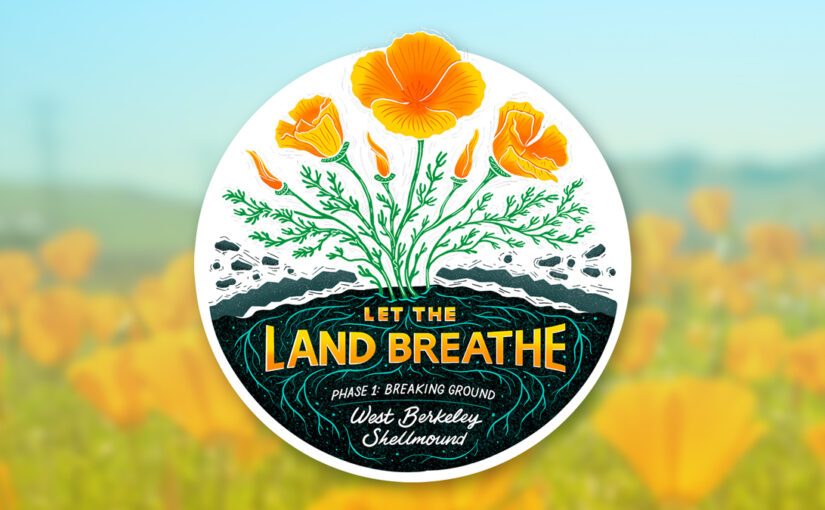
Utilizing the U.S. government’s 1856 Coast Survey map, landscape architect Chris Walker and filmmaker Toby McLeod set out to illustrate 150 years of changes to the landscape of the West Berkeley Shellmound (shellmounds shown in yellow). Animation of maps by Bioneers. Learn more at shellmound.org.
Host: The West Berkeley Shellmound near the shore of the San Francisco Bay was one of the largest, oldest, and most sacred sites in the Bay Area. Built over thousands of years by Ohlone ancestors, it stood at 20 feet within a vibrant fishing village and was a place of ceremony and a burial ground. But over time, settlers moved in and destroyed the Shellmound. By 1950, what was left of the site was covered in concrete. A proposed 5-story condominium and retail complex would dig 10 feet underground to construct a parking garage.
Corrina Gould has been part of the long struggle to protect and restore this last undeveloped portion of Ohlone ancient village sites.
CG: People from all walks of life came together and began to speak against a development happening on this 2.2 acres of land that would have continued the erasure of the Lisjan people.
Christians, and Jews, and Muslims, Buddhists, Tibetan chanters, Marshallese singers and dancers, Hawaiian singers and dancers, Korean drummers, and Aztec dancers. And we prayed.
We had people that were elders that held the street– a thousand grandmothers. I had two Native women lawyers that walked into developers with me, and oh my god, if you could see their faces when we walked in. [LAUGHTER] We kept zoning boards up until 2 a.m. [APPLAUSE]
Photo by Brooke Anderson | @movementphotographer
We had over 1800 letters against the first drafting environmental Impact Report, and the developers had three. [LAUGHTER] When they backed out, this woman, Dana Ellsworth, decided that she was going to continue this project, and we continued to have ceremony there.
We showed up and we won in the lower courts, and we lost in appeals court. That owner put up a six-foot fence with barbed wire around it, stopping us from going inside our sacred site for the first time in millennia. But that didn’t stop us.
Host: After eight years of tireless organizing, protests, prayer walks, and legal battles, the Sogorea Te’ Land Trust secured the West Berkeley Shellmound in what’s now recognized as the most significant urban Land Back victory in California history. The Trust secured a $20 million Shuumi Land Tax contribution from a family foundation, providing the bulk of funds needed for the City of Berkeley to purchase the land. The City then adopted an ordinance authorizing the acquisition and transfer of the land to the Trust, which will hold it on behalf of the Confederated Villages of Lisjan.
CG: We’re creating something way bigger than ourselves, this imagining this place of opening a creek again where water should always flow free. For us to be able to open it up and to sing to that water again in the way it should be sung to. To allow children to laugh and play in water like that is good for the water and it’s good for human beings. Water’s alive. To allow us to put our feet on the ground and to dance the way we’re supposed to dance is an amazing thing. For 200 years we haven’t been able to do that in our own territory.
To create a mound that’s possible, a mound that is either the one we imagine now, or to recreate a shell mound so that people can actually see what these were like. To find a place to re-inter our ancestors, to give dignity back to those ancestors, but also to the people that are living today. And not just the Ohlone People, but it gives dignity back to everyone that lives in our territory now. That’s the importance of doing this work, the importance of a new vision that’s there that we can bring people to. Where do you take people that come here, people from all over the world, and talk about who the Ohlone people are? Berkeley could be the first place. It was the first place my ancestors put that village, and so it should be the first place that stands up for those ancestors as well.
And we came up with a dream, a dream of freeing the West Berkeley Shellmound, and in doing that, she freed us. We were able to imagine having ceremony on this land, to building up and never disturbing what’s underneath, to creating a cultural center that could be there for every fourth grade child that has to learn about my ancestors, to not just learn about the history, but the resiliency of our people. [APPLAUSE]
Host: There’ve been other significant landback transfers throughout Turtle Island.
In 2020, the Supreme Court handed down a historic decision that nearly half of Oklahoma – a whopping 3 million acres – in fact belongs to Muscogee Creek Nation. That same year, a 1,200-acre ranch was returned to the Esselen tribe in Big Sur in California.
By 2025, California had allocated $107 million to ancestral land return that has facilitated the transfer of over 30,000 acres of land back to tribes. Well over half of California’s State Parks- covering 1.6 million acres – are governed by co-management and co-stewardship agreements with Native American tribes.
These are astonishing advancements for what was once an unthinkable idea.
CG: So let’s figure out how do we work together in reciprocity. Think back to where you live. Who are the First Nation people on whose land you live on? What is their real name? What is the language that they speak? What do they stand for? And how can you support that work that they’re doing? How do we say thank you and please? How do we ask permission? How do we not touch things that are not ours? These very basic things. [APPLAUSE]
These very basic things that we teach all of our children and our grandchildren how to be in good relation with their friends and their grandparents, and when you go to their homes, this is what we ask people to do. And this is what we’re asking for folks to do, to come in right relationship.
When we come in right relationships, when we work with Indigenous leadership, when we begin to see what our responsibilities are to the lands and waters and airs that we live, work and play on, we’re able to create magic. This is a time of great turning in the world. We are seeing this idea of land back, there’s this consciousness that’s happening, that people understand that settler colonialism has hurt this world, that capitalism is killing our Mother Earth. [APPLAUSE]
We’ve seen a lot of things happen in history, but we have seen that people can come together and stand, and that when we fall backwards, when we listen to our ancestors, when we listen to the direction of Indigenous people, when we follow rematriation and Indigenous women’s work, that we can remember who we are as human beings, that we can pray for the next seven generations to have fresh water to drink, that they could have fresh air to breathe, that they could have good soil to grow food and medicines, and that we create a relationship with fire again so that we are not afraid.
Thank you, all relatives, for being here today. [APPLAUSE]
Host: Corrina Gould… “The Native American LandBack Movement Reaches Urban America”
When members of Project CETI (the Cetacean Translation Initiative) witnessed the birth of a sperm whale, they observed a breathtaking scene of cooperation and communication that few humans on earth have ever seen. The extraordinary experience was both a scientific milestone as well as one more strand in the web of sperm whale culture that this innovative project is studying.
The Project CETI team leverages world-leading technology and science in a quest to understand nonhuman animal communication. At the same time, the scientists leading the project are keeping an ethical throughline, placing the health and well being of whales at the center of the effort. As we get tantalizingly closer to truly communicating with other species, the question becomes not only whether we can, but whether we should – and what the implications are if we do.
This is an episode of Nature’s Genius, a Bioneers podcast series exploring how the sentient symphony of life holds the solutions we need to balance human civilization with living systems. Visit the series page to learn more.
Featuring
David Gruber is the Founder & President of Project CETI (Cetacean Translation Initiative), a nonprofit, interdisciplinary scientific and conservation initiative on a mission to listen to and translate the communication of sperm whales. He is a Distinguished Professor of Biology and Environmental Sciences at the City University of New York, Baruch College & The CUNY Graduate Center.
Credits
Executive Producer: Kenny Ausubel
Written by: Cathy Edwards and Kenny Ausubel
Producer: Cathy Edwards
Producer: Teo Grossman
Senior Producer and Station Relations: Stephanie Welch
Associate Producer: Emily Harris
Host and Consulting Producer: Neil Harvey
Production Assistance: Mika Anami
Interview Recording Engineers: Rod Akil at KPFA and Bill Siegmund, Digital Island Studios, LLC
This limited series was produced as part of the Bioneers: Revolution from the Heart of Nature radio and podcast series. Visit the homepage to find out how to hear the program on your local station.
Subscribe to the Bioneers: Revolution from The Heart of Nature podcast
Transcript
Neil Harvey (Host): In this episode, we meet David Gruber, founder and president of Project CETI: the Cetacean Translation Initiative.
The name deliberately echoes the groundbreaking SETI Institute – the Search for Extraterrestrial Intelligence. Both share a dream of communicating with intelligent life beyond the human species. Rather than searching deep space, Project CETI’s quest is the depths of the oceans on Planet Earth.
I’m Neil Harvey. This is “The Quest to Decode Whale-speak”.
As the Coast Salish Chief Dan George wrote: “If you talk to the animals, they will talk with you and you will know each other.”
Indigenous traditions such as those of the Coast Salish are closely attuned to hearing beyond human boundaries. Yet talking, and listening, to other animals is a shared experience across humanity—intuitive to anyone who has ever conversed with their pet. Within the Western scientific tradition, researchers have struck up conversations with chimps and parrots, while revealing language-like qualities in bee dances and meerkat calls.
However, faithfully translating other animals’ communication is a formidable endeavor – as is the question of whether it really constitutes language. Other animals’ perceptual worlds are radically different from ours. So, naturally, their communication is also profoundly different, which presents a mind-bending challenge to interspecies translation. Project CETI’s mission to crack the code of sperm whale communication is monumentally ambitious.
[SPERM WHALE CLICKS]
David Gruber and the CETI team study whales near the island of Dominica in the Caribbean. This is how they sound…
David Gruber (DG): [AUDIO PLAYING] [CLICKS] They’re so social, living in families of grandmothers, mothers and kids, matrilineal populations in Dominica where there’s about 200 sperm whales that are almost there year-round.
We set up a 20-kilometer by 20-kilometer underwater listening/recording studio in Dominica. How we’ve kind of dreamed this up, is like, humans have invented all the technology, that we could do this; we could translate sperm whale language. And I think it reminded us all of when people started to look at the moon and be like, you know, can we go there? And they’re like “F=ma”, you know, they’re like, yeah, well you’ve gotta shoot the rocket, and then I’m going to get out and walk around it. It turns out there’s not that much to do on the moon. [LAUGHTER] So we’ve not been back that much.
But here, is like sperm whales! We live on a planet with sperm whales, and there’s still a couple hundred thousand of them. And they’re communicating in ways that are fantastic.
And going back to like Carl Sagan, you know: “Is it possible that the intelligence of cetaceans is channeled into the equivalent of epic poetry, history, and elaborate codes of social interaction? Are whales and dolphins like human Homers before the invention of writing, telling of great deeds done by, in the depths of and far reaches of the sea?” Like just these beautiful quotes. Like who knows?
Host: Whales loom large in our imaginations: their self-evident intelligence seems at once familiar and foreign. They have the biggest brains of any animal on Earth, and a humbling evolutionary history: Their ancestors went from the land into the sea nearly 50 million years ago.
Sperm whales themselves have been around for about 20 million years – that’s eons before any human ancestor walked upright. Over those unfathomable timescales, they’ve evolved an extraordinary capacity for complex communication. They seem to talk to each other in a kind of whale morse code: sequences of clicks known as “codas” that repeat and overlap.
[WHALE CLICKS]
Though these codas sound nothing like human language, we do have some things in common with sperm whales. Like us, whales have rich social lives, with unique cultures that vary between groups. And like us, they’re mammals who learn to communicate by imitating the intricate sound patterns of their elders.
DG: All life came from the ocean; we’re almost like little bodies of seawater trapped in skin. There’s this group of relatives that went back in and started, you know, about 50 million years ago, this Pakicetus, this wolf-like thing that went back into the ocean, and the nose rolled over the head and became a blow hole, and the skin had to change. So it’s like when you’re in the bathtub too long, they needed to fix that. [LAUGHTER] And their blood changed so that they can dive for a mile and they could hold their breath for over an hour, which I don’t—I mean, that’s like yogi central. You know? These guys are OG karmic masters of breath work. [LAUGHTER]
And thinking about the nostrils rolling over the head, one of the nostrils becoming a blow hole, but then if you hold a whale skeleton, you’ll see there’s still the other small nostril that is being used, and they kind of snap this air back and forth.
Host: Biologists believe sperm whales’ sound is produced by snapping this air along the right nasal cavity, which has twists and turns. It winds through a series of air sacs, spermaceti oil and fatty tissue to a pair of ‘phonic lips’ at the front of the head. This complex journey, they think, allows the whale to amplify and focus sound, giving it a vast sonic repertoire.
DG: Whales are living in this like deeply sonic world. Huge part of their brain is dedicated to sound processing, and echolocation is such a major feature of how they’re navigating living their lives, how they’re even producing the sound in their head and magnifying that sound to incredibly loud—They could produce it almost twice as loud as an airplane taking off. And they could focus it on very tiny fish or they can kind of have the sound permeate outward. They can even click right into each others’ heads using bone conduction.
Just phenomenal, the way in which sperm whales hear the world, and it would be equivalent to like us describing how our eyeballs work. To say, well, I open my eye and I see all these things, and I can sense depth. You know? It’s likely that their way of hearing echoes returning, and it gets processed in their lower jaw, similar to us describing how our eyeballs work.
Host: Whales’ sonic skills are essential for navigating ocean life. They sing different types of clicks for long-range sonar, for close-range hunting, and for socializing.
DG: There’s the echolocating, when they’re using it to kind of almost see in the dark, and you’ll hear them when they go down, it’s like click, click, click, click. And then as they’re getting closer to food, it’ll go faster, faster, faster, then you hear a gulp. [LAUGHTER] They’re very good at eating squid.
But they’re also—at the surface, they communicate with these codas, which in Dominica, the one that you hear all the time is just like click, click, click-click-click, the 1, 1, 3.
There’s actually regional dialects. So among the clans of whales in Dominica, each clan, even though they’re living in the same place, has a specific dialect, like it could be British and Scottish-type accents that are among them. [LAUGHTER]
Illustration by Alex Boersma for Project CETI
[WHALE CLICKS AND SOUND OF OCEAN]
Host: David’s colleague, marine biologist Shane Gero, has been observing the Dominica whales for 20 years. It was Shane’s work that revealed the unique codas that signal group membership, or cultural belonging.
Deciphering yet more meanings within this complex system of clicks and pauses needs diverse facets of expertise – from the mechanics of underwater recording to a deep knowledge of whale behavior, to the computational codebreaking required to unscramble the click patterns. The immensity of the project enthralled David Gruber.
DG: Oceanography is a very interdisciplinary field of working, understanding the physics of the ocean, the geology, the chemistry. And so I kind of came to this project taking on many, many different, increasingly complex interdisciplinary science projects.
For instance, I was working on a project to build a shark eye camera. We needed to put together a team of camera designers and optometrists that could study the eye of the shark, and divers that could dive with the shark. And we made this camera that sees a specific type of shark. And then we were able to make first order approximations of how that shark is able to see the world.
So seeing from the perspective is one of the really big themes of my work. And the other theme that we were really working on is gentle robotics and being as gentle as possible when studying life. So this project kind of brought everything together. Rather than seeing from the perspective of the shark, we’re hearing from the perspective of whales.
Host: Seeing from another being’s perspective requires imagination, care and empathy – and in Project CETI’s case, cutting-edge technology.
In the past decade, machine-learning systems have become remarkably adept at translating between languages.
Algorithmic tools excel at finding patterns in large data sets – for example, all the words that exist online. That’s what trains large language models like ChatGPT.
[WHALE CLICKS]
Could similar tools find hidden patterns, maybe even language-like words and grammars, in the click codas of sperm whales?
It seemed possible—if they had enough data, which, in this case, meant thousands and thousands more recordings of those codas. Recording them was the first challenge…
DG: It’s not like you can just go to the store out there and be like, “I’d like some whale listening tech,” you know? [LAUGHTER] So we have to design everything ourselves. So we’re making all the listening apparatus that’ll go into the project.
So there’s eight different disciplines in Project CETI. We have a machine learning team, and a robotics team, a natural language processing team, a network science team, marine biology team, underwater acoustic team. This all pieces together in this effort, and we’re almost getting close to the point where the word language could possibly fall as being a human-only thing.
Over these past five years, we’ve been understanding the basics of their communication system, and at the same time, we’ve been building up our data set. The reason like ChatGPT is getting so good is it digested the entire Internet—every book that’s ever been written—and was able to learn kind of where words are placed with each other. Like you might see woman and queen, or man and king, you know, next to each other. So once you put this together with billions of data points—we call them tokens—the machine learning can get good at predicting what will be the next piece. And they’re doing so by looking for patterns in multi-dimensional space. So that’s kind of why the more and more data you throw at these, the better it is, is finding elements and patterns that maybe humans couldn’t detect on our own.
Host: The process of gathering the data, however, was deeply human. In contrast to the robotic efficiency of large language models, recording the whales was an emotional voyage.
DG: So we’re going to be playing now two different sounds—which one would you be more likely to die for. [LAUGHTER]
Number one…[CLICKING NOISES IN WATER]
Alright. Number two…
[WHALE SONGS]
Host: Perhaps you recognise this second sound. It’s on the biggest-selling nature album of all time: Songs of the Humpback Whale, recorded by legendary biologist Roger Payne.
The album’s release in 1970 resonated powerfully with the public. The songs awakened many millions to humpback whales’ extraordinary intelligence and culture. They inspired the Save the Whales movement, one of the iconic conservation successes. It led to a global moratorium on commercial whaling.
[SPERM WHALE CLICKS]
These, on the other hand, are the clicks of the sperm whale. They may not carry the same visceral impact as humpback whale songs, yet they hold a spellbinding promise: not only hearing whales, but understanding them, too.
And these particular clicks tell a powerful story. We’ll find out more after the break.
If you’d like to learn more about the extraordinary intelligence of life inherent in fungi, plants and animals, the Bioneers Earthlings newsletter delves into stories and research that promise to reshape your perception of our fellow Earthlings – and point toward a profound shift in how we all inhabit this planet together. You can subscribe at bioneers.org/earthlings
[WHALE BIRTH CLICKS]
Host: These sperm whale codas were recorded during a magical moment that David Gruber and the Project CETI team witnessed in 2023.
DG: We were out there doing our normal thing of finding the whales and recording them, and we saw these 11 whales, and it was very odd, they were kind of just going up and down and up and down, and they weren’t diving. And about two hours later, there was a bunch of thrashing, and then there was blood in the water. And I think at that moment, you know, we thought there was some shark attack or something terrible might have been happening.
And then we saw that there was like a tiny little whale head amongst the ruckus, and there was this little baby whale, and we just realized that we were watching a whale birth. And literally, the whales started swimming right towards our boat, holding the baby above water. Inches from us we watched this baby whale go right past us.
As the baby came out, the fluke was folded, so the baby was unable to swim. And it took, you know, several hours for the kind of fluke to unfold so the newborn had the capability of swimming on its own. And in the process, all the other female whales were going under it, and lifting it, and twirling it.
And then there was another moment of collective terror, where we saw a group of pilot whales rolling in. Pilot whales could be aggressive to sperm whales, and there’s several reports of this. And we watched them kind of coming in slowly, and nothing really bad was happening.
And then we look over at the horizon, and there’s like 200 Fraser dolphins. They almost look like little pinwheels. And now there’s this scene out there, right in front of our boat, with hundreds of whales, all amongst these 11 whales that are holding the newborn above water, all kind of moving around.
Host: It was a breathtaking scene of cooperation and communication, engaging the baby whale’s family, the wider group of sperm whales, and even other cetacean species.
The Project CETI team were astounded by their luck in witnessing such a significant event, and being able to record it in great detail.
Then came the enormous task of organizing and analyzing six hours of data.
DG: It took us more than two years to design it and almost go frame by frame through the six hours. Some of the beautiful things that have come out is we found that the grandmother, the mother, and a mother’s daughter were all there, present. So we’re able to look at the role, the doula-type roles, that each whale played in this unit.
But what’s also interesting is this unit is separated between kin and non kin. And they took turns in diads, two by two, whales holding the baby like a ballet of two at a time, between the kin and the non kin. So it represents one of the most empathetic, collective examples of a mammal entering the world beyond maybe humans.
And I think back now of the story of the evolution by cetaceans going back into the water and delivering a thousand-pound baby. The baby is actually negatively buoyant. So the baby would sink to the bottom. So the sociality of whales, they needed to collaborate to hold the baby to ensure its survival. So they needed this collective communication.
Host: Studying this whale birth gave Project CETI a remarkable insight into sperm whale culture – as well as their communication system.
DG: We’ve been analysing this data now for two years, and looking at the acoustics of it underwater, and some new codas that were spoken during this. And then we also did an evolutionary analysis that’s able to show that likely this process of a mammal giving birth in the water is something that dates back around 35 million years.
And, you know, that brings up the profundity of—was their vocalizations necessary to coordinate this? Are these vocalizations something that we can now start calling language? And if so, do sperm whales have a language older than human language? Like it’s kind of raising these really profound questions that are making us question…how superior of a communication system we-we think we have.
[WHALE BIRTH CLICKS]
Host: During and after the birth, the whales exchanged copious complex codas. The multiple overlapping sequences are challenging to tease out, and they provide a treasure trove of data for translation.
In these and other recordings, the scientists have uncovered a rich palette of variation and nuance. They use musical terms like “rubato” and “ornamentation” to describe how the messages vary in speed, rhythm, and sonic flourishes. Gradually, some meanings may come into focus.
DG: What we recently did is show more of like a phonetic alphabet in the clicks, not just click, click, click-click-click. It could be like click-click, click-click-click—so tempo, and rubato, and rhythm, and ornamentation were playing significant roles in the context of their communication.
So one of the key parts now of being able to translate what sperm whales are saying is we need to be able to ground the symbols. Like we have all these vocalizations. We’re seeing there’s complexity. We’re seeing the kind of nuances of their alphabets. There’s a linguist on the team, Gašper Beguš, and he’s able to show now that there’s vowel-like features in sperm whales. But then, knowing there’s incredible complexity to their voices, but what are they saying still?
So at this stage now, we’re beginning to kind of parse out some of the first words, like diving. There’s a conversation, whale A is saying something to whale B, and then eventually they’ll make a decision to dive. And if you have hundreds and hundreds of those, you could just look at the vocalizations and say, that’s where they’re going to dive; that’s where they’re going to dive; that’s where they’re going to dive. And that would be a sperm whale language model. We have a kind ChatGPT 1 for sperm whale, is what it is.
Host: Creating this rudimentary dictionary of “whale-speak” requires painstaking work. It’s not just a matter of applying human language models to whale codas. The team is training its own computer models from scratch, homing in on the sperm whales’ unique communication traits.
DG: In the beginning of this project, some people would just be like, AI, animals, just throw them together. But all this AI is just designed for us. And what you really need to do is kind of like, yeah, which tools are going to work and which aren’t?
And the musical elements came from people on the team with backgrounds in both linguistics, and natural language processing, to be able to kind of look carefully at these smaller sized data sets and look for patterns. And once we kind of see some of the first patterns, then we can train the computer to look for them again.
Like tempo, rubato, ornamentation, really these early models were done a lot by hand and careful looking. And we still can’t understand other animals’ communication without the humans who have spent their whole lives looking carefully and listening. You know it’s kind of like, in Darwin’s sense of, the eyeballs are like the biologist’s best instrument because everything starts with just looking and observing.
Host: Deciphering what sperm whales may be saying requires a thorough understanding of their biology, their behavior, and their perceptual worlds. To try to comprehend their conversation requires trying to imagine what it’s like to be them.
Scientists with deep knowledge of other life forms have similar goals to decode the communication of elephants, moths, plants and fungi.
This is an era of rapid discoveries about the realities of other-than-human-life. At the same time, AI is turbo-charging breakthroughs in many areas of science. In this context, talking to other species feels tantalizingly possible.
Yet there are also grave risks. Rather than ushering in a golden era of interspecies understanding, new insights into whales’ worlds could also be used in harmful ways, along with precipitating yet another intolerable invasion of their lifeways.
To mitigate potential harms, Project CETI values the ethical implications of their research on par with the research itself. What are the moral and ethical risks? What’s in the whales’ best interests?
DG: Even the suction cups that we’re designing are inspired by sucker fish so that they don’t hurt the whales. We have a philosophy on the team of not to draw a single drop of blood.
And we always ask ourselves: Is this work in benefit of the whale? We’re at the intersect of animal, and then we’re also in groups with the AI crowd, and it’s a really intense place to be.
But all these new technologies now are slowly going to be applied to animals, and it could be beautiful. AI combined with bio acoustics can allow us to hear and interpret things that our Old-World primate weird little ears that we have don’t necessarily pick up. So this world of wonder and possibility and connectivity awaits, but how we do it is important.
Host: Working with the More than Human Life program at the NYU School of Law, CETI drew up 18 principles for using these technologies to study animal communication. By proceeding with care and precaution, they are committed to minimizing harms – while growing our empathy for other life. The hope is that this intrinsic biophilia – this instinctual bond that life has for life – will guide us to respect and protect the ineffably complex symphony of living beings.
So, suppose we can we dream up ways to speak to beings whose perceptual worlds are so wildly different from our own. If the whales were to respond, what do they have to say? And will we heed their call?
DG: The whales are more in danger right now, if you look at the ship traffic going across the ocean, it’s terrifying, and they are getting hit a lot. And then also imagine the idea if you had a jackhammer playing in your house all the time. You’d be very annoyed, and they’d probably want to sue as well.
And I guess the real fear is that what if we can deeply translate and we hear, but then we choose not to act. That’s going to be a real moment for us as a species, if we can actually really meaningfully translate and then we choose to turn that off. I mean I love the fact that it’s making us think of these things. But I think almost all science fiction is very dystopian. So I think because we are talking about this early, is there a possible pro-topian? And even just think about it before the future just comes to us.
Host: Even in best-case scenarios, a quest as ambitious as interspecies communication is bound to bring mistakes, misunderstandings, and unforeseen consequences. Now that AI is irreversibly out of the bag, thinking through how to use it ethically with whales and other organisms is crucial.
In truth, humanity has an ancient and sacred relationship with whales. For example, the whale is revered in Polynesian culture, whose navigators crossed vast oceans with extraordinary skill and knowledge thousands of years ago with no GPS.
David wonders whether human voyagers might have even learned navigation from the whales, who, like us, pass their knowledge across generations.
DG: Some whales could be over 200 years old, so by living in three generations, there’s so much knowledge that could be passed within three generations but then even more than that, like the navigators were just passing this on and on.
If being able to cross the ocean played such a big deal for human evolution, that story of the first human to like build a little canoe and go all the way across, and the knowledge of the navigators wasn’t even written; it was mainly just passed verbally around, just using dead reckoning and navigating by the stars, and being able to kind of use all these features.
But then I was like, well, if we look at the tract of cetaceans, they had to do a similar thing, because they’re also mammals that were just semi-aquatic. So there’s a parallel story of whales being a semi-aquatic thing that was getting chased into the water. But then, you know, going a little further out, and a little further out, and a little further out, and then one day being like, you know, I’m not even going to come in to go to sleep. I’m just going to sleep out here tonight. [LAUGHTER] You know? And then like one day, you know, I think I could go a little further out, and then like, you know… So being able to cross the ocean was a big deal for the first whale.
And then we began looking in the science record of, like, can the cetaceans use stars to navigate? And there’s like one study of a harbor seal that does show using stars to navigate. Like everything—We think that we’re inventing it, but it’s already been invented, and there could be this moment when humans were learning this information from the whales. So we’re looking for some of this in written records. But all these crazy ideas; half these are hypotheses, completely untested.
Host: There’s so much that remains a mystery, and likely always will. Humility is our constant companion. Perhaps we’ll never know whether whale language contains the equivalent of epic poetry and history, as Carl Sagan speculated.
But as science fiction gradually becomes science fact, the promise of forging closer ties with our underwater kin could inspire us for generations to come to respect, protect, and cherish the intricate web of life.
DG: I’ve only studied animals my whole life — every animal that I work with is like a series of mysteries and magnificence, like jellyfish and corals. I so deeply love jellyfish, and corals and anemones. But when it moved to whales it was like, whales just really reach almost everybody. We can get in a taxicab right now and just start talking about whales, and what they’re doing, and about whale dreams and…they are magnificent.
There’s a level of complexity in what they’re saying that is far beyond what I imagined at the beginning of this project. And I think probably, at the end of my life we’re not going to get to the end of this, this is like an intergenerational translation exercise, because the amount of mysteries is so huge that it’s far beyond what we will be able to do in this… on our time here on Earth.
Host: David Gruber, “The Quest to Decode Whale-speak”
Lead Photo: TheAlphaWolf, CC BY-SA 3.0, via Wikimedia Commons
We tend to think of flowers as decoration — something to admire, arrange, or pass along as a gesture. But beneath their beauty lies a far stranger and more consequential story.
In this excerpt from How Flowers Made Our World, biologist and writer David George Haskell invites us into the intimate, often surprising relationships that flowers form with the living world around them. Through the lens of the cranefly orchid, we begin to see flowers not as passive ornaments, but as active participants in complex ecological exchanges — shaping behavior, forging alliances, and, at times, exploiting the very creatures they depend on.
What emerges is a deeper understanding of life as a web of connection — one where even the smallest bloom carries the imprint of evolution, cooperation, and survival.
The following excerpt is published with permission from How Flowers Made Our World by David George Haskell (Viking, 2026).
Orchids first evolved 112 million years ago, and the family now contains about twenty‑eight thousand species, making the orchids the most species‑diverse plant family on the planet, although the aster and sunflower family is a close second or, by some counts, slightly more diverse. For comparison, there are fewer than seven thousand species of mammal. Each orchid species is a unique twine of plant, pollinator, and fungus. It is this closeness of relationship that fuels the orchids’ diversity. In many species, the bonds are mutualistic. Almost all newly germinated orchids, for example, are entirely dependent on fungi for their food, a radical departure from the sunlight‑fueled growth of most young plants. Orchid pollination is often highly specialized, using miniaturized and intricate sexual parts to work with a handful of pollinating insects or sometimes a single pollen‑ferrying species. It is tempting to find in these connections an allegory about the harmony and generous reciprocity of nature. But other orchid species undermine the parable. Relationships take many forms. Some orchids have embraced illusion and thievery with gusto, parasitizing fungi and duping pollinators. But whether parasitic or mutualistic, orchid relationships are always intense. They have taken novelist E. M. Forster’s exhortation “Only connect!” to extreme and sometimes twisted ends.
~~~
As autumn progresses and most plants in the forests of the eastern United States fall into slumber, the cranefly orchid wakes. As falling tree leaves presage winter, we get an unexpected glimpse of new life. A pointy‑tipped oval leaf pushes through the downed oak and maple leaves. The orchid’s leaf is pleated and its top surface is a dark matte green, the color and size of a spinach leaf. Bend down and flip the leaf and you’ll get a surprise. The underside is uniformly purple, sometimes as light as lavender but usually dark plum. The purple pigment salves the burn of frost inside the leaf. In a few individuals, the top of the leaf is spotted with purple. In others, the whole leaf is dark eggplant, one of the most striking and beautiful winter sights in these forests.
Autumn seems an odd time to unfurl a leaf, but the summer tree canopy here is thick. At midsummer, only meager greenish light trickles through. Many wildflowers emerge in early spring, then rush through their life cycles before the tree buds open. Cranefly orchid is hardier. It grows through the winter, then dies back as the spring wildflowers reach their peak. With little competition, the orchid leaf feasts whenever the sun is out and the temperatures edge above freezing.
The cranefly orchid rests all its hopes on one leaf. This precious solar panel is well defended. Microscopic spikes of calcium crystals are scattered throughout. Purple pigment makes the leaf hard for deer to see. As it sips on weak sunlight, the leaf sends food to a buried stem. In late spring, the leaf dies then quickly rots. Hidden in the soil, the stem waits out early summer, its tissues swollen with starch.
Sometime after the summer solstice, usually in July, a leafless stalk lances up. Straw thin, but as high as my calf, the stalk is first tinged with green and purple, then matures to the color of old hay. Flowers—sometimes two dozen or more—grow from the sides of the stalk, regularly spaced all along the top half. They look like half‑crushed leggy insects hanging in a spider’s web. Seen through a magnifying lens, the flowers sprout seven brownish‑yellow skinny petallike projections and a long, slender nectar tube. The projections are twisted and squashed to one side. The overall effect is like a wounded cranefly, its legs akimbo, hence the orchid’s name.
Against a backdrop of summer foliage, the flower stalks are easy to miss. To find them, it is easiest to note where the winter leaf grows, then return in summer to find the bloom. The flower might be inconspicuous to us, but not to owlet moths. For these small dusk‑and night‑flying moths, the blooms are an aromatic delight. A delight, that is, until the flower partly blinds them.
At night, the cranefly orchid bloom emits an aroma like a mild daffodil flower, so gentle that it is hard for my nose to distinguish from the smell of the dead leaves on the forest floor. When a cruising owlet moth picks up the scent, though, the signal comes through loud and clear. The moth flutters down and uncoils a long proboscis. Ah, sweetness. The throat of the flower leads to the backward‑pointing spur full of nectar. The moth pushes forward, slurping deeper. Bump! One of the moth’s eyes hits something very sticky. Orchid superglue gloms the eye. The moth pulls away and a pair of pollen sacs pop loose from their hiding place in the flower’s roof. The pollen sacs are cemented to one of the moth’s eyes.
The surfaces of moth eyes are smooth and hard, good places for glue, unlike the fuzz of scales that covers the rest of their bodies. The cranefly orchid’s strange asymmetry, petals twisted to the side, evolved to hit the eye square‑on. The arrangement works, at least from the orchid’s perspective, because one‑eyed moths keep searching for flowers.
Pollen sacs are first covered by a prophylactic cap that falls off after about thirty minutes. The cap prevents self‑fertilization. Such “selfing” yields inbred offspring, although many plants, including the cranefly orchid, will eventually self‑fertilize if they can find no other pollen. Once the cap is off and the moth finds another flower, pollen sacs get stuck onto a sticky stigma as the moth drinks. Half of the flowers twist left and half twist right. When moths visit a second flower, the pollen sac has a fifty‑fifty chance of finding a stigma with the same twist.
The moths’ love of orchid blooms partly blinds them. Photographer Ken Childs has recorded on his farm in Tennessee moths with half a dozen or more pollen sacs glued to each eye. When I’ve poked a toothpick into orchid flowers—including a few cranefly orchids—I’ve found the sticky pollen‑delivering pad extraordinarily annoying. It has a gummy texture and will not let go. I try wiping it away with another toothpick and both get gooped, even after several hours. The orchid is unquestionably harming its pollinator by dimming moth vision.
Although the cranefly orchid stalk can hold two or three dozen flowers, on average only about seven mature into fruit pods. These swell through the late summer until they are bean sized. The energy and material needed to grow these fruits depletes the plants’ underground stores. For every fruit grown in late summer, the leaf that appears in autumn is 2 percent smaller. Heavy fruiting causes the plant to skip flowering for a year.
In autumn, the stalk and fruits dry out, turning the light tan color of bleached fallen oak leaves, a great match for the leaf litter. On dry days, the fruit pods split, revealing shockingly small seeds. Through a magnifying lens I count thousands in a single pod. Like nearly all other orchid species, the cranefly orchid takes a minimalist approach to childcare. Each seed contains an embryo and nothing else. No droplets of nutritious oil, no starchy reserves, no protein packs. Just a ball of embryonic cells enclosed in a minuscule balloon‑like seed coat. The gentlest touch of wind carries these mini zeppelins aloft.
When the flyers land, only those that alight on fungus‑filled downed branches or tree stumps will live. Like all other orchids, germinating cranefly orchids draw their food not from the sun, but from fungi. The orchid babies welcome webs of fungal strands into their tiny bodies, then nurse on this inner network. Every orchid species has its own taste in fungus helpers, and cranefly orchids need wood‑digesting fungi, usually found in abundance on fallen trees. In this way, parts of giant fallen trees are, via fungi, resurrected as minuscule orchids. This dependence of orchid on fungus can last for many years. When the orchids finally get large enough to grow leaves, they may repay the fungi with sugars, although by then the original nurses may have been replaced in the orchids’ tissues by other fungus species.
Cranefly orchids are living headstones. Wherever we encounter them, we know we’re at the gravesite of a fallen tree or branch. The downed wood may be gone, but the orchids let us peer back in time and know that we’re in a healthy forest, one with a history of life‑giving rot. Decaying wood provides food and sustenance to many: orchids, fungi, salamanders, small rodents, and many invertebrate animals. A forest newly grown back from pasture or one intensively managed for timber lacks a history of fallen wood. Cranefly orchids reveal this past.
The curious life cycle of the cranefly orchid is built, in all its parts, on specialization. This is true of all orchids. They thrive by focusing. Orchid seeds are as small as a plant seed can be. But, with the help of fungi, orchid seeds explore wherever the wind takes them. Orchid flowers are also stripped down. Although their petals are often showy, usually with a distinctive swollen lower lip, the female and male parts of the flower are miniaturized and fused into a central column. The pollen of most orchids, like the cranefly orchid, is bundled into two compact sacs, delivered to insects on a sticky arm.
Orchids thus take the bisexuality of ancestral early flowers to the next level, shedding and receiving pollen from the same compact structure. Their sleek flowers waste no pollen. In addition, the column‑inside‑petals design allows evolution to sculpt each orchid species’ flower to the shape and aesthetic tastes of a small number of insect species. This allows orchids to develop specialized, tight relationships with insects.
Orchids are the anti‑magnolias. Magnolias offer generous all‑you‑can‑eat pollen buffets from open cups to any passing animal. Orchids invite only VIP insects to their blooms, often a single species of insect, then entrust these visitors with small parcels of elegantly wrapped pollen.
Mother Nature is the ultimate designer. After all, since life first emerged on Earth, she’s had 3.8 billion years of evolutionary R&D to get it right. Biomimicry is the art and science of learning from this ineffable genius: tapping into the patterns of nature to live harmoniously with life’s principles. We meet Janine Benyus, known as the “godmother of modern biomimicry”.
This is an episode of Nature’s Genius, a Bioneers podcast series exploring how the sentient symphony of life holds the solutions we need to balance human civilization with living systems. Visit the series page to learn more.
Featuring
Janine Benyus is a world-renowned biologist, thought leader, innovation consultant and author of six books, including 1997’s foundational text, Biomimicry: Innovation Inspired by Nature. She co-founded the Biomimicry Guild, which morphed into Biomimicry 3.8, a B-Corp social enterprise providing biomimicry consulting services, and The Biomimicry Institute, a non-profit institute to embed biomimicry in formal education.
Credits
Executive Producer: Kenny Ausubel
Written by: Cathy Edwards and Kenny Ausubel
Producer: Cathy Edwards
Producer: Teo Grossman
Senior Producer and Station Relations: Stephanie Welch
This limited series was produced as part of the Bioneers: Revolution from the Heart of Nature radio and podcast series. Visit the homepage to find out how to hear the program on your local station.
Subscribe to the Bioneers: Revolution from The Heart of Nature podcast
Transcript
Neil Harvey (Host): Looking to nature for inspiration and guidance is an ancient practice. For example, early medicines were likely discovered when humans observed other animals using them to self-medicate. Countless historical examples illustrate how people have long observed and mimicked natural phenomena. Indigenous and traditional cultures have an ancient lineage of emulating nature’s ways based on intimate long-term scrutiny.
Western science has also sought to understand the design principles of nature. Leonardo da Vinci famously studied bird wings in great detail, to try to understand how humans could take flight.
More recent examples of biomimicry abound as engineers and inventors have become more attuned to the symphony of life. Common burdock seeds inspired Velcro. The beaks of kingfisher birds led to the redesign of the Japanese bullet train. A sea sponge was the model for London’s famed Gherkin skyscraper.
In 1997, the publication of Janine Benyus’s landmark book Biomimicry: Innovation Inspired by Nature crystallized this paradigm of creating from nature’s playbook. It galvanized this breakthrough in design science.
A few years before writing this foundational text, Janine had a personal reason to seek answers from nature. In the early 1990s, she had moved to a property in Montana which had an ailing pond.
Janine Benyus spoke at a Bioneers conference.
Janine Benyus speaking at Bioneers 2025. Photo by Nikki Ritcher
Janine Benyus (JB): This pond, when we got there– it was a mess. Full of agricultural chemicals, it was full of silt, there was no open water whatsoever. We tried everything. And then what we did was we went to a healthy pond in the national forest, and we noticed—my partner and I, Laura—we noticed the flow happening, and we rushed back and we realized that we had four springs that were smothered. When we released them, and reconnected this pond to its source of groundwater, every year it’s been getting better, and better, and better, and better. Because that’s what life does. One organism promotes another organism’s success and thriving. Another organism promotes another organism’s, right? It’s this incredible positive feedback loop.
We talk so much about negative tipping points, right—climate change and Greenland melting. There are also positive tipping points. And when we can get in the healing team and bring a place like this to that positive tipping point, life takes over. Biodiversity begets biodiversity. It is stunning to watch and to be a part of. So let’s remember that and then let’s try to do it consciously.
Host: Janine sums up the essence of biomimicry’s mission this way: Life creates conditions conducive to life. That became her metric for biomimicry.
Janine went on to co-found a non-profit, The Biomimicry Institute, and a consultancy, Biomimicry 3.8. The goal is to encourage design innovation that’s guided by nature’s genius.
And the field has flourished: nowadays, biomimicry is widely taught and practiced. But it was an outlier back when Janine’s book was first published.
JB: So, how do you do biomimicry? You start with quieting your cleverness and then listening, and then echoing what you hear, and then giving thanks. But you quiet your human cleverness because we tend to, when we design new things -– say like, an industrial designer or product designer – we look at things that humans have done before. It’s very, very different to learn about, say, all the kinds of nests that organisms make out of local raw materials that dissolve back into the environment in safe and healthy ways.
Once they start looking at the natural world and saying, you know, what do you do for a living? Well, I’m a water desalination expert. And then you take a person like that to a mangrove grove and say, well, this mangrove has its roots in the saltwater, but it lives in freshwater, and it’s solar-powered desalination. And they go, what? Why didn’t I ever learn that in school? Once people realize that, then they become biomimics for life.
Host: Nature has a boundless treasure trove of such ingenious blueprints to be discovered and emulated by humans. There are literally billions of solutions to be unearthed and understood.
But naturally, there’s a risk. Human beings have a nasty habit of both plundering nature and not giving back – nor taking precautions against unintended harms.
For example, birds inspired the engineering marvel that is human flight—but the consequences are decidedly a mixed bag.
JB: I remember reading the first flight happened, and then 11 years later we were dropping bombs out of planes. So this has always been front of mind for us.
When people say what are you most proud of, that’s the ethos of biomimicry. It’s not enough to say look at a humpback whale’s flipper. There’s a scalloped edge which really reduces drag, and if you put it on a wind turbine, it reduces drag by 32%. It’s amazing.
So the shallow biomimicry is ‘I’m just going to mimic the shape’. A deeper biomimicry is ‘I’m going to mimic the chemistry—How is it made? How is it shipped? What kind of economic model are you using? And we try to bring nature’s wisdom into every one of those decisions’. So it’s biomimicry of form, process—which is, how do you make this? And then, also, system. Is it life-enhancing? Does it create conditions conducive to life at every single part of bringing it into the world?
It’s been our mission to try to teach people this ethical biomimicry. And I always say it’s remedial for Western industrial culture. Indigenous Peoples have been looking to the natural world for model, measure, and mentor for millennia.
Host: There are more and less sustainable ways to harvest nature’s bounty, and the same is true for harvesting nature’s ideas.
To raid a landscape for engineering models, then pollute it in the manufacturing process, is a fundamentally flawed way to mimic nature. Ecosystems have no “true” waste and are incredibly energy efficient. In fact, Janine and her colleague Dayna Baumeister have catalogued what they call “life’s principles,” a list of 27 characteristics and properties that all organisms have in common – for example, recycling all materials, using only water-based chemistry, and cultivating cooperative relationships. To design according to those principles is to create conditions conducive to life.
In recent years, Janine has become keenly attuned to one radically under-appreciated aspect of nature.
JB: Ecosystems — forests, corals, prairies, grasslands, steppes — are incredibly generous. And what I mean by that is they have knit their society together in such a way that each year they’re enhancing the place that they live, right? They’re building soil, and it’s getting more fertile.
But the thing that they also do is they exhale goodness. Like when water comes into a forest, it’s actually cleaned by the soils and the organisms. When it leaves, that water is cleaner than when it comes in. Same way with air. It might be full of pollutants, but when it goes through the forest, it gets purified. But then it gets sent downwind. What’s coming out of forests are migratory species. There’s all of these benefits being sent out beyond their borders.
Hoh Rainforest, Washington. Photo by Kelly vanDellen / Shutterstock
Forests, we now understand, are constantly releasing and transporting water vapor into the air, but they’re also transporting microbes, fungal spores, pieces of insects, little tiny, tiny insects like springtails and—there’s an aerobiome up there. And what that does is, those bits of life that the forest exhales become nucleators for raindrops. Say a small ice-nucleating bacteria floats up, that bacteria has proteins on its surface that hold the water molecules in such a way—it’s like a geometric template that they crystallize into ice, which then, as it moves through the cloud, melts and becomes rainwater.
So 40% of the rain in the Amazon is created by the forest itself. So you have all this rain that goes down into the Amazon, but then you also have these flying rivers, they’re called. And these rivers of water vapor will go down to South America. They also come up as far as Canada. So this is generosity. That’s what I mean by generosity.
Host: During a flight she took over Montana, Janine had an epiphany about this quality of generosity.
JB: I was flying in, flying over wilderness, and it’s so lush down there. It’s so beautiful down there, right? It’s so clean down there, the water, the fragrance. And then, I got to the city, and it ended. And I thought, wait a minute, what’s going on here? Why are all the arrows of benefits going from the green into the grey?
Host: Seen from above, the city revealed itself as a gray disfigured blot on the landscape. This footprint highlights a huge problem, given that 4 billion people, and counting, live in cities today.
What would it look like, Janine wondered, if cities were as generous as healthy ecosystems are?
JB: What would a biomimetic city be like? Well, it would function like a forest. And one of the things that it would do is export good things, positive benefits.
In ecology, we have this list of ecological benefits: things like purifying air, purifying water, storing carbon, supporting habitat, building soil, cycling nutrients, supporting pollinators – you know, it’s endless – moderating the climate, cooling the air. Right? Those are ecological benefits. We said why don’t we measure the ecological benefits of a reference habitat and literally come up with how many gallons of water is stored, how much nitrogen is cycled, how much habitat is created, and organisms supported.
And that’s what we do now. It’s called Project Positive, and it’s biomimicry at the systems level. We go to a reference habitat. Basically what that means is what would be growing there if we weren’t putting our building there? We go to the healthiest one we can find locally, and we say, okay, these are the benefits that are happening here. Then we go back to the building site and we say, that’s your aspirational goal, these ecological benefits.
So you’re not just creating a shelter for humans, you’re creating a shelter where the buildings themselves, the sidewalks, and the landscaping all provide benefits beyond their borders; they create such abundance that they clean the water, they clean the air, they support wildlife. Right?
I mean, our clients have said: Why should I export benefits beyond my borders? Why should I clean the water that comes through my site? Well, if you want to be biomimetic, that’s what natural systems do.
Now, what happens is once they figure that that’s an interesting way to design, and you say use as many surfaces as you possibly can—green walls, green and blue roofs, rain gardens—right, and stack as many benefits as you can, you wind up with amazing designs.
Host: Through the Project Positive initiative, Janine and her colleagues at Biomimicry 3.8 collaborate with a consortium of architects, engineers, and designers on a wide range of built environment projects and share best practices to embody this systems-level biomimicry. We’ll hear about some of these inspiring creations after the break.
I’m Neil Harvey. You’re listening to the Bioneers: Revolution from the Heart of Nature.
Through the Project Positive initiative, Janine and her colleagues at Biomimicry 3.8 collaborate with a consortium of architects, engineers, and designers on a wide range of built environment projects and share best practices to embody this systems-level biomimicry. We’ll hear about some of these inspiring creations after the break.
Host: Creating buildings and landscapes according to life’s principles can have spectacular results.
Just ask the United States Coast Guard. In the early 2000s, they decided they needed a new headquarters. They found a good site in Washington D.C., and started planning…
JB: And they were going to, you know, basically put up a couple office towers. And instead we got to talking. We said: What is your motto? What’s the motto of the U.S. Coast Guard? What do you do? And they said we protect the nation’s waters. So we said: Why don’t we try to build a building and a site that purifies water, then?
And we said, okay, in a watershed in the east, in a temperate broad-leaved forest, if you have a really healthy watershed, you probably have beavers there, they pond water, and those dams are leaky. And so what happens is you’ve got this shifting mosaic of everything from a pond to a wetland to a meadow. And as it goes down the watershed, the water is actually purified by these beautiful mosaic systems. So we wound up doing a series of terraced blue-green roofs that were connected with waterfalls. And it’s a gorgeous building.
And at the base, it was going to be a parking lot. It’s not a parking lot. We put the cars underground. It’s a lake with wildlife watching trails all around it, and many thousands of plant species, an actual wetland. When you fly over it, you can hardly see that there’s a building there. And it’s so beautifully integrated into the landscape, it has become part of the landscape. It’s functionally indistinguishable from other parts of the landscape around it. So, for instance, even when it was first built, it was 1.6 degrees cooler than any of the other building sites around it.
So that’s just one service, right? There’s noise abatement. There’s climate mitigation. You’ve got this leafy canopy that’s creating shade and that’s full of bird song. This idea that you would go to your workplace and see a waterfall out your window, and you’d picnic at lunch. That’s pretty amazing.
When you try to reach the emerald standard, and you take nature—the rest of nature—as your standard of excellence, what you’re building and why you’re building changes dramatically.
Host: Inspired by beaver dams, the U.S. Coast Guard building was a landmark project costing hundreds of millions of dollars. Many of Biomimicry 3.8’s clients these days are giant organizations working on big sites: Microsoft’s data centers, for example. These scattered sites are spores that can spawn additional visionary design revolutions and benefits at scale.
JB: One of the things that we realized is that it can’t stop with just a few data centers and factories, and the things we’re doing. That’s important. But what if everybody did it?
So now what we’re doing is saying: What land do you touch? We touch a lot of land. When I talk to these companies, I say, how many employees do you have? Oh, 235,000. How many customers? Can you help them do it in their backyards? What about your supply chain? What about doing positive ecosystem gifts on all farms, forests, fisheries?
Host: Influential high-profile projects like these can multiply their ecological gifts by showing a lot more people it’s possible, desirable and cost-effective to adopt a similarly generous approach in their own lives. Janine calls this ‘pixelated healing’, and she wants to ensure everyone has access to the knowledge they need in order to get in the game.
She and her team at the Biomimicry Institute created Asknature.org as an invaluable online tool for dialing up nature’s solutions. It’s a kind of ‘field guide to the natural world’ that catalogues over a thousand biological strategies, and it’s expanding.
JB: You learn about the place that you’re living in or building in, and you learn about the ecological dynamics—What makes it tick? What makes it tip? You know, the fragilities, the superpowers of that place.
And most people are not asking their backyard to do everything that a forest does or that a grassland does, but when they do, then you also have to say, okay, here are the design interventions, meaning when you’re planting trees, make sure that you plant shrubs beneath it. Why? Because a lot of, say, moths that feed birds, if you want the function of bird habitat, a lot of the moth species have their caterpillar stage in a shrub.
That sort of deep ecological knowledge is something that Indigenous People knew because they knew the deep patterns of their place. We’ve forgotten that. So if we give people the opportunity to see the deep patterns and how to replicate those landscape attributes, how to emulate those, it’s biomimicry at the ecological scale, they will begin to move towards an ecological positive tipping point.
And believe me, life will take off. I mean, the monitoring of this is really fun, because you go back five years later onto a landscape that you’ve intentionally tried to make a welcoming place, and you will see your ecological benefits just blossom, and they will be going beyond your borders.
Host: The aim of Ask Nature, says Janine, is for any of us to be able to type our zip code, and learn about the kind of habitat that existed in our area before it was ecologically degraded by human development.
Janine is confident people are yearning for this. She believes that we humans can be as generous as nature – because we ARE nature.
JB: We worked on a factory project in Georgia, and they had a stream on the property, but many streams in cities and urban areas are put into pipes. So we do what’s called daylighting, where we take that pipe up and we recreate the stream. And the employees at the factory, we sat with them for a long time in the reference habitats, in the pine forests, talking about what they remember of growing up in those places, and they remember things like picking berries, or having their father teach them to fish. So the idea that they could go to work and bring their kid and go fishing or pick berries at their workplace is amazing.
But what really amazed us was when we were talking about the ecological dynamics, and showing them that, yes, this stream in this part of Georgia eventually goes into the Apalachicola Bay. Hundreds and hundreds of miles away!
And we told them that the oyster fishery in the Apalachicola Bay was almost extinct because it’s so polluted, and that we were going to try to clean the water. Many, many times, they said, I want to tell my kid that I work at a place that’s helping the oystermen of Apalachicola Bay. Wow. I mean, that’s super generous. That’s our true nature. So if you give people the opportunity to make a place more and more generous, they will do that.
Host: Janine says that if many more people strove to emulate nature in their own locale, the results could be truly transformative. It’s something she has certainly experienced in her own life. Remember her formerly stagnant pond? Fast forward 33 years.
Restored pond on Janine Benyus’ Montana property. Photo courtesy of Janine Benyus.
JB: We were out along the pond, and I look down at my feet and there’s – in the water’s edge – there’s this giant swath of boiling organisms. It was amazing. It was tadpoles and toadlets, tiny things like the size of a—not even the size of a quarter. And then I looked at my feet, and the toadlets were coming out of the water. They were hatching and emerging. And they were like hopping by me. And it was our entire pond edge.
So we called—we have a friend who’s the non-game wildlife manager of Montana – and we called him. We said, there’s something you should see. And so he went down and he came running back and said they’re Western toads, and their habitat’s highly endangered in Montana. Only 10% of their habitat is left. And there were thousands of them, and they were not going to stay on our property. They move up to two-and-a-half, three miles away. And then, you know, herons came in and Sandhill cranes were eating them, and they flew away.
We could watch the beneficial flows of our property going to other places. Life’s abundance was now traveling beyond borders, beyond property lines. There are no property lines in the natural world.
And I’ve got to tell you, that’s—if everybody had that experience, even if they’re just on a balcony and they happen to create a home for something, there’s something deep about that in which we remember our generous spirits as humans.
So can humans be a welcome species? Yeah. Why not? We’re young, we’re young. But this is our true home. We belong here. And I think our true nature is generous, because we’re a biological being. [APPLAUSE]
And we can do what life does, I know that we can. Whatever part of the Earth you touch, you can help heal. Let’s do it by design. Let’s find our true generous natures. [APPLAUSE]
Host: Janine Benyus, “How Would Nature Do It?”
Keep Your Finger on the Pulse
Our bi-weekly newsletter provides insights into the people, projects, and organizations creating lasting change in the world.