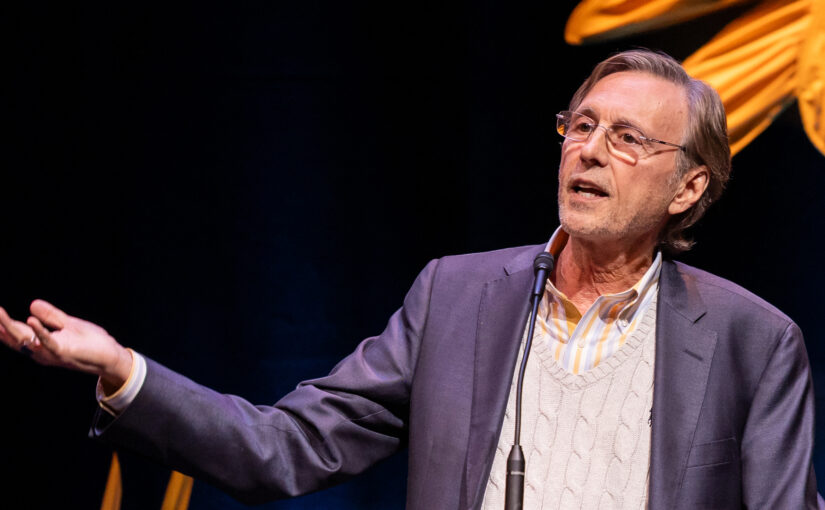
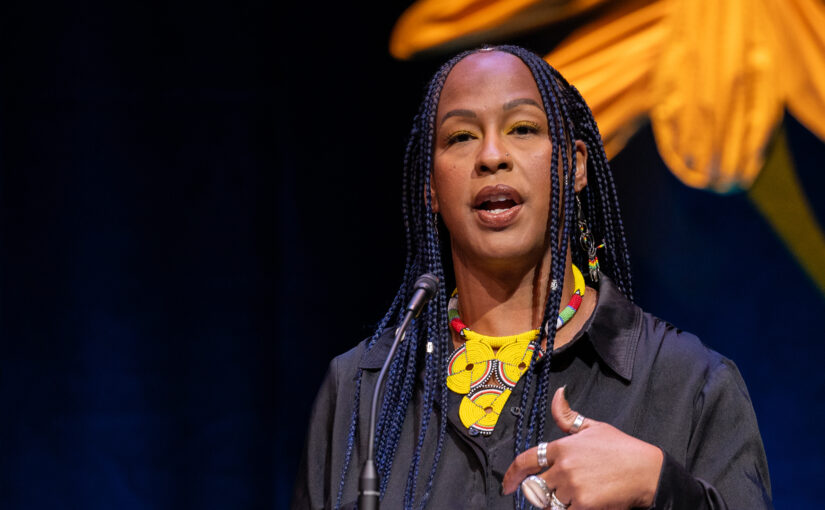
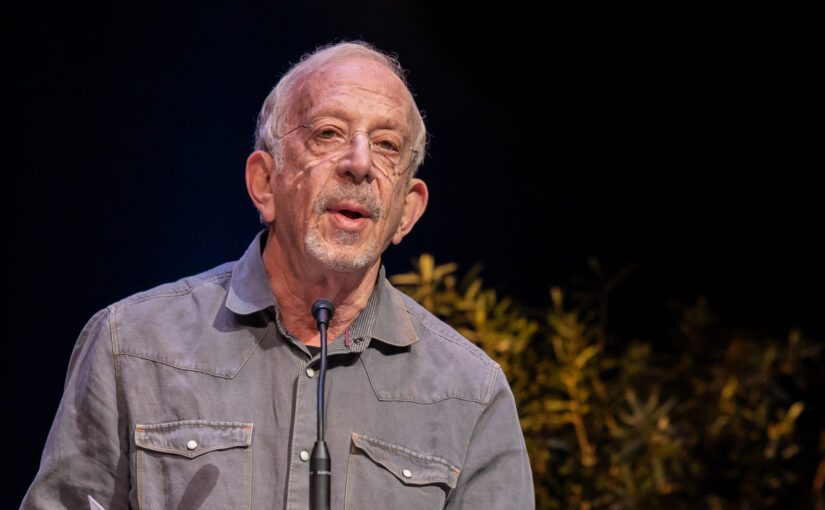
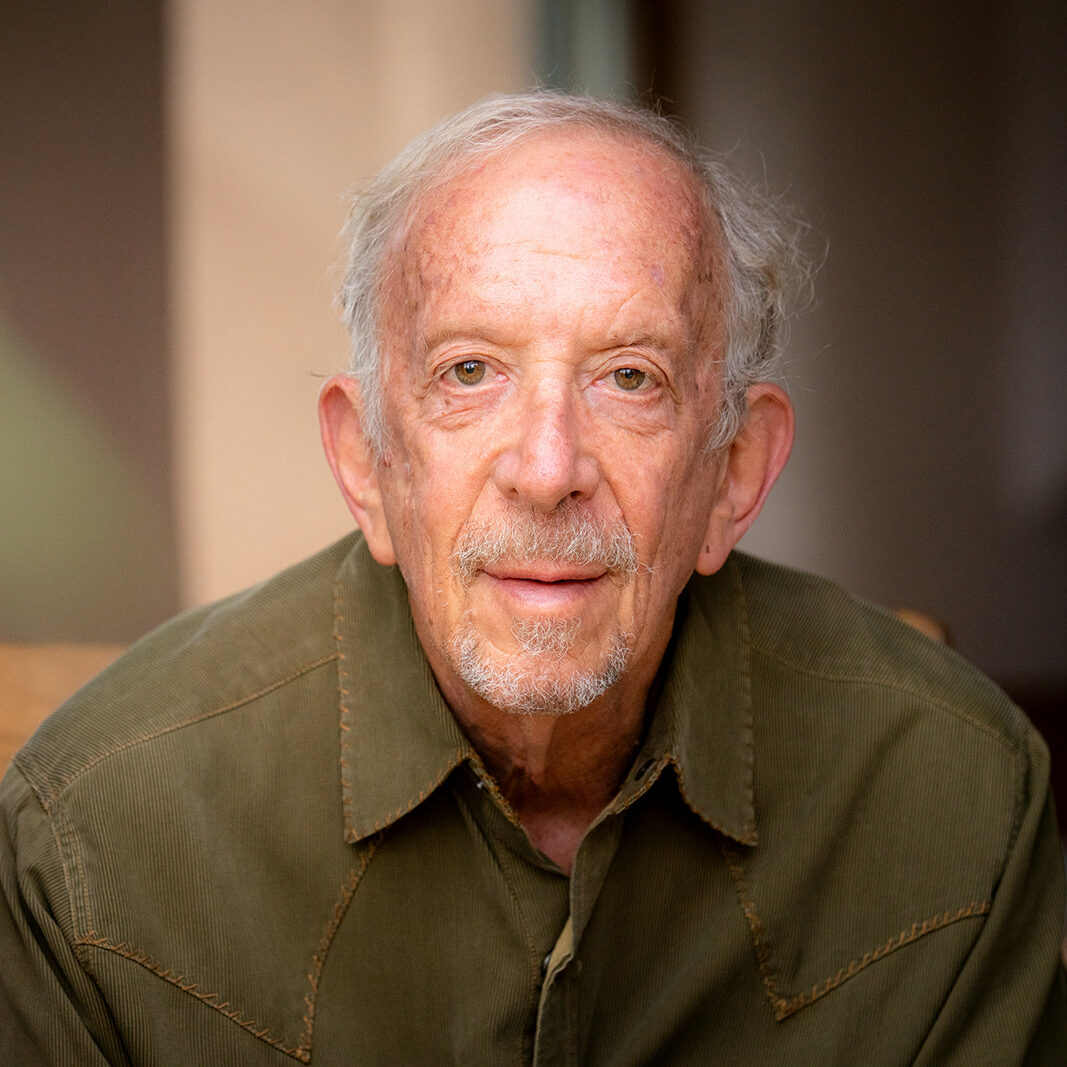
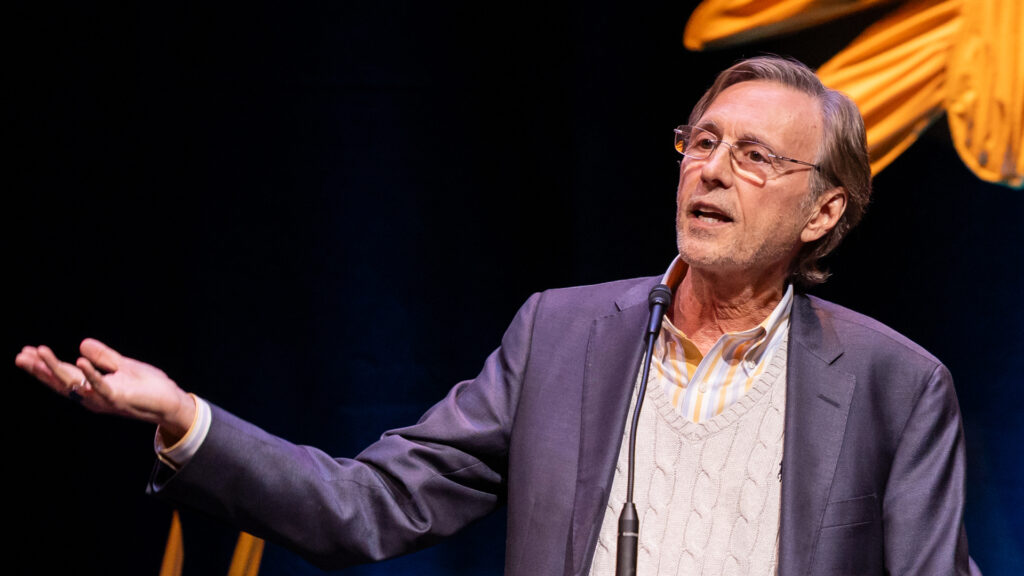
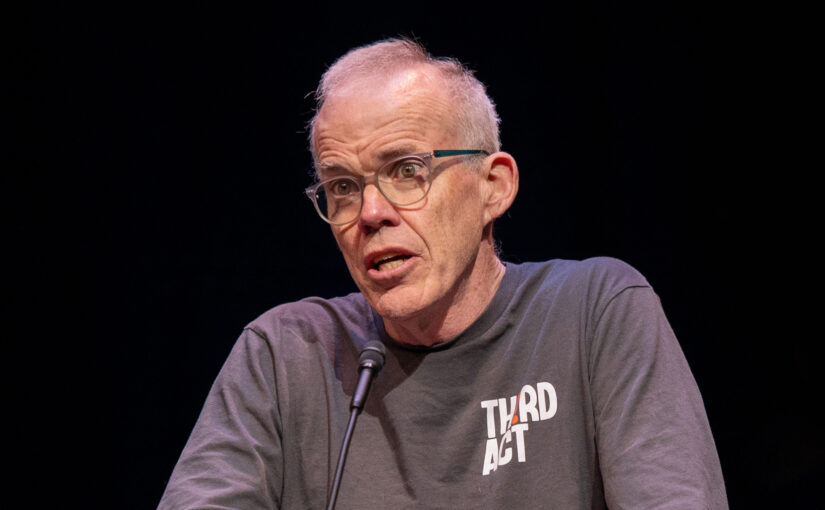
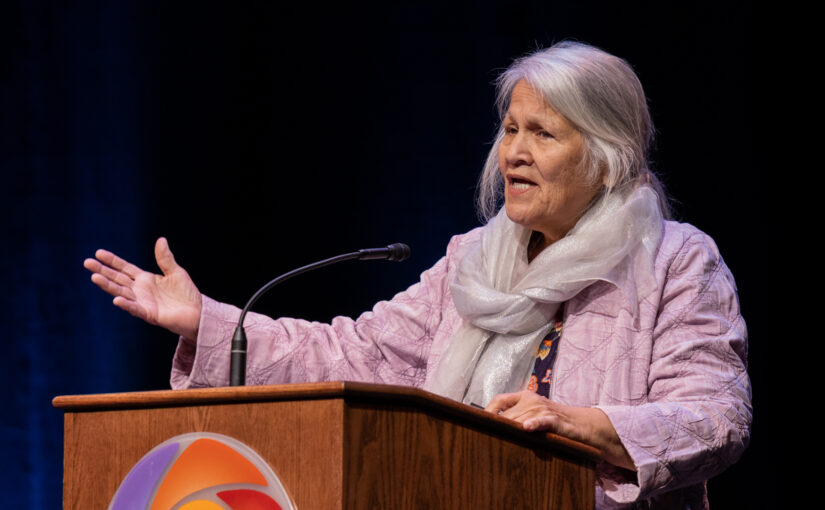
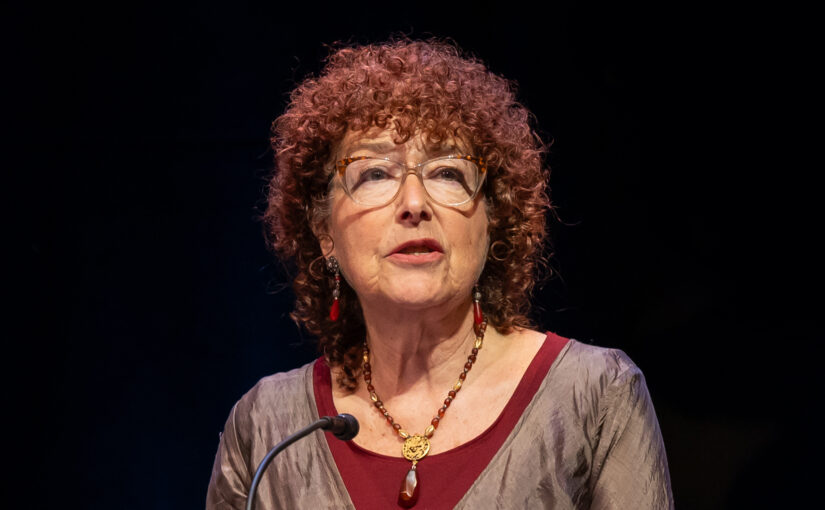
As author, broadcaster and scholar Thom Hartmann sees it, the lines between corporate power, billionaire interests, government authority, public “knowledge,” and foreign influence have not just blurred — they’re vanishing. This is not just politics as usual; this is an emergency. When has any small group of private citizens held such sway over both domestic and foreign policy? The America we once knew — where elected officials were accountable to voters rather than billionaires — is slipping away. This erosion of democracy is largely due to five corrupt Republicans on the Supreme Court ruling that political bribery equals “free speech,” allowing billionaires to flood our 2024 election with money. In truth, this long-developing alliance between American oligarchs and the Supreme Court marks a climactic corporate endgame to replace American democracy with plutocratic autocracy. Do we, the American people, still possess the power and will to challenge this oligarchic takeover? Yes, says Hartmann. This is a call to action.
This talk was delivered at the 2025 Bioneers Conference.
Thom Hartmann, a best-selling author of over 30 books in print and host of the #1 progressive talk show host in America for more than a decade, has co-written and been featured in 6 documentaries with Leonardo DiCaprio about climate change. A former psychotherapist, entrepreneur and refugee worker helping the worldwide Salem group start homes for abandoned and abused children all over the world, Thom and his wife Louise live in Portland, Oregon with a small menagerie of cats, dogs, ducks & geese.
To learn more about Thom Hartmann, visit his website.
In this podcast episode, the first part of a two-part program, we travel back and forth in time to explore the battle between democracy and plutocracy. In today’s new Gilded Age of rule by the wealthy, rising anti-trust movements are challenging the stranglehold of corporate monopoly.
We simultaneously face two related existential crises — climate breakdown and radical threats to democracy worldwide. Can democracy withstand climate chaos? Is a reformed and stronger democracy our best hope to make it through the long emergency ahead of us? What’s needed?
The passionate, long-time, award-winning Environmental Justice litigator and activist from Bayou Liberty, Louisiana, reminds us of the powerful lessons Hurricane Katrina delivered by laying bare the nation’s racism, neglect of disenfranchised communities and environmental mismanagement. She also encourages us all to participate in whatever way we can in the major events commemorating Katrina’s 20th Anniversary this August to help mobilize and redouble our efforts for Climate Justice.
This talk was delivered at the 2025 Bioneers Conference.
Colette Pichon Battle, a generational native of Bayou Liberty, Louisiana, is an award-winning lawyer and prominent climate justice organizer. In the aftermath of Hurricane Katrina, when Black and Indigenous communities were largely left out of federal recovery systems, Colette led the Gulf Coast Center for Law and Policy (GCCLP) to provide relief and legal assistance to Gulf South communities of color. After 17 years at GCCLP’s helm, as frontline communities from the Gulf South to the Global South face ever more devastating storms, droughts, wildfires, heat, and land loss, she co-founded Taproot Earth to create connections and power across issues, movements, and geographies.
In this podcast episode, award-winning lawyer and climate justice organizer Colette Pichon Battle lays out a bold vision to transform the Gulf South and Appalachia away from the lethal matrix of fossil fuel extraction and extractive economics, and toward a regenerative future of clean energy democracy, and an equitable, inclusive economy.
We simultaneously face two related existential crises — climate breakdown and radical threats to democracy worldwide. Can democracy withstand climate chaos? Is a reformed and stronger democracy our best hope to make it through the long emergency ahead of us? What’s needed?
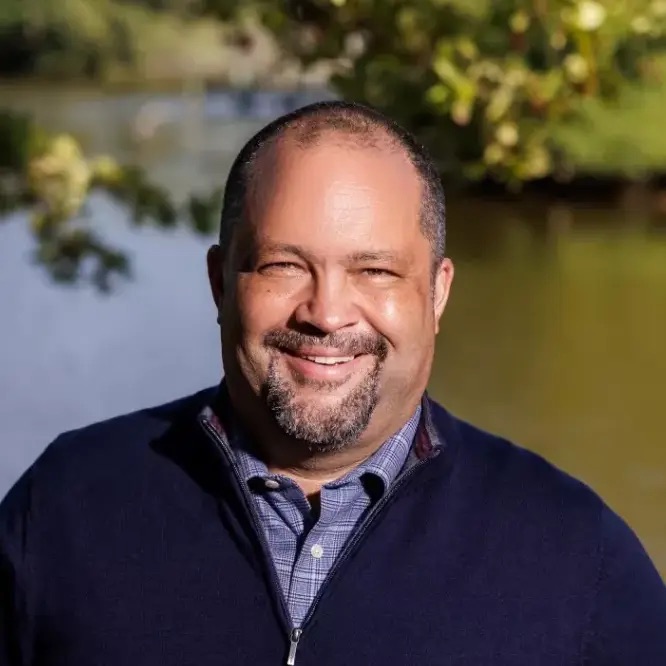
The renowned civil rights and environmental leader Ben Jealous, former (youngest ever!) President of the NAACP and then of People for the American Way, and now, since 2022, Executive Director of the Sierra Club (founded in 1892, one of the very first large-scale environmental preservation organizations in the world) examines how the green economy is driving job creation and transforming industries, including renewable energy and electric vehicles. He debunks myths that the transition will lead to job losses or take too long, instead showcasing how innovation is fueling economic growth. Jealous also highlights the health benefits tied to cleaner air and reduced pollution, including lower rates of asthma and heart disease. He underscores how the green economy is reshaping industries, improving workforce opportunities, and enhancing public health outcomes.
This talk was delivered at the 2025 Bioneers Conference.
Ben Jealous, named the seventh Executive Director of the Sierra Club in 2022, has served in roles from organizer to investigative journalist to president of two of the nation’s most influential groups pursuing equity and justice and protecting democracy and the environment. From 2008 to 2013, he led the NAACP as the youngest-ever president and CEO of the nation’s oldest and largest civil rights organization and launched the NAACP’s Climate Justice Program. More recently Ben was President of People for the American Way (PFAW). Ben began his professional trajectory as a reporter and managing editor at the black-owned community newspaper, the Jackson Advocate, exposing “cancer clusters” in Mississippi’s rural communities caused by industrial pollution. He has also been a partner at one of the nation’s premier ESG venture capital firms, has won many awards, served on the boards of the Environmental Defense Fund, the Trust for Public Lands and the Wilderness Society, taught at Princeton (and currently at the University of Pennsylvania), and is a best-selling author, including most recently of: Never Forget Our People Were Always Free: A Parable of American Healing.
In this podcast episode, award-winning lawyer and climate justice organizer Colette Pichon Battle lays out a bold vision to transform the Gulf South and Appalachia away from the lethal matrix of fossil fuel extraction and extractive economics, and toward a regenerative future of clean energy democracy, and an equitable, inclusive economy.
In this podcast episode, visionary clean energy entrepreneur Danny Kennedy explores the promise and challenges of the epic civilizational transition to renewable energy.
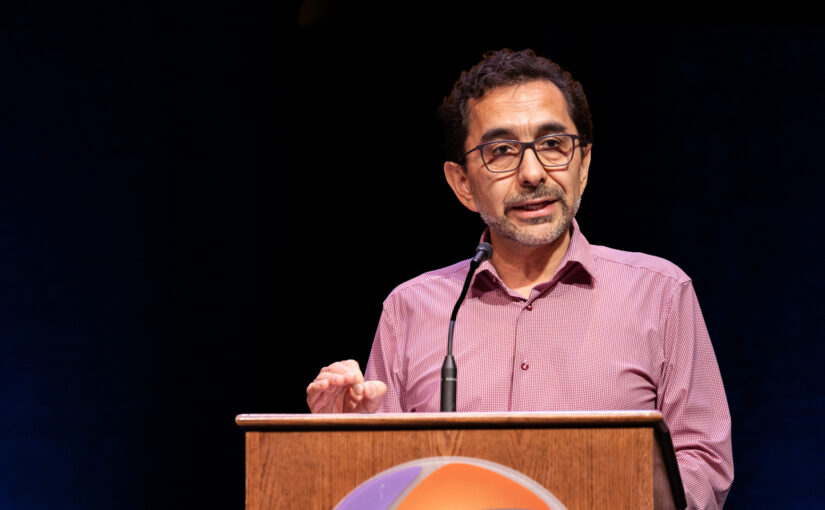
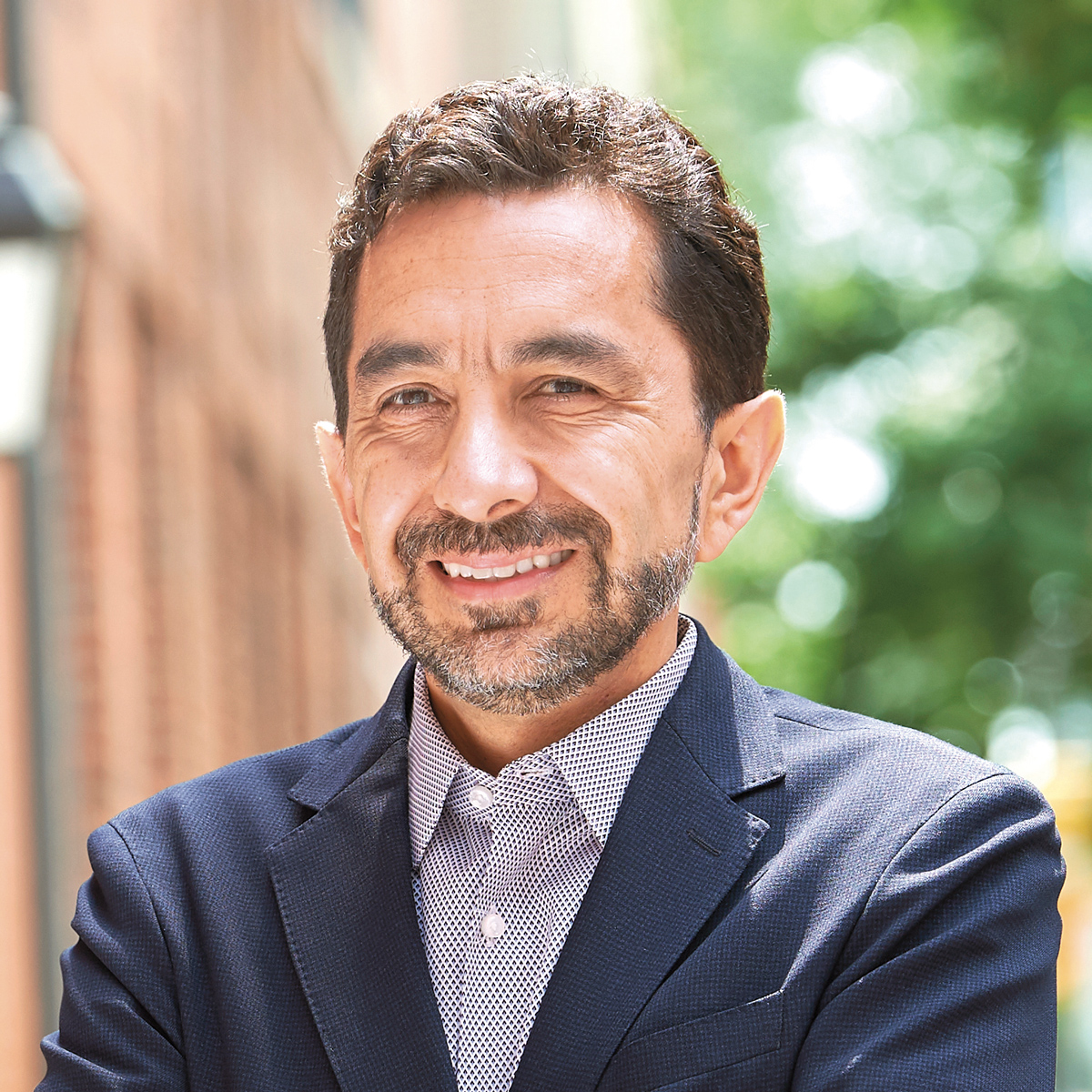
César Rodríguez-Garavito, an Earth Rights scholar, lawyer, and founding Director of the MOTH (More-Than-Human) Rights Program at NYU School of Law, has advanced new ideas and legal actions worldwide on issues such as climate justice, Indigenous rights, and what he proposes to call “more-than-human rights,” which are as much a legal proposition as they are a story about our relationship with the more-than-human world. Drawing on his fieldwork and participation in legal actions advancing the rights of nature around the world, César tells a renewed story about the living world: one in which all of nature is alive; where human and nonhuman animals, plants, fungi, rivers, forests, oceans, and other ecosystems are all animate, subjects of moral and legal consideration, and entangled in the planetary web of life.
This talk was delivered at the 2025 Bioneers Conference.
César Rodríguez-Garavito, a Professor of Clinical Law, Chair of the Center for Human Rights and Global Justice, and founding Director of the More Than Human Life (MOTH) Program and the Earth Rights Advocacy Program (all based at NYU School of Law), is a human rights and environmental justice scholar and practitioner whose work and publications focus on climate change, Indigenous peoples’ rights, and the human rights movement. Editor-in-Chief of Open Global Rights, César has been an expert witness of the Inter-American Court of Human Rights, an Adjunct Judge of the Constitutional Court of Colombia, a member of the Science Panel for the Amazon, and a lead litigator in climate change, socio-economic and Indigenous rights cases. He has conducted field research and environmental and human rights investigations around the world.
While the Rights of Nature movement has made incredible strides in recent years, obstacles loom large. Where is this movement headed, and how can you get involved? This email series offers an accessible crash course, featuring stories, interviews, and resources that provide context and real-world examples from this movement’s groundbreaking leaders..
Honoring the Rights of Nature has always been essential to the worldview and cultures of First Peoples. The Rights of Nature movement simply puts into law what has always been a part of traditional laws: that the natural world must thrive if our Peoples and cultures are to survive.
As a coalition of Native and Native-descended authors, the Bioneers Indigeneity Program team wrote a guide by and for American Indian/Alaska Native community members who are interested in learning about how the Rights of Nature can bring Tribal values into contemporary law.
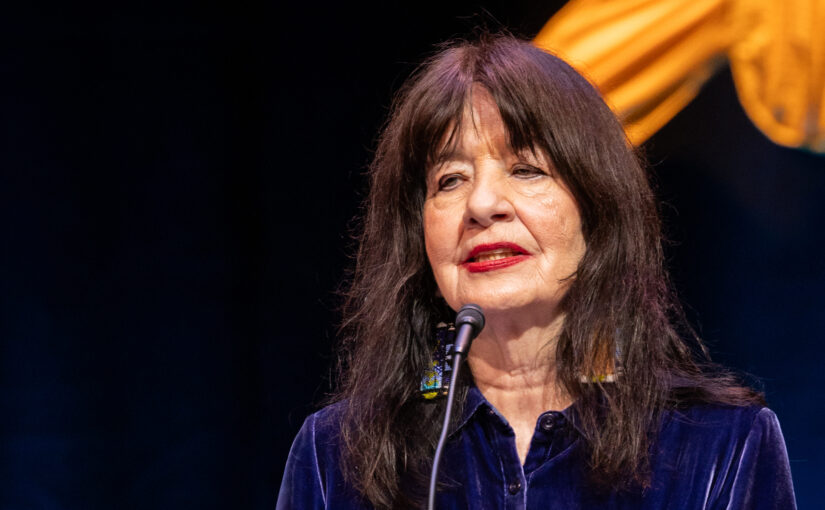
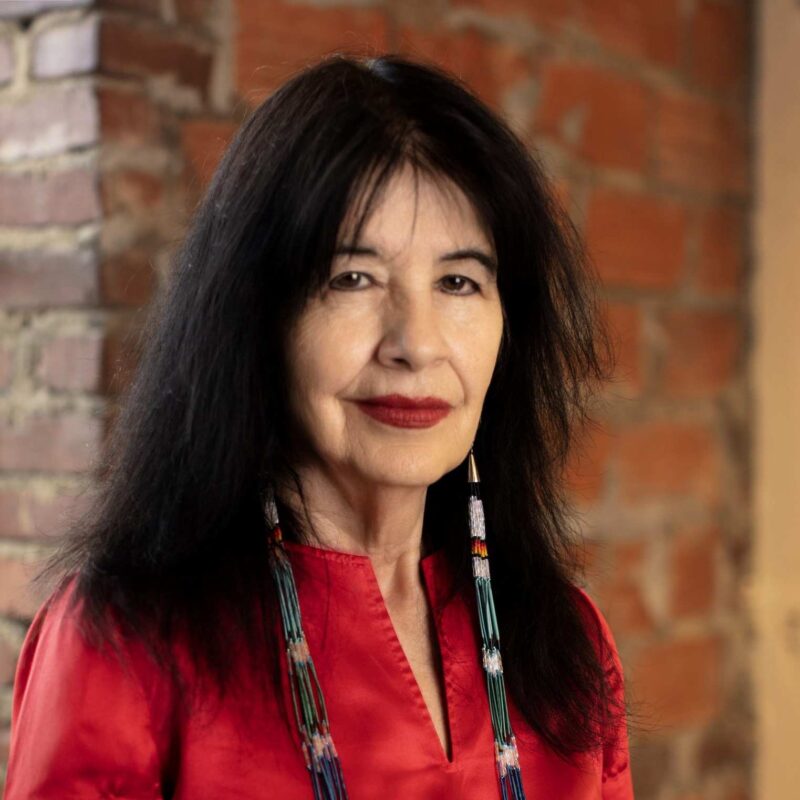
The world-renowned, multiple prestigious award-winning Muscogee poet, writer, and musician Joy Harjo, the first Native American Poet Laureate of the United States, author of ten books of poetry as well as plays, memoirs, children’s books, non-fiction, and seven albums, shares stories, perspectives and select readings from powerfully relevant poems.
This talk was delivered at the 2025 Bioneers Conference.
Joy Harjo, the 23rd U.S. Poet Laureate and member of the Muscogee Nation, is the author of ten books of poetry, several plays, children’s books, two memoirs, and seven music albums. Her honors include Yale’s 2023 Bollingen Prize for American Poetry, National Book Critics Circle Ivan Sandrof Lifetime Achievement Award, the Ruth Lily Prize from the Poetry Foundation, a Guggenheim Fellowship, and a Tulsa Artist Fellowship. She is a Chancellor of the Academy of American Poets and Chair of the Native Arts & Cultures Foundation, and is the inaugural Artist-in-Residence for the Bob Dylan Center in Tulsa, Oklahoma, where she lives.
In this moving personal essay, Robin Wall Kimmerer explores the rich afterlife of a fallen cedar, contemplating what its gradual return to the soil means for the forest and all who walk among the trees.
This podcast episode features doctor and healer Rachel Naomi Remen, who has cultivated a new generation of doctors practicing whole-person medicine, with an unlikely message: Bless others out loud. The wholeness of the world is restored one heart at a time.
In his eagerly anticipated yearly inimitably biting yet droll take on the zeitgeist, Bioneers founder Kenny Ausubel dissects the madness or our current politics and the incredibly high stakes at play, while passionately reminding us that we have no choice but to fight for the survival of the biosphere, and that if we work with “Nature’s Operating Instructions” in mind, we will ultimately prevail.
Kenny Ausubel, CEO and founder of Bioneers, is an award-winning social entrepreneur, journalist, author and filmmaker. Co-founder and first CEO of the organic seed company, Seeds of Change, his film (and companion book) Hoxsey: When Healing Becomes a Crime helped influence national alternative medicine policy. He has edited several books and written four, including, most recently, Dreaming the Future: Reimagining Civilization in the Age of Nature.
As Thom Hartmann sees it, the lines between corporate power, billionaire interests, government authority, public “knowledge,” and foreign influence have not just blurred — they’re vanishing. This is not just politics as usual; this is an emergency. Do we, the American people, still possess the power and will to challenge this oligarchic takeover? Yes, says Hartmann. This is a call to action.
Community action allows citizens from all walks of life to confront systemic challenges and build change through grassroots organizing. Across the country, activists are harnessing “We the People” power to make breakthrough systemic change at the intersection of climate, justice, and beyond. This article highlights just a few of these leaders and how they’re using equity-based community action to realize a better future for all.
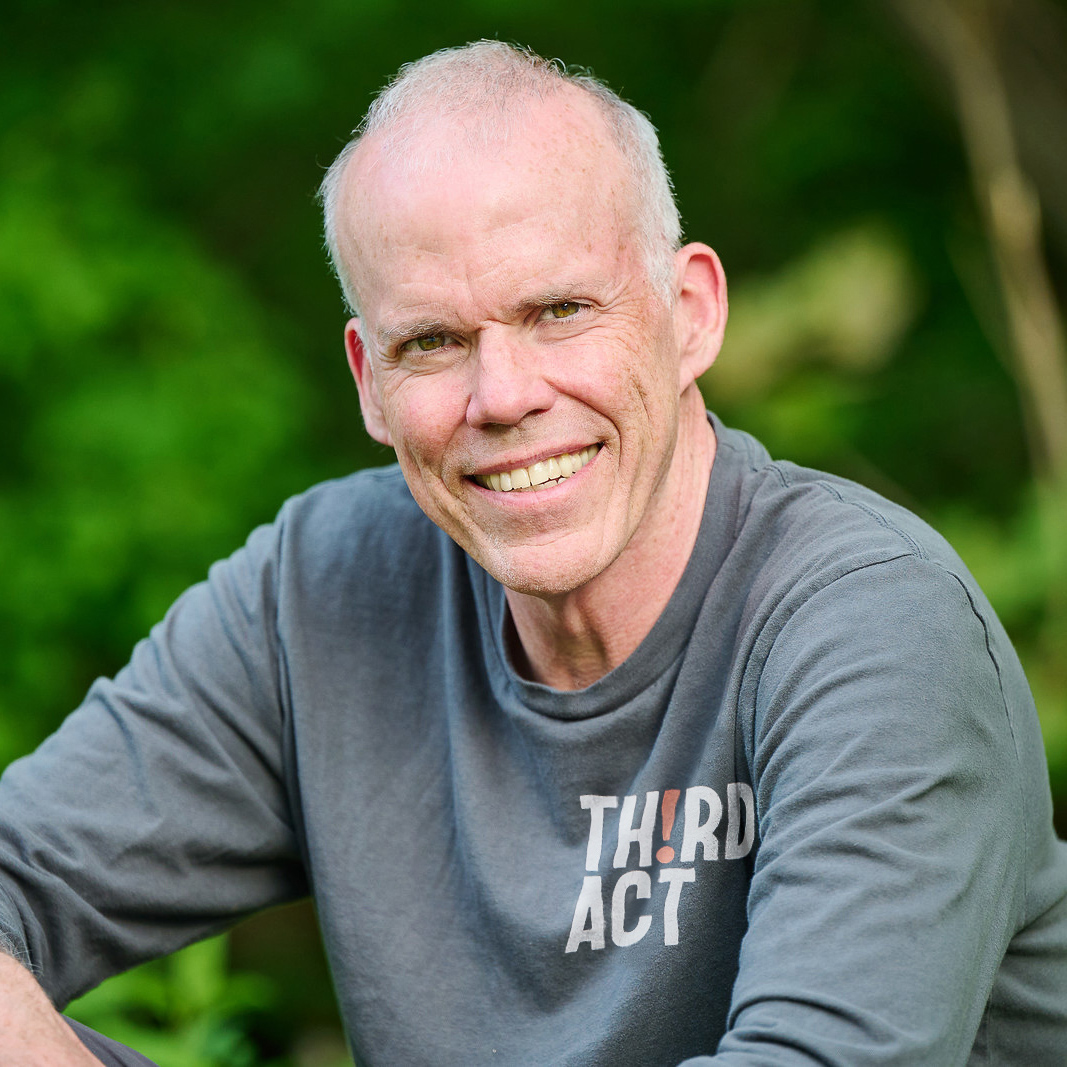
We’re at a dire point in the human story, with temperatures higher than they’ve been in 125,000 years, but we have one secret weapon: the sudden and rapid drop in the price of energy from the sun. Bill McKibben, one of the earliest to warn of the risks of climate change decades ago and in our view the most impactful climate activist of our era, explains that we have a fleeting chance for a truly transformative reorientation of the way our world works…but we will need everyone to make it happen.
This talk was delivered at the 2025 Bioneers Conference.
Bill McKibben, a contributing writer to The New Yorker and a co-founder of Third Act, which organizes people over the age of 60 to work on climate and racial justice, founded the first global grassroots climate campaign, 350.org, and serves as the Schumann Distinguished Professor in Residence at Middlebury College in Vermont. In 2014 he was awarded the Right Livelihood Prize, sometimes called the ‘alternative Nobel,’ in the Swedish Parliament and also won the Gandhi Peace Award as well as receiving honorary degrees from 19 colleges and universities. He has written 12+ books about the environment, including his first, one of the most prescient and important books of the last 100 years, 1989’s The End of Nature. His latest book is: The Flag, the Cross, and the Station Wagon: A Graying American Looks Back at his Suburban Boyhood and Wonders What the Hell Happened.
In this podcast episode, visionary clean energy entrepreneur Danny Kennedy explores the promise and challenges of the epic civilizational transition to renewable energy.
In this podcast episode, award-winning lawyer and climate justice organizer Colette Pichon Battle lays out a bold vision to transform the Gulf South and Appalachia away from the lethal matrix of fossil fuel extraction and extractive economics, and toward a regenerative future of clean energy democracy, and an equitable, inclusive economy.
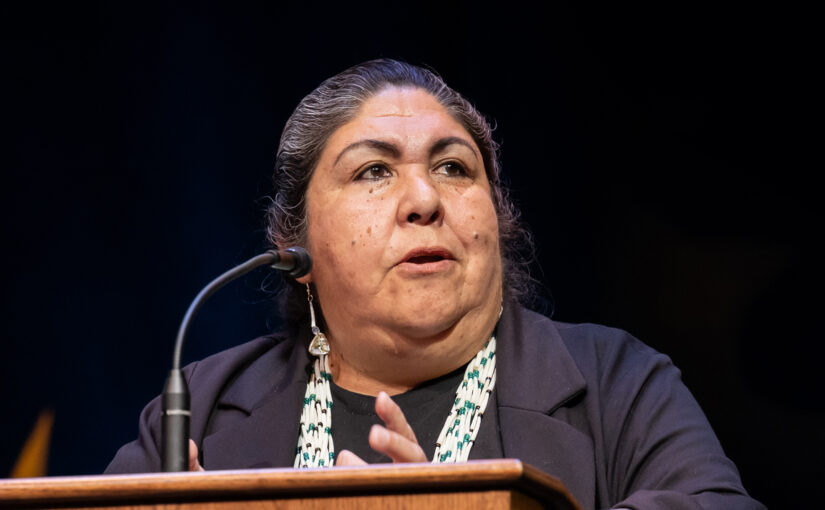
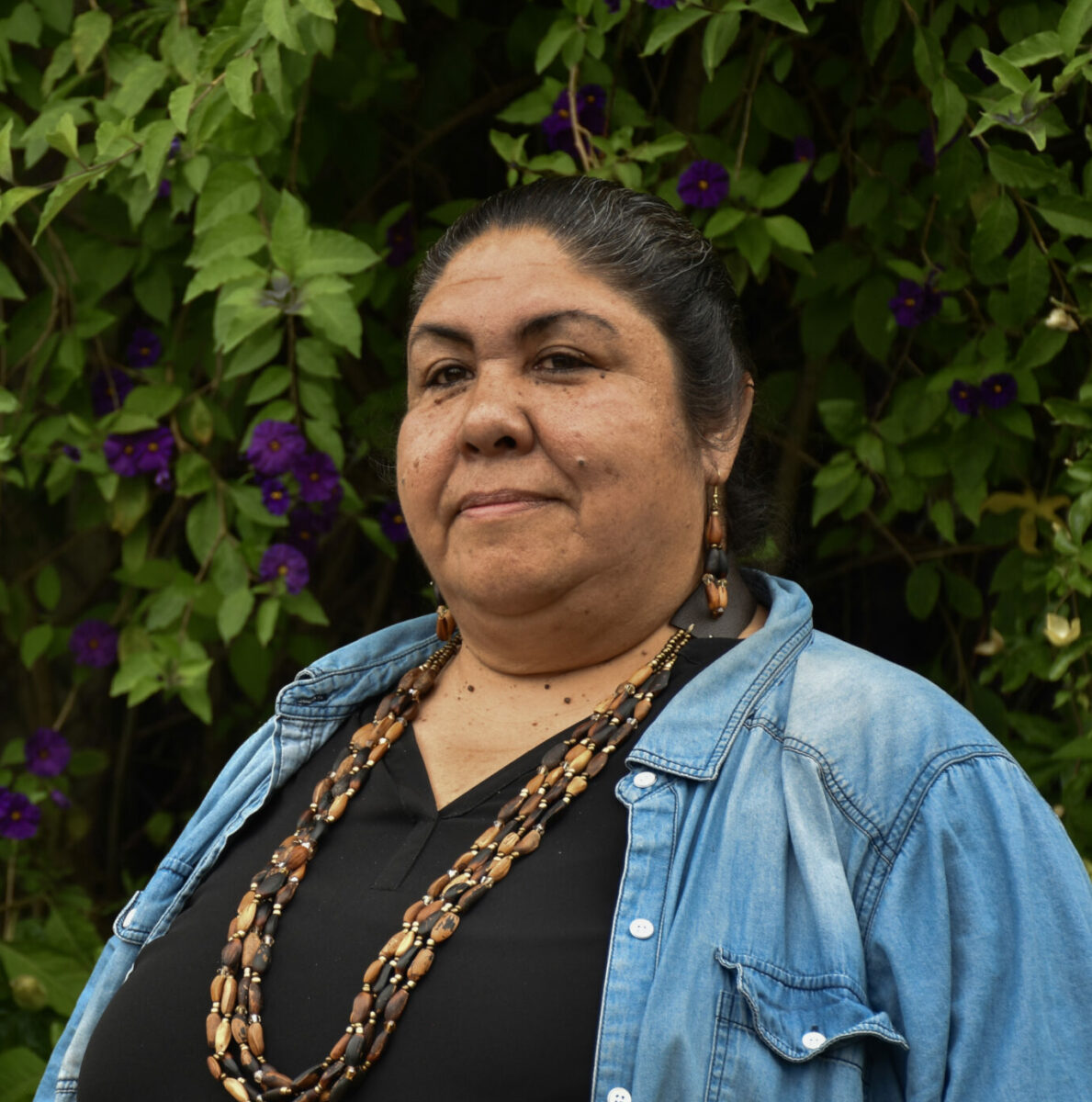
Corrina Gould, tribal spokesperson for the Confederated Villages of Lisjan and Director of the Sogorea Te’ Land Trust, greets attendees to her ancestral homeland, the territory of Huchiun. In her opening welcome, Gould reminds us of the brutal history of genocide and cultural erasure faced by Indigenous Californians, but also shares their powerful resilience and the ongoing rematriation, cultural revitalization and land restoration efforts underway to heal and transform the legacies of colonization and to do the work our ancestors and future generations are calling us to do.
This talk was delivered at the 2025 Bioneers Conference.
Corrina Gould, born and raised in the village of Huichin (now known as Oakland CA), is the Tribal Chair for the Confederated Villages of Lisjan Nation and co-founded and is the Lead Organizer for Indian People Organizing for Change, a small Native-run organization; as well as of the Sogorea Te’ Land Trust, an urban Indigenous women-led organization within her ancestral territory. Through the practices of “rematriation,” cultural revitalization and land restoration, the Land Trust calls on Native and non-Native peoples to heal and transform legacies of colonization and genocide and to do the work our ancestors and future generations are calling us to do.
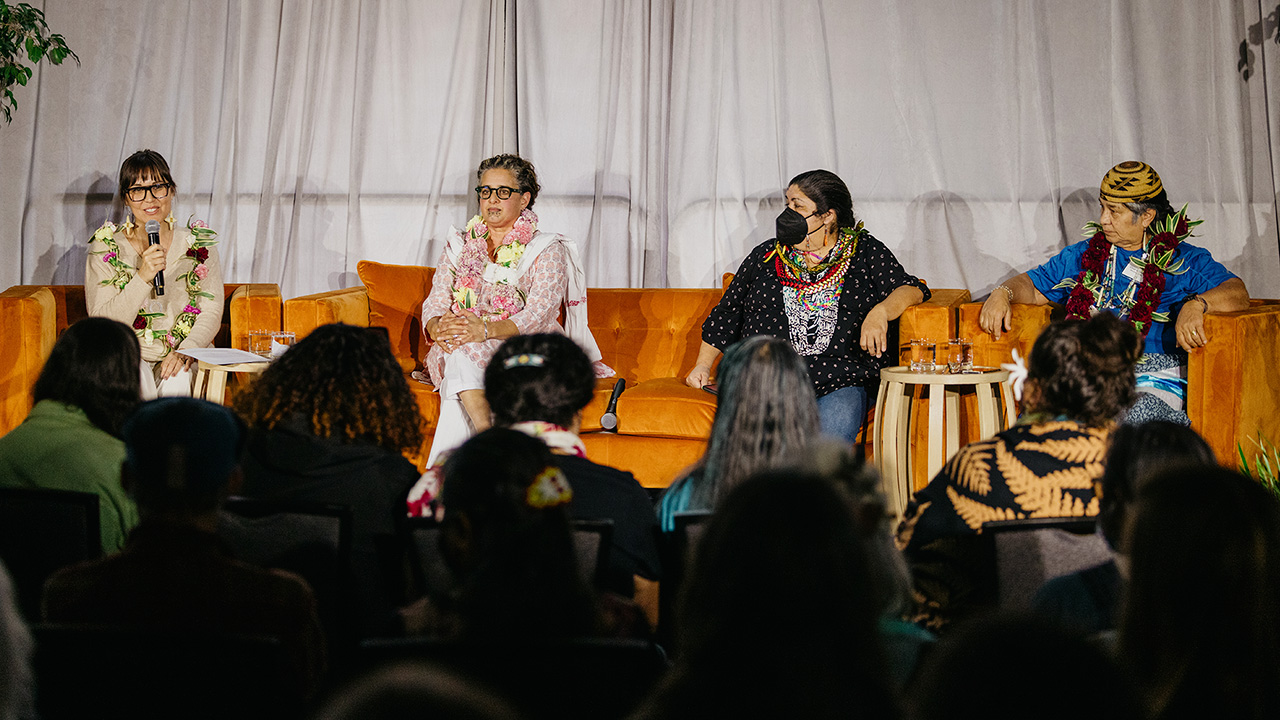
Corrina Gould, Caleen Sisk and Jessica Hutchings, three powerful Indigenous women, share “real-life” examples of rematriation, the ripple effects of these practices, and ways that we can all get involved to Indigenize the future.
California Indians have survived some of the most extreme acts of genocide committed against Native Americans. In this episode of Indigeneity Conversations, we discuss this brutal history and survivance with Corrina Gould, Co-Founder and Co-Director of the Sogorea Te’ Land Trust. We talk about the importance of addressing that historical trauma, which caused deep wounds that still affect Indigenous Peoples today.
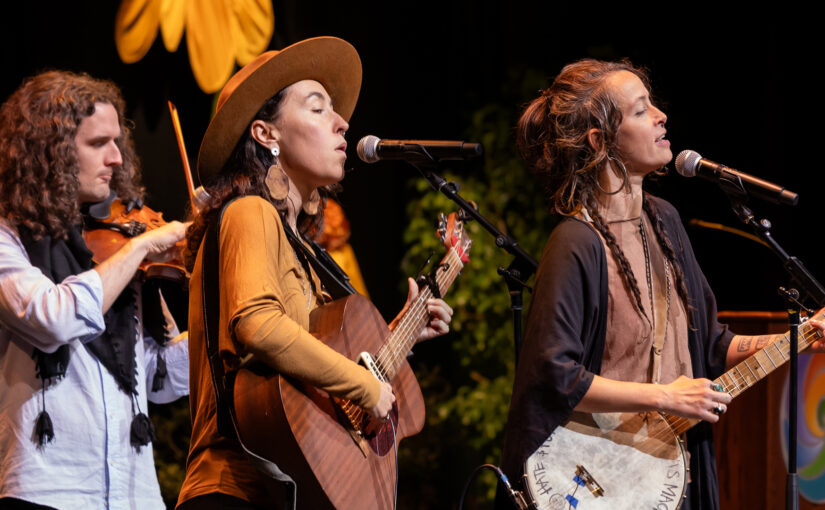
Rising Appalachia gave two performances at Bioneers 2025. Watch their second performance below.
Rising Appalachia, the brainchild of Atlanta-raised sisters Leah Song and Chloe Smith, rooted in the rich musical traditions of their family and region, is an internationally touring folk ensemble with a passionate global following. Eschewing industry norms, they have independently forged their own exemplary, deeply ethical, value-driven path for 16 years, producing seven albums and conducting tours around the world while simultaneously immersing themselves in community-building, cultural exchange programs, and music gathering and sharing everywhere they go. Their most recent album (their first of carefully curated cover songs) is: Folk & Anchor.
Chloe Smith of Rising Appalachia discusses making art that brings people together and responds to the times we’re in with Bioneers Arts Coordinator, Polina Smith.
Katsi Cook has, for 5 decades, been a visionary leader in the defense of Indigenous women’s health, from her groundbreaking environmental research tackling PCB contamination among her people, to helping solidly reestablish traditional Indigenous midwifery in North America, to founding and/or running a number of significant organizations. Katsi’s latest mission as leader of the Spirit Aligned Leadership Program is to elevate the lives, voices, and dreams of Indigenous elder women who desire to intentionally transfer their knowledge and experience to younger women. She shares stories of some of these remarkable women and what they can teach us about the Sacred Cycle of Life, covering such topics as the regeneration of Indigenous lifeways, ancestral healing, the world-building biocultural characteristics of matrilineal descent and rematriation, and addressing the maternity care crisis in Indian Country through kinship connection.
This talk was delivered at the 2025 Bioneers Conference.
Tekatsi:tsia’kwa Katsi Cook (Wolf Clan member of the Akwesasne Mohawk Nation), an Onkwehonweh traditional midwife, lifelong advocate of Indigenous midwifery and Native women’s health throughout the life-cycle (drawing from the longhouse traditionalist teaching that “woman Is the first environment”), is Executive Director of the Spirit Aligned Leadership Program. Her work over many decades has spanned a range of worlds and disciplines at the intersections of environmental reproductive health and justice, research, and policy. Katsi’s groundbreaking environmental research of Mohawk mother’s milk revealed the intergenerational impact of industrial chemicals on the health of her community, and she is a major figure in a movement of matrilineal awareness and “rematriation” in Native life.
Katsi Cook shares her journey in preserving and revitalizing indigenous knowledge, emphasizing the importance of cultural respect in the use of plant medicines and her pioneering work in environmental health and justice.
Corrina Gould reminds us of the brutal history of genocide and cultural erasure faced by Indigenous Californians, but also shares their powerful resilience and the ongoing rematriation, cultural revitalization and land restoration efforts underway to heal and transform the legacies of colonization and to do the work our ancestors and future generations are calling us to do.
Bioneers co-founder Nina Simons shares her rage and sadness at the current national and international situation and expresses her admiration for all those resisting in whatever ways they can. She also stresses the importance of taking care of our inner health and drawing from a range of wisdom traditions in order to maintain our psycho-spiritual equilibrium. We will need to nurture our souls and our affective relationships, Nina argues, lest we burn out during what is sure to be a protracted struggle to protect the natural world and birth a genuinely compassionate, life-affirming civilization.
Nina Simons, co-founder of Bioneers and its Chief Relationship Strategist is also co-founder of Women Bridging Worlds and Connecting Women Leading Change. She co-edited the anthology book, Moonrise: The Power of Women Leading from the Heart, and most recently wrote Nature, Culture & The Sacred: A Woman Listens for Leadership. An award-winning social entrepreneur, Nina teaches and speaks internationally, and previously served as President of Seeds of Change and Director of Strategic Marketing for Odwalla.
Learn more about Nina Simons and her work at ninasimons.com.
From co-creators Nina Simons and Anneke Campbell, “Leading from the Feminine” is a vibrant resource in the flourishing world of leading from the heart, hands and spirit. This newsletter exists to bridge divides and celebrate connections within the rich tapestry of trailblazers who are evoking the feminine to lead with courage, vulnerability, intuition and empathy.
Now in its second edition, Nature, Culture and the Sacred offers practical guidance and inspiration for anyone who aspires to grow into their own unique form of leadership on behalf of positive change. Learn more about the book here.
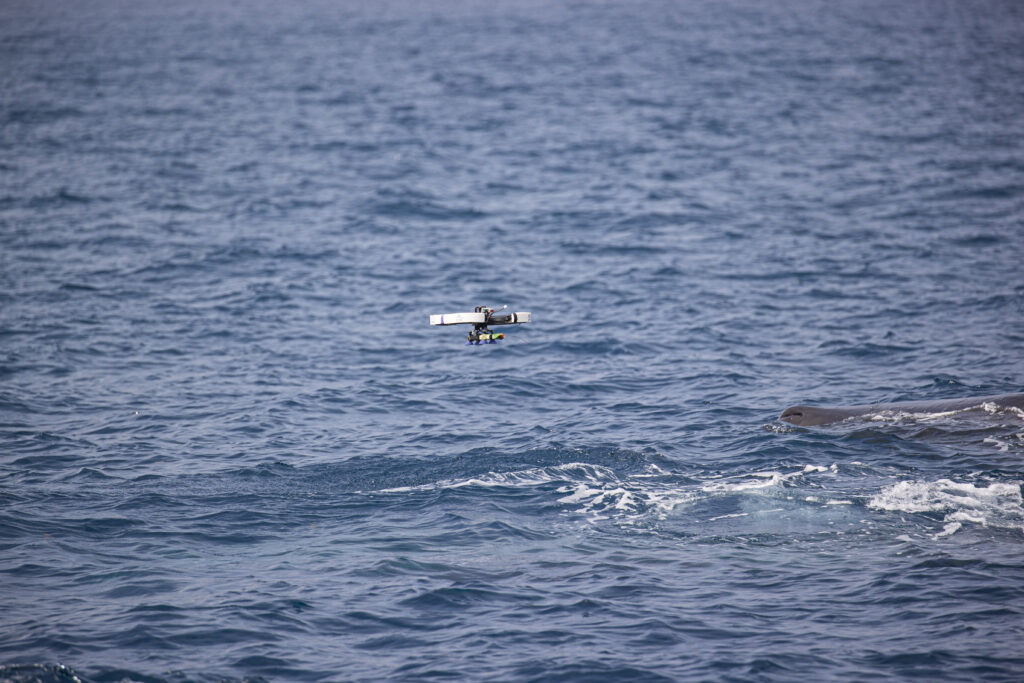
What if we could understand the language of another species—one with its own culture, dialects, and deep intergenerational bonds? David Gruber, founder and President of Project CETI, shares how his team is using advanced machine learning and state-of-the-art gentle robotics to translate the clicks and codas of sperm whales.
The following is an edited transcript from David’s presentation at Bioneers 2025.
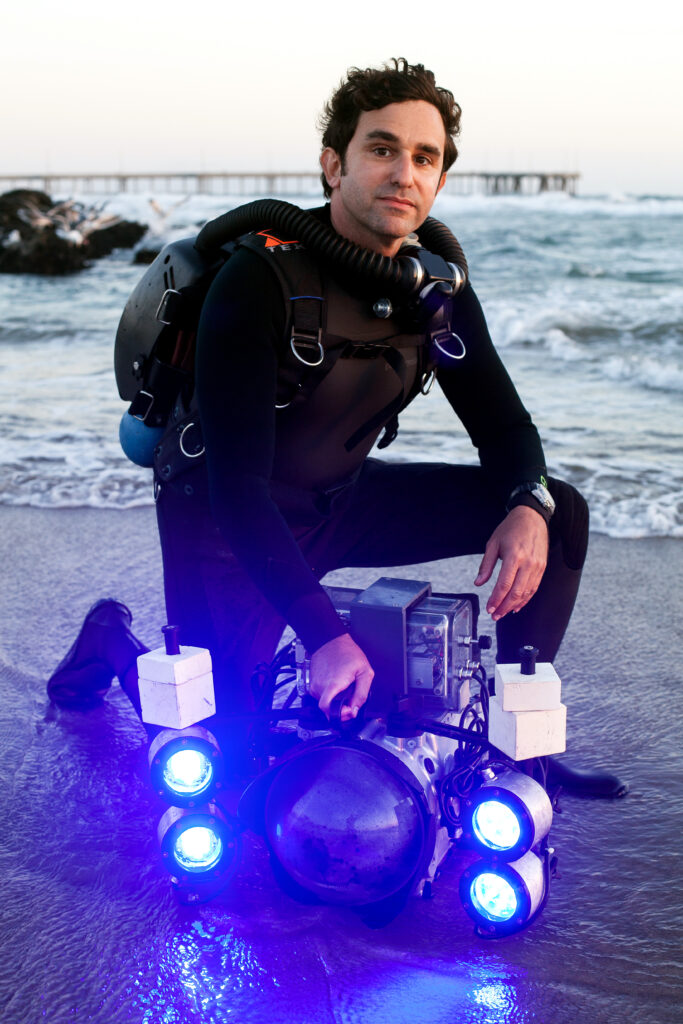
David Gruber, founder and President of Project CETI / Photo by Elias Carlson
Project CETI—the Cetacean Translation Initiative—is the largest interdisciplinary effort ever undertaken to translate the language of sperm whales. For the past five years, we’ve been working in the Eastern Caribbean, off the coast of Dominica.
But first, a bit about how I got here. I originally trained as a marine microbiologist, and I’ve always loved life in all its forms. As a kid, I was obsessed with ants—watching their little societies for hours. I remember learning about E.O. Wilson and his massive book The Ants, and thinking, Wait, you can actually make a living doing this? It was a total lightbulb moment.
Before whales, I spent years trying to get people to see how strange and amazing different animals are—jellyfish, for example. When you swim with them, you realize they’re incredibly sentient. I’ve spent a lot of time with jellyfish, as my background includes a lot of work in coral reef ecology and jellyfish are cnidarians, related to corals and sea anemones.
I took that curiosity to an intense level. But as I progressed as a marine scientist, I started to realize how disconnected the work could feel. On expeditions, we’d pull animals out of the ocean and watch them gasp for their final breaths on the deck of the boat—all while excitedly identifying new species. For a sensitive kid, it was jarring. The idea that studying an animal often meant killing it never sat right with me.
So one of the core themes of our work became: How can we study animals without harming them? That question sparked a long-standing collaboration with Rob Wood at the Harvard Microrobotics Lab—now over a decade strong. Together, we developed the gentlest robot ever created, capable of interacting with jellyfish using just one-tenth the pressure your eyelid applies to your eye.
I became increasingly obsessed with designing tools that could study these delicate animals without harming them.
I became increasingly obsessed with designing tools that could study these delicate animals without harming them. One example was an origami-inspired, rotary-actuated dodecahedron—a robotic structure we used to gently encase jellyfish in the deep sea for observation.
Now, we’re taking it even further. In collaboration with the Schmidt Ocean Institute, we’re preparing for our next expedition, Designing the Future 3. This project allows us to study jellyfish-like creatures, including siphonophores, using cutting-edge tools: 3D scanning, gentle robotic swabs to collect genomic data, and the creation of what we call digital holotypes—comprehensive, non-destructive records of individual specimens.
This approach stands in stark contrast to how the deep sea is being treated elsewhere. On one hand, we see efforts to mine the ocean floor, mowing down fragile ecosystems in pursuit of rare earth minerals like magnesium. On the other hand, a growing group of scientists is going to extraordinary lengths to study gelatinous life without causing harm.
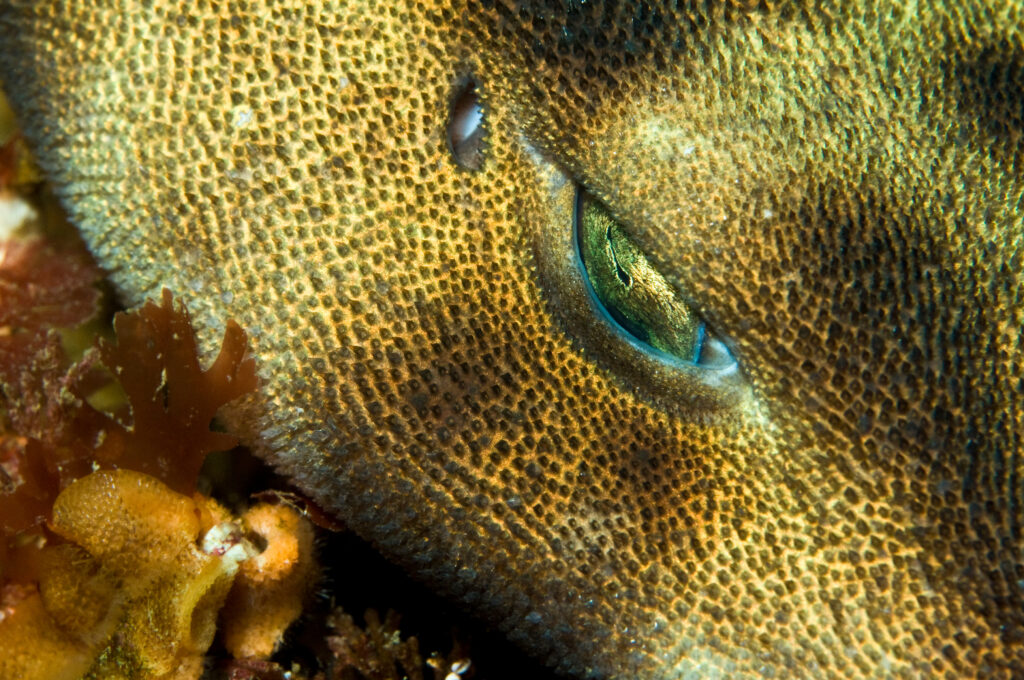
Swell shark (Cephaloscyllium ventriosum)
Another theme that’s been central to this work is learning to see from the perspective of the other. That “other” might be sharks, or biofluorescent animals—creatures that absorb the blue light of the ocean and emit it in brilliant, unexpected colors. My earlier research focused on them. It helped me realize just how much we share this planet with a more-than-human world, and how little we really understand about how other animals perceive, feel, and experience their environment.
As part of that journey, we encountered the swell shark—not exactly the most charismatic species at first glance. But when viewed under blue light, through a lens designed to mimic a shark’s eye, something incredible appeared: intricate patterns across its body. Even more fascinating, the patterns differed between males and females.
That discovery launched us into several years of work, designing a “shark-eye” camera to see the world the way a shark might. Everyone in my lab became obsessed with this project—and with this unassuming little shark. We used every tool we had, combining Western technology and creative design to try to see the ocean from the shark’s perspective.
Now, I’m honored to serve as a steward of the Cetacean Translation Initiative. With CETI, we’re focusing on sperm whales—fellow mammals, yet vastly different from us. They’re often called the poster species of macroevolution, and for good reason.
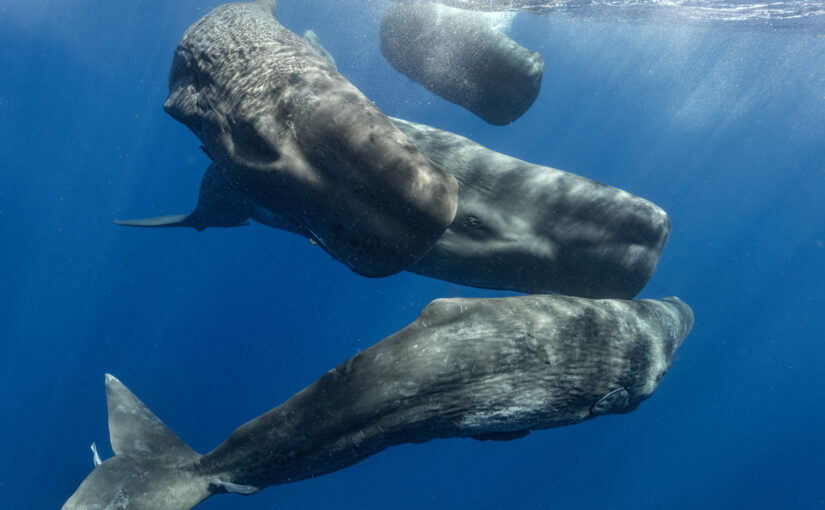
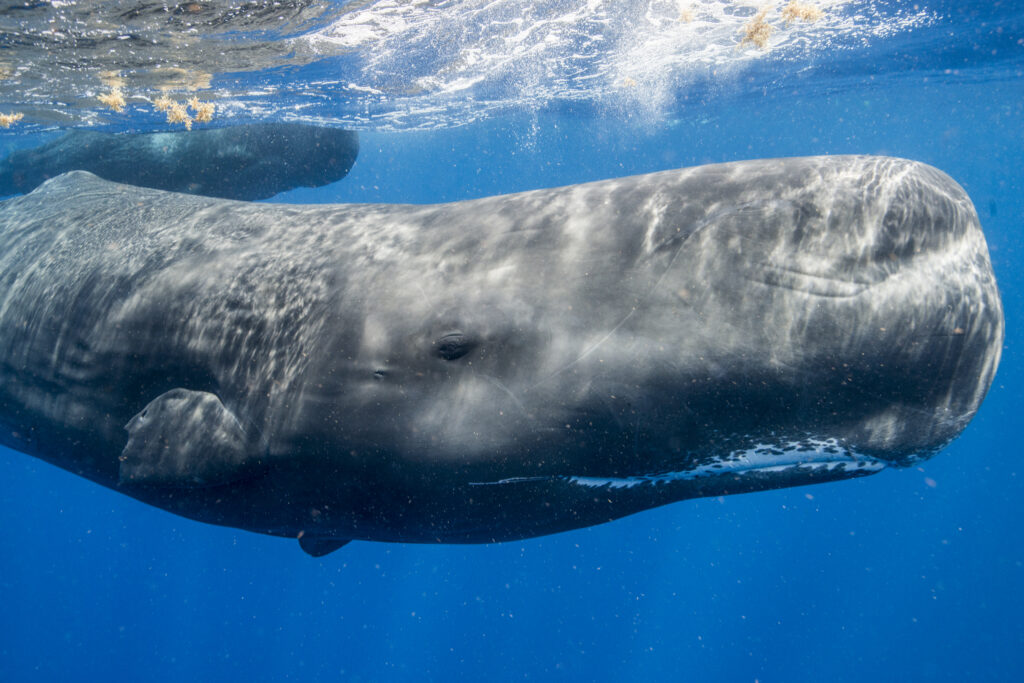
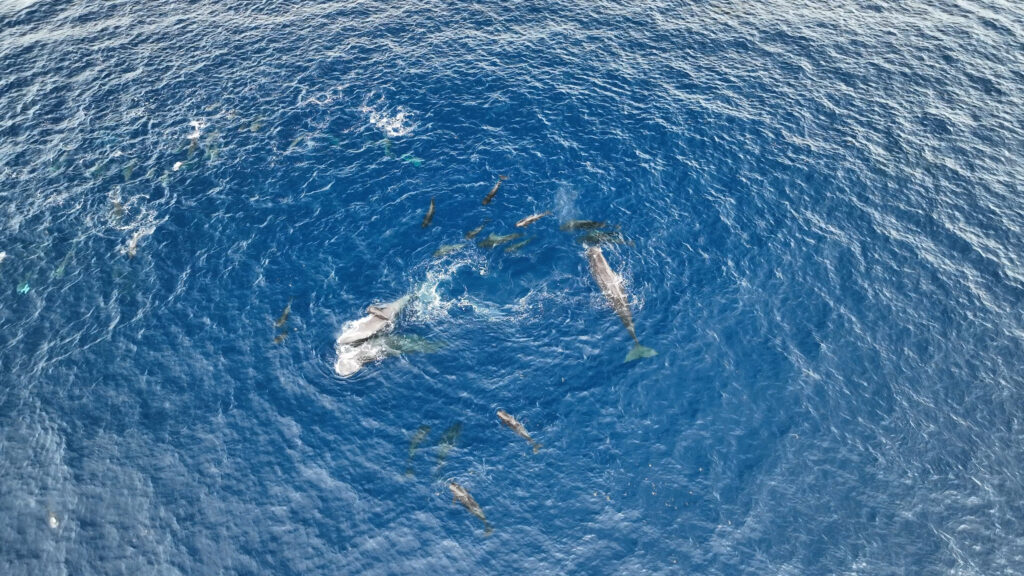
Dominica sperm whales / Photo by Amanda Cotton
Sperm whales are deeply social animals, living in close-knit family groups made up of grandmothers, mothers, and calves. Off the coast of Dominica, there’s a matrilineal population of about 200 sperm whales that remain in the region nearly year-round.
Shane Gero, one of our collaborators, knows these whales so well that he can identify individuals by just a glimpse of their tail. He’ll say, “That’s this whale, and it’s related to that one.” It’s incredible. This kind of deep, long-term human observation and care is absolutely essential to the work.
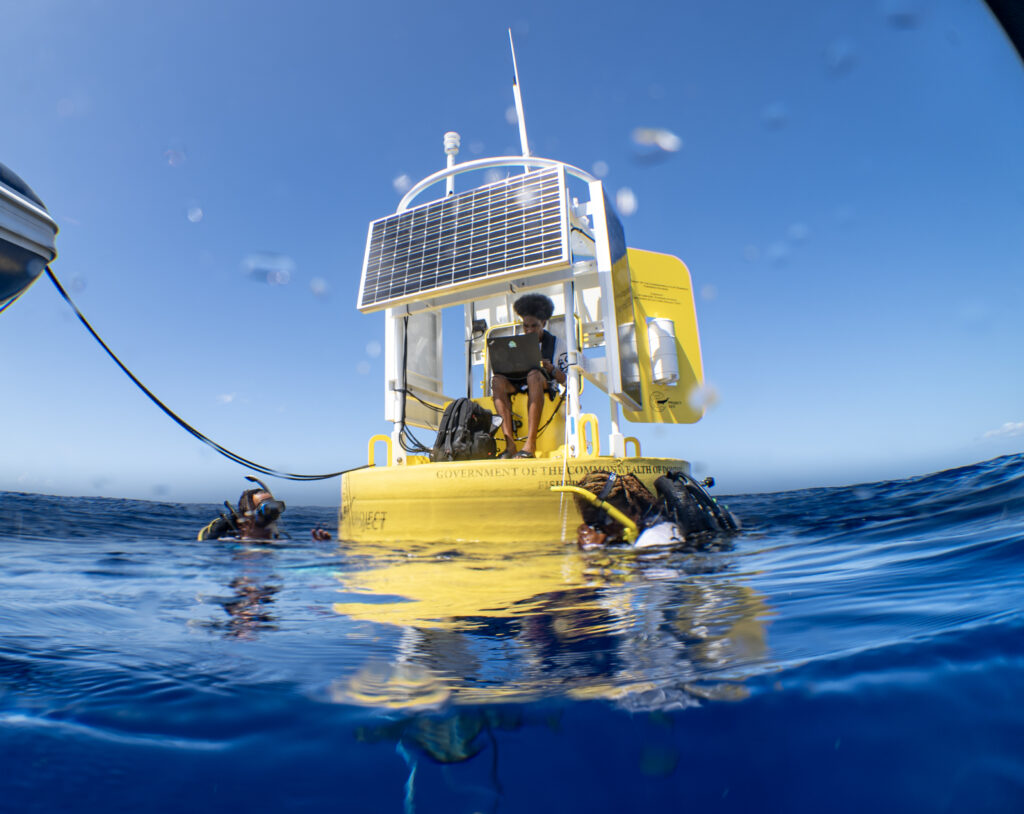
Project CETI officially launched in 2020 with catalytic support from the TED Audacious Project. We raised $33 million to get it off the ground, and today the initiative includes a team of 50 scientists. We’ve built a 20-kilometer by 20-kilometer underwater listening and recording studio off the coast of Dominica. Of course, there’s no store where you can pick up “whale listening tech”—we had to design and build everything from scratch.
The spark for the project actually began in 2018, when I was a Radcliffe Fellow at Harvard. I was sharing space with 50 other fellows from a wide range of disciplines. One of them was Shafi Goldwasser, a Turing Award winner and professor at Berkeley. At the time, her team was working on aspects of Google Translate. They were discussing how it could learn to translate between human languages—not by using a Rosetta Stone, but by analyzing the mathematical shapes of languages in multi-dimensional space. So I played them these recordings of the sounds made by sperm whales.
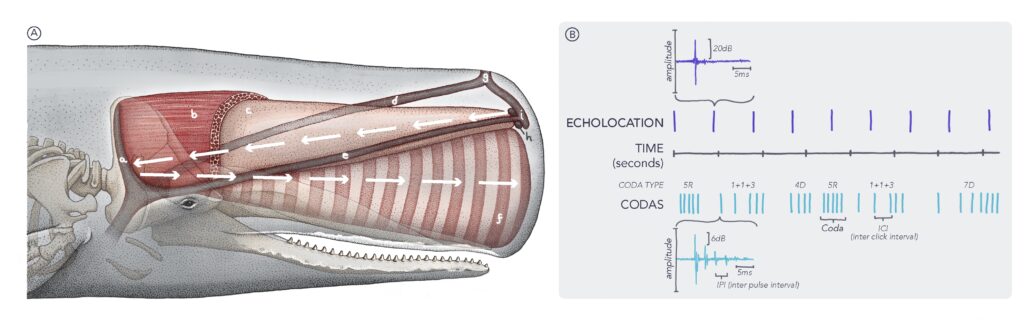
In sperm whales, one of their two nostrils has evolved into a blowhole, but if you examine a whale skeleton, you’ll still see the second, much smaller nostril. When whales vocalize, they move air back and forth through the structures in their head. That air travels through several hundred liters of spermaceti oil. (The name sperm whale unfortunately comes from whalers who mistakenly believed the oil was part of the reproductive system. One of our long-term goals is to rename the species through this collaboration.)
The sound then passes through a series of waxy structures that allow the whale to focus it very precisely. They use this sound in two main ways. One is echolocation—essentially seeing with sound in the deep sea. As a whale dives, you’ll hear a steady pattern: click, click, click, click. As it approaches prey, the clicks speed up—faster, faster—until there’s a final gulp. They’re particularly good at hunting squid.
At the surface, though, sperm whales use a different kind of sound called codas. These are rhythmic click patterns used to communicate. One of the most common in Dominica is a three-part pattern: click, click, click-click-click—we call it “1-1-3.” Remarkably, we didn’t even know sperm whales made sounds until the 1950s. Shane Gero’s research revealed that they actually have regional dialects. Among the whale clans in Dominica, for example, each clan has its own unique dialect, kind of like different accents, say British and Scottish, even though they live in the same waters.
This project is deeply inspired by past efforts—and by the human imagination itself. That sense of possibility fuels us. We often think back to the words of Carl Sagan and others who, while looking out into distant galaxies, also wondered about the mysteries right here on Earth. One idea that stays with us is the question: Could the intelligence of cetaceans be expressed in something like epic poetry, oral history, or intricate codes of social interaction?
Are whales and dolphins the equivalent of human Homers before the invention of writing, recounting great deeds from the far reaches and deep depths of the sea? Who knows? But it’s a beautiful idea—and one that motivates our work.
Dominica is the heart of this project, in part because Shane Gero has been working there for over 20 years. But also, the geography is uniquely suited to this kind of research. It’s like a volcanic Jurassic Park rising from the ocean, with waters that become incredibly deep just offshore. That means whales can swim close to land, unlike in most places where you’d need to go far out to sea to find them. And the population here is remarkably stable—many of the whales remain year-round.
And here we are—on a planet with sperm whales. There are still a few hundred thousand of them alive today, communicating in extraordinary ways we’re only just beginning to understand. We’re barely scratching the surface.
Around 2019, just before we received funding from TED Audacious, we had a breakthrough realization: this underwater recording studio we’d dreamed of? It was actually possible. Humanity had already invented all the necessary technology. We could do this. We could translate the language of sperm whales. It suddenly felt within reach, like the moment people first looked at the moon and thought, Could we really go there?
And here we are—on a planet with sperm whales. There are still a few hundred thousand of them alive today, communicating in extraordinary ways we’re only just beginning to understand. We’re barely scratching the surface.
Project CETI brings together eight different disciplines to tackle this monumental challenge. We have teams specializing in machine learning, robotics, natural language processing, network science, marine biology, and underwater acoustics. And we also have a legal team, which, honestly, might be the most important of them all. As this work unfolds, every piece—every discipline—matters.
One of our biggest breakthroughs this past year was identifying what we believe to be the sperm whale’s phonetic alphabet. That discovery is largely thanks to Jacob Andreas, a professor of natural language processing at MIT, and Pratyusha Sharma, a graduate student in his lab. Their work builds on years of collaboration with our trusted advisor, the late Roger Payne, and on tens of thousands of click recordings collected by Shane Gero.
What we’ve found is remarkable: the whales’ vocalizations appear to contain structured elements—almost musical in nature. Tempo, rhythm, even something we call rubato—subtle changes in timing. One of the most fascinating discoveries is a feature we’re calling ornamentation: small variations, like the addition of an extra click—click, click, click-click-click, click. At first, you might think it’s just noise or a mistake. But when you analyze tens of thousands—or even millions—of these codas, you begin to see patterns. Those subtle differences matter. They’re part of a complex system—perhaps even a language.
This coming year, we have so many exciting developments on the horizon. At a recent event at the Simons Institute for the Theory of Computing, we attended a talk on elephant communication by Joyce Poole and Mickey Pardo. They shared research suggesting that elephants may use names—and even more astonishing, that one elephant might say something and receive a response 15 minutes later.
That kind of delay would be considered rude in human conversation. If I sat silently for 15 minutes before replying to you, half the audience would probably walk out. We’re so accustomed to rapid-fire, back-and-forth banter, where interrupting is rude and pauses are awkward. But that’s not how communication works for elephants—and likely not for whales either. It requires a completely different frame of reference.
In our work with sperm whales, we’ve started analyzing the “negative space” between clicks—the silences—and we’re finding vowel-like features that may represent a whole new layer of their communication system. It’s just the beginning, but it’s incredibly promising.
At CETI, we hold ourselves to a strict ethical philosophy: We never draw a drop of blood. While other researchers may collect DNA samples by taking small plugs of skin, we’ve made a deliberate choice not to. We take the extra time to care for the whales and always ask ourselves one question before moving forward: Is this work in service of the whale?
What’s so exciting—and sobering—is that these new technologies, like AI, are beginning to be applied to the study of animals. And they hold extraordinary potential. This moment could be as transformative as the invention of the telescope or the microscope.
Karen Bakker, author of The Sounds of Life, describes this beautifully: She likens the combination of AI and bioacoustics to a new kind of scientific instrument—one that can help us perceive what our unaided, Old World primate ears cannot. Just as telescopes opened up the cosmos and microscopes revealed the hidden world inside cells, these tools may allow us to hear and interpret the voices of other species.
A world of wonder, connection, and possibility awaits. But how we move into that world matters.
At CETI, we’re working from the hypothesis that technology can deepen our connection to the natural world. It’s still a question mark. But it’s one we’re pursuing with care and humility.
Curious about the ethical side of this work?
If decoding the language of sperm whales and other animals is now within reach, what responsibilities come with that power? In a companion article, legal scholar César Rodríguez-Garavito explores the ethical and legal questions raised by this emerging science—and what it means to protect the more-than-human world in the age of AI.
Researchers are Using AI to Understand what Animals are Saying (TIME) | This article, written by David Gruber and César Rodríguez-Garavito, explores how artificial intelligence and new technologies are unlocking the hidden languages of nonhuman animals—from whales to elephants—and the profound legal, ethical, and ecological questions that follow. It asks whether these breakthroughs will lead to deeper empathy and protection for other species—or risk new forms of exploitation if not guided by care and precaution.
Keep Your Finger on the Pulse
Our bi-weekly newsletter provides insights into the people, projects, and organizations creating lasting change in the world.