How to Legalize Sustainability: An Interview with Thomas Linzey

Life, liberty, and the pursuit of happiness have long been held as the inalienable rights of US citizens. Then why is it that “corporate personhood” consistently overrides the legal rights of people? And what about the rights of nature? Do rivers, mountains – whole ecosystems – have inalienable rights that guarantee their interests?

Innovative environmental attorney and long-time bioneer Thomas Linzey co-founded Community Environmental Legal Defense Fund (CELDF) with Stacey Schmader to tackle these questions with practical action. Their breakthrough work has been redefining democracy.

Begun as a traditional public interest law firm seeking to protect the environment, CELDF quickly realized that no matter how hard they tried to stop harmful projects, our structure of law is not only inherently unsustainable, it has, in fact, made sustainability illegal.

Today, through grassroots organizing, public education and outreach, and legal assistance, nearly 200 municipalities across the U.S. have enacted CELDF-drafted Community Rights laws which ban practices that violate the rights of people, communities and nature– including fracking, factory farming, sewage sludging of farmland, and water privatization.

Teo Grossman, Senior Director of Programs & Research for Bioneers, caught up with Thomas earlier this month to hear more from the frontlines of the growing movement for Community Rights and Rights of Nature.

TEO GROSSMAN: For those unfamiliar with the work of the Community Environmental Legal Defense Fund, can you provide a brief overview of what you do?

THOMAS LINZEY: We’re the lawyers of last resort for those communities faced with corporate projects that they can’t stop through any other means. For the past 15 years, we’ve assisted close to 200 communities across the country to adopt Community Bills of Rights which ban dangerous corporate projects, like water bottling operations, factory hog farms, and fracking.

Because legal doctrines have been manufactured over the past hundred years by corporations to shield themselves from local control when that local control seeks to stop harmful corporate projects, the laws that we help communities to write and adopt include direct challenges to corporate constitutional “rights” and other powers that have routinely been used in the past to override those local laws.

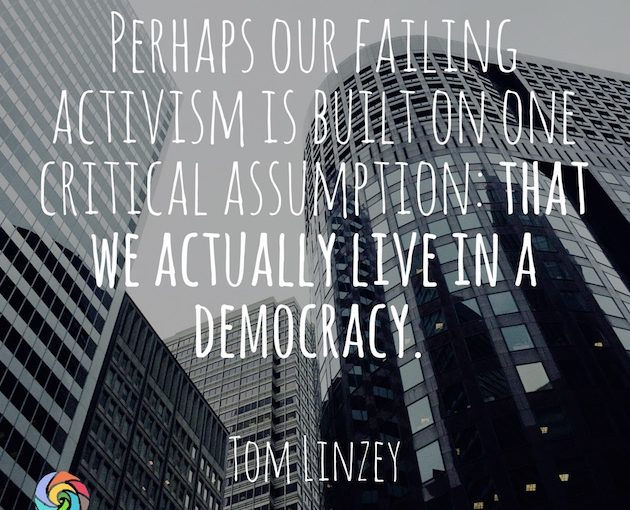
It’s our belief that, until communities have more rights than the corporations which seek to use our communities for their resources, we will be unable to create economic or environmental sustainability. In other words, we don’t have a factory farm problem or a fracking problem, we have a democracy problem.

GROSSMAN: It has been several years since you last presented at a Bioneers Conference. Has the work of CELDF changed, expanded or shifted in any significant ways? Any major success stories and/or hurdles to share?

LINZEY: The community stories that we’ve shared over the years have begun to merge. People across different issue areas now understand that their work is the same as others, regardless of what the underlying issue is. Over the past three years, communities have joined together in Oregon, Colorado, Ohio, Pennsylvania, and New Hampshire to create statewide Community Rights Networks. Each of those state organizations is now proposing state constitutional amendments that would elevate community rights above corporate “rights.” In addition, those state networks have joined together to create the National Community Rights Network (NCRN), which has now proposed a federal constitutional amendment that would recognize the authority of community lawmaking. As the community rights movement grows, these organizations give the communities a louder voice at the state and federal level.

GROSSMAN: At root, your work focuses on drawing attention to and hopefully altering the constitutionally embedded elevation of corporate rights over individuals, communities and natural systems. In an interview you gave to Mother Jones in 2006, you said the following: “The dream is that, 30 years out – and my heart sinks, because I don’t know if we even have 30 years from an environmental perspective – other places will join hands as well, and lead to a rewrite of the U.S. Constitution.” 10 years later, in the midst of a national political campaign replete with populist rhetoric, does this still feel like a dream or are we making some real progress?

LINZEY: The progress that’s being made is by individual people and their communities who are coming to grips with the fact that we don’t live in a democracy. The relatively small number of people who run this country’s largest corporations haven’t had to deal with any visions other than their own over the past hundred years, because people in each community haven’t had the legal authority to take them on.

That’s starting to change, but the institutions that have brought us to this point, including state and national political structures, will be the last ones to shift. While populist rhetoric grounded in the need for economic and environmental sustainability is a good thing, that rhetoric is usually drowned out by mainstream candidates who have more of an interest in merely “regulating” certain activities rather than stopping them completely. So, a lot of it is still a dream, but there is real progress on the ground towards people reclaiming the “we the people” of American historical lore, one community at a time.

GROSSMAN: In one of your talks at Bioneers, you said of environmental regulations: “Even when working perfectly, [environmental regulations] simply regulate the rate at which we destroy our communities and our planet.” The competing view is that if we can get that rate down to a manageable level, it’s better than nothing (this is basically the Obama Administration’s approach to climate change at the moment, leveraging existing regulations to their maximum extent.) Given the time crunch we are up against with many of these issues, is it possible to “change the system” and “work from the inside” at the same time?

LINZEY: Probably not. Almost all activist resources over the past fifty years have been focused on using tools that we’ve been given – like environmental regulations and regulatory agencies – to protect ourselves and the natural environment. There’s a belief that if we use those mechanisms enough, and if we change our own behavior enough, that we’ll be able to stop climate change in time and stop the other catastrophes that are bearing down on us. The problem is that we’ve been trying to use those tools for a long time, and we’ve been changing behaviors for a long time, but that simply hasn’t worked – things are worse now in this country than they were before the major environmental laws were adopted. “Working from the inside” means working with tools that the current system allows us to use, i.e., those tools which reinforce, and do not challenge, the basic operation of the existing system. As a colleague of mine likes to say, “If voting could actually change anything, we wouldn’t be allowed to do it.” The type of system envisioned by people at the Bioneers Conference – the type of system that will stop the planet from exploding – is so inherently in conflict with the economic system that currently exists that the two can’t cohabit the same space. One has to give way to the other, otherwise we’ll continue to accelerate our way off the cliff.

GROSSMAN: Outside the US, efforts (supported by CELDF) in countries like Ecuador and Bolivia have managed to inscribe Rights For Nature into national constitutions. Are there similar efforts in other countries? Is CELDF involved in additional work internationally?

LINZEY: We now have a program that focuses specifically on assisting people and communities in other countries to replicate the work happening in the United States. In addition to assisting people in Ecuador and Bolivia, we’ve been working in Nepal (to advance enforceable Rights For Nature in their national constitution), in India (to advance a rights of the Ganges River bill), and with communities in Canada, Mexico, Ireland, Ghana, Cameroon, Australia, and Colombia. While most of that work focuses on driving enforceable Rights For Nature and ecosystems into law, a lot of it focuses on local self-determination.

GROSSMAN: These types of ground-floor changes are inspiring to hear about, particularly given our struggles in the US. Now that it’s law, are you seeing that this is practically increasing the ability of local citizens in these countries to conserve and protect natural systems and community rights?

LINZEY: Yes. In Ecuador, cases have now been brought to enforce the rights of nature provisions in Ecuador’s constitution, and judges have held on at least two occasions in favor of an ecosystem. Of course, you’ve also had President Correa continue to be a big advocate for drilling in the Amazon, and the constitutional provisions haven’t been able to stop that drilling, but this type of paradigm change never comes all at once. In the United States recently, with our help, a watershed in Pennsylvania filed to intervene in a case brought by an oil and gas corporation against a community which banned a frack wastewater injection well. So, there’s a growing recognition of how these laws aren’t just for show, but can be used to strengthen community fights against these often-global corporations.

GROSSMAN: Are there any particular efforts, campaigns or local/national news stories that we should be aware of, that may be flying under the radar or not getting the coverage or attention they deserve (domestic or international)?

LINZEY: There’s an incredible fight happening in a small rural community in western Pennsylvania. In 2014, the elected Supervisors of Grant Township, a municipality of about 700 people, adopted a community bill of rights guaranteeing clean air, clean water, and a sustainable energy future to the people of Grant. The law banned frack wastewater injection wells within the Township, while removing certain powers and “rights” from oil and gas corporations within the municipality, and recognizing the rights of ecosystems. The Township was then sued, and they’ve been fighting the lawsuit ever since. In October of 2015, a federal judge overturned six sections of the law, and in response, the people of the Township overwhelmingly voted to become a “home rule” municipality.

By transforming their municipal government, the Township nullified most of the judge’s ruling, and they adopted a new municipal Charter, which again banned frack wastewater injection wells, while removing corporate “rights” and powers from oil and gas corporations, and recognizing rights for ecosystems within the Township. The oil and gas corporation has threatened to sue the Township again, and it’s pressing for at least half a million in damages as a result of Grant’s law. The Grant Supervisors have publicly declared that they will file for bankruptcy if a damage award is issued by the court.

The battle is a long way from being over, but it would be the first municipality in the United States to not knuckle under to a corporate challenge, but declare that the battle is important enough to bankrupt the Township.

Learn more about the struggle in Grant Township and how you can help »

Check out Thomas’s terrific book Be the Change: How to Get What You Want in Your Community (co-authored with bioneer Anneke Campbell) which details this growing movement and shows the arc of genuine political revolution brewing at the grassroots level across the US.

3 Bioneers on the Grist50 List

For the beginning of 2016, Grist.org, the irreverent environmental news blog, created Grist50, a list of “The 50 People You’ll Be Talking About in 2016.” Obviously there are far more than 50 people doing great work worth promoting in 2016, but here at Bioneers we’re quite familiar with the excitement and struggle of annually identifying a bounded number of incredible people and projects to highlight. We’re thrilled to see some of our favorite Bioneers speakers over the years making the Grist50 list, alongside many other brilliant minds. Check out some of these luminaries and their Bioneers talks below:

Adrianna Quintero

Bioneers was honored to have Adrianna Quintero presenting a keynote address at the 2015 Bioneers Conference. Adrianna is Director of Partner Engagement for the Natural Resources Defense Council (NRDC) and founder/Executive Director of Voces Verdes, a leading national Latino coalition on climate change and clean energy, started as an attorney in NRDC’s Environment and Health program litigating cases on pesticides, toxic chemicals, safe drinking water, clean air, environmental justice, and US-Mexico border issues.

“Let’s re-imagine what environmentalism means, and re-identify, re-envision what an environmentalist is. Because whether we are out on a beautiful hike or we’re walking our dog with our family, we’re appreciating nature and we are enjoying and valuing what it gives to us. That exposure is what makes us truly care and take the action that we need to in order to protect our environment. It’s time for us to do this, it’s time for us to bring diversity, the same biodiversity that we see in nature and value so strongly, into our movement.”

Vien Truong

Vien Truong, J.D., has been a speaker at several Bioneers Conferences, most recently in 2015. Her voice and work are featured in one of our most downloaded episodes from the 2015 radio series, Bioneers: A Revolution from the Heart of Nature, embedded below, and in a chapter of our recent eBook, available for free here. Vien is the National Director of Green For All, a national initiative to build an inclusive green economy, previously led the Greenlining Institute’s Environmental Equity team, helping pass SB 535, which directs a quarter of CA’s Greenhouse Gas Reduction Fund to disadvantaged communities.

“Often, our environmental campaigns are focused on traditional environmental groups, and yes, that is important. We need to have people who are fighting for the environment at the table. We now also have to realize that sixty percent of Californians are people of color. Seventy-three percent of people under eighteen years old in California now are people of color. We have to recognize this, and we have to organize around it if we’re going win.”

Jihan Gearon

Jihan Gearon, joined us in 2013 on several panels as part of the Bioneers Indigenous Forum. Jihan is of Navajo and African American ancestry, originally from the Navajo reservation, is the Executive Director of the Black Mesa Water Coalition, a board member of the Center for Story-based Strategy, and a steering committee member of the Climate Justice Alignment. She is a graduate of Stanford with a Bachelors of Science in Earth Systems and a focus in Energy Science and Technology.

“Under Black Mesa is the Navajo Aquifer, a pristine aquifer, the best water you can drink and the sole source of drinking water for Navajo and Hopi communities that exist in that area. Coal was being pulverized, mixed with water from the Navajo aquifer and pumped 273 miles through a slurry line to the Laughlin generating station. This was the only place in the world where coal was still being transported in this way. That’s how we got started, around protection of the water because it was being used up and contaminated.”

Bioneers 2015 Youth Leadership Program: Moving the Movement!

Way back when a handful of youth convened under a tree at Bioneers in 2000, at the behest of Julia Butterfly-Hill, we knew an essential piece of the puzzle had just been placed. This program was born to bring youth into the fold of Bioneers in a way that would inspire, inform and engage them, generating ambassadors for the world the world wants. Ever since, these inspired young people have set about translating the Bioneers messages of real, solutions-based hope into the language of our emerging generations of leadership.

That handful of young people turned into almost 500 youth at Bioneers 2015, thanks to your awesome support! The Bioneers Youth Leadership Program (YLP) today is making a deep and powerful impact for thousands of young leaders – and for our collective future.

[quote style=”default”]I was grateful this year to be part of the Youth Leadership program, where I was surrounded by motivated young adults to change the world. The dire state of our planet is often scary and overwhelming to think about, but the capacity of humans and our ability to collaborate on solutions keeps me hopeful. That is why I love Bioneers.

– Lily Urmann, student, University of California Santa Cruz[/quote]

Bioneers 2015 Youth Leadership Highlights

This year we hit high water marks across the board – and we had our highest youth attendance ever!

  • About 20% of attendees at Bioneers 2015 were youth, nearly 500
  • Bioneers awarded a total of 376 scholarships, a 37% increase in the last two years
  • We extended our invitation to all youth called to come, and 115 youth attended Bioneers with their own support, bringing overall youth attendance to 491!
  • Youth were supported by a total of 26 organizations from different cultural backgrounds and economic spectrums – vibrancy and diversity.
  • Approximately 42% of our YLP participants identified as youth of color.
  • Over 70 Indigenous youth attended the Youth Leadership Program on scholarships – a 20% jump – representing 20 tribes. Twenty-five were from the Navajo nation!
  • 2,500 meals were served throughout the weekend. BIG THANKS TO OUR SPONSORS!

Groups attended from California, New York, New Mexico, Colorado, Arizona, Texas, New Mexico, Washington, Arkansas and Illinois. The diversity, vibrancy and energy were awe-inspiring.

Every single youth participant had open access to all three days of powerful keynote talks on the main stage, as well as an impactful offering of activities:

  • Community of Mentors
  • Weaving Earth Mentoring Circles
  • Just Us For Food Justice (JU4FJ) Pre-conference Intensive
  • Interactive Living Mandala Art Project
  • LGBTQ Talking Circle
  • Brower Youth Award Winners
  • Generation RYSE organizing meeting
  • Youth of Color Caucus
  • The Trashion Show
  • The Power of Our Food Choices
  • Poetry Slam
  • Transforming Inspiration Into Action
  • Open Mic
  • The Singing Tree Art Project
  • Wiser Together Café
  • Digital Storytelling
  • Strategic Energy Innovation (SEI) Internship Program

And more! And youth participation and engagement were consistent throughout. These young people all took this seriously – as an opportunity to learn, grow and create relationships that will help them on their way on the road ahead. And when you have mentors like Luisah Teish, you’ve got good backing!

Luisah Teish Youth Mentor Bioneers 2015 © Republic of Light 650px
Luisah Teish, an elder in the Ifa/Orisha tradition and renowned speaker and artist-activist, met with youth for an intergenerational mentoring session at the 2015 Bioneers National Conference. Photo by Republic of Light.

What Bioneers Youth Say

Our overall success came through in the responses of the youth themselves:

[quote style=”default”]This year the conference had a very strong presence of Indigenous speakers, panelists, youth scholars, and attendees and I am both honored and proud to say that I was one of the Youth Scholars. For me this opportunity has been invaluable. Growing up I experienced conflicting and confusing feelings about my culture. There were times where I struggled to feel proud about my Indigenous roots, so I hid it. And there were also times when I felt guilty and ashamed that I wasn’t “Native” or traditional enough because I attended non-native schools and eventually left the community for college. I still work with this internalized oppression, however, there are moments when someone or something frees me from that, and that’s what happened at Bioneers.

– Jade Begay (Tesuque Pueblo and Dinétah), Sustainability and Justice Communications Fellow at Resource Media[/quote] [quote style=”default”]Bioneers made me come alive in such a way that I belonged deeply to myself and to this world. I was reminded that I belong to this small spinning water planet and that my work is to continue to serve this Great Turning in any way I can. That we all – every living thing – have work to do to feed and to feel that belonging. Thank you for reminding me of this.

– Justine Epstein, youth scholarship recipient[/quote] [quote style=”default”]Through all of my perspective changes and my brain being stuffed full of knowledge the thing that made Bioneers truly special for me was the absolute unity of everyone. Although we came together from all around the world, we all sought in one form or another to solve the major problems that are harming our world. This is so unique to gather several thousand people that all have the same desire to help, that is all we need to solve the problems of our world.

– Quincy Meisman, student, Alpine Achievers Initiative[/quote] [quote style=”default”]The Bioneers conference for me reinforced the idea that we are in it together and we need to stop dividing ourselves. Collaboration, innovation, and integration are essential elements needed to create change within our society. It was definitely a eye opening experience to me and one that I will not forget anytime soon.

– Miguel Garcia, student, A.L.M.A.S.[/quote] [quote style=”default”]Bioneers is not only an event. It is not only a group of people, or a media outlet. To me, Bioneers symbolizes a collective consciousness, with a conscience that’s caught up with us. There are no spectators here. I’m figuring out how I fit in, and what a glorious journey it is.

– Cal Huss, youth scholarship recipient[/quote] [quote style=”default”]If there is one lesson that I have learned from Bioneers, that sticks out above the rest, it is that bringing people together is one of the most powerful things that we can do.

– Lily Leveque-Eichorn,Youth Program Manager, Ceres Community Project[/quote]

Create and Support Youth Engagement at this Critical Time

As Bioneers so vividly shows, one person can make a real difference, and today’s leadership arises in and from community. Youth know this and today’s young people are deeply enmeshed in community. The Bioneers Youth Scholars are on their paths – or on their way to finding them – and they’re determined to bring about the world the world wants.

And we all know that they can’t do it alone-your partnership is essential to keep bringing youth to the movement and illuminating some of the pathways. Bioneers is a way station for them where they can find new maps, reset their compasses and form new relationships that will strengthen and support them on their journeys. Your support is vitally important.

You can contribute once a month and you can make a huge difference. Give as little as the price of a weekday lunch – $10. That becomes $120 a year and that’s almost a quarter of a youth scholarship! If you can commit to $50 a month, you’ll fund a full Youth Scholarship!

If you prefer, you can also make a one-time gift. It will make a difference that really makes a difference. And that’s perhaps most true when you consider that you are investing in these bright young advocates for our future.

The real power here lies in your giving. Investing in Youth Leadership offers such uniquely high value. And truthfully, in our efforts to shape a brighter future for all of us, we rely on you to make this powerful program and these profound opportunities real. We could not do this without you. And with you – together – we all benefit.

With your support, we can continue to provide a one-of-a-kind experience, network and way station for tomorrow’s leaders, the compassionate and caring youth, to connect, collaborate and create.

Thank you!

Bioneers 2015: Formidable New Output & Breakthroughs

Each year we produce a recurring cyclical body of work such as the annual conference, radio series, Cultivating Women’s Leadership trainings and Resilient Communities Network events. In 2015, several landmark accomplishments occurred, as well as new developments for future work in 2016 and beyond.

2015 New Media Products

In 2015, we released a formidable body of new media products developed over the past 3 years.

  • 18 New Media Collections. These 18 new themed Media Collections add to the 14 released in 2014, including an audio Collection on Women’s Leadership. See all Media Collections »
  • Indigenous Forum Media Collection. Edited from the unique material filmed at the 2013 and 2014 Indigenous Forums, this Collection is designed for the general public, educators and Indigenous communities. Check it out here » 
  • California Climate Leadership e-book. Edited from proceedings from the 2014 one-day Bioneers Summit, this short and compelling e-book is designed for educational and organizing purposes to continue to spread the California model nationally and globally. Download your copy »
  • Study & Discussion Guides. Our first three Study & Discussion Guides are companions to the Media Collections for use in schools and engaged civic settings: Climate Leadership; Food & Farming; and Indigenous Knowledge. A Women’s Leadership Guide is in production. These highly professional products meet rigorous educational standards for use in multiple contexts including service learning and project-based learning. They are formatted for multiple media including iPads and mobile devices and Skype in the Classroom. We created an education-centric microsite on our website as a repository and connection point for educators and students. In response to many requests, these materials will help disseminate our media and networks through current and new networks. They will engage people in action-oriented relationships in their schools, communities and/or workplaces. We propose to continue to produce these ongoing. See all Study Guides »
Dutch allies Bioneers 2015 © Nikki Ritcher 640px
Our Dutch Allies: (left to right) Netherlands Consul General Hugo von Meijenfeldt, Paul Vosbeek of Real NewEnergy, Bioneers E.D. Joshua Fouts, Special Envoy for International Water Affairs at Kingdom of the Netherlands Henk Ovink, Emily Ryan, Transformative Education Designer

2015 Special Events

In 2015 we also produced and/or participated in two important special events.

  • California-Netherlands Sustainability Summit. Bioneers co-sponsored a February 2015 event in San Francisco with the Dutch Consulate related to linking California Climate Leadership initiatives with advanced Dutch practices and policies around water and sea-level rise. (The Dutch subsequently signed a climate action pact with California in May 2015.) We then featured Dutch models and speakers at the 2015 Bioneers Conference and in the pre-conference intensive, including the globally renowned Dutch water wizard Henk Ovink. Discussions are underway about a Bioneers Global pan-European event in Amsterdam in partnership with the Dutch Consulate and others.
  • California Climate Leadership Summit Intensive II. Building on the highly successful first such intensive in 2014 in collaboration with Tom Hayden, we deepened our engagement with the California Climate Leadership model with a second one-day intensive. We went global in scope with major figures from other nations as well as key national and California government leaders and other national leaders. This work is an evolution of our Resilient Communities program and the Dreaming New Mexico project, building local, national and global resilience networks below the federal level.

2015 Program Breakthroughs

Please see our organizational brochure for a full description of our three core Bioneers programs:

  • Changing the Mindscape: Public Education and Media Outreach (includes our annual conference)
  • A Community of Leadership: Women, First Peoples and Youth
  • Resilience from the Ground Up: Resilient Communities Network (includes Bioneers Global)

All our programs produced significant milestones, breakthroughs and accomplishments in 2015. Following are the most significant.

Youth Leadership Program

  • The Youth Leadership program skyrocketed, with nearly 500 youth (ages 13-23) participating in the 2015 conference (20% of all attendees), including about 375 on scholarship. It is the most diverse constituency, with nearly half being youth of color. The past two years have seen a radical spike in requests for scholarships. The surge in youth participation may be the single biggest indicator of the health of the work and organization.
Indigenous Forum 2014 Oren Lyons © Zoe Urness
Indigenous Forum: (left to right) Evelyn Arce, IFIP; China Ching, The Christensen Fund; Pearl Gottschalk, LUSH Cosmetics; Chief Oren Lyons, Haudenosaunee

Indigenous Knowledge Program

  • The Indigenous Knowledge program achieved multiple breakthroughs and milestones over the past two years. At the 2015 conference, over 220 Native people participated, a record high of participants, from at least 87 nations. About 70 Native youth participated, also a record high. The conference Indigenous Forum has become like a mini-UN for Indigenous people and a trusted bridge with non-Native allies. It also serves as a key communications platform and focal point for educators and change-makers.
  • We were invited to jointly produce to the first-ever Intertribal Bioneers (see “What’s On Deck: 2016”).
  • We released multiple Indigenous Knowledge Media Collections and produced our first Study & Discussion Guide, an invaluable and unique tool.

Everywoman’s Leadership Program

  • Our ongoing Cultivating Women’s Leadership (CWL) Trainings began deepening place-based trainings to strengthen local and regional networks of diverse women leaders.
  • Our new CoMadres Leadership Retreats for advanced women leaders began creating the relationship infrastructure for a national Bioneers network of accomplished, diverse and well-networked women leaders.
  • The program released multiple Media Collections.

The Resilient Communities Network

This program has evolved to include our ongoing community-based partners across the country, our work with the California Climate Leadership model, and Bioneers Global Partnership events.

  • With a second one-day conference event, Bioneers continued to highlight and promote the California climate leadership model and to link “sub-national” resilience networks to build “resilience from the ground up.”
  • We began laying the tracks for future Bioneers Global partnership events abroad.

Keep the success going – make a gift to support Bioneers today! 

Bioneers 2016: Biomimicry Food Systems & Gender Equity

Biomimicry shows up in many aspects of modern life. Nature has over 3.8 billion years of proven designs to mimic! Image credit: Treehugger. Photo of train via wikipedia; photo of kingfisher via Len Blumin

For the Bioneers 2016 National Conference, we’re thrilled to announce two special programs around Biomimicry Food Systems and Gender Equity & Reconciliation.

2016 Biomimicry Global Design Challenge

We’re deeply honored to partner with the Biomimicry Institute and Ray C. Anderson Foundation to host the final presentation of the inaugural $100,000 Ray of Hope Prize for the winner of the Biomimicry Global Design Challenge focused on Food Systems! The challenge? Design teams from around the planet are working on projects that “show how modeling nature can provide viable solutions to reduce hunger and address industry challenges, while creating conditions conducive to all life.”

As the Biomimicry Institute explains:

“Healthy ecosystems are models of abundance, resilience, and fertility. Nature’s gardens feed hundreds of billions of organisms across the globe every day, without the need for miles of irrigation pipe, pesticide applicator licenses, refrigerated trucks, and imported fertilizers. Nature processes waste on site, and uses that waste to fuel fertility. Instead of harming or limiting biodiversity, nature’s food production techniques support conditions that enhance biodiversity. And even as they produce an abundance of food, most ecosystems sequester carbon rather than contribute to our global atmospheric carbon load as most conventional agricultural techniques do. Nature has an abundance of lessons to offer us with regard to our food system.”

Now there’s a model to emulate!

Join us at the 2016 Bioneers Conference to meet the brilliant innovators who are finalists for this competition. Find out which of the amazing eight global teams, including one high-school team, will garner the $100,000 prize.

We can’t wait to see what happens when the Bioneers community engages with all the finalists and their projects!

Biomimicry a Core Concept for Bioneers

For us, this event has extra-special meaning. Biomimicry was a core inspiration for founding Bioneers in 1990. Then in 1997, Janine Benyus, the brilliant naturalist and writer who coined the term “biomimicry,” wrote to Bioneers with a conference speaking proposal just when her landmark book was coming out.* Even though the program was already fully booked, we couldn’t say no!

The rest is history, and perhaps no single individual has been more primary to the practical spreading and scaling of Biomimicry. Janine and her organization, the Biomimicry Institute, have spent nearly two decades working with scientists, business leaders, designers, architects and citizens of all stripes to push biomimetic solutions into the mainstream. It has been our great honor to partner with Janine and the Institute for nearly 20 years, leading to this breakthrough event in 2016! Thank you!

Stay tuned here for updates, stories and information about the Biomimicry and Food Systems program throughout 2016.

Gender Equity & Reconciliation: A Game-Changing Breakthrough

We’re also wildly excited about the major program on Gender Equity & Reconciliation with Gender Reconciliation International’s Will Keepin and Cynthia Brix. I referenced their stunning work in my 2015 opening talk at Bioneers because I believe it’s one of the truly game-changing breakthroughs afoot today.

Cynthia Brix and Will Keepin of Gender Equity

Domestic violence is the leading cause of injury and death for women worldwide between the ages of 15 and 44, a third of all women. As the authors of the remarkable book Sex and World Peace document, “The physical security of women is strongly associated with the peacefulness of the state.”

States with higher levels of gender equality are less likely to rely on military force to settle international disputes – to threaten, display or use force – or go to war once engaged in an intrastate dispute. They’re also less likely to experience domestic conflict.

As the authors show, “States that have improved the status of women are as a rule healthier, wealthier, less corrupt, more democratic, and more powerful on the world stage in the early 21st century.”

The authors conclude: “The primary challenge of the 21st century is to eliminate violence against women and remove the barriers to the development of their strength and creativity and voice. Establishing gender equality in interpersonal relationships, in homes, in the workplace, and in decision-making bodies at all levels will change states and their behaviors, and in turn will bring prosperity and peace to the world.”

Connecting Racial & Gender Reconciliation in South Africa

To address this profound gender wound, Will Keepin and Cynthia Brix developed a process called Gender Equity & Reconciliation. It applies the principles of “truth and reconciliation” from South Africa’s post-Apartheid era to gender relations. They create a unique forum for women and men to come together safely to speak truth to their experience and seek healing. Gender Equity work originated within the environmental movement, recognizing a direct parallel between exploitation of the feminine and exploitation of the Earth.

South Africa has the world’s worst rate of violence against women and girls. Will and Cynthia were invited there by the deputy minister of health to work with members of Parliament and senior government and NGO leaders. Their methodology has been endorsed by Archbishop Desmond Tutu and his daughter Mpho Tutu, who says that “racial reconciliation will never be completed without gender reconciliation.”

At the end of the workshop, the men made this statement:
[quote] “The bonds of humanity have been broken. We acknowledge that we have shared in the unfair and unjust advantage that has upset the Creator’s intended balance of human relationships for love, companionship, and cooperation. We further acknowledge that we have been complicit in breaking the intended dream of equality. So now we come forward to you to say we are sorry. We affirm that we want to start anew, and we ask you to accept our offer to take responsibility as we commit ourselves to live out and challenge and support all men everywhere to live and work for gender equality, and thereby seek reconciliation.”
[/quote] “The women were profoundly moved,” recalls Cynthia. “Most women report a greater trust of men, and deep gratitude to discover true male collaborators in fostering gender equity.”

Will adds that, “What men discover is that the greatest male privilege is to participate in the deconstruction of the patriarchy.”

Cynthia Brix dancing SA

Take Action: Special 2016 Opportunities

Will and Cynthia will share a joint keynote and produce a one-day post-conference intensive that’s a deep dive into the work, which is profound and profoundly transformational.

And here’s a special call to action. Will and Cynthia are expanding the work by launching a special “train the trainers” training beginning in April at Ghost Ranch Center in New Mexico. Their remarkable multi-cultural training team includes leading South African trainers. If you are a facilitator or coach, or if you are inspired professionally to learn and spread the practices of Gender Equity, please contact Cynthia and Will at training@GRworld.org to learn more and sign up. Some scholarships are available.

And by the way, we’re designing multiple other exciting 2016 Bioneers Conference programs closely related to Biomimicry and Gender Equity – plus lots more. Stay tuned for updates in 2016…

Be sure to sign up for the 2016 conference, and at this winter solstice time of reflection and kindness, be sure to support our Youth Scholarships to bring even more inspired youth in 2016. Can you imagine the influence these programs will have on young people? Wow, I wish I had been exposed to this genius and these breakthroughs when I was young!

With love and gratitude –

Kenny Ausubel

Media for This Moment of Epic Change

Today most people get their environmental education through media. That’s why, with your support, we’ve been in media production mania for the past three years. We’ve put together over 35 themed Media Collections with today’s greatest nature-inspired visionary innovators, organized around the compelling issues of our time. Thanks to your generous partnership, we’ve been able to make these paradigm-shifting media freely accessible in this crucial window of epic change.

Now we’re ready to focus on widespread distribution of these transformational media, and you can help – a lot! Read on…

Change the Story, Change the World

No one knows why paradigms change – they just do. It’s something in the air – the zeitgeist – an idea whose time has come.

What we do know is that changing the story changes the world. And today the story is changing radically.

We’re living in a time of epic change and great awakening. The tipping point has come, and we’re at the dawn of the biggest, fastest cultural, economic and industrial transformation in history. Our charge now is to turn epic change into systemic change in culture, policy, law, governance – and consciousness.

Bioneers has been changing the story since 1990 and we’ve never seen a higher receptivity than today. Part of the reason is that this revolution from the heart of nature sparks a change of heart – celebrating life’s intimate interconnection and our deep kinship with nature and each other.

People are yearning for a life-affirming vision and want to act. As a fertile hub of authentic solutions – systemic solutions – Bioneers offers actionable intelligence, successful models, and a whole lot of heart. For 26 years, we’ve highlighted the world’s visionary solutionaries and made their wisdom, models and knowledge as freely available as we could.

Now the big wide world is ready for Bioneers. And by the way – most people today get their environmental education through media, which is why, with your support, we’ve been in media production mania for the past three years. We’ve put together over 35 themed Media Collections organized around the compelling issues of our time: Climate Leadership, Indigenous Wisdom, Biomimicry, Social Justice, Women’s Leadership, Restorative Food Systems, Youth Leadership and many, many more.

These are the greatest hits from our precious ark of Bioneers content – riveting keynotes and radio shows that inspire, inform and engage people to act. If you’ve been to the annual Bioneers conference, you know the feel of electricity surging through this diverse community of the truly epic social and scientific innovators of our age.

Because of your generous support, we’ve been able to make all these paradigm-shifting media accessible free to anyone who can stream from the Internet, on YouTube, iTunes and SoundCloud. Our award-winning annual radio series brings voices of the bioneers free to millions all over the world. You can access Bioneers media whether or not you can pay. We sell physical Collections as well as our outstanding series of Bioneers books – the books Mother Nature wants you to read.

This ark needs to be shared far and wide – now in this crucial window of epic change. So we’re turning our attention to dramatically amplifying our distribution, outreach and marketing. That’s what you’re supporting when you get your financial mojo working with Bioneers.

Now we want to reach out to mainstream and other influential media to promote the people and projects in the Bioneers network. Your support will allow us to work to introduce a new and improved repertoire of “pundits” – the ones the media ought to be showcasing, the ones who bring game-changing solutions to the real issues we face.

Apart from your generous gifts to Bioneers for this work, we encourage you to give these Bioneers Media Collections and our books as holiday gifts. Give the gift of hope.

As David Orr said, “Hope is a verb with its sleeves rolled up.” Be a Bioneers Media Pollinator. Spread Bioneers media as dynamic engagement tools in salons, house parties and community and workplace settings. Help get it on your local radio or other broadcast outlets. Spread it digitally!

We deeply thank all of you who’ve partnered with us to disseminate Bioneers media and public education freely – because everyone deserves access. Your support makes that possible. Let’s make a difference that really makes a difference!

Donor Spotlight: Maggie Kaplan

Our esteemed donor Maggie Kaplan (pictured above) – artist, activist, Bioneer and creator of the visionary Invoking the Pause Foundation – offers this first-person reflection on her philanthropy and how Bioneers has influenced her work.

It’s a wonderful moment at this “Thanksgiving” time of gratitude to “invoke a pause” and consider what parts of my life have influenced my focus on some of the issues I most care about, as I grow into becoming a “Wise Elder.”

A vivid memory from my childhood: I was born and lived in Detroit, Michigan until 7 years old. I remember my sister and I going to my grandparents’ home every Sunday. My grandmother kept a blue tzedakah box on her kitchen windowsill. While drinking a cup of heavily milk-diluted, Maxwell House coffee, served in one of her beautifully hand-painted porcelain cups, I learned about the importance of helping others. That each of us had a responsibility to take some small step to help others in whatever way we could, even if that meant putting only a penny or a nickel in her special little box. She helped instill in me a compassion for those less fortunate, by virtue of religion, race or other challenging life circumstances.

Also on her windowsill, she had a can with a picture of trees and words about planting trees in Israel. I also gave a coin to that box. Especially since I loved fall trees with their multi-colored amber, rust and yellow colored leaves, I wanted to help bring some of that natural beauty to the lives of others.

Reflecting back on those youthful memories, the seeds for my responsibility to help improve the lives of others in some small way, as well as appreciating nature’s beauty and sharing its healing powers, were set early on.

Over the years, I have been privileged to find many forms of beauty in the natural world – trekking in the Solo Kumbu region of Nepal and howling at the full moon at the Lukla airstrip with an 8-year-old companion; snorkeling in various parts of Thailand, Indonesian islands and other turquoise blue waters; river rafting and night-time hiking in the Brooks Range of Alaska; exploring the California Coastline with its magnificent mountain-oceanscapes, especially Highway 1 from San Francisco through Big Sur; and, closer to home, hiking and biking on many of the trails in Marin County and walking the beaches of Pt. Reyes and Sonoma Coastline.

The natural world offers such a multiplicity of beautiful forms and shapes – a visual feast as well as an inspiration for some of the artwork I have created over the years. But also it invites a deeper connection to self, a healing balm for connecting to the wildness within – to my instincts, needs for both connection and independence, creative and destructive powers—as well as an ineffable understanding of the interdependence and greater unities of all life forms in this vast web of life. Combined with a growing interest in spiritual practices over the past two decades, particularly Buddhism, I am becoming ever more aware of this ultimate connectivity and concomitant need for quiet moments of reflection and pause.

How to help steward and preserve the enormous gifts and beauties of the natural world has become more critical in the past few decades. Environmental degradation on many different fronts jars our sensibilities, and issues of climate change/disruption affect our entire planet and the survival of many life forms, some of which are extinct or rapidly becoming so.

Over a decade ago, I met Nina Simons at a Women’s Donor Network Conference. We connected almost immediately and felt a kinship – but that’s not hard to do with Nina! We followed up by taking a walk in Mill Valley. I recall hearing about Janine Benyus and the emerging field of biomimicry, Jay Harman utilizing biomimicry principles in designing his propeller, and Paul Stamets and mycology. These were all new names and concepts to me, but I was intrigued…. Thus began my education about Bioneers and growing involvement over the years – from attending the annual Conferences for the past 11 years and becoming part of the major donor family, including the Kinship Circle, in supporting what I lovingly call the “Mothership” of the environmental and social justice movements. Bioneers is a “network of networks” – cultivating collaboration and partnership among divergent communities.

I look forward each year to the Annual Conference for its cutting edge visionary social and scientific ideas, practices and people who have not yet reached the mainstream, such as those Nina first mentioned to me. That Bioneers has curated thought leaders and seminal ideas and practices ahead of the curve I deeply appreciate. I like supporting organizations that are early-stage “social change agents.”

Additionally, in the past few years, I have felt an increased sense of community, running into friends from the Kinship Circle and other organizations. Sharing lunchtime conversations formerly in the Green Room and now at Embassy Suites with some of Bioneers’ major supporters and friends is a wonderful way to keep building community.

And now I find that many of these ideas and people from the Conference have entered the mainstream with real potential for scalable solutions, as we move into an era of upheaval and “Epic Change” as Kenny calls it. Listening this year to Paul Hawken’s plenary talk on Project Drawdown, and learning about his systematic attempt to quantify the most effective climate solutions and technologies that already exist and scale their impact over the next 30 years. This exemplifies the kind of “juicy” information I enjoy learning about, and part of what keeps me supporting Bioneers and its mission.

This year I loved Annie Leonard’s remarks about how Bioneers gives her hope and is her antidote to fear. I share that sentiment, too. It’s my annual inoculation vaccine of hope amidst all the worldly gloom and doom.

Another profound way I find hope and resiliency amidst these challenging times began in 2006-7 when I was privileged to participate in a 9-month philanthropy program called The Philanthropy Workshop West, with its mission to help donors become more strategic philanthropists. As a result of this program, I honed my philanthropic areas of interest, with the environment being at the top of my list of what I dubbed “The 4-Es”: environment, economic empowerment of women and their families, education of the best and the brightest, and the “expressive arts and spirit.” I fund organizations in each of these areas, with Bioneers being a major commitment for my “Environmental E.”

For the final module of this program we were to make a 40 minute presentation on a new philanthropic engagement. Thanks to a convergence of synchronicities – seeing Al Gore’s “An Inconvenient Truth,” walking my dog in Sonoma and running into a female scientist I knew on that walk – led to the creation of a program that I thought would be just a one-time grant.

I called it “Invoking the Pause” – its hallmark a creative “pause,” a gift of time – in a place of natural beauty for two female scientists to seed reflective ideas and strategies on the impact of a 3-foot sea level rise on the Bay Area’s plant and animal diversity, downscaling IPPC data to the regional level.

A week before my presentation in May 2007, while walking Sonoma’s Overlook Trail, my gut told me this vision was larger than just a one-time presentation. The seeds of a small, innovative program had been planted. To enable busy professionals to take a “time out” – a sacred act – which is why I named it “Invoking” (rather than taking) a Pause, to reflect and hopefully envision some creative strategies dealing with some aspect of climate change adaptation, mitigation or resiliency. I also believe strongly in the power of collaboration and a cross-disciplinary approach, with their power to spawn greater creativity. So I require that two or more people be engaged in a project. Experiencing the power of partnerships and collaboration at Bioneers had subtly influenced my thinking. Hence, the birth of Invoking the Pause ( “ITP”).

I had never created an organization before. I had supported other people’s work, “investing” in organizations I felt had strong leadership and were at the cutting edge of social change, such as Bioneers. Through my contacts, I found a Grants Administrator and created an Advisory Committee. I asked Nina to be on it, as well as to recommend other individuals. Over the years, she has provided wise counsel in helping select grant partners, as well as recommended innovative organizations, often at the margins of what might be traditionally funded by foundations, apply for grants.

ITP is a small grants organization, not a foundation. Now in its 8th year, I have funded 35 grant partners to date. I call them “grant partners,” not grantees. We are co-creating together, using our different resources of time, energy and finances, to learn, collaborate and connect.

We are one small “network” of a larger constellation of networks – a part of the Bioneers community. I know I get “resourced” by attending the Conference and glean new knowledge, strategies, and meet new people who may help strengthen the collaborative tissue and cross-pollination efforts of ITP. I also have connected with different people I’ve met there and encouraged their participation in ITP.

A wonderful example: Joshua Fouts, our own Bioneers’ Executive Director, was selected as an ITP grant partner in 2012. I love how we connected! I first met him at the 2011 Bioneers Conference at a lunch following a plenary talk he gave on Second Realities. After an amazing two-and-a-half hour lunch conversation that spanned many topics, including how to create meaningful collaborations across cultures and communities, I encouraged him to apply for an ITP grant in 2012. He did and travelled to Brazil’s Amazon, bringing microscopes to an indigenous tribe that initially didn’t even want anything to do with him. (Ask him about the story some time!) He went on to receive further funding to develop an iPhone app called Tribal Changes, which will enable Indigenous communities to share information about their cultures.

Read Joshua Fouts’ reflections on his ITP journey here »

Starting 5 years ago, I brought the first three years of grant partners together and created a “Collective Group Pause” to gather, share and network with each other, recognizing the power of the collective. Having learned a bit about biomimicry at the Bioneers Conference over the years, I knew that networks and connectivity strengthen the capacity for innovation and resiliency.

As a result, several grant partner groups collaborated the following year with each other on new projects. For example, Terry Tempest Williams and her two partners who created the “Council of Pronghorn,” collaborated with the Cathedral of St. John the Divine in NY City on a huge 9-month show on water. The 23 pronghorn sculptures formed a circle in the nave of the Cathedral, bearing witness for over a million people who walked through them on their way into the Cathedral.

Since then, I have continued to hold an annual gathering with both current and former grant partners within a few days of Bioneers Conference. Hoping that the grant partners would attend the Conference and experience some of the inspiration I have had, especially around community building and networking. I also recognized the power of continuing to build a larger and more divergent ITP community.

This year I listened to my gut again and expanded the vision to enlarge the “Power of the Pause” by growing the ITP Gathering to an overnight retreat with almost 40 people, our largest Gathering yet. And for the first time we included several “outsider allies”—people from the business and non-profit worlds, who are interested in climate change and the nimbleness of small grant organizations. Infusing “outsider” energy proved a valuable addition of new energy, ideas, strategies and expanded the web of cross pollination possibilities. Another subtle Bioneers influence!!

The “Power of the Pause” continues to be validated both for a personal reflection and for facilitating new connectivity and network building in a fresh and collegial way! We sent out a survey to all participants with some validating results. Over 72% of the attendees responded that the part of the Gathering that provided the greatest value for their work was “having the time to take a Pause” from normal workday schedule and gain a fresh new perspective. Ranking second at 64% were taking part in informal discussions during meals, breaks, campfire and music time. Another benefit of “pausing.” Already, just a few weeks after the Gathering, I’m learning of follow-up meetings among grant partners and allies, as well as allies with other allies.

I am so pleased that, through “pausing,” new connections are being forged in building an engaged and growing community dedicated to making a difference on this global issue. The allies are no longer “outsiders”, but now part of the growing ITP family.

It is these kinds of experiences that touch me, renew my inspiration, and validate my intuitive vision. They help me know that I am in right alignment with ITP on my path with heart that started as a young girl in my grandmother’s kitchen. I have learned that to do this requires perseverance, dedication, consistency and a longer-term perspective. Combining elements of both “grit and grace,” I can better understand Nina and Kenny’s deep commitment and love for building the Bioneers’ community over 26 years and still counting!

I take encouragement from what Jack Kornfield writes in A Path with Heart: “The things that matter most in our lives are not fantastic or grand. They are moments when we touch one another, when we are there in the most attentive or caring way. This simple and profound intimacy is the love that we all long for. These moments of touching and being touched can become a foundation for a path with heart, and they take place in the most immediate and direct way.”

Mother Teresa put it like this: “In this life we cannot do great things. We can only do small things with great love.”

If I could time travel back to my 15-year-old self, I would encourage her to heed Jack’s message as she enters a world undergoing “epic change.” Listen to your heart’s calling and its wisdom. Know in a deeply intuitive way that we are connected to everything else in the larger web of life. Be grounded and spend time in the beauty, wonder and magic of the natural world. Recognize that “no one size fits all,” that there is no “scalable” solution that is a magic bullet to solve the enormity of issues facing us on the planet. Balance your feminine inner reflective guidance system with taking action in the world. May you hold the beautiful centrality of pure opposites and the power of paradox. Be dedicated and determined. Cherish perseverance.

As David Whyte writes in his poem “Start Close In”:

…To find

another’s voice,

follow

your own voice,

wait until

that voice

becomes a

private ear

listening to another.

Start right now,

take a small step

you can call your own

don’t follow someone else’s

heroics, be humble

and focused.

Start close in,

Don’t mistake that other for your own…

Bioneers 2015 Indigenous Forum: A Trusted Touchstone

Thanksgiving is when I think about early encounters between Indigenous peoples and Europeans and all the complexities of colonization and race relations over the last 520 years.

All of those complexities play a role in my everyday life as a bi-racial Indian (Native American/Anglo), and I suppose I have been a cross-cultural communicator all of my life. Reaching and engaging Indigenous communities is delicate work. Cross-cultural bridges can be fragile and never before crossed. It’s not the kind of thing any one person can tackle alone—as the Bioneers Indigenous Knowledge Program Director, I know I could never do this work alone.

[pullquote align=”right” class=””]Sometimes, it’s not about building bridges…it’s about leaping tall buildings.[/pullquote]

It takes a network of highly trusted Indigenous partners to make the magic happen, and on this day of thanksgiving I am so grateful for my partners and allies [link to list in full post], and for the commitment of Kenny and Nina, who made Indigenous knowledge and voices a cornerstone of Bioneers since its inception in 1990. It’s in our cultural DNA – and as Indigenous poet John Trudell puts it, “DNA” means “descendants ‘n ancestors!”

Bringing Indigenous communities from across the country and the San Francisco Bay Area to the Bioneers Conference requires year-round funding, but more importantly, it requires the trust of Indigenous peoples.

Trust? What does trust have to do with Indigenous peoples attending and participating at the Bioneers Conference? Everything, in my opinion.

Cross-cultural Values

2015-10-15_DAY 2_pre-conference_LARGE_031

At Bioneers, Indigenous attendees, presenters and youth can trust that there will be no exploitation, no appropriation, and no commodification of Native cultures. Instead, Native attendees find respect for intellectual property and cultural privacy, respect and acknowledgement of the California First Peoples’ land on which we gather, and respect for the incredible biocultural diversity reflected in our many different Native nations present (that means no stereotyping us as one culture).

Those values are at the heart of all the cross-cultural work we do to support the leadership of First Peoples, and to ensure critical visibility for Indigenous peoples who are at the heart of the Bioneers movement.

The program has grown into a trusted annual touchstone for Native leaders. The groundbreaking, culturally sensitive work we have done together has had resounding outcomes including sharply increased attendance and participation by Native Americans.

That’s why Kenny and Nina hired a Native person to lead the program, and long before me, always worked in close partnership with Indigenous leaders to make sure the work was done authentically. The program has grown into a trusted annual touchstone for Native leaders. The groundbreaking, culturally sensitive work we have done together has had resounding outcomes including sharply increased attendance and participation by Native Americans.

Bioneers Indigenous Forum 2015 Highlights

I’m proud to share the following 2015 highlights:

  • A record 70+ Native youth attended on scholarship, and most received additional food and transportation support through a grant from the San Manuel Band of Mission Indians.
  • Special arts programming designed for Native Youth included: a youth mural, a photography project, silk screening, a comic strip workshop, a dance/movement building workshop and a digital ambassadors program.
  • 222 enrolled tribal citizens and 87 different tribes participated, with over 30 representatives from Navajo Nation (most ever). Here’s a list of tribal nations:
  • Onondaga Nation
  • Northern Cheyenne
  • Kichwa
  • Sarayaku
  • Blackfoot
  • Chumash
  • Mexica-Xicana
  • Yaqui Nations
  • Muskogee Creek
  • Oglala Oyate
  • Northern Paiute
  • Mayan (Mexico Yucatan)
  • Pima
  • Chippewa
  • Cherokee
  • Lakota
  • Chickasaw
  • The Seminole Nation of Oklahoma
  • Tohono O’odham Nation
  • Chiricahua Apache
  • Kul Wicasa Oyate Lakota
  • Yankton Sioux
  • Manukiki
  • Navajo
  • Dine’
  • Laguna Pueblo
  • Mayan (Chiapas)
  • Igbo
  • Lenape Big Horn band
  • Sioux
  • Caddo
  • Kiowa
  • Delaware
  • Shawnee
  • Seminole
  • Mayan Tarascan
  • Potawatomie
  • Santa Clara Pueblo
  • Nompitom Wintu
  • Kiowa
  • Ohlone
  • Coastal Miwok
  • Aztec
  • Turtle Mountain Anishinaabe
  • Mohawk
  • Yaqui
  • Pomo Yuki
  • Akwesasne Mohawk
  • Hawaiian
  • Mathais Colomb Cree
  • Chemehuevi
  • Manda-Hidatsa-Arikara
  • Apelousa-Atakapa-Ishak
  • Tlingit
  • Zuni Pueblo
  • Onandaga
  • Chibcha
  • Kichwa
  • Dakota
  • Ponca
  • Gwich’in
  • Beaver Lake Cree
  • Athebaskan Chipewyan
  • Oneida
  • Pyramid Lake Paiute
  • Eyak
  • Tigua Pueblo
  • Salinan
  • San Manuel Band of Serrano Indians
  • Soboba Band of Luiseno Indians
  • Owens Valley Paiute
  •  Colorado River Indian Tribe
  • Havasupai
  • Hopi
  • Sault St. Marie Tribe of Chippewa
  • Tzeltil Maya
  • Choctaw
  • Seneca
  • Tongva
  • Ajachmeme
  • Quechua
  • Mexihcatl
  • Absentee Shawnee
  • Northern Cheyenne
  • Samala Chumash
  • Lenape
  • Sierra Mewuk
  • Over 40 Bay Area Natives were represented—the largest Bay Area Native delegation ever.
  • A traditional Coast Miwok dance group blessed the conference grounds, a huge honor!
  • We partnered with the Indigenous Fine Art Market and Warrior Project to bring 10 Native Artists to attend (first time ever).
  • Highest audience attendance ever at Indigenous Forum.
  • One outcome is that the Grand Canyon Trust will co-host and produce the first-ever Inter-tribal Indigenous Bioneers near Hopi in Arizona in the sacred Four Corners regions in November 2016. Stay tuned!

We’re also leveraging all the truly one-of-a-kind conference talks through our media and powerful Indigenous Knowledge and Indigenous Forum Media Collections. Thank you for your support in getting these unique Native voices out there and into the mainstream.

Now we’re working on bringing them into schools too, as well as into Indian Country. And I am so pleased to tell you that we have produced our first Indigenous Knowledge Study & Discussion Guide. It’s world-class, and you can help us disseminate it!

Here’s to growing this uniquely important work together, and we hope to see you next year for another amazing conference and the best Indigenous Forum ever!

The Power of Indigenous Scholarships

2015-10-15_DAY 2_pre-conference_LARGE_033

I had this strange, deeply resonant moment shortly before this year’s Bioneers conference that I want to share with you. We were working on conference badges, checking and double-checking to make sure all of our Indigenous guests had badges with their tribal affiliations (spelled correctly).

Our registration specialist asked me, “So, basically, what you’re saying is that all the Indigenous participants at the conference are here on scholarship?” At first, I felt ashamed. It’s true, yes, I told her. I don’t think one of us paid to be there. I don’t think any of us could’ve afforded it. It brings a lump to my throat for so many reasons—reasons along the lines of why social justice work is so hard.

Sometimes, it’s not about building bridges…it’s about leaping tall buildings.

And we can’t do it alone—your partnership is essential to keep sending Indigenous people the message, “You are crucial to this movement.”

Contribute once a month and you can make a huge difference. It can be as small as the price of a weekday lunch—$10 a month adds up to $120 a year. If you can commit to $50 a month, you’ll fund a full Indigenous Youth Conference Scholarship! Or if you prefer, you can also make a one-time gift.

And please spread our Media Collections as holiday gifts – what better way to give thanks than to give the gifts of wisdom and justice.

There is true power in your giving. To be honest, we rely on you to make this powerful program and these profound opportunities real.

With your support, we can continue to provide this authentic, one-of-a-kind space and support for Indigenous peoples to connect, collaborate, create and lead.

Thank You!

A special thanks goes to Kenny and Nina for their tremendous vision and support in founding and sustaining our Indigenous Knowledge program and delegation to be at the heart of Bioneers. They work tirelessly all year for us to be included. For free. Very special thanks to our founding partners The Cultural Conservancy and the Indigenous Environmental Network.

And more special thanks for the funding and in-kind generosity of our partners:

  • San Manuel Band of Mission Indians
  • The Christensen Fund
  • Aurora Foundation
  • Ames Foundation
  • Trisons Foundation
  • The Cultural Conservancy
  • Indigenous Environmental Network
  • San Francisco Unified School District Indian Education Title VII
  • Humboldt State College
  • Rez Refuge
  • Grand Canyon Trust
  • SNAG Magazine
  • Seventh Generation Fund
  • Audiopharmacy
  • Dancing Earth
  • Indigenous Fine Art Market
  • The Warrior Project
  • The Star School

And many thanks to you, the Bioneers global community, for supporting this work, sharing our media and taking part in this Revolution From the Heart of Nature!

Photo credits: Republic of Light

Indigenous Youth Movements Inspire at Bioneers

Photos By: Susanna Frohman and Tailinh Agoyo

Guest Post from Bioneers Indigenous Youth Scholarship Recipient Jade Begay

There is a profound and necessary shift happening right now. We saw it about a year ago when Indigenous peoples led the People’s Climate March, to demonstrate that Indigenous communities are on the frontlines of climate change. Last month, we saw it when the state of Alaska and cities like Albuquerque, Portland, St. Paul, and Olympia, joined the growing movement to replace Columbus Day with Indigenous People’s day. And this past week we saw with the rejection of the Keystone Pipeline.

The shift that I’m talking about is a shift of awareness and a recognition that Indigenous People and People of Color are the most critical communities we need to turn to, listen to, and support during this time of unprecedented challenge and opportunity.

Indigenous Youth Central to Environmental Conversation

The National Bioneers Conference has been a significant platform in listening to Indigenous voices and bringing their perspectives and solutions into the environmental conversation. Since 1990 the organization and conference have promoted Indigenous leaders to protect traditional knowledge and cultures.

Bioneers says it well:

“Indigenous peoples—keepers of the world’s “old-growth cultures”—provide critically important leadership and insight into Traditional Ecological Knowledge (TEK), empirical indigenous science highly specific to place, earned over generations of careful observation and cumulative collective experience.  To meet today’s challenge of potential global collapse that no society has ever faced, indigenous science offers a way of knowing that can provide a crucial complement to the tools of Western Science.  First Peoples also carry what is sometimes called “The Original Instructions” –guiding principles, values, ethics, social processes and tools for how a culture or society can collectively organize itself in relations to place, embody kinship, and practice peace”.

This year the conference had a very strong presence of Indigenous speakers, panelists, youth scholars, and attendees and I am both honored and proud to say that I was one of the Youth Scholars.

Each year Bioneers strives to offer Indigenous youth scholarships to attend the national conference, to further inspire and inform youth’s work.

For me this opportunity has been invaluable. The main focus of my work in my fellowship at Resource Media is to learn how to authentically and respectfully amplify the voices of Indigenous communities, thus learning more about various movements and meeting leaders and organizers was such a gift. However, putting my professional life aside and speaking as an Indigenous woman, this year’s conference impacted me on a much more personal level.

Internalized Oppression, Intersectionality, Inspiration

Growing up I experienced conflicting and confusing feelings about my culture. There were times where I struggled to feel proud about my Indigenous roots, so I hid it. And there were also times when I felt guilty and ashamed that I wasn’t “Native” or traditional enough because I attended non-native schools and eventually left the community for college. I still work with this internalized oppression, however, there moments when someone or something frees me from that, and that’s what happened at Bioneers.

One speaker in particular got up on the Bioneers stage and blew me away with her fearlessness to be outspoken and authentic. Her name is Eriel Deranger and she is a key leader in the Canadian Tar Sands Resistance and the Communication Coordinator for Athabasca Chipewyan First Nation.

Photo By Josué Rivas

Deranger’s session was called “Reclaiming our Indigeneity and Our Place in Modern Society.” She opened her talk by honoring the shift that I mention above and how it has come to be:

“The environmental movement is changing and growing. It’s incorporating and integrating Indigenous rights into its campaigns and practices. However, this hasn’t happened because of the good will of people, it’s happened because of Indigenous people’s tireless work for the recognition of our rights”.

Deranger is one of those heroines working tirelessly and selflessly to stop the Tar Sands Gigaproject, the largest industrial project on Earth, which emits 3 to 4 times more climate-warming greenhouse gases than producing conventional crude oil. This project has had a disproportionate impact on surrounding First Nation communities, namely the Athabasca Chipewyan First Nation, with increased rates of cancer and disease in humans and wildlife, increased sexual violence towards women, poisoned rivers and bodies of water, and 180 thousand acres of pristine forest cut down. According to the Tar Sands Solutions Network this project is the sole reason why Canada has had to pull out of the Kyoto Climate Agreements.

What is so striking about Deranger’s activism is her full embrace of intersectionality, which is the study of related systems of oppression, domination, or discrimination. In her speech she challenged not just environmentalists but social justice activists, Indigenous rights activists, and climate activists, “to work together, to find ways that address the roots of oppression.”

She states:

There is still work to be done to fully actualize and empower Indigenous communities to develop independent and sovereign strategies that encapsulate international standards of recognition of our rights… While we remain on the frontlines of environmental racism, we remain poorly resourced and poorly supported. It’s time for all of us to stop, and reevaluate the power dynamics that exist in (the environmental) movement and dissect the dichotomy of high-level environmental organizations and the grassroots Indigenous communities.

This call to action gave me chills and brought tears to my eyes, not only because of the complete truth and urgency in her words but because in that moment Deranger embodied this shift. For me, to see a young First Nations Woman, speak her truth and to share story, to a largely White audience and then to see that audience show such respect and understanding, well in that moment, I was able to reclaim more of my identity and more of that internalized doubt and insecurity was released.

Accelerate the Shift

This is why amplifying the voices and the stories of marginalized people is so important. As Deranger pointed out in her speech, “it’s easy to forget that Indigenous communities have faced centuries of systemic oppression that have robbed us our ability to easily enter local, national, and international forums where policies and decisions are being made, that ultimately affect our rights and our cultural survival”.

This is also true for mainstream media and journalism. Everyday marginalized communities are working to protect their health and their environment, and there are stories of success but also setbacks, rejections and challenge. And far too often we don’t hear either of these stories because stories about the dominant culture are privileged.

So now I am inspired to make a call to action of my own, and I extend it to all media and news outlets, especially the organization I work with: Let’s stop and reevaluate who’s voices we are privileging and ponder what kind of infrastructure we can create to amplify the voices of marginalized communities.

I believe that if people take the time to address these questions, more powerful stories will be seen and heard, stronger alliances will be made, and this shift will grow and accelerate with more steadfastness than we’ve seen before.

Amplify the voices of Indigenous youth—please like and share Jade’s piece with your networks!

Jade BegayJade Begay, of Tesuque Pueblo and Dinétah (Navajo Nation) is a filmmaker and the Sustainability and Justice Communications Fellow at Resource Media, a nonprofit PR firm that provides media strategy and services to groups who are working to protect communities and the environment. In May 2015, Jade completed the Environmental Leadership MA program at Naropa University which trains students, like Jade, in how to lead organizational and community transformation towards an environmentally and socially just and sustainable society. Currently Jade works on a wide range of issues from Women’s and reproductive rights to Climate Change to racial justice and to nuclear guardianship. Jade is also a facilitator in equity and inclusion work. At the foundation of Jade’s work is her life’s purpose to support Indigenous and First Nation communities in restoring ecological balance and protecting their cultures. Her camera, her communications skills, and her passion for justice are her tools for amplifying marginalized voices and movements.

Kim Stanley Robinson – Rethinking Our Relationship to the Biosphere

The coming century requires that we rethink and restructure our relationship with our planet to avoid endangering the integrity of the biosphere and risking the end of human civilization. This means reforming our economic system, which uses a market and trade system that systemically under-prices and degrades both people and the natural world. How can we change that, and what would it look like if we did? One of the great visionary science fiction writers of our era will draw from his decades of work and thinking on this question to sketch a utopian but deeply informed and cogent scenario of a new economy for the coming decades.

Introduction by J. P. Harpignies, Bioneers Senior Producer.

This speech was given at the 2015 Bioneers Annual Conference.

Everywoman’s Leadership 2015: Local and Global Connections

Over the past year, the Bioneers Everywoman’s Leadership program has continued to expand its reach—from a surprise hit panel at the UN to three new Media Collections—while still continuing deep connection and network building through our Cultivating Women’s Leadership intensives.

Read on for more details and how you can be a part of our work in the coming year.

UN Commission on the Status of Women

In mid-March, I attended the UN Commission on the Status of Women (CSW), and was invited to host a panel session sponsored by an interfaith justice NGO led by radical and inspired women.

This year, our panel topic was Women, Democracy, Health and Extractive Industries. They invited a longtime friend and past Bioneers presenter, marine biologist and democracy activist, Riki Ott, and others. A fisherwoman in Alaska, Riki was politicized into action by the Exxon Valdez oil spill and witnessing its long-term effects on that region. Now, she travels to educate communities about the toxic health impacts of spills, and about how to organize locally for democracy.

As I prepared for the panel during the nights preceding it, I was stunned by the scope of global data I found. Everywhere on the planet, it seemed, extractive industries (corporations drilling or mining for oil, coal or minerals) were assaulting women at the front lines of their communities, most often rural and Indigenous. I learned that companies move in “man-camps,” which precipitate heightened rates of sex trafficking, domestic abuse, rape and sexual violence, while also increasing drug and alcohol addiction among the men of those communities.

Although I’d known of this pattern permeating North America, I’d had no prior understanding of the global nature of the impacts on women and how closely it parallels the assault and commodification of the Earth.

At the UN, our session attracted nearly 150 people, about twice as many as any prior session. After framing the issue, we invited comments, testimonials and questions, and heard from women from Goa, France, Africa and Portugal about the health, environmental and social crises women were experiencing caused by the same threats.

The audience responded with passionate enthusiasm to Riki’s teachings on democracy and my correlation between this corporate assault on women and the rape of our Mother, the Earth, which threatens the very fertility of life itself.

Everywoman’s Leadership Collections

This year, I’m feeling like an expectant mom with the birth of three Media Collections featuring diverse and inspiring women leading change that are ready to be released:

  • Everywoman’s Leadership, Volume 2
  • Women Leaders on Leadership, Volume 1
  • Everywoman’s Leadership Audio Collection

These new Collections complement last year’s release of Everywoman’s Leadership, Volume 1, which is available as a digital download and as a beautifully packaged CD/DVD set.

The three new titles, also enhanced by great art, will be available as digital editions to stream for free and to download in a pay-what-you-wish model that gives you a stake in the Bioneers vision of spreading ideas that can change the world. 

Two of the new Media Collections are selections of videos and audio that feature an array of women whose modeling of leadership will be accessible to women and girls of any background. The third is an all-audio set, featuring seven great half-hour shows that span an array of stories, women and leadership.

We’ll be sharing them widely in the months ahead, and I’m elated at the prospect of this rich and varied response to the feminist adage “If you can’t see it, you can’t be it.”

Cultivating Women’s Leadership Intensives

In June, and again in July, we gathered 20 women leaders from a larger pool of applicants for a Cultivating Women’s Leadership intensive.

After having refined and produced this gathering for the past ten years, in collaboration with CWL co-founder Toby Herzlich and co-facilitators Rachel Bagby and Elsa Menendez, I enter each annual cycle with curiosity.

I wonder about what might be revealed that’s different this year; about whether I still feel called to continue this form given the challenges of supporting its scholarship requirements financially; and wondering about its continued relevance to my own purposes and the truths of now.

One of our youngest participants was producing large-scale events featuring music and life skills as a way of igniting engagement among youth in Georgia, while the eldest was an accomplished biologist, systems thinker and author.

A farmer developing a site for homesteading education came, and a community developer working to teach permaculture, food self-sufficiency and self-esteem to low-income girls in San Francisco’s Bayview-Hunters Point neighborhood.

One woman is developing a framework for integrating arts with international economic development, while an attorney works to transform legal education for women and legal policies around incarceration. I was enthused to discover that this lawyer had been invited to help inform curricula for women in law school, the third CWL alumna working to help transform the law through this arena.

I am profoundly moved by the caliber and dedication of the applicants we select to work with and the transformative experience each of them has in her own way.

Though their numbers are not large, each is a deeply influential leader, reaching many more in her community. Their backgrounds vary widely and they are at very differing phases of their leadership evolution. Each one opens to seeing herself differently—with greater respect, love and appreciation—due to the program design, facilitation and reflections from a remarkable group of peers.

I recalled how well used I feel in producing these trainings, and how much I love our team supporting each woman’s transformations in sacred nature.

I remember the power of women collaborating toward effecting big change, and imagine that women’s abilities to grow each other’s leadership capacities may be one of the greatest untapped resources of this time.

What’s Next

We’ve just landed on dates and locations for next year’s Cultivating Women’s Leadership intensives, and applications are now available:

  • Northern California: Monday, April 25th-Saturday, April 30th, 2016 | Apply here
  • New Mexico: Sunday, July 24th-Friday, July 29th, 2016 | Apply here

I so hope that you may feel inspired to apply, and experience the dimensional power and magic that’s possible among women in such an extraordinary peer community. Read more about the CWL intensives here.

And in the nearer future, I hope to see you at the 2015 National Bioneers Conference, October 16th-18th in San Rafael, California.

Check out my must-see 2015 Bioneers conference highlights » 

Everywoman’s Leadership Highlights at Bioneers 2015

For the 2015 Bioneers National Conference coming up this October, I’m elated that we’re featuring truly outstanding women leading change from a spectrum of disciplines, backgrounds and approaches.

The integration of arts, spirituality and culture with healing for the earth and our human systems—a core aspect of leadership from the feminine—feels fuller and more dimensional than ever before!

Must-see Morning Keynotes

In the mornings, on the main stage, a highlight for me will be the keynote by Rinku Sen, who is perhaps the best spokesperson I’ve ever heard on healing our racial inequities and divides and the promise of transforming systems that perpetuate them.

Rinku carries so much clarity and light and translates with ease between the systemic and the personal. The quality of her inner awareness, coupled with clear-eyed analysis, knowledge and skillful means brings tremendous credibility and promise to her leadership.

I am also super jazzed about keynote speaker Jensine Larsen, the founder of WorldPulse, who will be sharing the stage with Sister Zeph, a young Pakistani advocate for girls’ education.

WorldPulse has grown its capacities and reach as a global platform to amplify and connect the power of women’s voices, which may be the most important tactic I know to help shift cultures and societies toward a future that is just, resilient and life-honoring.

I’m deeply honored to have Eriel Deranger offering a keynote this year. Eriel is a dynamic and fierce organizer working with Idle No More on the Alberta Tar Sands fight. As a young mother herself, coming from a First Nations community that’s been most directly impacted by extractive industries, her commitment and savvy as an organizer are dazzling.

Fania Davis has been adapting restorative justice practices in Oakland Schools with great success, and may open your eyes to an immensely powerful tool for social transformation. Her skillful applications, fierce commitment and wisdom in articulating the value of restorative justice help me to understand in entirely new ways, with larger applicability than I’d ever previously imagined. As a great innovator in social healing, she’s one to experience.

I’m super enthused to hear Michael Meade’s brilliant storytelling accompanied by John Densmore’s drumming. We’ve wanted to feature Michael’s work for years—his mythic storytelling illuminates truths about living now, while offering his particular street-smart brand of healing to our fractured world.

Paul Hawken’s eloquence is always a thrill—especially in sharing some of his work this year on Project Drawdown—as its relevance and timeliness is hard to beat.

And in this year of the Pope’s encyclical on climate justice, I’m overjoyed to feature one of the US’ greatest faith-based activists, Sister Simone Campbell, author of Nuns on the Bus.

Experiential & Interactive Options

In the afternoons, we’ll feature an array of experiential and interactive options that speak to the nexus of Earth health and social justice and also address everything from youth and Indigenous leadership to climate, movement building, citizen science, education and business.

There’ll be great how-to sessions, and some really edgy innovations, like Reimagining Philanthropy and Learning from Our Primate Kin, and The Art of Empathy.

Council sessions will gather to explore some of our most pressing themes, in a fully participatory forum. Other sessions will look at lifting our voices (there’s never been a revolution without song!), caring for the self and the world in balance and navigating power differentials.

I’m also excited that we’re so family-friendly this year, from our new Family Fair to rich mutual learning opportunities for youth and elders, so that intergenerational inspiration can flourish and seed future leadership from a very early age.

The films we’re featuring are fantastic, too, as well as dancing, celebrations and networking over meals and on the fairgrounds.

And Don’t Miss This Post-Conference Intensive

Another woman whose work I’m super excited about is Miakoda, founder of Fierce Allies. She is producing a daylong intensive on Monday, Oct 19th, just following the conference.

Called Transforming Power Dynamics into Dynamic Power, the intensive will focus on methodologies that combine restorative justice, somatic trauma work and Indigenous social practices.

I cannot imagine a more relevant skillset for this time, or one with more diverse applications. It equips people who come from differing power structures (as often occur across differences of age, race, gender or ability) to remain in challenging conversations and work toward greater collaboration.

Join Me at the 2015 National Bioneers Conference!

In summary, as I scan back over many years of our annual conference, I am gratefully observing how the systemic approaches of Bioneers create pathways to ignite changes in people and groups at both the micro and the macro levels.

I’m appreciating how well the holistic nature of our work is connecting the dots among disparate but related communities. And I am honored by the opportunity to help identify key ideas and leaders whose visions reveal viable routes to reinventing how we live as people, and with each other and the Earth.

I hope to see you at the Bioneers conference this October, please come up and say hello!

See the full Bioneers 2015 schedule and register today »