L. Frank Manriquez – Opening Ceremony

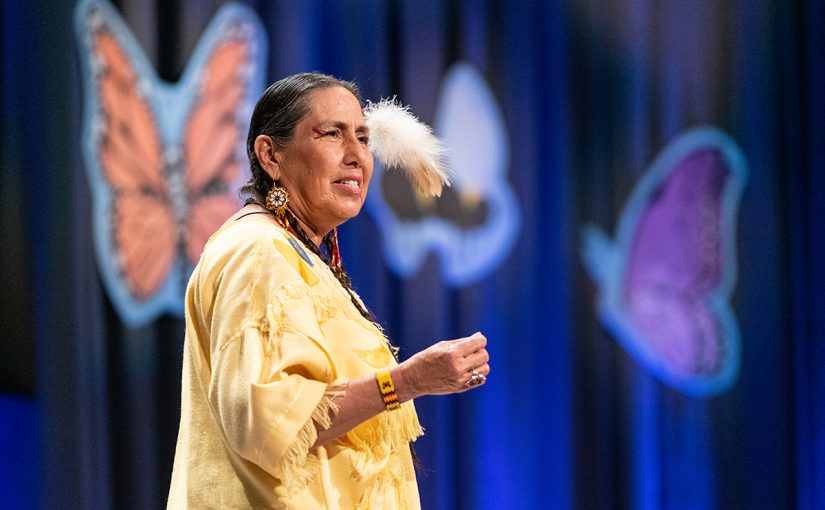
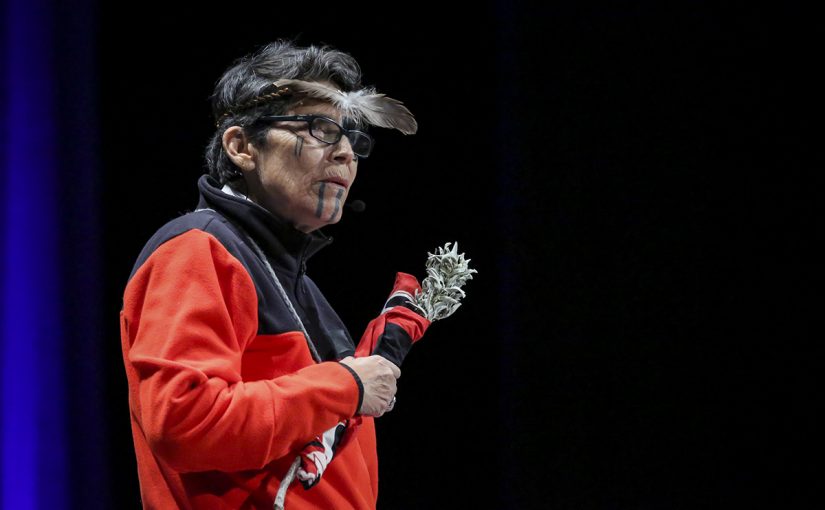
This performance took place at the 2019 Bioneers Conference.

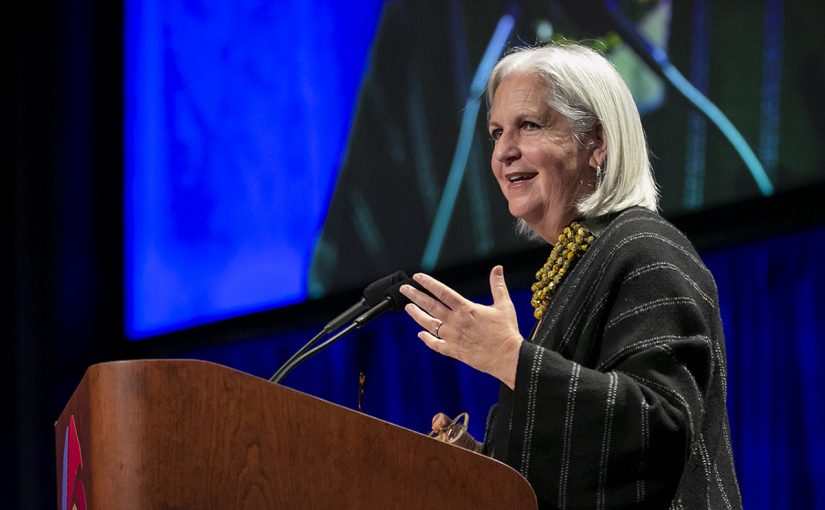
L. Frank Manriquez (Tongva/Ajachmem), an award-winning Native California Indian artist working in many media and a tribal scholar, community activist, and language advocate, has exhibited her artwork in museums and galleries nationally and internationally. She has served or serves on a number of boards, including that of the California Indian Basketweavers Association (for 15 years) and the Cultural Conservancy, and is a founding board member of the Advocates for Indigenous California Languages.

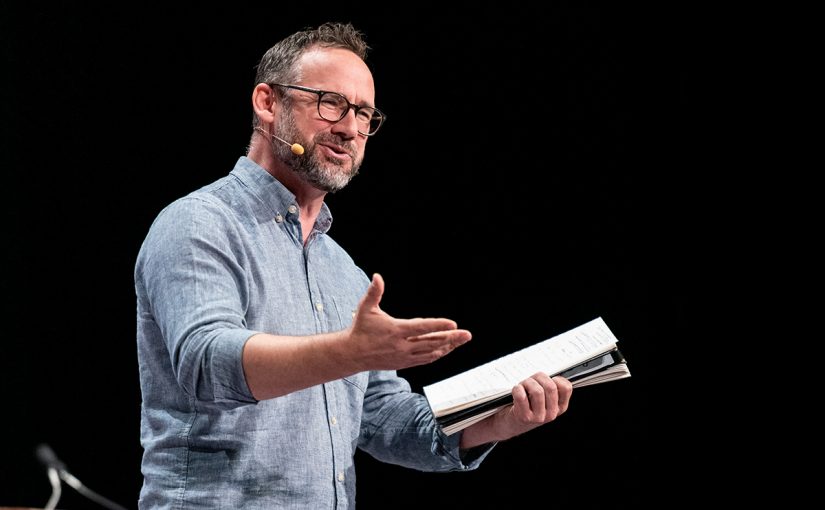
David Orr: Is There a Future for Our Democracy? Why Everything Depends on the Answer

This keynote talk was delivered at the 2019 Bioneers Conference.

We are living through the most dangerous challenge to free government in the U.S. anyone of us alive has encountered. Like a house with crumbling foundations, American democracy is suffering from decades of deferred maintenance. The challenge of repairing and updating our institutions would be difficult enough, but we obviously do not live in “normal times.” The pace of change is faster, threats bigger, risks global, and the time to forestall the worst is very short. David Orr, one of the nation’s most lucid and influential thought leaders, draws from his forthcoming book, Democracy Unchained: Politics as if All People Matter, to consider what we must do to return to the better angels of our collective nature and turn the ship around. What happens next is up to us.  


David W. Orr, a Professor of Environmental Studies & Politics (Emeritus) at Oberlin College, is a pioneering, award-winning thought leader in the fields of Sustainability and Ecological Literacy. The author and co-author of countless articles and papers and several seminal books, including, most recently, Dangerous Years: Climate Change, the Long Emergency, and the Way Forward, he has served as a board member or adviser to many foundations and organizations (including Bioneers!). His current work is on the state of our democracy.

For more information about David Orr, visit The Oberlin Project.

Read the full verbatim transcript of this keynote talk below.


Transcript

Introduction by Kenny Ausubel, Bioneers CEO and founder.

KENNY AUSUBEL:

For decades, the work of David Orr has revolved around changing the structure of a system that’s programmed for disaster. I’d like to introduce David through some of his own words excerpted from his forward to my last book, Dreaming the Future. David is an amazing writer.

Structural change requires tossing overboard many of the foundational myths of the modern world. There’s the myth of lordly human dominance over nature that presumes that we know enough to manage the planet even though we can’t manage the back 40. There’s the myth that ignorance is a solvable problem, not an inescapable part of the human condition. There’s the myth that economy can grow forever on a finite planet. And it’s corollary, that human happiness is a byproduct of consumption, a word that ironically once referred to a fatal disease. [LAUGHTER] There’s the myth that–[LAUGHTER] [APPLAUSE] Yay, David. There’s the myth that security is the offspring of a monstrous capacity to kill and cause havoc. Beneath such thinking is a kind of feckless belief that we can tame the demons that we unleash on the world.

And he continues: Two broad revolutions have been gathering force for centuries, but always against long odds and stacked decks. In the West, the first began with fledgling steps toward democracy and the concept of human rights based in law. Across the span of nearly 2500 years, the battle for basic rights has gathered force. The decks are still stacked, and the road ahead will be no less challenging or bloody than that already traveled, but the battle for enforceable human rights and the extension of the rights to life, liberty and property to future generations and eventually the extension of rights to animals and nature will go forward. And someday, what Martin Luther King, Jr. described as the arc of history, will indeed bend toward inclusive and dependable justice.

The second stream is still older. It’s the knowledge of how to make the human presence in the world on nature’s terms not just human contrivance. Everywhere its hallmark is the humility to learn from nature and develop partnerships with ecological processes. It’s alive and flourishing in our time in the work of so many people and the Bioneers all working with nature and posterity in mind.

David Orr’s vision, wisdom and example have helped shape and guide so very many of us for so many years. Although David’s above all an educator, he’s always combined scholarship with action. Along with an illustrious academic career, his teaching has extended far beyond the classroom into the campus, the town and region around it, and the national dialogue. He’s been seminal in advancing ecological literacy and the greening of educational curricula in higher education institutions. His books remain foundation to the entire field.

He’s also been a leading figure in developing ecological design and putting it into action in local economy movements. A long-time professor of environmental studies and politics in Oberlin College, in 1996, he spearheaded the design and construction of the first LEED platinum green building on a US campus. [CHEERS] Yeah. [APPLAUSE] The Oberlin project then extended the effort into a Town Gown partnership to build a regional green economy template that others are now emulating.

David’s influence has also reached into the corridors of national political power. He was in the vanguard of identifying climate disruption as the biggest political failure in human history. In 1989, he organized the first ever conference on the effects of climate disruption on the banking industry. In 2008, he organized the Presidential Climate Action project with a world—which was a world class think-and-do tank that positioned climate disruption as the top national security issue. Its policies and recommendations penetrated the Obama administration’s policies, though we wish it had been more.

His books including Down to the Wire: Confronting Climate Collapse are among the best on the subject. David’s received countless prestigious awards and sat on many, many nonprofit boards and foundation boards including Bioneers and Rocky Mountain Institute. His focus today, thankfully, is on the crisis of democracy and on the crisis of governance that threatens the viability of human civilization.

So please join me in welcoming our dear friend, who reminds us that hope is a verb with its sleeves rolled up, David Orr. [APPLAUSE]

DAVID ORR:

Pronouns are interesting things, and they cause us to do lots of things we otherwise would not do. So when we say I and me and mine, that takes us to markets. That’s the side of us that is a consumer. If you say we, ours, and us, that takes you to a different area, where we’re citizens, not just of the United States, but also of a biosphere, and a moralsphere. So for 40 years or longer, we’ve had a war waged against ours and us and we, a war waged against government. Get government off our backs. Government messes up everything. So government is the problem. Markets are said to be infallible.

Now the point of what I want to say today is that this is the most massive political failure in history. We call it climate change or climate destabilization, but it is chaos in any word. So I want to connect that to a political failure, this failure to do the public business in a way that was transparent and open and competent. And that’s the headlines every day.

And so we had the first warning given to a US president about climate change. It was given in 1965. That’s a long time ago. We knew enough in 1965 to develop a day jury, a climate policy binding in law.

So let’s talk about politics. You’re not supposed to talk about politics, sex and religion, and I’m going to talk about politics. We’ll leave sex and religion out of this. Unless you…nevermind, that’s too…[LAUGHTER]

Now, here’s the origin of the idea. Lost in the mists of time, we don’t know exactly where the idea of democracy started, but in the Western world it started here. That is the agora or the Greek forum below the Parthenon. This is where Socrates and others debated the ideas of democracy, and it wasn’t always pretty. Democracy seldom is. But what they did was to wager a bet that enough people, enough of the time, would know enough and care enough to conduct a public business in a way that was responsible.

And then there was a second proposition, and the second proposition was very simply that you and I matter, that people matter, our rights count. As Jefferson put it, unalienable rights that we have to life and certain things that guarantee our dignity and our way in the world. And that we, as people with those rights, have a or should have a say in how we’re governed and by whom. That was the bet.

Did it work? Well, this is Thucydides. You all remember Thucydides and the Peloponnesian Wars. You remember these things, right? [LAUGHTER] This is a lesson in civics. You’ve all been there. So what he wrote here on the screen was why it didn’t work in Greece, in the Peloponnesian Wars. This is that famous classic history. And I’m not going to read this slide, it takes too much time, but the issue here is it falls apart.

John Adams, one of the founding fathers, as we call them, said that democracies die by committing suicide, seldom by outside intervention. They commit suicide. Read the daily papers. [LAUGHTER]

The next case I want to bring up here is this, the question here is: How did the democracy of the Weimer Republic after World War I descend in the world of Goethe and Schilling and great German philosophers. How did it become the world of Hitler and Himmler and Auschwitz? And so how did these people, the most educated people on Earth, how did they fall for Hitler? What was the origin of that? So how did this occur, and what are the lessons we could draw from that in our own life?

Now, second point: Is the US a democracy? How many of you think the US is a democracy? Let’s see your hands. Put them up really high. Shout. [LAUGHTER] Well, we established that point. I guess we move on. [LAUGHTER] How many of you are in favor of royalty? [LAUGHTER] The data is not encouraging.

This is from one of the great studies of American democracy by two of the best political scientists that observed this, and they say that your opinion and mine don’t really matter much. And so there effectively is—Think of this as the Grand Canyon, a chasm, and on this side there’s us and our public opinion, and on this side there are laws and regulations and so forth, and the bridge that ought to connect what we want as people and the policies and regulations and laws that we get over here is broken, or it’s been turned into a toll bridge.

So down this list of items here, we favor all of these things: healthcare, climate action, and so forth. You get down to here, what passes Congress? $1.4 trillion tax cut for people who really don’t need it. So we don’t get what we want, and democracy is broken.

Is democracy dying? The scholars, the people who study this for a living, believe it is, or at least it’s impaired. This is from the Economist magazine, and they have the United States as an impaired democracy and going south. The public opinion – this is from a poll the World Values survey – and what it shows is that virtually in every country, every democracy, support for democracy is declining. And if I broke this out into age groups and so forth, it’d say the same thing. The elderly, the middle class, young people, democracy is failing.

Now part of this goes back to the fact that—that pronoun issue – I, me, and mine. We’ve been focused on market solutions, and the climate change is going to respond to markets or technology, and those are important things, but not to political change, where we come together and we say, This is our country, it’s our democracy, it’s our policies, and they do matter.

I grew up near Youngstown, Ohio. Youngstown in 1941 was the wealthiest city per capita in the county. If you go there now, it looks like it was bombed down in World War II. This is very typical of the rust belt region. It’s not shiny like a lot of California is. It’s rusted out, burned down, disinvested. Cities like Detroit, and Cleveland, and Toledo, and Youngstown, Ohio, these are cities we now fly over. This is part of the flyover zone. So if you wonder why there was support for Donald Trump in the last election, a lot of it is found in the failures that we’ve pursued.

As Youngstown was declining, so too were the prospects of each generation. So this just shows the odds of people, young people, earning as much or more than their parents by 10-year periods. It’s going down. So if you’re a young person in Youngstown or in that rust belt, or in a lot of the areas in the United States we mark as a red zone, which will come up here in just a minute, you don’t see a future that your parents saw. That’s that map.

Now it isn’t quite that bad. A lot of those red zones are 47/53 in terms of support for and against, and so forth, but that’s the United States right now. And we here are in the blue zone, but we’ve got to find ways to reach into that red zone. We’ve got to reach out across these chasms.

This is from a report recently released – well last month – from the US Senate Committee, Joint Economic Committee. This is—What is circled here are deaths of despair – opioid addiction, drug addiction, suicide. It’s going straight up. This is my district, and this is called gerrymandering. You all know the term. This is how you have to gerrymander Ohio to keep the most far right wing Congressperson in office. And so that’s called gerrymandering and it happens. There are a lot of reasons. You—Most of you know all about that.

This is the transition of the United States. Now here in California, you have six cows and 40 million people. [LAUGHTER] Wyoming has 40 million cows and six people. But you both have two Senators. And so the way the Senate is going right now, very soon, 30% of the country will decide 70% of the Senate membership.

And then there’s this problem. We thought we had this solved at one time. When Barack Obama was elected president, I just assumed, boy, that’s great; it’s over; we’re going to win; we finally have crossed that threshold into acceptance and diversity. But we found it was a little premature. These are the hate groups across the United States that the Southern Poverty Law Center tracks. And there are probably more than this, and they’re well armed and they’re not quite with us yet. This is a problem of income. If you want to know why democracy collapses, go back into history. Plato and Aristotle said it collapses because of oligarchy. Democracy becomes an oligarch world. It’s ruled by the rich people and so forth. This is simply a diagram that shows the transference of roughly $20 trillion from the bottom to the top of the income spectrum – $20 trillion. That red bump down at the bottom, if you’re a working person, you’ve lost ground. If you’re one of those workers in Ohio or the rust belt states and you have to live by paycheck to paycheck, you’ve lost ground.

The question is: So what? Why don’t we just become an epistocracy and rule by expertise? Why don’t we do what China is doing? Surveillance, democracy, and imprison dissenters. Democracy really doesn’t work, and again, it does seem to commit suicide fairly often. Thucydides’ comments are still relevant to our world today.

Let me give three reasons why we have to defend democracy, and this is where we’ve got to come together as citizens to understand how we conduct the public business in ways that’s fair and decent and sustainable. So this is Jim Hansen, the best climate scientist – certainly the most famous climate scientist – in the world. That’s right, you can applaud. [APPLAUSE] He is a genuine hero. [APPLAUSE]

Jim Hansen, the quote here says that you can’t fix climate until you fix democracy. And that’s really inconvenient because we don’t have much time to fix climate. The IPCC about a year and a half ago said we had about 12 and a half years to fix it, but we’re down to say 11, or whatever the number of months it might be, but that doesn’t give you much time, not on this planet with this much infrastructure, and that long way to go. But 11 to 12 years to deflect carbon emissions downward.

So why do we have to fix democracy? And you begin to think about the reasons here. This is going to be an all-hands-on-deck time for us. We’ve got to all of us get engaged. So all of you who are organic farmers and permaculturists, and all of you who are business people, and all of you who are educators, we’ve got to come together, and we can only do that if our votes matter, if our policies are supported, if we can bridge that gap from this side to that side.

And then there’s this point. Wait, I want to skip over that slide. There’s this point, and this gets into some kind of difficult things. Can you imagine a solar powered, sustainable, resilient, hyper-efficient, fascist society? [LAUGHTER] Now think about that, because the bottom of this explains what fascism is: ruled by oligarchy, misogyny, racism, and so forth. That’s the daily headlines. Do you see any difference between the bottom of this slide and the top, the prospect? Not much. And that’s where we’re headed.

And then there’s this: Shoshana Zuboff is one of the great lights at Harvard Business school. In that quote at the top, describes the inherent dignity of people. Democracy may be, as Winston Churchill once said it was, the worst form of government, except for all the others that have ever been tried. [LAUGHTER] But even in its imperfections, and it is imperfect, but it’s the only system of government that says you and I matter, at its best, not always, not everywhere, not any one place all the time. But at its best, democracy does matter.

And then the bottom quote is from C.S. Lewis who concluded—the theologian—that he wasn’t fit to rule even over a henhouse, as he put it. So the question is: Who among us could be the ruler, the king, the emperor? Who has that level of wisdom? It would have to be somebody with a really, really big mind and great foresight and so forth, and the hutzpah to tell you what a great mind he has. [LAUGHTER] Nobody. Nobody, Lewis’s point has that claim.

So what do we do? [LAUGHTER] I want to issue a caution here. I don’t think we ought to be directed solely at Donald Trump, No. 45, because what he did – and we ought to also give him a round of applause, because what he did was to highlight everything that was wrong and had to be fixed. He took a highlighter [APPLAUSE]… essentially to everything that we need to undo and redo and rethink.

So the end of the stalk is going to be we don’t need to repair democracy so much as we need to invent the first ever democracy, true democracy. [APPLAUSE] So this gets personal. We started after the election. I, after the election of 2016, I went into a deep depression, and I was ready to retire and go off and do what old white guys do and play golf, and bowl, and things like that. [LAUGHTER] Neither of which I do well. But the—Or with any particular joy. [LAUGHTER] So what we did was to organize a conference. And what we were looking at here was like looking through the rearview mirror. How did we get to the election of 2016?

So this, by the way, is a new hotel we built entirely solar powered, platinum building. That’s where we had all these gatherings. Tim Egan from The New York Times and a whole series of wonderful, far-out speakers, the one on your left there, I’ve forgotten his name, but you see him in movies. We brought people together. This, by the way, is [Peter Wehner] on the right, on your righthand side, and Bill, former governor of Colorado – I’m blanking on his last name. [AUDIENCE RESPONDS] Bill Ritter. That’s right. And you know what happened here? This was interesting, because we put them on the stage together and we asked each to explain how you would repair liberalism or conservatism. And you know what? The conversation was civil, funny, productive, creative. Imagine that in American politics. It can happen.

Reverend William Barber was like an exclamation mark at the end of the event. [APPLAUSE] And so when you come to think of what ails us, it may be economics, may be technology, climate change certainly has both of those elements to it, but it’s moral. And William Barber pointed out that this is a moral failure before it’s anything else, before it’s even a political failure.

So this is the next part of this. We’ve pulled together 34 authors – Bill McKibben, who’s here, and a lot of very, very bright people, K. Sabeel Rahmann, and Ganesh Sitaraman, and so forth, Jessica Tuchman Matthews. And we assembled a book: Democracy Unchained. We took Nancy MacLean’s book, Democracy in Chains, and inverted the title. She’s on our advisory board, by the way. And the book comes out in mid-February of 2020. Make your order. So if you have a smart phone, order it on Amazon. [LAUGHTER] You can pre-order.

And then we’re following that with events that are on the right side of the screen. The opening event with authors and others will be at the National Cathedral March 25th of 2020. And then we do events in Boston, Philadelphia, Cleveland, Denver, Los Angeles, San Francisco. What we want to do is start a conversation, a conversation about how we rebuild first American democracy. As you’re bringing this democracy into an emergency room, you’d stop the bleeding and stabilize the vital signs first, then you get to lifestyle changes. But the long-term conversation we have to have is how do we build a democracy in which all of us in fact do matter.

So that’s part of this. And then government, trying to restructure government, starting with the words that we use. Let’s reclaim our public language. How did the word conservative become what it has become? Or how did the word liberal become so disparaged? Those are flip sides of the same coin. Everybody in this room, on one issue or another, you’re conservative or liberal, but you’re both. It’s called a thinking person, not a ditto-head. [LAUGHTER] [APPLAUSE]

And then why governments matter. I don’t have time to read this, but begin to think about what we do in the public arena. We need government. Not a government that’s been defunded and defrauded and depersonalized and all those things that we’ve done in the past 40 years to disparage government and to disparage the idea of public service. We need government, but we need government of the people, and by the people, and for the people, that’s transparent and effective, and all of those things.

And so what’s to be done? Well, here’s where we at Bioneers need to think through how hard this is going to be, and think of the heroes and heroines in this room, people who have sacrificed and who have risked a great deal. That’s all of you. We’re going to all have to risk, we’re all going to have to sacrifice something to make this dream come true.

Frederick Douglass said power doesn’t give up, never easily. And so it hasn’t. So what’s this change look like? Well, this is part of it. It’s the power that we have to be citizens, the power that we have to be foresightful, the power that we have to engage power and tell the truth. And so… [APPLAUSE]

We’ll just call her what’s-her-name. She’s up there. Imagine 13 years old. Now she’s 16 or so. Imagine the courage she demonstrated. Like lightning on a dark night, she illuminated the terrain.

So imagine democracy unchained, from what? All those isms, all those human failures and frailties and sins. Imagine a real democracy – us, we, ours – where all votes are counted. The right to vote in fair electoral districts is guaranteed. Our representatives both in state legislatures and county legislatures and federal government and so forth look like us, they’re diverse and are not old like me, all of them. A few of them could be old. [LAUGHTER] Imagine publicly funded elections. Get money out of politics once and for all. [APPLAUSE] Imagine that you have the same healthcare benefits guaranteed to Mitch McConnell. [APPLAUSE] Imagine a democracy in which corporations are not persons. [APPLAUSE] Imagine a democracy in which ecocide is a crime against humanity and punishable as such. [APPLAUSE] Imagine a democracy where lying and systematic deception is wrong and is a crime, and that includes Facebook, that includes television, that includes all the media. Imagine a democracy that would protect our lands and waters, as my friend and that eloquent writer, Terry Tempest Williams, who will be out here in just a moment when I get off the stage has said for so long, imagine our public domain protected by a democracy that is competent and ecologically alert. [APPLAUSE] Imagine a democracy that would protect the global commons. Imagine a democracy calibrated to the way the world works as a physical system, that Bioneers and all you Bioneers for years have showed. Imagine a democracy in which justice flows down like a mighty river. [APPLAUSE] Nirvana. No, this is planet Earth, not nirvana.

But only a government of, by, and for the people in which we have no malice toward anyone, but charity for all. Thank you very much. [APPLAUSE]
Terry Tempest Williams: Erosion

This keynote talk was delivered at the 2019 Bioneers Conference.

Wind, water, and time are agents of erosion evident in the desert. They have shaped the spectacular physical landscape of our nation from the Great Smokies to the Grand Canyon. But Terry Tempest Williams is also seeing another kind of erosion in America: erosion of democracy; erosion of science, decency, compassion, and trust.  “How do we find the strength to not look away from all that is breaking our hearts?” she asks. “What if our undoing leads us to our becoming? We are eroding and evolving, at once.” Terry Tempest Williams, one of this country’s most beloved authors and defenders of public lands, and social and environmental justice, comes to us from her desert home in Utah.  She writes, “Beauty is its own resistance. Water can crack stone.”


Terry Tempest Williams, one of the greatest living authors from the American West, is also a longtime award-winning conservationist and activist, who has taken on, among other issues, nuclear testing, the Iraq War, the neglect of women’s health, and the destruction of nature, especially in her beloved “Red Rock” region of her native Utah and in Alaska.

To learn more about Terry Tempest Williams, visit her website.

Read the full verbatim transcript of this keynote talk below.


Transcript

Introduction by Nina Simons, Bioneers co-founder and Chief Relationship Strategist.

NINA SIMONS:

This year, it is particularly joyful for me to be able to welcome back to Bioneers several women who have been incredibly important as friends, inspirations, and role models to me. Among them, none has been more influential in inspiring my life’s journey than Terry Tempest Williams. [APPLAUSE] Yeah.

Terry is a naturalist, author, educator, artist, and activist. She’s one of the greatest engaged nature writers in the lineage of John Muir, Aldo Leopold, Rachel Carson, Gary Snyder, Barry Lopez, Mary Oliver, and Thoreau. But her body of work, which includes over a dozen extraordinary books, transcends any pigeonholes.

Her latest book of essays, which is just out, called Erosion meets us exactly at the nexus of this moment. Terry is in fact one of the greatest writers period, with the countless literary awards she has received and their testament to that.

Coming from a culture that’s encouraged us to specialize, to confine our purview and interests in one direction, Terry’s writing has inspired me to slough off that conditioning and to instead embrace all my curiosities and passions. The unfettered wildness of her mind and heart have modeled for me a kind of systems thinking that wraps her arms around the whole caboodle, linking the inner experience with the outer worlds while exploring the connections among art, ecology, women, politics, social healing, indigeneity, democracy, wild lands, family, and faith. She’s long been a passionate advocate and activist for peace, indigenous rights, environmental and social justice, women’s health and freedom of speech, and one of the most ardent defenders of wild lands, especially the transcendentally beautiful Red Rock Canyon country of her home state of Utah.

She is a woman who contains many seeming paradoxes, someone who gracefully reconciles her family’s deep ancestral roots in the earliest days of Utah’s Church of Latter Day Saints with a thoroughly modern, exquisitely refined, sophisticated sensibility of the sacred, someone who can testify passionately but politely before Congress one day, but get arrested in an act of principled civil disobedience on the next. She is a naturalist, scholar, and beloved professor, but also a wanderer, a sublime poet, an artist, and a desert mystic.

Through it all Terry has taught me how to transcend apparent polarities, that by linking paradoxes we can help to define healthy, whole systems to regenerate life itself. She’s taught me how to dance with duality to reclaim wholeness.

With all that she is, I must admit that she has had the greatest impact on me in how she is as a person herself. Her embodied essence, her purposeful presence, her radiant authenticity, and the unshakable dignity, humility, and nobility of soul that emanates from the core of her being. We all know we are living in incredibly challenging times, with the integrity of the entire biosphere and the survival of us and all our kindred species and our democracy hanging in the balance. There’s never been a time in which we need to hear and read voices who can show us how to see and feel the truth without turning away, acknowledge our pain while embracing life with love, and resist wrongs with every fiber of our being but never lose our humanity and compassion in the struggle.

Please welcome one of my greatest sheroes and beloved friends, Terry Tempest Williams. [APPLAUSE]

TERRY TEMPEST WILLIAMS:

It is a privilege and humble joy to join you today in the name of all that binds us together in this beautiful broken world.

And to the Miwok people, thank you. Deep, deep gratitudes.

Erosion. Evolution. We are eroding and evolving at once.

All souls come here to rub the sharp edges off each other. This isn’t suffering, it’s erosion. – Chuck Palahniuk

I come from an erosional landscape in the Red Rock Desert of Southeastern Utah. To the south rise the La Sal mountains 12,000 feet high. To the north is the Colorado River running red carrying the sediments of sandstone downriver. To the west is Porcupine Rim, that holds the last light of day. And to the east is Castleton Tower, rising from the ground floor 400 feet tall. Wingate sandstone, one of the largest free-standing towers in the world, eroding.

This past summer, geologists from the University of Utah detailed the natural vibration of this sandstone tower. They enlisted two climbers to place a seismometer at the bottom of the tower and then climb and place another seismometer at the top. They wanted to listen to stone. What they found surprised them. This from Science News and the bulletin of the Seismological Society of America. It was published last month. “At about the same rate that your heart beats, a Utah rock formation called Castleton Tower gently vibrates, keeping time and keeping watch over the sandstone desert, swaying like a skyscraper, a red rock tower taps into the deep vibrations of the earth – wind, waves, and even far off earthquakes.”

“We often view such grand and prominent land forms as permanent features of our landscape when in reality they are continuously moving and evolving,” says Riley Finnegan, a graduate student and co-author of this paper.

Lastly, “Most people are in awe of its static stability and its dramatic free-standing nature, perched at the end of a ridge overlooking Castle Valley,” said the geologist Jeff Moore, who led the study. It has a kind of stoic power in its appearance. Moore and his colleagues study the vibrations of rock structures, including arches and bridges. So this isn’t unique to Castleton Tower, they just chose to focus on Castleton Tower, to understand what natural forces act on these structures. They also measure the rock’s resonance, the way the structures amplify the energy of the earth that passes through them. Castleton Tower has a pulse.

For those of us living in the valley, what we have intuited has been confirmed. Castle Rock is alive.

Let’s take this next few minutes, and I just want us to listen to the pulse of earth – Castleton Tower.

 [AUDIO PLAYS RUMBLING NOISE]


The earth has a pulse, as do we. No separation.

 [AUDIO ENDS]

Our pulse, the pulse of Earth, Castleton Tower, is relational, born out of love and grief, disturbance and stillness at once. There are no beautiful surfaces without a terrible depth. – Nietzsche

To commit to a place is to commit to the shadow side of our own home ground. Sometimes we see it, sometimes we don’t, but when we do, we must speak.

On December 28th, 2016, Barack Obama established Bears Ears National Monument, protecting 1.3 million acres of fragile desert lands. He heard the voices of the Diné, the Navajo, the Hopi, the Ute, the mountain Ute, to the Ouray Ute and Zuni Nations. He heard them. These lands are sacred, where their prayers are spoken, where their ancestors are buried, where their ceremonies are performed. It was a handshake across history, a renewal, a commitment of trust.

Less than a year later, Donald Trump by executive order eviscerated Bears Ears National Monument, by 85%, and cut Grand Staircase Escalante National Monument in half. Those protected lands, sacred lands, are now open for business to oil and gas development, to coal mining, to uranium mining, a boon to the fossil fuel industry in the midst of the climate crisis. This is my home.

What is beauty if not stillness? What is stillness if not sight? What is sight if not an awakening? What is an awakening if not now?

The American landscape is under assault by an administration that cares only about themselves. Working behind closed doors they are strategically undermining environmental protections that have been in place for decades, and they are getting away with it in practices of secrecy, in deeds of greed, in acts of violence that are causing pain. Like many, I have compartmentalized my state of mind in order to survive. Like most, I have also compartmentalized my state of Utah. It is a violence hidden that we all share.

This is the fallout that has entered our bodies, nuclear bombs tested in the desert. Boom. These are the uranium tailings left on the edges of our towns where children play. Boom. The war games played and nerve gas stored in the West desert. Boom. These are the oil and gas lines, frack lines, from Vernal to Bonanza in the Uinta Basin. Boom. This is Aneth and Montezuma Creek, the oil patches on Indian lands. Boom. Gut Bears Ears. Boom. Cut Grand Staircase Escalante in half. Boom. And every other wild place that is easier for me to defend than my own people and species. Boom. The coal and copper mines I watched expand as a child, Huntington and Kennecott. Boom. The oil refineries that foul the air and blacken our lungs in Salt Lake City, our children’s lungs. Boom. And the latest scar on the landscape, the tar sands mine in the Book Cliffs closed, now hidden, simply by its remoteness. Boom. Add the Cisco Desert where trains stop to settle the radioactive waste they carry on to Blanding. Boom. Move the uranium tailings from Moab to Crescent Junction, then bury it, still hot, in the Alkali Desert, out of sight, out of mind. Boom. See the traces of human indignities on the sands near Topaz Mountain left by the Japanese internment camps. Boom.

President Donald J. Trump can try to eviscerate Bears Ears and Grand Staircase Escalante monuments with his pen and poisonous policies. He will stand tall with other white men, who for generations have exhumed, looted, and profited from the graves of ancient ones. They will tell you Bears Ears belongs to them. Boom. Consider Senator Oren Hatch’s words regarding the Bears Ears Intertribal Coalition, support of the Bears Ears National Monument, the Indians, he says, “They don’t fully understand a lot of things that they are currently taking for granted on these lands; they won’t be able to do it if it’s made clearly into a monument.” And when he was asked to give examples, the Senator said, “Just take my word for it.” Boom.

This is a story, a patronizing story, a condescending story. I see my politicians and frontier Mormons discounting the tribes once again, calling them Lamanites, the rebellious ones against God, dark-skinned and cursed. That is their story. Racism is a story. The Book of Mormon is a story. [CHEERS] Boom.

Perhaps our greatest trauma living in the state of Utah is the religiosity of the Mormon patriarchy that says you have no authority to speak – women, Indians, black people, brown people, gay people, trans people. It is only the chosen ones who hold the priesthood over us and council us that their only way to heaven is through them. Boom.

All my life I was told I could not speak, that I had no voice, no power except through my father or my husband, or my bishop, or the general authorities. And then there was the prophet. Boom. I refused to perpetuate this lie, this myth, this abuse called silence. If birds had a voice, so did I. [APPLAUSE] I would tell a different story, one of beauty and abundance, and what it means to be alive.

Environmental racism is the outcome of bad stories, a byproduct of poverty. In Utah, yellow cake has dusted the lips of Navajo uranium workers for decades who are now sick or dead. Boom. There is no running water in Westwater, a reservation town adjacent to Blanding. Local municipalities refuse to provide Navajo families with a basic right, a human right. Boom. But we are not prejudiced. Boom.

If you speak of these cruelties, we, as Mormons, I am a Mormon, are seen as having betrayed our roots and our people. These are my people. Boom.

This is who I am. Boom. A white woman of privilege born of the covenant. I am not on the outside, I am on the inside. Boom. It is time to look in the mirror and reflect on the histories that are mine, that are ours. Boom. We are being told a treacherous story, that says it is an individual’s right, our hallowed state’s right, our nation’s right to destroy what is common to us all.

The earth has a pulse. We have a pulse. No separation. The land beneath our feet, the water we drink, the air that we bring gifts, breathe. Our bodies and the bodies of the state of Utah are being violated. Our eyes are closed. Our mouths are sealed. We refuse to see or say what we know to be true. Utah, this nation, is a beautiful violence. Boom.

Do we dare to see ourselves for what we are, broken and beautiful? Do we dare to see Utah for what it is, an elegant, toxic landscape where the power of oppression rules by repression, our proving grounds of fear? What are we afraid of? Exposure. Boom. Our denial is our collusion, our silence is our death. The climate is changing. We have a right and responsibility to protect each other. Resistance and insistence before the law. We are slowly dying. We are ignoring the evidence. Awareness is our prayer. Engagement is our prayer. Beauty will prevail. Native people are showing us the way. It is time to heal these lands and each other by what, by calling them sacred.

May wing beats of raven cross over us in ceremony. May we recognize our need of a collective blessing by Earth. May we ask forgiveness for our wounding of land and spirit. And may our right relationship to life be restored as we work together toward a survival shared. A story is awakening. Many stories are awakening. We are part of something so much larger than ourselves, an interconnected whole that stretches upward to the stars. Coyote in the desert is howling in the darkness, calling forth the pack, lifting up the moon.

We are eroding, we are evolving together. This is the place we create from, with love, with courage, in grief, and with anger. What do we do with our anger? With a name like Tempest, I can tell you I don’t have a lot of hope. [LAUGHTER] But I have sought wisdom from my elders, the elders that we live near – Willie Greyeyes, a community organizer who now is a county commissioner in a Navajo majority in San Juan County Utah. [APPLAUSE] When he was told that he was not a resident of the state of Utah, that it was an illegitimate election from an illegitimate candidate, whose family have lived in Navajo mountain for generations, when they asked what right he has to the state of Utah, he simply said, “My umbilical cord is buried here.” When I asked Willy what do we with do with our anger, he said, “Terry, it can no longer be about anger. It has to be about healing.” Going to the source of our pain, and recognizing it, owning it, apologizing for it, embracing it with a commitment to change.

And when I asked Jonah Yellowman, a medicine person among the Diné what he was seeing, he said, “Terry, we have to go deeper.” And so I ask us today, together, what does that look like for each of us, each of us in our own places with our own gifts, in the places we call home.

And Evangeline Gray, a medicine woman, who’s been fighting for water rights for her people in San Juan County for 30 years, still no water, she says to dwell is to see things as they are. And then you stay and fight for those things that you see for your community. It is a privilege, she said.

We are eroding and evolving at once. Perhaps Jonah’s call to go deeper is a call to acknowledge the power that resides in the Earth itself. The organic intelligence inherent in deserts and forests, rivers and oceans, and all manner of species beyond our own, even within our own bodies. We cannot create wild nature, we can only destroy it, and in the end, in breathtaking acts of repentance and renewal, try to restore what we have thoughtlessly removed at our own expense, be it wolves in the Yellowstone or willow flycatchers along the Colorado River. We are eroding and evolving at once.

How do we find the strength to not look away at all that is breaking our hearts? Hands on the earth, we remember where the source of our authentic power comes from. We have to go deeper. What has been weathered and whittled away is as beautiful as what remains – erosion, essence. We are eroding and evolving at once.

Shinran, the 14th century Buddhist poet said, This happened. Now something else can occur. We need not lose hope, we just need to locate where it dwells. To dwell is to see things as they are, and then you stay and fight for the things you love in your own community.

Castleton Tower has a pulse. We have a pulse. The pulse of the planet is in our hands. Engagement is a prayer. Boom. [APPLAUSE]

Demond Drummer: A Green New Deal

This keynote talk was given at the 2019 Bioneers Conference.

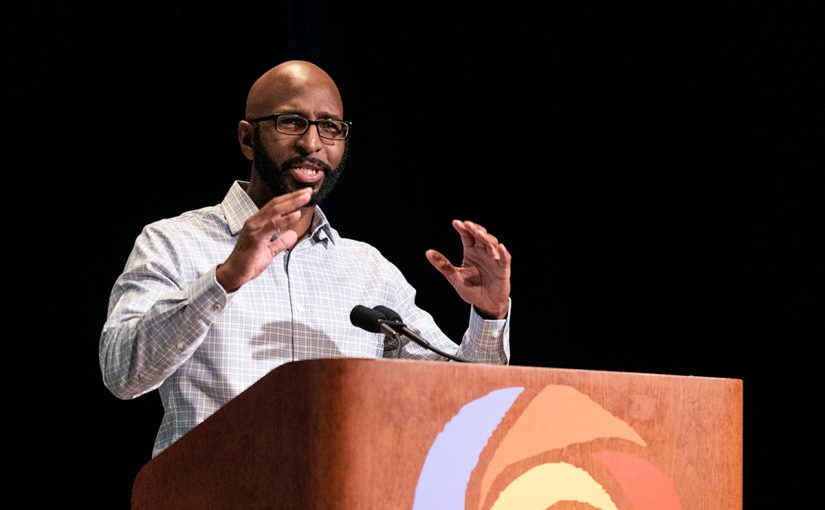
New Consensus is a leading-edge non-profit policy “think tank” working behind the scenes supplying research and detailed policy proposals for the Green New Deal to its leading political advocates, such as Congresswoman Alexandra Ocasion Cortez. Demond Drummer, New Consensus’ co-founder and Executive Director, well known in Chicago as a highly effective activist, is one of the true intellectual architects of the Green New Deal. He draws from the history of FDR’s WWII mobilization, the moonshot of the 1960s and the Civil Rights Movement to explain the critical importance of the Green New Deal as the next chapter of the American story.


Demond Drummer is the Chicago-based co-founder and Executive Director of New Consensus, a nonprofit working to develop and promote the Green New Deal that has advised many progressive leaders and organizations, including Representative Alexandria Ocasio-Cortez and the Sunrise Movement. Demond’s other notable projects include CoderSpace, a computer science learning lab where youths develop leadership skills, and LargeLots.org, a community-driven effort to reclaim and city-owned vacant lots in Chicago.

To learn more about Demond Drummer, visit New Consensus.

Read the full verbatim transcript of this keynote talk below.


Transcript

Introduction by Michelle Romero, National Director, Green For All.

ANNOUNCER:

Please welcome the national director of Green For All, Michelle Romero. [APPLAUSE]

MICHELLE ROMERO:

Good morning. [AUDIENCE RESPONDS]

Over the past decade, so many of you in this room today have poured your hearts and souls into building a more inclusive green economy and a better future for all. In 2007, back when the green economy was more of an idea than anything real, our founder, Van Jones, published his national best seller, The Green Collar Economy. [APPLAUSE] How one solution can fix our two biggest problems. And I think many of us in this room can agree that our two biggest problems back then are some of our two biggest problems today – the climate crisis and growing inequality.

In Chapter 4 of Van’s book, which is titled Green New Deal, Van became the first person to flesh out what a Green New Deal could look like, and Green For All became the organization to advocate for these solutions. The idea was simple: let’s put the people who most need work to work doing the job that most needs done, and build a more sustainable future. [APPLAUSE]

Green For All helped to popularize the term green jobs, advance solutions that tackled poverty and pollution together. We won millions of dollars for green jobs, trained green entrepreneurs to grow their businesses, and continue to this day to mobilize public funding and private finance for clean economy projects in underserved neighborhoods. You see, we don’t believe in a green economy that’s just for some, we believe in green for all. And that means ensuring that the people who are hit first and worst by the climate crisis do not benefit last and least from the solutions. [APPLAUSE]

We also…We also don’t believe that you need to choose between good jobs and a livable future. As Van say, everything’s that’s good for the planet is a job, a contract, a business opportunity. Well in the 10+ years since Van wrote his book and we were founded, we have faced some major challenges along the way, challenges that we must overcome as a movement if we’re going to build the future and the world that we want.

One of those challenges these past few years, which I know has been very difficult for those of you who’ve dedicated so much of your lives to advancing this agenda, has been the lack of attention that our politicians have given to the greatest existential threat of our time. And I’m not just talking about the Republicans, the Democrats too. [APPLAUSE] But all of that changed in the fall of 2018 when the Sunrise movement activists successful broke through the silence to deliver a salient message: the climate crisis cannot wait; we will not wait. And thanks to the work of youth activists around the country and the globe, climate change has risen to the top of our 2020 political agenda, and a Green New Deal has become a household name. [APPLAUSE]

I could not be prouder to introduce our next speaker. Demond Drummer is executive director and co-founder of the New Consensus, and a leader at the forefront of the movement for a Green New Deal. Since 2018, the New Consensus has been working to turn the dream of a Green New Deal into a policy platform that centers the needs of directly impacted communities and workers, and put into place a plan to transform the United States economy. Over the course of the last year, Demond and the New Consensus team have advised some of our country’s most influential politicians and movement builders, including Representative Alexandria Ocasio-Cortez, the Justice Democrats, and the Sunrise Movement. [APPLAUSE]

As one of the most ambitious and transformative policy platforms since Franklin Delano Roosevelt’s original New Deal, New Consensus’ Green New Deal has made headlines, transformed our politics, and provided a bold and critical vision for the future of our country. Please welcome to the stage, Demond Drummer. [APPLAUSE]

DEMOND DRUMMER:

So I’m here to talk about the Green New Deal, and I’ll talk about it in three different ways. First, I’m going to talk about the Green New Deal as a mobilization. Second, I’ll talk about the Green New Deal as a series of moonshots. And third, I want to talk about the Green New Deal most importantly as a movement, or rather a movement of movements. And I’ll be doing this by showing some old photographs that we looked to for inspiration.

The first photo is fascinating. At the beginning of America’s full entry into World War II, the United States had the productive capacity to build about 3,000 airplanes, like literally 3,000 airplanes. President Roosevelt, however, wanted 189,000 airplanes. And you can imagine how long that would take to build that. And, of course, some folks thought he was being unrealistic, and these skeptics weren’t completely unjustified in their skepticism. Because, again, the productive capacity of the country simply did not exist, and not just for airplanes, the tanks, the jeeps, and the helmets, all the equipment that was needed to wage war, there was no military industrial complex. Now this is not to praise the military industrial complex, but I’m making a point, so bear with me. [LAUGHTER]

So Roosevelt tapped some of the leading business figures to organize America’s industry for the war effort. These leaders assessed the capacity of different factories all over the country and worked out how to retool them and share processes and expertise to produce what was needed to sustain a war effort. Critically, the financial capital needed for this rapid scale-up of productive capacity came from the public sector, and not just as a purchaser of the end product, but as the initial investor in the factories that were building the things that we needed. And when it was all said and done, a country that could only produce 3,000 airplanes before entering the war, had produced 300,000 by the war’s end.

Now, to be clear, the history of the economic mobilization for World War II is challenging and complex. It is quite shameful that the greatest mobilization of our country has been around war. Now we can’t change that history retroactively, but we can use the example and the lessons of that history to mobilize for the future and change the story of this country, where the biggest mobilization that will be told of America will be around the Green New Deal. [APPLAUSE]

And at New Consensus, we see the Green New Deal as a World War II scale mobilization of all the resources of our country, our industrial capacity, our ingenuity, our financial capital, everything, all of the resources of our country to transition to a clean and just energy economy. The Green New Deal proposes a set of solutions and national projects that match the scale, scope and speed of climate breakdown. Again, we believe that we need to set out bold solutions that meet the scale and scope of the problem, and not let our politics define the type of solutions that we can implement. [APPLAUSE]

So what are we proposing? We propose that we upgrade every single building in this country to the highest levels of energy efficiency, air quality, water efficiency, and water quality; upgrade our country’s infrastructure to be more resilient; accelerate, massively accelerate the adoption of renewable energy; restore our natural ecosystems; research, develop, deploy technologies to decarbonize heavy industry; and position our country to be a leader in clean manufacturing. Why can’t we do that? [CHEERS]

We must also transform our food system and invest directly in farmers to adopt regenerative and sustainable agricultural methods. [APPLAUSE] Let’s take the subsidies away from Conagra and Monsanto [APPLAUSE] and give that money directly to farmers whose rural areas are being literally gutted with all their wealth. So we have a lot of work to do. The money is there. Don’t let anybody fool you.

So we also want to invest in America’s productive capacity to produce the stuff that we need to have a clean economy – electric vehicles, not too many, right, electric vehicles; the energy efficiency parts and components, pipes; all the stuff that we need to see the economy and have a society that we want. We have to build and produce more things here. About 25% of emissions comes from trade alone. So the economic mobilization will renew our economy and give rise to sustainable businesses and industries, and create millions of good, quality, high-paying jobs.

And because of the sheer size and scale of this great effort, the Green New Deal will leave no worker and no community behind. So the greatest generation mobilized our country to beat fascism abroad. It is our task and our day and our time to beat fascism right here at home, and mobilize our country to meet the imminent and existential threat of climate breakdown. [APPLAUSE] And this is what the Green New Deal is all about.

Now the next photo is much more familiar to the American story as we traditionally tell it. I spent most of my childhood wanting to be an astronaut until I reached calculus. [LAUGHTER] And I was particularly inspired by Kennedy’s moon mission speech at Rice University, where he said we choose to go to the moon in this decade because that goal will serve to organize and measure our country’s energy and skills. The moon shot wasn’t just about science. It was about survival. It was about proving that the American system could beat the Soviet system. That’s literally what it was all about. And, again, it’s unfortunate that we have these moments of galvanizing work around conflict. Right? But this is the history that we’ve been given. We must build on this history to create new history. Right? And write the next chapter of the American story. But the moon shot wasn’t just about science.

And we often forget that the U.S. spent most of the so-called space race behind the ball, behind the Soviet Union. The whole idea was to catch up and assert some level of technological sophistication. Right? And today we find ourselves in a very similar situation. When it comes to the technologies that we need to move to a clean economy, we as a country simply—we’re not on the map. Right?

So the Green New Deal calls for a series of technology moon shots, and like the space race before, the Green New Deal is a great national effort and exercise, not just in research and science, but in survival. And it goes without saying that transforming every sector of our economy will be difficult. It’s not easy. And in most cases some of the technology that we need is either in its infancy or it simply doesn’t exist. But that simply cannot stop us. We must throw the entire might of our human ingenuity at these problems and make massive investments of public capital to a network of research universities and labs and small companies that are trying to figure things out to solve the most pressing technological challenges that stand in our way to a clean and just economy.

And this brings me to my last photo. We’ve talked about the Green New Deal as a mobilization. We’ve talked about the Green New Deal as a series of moon shots, again building on the story of this country to show that the Green New Deal is not antithetical to the scale, scope, and ambition that this country has seen in other endeavors.

Now I’d like to talk about the Green New Deal as a movement, and maybe more appropriately a movement of movements. What we are seeing today in this time is a gathering of the justice movements. The Green New Deal is a capacious framework that is designed to address the interlocking systems of oppression that affect us all. Some see this as a weakness, but I argue that the comprehensiveness of the Green New Deal is actually its true strength, because there is no way to truly transition to a zero carbon economy without interrogating and challenging the logic of an economy that exploits people and extracts from the earth. [APPLAUSE]

Economist Mariana Mazzucato argues that behind the climate crisis, behind every economic crisis is a crisis in thinking. I’m going to say it again, that behind the climate crisis, behind the persistent economic crisis that exists throughout the world and communities all across this country, is a crisis of thinking. And it’s important that we notice that the people who are opposed to the Green New Deal right now, say it can’t be done, where are the details, all of this stuff, this is a crisis in thinking. And what we require in this moment is a new political consensus and a new economic consensus, a consensus that says that we will no longer be duped by the mythic invisible hand of the market–[APPLAUSE] a consensus that recognizes that the public sector has a fundamental role to play in shaping markets – energy markets, financial markets, labor markets – to serve the interests of society. [APPLAUSE]

The Green New Deal proposes a set of solutions that meet the scale of the crisis that we’ve created for ourselves. Its comprehensiveness is its power. So the Green New Deal, we’ve talked about it as a World War II scale mobilization of all the resources of our country, we’ve talked about it as a series of technology moon shots, and we understand that the Green New Deal is a movement of movements. It will be brought forth and sustained by an enduring alignment of our youth, who are leading the way and know that we all deserve clean air, clean water, and good food, workers who deserve pay on which a family can thrive. It’s being brought forth by scientists and researchers who can lead us into the light, and even by entrepreneurs of all types, investors even, who are looking for good returns that can renew this economy—they do exist—grassroots leaders and organizations who continue to lead change, mobilizations, moon shots, movements, that’s the story of our country. That’s the story of America. And we in this room and in communities all across the country are writing the next chapter of the American story. [CHEERS]

There is a direct correlation between wages that can’t sustain a family and an economy that can’t sustain human life on this planet. [APPLAUSE] So this morning, we, the people, we have an economic mandate. We have the ingenuity, we have the existential imperative, and the power to give ourselves a Green New Deal. And I know deep in my heart and in my soul that we can, and even more that we will. Thank you so much, Bioneers. [APPLAUSE]

Isha Clarke: A New Era of the Climate Justice Movement

This keynote talk was delivered at the 2019 Bioneers Conference.

With Isha Clarke. To build a successful global climate movement, we must prioritize the voices of those most impacted by environmental injustice. We must recognize that our current climate crisis is rooted in racism, white supremacy, and greed. We must also resist efforts to tokenize the term “intersectionality” rather than actually implementing it in our movements and daily lives. What would a movement and a society functioning on a genuine understanding of intersectionality look like?


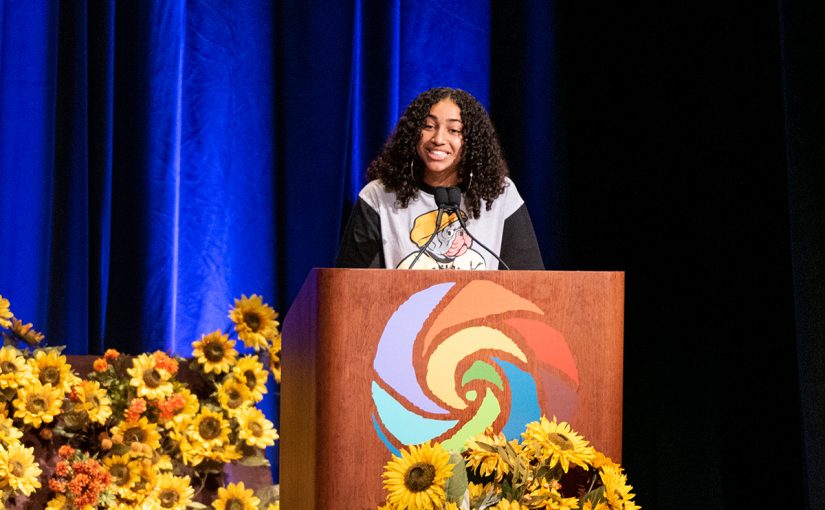
Isha Clarke is a dynamic, passionate high school student environmental and social justice activist born, raised, and educated in Oakland, CA. Her experience has taught her first-hand that threats to the environment disproportionately affect people of color, low-income folks, and young people, and this realization has fueled her passion to fight to create a just and equitable world while maintaining a livable climate.

To learn more about Isha Clarke, visit Youth vs. Apocalypse.

Read the full verbatim transcript of this keynote talk below.


Transcript

ANNOUNCER:

Please welcome from Youth Vs. Apocalypse, Isha Clarke. [APPLAUSE]

ISHA CLARKE:

Hey! [LAUGHTER] How’s everybody doing today? [AUDIENCE RESPONDS] Good? You look as good as you feel then. [AUDIENCE RESPONDS] Good morning, everyone. I am so, so, so grateful to be on this stage right now.

My name is Isha Clarke. I am 16. I am—[CHEERS] I am born, raised, and educated in Oakland, California. [CHEERS] And I am an activist with Youth Vs. Apocalypse. [CHEERS]

When people ask me what Youth Vs. Apocalypse is I find it hard to answer because it’s so many things. But if I had to condense it, I would say that YVA is a Bay Area youth climate justice organization that seeks to redefine the climate justice movement so that we can reverse the climate crisis and save the world. [APPLAUSE]

Historically, climate justice movements and environmental justice movements in general have been very white and very old. But that demographic doesn’t represent, doesn’t accurately represent the people being most directly targeted by environmental injustice. [APPLAUSE] People of color, people from working class, underserved communities, and indigenous communities are consistently targeted by environmental injustice. This is exactly why I came into this movement and the foundation of Youth Vs. Apocalypse.

In June of 2017, as a freshman in high school, I was invited to an action targeted Phil Tagami, a prominent developer in Oakland. Phil Tagami was and still is suing the City of Oakland so that he can build a coal terminal through West Oakland, two and a half miles away from my house. [AUDIENCE RESPONDS] West Oakland is a predominantly black and brown, low-income community that already suffers from high rates of health issues like asthma that would be exacerbated by this coal terminal. It was during this action that I learned what environmental racism is.

Environmental racism is coal terminals through West Oakland, is oil refineries through Richmond, and oil pipelines through indigenous lands. [APPLAUSE] I thought to myself: If this is true, if this is the root of environmental injustice, why doesn’t the environmental justice movement include anyone from these communities? And if they do, why are they not the leaders? And on top of all of this, why aren’t these movements talking about environmental racism and its importance?

I knew that this needed to change. I knew that if we really wanted to defeat what we’re up against, the movement couldn’t leave out the people on the frontlines of its impacts. In fact, it had to be led by them. [APPLAUSE] I wanted to be involved in a movement that acknowledged this. And more than that, put in the work to make this new movement a reality.

This is the work of Youth Vs. Apocalypse. This is what we mean when we say our work is to redefine the climate justice movement. Our work and what should be the work of everyone is to build movements where people on the frontlines of injustice are leading the fight and pioneering new systems of being. On top of this, we must recognize that the fight against climate change is a fight against all of the systems of oppression that fuel the climate crisis– [APPLAUSE] white supremacy—white supremacy, racism, economic exploitation, greed, the list continues. When we scream for climate action, we are also screaming for the abolishment of ICE and closure of concentration camps at the border. [APPLAUSE] When we scream for climate justice, we declare the Black Lives Matter. [APPLAUSE] When we scream for a green economy, we are calling for unionized jobs and livable wages for all. We are calling–[APPLAUSE] Yeah! We are calling for an end to displacement. If we do not truly acknowledge intersectionality in the fight against climate change, then we will never be able to reverse the climate crisis. [APPLAUSE]

So, I challenge each and every one of you in this room today to not only understand intersectionality but to practice it. Start by acknowledging your own privileges. It may be white privilege, it may be class privilege, it may be privilege that you get from your citizenship status. How does that privilege influence how you think, how you act, what you feel comfortable saying, what you feel comfortable doing, how much you feel comfortable speaking, how often you choose to volunteer yourself for tasks, etc. etc. etc.? We must always check our own privilege. We must always ask ourselves how we can use our privilege to provide a platform for others to claim their own power and voice. [APPLAUSE]

This is how we create a movement that reflects the injustice that we are fighting. This is how we reverse the climate crisis. This is how we create a world that is both just and sustainable. This is how we save the world. Thank you so much. [APPLAUSE]

brandon king: Making the Transition from Extraction to Regeneration

This keynote talk was given at the 2019 Bioneers Conference.

Given the existential threats of climate change, economic inequality and ever escalating political instability, we need concrete, integrated solutions to our shared problems. An inspiring model of what such an integrated approach could look like is Jackson, Mississippi’s Cooperation Jackson, an emerging network of worker cooperatives and solidarity economy institutions working to institute a Just Transition Plan to develop a regenerative economy and participatory democracy in that city. brandon king, Founding Member of Cooperation Jackson, shares his experiences helping conceive and build these extraordinarily promising strategies and social structures that reveal that we can put our shoulders to the wheel and build a truly just and sustainable future.  


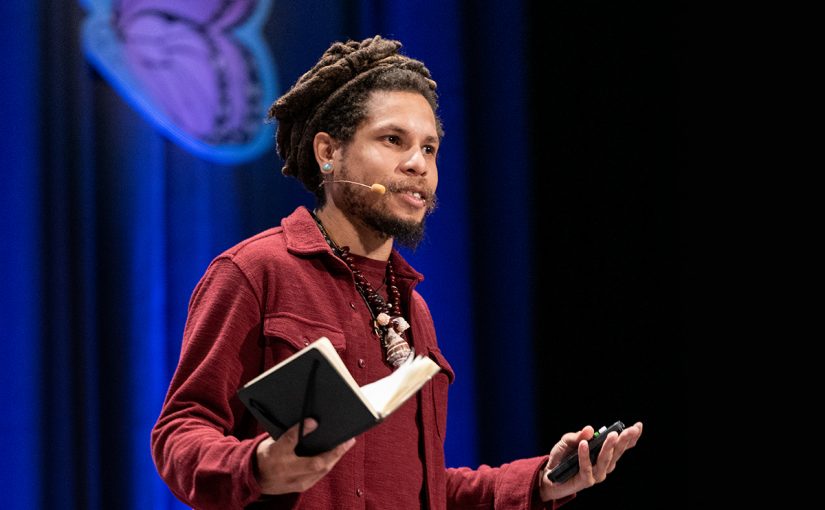
brandon king is an community organizer and cultural worker originally from Hampton Roads VA, currently living in Jackson MS. After graduating from Hampton University in 2006 with a BA in Sociology, brandon moved to New York City where he worked as a union organizer and later as an organizer working with New York City homeless people.

To learn more about brandon king and his work, visit Cooperation Jackson.

Read the full verbatim transcript of this keynote talk below.


Transcript

Introduction by David Cobb, Cooperation Humboldt.

ANNOUNCER:

Please welcome the founder of Cooperation Humboldt, Mr. David Cobb. [APPLAUSE]

DAVID COBB:

Good morning, Bioneers. [AUDIENCE RESPONDS] So I have the distinct privilege of standing before you to introduce brandon king, and so that’s the main reason I’m here.

But I’m also here for another reason. I suspect the reason that many of you are here. And that’s because I know that we are living in a moment of fundamental crisis, actually a series of crises, an ecological crisis. It’s not coming, it’s here and getting worse. It’s an economic crisis because we are living in late-stage capitalism and watching as this economic system continues to destroy the planet and create a racist, sexist, and class-oppressive world order as we go over the cliff. And that is leading to a political crisis because our current political institutions cannot solve the problem. How am I doing so far? [APPLAUSE]

Okay, so we’re in the right spot. And I want to be clear that what this means, these three series of crises are called systems collapse. Now, in one sense, that’s a good thing. It’s a good thing because our current systems are fundamentally premised on white supremacy, capitalism, patriarchy, and empire. So it’s goo that those systems are collapsing. In another sense, we recognize the sense of joyful urgency that this moment creates for us, because we are the generation that is going to have to shift the dominant institutions from the power over, dominating, extractive systems back to the ecologically sustainable and socially just systems that once existed. And that’s why I applaud the commitment that Bioneers is making, and more and more people are making, to go back to indigenous people who still know what that means. [APPLAUSE]

I study, relate, and work with indigenous people not to make myself feel good. I already feel good. [LAUGHTER] I study and relate with indigenous people because I want to live. And I know that they remember the ways to live properly so that my children and grandchildren can live too. [APPLAUSE]

So I’m here to introduce brandon king because brandon king is a founder of a group of people doing that work right here, right now, in the United States, the capital of empire, and doing it in a way to meet people’s material needs. Brandon king is a farmer. He is an artist and culture worker, and he’s a revolutionary. I know that because that’s what he told me the first time I met him several years ago at Cooperation Jackson when that experiment was first beginning. He was an inspiration to me then. He is more than an inspiration to me now because he has data about what this experiment looks like. He has lived experience about what it means to begin to make a just transition.

Brandon will tell us, I hope, about what he and his colleagues and comrades are learning in Jackson, Mississippi, the heart of the old confederacy, about what it means to create conditions to shift to a just transition, to meet people’s material needs in economic ways concretely, both the challenges—So I don’t expect to just get a uproarious everything is good. I hope we’ll get a little of that, but I hope he will share it with us, exactly what they have learned so we can begin to apply it.

Ladies and gentlemen, please help me in welcoming a DJ, a farmer, and a straight up revolutionary, brandon king. [APPLAUSE]

BRANDON KING:

Peace, Everybody. How’s everybody doing this morning? [AUDIENCE RESPONDS] I think David, he spoke well. I think he sort of—For me, I consider myself an aspiring revolutionary, because that’s a big, big, big, big word, and there’s people who really deserve to carry that. Right? That’s a big responsibility. And I hope upholding what my ancestors would like for me to do and would like for me to be.

So, yeah, I’m here to talk about just transition, like transitioning from an extractive, destructive, exploitative economy to one that affirms life, to an economy that is regenerative, to an economy that honors Mother Earth, honors the sacred. How can we sort of get back to those ways? And, yeah, I think about just transition, and I think it needs to be a framework which includes social justice, because many times the people who are on—who are mostly directly impacted by climate change are the communities on the frontlines, and so a social justice framework should be sort of put in place when thinking about a just transition.

So, I think right now, it’s a call for us to have a bold commitment to radical change, and to take action, and we need to go back to and—1) I think science is calling it out. They’re like, We don’t have a lot of time. And 2) I feel like there’s deep indigenous knowledge that has been telling us that we need to listen to in terms of shifting the way that things are currently, and going back to ways that were in alignment with the planet and in alignment with the Earth.

And so I want to share a bit just about Jackson, and about what’s happening locally, and this experiment, this project that I’ve been a part of and have been—like before it was even a name of an organization, I had been sort of working towards building something that is a self-determined, something that is life-affirming for black people in the US. And so this plan that we had is called the Jackson-Kush Plan. Jackson, Mississippi.

And what David talked about in terms of Jackson being a place that is the heart of the confederacy. All of that’s true. It also is a place where a lot of folks who migrated up North because of Jim Crow violence, because of white terror, the people who stayed are people who understand the need for self-defense and self-determination, and defending what’s theirs. There’s a rich history and culture of resilience that’s in Mississippi that I don’t think gets spoken much about.

But, yeah, so Jackson, we had this plan, right, and we wanted to develop people’s assemblies, so figure out ways to do people-centered decision-making processes. We wanted to pursue political office but to do it in a way where our politics are ours. It’s not beholden to the two-party system that’s in bed or in alignment with this capitalist sort of structure. Right?

And the other thing, which is the project that I’m a part of building, is building a solidarity economy. And so Cooperation Jackson comes out of an organization, a New African People’s organization, the Malcolm X. grassroots movement, which I’m—which I come out of. It’s the goal to build power for people.

And so, yeah, there’s different things that sort of play into that. Right? Jackson being a place that is in contention, contention with gentrification and communities that are looking to prey upon the existing community, and grassroots folks that are looking to shift power and shift control and shift wealth and resources to themselves and to the community. Right? So that’s what we’re sort of in the heart of.

When I think about Jackson and when I think about just transition and how it looks in the South is something where you can’t just build in a way without opposition in Mississippi. The laws—You can’t even officially incorporate as a cooperative in Mississippi. So the question of building and fighting, it wasn’t even a question around fighting because that’s already is. You know?

And so when we think about shifting and transforming the world around us, we want to build in a way where we’re building green worker cooperatives, where we’re doing community production. I don’t know how many people know about that. If you’ve heard of maker spaces or fab labs or 3D printing and stuff like that, I feel like we’re on the edge of being able to produce the means ourselves. I think the whole question around seizing the means of production is a real question, and that needs to be addressed. And we exist in a world and a time where we can start to produce the means ourselves with existing—with the resources existing in our community. [APPLAUSE]

And so that’s what we’re embarking upon just with Cooperation Jackson. We want to build an eco-village, like how can we incorporate a bunch of different practices from composting to using solar energy, to using—producing the homes from the materials that exist within our community, all of these different things to build a sustainable sort of infrastructure for our folks. Those are some of the things. I mean, because if you think about just transition, for me, I’m like capitalism in many ways takes our time. It takes our time. Right? Like most of the time we’re working all day and all night or whatever because we’ve got to pay bills because we’ve got to live in a house, we’ve got to pay for food, but like how about if we were able to set up a situation where we have housing, we’re growing food, that’s less reason for you to want money. You can have money to do other things that you like want to do, but if we take away the things that are—if we take away the things that—Actually if we provide the things that we actually need in order to survive, it makes us less dependent upon these systems that are harming us. [APPLAUSE]

And so in Jackson, we have this thing called the Sustainable Communities Initiative, and my thing is it’s like—it’s a local sort of project. The—Something’s may be transferable to your situation wherever you are, and I think a principle of just transition is that it’s local communities figuring out what local solutions work best for them. So with our research and with folks have been doing for 30+ years, this is what we came up with in terms of like how to address building a sustainable, regenerative community, and if you could see, thinking about alternative currency as something, building a community land trust, which is something that we have, eco village, all the things.

And so just wanted to show this graphic. One of the ways we’re—we sort of came about our work, it’s like we didn’t think about it doing it just like one thing, like we’re just going to do farming or we’re just going to do catering, or we’re just going to do arts and culture, or we’re just going to do composting. We were thinking about like whole systems approach. What are the things that we need in order to sustain life? How can we work in a way where we are owning our labor? How can we work in a way where we are learning collectively how to be democratic with each other?

I think this country in many ways talks about democracy, but we don’t know how to do it. We don’t know how to do it. [APPLAUSE] Because I mean it takes a deep level of patience and trust in each other that we’re going to come across or come to the decision, but there’s a struggle that happens when we’re actually listening to each other, when we’re valuing each other’s opinions. I feel like the exploitative, the extractive economy that values bosses, they would have get[?] things done a lot quicker because it’s just one person that decides, but when we’re making space for all of us to decide, the process is a bit slower.

But the challenge is that with climate change we don’t have much time. Right? And so how do we do these things? How do we hold ourselves? How do we hold each other? How do we learn how to be democratic with each other? How do we learn how to share resources and wealth, and distribute that with each other? All of those things are the things that we are experimenting with and trying in Jackson. [APPLAUSE]

I don’t know if y’all seen this map before, but this map is—Movement Generation put it together, folks in Our Power campaign, the Climate Justice Alliance, which Cooperation Jackson is a member, with just a layout of what the extractive economy is and what the values are of an extractive economy, and how can we—how we can move and build towards a regenerative economy, an economy that affirms life, that—the worldview is about caring, and protecting, and honoring the sacred, where the purpose is ecological and social well-being, where we’re building deep democracy. Right? Like I said, like the—being patient with each other, and knowing that it may take some time to come to decisions, but if we hold each other, then that’s all the more good for us. Right?

And so, yeah, the goal is to build a living economy, one that affirms life. [APPLAUSE] So we have a center. It’s called the Kuwasi Balagoon Center. Kuwasi Balagoon was a New African anarchist based in New York City, but he was a citizen of the Republic of New Africa, which is based in Mississippi. Jackson is a part of it, the land—and he was in the Black Panther party, was forced underground into the BLA, the Black Liberation Army. But the territory, when he was talking—fighting for sovereignty and self-determination, it was the South. It was Jackson.

And so when we think about someone who believed in horizontal decision making, who was also queer, who believed in being completely free, we look to this person. This person also said a lot about growing food in vacant lots. He said a lot about learning how to can food. He said a lot about staying in shape and working out together. He said a lot about free clothing exchanges. He said freely—like anarchist clothing exchanges. But all of these things I feel like are, for me, it’s like a monitor. It’s a monitor to a barometer to like where we need to go, and an inspiration of where we’ve been, and where we can go.

And so that picture right there is like a picture of him. I painted it, and I donated it to the center. And, yeah…[APPLAUSE] So, yeah, the background is about freedom. I just thought about complete freedom: What would that mean? How would that feel? And in the foreground that’s him. And the painting is a picture that he drew actually, that I redrew, but it was on his obituary. It’s called Piece By Piece, Fight by Flight. Yeah, so yeah, that’s that. [APPLAUSE] It’s cool to share my art work with like mad people. [LAUGHTER]

So yeah, so that’s the center. We also have solar like on our—on the Kuwasi Balagoon Center, but also on the community production space as well. I’m sorry it’s all pixelated.

And then, so Freedom Farms Coop is a coop that I’m an anchor for as well, and the goal for Freedom Farms is to grow food for our community to incorporate agroecology and Afro-ecology principles and practices, and figure out a way to build food security towards building for broader food sovereignty. So we’re growing food to feed people. [APPLAUSE]

And that’s—And, yeah, and so I mean, the goal, we’re going—we want to build to scale, but we also know that we—there’s a learning curve, and there’s also—I feel like history and ancestral history and trauma, all of those things are real in the black community, and it’s sort of difficult to get black folks to be back on the farm because of our history that we’ve had with the land here, and how we’ve interacted with the land here, based on our exploitation. And so there’s a deep level of healing from the trauma that has to happen. And folks—And we’re working on ways to figure out how to do that, and to be mindful, because we know that our history with the land came a long, long time before our enslavement, and we also know that because of the agricultural technologies that our communities had in West Africa, folks were directly targeted in order to implement that here on these lands. So, yeah…

So the Green Team, they do landscaping and composting, whatever. Trimmings that they get from the leaves or whatever from their jobs, we make that into compost. The compost goes back to the farm.

The Community Production Cooperative, like I told you, like I said before, it’s about—it’s about how can we create the means of production ourselves using tools that exist. So fab lab equipment, it’s like I think 30 or so different tools, like different robots kind of things. And if you put these tools together, you can make almost anything. And it sounds really weird until you like actually see it. [LAUGHTER] And I’ve seen it. I’ve been to fab labs. There’s one in Detroit that we’ve connected with, Inside Focus. There’s fab labs all over the world – Barcelona, in Chile, in Africa, all over.

And so, yeah, I think it’s important to—If there’s thing within our grasp that could help us to gain more control over our lives, like how can we do that, and how can we engage in that process. Right? And so one of our goals is to be—like to delink from the systems that are harming us, and delinking, I think, requires us to be—have some sort of sense of what the value chain and exchange chain sort of looks like, and how do we sort of gain control over those aspects. And to be able to demonetize that, and to do it in a way that we decide what the value is rather than the markets. [APPLAUSE]

So, yeah, so a goal of building a transition city, that’s what we’re about. The land that we have is on a community land trust, Fannie Lou Hamer. It takes the land and the housing off the market. You’re able to say land in a community land trust can’t be sold for over 99 years. And there’s a board that includes people from the community that decides what happens to that land. And so all of our land that we have from housing projects to our production spaces, all of that is in the community land trust. Yeah. [APPLAUSE]

And so, in closing—I’ve got like 30 seconds—one thing that I want to say is that urgent action is needed. I think—I was thinking about the workshop I went to in the indigenous tent about Alcatraz and Standing Rock, and just to think about how many indigenous territories were reclaimed after Alcatraz because of people being inspired to take action. [APPLAUSE] Those kind of things are very important for us to do and to think about.

I think in closing, there’s a resource gap for groups locally that are trying to do similar things. I think it’s important for us to figure out how to connect and to build solid relationships with each other. I know that the task is super daunting, and at the same time, I feel like we have the capacity, the potential, the wherewithal, and we also have our ancestors that are—that I feel like want us to live in a better and more just, more humane, more—world that is in right alignment and right relationship.

And, yeah, I’m looking forward to doing that, continuing to doing that with y’all. Yeah, peace. Peace. [APPLAUSE]

Intrinsic – A Performance by Climbing PoeTree (Day 3)

This performance took place at the 2019 Bioneers Conference.

These two Brooklyn-based poets-artists-activists-educators-musicians-performers may be the most brilliant socially engaged spoken word duo in the known universe. They perform material from their recent kickass album, “Intrinsic”.

Climbing PoeTree (Alixa Garcia and Naima Penniman) are award-winning multimedia artists, organizers, educators and a spoken word duo who have independently organized 30 tours, taking their work from South Africa to Cuba, the UK to Mexico, and 11,000 miles around the U.S. on a bus running on recycled vegetable oil, presenting alongside powerhouses such as Vandana Shiva, Angela Davis, Alicia Keys, and Alice Walker, in venues ranging from the UN to Harvard to Riker’s Island Prison.

To learn more about Climbing PoeTree, visit http://www.climbingpoetree.com/

Casey Camp-Horinek: Aligning Human Law with Natural Law

This keynote talk was given at the 2019 Bioneers Conference.

According to Casey Camp-Horinek (Ponca), for as long as Mother Earth and Father Sky have blessed all life on Earth with sustenance, there has been a Sacred System honored by all species. Only humans have strayed wildly from these original instructions to live in harmony with all and to recognize our place in the Great Mystery. Now, she says, in this crucial moment, we must find our way back to Balance if we are to avoid the unraveling of the web of life.


Casey Camp-Horinek, a tribal Councilwoman of the Ponca Tribe of Oklahoma and Hereditary Drumkeeper of its Womens’ Scalp Dance Society, Elder and Matriarch, is also an Emmy award winning actress, author, and an internationally renowned, longtime Native and Human Rights and Environmental Justice activist. She led efforts for the Ponca tribe to adopt a Rights of Nature Statute and pass a moratorium on fracking on its territory, and has traveled and spoken around the world.

Read the full verbatim transcript of this keynote talk below.


Transcript

Introduction by Alexis Bunten, Co-Director, Bioneers Indigeneity Program

ALEXIS BUNTEN:

So it’s my absolute pleasure to introduce Casey Camp to the main stage today. I started hearing about Casey about two and a half years ago, when Cara Romero and I were just in the beginning of our work with the rights of nature tribal governance. People in and around the movement kept saying to me, “You’ve got to meet Casey Camp, she’s…” and what I heard from them was that she was leading the movement for the Ponca Nation, her nation, to be the first tribe in America to adopt the rights of nature. [APPLAUSE]

The Ponca were removed from their ancestral territory in what’s now called Nebraska, and forcibly taken to what’s now called Oklahoma. When fracking started causing earthquakes in their reservation territory in Oklahoma, they’d had enough. They needed—they knew—Casey knew they needed stronger protection than current environmental law to stop the destruction of land, for everybody. Sure enough, not shortly after I started hearing about Casey, the Ponca Nation did adopt a rights of nature tribal law in January 2018, and I was thrilled.

And at the same time, our Indigeneity Program director, Cara Romero, had just started an information sharing and knowledge-creation campaign about rights of nature with her own tribe, the Chemehuevi. And over the next few months, Cara presented this idea of tribal rights of nature to her community. This is the idea that tribes can write their own policy to protect nature in perpetuity.

Rights of nature forces those who dare to harm ecosystems not just to pay for damages done but to ensure that the ecosystem, all life forms – water, air – must be allowed to thrive and evolve. And tribal rights of nature law is extremely exciting because US federally recognized tribes are not like states, whose authority is underneath that of the federal government. They have a nation-to-nation relationship with the federal government which means that our nations have sovereign immunity. And what that means in regular terms is that if a tribe adopts rights of nature law and that law is challenged by, say, a transnational corporation wanting to frack, that the corporation can’t sue the tribe. [APPLAUSE] We’re ready to test it out.

Since the Ponca Nation adopted rights of nature into their tribal law, the White Earth Band of Ojibwe have adopted the rights of manoomin, or wild rice, and many other tribes are really interested and excited to build this movement. They are looking for the legal, financial and capacity-building support, and that’s what Cara and I are trying to build with our tribal rights of nature movement.

So I hope that you’re starting to understand the historical and monumental magnitude of what it meant when the Ponca tribe adopted the rights of nature. What Casey set in motion was a not-getting-in-the-back-of-the-bus, paradigm-shifting moment.

I finally got to meet Casey at the Protecting Mother Earth conference hosted by the Indigenous Environmental Network and the Nisqually tribe last May… Her poised leadership, intelligence, and innate beauty blew me away.

So then I just did what I usually do when I want to get to know someone better, and help to raise awareness and support for the incredible work they’re doing, I invited her to come speak at a conference with me in New York. Sadly, she wasn’t able to come, but I’m very dogged, so then I invited her to come speak at a conference in London with me. And the highlight of our time together, which was about three weeks ago, was getting to spend time with Casey and her absolutely beautiful granddaughter, Casey.

And I learned that Casey’s got this incredible vision for her tribe. Besides rights of nature, she’s leading a number of other initiatives for food sovereignty, restoring ancestral seeds, and indigenous-led regenerative economy, and acquiring her tribe’s ancestral territory in Nebraska. [APPLAUSE] That’s true decolonization. Some people call it the Native Land Return movement. You’re going to be hearing a lot more about it in the next few years, gifting ancestral territory back to the original tribal caretakers. [APPLAUSE]

And when Casey and her tribe get their ancestral territory back, she’s got some big plans. Casey is so many things. She’s a traditional person, a grandmother, a leader, a movement builder, a peacemaker and a revolutionary. And I just learned backstage that she sewed her own dress, so I think she can literally do everything. So with no further ado, let’s all give a warm welcome to my friend Casey Camp. [APPLAUSE]

CASEY CAMP-HORINEK:

My relative. You are everything. You are life itself. You are me and I am you. All of my relatives here, they love you like I love you. We appreciate you beyond words. We ask you to carry our blessings to the Coastal Miwok and the Pomo ancestors, who are sustaining us in this beautiful place. We ask you in your beauty to talk to the sacred air for us, to talk to the Thunder Nation for us, to talk to the water of the oceans, to talk to the mountains, to flow through us in a sacred manner and give us words, give us a way forward, help us to honor you as you honor us, help us to understand that you are all that is and we are your children, that you as you flow through our Mother Earth within her veins, with you as you come down from the skies, with you as you live within our wombs, with you that take care of us, we come today and we offer this song. I thank you. I love you. I’ll do my best because of you and for our future generations, for all the unborns. We say thank you for this life.

The song says [NATIVE WORDS] and that is simply: We thank you for this sacred gift of water and the blessing that it brings to us. Water is in everything and everything is within the water.

 [SINGS NATIVE WORDS] [APPLAUSE]

I’ve been told in the ways of the Ponca, which means sacred head, that we’re supposed to have witness wherever we travel so that we could be sure that we have told the truth when we go back home and our people ask us: What was said, what was done? So I’m asking this water to stand witness for you and for I, and for all the things that are said and done in this sacred manner.

I want to say thank you to Alexis for the beautiful words she said about me. It’s kind of tricky. I think my daughters and sons might have sent her that note to say, “And you better say this about our mama, ‘cause…” [LAUGHTER] ‘Cause she’s an incredible human being and it’s an honor to work with her.

It’s an honor to be here among you. It’s an honor to be among warriors. It’s an honor to be alive at this time of crisis. It’s an honor to be with relatives.

We talk about the rights of nature as if that’s a separate thing from us. And so in our way, when we wrote this statute, we wrote the immutable Ponca rights of nature, because how are we to say that we are inventing something new but know we are recognizing what has always been? So in coming to you today and bringing this sacred water to you, as she brought me, I believe that we need to take this moment to recognize the interconnectedness to all things, not in the esoterical way but in the truth and reality of what this human body is made of.

In the Ponca way, I was told by my mother that a long time ahead ago – she said it that way – a long time ahead ago, there was a being that lived in the red star area. I think the white folks call it the Pleiades. And among those seven sisters, on that red star, this being focused on this beautiful blue-green jewel that was floating through and around the heavens. Among all the sparkly things, this attracted that being, this red star child. And this red star child was constantly talking to the Great Mystery, to the Creator, and saying, “My spirit longs to be there. When I look at this place, this beautiful star in my sky, it calls me. I see how the four legs walk there. They understand each other. They understand where to feed, when to move on, how to give birth, and I long to be part of them. There’s these winged things. Some of them are small and fluttery, some of them are huge and soaring. Some of those four legs got big noses. But every one of them already loves me. Can I go there, Creator? Can I be part of that great mystery?” “Nah, you haven’t grown up enough. You don’t understand the oneness that exists in this place.” “Oh, but look at the snow fall. Isn’t that what you call it? It’s called [NATIVE WORD] in our language. And that Mija[ph] is so beautiful and sparkly, and it falls into these beautiful piles of softness. I want to jump in those. Oh, and look where the earth has this portion of sand. I think I’ll call her that. I like the sound of that word. I think she might be my mama.” Great Mystery said, “No, you’re just a child, yes, but that’s not your mama. You live here. You’re part of this. Millenniums. Eons.” Red Star child begged for the oneness here in this place that felt like his mother, the earth, until finally the Great Mystery said, “If you arrive there, look at those things with their roots deeply inside the mother and loving her. Do you promise to honor that way of life if I let you put your roots down there? Those buffalo that roam that area that you’re looking at, those can be your brothers, but there must be a way forward where you honor one another, and besides that, you’re just a spirit, Red Child, how are you going to embody yourself?” the Great Mystery said.

And the Great Mystery thought, “What if over that spirit that you are, I built a body from your mother, the earth, to birth you? What if I gave you a way to be part of that harmony? Would you honor it? Would all of your children’s children’s children’s children’s children children and on honor that? I’ll make you different. I’ll give you two legs instead of four. I’m not going to let you fly because you haven’t earned that right. [LAUGHTER] But I will allow you to be part of that if you honor the sacred system of life that’s already in place there.” That’s where the first Ponca came was with the idea, with the understanding that those beautiful things with their roots in the ground would have a breath that Red Star Child would share. And as Red Star Child built a body out of eating the grains, the corn, out of sharing life with the four legs, out of drinking the sacred water, out of listening to the Thunder Nation and the directions that came, there became a sacred way of life that happened, and he built a body to wear over his spirit, her spirit. Because Red Star Child was genderless at that time, because within that body was also self-determination of what Red Star Child chose to be.

And that is us. That is us. That is you. That is I. That is this particular group of two-legged beings that are blessed sharing one mother, one mother, one father, the sky. This incredible mother who sustains us no matter what we do to her, she has unconditional love for us. The sacred pact that we made with the Great Mystery, with the Creator, with the earth Mother is something that is beginning to seep into the consciousness of the two-legged, something that’s beginning to be remembered, and that’s why we gather at a time like this, you and I, that’s why we come together as warriors for her, warriors in peace, warriors in love, but warriors with no way back, only forward. [APPLAUSE]

 [NATIVE CALL] [AUDIENCE RESPONDS]

And at this time of imbalance, when humans have gotten their egos so berserk that they think because we speak a particular language that we share, we’re the boss. Yeah. That shows you just how stupid we are. [LAUGHTER] We’re still that little child. We haven’t even hit adolescence. We’re still those little guys that say, “No, no, no, no, no! I want it my way! I want creature comforts! Give me something to eat. Give me something to drink. Take care of me right now!” And she does. And she does.

And those green things that taste our breath as we breathe out oxygen and they breathe it in and shoot that oxygen back to us, they take care of us. Those sacred things in the ocean that have the same pH level and the same saline solution as the womb of the woman still tries to care for us. Those relatives, whether they are of plant life, whether they are of rock, whether they have four legs or whether they have fins, or creepy crawlers that live way underneath the earth, they still take care of us.

So now what? Now what? If you realize that you’re this embodiment, if you take responsibility because you ate this morning, because you drank this morning, because you breathe, what further responsibility will you take? We are beyond the seventh generation, but we haven’t gone so far as to step out of our creature comforts, like that 3 year old. What will do next?

The Ponca Nation has chosen to follow the rights of nature, the immutable rights of nature by recognizing those rights of nature, and recognizing that we as human beings are not separate from but part of this sacred system of life. And so what we have to do, and we cannot wait, is we have to allow ourselves to grow to the point to take chances, to believe that there is a just transition away from fossil fuels, and that we can say that, we can demand that, we can vote people into office, or just kick them out and do it ourselves. [APPLAUSE]

Not yesterday, not tomorrow, but today. We need to make that difference. And within our community, we do it in the kitchen-table way. All of our conversations looking for native rights to be upheld and environmental rights, which are one, was begun around our mama’s kitchen table, being taught. All of my daughters and granddaughters go to MIT. I myself am a graduate of Matriarch in Training. [LAUGHTER] [APPLAUSE] Two fists for that one! [CHEERS] And down to the babiest one. They know how to listen to our Mother and to receive instructions from her, and to follow through with those fearlessly, as you must do.

We have strong, strong men in our family, and they’re beautiful warriors. They stand around us. Have you ever seen a herd of buffalo protecting the weakest in the center? They stand facing out taking on any obstacles. That’s my family. [APPLAUSE] I’m proud of them. I didn’t even know this word called activist and environmentalist was something separate from what being a human entails. [APPLAUSE]

And that’s what I’m here asking you to do: Take responsibility. Pay back to the Earth herself what she has gifted to you. Take responsibility today. Gather your family around your kitchen table, talk to them about what is going to happen in the next seven generations. Do you want to breathe? Do you want to eat? Do you want to drink? If you do, do something. Go to your state government. Go to your local government. Go to your federal government and say: We are part of nature. We want you to enact these laws, like in New Zealand with the Wanganui River. [APPLAUSE] And if they don’t do it, you do it. You do it. [APPLAUSE] And if you want to look in the mirror this evening, in the morning, any day, see yourself, really see yourself, you have the capabilities, you have the innate understanding, you have the spirit living within you that’s connected to all. Honor that. Honor yourselves. Honor all of creation.

And then we get to hang around here, because I really hate to say this to you, but human beings right now are kind of like ticks are fleas on the Mother Earth. [AUDIENCE RESPONDS] We’re kind of like…and pass around some diseases and refuse to let go…[LAUGHTER] Mosquitoes, all of that kind of stuff.

Don’t we want to be honored as a part of all that is? Yeah. We’re going to do that. We’re going to do that, you and I, all of our relations. All things are connected. We appreciate you very much.

I’m going to ask my nephew, Rain[?], to come out here. We are beginning to make treaties, as we have in the past. We have a woman’s treaty that was made just for women and our supporters, indigenous women to begin with, and then everyone, and I wanted to be able to introduce another form of a treaty to you, because we want to honor all living things in that manner.

RAIN[ph]:

 [NATIVE WORDS] It’s an honor to be here, honor to be here with my aunt. We have very, very little time. So I just want to tell you that in the indigenous space we have a first treaty that’s ever been written under the indigenous rights of nature. This treaty is called the Wolf Treaty. We use the wolf just because it is symbolic. You think about all the misconceptions and stereotypes that people have attached to the wolf, and you think about all the stereotypes and misconceptions people have attached to indigenous people to justify heinous acts. We had a treaty for the grizzly bear. I don’t know if you know this. Two hundred tribal nations signed that treaty, most signed treaty in history. We ended up taking that treaty, going to federal court, and we fought the Trump administration, State of Montana, State of Wyoming, State of Idaho, National Rifle Association, Safari Club International. We were defending not just our sacred relative, the grizzly bear, the first two-legged to set foot upon the Earth, we were defending treaty rights, spiritual, religious freedoms, the Federal Indian Trust responsibility. And you know what? We won. [CHEERS]

So we don’t have a whole lot of time to share [CROSSTALK] to share this with you. But I want to remember a dear friend of mine who passed of ours. His name was John Trudeau. [APPLAUSE] And if our brother John Trudeau was here today, he would say to you, each and every one of you is descended from a tribe. You may not know what that tribe is, but you are descended from a tribe. And he would remind you that you are all indigenous because you are indigenous to the planet, you are indigenous to our Mother Earth.

I’m going to leave you with this thought, briefly. Crazy Horse, he said that we would end up living in a shadow world, but the real world is the world behind this one. It is the world of dreams. So today, I ask you to dream.

There was another prophet, and he sang a song, and he said, You may say I’m a dreamer, but [CROSSTALK] [CASEY: But that’s not the only way.] but I’m not the only one. [LAUGHTER] And here today we see [CROSSTALK] we’re not the only one.

CASEY:

They’re asking us to leave right now, but all of our stuff is over at the indigenous tent. We’re trying to raise youth awareness. We’re trying to bring this treaty to light. And we’re trying right now to create some women’s retreats in a beautiful place. And Earth Rights is the name of it. [APPLAUSE]

Closing Performance by Oakland’s Thrive Choir (2019)

This performance took place at the 2019 Bioneers Conference.

The Thrive Choir, an Oakland-based singing group affiliated with Thrive East Bay, a purpose-driven community focused on personal and social transformation, is composed of a diverse group of vocalists, artists, activists, educators, healers, and community organizers directed by musicians Austin Willacy and Kyle Lemle. They have performed their original fusion of gospel, soul and folk in a wide range of settings, including: marches, conferences and festivals across California.

Learn more about Thrive Choir at http://www.thriveeastbay.org/thrivechoir/

Tim Merry: Holding Up a Mirror to the Moment (Day 3)

Slam poet Tim Merry weaves highlights of Bioneers Day 3 into bardic verse.

This performance took place at the 2019 Bioneers Conference.


Tim Merry works with major businesses, government agencies, local communities, and regional collaboratives to help engender breakthrough systems change through coaching, training, keynote speaking, engagement, and facilitation designed to energize and shake up the status quo. Tim is also a traveling spoken word artist inspired by poets from the ancient Anglo Saxon oral tradition all the way through history to modern poets such as Kate Tempest.

Monika Bauerlein: The Future of Journalism

This keynote talk was delivered at the 2019 Bioneers Conference.

Democracy is in crisis, and one central reason is the transformation of the media landscape resulting from the collapse of the economic model for news. From where will truth-seeking, fact-based, trustworthy journalism come as we rebuild our democracy? How do we overcome the hyper-capitalist algorithm devouring the free press? Monika Bauerlein is the groundbreaking CEO and former Co-Editor of Mother Jones, which since 1976 has stood among the world’s premier progressive investigative journalism news organizations.


Monika Bauerlein is CEO of Mother Jones, the American Society of Magazine Editors’ 2017 Magazine of the Year. Previously, she served as co-editor with Clara Jeffery, who is now editor-in-chief. Together, they spearheaded an era of editorial growth and innovation, marked by tenfold growth in audience and newsroom staff.

To learn more about Monika Bauerlein, visit Mother Jones.

Read the full verbatim transcript of this keynote talk below.


Transcript

Introduction by Steve Katz, Publisher, Mother Jones.

STEVE KATZ:

Hi Everybody.

I want to do two things. One is to tell you a little bit about what Monika Bauerlein, the CEO at Mother Jones has accomplished over those years, and then I want to say a few things about who I think she is, and what you may hear from her today.

Mother Jones has, through Monika’s leadership, provided a home for 100 reporters and editors to do their work in three bureaus around the country, reaching eight million people every month, with investigative reporting that has changed the culture and changed the outcome of presidential elections. And it’s thanks to people like you that that has been possible. We’re deeply appreciative to everyone in the audience who reads our work, supports us, and really finds the rationale for reader-supported journalism as a central part of what they—the kinds of organizations that they support for social change.

All this is why Monika and Clara Jeffery, our editor-in-chief, were awarded the 2019 IF Stone Medal for Journalistic Independence earlier this year from the Nieman Foundation at Harvard. They gave it to Monika and Clara in recognition of their enduring support of investigative reporting and independent journalists. And they went on to say that Monika and Clara have done a spectacular job of bringing Mother Jones fully into the digital age, and continuing the groundbreaking investigative reporting that Mother Jones has been known for since we launched in 1976 in the aftermath of the Watergate scandal.

It’s also why in 2017, Mother Jones was recognized as Magazine of the Year by the American Society of Magazine Editors, and why PanAmerica recognized Monika and Clara as having been the leaders in transforming Mother Jones from what was a respected if “under the radar” Indie publication to an internationally recognized powerhouse. Not bad. She’s fun to work with. [APPLAUSE]

So, who is this woman? She’s a smarty pants. [LAUGHTER] But first and foremost, she is a journalist, deeply curious about the world that we live in, and with a remarkable openness to be surprised by what she learns from inquiring about the world. She’s a superb writer and editor, who expertly deploys her craft to introduce all of us as readers to stories through character-driven narrative.

But then she takes it the next crucial step, turning a personal problem, as C. Wright Mills, a political scientist wrote many years ago, into a public issue and lifting the story up into an analysis of systems of oppression and control, but also pointing us towards solutions and right actions. As a journalist, Monika is professionally skeptical of extravagant claims, and looks at the world through a lens of verifiable facts. But I think what you’re going to hear as well in just a moment is a talk from someone who has a deeply held moral and ethical view of the world, and is motivated primarily by the passion and promise of what humanity is capable of achieving when we bring our best selves to the work.

She has a remarkable quality of being fully present with someone while never losing sight of the work at hand. And like gravity, she seems to be able to do that at a distance.

And I want to close my introduction by quoting from a note that we received from a donor of ours recently in response to a fundraising letter that we sent out for a very special, a very challenging fundraising campaign that we’re doing these days. And this donor made a lovely contribution to us for our reporting, and went on to write a handwritten note on the cardback that went like this:

Dear Monika, I could already walk when Hitler assumed power on January 30th, 1933. I remember only too well how difficult and full of daily anguish life was during the Third Reich for our family. The Moment for Mother Jones – that’s the campaign we’re doing – brings me hope in our current horrific moment in history, especially here in the USA. My donation and pledge comes with fervent good wishes.

Please welcome Monika Bauerlein, CEO at Mother Jones. [APPLAUSE]

MONIKA BAUERLEIN:

Thank you, Steve.

I’m starting with a picture of Mary Harris Jones, who is the badass lady that Mother Jones is named after. And I wanted to do that because she was somebody who took on a really impossible challenges at a very tough time, more than 100 years ago, and she prevailed. And so may that be an inspiration to us.

I came back not long ago from a gathering of investigative journalists from all over the world, and this was a workshop that I saw there. And it was really a reminder of how many journalists all over the world deal with the same problem, which is that there is this rise of authoritarian and demagogic leadership in many, many places, and one of the first things that these leaders do inevitably is they go after the press. This is in Turkey, which is accidentally the worst jailer of journalists in the world. In India, in Denmark, in Hungary, in all these places, sometimes the journalists are murdered, sometimes they are put in prison, sometimes the oligarch gets their cronies to buy up the news organization and get rid of the troublemakers, sometimes it’s just a constant war of attrition and attacks on credibility and cries of fake news. And not familiar at all…In fact, the United States has fallen every year now in the last three years in the press freedom index that Reporters Without Borders puts together, because this is now a country where journalists are under attack all the time. And this is—I hope you can see this, but we’re ranked between Romania and Senegal at the moment.

And why do these autocrats do this? Why are they so obsessed with getting control of the press? It’s because the truth is really, really dangerous to them. It is one of their worst enemies. And they can’t have it, which is also why the people who wrote the Constitution, with all their flaws and all their blind spots, but they were trying to prevent anti-democratic governance. And so in the fight against tyranny, they saw journalism and a free press as a really essential ingredient.

And so, too, the kind of rise in civic energy that we’ve seen in this country in the last few years has been among other things a rallying to journalism and to the role of truth in empowering an engaged community. But this all goes back well before – that’s me trying to get a source on the phone. This all goes back well before our president with an itchy Twitter finger and all of that. And so I wanted to spend a little bit of time analyzing how we got here, particularly when it comes to this field that I work in.

So I’ve been a journalist all my life, and when I started out, I was living in Germany where I was born, and we spent a lot of time in Italy as well. And in those countries at that time, the memory of fascism and genocide and war was alive. All the old people around me had living memories of these things, and had been participants or affected by them in some way or another. And that gave me a real appreciation of how fragile democracy can be, and how dangerous it is to not fight for it at every step.

The Nazis, when they took power, one of the very first things, like all these other autocrats, they went after the press, and they melted down printing presses. And you know what they did to books. So this all seemed nonetheless really distant and sort of important but not present living history when I came to this country, and ended up in an incredibly vibrant and strong press landscape.

And in the Twin Cities, Minneapolis/St. Paul, where I spent a lot of my early years as a journalist, they had two daily newspapers, two alternative weeklies, African American newspapers, Native American newspapers, Mung newspapers, dozens and dozens of neighborhood newspapers, and those are just the papers. And there were television and radio outlets, and all of them with compliments of journalists and sometimes investigative teams. So a huge amount of journalistic firepower directed at sometimes the powerful.

And I want to pause there to say that this was not the golden age of journalism that some people in my profession sometimes sort of wax nostalgic about, that there were a lot of blind spots. There were a lot of stories that were not being told. There were a lot of communities being ignored. The elite news organizations in particular were very bought into the status quo, and they were very white and very male.

So that was already a problem, and it became more of a problem because of the way that these news organizations were owned, because ownership, and then follow the money is what we say in my profession. The way we’ve paid for journalism in this country historically is by bundling up eyeballs, so all of you, gathering you up and tying you into little bundles and selling that attention of one minute or 10 minutes or two seconds to advertisers. And that was profitable for a really long time, and like any profitable activity, the people who were doing it, and particularly the people who owned the profit-making wanted to do more of it, and so there was an incredible amount of kind of corporatization and consolidation in the business.

Some of you may remember many years ago when Ben Bagdikian sounded a warning about there being 50 corporations that controlled much of the media. We’re actually down to six, and this chart is already back again out of date. So this has been an ongoing problem, and it’s made worse by the fact that really there are just two corporations that control a lot of the news that many people get. This is what happens when you Google—Facebook Big Brother or Google Big Brother. People have—Basically we’ve all had the same idea.

And Google and Facebook have this incredible amount of power. I want to kind of nerd out with you on the details a little bit because we don’t have enough of a conversation of what happens under the hood of how we get information. They have this inordinate amount of power, and it’s not by people walking around and saying, “Elevate this story,” “bury that story,” it’s robots. It’s algorithms. It’s algorithms that are programmed by humans, and in Facebook’s case, for instance, the algorithms are programmed in such a way as to maximize profit for Facebook. That’s what they’re there for. And so the way Facebook makes a profit is the more people spend more time on the platform and share and like and engage, the more money they make by them being the people who do the bundling of eyeballs and selling them to advertisers.

So it turns out one of the easiest ways to get people to like and share and engage is to cater to anger and fear. Whatever your anger or your fear may be, when you push those buttons, there are biochemical responses that happen. And so people who create content for Facebook understood that some people who were just trying to sell cat videos and some people who had much more of an ulterior motive, and we saw that in the 2016 campaign, how much content was shown in people’s feeds that people accepted as news coverage that was actually just designed to manipulate them.

But it gets worse, and it gets even a little more complicated, because Facebook gets a black eye for all of this after the election. And so they decide to ratchet way back the amount of news that they show in your feed period, not just the false stuff but all of it. And because Mother Jones is a nonprofit and we are accountable to our readers, we can actually show some of this stuff in a way that a for-profit corporation couldn’t, and we can also say things about it that maybe not everybody would.

This one’s for our creative director. And we can show the numbers behind it. So you can see that over a period of time, a lot of people became very engaged with our journalism on Facebook because they’re passionate about it. And then suddenly it falls off a cliff in the middle of 2017. And it’s not falling off a cliff because people stopped being interested in news. In fact, there are more people now who follow Mother Jones on Facebook than there were then, but because Facebook tweaked the robots and the algorithms in such a way that you see less news in your feed even when you have told Facebook that you want to follow news.

And that has a huge impact, not just on the information that people see, but also the resources that are available to make that journalism… So that’s just a not-very-well-made chart that shows you how Google and Facebook have sucked up the vast majority of dollars from the eye-bundling business that used to go to pay for journalism.

And just to bring that Facebook story forward all the way to the present, what happens is Facebook still shows people news, but the news—this is something I did yesterday with a tool where you can see what’s trending on Facebook, and you see the top—on the right are the top five stories that happen to be trending at that moment, and it’s basically animal news, lad magazines, and conservative right-wing propaganda. And this is what it looks like every day. It’s Fox News, Breitbart, celebrity stuff, rinse and repeat.

And the result is what has happened to news all over the country. This is a photo of the Philadelphia Inquirer newsroom, but the same has happened to the news in wherever you live. There are—There were 56-some-odd-thousand journalists working in just daily newspapers all over the country just 12 years ago, and there are now fewer than half that many. Journalists have actually been losing their jobs faster than coal miners. And I can tell you that in five or seven years, I don’t think your city is going to have a daily newspaper, if it does today. And this is capacity that is not being replaced. It’s not like the Internet is generating content that is no longer coming out of these newsrooms.

And it’s no coincidence that the time frame in which we have seen this implosion of journalism is the same time frame in which we have seen a rise in a different kind of politics, and of a politics that is much more reliant on disinformation and propaganda and ultimately anti-democratic impulses. And just to—The cherry on top is in this environment the only people who are investing in news operations are people who have often an ulterior motive, like Rupert Murdoch and like Sinclair Broadcasting is another company that you may have heard of that’s buying up local television stations all over the country, and you may have seen a video that went viral a couple of years ago where dozens and dozens of these local news anchors were forced to read basically a conservative propaganda script.

So that’s it. Bye! Yeah, no, again, we can’t leave it there, because at Bioneers we’re about solutions. And there is a solution to this, and it’s you.

And I mean that very specifically. I am convinced after everything that I’ve seen in this story of what has happened to news in this country and around the world, that the only way we are going to have journalism that serves the public, that serves the democracy that it’s a part of is for the public to take ownership of it. And that is a very different bottle.

So again, at Mother Jones that’s—we’ve kind of been a 43-year experiment in creating this sort of model. We were started 43 years ago as basically a crowd-funded nonprofit magazine, and today we are much larger than we were, but 68% of our revenue, as you can see there, comes from our readers in the form of a subscription or a donation. And that gives us a totally different set of incentives, and a totally different group of people that we are accountable to, because it’s not shareholders, it’s not Rupert Murdoch, it’s not even a well-meaning billionaire like a Jeff Bezos, it’s you.

And that gives you, gives us, gives you a newsroom that serves you, that can go and do things like send a reporter to work inside of a private prison and find out what’s really going on in these for-profit jails and prisons and detention centers that a lot of people, especially black and brown people, are locked up in.

And when you do that kind of journalism, it—again, because it is so threatening to the powerful, it’s threatening because it has impact. In this particular story that we published, the Obama administration then responded by saying, okay, then we’re going to have to scale back on use of these prisons. Now the—We know how this story ended, literally the day after the election in 2016, private prison stocks went through the roof. But the arc of history bends slowly, and the story is not done yet.

I wanted to address one thing that I do hear a lot right now, which is, okay, but we have these great national newspapers that are doing all this amazing investigative work. How many do we really need? Like The New York Times and The Washington Post are getting at a lot of the stuff that I want to know. And they are doing really amazing work, and I am very happy that there are 1200 people working in The New York Times newsroom, but you don’t want a situation where two elite news organizations, or three or five are the gatekeepers for what news gets gone after and what news you should see. And as an illustration of that, I wanted to show you what happened on Halloween in 2016, which was the day when The New York Times published the story on the left, and Mother Jones published the story on the right. And had—That to me is a real illustration of how you want many different voices and many different perspectives.

And the great news is those are starting to happen. That collage, look, Mother Jones is just one of the tiles over there on the right. There are now more than 200 nonprofit news organizations all over the country. I’m sure there’s one where you live. There are ones focusing on particular issues, there are ones focusing on particular communities, there are ones that have two journalists, there are ones that have 20. There are in total 2,000 people now working in nonprofit newsrooms all over America, and this movement is [APPLAUSE]—Thank you.

You can find them if you want at the Institute for Nonprofit News, INN.org, and you can look at what they’re doing, whether there’s one in your town. They all do fundraising at the end of the year, so there are ways to get involved at any level you want. But the great news is this is a movement that’s spreading. It’s actually spreading around the world.

At this conference that I was at, there were nonprofit news organizations in countries where journalists are killed and imprisoned, and yet they are coming together and making this happen. And you can easily see, from 2,000 to 20,000 is only a factor of 10X. That’s nothing in Silicon Valley. That’s something that could happen over a period of five or 10 years, and then we would have replaced a lot of the capacity that we lost, but we would replace it with something much more democratic, accountable, transparent, and diverse, and we would have replaced it with something that serves you.

And I think she would be proud. [LAUGHTER] [APPLAUSE] Thank you so much.

OLOX: A Neo-shamanic Transformative Journey Through Arctic Sounds

This performance took place at the 2019 Bioneers Conference.

The duet OLOX, which combines Zarina Kopyrina’s ancient, traditional Siberian shamanic music with modern sounds, has performed around the world, from Burning Man to the Kremlin to Iceland to the Arctic. Zarina is passionately engaged with activism and advocacy for the rights and lands of far northern Indigenous peoples.


Zarina Kopyrina, born in the Siberian tundra of the Sakha Republic (aka Yakutia) in a large family, was introduced to the magic of traditional folkloric music and local Indigenous shamanic cultural practices at a young age by her grandmother and others. After graduating from the University of Yakutsk in Economics, Zorina became very politically and culturally active and eventually began a musical career, traveling globally and becoming a widely sought-after performer, one who has created a unique combination of authentic Yakut traditional shamanic sounds deeply rooted in nature and modern musical forms.

To learn more about Zarina Kopyrina and OLOX, visit olox.life.

Read the full transcript of Zarina Kopyrina’s introduction below.


Transcript

ANNOUNCER:

Please welcome OLOX with Zarina Kopyrina. [APPLAUSE]

ZARINA KOPYRINA:

Urui-aikhal Bioneers! It’s a traditional greeting from my people to you. We are Sakha people from Arctic Siberia.

There is an old saying: The tree doesn’t move without wind. It means that we’re all sitting here for the reason. We’re all part of wind of change. We are brought here from the wind of our ancestors who shoulders we stand upon. We are wind to bring a better life for future generations. Thank you. [APPLAUSE]

My name is Zarina. My soul brother’s name is Andreas. He’s going to join us very soon. Together we created Olox Project. It means the life. Olox means the life in my Sakha native language. The vision of Olox is to create a bridge between ancient wisdom and modern life.

Let me tell you about my Sakha people. I was born in a small village of 900 people in the most of remote places in the world. You can see from the map that Yakutia is in Arctic Circle, and it would be one of the six largest countries in the world if it was an independent country. It is one of the coldest inhabited places in the world, where winters can reach lows of -94 degree by Fahrenheit. It’s very cold there. [LAUGHTER] So that’s why we deeply respect the power of nature, and we do believe that everything is alive.

Let me show you some pictures of this beautiful world. The reindeers are the lords of tundra. Our Yakutian horses are central for our lives. This is a majestic beauty of our winter. You will be surprised by natural horses, natural wonders of our homeland, such as land of pillars, a beauty of Aurora Borealis.

Sakha culture takes its breath from shamanism. So the word shamanism actually came from our culture. It is one of the ancient and sacred traditions in the world. Shamans are healers of people and nature.

Winter made us a strong people. We’re also well-known and we have famous artists who work with silver and gold.

Sakha people celebrate new year during solstice. Yhyakh is a collective ceremony of cleansing body, mind, and soul. We connect to the sacred with the dance. You can see here a beautiful crane dance. Over 200,000 people are involved with the Sakha ceremony Yhyakh, and here you can see a large circle of Ohuokhai. This is circle dance.

Our ancestors’ wisdom is written everywhere. We receive our energy from the sun for the whole year. We respect the spirit of the fire. We are horse people. The sacred life is written and it’s woven into our beautiful costumes. Ours are the most severest environment on Earth comes some of the most beautiful spirits.

My people also have challenges in this era of globalization. For the last decades, the permafrost is melting at enormous speed. You can see some pictures here. This summer news about wildfires in Siberia broke my heart. So much of my homeland was destroyed. Mining by big corporations creates a lot of destructions. There are large wounds all over the face of Mother Earth. So, let’s pray all together that all sentient beings may be free from suffering, that we bring our dances and songs to the challenges of the precious Earth, that we awaken our inner shamans for the healing of this world. Makhtal! [APPLAUSE]

 [PERFORMANCE]