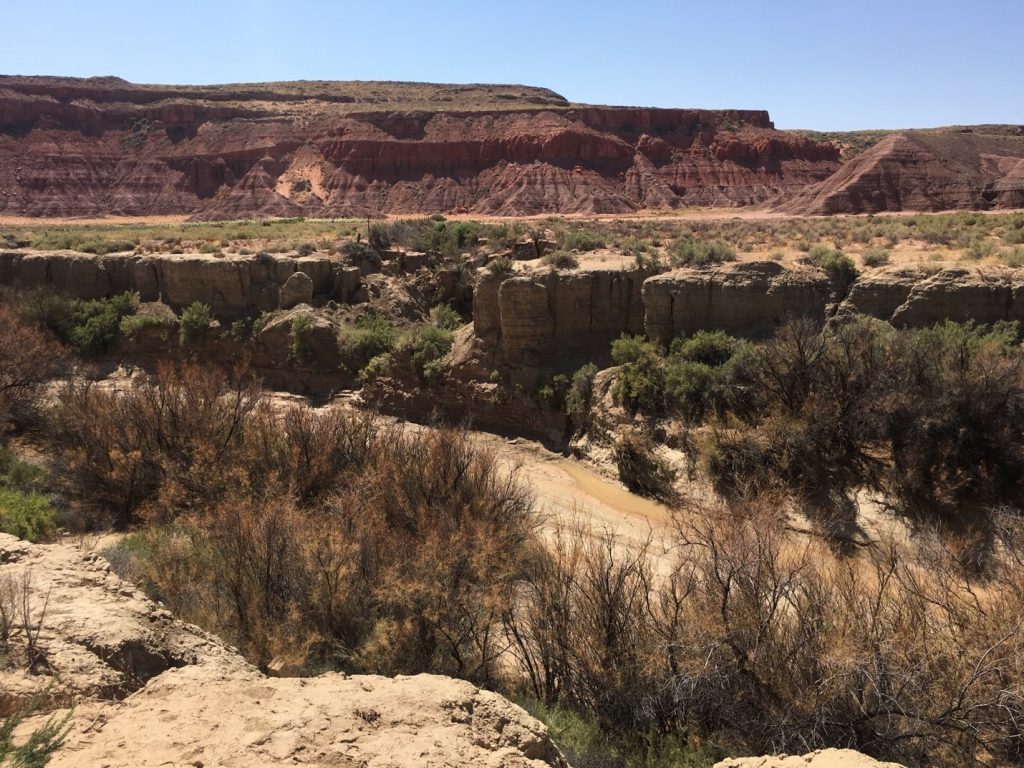
As we walk through our day-to-day lives, many of us regularly step past places that have been damaged, either by humans or by natural events. Trebbe Johnson—the founder and director of Radical Joy for Hard Times—calls these “wounded places,” and she is dedicated to creating a global network devoted to finding and making beauty in those places. It’s her way of connecting with, and giving thanks to, the places that surround us. Johnson’s book 101 Ways to Make Guerrilla Beauty (CreateSpace Independent Publishing, 2017) is centered on this concept, giving readers practical advice for how to recognize and appreciate oft-overlooked spaces. The following is an excerpt from the chapter “Meet With Friends at a Wounded Place.”
Trebbe Johnson will be joining us at the 2017 Bioneers Conference in October to speak about leading with nature’s guidance.
The first step of an Earth Exchange is to go to the wounded place. Being there in person, on the land or by the water, grounding yourself in the place that has fallen on hard times is very important. It’s fine to meditate on a hurt place from afar, but that’s not an Earth Exchange. Focusing on the place in your mind—or even in your heart—just maintains your separation from it. And of course, all too often, distancing is exactly the response so many of us revert to when a place is damaged or destroyed. It’s no longer what it used to be or what we wish it were, so we ignore it. It becomes, in the words of Middlebury College professor and author Adrian Ivakhiv, “taboo.” It’s off limits, officially or in the minds of people or both.
So the point of the Earth Exchange is to move out of our comfort zone and actually make a visit to this place. Think of it as a pilgrimage, a spiritual journey made with a mission. Your mission on this Earth Exchange pilgrimage is to become reacquainted with a place that is being neglected, ignored, forgotten. You go there to find out how it’s doing in its current state and also to be open to how you’re doing. You don’t have to fix anything. You don’t have to convert anyone. Your mission is not to heal either the place or the people. You’re simply there to find and make a little beauty.
Don’t worry if you feel anxiety or trepidation before you set out. Whatever you feel when you begin is likely to change into something else. You will be surprised. You will notice things you did not expect to notice and feel things you did not expect to feel.
Although this step says to “meet with friends,” it’s also fine if you go to a wounded place alone. A big part of why the Earth Exchange works is that any person can do it at any time in any place. You can plan weeks ahead for your event or you can do it on the spur of the moment whenever the need of a place and your own inclination seize you.
No matter where you go or with how many people, it is essential that you insure the health and safety of yourself and everyone else. Avoid places where the land is unstable, such as the sites of explosions, earthquakes, or rock slides. Do not expose yourself and your group to toxic waste or pollution. Don’t break laws or trespass.
The following suggestions will guide you into your first few moments of being at a wounded place.
When you come to a wounded place that makes you feel sad, don’t just walk or drive on. Risk the encounter! If you’re driving, get out of the car. If you’re walking, pause. Face the place and take it in. Note the details. What are the boundaries of this wounded place? Is there an epicenter, where the situation looks and feels worse than in other places? Note how you are feeling about witnessing what has happened or is happening. Acknowledge that your feelings confirm your connection with this place. Even if you pause for just a moment or two, you have begun to bridge the gap between a place that has fallen on hard times and the humans who can care for it.
When you are ready to enter your wounded place, step over a “threshold.” Before you and those who are with you step onto the grounds of the place you’ve chosen, make a simple threshold. It can be a line drawn in the soil, a stick, a row of stones, a branch, or other clear boundary line. Stepping mindfully over a demarcation between the world you typically inhabit and this place that has become separate from other, healthier places transforms your presence there from a mere visit into an event filled with meaning and import. The place becomes what the Greeks called a temenos, a space set aside from common use and dedicated to sacred activities. Stepping over a threshold also enables you to regard your own presence there as sacred and meaningful.
When your Earth Exchange is complete, step back over the threshold.
Move more slowly than you think you need to. When you first arrive at this wounded place, you may be tempted to proceed quickly through the steps of the Earth Exchange in order to get it over with quickly, so you can leave. Acknowledge this impulse—and then do your best to resist it. You are here to visit this place as if it were a sick friend (which it is), get to know it, and let it get to know you. So, instead of hurrying, try moving with exaggerated slowness.
Don’t run away—from the place or yourself. Whatever you feel, it will shift in a moment. Your feelings won’t destroy you. What usually happens, in fact, is that opening up to them has just the opposite effect: after a moment of intensity, the first burst of feeling passes and shifts into something else. You may even feel a sense of relief. You have faced what you did not want to face, and now you are available to new feelings such as compassion, courage, and a greater sense of connection to all life.
Practice balance. If you find that conflicting emotions are swirling within you, don’t try to choose between them. Acknowledge these opposites. They may be sorrow and fascination, anger and admiration, delight and despair, anger and hopelessness, or anything else. Imagine that you can hold these emotions gently in each of your hands. Recognizing that both are true for you in this instant means that you are able to open up to the widest possible state of presence within yourself.
Have fun. The place, the community, the nation, the world— there is plenty of sadness all around. Making a gift of beauty for a place you love and getting reacquainted with it in the process ought to provide some joy. Stephen Duncombe, founder of Creative Activism and author of Dream: Re-imagining Progressive Politics in an Age of Fantasy, writes: “If progressives hope to appeal to anyone outside of a small group of self-flagellants and the terminally self-righteous, we need to cultivate and articulate positive associations with progressive politics.” So let yourself have fun.
This excerpt has been reprinted with permission from 101 Ways to Make Guerrilla Beauty by Trebbe Johnson, published by CreateSpace Independent Publishing, 2017.
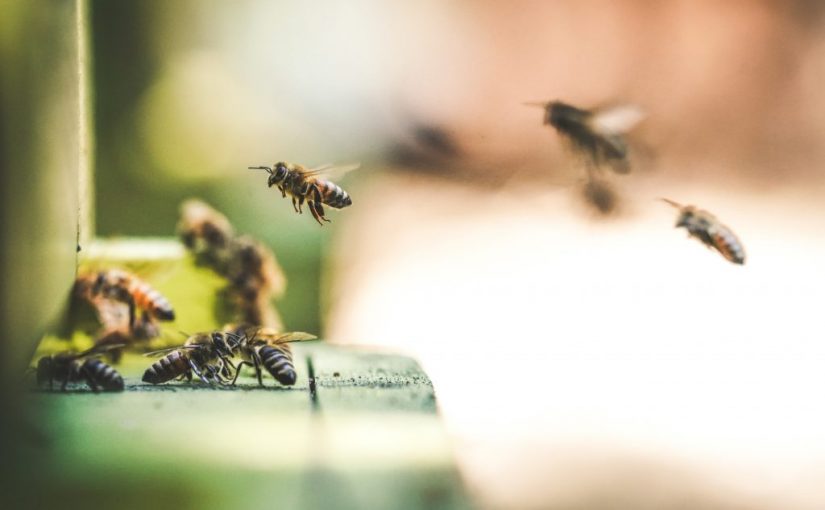
Ants, termites, honeybees, wasps—they may make our skin crawl, but they operate in ingenious, cooperative ways that humans have yet to be able to replicate. These are examples of superorganisms: societies that operate as collectives rather than as individuals with varied interests. Do humans have the ability to join forces and act as a superorganism? Dr. Tamsin Woolley-Barker thinks we do.
Woolley-Barker is an evolutionary biologist, primatologist, and biomimicry pioneer with an extensive background in leadership, innovation, and sustainability. Her book Teeming: How Superorganisms Work to Build Infinite Wealth in a Finite World (White Cloud Press, 2017) tells the story of organism networks, drawing parallels between their potential and the collaborative potential of humans. The following is an excerpt is from the book.
Like any good backyard biologist, I scrabbled around in the dirt a lot as a kid, watching ants. They seemed to speak in a chemical code—food’s over here! Hey, who moved our cheese? I scratched out their invisible trails and tricked them into following the wrong ones. Each one cruised in dopey circles, but together they always figured it out. They were good at their work, industrious and easy-going, running in endless, cheerful loops.
One day, my mom took me along to visit her friend, ten minutes east to the dry, planned-housing frontier—along the edge of the wild chaparral. I hotfooted it on their ill-conceived black slate patio, seeking a patch of shade where I could sooth my raw feet. I cooled them off with the hose, inspiring a teeming mass of furious red ants to stream from a crack in the pavers, straight up my leg. Like the peaceful little black ants back home, there was no stopping these hot-pepper red ones either. I shrieked and stamped, rubbing my legs in frenzied agony until my mom whisked me to safety and hosed me down. Wow! I was filled with respect for those angry red soldiers, and happy they didn’t live at my house.
I never saw those red ants again—San Diego’s native Southern fire ants are gone from our chaparral hills, wiped out by the mellow little black ants. How could that be? The black ants were descendants of banana boat stowaways from Argentina, disembarked many decades before. They were sisters, bearing the same chemical fingerprint, and warfare among themselves no longer interests them. Today, their vast supercolony sprawls across California, pushing out the natives as it goes. The black ants simply have more friends.
There are at least 14,000 species of ants around the world, maybe twice that many, and all live as superorganisms—amoeba-like societies whose members fundamentally depend on one other to survive. No one can do everything, but together, the colony is much greater than the sum of its parts. If it takes a village to survive, that’s a superorganism.
All these ants, tied together in a sack, would weigh about the same as all humankind. The global population of termites, which share a similar superorganism social structure, weighs twenty-seven times that much—there’s a cow’s worth of them for every one of us. Social insects like the ants, termites, honeybees, and wasps make up a quarter of the animal biomass in the Amazon Basin, and 80% of the total insect biomass in the world. This way of life is wildly successful, and ancient. The ants have lived this way for 150 million years, the termites a quarter of a billion. Even the great biologist EO Wilson takes “great pleasure to think that they stung or sprayed formic acid on many a dinosaur that carelessly trampled their nests.” The superorganism way of life persists, even as the world changes.
And believe it or not, there are societies even more successful and ubiquitous than these. Beneath the soil you walk on lies a half-billion year old pulsing nutrient superhighway of fungus—a dense fuzzy network of genetically distinct individuals on the hunt for matter to digest, minerals and water to absorb. If a meal is there, they will find it, and when they do, it will flow throughout the system, shuttling wherever it is needed most—because the fungi are fused into one. Each fungal cell gets more as a member of the network than it could on its own. Together, these fungal patches thrive—making up a quarter of all terrestrial biomass.
I’ve studied the evolution of social systems my whole life—everything from baboons and bonobos to orcas and insects—even slime molds and fungal networks. How do they cooperate, and why? What does working as a superorganism mean for individuality, personal freedom, and creativity? How does the fractal, ebb-and-flow math of collaboration and competition contribute to evolutionary change and complexity? And, how do these most ancient societies work to compound their value from one generation to the next? Superorganisms are everywhere, just like we are, and their footprint on the land isn’t small. And yet, we don’t see them choking on smog or stuck in traffic. The fungi aren’t counting carbon credits or worrying about the Pacific Garbage Patch, and termites and honeybees don’t have slums. These colonies have the same kind of metabolic requirements we do, yet they survive and thrive, sustainably—regeneratively—for hundreds of millions of years, through radical waves of change that turned other populations into fossils. Can we do the same?
After nearly thirty years of studying every kind of social structure, my conclusion is that we can. I know that, because it‘s been done before. The math is simple and universal. Botanical philosopher Michael Pollan says it well: “our relationship to the planet need not be zero-sum…as long as the sun still shines and people still can plan and plant, think and do, we can, if we bother to try, find ways to provide for ourselves without diminishing the world.” Other superorganisms have done it, and they can show us the way.
As an evolutionary biologist and primatologist, I’ve come to see humanity’s special niche as a social one: we’ve combined the political and problem-solving abilities of a chimpanzee with the collaborative teamwork of an ant society. Our ancestors were the first ant-like apes, and in many ways we have more in common with the termites and honeybees and even fungus than with our powerfully individualistic ape brethren. We are Pan superorganismus! I’m in good company with this line of thinking: eminently respectable evolutionary biologists like EO Wilson and Bernard Crespi agree.
As humans, everything we do requires collaboration—who among us makes all the clothes on their back? Like ants, we even expect strangers to coordinate with us, and reasonably politely as well. We drive on one side of the street, stop at the signs, stay in our lane (in some places better than others). We wait patiently for our latté, hold the door for others, say please and thank you, how do you do and excuse me. But if, for one second, you remember—as I always do—that we are 98% chimpanzee, you start to find these good manners extraordinary.
Yes, we’re apes—political and self-serving, affectionate and imaginative. But also we are responsible honeybees, filled with obligation and civic duty; industrious ants, moving earth and tending gardens; DIY paper wasps, driven by the urge to make; and densely networked fungi, pulsing through our digital webs supporting all kinds of teeming ecosystems together.
We are superorganisms, with all the ingredients we need to work together sustainably at scale. If we can embrace the ant and the ape at work in us, I think we can evolve the adaptive, resilient, regenerative global society we require, and design and realize the future we’d like to see.
Here is the simple difference between ancient superorganism abundance and our own increasing scarcity: they compound their wealth by building with virtually infinite things—sunlight and atmospheric carbon, diffuse specks of moisture and nutrients, trust and transparency, and the complexity, diversity, and interconnectedness of networks. There are always more of these things. These organizations are no pyramid schemes—they have virtually no hierarchy or top-down management, and no one tells anyone what to do. Information and resources flow among them, and teams grow from the edges out, in modular, self-managed units that form and dissolve around opportunity and risk when and where it occurs.
This approach maximally leverages diverse individual talents and experiences, and allows these organizations to reap the exponential rewards of collective intelligence and swarm creativity. Optimizing these things lets them accomplish the same kinds of complex tasks we require, with minimal processing power and maximal personal freedom. And these colonies work the same at any scale—no restructuring requires, they just fission or fuse on the fly.
This may seem like a radically new way to live, but I don’t think it is actually that hard. We are superorganisms too, after all, and this way of working feels natural to us. We already work this way in our families and communities—it’s the way we work best. We needn’t fight our nature to get there; just eliminate the obstacles that keep us from it. Superorganism logic is vital for our evolutionary success. These ancient societies offer a new and deeply biological way to do business—a new way to organize our entire global society as we do the hard work of adapting to a finite Earth. This is not a recipe for despair, scraping by, or doing less harm while delaying the inevitable death spiral, nor does it require us to become an army of faceless automaton clone ants or assimilate into the Borg. Quite the contrary—this is a recipe for unbounded optimism, abundance, individuality, personal freedom, and creativity.
These creatures make more each generation without poisoning their world through a set of surprisingly simple deep patterns. They gather diverse scraps of experience, talent, style, and resources, to yield powerful collective intelligence and swarm creativity. They share a compelling purpose, distributing leadership to find the sweet spot between order and chaos, top-down vision and bottom-up productivity. They protect collective value by distributing mechanisms for maintaining trust, and insisting on transparency and accountability. And, perhaps most importantly, they spill this value out into the larger ecosystems they inhabit, feeding the life that feeds them. They have to: it’s the only way to compound that value for the future.
Superorganism logic is proven, and feels right—our biology prevails where our governance fails. Collective value endures, and the simple principles needed to create and maintain it can change the world. They already have—many times in the history of Earth. They can do it again.
Superorganisms are all around us—nimble and adaptive, resilient and regenerative, dramatically outlasting the dinosaurs. The opportunities to borrow their collaborative logic are endless, with proven and enduring results. Our future is uncertain, but countless others have solved these problems before us—some with no brains at all. It can be done. With the right leverage points, any system can flip on a dime. Revolutions and tipping points surprise us. And we are not alone—we have millions of teeming mentors to learn from. Reach out and introduce yourself, because life “did not take over the globe by combat, but by networking.” Watch and learn from them. If we do, I’m certain that we—and all the life that we touch—can survive and thrive as they do, far into the future.
What does an empathetic person look like? Is an empathetic person generally a woman? Can an empathetic person be on the autism spectrum?
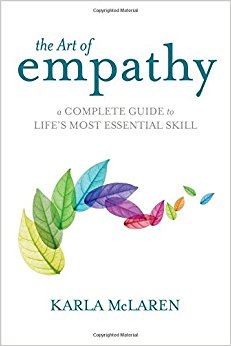
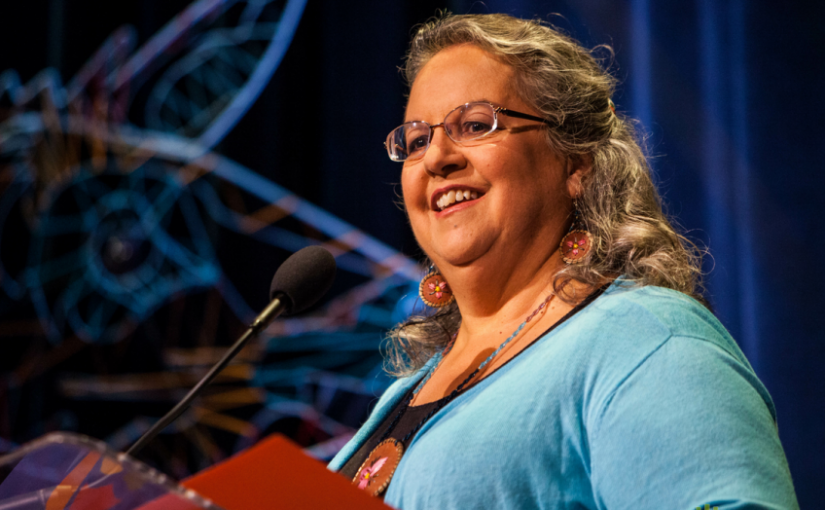
Social science researcher and educator Karla McLaren thinks society has drawn too hard a line between those who empathize and those who supposedly do not. It’s an important issue, as the ways in which we raise our children are sometimes affected by our preconceived notions about their inherent abilities. And the development of empathetic skills can change the face of our relationships—at work and in our personal lives.
InThe Art of Empathy (Sounds True, 2013), McLaren provides insights into what empathy is, who has it, and how best to make use of this powerful ability. The following excerpt is from the book’s second chapter, “Defining and Redefining Empathy.”
Bioneers is excited to welcome Karla McLaren to the 2017 Bioneers Conference, where she will speak on a panel with Arlie Russell Hochschild about the emotional underpinnings of the divides we’re experiencing in our nation – and how exploring them might help us to heal.
An unfortunate offshoot of all of this intense interest in empathy is that there’s been a facile and frankly unempathic quest to exclude entire categories of humans from the empathic community. As an empath, I challenge these exclusions wholeheartedly, and I absolutely won’t perpetuate them. Certainly, in popular culture, there’s a deeply sexist notion that empathy is a female skill and that males are constitutionally less empathic or less emotive than females are. This terrible idea has created untold suffering for boys and men, who are often not taught much about emotions and are not treated as fully emotive and sensitive beings. I can’t tell you how many times I’ve given talks and had men come up to me afterward and whisper, as if they don’t even have the right to say it, “I think I’m an empath.” What? Of course men are empaths!
Certainly, many males have been excluded from an understanding of emotions and empathy, and sexist ideas about men are absolutely commonplace, but they’re not true. So let’s look at our definition of empathy again, specifically in terms of men and boys:
Empathy is a social and emotional skill that helps us feel and understand the emotions, circumstances, intentions, thoughts, and needs of others, such that we can offer sensitive, perceptive, and appropriate communication and support.
This definition does not exclude men or boys, and it doesn’t suggest that feeling or understanding emotions is a female skill. Males can easily understand the feelings, circumstances, thoughts, and needs of others. Males can also offer sensitive, perceptive, and appropriate communication and support. Empathy is not a gendered skill — it’s a human skill! The alleged problem of male empathy doesn’t come from inside the male body; there is no male-specific defect of empathy or emotional awareness; and there are no male-specific differences in early emotional development. Little boys love cuddling and love and emotions and empathy. So do men.
But tragically, we don’t tend to raise boys (or men) as if they’re fully empathic and fully emotive beings. As a direct result, males in our heavily gendered society may experience emotions more intensely than females do. However, because they’ve been socialized to view themselves as unemotional, many males may believe that their normal human emotions are strange or out of place. In general, males are not socially permitted to express a full range of emotions or to chat with friends about those emotions (as females are socially allowed to do), which leaves males with very few healthy or fully conscious outlets for their emotions. In our social training and our social myth making, we’ve created an appallingly unempathic environment for most males.
I wrote a piece on my website about this in connection to the wonderful book Pink Brain, Blue Brain, by neurologist Lise Eliot. She busts sexist myths about boys and girls, and in her book, she points out that the differences between the brains of males and females are actually quite small at birth and throughout childhood. Eliot focuses on socialization — on how we approach gender roles and how we treat boys and girls so wildly differently — as the chief contributing factor in the later differences between males and females in terms of their emotional, social, and verbal skills. Eliot also notes that although there are some early, sex-based differences in verbal abilities (girls are sometimes more verbal than boys, but not always), as well as some differences in activity levels (boys are sometimes more active than girls, but not always), there is not as much difference as we’ve been led to believe. In fact, there is more difference between girls in these traits and between boys in these traits than there is between the sexes. However, parents tend to support these gender-linked behaviors very early. For example, they may respond positively to baby girls’ vocalizations while subtly ignoring their activity levels (and vice versa for boys).
In numerous disguised-gender studies, people describe identical behavior differently depending on whether they think a baby is a boy or a girl. A pink-attired sleeping baby will be called delicate and darling, while the same sleeping baby attired in blue will be called strong and dynamic. What? It’s the same baby! But in a heavily gendered world such as ours, it’s not the same baby at all. We actually attribute different (and sometimes opposite) emotional and empathic qualities to identical behaviors in boys and girls. We enforce gender so strongly and so incessantly that we don’t even notice we’re doing it; it’s the air we breathe and the ground we walk on.
Most of our valenced ideas about gender roles for males and females are socially created; they’re not biologically or objectively true, and they can’t be found in the brains of infants. But because so few people understand the difference between objective reality and socially constructed reality, these myths and falsehoods gain the status of concrete truth. Accordingly, many little girls are encouraged to become relatively inactive people who love to talk about defining and redefining empathy emotions and social relationships (but hate math), while little boys are urged to stop crying at a certain age, even when they’ve been hurt deeply. Boys are given guns and trucks and told to man up, stop crying, there’s nothing to be afraid of, stop being girly, stop talking about feelings, and basically stop being fully alive. When we enforce gender stereotypes, we actually reduce the intelligence, the emotional capacity, the empathic skills, and the very humanity of little boys and little girls. We also throw most of the emotional awareness tasks in heterosexual relationships onto women, which might seem helpful but which actually further reduces males’ emotional skills.
Enforced gender stereotypes can certainly interfere with the emotional and social development of human beings. And yet we all have the capacity for emotional and empathic awareness. All of us — males, females, and everyone in between — can intentionally learn how to identify and work with emotions and empathy at any age and from any position on the gender continuum. Empathy is a human skill; it’s not gender specific.
As we grow up, our brains do change, and adult women often have different emotional skills and neurological profiles from adult men. But the brain is a highly plastic organ, and it will change in response to any strong training. For instance, the brains of highly trained musicians or people who speak many languages look and behave differently from the brains of nonmusical people or speakers of only one language. But this doesn’t mean that music and language are forbidden to you if you weren’t trained early; your brain is plastic, and you can learn new things at any age. There may be some discernible differences in the brains of adult males and adult females, but the old myth about men being less emotional or less able to feel emotions has no basis in neurology. Even the idea that men have smaller corpora callosa than women (the corpus callosum carries information between the left and right hemispheres of the brain) was based on a study of just fourteen brains and has since been disconfirmed, as Eliot points out. But people hold onto this sexist idea, repeat it constantly, and write books and make whole careers around it, while males suffer silently (or act out) the emotions they clearly feel but aren’t invited (or allowed) to understand.
Even so, males have always found ways to feel deeply, to become highly skilled in the social world, to create great art, to parent lovingly, to care for animals, to heal the sick, to fight for social justice, to love fully, to dance and sing and act, to communicate meaningfully, and to be profoundly emotive beings. So let me state this right out loud: males have all the human emotions, males can feel and understand all emotions, males have empathy, males can display empathy, and males are natural empaths. I enthusiastically welcome men and boys into the empathic community.
Another group of people who are tragically and unfairly excluded from the empathic community are people on the autism spectrum, whom I and others have identified as hyperempathic rather than unempathic. In some areas of empathy research, the multiple hypersensitivities that many autistic people experience are not clearly understood, which has led to the mistaken assumption that because many autistic people have difficulty deciphering social cues, they must therefore lack the capacity for empathy. (When I describe people as autistic, I’m using “identity first” language very intentionally; please see the endnote.) This deeply unempathic assumption creates continual misery for autistic people, such that many otherwise caring people will blithely refer to autistics as being cold and incapable of meaningful relationships or even love. This is not only thoroughly and demonstrably wrong, but it’s also insensitive, discriminatory, and ableist. It also has terrible effects on the way autistic people are viewed, taught, portrayed, and treated in the larger community. Some researchers in the area of autism are becoming more awake to the humanity and dignity of autistic people, but there’s still a very, very long way to go.
In our work as empaths, however, we’ll enthusiastically welcome autistic people as fellow empaths — and often hyperempaths — who have unique sensitivities and immeasurable capacities for deep relationships, social interactions, and love. Let’s state this right out loud: autistic people have all the human emotions — autistics can feel and understand all emotions, autistics have empathy, autistics can display empathy, and autistic people are natural empaths.
The deeply mistaken exclusion of boys, men, and autistic people from the world of fully realized empathy tells us that the study of empathy is a very active and tumultuous (and, in some cases, very backward) undertaking. Clearly, the story of empathy is still being written.
There is yet another category of humans who are excluded from the realm of empathy; these people are variously called psychopaths, sociopaths (though this term is considered dated), narcissists, borderlines, or antisocial personalities. There is a great deal of interplay among these definitions, and diagnostic defining and redefining empathy criteria shift (as do the diagnostic titles). However, each condition includes assumptions of a pathological lack of empathy. As a survivor of predatory abuse (I’ll explain what I mean by that, gently, at the end of this chapter), I’ve had a lifelong interest in the dark side of human nature: of criminals and victims, abusers and manipulators, and our many shifting conceptualizations of human evil. Right now, one approach is to attribute all human evil to a lack of empathy, but I find that explanation to be too pat and too simplistic. I’m also very concerned sociopolitically about the fact that early research on psychopathy was conducted on imprisoned people, who are a socially created category rather than a truly different type of person. Although there are certainly people who victimize others intentionally, attributing this abusive and predatory tendency merely to a lack of empathy displays an incomplete understanding of empathy, emotions, the nature of conflict, a sociologically grounded approach to crime and social control methods, and the many ways in which empathy development in early childhood can go awry.
As we move into a deeper study of empathy, beginning with a short history of the concept, we’ll revisit abusers and predatory people not as ominously inhuman specimens with terrifying empathy deficits, but rather in a more empathic way altogether.
This excerpt has been reprinted with permission from The Art of Empathy by Karla McLaren, published by Sounds True, 2013.
Listen to McLaren speak on empathy at the 2015 Bioneers Conference on Soundcloud.
Robin Kimmerer, Potawatomi Indigenous ecologist, author, and professor, asks this question as she ponders the fleeting existence of our sister species—species such as the passenger pigeon, who became extinct a century ago. She asks this question as she tells the stories of Native American displacement, which forever changed the lives of her ancestors. And she asks this question as she bears witness to global climate change, the disturbance of natural habitats, and the destruction of native lands.
In her presentation at the 2014 Bioneers Conference, Kimmerer brings to life the heartbreak inherent in the commoditization of nature and human development without reverence for Mother Earth. Listen to her story by watching the video below or reading the transcript that follows.
I want to say at the outset that I will not tell you anything today that you don’t already know, but we forget, we human people … our elders have told us that our job is to remember. To remember. That’s where the stories come in, because once upon a time, the skies over the Potawatomi homelands carried flocks of birds so vast they darkened the sky. They could take days to pass by overhead; flocks so large that their collective weight in roosting broke off the limbs of trees.
It was 100 years ago this fall on September 1, 1914, that the last passenger pigeon passed from this Earth. She was known as Martha, and she lived all alone in the Cincinnati Zoo. In this time of accelerating species loss, this centennial commemoration of her death has really weighed very heavily on my shoulders. So I dedicate this talk today to her.
I was surprised to find that while I knew a fair bit about the extinction of the passenger pigeon, I knew relatively little of their lives. So I started reading. I read about their communal nesting, all wing to wing, the way they cherish their single egg, how they shape the forest with their feasting on oaks, and how they came like a distant wind and settled by the thousands to roost, conversing with one another — mothers, children, relatives of all kinds — in the voices which linger in the name that our people bestowed upon them. We called them “omimi.
I was also fascinated to learn about how the lives of omimi intercepted with the lives of my Potawatomi ancestors … how many of our people understood the great flocks as flocks of departed souls, and how today we wear bird clan regalia of red and blue in their honor. And that one of the early chroniclers of the abundance of omimi was none other than Simon Pokagon, a Potawatomi leader, who described them, as it was proverbial among our fathers, that if the great spirit in his wisdom could have created a more elegant bird in plumage, form and movement, he never did. Among Simon Pokagon’s people up there on the St. Joseph River was a leader who had a daughter named Shinoda, “the wind blowing through,” and she was my great, great, many greats grandmother.
Like omimi, they moved about the landscape together too, making their lives in the oak forest where they, too, feasted on acorns, set their lodges in communal circles, and relatives of all kinds, wing to wing, cherishing their single offspring. They gathered around the fire at night to tell stories.
But someone else wanted those forests for farms, and the birds became a threat to the crops. And so, 1838 was a year in which passenger pigeons were killed by the thousands in traps, with shotguns, in nests, packed in salt and sent by trainloads back to the East. The birds became fewer, and so our people became fewer.
Our Potawatomi people were canoe people. Our lodges were built on cold, blue lakes under the birches and the pines, lakes that rang with the voices of loons. Our Potawatomi people were canoe people until they made us walk, until someone else wanted that forest, and we were marched away at gunpoint from all that we knew … marched from Michigan to Kansas in what became known as the Trail of Death. I imagine my grandma Shinoda’s hand just trailing over her beloved medicine plants as she walked away from them, saying a silent farewell to maples.
I was also fascinated to learn about how the lives of omimi intercepted with the lives of my Potawatomi ancestors … how many of our people understood the great flocks as flocks of departed souls, and how today we wear bird clan regalia of red and blue in their honor. And that one of the early chroniclers of the abundance of omimi was none other than Simon Pokagon, a Potawatomi leader, who described them, as it was proverbial among our fathers, that if the great spirit in his wisdom could have created a more elegant bird in plumage, form and movement, he never did. Among Simon Pokagon’s people up there on the St. Joseph River was a leader who had a daughter named Shinoda, “the wind blowing through,” and she was my great, great, many greats grandmother.
Like omimi, they moved about the landscape together too, making their lives in the oak forest where they, too, feasted on acorns, set their lodges in communal circles, and relatives of all kinds, wing to wing, cherishing their single offspring. They gathered around the fire at night to tell stories.
But someone else wanted those forests for farms, and the birds became a threat to the crops. And so, 1838 was a year in which passenger pigeons were killed by the thousands in traps, with shotguns, in nests, packed in salt and sent by trainloads back to the East. The birds became fewer, and so our people became fewer.
Our Potawatomi people were canoe people. Our lodges were built on cold, blue lakes under the birches and the pines, lakes that rang with the voices of loons. Our Potawatomi people were canoe people until they made us walk, until someone else wanted that forest, and we were marched away at gunpoint from all that we knew … marched from Michigan to Kansas in what became known as the Trail of Death. I imagine my grandma, Shinoda’s hand just trailing over her beloved medicine plants as she walked away from them, saying a silent farewell to maples.
We should ask them about climate change. In a single season, they lived it. What is it like to exchange a cool, lush forest for a hot, dusty grassland? Lakes for dry riverbeds? Baskets of wild rice for sacks of weevily flour? Loons for — well, there is no replacement for loons.
When I found the photograph of Martha, I felt in her gaze a lament. How could something so beautiful, so ancient, so prolific simply vanish? What happened to the sound of their wings and where did everybody go? What happened to the world I knew?
And you know what? Every time I looked at that photograph, I felt my great grandmother’s voice tugging at my sleeve. Born on the shores of Lake Michigan and buried on the Kansas prairie, she probably said it too. How could something so beautiful, so ancient, so prolific just go away? What happened to the world I used to know?
Climate change is a major driver of species extinction. On average, we lose 200 species every day. Every day. Shouldn’t we be looking over our shoulder and saying goodbye as well? Because the stories of our people and the stories of omimi converge, for both were swept away by the same wind, and we know what happens when two winds, two weather fronts collide—great turbulence and often suffering for the ones below. Two winds, two worldviews, met on this continent … worldviews which color our relations with the living land, which shape our answer to the question of: What does land mean? A worldview in which land was understood as sacred, as our sustainer, our pharmacy, our identity, our home, our library, the place where we play out our moral responsibility in return for our very lives, peopled with our non-human relatives.
This is a way of being in which the tar sands are unthinkable. This view of the Earth suddenly encountered another view, a kind of climate change in values. The whole notion of land as a set of relationships and moral responsibilities was replaced by the notion of land as rights, rights to land as property, and what our people called the gifts of the land suddenly became natural resources, ecosystem services and capital. Nature as family became nature as machine, and our non-human relatives, our teachers, became mere objects for consumption. This is a way of being that invites us to the tar sands.
This is the same question that has us teetering on the precipice of unparalleled extinction and climate chaos. Is the land a source of belongings or a source of belonging?
You should know that the story of Martha and my grandmother, Shinoda, are foretold in the Anishinaabe teachings, the people of the Seventh Fire. It’s an ancient teaching which could not be more urgent, for unlike our sister species, omimi, we are still here—with teachings that enable survival and resilience, teachings that the Earth asks for today.
In the teachings of the Seventh Fire are the history of our people, and I’ll share just a tiny fragment of it today, each fire refers to an era in the history of our people. It’s the story of our origins, our migration, and of our great teachers who warned of the changes that were to come.
The teachings told about a time when the people would become separated from their homelands and from each other, forbidden by law to practice our religions, speak our own languages. A whole way of knowing was threatened with extinction. It was said that there would come a time when you could no longer dip your cup into a stream and drink, when the air would become too thick to breathe, and when even the plants and animals will begin to turn their faces away from us. This, too, we know has come to pass.
But it’s a story of hope as well, because the Seventh Fire teachings spoke of a time when all of the world’s people would come to a fork in the road and stand there together with a choice to make. In my imagination, one path is soft and green, all grassy and spangled with dew and you want to walk barefoot there. But the other path is burnt, and it’s black and it’s all cinders; it would cut your feet. Prophecy has become history, for at this time when the world as we know it hangs in the balance, we know we are at that crossroads.
The prophecies of the Seventh Fire tell us that if we want to choose that green path, we first have to turn back along the path that our ancestors left for us and pick up the teachings that they gave us, to retrieve the language, the ceremonies, our spiritual ways, and only when we have picked those up can we then walk that green path to light the eighth and final fire.
We are the people of the seventh fire, marching toward the lighting of that eighth fire, all of us. It is the people—the wisdom that we reclaim—that will allow us to renew the world. The indigenous peoples and the newcomers, we are all part of this story.
If I could choose just a single element of the traditional teachings that we’re called to pick up, it would be the teachings of the honorable harvest, which were taught us by the plants who give us everything that we need. We are destined by our biology to take lives in order to sustain our own, aren’t we? And that utter dependence upon the lives of others sets up certain responsibilities which are simultaneously practical and spiritual. This is known as the honorable harvest. They are rules of sorts for our taking. It’s a covenant of reciprocity between humans and the living world, a very sophisticated, ethical protocol. One of the first steps of the honorable harvest is to understand that the lives that we are taking are the lives of generous beings, of sovereign beings, and in order to accept their gift, we owe them at least our attention. To care for them we must know what they need. And at the very minimum, we should know their names, especially this one, whose name is “heal all.”
It’s a sign of respect and connection to learn the name of someone else, a sign of disrespect to ignore it. Yet the average American can name over 100 corporate logos and 10 plants. Is it a surprise that we have accepted a political system that grants personhood to corporations and no status at all for wild rice and redwoods? Learning the names of plants and animals is a powerful act of support for them. When we learn their names and their gifts it opens the door to reciprocity.
These guidelines of the honorable harvest were taught to me by generous teachers as I was learning to pick medicines and berries. But it also applies to every single exchange between the people and the Earth, from catching a fish to fossil fuel extraction. The protocols for the honorable harvest are not really written down, but if they were it would look something like this: When you get to the woods, you don’t just start grabbing everything in sight. We’re taught never to take the first plant that you see, and that means you’ll never take the last. This is a prescription with inherent conservation value.
Then, if we encounter another plant, we ask permission. I’ve always been taught to address that plant, to introduce myself and tell it what it is that I have come for. If you’re going to take a life, you have to be personally accountable for it. I know there are places where if you talk to a plant, they’d think you were crazy. But in our way, it’s just good manners.
It’s a two-way conversation, though. If you’re going to ask, you have to listen for the answer. You can listen in different ways—pragmatically, intuitively. Look around. See whether those plants have enough to share. And if the answer is no, you go home, for we remember that they don’t belong to us, and taking without permission is also known as stealing. If you are granted permission, then take only what you need and not a bit more. This is a difficult step in our materialist society, where the difference between wants and needs are so blurred.
The honorable harvest counsels that we also take in such a way that does the least harm, and in a way that benefits the growth of the plant. Don’t use a shovel when a digging stick will do. Use everything that you take. It’s disrespectful of the life that’s given to waste it, and we have forgotten that the easiest way to have everything that you need is not to waste what you have.
Be grateful. Give thanks for what you have received. And in an economy which urges us to always want more, the practice of gratitude is truly a radical act. Thankfulness for all that is given makes you feel rich beyond measure. It reminds us that we’re just one member of the democracy of species; it reminds us that the Earth does not belong to us.
The next tenet of the honorable harvest is to share it with others, human and non. The Earth has shared generously with us, so we have to model that behavior in return. And a culture of sharing, we know, is a culture of resilience.
Reciprocate the gift. We know that in order for balance to occur, we can never take without also giving back. Plant gatherers often leave a spiritual gift behind, but it can also be a material gift—weeding, caretaking, spreading seeds, helping those plants to flourish. We give songs. We give ceremony. We give our respect. We give fertilizer. The ways to reciprocate are many.
What if the precepts of the honorable harvest was the law of the land? What would the world look like if a developer poised to convert a meadow into a shopping mall had to ask the permission first of the goldenrod and the meadowlarks, and had to abide by the answer?
Can we extend the concept of the honorable harvest to address the causes of climate change and extreme energy development? You bet we can. I’m told that there is a teaching even older than take only what you need, and it is take only that which is given to you. It’s a pretty challenging idea to be able to discern what it is that is given as opposed to what we simply take, and I’ve really wrestled with this idea. I’m not sure I fully understand it yet, but I’m pretty sure that coal from mountaintop removal is not given to us. Tar sands oil is not given to us. But the sun’s energy is given to us everyday. Every day the wind blows. The surf rolls. They’re given to us freely and without limit. Had we taken only that which was given to us, perhaps today we would not be afraid of our own atmosphere.
For a time my research as an ecologist was in the field of restoration ecology, but I came to understand that it’s not the land which is broken, it’s our relationship to land which is broken. Our work must be to heal that relationship. The honorable harvest is a small part of that healing.
We need acts of restoration for polluted lakes, for degraded lands, yes, but we also need a restoration of our own honor, honor in the way that we live, so that when we walk through the world we can hold our heads up high and receive the respectful acknowledgement of our plants and animal relatives. We can look them in the eye in return. And the reward is not just a feel-good sense. It may save us all.
Our challenge as scientists, as citizens, as leaders, as designers, planners and dancers, as students and artists and dreamers in the Bioneers community is to ask how can the effect of the honorable harvest be realized on the land and in our communities? For if we had adopted the wisdom of the honorable harvest instead of marching it away to whither in the dry lands of Kansas, we might this very spring have looked up to see flocks of omimi flying overhead in what Aldo Leopold called a living wind.
If we sustain the ones who sustain us, the Earth will last forever.
The café is actually called Bytes, and it’s Paul Ehrlich’s lunchtime hangout. As it abuts Stanford’s Electrical Engineering Department, most of the crowd exudes practical optimism. Not so much Dr.
Ehrlich, Bing Professor of Population Studies and president of the Center for Conservation Biology at Stanford. A persistent mystery concerns his good cheer, pretty much unfailing even as he describes the soon to be scorched earth. A favorite topic: the imminent collapse of industrial civilization.
“We aren’t going to be able to build it all back up again either,” he told me one day.
“Don’t candy coat it Paul.”
“’My plan is to avoid the whole thing by dying,” he said (he is 86). “We’ve already depleted all the precious metals and so forth that are easy to get, close to the surface,” he went on. “So if we want to
remake computers, we aren’t going to be able to get to the necessary materials without electricity for hydraulic drills. Of course all of that will be down.”
Ehrlich has specialized in dire since he first attained popular notoriety in the 1970s, publishing The Population Bomb with his wife Anne Ehrlich. The book propelled him into a limelight that rarely shines on scientists. Back in the day, he appeared on the Johnny Carson Show scores of times. Handsome, hyper-articulate, with a fast hearty laugh, the young Ehrlich was a cross between Carl Sagan and James Bond.
I met Ehrlich about four years ago while researching my book Citizen Scientist: Searching for Heroes and Hope in an Age of Extinction. One of the book’s threads is an investigation into some of the reasons why plants and animals are disappearing at a rate and magnitude equaling that which took out the dinosaurs. One of Ehrlich’s most lasting contributions to science concerns co-evolution. The concept describes how species evolve in relationship with other species – and these relationships are being torn asunder by climate change and habitat loss, leading to accelerated extinctions.
Co-evolution was intuited by Darwin but not proved by him. With botanist Peter Raven, today president emeritus of the Missouri Botanical Garden and an author of the Pope’s encyclical on climate change, Ehrlich comprehensively documented the step-wise process by which species develop traits in tandem.
Working with plants and butterflies, Raven and Ehrlich showed that as plants develop defense mechanisms against predation by butterfly larvae, the butterflies develop ways to survive them.
Raven and Ehrlich were able to quantify the process of co-evolution because for hundreds of years, avid butterfly collectors have documented the relationship between species and their host plants. “People raised butterflies because they wanted perfect specimens. When they figured out the host plant, they sent in a little notice or paper to a journal, and now we have this unparalleled database,” Ehrlich told me.
Similarly large databases have essentially been accumulated by amateur naturalists – citizen scientists – who have also documented birds, weather, and phenology, or the timing of natural events including spring bloom times, also for hundreds of years. Ecological relationships are discernable in the resulting patterns, and so is change over time. Today’s citizen science is turbo-charged by computing power, satellite technology, statistical analysis, and smartphones. Millions of observations made every year by citizen scientists contributing to eBird and iNaturalist (check it out – they’re free!). Right now they are helping to explode our understanding of how nature works, and what we need to do to protect it.
“One of the things were doing with climate change is tearing apart long-evolved co-evolutionary relationships and doing it at a rate which is higher than we have seen over most of history, but not
entirely,” Ehrlich told me. “Things have happened fast before. One of the problems though is that we’re having this extremely rapid evolutionary change for the first time since we’ve had an over- populated, resource-short civilization trying to do it.”
Ehrlich has been among a handful of scientists pointing out that absolute extinction rates are bad enough, but we are confronting an even worse loss of overall biodiversity – we are losing vast numbers of bodies of plants and animals, even those that are not yet in danger of completely blinking out. In just the past 40 years, wild species populations have shrunk in alarming numbers: 39% of marine wildlife and 76% of freshwater wildlife are gone. In 1970, a billion more birds flew over the Earth than do so today.
“We’re going to have to get into triage,” Ehrlich told me.
“Like bringing back the wooly mammoth and the passenger pigeon?” I asked. Stuart Brand, who spearheads an effort called “de-extinction,” was once a student of Ehrlich’s.
“Smart guy,” Ehrlich said. “Completely nuts.”
“They’re pretty far along with some aspects of it,” I said.
“No they’re not. They’re not even started.”
The professor of population biology patiently explained. “If you’re going to reestablish the passenger pigeon, first of all, you’d have to recreate about a million of them because they are predator saturators. They went extinct when there were still many thousands of them left. The way they survived was by having gigantic breeding colonies in random places so that predators could never catch up with them. Additionally, their biggest food sources were acorns from the great forests of northern and eastern North America – most of those are gone now, fragmented, and they don’t produce enough food for passenger pigeons anymore.”
“What are we going to do?”
“You know I never like to give my opinion on anything.”
“That’s why you’re a terrible interview.”
“We have to assign an intrinsic value to nature, show why it’s important to human beings. We can’t avoid the problem of biodiversity loss and just hope we can find some sort of palliative. If people tell themselves we don’t have to worry about extinction because we can bring animals back, that’s moral hazard. The solution to our problems is to rescale society. We have to lower our population and our rate of consumption, particularly among the rich.”
“But our instincts tell us to get more and more, to build our coffers and increase our genetic success.”
“Do you have more than 30 children?”
“Two.”
“The instinct we know is engraved in our DNA tells us to out-reproduce our buddies. So you are fighting your instincts and doing a good job of it, because your physical capacity would be about 30 births. You and millions of other women have suppressed your instincts using pills, condoms, and so on. In ancient
Egypt women used crocodile dung suppositories as contraceptives.”
“How effective was that?”
“I’ve tried to get some graduate students to study this, but they refused.”
“So if it isn’t instinctive, then we aren’t we stopping ourselves from destroying our own world?”
“If I throw a rock at your head, you do a whole series of differential equations in one millionth of a second and duck. You see the rock coming at you against a constant background. Our constant background is changing gradually and we don’t see it. Gradual accumulation of greenhouse gases, nuclear weapons, toxins, population. We aren’t designed to see and respond to the ethereal.”
But today, we have a way to visualize and so confront the ethereal – or at least patterns in nature that are hard to discern in the short time frame. Raven and Ehrlich discerned co-evolution from historical citizen science records of butterflies – other scientists have used the same data to show how butterflies are changing their distributions in response to temperature and precipitation change brought on by greenhouse gas warming. When we see where the butterflies are moving, we can target our conservation efforts to help them adapt. Citizen science is a tool for grappling with change – hopefully, before it hits us in the head.
Mary Ellen Hannibal is a long-time journalist living in San Francisco who has focused on natural history and literature. Her most recent book, Citizen Scientist: Searching for Heroes and Hope in an Age of Extinction, was one of the San Francisco Chronicle’s 2016’s best non-fiction books. She is a recipient of the National Association of Science Writer’s Science and Society Award.
Searching for the perfect news round-up? Look no further! We’ll keep you savvy with all the Bioneers creativity and inspiration you need in your life. Follow the Bioneers Blog for our bi-weekly news roundup:
“You shouldn’t need to be a hero to catch a break, and you shouldn’t be punished for trying your best to survive through an immigration system that doesn’t recognize the realities on the ground. So grow a heart, sure, but let’s also focus on making sure our leaders grow a spine.” Manuel Pastor responding to the latest on DACA
Calling all nonprofit fundraisers! Don’t miss Kim Klein, Kay Sprinkel Grace, Room to Read & more at Nonprofit Fundraising Masters in SF on 9/19: mingle, learn & get inspired and save $20 w/ NFM code.
Our own Dorothee Royal-Hedinger talks about connecting with the plants, motherhood and being a Bioneer on the My Home Planet Podcast »
Bioneers partner, Pachamama Alliance collaborates with indigenous groups in the Ecuadorian Amazon to work towards permanent protection of their lands and cultures. Join a 1-hour intro call on September 13th to learn about their life-changing Journeys to the Ecuadorian Amazon, and how you can reserve your spot on an upcoming trip.
“Of course plants can remember.” Evolutionary ecologist Monica Gagliano in this fascinating read from Atlas Obscura
“Detroit is experiencing a food revival, that’s true, but it isn’t happening much in neighborhoods. It’s mostly not Black-owned restaurants, Black-owned stores, or businesses. Economically, the majority of African-Americans are seeing very little benefit.” Malik Yakini featured in Civil Eats »
Follow us on Facebook and Twitter to stay up to date on the latest Bioneers news in real time.
Jonathan Smuckerhas spent more than two decades organizing and formulating strategies for grassroots social movements. He is a doctoral student of sociology at U.C. Berkeley and the director and co-founder ofBeyond the Choir, an organization that capitalizes upon Smucker’s experience, crafting strategic messaging and campaigns for social justice groups. In his book,Hegemony How-To(AK Press, 2017), Smucker provides practical tools and advice for the next generation of grassroots organizers and changemakers based upon his depth of experience and research. The following excerpt is from the book’s third chapter.
Bioneers is excited to welcome Jonathan Smucker to our 2017 conference, where he will be speaking on a panel about resistance and belonging.
“Intuitively speaking, not all social groups involve the current pursuit of a goal or end, in spite of the impression given by some writers.”
—Margaret Gilbert
“Thus the other-directed child is taught at school to take his place in a society where the concern of the group is less with what it produces than with its internal group relations, its morale.”
—David Riesman
The personal is political
When Carol Hanisch published her classic essay “The Personal is Political” in 1969, she was pushing back against critics who had been dismissing women’s caucuses and discussion circles as being merely “therapeutic.” The essential argument of the criticism—which was coming from within social justice movements—was that women were indulging in “navel-gazing” retreats to talk about their “personal problems,” distracting themselves and others from the “real work” of challenging systems and structures (like capitalism). If a woman was doing too much of the cleaning, cooking, or childcare at home, or if she was dealing with an abusive husband or boyfriend, the problem was a personal one, for her to either get out of or to figure out how to deal with. Maybe she should just be more assertive. Hanisch rejected this view. She argued that while individual women were facing innumerable everyday forms of oppression on their own, isolated from one another, this oppression was structured and common across a category (i.e., women). Hanisch asserted that to address these problems women needed to come together as women—as a group—in order to articulate their grievances together and ultimately to enter into the political field with enough force to make structural changes: “One of the first things we discover in these groups is that personal problems are political problems. There are no personal solutions at this time. There is only collective action for a collective solution.”
Thus, the phrase the personal is political was originally intended to mean that the oppression you experience as an individual is patterned—that there are structural factors underlying your experience, and so there are probably others experiencing similar things. The personal is political encouraged individuals who were experiencing oppressive situations—a woman abused by her husband, or a worker exploited by her employer—to view these situations not as personal problems, but as political problems, and to realize that remedial action requires coming together with others to address the issue in the public sphere. It is no small irony that the phrase the personal is political is now often used to mean something almost opposite of its original meaning. While it once meant that personal problems are not really personal, inasmuch as they are structural problems and collective action is required to address them, now people use the phrase to advocate uncoordinated individual action (e.g., buying organic shampoo) as somehow constituting a political intervention. This morphing of meaning may say something about the rise of individualism in the culture—even within social movements—as the tendrils of neoliberalism penetrate more and more of social life and its individualist logic makes the logic of collective action less and less intuitive.
But with its original meaning, the phrase the personal is political spoke to the process of fragmented and isolated individuals coming to identify as a group with common—or political— grievances and goals, rather than merely personal problems or shortcomings. This is the process of politicization in a nutshell. Articulating such a basis for common identity is precisely what Antonio Gramsci meant by the word articulation.
Recently, such a process has been unfolding across the United States as police killings of our black and brown brothers and sisters are now being articulated popularly as a pattern, a structural problem, and a political problem—recognized as such by more and more people. Of course some voices have been saying this for decades and organizing consistently around these issues, but only recently has this analysis and mobilizaton broken through into a nationally-recognized movement. This means that each needless death and each instance of excessive force is now understood as part of a bigger moral narrative. Victims’ families and communities no longer have to struggle on their own, isolated from each other. There is now a stronger sense, at least, that “you are not alone.” This articulation of a common story about structural racism and economic inequality in relation to America’s police departments provides a stronger basis for the collective mobilization it will take to change this intolerable situation.
However, it is not easy to get people to recognize as a political problem what the prevailing common sense has told them to see as a personal shortcoming. Struggling homeowners in the wake of the 2008 financial crisis, for example, tended to struggle in isolation. In the American Dream narrative, homeownership is a source of individual pride. Foreclosure and underwater mortgages have thus been implicitly, and sometimes explicitly, framed as personal problems and even reason for shame. Thus, struggling homeowners often worked extra jobs to make payments on underwater mortgages, or they went quietly when facing foreclosure and eviction. However, as the banks got bailed out to the tune of a trillion dollars, but no relief was extended to struggling homeowners— and as banks’ predatory lending practices started to face scrutiny—the political nature of the housing market crash began to come into focus. At the height of Occupy Wall Street, Monique White went to the public park where Occupy Minnesota had set up and asked the occupiers to help her fight to save her home. By joining with others to take collective action, she was able to fight the bank and eventually save her home. In similar fashion, Occupy Homes campaigns kicked off all across the country, successfully saving many homes along the way. Still, most homeowners who joined the effort did not start out as ready as Monique White. Tim Franzen, an organizer with Occupy Homes Atlanta explained how “The biggest barrier was getting homeowners to fight—to believe that it was right and just for them to fight, instead of just suffering alone in the shadows.” Individual homeowners had to confront the intuitive shame they often felt—a product of seeing their situation as their own personal problem or shortcoming—in order for the personal to become political.
Belonging and “therapy”
Jose Vasquez served fourteen years in the United States Army. As he watched the George W. Bush Administration exploit the political capital it had been awarded following September 11 to launch a war of choice in Iraq, Jose became disillusioned. Eventually he successfully petitioned to become a conscientious objector. Exiting the army, he hit the ground running by joining Iraq Veterans Against the War (IVAW), where he has over the past decade served in several leadership roles, including President of the IVAW NYC Chapter, Co-chair of the national board, and Executive Director of the organization. I first met Jose in the office of the War Resisters League (WRL) on Lafayette Avenue in Manhattan’s Lower Eastside, when I started working for WRL as their national field organizer.
Jose described to me how he had met a fellow veteran at a public event that IVAW NYC had organized. The veteran, who would soon join up to become an IVAW member, had found out about the event from a professor at his college. The event was actually Iraq vets reading from their memoirs, so it was people telling their stories…
[quote format]Then he came out and hung out with us afterwards and was just really excited and animated and said, “Man, I’ve been kind of like holed up in my apartment for the last six months.” He literally said, “It’s so fucking good to meet you guys. I just thought I was, like, going crazy. I thought I was the only one who thought the whole war was fucked.”
So yeah, I think it’s empowering to identify with other people, to find likeminded individuals, to have that outlet, to do things with others—sort of taking that negative energy and turning it into something positive. A lot of people come home from war with their whole worldview shattered and it leaves them in a very fragmented place, but being able to talk things through… it’s therapeutic to just be able to tell your own story and not be judged. And I think people begin to then rebuild a new worldview for themselves… They start to then take their own very individualized experience of combat and place it in the larger context, and then bounce it off of other people’s… “Oh, yeah, this happened to me over here. I was in Fallujah. I was in Ramadi.” And so they understand that like, “holy shit, this kind of stuff was happening all over the place!”[end quote format]
Jose provides us with yet another powerful example where what felt like personal and isolated experiences were discovered to be widespread phenomena, and thus articulated as political matters. Yet Jose sees this realization as not only politically necessary (in order to organize a force to pressure a change in US foreign policy), but also as therapeutic. For him the two purposes get mixed up with each other. There’s no clear line separating them and there’s no reason to diminish the one in order to elevate the other. On another occasion, Jose went into even more detail about the therapeutic aspect of IVAW members’ organizing work together: “The camaraderie is a huge asset. It’s probably saved a couple of people’s lives actually—people on the verge of suicide. They meet up with other IVAW members and realize, ‘I’m not alone. It’s okay for me to be against what I just did.’ That’s enormous for some people.”
How are we to square this with Carol Hanisch’s pushback, four decades earlier, against the charge that women’s groups were merely indulging in personal therapy? Hanisch’s important and necessary intervention has to be interpreted partly in relation to the narratives she was pushing against. She never argued against the value of individuals finding in each other’s company a sense of belonging and a space for healing. Rather, she rejected the notion of stopping there.
It is important that we recognize the necessary therapeutic subtext that is always operative in social justice struggles. Yes, we come together with others because there is political strength in numbers, and we are aiming to accomplish instrumental goals. But we also come together with others because it feels good to do so—because we find a deep sense of community and belonging that accomplishes what could be described as “therapeutic” purposes.
In modern US society, many of us suffer from a lack of adequate community in our daily lives. Indeed, social alienation and psychological strain seem to be endemic to late-stage capitalist societies. As such, we are both psychologically and politically motivated to participate in protest and collective action. In other words, the social, economic, and political structures that are the source of our political grievances are also a major cause of psychological strain. Why then should we count psychological motivation as something that is not political? If psychological strain is produced by an alienating underlying social structure, then psychological and political motivations can be one and the same (which is not to say that they will never operate in tension with each other).
Add to this the particular sense of alienation that can accompany political radicalization. We who hold progressive or radical values often feel an acute lack of representation, if not outright repression, of these values in the dominant culture. Many of us, during the process of our politicization, come to feel isolated within our communities of origin, and often for good reasons. As I came of age in rural Lancaster County, Pennsylvania, I encountered resistance to my newfound radical notions of social justice, and I felt isolated. So I went out looking for likeminded people. Finding them and communing with them has been and continues to be both inspirational and therapeutic. It contributes to my well-being.
When we look at the state of the world we may understandably feel frustrated, angry, and heartbroken. Besieged by a dominant culture in which destructive values and politics seem to reign supreme, we may feel isolated. We can find community—a sense of sanity and belonging—by coming together with likeminded people to express our alternative values boldly, loudly, and, most importantly, collectively. The explicit purpose of coming together with likeminded people is to affect change, more effectively by joining together in greater numbers. A second, less explicit purpose is to surround ourselves with community and also with reflections of the values that we hold dear. Together we create projects, spaces, culture, and ritual that cultivate a strong life of the group.
Collective ritual and strategic engagement
As we have seen, achieving our political goals and fulfilling our psychological needs can be mutually reinforcing and positive processes. Unfortunately, this is not always the case. These two purposes can also operate in tension, and can even undermine one another. While the “therapeutic” motivation may be an inherent and even necessary part of social change work, it is also deeply connected to self-defeating patterns that can undermine our political efficacy.
Before proceeding, a clarification of the term “therapy” must be raised, as the term can conjure a picture of individuals pursuing their own psychological health as individuals, often in order to personally adjust themselves to the structural causes of psychological strain, as opposed to joining with others to confront these causes. The form of “therapy” that I have been discussing here is fundamentally a group process, essentially about community and belonging. The longing for meaningful community— which, unfulfilled, is indeed a major source of psychological strain for so many—can be fulfilled in social movements through the life of the group (a term I will use throughout this book). Motivations that pertain to the life of the group overlap substantially with what is often referred to in the academic social movement literature as expressive motivations. I prefer the term life of the group, because expressive can imply an individualistic self-expressive motivation. My view is that a collective dynamic is the main driver of the patterns I have observed, which I hope to illuminate here.
The life of the group is cultivated through collective ritual. By collective ritual I mean collaborative expressions of shared values that serve to further a sense of community and belonging. Ritual can describe acts that affirm our sense of community, our collective narratives, and the values contained therein. In Christianity, collective ritual may include church attendance, group singing, and Eucharist, but it can also be found in far subtler aspects of everyday life. In social change groups and subcultures collective ritual may include protests, events, gathering places, music, fashion, publications, specialized vocabulary, and much more. Collective ritual is hardly distinct from culture itself. We can find a layer of collective ritual in any word or deed that affirms the group or subcultural identity and narrative. This is not to say that a protest has no instrumental political purpose other than affirming a group’s identity—or an individual’s sense of belonging to the group—but rather that this affirmation is always part of what motivates protest participants. And without conscious awareness of this layer of motivation we run a greater risk of our protests and collective action truly having no instrumental value; that it will accomplish nothing other than making us feel good.
Ritual is important—vitally so for collective action and social movements. Our rituals partly represent the survival of alternative values within a dominant culture that under-represents and represses such values. Through collective ritual we gather strength and build solidarity by surrounding ourselves with reflections of our alternative values and visions. However, expressing values and living principles is not the same as strategically engaging society and political structures in order to win systemic change. Even though these expressive and instrumental aspects intermingle in messy reality, it is nonetheless important to draw a conceptual distinction between collective ritual and strategic political engagement—between the life of the group and what the group accomplishes beyond its own existence (i.e., the work of engaging with social and political structures in order to affect change). Strategic engagement overlaps with collective ritual, but the two are conceptually distinct, and it is advantageous to develop a consciousness about when and how we utilize one or the other or both. Both agendas are essential, and social change movements suffer when either is neglected. Collective ritual serves as a remedy to the paralysis caused by isolation. It provides connection, community, a sense of belonging—and there can be no politics without this collective sense. However, strategic thinking and action in social movements is hampered when participants pursue insular ritual to the neglect of broader strategic engagement.
Author and grassroots organizer Mark Andersen describes the distinction in terms of subjective and objective:
…if we are to really contribute to change, much less revolution, we must distinguish between the “subjective” (internal: seeking personal identity, meaning, purpose) and the “objective” (external: actually helping to change power relations, structures, and values that uphold oppression of the many by the few) aspects of our activism. …Both the subjective and the objective are critical, at different times and in different ways. They are even interconnected— i.e., I begin to feel personal power, which enables me to take actions that might help striking workers get better pay and working conditions or, more fundamentally, help to build power to alter social structures. However, the two are not the same.
While both are important, these two motivations for participation in social change efforts often operate in tension with each other. A group that focuses only on instrumental goals and neglects the well-being of its members will likely burn out its core while repelling potential newcomers. The opposite problem is when groups become content to functionally operate as little more than therapy, losing interest in questions of political efficacy and strategy.
I have seen the latter situation play out an embarrassing number of times. Let’s be frank. I suspect that anyone who has meaningfully participated in contemporary social movements in the United States would have a hard time denying that movements often attract some very alienated individuals who sometimes arrive with overwhelming psychological needs. There is even a logic to the pattern: by publicly challenging aspects of the status quo, movements may unsurprisingly become a kind of “magnet” that attracts people who feel especially alienated from that status quo. And movements often provide a space where such individuals can meaningfully participate and feel empowered. It can be highly problematic to psychologize the motivations of individual participants in political movements, but given that we have to practically navigate—toward political ends—the consequential social psychological level within social movements, it behooves us to candidly assess this level, including the pathologies. We might lean toward structuralist explanations for social, economic, and political problems, but if we want to build functional political vehicles run by actual human beings, we cannot afford to be disinterested in the psychological level of collective action. This level is an important part of the terrain that we have to learn to navigate.
By understanding our own psychological motivations and how they are connected to our political grievances, we will be better equipped to act effectively on both. And by developing an analysis of how collective ritual and strategic engagement often operate in tension, we might get better at making sure they operate symbiotically instead. We can become more discerning about when and how we fulfill each purpose. We can act more effectively, while also building a beloved community together.
This excerpt has been reprinted with permission fromHegemony How-Toby Jonathan Smucker, published by AK Press, 2017.
When it comes to items and entities that are human-made—mass transportation systems, homes, businesses, clothing—there’s a historic tendency to rely on original ingenuity. As brainstormers and problem-solvers, humans have become quite adept at creating their own solutions to a multitude of problems. But what if the very best solutions could be found, not by brainstorming or creating ideas from scratch, but by observing nature? How might nature do it? This concept of looking to the natural world as a blueprint for everything from design to finance is called biomimicry. It’s rooted in the idea that nature is perhaps the ideal pattern from which to work; it has, after all, adapted and developed into a brilliant blend of species and ecosystems, all nearly perfectly designed to survive and thrive. Call it 3.8 billion years of R & D.
Katherine Collins, an expert in sustainable and regenerative finance, has turned to biomimicry in order to inform investment strategies. “I decided I needed to be more like a honeybee,” she says of her shift toward biomimicry. “To deliberately refocus on an investment approach that was more open, more connected to the world, and more explicitly focused on its guiding value system.”
It comes as no surprise, then, that when Collins started her own research firm, she named it Honeybee Capital. Her road to the world of ESG (environmental, social, governance) investing has been somewhat winding—she has received her master’s degree in Theological Studies from Harvard Divinity School and a B.A. degree with honors in Economics and Japanese Studies from Wellesley College. Before Honeybee, she spent nearly 20 years working for the same financial company. Today, she is Head of Sustainable Investing at Putnam Investments.
In The Nature of Investing (Routledge, 2014), Collins speaks to how the world of finance has stagnated by becoming to impersonal and mechanical. She suggests taking cues from the natural world using biomimicry investing in order to achieve both financial resilience and ethical, life affirming investments. The following excerpt is from the chapter “Saved by the Bee.”
One of my most treasured possessions is the gift my father gave to me when I started my first job: it’s a sign from IBM, circa 1970. My dad worked there for many years, and so our entire family was constantly surrounded by this motto. Every pencil, every notepad, every coffee mug held this simple command, in classic typewriter font:
THINK.
This sign has come with me everywhere, from a little cubicle with a scenic view of the ventilation shaft to a big corner office, and it’s only recently that I realize what a true gift it was: embedding in my mind, from my earliest memory, the idea that when you go to work, your job is to THINK.
For more than twenty years I’ve been a professional investor, and this is what I love most about my profession: it requires you to think, in a proactive, engaged, creative way. Partly that’s due to the fact that the world is always changing. Of course, things have been shifting within the investment business too. In fact, it’s hard to overstate the changes in the structure of our financial markets just over the last twenty years or so.
Take one small example of an investment tool: the heat map. Twenty years ago, heat maps—those red and green patchwork charts that display stock prices on every TV finance channel and every investing website—did not exist. In fact, when I started as an investor, the Quotron was still our main source of stock prices, and it was down the hall, shared by about a dozen people. This was not an elegant piece of technology: the Quotron weighed at least fifteen pounds, it required a dedicated phone line, and it had one of those tiny green screens that quivered with the sheer physical effort of transporting small bits of data. You had to manually enter each ticker symbol, which led to some long lines around the machine, especially on days when a lot was happening in the stock market.
But the Quotron, precisely because it was so user-unfriendly, brought a great advantage. It was our water cooler. If you were a semiconductor analyst, this is where you learned about oil prices. If you were a retail analyst, this is where you learned about housing starts. You knew which industries were doing well just by the look on your colleagues’ faces as they checked their top holdings. That crowd around the Quotron connected our individual pods of data into a web that was more like knowledge, and sometimes even wisdom. Just as importantly, it connected us to one another.
There is no question that the heat map is a better, easier tool to use for data on stock prices. And these days, you don’t need to be a professional investor to access all of that data every second of every day, right from your cell phone. But something has been lost amidst this efficiency: those hallway conversations have disappeared. The perspective, the exchange, the connection provided in that water cooler setting— that’s not something I can carry in my pocket. It’s still out there, but it’s farther away than ever.
This cycle of technological improvement has repeated itself over and over again, with most of our new tools and products and processes bringing big gains in efficiency or speed or scale. But gradually, many of these advances have chipped away at the connection—connection to the world, and to each other—that has always been at the heart of the investment profession.
As the investment business was evolving in this direction over the years, I felt more and more a sense of personal struggle. I couldn’t quite define its source, or even recognize the strain, but at one point during my last few years of money management, I had a long day of client meetings, about a dozen in a row. At the end of the day I realized that every single client had asked me questions about portfolio statistics like tracking error, but only one client had asked anything about an actual investment I’d made—what the company did that was of use to the world, what made it worthy as a place to deploy our shareholders’ funds.
Soon after this, in the face of a tiny market correction in 2006 (nothing like what we were to see a couple of years later), my funds underperformed by ten times more than any of our fancy risk-management models said was possible. Over the course of the next year, my funds recovered and outperformed again, but even after this small crisis passed, I felt a deep sense of disease. I feared that my profession was evolving in a direction that was foreign to me. I feared that the tools we’d invented to help us invest wisely were beginning to pull us off course. Importantly, this was not a question of wanting a new job, or even a new career. Investing is my vocation—and the idea of splitting from one’s vocation, well, it’s just heartbreaking.
Fortunately, in the midst of all this struggle, I found the honeybee.
More precisely, I found Dr. Tom Seeley, the noted honeybee researcher from Cornell University. Dr. Seeley’s recent work has been focused on collective decision making within beehives. It turns out that bees are not just pretty good at decision making, or above average. They are fantastic! For example, bees choose the best available hive location almost every time when they are getting ready to swarm to a new home.
Dr. Seeley’s work is amazing from a scientific standpoint, but what really struck me was the conclusion of his talk, when he described the key characteristics that enabled the bees’ optimal decision making.
• First, bees go out into the world to gather data. When they have an important decision to make, bees do not hole up in a little honeybee conference room and bust out PowerPoint presentations. They leave the hive to see what’s out there in their surrounding environment.
• Second, they come back together and engage in active, objective sharing of information. There are no bee spin doctors, no bee talking heads, no bee pundits. They come back to the hive and share what they’ve learned, openly, directly, and objectively.
• Third, they reiterate this process until the information is complete and compelling.
• Finally, and most importantly, bees have a clear, shared common value system. They all know what makes for the best hive location, and those are the criteria upon which their decisions are based. There are no hidden agendas, no political motives—the bees just want the best answer.
As Dr. Seeley talked, I felt more and more excited, and also, curiously, more and more at ease, a sense of ease I had not felt in a long time. I realized that the honeybees’ characteristics are the exact same ones that lead to the best investment decisions.
The best investors I know go out into the world, observing, interacting, gathering information. They do not expect investment ideas to pop out of the screens on their desks; the best ideas come from the real world. And once they have an initial thought, great investors want to debate it, especially with others who might have different information. They are not concerned about pitching stocks or winning a sound-bite contest; they want to be challenged by other informed people who have different points of view. And finally, great investors have a clear, strong value system. It’s so clear and so strong that they often don’t even stop to think about it, but when they see an opportunity that is a match for their approach, for their own definition of good investing, it is clear as day.
I realized as Dr. Seeley spoke that the core of my profession was completely intact. In fact, it was beautifully aligned with the basic, brilliant principles that govern the natural world. It turned out that this struggle I felt was not against my vocation, the profession of investing—my struggle was against the business of investing, all of the tools and mechanics and distraction that we’ve created. These tools are each helpful in their own small ways, but their cumulative effect had been to gradually pull me off center, away from the essential, connected nature of investing.
So, I decided I needed to be more like a honeybee. To deliberately refocus on an investment approach that was more open, more connected to the world, and more explicitly focused on its guiding value system.
This re‑rooting involved some change. I left the hive, the firm that I had loved, the professional home where I had thrived for almost twenty years. This was the place where I had taken on my first glamorous assignment fresh out of college, as a cement industry analyst. This was the place where I had managed my first sector fund, at the shocking age of twenty-two (never fear, I was very well supervised). This was the place where one company management team brought cake to our update meeting, because they knew I’d be working late on my birthday. This was the place where I’d managed billions of dollars, where I’d met countless CEOs and analyzed hundreds of businesses. This was the place where I’d taken on the toughest management role of all, managing an intense and brilliant team of people (much more challenging than managing money). In that hive, I had had more opportunity than I’d ever dreamed of, had worked side by side with some of the best investors of all time, had learned and been tested in every possible way, and, best of all, had forged many dear, lifelong friendships.
Leaving my home colony, needless to say, was both exciting and unsettling. I reengaged in the world around me, travelling as a volunteer and a pilgrim. I earned a degree at Harvard Divinity School, to strengthen my own core of values that underpin all decision making. And I started Honeybee Capital, with the simple premise that pollination of ideas, connection to the real world, and a strong underlying value system lead to optimal investment decisions.
Dr. Seeley’s honeybees have now led me on a longer journey, a broader exploration of how all sorts of natural systems can provide us with road maps for our own human-created systems. Thanks to the generosity and vision of Janine Benyus and Hazel Henderson, who led a joint gathering of biomimicry leaders and investment innovators in 2011, ultimately my research has led to a deeper study of biomimicry, a framework for understanding the key characteristics of all natural systems and organisms. Applying the principles of biomimicry (life’s principles) to investing gives us an approach that realigns and reintegrates our investment activity with the world around us.
The biomimicry-based framework offers several key advantages:
• It is the ultimate in sustainability. Nature has sustained for 3.8 billion years! In fact, it goes beyond sustainable: nature is adaptive and regenerative.
• It is nonjudgmental. Nature can be a wonderful instructor, but it is not preachy. Nature just is. Nature does not tell you what to do; nature demonstrates how the world actually functions.
• It is an inherently integrated approach. No single component of a natural system exists in isolation. Employing biomimicry automatically employs a networked, systems-based, integrated methodology.
• It is inspiring and comforting. Relying on deep, functional knowledge, embedded in ancient, real, observable natural systems, feels a lot better than taking up the latest clever (but limited) business school buzzwords. And the examples provided by nature are just stunning in their elegance and effectiveness.
• It is flexible and durable. Life’s principles focus on adaptability, local responsiveness, and resource efficiency; they incorporate and anticipate all sorts of environments and changes. These are not ideas that become suddenly invalid when things shift. Just the opposite, they are even more illuminating in times of flux.
• It is un‑fluffy. Nature is not all rainbows and kittens, and natural systems certainly do not sit in a romantic state of perpetual balance and bliss. It is the disruptions in nature, and the responses to them, that can teach us the most.
As I have employed these biomimicry principles more and more in my own investing, I have found greater clarity in my decision making, greater total returns (both financial and nonfinancial), and yes, greater joy. Investing according to life’s principles has led me away from the overly engineered, disconnected, mechanical parts of finance. I still use many of those helpful tools, but they are now in their proper context: used as tools only, not as drivers of my decision making. And I’ve been able to refocus on the connected, integrated, mutually beneficial activity that represents investing in its truest and best form.
This is where real value is created. This is where our future lies. Biomimicry investing requires our most intellectually and emotionally robust resources. It requires us not to react blindly to numbers on a screen, but to engage proactively with the world around us. It requires us to utilize our full, independent, creative, multifaceted minds. It requires us, in the broadest and most inspiring way, to THINK.
This excerpt has been reprinted with permission from The Nature of Investing by Katherine Collins, published by Routledge, 2014.
Michael Ableman, a farmer, author, photographer, and one of the pioneers of the organic farming and urban-farming movements, is the founder of the Center for Urban Agriculture, Sole Food Street Farms, the Agrarian Elders, and the Center for Arts, Ecology and Agriculture. Sole Food Street Farms―now North America’s largest urban farm project―has transformed acres of vacant and contaminated urban land in downtown Vancouver into street farms that grow artisan-quality fruits and vegetables. Sole Food’s mission is to encourage small farms in every urban neighborhood so that good food can be accessible to all, and to do so in a manner that allows everyone to participate in the process. By providing jobs, agricultural training, and inclusion in a farming community, the Sole Food project has empowered dozens of individuals with limited resources who are managing addiction and chronic mental health problems. Bioneers is honored to host Ableman onour conference stage this year.
In his poignant and inspiring book Street Farm: Growing Food, Jobs, and Hope on the Urban Frontier (Chelsea Green Publishing, August 2016), Ableman chronicles in words and images the challenges, growth and success of this groundbreaking project. The book contains moving accounts of residents in the notoriously low-income, drug-plighted Low Track neighborhood in Vancouver, British Columbia. Ableman shares his life-changing experience as well as those of the residents-turned-farmers whose lives have been touched by Sole Food. Street Farm provides a roadmap for combining innovative farming methods with concrete social goals, all of which aim to create healthier and more resilient communities. The following is an excerpt from the book.
Halloween day, 2009. One hundred urban farming volunteers recruited through social media gathered at the Astoria Hotel’s parking lot to clean up and haul away abandoned vehicles, bed frames, beer bottles, cigarette butts, shoes, clothing, used syringes, piles of trash, and construction debris, as well as to help build the wooden growing boxes for our first urban farm.
I remember standing in that parking lot on our first day of planting with four hundred 4-by-50-foot boxes full of soil waiting for the first seed or transplant. The transplants I’d brought to Sole Food were grown on my family farm. “Hardening-off” transplants is a practice that normally involves gradually introducing tender plants to cold and sun, allowing for the transition from protected greenhouse to open field. As we unloaded the plants from my van that day, I had the thought that we ought to have piped the sound of sirens, rap music, and car horns into their protected rural greenhouse space before introducing them to this harsh urban landscape.
Among the crew of 11 people, not one of them had ever grown anything before. Yet they’d shown up and their hands were getting dirty. One was a man named Kenny, our very first hire. Kenny had worked with Seann at United We Can and jumped at the chance to be involved with urban farming and help develop a neighborhood farm.
I came to this work with my own package of preconceptions and judgments. When I met Kenny, my first impression of him fit every stereotype about drug addicts and what they look like. Sporting a wispy, slightly graying goatee and wearing multiple chains around his neck, he was desperately thin and hollow-eyed, with a shaved head and a fast-talking skittishness that reeked of crack or speed.
I came to learn that, for someone who has been through hell and has had so much badass shit happen in his life, Kenny is a real softie inside. When ladybugs show up on the produce while it is being washed and prepared for sale, Kenny will go to great lengths to save every last one from drowning.
People connect in many different ways. I don’t need to be everyone’s best buddy; sometimes I just like those relationships founded on mundane things, like a shared interest in cooking or food. I feel a special connection to those who have an eye for organization and an aesthetic that does not allow for things to be buried in disorder.
This is one of the things that I liked about Kenny from day one. He was the guy who noticed when the farm needed to be cleaned up, the tools organized, the fine details attended to. And while some farms worry about pesticide drift or safety around farm machinery, Kenny and the rest of us have different concerns. Residents of the Astoria drop used needles, crack pipes, condoms, and other paraphernalia out the windows, making work in the 8-foot stretch of the vegetable beds closest to the hotel a cause for caution. Kenny gets pissed off when the Astoria treats our urban farm as its dumping ground, or when folks throw trash, and worse, from the windows or over the fence.
One of the roles that I have proudly accepted on every farm I’ve worked on has been head janitor. Most farms match people’s visions—totally junked out with old equipment rusting on the edges of fields, hand tools left where they were last used, and piles of everything left everywhere simply because they might have some use at a later time.
On my family farm on Salt Spring Island, we have our “boneyard,” but it’s organized and managed, so that when I need a 2-by-4 or a piece of rebar or a section of pipe, I know where to find it. Visitors to my farm are always surprised when they see how neat and organized it is. “This is the cleanest farm we have ever seen!” they exclaim with some level of mistrust, as if a messy farm is some sign that everyone is too busy doing the real work of farming to put things away. “I don’t have time to be disorganized or messy,” I respond. I don’t want to spend half an hour looking for a tool or repairing an implement that got left out in the rain. And I have an aesthetic that does not support junk piled everywhere.
At one of our year-end staff parties, we presented Kenny with an apron that says “The Original East Van Farmer.” Given his tenure at Sole Food, “original” works for Kenny in any context. He’s been with us seven years, a long time for someone who has spent the last 20 years of his life strung out on heroin. I consider it a testament to our work that Sole Food is Kenny’s longest-held job.
Unlike many social-service projects, we have never seen it as our role to train people and move them onto other jobs. We’ve always wanted people to stay with the organization; we believe the urban farms—there are now four—and the work we do create safe zones, places to continuously return to. A job on one of our farms is one of the few meaningful engagements that our staff has, a place away from the hustle, the temptation, the noise, and the struggle.
None of us who’ve organized Sole Food really know that much about addiction, and so we don’t diagnose or analyze or pretend that we are anything other than farmers providing meaningful work and a place to connect to. Kenny cannot turn to us for those things we cannot provide.
It might be that all we offer of real value is that rare constant, a touchstone, the stability that many of our staff have never experienced.
But going through the cycles of a year on a farm is also incredibly valuable. People who farm constantly see stuff die and other things come into life. When every day is spent getting down and dirty and close-up with those cycles, it gets into you, and you start to see the world differently, with a little more acceptance and an understanding that each of us is subject to those same forces.
Physically, Kenny is a walking miracle. He’s been stabbed, held up at gunpoint, wanted by police; he’s known most drugs. He’s suffered bicycle accidents, illnesses, imprisonment. He’s faced years of rehab. I am in awe of the life force that can keep someone going with that kind of hard-living history.
Yet when I talk to Kenny now, he tells me Sole Food has been a chance for him to achieve something—personal satisfaction, a place in the community: “It’s a time when I’m happy,” he says. “It gives me a sense of accomplishment.” Sole Food has gotten some media attention, and Kenny, at least in his own mind, is a minor celebrity. As he speaks his hands are moving, he’s fully animated, and his voice rises in pitch. “Everyone comes up to me and says, ‘I’ve seen you on TV. What you’re doing is a really good thing!’”
Kenny says he feels lucky, and proud, to be part of this farm. His work can turn a day around: “I come to work feeling miserable,” he says, “and leave feeling relief and hope.” Although my personal challenges are different, I can relate. There are so many times I too don’t want to get out of bed, cold or rainy mornings when my back hurts and my hands are cracked from soil and water and I’m tired and curse the thought of having to get up and move through another harvest or day in the fields. Somehow, I drag myself up, get dressed, and as soon as I am out the door and immersed in the open air, moving and responding to the myriad sounds and smells and sensations of farm life, I feel better, and I know that this is where I belong, and I feel thankful that I can be on the land.
Kenny tells me, “I’ve worked jobs where I’ve made a lot more money, but now I actually love my job, I love going to work. I still struggle, but this gives me an opportunity to help others.” By Kenny’s accounts, everyone who has stayed with us at Sole Food has gotten healthier. If you stretch your concept of what family is, move beyond the stereotype of Mom and Dad and the kids, you could say that the Sole Food farms and the community of farmers and eaters that rely on us are just that—a family. And for many of our staff, this family may be the only one they have ever had.
As employers—and we are employers—our goal is try to maintain that sense of family, even while balancing the expectations that employees will do the jobs they were hired to do. I won’t say it isn’t frustrating when, with crops ready to be harvested or new transplants waiting to be planted, a farmer misses his shift. But in guiding the farms, we accept that the lives of our employees are sometimes more chaotic and less secure than our own. So our employment model also allows for people to fall off the wagon and still keep a job. For Kenny that has been essential. When he is on, he’s right there, 100 percent present and totally committed to the work and the team. But sometimes he still disappears into his opiate addiction or into rehab.
Though Kenny and I connect in both roiling at disorder on the farm, Kenny has told me that he’s had a hard time shouldering the kind of responsibilities we face at Sole Food, responsibilities that are inherent to farming. Over his whole life, he says, “I’ve gotten away with everything.” Kenny works hard, but sometimes he doesn’t show up. “When I miss work,” he says “it’s not, ‘Why didn’t you come to work?’ It’s ‘Are you okay?’” Growing and selling produce is not the only measure of a job well done. This is a lesson I’ve taken from Kenny.
“I get to be in nature at the farms,” he’s told me, “and working with other people, and also be in the city. If it wasn’t for my job I would be sitting in some basement not caring about anything. It’s not about hurting yourself with drugs, it’s about the damage you do to other people.”
One of the wonderful and strange things that happen when you work with people on a regular basis is that your differences start to drop away. Farming together becomes a great equalizer. The traditional roles of “management” and “employee” are still there in subtle and not-so-subtle ways, but when there are so many bunches of radishes or chard or kale to harvest and the sun is getting hot and the orders have to be delivered, you’re all just part of the same farm crew.
Journey to the Four Corners with Bioneers Indigeneity Program, DAY 3
Navajo and Hopi Food and Farming, Part I
Alexis Bunten, Bioneers Indigeneity Program
This blog series is to share our week-long journey to the Four Corners region to experience first-hand amazing work undertaken by our partners with from the Colorado Plateau Intertribal Conversations Group, and inspired by our collective efforts to protect the Rights of Nature.
Anything written in this blog series reflects my personal interpretations of the 2017 Kinship Journey to the Four Corners, and does not reflect Bioneers Collective Heritage Institute, or the opinions of the wonderful people I traveled with.
On the third morning of the journey, we woke up in Moenkopi, Arizona, where we stayed at the Legacy Inn and Suites. Moenkopi, lies at the very edge of the Hopi Reservation, which is surrounded by the much larger, Navajo Reservation. From where we were staying, all we had to do was cross the street and we’d be back on Navajoland, in Tuba City. (Click on the links to catch up on Day 1 and Day 2.)
Rosemary Williams shares a funny story.
We drove to Rosemary Williams family farm in Kerley Valley to learn about her techniques for producing the most abundant organic, dry crop yields for miles around. (I remembered Tom Goldtooth talking about growing up near Tuba City harvesting corn and watermelons on his family’s Kerley Valley farm in his 2016 Bioneers Indigenous Forum Presentation, the Art of Intergenerational Activism, with his son, Dallas Goldtooth.) Rosemary is a member of the CPIC gathering, a grandmother, and traditional farming expert.
Picking a juicy melon from Rosemary’s productive Kerley Valley fields.
We sat under an awning, listening intently to Rosemary, as she talked about the lessons and stories she learned from her grandfather as a small girl. All the grandkids used to run up the wash and over a huge sand dune –it must have been miles—to go back for lunch time each day.
Beyond the wash behind Rosemary’s fields lie the hill Rosemary’s grandfather instructed all the kids to run up at lunchtime, miles away.
Developing a sense of urgency was vital to the farm’s operations; if something threatens the crops, speed in addressing the issue can mean the difference between success and failure for the annual food supply. Indeed, when the wind blew some of the clothes off a scarecrow, Rosemary hustled to fix the situation. (This happened a few times during our visit. Rosemary quickly ran off to adjust something and would be back with us in no time.)
One of my favorite grandfather lessons that Rosemary shared was the idea that “weeds are our friends. Love them, and that way, they won’t hurt you do bad.” Plus, Rosemary added, “They keep you young because they keep you weeding!”
Even the weeds, adjacent to the well-tended fields, were beautiful.
Rosemary didn’t sugarcoat the harsh times growing up, “Rosemary is lazy. That’s why we are here and we are going to choke out all the corn,” Rosemary demonstrated her grandfather giving voice to the weeds themselves to berate her as a child for not doing her part to keep the farm thriving. Despite the hard life, the old times were also incredibly beautiful, as Rosemary recalled her grandfather laying down with all the grandkids in the fields at night, with all the grandkids surrounding him like a spoke, their little heads closest to his body so they could all equally hear grandfather’s stories about the constellations.
Rosemary talked about the annual cycle on the farm from the springtime irrigation (that’s right, this dry farm only irrigates once per year), to staggered plantings, ensuring that a variety of foods would be ready from month to month –and what a diversity of plant foods she grew! Rosemary’s fields produced yellow, blue and white corn, a wide variety of melons, and other favorites like traditional Navajo squashes, and more recently introduced zucchinis and tomatoes. The traditional diet was so healthy, for body and soul.
Noel Littlejohns reveals an ear of corn. Even the short corn stalks produced beautiful, healthy corn.
The Diné people tended heirloom varieties for generations until they were perfectly adjusted to the regional elevation, soil and moisture.
Rosemary demonstrates how to gather pollen from the corn. The pollen from Rosemary’s organic, non-GMO, heirloom corn is highly sought after for its role in prayer.
After the farm visit, we had lunch with Rosemary at Navajo-owned Hogan Family Restaurant, where I was excited to finally try a local favorite, mutton stew. People always talk about mutton like it is “old tough sheep,” but I found the mutton stew delicious. It was surprisingly light and not too salty, unlike some of the Anglo food I ate on the first two days of the journey. And, the mutton was boiled to perfection, tender, juicy and delicious.
Mutton stew with frybread. Yummmmmmmmm.
We all recognized what a precious gift we experienced getting to know Rosemary, who we all regarded as a real national treasure. Today, Rosemary splits her time between her family farm, and teaching children throughout the region about farming, health, and wellness.
After lunch, we all walked across the parking lot, where our host with CPIC, Deon Ben, showed us what a traditional Navajo Hogan looked like, and how it would have been constructed.
After we finished shopping at the Trading Post next store to the hogan (that had excellent inventory, I might add) we broke up into groups for different excursions. My group visited the Navajo Interactive Museum, whose origins began as a cultural exhibit at the 2002 Winter Olympic Games in Salt Lake City. I really appreciated how the architecture of the museum was based on a Navajo world view. Upon entering the Hogan-shaped building, visitors are invited to watch a short film that outlines the Diné creation story –I loved the animation, which transported me to a more magical place where I could take in the stories of the worlds that existed before the current fourth world we live in now, where people, animals and fantastic beings communicated with ease.
I liked this exhibit showing materials used to dye fibers in Navajo weaving.
The inside of the museum spoked out in different directions with exhibits that covered a lot of territory, from the Navajo creation story and cosmology, to traditional economy, history, current issues, government structure, arts and more.
A peak inside 1 direction of the Hogan-shaped Navajo Interactive Museum.
By now, I had already learned much of this information by listening to our Navajo hosts the first day and a half of our journey, and the museum interpretation corroborated exactly with oral history (oral history in Indian country is usually similar to reading a book, or seeing an exhibit, only better because it includes personal stories to back up “the facts”). The group that came with me to the museum really enjoyed the 1983 ethnographic film, Seasons of a Navajo. I remembered seeing the film in an undergraduate anthropology class and being captivated.
How fitting was this little interpretive sign about corn, after just having visited a Navajo farm with its yellow and white varieties ready to harvest?
As I was finishing up at the museum, I heard a “hot tip” that Tuba City has a place to go see dinosaur footprints. Two of us set out to find them, and we were successful! Pulling off the side of the road next to the red painted sign for “Dinosaur Tracks,” we were greeted by a young guide, Tyler, who showed us exactly where to find the footprints, eggs, and even dinosaur scat (though, online sources suggest that the interpretation about bones, scat and even T-Rex footprints are incorrect). I tried to ask our guide whether the local Navajo had any old stories about these tracks, but he didn’t understand my question. These tracks were “discovered” by non-Natives in the 20th century during road construction, but my common sense tells me that Native peoples usually know what’s on their homelands, especially if it is something unusual like giant lizard tracks. Maybe Tyler did know the answer to my question and kept it from me for cultural reasons. Who knows?
Dilophosaurus weatherilli were a crested species of meat-eating dinosaur living during the Jurassic period.
Don’t be fooled by the size of the track in the last image. I definitely wouldn’t want to run into one of these 20 foot-long, thousand pound predators!
Impromptu tours at Dinosaur Tracks were on a “volunteer basis,” but I wouldn’t have walked around the site without one of the guides pointing out what to see. It was a once in a lifetime experience to witness these tracks close up out in the open (e.g., not cut out of the ground in placed in a museum), but I couldn’t help but think that if the tracks are not protected, the weather will erode them away within a few generations. This reflection foreshadowed one of the bigger emerging lessons of the trip –that things we enjoy now, like the water resources needed to farm, will not necessarily be here for our grandchildren and beyond.
After our free afternoon, the whole group came back together for an evening program at the Learning Center, the dedicated space for community-building efforts of our partners with the Colorado Plateau Intertribal Conversations group (CPIC) in Tuba City and Moenkopi. In a few short years, CPIC has supported community gardening and a farmers’ market, while teaching workshops to youth and lifelong learners about how to grow, prepare and preserve fresh produce.
Staci Tsiniginnie, with CPIC, shares the many types of community empowerment workshops held inside the Learning Center, with its state of the art communications equipment (that’s a drop down screen on the ceiling) and facilities.
This inspirational work of CPIC demonstrates how a community can become self-empowered. By re-introducing the knowledge of how to grow, share and cook healthy, organic produce today, CPIC members are actively addressing the intergenerational trauma of genocide embodied within the unhealthy diet of preserved and commodity foods begun when the US military systematically destroyed Navajo farms, and replaced the traditional foods with unhealthy commodities, like white flour and sugar, whose legacy is ever present in the gut-busting (and sadly, now considered “traditional”) fry bread ubiquitous throughout the reservation.
After Staci’s presentation, we were in for a special treat, a catered dinner under the stars prepared by Somana Tootsie, a Hopi caterer and genius food artist from 3rd Mesa. Somana shared with us the story of how she came to become a caterer with mentorship from our partner, Tony Skrelunas at CPIC and Diné Hozho. Our mouths watered as Somana described the sumptuous meal we were about to eat, whose flavors and textures, she had carefully planned to take our palates on a journey.
Somana Tootsie describes how she became a caterer, and the food we were about to enjoy in front of the CPIC Learning Center, and on the grounds of the Moenkopi Farmers Market.
We started with a salad of locally grown organic corn, squash with a light garlic braise, greens and tomatoes followed by steamed pork bundles, with meat so tender and juicy that it fell apart as we opened the corn skin wraps. Three distinctly different sauces accompanied the pork, chipotle with carmelized wild onion, pineapple and smoked cumin, and chile verde green chive salsa with fresh avocado with an undertone of fresh roasted jalapeno in light vinegar.
Inspired by the aesthetics of salade niciouse, the fresh veggies that Somana prepared us was a true feast for the eyes as well as the heart.
(Notice the racks of drying fruit in the background, another project of CPIC educational workshops held at the Learning Center.)
We were all eager to get in line for dinner after hearing Somana’s description of what we were about to eat. And boy, did she deliver!
Dessert was traditional corn mush topped with a sauce of Clover Honey, elderberries and blueberries, topped with roasted sunflower seeds and pepitas (pumpkin seeds). The slightly mealy texture of the mush combined with the smooth, tart and sweet of the sauce was brought alive by the salty taste and crunchy texture of the nuts. My mouth is watering as I write, remembering how delicious and special our meal with Somana and her family was. And, it goes without mentioning that not only was this a community effort, but a family one as well, as Somana’s mother and children came to help with the catering, exemplifying Indigenous values of the Colorado Plateau, where food, farming, family and community are inexorably intertwined.
Our group ended the meal under the big stars of the Hopi Reservation long after the sun had set, satiated by what we had learned and eaten over the course of a good, long day. We settled in for a good night’s sleep and ready to head out to the Hopi Mesas the next morning, Day 4 of our Journey to the Four Corners.
Sole Food Street Farms has transformed acres of vacant and contaminated land in the poorest neighborhood in Canada into an urban farm. Employing people who are struggling with poverty, addiction, and mental illness, the urban farm grows food for the top chefs in Vancouver. Below is an interview Bioneers’ Restorative Food System Program’s Director Arty Mangan did with Sole Food Street Farms Co-Founder, Michael Ableman, who will be joining us at the 2017 Bioneers Conference.
Arty Mangan: In your latest book, Street Farms, you quote Masanobu Fukuoka, “The goal of farming is not growing crops but the cultivation of human beings.” Is that what Sole Food is all about?
Michael Ableman: I love that quote, but I would probably qualify it by saying it’s both. I don’t necessarily like to disconnect the two. But definitely with Sole Food, if you were to ask me what the primary goal, the core mandate is it’s very much a social one versus an agricultural one, although the agriculture supports the social one, not the other way around.
This has been quite a journey for me as well as it has been for the people I’m working with because as a farmer, when I started, I had no interest in being involved in a project that would have its hand out forever. But I quickly realized that the work we were doing was not like the work that I had been doing in a number of my farming ventures. It wasn’t just about stewarding land, growing amazing food, and feeding communities. It was really very much about trying to provide an opportunity to people who were really struggling in pretty significant ways around drug addiction, mental illness, and material poverty. I had to put aside, as a farmer, my production goals and let go of the kinds of perfection that I was usually trying to achieve agriculturally in order to support the needs of the people.
The result of that has been profound. I remember the first year, we had 11 people on the first day of planting; I showed up with a van full of plants. It was raining and early spring. I looked at the plants and the scale of the farm we were going to start, and I looked at the people and thought to myself, my God, what have I gotten myself into?
Now I see some of those same people who were at that same first meeting, people who had not held a job previously for more than four or five months, still employed with us after eight years. Addiction is a lifetime experience. You’re never entirely clean, but their lives have really come together in many ways.
Alain, for example, a hardcore crack addict, became one of our supervisors. In fact, a guy who has become such a skilled, efficient and good farmer that I would hire him on any farm. This is a guy who I would never have dreamed saying that about seven or eight years ago.
It’s nothing we’ve done for anyone, and I have to emphasize that because, first of all, the amount of perseverance and courage that it takes for somebody in the circumstances that our staff are in to get themselves out of bed and get to work requires an effort of monumental proportions. In many ways, they did this for themselves. All we did was set the table.
We provided the soil and the boxes, and a little bit of know-how, the markets, the structure, and the result are people who will honestly look you in the eye, people who are not bull-shitters, and tell you the reason they are still alive today is because of the work they’re doing here. And that’s not about me or Seann or anybody else.
Michael Abelman
AM: Years ago, I visited the Garden Project in San Francisco, which was working with people who were formerly incarcerated, they had a very stringent standard: if you do drugs you lose your job. Sole Food Farms has a different approach.
MA: You don’t lose your job if you fall off the wagon or we’d have nobody working. If somebody vanishes for a week or two, which happens, when they return, the question is not: Where have you been? The question is: How are you doing? Those are two very different questions, and the project itself is a touchstone. It’s a safe zone. It’s a place people can feel they’ll always be connected to.
Most social service agencies’ goal is to train them and move them on. We have an opposite goal. Our goal is to keep people connected and involved, which means we have to bring on new people and expand. We have to bring on new sites, which is a bit challenging.
We have a business we’re operating. The social needs fundamentally rub up against the business needs. They don’t necessarily make sense together. On a Friday, we may have 500 bunches of radishes to harvest, and a 100 bunches of carrots, and so many pounds of this and that – there are restaurants who’ve placed orders, and their businesses and livelihood depend on us showing up on time; whether somebody shows up for work or not, it doesn’t matter, the job has to get done. So we’ve had to design our system so there’s always backup. You always have to know there’s someone available for backup if somebody doesn’t show.
AM: You occupy a very narrow space where business and social service overlap and yet the marketplace has its own demands.
MA:I don’t really want people buying our food because they like our story or out of some sense of charity. I want them buying it because it’s the best food. If not, they should go somewhere else. I tell our staff that. I said I don’t care what kind of problems you have or challenges, or what happened to you last night or whether you got into a fight, or out of jail, it doesn’t matter. We have to operate on the same high standards as everybody else. We’re supplying Vancouver’s top restaurants. You don’t have a monopoly on suffering.
We have these conversations. It’s an honest scene. But it is hell for me personally. It has become less so, this opposition between quality of production, beauty of farm, and the social piece. Sole Food has really been working on me as much as it’s been working on anybody from the Downtown Eastside. In many ways, I have grown up to the same degree that they have because it’s forced me to accept that it’s not about the quality of the tomatoes; it’s about the quality of the soul, the person. I’ve been whipped into shape and it hasn’t been easy.
AM: One of the themes in the book that emerges for me is the dichotomy of privilege versus poverty.
MA: Well, we’re sitting right now at the corner of Main and Terminal, one of the busiest intersections in Vancouver, in the middle of a producing orchard with things like persimmons, figs, quince, pears and apples, with cars all around that. But second of all, that orchard on this corner exists within a city that is now considered to be the most expensive real estate market in the world, not just in North America. Yet within that most expensive city is Canada’s poorest neighborhood, the downtown east side, home of the term Skid Row, Ground Zero of the low track. It’s a world renowned location with the highest concentration of intravenous drug use, HIV, you name it. We now have five deaths a week from Fentanyl overdose.
In Sole Food, we are seeing embodied the collision of those worlds. The food goes to the wealthiest segment – to restaurants and farmers’ markets. The people growing that food are from the poorest part of the country. There are so many aspects of this project that are like that, completely contradictory to each other. In a way it’s great poetry. It is what it is. It’s a complete and total contradiction.
AM: Some years ago when you and I co-produced urban farming workshops on your farm in Santa Barbara County, at one point you said, “I want to see farmers make as much money as possible.” La Donna Redmond, a food security activist in Chicago’s inner city said, “Does that mean organic food for rich people?” I agree that access to healthy food is a serious issue, but blaming the farmer for an economic system that results in poverty is misguided.
MA: I’ve spent most of my 43-year career as an organic farmer, with the majority of the food going to a very narrow segment of the society, which is those who can afford it. As a result, I have felt this incredible need to do something to reach out to people who can’t.
Is it giving away the food? I don’t think so. I’d rather teach people how to grow it. I’d rather have them work with living soils and plants, and have the responsibility of people expecting food from you, and that there’s a community of farmers who expect you to show up, I’d rather all those things provide the basis for someone to get well, if they’re not well, to raise themselves up within a community that’s underserved, to have some new skills that can actually support them.
When we first started this project, everyone was saying, Of course you’re going to grow all this food and give it to the downtown east side kitchens. I said, No, we’re not. No. What’s important here is the jobs. That was our determined focus. Yes, we give away lots of food every year, but for every pound of food I give away, that’s a dollar out of somebody’s pocket. I don’t like to give the food away. It was given for various reasons – it has a problem, it was cosmetically imperfect, who knows what. I want to sell all that food so I can pay people and hire more people and train more people.
AM: You use the portmanteau “Farmily” to describe the blend of social and professional life at Sole Food Street Farms.
MA: Nova, who was a street kid on Granville Street in Vancouver and addicted to meth, came up with that term, and it’s just beautiful. I titled one of the chapters of the book Farmily because in a way it really encapsulates the whole experience. I love it. It suggests, for the people who we’re working with, that this is their only meaningful engagement, and coming together on a daily basis on the farms with a group of people and doing this good work, having your hands in the ground and growing food for your community, creates a great sense of community. It creates a great sense of family. It creates a sense of belonging for people who don’t have much of that.
AM: You designate your staff as farmers, how important is that?
MA: I think when outsiders come and refer to our farms as gardens, and a Downtown Eastside staff member is present for that, they get really upset. They don’t think of themselves as gardeners. That’s insulting. One of our sites is an acre and a half, almost two acres. When you’re producing 25 tons of food per year, that’s a lot. That’s not exactly gardening. They think of themselves as farmers, and that’s a source of pride.
I never thought I would see the day when our staff identified themselves as that, and were proud walking down the streets of the city with soil under their fingernails, or tomato or strawberry stains on their hands, and felt proud of the way they felt at the end of the day. That’s awesome.
One of the leading and respected voices of the environmental movement is that of Paul Hawken, renowned environmentalist, entrepreneur, author and activist who has dedicated his life to changing the relationship between people, business and the environment. Currently, Hawken is Executive Director of Project Drawdown, a nonprofit dedicated to researching when and how global warming can be reversed. Bioneers has been honored to host Hawken on our conference stage in past years.
Scientific consensus points towards the need to limit global warming to two degrees above 1990 levels to avoid the most calamitous impacts of climate change. At the very same time, significant research (and current events – see: Trump, Paris Accords) indicate that reducing emissions to meet that goal is becoming an increasingly difficult prospect. Project Drawdown asks a fundamentally different question: What if we think bigger? What would it take to not just limit emissions but literally draw them down, actually reducing the quantity of greenhouse gases in the atmosphere over time. Project Drawdown has pioneered the first-ever means to map and model the scaling of 100 substantive technological, social, and ecological solutions to global warming—and the math to rank which ones will do the most to reduce and reverse the effects of climate change. These key ideas, based on research by an international coalition of researchers, professionals and scientists, are summarized in the groundbreaking book Drawdown: The Most Comprehensive Plan Ever Proposed to Reverse Global Warming (Penguin Books, 2017).
The news is good. If deployed collectively on a global scale by 2050, the 100 solutions represent a credible path forward, not just to slow the earth’s warming but to reach drawdown, that point in time when greenhouse gases in the atmosphere peak and begin to decline. Hawken and colleagues are clear that their research and solutions represent the 50,000 foot view. Much remains to be done to deploy these solutions, but, as Hawken points out, the inception of this project was his disbelief that nobody had yet ‘done the math’ on large scale solutions. So he set out to do just that. In doing the math, the researchers found that the top cause of climate change is, perhaps surprisingly, what we eat.The fourth-most impactful solution outlined in the book is also one each of us can start immediately: eating plant-based diets. The following excerpt is from the chapter titled “Food.”
Think of the causes of climate change, and fossil fuel energy probably comes to mind. Less conspicuous are the consequences of breakfast, lunch, and dinner. The food system is elaborate and complex; its requirements and impacts are extraordinary. Fossil fuels power tractors, fishing vessels, transport, processing, chemicals, packaging materials, refrigeration, supermarkets, and kitchens. Chemical fertilizers atomize into the air, forming the powerful greenhouse gas nitrous oxide. Our passion for meat involves more than 60 billion land animals that require nearly half of all agricultural land for food and pasture. Livestock emissions, including carbon dioxide, nitrous oxide and methane, are responsible for an estimated 18 to 20 percent of greenhouse gases annually, a source second only to fossil fuels. If you add to livestock all other food-related emissions—from farming to deforestation to food waste—what we eat turns out to be number one on the list of causes of climate change. This section profiles techniques, behaviors, and practices that can transform a source into a sink: Instead of releasing carbon dioxide and other greenhouse gases into the atmosphere, food production can capture carbon as a means to increase fertility, soil health, water availability, yields, and ultimately nutrition and food security.
Plant-Based Diets
RANKING AND RESULTS BY 2050: #4
66.11 GIGATONS: GLOBAL COST AND SAVINGS DATA
REDUCED CO2: TOO VARIABLE TO BE DETERMINED
The Buddha, Confucius, and Pythagoras. Leonardo da Vinci and Leo Tolstoy. Gandhi and Gaudí. Percy Bysshe Shelley and George Bernard Shaw. Plant-based diets have had no shortage of notable champions, long before omnivore Michael Pollan famously simplified the conundrum of eating: “Eat food. Not too much. Mostly plants.” “Mostly plants” is the key, although some argue all. Shifting to a diet rich in plants is a demand-side solution to global warming that runs counter to the meat-centric, highly processed, often-excessive Western diet broadly on the rise today.
That Western diet comes with a steep climate price tag. The most conservative estimates suggest that raising livestock accounts for nearly 15 percent of global greenhouse gases emitted each year; the most comprehensive assessments of direct and indirect emissions say more than 50 percent. Outside of the innovative, carbon-sequestering managed grazing practices described in this book, the production of meat and dairy contributes many more emissions than growing their sprouted counterparts — vegetables, fruits, grains and legumes. Ruminants such as cows are the most prolific offenders, generating the potent greenhouse gas methane as they digest their food. In addition, agricultural land use and associated energy consumption to grow livestock feed produce carbon dioxide emissions, while manure and fertilizer emit nitrous oxide. If cattle were their own nation, they would be the world’s third-largest emitter of greenhouse gases.
Overconsumption of animal protein also comes at a steep cost to human health. In many places around the world, the protein eaten daily goes well beyond dietary requirements. On average, adults require 50 grams of protein each day, but in 2009, the average per capita consumption was 68 grams per day — 36 percent higher than necessary. In the United States and Canada, the average adult consumes more than 90 grams of protein per day. Where plant-based protein is abundant, human beings do not need animal protein for its nutrients (aside from vitamin B12 in strict vegan diets), and eating too much of it can lead to certain cancers, strokes, and heart disease. Increased morbidity and health-care costs go hand in hand.
With billions of people dining multiple times a day, imagine how many opportunities exist to turn the tables. It is possible to eat well, in terms of both nutrition and pleasure, while eating lower on the food chain and thereby lowering emissions. According to the World Health Organization, only 10 to 15 percent of one’s daily calories need to come from protein, and a diet primarily of plants can easily meet that threshold.
A groundbreaking 2016 study from the University of Oxford modeled the climate, health, and economic benefits of a worldwide transition to plant-based diets between now and 2050. Business-as-usual emissions could be reduced by as much as 70 percent through adopting a vegan diet and 63 percent for a vegetarian diet (which includes cheese, milk, and eggs). The model also calculates a reduction in global mortality of 6 to 10 percent. The potential health impact on millions of lives translates into trillions of dollars in savings: $1 trillion in annual health-care costs and lost productivity, and upwards of $30 trillion when accounting for the value of lives lost. In other words, dietary shifts could be worth as much as 13 percent of worldwide gross domestic product in 2050. And that does not begin to include avoided impacts of global warming.
Similarly, a 2016 World Resources Institute report analyzes a variety of possible dietary modifications and finds that “ambitious animal protein reduction” — focused on reducing overconsumption of animal-based foods in regions where people devour more than 60 grams of protein and 2,500 calories per day — holds the greatest promise for ensuring a sustainable future for global food supply and the planet. “In a world that is on a course to demand more than 70 percent more food, nearly 80 percent more animal-based foods, and 95 percent more beef between 2006 and 2050,” its authors argue, altering meat consumption patterns is critical to achieving a host of global goals related to hunger, healthy lives, water management, terrestrial ecosystems, and, of course, climate change.
The case for a plant-based diet is robust. That said, bringing about profound dietary change is not simple, because eating is profoundly personal and cultural. Meat is laden with meaning, blended into customs, and appealing to taste buds. The complex and ingrained nature of people’s relationship with eating animal protein necessitates artful strategies for shifting demand. For individuals to give up meat in favor of options lower on the food chain, those options should be available, visible and tempting. Meat substitutes made from plants are a key way to minimize disruption of established ways of cooking and eating, mimicking the flavor, texture, and aroma of animal protein and even replicating its amino acids, fats, carbohydrates, and trace minerals. With nutritious alternatives that appeal to meat-centric palates and practices, companies such as Beyond Meat and Impossible Foods are actively leading that charge, proving that it is possible to swap out proteins in painless or pleasurable ways. Select plant-based alternatives are now making their way into grocery store meat cases, a market evolution that can interrupt habitual behaviors around food. Between rapidly improving products, research at top universities, venture capital investment, and mounting consumer interest, experts expect markets for nonmeats to grow rapidly.
In addition to meat imitation, the celebration of vegetables, grains, and pulses in their natural form can update norms around these foods, elevating them to main acts in their own right, as opposed to sideshows. Omnivorous chefs are making the case for eating widely and with pleasure without meat. They include Mark Bittman, journalist and author of How to Cook Everything Vegetarian, and Yotam Ottolenghi, restaurateur and author of Plenty. Initiatives such as Meatless Monday and VB6 (vegan before 6 p.m.), as well as stories that highlight athletic heroes who eat plant-based diets (such as Tom Brady of the New England Patriots), are helping to shift biases around reduced meat consumption. Debunking protein myths and amplifying the health benefits of plant-rich diets can also encourage individuals to change their eating patterns. Instead of being the exception, vegetarian options should become the norm, especially at public institutions such as schools and hospitals.
Beyond promoting “reducetarianism,” if not vegetarianism, it is also necessary to reframe meat as a delicacy, rather than a staple. First and foremost, that means ending price-distorting government subsidies, such as those benefiting the U.S. livestock industry, so that the wholesale and resale prices of animal protein more accurately reflect their true cost. In 2013, $53 billion went to livestock subsidies in the 35 countries affiliated with the Organisation for Economic Co-operation and Development alone. Some experts are proposing a more pointed intervention: levying a tax on meat — similar to taxes on cigarettes — to reflect its social and environmental externalities and dissuade purchases. Financial disincentives, government targets for reducing the amount of beef consumed, and campaigns that liken meat eating to tobacco use — in tandem with shifting social norms around meat consumption and healthy diets — may effectively conspire to make meat less desirable.
However they are achieved, plant-based diets are a compelling win-win for society. Eating with a lighter footprint reduces emissions, of course, but also tends to be healthier, leading to lower rates of chronic disease. Simultaneously, it does less damage to freshwater resources and ecosystems — for example, the forests bulldozed to make way for cattle ranching and the immense aquatic “dead zones” created by farm runoff. With billions of animals currently raised on factory farms, reducing meat and dairy consumption reduces suffering that is well documented, often extreme, and commonly overlooked. Plant-based diets also open opportunities to preserve land that might otherwise go into livestock production and to engage current agricultural land in other, carbon-sequestering uses. As Zen master Thich Nhat Hanh has said, making the transition to a plant-based diet may well be the most effective way an individual can stop climate change. Recent research suggests he is right: Few climate solutions of this magnitude lie in the hands of individuals or are as close as the dinner plate.
IMPACT: Using country-level data from the Food and Agriculture Organization of the United Nations, we estimate the growth in global food consumption by 2050, assuming that lower-income countries will consume more food overall and higher quantities of meat as economies grow. If 50 percent of the world’s population restricts their diet to a healthy 2,500 calories per day and reduces meat consumption overall, we estimate at least 26.7 gigatons of emissions could be avoided from dietary change alone. If avoided deforestation from land use change is included, an additional 39.3 gigatons of emissions could be avoided, making healthy, plant-rich diets one of the most impactful solutions at a total of 66 gigatons reduced.

 The first step of an Earth Exchange is to go to the wounded place. Being there in person, on the land or by the water, grounding yourself in the place that has fallen on hard times is very important. It’s fine to meditate on a hurt place from afar, but that’s not an Earth Exchange. Focusing on the place in your mind—or even in your heart—just maintains your separation from it. And of course, all too often, distancing is exactly the response so many of us revert to when a place is damaged or destroyed. It’s no longer what it used to be or what we wish it were, so we ignore it. It becomes, in the words of Middlebury College professor and author Adrian Ivakhiv, “taboo.” It’s off limits, officially or in the minds of people or both.