Bioneers Statement on North Bay Fires


As the annual Bioneers conference fast approaches, we’ll be gathering in the shadow of the calamitous California fires. The Bay Area is Bioneers headquarters, and our roots are deep and wide with so many of you in the region. Our hearts mourn for the loss that’s happening so rapidly and painfully to loved ones, and communities,  throughout Northern California. As so many of us have beloved family and friends in the evacuated or damaged areas, this crisis is hitting home for us all, deeply. We send love and light to all of you.

To pitch in, either in person or financially, a list of organizations, funds and opportunities to support those impacted by the fires is here.

Sadly, it will take more than love and light to make the region and the world whole again. This is the living truth of what the climate crisis looks like. It’s exactly the reason we gather each fall at Bioneers to fast-forward the solutions coming from our Bioneers Community to co-create a habitable, just and joyous world.

Psychiatrist Robert Jay Lifton recently coined the phrase “climate swerve” to describe the massive climate awakening that’s finally happening here in the US. These kinds of tragedies across the nation and world are creating unprecedented receptivity as people search for solutions. Now is our time to reach more people than ever and actually build the political power to change the current systems, which are intrinsically a “strategy of tragedy,” as architect Bill McDonough calls it.

Although we can be highly adaptable, we are reeling from the impacts of fires that are wreaking havoc on the land, on homes, farms and animals, and on life itself. There is so much loss and upheaval  happening so fast, so frighteningly – The Caribbean, Houston, Florida, Mexico, Las Vegas, the ongoing devastation in Puerto Rico (and that’s strictly a short list from the US and our immediate neighbors).

As the annual Bioneers conference approaches next weekend, we need each other now more than ever. We need to remember that we are defined by our relationships and all our relations. Our true wealth lies in our circle of loved ones, and in our capacity to show up in caring generosity to support each other through difficult times. Painful as it is that so many homes and so much life, land and beauty is going up in flames, we need the comfort and vision of each other now more than ever. We need to hold it, together.

This is about nothing less than fundamentally changing our way of living on Earth and with each other. It’s about building resilience for a predictably unpredictable future of shocks and disaster preparedness.

Communities that get through crises are ones where people build strong relationships, hold shared values across difference and keep coming back to the table to get the job done for the sake of the common good. That’s just what the Bioneers community has been practicing and doing for nearly 30 years.

This disaster is still unfolding on an hourly basis and the impact of these fires will be felt for months and years. This region is our home base and Bioneers will be involved for the long haul as our community collectively rebuilds.

At this now-more-than-ever moment, we look forward to hosting this community at the upcoming Bioneers Conference to hold and comfort each other and to be inspired by the clear visions of the future that we’re collectively building towards. They say the best way to predict the future is to create it. That’s what we’ll be doing together.

With All Our Love, Compassion and Gratitude –

Kenny Ausubel, Nina Simons, Joshua Fouts and All of Us at Bioneers

A Glimpse Through the Eye of the Albatross

While the albatross has achieved fame through literature—perhaps most notably as a majestic and tragic character in Samuel Taylor Coleridge’s “Rime of the Ancient Mariner”—the species has been a veritable mystery to scientists throughout much of human history. Capable of covering incredible distances and living mostly at sea, albatross tracking and study present obvious challenges.

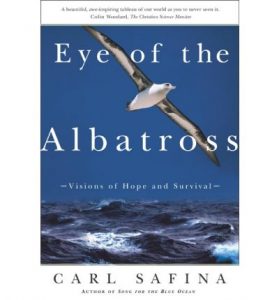
Amelia is one such hard-to-track albatross. By joining a research team that attached a transmitter to her feathers, Carl Safina was able to take part in following and recording her adventures. In the introduction to his book about the experience, Eye of the Albatross (Holt Paperbacks, 2003), Safina writes:

“Amelia’s transmitter battery eventually died, so we don’t know where Amelia is now. That
matters less to her than it does to us. She doesn’t need us in order to be an albatross; albatrosses knew what they were doing millions of years before people appeared. But because people were born into a world that included albatrosses, we need them—to prove to ourselves that we can be fully human.”

The following is an excerpt from Eye of the Albatross.

Bioneers is thrilled to welcome Carl Safina to the 2017 Bioneers conference where he’ll speak about how humans can learn from the natural world.
The breeze in my bedroom is the first sign that this morning is different. After prior days of dead calm, newly moving air has passed its kinetic energy along to the heat-stressed birds. You can feel their excitement in their increased activity.

Patty is doing the day’s first round of her nest checks, looking for any mates of transmittered albatrosses that may have arrived and switched incubation duties. We walk among the incubating birds like grape growers among vineyards. So far all the incubating birds in the study area are the same; Amelia and the others. No new arrivals. But one premature departure, probably forced by the just-ended heat-wave; its abandoned egg now cool to the touch.

Patty, several yards ahead, suddenly calls and waves.

Has one of the transmittered adults departed? No. But when we walk up, Patty gestures to a Black-footed Albatross standing over an eggshell with a gaping hole at one end and a downy chick beside it. Karen arrives eagerly, and immediately volunteers to guard the chick as we give its parent a transmitter.

She gushes, “Oh my God. It’s so cute!” Its head is wobbly. Its little black decurved bill seems proportionally larger than an adult’s. The little wing stubs offer scant hint of the flying power that may come. The chick’s black down, frosted light-gray at the tips, is so thick and long and matted that the nestling looks rather oddly like a large fluffy pine cone. It probably weighs about seven ounces. “Oh my gosh, look at its fat little legs!”

The chick stands shakily and stretches its wings, pulling all heart strings within ten meters. Before the mind had a name for beauty, the heart had a response. The chick instinctively starts digging a scrape for itself with its back legs. When it yawns a teetering little yawn. Karen’s hand goes to her face in delight and astonishment. To the chick she says, “I’ll take care of you anytime.”

Her job right now—a tough job if ever there was one—is protecting this chick from possible frigatebird attack and the sun. Karen is concerned the chick is too exposed. “It’s not used to being out in the sun,” she says. I offer her my hat to shade it, but she’s transfixed.

The chick begins preening, nibbling at it’s down. The effort seems to tire it and it rests its head and closes its eyes. When the chick begins to shiver, Karen takes off her sweatshirt and lightly covers it, saying tenderly, “It’s a rough life.”

That, it is. But with luck and all odds vanquished, this unsteady little new life may go forward—and outlive us.

A Laysan Albatross walks by like a pedestrian, pausing to stare at the chick like an admiring passerby. A nearby nester stands up, looks at its own egg, and starts talking to it. As hatching nears, parents commonly vocalize to their upcoming offspring. And as soon as a chick holes or “pips” the egg, it begins talking back. As Dr. Seuss might summarize: Horton finally hears a Who. Parent and child keep the conversation going through the hole in the eggshell during the many hours it takes for the chick inside to painstakingly chisel out.

When our crew has affixed the transmitter, we take the adult back toward Karen and its chick. We place the bird near its nest. It stands there until the chick begins calling, then suddenly runs to it. Laura turns to Karen and says, “Well, Karen, anytime you’d like to help out—.”

With what might be termed enthusiasm, Karen interrupts, “I would love to help.”

By our fourth day, ten albatrosses wear transmitters. Now, oddly, the field work is largely done, and most of the data accrual will happen almost passively as technology takes over, reporting the birds’ positions. (So far the data are less than interesting, because none of the birds has moved.) Now, we ourselves will also wait faithfully like Horton the Elephant, attached by effort and scientific curiosity to the patiently sitting birds. Each day we check.

Each day, the faithful birds at their nests remain.

<•)>< <•)>< <•)><

Patty is excited. Halfway through a new day’s morning nest check, she’s just discovered the mate of one of our birds sitting on the nest. The transmitter-bearing bird is gone!

Dave comes riding up slowly on his bicycle. Even though it arrived just last night from weeks at sea, the new bird sits here as though nothing is unusual. Amelia and her neighbors, sitting as always, appear equally indifferent.

But Patty is stoked. “Now,” Patty says, “we’ll be getting some data.” Somewhere between the vast Pacific and outer space, albatross, satellites, and Dave’s North Carolina laboratory are already corresponding. Each day the satellites will interrogate the transmitter, and the bird’s location will be beamed to Earth.

Amelia couldn’t care less; she’s still here on her nest near the porch, still broody and dozing.

Patty and Dave set up a laptop computer on a picnic table on the barracks’ back porch, and using a solar panel to power it, they link to a communications satellite to download e-mail. With noddies lined up on the porch rail and the computer set up near the laundry lines, information flows into the laptop from outer space. The transmitter data has already been beamed via another satellite to a facility in France, then sent from France to Dave’s North Carolina lab, and a student has e-mailed it. Result: we discover that our outbound bird is sixty miles north of Tern Island.

Dave, munching from a bowl of cereal, says, “It’s nice to see everything working. It’s really remarkable how all this technology is being coordinated to solve this question of where they go.”

And while most university research data is eventually published years later only in obscurely specialized technical journals, Dave’s approach to this albatross work is very different. Every morning when the satellite data from traveling albatrosses arrives, Dave will e-mail it to over 500 teachers in classrooms in the U.S., Canada, Germany, Estonia, Japan, South Africa, Australia, and elsewhere who have subscribed to Dave’s Albatross Project. Students will map the albatrosses’ travel tracks as they unfold. “I realized early on,” Dave says, “that kids from kindergarten through high school could be discovering what’s happening with the birds at the very same time we ourselves are discovering it.” He adds, “I’m trying to find ways to communicate effectively about science.” Dave believes freedom and democracy require a public that can think critically. “If a scientist has a new idea, his or her first task is to challenge it against everything else that’s known, seeing whether it can be disproved. In most other endeavors, everyone is pushing their own ideas and their own narrow interests. I think that when you teach science, you’re teaching people a way of thinking that can help them stay free.”

During the night of January 17-18 another transmittered albatross has left Tern Island. But the albatross I call Amelia resides, remains, and rests upon her nest next to the porch steps. We pause. She waits. We watch. She stands, talks in low tones to her egg, flares her brood patch and sits back down. For now, that has to count as action.

By the following day, two more of the birds are outbound over the ocean. Things are happening. Patty and Dave are departing too, headed home. Patty will leave her birds and begin the hard work of her Master’s project in earnest from thousands of miles away.

Getting here has been neither likely nor easy for any of us, biologist or bird. The planning, the traveling, the personal and professional toil, the resolute routes and sheer luck that have led us here—the convergence is quite an improbable one. All of us differ in every detail. All have one thing in common: whether seeking to succeed or striving to breed, we’ve arrived here as survivors of earlier struggles. Hoping our efforts will meet continued luck, we now stand poised for payoff, ready to see our labors produce.

Mark is checking to make sure the cargo and passengers don’t exceed the plane’s weight limits. He weighs all the bags, then calls across the room, “Patty, how much do you weigh?” Patty yells back “One thirty-four,” then says to me, “Now everybody knows.”

I say our time has shot by. Dave looks at his watch to remind himself what month it is.

Waving, waving, waving, they are gone. They leave over the ocean, like everything else.

<•)>< <•)>< <•)><

When Amelia stands for her next nest-check, her egg is gone. Between her massive webbed feet sits a gray ball of spiky fluff. By this time, the sixth of February, many of the other albatross nests already harbor chicks.

Amelia broods her baby three days, providing shade and shelter from heat and high winds. When her mate arrives to relieve her in the early morning of February 9, Dad immediately feeds the little chick. Or tries to.

He crouches so far forward toward the chicklet that his breast is touching the nest’s low rim. The hungry chick is eager, pecking shakily at its parent’s bill, peeping a shrill call that sounds like, “Me, me, me.” Dad is trying so hard to begin regurgitating that the effort seems to force his wings partly open. At the same time, he is trying to make contact with the chick’s little bill, but the uncoordinated hatchling keeps swinging away at the critical moment.

Eventually, with the kind of persistence that precedes all earned rewards, the male practically swallows the chick’s head. In the cavern of its father’s gape, the chick opens its wobbly little bill. Dad squirts a concentrated stream of gooey, nutritious, liquefied oil into the chick’s throat. Unlike most other birds, albatrosses and their tube-nosed relatives store oil extracted from their food. Albatross stomach oil is so energy rich its mean caloric value rates just below that of commercial diesel oil.

After wiping its beak, the chick half-stands and waves it’s little wings, then sits back down contentedly. For the moment, all’s right with the world.

And so a new phase kicks in. Amelia and her mate must now no longer simply share incubation shifts; the chick’s arrival begins a period of increasing strain in an already strenuous life. Bodily reserves will be taxed to the max. Now, food is the issue.

Somewhere out on the sea, these birds are finding a food supply that is not at all obvious when you look at the surface of that vast ocean. But find it they do. All together, the seabirds of the Northwest Hawaiian Islands require an estimated 800 million pounds of prey annually, largely fishes, crustaceans, and squids—perhaps two-fifths of the annual production of those animals in the ocean region. Of the amount consumed, Albatrosses take probably half. Laysan and Black-footed Albatrosses eat mostly various species of squid, fishes, fish eggs, crustaceans, and anything else living or formerly living that they can hook their bills into. Albatrosses in general eat everything from small fishes to dead seabirds to squid to krill to gelatinous drifting tunicates to jellyfish (including the famously sting-infested Portuguese Man-o’-war). If they find a dead whale, their diet will include whale meat. Sometimes they feed on scraps of skin and blubber of whales killed by Killer Whales, or by people. What they eat depends on where they happen to be and what they find. Many albatrosses follow ships because even kitchen scraps can make an albatross happy. They are inveterate scavengers and opportunists. When it comes to eating, albatrosses’ motto seems to be, “Better full than fussy.”

But in practice almost all albatrosses almost everywhere eat mostly squid. It’s even been suggested that albatross evolution and radiation around the world has corresponded to squid evolution as the birds became skilled squid finders. Squids are highly evolved, unusually successful predators in their own right. The Cretaceous mass extinction wiped away not only dinosaurs but also many kinds of marine life that had flourished for an enormity of time. As disappearance of dinosaurs opened the land to opportunities for birds and mammals, extinction of marine faunas opened the seas to the radiation and proliferation of modern-style fishes and squids, with new monarchies of predators. The rapidly spreading new jet-propulsion-bodied animals we know as squids evolved complex behavior, excellent eyesight, and surprising smarts (they have been called “the soft intelligence” and “honorary vertebrates”). Squids have proliferated into over 700 species moving throughout the world’s seas, from sunlit reefs to the black abyss, from the size of your little finger to the Giant Squid measuring almost sixty feet.

Enter albatrosses. Albatrosses eat about 70 species of squid. At times the birds catch them live and vigorous. But they also exploit the fact that many kinds of squid die en masse after spawning. About a day after dying in the chilly deep, the carcasses of many species of squid float to the surface, buoyed by increasing ammonia resulting from chemical changes in their livers. Albatrosses rely heavily on this phenomenon to make deep food available. In the western Tasman Sea off New South Wales, Australia, a spectacular post-nuptial appearance of dead and dying 10-pound Giant Cuttlefish prompts a remarkable convergence of albatrosses. Birds from half a world away—from the South Atlantic, Indian Ocean, and New Zealand—find it worth their while each year to come for the funeral feast. In sum: Albatrosses eat a lot of squid. People also eat a lot of squid, and fishing boats remove enormous quantities of food albatrosses have for millennia relied on. In much of the world, squid fishing is done at night, using bright lights to attract squid to the boat as moths are attracted to porch lights. So great is the fishing pressure now that the lights of squid fishing fleets are visible to astronauts in space, appearing like cities in the sea.

With Dad now nest-bound, it’s Amelia’s turn to face the vicissitudes of the ocean, but she’s an experienced pro. So far, she has survived all trials of weather, threats of starvation, and hazards of humanity. She launches herself from the runway and strikes immediately northward.

Amelia sails past the island’s shore, skims across the lagoon, and rises above the towering breakers beyond the reef, setting her course upon an open ocean, striking out into the wide trance of the sea.

Belly to the sideways breeze, catching the wind for levitation, she climbs. Then turning her back to that same breeze, she uses the wind differently—and adds gravity—to accelerate her forward and downward toward the surface of the ocean. She brushes the water and shifts her body again, transferring the downward momentum to help lift her; exploiting the force of gravity to take her upward. Having used the wind to take her up, she uses it to take her down; having used gravity to take her down, she uses it to take her up. This gives her a smoothly undulating, rocking flight; each wing alternately pointing skyward, then pointing toward the water’s surface, showing you now her dark back, now her bright belly. Wings fixed, she seems magically propelled.

Only as you watch her nearing the vanishing point—only then—do you begin seeing and feeling that these birds muster all their distance-eating achievement with their own effort and the skillful exploitation of their exquisite design. Keep watching as she shrinks to a pinpoint, swooping up and down, swiveling side to side, bounding onward into the boundless Pacific. Just this way, she starts steadily accumulating the great span of a great ocean, mile after mile after mile.

This excerpt has been reprinted with permission from Eye of the Albatross by Carl Safina, published by Holt Paperbacks, 2003.

Read an excerpt from another Carl Safina book, Beyond Words: What Animals Think and Feel.
Celebrate Autumn’s Harvest With Food Tank’s Fall Reading List

By Sean Alexander

This piece was originally published on the Food Tank website. Food Tank is a nonprofit organization focused on building a global community for safe, healthy, nourished eaters.

For fall, Food Tank has compiled a list of 17 books we hope will educate, inform, and inspire. As the weather cools and we turn to more savory foods, learn about the history of butter, duck season in France, and the life of Patience Gray, the visionary behind the modern slow food culture. For reflecting during the turning of the seasons, read about how antibiotics changed our food, how to combat a hot and hungry planet, and the food truck movement. Or, in the spirit of the fall harvest, learn about migrant workers in California. There is something for all tastes, so take advantage of the lengthening nights to read a few.

  1. Against the Grain: A Deep History of the Earliest States by James C. Scott
    The conventional teaching is that, in order to create civilization, humans moved from hunting and gathering toward sedentary communities that cultivated cereal grains and domesticated livestock. In his newest work, James C. Scott, Professor and co-director of the Agrarian Studies Program at Yale University, challenges that narrative. In Against the Grain, Scott argues that the transition to sedentary livelihoods was born not of a need for secure living, but a desire to control reproduction in several spheres of human life.
  2. The Angry Chef: Bad Science and the Truth about Healthy Eating (available now in the UK; forthcoming January 4, 2018) by Anthony Warner
    Each year, new diets and food fads become popular—some have value while others fall short, or may even be harmful. So why do consumers buy them in the first place? In The Angry Chef: Bad Science and The Truth About Healthy Eating, Anthony Warner, with other experts, explains why intelligent people bite on the latest food fads. By the end, Warner hopes readers will have the tools necessary to set healthier food habits and a course for a healthier life.
  3. Big Chicken: The Incredible Story of How Antibiotics Created Modern Agriculture and Changed the Way the World Eats by Maryn McKenna
    Each day, what we choose to eat affects ourselves and the world around us: that is the core idea that drives Maryn McKenna’s new book, Big Chicken. One part history and one part investigative journalism, Big Chicken traces the history of modern chicken production and antibiotics in agriculture, and how this history fits into a larger narrative about our food habits. Drawing on the tradition set by Upton Sinclair’s The Jungle, McKenna’s Big Chicken aims to encourage better food consumers through a more holistic view of modern agriculture and the issues embedded within it.
  4. Butter: A Rich History (re-issue forthcoming October 17, 2017) by Elaine Khosrova
    In her cultural and culinary history, former pastry chef and acclaimed food writer Elaine Khosrova tells the story of a modern staple: butter. Tracing butter’s history across three continents, Khosrova’s work carries the reader into a deeper understanding of the role of butter in political economy, nutrition, and art. As an added benefit, Khosrova includes a few butter recipes taken from her travels. One part history, one part cookbook, Khosrova aims to give meaning to an overlooked culinary staple.
  5. This Blessed Earth: A Year in the Life of An American Family Farm (forthcoming September 19, 2017) by Ted Genoways
    In his new book, This Blessed Earth, Ted Genoways explores the history and future of America’s family farm. Situated at the crossroad of isolation and change, the modern family farm is valued through the past and faced with challenges in the future. Living with the Hammond family of York County, Nebraska, from harvest to harvest, Genoways maps the changing landscape that surrounds the family farm. In doing so, This Blessed Earth hopes to convey an intimate portrait of an American experience.
  6. Chasing the Harvest: Migrant Workers in California Agriculture by Gabriel Thompson
    In 1939, John Steinbeck released The Grapes of Wrath, a realist novel that follows the Joad family out of the Oklahoma Dust Bowl and to California. The book aimed to make the public more attuned to the conditions of Californian migrant farmers. In the 1970s and 80s, Cesar Chavez and the Salad Bowl strike affected the public in much the same way. Drawing on—and combining—these traditions, Gabriel Thompson’s Chasing the Harvest seeks to give voice to the nearly 800,000 people working on California’s farms and the conditions they face.
  7. Devoured: How What We Eat Defines Who We Are by Sophie Egan
    Sophie Egan’s Devoured: How What We Eat Defines Who We Are reflects on how the food emerging from traditional American values makes for a simultaneously unhealthy and trailblazing food culture. Blending the non-fiction traditions of The Omnivore’s Dilemma and Freakonomics, Egan’s work is an in-depth analysis of the nature and effects of American food habits.
  8. Duck Season: Eating, Drinking, and Other Misadventures in Gascony—France’s Last Best Place by David McAninch
    For nearly eight months, David McAninch lived as a Gascon of Gascony, a rural region in southwestern France and famous for its influence on French cuisine. As a Gascon, McAninch worked to change the way he thought about food: herding sheep, harvesting grapes, and eating—a lot. Exploring a local culture through agricultural and cooking traditions, Duck Season describes McAninch’s transformation as a result of this journey, providing a few recipes to try at home, as well.
  9. Fasting and Feasting: The Life of Visionary Food Writer Patience Gray (forthcoming September 6, 2017) by Adam Federman
    When Patience Gray passed away in 2005, the British Broadcasting Corporation (BBC) called her an “almost forgotten culinary star.” Gray lead a life of relative isolation in an impoverished region of southern Italy, without electricity or telephone. And yet, Federman argues, contemporary food movements like Slow Food, committed to regional cuisine, can trace their foundational missions to Grey’s writing and life. Recognizing her importance to modern food culture, Fasting and Feasting aims to change the common conception—or lack thereof—of Patience Gray, celebrating her life and her legacy.
  10. Fishing: How Sea Fed Civilization by Brian Fagan
    In his new book, Fishing: How the Sea Fed Civilization, Brian Fagan presents the history of aquaculture as an important and often overlooked topic. Drawing on archaeological information, Fagan argues that—in contrast to the land-bound practices of agriculture—the technologies and cuisine that fishing enabled helped to empower humans to explore the globe, both as conquering armies and recreational travelers. Conveying the histories of archaeological sites from across the oceans, Fagan’s Fishing endeavors to explain how fishing fits into the larger human narrative.
  11. Food Trucks, Cultural Identity, and Social Justice: From Loncheras to Lobsta Love edited by Julian Agyeman, Caitlin Matthews, and Hannah Sobel
    In cities across America, food trucks are gaining popularity; but do food trucks help or hinder other societal goals? Examining the food truck phenomena in North America through the lens of social justice, the contributors in Food Trucks, Cultural Identity, and Social Justice investigate the topics ranging from discrimination, gentrification, and community development. The editors hope that everyone interested in food trucks, be it their criminalization in Los Angeles or celebration in Vancouver, will learn something new from this unique anthology.
  12. Grocery: The Buying and Selling of Food in America by Michael Ruhlman
    Grocery: The Buying and Selling of Food in America takes a deeper look at a routine task: grocery shopping. Ruhlman takes readers from the family-operated Heinen’s grocery chain in the Midwest to the opaque structure of modern supermarkets. Between the stories and insights, readers will also learn of Ruhlman’s ideas to renew the modern food shopping experience: a few tips intended to help readers consume food more wisely.
  13. Give a Girl a Knife: A Memoir by Amy Thielen
    After a career as a chef in New York City, Amy Thielen moved back to Minnesota and into a cabin deep in the woods, rediscovering her culinary and personal roots. Recounting this experience in Give a Girl a Knife, Thielen conveys a coming-of-age story that connects her rural upbringing to life in kitchens of New York’s most famous chefs.
  14. Hot, Hungry Planet: The Fight to Stop a Global Food Crisis in the Face of Climate Change by Lisa Palmer
    By the year 2050, the United Nations projects that the world population will reach nearly 9.8 billion people. Meanwhile, increasingly extreme weather patterns are affecting vulnerable societies around the globe. Following these two trends, Lisa Palmer’s journalistic career has focused on how our global food system can do right by future generations both in terms of food security and climate policy. In her new book, Hot, Hungry Planet, Palmer outlines three policy levers that can play a part in our global response.
  15. Notes on a Banana: A Memoir of Food, Love, and Manic Depression by David Leite
    In Notes on a Banana, celebrated food writer David Leite describes the role that food and family played in his struggle with sexual identity and mental illness. Tracing his own life from Fall River, Massachusetts, to his present life as a James Beard Foundation Award-winning food writer, Leite’s Notes on a Banana is a reminder that beneath the surface, what we eat is both a reflection of who we are and something that shapes us.
  16. A Square Meal: A Culinary History of the Great Depression (re-issue) by Andrew Cole and Jane Ziegelman
    The Great Depression affected America’s political and economic institutions, but how did it transform American cuisine? In their James Beard Foundation Award-winning book, A Square Meal (a re-issue), Jane Ziegelman and Andrew Coe explore how the Great Depression shifted American perceptions of government-sponsored food charity, nutritional guidelines, the dinner time menu itself, and more. A Square Meal considers the impact of economic and environmental disasters on how Americans ate, and how we eat today.
  17. What She Ate: Six Remarkable Women and the Food That Tells Their Stories by Laura Shapiro
    Although what we choose to eat is an important part of our lives, it is seldom thought of as a central element of biography. But in What She Ate, Lauren Shapiro tells the stories of six prominent women—Dorothy Wordsworth, Rosa Lewis, Eleanor Roosevelt, Eva Braun, Barbara Pym, and Helen Gurley Brown—and their food. In doing so, Shapiro’s What She Ate tries to nuance readers’ understanding of six extraordinary lives.

Continue with good food reads every month through Real Food Media’s Book Club, or download the monthly book club podcast to listen on your commute.


This piece was originally published on the Food Tank website. Food Tank is a nonprofit organization focused on building a global community for safe, healthy, nourished eaters.

Bioneers Recognizes Indigenous Peoples Day

In recent years, I have been thrilled to witness more and more cities ban Columbus Day. To see how widespread this movement has become, check out this awesome interactive map created by the Zinn Education Project has made an. At Bioneers, we honor Indigenous Peoples Day. Our San Francisco Office is closed today, and many of us are thinking about those who have fought for Indigenous rights and a more inclusive America. Now, more than ever, it is critical that we bring our voices together to speak out against the parts of American society that condone and promote intolerance against North America’s First peoples.

Cities, States and Institutions that have banned Columbus Day.

It wasn’t that long ago that our relatives were forced into Indian Boarding Schools. Program Director, Cara Romero and I both grew up with grandmothers who were sent off to them as young girls, and our families have been personally affected by the trauma of this experience.

When my mother was born in Alaska, the territory exercised “Jim Crowe” policies against Native Alaskans. Just like the deep south, Natives were not permitted to ride in the front of the bus, sit in the front of the movie theater, or dine in white establishments.

The girls at Chemawa Indian Boarding School in my grandmother’s time.

So for me, growing up in a society that celebrates the genocidal foundation of the United States of America, has always been beyond hurtful. Columbus Day is essentially state-sanctioned bigotry. However, I also recognize that many Americans are not exposed to the truth through the public education system or mainstream media. That’s why we are committed to providing programming and educational materials to help the public to understand the truth in America.

For Indigenous Peoples Day, I’ll be thinking about some of my heroes in my adopted home of California, people like Sage LaPena (Northern Wintu), who is keeping traditional plant knowledge alive for the healing of all peoples; Chiitaanibah Johnson (Maidu/Diné) who spoke out against her racist history professor at Sacramento State University, and Valentin Lopez, Chairman of the Amah Mutsun Tribal Band, all of whom are speaking at the 2017 Annual Bioneers Conference.

Indigenous Peoples Day is a good day to get involved.

When we celebrate Columbus Day, we actively take part in a world that condones genocide. So to celebrate Indigenous Peoples Day, my plan is to get involved and to do something about the ongoing destruction of Indigenous homelands that was begun in 1492.

Chances are, right now there is something in your backyard that you can support. For me, it is protecting Juristaic, a holy place for the Amah Mutsun people, the descendants of the Central California California Indians who survived the Missions San Juan Bautista and Santa Cruz. I was surprised and shocked to learn a few months ago about the Sargeant Quarry “Project,” a proposed sand and gravel mine on 320 acres at Juristaic (four miles south of Gilroy, California, at a place now called Sargeant Ranch), a spiritually significant site for the Amah Mutsun tribal people from Central California (to understand the importance of Juristaic, tribal members describe it akin to Jerusalem for Jews, Christians and Muslims). In addition to irreparable harm to the tribe’s religious and spiritual integrity, the 30 years of proposed mining will cause significant adverse environmental impacts to the water, wildlife, plants, and other natural and cultural resources in the area forever.

It was my honor and privilege to learn about the significance of village sites and traditional lifeways from Amah Mutsun Tribal Chairperson, Val Lopez, a few weeks ago. To witness the reclamation of traditional ecological knowledge alongside the restoration of these sites within the Amah Mutsun Land Trust, only strengthened my commitment to help protect this special place for generations to come.

I have only lived in Monterey, CA for seven years, but it is my responsibility to help protect this region for future generations. I felt even more connected to this resolve after I had the special opportunity to visit the Amah Mutsun Land Trust, a few miles north of Santa Cruz a few weeks ago, where I learned about the amazing collaborations between the Amah Mutsun Tribe, UC Santa Cruz and other institutions to reclaim the Indigenous knowledge of the very site where Europeans first encountered California’s central coast peoples.

The Sargeant Ranch Program is my region’s “Standing Rock” and it seems like nobody knows about it. So today, I’ll be drafting letters in opposition to the Sargeant Ranch project. You can learn more about the proposed mine threatening this sacred site here or here.

Other things you might do today, this week, or going forward might be to 1) learn about the Indigenous Peoples where you live; 2) get involved with environmental threats to the place you live (because odds are, if you are living in America, you live on occupied Indigenous territory); and, 3) connect with your ancestors. Learn where they came from, and the tides of history that displaced them.

At the annual Bioneers Conference coming up October 20-22, you will have many opportunities to learn about California Indian history, and how to get involved with several other Indigenous-led and other initiatives in California and around the world to take care of our planet. Check out this blog I wrote a few months ago about our amazing Indigenous Forum line up.

Sincerely,

The Bioneers Indigeneity Team,

Cara Romero (Chemehuevi), Program Director

Alexis Bunten (Aleut/Yup’ik), Program Manager


Updates From The First Biomimicry Accelerator Team Cohort

From Bioneers to boardrooms, these biomimicry entrepreneurs are getting ever closer to bringing their food system solutions to market.

A year ago this October, Camila Hernandez and Camila Gratacós stood in front of 2,000 people on the National Bioneers Conference main stage and accepted the first-ever Ray of Hope Prize® for their nature-inspired soil restoration solution called BioPatch. The BioPatch, inspired by hardy “nurse” plants that survive in harsh conditions and pave the way for new plant species to grow, was created as a way to grow and protect new plants while restoring health back to the soil.

With the $100,000 grand prize in hand, the team got the chance to make their goals for BioPatch a reality. Today, they and the rest of their team are working hard to bring their design to market, engaging manufacturing and sourcing partners, rigorously testing prototypes, and linking up with business networks that promote circular economy business models. “Daring to participate in the Biomimicry Global Design Challenge was the first step to lose the fear of starting something new and start to believe that our ideas could be realized,” said BioPatch co-founder Camila Hernandez. “Life can be full of problems or full of solutions, depending on your point of view. This experience has helped me declare my love for solutions that are friendly to the environment and society.”

The six other teams who were part of the inaugural Biomimicry Accelerator cohort are also forging ahead with their nature-inspired food system solutions. From winning prestigious spots in international business incubators to speaking at conferences around the world to scoring additional funding, it’s been a busy year for these biomimicry entrepreneurs. Read on to find out what they’ve been up to and where they are now. Oasis Aquaponic Food Production System Shortly after winning second place funding in the Biomimicry Accelerator for their aquaponic


Oasis Aquaponic Food Production System

Shortly after winning second place funding in the Biomimicry Accelerator for their aquaponic growing system, Team Oasis was one of ten winning teams in the Blue Economy Challenge, a program that funds sustainable aquaculture innovations. With this combined funding, the team was able to rent a manufacturing space, purchase equipment, and travel to Uganda and Tanzania to establish community organization partners to test the Oasis design. They have manufactured and shipped 13 demo systems to East Africa for these partner organizations to test for six months. At the same time, the team is working on honing their design by improving the aesthetics of the Oasis and making manufacturing more efficient.

Shortly after winning second place funding in the Biomimicry Accelerator for their aquaponic growing system, Team Oasis was one of ten winning teams in the Blue Economy Challenge, a program that funds sustainable aquaculture innovations. With this combined funding, the team was able to rent a manufacturing space, purchase equipment, and travel to Uganda and Tanzania to establish community organization partners to test the Oasis design. They have manufactured and shipped 13 demo systems to East Africa for these partner organizations to test for six months. At the same time, the team is working on honing their design by improving the aesthetics of the Oasis and making manufacturing more efficient.


Jube

This team, with members from Thailand and the U.S., developed a bio-inspired chamber for capturing edible insects, a more earth-friendly source of edible protein. After winning third-place funding in the Biomimicry Accelerator, they created and shipped their first prototypes to the U.S. in April. They are planning on hosting their own biomimicry challenge in Thailand, asking the public to help improve on the existing Jube concept. Jube team leader Pat Pataranutaporn was invited to give a TEDx talk at Arizona State University where he is currently a student and spent the summer interning for IBM’s Watson group in New York City. Pat is looking forward to combining what he learned during his internship to develop biomimetic algorithms to apply to various software development solutions.


Hexagro

Over the past year, this international team has won multiple awards and coveted spots in start-up programs worldwide. Hexagro Urban Farming’s Living Farming Tree is a modular aeroponic growing system that enables people to grow healthy, fresh food in urban areas. After forming a for-benefit corporation in Italy, Hexagro won the Switch to Product contest sponsored by the Politecnico di Milano and earned a spot in the school’s startup incubator. They have also displayed their designs at conferences all over the world, including at a technology display in Lyon, Milan Design Week, Seeds and Chips in Milan (where Barack Obama gave the keynote address), Tech Open Air in Berlin, and at universities in Costa Rica and Slovenia. They were one of 20 teams chosen to attend the Thought for Food Summit in Amsterdam. They also participated in the Katana Bootcamp in Stuttgart, Germany, where they were selected as the #1 pitch out of 100 teams participating in the bootcamp. Most recently, the team was invited to be part of the Kickstart Accelerator program in Switzerland, where they will compete for a $25k prize. They have also been selected as a semi-finalist for the Lee Kuan Yew Global Business Plan competition in Singapore this fall.\


Mangrove Still

This Italian team created the Mangrove Still, a desalinating still inspired by how coastal plants process seawater that costs five times less than traditional solar stills. The Mangrove Still teamhas been busy expanding their design from individual units to a complete system that is adaptable to regional climates and locally available materials. Their goal is to develop communities of practice that will incorporate the Mangrove Still design into their local context. They were awarded a grant from Dubai Expo 2020 and are using those funds to run a design hackathon to hone the Mangrove Still system and test the system in Egypt, India, Namibia, Cape Verde, and Cyprus. The team is also working on setting up a crowdfunding campaign and has been presenting their design at conferences, including the European Biomimicry Summit in Utrecht, Netherlands.


Living Filtration System

The Living Filtration System team developed a biomimetic drainage system that keeps nutrients in the soil rather than leaving the field in runoff and was inspired by earthworms and the human digestive system. Members of this University of Oregon team have graduated and are currently pursuing careers. They are all actively working to incorporate biomimicry into their career plans.


BioCultivator

The BioCultivator team from Slovakia developed its lizard-inspired, self-sustaining growing system to encourage more urban dwellers to grow fresh food. The team was invited to take part in Startup Awards Slovakia’s bootcamp and was chosen as a finalist in the Art and Design category. This award event was broadcast on national television and was attended by Andrej Kiska, the President of the Slovak Republic. The team was also invited to be part of a mission of Slovak businesses to the Republic of Croatia this past June, was selected to be part of the Women in Tech Forum at PIONEERS 2017 in Austria, and participated at the first CEE Founders’ Summit in December. The team has manufactured 11 prototypes to date and is looking to finish a proof-of- concept in late fall 2017. Team members are working to make connections with potential investors and business partners in order to create BioCultivator 2.0, based on lessons learned from the first round of prototype testing.


The second Biomimicry Accelerator cohort will be coming to Bioneers on October 21, 2017, for the second annual Ray of Hope Prize® award event. Stay tuned to find out which of these
teams will win the Ray C. Anderson Foundation’s $100,000 prize to take their biomimetic innovations to the next level.You can get a sneak peek at the second cohort’s innovations ahead of the big Ray of Hope

You can get a sneak peek at the second cohort’s innovations ahead of the big Ray of Hope Prize announcement at the Biomimicry Pitch Event and Technology Showcase on October 20, 2017 at the Autodesk Atrium. Watch as the six teams from the 2016-17 Biomimicry Accelerator take the stage to pitch their innovations to a VIP panel, including Biomimicry Institute co-founder Janine Benyus, Green Biz Executive Editor Joel Makower, venture capitalist Ibrahim AlHusseini, and Singularity University’s Robert Suarez.

Plus, a brand-new round of the Challenge—along with the chance to join the fourth cohort of the Biomimicry Accelerator—will open this fall. To learn more, go to challenge.biomimicry.org.

Xiuhtezcatl Martinez: A New Chapter in My Life

As brilliant thinkers and leaders work to solve some of the biggest problems facing humanity today, Xiuhtezcatl Martinez has been making sure that young people are represented in moving toward a more equitable tomorrow. An influential and outspoken teenager, Martinez has been speaking to audiences about environmental justice and youth activism since he was 6. Presently, he is the youth director of Earth Guardians, a “tribe of young activists, artists, and musicians from across the globe stepping up as leaders to co-create the future we know is possible.”

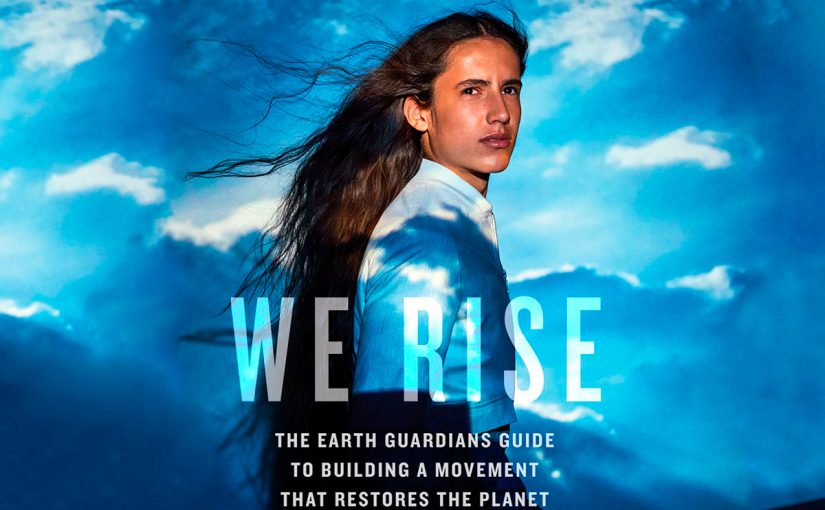
Martinez’s new book, We Rise (Rodale Books, 2017), is an empowering call to activists—young and old—to fight to restore our planet. The following is an excerpt from the book’s prologue.

Attend the 2017 Bioneers Conference in October to see Xiuhtezcatl Martinez speak in person, and read to the end of this post to watch a video of his talk at a previous conference.

There are moments in our lives that help shape the way we see our world. They shift our perspectives and help us understand our immense potential to define our future. The first 17 years of my life have led me to believe that everything happens for a reason. Maybe that’s why I didn’t feel at all phased as I looked out into the audience of world leaders from more than 100 nations. I’d been given a stage at a pivotal moment in history, and I saw the world needed fresh perspectives if we wanted to make real progress on climate solutions. We’ve spent the last 20 years pointing the finger and passing off responsibility. We are in a place where we can’t afford to wait for others to solve this problem for us. We have all the tools we need…the only thing missing is the will to help us get there.

My name is Xiuhtezcatl (pronounced ‘Shoe-Tez-Caht’). I am 17 years old, and I’m doing everything I can to fight for change in a collapsing world. In 2015, I had just finished middle school, and the state of the climate was descending into chaos. That year, global temperatures were the hottest in recorded history, sea levels had reached an all-time high, and greenhouse gases had never been more present in our atmosphere. Climate scientists worldwide were alarmed by how much faster the ice caps were melting than previously projected.

In response, world leaders were preparing to meet in Paris for the most important conversation on climate in our history. This was the COP 21 United Nations Climate Change Conference, and we weren’t about to let our voices be excluded from this pivotal moment in history. In the climate movement, we talk a lot about tipping points, and we know that we’re running out of time to act before climate change becomes irreversible.

Earlier that year, on Earth Day, I was featured in a short film called Kid Warrior. This was a documentary telling the story of my life and my work as the Youth Director for Earth Guardians, a global movement working to empower the younger generation to use our voices and create positive solutions. The film was meant to inspire other young people to get involved, connect, and engage in climate action and other important social issues of our time. I also wanted to show the world that my story is more than just activism . . . that I’m just a regular kid chasing big dreams in a crazy world.

After the Kid Warrior short hit the Internet, e-mails from young people flooded Earth Guardians, asking how they could get involved and start Earth Guardian crews of their own. I was swamped with interviews, speaking invitations, and media opportunities. One of those invites came from Susan Alzner, head of the United Nations Non-Government Liaison Service and by far my favorite person working at the UN. She’s helping build bridges to connect the UN General Assembly and voices of the people, by identifying civil society attendees and speakers for high-level events, conferences, and summits. One of her topics of interest was climate change, and she got wind of Kid Warrior and the Earth Guardians movement, leading to me.

While I was kind of surprised that the UN heard about me through social media, it was pretty remarkable to get an invite to address the general assembly. My intention was to plant the seeds and lay the foundation of hope for the upcoming Paris climate change conference, while representing the many youth voices that won’t be heard by the UN. I was only the second nongovernment person to address the general assembly.

Kathy Jetnil-Kijiner was first. She addressed the United Nations in 2014. At the time, she was a 26-year-old woman from the Marshall Islands, a small island nation that sits about 6 feet above sea level and is already experiencing the impacts of climate change. Rising sea levels and severe storms have come extremely close to destroying these beautiful islands.

In her speech, Kathy indicated that, no matter how hard it might be, we have to solve the issue of climate change. In a truly emotional and beautiful moment, she recited a poem to her infant daughter, promising the little girl that she would do everything she could to protect her from rising seas. She entitled the poem “Dear Matefele Peinam,” and here are the first few verses:

dear matafele peinam,
you are a seven month old sunrise of gummy smiles
you are bald as an egg and bald as the buddha
you are thunder thighs and lightning shrieks so excited for bananas, hugs and
our morning walks past the lagoon

dear matafele peinam,
i want to tell you about that lagoon that lucid, sleepy lagoon lounging
against the sunrise
some men say that one day that lagoon will devour you

they say it will gnaw at the shoreline
chew at the roots of your breadfruit trees
gulp down rows of your seawalls
and crunch your island’s shattered bones

they say you, your daughter
and your granddaughter, too
will wander rootless
with only a passport to call home

dear matafele peinam,
don’t cry
mommy promises you
no one
will come and devour you
no greedy whale of a company
sharking through political seas
no backwater bullying of businesses with broken morals no blindfolded
bureaucracies gonna push
this mother ocean over the edge …

She concluded to a standing ovation, leaving many attendees in tears. The beauty of her poem is that it wasn’t just about facts and figures, it told a relatable story about a mother’s love for her child and an unwavering will to protect her in the face of big challenges. I knew I had big shoes to fill after learning about her speech and just how deeply she touched the world leaders in attendance. I was excited to be the second person and youngest ever to address the United Nations General Assembly. The voices of the people needed to be heard, and I was up for the challenge.

It seems like the majority of people are disconnected from what actually occurs at the UN. With more than 20 years of world leaders talking to each other about climate change, nothing had been solved. For the UN, climate change is topic of bureaucratic debate, whereas for many communities, it’s a life-or-death situation. I felt like I had the opportunity to offer my perspective from the front lines of watching climate change decimate our planet. Whether it was feeling the tremendous impact of fracking on the water and air in my hometown of Boulder, or traveling to North Dakota to stand in solidarity at Standing Rock, or protesting against the Keystone XL Pipeline, or visiting damaged rain forests, oceans, and glacier melting sites, I have learned about the impact of climate change one powerful experience at a time.

Looking back, I now know that that speech was the culmination of an incredible period of growth in my life. My voice had just dropped, I was sprouting up, and I was taking my fight to a much bigger stage. I usually don’t memorize speeches; most of the time, I just speak from the heart. But, this was no ordinary speech. The UN wanted me to write out every word I was going to say. I have always viewed the words on the page as more of a road map to the places I might go.

The night before I boarded the flight to New York, I finished a draft of the speech. My badass mom, Tamara Rose, came with me on this journey. She’s endlessly supportive and my partner in crime in this movement. She does a great job of keeping the pressure out of it, always looking out for my best interests. I know she is proud of me, but she doesn’t add any expectations to the moment. She did want me to memorize the speech while I was on the plane though. As we began our ascent into the clouds, I reviewed my speech a few times, but after about 30 minutes or so, I figured I should just relax. I fell asleep, and I didn’t wake up until the captain came over the intercom system, indicating our initial descent into New York City.

As we got off the plane, my friend Vanessa Black, who made Kid Warrior, and her camera crew were there to film my journey to the UN. Vanessa took us directly to Manhattan, over the Brooklyn Bridge, and to this small suit tailor in the city. It was a pretty funky place. A tailor met me and started taking my measurements. That was the first time in my life that I had ever put on a suit. The tailor shuffled jackets on and off of me and fit me for a shirt and shoes to match my suit. To that point, most of my activism was very grass roots, community-driven, and localized for the most part. This was an entirely different kind of thing than I was used to.

I was both pretty tired and hungry at this point, and I wanted to enjoy some of NYC’s best eats. My mom was stressing a little that I didn’t have my speech memorized, and I could appreciate her concern, but I was just chilling, knowing that I was ready for the moment. I think my exact words to her were, “Mom, don’t worry. I got this.” I can only imagine how reassuring that might sound coming from a 15-year-old kid who had just put on his first button-down shirt that wasn’t plaid.

June 29, 2015, arrived. As we approached the front entrance to the UN, there was a ridiculous amount of security. We were issued a number of clearance badges, and were eventually connected with Susan Alzner, who greeted us and showed us around. We took our seats in the audience, and I remember sitting through a number of different speakers who took the stage before me. It wasn’t engaging at all—the room was lifeless. I tried to sit up straight, so as to not wrinkle my suit or mess up my long hair. I was a little nervous; this was bigger than anything I’d done before.

About 20 minutes before I was scheduled to speak, we were ushered to the side of the stage. We continued to wait, and I surveyed the room filled with chairs, each with a different little placard in front of it, designating the country represented by that seat. The room went silent, and I heard a UN representative start to introduce me. He wasn’t the first to mess up the pronunciation of my name. To his credit, he tried a couple of times, but it just wasn’t happening for him. As I approached the podium, I looked out into the audience. The atmosphere still felt stale and stuffy. I knew I needed to bring some life into the room.

I unrolled my written speech, took a deep breath, and started off with a prayer in my native language. As you can imagine, not everyone in the room spoke the same language, so there was a booth set up with translators repeating everything for the diplomats in various dialects. Because my prayer was in Nahuatl and it isn’t a spoken language, it totally threw everyone off. I could just imagine what the interpreters were saying. Probably something like, “What the hell is happening right now? Nobody recognizes this language.” The UN required strict preparation for its speakers, and, in the first 30 seconds, I was already breaking the rules and going off script. Classic.

It only took the audience a few moments to realize that a 15-yearold kid was standing in front of them. I had their attention now—all eyes were on me.

I left the written words behind and spoke what I needed to say from my heart. I used the speech as an outline to freestyle the content. Looking out at the audience and recognizing the importance of this moment, I knew I had an opportunity to say more than what was on the page. By the end, I was totally off- script, and I was flowing with it. It felt perfect. My friend Paul Basis tells me that the power in your words is in the space between them. I took my time so people could feel everything I said. By the time I said what I came there to say, I had gone 3 minutes over the time I was given.

Getting off the stage after you speak to a bunch of people in suits is always a strange feeling. I felt like I said what I Xiuhtezcatl at the United Nations wanted to. Besides, the people in that room weren’t the ones I was really speaking to. Speeches don’t change the world, movements do, but the words and the messages that come through can spark a flame to ignite a movement.

Following the speech I felt the tremendous potential of what this moment could be. While this felt like a powerful culmination of 10 years of passion and dedication, I knew it was just the beginning of a nextlevel journey—to fulfill the promise of my words would take many more years of hard work. So often people compromise themselves in order to accomplish their political objectives. The goal of my speech was to defy that. I don’t ever want to have to be something that I’m not to make a difference in the world. I gave that speech because I wanted to show the world that a kid with a passion and a voice could make a difference, regardless of who he is or where he comes from.

I was able to show up in a fully authentic way, in a place where such blunt honesty is rare. Whether or not my words sunk into the people in the room, my message would resonate to those frustrated by a bureaucracy that had failed to meet the needs of the people. In my speech, I told the audience: “Don’t be afraid to dream big.” The failure of global leaders to solve this crisis is direct result of their lack of imagination. If we want a sane climate policy, we the people have to push them beyond what they see as politically possible.

Sadly, the UN didn’t dream big enough with the Paris Climate Conference that followed my speech several months later. Their efforts fell short of the concrete actions needed to curb greenhouse gas emissions substantially. What progress was made in Paris many fear will be thwarted by a Trump administration, which says they plan to cancel the agreement.

For many of us, waking up on November 9th felt as if we were entering a national nightmare. But I’ve learned that big dreams often come from total nightmares. The UN was formed in response to the tragedies that occurred during World War II. So I can only imagine that we are primed and ready for something larger than previously imagined. I know that change occurs through each of us. It is the manifestation of our collective efforts. This book is a resource to transform a broken system and build a new one in its place. It will help to paint the picture, demonstrate the struggle, and then outline a solution.

We’re up against a lot, but together we’ve got this. Movements can begin with one idea, one spark of inspiration, and one action. They catch fire when we unite around them. Each of us has a part to play, no matter how small. The solutions we create in our communities are the foundation for something bigger than us all.

Every generation leaves a legacy. The tools to create one are in your hands. Think of this book as a map to help you find your way when you get lost. The ending remains unwritten, because the actions we take will shape the world that the next generation inherits. This book is for the frontline fighters, the people who won’t take no for an answer, and for those who believe in change and are seeking guidance to create it. This book is for the straight-A students, the high-school dropouts, the single moms, the rebels, the farmers, the architects, the healers, the poets, the entrepreneurs, the leaders, and those who have not yet found their voice. My faith lies in the amazing people I’ve met along this journey who won’t stop fighting for what we believe in. Another world is possible.

Together we can do this if we just put boots on the ground and pool our time and energy to heal the world one leaf on one tree in one forest in one city in one state in one country at a time. It isn’t going to happen overnight, but it can happen if we make the most of each day. Every little bit helps. Local efforts can create global waves. Throughout this book, you’ll find helpful conversations about the most important social issues of our time. At the end of the conversations, I will outline steps and resources you can take and use to join in and make a difference.

So keep this book by your side as you navigate the road ahead. Keep it in your backpack, near your bed stand, or in your hybrid. Write in it, highlight it, even rip out the pages and give them to your friends. Please pass it around, and share the guidance and suggestions in the pages ahead. I want you to love reading this book as much as I loved writing it. This is my way of spreading the word as quickly as possible. This book is just the beginning of the movement for change, but I know there are difference-making resources in the words to come. It means the world to me that I have the opportunity to outline my plan to save the Earth that has given so much to each of us. I am one of the many. And so are you. I look at you as my teammate and partner in this battle. We got this if we just work together.

So with that said, please dream big and read on.

This excerpt has been reprinted with permission from We Rise by Xiuhtezcatl Martinez, published by Rodale Books, 2017.

Xiuhtezcatl Martinez speaks at the 2016 Bioneers Conference:

Celebrity Chef Jose Andrés Is Feeding More Than 5,000 Victims of Hurricane Maria

By Michael Peñuelas

This piece was originally published on the Food Tank website. Food Tank is a nonprofit organization focused on building a global community for safe, healthy, nourished eaters.

Celebrity chef Jose Andrés, best known for his restaurants Jaleo, minibar, and Zaytinya, is working alongside local Puerto Rican chefs to feed more than 5,000 Puerto Ricans per day in the wake of Hurricane Maria.

Andrés and his team at the World Central Kitchen (WCK) are coordinating a large network of volunteer chefs and food service workers to collect donations from around the country, transport them daily to Puerto Rico, and prepare thousands of meals in borrowed kitchens and food trucks on the island.

In addition to feeding some of most vulnerable residents of Puerto Rico’s capital, San Juan, the WCK network is making a concentrated effort to feed the staff of hospitals and elderly homes, who are working long hours in increasingly desperate conditions, according to WCK Communication Director Kevin Holst.

Dubbed “Operation #ChefsForPuertoRico,” the campaign seeks to draw attention and resources to the plight of the island’s 3.4 million residents, most of whom are citizens of the United States and remain without water, electricity, or food, according to the Pentagon. Hurricane Maria was the strongest storm to hit Puerto Rico in more than 80 years.

In addition to wiping out power to the entire island and disabling 90 percent of cellphone towers, the storm also decimated Puerto Rico’s food systems. Before the hurricane, Puerto Rico already imported about 85 percent of its food, though the island’s agricultural industry had been growing steadily, according to Carlos Flores Ortega, Puerto Rico’s secretary of the Department of Agriculture. In a matter of hours, Ortega reports, the hurricane destroyed more than 80 percent of the island’s existing crop value. Residents will now be forced to rely almost exclusively on imports until they are able to rebuild their food systems, a process which will take years.

WCK’s response follows the network’s recent work in the aftermath of Hurricane Harvey, which impacted the region surrounding the city of Houston, Texas in August of 2017. After Harvey, the WCK network coordinated donations of over 1 million pounds of food and served 20,000 meals for Houston residents.

Follow Jose Andrés’ Twitter feed for further updates.

Click here to donate to ongoing relief efforts by Jose Andrés and the World Central Kitchen.


This piece was originally published on the Food Tank website. Food Tank is a nonprofit organization focused on building a global community for safe, healthy, nourished eaters.

Sex in the Sea: How Sex-Changing Fish Are Biologically Advantaged

As our society becomes more accustomed to conversations about sex and gender—in terms of biology, psychology, and justice—it is becoming clear just how complex and nuanced these topics can be. While we strive to understand the details of human sexuality, many of us don’t stop to consider the bigger picture: Gender and sexual fluidity isn’t a human-specific concept. Species that walk, swim, and fly about the Earth have fascinating sex lives, some of which we’re just beginning to understand.

Dr. Marah Hardt’s research is bringing us closer to understanding the bigger picture, specifically in relation to sea life. The research director of Future of Fish—a nonprofit incubator working to solve oceanic challenges—Hardt is currently engaging with organizations to find solutions to global overfishing problems. Having spent much of her career studying life among coral reefs, she became an expert in the sex lives of certain fish and ocean creatures, eventually writing the book Sex in the Sea (St. Martin’s Press, 2016), a humorous and captivating examination of the underwater mating rituals most of us have never seen. The following excerpt dives into the world of sex-changing fish, and is from the book’s chapter “Flex Your Sex: Sex Change in the Sea.”

Once Upon a Time there was a King and Queen who ruled over a peaceful kingdom. The peace came from order, and that order was imposed through fierce intimidation. No one dared rise up to challenge their reign. Beautiful and standing a full foot taller than the King, it was no secret that the Queen was in command. It was even rumored that she bullied her King, just as he bullied his court.

Then, one night, the Queen died. Within moments, a strange new force began to swirl within the castle walls. As if released from some spell the King felt a change deep within himself, a blossoming of something new, something different, something . . . feminine. For the next few weeks this inner transformation progressed until finally he stepped forth as a new and powerful Queen, equally as beautiful, fertile, and commanding as the former had been.

The King-now-Queen took as her mate a spirited youth who had, under the same spell, developed into a strapping, virile male. Under the new Queen’s hard-hearted watch, the new King embraced his role and began a new reign of intimidation—and the two lived and laid many successful clutches of eggs, Happily Ever After.

The End.

Or so a fairy tale might go, had the Brothers Grimm known anything about clownfish. Yes, clownfish. Sorry folks, but Pixar got it wrong. Way wrong.

When it comes to relationship dynamics of clownfish, the true adventure tale reads more like the Greek tragedy Oedipus than it does Finding Nemo. As Nature writes the story, by the time Nemo hatched out of the egg, his dad, Marlin, an unpartnered male head of household, would have already morphed into Marlene. For clownfish, when the leading lady dies, the top dog promotes to bitch.

Rather than chasing after a kidnapped Nemo, Marlin-now-Marlene would stay at home and welcome the next largest male around to join her as her chosen mate inside her spacious anemone abode. A mature, ready, and waiting female occupying a decent anemone would not remain lonely. Nemo, if he ever did escape and make it back home, would find the anemone filled with other male clownfish. He would have to wait his turn to meet (and mate with) his father-turned-mother, delaying the happy reunion of son-as-lover with mother-who-was-father.

Though lacking the sharks, jellyfish forest, and surfing sea turtles, when it comes to personal growth and triumph sagas, the real Nemo story offers a far more colorful tale that hinges on the ability of a clownfish to change sex during its lifetime. It’s a strategy deployed by many species of fish and invertebrates—species that never have to wonder what shagging is like for the opposite sex . . . they know.

A Brief Sojourn into Sex-Change Strategies

Under the sea, the boundary between male and female is far more fluid than on land. A little midlife sex swapping is part of the natural lifecycle of everyone from Nemo to the shrimp in your shrimp cocktail. In fact, start naming all the sex-changing animals in the sea, and the list looks like a recipe for bouillabaisse: mussels, clams, shrimp, and a whole slew of fish. There are others, too, such as worms and some sea stars (formerly known as starfish), that don’t lend themselves as readily to a chowder but do exhibit some serious flex in their sex.

Though energy intensive, the ability to alter one’s sex is a strategic way to boost babies per reproductive bonk. Here’s why: in some situations, one sex will make more babies when they are bigger (or older) than when smaller. In human terms, a woman’s fertility peaks in her twenties and declines later in life. But the same doesn’t go for a guy. Instead, he can continue to make babies by hooking up with younger women far into his fifties, sixties, and beyond.

Now imagine that younger guys, with their overeager sex drive and lack of experience, weren’t likely to get much action from discerning females who wished to have their babes sired by only the strongest, wisest, best providers. Under these circumstances, if people wanted to maximize the number of children they could produce, and if we could change sex, it would make sense to start life as a female, making babies by reproducing with older men while you are young and fit. Then, as conception and baby carrying success diminished around thirty-five years old, you would switch to being a male, and kick up your offspring output by finding a pretty young thing to mate with. Voila! You’ve just increased your human production potential.

Of course, you also would have to endure the pangs of puberty twice. In reality, human biology is too prudishly rigid to allow for this kind of flexibility with our sex. The same holds for other mammals, including species such as elephant seals, which would certainly benefit from that kind of flexible strategy: all those small males kicked off the beach by the big alphas could instead start off as females and then morph to males when big and ready to do battle. Alas, it is not an option for most vertebrates.

Fish are an exception. Along with many invertebrates, they aren’t nearly so limited. For them, the cost of sex change is a small price to pay in return for some serious reproductive advantage.

Li l’ Males and Big Ol’ Fat Fecund Female Fish: Protandrous Hermaphrodites

To understand why the real Nemo story reads more like Greek legend than it does Pixar, first you need to wrap your head around the fact the bigger a female fish grows, the more eggs she can make. This “bigger equals more eggs” concept is completely foreign to humans. Our females are born with roughly the same number of eggs—about one million. No matter her height, weight, ethnicity, et cetera, a woman has all the eggs she will ever have before she is born—by about twelve weeks in utero. As she ages, the number of eggs she carries goes down. By the time she hits puberty, only about half of her lifetime egg pool remains (most of these never fully develop and are reabsorbed into the body—only about three hundred to five hundred eggs ever fully mature).

This is not the case in fish (and many other marine species, too). For them, eggs are produced over the course of their female lives, and size matters. The bigger a female is, the more eggs she can fit, and as long as she is healthy, the more eggs she can make. For example, a fourteen-inch-long vermillion snapper will make about 150,000 eggs. A twenty-two-inch female of the same species will make 1,700,000 eggs. That’s over ten times more eggs before the fish doubles in size. So big, old, fat, fecund female fish (affectionately known as “BOFFFFs”) can pump out far more eggs than their younger sisters a few notches down the size scale.

There may be other advantages to BOFFFFs besides sheer increases in number too. Older (and wiser?) females may release eggs over a longer spawning period and more diverse spawning habitats than younger females. This helps them hedge their bets in terms of hitting favorable conditions for larval survival. These factors indicate that BOFFFFs are disproportionately beneficial and perhaps even critical to long-term survival of populations.

That bigger females can carry more eggs is not a trick specific to sex changers. Any large female fish—whether she was born female and stayed that way or started as a male and transitioned to female—contributes significantly more to future generations than a smaller female. But this feature becomes something sex-changing species can exploit, especially for those species that engage in the abnormal behavior of pairing up one-on-one for the season. Such is the case with clownfish, male-to-female sex changers that join seahorses in the minority club of species forming monogamous couples.

As a candy-colored bite-sized fish on a predator-filled reef, clownfish (also known as anemonefish) tend to stick within the confines and safety of their anemone homes. Distant cousins of jellyfish, anemones have a soft body surrounded by rings of stinging tentacles that present a perfect fortress of protection for clownfish, which hide within their waving tendrils. But a good anemone can be hard to find. If you’re an adult clownfish who decides to go looking for a new home, other clownfish will likely chase you away from their already-occupied abodes. No room at the inn for you. But as a juvenile, you’re pretty innocent and pose no competition to the ruling adults, so unless an anemone is particularly crowded, odds are you can stick around. So, young clownfish use their sense of smell to find their way to a good anemone, and once allowed to join a group, they stay.

Confined to an anemone, these fish are stuck with whoever else lives there. It’s kind of like being forced to date only the girl or boy next door. But although there may be four to six individuals living around one anemone, only the two largest individuals will mate: the one and only female with the largest male. And here’s where being a BOFFFF comes in handy. Generally speaking, even a small male has enough sperm to fertilize all of a female’s eggs. The more eggs the female can make, then, the more offspring the couple can produce. So a bigger female benefits them both. By starting off as a male, an individual that hooks up with a big female can produce lots of offspring when small, and then, when his older, bigger partner dies, he can then grow into the female role, get a new mate, and continue the high-level offspring output. This is what clownfish do, and this is why the real Nemo tale doesn’t look anything like the movie.

The trick to an individual clownfish’s sexual success, though, isn’t sex change as much as preventing other adult clownfish from sneaking sex with their mate. Both the top-ranking male and the female engage in some psychological warfare, bullying the other resident clownfish and stressing them out so much that their sexual development ceases. It’s a delicate art form, really. The female torments the largest male just enough to keep him from growing too big (and risk turning into a competing female) but not too much intimidation, so as to which would suppress his manliness. Whipped as he is by the female, the male then takes out his aggression on the next largest individual, but he goes all the way, intimidating that male into suspended maturation. The intimidated then becomes the intimidator, turning to dominate the next biggest, and so on down the line, ensuring that each individual knows his place in the pecking order and remains in pre-pubescent limbo.

Life may not be easy for young, stunted clownfish, but there are advantages to all that torment. When the female dies, the ranking male can quickly convert to female and reap the reproductive rewards: the next juvenile in line simply rises up, grows a pair, and the new couple gets on with the show. Nobody has to venture outside the green zone of the anemone to find a mate.

Clownfish are not alone in their protandrous lifestyle; many oysters also know sex—in the biblical sense—from both sides of the bed. The most popularly consumed species, including those Bluepoints and Belons, Sweetwaters and Wellfleets, Kumamotos and Pemaquids, in all their wondrous, buttery, salty, smoky, earthy, fruity merroir—all have the potential to morph from male to female. Such a talent is also beneficial when you’re an animal that’s stuck in the muck for life.

Glued together as a living rock wall, oyster reefs or “beds” are made up of generations of individual oysters that, as tiny free-swimming larvae, sink down from the surface to attach and grow on the backs of their ancestors. During a season of summer lovin’, oysters contract the two halves of their shelled house, forcefully ejecting enormous numbers of sperm or eggs into the water, where they mix with the gametes of other neighboring oysters. As we will discuss in a few chapters, animals such as oysters that can’t move instead set their gametes free in the open blue to find their complement and fuse. To help increase the odds that fertilization will occur, these animals pump out spectacular numbers of eggs and sperm. Bigger females are advantageous because they can significantly up their egg output—just like BOFFFFs. An adult female oyster may release over a million eggs in one go, and they often have multiple spawning events in a year. Smaller males, with fewer energy reserves, can still make lots of cheap sperm, but it is difficult to make lots of fat-rich eggs and still have energy left over to grow. So, protandry makes sense, with bigger oysters able to divert more energy to female reproduction, which helps everyone.

While size does matter, it is not the only factor controlling sex change. Social cues are also important. As Dr. Juliana Harding, an oyster expert at Coastal Carolina University, notes, “What’s the point of spawning as a male if everyone around you is a male?” Or equally important: why bother changing sex if your neighbor already has? Harding explains that oysters use chemical cues to determine who else is around and of what sex in order to calculate when and if sex change makes sense. “Both size and social cues influence the end product.”

Actual sex change happens after spawning, when the overflowing gonads are finally spent. But in contrast to many sex changers that can make the leap from male to female (or vice versa) in a manner of days, oysters take a bit more time in swapping sex. Harding explains: “It is like phasing out one set of equipment and bringing a new set on line and testing it before getting rid of the old. From an evolutionary standpoint, you always want to be able to spawn as something so as to not miss opportunities to contribute to future generations.” This is also why oysters “trickle spawn,” releasing some eggs or sperm over an extended time frame.

Not all individual oysters change sex, though. In some species, oysters born male stay male while others born male will transition to female after a few years. The difference in the two paths seems to be mostly genetic, with some environmental influence. In the Pacific oyster, for example, it is likely that males born with a genotype MF are true males (similar to male human XY genotype); those oysters with an FF combination (similar to female human XX genotype), however, are protandrous—born male, they may sex-change into female after one or two years. There isn’t a hard deadline for when sex change occurs. Instead both age and the environment can influence the timing: if food supplies are low, or the conditions otherwise harsh, an individual may delay the switch. On the other hand, disease or fishing pressure that targets older and larger individuals may trigger an earlier transition to female—to ensure they pump out a few rounds of eggs before being knocked off. This kind of variable sex change is one example of how external forces can fundamentally affect the sex lives of a species.

The male-to-female transformation is but the tip of the sex-change iceberg, however. The far more dominant strategy (at least in marine fish) for boosting sexual success via sex swapping is the female-to-male route— that’s the pathway of choice for species where big males can effectively rule the school.

This excerpt has been reprinted with permission from Sex in the Sea by Marah J. Hardt, published by St. Martin’s Press, 2016.

Rethinking the ‘Infrastructure’ Discussion Amid a Blitz of Hurricanes


This story was originally published by ProPublica. Written by Andrew Revkin.

The wonky words infrastructure and resilience have circulated widely of late, particularly since Hurricanes Harvey and Irma struck paralyzing, costly blows in two of America’s fastest-growing states.

Resilience is a property traditionally defined as the ability to bounce back. A host of engineers and urban planners have long warned this trait is sorely lacking in America’s brittle infrastructure.

Many such experts say the disasters in the sprawling suburban and petro-industrial landscape around Houston and along the crowded coasts of Florida reinforce the urgent idea that resilient infrastructure is needed more than ever, particularly as human-driven climate change helps drive extreme weather.

The challenge in prompting change — broadening the classic definition of “infrastructure,” and investing in initiatives aimed at adapting to a turbulent planet — is heightened by partisan divisions over climate policy and development.

Of course, there’s also the question of money. The country’s infrastructure is ailing already. A national civil engineering group has surveyed the nation’s bridges, roads, dams, transit systems and more and awarded a string of D or D+ grades since 1998. The same group has estimated that the country will be several trillion dollars short of what’s needed to harden and rebuild and modernize our infrastructure over the next decade.

For fresh or underappreciated ideas, ProPublica reached out to a handful of engineers, economists and policy analysts focused on reducing risk on a fast-changing planet.

Alice Hill, who directed resilience policy for the National Security Council in the Obama administration, said the wider debate over cutting climate-warming emissions may have distracted people from promptly pursuing ways to reduce risks and economic and societal costs from natural disasters.

She and several other experts said a first step is getting past the old definition of resilience as bouncing back from a hit, which presumes a community needs simply to recover.

“I don’t think of resilience in the traditional sense, in cutting how long it takes to turn the lights back on,” said Brian Bledsoe, the director of the Institute for Resilient Infrastructure Systems at the University of Georgia. “Resilience is seizing an opportunity to move into a state of greater adaptability and preparedness — not just going back to the status quo.”

In thinking about improving the country’s infrastructure, and provoking real action, Bledsoe and others say, language matters.

Bledsoe, for instance, is exploring new ways to communicate flood risk in words and maps. His institute is testing replacements for the tired language of 1-in-100 or 1-in-500-year floods. A 100-year flood has a 1 in 4 chance of occurring in the 30-year span of a typical home mortgage, he said, adding that’s the kind of time scale that gets people’s attention.

Visual cues matter, too, he said. On conventional maps, simple lines marking a floodplain boundary often are interpreted as separating safe zones and those at risk, Bledsoe said. But existing models of water flows don’t provide the full range of possible outcomes: “A 50-year rain can produce a 100-year flood if it falls on a watershed that’s already soaked or on snowpack or if it coincides with a storm surge.”

“The bright line on a map is an illusion,” he said, particularly in flat places like Houston, where a slight change in flood waters can result in far more widespread inundation. Risk maps should reflect that uncertainty, and wider threat.

Nicholas Pinter, a University of California, Davis, geoscientist who studies flood risk and water management, said that Florida is well-situated to build more wisely after this disaster because it already has a statewide post-disaster redevelopment plan and requires coastal communities to have their own.

It’s more typical to have short-term recovery plans — for digging out and getting the lights back on, as 20,000 utility workers are scurrying to do right now.

The advantage of having an established protocol for redevelopment, he said, is it trims delays.

“Draw up plans when the skies are blue and pull them off the shelf,” he said of how having rebuilding protocols in place can limit repeating mistakes. “That fast response cuts down on the horrible lag time in which people typically rebuild in place.”

In a warming climate, scientists see increasing potential for epic deluges like the one that swamped Houston and last year’s devastating rains around Baton Rouge, Louisiana. How can the federal government more responsibly manage such environmental threats?

Many people point to the National Flood Insurance Program, which was created to boost financial resilience in flood zones, but has been criticized from just about every political and technical vantage point as too often working to subsidize, instead of mitigate, vulnerability.

As has happened periodically before, pressure is building on Congress to get serious about fixing the program (a reauthorization deadline was just pushed from this month toward the end of the year).

How this debate plays out will have an important impact on infrastructure resilience, said Pinter of the University of California, Davis. If incentives remain skewed in favor of dangerous and sprawling development, he said, that just expands where roads, wires, pipelines and other connecting systems have to be built. “Public infrastructure is there in service of populations,” he said.

He also said the lack of federal guidance has led to deeply uneven enforcement of floodplain building at the state level, with enormous disparities around the country resulting in more resilient states, in essence, subsidizing disaster-prone development in others.

“Why should California, Wyoming or Utah be paying the price for Houston, Mississippi or Alabama failing to enforce the National Flood Insurance Program? ” he said.

Bledsoe, at the University of Georgia, said there’s no need to wait for big changes in the program to start making progress. He said the National Flood Insurance Program has a longstanding division, the Community Rating System, that could swiftly be expanded, cutting both flood risk and budget-breaking payouts. It’s a voluntary program that reduces flood insurance rates for communities that take additional efforts beyond minimum standards to reduce flood damage to insurable property.

Despite the clear benefits, he said, only one municipality, Roseville, California, has achieved the top level of nine rankings and gotten the biggest insurance savings — 45 percent. Tulsa, Oklahoma, Fort Collins, Colorado, King County, Washington, and Pierce County, Washington, are at the second ranking and get a 40 percent rate cut. Hundreds of other municipalities are at much lower levels of preparedness.

“Boosting participation is low-hanging fruit,” Bledsoe said.

Some see signs that the recent blitz of hurricanes is reshaping strategies in the Trump White House. President Donald Trump’s infrastructure agenda, unveiled on August 15, centered on rescinding Obama-era plans to require consideration of flood risk and climate change in any federal spending for infrastructure or housing and the like. The argument was built around limiting perceived red tape.

After the flooding of Houston less than two weeks later, Trump appointees, including Tom Bossert, the president’s homeland security adviser, said a new plan was being developed to insure federal money would not increase flood risks.

On Monday, as Irma weakened over Georgia, Bossert used a White House briefing to offer more hints of an emerging climate resilience policy, while notably avoiding accepting climate change science: “What President Trump is committed to is making sure that federal dollars aren’t used to rebuild things that will be in harm’s way later or that won’t be hardened against the future predictable floods that we see. And that has to do with engineering analysis and changing conditions along eroding shorelines but also in inland water and flood-control projects.”

Robert R.M. Verchick, a Loyola University law professor who worked on climate change adaptation policy at the Environmental Protection Agency under Obama, said federal leadership is essential.

If Federal Emergency Management Agency flood maps incorporated future climate conditions, that move would send a ripple effect into real estate and insurance markets, forcing people to pay attention, he said. If the federal government required projected climate conditions to be considered when spending on infrastructure in flood-prone areas, construction practices would change, he added, noting the same pressures would drive chemical plants or other industries to have a wider margin of safety.

“None of these things will change without some form of government intervention. That’s because those who make decisions on the front end (buying property, building bridges) do not bear all the costs when things go wrong on the back end,” he wrote in an email. “And on top of that, human beings tend to discount small but important risks when it seems advantageous in the short-run.”

After a terrible storm, he said, most Americans are willing to cheer a government that helps communities recuperate. But people should also embrace the side of government that establishes rules to avoid risk and make us safer. That’s harder, he said, because such edicts can be perceived by some as impinging on personal freedom.

“But viewed correctly, sensible safeguards are part of freedom, not a retreat from it,” he said. “Freedom is having a home you can return to after the storm. Freedom is having a bridge high enough to get you to the hospital across the river. Freedom is not having your house surrounded by contaminated mud because the berm at the neighboring chemical plant failed overnight.”

Thaddeus R. Miller, an Arizona State University scientist who helps lead a national research network focused on “Urban Resilience to Extreme Events,” said in an email that boosting the capacity of cities to stay safe and prosperous in a turbulent climate requires a culture shift as much as hardening physical systems:

“Fundamentally, we must abandon the idea that there is a specific standard to which we can control nature and instead understand that we are creating complex and increasingly difficult-to-control systems that are part social, part ecological and part technological. These mean not just redesigning the infrastructure, but redesigning institutions and their knowledge systems.”

After the destruction and disruption from Hurricane Sandy, New York City didn’t just upgrade its power substations and subway entrances, Miller said in a subsequent phone call. The city also rebooted its agencies’ protocols and even job descriptions. “Every time a maintenance crew opens a sewer cover, fixes or installs a pipe, whether new or retrofitting, you’re thinking how to enhance its resilience,” Miller said.

Miller said another key to progress, particularly when federal action is limited or stalled, is cooperation between cities or regions. Heat was not an issue in Oregon historically, Miller said, but it’s becoming one. The light rail system around Portland was designed to work with a few 90-degree days a year, he said. “The last couple of summers have seen 20-plus 90-degree days,” he said, causing copper wires carrying power for the trains to sag and steel rails to expand in ways that have disrupted train schedules. Similar rail systems in the Southwest deal with such heat routinely, said Miller, who has worked in both regions. The more crosstalk, the better the outcome, he said.

“At the broadest level, we need to think about risks and how infrastructure is built to withstand them at a landscape level,” Miller added. “We can longer commit to evaluating the impacts and risks of a single project in isolation against a retrospective, stationary understanding of risk (e.g., the 100-year flood we’ve been hearing so much about.)”

He said that an emerging alternative, “safe-to-fail” design, is more suited to situations where factors contributing to extreme floods or other storm impacts can’t be fully anticipated. “Safe-to-fail infrastructure might allow flooding, but in ways that are designed for,” he said.

(With an Arizona State colleague, Mikhail Chester, Miller offered more details in a commentary published last week by The Conversation website, laying out “six rules for rebuilding infrastructure in an era of ‘unprecedented’ weather events.”)

Deborah Brosnan, an environmental and disaster risk consultant, said the challenge in making a shift to integrating changing risks into planning and investments is enormous, even when a community has a devastating shock such as a hurricane or flood or both:

“It requires a radical shift in how we incorporate variability in our planning and regulations,” she said. “This can and will be politically difficult. New regulations like California fire and earthquake codes and Florida’s building codes are typically enacted after an event, and from a reactive ‘make sure this doesn’t happen again’ perspective. The past event creates a ‘standard’ against which to regulate. Regulations and codes require a standard that can be upheld, otherwise decisions can be arbitrary and capricious. For climate change, non-stationarity would involve creating regulations that take account of many different factors and where variability has to be included. Variability (uncertainy) is the big challenge for these kinds of approaches.”

Stephane Hallegatte, the lead economist at the Word Bank’s Global Facility for Disaster Reduction and Recovery, has written or co-written a host of reports on strategies for limiting impacts of climate change and disasters, particularly on the poor. When asked in an email exchange what success would look like, he said the World Bank, in various recent reports, has stressed the importance of managing disaster risks along two tracks: both designing and investing to limit the most frequent hard knocks and then making sure the tools and services are available to help communities recover when a worst-case disaster strikes.

He added: “Facing a problem, people tend to do one thing to manage it, and then forget about it. (‘I face floods; I build a dike; I’m safe.’) We are trying to work against this, by having risk prevention and contingent planning done together.”

This piece was originally published by ProPublica.

On Winning in Turtle Conservation

By Wallace J. Nichols

This article first appeared in The State of the World’s Sea Turtles (SWOT) Report, Vol. 9, published by Oceanic Society in April 2014.

Winning isn’t everything. It’s the only thing.

— Vince Lombardi

I am not a very competitive person when it comes to sports. Neither are my daughters, which suggests the possibility of a genetic basis for such things. We prefer the personal enjoyment of athletic activities without the confines of “winners,” “losers,” speed records, or scoreboards. As spectators, we like a good game as much as we care about our team winning. That is not to say we do not strive to improve our skills and endeavor toward self-improvement. But process usually trumps outcome. We relish mistakes and learning for the sake of improving.

My philosophy is different when it comes to my chosen work—protecting oceans and restoring sea turtles: I like to win, and I know you do too. In the conservation game, losing means extinction. And although the phrase has become cliché, extinction is forever. Losing sea turtles is just not an option. We have devoted our lives to winning this game.

Some of our colleagues have been at this for over half a century. I have more than 20 years of work for sea turtles under my belt. Some among us are just getting started. What seems clear is that when you commit to fighting for sea turtles, you are in it for the long haul. This is a game of slow-motion chess, not downhill skiing or even four quarters of football.

A quick web search for “sea turtle success stories” produces tens of thousands of results. But the query “Have we won?” has a more elusive response. For those engaging in sea turtle work, right off the mark things often get worse—sometimes much worse—before they get better. My sense is that the most interesting and useful information about winning comes from those low points, when our backs have been against the wall and the odds and the best science are against us. It is a fuzzy topic, winning, but here are five thoughts:

  1. Science and policy are far from enough. Over and over again, we have seen the science pile up alongside poetically written laws and policies, international agreements, and treaties. Although we need science and policy, alone they certainly are not enough, especially when resources for enforcement are thin or nonexistent.
  2. Winning is tenacity to the point of fanaticism. Someone must take the guidelines provided by scientists and policymakers and put them into play. That would be us, the turtle-hugging, fanatical, ocean-loving members of this tribe of tortugueros. No one else cares enough to do what we do. Who else would stay up all night in the rain—with millions of mosquitoes—waiting to move some eggs? No one, that’s who.
  3. Winning is not the end, it is a process. The honest truth—perhaps good news for those who love this game—is that there is no end for the foreseeable future. Even if you could define the ultimate win, emergent threats like climate change and plastic pollution lie just beyond those threats we are addressing now—bycatch and beach development.
  4. Winning is a state of mind. There are plenty of signs that things are getting better. First, the sheer numbers of people of all kinds, grassroots organizations, and research institutions working for sea turtles globally are staggering. Second, over the past 20 years sea turtles have become much more popular, even cool. That really was not the case a few decades ago. Third, as you will read throughout this issue, at many locations around the globe the number of sea turtles is way up, and people are now dealing with new questions related to legal use of turtle products and negative impacts of “too many turtles” (be still my heart). Neuroscience suggests that staying in a positive state of mind is a very useful, powerful tool.
  5. Winning is a feeling. You have been there in the trenches, in the chaotic mix, and felt that what you were doing was right, good, and working. You could never quite put your finger on it, but your years of experience and study told you to “keep pushing right there.” So you did, and things continued to get better. That was your brain working together with other brains the way it has evolved to do so elegantly.

Sea turtle conservation is not a game, a campaign, or a battle. Sadly there are no starting guns, time clocks, or final whistles and no finish line, goalpost, or winner’s circle. Having more live turtles is better than having fewer, we know, but what metrics truly define success? Across a playing field or a chessboard, those questions are well defined. Across the globe’s coasts and oceans, they are less so.

One thing I know with certainty is that global sea turtle conservation has the best team: smart, innovative, tireless, and passionate. What we sometimes lack in funding resources we make up for in tenacity, grit, and camaraderie. Through relentless collaboration and sharing, world-class science, and creative communication, we are indeed driving down the field and keeping sea turtle extinctions at bay.

We are all part of a process that includes times for teamwork, times for fighting, times for loving, and no clear ending. And we have some remarkable stories and some deeply experienced conservationists among us to consult with as we proceed. The answers are elusive and, frankly, well beyond the scope of this essay, but the articles in this SWOT Report Special Feature offer a handful of ideas from different perspectives within our discipline—they mark a step toward defining how we know we have won.


Download a free copy of The State of the World’s Sea Turtles—SWOT Report, Vol. IX, including this article by Wallace J. Nichols and many more, at www.seaturtlestatus.org.

Author: Wallace J. Nichols is a scientist, wild water advocate, community organizer, dad, and author of the New York Times bestselling book, Blue Mind. Learn more about J’s work at www.wallacejnichols.org.

Divided: In the Body of the World

Eve Ensler—best known for her award-winning play The Vagina Monologues—is an activist and vocal advocate for widespread education about violence toward women. As founder of the movement V-Day, her advocacy has spurred thousands of events and raised upwards of $100 million to build campaigns and programs centered around anti-violence. The author of an impressive collection of plays and other media, Ensler continually returns to concepts of womanhood, women’s rights and female embodiment. In 2016, she performed a moving monologue at the Bioneers Conference called Coconut.

In the Body of the World (Picador, 2014) is a memoir in which Ensler recounts her experience as a cancer patient, becoming a body, an experiment, and a scene of destruction. The following is an excerpt from the book’s first chapter.

A mother’s body against a child’s body makes a place. It says you are here. Without this body against your body there is no place. I envy people who miss their mother. Or miss a place or know something called home. The absence of a body against my body created a gap, a hole, a hunger. This hunger determined my life.

I have been exiled from my body. I was ejected at a very young age and I got lost. I did not have a baby. I have been afraid of trees. I have felt the Earth as my enemy. I did not live in the forests. I lived in the concrete city where I could not see the sky or sunset or stars. I moved at the pace of engines and it was faster than my own breath. I became a stranger to myself and to the rhythms of the Earth. I aggrandized my alien identity and wore black and felt superior. My body was a burden. I saw it as something that unfortunately had to be maintained. I had little patience for its needs.

The absence of a body against my body made attachment abstract. Made my own body dislocated and unable to rest or settle. A body pressed against your body is the beginning of nest. I grew up not in a home but in a kind of free fall of anger and violence that led to a life of constant movement, of leaving and falling. It is why at one point I couldn’t stop drinking and fucking. Why I needed people to touch me all the time. It had less to do with sex than location. When you press against me, or put yourself inside me. When you hold me down or lift me up, when you lie on top of me and I can feel your weight, I exist. I am here.

For years I have been trying to find my way back to my body, and to the Earth. I guess you could say it has been a preoccupation. Although I have felt pleasure in both the Earth and my body, it has been more as a visitor than as an inhabitant. I have tried various routes to get back. Promiscuity, anorexia, performance art. I have spent time by the Adriatic and in the green Vermont mountains, but always I have felt estranged, just as I was estranged from my own mother. I was in awe of her beauty but could not find my way in. Her breasts were not the breasts that fed me. Everyone admired my mother in her tight tops and leggings, with her hair in a French twist, as she drove through our small rich town in her yellow convertible. One gawked at my mother. One desired my mother. And so I gawked and desired the Earth and my mother, and I despised my own body, which was not her body. My body that I had been forced to evacuate when my father invaded and then violated me. And so I lived as a breathless, rapacious machine programmed for striving and accomplishment. Because I did not, could not, inhabit my body or the Earth, I could not feel or know their pain. I could not intuit their unwillingness or refusals, and I most certainly never knew the boundaries of enough. I was driven. I called it working hard, being busy, on top of it, making things happen. But in fact, I could not stop. Stopping would mean experiencing separation, loss, tumbling into a suicidal dislocation.

As I had no reference point for my body, I began to ask other women about their bodies, in particular their vaginas (as I sensed vaginas were important). This led me to writing The Vagina Monologues, which then led me to talking incessantly and obsessively about vaginas. I did this in front of many strangers. As a result of me talking so much about vaginas, women started telling me stories about their bodies. I crisscrossed the Earth in planes, trains, and jeeps. I was hungry for the stories of other women who had experienced violence and suffering. These women and girls had also become exiled from their bodies and they, too, were desperate for a way home. I went to over sixty countries. I heard about women being molested in their beds, flogged in their burqas, acid-burned in their kitchens, left for dead in parking lots. I went to Jalalabad, Sarajevo, Alabama, Port-au-Prince, Peshawar, Pristina. I spent time in refugee camps, in burned-out buildings and backyards, in dark rooms where women whispered their stories by flashlight. Women showed me their ankle lashes and melted faces, the scars on their bodies from knives and burning cigarettes. Some could no longer walk or have sex. Some became quiet and disappeared. Others became driven machines like me.

Then I went somewhere else. I went outside what I thought I knew. I went to the Congo and I heard stories that shattered all the other stories. In 2007 I landed in Bukavu, Democratic Republic of Congo. I heard stories that got inside my body. I heard about a little girl who couldn’t stop peeing on herself because huge men had shoved themselves inside her. I heard about an eighty-year-old woman whose legs were broken and torn out of their sockets when the soldiers pulled them over her head and raped her. There were thousands of these stories. The stories saturated my cells and nerves. I stopped sleeping. All the stories began to bleed together. The raping of the Earth. The pillaging of minerals. The destruction of vaginas. They were not separate from each other or from me.

In the Congo there has been a war raging for almost thirteen years. Nearly eight million people have died and hundreds of thousands of women have been raped and tortured. It is an economic war fought over minerals that belong to the Congolese but are pillaged by the world. There are local and foreign militias from Rwanda, Burundi, and Uganda. They enter villages and they murder. They rape wives in front of their husbands. They force the husbands and sons to rape their daughters and sisters. They shame and destroy families and take over the villages and the mines. The minerals are abundant in the Congo—tin, copper, gold, and coltain, which are used in our iPhones and PlayStations and computers.

Of course by the time I got to the Congo, I had witnessed the epidemic of violence toward women that scoured the planet, but the Congo was where I witnessed the end of the body, the end of humanity, the end of the world. Femicide, the systematic rape, torture, and destruction of women and girls, was being employed as a military/corporate tactic to secure minerals. Thousands and thousands of women were not only exiled from their bodies, but their bodies and the functions and futures of their bodies were rendered obsolete: wombs and vaginas permanently destroyed.

The Congo and the individual horror stories of her women consumed me. Here I began to see the future— a monstrous vision of global disassociation and greed that not only allowed but encouraged the eradication of the female species in pursuit of minerals and wealth. But I found something else here as well. Inside these stories of unspeakable violence, inside the women of the Congo, was a determination and a life force I had never witnessed. There was grace and gratitude, fierceness and readiness. Inside this world of atrocities and horror was a red-hot energy on the verge of being born. The women had hunger and dreams, demands and a vision. They conceived of a place, a concept, called City of Joy. It would be their sanctuary. It would be a place of safety, of healing, of gathering strength, of coming together, of releasing their pain and trauma. A place where they would declare their joy and power. A place where they would rise as leaders. I, along with my team and the board at V-Day, were committed to finding the resources and energy to help them build it. We would work with UNICEF to do the construction and then, after V-Day, would find the way to support it. The process of building was arduous and seemingly impossible—delayed by rain and lack of roads and electricity, corrupt building managers, poor oversight by UNICEF, and rising prices. We were scheduled to open in May, but on March 17, 2010, they discovered a huge tumor in my uterus.

Cancer threw me through the window of my disassociation into the center of my body’s crisis. The Congo threw me deep into the crisis of the world, and these two experiences merged as I faced the disease and what I felt was the beginning of the end.

Suddenly the cancer in me was the cancer that is everywhere. The cancer of cruelty, the cancer of greed, the cancer that gets inside people who live downstream from chemical plants, the cancer inside the lungs of coal miners. The cancer from the stress of not achieving enough, the cancer of buried trauma. The cancer that lives in caged chickens and oil-drenched fish. The cancer of carelessness. The cancer in fast-paced must-make-it-have-it-smoke-it-own-it formaldehydeasbestos-pesticideshairdyecigarettescellphonesnow. My body was no longer an abstraction. There were men cutting into it and tubes coming out of it and bags and catheters draining it and needles bruising it and making it bleed. I was blood and poop and pee and puss. I was burning and nauseous and feverish and weak. I was of the body, in the body. I was body. Body. Body. Body. Cancer, a disease of pathologically dividing cells, burned away the walls of my separateness and landed me in my body, just as the Congo landed me in the body of the world.

Cancer was an alchemist, an agent of change. Don’t get me wrong. I am no apologist for cancer. I am fully aware of the agony of this disease. I appreciate every medical advance that has enabled me to be alive right now. I wake up every day and run my hand over my torso-length scar and am in awe that I had doctors and surgeons who were able to remove the disease from my body. I am humbled that I got to live where there are CAT scan machines and chemotherapy and that I had the money to pay for them through insurance. Absolutely none of these things are givens for most people in the world. I am particularly grateful for the women of the Congo whose strength, beauty, and joy in the midst of horror insisted I rise above my self-pity. I know their ongoing prayers also saved my life. I am in awe that it happens to be 2012, not twenty years ago even. I am gratefully aware that at just about any other point in history I would have been dead at fifty- seven.

In his book, The Emperor of All Maladies, Siddhartha Mukherjee says, “Science is often described as an interactive and cumulative process, a puzzle solved piece by piece with each piece contributing a few hazy pixels to a much larger picture.” Science, then, is not unlike a CAT scan, a three-dimensional magnetic electronic beam that captures images as it rotates around the body. Each image is separate but somehow the machine makes them seem like one.

This book is like a CAT scan—a roving examination—capturing images, experiences, ideas, and memories, all of which began in my body. Scanning is somehow the only way I could tell this story. Being cut open, catheterized, chemofied, drugged, pricked, punctured, probed, and ported made a traditional narrative impossible. Once you are diagnosed with cancer, time changes. It both speeds up insanely and stops altogether. It all happened fast. Seven months. Impressions. Scenes. Light beams. Scans.

This excerpt has been reprinted with permission from In the Body of the World by Eve Ensler, published by Picador, 2014.

Eriel Deranger: Indigenous Communities Are Leading the Environmental Justice Movement

There’s a prophecy that says that at this time in Earth’s history, the eagle and the condor will rejoin, remembering they are one. They will reconnect and remember their common origin and share knowledge and wisdom and save each other. The eagle and the condor will fly together and the world will come into balance at a point of near extinction. We are at that point now.

This important moment in time is at the heart of Eriel Deranger’s inspirational 2015 Bioneers presentation. Not only is humanity at an environmental tipping point, she says, but Indigenous People—who have historically cared for and revered Mother Earth—are leading the way toward a cleaner, healthier ecological future.

Deranger has been an important voice within the environmental justice movement for the better part of a decade. She is currently the director of Indigenous Climate Action, an Indigenous-led organization formed in 2015 to inspire action for climate justice while supporting Indigenous communities to build power and drive climate solutions.

Watch Deranger’s 2015 presentation and read excerpts from the transcript below. See more from our Indigeneity Program here.

Eriel Deranger:

We still struggle for the recognition of our humanity and our rights as Indigenous People. It’s time that we abandon the patriarchal and colonial ideologies rooted in things like the Doctrine of Discovery and terra nullius. We have always been here, and we were never discovered.

Today, we are facing a global crisis—climate change. Indigenous People are not only threatened by colonial policies to eradicate our rights, our cultures and identities that are intrinsically linked to our places of origin. We are now threatened by manmade climate change. Coastlines are rising, weather patterns are changing, and we’re experiencing floods, droughts, out-of-control forest fires, and species disappearing. It’s Indigenous Peoples and land-based peoples that feel it first and most adversely.

So, who am I? I’m an Indigenous person. And like many Indigenous People who work and walk within the environmental movement, I’ve never actually considered myself an environmentalist. First and foremost, I’m a proud member of the Athabasca Chipewyan First Nation, the “people of the willow,” a reference to the Delta where my people have lived since time immemorial.

My people’s rights and culture are in the crosshairs of the largest project on Earth, the tar sands. The legacy of this project is one of contamination and out-of-control pollution that puts us all at risk. It consists of toxic lakes that cover 240 square kilometers, seeping contaminants into the river systems that my people rely on. It creates as much greenhouse gas emissions as all of the vehicles in Canada combined. And if left unchecked, it could double, if not triple. It’s out of control.

And yet with all these facts and stats, I’m still just that little Indigenous girl. I’m an Indigenous woman working to ensure that my children and the generations to come have an ability to understand our culture, our identity, and our connections to our places of being.

I have found allies and kinship within the environmental movement, and I’ve begun to find hope. I’ve begun to believe that we can stop this destruction and start the process of healing and reconciliation, and decolonization, and challenging the status quo of the blind acceptance and the marginalization of Indigenous Peoples.

. . .

There has been a dramatic shift in the recognition of the unique rights of Indigenous People, from truth and reconciliation in South Africa, the united declaration on the rights of Indigenous People, truth and reconciliation in Canada and the countless court victories recognizing and affirming Indigenous People’s rights. We are shaping the future.

These founders have allowed me to stand here today, and they have created this merging of movements. But it hasn’t come without its challenges. It’s easy to forget that Indigenous communities have faced centuries of systemic oppression that has robbed us our ability to easily enter local, national and international forums where policies and decisions are being made that ultimately affect our rights and our cultural survival. As we attempt to merge these movements it’s imperative that we work together to find ways to address the roots of oppression and not get lost in surface issues like simply protecting a piece of land, as was commonly done by early inceptions of the environmental movement. It’s become imperative that we work together to address colonialism, racism, sexism, and the continued marginalization of those who have been deemed less worthy.

. . .

A new way forward is emerging and Indigenous Peoples are leading the way, from the Beaver Lake in Northern Alberta, who have set a legal precedent by launching litigation highlighting the tens of thousands of treaty violations created from tar sands extraction; to the Unist’ot’en, who have set up blockades stopping the construction of gas, oil and tar sands pipelines through their territory in Northern British Columbia; to the Elsipogtog First Nation in New Brunswick, fighting the fracking of shale oil on their sacred lands, sparking an anti-fracking movement in Canada; to communities here in the United States like the Hidatsa, Arikara, and Mandan in North Dakota, challenging the development of the Bakken oil fields. And in the north, the Indigenous Inupiat communities have stood up en masse, challenging off-shore drilling in the Arctic, and it’s resulted in Shell pulling their application to drill.

As we continue to the South, the Nahuatl and the Otomi people of Mexico are rising up against the exploitation in their traditional territories, working alongside groups like the Zapatistas. The Awajun in Peru are challenging illegal exploration and exploitation in the Peruvian Amazon, and the Kichwa people of the Sarayaku in Ecuador are fighting oil and gas exploitation in their traditional territories in Ecuador.

Our people are becoming the face of the environmental movement, and this hasn’t happened by accident. It’s been our people having the legal and moral authority to stand up and challenge these systems of oppression that has brought us to where we are today. In addition, we have a deep spiritual connection to this place we call Mother Earth. Indigenous People of the global north and the global south have been utilizing a platform created by our ancestors—the foundations of our culture—to safeguard our river systems, our food systems, our culture, our identity and our land base.

There’s a prophecy that says that at this time in Earth’s history, the eagle and the condor will rejoin, remembering they are one. They will reconnect and remember their common origin and share knowledge and wisdom and save each other. The eagle and the condor will fly together and the world will come into balance at a point of near extinction. We are at that point now.

If we do not work together, we will not survive. A new consciousness is emerging. Indigenous People globally are demanding recognition of who we are, and there’s an undeniable resurgence of indigeneity and Indigenous People reclaiming their places and spaces in society. This couldn’t be more true than what we are witnessing in the environmental movement. We have a future worth fighting for.