The Apology: Love Means Having to Say You’re Sorry

They say love means never having to say you’re sorry. But what if that popular aphorism from the 1960’s is wrong and that love precisely means having to say you’re sorry? Can an apology release the trauma, grief, rage and disfigurement arising from past abuse? But what if the perpetrator does not apologize? Can you still resolve or reconcile the trauma and hurt? How?

These are some of the agonizing questions that the artist, playwright, performer and activist Eve Ensler, now known as V chose to face to resolve her own relationship with her abusive late father. She did it by writing a book, The Apology.

In writing it, she tried to imagine being her father. Who was he? What allowed him to do such terrible harms? Could she free herself from this prison of the past? Could she free both of them?

Featuring

  • V (formerly Eve Ensler), Tony Award-winning playwright, performer, and one of the world’s most important activists on behalf of women’s rights, is the author of many plays, including, most famously the extraordinarily influential and impactful The Vagina Monologues, which has been performed all over the globe in 50 or so languages.

Credits

  • Executive Producer: Kenny Ausubel
  • Written by: Kenny Ausubel
  • Senior Producer and Station Relations: Stephanie Welch
  • Host and Consulting Producer: Neil Harvey
  • Producer: Teo Grossman
  • Program Engineer and Music Supervisor: Emily Harris

Music

Our theme music is co-written by the Baka Forest People of Cameroon and Baka Beyond, from the album East to West.  Find out more at globalmusicexchange.org.

Additional music was made available by:

This is an episode of the Bioneers: Revolution from the Heart of Nature series. Visit the radio and podcast homepage to find out how to hear the program on your local station and how to subscribe to the podcast.

Subscribe to the Bioneers: Revolution from The Heart of Nature podcast


Transcript

NEIL HARVEY, HOST: Love means never having to say you’re sorry.

But what if that popular aphorism from the 1960’s is exactly wrong? What if love precisely means having to say you’re sorry?

Can an apology release the trauma, grief, rage and disfigurement arising from past abuse?

Can an apology free both victim and perpetrator from the prison of unresolved past harms? 

Can an apology lead to the forgiveness that allows for genuine transformation?

But what if the perpetrator does not apologize? Can you still resolve or reconcile the trauma and hurt? How?

And can an apology close one door and open another – unearthing yet deeper layers of pain and grief yet to be healed?

These are some of the agonizing questions that the artist, playwright, performer and activist Eve Ensler, now known as V chose to face to resolve her own relationship with her abusive late father. She did it by writing a book, The Apology

In writing it, she tried to imagine being her father. Who was he? What allowed him to do such terrible harms? Could she free herself from this prison of the past? Could she free both of them?

This is “The Apology: Love Means Having to Say You’re Sorry”.

I’m Neil Harvey. I’ll be your host. Welcome to The Bioneers: Revolution from the Heart of Nature

V: This is an offering, not a prescription. If it doesn’t work for you, release it. If it does, excellent. When I use the word woman, I mean to include women – straight, gay, bi, trans, non-binary, queer, gender queer, agender, and gender fluid. [APPLAUSE]

HOST: V has spent most of her adult life working tirelessly to end violence against women and girls. She founded V-Day and One Billion Rising, which have become global forces to prevent the 1 billion women and girls around the world from the physical and sexual violence that plagues this half of the world’s people.

For V, this struggle is profoundly personal. She directly experienced that violence beginning from her early childhood. She spoke at a Bioneers conference.

V: I was sexually abused by my father from the time I was 5 until I was 10. Then physically battered regularly and almost murdered several times until I left home at 18. Some place deep inside, I believe my father would one day wake up out of his narcissistic, belligerent blindness, see me, feel me, understand what he had done, and he would step into the deepest truest self and finally apologize. Guess what? This didn’t happen. And yet the yearning for that apology never went away. I cannot tell you how many times I’ve rushed to the mailbox, believing that finally today there will be a letter waiting, an amends, an explanation, a closure to explain and set me free.

It’s 31 years since my father died. For over 22 of those years, I have spent and been a part of a glorious movement to end violence against women, struggling day in and day out to put an end to the scourge. I’ve watched as women break the silence, share their stories, face attack, doubt, humiliation, open and sustained shelters, start hotlines. I’ve been part of a movement that is 70 years old, began by African American women fighting off their rape of slave owners and white supremacists. I have witnessed the recent powerful iteration of Me Too. I’ve seen a few men lose their jobs or standing, a few go to prison, a few faced public humiliation, but in all this time, I have never seen or heard any man make a thorough, sincere public apology for sexual or domestic abuse. [APPLAUSE] In 16,000 years of patriarchy – and I have done a lot of research – I’ve never read or seen a public apology for a man for sexual or domestic abuse.

It occurred to me there must be something central and critical about that apology. So I decided I wasn’t going to wait anymore, that I was going to climb into my father and let my father come into me, and I was going to write his apology, to say the words, to speak the truth I needed to hear. This was a profound, excruciating, and ultimately liberating experience. And I have to tell you, I learned something very profound about the wound.

I don’t imagine there’s anyone sitting here today that doesn’t have a wound that they carry, that has in some ways defined or guided or determined your life.

And what I learned writing this piece is that when we sit outside the wound, the radiation pours down on us, but when we go through the wound, it’s very, very painful, and it feels as if we might die, but as we keep going and going and going, we come to a point of ultimate freedom. I’ve learned about what a true apology is.

We teach our children how to pray. We teach them the humility of prayer, the devotion of prayer, the attention required, the constancy, but we don’t teach our children how to apologize, or maybe they get to say an occasional meager, “I’m sorry if I hurt you,” or “I’m sorry if you feel bad,” but what I learned writing this book is that an apology is a process, a sacred commitment, a wrestling down of demons, a confrontation with our most concealed and controlling shadow.

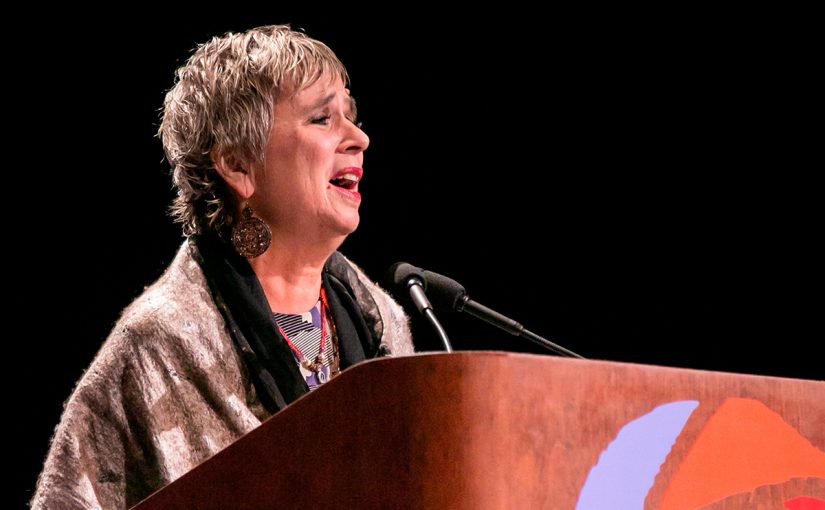
Photo credit: Nikki Ritcher

HOST: But what exactly is a true apology? What does it take to truly inhabit another person’s interior life – to know their wound?

V: I learned that an apology has four stages, and all of them must be honored. The first is a willingness to self-interrogate, to delve into the origins of your being, what made you a person who became capable of committing rape or harassment or violence, to investigate what happened in your childhood, in your family, in this toxic, toxic culture.

In my father’s case, he was the last child, the accident who became the miracle and he was adored. But I’m here to tell you, adoration is not love. Adoration is a projection of someone’s idealized self-image onto you, forcing you to live up to their image at the expense of your own humanity. My father, like many, many boys, was never allowed to be tender, vulnerable, full of wonder, doubt, curiosity and yearning. He was never allowed to cry. All of those feelings had to be stifled, pushed down, and in doing so they metastasized, and eventually became what he called the shadow man, this buried creature who later surfaced as a monster.

The second stage of an apology is a detailed accounting and admission of what you have actually done. Details are critical because liberation only comes through the details. Your accounting cannot be vague. “I hurt you,” or “I’m sorry,” or “I’m sorry if I sexually abused you” just doesn’t do it. Those words don’t mean anything. One must say what actually happened. “Then I grabbed you by your hair, and I beat your head over and over against the wall.” This investigation into details includes unmasking your real intentions and admitting them. “I belittled you because I was jealous of your power and your beauty, and I wanted you to be less.”

Survivors, and I know there are many here today, are often haunted for years by the why. Why would my father want to kill his own daughter? Why would my best friend drug and rape me? There is a difference between explanation and justification, and knowing the origin of a perpetrator’s behavior actually begins to create understanding, which ultimately leads to freedom.

HOST: V found that, although knowing the origin of a perpetrator’s behavior can create understanding that can lead to freedom, it doesn’t make the behavior any less repulsive. On the other hand, not facing it would keep her trapped in the cage of the victim-perpetrator paradigm that her father had designed.

V: One of the hardest things about writing this book was how deeply I didn’t want to feel my father’s pain. I didn’t believe he had earned the right from me to feel his pain. But to be honest with you, I have remained connected to my father since the time of the abuse through my rage. I was a permanent victim to his perpetrator. And I just want to say about my anger, I was very able to be compassionate to so many people in my life, in all sorts of countries and places, I always had compassion. But I found the way I talked about white men very dis-compassionate. I found it in anger, and I listened to myself. There was a part of me that I just wasn’t happy with. I was stuck in a paradigm I realized that my father had designed. And as my father’s mother says to him in my book, anger is a potion you mix for a friend but you drink yourself. Feeling my father’s pain and suffering, ironically, released me from his paradigm.

The third stage of an apology is opening your heart and being, and allowing yourself to feel what your victim felt as you were abusing her, allowing your heart to break, allowing yourself to feel the nightmare that got created inside her, and the betrayal and the horror, and then allowing yourself to see and feel and know the long-term impact of your violation. What happened in her life because of it, who did she become or not become because of your actions?

And the fourth stage, of course, is taking responsibility for your actions, making amends and reparations where necessary, all of this indicating you’ve undergone a deep and profound experience that has changed you and made it impossible for you to ever repeat your behavior.

What and why should one want to undergo such a grueling and emotional process? The answer is simple: freedom. No one who commits violence or suffering upon another, or the Earth, is free of that action. It contaminates one’s spirit and being, and without amends often creates more darkness, depression, self-hatred and violence. The apology frees the victim, but it also frees the perpetrator, allowing them deep reflection and ability to finally change their ways and their life.

My father, in my book, wrote to me from limbo, and it was very strange. I have to tell you, he was present throughout the entire writing of the book. He had been stuck in limbo for 31 years. I truly believe that the dead need to be in dialogue with us, that they are around us, and they are often stuck, and they need our help in getting free.

With this exercise, I believe now that my father is free. And because he was willing to undergo this process, he’s moved on to a far more enlightened realm.

As for those of you who cannot get an apology from your perpetrator, I believe that writing an apology letter to yourself from them is one of the most powerful things I’ve ever done, and it can shift how the perpetrator actually lives inside you, for once someone has violated you, entered you, oppressed you, demeaned you, they actually occupy you. We often know our perpetrators better than ourselves, particularly if they are family. We learn to read their footsteps and the sounds of their voices in order to protect ourselves. By writing my father’s apology, I changed how my father actually lived inside me. I moved him from a monster to an apologist, a terrifying entity to a broken little boy. In doing so, he lost power and agency over me. [APPLAUSE]

We cannot underestimate the power of the imagination. And I just have to say in these times that we are living in, our imagination is our greatest tool. It is shifting trauma and karma that has numbed our frozen life force, and in the deeper and more specific my imagining and conjuring in this book, the more liberation I experienced. When finally at the end of the book my father or me, or me or my father, or both of us as one – I’m so not clear who wrote this book – my father says to me, “Old man, be gone.” It was exactly like the end of Peter Pan. Do you remember when Tinkerbell says goodbye and goes [MAKES SHOOSH SOUND] into the ethers? My father was gone, and to be honest, he hasn’t come back.

HOST: From monster to apologist. From terrifying figure to broken little boy. Free at last – even when it meant writing the apology herself – to liberate them both.

When we return, V’s descent into the hidden depths of what saying you’re sorry really means took her somewhere she did not expect to go – to her mother – Mother Earth.

I’m Neil Harvey. You’re listening to the Bioneers: Revolution from the Heart of Nature.

As V freed herself from the psycho-spiritual cage of her father’s abuse, she began to wonder: What other apologies need to be made? Where else can the alchemy of apology create healing in this broken world?

V: I think often we are survivors of all kinds of things, whether it’s racial oppression, or physical oppression, or economic oppression, or sexual violence. We’re told that we have to forgive and get over it. I don’t really believe that the mandate is ever on the victim to forgive, ever. But I do believe that there is an alchemy that occurs with a true apology, where your rancor and your bitterness and your anger and your hate releases when someone truly, truly apologizes.

People have asked me throughout the tour of my book, “What will it take to get men to apologize?”  This is the $25 million question. And I have to tell you, it’s a question that is underlying everything that we are experiencing on this planet right now. Our entire country rests on unreckoned landfill. That’s why it so easily becomes unraveled. Think of the massive apology and reparations due the First Nations people for the stealing of their lands, the rapes, the genocide, the destruction of culture and ways. [APPLAUSE]

Think of the apology and reparations due African Americans for 400 years of diabolical slavery, lynchings, rape, separations of family, Jim Crow and mass incarceration. [APPLAUSE] I honestly believe that apologies, deep, sacred apologies are the pathway to healing and inviting in the New World.

HOST: If deep sacred apologies are a pathway to healing and inviting in a new world, what about the world itself – the natural world that gives us life – that’s literally our home. V delivered this apology to Mother Earth at the Bioneers Conference.

V: So as I was preparing this talk, something miraculous and difficult happened. I realized there was an apology I needed to make, an apology that would force me to confront my deepest sorrow, my guilt and shame, an apology I had been avoiding since I moved out of the city to the woods where I now live with the oaks and the locusts and the weeping willows, Lydia, the snapping turtle, running spring water, foxes, deer, coyotes, bears, cardinals, and my precious dog Pablo. This is my offering to you this morning. It is my apology to the Earth herself.

Dear Mother, it began with the article about the birds, the 2.9 billion missing North American birds. The 2.9 billion birds that disappeared and no one noticed – the sparrows, the blackbirds, and the swallows who didn’t make it, who weren’t even born, who stopped flying or singing, making their most ingenious nests that didn’t perch or peck their gentle beaks into moist black earth. It began with the birds. Hadn’t we even commented in June, James and I, that they were hardly here? A kind of eerie quiet had descended. But later they came back, the swarms of barn swallows and the huge ravens landing on the gravel one by one.

I know it was after hearing about the birds that afternoon I crashed my bike, suddenly falling and falling, unable to prevent the catastrophe ahead, unable to find the brakes or make them work, unable to stop the falling. I fell and spun and realized I had already been falling, that we had been falling, all of us, and crows, and conifers, and ice caps, and expectations falling and falling, and I wanted to keep falling. I didn’t want to be here anymore, to witness everything falling and missing and bleaching and burning and drying, and disappearing and choking and never blooming. I wanted—I didn’t want to live without the birds or bees, or sparkling flies that light the summer nights. I didn’t want to live with hunger that turns us feral and desperation that gives us claws. I wanted to fall and fall into the deepest, darkest ground and be still finally, and buried there.

But Mother, you had other plans. The bike landed in grass and dirt, and bang, I was 10 years old, fallen in the road, my knees scraped and bloody, and I realized even then that earth was something foreign and cruel that could and would hurt me because everything I had ever known or loved that was grand and powerful and beautiful became foreign and cruel and eventually hurt me. Even then, I had already been exiled, or so I felt, forever cast out of the garden. I belonged with the broken, the contaminated, the dead. Maybe it was the sharp pain in my knee or elbow, or the dirt embedded in my new jacket, maybe it was the shock or the realization that death was preferable to the thick tar of grief coagulated in my chest, or maybe it was just the lonely rattling of the spokes of the bicycle wheel still spinning without me. Whatever it was, it broke, it broke inside me. I heard the howling.

Mother, I am the reason the birds are missing. I am the cause of salmon who cannot spawn, and the butterflies unable to take their journey home. I am the coral reef bleached death white and the sea boiling with methane poison. I am the millions running from lands that have dried, forests that are burning, or islands drowned in water. I didn’t see you, Mother. You were nothing to me. My trauma made arrogance, and ambition drove me to that cracking, pulsing city, chasing a dream, chasing the prize, the achievement that would finally prove I wasn’t bad or stupid or nothing or wrong.

My Mother, I had so much contempt for you. What did you have to offer that would give me status in the marketplace of ideas in achieving? What could your bare trees offer but the staggering aloneness of winter or a greenness I could not receive or bear. I reduced you to weather, an inconvenience, something that got in my way, dirty slush that ruined my overpriced city boots with salt. I refused your invitations, scorned your generosity, held suspicion for your love. I ignored all the ways we used and abused you. I pretended to believe the stories of the fathers who said you had to be tamed and controlled, that you were out to get us.

I press my bruised body down on your grassy belly, breathing me in and out, and I inhale your moisty scent. I have missed you, Mother. I have been away so long. I am sorry. I am so sorry. I know now that I am made of dirt and grit and stars and river, skin, bone, leaf, whiskers and claws. I am part of you, of this, nothing more or less. I am mycelium, petal, pistol, and stamen. I am branch, and hive, and trunk, and stone. I am what has been here and what is coming. I am energy and I am dust. I am wave and I am wonder. I am impulse and order. I am perfumed peonies and a single parasol tree in the African savannah. I am lavender, dandelion, daisy, dahlia cosmos, chrysanthemum, pansy, bleeding heart, and rose. I am all that has been named and unnamed, all that has been gathered, and all that has been left alone. I am all your missing creatures, all the sweet birds never born. I am daughter. I am caretaker. I am fierce defender. I am griever. I am bandit. I am baby. I am supplicant. I am here now, Mother, in your belly, on your uterus. I am yours. I am yours. I am yours. [APPLAUSE] Thank you.

Why Outdoor Education May Be the Key to Reopening Schools Safely

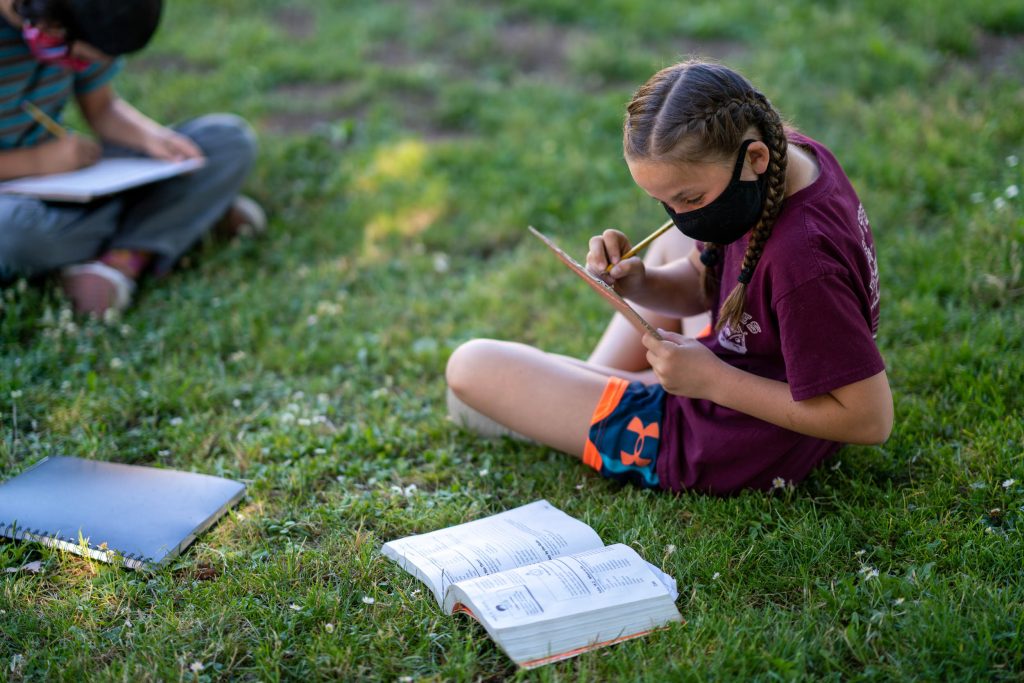
I was camping with my family in the mountains in Colorado’s Front Range when we crossed a COVID-19 milestone: 100 days since the schools closed and our family began the now all too familiar shelter-in-place routine that much of the country is just beginning to emerge from, for better or worse. I’m fortunate enough to live in a place where there are ample outdoor recreational opportunities and getting outside has been unbelievably essential to my children’s physical and mental health throughout this time. Without school and friends, simply going for a bike ride has turned into a can’t-miss activity. 

Back in range after the weekend trip, I checked my email to find two messages from my state and local leadership in my inbox. The first was from the Colorado Department of Public Health & Environment titled, “Risks & Benefits of Everyday Activities.” Among the suggestions (airline travel: higher risk, camping: lower risk) was general guidance suggesting, “Outdoor activities pose less risk than the same activity indoors.” As epidemiologists increasingly understand the transmission modes of the virus, it is becoming clear that for aerosolized viral particles, dilution is the solution.

The second email was from the local school district, outlining the various scenarios on the table for re-opening in the fall. Like many other districts around the country, all of whom are under tremendous pressure to re-open, the vision for the school year would be focused on transforming the school building and experience by halving class sizes, alternating schedules, mandatory mask wearing, physical distancing and minimizing transit/mixing between individual students and between groups of students, including eliminating activities like lunch in the cafeteria, visits to the library and the opportunity for recess. Elementary school was being re-envisioned as, well, something else, more aligned with a correctional facility than a comfortable learning environment.

How did it come to this? While the State of Colorado was branding their COVID response, “Safer at Home and in The Great Outdoors,” their school districts developed plans to pen children and staff inside poorly ventilated classrooms. Following official guidance, outdoor restaurants are taking over what were formerly known as streets and parking lots, religious institutions are gathering on lawns instead of sanctuaries. Why aren’t schools following suit?

As it turns out, I’m not the only one asking the question. There’s a rapidly growing movement underway to support schools to do just that. I spoke with Sharon Danks, CEO and Founder of Green Schoolyards America, and Craig Strang, Associate Director for Learning and Teaching at the Lawrence Hall of Science in Berkeley, CA. Alongside several other core partners, Danks and Strang have been assembling research, policy and guidance to help rapidly create pathways for US K-12 public schools to transition to a model of education where outdoor learning is Plan A.

According to their research, a swift move into outdoor learning may well be the only way that school districts can reopen safely with maximum enrollment while minimizing risk. For anyone who has been paying attention to the scholarship in the past several decades, outdoor learning and exposure to nature is not simply a nice idea. A cascade of physical, emotional and academic benefits accompany even basic outdoor activities, like recess. For purposefully built models of outdoor and experiential learning, the results are even greater. I spoke to Sharon and Craig via Zoom and an edited version of our conversation is below.

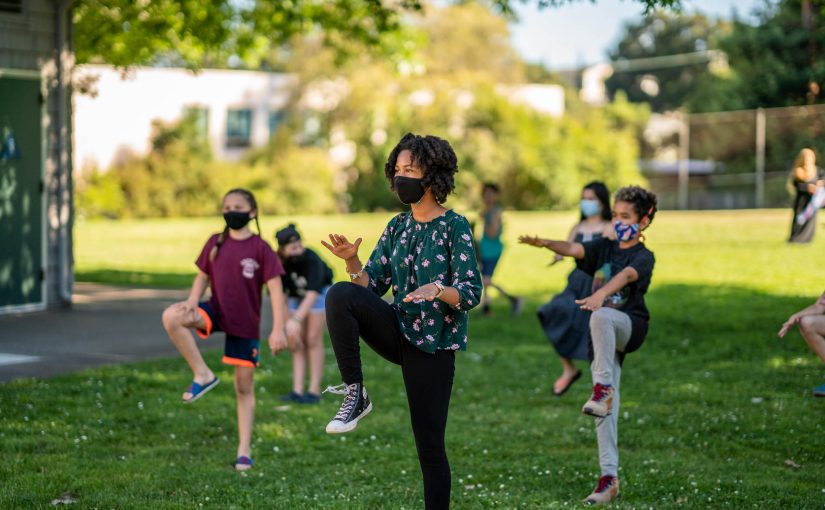
Photo by Drew Kelly Photography

SHARON DANKS: We know that being outside is good for kids in general, and there’s a 30+ year old movement in the United States for outdoor learning, hands-on play and discovery based on the research about the benefits of nature to children’s health – mental health, physical health, and the learning that they do in a hands-on way outside.

Sharon Danks

At the same time, we know that greening our cities, adding trees and plants, helps the ecology of our neighborhoods. Public schools manage a vast amount of land and we’re working to make these landscapes part of the climate solution, reforesting these urban public lands which addresses both large-scale climate change as well as neighborhood-scale microclimates where children are present.

This is the basic context we started from: our work using school grounds as a benefit for children’s learning, health, engagement, quality of life, and ecological system services, and community access to open space all together.

We’re troubled by the solutions being presented. The National Council on School Facilities estimates that school buildings in general only have space for about 60 percent of their enrolled students in their classrooms if they’re asked to be six feet apart. School HVAC systems are not set up to have good air quality circulation.

It is essential that we consider the outdoor landscape as an asset to help kids spread out and to be in environments that are healthier for them in the process. The key idea is that outdoor school grounds and even nearby parks can be used as places for classes to meet, allowing education to continue in person.

CRAIG STRANG: We know from the experiment that we ran this last spring that distance learning and home learning is hugely problematic on a large scale with kids of all ages, but in particular for young kids, and especially for kids within communities of color. In California, we estimate that 40-50 percent of all the K-12 students in the state never logged on, didn’t have a formal learning experience for three or four months. The idea of being able to deliver distance teaching to kids on a large scale two or three days a week, or five days a week, is hugely damaging within communities of color and low-income communities. The digital divide has never been addressed in this state or in the country.

Craig Strang

At the same, communities of color have been historically been excluded from outdoor spaces and access to outdoor learning and recreation opportunities – national parks, state parks, local parks, jogging in your neighborhood, you name it. That lack of opportunity has also been exacerbated by shelter-in-place mandates. If your home is in a community designed without local parks and outdoor spaces within walking distance, then what?

On top of that, COVID-19 has hit Black and Latinx community much harder than the white community or other populations. There are double, triple, quadruple impacts that are really causing harm and damage in communities of color.

There wasn’t a lot of time to plan for high-quality distance learning, so there’s no expectation that it should have been great right out of the gate. I’m sure that in the fall it will be better than it was in the spring, but even the better version will be disproportionately damaging to our most vulnerable communities.

Think about it this way. Getting kids back to school in classrooms would be vastly beneficial to distance learning, and having kids learning outdoors would be even more vastly beneficial than having them in classrooms face to face. There’s plenty of research proving that kids learn more and learning is accelerated outdoors. Even limited opportunities matter: when kids come back into a classroom from an hour outdoors, they’re focused, calmer and more able to absorb content. Now add the health benefits, decreased anxiety, addressing ADHD issues, depression issues, all kinds of learning challenges, all of those things are mitigated by spending time outdoors and connecting with the natural world.

We really think that the solution that Sharon is proposing, to green and create outdoor learning spaces on school yards, and take advantage of local and regional parks within walking distance is not just a Band-Aid to put on top of a horrible situation during COVID-19. This is an opportunity to showcase and shine a light on the best possible learning environments that kids could have, which we’ve not been able to achieve pre-COVID-19. We’re really hoping that we can take advantage of this opportunity, and that what we learn from it will have a lasting benefit to our school system and communities for decades and decades, not just until there’s a vaccine.

SHARON: Investments made now will be useful later. California has 130,000 acres of school ground land at 10,000 schools. In general, these publicly owned lands are vastly underutilized for kids and communities. We also have access to neighborhood parks in a lot of our cities when school grounds are not viable. Schoolyards are our most visited public parks, essentially, and we haven’t yet funded them to live up to that potential. It is about investing in the future while meeting today’s needs to get kids outside.

Photo by Thomas Kuoh Photography

An Improvement, Not a Detraction: How Outdoor Education Could Work

TEO: What would a school day actually look like if we leveraged outdoor education as a pandemic response?

SHARON: The idea is to use the outdoors as an asset with many different potential permutations and scales. We’re advocates of a large-scale approach, but we recognize that this is going require flexibility.  

We’ve been walking through some case studies with school district partners to think about how they might use their own environments. In circumstances when school buildings have classroom doors that open directly to the outside, it’s very easy to move furniture outside. You can just put it on the shady side of the building and have your class outside. One school we were talking with was interested in having a single teacher inside supervising children in breakout groups moving between the inside and outside so that they would essentially double their classroom size, because they have big windows and they can see the immediate outdoors.

All the modeling suggesting six feet of distance between students in the classroom is predicated on the idea that kids will stay in their seat for eight hours a day. We know that is not going to happen. Even if we’re thinking of this indoor six-foot model, we need our kids to be able to spread into outdoor spaces.

A lot of districts are anticipating being able to host 50% classroom capacity. We’re exploring how a school might place the remaining students in the environment outside, either at parks or at school grounds, in order to potentially serve all enrolled students.

For schools that are modeling 100% capacity, an idea might be that these class clusters are sitting on a combination of existing infrastructure that schools have in their yard and new straw bales and logs and camping chairs and seat cushions, or whatever arrangement of furniture they’d like to have from inexpensive to more of an investment. There are a range of possibilities. They might be sitting under an event tent like you might have at a wedding or a carport or a yurt. There are many choices for outdoor shelter, for shade, and for rain that would place them out into the landscape.

Climate is another factor. In Southern California, it may be too hot go outside until November, so they’re looking at how an outdoor plan specifically from November to May. Schools with colder climates might have the reverse pattern, staying until it’s really bitter cold or outside until there’s serious thunderstorms and wind. The question we’re asking how does the outdoors become Plan A? How can we get everyone outside as much of the time as possible, looking at indoors and as backup plans rather than the other way around?

CRAIG: We would advocate for adapting instruction to the opportunity that the outdoors provides, which is usually an improvement, not a detraction from teaching and learning. This requires providing opportunities for teachers to improve their practice at outdoor learning, providing them with resources, while also infusing schools with educators who are skilled at outdoor learning. We think there’s a ready workforce that’s available and in desperate need of gainful employment that could be redeployed to solve this huge problem that the schools are facing of not being able to bring enough kids onsite.

The outdoor education, outdoor science, environmental education community has been hugely impacted by COVID-19. In a recent national survey, 30 percent of environmental education and outdoor science programs say that they are highly unlikely or certain not to reopen if social distancing stays in place and they can’t run programs at their sites through the end of the year. Only 37 percent of all the programs in the country say that they’re likely to reopen after January 1. Between 30 and 63 percent of all the programs in the country are likely not to come back.

About 1,000 organizations respond to the survey, which is just a fraction of all the programs in the country. Those 1,000 organizations said that they have 30,000 employees that will be laid off and furloughed. We think that there’s an opportunity there for a partnership, to redeploy those 30,000+ outdoor instructors who are trained, skilled, passionate, dying to work with kids again outdoors, and put them to work solving this problem that schools have that otherwise is insoluble. Even if they can expand their space capacity, schools cannot realistically expand their personnel capacity, particularly in an era of budget reduction. Schools have a personnel problem and there’s a workforce currently ready and waiting and trained up. We need to find the mechanism to put them together.

These instructors that could be redeployed could be working with kids and providing extraordinary experiences and outdoor learning, while also modeling, demonstrating and providing guidance to classroom teachers who don’t feel as comfortable in those outdoor settings, helping them to slowly, over time, adjust their instruction for the long run. It’s not a simple solution, and there are a lot of barriers, but if we could make it work it would be an extraordinarily mutually beneficial relationship. As crazy as an idea as it is, I don’t think it’s any crazier than saying that kids should be home three days a week doing distance learning while their parents are at work, and trying to figure out how to get their laptop to work, and doing worksheets and online quizzes for three or four hours a day in the best-case scenarios.

Photo by Drew Kelly Photography

Is Outdoor Education Feasible?

TEO: Public K-12 education can be compared to a massive ocean liner, where making a course correction is not a quick endeavor. It really feels that we don’t have that kind of time right now. However, we just witnessed a dramatic shift, where the entire K-12 education system went online within a matter of weeks. Clearly there were problems and it didn’t work very well, but it probably worked better than people thought it might.

CRAIG: On February 15th of 2020, distance learning was not a very high priority in our schools. If you came forward and said, “Hey, I have this great idea. I think that our schools would be a lot better if we could have some kind of distance learning thing that would individualize and allow kids to learn at their own pace, and all these great things,” people would tell you that you’re crazy, we can’t afford that, we don’t have the resources, we can barely support classroom instruction.

As you just said, overnight it became a priority. And we did it. We didn’t do a perfect job of it, but it became a priority, and as soon as it was a priority, we had the resources to do it.

The question is: What are our priorities? If it becomes a priority, the resources materialize. The core always has funding. It’s all the peripheral things that get cut back when times are hard. There’s a re-framing that needs to happen. This is a better solution, and this should be prioritized. It’s not supplemental. This is the solution.

People talk about the funding. If it’s a priority, I think we can work it out. People talk about teaching credentials for outdoor ed instuctors. There are solutions for that, especially given that the workforce that we’re talking about is trained and skilled and has been working in the field for a long time. Many states have emergency credential-waiver processes. Many schools have systems where if the students that are not with a credentialed teacher are within sight or earshot of a credentialed teacher that can supervise, that’s okay. Some of these of barriers can be addressed with the wave of a hand.

SHARON: Education is not an island, it’s the linchpin to the economy. It allows parents to go back to work, particularly parents of younger kids. The cost of not having 100 percent of students at school is extremely high and is more than enough justification for an investment in people and place to make this happen, even without considering the amount of learning loss and expanding inequality.

We know that outdoor learning is an effective and feasible solution that’s been tried before. It’s what happened in the tuberculosis epidemic and the Spanish flu epidemic 100 years ago. It’s also happening around the world. Other countries are looking at the same approach, including Scotland and Italy.

Under the re-opening conditions that are being envisioned, it’s arguably less complicated to have kids sitting in outdoor environments than it is having them sit in indoor environments. If they’re on the inside of a building, it might require three or four times the janitorial staff to wipe surfaces down, to sanitize everything the kids touch, every time the kids come and go and there’s a new group in, everything has to be cleaned. There’s a lot of installation of barriers and upgrading of HVAC systems that needs to happen. Outdoor education requires the kids and supplies outside. In a lot of ways this is much simpler and cheaper than the solutions that are being proposed on the interiors.

This is not to say there aren’t complications. Questions around permitting outdoor structures and bathroom access and lunch service and more require logistics integration planning that needs to happen, but I would not say that they’re barriers. We need to un-silo some of those thinking processes and bring them together to make them function smoothly. That’s the work that we’re doing right now.

Next Steps

TEO: You had a large kick-off event in early June and 1,000 people attended. I assume that the end goal is to provide road maps and resources for communities all over the country who want to rapidly implement this approach?

SHARON: There has been a groundswell of interest that we’re trying to harness. The we in this is Lawrence Hall Science collaborating with Green School Yards America, San Mateo County Office of Education and Ten Strands together alongside a whole network of partners joining us from around the country.

We’re channeling those efforts into 11 working groups that will be working over the summer in their own areas of expertise to weave together some ideas, strategies, frameworks and guidance around the following:

  • Plans to ensure equity
  • Outdoor classroom infrastructure
  • Park/school collaboration
  • Outdoor learning and instructional models 
  • Staffing and formal/nonformal partnerships
  • School program integration (with PE, recess, before/after care)
  • Community engagement
  • Health and safety considerations
  • Local and state policy shifts
  • Funding and economic models
  • Community of Practice for Early Adopters

The first 10 are setup to produce materials that can be downloaded for free by districts across the country to help them not to reinvent the wheel. The 11th group is one that doesn’t want to wait for the end of the summer for it to happen, and would like to move forward and work it out with us.

We want to invite people who are interested in joining us to look at the website and fill out a survey of how they’d like to be involved.

TEO: I think that’s the next logical question. What are the next steps if somebody really wants to get involved in this particular project and process you’re hosting? And what are the strategies that you would recommend in terms of reaching out to school districts to try to make this part of the thought process?

SHARON: It is fundamentally a collective impact problem. These are problems that are too big for any single organization to solve, so we’re trying to be the backbone to a process that allows many people from many fields to contribute ideas so that individual districts and states don’t have to do it themselves.

But we also want to inspire people to go back to their own areas and support their own school districts armed with the collective thoughts from the group, and ready to work in an organized.

CRAIG: On a larger scale, we’re hoping that every individual person who has a relationship with any school or school district – whether it’s because you have kids there or you’re an educator in some other sector, or in any way intersect with the work of schools – that all of those people will go back and raise this as a possibility to be considered, and point to the resources that are being developed.

The biggest challenge that we’re facing is where we started in this conversation, that there is an accepted paradigm pointing towards one solution:  fewer kids at school for fewer hours a week. What we’re experiencing is that schools that conceive of or become aware that there’s another possibility are generally pretty receptive to the idea, but they just hadn’t thought of it or didn’t realize that there were resources available.

That level of awareness on a large scale is what’s needed reach the tipping point. It can’t be just an individual outdoor garden coordinator at one school trying to figure it out on their own, and everybody thinks they’re crazy. Right? We need parents and superintendents, and classroom teachers, and business people all going, “Oh yeah, I heard about that! Let’s make it happen.”

SHARON:  We need to ask ourselves what kind of experience we want kids to have next year? What kind of experience do we want the adults in the schools to have next year? How can we make it safe, positive, and welcoming? Kids are coming back to school holding onto a lot of trauma from this year, and they’re going to need to be in a nurturing, supportive, calming environment when they come back. Being asked to sit in your chair inside in the same spot the entire school day with a mask on is not going to help. There is a need for us to focus on the outcome we want to see for kids, and to generate and create the environment that will bring about that shift in experience for children.

Advancing the Legal Rights of Nature in a Time of Environmental Crisis

The first “rights of nature” law was enacted in a Pennsylvania community in 2006, followed two years later by Ecuador’s enshrinement of that principle in its constitution, the first country to do so. This discussion covers how Indigenous people, communities, countries, and courts have continued the struggle to secure the highest legal protections for nature and how you can become part of this growing movement. With Mari Margil, who was Associate Director of the Community Environmental Legal Defense Fund at the time of this conversation and a leading figure in the global movement to enshrine Rights of Nature in jurisprudence; and Bill Twist, Co-Founder and CEO of the Pachamama Alliance. 


Mari Margil

MARI: My name is Mari Margil with the Community Environmental Legal Defense Fund. I’m pleased to be sharing the stage today with Bill Twist of the Pachamama Alliance.

What we’re hoping to do today is share with you how the Rights of Nature movement has developed and evolved. Let’s get started, Bill.

BILL: Thank you. Mari really knows this subject inside out. Pachamama Alliance had the good fortune to be involved through Bioneers originally, but then be involved with rights of nature being introduced into the Ecuadorian Constitution in 2008. So I’m going to be the historian, telling the history of how this got started and where the movement around rights of nature exists right now. And then Mari will spend more time filling people in on some of the specifics of what’s going on around the world.
Bill Twist

In 2006, Thomas Linzey, who’s the founder of the Community Environmental Legal Defense Fund spoke here at Bioneers, talked about work that they had done, where they had introduced a Rights of Nature provision in rural Pennsylvania, and it had been passed. The first time ever that legal language had been put in place anywhere actually enshrining nature as a rights-bearing entity.

And out of that Thomas did a democracy school, and it’s something that the Community Environmental Legal Defense Fund had developed as a way of presenting rights of nature within a legal environment. And someone who works with me had showed me the handbook for this democracy school. I read through the handbook and I thought, God, this is amazing, this thing about rights of nature.

Pachamama Alliance had been working for years in Ecuador, with Indigenous People. Ecuador was writing a new constitution from ground zero. And I remember being inspired by the Democracy School, and thinking, if the United States could write a constitution from ground zero, what would we do? We would put rights of nature into it. We were trying to get rights of nature in it.

Ecuador’s really unique in that it’s a country with a huge indigenous population. Its vision for itself is really grounded still in indigenous cosmovision. So the work that was being done around the constitution was to put a constitution in place that enshrined this idea of sumak kawsay, which in Quichuan language means harmony with nature. It’s like mutually enhancing human-Earth relationship. That’s the vision of this country.

So I thought, they’re writing a new constitution, they should put rights of nature in it, which I knew nothing about. And so I called Thomas Linzey out of the blue and said, “Hey, I’m Bill Twist. I’m working down in Ecuador. Why don’t you come down to Ecuador and work on putting rights of nature in their constitution?” And basically he said, “I’ll come down there if you can get people who are in the process, who are really playing in this process, to understand it, and want to be engaged in the conversation.”

So I went back to the groups that we were working with in Ecuador and was able to get people involved, talking with Indigenous People, talking with people who were involved in the constitutional process who got really intrigued by the idea. And out of that, Thomas did come down. And then Mari came down with Thomas. And CELDF played a critical role in crafting language, working with the constitutional assembly process, and putting the language in place, this strange idea that nature should have rights and we should put it into a form of jurisprudence.

One of the biggest hurdles to get over was the indigenous opposition to the idea in Ecuador. It just sounded crazy to them. It sounds like another white man’s idea of how to deal with the world that was just so totally off, that nature needed to have people say it had rights. To them, it’s clear nature is a living being, it’s a subject. The whole world is this animated place that they’re living in. And so to think that we were going to make that right and to honor that understanding that they already had, that we needed to put it into our legal system just sounded crazy. So they were one of the biggest hurdles initially. They were really strongly opposed until they saw – and I think it occurred fairly quickly to them – that the biggest threat to their world was this structure of rights that had been created and imposed on them, and the thought that we could create property, and we could create rules as to how you could use property. So when they saw that it was almost like a skillful Aikido move, to use the tool that was being used to destroy the world and to deny them rights, to put rights of nature into that structure of jurisprudence, they could see this is actually a really smart thing to do. And the indigenous movement got behind it.

Thomas and Mari played a huge role down there. They participated in the constitutional assembly drafting process, and there were big rooms of people, all the delegates, and Thomas and Mari were drafting and diagraming, but there was something really special. Thomas and Mari and CELDF was a key part of this, but it couldn’t have happened anywhere but in Ecuador. The country has such a strong history and its vision for the country so deeply embedded in honoring and protecting the natural world. The people who were running the constitutional assembly, this man Alberto Acosta, is a brilliant economist, environmentalist, and he was the president of the constitutional assembly, and he picked up on this idea. He’s the one who really skillfully got the Indigenous People involved, got the business community involved. So there wasn’t any place else in the world where it could have happened. The conditions were absolutely right in Ecuador, with the indigenous vision and really skillful people who were part of the constitution assembly.

So the rights of nature did get enshrined in that constitution. Since then there have been a number of cases brought in Ecuador, some that were ruled against, some that clearly should have been ruled in favor of rights of nature were ruled against. The government asserted national security interests to ignore this provision of the constitution when it dealt with a big, huge mining project. The mining project still hadn’t happened, but the case was lost. There’s been a number of cases won, and Ecuador has been just a great example and a great building block for this movement.


I wanted to share one of the things that happened after the rights of nature did get passed in the constitution in 2008. This was just an isolated example in Ecuador. There had been some discussions in Bolivia about rights of Mother Earth, but it hadn’t turned into actual law yet. There had been some proposals to introduce the idea of universal rights for Mother Earth at the United Nations, but it hadn’t been accepted yet. But Thomas and Mari had been doing work on rights of nature, even before Ecuador, around the world. They had a real network of people in Australia, South Africa, India, Europe, United States that had been working on this idea of rights of nature, all inspired by Ecuador.

Thomas Linzey had the idea that what we really need to do is to pull this together as a movement somehow. He called together a group of people together to have a meeting in Ecuador, and so in 2010, there was a meeting in Ecuador. Mari was at the meeting, Thomas was at the meeting. There were about 25 of us who were there to create what’s now known as the Global Alliance for the Rights of Nature. And it was really Thomas’ idea that we need to build on what had been created with the constitution in Ecuador.

The meeting was at Hacienda Manteles at the foot of Mama Tungurahua—Tungurahua is a huge, active volcano in Ecuador. And when we were there, it was an absolutely crystal clear day, and so we were right at the foot of this volcano that was letting steam off. It wasn’t pouring out lava, fortunately, but it was letting steam off. There was this huge energy field that we were in.

So, we the people and organizations meeting at the Hacienda Manteles at the foot of Mama Tungurahua from the 2nd to the 5th of September (“the Founding Members”); Recognizing that we are all part of an indivisible living Earth community of interrelated and interdependent beings; Conscious of being complemented by the presence of the lizard, the hummingbird, water, fire, earth, moon, sky and other beings to create an integral Earth Community.

I love that. So there were Indigenous People who were part of this, and they insisted that we weren’t just some human beings trying to do something, but it was the spirit of nature itself working with something significant. Ancient native communities have always defended Mother Earth’s rights, because those rights are innate to their cosmovision.

Motivated by our love of Mother Earth and all beings and by a vision of creating societies that live in harmony with Nature and are socially just and spiritually fulfilling. . .Believing that the universal recognition and implementation of the rights of nature is essential to achieve that vision and to avert catastrophic harm to humanity and life as we know it; We hereby establish the Global Alliance for the Rights of Nature.

It was a significant moment. I remember we had a discussion then, and people were saying, this idea — rights of nature — had been now in the constitution of Ecuador; this is an idea whose time has come. Remembering the famous Victor Hugo quote, that nothing is so powerful as an idea whose time has come. And we were having this discussion about whether this is an idea whose time has come or not.

I remember saying, it’s not yet. It’s not an idea whose time has come. When an idea’s time has come, it has an energy of its own. And it was clear that the people there needed to be still driving this.

The real question is: How do you make an idea’s time come? And I remember talking about that with the people, and I’d be like, what are we going to do with this? We’ve got to do something with it.

Mari and I were in Ecuador just a couple of weeks ago at the 10th anniversary of the rights of nature being put into Ecuador’s constitution. And a lot of the same people who had been at Manteles were there, and this conference was amazing. It was just a really compelling, exciting conference as to what’s happening around the world with regards to rights of nature.

So I just wanted to report that where it is now, I think it is an idea whose time has come. It’s something that is really picking up momentum. It’s so consistent with the understanding that’s emerging in the world now, that the world is not out there as some object and we’re over here. Rights of nature is something that has to be an integral part of the way we deal with the world. So that’s the historical update of where we are now. Thank you.

MARI: I’ll pick up on where Bill left off: this idea of a time whose come. And I think you know an idea’s a good one when you say it and other people end up picking it up and thinking it’s theirs. We’re starting to see that happen. People who were not touched by us in any way, or members of the Global Alliance in any way, are just picking this up on their own. You begin to see that, indeed, it is an idea whose time is coming or has come.

What we’re starting to see is that it’s not just people, not just civil society groups or Indigenous organizations and tribal nations, all of whom are engaging in the rights of nature — we’re also starting to see governments and courts on their own begin to pick this up.

I think part of the reason they’re starting to do it is that we’re in a time of environmental crisis. We have ecosystem collapse occurring. Today the rate of species extinction is 1,000 to 10,000 times faster than natural background rates. And of course climate change, which is related to everything, is accelerating far faster than even the most optimistic scientific models predicted. So we’re in a time of overlapping environmental crises that are fueling each other. And so a need for a fundamental shift in human kind’s relationship with the natural world is building, this understanding that we need to make a significant change in how we govern ourselves toward the natural world.

Now 10 years ago in Ecuador, these crises were also happening, and 12 years ago in Tamaqua Borough in Pennsylvania, which Bill talked about. Tamaqua was the very first place in the world that passed a rights of nature law, and we were involved in that. And now today across the United States, there’s more than three dozen communities that have established the rights of nature in law.

And that work is growing, much in the footsteps of past people’s movements in this and other countries. We’re starting to see this build up from the grassroots in the United States, which is a very different pathway than what Ecuador took. Ecuador obviously put it into their national constitution, an extraordinary achievement, and it’s opened up so many doors to this idea coming, but here in the United States we understand that we can’t walk into the halls of Congress and say, “Hey, we need a rights of nature constitutional amendment.” That’s simply not going to happen. But what we are seeing is the ability to to build it upward from the grassroots, starting with lawmaking locally and driving upward to ultimately affect national constitution change. So not only do we have communities in 10 states across this country with rights of nature laws in place, we’re also now having those communities join together in what we call community rights networks, in places like Oregon, Ohio and New Hampshire. People are joining together to advance constitutional amendments into state constitutions, so that would help enshrine rights of nature at the state level. That, I think, is the pathway we’re seeing to build rights of nature in the United States.

Today in countries around the world—Ecuador the exception—nature is treated as rightless. It has no legal rights. It’s treated as property or an item of commerce. The law sees things in a binary fashion, either as rights bearing or rightless. Rights bearing is generally treated—we call them persons. You and I are persons, corporations are persons, other entities happen to find us being legal persons under the law. So you’re either a person with rights or you’re not. Nature is in the rightless property bucket, which means that we can’t today go into court of law here in the United States and say, I’m defending the rights of a river or the rights of a forest because there are no rights that exist for those ecosystems within our structure of law. The courts can’t defend those rights because they don’t yet exist in written law.

So today we regulate the use of nature. That’s why we can frack through aquifers. That’s why we can blow the tops off of mountains in West Virginia. That’s why we’re able to do these massive corporate water withdrawals by bottled water companies, because our environmental laws regulate the use of the natural world. That’s a very anthropocentric view of nature. And the major US environmental laws – Clean Air Act, Clean Water Act – now in place 40 or 50 years, those have been mirrored around the world. So we have structures of law around the world which are all based on the same framework, the same premise of how nature is something other than rights bearing.

And the result of course is what we’re seeing, which is ecosystem and species collapse, we’re seeing climate change advance, and all of these different indicators that we are now worse off environmentally speaking than we were two generations ago. And something fundamental needs to shift if we’re going to make any kind of change. This is that kind of shift.

And in one of the rooms that we were in in Montecristi meeting with delegates to Ecuador’s constituent assembly, we also met with lawyers who were advising them on how to draft their new constitution, and it was a both fascinating and frustrating conversation. I say that because we were introducing this idea to them, explaining how it had begun to advance the United States, and they said, “Well you can’t do that.” And we said, “Well, what do you mean?” And they said, “You can’t do that; nature doesn’t have rights; you can’t put rights of nature into the constitution.” And we said, “Well, why not?” As Bill said, they were starting from ground zero, blank page, why can’t they do anything the hell they want? And they said, “No, you can’t do that; that’s not how nature is treated under legal systems.”

And so we had to have a really frank conversation about past people’s movements. We talked about how abolitionists in the United States, in England and other countries, their goal was to move that which was treated as property under the law, i.e., enslaved people, transform them from being property to being rights bearing. And how the suffrage and women’s rights movements in different countries transformed women, which were treated as property of their husbands or fathers, transformed them from being considered property under the law to being rights bearing. And so nature today is in that same bucket. It needs to be transformed into being rights bearing to gain the highest level of legal protection that we have in our laws, which are legal rights. Our highest protection of the law is legal rights that you and I all have in the United States under the Bill of Rights. And sometimes it might feel like we don’t have them, but they’re at least on paper, people.

So that’s really the conversation that we had to have, not only with the lawyers, but with the delegates as well, which is how to transform something. It’s been done before. The body of legal rights has grown; it’s expanded to include people who were not considered to be people, who were not considered to be rights bearing, to move them into that category of being a rights holder. And so we had that conversation.

Bill told the story so beautifully about what happened in Ecuador. And today, Ecuador indeed is the first country in the world to recognize the rights of nature in its constitution. Bolivia came next. They have their law of the rights of Mother Earth. And now we have other things that have happened as well. I wanted to share some of that with you.

So one of the ways that we know an idea’s time has come is when others are picking up that idea and considering it and taking it as their own. In 2016, Colombia’s Constitution Court, their highest court in that country, was considering a case for Rio Atrato (the Atrato River) which is a heavily devastated ecosystem due to mining and other activities. The river basin is home to Indigenous Peoples who are being severely impacted by the pollution and impact on the river. And they were considering a case about protecting the river. In Colombia, there was no national rights of nature law. And the constitution court of Colombia essentially looked outside of the national boundaries of their own country, and they took in what’s happening within the international community. What can we look to to help protect this river, because clearly conventional environmental laws are not doing the job. And they, for the very first time, recognized that an ecosystem in Colombia has legal rights.

It’s extraordinary because they’re not basing it on their own national law. Instead they speak about looking out to the international community and seeing what’s the best thing happening out there that we can bring here at home. And so I wanted to read you just an excerpt from that very long decision, but it’s a terrific decision. The court said that the Rio Atrato possesses rights to “protection, conservation, maintenance, and restoration.” And the court explained its decision this way: “A new legal approach has been developed at the international level whose central premise is the relationship of profound unity and interdependence between nature and human species, a new socio-legal understanding in which nature must be taken seriously and with full rights. That is as a subject of rights.” And they went on to say: “It is the human populations that are dependent on the natural world and not the opposite, and that they (meaning us)—they must assume the consequences of their actions and omissions with nature, with the aim of achieving a respectful transformation with the natural world and environment as has happened before with civil and political rights.”

Rio Atrato. Image credit: Wikimedia Commons

So the court not only is taking rights of nature in, they’re putting in the context of other people’s movements as well, that had to transform those considered rightless to become rights bearing.

In some ways, the constitution court of Colombia has done a better job than some of the Ecuador courts at explaining why rights of nature is important. Bill explained how the prior presidential Correa administration didn’t really embrace the rights of nature when it was put into Ecuador’s constitution. There’s been essentially a void. There was no legislation in Ecuador to say how are we going to implement this constitution provision; what steps do we need to take? And in the void, all of these pieces of litigation have gone forward, but fortunately we’re also beginning to see some movement into things like their environmental code of regulations. They are starting to see the rights of nature move its way into that. They’re starting to see it move into procedural law. This stuff takes time to develop and evolve, and Ecuador is not only a great example but also a laboratory that other places, other communities, other countries are looking to.

And I can tell you that the moment Ecuador occurred – so September 28th, 2008 – we started getting phone calls from different places. The first call that we got was from Nepal. They had a constituent assembly in place, just like Ecuador had. They were coming out of a civil war and were beginning to draft a constitution, which was put into place in 2015. Nepal, of course, is home to Mt. Everest, the tallest mountain in the world, and as you may or may not know, the Himalaya is the fastest warming mountain range on Earth. The Himalayas are in the north of Nepal, so literally everything is downstream from that. With the erratic rainfall coming from climate change, with this melting that’s causing glacier bursts, and with climate refugees, you have all these problems that are occurring in a very agrarian society so dependent on water that they said: “We need really to do something about climate change here; can rights of nature apply?”

We have been working there for almost 10 years now, and have been there a number of times to meet with their constituent assembly when it was drafting the constitution. And now since their Constitution is in place, we’ve met with members of parliament on climate change to talk about establishing the rights of nature in Nepal’s Constitution — particularly rights of the Himalaya, so that the Himalaya have the right to be free from human-caused global warming pollution, and the people of Nepal have the right to a climate, a healthy climate free from human-caused global warming pollution.

Nepal is becoming a real frontline leader within the global grassroots, and some smaller nations that don’t have much political strength are joining forces to say we have to fundamentally shift our relationship with the natural world and advance rights of nature, right to climate, right of the Himalayas. That work has been going on for almost 10 years now.

The Himalayas

Other places are advancing rights of nature today. In India, last year a state high court in the state of Uttarakhand issued two decisions and a third one this year on the rights of nature. Much like in Colombia, there’s no national rights of nature law in India. And so the court, very similar to Colombia, looked outside of its own national boundaries and said, “What’s going on out there that we can bring here?”

And what they did is recognize that the Ganges (or Mother Ganga, as they call it) and the Yamuna Rivers have legal rights to protection, conservation, restoration. This was a necessity because conventional environmental laws were unable to protect those rivers which are facing significant devastation. This year on the Fourth of July, they issued a third decision, and that decision recognized rights of the animal kingdom, rights of species within this state in India. And so we’re starting to see that evolution in jurisprudence in that absence of actual lawmaking. They’re taking law from other places and putting it in place, which is extraordinary.

We’ve been working there on a national law, to write the national Ganga River Rights Act. We think those court decisions from the high court are going to boost that effort to put through national legislation, which the court said was necessary to happen nationwide. So that’s building.

Another place in which we’ve been doing work is Australia. The Great Barrier Reef, the largest coral reef on Earth – you can see it from space – is dying. We teamed up with the Australia Earth Laws Alliance, which has been working on bringing rights of nature to Australia, to develop the Great Barrier Reef Rights campaign. We developed model local, state, and national constitution frameworks to recognize rights of the reef: Model laws that people can take in their community, in their state of Queensland, and then at the national level to recognize fundamental rights of the reef and the people of Australia to a healthy, thriving reef ecosystem.

All of this work has been very much about people. It’s very much, some have said, a codification of indigenous values. Indigenous Peoples were extremely involved and pivotal in Ecuador. They’ve been very involved in work in other places like Nepal, like in India. They’ve been involved in the Great Barrier Reef campaign in Australia. They’ve also been very involved and active here in the States.

We began working with the Ho-Chunk Nation which is based in Wisconsin, formerly known as the Winnebago, to move rights of nature into their tribal constitution. Several years ago they took a first vote on that. Just three or four weeks ago in September, their general council took another vote on it to establish and enshrine the rights of nature in their tribal constitution. They need to take a second vote to ratify, but if in fact it is ratified, they become the first tribal nation in the United States to codify the rights of nature in their constitution.

Other tribal nations are moving this forward. Bioneers has hosted us to do a Rights of Nature and Indigenous Rights workshop, which we’ve been doing in different parts of the country with different tribal nations. We’ve done one on the White Earth reservation. We did one last year with the Grand Canyon Trust, their intertribal conversations groups with tribes throughout the Southwest, around the Colorado River Basin. So there’s growing interest. And I think Bill said this best, they’re using the law that’s been used against them, using it to actually protect themselves in the places where they live, and the lands they depend upon.

I’ll finish with saying that the rights of nature as an idea whose time has come, and I’ll just quickly run through a few more developments.

  • In 2017, in Mexico City, they established a constitution that says that a rights of nature law needs to be passed here. So they have set up the need to establish a rights of nature law within the city of Mexico City, which we’re beginning to work with folks on.
  • In Northern Ireland, we’ll be heading there in January to do a rights of nature workshop and begin to meet with communities who are very much frontline resistance against things like industrial farming and fracking, which maybe we don’t associate with that part of the world, but it’s very much occurring.
  • In Sweden, we continue to work with folks there to bring this idea into the country, and meet with members of the Green Party, for example, who are members of parliament to bring this idea into parliament. In the northern part of Sweden, where the Sami indigenous people are primarily based, they have a Sami parliament which is not recognized by the Swedish central government, the central government, as really having any legal authority. Nonetheless they, earlier this year, endorsed the Universal Declaration for the Rights of Mother Earth because they said, we’re going to do this anyway, even though we don’t essentially have legal authority here. They’re the first Indigenous Peoples within Europe to do so.
  • What’s been happening in New Zealand is also very much involving Indigenous Peoples there. What they have done with several different ecosystems, including the Whanganui River, is recognize that those ecosystems no longer have human ownership, that they are entities unto themselves with certain rights unto themselves. They’re saying that the ecosystems have what they’re calling legal personhood.

And so there’s a lot developing in different parts of the world. We’ve also been talking with people in Africa, other people in Asia, in Philippines, in Pakistan, other places which I think are all seeing this crisis developing and are all saying we need to do something fundamentally different in our relationship with the natural world.

Rights of Nature laws tend to include rights like the right to exist, the right to thrive, the right to water for an ecosystem, the right to evolve, to be restored. This is a somewhat different take on it, but it’s recognizing certain rights of ecosystems and with that essentially a shared management of the ecosystem by Indigenous Peoples and the central government, which is a completely new way of thinking about how to manage ecosystems, and that ecosystems are rights-bearing entities on their own.

The World’s Leading Entheogenically-Inspired Artist Shares Stories about His Creative Journey

An edited excerpt of a talk given by Alex Grey at the 2003 Bioneers Conference

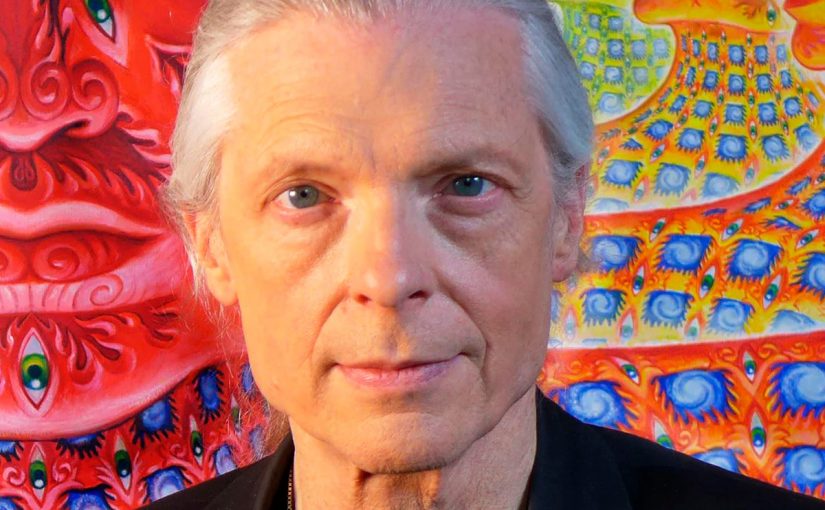
Alex Grey is a NY-based artist who has achieved worldwide renown, especially for his extraordinary x-ray-like portraits of the human body’s physiological and energetic systems and for his search for a common mystical experience underlying all the world’s spiritual traditions. He has also courageously and unhesitatingly acknowledged his deep debt to vision-inducing substances in helping shape his artistic vision.

Alex bonded with his life-long partner, the artist, Allyson Rymland Grey in Boston in 1976 when they had a life-changing, joint, simultaneous entheogenically induced mystical experience, which transformed Alex’s agnostic existentialism to a radical transcendentalism. The Grey couple continued to take “sacramental journeys” on LSD. For five years, Alex worked in the Anatomy Department at Harvard Medical School preparing cadavers for dissection while he studied the body on his own. He later worked for Dr. Herbert Benson and Dr. Joan Borysenko as a research technologist at Harvard’s Department of Mind/Body Medicine, conducting scientific experiments to investigate subtle healing energies. Alex’s anatomical training prepared him for painting the Sacred Mirrors series of paintings and for working as a medical illustrator.

Alex’s paintings, which have appeared as album art for such leading musicians’ as the bands TOOL, the Beastie Boys and Nirvana, have been exhibited throughout the world and are chronicled in a number of monographs: Sacred Mirrors:  The Visionary Art of Alex Grey, Transfigurations, and Net of Being. He is also the author of The Mission of Art and co-editor of a book about the conjunction of Buddhism and Psychedelics, Zig Zag Zen.

In 2004, Alex and Allyson Grey founded the Chapel of Sacred Mirrors in New York, a cultural center and refuge for contemplation that celebrates a new alliance between divinity and creativity. A five-year installation of Grey’s best-loved artworks was exhibited at the Chapel of Sacred Mirrors, CoSM, in New York City from 2004-9. The Chapel moved to its permanent home in Wappinger Falls, New York in February 2009.

In this talk, Alex recounts some of the artistic experiments from a “middle period” that bridged some of his earlier, truly transgressive work with social awareness and his nascent spiritual awakening. He then goes on to describe some of his later, now famous works and how the psychedelic experience informed their creation.


Chapel of Sacred Mirrors, alexgrey.com

ALEX GREY: A few years back in New York, I was sitting in a pool of black, tar-like liquid in a performance called “The Beast.” As people entered the space they would see a hydrogen bomb blast projected on one wall that was to my side. If they wanted me to, I would stamp their hand with the number of the beast – 666. Quite a few people wanted me to stamp their hands, and a few of them wanted me to stamp their foreheads. About ten feet away from me was my painting called “Nuclear Crucifixion.”

My wife, Allyson, joined me in another performance piece I called “The Wasteland,” in which we represented the nuclear family. On each one of the seats there, we had written “Mr. and Mrs. X were on their way to dinner when they were surprised by a nuclear blast. They arrived at a dinner table in hell to feast on money.” We sat at the table, drinking “blood” and eating “money,” and there was an alarm bell going off in the heart of a skeleton in the piece and bomb blast sounds in the background. As the clock approached nuclear midnight, Mrs. X got up (Allyson was a gifted bulimic for years) and she puked up the money onto a table. Then she jammed her fingers down my throat and I did the same.

Another piece I did was called “Human Race.” I had had a vision of a piece involving a machine/vehicle of sorts that had a motor and a wheel and a little clutch that was a kind of hand throttle that would engage it to the side in such a way that it could go round and round inside a room. I put steel rods down into concrete in the floor to anchor the thing. The audience was sitting about a foot and a half away from the wheel as it came around, and when I started it up, the engine had a little trouble starting. When it finally did, I lay down in the contraption and it started going round. I originally thought this would kind of be a boring piece in which I would just go around and around. There might be noxious fumes that would eventually drive the audience out, or it would run out of gas. Either of those endings would have made a point. I wasn’t sure how it would end. But the wheel started picking up way more speed than I had anticipated, and it then occurred to me I hadn’t put a brake on the thing. It got going faster and faster until it was going really fast. I guess I should have paid more attention in physics in high school. It sheared the steel rods right off, and pulled itself right out of the concrete and went careening toward the audience. Fortunately, I was able to fall off of the thing and stop it before it hit anyone. Everyone jumped up in wild applause, thinking that’s what it was supposed to do.

We later did several pieces that were early attempts on our part to look at different religions, trying to get to some essence in all of them. In one called “Burnt Offering” I read scripture from three different holy books from three different traditions, the Baghavad Gita, the Bible and the Koran. Then I set them all on fire in a kind of totem urn, then after they had burned down a bit, I mashed their ashes together and then rubbed it on my body. After I was ashen, I lit seven skulls and a skeleton behind me. Another of these, in about 1982, was called “Prayer Wheel,” named after the Tibetan device that can be either large or handheld and is spun as a way of generating good will and furthering your own spiritual evolution. It was a piece about the life cycle. I imagine all of us, somehow, as this combination of polarities: male and female, between birth and death, and so on, so to embody this I tied a skeleton on my back while Allyson carried a baby doll, and we were painted gold. This is a way to look at the soul externalized, that’s why I painted us gold, to represent something of great value. As we walked we intoned the national mantra of Tibet (“Oh hail the jewel in the lotus”—the jewel is our spiritual essence). I tend to have visions of these things and do them, and then years later I start to think that they’re about something.

In another of these pieces, “Living Cross,” Allyson and I were once again trying to bring together the polarities, referencing different world religions. We used universal symbols, the yin/yang symbol, the cross, and the Star of David, to highlight polar opposites: heaven and earth, matter and spirit, etc. We made a giant cross out of 500 apples and lay in the center of it surrounded by roses. Above us was this angel of death and transcendence while Gregorian chants were going on in the background. We used apples again (about 5000) to make a 55-foot effigy of a goddess on the ground outside at Lincoln Center. I did a hundred prostrations at the foot of the Goddess as Allyson was in its heart center nursing our daughter Zena. It was up for about an hour or two; then we boxed all the apples and donated them to homeless shelters.

To me, most of the time, babies imply some kind of hopefulness. I created a piece called “Heart Net” that represented this. It had many flowers creating a heart shape and an eye in the center that was crying into a pool that a child looked like it had crawled out of. People were encouraged to write prayers or good wishes for the planet, their own healing, loved ones’ healing and so on and hang them on the net. This was at the American Visionary Art Museum. A Buddha figure was positioned at the top, so it was going from the earth to a transcendental realm. A world map was painted on the wall and by the end of the year the piece was up, thousands of prayers had accumulated on the heart net.

Heart Net, alexgrey.com

I made an eleven-foot high (with a six-foot wing span) sculpture called “World Soul” that took two years to finish. It’s a hybrid, divine mutant, multi-faced, hermaphroditic kind of character, perched on the world globe. It has a fish tail, claw-like paws grasping the earth, and eagle wings. You can look at it as a kind of shamanic combination of the various elements, wings indicative of the super conscious, perhaps. After an exhausting day of teaching, I was standing on a subway platform and sort of saw this thing in a vision on the platform, and I thought: “Oh, what a nice painting image,” but then it opened up its wings and turned around and I could see it was a sculpture. It points to its own heart center, which is a mirror, saying: “See yourself reflected in me; I am you.”  It has eyes above, seeing all around. One of its faces has a wrathful aspect, but in front it has a peaceful aspect and cradles new life, an infant. Years after examining this sculpture, I’ve come to regard the infant as a symbol that implies: “ Consider the generations to come before you ruin this gem of a world.”  Before we welded the head onto that bronze piece and sealed it, I encased a number of things inside its heart: written prayers of many different world religions and shamanic invocations, objects that had been blessed by different religious leaders, and a number of plant and other entheogenic substances and medicines from all around the world as well. This is a trick I learned from some African sculptures whose creators also sealed magical elements inside of the figures to bring them to life.

Not all my projects are on that level of intensity. High Times asked me to do a poster for their “Cannabis Cup,” an event in Amsterdam in which the best pot in the world is judged and awards are given out. My wife and I were invited to be celebrity judges. We’re still recovering. It was a difficult job, but someone had to do it. Obviously, entheogens have been central themes in my work and life.  I did a painting portraying Adam and Eve as early humans eating of the tree of the knowledge of good and evil and the forbidden fruit as an entheogen. The earliest religious books ever written – the Vedas – contain hundreds and hundreds of references to hallucinogenic plants that would allow one to see God, and we know of the shamanic use of consciousness altering plants from all over Central and South America and the world. I hope that in the future our society will once again find a place for those of us who are called and attuned to their gifts to be able to partake of the power of entheogens in our spiritual lives without risk of harassment and incarceration.

The Sacred Mirrors series, which is now my most well known body of work, began out of a performance called “Life Energy” we did in 1978. I had this idea that I needed to look at life energy in various ways. We did a series of performances exploring that concept, and as part of this process we created two charts of human figures – one was of the nervous system and the other was of auras, chakras and meridian points. We demarcated a little zone in front and suggested that people stand in front of the charts and see if they could identify with the figure and use it as a mirror to start to imagine the systems in their own bodies.

At the end of the performance, I executed a rat to show the passing of life energy. We really felt like we had lost all of our friends because of that. It didn’t go over too well at all. But as Allyson and I were walking home and a little despondent, she said:” You know, Alex, people really liked the charts. You should do a whole series based on them.” That was the birth of the Sacred Mirrors. It evolved, and eventually I did an exhibition at the New Museum in New York with life size pieces that were roughly six-foot high figures in five-foot wide frames, ten and a half feet high. They all had stained glass in them. There were 21 of them. The idea was to trace the body-mind-spirit trajectory.

The first one called “The Material World” was made of dozens and dozens of mirrors that were sandblasted with the periodic table of the elements and a figure filled with biochemical data about what goes into a human body. This was a representation of the first step on the journey, the material plane of elements and chemistry. It had a rather elaborate frame that Allyson and I had carved that was packed with many symbolic elements. On one side were representations of biological evolution and on the other side technological evolution. There was a kind of big bang at the bottom of the frame and then evolution ascended narrowly up the sides. At the bottom there was a globe with a DNA chain rising out of it that had unicellular life forms, algae and little flagellates and things, and it moved up to the higher mammals. At the top were the elements of the polarities of male and female. The eye of God or eye of the cosmos or eye of the spirit, whatever you want to call it, was in the very center to express the universe’s coming to be aware of itself, the evolution of consciousness.

I basically taught myself anatomy by painting the skeletons and bodily systems in the Sacred Mirror pieces. I wanted people to be able to stand in front of them and start to feel the systems in their own bodies and their infinite complexity and relationships with each other. The eyes are always open and staring, so one can have a focal point to fix upon when standing in front of each piece. The first few pieces look below the skin, inside the body, at the skeletal, nervous, lymphatic and other systems. The next few have skin, and once there is skin on the body, you’ve got specific gender and race. There are portraits of male and female humans of various races, painted on linen. I called this part of the series the “Mind Area” of the Sacred Mirrors because the mind is constantly differentiating between self and other. All of these differences are visible, but in the context of the Sacred Mirrors what is suggested is that we see ourselves reflected in each other.

After the “Mind Area,” the series leaves the purely physical realm and takes us to the layer of subtle anatomy with representations of the invisible psychic energy system with various chakras and acupuncture meridians and auras and chronic energetic wisps surrounding the figures. These were painted in 1980. The series then continues into a look at the “Spiritual Energy System,” and we see the increasing breakdown of the boundaries between the self and the surroundings. After that comes the “Universal Mind Lattice,” a depiction of an acid trip experience that my wife and I had back in 1976. I met my wife while I was tripping. For us LSD served as a kind of magical elixir that brought us together, and in those days we would lie in bed and take a mega-dose and put on blindfolds to see what would happen. On one of those forays the physical reality I was familiar with completely dissolved. We became toroidal fountains of light interconnected in an omni-directional field that extended boundlessly. It seemed like every other being and thing in the cosmos was one of these fountains of light, these cells of energy, and the energy that was going through all of us was the same, and the energy was love. We were part of a vast love circuit made of the same stuff, yet each of us was a distinct point in this field. You could stare endlessly into space and see that everyone and everything was connected, even though you were unique. It was truly one of the weirdest experiences I’ve ever had and one of the most beautiful.

I took off my blindfold and Allyson was staring at me. She said: “I was in the most amazing place,” and she started drawing, and she drew exactly what I had seen. Even though we had both had blindfolds on and hadn’t communicated, we had shared an identical vision of the same transpersonal reality at the same time. It totally changed our work. From then on we wanted to make art about interconnectedness. The “Universal Mind Lattice” tries to capture that vision.

Universal Mind Lattice, alexgrey.com

After the Universal Mind Lattice, the next few pieces try to reference the void and clarity at the core of all the different mystical teachings. Most all of them point to a space beyond depiction, which I try to suggest symbolically. I wanted to bring in the elements – fire, water, earth, air – and the Kalachakra, the Tibetan Buddhist symbol of the wheel of time and the principle of the transmutation of the elements by the principle of emptiness. I also did a version of Avalokiteshvara, the thousand-armed Buddha of active compassion because I thought it made a nice segue from the pieces about “voidness” and clarity. All those hands are reaching out like activists. It’s the activist Buddha with an eye of unobstructed vision in each palm so it can see what needs to be done around the world to relieve suffering and help living beings.

By playing with different mystical traditions and bringing them into the Sacred Mirrors, I’m hoping to point beyond dogma and trying to look for some common threads, so also I did a picture of Sophia, the goddess of wisdom. There aren’t that many conventional portrayals of Sophia, so it was kind of up to the imagination to bring me one. It came out as an archetype of the feminine aspect of the godhead that is made out of eyes. I love eyes. The eye is a symbol, to me, of awareness. If you’re going to make art about consciousness, how do you do it? Consciousness has no color; it has no weight or form, so I use symbols, and multiple eyes point to infinite consciousness. The final piece in the Sacred Mirror series is called “The Spiritual World.” It is, in fact, an actual mirror. When you stand in front of it, depending on where you’re standing, a sun that I’ve sandblasted in the center radiates out from your heart. The whole point of the Sacred Mirrors is to help us see ourselves and each other and the world as a reflection of the divine.

Besides the Sacred Mirrors, I’ve done a number of other paintings that look below and beyond the skin at human physical and energetic systems. I painted a series that seeks to depict the spiritual and esoteric dimensions of the human trajectory from conception to death. It begins with “Kissing,” which shows two very physical bodily systems embracing, the coming together of mortal flesh as genitalia, bones, muscles and nervous systems entwine, but it also points to an infinite element of consciousness. Along with eyes, I like to use gold and golden flames to indicate consciousness, so I placed bands of golden infinity symbols looping through the minds and hearts of the lovers in that painting. Vortices shoot out from the lovers, alerting the souls in the other dimensions that this might be their opportunity for incarnation. Various mystical systems describe souls hovering and looking at couples mating, hoping for the right opportunity for physical incarnation. The painting draws from the Tantric tradition the image of the lovers connecting with each other not only through the skin but, in a sense, fusing together at the heart level and dissolving into each other.

The result of that intense fucking is in the next painting in that series, which depicts pregnancy and uses a lotus as a symbol of the soul. Quite logically, a really dynamic painting called “Birth” follows. In it I tried to capture the incredible channeling of almost explosive energy that goes through a mother during childbirth as well as the ultimate compassion inherent in giving birth, which I use Tibetan seed syllables that say, in essence: “Here is a birthing Buddha” to express. A painting about nursing once again captures the physicality of the act but alludes to subtle fields of interconnectedness between mother and child that forge invisible but powerful emotional and spiritual bonds. My daughter, Zena, is the subject of that and several other paintings at different stages of her life. The Dzogchen teachings in Tibetan Buddhism state that our inherent Buddha nature is one of primordial perfection, but that it gets more or less obscured. It’s sometimes easier to see it in children and the young. I tried to express different ideas relating to family bonds, the passing on of culture and knowledge and the development of conscious awareness in those paintings with Zena.

I’ve also done paintings that deal with archetypal figures and themes. One is “The Painter” which depicts a sort of cosmic funnel of inspiration entering the artist’s brain, a phantasm suggesting that he better get to work because he’s not going to be around here forever, and a peanut gallery of demanding critics including Van Gogh, Michelangelo, William Blake, Rembrandt, Frida Kahlo, and other renowned artists in the background. I do tend to pack in a lot of symbols, so that piece also refers to the paintbrush as a spiritual tool, referencing the image of the Tibetan Vajra scepter, and there are allusions to prehistoric and other artworks to imply that our individual creative energy draws from a collective field of humanity’s shared consciousness and traditions.

Art has been for me a way to integrate both the most difficult and the most uplifting material in my life. I don’t feel complete unless my art can express that full emotional range. I experience darkness and the shadowy sides of life all too often. Those are components of all great works of art, no matter how exalted, and that’s why I point to them in my work as well. I depicted the dying process in two pieces, “Caring” and “Dying” (in which consciousness is again symbolized by eyes, one of my recurring motifs). A 1989 painting called “Gaia” contains (unfortunately realistic) depictions of the planet’s current environmental and political crises. It has many dark elements, and one background detail I had forgotten but was later jolted to re-discover is an image of two airplanes flying over the twin towers…

Another category of my paintings depicts the human spiritual quest. One if these called “Holy Fire” portrays a pilgrim on a mountain receiving divine grace in the form of a lightning bolt into his heart and his physical body melting into a sun-like form or radiant fire. It describes the dislodging of the identity from the material body. Another called “Nature of Mind” follows a pilgrim on life’s path and portrays a number of episodes in that journey, from the discovery of sacred texts to the appearance of a teacher to an experience of enlightenment to a return to society to share his newfound wisdom.

Though this is not a fashionable view today, I think that is one of the artist’s functions as well: to fearlessly probe behind appearances and illusions in a quest to experience clarity and universal truths and to then seek to communicate those experiences. I will end with this statement from my book The Mission of Art, which captures some of what I feel art can be:

“Art can be a form of worship and service. The incandescent core of an artist’s soul, a glowing God’s eye, infinitely aware of the beauty of creation, is interlocked with a network of souls, part of one vast group soul. The group soul of art beyond time comes into time by projecting symbols through the artist’s imagination. God’s radiant grace fills the heart and mind with these gifts of vision. The artist honors the vision gifts by weaving them into works of art and sharing them with the community. The community uses them as wings to soar to the same shining vistas and beyond. Translucent wings team with eyes of flame on the mighty cherub of art. Arabesques of fractal cherub wings enfold and uplift the world. The loom of creation is anointed with fresh spirit and blood…Transfusions from living primordial traditions empower the artist – shaman, yogi, devotional prayer – all break through with the visionary cure and take the artist to the heights and depths needed to find the medicine of the moment, a new image of the infinite one, the God of creation manifesting effulgently, multi-dimensionally, with the same empty fullness that Buddha knew and the same compassionate healing that Jesus spread. Krishna plays his flute, the Goddess dances, and the whole tree of life vibrates with the power of love. A mosaic and tile maker, inspired by Rumi, finds infinite patterns of connectivity in the garden of spiritual interplay as the World Spirit awaits its portrait.”


A version of this presentation appeared in Visionary Plant Consciousness Edited by J.P. Harpignies, published by Inner Traditions International and Bear & Company, ©2007. All rights reserved. http://www.Innertraditions.com  Reprinted with permission of publisher.

Plant Messengers: A Diverse Panel of Experts on Psychoactive Plants

A Gem from our Vaults: A Historic Session from 1992

The following are edited excerpts from “Plant Messengers” a panel held at the 1992 Bioneers Conference.

This panel has to be one of the most remarkably diverse and unusual gatherings of experts on psychoactive plants ever assembled on one stage: Andrew Weil, MD, perhaps the world’s most famous holistic/integrative physician; Marcellus Bear Heart Williams, a Muskogee medicine man and member of the Native American Church; Edison Saraiva, MD and Florencio Siquera de Carvalho, two of the earliest representatives of the Uniao do Vegetal Brazilian Church to visit the U.S.; Kathleen Harrison-McKenna, an intrepid ethnobotanist, artist and plant woman extraordinaire; and Dennis McKenna, Ph.D. and Charles Grob, MD, two of the world’s leading research scientists studying psychoactive plants.


Dr. Edison Saraiva: I am a physician and homeopathic doctor in Brazil, and I work in the area of eco-toxicology, the toxicity of the environment as it affects human beings, and I also do research on nutrition. I’m part of the Uniao de Vegetal church. I have been drinking hoasca (aka ayahuasca and also called vegetal) for eighteen years. During this time I’ve lived partly in the Amazon area and I’ve worked with the ministry of the interior of a regional area of northwestern Brazil. Throughout these eighteen years, I’ve been drinking the hoasca tea, and I find it helps me to balance my governmental work and my inner life. It is interesting how one can inhabit these two different realms of reality and maintain excellent mental health. The hoasca, when well administered, brings the ability to transform the subtle, non-material world into something very palpable.

Kat Harrison: I’m the President and Project Director of Botanical Dimensions, a nonprofit organization I co- founded for the purpose of collecting, protecting, propagating and understanding plants of ethno-medical significance (including shamanic plants) and their lore. Part of my intent is to broaden our cultural definition of what healing is and what healing plants are, what medicine is, and to incorporate the shamanic plants into categories our culture is gradually accepting in terms of herbal medicines. Botanical Dimensions operates an ethno-botanical garden in Hawaii and another in Peru. I’ve explored these various plants and substances extensively over the last twenty-some years in several cultures throughout the Americas.

Dennis McKenna: I’m also associated with Botanical Dimensions as a research director. If you look at cultures in which shamanism has a strong tradition, almost invariably you find that that tradition is centered on the use of one or more powerfully psychoactive plants. I did my graduate research in ethno-botany in Peru in the early ‘80s, studying ayahuasca, and I came away from that experience with the intuition that this was really a very interesting drug or plant complex, and that it and the methods of the traditional healers who used it were worthy of investigation from both a medical and an ethno-botanical point of view. I found that many of the ayahuasceros I encountered in my field work, who had used ayahuasca on a regular basis, some for most of their adult lives, far from being what we think of as impaired by drugs, were actually extremely mentally well balanced, physically healthy people who were extremely high functioning and actually seemed to have derived a lot of benefit from their incorporation of ayahuasca into their lives.

I realized that we didn’t really know anything about the pharmacology of this drug in humans. We knew a great deal about the chemistry of the plants and their effects on animals, but animal models are not really adequate to describe how these things work in humans. I had long wanted to do a biomedical study of long-term ayahuasca users, but it simply wasn’t feasible to do such a study with traditional indigenous populations or jungle dwelling mestizos, the main users of these substances, so I had put this idea on the back burner until last year when I was invited by Edison and the Uniao do Vegetal to attend a conference in Brazil that they organized to give a paper on my chemical and pharmacological work on hoasca. I realized when I was there that the membership of the Uniao could provide an ideal group to study. Many of them were urban professional people who could be monitored and interviewed and could have medical tests performed with their full consent, and who would understand the value of the research. I broached the idea to Edison and some of his colleagues, and I was a little apprehensive because they regard hoasca as a sacrament, so I was worried they might feel I was being blasphemous in some way, but I found in them an extreme attitude of openness and a desire to understand their sacrament on all levels from the biophysical to the metaphysical. They were enthusiastically receptive to the idea.

So we began working together and I thought I would come back to the U.S. and write a grant and submit it to NIDA, the National Institute on Drug Abuse-the government agency that funds these kinds of studies. I started to write the grant. I worked on it for a year or so, and as I was working on one of the final drafts, I was reading it through and I realized that NIDA would never go for it. I realized that the only chance to fund such a project was to find some private individuals with resources whose lives had been touched by shamanic plants who would be willing to fund this sort of research, and lo and behold a couple of very generous individuals, one of whom is Jeffrey Bronfman, came forward. We picked Dr. Charles Grob from UC Irvine Medical School to act as the principle medical investigator, and we are now ready to initiate a pilot study on the biomedical effects of ayahuasca in people who have used it for many, many years.

Charles Grob, MD: I’m a psychiatrist at UC Irvine. I have had a long-standing interest in the potential medical and psychiatric application of psychedelic drugs. In fact, that is a good part of the reason why I decided twenty years ago to go to medical school. I felt that in order to do that sort of research, I had to get unimpeachable credentials. When I made that decision to go to med school twenty years ago, I figured that in about five years the country would come to its senses and we would be allowed to do sanctioned research the way it should be done, but here we are, twenty years later, and we are barely now on the verge of perhaps being able to resume some serious research on psychedelic substances.

Most people don’t realize that some 35 years ago psychedelic drugs were one of the hottest topics of study within psychiatry. It was widely felt at the time that they might hold an important key to really understanding how the mind works, to understanding psychopathology and to developing new treatments that could help people overcome some mental afflictions and live healthier, more fulfilling lives. I think that potential is still there. Tragically this research was blocked twenty years ago and it has not been allowed to go forth, but I think that is starting to change, though still very slowly and hesitatingly. I had submitted a protocol to do a study on MDMA, which may have considerable therapeutic potential. After a long series of drafts of a protocol, we submitted a proposal to the FDA and the decision there was very encouraging. They essentially felt that this was a worthy area of study and basically should be treated no differently than any other drug. Perhaps we are starting to see a slight paradigm shift, so I was very excited when Dennis asked me if I wished to join him as a co-investigator on the Hoasca Project. Ayahuasca has been used as a medicinal remedy and shamanic plant for thousands of years. It has enormous potential. Our study is essentially designed to look at both the physiology of experienced users when they imbibe the substance and at the biochemistry, particularly as it relates to neurotransmitter function and psychological effects. It is our hope that with the preliminary data that we can gather with our initial trip and work in Brazil that we might be in a better position to approach our own government, NIDA or other government agencies, to approve and support further research here.

Andrew Weil, MD: I am from the University of Arizona College of Medicine. I am a botanist and practicing physician. I practice natural and preventive medicine. My main interest has always been teaching people correct uses of plants and the most profitable uses of plants, and I include shamanic plants in that. I’ve always been interested in the healing potentials of the psychedelic plants and drugs, not just in psychiatric medicine, which is what most of the literature has been about, but in clinical medicine as well, because I have seen remarkable examples of healings from chronic pain syndromes in autoimmune disorders in connection with psychedelic experiences, and I think it’s a shame that physicians are denied the right to experiment with and use those drugs clinically, especially since from a medical viewpoint most of these are among the safest of all known drugs in terms of toxicity. Most of the things that we routinely dispense to patients are much, much more toxic than the true psychedelics.

I am also interested in magical plants other than psychedelics, and an example of one that I have had a long history of involvement with is coca leaf. I think the history of coca is the most flagrant example of the way in which we have gone wrong in our relationships with plants. Coca is the sacred plant of a large population of Native Americans in the Andes. The religious and sacramental significance of coca is enormous in these cultures. If you are in the area where coca is used and watch Indians in an unobtrusive way, you will often see them when they first begin to chew coca take three perfect leaves and put them together in their hand and then blow on them and whisper a prayer to the leaves before they put them in their mouths. There is a tradition of divination involving reading coca leaves in the Andean highlands, done mostly by women. You cannot get the power to read coca leaves in this way, they say, until you have been struck by lightning and survived. These are just a few examples of how central to the spiritual life of Andean culture coca is.

When the Spanish Conquistadores came to the New World, their immediate reaction to coca (and to most everything else associated with Indian life) was that it was satanic and should be suppressed. They tried to do that initially, but then they discovered that Indians worked better if they gave them coca. They enslaved a lot of the Indians and put them to work in mines and found that selling coca to them and profiting from the sale of it as well as getting enhanced labor was in their own selfish interest, so for the next couple of centuries, the only interest that Westerners had in coca was that it was a tool to get more work out of Indians. It wasn’t until about 1869 or 1870 when an Italian neurologist wrote an essay about coca, pointing out that it had very unusual, interesting properties that Europeans got interested in it. Within a year of that, cocaine was isolated from coca, and all scientific interest shifted to cocaine in the belief that all of the active properties of coca leaf were to be found therein in a form far easier to measure and study that in the whole plant. We are paying dearly for that reductionistic mistake to this day. It has led to an epidemic of cocaine use in the world created entirely, initially, by the medical profession, which handed it out as a panacea thinking that it had no downside. Eventually the problems caused by its abuse led to a great public outcry against cocaine, and the medical profession then had the same response it has had for a century or so to every psychoactive drug that it has initially mis-prescribed: it deflected any blame for its prescribing practices and labeled coca an inherently bad substance with no redeeming qualities. When you do this and a drug is banned, instantly a black market comes into existence to supply the thousands of people who have been addicted to it by doctors.

The laws against cocaine drove out of circulation the safe form of that plant, the leaves, which have medicinal properties and are not very prone to abuse as they have low addictive potential, and they created an enormous black market in cocaine. Massive efforts are made to eradicate the plant in the area where it grows, so there has been a constant, bloody, destructive war against coca growers (and the ecosystems in which they live) in the Andes stimulated by the international narcotics control bodies, with the U.S. at the helm. Clearly, this war suppresses Indian peoples. The chewing of coca is a very powerful symbol of Indian identity in these regions, so the people who want coca to go away really want Indians to go away, or they want Indians to turn into us, though the rationale is always posited in medical, psychiatric Terms.

The quality of scientific research on coca’s supposed harm in the Andean areas has been dismal. To cite only one example, in the late ‘60s, the United Nations sent a team of Canadian psychologists into Andean villages to administer standard Western intelligence-scale tests to Indians to “measure” their intelligence. They somehow concluded from the results of this culturally absurd, racist exercise in bad science that coca caused mental deterioration and brain damage, and this was then used as a further rationale to step up the war against the coca leaf. The shame of it is that coca leaf has a whole range of interesting therapeutic qualities not attributable to cocaine alone but to a wide range of chemicals found in the whole plant. You lose positive aspects of the plant in transforming it into cocaine. I think of all the many cases I have looked at of magical plants and relationships that people have formed with them, I have never seen one in which it is so obvious what our culture has done wrong, and the scale on which the mistake has been made and the costs of it, both to us and to the native populations that originally knew how to use this leaf, are just flagrant and horrible and tragic. It would be wonderful if we could shift that.

Marcellus Bear Heart Williams: I have an adopted son named Johnny White Cloud who couldn’t be here today and asked me to come to say something about the Native American church and peyote. So far chemists have found more than 59 different alkaloids in peyote. It has very complex kinesthetic, olfactory, visual and auditory properties. There is a long history of pre-Christian use of peyote. It came to the United States from Mexico, and Indians in the Southwest began using it centuries ago, but not in an organized church context. Different people began to investigate its use in the late 19 th and early 20 th centuries because white settlers who thought Indians were pretty crazy to begin with were really worried about those crazy Indians getting even more loco by eating that loco stuff.

Early in the 20th century, James Mooney, the historian, was taken into some of the peyote meetings. He advised the Indians that they had something really good going on. He told them: “If you want to protect your peyote ceremony, charter yourselves as a church, because before too long the BIA (Bureau of Indian Affairs, but we say BIA stands for “bossing Indians around”) will try to stamp it out, and not only that, but missionaries will also come and try to stamp it out.” The Indians took his advice. On October 10, 1918, at my Uncle Bob Cook’s place in Oklahoma, the Native American Church was chartered.

We had used this peyote long before then, and many of the old timers who have kept traditional ways still address the supreme being by the same name that they used before white men came to this continent, but one of the main leaders who helped found that church back in 1918 had become Christianized into the Methodist faith, and he said we should keep our Indian motifs, the teepee and our traditional paraphernalia in our ceremonies, but that he had been fasting and praying and eating peyote and drinking peyote tea and he had received guiding visions about the structure of the church. It would be called the Native American church and it would also incorporate Christian teachings. Because he was a respected leader, people went along with his vision.

In this church many miraculous things have happened over the years. A lot of psychological and spiritual power seems to evolve within a circle as we do our ceremonies, and people have been cured of serious illnesses. Many, many people have straightened out their lives and stopped drinking. It is not the peyote itself. The peyote is only used as a focal point for the power of the creator. We don’t worship this herb. We acknowledge it as a gift from the creator through which we manifest many positive forces that can help us heal emotional, physical or spiritual illness.

Florencio Siquera de Carvalho: I am a very simple person. I have lived most of my life in the forest. I have learned a lesson that has been very important for me: I know that I don’t know anything. I am a member of the Uniao do Vegetal and I hold it and all its members very dear to my heart. I have been drinking ayahuasca tea for more than thirty years. I leave it up to your criteria, you who are well studied and knowledgeable about many things, to judge whether this tea has or hasn’t been beneficial for me. We use this tea for mental concentration and to cure illnesses of all types. One of the illnesses that the vegetal has cured the most is the fighting amongst neighbors. It has brought people to join their hands together to be friends and brothers. For this reason, I am proud to be a member of this sacred organization, the Uniao do Vegetal, and I don’t consider this particular pride to be a human fault.

Audience Questions and Panelists’ Responses:

Q: How might we use these plants therapeutically outside of a traditional ritual context?

Andrew Weil: One of the problems that happened with early LSD research was that researchers who took LSD themselves and had positive experiences with it and understood its potential to alter consciousness in ways that could serve healing, conducted studies and published their results, but then other people who had never taken LSD and didn’t understand the way it worked and thought of it as a magic bullet went about administering it in other circumstances without attention to set and setting and didn’t get the same positive results. That kind of controversy in the literature, I think, scared a lot of other researchers away from attempting to use LSD therapeutically. The point is that these drugs in themselves don’t have absolute properties. They can have certain positive therapeutic properties if they are used in the right context and if the expectation of both the patient and the doctor are supportive. That is difficult at the moment to explain to many physicians and many psychiatrists who think that the magic is all in the substance. It’s a matter of training people to use these things correctly. The first prerequisite is having the experience yourself and in the right sort of context so that you can transmit it to other people. There’s no substitute for that.

Q: I was wondering if anyone who’s involved with the Hoasca Project has thought of the idea of using it as a possible therapeutic tool to help rehabilitate prisoners and criminals.

Dennis McKenna: Certainly part of the objective of the project, which is a long-term process, is to look at many potential therapeutic uses. I think it would be great if you could use it to treat, for example, chemical dependency. I think it might have great possibilities in that realm, but the initial objectives of the project are more modest than that. Basically nothing is known about the pharmacology of ayahuasca. We are trying to get some baseline data, some limited amount of information about how it acts on human physiology and on human cognitive functions. Once we have that, hopefully, out of that will emerge some suggestions, some ideas as to where to go. In other words, the data sort of defines itself. The way that science works is that you do experiments, you get results, you look at the results and then you try to ascertain what the next logical question to be answered is. But because of the political and regulatory climate in this country we are a long way from being able to use ayahuasca or any other traditional consciousness altering substances in that sort of human research here, especially in prisons. That doesn’t mean that that sort of thing can’t be pursued in Brazil where religious ayahuasca use is now legally recognized or in other countries where there is more openness to such research.

Marcellus Bear Heart Williams: We in the Native American Church really have to hurdle the FDA to get peyote in to our church members who are in prisons, but our ceremonies have helped reform quite a few criminals. I’ll give you an example. Roland Hague was a notorious troublemaker who did drugs, stole cars, robbed banks and went to prison. Even his mother had given up on him. But when he came out, somebody brought him to the church, and he never went back to drugs or crime. He is now a very respected member of the Cheyenne tribe. There is no doubt that it can turn things around.

Dr. Edison Saraiva: In Brazil we are already working all the time with ex-prisoners among our members in the Uniao, getting excellent results with their rehabilitation and social re-integration, and we would like to be able in the near future to also work with prisoners while they are still behind bars.

Q: I’m wondering what you think will happen with the use of ayahuasca analogues in North America. I’ve heard people have discovered high amounts of DMT (editor’s note: dimethyltryptamine-the most active hallucinogen in the ayahuasca brew) and harmaline (the other main chemical component of the tea) in a variety of plants that are indigenous to our region.

Kathleen Harrison: It’s true that upon hearing about ayahuasca in the last decade or so a number of inquisitive North Americans have looked into what might be here in our territory that would have the same components. There is a lot of searching and experimentation going on with several plant species. I think some of the amounts of active components that have been reported are exaggerated, but people could probably come up with a contemporary North American botanical analogue to ayahuasca, and what would happen with it would really depend, as always, with the attitude people prepared it with and how they approached the experience. Such people would be wise to model their use on the indigenous traditions that have a long history of using these substances to build respectful, reciprocal relationships and to achieve healing on many levels. That’s the reason that I have spent so many years studying these cultures and traveling to experience the way that different indigenous people use their shamanic plants. If we use these sacred plants, we have to do it right.


Panel Biographies

Marcellus Bear Heart Williams, (1918-2008), born in Okemah, Oklahoma, was a full-blood spiritual leader of the Muskogee-Creek Nation trained in the traditional ways of his tribe. Highly regarded as a healer and counselor, he was also a respected leader of the Native American Church, Sun Danced with both the Northern and Southern Cheyenne people, and was an ordained minister in the American Baptist Church. Bear Heart was asked to be one of the spiritual counselors for the firemen and their families after the Oklahoma City bombing tragedy and put down prayers with the Fire Department at Ground Zero, New York in November, 2001. Bear Heart helped thousands of people over the course of his life and his book and is the author of The Wind Is My Mother.

Charles S. Grob, M.D., a professor of Psychiatry and Bio-behavioral Sciences and Pediatrics at the UCLA School of Medicine and Director of the Division of Child and Adolescent Psychiatry at Harbor-UCLA Medical Center, conducted the first government-approved study of MDMA, and was the principal investigator of an international biomedical psychiatric research project in the Brazilian Amazon of the plant, ayahuasca. He has also conducted investigations into the effects of psilocybin on anxiety in terminal cancer patients. Dr. Grob has published numerous articles in medical and psychiatric journals and collected volumes, and is the editor of Hallucinogens: A Reader. He is a founding board member of the Heffter Research Institute.

Kathleen (Kat) Harrison is an ethnobotanist, artist, illustrator, and photographer who researches the relationship between plants and people, with a particular focus on art, myth, ritual, and spirituality. Kathleen has taught at the California School of Herbal Studies, Sonoma State University, and the University of Minnesota (with field courses in Hawaii), and has done fieldwork in Latin America for several decades. She is the co-founder and Director of Botanical Dimensions in Occidental, CA (http://botanicaldimensions.org/), a nonprofit foundation whose aim is to preserve plant knowledge as it pertains to medicinal and shamanic usage. Kat Harrison’s is a unique voice in ethnobotany. She brings deep integrity and fearlessness and a lovingly intense, profound intelligence to the study of medicinal and sacred plants and human cultures.

Dennis McKenna, Ph.D., is a renowned ethnopharmacologist who co-authored, with his brother Terence, a classic in the field of psychedelic literature, The Invisible Landscape, which recounted their wild adventures in pursuit of Amazonian hallucinogens in 1971. He co-stars in Terence’s later book, True Hallucinations, which further describes that fateful trip. Dennis earned his Master’s degree in botany at the University of Hawaii in 1979 and his Doctorate in botanical sciences in 1984 from the University of British Columbia. In the early 1990s he held positions at Shaman Pharmaceuticals (Director of Ethnopharmacology) and the Aveda Corporation (Senior Research Pharmacognosist). In 1998 Dennis co-founded the non-profit Institute for Natural Products Research (INPR) to promote research and scientific education with respect to botanical medicines and other natural medicines. Dennis is also a founding board member of the Heffter Research Institute and serves on the advisory board of the American Botanical Council. He has served as a board member for Botanical Dimensions and as well, he is the editor-in-chief of The Natural Dietary Supplements Pocket Reference and Botanical Medicines: The Desk Reference for Major Herbal Supplements and the author of countless scientific papers. From 2004-2008, he was Principal Investigator on a project to investigate Amazonian ethnomedicnes as potential treatments for cognitive deficits in dementias and schizophrenia funded by the Stanley Medical Research Institute. In 2010, he served as co-Principal Investigator for the Botanical Dimensions/UNAP Digital Herbarium Project, a three-year project to scan and digitize the 100,000+ specimens in the AMAZ Herbarium at the Universidad Nacional de la Amazonía Peruana (UNAP) in Iquitos, Peru. His most recent book was a memoir: The Brotherhood of the Screaming Abyss: My Life with Terence McKenna.

Edison Saraiva, MD., a Brazilian physician and homeopathic doctor and a specialist in eco-toxicology and nutrition who worked with the Brazilian Ministry of the Interior in the northwest Amazon for many years, is a long time member of the Uniao do Vegetal church which uses ayahuasca as a sacrament.

Florencio Siquera de Carvalho, now deceased, a humble man with very little formal education who endured intense poverty and suffering in his life, most of it lived in the Amazon jungle, became an important spiritual teacher in Brazil’s Uniao do Vegetal church, which uses hoasca (ayahuasca) as a sacrament.

Andrew Weil, M.D., trained at Harvard Medical School, was already well known in 1992, but he subsequently became the most famous pioneer of holistic/integrative medicine on the planet. He has impeccable mainstream medical credentials, but he also has a Harvard degree in botany, and, like Wade Davis, was a student of the amazing pioneer in Ethnobotany, Richard Evans Schultes. He worked for 13 years on the research staff of the Harvard Botanical Museum and traveled extensively throughout the Americas and Africa in the 1970s studying indigenous and folk medical healing traditions. He has become famous with books on natural medicine such as Natural Health, Natural Medicine; Spontaneous Healing; Eight Weeks to Optimum Health; and Eating Well for Optimum Health, but he has also long been one of the sanest voices on drug use in our culture in controversial books such as The Natural Mind and From Chocolate to Morphine. Dr. Weil went on to found and direct the Andrew Weil Center for Integrative Medicine at the University of Arizona, where he also holds the Lovell-Jones Endowed Chair in Integrative Rheumatology, and is Clinical Professor of Medicine and Professor of Public Health. The Center is the leading effort in the world to develop a comprehensive curriculum in integrative medicine. Graduates of that program now serve as directors of integrative medicine programs throughout the United States, and through its fellowship, the Center is now training doctors and nurse practitioners around the world.


A version of this presentation appeared in Visionary Plant Consciousness Edited by J.P. Harpignies, published by Inner Traditions International and Bear & Company, ©2007. All rights reserved. http://www.Innertraditions.com  Reprinted with permission of publisher.

Architects: Stop Building Prisons! Fighting Human Rights Abuses Within One’s Own Profession

Raphael Sperry.
Photo credit: Noah Kalina

Raphael Sperry is an architect, sustainable building consultant, and human rights advocate. President of Architects/Designers/Planners for Social Responsibility (ADPSR), he leads national campaigns to ban the design of spaces that violate human rights and to promote restorative alternatives to incarceration. His design and consulting work focuses on “net positive” design for buildings that regenerate energy, water and natural systems.

Raphael spoke at the 2017 Bioneers Conference as part of a panel discussion examining how engaged scientific, technological and design professionals can ensure the careful weighing of social justice, public health and environmental impacts becomes a cornerstone of all decisions made in their disciplines. An edited transcript of that talk is below.


ADPSR (Architects/Designers/Planners for Social Responsibility) is an independent 501(c)3 organization. Its origins go back to the early 80s when a bunch of varied groups united by their fear of the nuclear threat came together after the election of Ronald Reagan and the reigniting of a hostile phase of the Cold War. One outgrowth of that was that an exchange of American and Soviet architects was organized. The goal was to demonstrate that even though our governments were being hostile towards each other, within our shared professional world we could approach each other as citizens and colleagues and partners with mutual respect and learn from each other and have a peaceful citizen-to-citizen relationship. 

We insisted on standing up and saying that it’s not acceptable for the government to prepare for a war that’s going to destroy all of life on earth, all of human culture, and everything that our professions have created, i.e. the built stuff of civilization.

Raphael Sperry

Another thing we did was organize a competition to design a bomb shelter as an educational tool: the point was to state clearly that architectural professionals were not willing to be complicit in trying to make it look as though we could fight and win a nuclear war. We insisted on standing up and saying that it’s not acceptable for the government to prepare for a war that’s going to destroy all of life on earth, all of human culture, and everything that our professions have created, i.e. the built stuff of civilization.

That was an example of how you can respond as a profession when you’re facing what seems like an overwhelming issue. ADPSR has over the years tried to identify the big issues that we’re confronting as a society and to single out the things that are specific to our professional identity, the pieces that we work on. For example, in the face of the growing environmental crisis, we were one of the early organizations to dive into what in the ’90s we called ecological building, a forerunner of what was later called “green building.” In fact a number of local green building organizations such as the West Coast Green Trade Show and the Build It Green Certification Program in Alameda County were spinoffs of ADPSR’s Northern California chapter. We published one of the first books on the topic in the mid 1990s, a compilation that described how to use building materials that had recycled content and/or were made from sustainably sourced materials, that were recyclable, that were nontoxic and so on.

A lot of that work has become mainstream in the profession, which is great. ADPSR has always been an organization that tries to be at the forefront of things and to speak about emerging issues before they become well known. We have tried to function as a conscience for our profession, but when you do that and you’re ahead of the curve, it’s not easy for the people in your profession to accept what you’re saying, especially the first time you bring it up. After a couple of years, though, they get used to your message, and gradually it becomes more acceptable. 

In the 2000s we began publishing a lot of books through our New Village Press imprint, mostly about more equitable and rational community building and planning. We also developed an international affiliation called ARC-Peace starting in the ’80s. It’s a really interesting organization in that it has really good representation from both the developing and the developed world. It was long headquartered in Sweden, but its headquarters is now in Spain.

Architecture and Prisons

More recently the campaign that I’ve been most personally involved with is one that is trying to bring the voice of architects, designers and planners to challenge mass incarceration, which is one of the biggest social justice challenges facing the United States. Our level of incarceration sets us apart from the rest of the world. It’s part of a larger culture of violence in the U.S, which of course includes our wars, the wars in Iraq, Afghanistan, etc. We have to recognize that those wars spring from a culture that’s willing to accept violence as an instrument of public policy, and that it’s exactly that same acceptance that is comfortable with police brutality, horrible prisons and a criminal justice system that destroys communities of color in the United States.

And our professional community is implicated in that culture. Prisons are buildings. Architects have produced those buildings. No civilization in the history of the world has ever developed a penal system nearly as large as what the United States has today, and many architects had to design those facilities. Historically, some of the prison builders were well intentioned. The first prisons were called penitentiaries, often run by Quakers who of course have a history of social justice activism. The idea was that people would go to the penitentiary and become penitent; they’d be given a Bible; they’d study and return to God and become members of the good community again. But a penitentiary built in the 1830s by the 1890s had become a total hellhole. It was originally supposed to have light and air and be a healthy place conducive to rest and rehabilitation. Instead, it had become violent, abusive, dangerous, filled with disease. 40, 50 years later they built “reformatories” that were hellholes. Later they called them “correctional facilities.” The names changed but each “reform” was as bad as the one before, and by the 1970s there were major riots in prisons all across the country. We had recreated the same problems over and over again.

Prisons are buildings. Architects have produced those buildings. No civilization in the history of the world has ever developed a penal system nearly as large as what the United States has today, and many architects had to design those facilities.

Raphael Sperry

We started a campaign called the Prison Design Boycott to encourage people to start thinking about alternatives to incarceration. We advocated that all of us in our profession turn down commissions to design prisons and say: “Designers are being asked to solve the wrong problem. Don’t come to us anymore and ask us to design better prisons when you’ve got 2.2 million people in thousands of new prisons already, and the country is getting worse as a result of it, with more injustice, not less. We want to design what’s really needed—affordable housing, mental health centers, etc., all of the things that are not provided to people in the very communities we’re over-policing and targeting with our prisons.”

That first campaign generated a lot of dialogue, and quite a bit of pushback too. We expected initial resistance, but it was pretty hard for our opponents to come up with credible defenses of, say, the “supermax” prisons in which some detainees are in permanent solitary confinement in tiny cells; or the forever infamous Abu Ghraib prison in Iraq, which was actually designed by American architects and with British funding for the Iraqi government in the 1980s, when we were allied with Saddam Hussein in his incredibly bloody war against Iran. It was pretty hard for them to defend the facility at Guantanamo Bay, the first prison built specifically to deny people their constitutional rights in the United States, and that is actually a copy of a federal prison in Indiana.

And then there’s the California lethal injection chamber just over in San Quentin. There was a prolonged lawsuit in California that had very effectively stopped the implementation of the death penalty. That suit argued that using the state’s old execution chamber constituted cruel and unusual punishment because the facilities were so antiquated. Eventually the courts agreed, so the California Department of Corrections decided that in order to keep executing prisoners they had to build a new facility. They spent over a million dollars designing and building it, and they were really proud of it. “Look,” they said, “We’ve met the court standards and we’re ready to go.” They published photos and displayed the model of the chamber because they were so proud of its design. In order for that execution chamber to be built, someone had to use professional skill and professional tools, such as architectural software, to design it.

This offers a crystal clear example of the fact that professional expertise and tools are not value neutral. In this instance, they were used to build a killing machine, quite literally. This is something students aspiring to be professionals and those already established in a profession need to understand. Just because your expertise seems technical and removed from the social and political conflicts of the society and just because you receive a license to practice your craft, you are not absolved of moral responsibility about how your work is used. All these buildings I have mentioned have in common that the activities that take place inside them are gross human rights violations. And they were built specifically to house those activities. Those who designed those buildings are not insulated from what happens inside them. They participated in the intention behind them. They have to take responsibility for their involvement, in these cases, in torture, in inhumane confinement, in degrading treatment of human beings.

So we sought to mobilize people and to build a campaign around these issues. We dug through the AIA (American Institute of Architects—the main professional body of architects) code of ethics, and we found that it actually already contained some language that said that members should uphold human rights in all their professional endeavors. So we asked the AIA: “How come some of your members don’t seem to have a problem designing execution chambers?” But the AIA told us that the language in question just applied to non-discrimination within professional practice. They weren’t prepared to extend the concept of “human rights” to the actual end use of the buildings their members designed.

So we had a pretty simple proposal. We told them: “Why don’t you add a simple rule to your code of ethics that says members shall not design spaces intended for killing or torture or other human rights violations? We’ll even write it for you to save you a little bit of time and legal research because we’ve studied the question in great detail.” It seemed like a good idea at the time, but the national organization’s leadership didn’t go for it, so we did a bunch of organizing around it. We got three chapters, the San Francisco, Portland and Boston chapters of the AIA to support us. We worked with Amnesty International, Human Rights Watch and other like-minded organizations as well. I think AIA is feeling the heat, but so far they have not approved it.

Some people argued with us that we should just focus on positive aspects of architecture. Architects love designing schools, universities, hospitals and clinics and cutting edge green buildings. Why not highlight those positive projects? But we felt that if you want to be in a profession that’s dedicated to providing people with housing, healthcare facilities and schools, you can’t be out there at the same time killing people and torturing people through designing prisons. There are some projects you should never do, like inhumane prisons and execution chambers. Not every design project can be totally great, but there has to be a minimal level of moral clarity in a profession. Architects can’t, on their own, transform the criminal justice system or implement the U.N.’s Sustainable Development Goals, but they can try to be as strong a force for progress as possible and at least not to participate in crimes against humanity.

In that spirit, ADPSR has just recently spun off a project that we started a couple years ago called Designing Justice + Designing Spaces. It’s the first architecture firm in the nation specifically focused on designing centers for peacemaking, restorative justice, reentry housing for people coming out of prison, and other projects that contribute to transforming the criminal justice system. I urge you all to learn more about that, and I urge all of you, whatever profession you are in, to work to mobilize your peers to help transform your spheres of activity into vehicles of progress towards peace and justice.

Owning Our Future After COVID-19: A 5-Point Plan for U.S. National Economic Reconstruction and Community Transformation

By Ted Howard, Ronnie Galvin, Joe Guinan and Marjorie Kelly

This piece is re-posted with permission from the Democracy Collaborative & The Next System Project.

COVID-19 poses a dual challenge: a terrifying public health emergency, and the unprecedented economic shutdown. At the same time the pandemic is once again making obvious the racialized nature of our political economy. It is no coincidence that Indigenous, Black, and Latinx peoples are bearing the brunt of the disaster, in general suffering much higher morbidity rates and health and economic pain than white communities. This underscores a truth that long preceded COVID-19: the real virus is our undemocratic, inequitable and ultimately destructive economic system that attacks the vital organs our lives depend on: our communities, how we relate to each other, meaningful work, how wealth is produced and enjoyed, and even nature’s capacity to sustain life.

The destructive power of this exploitive capitalism, revealed again through this pandemic, has been relentless. Its appetite for extraction is insatiable, its capacity for destruction seemingly limitless. People of color in America have certainly suffered the worst effects of this system, but others— women (including women of color, of course), LGBTQI peoples, youth, our elders, and the white working class, have all endured violence at the hands of this system. People of color remain the primary targets, and race and racism continue to be weaponized to divide and conquer and to undermine the possibility of solidarity amongst these groups.

If past performance is a predictor of future outcomes, the COVID-19 pandemic points to a grim future. As the initial crisis passes, we will reemerge into a shattered economic landscape, with the old inequalities of wealth, power, and control we faced beforehand newly amplified many times over. The challenge will be to rebuild this broken economy into one that is not only financially resilient but also sustainable, just, and reparative.

For advocates of a new way—a new world, even—the occasion demands bold and strategic ambition, grounded in an honest reassessment of our prior convictions and assumptions. This paper proposes a cohesive response to the crisis in the form of a five-point plan for national economic reconstruction and community transformation that discusses how to:

1. Preserve local community economies by blocking financial extraction and consolidation;

2. Extend public ownership in the public interest;

3. Ground economic reconstruction in a new era of community wealth;

4. Institute a green industrial strategy on the basis of a green stimulus recovery package;

5. Establish a Next Generation Institute to support the movement for a democratic economy.

We see this plan as the basis for orienting our organization, The Democracy Collaborative, in partnership with the growing democratic economy movement, toward a limited number of points of intervention for maximum leverage in a time of crisis. We realize that many of our peer organizations in the United States, and indeed in other countries, are themselves pivoting to meet the challenges of this time. As we have since The Democracy Collaborative was established 20 years ago, we will continue to learn from and work with others as we evolve our own program and seek to make our contribution. We are all in this together, and this historic moment demands the shared experience and wisdom of all who are struggling for a more just, inclusive and democratic system.

Two Pathways Forward

Who will own America’s economy post-crisis? Two starkly differing paths lie before us. Down one path, we see the extractive economy restored—one established on land stolen from Indigenous people and built on the bloody backs of African slaves. It will continue to be an economy fed by low wages, especially for essential workers from Latinx and other communities of color. Too many white working-class people who have benefited from the currency of whiteness will continue to forfeit their opportunity to be in coalition with communities of color—and will themselves continue to suffer as a consequence.

Following this path, as the nation did after the 2008 Great Financial Crisis, will mean corporations will be bailed out and the wealthy will be protected, while the brunt of economic losses—bankruptcies, foreclosures, and a pileup of household debt—will be borne by ordinary people, particularly those on low incomes and people of color. Many more Main Street businesses will go under, with the best firms acquired by large companies and private equity at fire-sale prices. Elite, concentrated, absentee ownership will increase massively. The chasm of wealth inequality and the nation’s immense racial wealth gap will widen. At worst, this more virulent form of hyper-capitalism will survive through state authoritarianism, buttressing an already racialized police state that suspends basic liberties, backed by vicious populist politics. In such a scenario, the rough beast slouching toward us will wear the face of corporate neofascism.

Thankfully, there is another path—one that leads to a just, reparative, democratic, antiracist economy of broad prosperity and shared power. Here, government will belong to and serve the interests of We the People—with “we” really meaning all of us. In this scenario, when big companies receive aid, the public will receive an equity stake in return. These stakes could be placed into citizen wealth funds and used to rebuild shattered communities, both urban and rural, and could pay dividends as reparations to Black, Brown, and Indigenous communities from which extractive capitalism has taken the most. Those who have contributed so much to the wealth of America but always been denied their share will finally receive a stake in owning their own future.

In this scenario, investors will become part of the solution. New investment vehicles will spring up to preserve local businesses, transitioning them— when feasible—to shared ownership. Instead of extractive private equity gobbling up distressed assets on Main Street, it will be fossil fuel companies that are bought out at fire-sale prices by government in order to wind them down. As COVID-19 recedes, a massive green stimulus will refloat the economy, creating millions of jobs and propelling us into the sustainable, post-consumer economy that the well-being of our planet requires.

As we move through and ultimately out of the COVID-19 crisis, one world or the other will be left behind—with consequences for generations to come. The business-as-usual path may seem far more likely, but the shape of the future remains radically undetermined. With crisis comes opportunity. Collectively, we face a once-in-a-generation opening to build a better world—our last best chance to construct a new social contract, grounded in the places we love, binding us together in a new, generative, democratic system in which all can thrive. We must strive to use the economic recovery as the starting point for a new birth of community in America.

We offer a five-point plan for shaping a powerful response to the crisis, a set of strategies to put the nation on the high road to a democratic economy rather than continuing down the low road of today’s elite-enriching, financially extractive economy. This is an ambitious program—and progressives do not yet have the power base to bring it all into effect, but it offers a direction around which to calibrate joint efforts, and a call to action with which to engage allies. This is a critical moment. How we handle the post-crisis recovery phase will help set the terms for the 2020s—the decade in which our collective future, the shape of things to come, will largely be decided.

A Five-Point Plan for US National Economic Reconstruction and Community Transformation

1. Preserve local community economies by blocking financial extraction and consolidation.

Amidst this crisis, local communities risk losing what remaining control they have over their economic future. We face the frightening prospect of a massive ownership transition, as large numbers of small and medium-size enterprises go under or are sold at pennies on the dollar. We can help make this a transition for good rather than for ill—preserving and supporting local businesses in the crisis, then keeping them rooted in community for the long run by transitioning them whenever possible, in the recovery, to models of shared ownership.

Small business is the lifeblood of our economy, providing nearly half of all jobs and circulating three times more money back into local economies than other companies. Yet according to the National Bureau of Economic Research, only one-third of small business owners could survive a shutdown of four months or longer. In majority African American communities most small businesses have less than two weeks’ worth of cash available. Many small- and medium-size enterprises (SMEs) could be lost forever. The pain of these closures will fall disproportionately on low-income workers of color. In rural areas, this could mean economic recovery never comes.

For the pick of the bunch, another fate may be in store. Waiting in the wings is private equity, with a reported $2.5 trillion on hand, ready to acquire companies at fire-sale prices. Further acquisitions will be made by corporations. Cities could lose their engines of prosperity. Millions could lose their jobs, which the corporate drive toward automation could mean will be gone forever. Down this road lies a massive shift in ownership upward to elites—“trickle-up” on steroids.

Capital will be the key agent needed to preserve and restore SMEs. Yet it must be of a new kind— both public and private, but operating in either case in the wider public interest. First, we must call for mobilizing public capital to prevent the leveraged buyout of local economies by private capital. One mechanism could be a federal, state, or even city-level holding company that would acquire struggling SMEs and hold them until they could be relaunched in the recovery. One historical model is the Reconstruction Finance Corporation, used to great effect in the New Deal when it became the nation’s biggest bank and single largest investor. The International Monetary Fund’s research arm has already indicated such vehicles may become necessary in the COVID-19 crisis. If such a visionary move seems politically impossible now at the federal level, states or cities could pilot the model, creating Local Economy Preservation Funds. These might be financed through the Federal Reserve’s Municipal Liquidity Facility. When firms are exited from these funds in the recovery, preference should be given to locally-based enterprises owned by employees, communities, municipalities, and people of color.

Other public interventions may also be possible. The Treasury Department should be urged to quickly expand the capital base of the nation’s roughly 1,000 community development financial institutions, which use a combination of federal and investor assets to lend in disinvested, beaten down communities. The emphasis should be on CDFIs that specialize in employee ownership and support for local business.

We should also mobilize private wealth, with local investing and impact investing by high net worth individuals becoming widespread new norms, something the era of low interest rates may make possible. New “impact funds” are already planning to purchase and hold companies, with a view toward exiting the firms after transferring them to employee ownership. Support for startups by entrepreneurs of color and women will also be needed to fill the gaps in hollowed-out local economies. Such processes cannot be about restoring the status quo ante. Preserving locally owned companies is a vital first step, but to build a more just and democratic economy, we must root ownership in community for the long haul by transitioning firms when possible to local shared ownership models.

Much as the nation made a strong commitment to home ownership—albeit one with severe limitations along racial lines—after World War II, we now need a national commitment to broad ownership of enterprise. It might include the creation of a National Commission on Shared Ownership, which would launch conversations on how to lay the groundwork for a new movement for owning our future after coronavirus.

2. Extend public ownership in the public interest.

It’s time to usher in a new era of democratic public ownership for public purposes as part of our collective response to COVID-19. First, in order to protect communities, workers, and the environment, we must block crisis profiteering by absentee corporations and extractive capital. If the government bails out large corporations, it should receive ownership stakes in return and use its voting rights to restructure and repurpose companies in the interests of people and planet. The time has also come to establish long-term democratic public ownership as a new common sense, especially in essential sectors such as utilities, housing, transportation, education, and health care.

In responding to today’s economic crisis, we must not repeat the mistakes of the 2008 financial crisis by using public funds to bail out distressed industries in ways that deepen inequality. Instead of “bailouts” that reward elite shareholders, government should instead perform “buyouts” in which the public gets an equity stake in assisted firms. In such instances, the government should be an active owner, embedding democratic values and public purpose within these companies, to deliver on pressing social, economic, and ecological needs. For instance, car companies might be tasked with producing electric buses and other mass transportation vehicles. Large financial institutions could power a renewable energy transition and revitalize the real, productive economy. Airlines could refocus solely on long haul flights, with revenues helping fuel a massive expansion of high-speed rail and other less carbon-intensive forms of transportation. Fossil fuel companies could be decommissioned or converted to renewable energy production in an orderly fashion, providing for both the nation’s energy needs and a just transition for workers and communities.

Public equity stakes from government rescues could be placed in a social wealth fund. Versions of such funds, often called sovereign wealth funds, are already in existence across the United States (such as the Alaska Permanent Fund) and around the world (such as the Government Pension Fund of Norway). Such funds could finance community restoration, support universal basic services, or pay dividends to citizens. In the American context, these social wealth funds could be explicitly set up as reparations funds, undoing the pattern of material dispossession that has held since European colonists first set foot on the continent. These reparations funds could be the basis for finally achieving economic justice in response to the legacy and ongoing extraction experienced by Indigenous, Black, and Latinx peoples while also giving rise to new political alliances among them. White working-class people who are discovering that the wages of whiteness have undermined their own economic interests might also be incorporated into coalitions and solidarity with these groups.

To block crisis-enabled financial extraction, the public should be given the right of first refusal on large corporate acquisitions and mergers during the crisis and recovery. Approval of corporate acquisitions and mergers in essential industries— food, medical equipment, pharmaceuticals—could be conditioned on companies adopting new charters mandating public interest and democratic governance approaches. Such steps could prefigure an era in which maximizing returns to capital is viewed as outmoded, archaic, and dangerous in a world of interdependence and resilience.

The crisis has refocused attention on the failure of the corporate ownership model. One glaring example is vaccine production, neglected because it was insufficiently profit-producing. Going forward, we must defend public ownership—for instance, beating back Trump administration attempts to privatize the U.S. Postal Service—but also extend it in such areas as pharmaceutical production as a vital element of a thriving economy with plural forms of broad-based ownership.

3. Ground economic reconstruction in a new era of community wealth.

Communities face an imperative to take back the power to determine their own fate. This means abandoning the practice of luring absentee corporations through tax giveaways and instead begin building broad prosperity from the ground up in every community in America. Building community wealth should be the basis of a national reconstruction strategy. The explosion of mutual aid groups and community tables in the crisis could be incorporated into a major push to build power at the community level, centering recovery and reconstruction in a paradigm of community wealth.

Community wealth building—developing local assets and institutions in ways that ensure that wealth stays local and is broadly shared—first emerged in the 2000s to challenge the underlying logic and failures of neoliberalism. Over the last two decades, community wealth building has gained momentum as a local economic development alternative, one that seeks new levels of community control and power and a democratic economic infrastructure. It must now become the dominant paradigm. This means “going big” to integrate and scale the model: integrate, by intentionally weaving together a growing patchwork of institutions, activities, and constituencies to create a new self-conscious politics of community, and scale, by moving out of the narrow lanes of economic development and into across-the-board economic policies and strategies, mobilizing the full weight and resources of the local public and nonprofit sectors for community stabilization, development, and well-being.

A key power base of community wealth building lies in place-based institutions, such as nonprofit hospitals and universities. In adopting the “anchor mission,” these institutions can seek to deploy their substantial resources to benefit local communities through targeted hiring, purchasing, and investing. This must now become the norm, not the exception. Beyond “eds and meds,” the whole of the public sector should be mobilized, including local government, K-12 education, public policy, and not-for-profit activity, forming the basis for re-exerting wholesale local economic control.  

As literally trillions of dollars come from the federal government to stimulate state and local economies, civil society organizations and political leaders should mobilize together to rapidly plan how to direct these resources toward building the ecosystems and structures of community wealth. Community wealth building practice must shift to meet the scale of the emergency—going beyond pilots and demonstration projects to help deliver a thoroughgoing recovery and reconstruction through economic transformation.

Post-COVID-19, we need to create an economy in which the needs of the community, as well as the imperative to live within planetary boundaries, come before the prerogatives of private capital. Clear principles for recovery flow from this approach. We must resist calls for cuts to public sector jobs and spending. The jobs that return should be full-time with benefits, not the precarious work that has come to predominate. Public and tax-favored private institutions—corporations, schools, city and county governments—should evaluate all their purchasing and procurement to see how much can be routed to local and democratically owned businesses. We should develop incentives for re-localizing procurement, since we have seen how global supply chains have broken down so spectacularly during the pandemic. When possible, we should bring manufacturing from overseas back to our communities, and keep it in the hands of businesses that are broadly owned, to create greater resilience.

In an ironic turn of events, the COVID-19 crisis may leave the entire nation looking like the Rust Belt, with its swath of lost small businesses and shuttered storefronts—the landscape for which community wealth strategies were first developed. As the national landscape takes on the devastated character of the Rust Belt, community wealth building principles are uniquely positioned to be at the heart of our economic response.

4. Institute a green industrial strategy on the basis of a green stimulus recovery package.

After the emergency phase of the crisis, the economy should be rebooted on the basis of a Green Stimulus. Looming beyond the massive but short-term economic damage of the pandemic is a far larger crisis in the shape of anthropogenically-induced climate change. A Green Stimulus would not only restart the economy after the present crisis but help stave off that next one. This is the call from climate and environmental justice organizations, whose work on the proposed Green New Deal is now being adapted to visions of how to best emerge from the pandemic. A post-COVID-19 Green Stimulus should be used to create living-wage jobs, transform the public health and housing sectors, and shift the economy away from fossil fuels.

Those suffering the most damage from COVID-19—low-income people and communities of color—are also those most vulnerable to the impending effects of climate change. Absent a focus on climate justice, any economic stimulus risks worsening these inequalities and further entrenching fossil fuel reliance. An ambitious Green Stimulus, by contrast, would be a down payment on a regenerative economy that builds wealth and resilience. We can invest in millions of green, union jobs to serve the nearly 40 million (and counting) who have filed for unemployment in the current crisis. We could build the public sector workforce and expand opportunities for shared and local ownership in green industries, while providing a just transition for workers in fossil fuel and carbon-intensive industries.

Green Stimulus investments must institute energy democracy through community- and municipally-owned renewable power. Also critical are major investments in greening our housing stock, particularly public and affordable housing. We must likewise build the resiliency of our water systems to deal with extreme weather events, and expand the capacity of public transit systems while making them fare-free. Such investments must be responsive to—and designed in collaboration with—frontline and fence-line communities that have suffered the most from disinvestment.

We will not make our way safely through the climate emergency if our economy remains dominated by corporations with a primary duty to profit maximization and investor return. This crisis has shown how the market fails when confronted with existential risk, and how basic services that should be universal—such as broadband or energy—cannot be treated as the byproducts of profit-seeking investments.

The fossil fuel industry provides perhaps the clearest example. Hundreds of oil and gas companies will likely seek bankruptcy protection, attempting to evade worker and environmental protections in the process. Left unprotected are millions of people unable to pay their utility bills because of this crisis, who are having utilities shut off by companies designed to commodify energy for profit rather than serve the public interest. Public ownership of the industry is the clearest pathway to managing a shift away from fossil fuels in a way that puts workers, affected communities, and the public interest first. This moment should be used to transform our utility system, perhaps through a new federal Community Ownership of Power Administration (COPA), working for a large-scale shift from investor- to community-owned energy.

A green industrial strategy—pairing a federal injection of capital with strict environmental regulation—could support the transition of workers into green jobs, while also mobilizing us to keep global warming under 1.5 degrees Celsius within 10 years. Such a strategy will also require regional coordination of the sort being seen during the pandemic, as governors retain collaborative control of when and how to restart the economy. These emergent approaches can be built into new forms of national, regional, and local government planning that must be reclaimed and re-energized as we enter the long climate emergency.

5. Establish a Next Generation Institute to support the movement for a democratic economy.

Prior to the current crisis, a tremendous wave of local organizing and activity was already taking place across the nation—around housing, racial equity, gender equality, minimum wage campaigns, climate justice, immigrants’ rights, and more. We at The Democracy Collaborative continue to be inspired by the hard-won experience and wisdom of these heroic community-based efforts, from which we have greatly benefited and learned valuable lessons for our own work. Yet even when these activists achieved important victories, they ran headlong—every time—into a system taking the nation on a downward trajectory toward greater inequality, rising environmental destruction, and the undermining of our democratic polity. In the face of this plutocratic system, the landscape of progressive organizing has thus far remained too fragmentary and disconnected, with inadequate larger-order systemic thinking and analysis, to challenge the dominance of neoliberalism and corporate capitalism.

Historically, the constraint on the system’s capital bias has been from government policy and organized labor. But the U.S. government has been largely captured, and labor’s strength has dramatically declined. We need a new institutional power base. This might be constructed by uniting the growing efforts of community-building institutions, grassroots organizers, and next generation enterprise developers who are already engaged in democratic economic experiments. We need a catalytic, sustained, and organized effort to take their work to a scale commensurate with that of the challenge—advancing the democratic economy by building power, policies, and institutions-hand in hand with powerful movements working in a converging direction. In this way, we can position the democratic economy as the new economic paradigm for America and beyond. This is, obviously, not simply the work of The Democracy Collaborative, but of thousands of organizations at all levels of our society, joining together in a spirit of trust, co-learning, reciprocity, alignment and respect.

Where it begins, in the shattered post-pandemic landscape, is in rebuilding wealth rooted in our communities. This requires the development of a new politics—beyond single issues and individual models—built around achieving deep systemic change. Throughout American history, broad social movements have succeeded in pushing forward progressive agendas, whether in the Progressive Era, the early labor movement, or the Civil Rights Movement. We need such a movement appropriate for our own times and challenges, linked to a system change agenda, capable of pushing radical “non-reformist reforms.” Our communities must start demanding a new approach that can hold local and national political leadership to account.

Achieving change at this level of ambition will require the development of new movement infrastructure and capacity, as well as an alliance among groups of unlikely bedfellows—investors, entrepreneurs of color, nonprofits, mayors, governors, activists, faith leaders, academics, economists, anchor institutions, civil society—as well as countless voters and community organizers. Also critical to this work are all the groups and individuals advancing progress in such areas as reparative justice, climate justice, green energy, employee and worker ownership, land trusts, and municipalization. Grounded support, training, truth-telling, and cross-racial, cross-sector relationship-building will be critical to meeting the challenges ahead and to knitting together a powerful movement for deep change.

Building the alignment, power, and energy that fuels a movement such as this will require deeper and more innovative approaches to political education. We envision a new research and training institute to support movement-building, the development of leaders, the sharing of cutting-edge practices and policies, and training in theories of organizing and enterprise development for long-term systemic change. Such an institute would also organize retreats, summer schools, visiting fellowships, and act as a place of contemplation and grounding for the work and the strategy. It would help create the relationships, trust, spaciousness, and time to facilitate deep thinking and reflective praxis. It would be the home of deep system-change ideas, the source of their propagation, and the archive and repository of institutional memory and knowledge for the wider movement.

We need such a training institute so we can learn from one another, challenge unexamined assumptions and beliefs and empower our activism toward systemic change (while not neglecting the cultivation of emotional intelligence, resilience, and well-being, without which too many activists burn out). The Democracy Collaborative’s specific contribution to this effort will be to build upon our two decades of intense work and deep practical knowledge on new economic models, public policy at all levels, and systemic design and theory.

To this end, we envision augmenting our existing institutional capacity with a new training institute that would ground our ideas and work in deep pedagogy and practice, aimed at cultivating the well-rounded and more deeply informed and trained movement leaders necessary to carry this work forward over the long haul. We currently lack the appropriate tools that would allow for the kind of cut-through and inspirational effect we will require if we are truly to sweep through the existing system and effect change—like poet and Nobel laureate Seamus Heaney’s once-in-a-generation tidal wave of justice that rises up and makes hope and history rhyme.

Conclusion

For decades, many have pointed to the inherent failures of our political-economic system and its inability to deal with growing challenges, from climate change to wealth inequality. Now, with the COVID-19 pandemic, the system’s contradictions have become intolerable. The precariousness of modern work, the eviscerated public sphere, the consequences of the limitless extraction of wealth from our communities and its redistribution upwards to the largest corporations and a tiny group of elites, the marginalization of a government apparatus demeaned by right-wing ideology and corporate capture, the fragility of a health system that is not a system at all—all stand revealed in the light of the present emergency. These crises were present long before COVID-19, but this pandemic is doing what even the great financial crisis of the last decade could not: it is revealing the necessity of fundamental changes in our social and economic organization.

A different kind of economy is further along in development than most realize, worked out in tangible detail in economic institutions and practices that are succeeding all around us, yet often remain invisible. This new kind of democratic, sustainable, reparative economy is both possible and now necessary, in ways previously unimaginable.

The COVID-19 crisis may well mark the beginning of a large historical rupture, a great divide between one era and another. We may be approaching a watershed moment in political affairs. There is no returning to the already-broken past before the crisis began. A new social and economic order must be built. We hope this five-point plan of action can be a starting point.

The work ahead will not be easy or automatic. But we must push forward on many fronts to advance the systemic transformation our time in history demands. Put quite simply, and to borrow a phrase beloved of our political opponents, There Is No Alternative.

Artivism: Painting a Future of Justice and Peace

This article contains the content from the 7/02/2020 Bioneers Pulse newsletter. Sign up here to get the newsletter straight to your inbox!


Artivism = art + activism

Art is meant to elicit emotion. That’s what makes it a powerful tool for activists to advance movements of peace, love and justice. Art confronts social issues in ways that words alone cannot. From dance and theatre to painting and poetry, creative expression helps people share experiences and speak to the heart. Bioneers has always featured engaged arts and artists as core components of our annual conference.

This week, we explore how visionary artists around the world are critiquing the world’s most pressing challenges while inspiring hope and advancing solutions. The featured image is “Unite” by Barbara Jones-Hogu, 1971.


The Thrive Choir: Harmonies of Liberation

Oakland’s Thrive Choir, a collective of passionate activist musicians, has created a groundbreaking model of what a fully engaged vocal ensemble rooted in community can do to inspire and galvanize its audiences. We spoke with three leading members of the choir, Austin Willacy, Kyle Lemle and Joyous Dawn, to explore their history, motivation and process.

“Creating music in groups and singing with other people have always been powerfully healing practices, and that’s as important now as ever, or more so, even if we have to do it online,” says Dawn. “And art can play different roles. One thing it can offer is a kind of chronicle of what’s happening right now, but it can share it in a way that’s not just intellectual (which is also important of course). It can convey the feeling of the current moment in a form that’s charged with creative spirit and that can reach people in a different, more direct way.”

Read more and watch Thrive Choir perform here.


Ancient Arctic Wisdom and Cutting-Edge Sounds: Zarina Kopyrina of OLOX

Indescribable performer Zarina Kopyrina (one half of the musical duet OLOX) discusses her roots in Siberia’s Yakutia region, steeped in an ancient and still vibrant shamanic culture, and her extraordinary life trajectory that has taken her from a tiny village in one of the remotest and coldest places on the planet to playing her mind-bendingly original and hauntingly beautiful music around the globe.

Read more and watch OLOX perform here.


Your Invitation to Truth Mandala: A Community Ritual for Honoring Our Grief, Anger and Love for the World

This Sunday, July 5, join Bioneers Co-Founder Nina Simons for this two-hour ceremony, which will create a brave space to experience, witness and (if desired) express emotions you may be feeling about systemic racism, state violence, climate, the pandemic and all the roiling changes, challenges and movements uprising at this time.

Learn more and register here.


Facing our Wounds: A New Narrative for a Time of Awakening

Jerry Tello is one of the most beloved wisdom teachers and brilliant storytellers we know. Of Mexican, Texan and Coahuiltecan roots, Jerry was raised in the South Central/Compton areas of Los Angeles and has dedicated himself for four decades to transformational healing, to the mentoring of men and boys of color, to racial justice, and to community peace and mobilization.

In this interview, Jerry discusses how we can begin to address the imbalances and injustices in our society by taking a deep look at the false narratives that have dominated our culture for far too long, and how we can begin to reclaim our understanding of the sacredness and interconnectedness of all things.

Read more here.


Art As Social Change: Birthing the Dawn Of A New Day | John Densmore & Climbing PoeTree

“Art is not a mirror held up to reality, but a hammer with which to shape it.” (Bertolt Brecht). John Densmore, legendary drummer of the Doors, joins visionary spoken word duo Climbing PoeTree in an exploration of creativity and social change. This episode of Bioneers Radio features exclusive interviews with the artists and a special Bioneers performance of Jim Morrison’s poem, “American Prayer.”

Listen to the podcast episode here.


New Bioneers Media Collection: “Artivism” for Social Change

All significant movements for positive change are accompanied by outpourings of artistic expression that help open our eyes to injustice and convey powerful new visions and possibilities.

This key role of the arts in social movements is as true today as it’s ever been, and we at Bioneers have sought to feature the work of groundbreaking socially and eco-engaged artists from across different disciplines.

Browse the collection here.


What We’re Tracking


Schumacher Conversations: Envisioning a New Economics

The annual E. F. Schumacher Lectures represent some of the foremost voices on a new economics, including a number of visionaries from the Bioneers community. Join Bill McKibben, Gar Alperovitz, David Orr and more in celebration of the 40th anniversary Schumacher Conversations series.

Registration for each virtual meeting is free, and the series begins on Thursday, July 9. Sign up today for the opportunity to hear these speakers reflect on their previous Schumacher Lectures given current economic, social, ecological and political realities.

Learn more & register.


This article contains the content from the 7/02/2020 Bioneers Pulse newsletter. Sign up here to get the newsletter straight to your inbox!

The Thrive Choir: Harmonies of Liberation

Oakland’s Thrive Choir, a collective of passionate activist musicians, has created a groundbreaking model of what a fully engaged vocal ensemble rooted in community can do to inspire and galvanize its audiences. Bioneers’ Polina Smith interviewed three leading members of the choir, Austin Willacy, Kyle Lemle and Joyous Dawn, to explore their history, motivation and process.


Polina Smith: Hi Friends, would you start by telling us about the origins of the Thrive Choir?

Kyle: Almost 5 years ago now, a community dedicated to personal, systemic transformation called Thrive East Bay started to form in Oakland. The basic idea was that this community would provide a church-like, solid base that would help people come together across traditions, cultures and ages in a sacred space to form a “beloved community” that was not limited to any specific dogmas. Elders in our community, who have long been in the front lines of our movements, told us that central to any spiritual community there has to be uplifting music! And so I got to talking to Joshua Gorman in the beginning of this journey with Thrive, and I was invited to start a choir that would perform monthly in the community in Oakland.

For the first year or so we were a smaller choir and we performed once a month. We started writing songs and the choir began to form a real identity. We produced a whole bunch of original music, and we grew our membership. Then folks started asking us to perform all over the Bay Area and Northern California. There was apparently a real thirst for social justice-themed music, and people sensed the beauty of who we are as a group. All of our diverse members were just hitting it, really striking a chord with audiences, so we ended up being asked to perform at festivals and conferences, including Bioneers, the IONS Conference, etc. I think that at some venues that can get very cerebral and intellectual, we could provide a way for folks to also feel the messages at a soul level.

We’ve also performed a lot at direct actions and rallies in support of black lives and climate justice and immigration reform, and increasingly now as well we’re being invited to some venues because people just like our music, so we’re performing at music festivals such as Lightning in a Bottle. So, that’s our origin story. And this year we’re coming out without first EP of recorded music.

Polina: What about the Street Choir? How did that start?

Kyle: It was a pretty immediate response after Trump got elected. That changed the culture of resistance in America. People began to mobilize a lot faster and in larger numbers than what I’d seen during the Obama years, and we at Thrive felt that we wanted to make our music part of resistance movements here in the Bay Area, so we started training song leaders, folks from the choir and anyone from our broader community who was interested in offering music in the streets.

We bought a battery-powered speaker, attached it to a luggage roller and started wheeling it around to protests. We created a songbook compiled of some originals and some beautiful protest songs from the past two decades. It’s been really special. It has inspired a lot of people to share their voices. I think there are a lot of musicians and singers out there who might not always be comfortable showing up violently or in anger but are happy to channel their gifts in ways that are supportive to everyone else around them.

Polina: How have you adapted to the pandemic?

Joyous Bey: Pre pandemic we were still singing monthly at the base community of Thrive East Bay, and as Kyle mentioned we had been performing at some festivals and we were getting requests to share our music in more and more different spaces. Obviously we can’t do any of those live performances now. In a way, the pause has helped us solidify our business side, get our stuff together, launch our EP to the world and just get a bit more organized. We’ve been singing together almost for 5 years now, but we need to get our act together as an actual professional music group. In this moment we are still working on that, and we can focus a bit more on that aspect of things because we can’t sing together as a choir in person. We’re about to launch a crowd-fund campaign to support our EP getting out into the world. On the choir side, we’re continuing to have our check ins and having rehearsals on Zoom and having deep-dive opportunities to share because a big part of what makes this group so special is the amount of heart we put into what we share with each other.

Now our events are completely online, and we’ve also been hosting a weekly artist series. Actually, it’s not just artists. It’s a series called Medicine for These Times, and it features speakers from within our community who have a lot wisdom to share about how to tap into sources of resilience by offering such things as guided meditations or musical performances. Actually, all 3 of us have been featured on that series. It involves artists performing on video and offering their medicine into the world, into the virtual world in this case. We’ve also been doing virtual song circles. It’s been a real learning curve trying to figure out how to keep contributing under these conditions, and I’ve actually been surprised that strong connections can still be established, even when I’m not physically present with the artist or the community.

Kyle: Since we have some amazing songwriters in the group, one of the things we’ve been doing more of since we can’t sing together is songwriting together. Everyone in the group is now officially a songwriter, so now we almost entirely perform original music other than a couple songs here and there. So the lockdown has in that way stimulated our creativity and originality.

Polina: Who are some of the people and some of the traditions you have been influenced and inspired by?

Kyle: One person Thrive East Bay was definitely inspired by is the revered activist, philosopher, Buddhist teacher and whole systems thinker, Joanna Macy. On the musical side, artists who sing about and exemplify in their lives the themes of radical love and transformation, such as Sweet Honey in the Rock, Stevie Wonder and Melanie DeMore have influenced us. In general, those artists who feature harmony as a guiding force in their music and who gracefully sing of justice inspire us.

Joyous: Yeah, as far as the choir goes, Melanie DeMore, a really important vocal activist and songwriter in social justice movements, is someone we’ve had the privilege of working with, and she has guided us at different moments and different spaces. She has supported us in a number of ways and helped us improve our sound and has also taught us some really beautiful songs.

Polina: Do you think art and artists have a special role to play in this very challenging time?

Austin: As a result of the quarantine, it feels like everything is slower; people have had to slow down, and a lot of suffering, both economic and social, has resulted from those slowdowns, but one of the things that has also shifted is the way people are able to connect with art and music. I feel that maybe messages and inspiration from music and other forms of art can reach people on a deeper level because there’s not such a frantic pace of life. So the slowdown has been a big problem in many ways, but it may also have created more fertile soil for people to actually receive what artists are expressing.

Joyous: Creating music in groups and singing with other people have always been powerfully healing practices, and that’s as important now as ever, or more so, even if we have to do it online. And art can play different roles. One thing it can offer is a kind of chronicle of what’s happening right now, but it can share it in a way that’s not just intellectual (which is also important of course). It can convey the feeling of the current moment in a form that’s charged with creative spirit and that can reach people in a different, more direct way.

Kyle: I think the mission of our work with Thrive Choir is to help illuminate the joy and pain of what it means to be a human in a time of great transformation. And we’re at a time of great transformation right now with the uprisings across the U.S. (and around the world) in response to George Floyd’s murder. Artists and musicians have often been called to carry forward prophetic messages and speak to the possibilities of change and healing. They cannot just provide messages that are complacent and reinforce what’s already here, especially in times of great transformation and struggle. And right now I think artists can also help us look beyond the present to a world that’s more loving, that reveres the sacred in every human being and doesn’t try to go back to normal, but looks instead toward what positive futures might be possible on the other side of collapse. I think it’s up to artists to begin to paint those pictures and those songs that can give us a little guidepost towards a world of more harmony, a world that’s built to support everyone.

Polina: How might music help us to dismantle systems of oppression?

Austin: Music is a great example of something that’s greater than the sum of its parts. If you take a chord progression or a melody by itself, or even if you combine a melody and a chord progression, that’s one level of engagement. But if you combine those things with words, and in the case of the Thrive Choir we get a chance to also add harmony, there’s some third space that is being created. And it’s not like reading an article or reading some statistics to somebody. Music can find the chink in people’s armor and bypass the self-protective analytical mind to directly reach the heart and soul.

With live performance, particularly performance with a bunch of people singing, because human being have tons and tons of mirror neurons, people who are listening are also on some level experiencing the act of singing, and they’re getting to on some level embody the messages that are being sung, which in the case of the Choir are messages about creating just and sustainable ways to live for all beings, about getting in touch with spirit, about stepping up and standing up for things that really matter, about re-connecting with the earth, so I think that kind of music can really help change people.

Polina: What are your visions and hopes for the future of the Thrive Choir?

Kyle: Knowing that folks are really looking for music that speaks to the tragedies and beauty of this time and that really delivers a positive message of unity, of radical love, of harmony, we’d like to share our music beyond our northern California community. Our album that we’re releasing this year will help us to do that. We’re very committed to our work in our Oakland and East Bay communities, and that won’t change, but we also want to explore who else would benefit from hearing our music, so that’s a big vision for us this year, to share our music digitally so folks can hear it everywhere.

Polina: Do you have any messages for young artists?

Austin: NASA hired a professor named George Land to put together a creativity test in the 60’s.  Some of their teams were getting stuck in their thinking about viable ways to get their ships and astronauts safely back to Earth and recognized they needed people who think outside of the box to help them get unstuck- the rest is history.

In his tests, he found that in an adult population, 25 and older, only 2% of us exhibit a genius level of creativity. He was curious about what would happen if he put together an age appropriate creativity test for 1600 5-year olds. He discovered that 98% of 5-year olds exhibited genius level creativity. At age ten, 30% of these same kids were at genius level creativity. By the time they were fifteen, 12%, and by the time they were 25, there were only 2%.

So, I would say: please, please, please do not let anyone socialize your creativity out of you. It is the most important thing you can offer in this life.
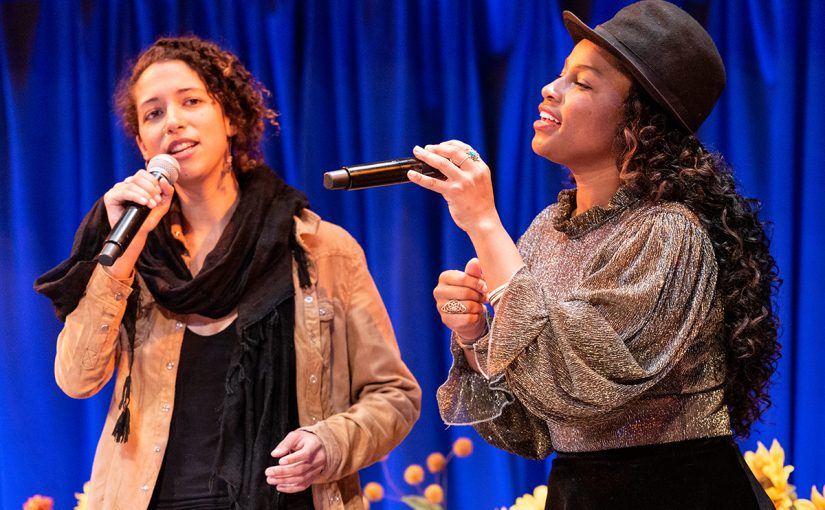
Kyle: I had a vision of a social justice gospel inspired choir, maybe when I was 13 years old, but I always thought it was too cheesy, that it wouldn’t work, that folks wouldn’t want to come together across different traditions. I thought that singing songs about trees and love would be just, cheesy, so I guess my message is that you need to believe in your dreams. Write the songs that are meant to be coming through you, and if it sounds cheesy to you, just keep working until it sounds epic. Trust that the messages that want to come forward need to, and don’t let perfectionism get the best of you. You will never know who will benefit from what you have to say.
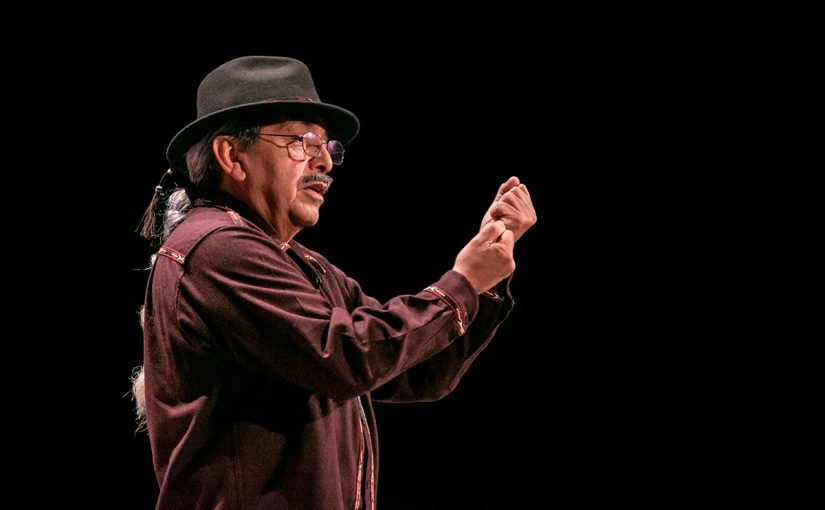
Polina: Thank you so much to speaking with me today and for all the incredible work you do!

Learn More about Thrive Choir here.

Learn more about their upcoming album and crowdfunding campaign here.

Facing our Wounds: A New Narrative for a Time of Awakening

Bioneers’ Polina Smith interviews one of the most beloved wisdom teachers and brilliant storytellers we know, Jerry Tello. Jerry, of Mexican, Texan and Coahuiltecan roots, was raised in the South Central/Compton areas of Los Angeles and has dedicated himself for four decades to transformational healing, to the mentoring of men and boys of color, to racial justice, and to community peace and mobilization. Co-founder of the National Compadres Network, Jerry has, among many other achievements, authored many articles, videos and curricula addressing fatherhood, youth “rites of passage” and culturally based family strengthening. He is the author of: Recovering Your Sacredness, A Father’s Love; a series of children’s books, and co-edited Family Violence and Men of Color.

Jerry discusses how we can begin to address the imbalances and injustices in our society by taking a deep look at the false narratives that have dominated our culture for far too long, and how we can begin to reclaim our understanding of the sacredness and interconnectedness of all things.


Polina Smith: Jerry, as a storyteller, a community leader and spiritual mentor to many young people, what are your thoughts about how to navigate our way through this incredibly challenging time of pandemic and social crisis?

Jerry Tello: It’s a time of reflection, a time for prayer, and a time of truth. Many people seem to believe that human beings are in control of everything that goes on, and that as long as you become successful according to Western ways, i.e. getting an education, making money, having material things and then getting power, then you can control your life, you can control your destiny, you can control your world, you can control your environment.

But our ancestors’ teachings tell us that we’re a very small part of this universe. We’re a sacred part of it as well (even though we don’t act that way most of the time), but we are beholden to Mother Earth, Grandfather Sun, the beautiful wind spirit, and Grandmother Moon. And if you look at our history, we have disrespected all those elements of the universe and nature. We’ve disrespected the trees that we cut down just to make money, and those trees and the plants are the ones that give us oxygen, so now we get a disease that makes us unable to breathe, right?

We have killed animals for our pleasure and for our comfort and destroyed their habitats without recognizing the interconnectedness of everything in the universe. Those animals have a part to play in the balance of all life. Once a species is not there anymore or its life is disrupted, the part of nature that those animals were a key piece of starts to fall apart, and viruses and bacteria that had been under control in their bodies escape and enter into us who weren’t designed to handle them.

So, we are seeing some of the results of our great disrespect, our tremendous ego and the false notion that we are, because of our borders and because of our governments, separate peoples and separate from nature. This virus is saying: “No you’re not! You’re all connected.”

Polina: What is your perspective on the incredibly dynamic global anti-racist movement that has arisen in the past few weeks since the murder of George Floyd in Minneapolis?

Jerry: The overall mentality that sees some people as worth less than others, that fails to see some groups of us in all our complexity, our beauty, our medicine and our blessings, is often based on the woundedness of the people in power. Many of our laws and systems, including our educational system, are steeped in that false story.

Many of us have, for many generations, have said: “Wait a minute! That’s not the true story.” But the folks in positions of power and a lot of those who have seen themselves as the dominant group have, for the longest time, been unwilling to face their own wounds. They’re addicted to their false story, and like any addiction, you’ll never get to heal it if you don’t acknowledge it first. We all know that if you have an alcohol problem, but you say no, I’m not an alcoholic, you’re not yet on a path to change.

When you take our breath away, when you stop us from breathing without any contemplation or thought, the ancestors begin to cry. It reawakens the pain of centuries. When Mr. Floyd said: “I can’t breathe,” we’ve heard that before too many times. If we can’t breathe yet again, people say: “I’m going to use the breath I still have in me now to speak truths and to express the anger and the hurt we feel when we are not being seen. We will make all kinds of noise to make sure we’re not forgotten.” And sometimes when we feel uncontrollable hurt, we all do things that are not logical, that are not reasonable, but when the spirit shouts out “I can’t take this anymore,” it goes beyond the level of the logical mind.

So, right now we’re in a time of tremendous grief, tremendous pain, but tremendous opportunity. If we can honor each other’s breath, each other’s medicine, each other’s stories, maybe all of our stories will be able to be told, and a collective story that is not dominated by one people, one narrative or one point of view can be born. Unless all people’s stories are told, this world will never be healthy.

Polina: I’m moved when you say that to heal, we need to first acknowledge our wounds, but how do you think that false story, the thinking that one group is better than another begins?  How do you think this disconnection from the sacred gets started?

Jerry: I think it starts with what we believe has value. We modern humans have created a hierarchy of value that tells us humans are more valuable than nature and the animals and then, after that, that certain humans are more valuable than the others. So that’s where it begins.

As a kid I remember that when we would go visit people, my dad would scold us and tell us: “Remember when you go visit your aunt, before you go and play, you have to hug everybody.” We had to acknowledge everybody, whether we liked them or not, wanted to or not. We were taught that you just did that. You had to acknowledge people, to see their spirit and acknowledge their worth. That is coming back to the belief that we will not be whole, balanced or healed unless all people’s medicine is valued in the same way, all people’s stories are valued in the same way. Then you’re acknowledging their sacredness and the sacredness of the whole world.

But if you’re not willing to face your wounds, you can’t get to sacredness. We have to start by wanting to change our narrative to a narrative based on interconnected sacredness, a deep understanding that we are sacredly interconnected to all things. That’s why my grandma talked to the plants, she’d say: “Good morning, how beautiful you look!” And she wasn’t crazy; she knew how those plants could heal us!” So she was acknowledging their medicine and asking for their permission to take a piece of them. This is what we need to do with each other as well.

Polina:  One of your main messages in the talk you gave at Bioneers was to see the sacredness in everyone.. How we do that with people in power who are doing so much harm?

Jerry: We had a dog when we were younger. I loved that dog, but a car hit him one day, and he was in a lot of pain. We wanted to go help the dog, but we were told: “No, no, no, be very careful; he’s going to bite you.” He was in a lot of pain and was reacting to the pain, so he couldn’t accept our love in that moment. We have to be aware that people in deep pain and in denial and who are deep down ashamed, even if they’re not aware of it or are trying to cover it up, can be very dangerous.

And you can see, for example, that this man in the White House isn’t right; he’s damaged in many ways. You have to always pray for everyone to be able to heal, but it’s a more complicated problem because there are so many people around him who just want to stay in positions of power, who don’t speak truth and don’t acknowledge the wounds and won’t acknowledge what is wounding the world, let alone have any desire to change it for the better. That doesn’t mean that there is no potential for healing in those people, that there’s no sacredness there because there is always potential for sacredness everywhere, but when the woundedness is so deep among so many people in power, that creates a very dangerous situation for all the rest of us.

“Indigenous teachings tell us that you can’t have night without day, day without night.”

Polina: So, what do we citizens do?

Jerry: We have to change our narrative, but to be real we’ve also got to vote, and we have got to get active in a lot of different ways in the world in order to change the systematic ways of doing things that are broken. We have to get out there and change the systems, change the priorities, change the funding structure, and we also have to pray a lot and do our own healing.

Indigenous teachings tell us that you can’t have night without day, day without night. We all have our sacredness, but we also all have our own woundedness, and it’s not a shameful thing. It doesn’t mean you’re not functional; it just means you’re human, but there are many humans who don’t want to acknowledge their woundedness. And when powerful politicians don’t want to acknowledge their wounds and don’t want to acknowledge that our wounded politics and systems need big changes, that’s a big problem we have to face and try to deal with, with all the tools at our disposal.

So, we must all individually and together do what we have to do in our communities. We have to stand up and demand that this society and this system take accountability and shift the narrative so that the next generations might have fewer wounds.

Polina: Do you think artists and storytellers have a special role during this Time?

Jerry: Well, we are all artists. We all have our flower and song; we all create beauty. Even if it’s just combing our hair, or putting our makeup on, we create beauty. We are beauty; our voice is its song; our walk is a movement. The artist has the ability to take some things that seem simple and make them profound, things that seem valueless and make them valuable, things that don’t seem attractive and make them beautiful.

Storytelling is a feminine art form, and unfortunately in our culture it has not been given the validation and the worth that it deserves. But telling the right story can help transform ugliness into beauty, and pain, struggle and inequity into blessing and interconnectedness. We must call to all those skillful storytellers right now, and they are out there! They are speaking truth! They are marching in the streets right now! But we must tell the whole story, and we must challenge the news media to tell the whole story.

We also must have those wisdom keepers who can vision beyond the present—the storyteller dreamers, is what I call them, so they can tell what is going to happen in a beautiful way. We storytellers are responsible for transforming shame and the blame into understanding, so that the next generation doesn’t have to carry the same baggage, but has the ability to give more blessings and create more stories of possibility and of beauty.

Polina: Thank you so much, Jerry, for sharing your words and wisdom with us today. May your work forever be blessed.

Learn more about Jerry’s work.

Listen to Jerry’s podcast, Healing Generations, on Spotify.

Ancient Arctic Wisdom and Cutting-Edge Sounds: An Interview with Zarina Kopyrina of OLOX

Bioneers’ Polina Smith interviewed the indescribable performer, Zarina Kopyrina (one half of the musical duet OLOX) to explore her roots in Siberia’s Yakutia region, steeped in an ancient and still vibrant shamanic culture, and her extraordinary life trajectory that has taken her and from a tiny village in one of the remotest and coldest places on the planet to playing her mind-bendingly original and hauntingly beautiful music around the globe.


Zarina Kopyrina, born in the Siberian tundra of the Sakha Republic (aka Yakutia) in a large family, was introduced to traditional folkloric music and local Indigenous shamanic cultural practices at a young age by her grandmother and others. After graduating from the University of Yakutsk in Economics, Zorina became very politically and culturally active and eventually began a musical career, traveling globally and becoming a widely sought-after performer, one who has created a unique combination of authentic Yakut traditional shamanic sounds deeply rooted in nature and modern, cutting-edge, electronic musical forms. Zarina is also passionately engaged with activism on behalf of the rights and lands of far northern Indigenous peoples.

She performs as half of the duet, OLOX with her partner, Andreas Veranyan-Urumidis. Olox, which seeks to bridge ancient wisdom and modern ways, has performed around the world, from Burning Man to Bioneers to the Lucidity Festival to the Kremlin to Iceland to the Arctic.

Read Polina Smith’s interview with Zarina below.


Polina Smith: Where were you born? Where are your roots?

Zarina Kopyrina: My heritage is in Arctic Siberia, in what is officially the Republic of Sakha of the Russian Federation (also known as Yakutia). I was born in a small village with 900 people in the middle of nowhere, in one of the most remote inhabited areas anywhere, but it’s a big region. If Yakutia was its own country, it would be one of the six biggest in the world. It’s also one of the coldest inhabited places in the world, but that winter makes us strong. We live in one of the most severe climates on earth, but I think we have some of the most beautiful spirits. We deeply respect the power of nature and believe that everything is alive. There are many reindeers, and beautiful Yakutian horses who are central to our lives, and you can often see the Aurora Borealis. And Sakha culture takes its breath from shamanism. The word shamanism was first used to describe our culture. It is one of the most ancient spiritual traditions in the world. Our shamans are healers of people and Nature.

And I have to say today we really need to heal nature. Like in many parts of the world, my people are facing big challenges: the permafrost is melting at enormous speed; there are more and more huge wildfires in Siberia; and mining by big corporations creates a lot of destruction and leaves large wounds all over the face of Mother Earth.

Polina: Did you always know that you would one day leave your village?

Zarina: I had a very happy childhood exploring the forest, but I always knew that there were lands beyond our forests. We had a TV, and my grandfather and I used to watch National Geographic movies about wildlife, which I loved. I had a sense that my inner voice was guiding me and that one day I would link my small world with the bigger world.

Polina: How did your career as an artist begin?

Zarina: My grandmother contributed a lot of time and care to me, teaching me traditional Yakut songs and singing techniques, and I started participating in ceremonies. In every village in my homeland there is a big solstice celebration, and then there’s a really huge one in which all the villages from a big, big region come together. Around 200,000 people come to that celebration. I would sing at the ceremonies and lead the circle dance and play different instruments. These are collective ceremonies to help people cleanse body, mind and soul and connect to the sacred with dances.

There are also a lot of beauty and talent contests at these celebrations in which you present traditions from your particular culture. One year I won one of these musical contests, and for some reason the prize was to go to Vienna to see the opera, in German. I’d never seen a big city! I was just so overwhelmed, but in a positive way! This is what my inner voice had been telling me! I can love my home, but there is also a bigger world that I can embrace. My whole consciousness was completely changed by that trip.

Polina: What is your perspective on the difficult times we are living in?

Zarina: The pandemic happened so quickly that we didn’t have a time to prepare. I think that many of us thought this was the kind of thing that only happened in sci-fi and fantasy movies, and we can spend a lot of energy trying to understand which theories about the disease are true and which are false, but then we might miss the main message, which is that the whole world is changing—mentally, spiritually and physically. A big shift is happening.

I am trying to focus on what I can do with myself and how I can be useful. The first thing that pops up for me is how I can feel more compassion and help other people to feel more compassion. The second is how I can still make my music during this time and have it be a positive force, so Andre and I built a home studio in our garage, and we are currently working on live-streaming and preparing workshops we can offer. The whole world is shifting to the online lifestyle and we are part of that during this time too. We have always offered our music as a form of healing. When we play we feel healing energy flow through us and we try to transfer it to people we perform for, and we still feel that healing energy can reach people through music online.

Polina: Do you have a sense of what your life’s mission is?

Zarina: One thing I would love to do is to build a spiritual center in America where people could learn about my culture and where ancestral Indigenous wisdom from around the world could be shared. I would also love to invite young people from my homeland to such a place, so they could learn English and techniques such as permaculture and sustainable energy systems, all of these beautiful solutions that our elders were using versions of long ago, but that have been forgotten in modern life. I would like young people to come and learn these things and then go back to their homelands and build beautiful, healthy, sustainable communities.

Polina: If you had a message to young artists right now, what would it be?

Zarina: Just pay attention to what your heart would really like to sing about, or dance or draw. Put some deep wisdom into it: don’t just make it about entertainment or showing off. Pay attention to what your heart wants to express. I believe that young people have a big mission and that they can lead a lot of people. They will be the fresh wind that changes the world. Put the message of the world you dream of into your art!

OLOX performing at Bioneers 2019

Polina: Is there anything else you would like to share?

Zarina: We recently auditioned for America’s Got Talent (AGT) and have made it to the next round! You can see our performance here.

Some of our friends were surprised we went on that show because they consider it just pop music, but we enjoyed the experience. The AGT team love what they do, and they were very nice to us. I was surprised: they really wanted to get to know and understand us. So we feel very lucky to have that exposure. I think that this mass media, TV and the Internet, can be dangerous because it’s often used for brain washing, but if you have a clear vision, and you use it with a clean heart to share your gifts, it can be a great way to reach a lot of people.

Polina: I think in your case that’s definitely true, because I’ve seen you perform in several different settings, and I always felt that you showed up with total dignity and authenticity, no matter where or for whom you were playing, but how did you decide to audition for America’s Got Talent?

Zarina: I had wanted to be on there for 5 years. When I was in Moscow, I said to Andres, “we’re going to go to America and we’re going to be on a big, big show one day: it will happen!” It did take three attempts. It wasn’t easy to get on there. A few years ago we performed in front of the President of Russia, and we didn’t push it at all, but 3.5 million people watched the video of that performance. Then, this year another one of our videos got a million views, and I think that finally helped, so the third time we auditioned, we got called back. It’s not always easy or fast, but I feel the universe is helping us.

Polina: Thank you so much for speaking with us, Zarina. Good luck with AGT! And thank you for all your incredibly inspiring work!

Working Against Racism in the Food System

By Karen Washington

Since the 1980’s, Karen Washington has been a pioneering leader in urban agriculture. She farms in New York City as well as on a rural farm north of the city. In 2012, Karen was named one of the most influential African Americans by Ebony Magazine. This is an edited excerpt from a presentation she made at a past Bioneers Conference.

I live in a marginalized community in the Bronx in New York City. Out of 62 counties in New York State, the Bronx is rated number 62 as the unhealthiest county in the state. People in marginalized communities have been labeled as people in need, as people who have deficits. We have to change the way we look at marginalized communities, and it starts with the food system. 

Shifting Power in the Food System

The food system is not broken; it’s working exactly the way it’s supposed to as a caste system based on demographics, economics, and race. If we’re going to transform this food system, we have to look at power and who has power. The current food system is controlled by a handful of people who are predominantly white men. 

The dynamics has to change so that people of color have wealth and power. I’ve been involved in urban agriculture for a long time, and there have been some advances for people of color, but we don’t have power in decision making, and we don’t have the power in policy. In order for that to change, we have to change the way we look at ourselves and change the language of being called poor. In my community, I see people who have done so much with very little resources. I see the power in those communities rather than viewing them as weak. But, I have mixed feelings about the promise of the urban agriculture movement because I don’t see our faces, and I don’t see our voices, and I don’t see our power.

In my community and communities that look like mine, we are trying to form our own destiny. We don’t want to replicate the capitalistic system that extracts wealth, but rather we want to tap into the value of the social capital within our communities. Time and time again we’ve asked for help, but to no avail. So, now we look at our communities as a force and a power to come together to challenge the industrial, capitalistic system and to look at the impact of inequity when it comes to wealth and land. 

Urban Agriculture: Local Control of Food and Economics

People have been growing food in cities for thousands of years. There seems to be a feeling that if people are able to grow food in their communities that things are going to change. For me, growing food isn’t enough. We need to address the structural, industrial and environmental determinants that reinforce racism in our society. 

When we first started growing food in New York City, it was about taking back ownership of a community that had been devastated because of the exodus of white people – white flight. The people that stayed in those communities were usually people of color. 

People began community gardens collectively coming together to change something that was devastated into something that is beautiful. Community gardens were a way to take ownership and to control the food and economics in our neighborhoods. Those things were unheard of in marginalized communities. 20 years ago, we started a community-based farmers market, which was unprecedented in a low-income neighborhood.

Marginalized communities are surrounded by a charity-based, subsidized, food system. In addition, on every block there’s a fast food restaurant. From Monday to Saturday you can go to a soup kitchen or food pantry. I’m not saying that those things are not important, but they don’t encourage local ownership. In order to change the structure of a charity-based, subsidized food system, people have to understand the language of financial literacy, economic development, and entrepreneurship so that the money that we make in our community stays in our community. That’s number one. Starting a farmers market in communities of color is an opportunity to make money and take ownership. 

Overcoming Political Obstacles

But whenever communities of color try to move forward, politics comes into play. In New York City, there is a growing problem between open-space community gardens and development. How do we make structural change when the local food economy is up against city politics? If we’re going to move forward in the urban agriculture movement, we have to understand the politics that make it difficult to grow and sell food in the city.

The City said it was illegal to raise chickens and bees. Bees were designated as ferocious animals. We had to correct that misconception and educate the City that bees are critical to pollinate many crops. We had to explain the social impact of those restrictions. 

I view community gardens and urban agriculture as a way to change the dynamic of the power structure because people within marginalized communities are not going to advance unless we take back power. For me and for a lot of people in my position – not only in New York, but in Detroit, Baltimore, and Oakland – we are trying to change the system so that the power of financial literacy and economic development is in the hands of people who have been oppressed. That means that we have to change the dynamics of the power structure so that people in those communities have control over their food system, but that’s a difficult task. I hear the promise of urban agriculture, but it’s not going to be fulfilled unless the people in those communities have ownership of land, have the right to grow, and have ownership of an economy that is a base for building from the ground up. 

Building Social Capital and Community Wealth 

A group of people in New York City have decided that we’re going to create something unheard of – a Black Farmer Fund. We have been waiting for support from the USDA for a long time. We have been waiting for the government to solve our economic dilemma, but the only way we’re going to move forward is by building social capital and wealth within communities of color in place of the capitalist system that extracts wealth and resources.

The Black Farmer Fund in New York State has started to put the power back into the hands of people that look like me. We’re starting to form a language that is totally different. We’re trying to get people who have been out of wealth building, who have been out of the context of economic development and entrepreneurship and making them understand the power that they have within their own community to build wealth. Wealth building is never talked about in our community. Financial literacy and ownership are not talked about in our community.

I’m working to change that dichotomy, change the language, and help people understand the power that they have by coming together, sharing resources and putting money into a system that’s going to change the economic outlook so that farmers will be able to purchase seeds within their own community, purchase land, and purchase resources. It’s not going to come from outside. It’s not going to come from the government, it’s going to come from the social capital that’s built within those communities.