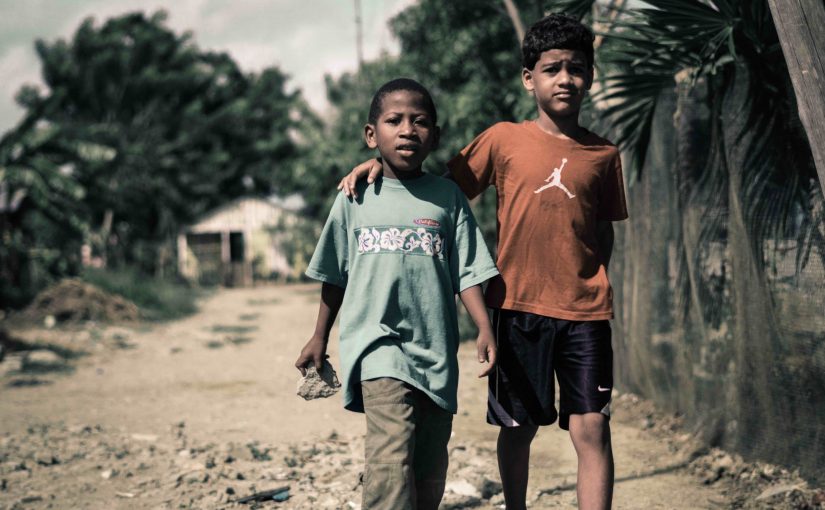
A child’s first introduction to manhood is often through their fathers. It’s high time we push back on toxic masculinity and what it means to “be a man”, in order to create a better future for our children and ourselves. Featuring author and activist Kevin Powell and Tony Porter, the Co-Founder of A Call To Men.
With growing interest in co-ops, public banking, worker-owned companies and non-profit corporations, could we be setting a new standard for the American ideal, while building a more sustainable economy? Featuring Gar Alperovitz, co-founder of the Democracy Collaborative and co-chair of its Next System Project, and Ted Howard, co-founder and President of The Democracy Collaborative.
Directed and Edited by: Theo Badashi Animations by: The Next System Project Consulting Producer: Kenny Ausubel for Bioneers Produced by: Theo Badashi and Maximilian DeArmon for Cosmogenesis Media Group
By Richard V. Piacentini, President and CEO of Phipps Conservatory and Botanical Gardens
At Phipps Conservatory and Botanical Gardens, our commitment to sustainability in everything we do has led us to construct some of the world’s greenest buildings. On a single project site, a visitor to Phipps can now see an unprecedented multi-facility complex of three buildings, each showcasing a different construction type — new, modular and existing — and each designed to meet the most rigorous standards in the built environment. We use the Living Building Challenge, LEED Platinum, SITES Platinum and WELL Building Platinum certifications as our standards for our new buildings.
Our commitment to these certifications began in November 2006 when I attended the Greenbuild Conference in Denver. We were one month away from opening our Tropical Forest Conservatory, a revolutionary 12,000-square-foot glasshouse that was designed to be passively cooled and have no greenhouse effect. By this time, we found ourselves thinking in systems, which is how nature works. We were trying to understand how to best integrate our buildings into the environment.
While I was at Greenbuild, Jason McLennan introduced the Living Building Challenge, the most rigorous green building standard in the world that is based on systems thinking. We were just about to start planning for our education, research and administration building, the Center for Sustainable Landscapes (CSL). Finally here was a certification program that went beyond checking boxes and understood that we should be thinking more broadly than just saving energy and water. It was more than a program — it was a philosophy that understood that the way we construct our buildings could help us integrate ourselves back into nature. So we decided to pursue it. At that time, no one had ever built a Living Building and no one knew if it was possible so we decided to pursue LEED Platinum as a backup.
Right before we started design, the Sustainable SITES Initiative was launched, which attempted to define best practices for integrating buildings into the environment. We decided to pursue that too. During construction, the WELL Building Standard was launched to define best practices for human health in the built environment. Even though the Living Building Challenge has many requirements related to human health, by this time we had really come to understand how human and environmental health are inextricably connected, so we decided to pursue WELL too to see if there was anything else we could learn to make buildings better for the people who will occupy them.
During the construction of each of these buildings, the question often came up: “How much did this project cost?” A simple answer just doesn’t do it justice, as it implies that the only factor that should be considered in a new project is the initial cost. A popular misconception that passes for conventional wisdom says that green buildings are too expensive and aren’t worth the investment. At Phipps, we know that this is a short-sighted mindset — in fact, green buildings make perfect economic sense, and their benefits only increase when an organization approaches a construction project with a holistic, long-term view.
All
three of our new green buildings are designed to meet the Living Building
Challenge and operate at net zero energy, meaning they generate all of the
energy that they use within a year. The CSL actually produces more energy than
it uses in a year (net positive), generating 133,301 kWh and using only 129,876
kWh in its last year of operation. This electricity that powers the CSL is
produced entirely on-site through solar and wind generation. One of the reasons
the building is able to achieve this remarkable feat is because it is extremely
efficient. The CSL has an energy use intensity (EUI) of 18, which is 73.8% less
than the EUI of a typical office building. This energy efficiency is achieved
through a combination of sustainable features and strategic design choices that
anyone can make. For example, choosing to situate the building so that it faces
south, maximizing solar gain and daylighting, greatly reduced our energy needs.
Our geothermal heating and cooling system is a very efficient way to condition
the building and it is completely powered by on-site generated power. Over
time, the fact that Phipps’ green buildings will never have a heating, cooling,
electric or sewer bill really adds up. The cost of operating the CSL over the
next 30 years compared with a conventional office building of the same size will
save Phipps $3 million in energy costs alone. With conventional buildings there
will always be utility costs.
On its lower campus, Phipps’ green buildings capture,
treat and reuse all water that falls onsite, managing 3.25 million gallons of
storm water per year — enough water to fill five Olympic swimming pools. Since
the CSL opened in 2012, not a single drop of storm or sewer water has left the
site. As a botanical garden, Phipps has a great need for water. Water that
falls on the back of our campus, where our three green buildings are located,
is used to irrigate the landscape or is allowed to infiltrate. A combination of
constructed wetlands and sand filters allows us to clean and reuse all of the
water from toilets and sinks. A typical office building using the CSL’s amount
of potable water will spend more than $140,700 over the next 30 years on water
usage and treatment. That cost simply does not exist in the CSL, Nature Lab and
ESC. By capturing, treating and reusing the water on our site, Phipps also
saves the City of Pittsburgh money by keeping this water out of the already
overtaxed combined sewer and storm water system. By treating and reusing all
water that falls onsite, green buildings save money for the building owners and
the cities in which they exist.
Though it is often not considered during the building
design process, the biggest cost to an organization is staff — not electric,
rent, water, etc. Many peer-reviewed professional studies show correlations in
building design that are designed to address employee health and staff
productivity, attendance, focus and mental engagement, mood, overall physical
health, recruitment, and retention. These studies appear in journals such as Indoor and Built Environment, Journal of the Illuminating Engineering
Society, International Journal of Epidemiology
and International Journal of Environmental
Research and Public Health. In fact, a study done by real estate services firm Stok
cites an annual profit of $3,395 per employee in a 150,000 square-foot high
performance green building. In addition to the Living Building Challenge, Phipps’
CSL and ESC are designed to meet WELL Platinum Certification, a certification
that focuses on human health and well-being in buildings. Our green buildings
are free of Living Building Red List toxic chemicals, which are very commonly
found in typical office buildings and are harmful to human health. They also
incorporate elements of biophilic design, which connects people to nature in
the built environment and has a positive impact on human health. From extensive
use of indoor plantings to plentiful windows offering views of nature and
natural light and ventilation, these buildings blur the line between the built
and natural environment, celebrating the bonds between humans and nature. By
investing in our staff’s well-being upfront, we will see a long-term payoff in
the future.
Before Phipps began constructing green buildings on its lower campus, the site was a brownfield — toxic, barren and completely paved over. Now, it has transformed into a thriving ecosystem that is healthy for the people, native plants and wildlife who occupy it. Restoring the land and making it more beautiful also added an attraction for the visitor experience. Green buildings operate with nature, not in spite of it. This creates a beneficial ecosystem for all living beings that use the space.
Finally, taking a broader look at green buildings, Phipps’ projects support a new sector of construction. By serving as a role model for the world, the CSL, ESC and Nature Lab encourage other organizations and individuals to pursue Living Buildings. Our spaces prove that green buildings can be beautiful and are better places to live, work, learn and play than traditional buildings. If more organizations follow Phipps’ lead, more manufacturers will respond with more efficient and less toxic building materials increasing competition for these items and thereby lowering their cost. In addition, as more people begin to construct high performance green buildings, industry leaders will be encouraged to innovate and invent new technologies for them, leading to job growth in their fields. Constructing green buildings doesn’t just make economic sense for individual organizations; it contributes to the economy as a whole.
When looking at a building project from a long-term view, it becomes increasingly apparent that high performance Living Buildings vastly out-perform their traditional counterparts. By generating their own energy and managing all of the water that falls onsite, they never see a utility bill, saving millions of dollars over time. The value of human and environmental well-being are not typically a part of building design conversations, but they should be.
Since 1994, Richard Piacentini has led the green transformation of Phipps Conservatory and Botanical Gardens, including construction of the Center for Sustainable Landscapes, the only building in the world to meet Living Building Challenge™, LEED® Platinum, WELL™ Platinum, and SITES™ Platinum certifications. Richard is interested in the connection between people and plants particularly as it relates to human and environmental health. He has received numerous professional honors, including APGA, ILFI and USGBC leadership awards.
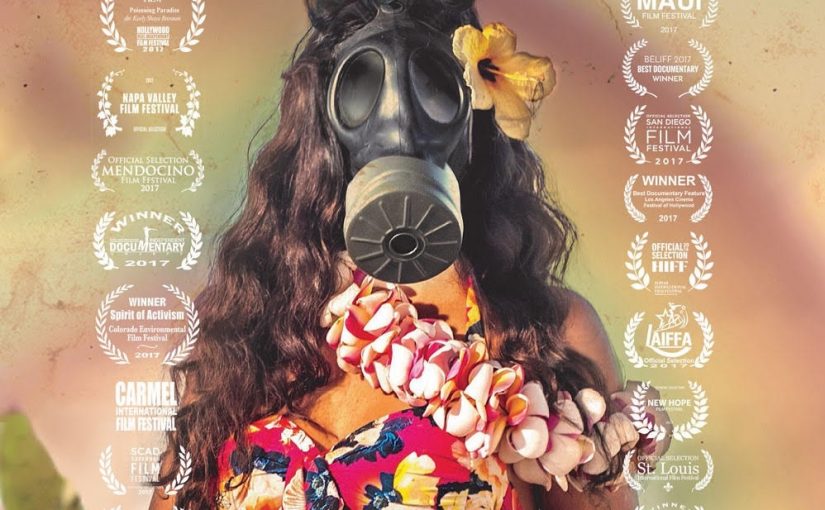
The
new documentary film “Poisoning Paradise” tells the story of local activists in
Hawaii who are battling political corruption, corporate bullying, and
systematic concealment by the agrochemical industry about their widespread
testing of genetically engineered seeds and crops.
Communities became surrounded by experimental test sites after policymakers in Hawaii and D.C. tried to diversify the Hawaiian economy, which was overly reliant on tourism. They encouraged the world’s largest chemical companies to utilize Kauai’s favorable climate and fertile soil to test their biotech seeds, which are designed to be reliant on toxic chemicals, such as RoundUp Ready herbicides. For years, Syngenta, Pioneer DuPont, BASF, and Dow AgroSciences have been allowed to apply hundreds of tons of Restricted Use (RU) pesticides on thousands of acres across the Garden Island’s West Side, the traditional homeland of an Indigenous and disenfranchised population.
Bioneers sat down with Director Keely Brosnan to discuss how “Poisoning Paradise” explores the community’s ongoing struggle to advance bold new legislation governing the fate of their island home.
BIONEERS: What inspired you to make this documentary?
KEELY BROSNAN: In essence, this film is really a love letter to Hawai‘i. I grew up in Hawai‘i as a small child, and live in Hawai‘i part-time. It’s a place I love and with people I love.
I started to hear rumblings in 2013 about GMOs and
experimental outdoor field trials of genetically engineered crops and
pesticides, but I didn’t really understand what was happening. So, I met with
some residents and local activists and attended meetings. And my neighbor and
producing partner Teresa Tico wanted to make a film about Bill 2491, and my
husband and I agreed to fund the project. Then it grew exponentially into Poisoning Paradise, which has a much
broader reach and message than the original concept.
BIONEERS: What
were some of the shocking things you learned in your research that you decided
to include in your film?
In the 1980s, as the colonial-based sugarcane industry
collapsed and the pineapple industry collapsed, policymakers in Washington and Hawai‘i
invited the biotech industry to take over the fallow fields. I don’t think that
they understood what the consequences would be, or the amount of chemicals that
these agro-chemical industries would be utilizing.
The business model of large agricultural companies is to maintain a system that’s reliant on toxic pesticides. They have an arsenal of tools in their toolbox, including restricted use pesticides: Atrazine, Chlorpyrifos, and “general use pesticides” that people are more familiar with, like Roundup. The chemical companies use pesticides on their GE crops at a much higher frequency than conventional farmers. Handwritten spray logs show that GE fields are sprayed with a higher frequency and many more times per day than conventional farms. This results in a chemical cocktail of untested combinations of pesticides that are sprayed multiple times a day, multiple days per week, all year long near our schools, homes, hospitals, and environmentally sensitive shorelines. So, it’s really caused a lot of uproar in our community.
BIONEERS: We hear these companies referred to as “biotechnology” companies, but as your guests point out in the film, these are chemical companies who have no interest in reducing the amount of pesticides that farmers spray on crops. On the contrary, their primary technology is “pesticide-tolerance,” which allows farmers to blanket crops with chemicals that kill weeds without killing the plant itself. It seems like these companies are contributing to a massive increase in pesticide use?
KEELY: They’re
chemical companies that are developing seeds for GE crops that are designed to
rely on the chemicals they sell. So as Vandana Shiva says in our film, why
would a chemical company be a means to reducing the sale of Roundup, the single
largest contributor of profits to Monsanto? They designed these crops to sell
more chemicals. This is why what’s happening on Kauai is important for
everyone, because this is where research and development and field trials for
genetically engineered crops happens. Once they develop their seeds, they ship them
around the country and around the world.
BIONEERS: These trials are allowed to go on without any environmental impact studies?
KEELY: To date,
yes. The federal government hardly regulates genetically engineered crops in
any meaningful way, and until recently, the state has had a hands-off approach
to these chemical companies. But I think the day of plausible deniability is
over. I don’t think lawmakers can say that they didn’t know that these
chemicals were dangerous.
Just in the past six months, we’ve had three different courts who ruled in favor of individuals who sued Monsanto/Bayer, the conglomerate, after developing Non-Hodgkin’s Lymphoma, totaling nearly $2.5 billion in damages. In August 2018, a San Francisco jury awarded Dewayne Johnson $250 million in punitive damages and another $39 million in compensatory damages for his lost income and pain and suffering. A federal jury in March 2019 ordered Monsanto to pay more than $80 million in damages to another California man, Edwin Hardeman, after it was determined that his cancer was partly caused by his use of the weed killer Roundup.
Director Keely Brosnan
BIONEERS: Can residents find out about statistics
regarding birth defects or environmental damages caused by the spraying of chemicals
in Hawai‘i?
KEELY: I’m not sure that they’ve been keeping accurate records at the National Birth Defect Registry in the State of Hawai‘i. Often when you have a serious ailment, you have to leave the island and seek treatment elsewhere in order to get the kind of specialized care that Children’s Hospital in LA, or St. Jude’s Children’s Research Hospital, or other hospitals that are geared towards treating children provide.
The truth is I’m not aware of anybody testing the air, water or soil quality. Nobody really knows, for example, what happens at the end of the day after they’ve applied these chemicals on fields. They mix the chemicals in their trucks for application, and then they clean out that drum from their truck. They’re not hauling away the poison that was inside. So where does it go when they rinse it out into the field? We live on an island with finite natural resources, and one of our most important natural resources is our drinkable water. We have to be very careful about contaminating aquifers.
We need to start gathering data and testing the oil samples near people’s homes. We need people to start canvassing neighborhoods and going door-to-door to talk to people about whether they’re sick, or whether their family members or neighbors are sick. Putting federal, state or even private funding into that kind of a program would be a good idea. Our federal regulatory agencies aren’t doing enough to protect people and the environment from these toxic pesticides. [Report on
BIONEERS: You address
neonicotinoid pesticides in the documentary. Can you talk about the dangers of
that particular technology?
KEELY: Unfortunately, Neonicotinoids and similar systemic insecticides are currently among the most utilized pesticides in the world. They are linked to the alarming collapse of bee colonies and, without a doubt, the decline of our pollinator population.
I believe the EPA is going to ban the use of Neonicotinoids
in the U.S., and ask that they be removed from the shelves for consumer use.
I’m following that story and will be updating information on our website for
people who are interested.
There are fantastic organizations like the Center for Food Safety, who is defending our food system from pesticides and pharmaceuticals, and toxic food additives and genetic mutations. Most recently, they spent years in court representing conservationists and beekeepers who sued the EPA for failure to protect pollinators from toxic neonicotinoids. There was a settlement reached last month where the EPA agreed to withdraw certification for 12 Neonicotinoid-based products, pulling them from the market because of the devastating effects that they have on our pollinators.
BIONEERS: You show in
the film that people of color and Indigenous Hawaiians are bearing the brunt of
the harms caused by the experimental tests. The local community there in those affected
areas are deeply involved in organizing around raising awareness and advocating
for legislation. Can you tell us about the bills that have been introduced and
the status?
KEELY: Bill 2491
failed, which was really sad. It asked for modest buffer zones around schools
homes, hospitals and other environmentally sensitive areas. It also would have
required disclosure of what was being sprayed, when and where it was being
sprayed, and an environmental impact study. As you saw in the film, that bill
failed after going through the 9th Circuit Court of Appeals.
The grassroots movement just for Bill 2491 probably
surprised local legislators and government officials, but it didn’t surprise me
because people who live in Hawai‘i really have a sense of stewardship of the
land. They really want to be thoughtful and careful and I don’t think that
government reflects the people’s wishes and desires as it should.
Then, last summer, the Governor of Hawai‘i signed into law Bill SB-3095, which does require 100ft buffer zones around schools. That was fantastic news, but it’s by no means a solution. I was sitting on an airplane at the time with my husband when I heard the Bill had passed, and although I felt some elation that we had some forward momentum and that it would set a precedent, I told my husband, “This plane that we’re sitting on right now is longer than a hundred feet,” so to require only a hundred foot buffer zone around a school is clearly inadequate.
Through SB3095, we were able to ask for disclosure of the chemicals that the agrochemical industry is using on the island. That report should be made available sometime in January 2020, and will be the first time that we have real disclosure. Then, the State of Hawai‘i initiated a total ban on Chlorpyrifos, which is extremely important, because they know that it causes damage to fetuses in utero, and also to babies and children as they develop and grow. The problem is the ban is little consolation if you live next door to these fields, because they’re allowing three more years for companies to phase it out, so they can still use it in Hawai‘i until 2022, I believe.
The Ninth Circuit Court of Appeals has given the EPA until July of this year to decide on the use of Chlorpyrifos. Hawai‘i was the first state to ban it, and then California followed suit. Other states like New York, Oregon, Connecticut and New Jersey have bills under consideration to remove Chlorpyrifos from the market. So, we’ll have to wait for the EPA findings.
BIONEERS: Your film includes a nice balance of voices. There are people such as Robert F. Kennedy Jr.; Sylvia Earle, the marine biologist; Vandana Shiva, the activist and author; Andrew Kimbrell, attorney and director of the Center for Food Safety and other lawyers they’ve worked with on the ground. Can you talk about some of the local experts and activists who appear in the film?
KEELY: Yes, I wasn’t an expert on the subject. I am a
filmmaker, and I stepped up to document what was happening as a journalist. But
we also had local experts and scientists and we decided that it would be useful
for us to gain some expertise from them. Fern Anuenue (formerly Rosenstiel)
obtained her Bachelor’s in Science with triple majors in wildlife management
and environmental science and marine biology. Andrea Brower has a PhD in Sociology
and, specifically, from working in environmental sociology. So, they brought a
lot to the table. They are residents and they are on the ground assisting a
very grassroots movement.
BIONEERS: How concerned should tourists who are traveling to Hawai‘ibe about risks to their own health? Who would they contact if they’re planning to travel to the Islands?
KEELY: I certainly think it’s worth a call to the tourism office to tell them they’re concerned. Whether they give you any information or not is another question. The 1.3 million people that went to Kaua‘i last year probably weren’t aware that Hawai‘i hosts more outdoor GE crop field trials than any other state in the nation.
As you’ll see in our section on tourism, you can’t even
bring an apple to Hawai‘i. The State Department of Agriculture will take
that away from you. So, while on one hand, they’re doing a very good job of
protecting our natural resources, I personally think that the visitor industry
should be pushing our state officials to protect public health. They have a
responsibility to inform visitors who are going to be in the Hawaiian Islands
that they may be exposed to these RU pesticides and chemicals.
Let’s say you want to go camping at Polihale State Park. The
winds can blow from those fields right across your campsite to the ocean. Drift
is relevant and it’s real. If you were trying to be careful, if you were trying
to protect your children’s health, you might want to avoid a certain part of
the island where these field trials are taking place.
I think anyone who is visiting Hawaii should could call the Board of Tourism, the Department of Health, the Department of Agriculture, the Governor’s office and ask these really important questions. I believe that the County government is a political subdivision of the State, and it has a responsibility to protect the environment for everyone’s benefit.
Hawai‘i’s State Constitution states that for the benefit
of present and future Generations, the State and its political subdivisions
shall conserve and protect Hawai‘i’s natural beauty and
all its natural resources — and that includes land, water, air, minerals and
energy sources. It would be good for elected officials to know that people are
concerned.
BIONEERS: Who are you
hoping to reach with your film, and how they can become involved?
KEELY: We hope to
reach a broad audience. While we talk about Hawai‘i, we are trying to
help people around the country understand the situation here as well as the
broader impacts.
Poisoning Paradise
is a time capsule of a grassroots movement that is seeking disclosure and environmental
protections, which necessitate an Environmental Impact Statement. We want
scientific data to understand how these chemicals affect our food, health,
land, water, air, oceans and wildlife, and all other natural resources in the Hawaiian
Islands. We want to reach out to anyone who is also interested in protecting
the environment and who are involved in the food movement and sustainable
agriculture. The recent rulings against Monsanto make this discussion very
relevant and real.
I think education will always be part of the solution. The
bottom line is that we need to move away from pesticide-heavy agriculture, and
we need to put our resources into recreating regenerative, diversified
agriculture systems. They remove toxic pesticides and fertilizers from the
equation, and they help to protect our communities, farmworkers, and our
environment.
These regenerative systems also drastically reduce
agriculture’s reliance on fossil fuels, which include petroleum-based
pesticides and fertilizers. They help to build soil that sequesters carbon,
which slows down climate change. They help to build a strong foundation of soil
that captures and holds water, eliminating destructive sediment and runoff. They
also make farms more drought tolerant.
I think everyone should be pushing for counties to regulate
from within when it comes to pesticides. That includes your county parks, county
roads, and especially your county schools. Every state and every county should
be pushing to get the Department of Education to ban the use of herbicides
around schools to protect children. That’s a great first start.
Also, while you might not be able to grow all your own food,
grow something, or get to know your farmers at the local markets. Buy organic
where you can, educate yourself about the “dirty dozen,” what to avoid unless
it’s organic. Pick and choose, if you have to, which crops you can afford to
buy that are organic. We want to protect our food supply. We want to protect heirloom
seeds, and organic seeds. I think it’s the only way that we’re going to have a
viable food system.
Be part of the solution. We need everybody’s help and
everybody’s voice. I hope that audiences find Poisoning Paradise, not only informative but also beautiful to watch—it
really highlights what’s at stake for all of us.
A conversation with Gar Alperovitz, co-founder and co-chair of the Next System Project and the Democracy Collaborative.
BIONEERS: When you talk about the “Next System”, how far-reaching is the change you’re talking about?
GAR ALPEROVITZ: We’re talking about the entire political economic system, which means how business is organized, how cities are developed, how parliaments or governments are organized, how states are organized, how regions are organized. Everything, starting at the grassroots level in a neighborhood all the way up to: What’s wrong with the Constitution? What are the problems in parliaments? What are the problems in Washington? How do you replace the corporation? Every level. Changing the system means re-examining every single institution and seeing pathways forward, those that are theoretically meaningful but also practical things on the ground that point in a new direction.
I think as time goes on what we’re looking at is the introduction of new ideas. The ideas that became the New Deal were local experiments in the 1920s that were worked out and fine-tuned. Then when the time was right in the 1930s they went national with the New Deal, we saw Medicare, Social Security, and labor law allowing for unions. All that was experimented with locally, then became national, and I think we’re going to see a similar process.
BIONEERS: Do you feel there are certain big, game-changing actions that would address many of those things at once?
GAR ALPEROVITZ: People usually distinguish between reforms, which are small changes at the edge, and revolutions, where everything changes at once. The language I like is “evolutionary reconstruction”. This means redeveloping how cities are organized, piece by piece, looking at how regions might be changed and developing the elements, walking the path as you go. It produces systemic change, fundamental change in the institutions, but the pathway is a reconstructed pathway, not reform. Reform keeps the institutions in place and tries to fix up around the edges. Revolution is explosions, tries to throw things over. The pathway we think makes sense in an advanced system like our own is kind of evolutionary, while changing the fundamental institutions as you go.
Gar Alperovitz
BIONEERS: A key question is how to deal with industry, transnational corporations and large banks that hold so much power?
GAR ALPEROVITZ: I think we will begin to see larger scale publicly-owned or democratically owned structures, maybe even regional/community/worker, different structural forms that represent the community that are not just centralized kind of authorities.
A decade ago, the big banks collapsed, General Motors collapsed, Chrysler collapsed, and the U.S. government nationalized those companies. If the speculation had been allowed to go on, the country would have gone into massive depression. When General Motors and Chrysler went down, all the suppliers in the cities around them suffered too, which meant those communities were badly beaten up. That’s why the Obama administration had to jump in and do something. Then, after we put a lot of taxpayer money into them, they went back to the old owners after taxpayer expense.
I think we’ll see another economic crisis, because the regulatory structure is being ripped apart by the government at the interests of the big corporations and banks. At some point, some of those will become public or regional or state structures.
BIONEERS: What are public or community banks, and how do they fit into the picture?
GAR ALPEROVITZ: Big banks in almost every other major country around the world are actually public banks. It’s very common for the reasons I’m talking about, because if you don’t do that, you run into trouble and it costs the whole country a lot of money.
The most important aspect is that this is where people put their savings, but also city tax money goes into the public bank. Cities have a lot of taxpayer money, so why put it in a big, big New York or Wall Street bank, which invests that capital in speculative things, rather than the local community? Keeping that money in public banks allows that capital to be invested in what a community needs. It’s part of this whole notion of democratic development of the community. It’s a very practical, common sense approach, and not in any sense radical.
We love to point to the Bank of North Dakota because they do it so well. The Bank of North Dakota is a statewide public bank that’s 100 years old, and it’s in one of the most conservative states in the country. They run it with the support of farmer co-ops and small businesses, local townspeople. It’s very popular and very successful.
The model is being replicated or considered in many parts of the country, including Los Angeles, Washington State, Philadelphia, and Phil Murphy won the governorship of New Jersey campaigning on developing a public bank. Cleveland hasn’t done it yet, but is in the process.
BIONEERS: You’ve mentioned that Ohio has quite a lot of action in this regard. Can you describe what is happening there?
GAR ALPEROVITZ: Ohio is very interesting because we’ve had a lot of job displacement and companies leaving. We can trace this all the way back to the Youngstown fight, which was about 35 years ago, when a big steel company shut down and workers decided to take it over and own it themselves. There was a big, big fight about that. Since then, the idea has been in the air that companies might be owned by workers, or in that case, by the community or community-worker ownership.
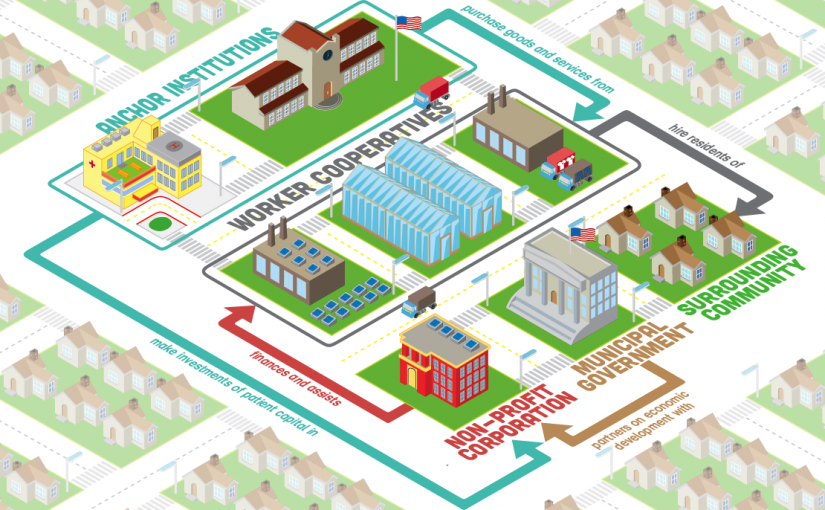
Many worker-owned companies have developed over the last number of years. ESOPS – Employee Stock Ownership Plans and co-ops in Cleveland culminated with a development of about 40,000 people in a very poor, black neighborhood with about $20,000 per year annual family income, and 20% unemployment. Our folks helped to develop a community-wide nonprofit corporation that covers the whole community, and worker-owned companies are attached to that. They’re not stand-alone, they’re part of the community building structure.
BIONEERS: How do worker-owned companies benefit the community and build community wealth?
GAR ALPEROVITZ: A worker-owned company is a worker-owned co-op, one person, one vote. One example would be a credit union. There are 3 million people in credit unions, so this is very conventional in many parts of the country. The idea that the workers could have a stake in their company and own it, control it, is just an extension of this. There are lots of co-ops in this country, and a lot of experience with this around the world, so it’s not a very novel idea.
What’s interesting is bringing co-ops in as part of a community structure that is a nonprofit corporation. This benefits the whole community, because those companies can’t get up and go. They’re financed in part by the community through a community corporation. So it’s a mixed model, and that’s what’s unique about the Cleveland model and others in different parts of the country that are following suit.
The notion of trying to stabilize the economic health of communities is very commonsensical, and doing it in ways that change the ownership patterns. Community and worker-owned companies don’t get up and move, because they live there and the people are there.
BIONEERS: You stress the importance of “anchor institutions” in this next system. What are those?
GAR ALPEROVITZ: Big anchor institutions are very important. They are institutions that don’t leave the area. In Cleveland, we have both public and private hospitals as part of the network. Cleveland Clinic is a private hospital. Case Western Reserve University also has a hospital and medical school. Hospitals connected with universities are all anchored in the community. They receive and use so much public money – Medicare, Medicaid, educational money – you can use that as leverage in the development process.
There’s a whole network called the Health Anchor Network, and those anchor institutions help build up the community by redirecting their purchasing power. They say, we buy a lot of food, we buy a lot of goods, we buy a lot of furniture, we buy a lot of equipment. If we direct some of that to the community – not just to get supply, not just because it helps the community, not just because it might be good to give the workers some ownership, and not because it’ll anchor more jobs – but it also improves the job situation in a community, and the health outcomes improve. So this is a converging trend.
Anchoring institutions in a way that allows people to have a long-term stake in the community is financially practical and it makes sense to people. The ideas seem novel, but they’re quite, quite straightforward.
BIONEERS: Where are some other places where innovative projects in this vein are sprouting up?
GAR ALPEROVITZ: Austin, Texas and Madison, Wisconsin are doing really interesting things with co-ops and land trusts and credit unions. There are people in Oakland and the greater Bay Area doing really interesting development around transit exits. When you put in a subway or a transit system at the exits, property values go way up, because it’s a really good place to put housing. Developers want to capture that, but if you hold on to it and develop it in public ways, the public captures that money and can subsidize the transportation system. Washington, D.C, has been doing that for a long time.
Major cities like New York City, Philadelphia, Seattle are all experimenting with worker-owned land trusts, different kinds of end-to-end energy systems.
The truth is lots of people are taking part in what some people are calling The New Economy Movement. If you go to the Democracy Collaborative website and many others, you’ll find hundreds of these kinds of experiments. There’s enough practical experience around the country, you can just call somebody up and find out how to do it.
Several of our folks have gone to the city of Preston in England to share what is happening in Cleveland. It’s a city of about 120,000. One particular person there, Matthew Brown (who’s now the head of the city council, but at the time he was what we would call an alderman) got turned on with what we were doing at the Democracy Collaborative and with what was going on in Cleveland, and got interested in one of my books. He said, We could do that here in Preston. And he rolled up his sleeves and got it going. People liked the idea. Other cities in England are looking at doing that kind of model. The Labor Party has picked it up, and there are a number of people working in European communities that have begun thinking about it. You don’t have to have an election, you can develop it locally. It’s a very exciting development.
BIONEERS: What about rural areas where small communities have been abandoned by poor agricultural policy choices and big corporations? There was an intentional effort by industry and the US Government to get rid of farmers, mechanize agriculture and capture all that land to turn food into a commodity. Now these small towns are really suffering.
GAR ALPEROVITZ: Yes, it’s terrible history. There are a very small number of farmers now, about 1.5% of the labor force. That means the people either stay in these dying towns or they drain to the cities. Development in rural areas is very, very difficult. Some of that can be reversed around small town redevelopment in rural areas, and I think some of it’s going to be. Historically, farmers co-ops and rural electric co-ops organized and played a big part in putting together the Bank of North Dakota.
Also, with adequate political buildup, it makes every bit of sense to create land trusts from the point of view of the nation, to keep people on the land and in small towns. Small towns can be very ecologically efficient if you build them up sufficiently. I’m looking for current experiments that work in the rural areas. There are some attempts in Wisconsin to create multi-stakeholder kind of cooperatives, often around using a public facility or public university.
You put your finger on one of the hardest problems in the rural, decaying areas. The paradox here is that subsidies for agriculture are a huge part of the federal budget, and yet farmers are a very small part of the population. Somehow the politics of that can be worked. It’s a really hard problem. It’s doable, but it takes a political push. We’ve got to organize the constituency.
BIONEERS: How do politics play into these new economic models and systemic changes?
GAR ALPEROVITZ: Red/Green/Blue doesn’t work anymore. Ohio is a good example. Ohio voted for Mr. Trump, and it is one of the most interesting places for experimentation in the country. So what’s happening at the grassroots level may be different from what happens at the current level of politics.
What’s driving a lot of our current politics is unanswered pain, and it’s being exploited by the right. But the pain levels are growing, and that means you need solutions at some point. I think we’re seeing the prehistory of a real transformation happening. If you look at it historically, the kinds of things people are focusing on that look like small experiments are often the seedlings for giant redwood trees. That’s possible. It’s also possible that we will go in a really rightwing direction and things get very painful. Lots of transformations go through difficult phases.
At the Next System Project, we’ve asked the big questions: How would you actually design a system? We’re talking about bits and pieces here. There’s a whole group of people who we’ve asked, “What makes sense? How do you get democracy? How do you get real liberty? How do you get equality? How do you get ecological sustainability? What is a systemic vision? We’ve had something like 45 different contending papers written. We’ve had conferences at MIT and Harvard, really trying to get deep into this so-called “Architecture of the Next System.”
Ideas matter, and have magical power because people see, “Oh, we could do it a different way. If we really wanted to, we could roll up our sleeves and try it here.” That’s what makes this period a very powerful time of American history.
From ancient myths to modern blockbuster movies, humanity has recounted countless stories in which a seemingly inert vegetal world suddenly comes to life to express itself like a person. What if these stories were more than the fruit of vivid imaginations and were based on an underlying truth? Monica Gagliano, Research Associate Professor in Evolutionary Ecology at the University of Western Australia, has courageously illuminated the revolutionary new field of Plant Bioacoustics. She shares startling cutting-edge research and shows how contemporary science has finally begun lifting the veil of our assumptions by beginning to attune its ears to vegetal “voices.” She believes this new paradigm will expand our perspectives to provide us with imaginative new solutions to our current eco-cultural predicaments.
Introduction by Kenny Ausubel, Bioneers CEO & Co-Founder.
Ellen Brown is an attorney and leading public banking advocate, founder of the Public Banking Institute, and Senior Fellow of the Democracy Collaborative. She is the author of hundreds of articles and 13 books, including the best-selling Web of Debt, The Public Bank Solution and Banking on the People. She also co-hosts the “It’s Our Money” radio program on PRN.FM. Bioneers sat down with Brown to discuss the speculative economy, public banking, and whether we could be headed toward another major financial crisis.
BIONEERS: Let’s start with a big picture. We’re more than 10 years past our 2008 financial crisis triggered by Wall Street banks. Can you talk about some of the worst effects that we’re still seeing now?
ELLEN: The rich are getting richer, as most people are aware, and the rich, of course, own the media, so they report that the economy is doing fine. But for the lower 80% of the population who are net debtors, it’s getting worse. Consumer debt is ballooning. We have a massive homeless problem. We have a shortage of houses and jobs.
There’s a deficit of money in the system. And it’s not just the U.S. Virtually all countries are heavily in debt. So if everybody’s in debt – countries, businesses, individuals – who are they in debt to? They’re in debt to the banks. Banks create our money supply, not governments, as most people think. They create it as debt — as loans. They just write the figure into your account when they make a loan, and then that money has to be paid back, plus interest. So there’s a catch: more money has to be paid back than was created in the original loan, so there’s never enough money to pay off the debts.
BIONEERS: When you said that the rich are getting richer, you’re saying that as they get richer, they’re capturing that capital and it’s not going back into the economy?
ELLEN: Exactly. It’s extraction – extracting money out and putting it into the speculative, wealthy money-making-money economy. It’s a closed loop, driving asset prices up without producing anything new.
BIONEERS: Many economists are agreeing that there are bubbles again, and that we’re in for another financial crisis. Do you agree? What do you see as the indicators of something like that?
ELLEN:I definitely agree. One indicator is that the Federal Reserve has been raising interest rates, at least until recently, and virtually every time they raise interest rates, it creates a recession. Their argument is that we’re at technical full employment, so if everybody’s working, they’ll demand more money, wages will go up, and that will create inflation.
We’re not even close to true full employment. But that’s their argument, that we’re dangerously close to full productivity, and therefore if they raise interest rates, that’ll slow the creation of money in the economy in the form of credit. But it puts a huge burden on businesses that now have to pay more, along with students, consumers and governments.
It’s estimated that at current rates, the U.S. government will be paying close to a trillion dollars just in interest every year, which is more than we pay for the military. That would eat up our tax base. So it’s unsustainable and it’s unnecessary. There are other ways we could work this system that would be sustainable.
BIONEERS: What are the dangers of wealth funneling into what you call the “speculative economy”?
ELLEN: The speculative economy is a big casino. When you buy a stock, the money you spend does not go back to the company. The only money that the company gets is with the initial public offering. After that, it’s literally a casino. The prices keep going up and up, and there’s little relationship between the stock price and the real value of the stock. But it doesn’t matter. You buy it because you think somebody else, some “greater fool,” as they say, will buy it at a higher price, and you’ll make money off of it.
But if you are in that position, you’re not using that money to buy your groceries. That’s play money. It’s extra money that you’ve got, and you just keep speculating until you lose. You lose the bet, and then you get wiped out, and some wealthy person gets more. It’s a game of Monopoly. The game was designed to show that the rich get richer. The hotel owners always win in the end. They suck out the profits, and they win.
BIONEERS: Did publicly owned institutions fare better during the financial crisis?
ELLEN: Eighty percent of the Chinese banking sector is publicly owned. And they just sailed through the crisis. They continued with this remarkable 10% growth for a while.
Public banks lend counter cyclically. They put more credit out there when the private banks are pulling in their credit. That keeps the economies going. North Dakota has its own public bank, and it survived the credit crisis better than any other state. Even today, the Bank of North Dakota is doing brilliantly well. There was an article in 2014 in the Wall Street Journal that said that the Bank of North Dakota was more profitable than JP Morgan Chase and Goldman Sachs. The author of that article said that it was due to oil. But that very year, oil collapsed, and the Bank of North Dakota continued to report record profits. They have a very efficient business model. That’s what I say their profits are due to.
BIONEERS: What have been some other positive effects of North Dakota’s public banking sector?
ELLEN: By law, all of the state’s revenues are deposited into the Bank of North Dakota. The bank’s charter says it will not compete with local banks. Instead, it partners with them. Local banks have all the branches and tellers, and they’re doing the basic banking. If they need help with loans that are too big, that they would otherwise have to let a Wall Street bank take on, they tap the Bank of North Dakota. It allows their state to use its own credit without being exploited by out-of-state banks.
The bank was set up in 1919 because the farmers realized they were being exploited by what was basically a cartel. The railroad, the banks, and the granary were all one system. It was extractive, extortionate, and the farmers were going bankrupt. When they realized they were losing their farms and that was the reason, they got together as the “Non-Partisan League”, and they won an election and set up their bank.
That’s basically what it is for them. It’s about keeping money in the state and leveraging it for their own purposes. When you realize that banks actually create money, it makes sense that that power should belong to the people. They’re creating money out of their own capital and their own deposits. It’s just a more efficient way to use their own money.
Los Angeles paid $170 million in 2017 just in bank fees. Plus $1.1 billion in interest. So it’s just an inefficient system. We’re sending our money off to Wall Street. They have no obligation to reinvest it in our communities, and they don’t. Their mandate is to make as much money as they can for their shareholders. So they invest in the big money makers, even though we the people don’t approve. It might be oil, it might be prisons, it might be fracking. But if it makes money, they’re not worried about the environment. They don’t have those standards.
The Bank of North Dakota is making low-cost loans into the community for the particular sectors that they support, and any excess profits go to the state. Then the state can spend that money on the things that people need.
BIONEERS: If we have another financial crisis, how do you see the bailout process transpiring?
ELLEN: Theoretically, the Dodd Frank Act was all about no more bailouts. But the Dodd Frank Act specifies avoiding bailouts by doing bail-ins. Bail-ins means taking the depositors’ money instead of the taxpayers’ money. So they’re taking our money either way.
If you’re a too-big-to-fail bank and you are insolvent, you’re required, under Dodd Frank, to take the money of your creditors and turn it into capital of the bank. So you used to think you had money in the bank, now what you’ve got is a share of a bankrupt bank. Depositors are theoretically protected by FDIC insurance. But the pot of money in the FDIC fund is very small, and what they’re insuring is $6 trillion in deposits.
There was another alternative that was raised when Obama was President, which was to nationalize the banks. What they call nationalization is that we take over the debts and clean up the books, and then we hand them back to private investors. The reason they didn’t do it was that it would be too expensive to pay off the debts of these bankrupt banks.
Hopefully somebody will raise this idea again. If you nationalize the banks, you don’t need to pay off those debts, since banks actually create money on the money they lend. You could have the Federal Reserve buy the bad debts in the same way it bought the dodgy mortgages or the mortgage-backed securities off the banks and rebuilt their asset base by replacing these mortgage-backed securities with good assets that they could call capital. They could do the same thing here: put the bad debts of the banks on the Federal Reserve and just leave them there. You don’t need to balance the books. The Federal Reserve can carry that debt indefinitely.
BIONEERS: How popular is the idea of public banking? Have there been polls done?
ELLEN: No, all we know is that there’s obvious growing support. We have over 50 activist groups in different cities and states around the country working on their legislators. We have 25 pieces of active legislation. Some of them are getting close. Progress is slow. But we’re essentially changing the whole system, so you expect it to be a little bit slow. I think the biggest resistance – not counting the big banks themselves and people with a vested interest in protecting their jobs, like bureaucrats and politicians – is from people who don’t understand what we’re talking about.
BIONEERS: What drew you to this subject matter? What would success look like to you?
ELLEN: I actually wrote 10 books on health, and the politics of health. At some point I realized that if you wanted to fix the health system, you had to fix the banking system. That’s how I jumped over into writing about banking.
Right now, we have all these little “siloed” movements that are really good, but they just don’t have enough power by themselves. What they all need is money. Many things need funding, and we think we’re short of funding. We think the government can’t put more money out there, but it can. Once you realize how the system works, you realize that there is too little money in the economy. We could pump a lot more in there. Rather than creating price inflation, we could generate jobs and productivity. We could build infrastructure. Infrastructure is a type of thing that you can extend credit for that will be paid back. They’re called self-funding loans.
That’s how money should work. You should spend the money first, on good things, productive things, not speculative things that’ll suck money out of the economy. Spend it into the economy, and it will pay back.
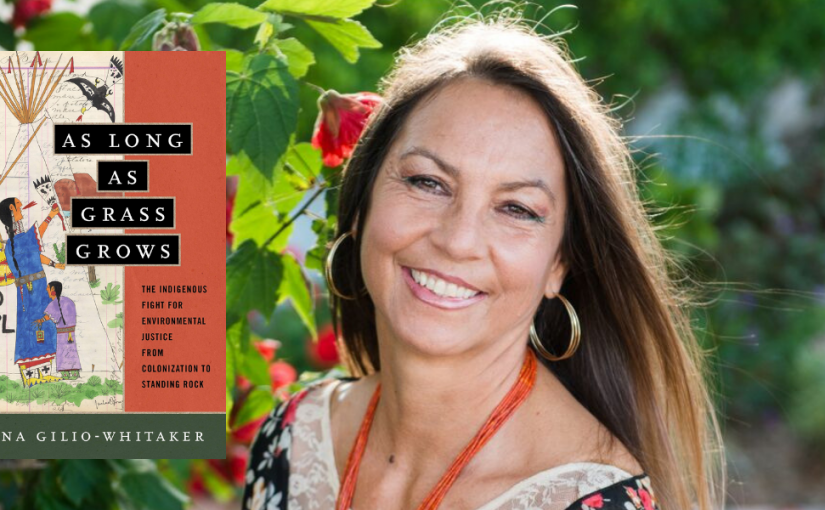
Through the unique lens of “Indigenized environmental justice,” Indigenous researcher and activist Dina Gilio-Whitaker (Colville Confederated Tribes) explores the fraught history of treaty violations, struggles for food and water security, and protection of sacred sites, while highlighting the important leadership of Indigenous women in this centuries-long struggle in her book As Long as Grass Grows (Beacon Press, 2019). The book gives readers an accessible history of Indigenous resistance to government and corporate incursions on their lands and offers new approaches to environmental justice activism and policy. Gilio-Whitaker is an independent consultant and educator on environmental justice and other Indigenous policy-related issues. She teaches American Indian Studies at California State University San Marcos
The very thing that distinguishes Indigenous peoples from settler societies is their unbroken connection to ancestral homelands. Their cultures and identities are linked to their original places in ways that define them, as reflected through language, place names, and cosmology or religion. In Indigenous worldviews, there is no separation between people and land, between people and other life forms, or between people and their ancient ancestors whose bones are infused in the land they inhabit. All things in nature contain spirit (specific types of consciousness), thus the world is seen and experienced in spiritual terms.
As many scholars have noted, the Indigenous world is a world of relationships built on reciprocity, respect, and responsibility, not just between humans but also extending to the entire natural world. Indigenous relationships with nature have been stereotyped and appropriated by dominant society in a multitude of ways (such as the ecological Indian), but in reality are rooted in a philosophical paradigm very different from that of dominant Western society. Native scholars argue that the difference between Indigenous conceptions of the sacred and Western conceptions are their different orientations to time and space.
Vine Deloria Jr., in particular, first articulated these ideas in his pioneering book God Is Red: A Native View of Religion (1973), and later built upon them in his theoretically dense The Metaphysics of Modern Existence (1979). In both works Deloria presents fundamental challenges to the Newtonian-Cartesian view of a mechanistic, linear universe. Identifying Western paradigms and drawing on Deloria, Osage theologian George Tinker observes that centuries ago Europeans adopted a perceptual orientation based on temporality. Time, as the primary organizing intellectual principle to which a spatial orientation is secondary, creates a linear and unidimensional world in which human existence is perceived as motion through space, which is cast as the past, present, and future.
An orientation that favors time over space in which the world is perceived in terms of progress based on forward motion naturally results in systems of hierarchy. Hierarchies of knowledge and life forms (evolution; concepts of superiority and inferiority), for example, make it possible for a paradigm of domination to become a guiding principle in a society. The sacred is also perceived in terms of history; places are sacred because of the events associated with them and contained within time. For instance, for Christians, Jews, and Muslims, Deloria argues, particular sites in the Holy Land are sacred primarily because of their historical significance more than a sense of rootedness in them, as is true in Native American cultures.
For
Indigenous peoples, a spatial orientation emphasizes human linkages with place,
and all the elements of that place, spanning time. These connections are
reflected by and infused in all aspects of Native life, including identity,
culture, and ceremonial cycles, as people recognize themselves as having been
placed there by spiritual forces to which they are responsible. But this
responsibility is a two-way street, and the elements of those places are seen
to be responsible to the people as well; this reciprocal relationship forms a
sense of kinship with the land itself. The emotional bonds of people to place
reflects an egalitarianism that does not distinguish hierarchies of importance,
and as Tinker observes, “humans lose their status of ‘primacy’ and ‘dominion.’
. . . American Indians are driven by their culture and spirituality to
recognize the personhood of all ‘things’ in creation.”19 Said another way, for
Indigenous people land and all its elements have agency by virtue of their very
life energy in a way that they do not in Western cultures. Humans are only part
of the natural world, neither central to nor separate from it.
From the Introduction of As Long as Grass Grows
It is no
surprise that the #NoDAPL movement would spring up in Indian country. In the
big picture, after all, it was just one more assault on the lands, resources,
and self-determination of Native peoples since the beginning of American
settler colonialism. As the Standing Rock story illustrates, the assaults have
never ended. It also illustrates the trend in the past couple of decades of the
uniting of the environmental movement with Indigenous peoples’ movements all
over the world, something that hasn’t always been the case. Environmentalists
recognize that the assaults on the environment committed by relentless
corporate “extractivism” and development are assaults on the possibility for
humans to sustain themselves in the future. They recognize that in some ways,
what happened to the Indians is now happening to everybody not in the 1
percent.
This book
is not about Standing Rock—but it takes Standing Rock as an excellent example
of what environmental injustice in Indian country looks like. It starts from
the assumption that colonization was not just a process of invasion and
eventual domination of Indigenous populations by European settlers but also
that the eliminatory impulse and structure it created in actuality began as
environmental injustice. Seen in this light, settler colonialism itself is for
Indigenous peoples a structure of environmental injustice. As this book will
argue, however, the underlying assumptions of environmental injustice as it is
commonly understood and deployed are grounded in racial and economic terms and defined
by norms of distributive justice within a capitalist framework. Indigenous
peoples’ pursuit of environmental justice (EJ) requires the use of a different
lens, one with a scope that can accommodate the full weight of the history of
settler colonialism, on one hand, and embrace differences in the ways Indigenous
peoples view land and nature, on the other. This includes an ability to
acknowledge sacred sites as an issue of environmental justice—not merely
religious freedom—and recognize and protect sites outside the boundaries of
reservation lands or on aboriginal lands of nonfederally recognized tribes.
Overall, a differentiated environmental justice framework—we could call this an
“Indigenized” EJ—must acknowledge the political existence of Native nations and
be capable of explicitly respecting principles of Indigenous nationhood and self-determination.
These
principles of nationhood and self-determination are plainly evident in the ways
Native peoples have always fought to defend and remain on their lands and the
life those lands give them. From the intrusions of the earliest colonists into
Native gardens, to the havoc wreaked by railroads and the imposition of
reservation boundaries, to today’s pipeline and fracking conflicts, Indigenous
peoples have been forced into neverending battles of resistance. As the #NoDAPL
movement made clear through the slogan “Water is life,” Native resistance is
inextricably bound to worldviews that center not only the obvious
life-sustaining forces of the natural world but also the respect accorded the
natural world in relationships of reciprocity based on responsibility toward
those life forms.30 The implicit question this book asks is what does
environmental justice look like when Indigenous peoples are at the center?
To that end, this book proceeds in eight chapters that identify Indigenous approaches to conceiving of environmental justice. Having laid the foundation with the Standing Rock story, it views environmental justice and injustice from a variety of angles, taking a view on the history of American Indians’ relationship with the US as an environmental history. It uncompromisingly exposes the roots of white supremacy not only at the governmental level but even within the environmental movement itself, ultimately for the purpose of building effective alliances around issues of common concern. It recounts numerous examples of how Native and non-Native peoples are working together to build those partnerships, and the importance of women to these efforts, and takes you on a journey to Southern California to tell a story about how one coastal sacred site and iconic surf break were simultaneously saved as a result of successful coalition building and recognition of the sacred site’s importance.
Finally, the book looks for a way forward for environmental justice in Indian country by identifying positive trends and innovative ways communities are rallying together to build a more sane future in the face of relentless corporate power, an entrenched fossil fuel industry, and its collusion with the US State. The most I hope to accomplish is to scratch the surface of what environmental justice means in Indian country, in terms of academic theory, activist praxis, and where the two meet in the formulation of government policies at all levels. It is a daunting (and humbling) task in which this is but one possible starting point; it is undoubtedly incomplete and imperfect, but one that I hope scholars more accomplished than I will expand and build upon in time.
Excerpted with permission fromAs Long as Grass Growsby Dina Gilio-Whitaker, published by Beacon Press (2019).
Filmmaker John Chester and his wife Molly took a leap of faith leaving city life behind to become farmers with the ambitious goal of bringing life back to a lifeless 200-acre piece of land. They relied heavily on the mentorship of Alan York, a pioneering leader in the biodynamic viticulture movement, who sadly passed away as the farm took shape.John documented their many failures and ultimate success in the film The Biggest Little Farm. Arty Mangan, Bioneers Restorative Food Systems Director, interviewed John about his travails and triumphs.
ARTY MANGAN: Before getting into the themes of the film, my first question is a practical one. For new farmers, raising capital to get land is huge barrier. Any tips you can share from your experience?
JOHN CHESTER: Each experience is incredibly unique, I mean, the type of investor, their open and willingness and belief and support, and the time that it takes to build the immunology of a regenerative farm, because that’s really what we’re talking about, rebuilding the biodiversity of the soil and the ecosystem of the land. The other thing is proximity to a large city, to be able to sell direct to a local food economy. The closer you are to a large city, the more expensive the land is. These are all factors in the numerous considerations when you’re looking at the emotional, economic and ecological sustainability of the farm.
We were fortunate enough to find an investor that didn’t need to be convinced that nutrient-dense food grown in an ecologically restorative way was the future. But they also had the patience to realize that when you purchase a piece of land that had been extractively farmed for 45 years in order to grow as cheaply as possible, you are going to have to spend some time and money putting finances into the bank of the soil to regenerate it to where it would become what you envisioned, which is a more self-sustaining, nutrient-cycling flywheel.
In terms of finding the money, we talked about our idea incessantly and told everyone our dream. Oftentimes when we talk about our dreams in life, we’re shamed by the standard questions of, “How do you know anything about that? Have you ever done anything like that before?” So, many people don’t talk about their dreams and aspirations. But we talked about it so much that eventually it connected us with the right people. I really believe we deserve the credit for cultivating that luck, because we risked the shaming and shared our vision with the world at a time when we probably were no more deserving than anyone else to get the opportunity.
John Chester and Emma
ARTY: From your dream, your original vision, when you look back now, how naïve were you when you began?
JOHN: We were a mix of incredibly naïve and idealistic about coexistence [with the natural world]. We have now reached a comfortable level of disharmony and purposefulness in the disharmony. Over the eight years, we are beginning to understand and accept why things can’t be perfectly balanced, because that’s not the intent of nature, at least in our eyes the way we see balance. But we’ve begun to develop a new appreciation for why the imbalance is there and have a wider acceptance for judging our coexistence with nature. We were naïve in the beginning thinking if we do all these things right, nature’s going to give us a hand. Nature doesn’t look at things from the perspective of right and wrong, it’s purely based on consequences. That’s a deeper truth that you have to take time to appreciate the integrity of.
ARTY: At one point in the film, your wife Molly said it seemed like the more the farm flourished, the more pests you attracted. There were a number of discouraging events – 70% loss of fruit to birds, major snail infestation, gophers destroying the orchard, coyotes killing chickens. Did you feel like giving up? What kept you going?
JOHN: It’s so true. It feels like everything we did to enhance the biological diversity of the land just brought about the next pest, and with vigor at embarrassing levels. We created the worst gopher problem in Ventura County. If someone would have told me what we could do about gophers, the farm would have been in the black by year three. We had the worst wild morning glory problem on any farm that I’ve ever seen. It was on easily 60 to 100 acres of the farm climbing trees, climbing the irrigation sprinklers and other stuff.
One year, the team member who was running the orchard, said, “I don’t know what else to do; I think we should spray RoundUp.” I said, “We can’t do that. It goes against four years of what we’ve built up to get [organic and biodynamic] certified.” It was either completely give up and go with a whole other way of farming, or we’ve got to see this through. Although it felt incredibly crazy and scary at the time, the more time we sat in the embarrassment of the failures, the more it gave us a deeper level of awareness for the possibilities for innovation. We all want to escape the embarrassment part of failure and put band-aids on things to cover it up, but that doesn’t solve the problem.
ARTY: Alan York, a pioneering leader in the biodynamic viticulture movement, obviously was a great mentor to you. One of the things that he said was that the rhythm of nature becomes more predictable in the seventh year. That year your sales were higher than ever before and it seemed like an ecological balance started to come into play. What happened on the farm in the seventh year?
JOHN: Between year five and seven, we saw such an immense return of biodiversity that we became aware of nature’s intent to balance out epidemics of pest and disease that we’d been struggling with years prior. That was like the cavalry coming over the hill in the third act of the film when you thought that the cavalry would never show up. It was that profound and splendid.
A simple example was the amount of ladybugs and ladybug eggs I was seeing in the spring resulting in the decimation of the aphids. Not only the aphids, but a rebalancing of everything from aphids to ACP [Asian Citrus Psyllid, an insect pest] and other things that the ladybugs like to devour. But we were also learning that you can’t solve a problem with one simple fix. That’s not how an ecosystem works unless you’re willing to take collateral damage, because the simple fix is overly aggressive.
We also learned simultaneously that the aphids and the ACP are being protected by the ants. Maybe it’s time to actually spend money on the ant control. Because we didn’t use chemical sprays, we spent five years not killing wolf spiders, which would have been inadvertent collateral damage from chemically derived sprays. So now, there’s tons of wolf spiders on this farm. They eat things like aphids and ACP. So, all these other critters were coming back to life simultaneously, and that’s what Alan kind of promised. That’s what gave us so much confidence, just keep doubling down our belief in it. That’s what cultivates more opportunity.
ARTY: Talk a bit about your relationship with Alan and what that meant to you.
JOHN: Alan was someone who had put his time in. And Molly and I are still very young, green farmers. I feel like we know nothing in comparison to what Alan could have continued to teach us. His presence in our lives gave us confidence to be really courageous and quite crazy in terms of that courage. I think he’d been waiting for the opportunity to find a couple like us that were willing to really go for it. So, he was able to take the 50 years of his life experience and apply it on a farm that grew more than just grapes, because he was mainly a vineyard consultant in the biodynamic world internationally. His emphatic cadence of speech was always direct. It’s more fun to believe him than it is to go against him.
ARTY: At one point in the film, Alan said, “Observation followed by creativity is the greatest ally.”
JOHN: That’s actually something that I’ve heard from a few people, including Joel Salatin – it could very well be his quote. There is a really important final component of that line, and that is observation followed by creativity followed by humility. And to that I would add repeat. So you just keep repeating observation, creativity, humility, repeat. You’ve got to just keep going back at it.
The humility part of it is the most freeing, energizing, encouraging realization that I think both Molly and I had. Humility means admitting you don’t have the answers, asking for help, admitting you’re scared, and realizing at the same time that your greatest mentors around you are feeling the same things. It frees you from being a farmer who has to know anything definitively, because even after eight years, the only thing I know for sure is that I don’t know anything for sure. It’s quite freeing, because it gives you the space to stay present and traverse through breaking down the anatomy of the failure, and understanding the elements that exist on your farm to combat it. But you have to stay present. I think to free yourself of this responsibility of having to know or should have known more, or should be more educated, takes up bandwidth in your brain.
ARTY: Keen observation is kind of a lost art in our culture these days, particularly when it comes to observing nature.
JOHN: I think that art has obviously been lost on farming. We spend a lot of time shaming farmers for not being millionaires. I think shaming farmers into thinking that they’re failures when they’re trying to innovate alongside nature, which is a courageous act, is an atrocity that will not encourage more farmers to innovate our way through the next 200 years.
ARTY: How can the system be changed from rewarding those who use degenerative practices – spraying chemicals, creating pollution, destroying biodiversity, etc. – to economically encourage regenerative agriculture?
JOHN: We have underestimated the force of nature, which is conscious and more powerful than the political framework. It’s far more powerful than the economic framework. When that’s aligned and it’s supporting farms that grow things in a regenerative way, expect massive change. I think that we’re seeing incredible support from consumers who know about soil. There is a growing tide of awareness and education and those consumers are the people that will make the difference, beyond the politics, beyond the chemical companies that we’ve become dependent upon because of our complacency and detachment over a prioritization of innovating alongside of nature, which has been lost for 75 to 260 years.
We’re in a much better time now because there is a consumer base that wants this, that understands the value of nutrient density. There’s another consumer base that understands the value of restorative eco-agricultural practices. Ten years ago, people weren’t even saying the word regenerative.
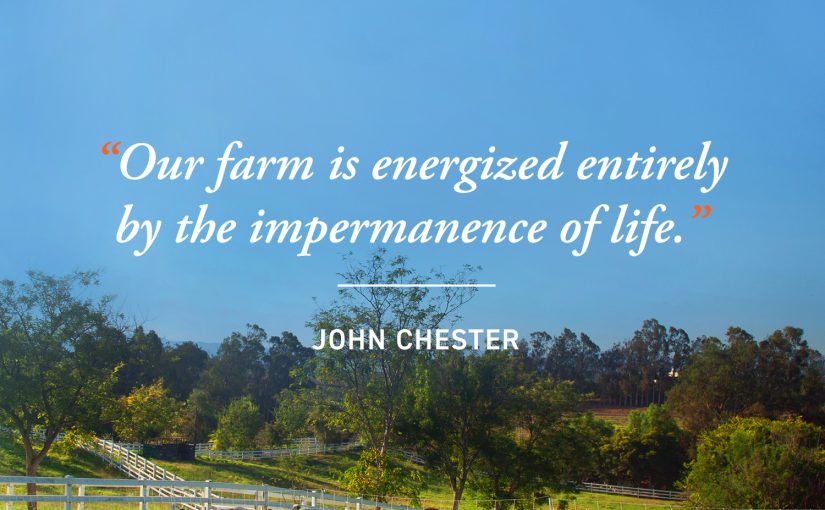
ARTY: Another quote by you in the film illustrates for me a spiritual perspective, “The farm is energized by the impermanence of life.”
JOHN: I’m really glad you brought that up because I think that is, to me, the most important line in the entire film. I say that because if you spent time on a farm going through enough repetitive seasons, or gardening in your backyard and you understand the way soil systems work, you begin to realize the requirement of death as a part of life. To grasp the profoundness of that can reshape how you see death. It reshapes how you see life. The limit of life is a requirement for the energy that is needed by the next life.
Knowing something is impermanent also allows you the freedom to accept and let go when things are on their way out – an animal, a tree, a plant. You can’t have anything new without the death of something. For me that’s been the most humbling part of this whole experience. In the beginning, I was trying to hold on a lot more to things than I do now. I’m not saying that I’ve washed my hands of things or take myself out of the responsibility of being restorative and trying to save something, but I have accepted the impermanence of life in a very different way, and that’s changed the way I see my life, and Molly’s and my role on the farm.
ARTY: You experienced a lot of death on the farm, the death of hundreds of chickens, and near death of Emma the pig, and your interaction with the coyote.
JOHN: The coyote, there’s a moment in the film where we’re setting up to coexist with nature, and coyotes killed 350 of our chickens. My crew is looking at me saying, “Why does the coyote deserve to live over the lives of these chickens?” It’s indefensible. I finally killed a coyote in the film. That was the loss of the commitment to the idealistic pursuit to coexist, and to me it felt like complete failure, but through that experience, it allowed me to see something completely different in the coyote. That was a pretty low moment for me because I realized that it wasn’t just one coyote. I was going to have to kill probably 12, maybe 15. And when would that stop? And what else could I have done?
So it’s a battle of the lesser of two evils. Was it right? Was it wrong? It’s all based on consequences and sometimes it takes a lot longer to figure out what’s right and wrong because time needs to reveal those things.
We want answers. We want answers to everything right here and now. We’re an immediate sort of culture and species because we have this intellect to be able to say, “Well, there’s an answer.” Sometimes it’s hard to accept that answer will not come right away, that you have to be accountable to the decisions you make. So, that moment was really very challenging for us and humbling.
ARTY: You had all of these profound experiences and life lessons with a camera following you. What was that like?
JOHN: The film was shot over eight years, so there was definitely a time, especially in the beginning, where we were running the camera when I was too conscious of it, even though I’ve been in the business for 30 years. I was self-editing, and when things got hard, I would say, “Don’t shoot this; we don’t need this.” Then I realized, who am I serving here? Am I serving the truth of what this experience is like? Because my ego is in jeopardy and I’m terrified that I don’t know what to do.
Then there was a moment of clarity, and I sat down with two of the interns who both became very competent [film] shooters, and I said to them, “I’m never going to say this again. No matter what I say after this, you don’t have to listen to me, but I’m going to say this once. If I ever tell you to stop shooting, I want you to just step back 10 feet and keep rolling, regardless of what I say.” So we would have these moments where I would say, “Don’t shoot this.” And they would disappear, and later, and I’d ask them, “Did you guys keep shooting?” And they’re like, “Yep, we kept rolling.” And I was like, “Okay, we’ll see if it ever sees the light of day.” But I’m really glad I did because I think the film is way more valuable as a tool of inspiration with the more honest and vulnerable element that I allowed myself and my wife be in the experience.
ARTY: I commend you for your courage and the right decision in terms of letting it roll. The authenticity really comes through in the film.
Paul Hawken, one of the most important environmental authors, activists, thinkers and entrepreneurs of our era, has dedicated his life to sustainability and changing the relationship between business and the environment. His many bestselling books include such massively influential texts as: The Next Economy; The Ecology of Commerce; Blessed Unrest; and most recently, Drawdown, The Most Comprehensive Plan Ever Proposed to Reverse Global Warming.
Hawken is the founder ofProject Drawdown, a nonprofit dedicated to researching real solutions to global warming.
Below, read an edited version of his talk from 2002, where he spoke passionately and eloquently on corporate capitalism and control, wealth disparity, social injustice and how each of those issues plays into ongoing environmental degradation. In the 17 years since, Hawken’s dreams of a more just, sustainable world have yet to be realized.
Pseudopodic ego, what’s that? It’s the guy who gives a dollar to a homeless person every day, and then goes to the bar, ties one on, goes home and abuses his wife and children. He takes his identity from that moment when he gave the dollar to the homeless person. That is exactly what I want to talk about today.
The people who are arguing most articulately and vociferously against globalization are not protesting trade but the corporatization of the world’s commons. The very same companies that are issuing corporate responsibility reports are busy enclosing and dominating the world’s commons. The very companies that tout their environmental records are the ones who dominated the World Summit on Sustainable Development in Johannesburg and obstructed all meaningful resolutions pertaining to poverty, water, energy, and climate change.
The commons that are being corporatized include the human genome, seeds, water, food, air waves, and the media. The commons include our stories, our music, our culture as well. It includes self-determination and democracy. It includes the ability for people to decide what is and isn’t acceptable as a product in a locale, in a region, a place, or a country. It includes all tradition. All these areas are being taken over and corrupted by corporations, and publicly held corporations live by a lie. They believe that we reside in a world where capital has a right to grow, and that is a higher right than the rights of people, of culture, of place, of qualities that historically have been our commons.
You can’t get to sustainability from the economic model that strives to increase the amount of money large corporations have.
You can’t get there if you’re destroying the world’s local economies. You can’t get there if you’re McDonald’s and spend $2 billion a year to get our children to eat junk food. We cannot correct environmental problems if we don’t correct the assumptions that cause them. Most of the world’s economy and the behavior of the world’s governments are under the control of corporations, and they are striving to increase that control. At the same time, have you noticed that the world is getting out of control? There is a direct connection between the two.
A highly placed government official from the Clinton administration recently met with his counterpart in the Bush administration. After that meeting, his conclusion was this: They are not governing. They are preventing governance in order to serve their masters: corporations. Even if a large corporation does not engage in that activity, why are they mute in the face of this liquidation sale of government to private interests?
This new way of corporate colonization is having disastrous results. Bechtel in San Francisco, and Vivendi in France want to privatize water the world over. Novartis, DuPont, Monsanto, and Bayer Aventis want to control 90% of the germ plasm of 90% of the caloric food intake of the world. These are companies that make toxic aniline dyes, animal hormones, artificial sweeteners, explosives, and pesticides.
Ted Turner said in the end there’ll be two media companies in the world. He wants to have a stake in one of them. Rupert Murdoch said the same thing. He wants the other. McDonald’s opens up 2,800 restaurants a year, and even the U.S. government under President Bush said that the doubling of childhood obesity and diabetes in the past 10 years is due to fast food.
The Domini Social Index Fund, run by Amy Domini, the doyen of social responsible investing, owns 357,000 shares of McDonald’s. Go figure. Right now, one of every five meals in the U.S. is fast food, and they want that to be the case everywhere in the world.
Coke now has 10% of the total liquid intake of the world. And they want to increase that to 20%, or was it 30%? Or maybe it’s 50%. These are absurd and devastating goals for corporations.
I do not believe that any Fortune 500 company can be sustainable. But there are definitely things that transnational corporations can do to help society and to help the environment. The first thing they can do is to get out of our schools. And the next thing they can do is to get out of our stomachs. And they can get out of our government. And they can get out of our rivers, our oceans, our forests. Get out of our skies. Get out of our soils. Get out of our seeds. Get out of our genome. And for God’s sake, stop molesting our children.
Wendell Berry says a corporation does not arrive, as most persons do, at a realization of the shortness and smallness of our life. It does not come to see the future as a lifetime of its children or grandchildren, or anybody in particular. It cannot experience personal hope or remorse, nor change of heart. It cannot humble itself. It cannot sing. That’s my line. It goes about its business as if it were immortal with the single purpose of becoming a bigger pile of money. Until corporations understand that they are spearheading a kind of commercial fascism, they are going to find that worldwide resistance will grow. It is fascist in its attempt to create a meta-order for people, with the assumption that a small group of people know better than the larger group, therefore the larger group does not have to be consulted. Whether it was Marxist Lenonism or Mussolini, fascism has always been informed by the vanity that a few know more than the many for our own good.
In The Lexus and the Olive Tree, Tom Friedman wrote: “The hidden hand of the market will never work without a hidden fist.” McDonald’s cannot flourish without McDonald Douglas. The hidden fist that keeps the world safe for Silicon Valley to flourish is called the U.S. Army, the Air Force, the Navy, and the Marine Corps.
Trade is great. Trade is civilizing. Trade’s not the issue. The question is: Who sets the rules and who enforces them? There can be no sustainability when the rules and standards are being set by institutions whose primary purpose is to create money. The question to be grappled with is the shape of the relationships between sovereign nations, between regions and peoples, between companies, markets, and the commons which support all life on Earth.
It will come down to some very simple questions: Do we want democracy and self-determination, or do we want oligarchic institutions? Do we want a world of uniformity, where the road from every airport to every city center looks like every strip mall in the world? Do we want a different world than the one envisioned by Monsanto, Walmart, and Disney? Do we want our 9-year-old girls being lured by dolls with happy meals into McDonald’s and to end up with Type II diabetes? Or do we want strong, regional and native cultures, proud of their heritage, devoted to their land, committed to true development and the future of their children? In short, do we want a world structured by rich, mostly white men, or a world that is an expression of the fabulous qualities of all human beings? You choose.
The way to create a healthy, vibrant economy in society is through diversity. That’s ecology 101. We know that scientifically, but we also know that economically. Any system that loses its diversity loses its resiliency. It is more subject to sudden shocks and changes from which it cannot recover.
The corporatization of the world is a loss of diversity. It enforces uniformity upon people, upon place, and upon culture.
The degree to which a company honors and then allows diversity to emerge from a place, from a country, a locale, a culture, a tribe, a city is a very good thing. The degree to which it tries to enforce a one-size-fits-all formulaic solution to diet, or media, or agriculture is, in my opinion, going to be seen in hindsight as just as much a criminal act as the deracination and slaughter of Indigenous People by the Spaniards, the genocide of Native Americans, or the enslavement of African Americans.
We look back at those things now and feel ashamed. We look back, and we will look back at what we’re doing right now, and see the world for what it is, which is a violation of humanity. The very same companies that invoke sustainability have business models that destroy people and life. We will, I predict, in our lifetime, convict corporations of crimes against humanity.
A time will come when we honor those who truly do add value, not those who take it away. A Nigerian chief once said: “If you don’t share your wealth with us, we will share our poverty with you.” It is a lot less expensive to share our wealth. It is less expensive to do that than to continue this extravagantly self-centered system we call “corporate capitalism.” This is not the most economic system. It is the most expensive one there could possibly be.
In systems theory, if you optimize only components in a system, you pessimize the entire system. If you optimize corporate profitability, you destroy society. The idea that sustainability costs more is upside down and backwards. It costs less to maintain and honor the Earth in real time.
My state, California, spends more money on prisons than classrooms. A country that rapes its oceans and forests, a world where 20% of people get less than 1% of its resources, where nearly a billion people go to bed hungry, a world torn by strife, riddled by greed, controlled by small, petty men, bankrolled by large, transnational corporations is not cheap. It’s really costly.
Vaclav Havel has said that we’re on the brink of a new order, if for no other reason than the old order has become invalid. We know how to transform this world, to reduce our impact on nature by several-fold, to provide meaningful, dignified, living-wage jobs for all who seek them, and how to feed, clothe and house every person on Earth. What we don’t know is how to do is remove those in power, those whose ignorance of biology is matched only by their indifference to human suffering. This is a political issue. It is not an ecological problem.
The way to save this Earth is to focus on its people, and particularly those people who pay the highest price – women, children, communities of color, and the localized poor. The sustainability movement, without forsaking its understanding of living systems, resources, and conservation biology, must move from a resource float model of saving the Earth to a model based on human rights, the right to food, the right to livelihood, the rights to culture, and to the rights of community, and the right to self-sufficiency.
Essentially the environmental movement must become a Civil Rights movement. A human rights movement. Without that we will simply be a failed white man’s movement from the North.
The understanding of sustainability in the North is largely meaningless to the world’s poor. We cannot say to the South that we’re sorry that their end of the lifeboat is sinking but we’re doing pretty well on our end. It was David Brower who said that environmentalists make terrible neighbors, but they make great ancestors.
There are two voices on the world’s stage: the voice of the wealthy and the voice of the poor. One is an extreme minority and the other is the majority world. And the shift is occurring with the poor themselves. Poverty, in their view, derives from a deficit of power, not a lack of money. Far from being needy persons waiting for handouts from the North, they are citizens who are constrained by a lack of rights, entitlements, salaries, and political leverage.
Rafael Diaz said a family is where every human being knows that they matter. To me, that is what sustainability is about. It is about improving the quality of life for all people on Earth. The only kind of sustainability that makes sense to me is alleviation of suffering and honoring of all forms of life.
There’s a big sign out there. It says, “You are brilliant and the Earth is hiring.”
Helen Keller once said, “This is a time for a loud voice, open speech, and fearless thinking. I rejoice that I live in such a splendidly disturbing time.”
After a two-hour interview for Fortune magazine, a journalist turned his tape recorder off, and he said to me, “Aren’t you just dreaming?”
I said, “Absolutely, I’m dreaming. Somebody’s got to dream in America.” It is our right to dream. It is something that we owe our children’s children. A dream is a gift to the future, and the future is begging.
So I do have dreams, and I think we should get together and talk about what they mean. I dream of a UN team shutting down the 10,000 chemical plants in this country, which are essentially biological weapons waiting to happen. I dream of my country living up to its legal treaty commitments and getting rid of weapons of mass destruction. I dream of a U.S. that actually has an energy plan and a climate plan. A 100-year plan, not a midterm election plan. A water plan to get rid of all the corporate pollutants in our riparian corridors and in our streams, a biodiversity plan, a plan to eliminate poverty, illiteracy, a plan that ensures no child here or anywhere goes to bed hungry.
I once gave a talk at an elementary school to third graders. I told them that there are a billion people in the world who want to work and can’t. One person, a girl, raised her hand, and she said, “Is all the work done?”
I dream of getting my government back, a country of by and for the people. And I dream of a country that can say that it’s wrong, that it’s sorry, and that it’s remorseful.
I dream of a country that can apologize for the suffering it’s caused First Peoples, African Americans, Hispanic Americans, Asian Americans, and all people in all lands that we have tortured, that we have harmed, and that we have killed. A country big and generous enough to pay reparations and build new schools in inner cities and act with decency.
Eduardo Galeano talks about a time when historians will stop believing that countries enjoy being invaded. When the world will no longer be at war against the poor, but against poverty. Where the weapons industry will have no choice but to declare bankruptcy. When nobody will die of hunger, and the street children will not be treated as if they were trash because there will be no street children because a black woman will become president of Brazil, and another black woman president of the United States, and an Indian woman president of Guatemala.
These dreams are pipe dreams unless we act politically. As David Orr says, We have great ideas. The right wing does politics. We are cozy in our niches. We are titillated about being right, they are busy being in control. I dream that we will become a political movement, not simply one called by the name of a color but by the name of an ideal. What should we call it?
And let’s not spend so much time on the big villains. What we need to do is honor the saints in our midst, not the fools. The small heroes, not the big louts. Arundhati Roy writes that we have to support our small heroes, of these we have many. We have to fight specific wars in specific ways. Who knows, perhaps that’s what the 21st century is about and has in store for us: the dismantling of the big – big bombs, big dams, big ideologies, big contradictions, big countries, big wars, big heroes, big mistakes. Perhaps it will be the century of the small. Perhaps right now, this very minute, there is a small god up in heaven readying herself for us.
The great Sufi poet Hafiz said clever men place the world into cages, but the wise woman who must duck under the moon throws keys to the rowdy prisoners. Please throw keys to the rowdy prisoners. Freedom, that’s what sustainability is about – freedom from tyranny, freedom from empire, freedom from corporate rule. Freedom to honor life, to create – in Janine Benyus’ memorable phrase – a world that is conducive to life.
Of Mexican, Texan and Coahuiltecan ancestry, Jerry Tello was raised in South Central Los Angeles and has worked for 40+ years as a leading expert in transformational healing for men and boys of color; racial justice; peaceful community mobilization; and providing domestic violence awareness, healing and support services to war veterans and their spouses.
Bioneers spoke with Tello about the hot-button issue of “toxic masculinity” and how society can effectively raise and work with men and boys to improve their lives and the lives of those who depend on and love them.
Jerry Tello spoke about his important workat the 2019 Bioneers Conference. View his talk here.
BIONEERS: Tell us about what the term “sacred manhood” means to you.
Jerry Tello
JERRY: I think when we begin to think about sacred manhood, it’s important to base it on the sacredness of all humanity. And if we don’t start from the rooted place, what is balanced, what is whole, what is interconnected, then we give energy to what is imbalanced. We can talk about what people call “toxic masculinity” all you want, but if you don’t know what you’re supposed to heal from, what you are supposed to detoxify from, where you’re supposed to go, what you are supposed to be, then you’re really just searching. It’s like saying no to something, but what do you say yes to. So sacred masculinity really starts with the premise that we’re all sacred. All nature is sacred – men, women, children, elders, and all those in between. However you identify, you’re sacred. Children, when they come into this world, are sacred in their essence.
The real challenge is what happens on that journey. When little boys are born, they’re sacred. What happens in that journey that takes them to a place where they are disconnected, where they’re no longer acting in a sacred way, where they’re no longer treating their relationships in a sacred way, where they’re no longer treating themselves in a sacred way?
When we talk about sacred manhood, it’s really about that understanding that interconnected premise. In our society, we have come to a place where we don’t trust men, where many times men are seen as the perpetrators, as the manipulators, as the ones that are violent, the ones that are misogynistic, that are patriarchal. And it’s not that we don’t have those characteristics. We do. We carry those wounds. We carry those issues. We carry those false teachings. But rarely do we talk about the sacred part of who we are.
My work over the last 40-some years has been working with a lot of wounded boys, a lot of wounded men, a lot of men that have been incarcerated or accused of domestic violence or child abuse or youngsters that are gang banging or into drugs and violence. On the other hand, a lot of people that are so-called professionals are very toxic.
Those young men and men that are referred to me for all these violent and negative things know their woundedness. There’s a whole other group of men that think because they have material or professional or intellectual success, that they don’t have imbalance, that they don’t have toxicity. I’m more afraid of them because they don’t recognize and they don’t acknowledge it, which means they don’t work on it; they think it’s the norm. I think that’s what’s happened in our society.
I see little boys at 4 already angry. And how do you become so angry at 4? What are you angry at? A lot of times anger is really a manifestation of shame, a manifestation of being stuck, a manifestation of being unclear, of not knowing what to do, so you react. When you’re only focused on that which is imbalanced, then when do we get to the balanced? When do we get to the rootedness? When do we get to re-rooting, to cleansing? When do we get to honoring and acknowledging?
I grew up in Compton, South Central LA. There is a lot of woundedness in those communities, based on the poverty and on the racism and on the oppression and all those things that go on in those very stressed out communities. Because of having to live based on survival sometimes, you have to reorient your life.
There are men that I’ve talked with who say, “I’m willing and want to be connected to my heart and to my feelings, but when I walk out my door, I can’t. I can’t survive because society sees me in a negative way; I’m always being attacked for nothing else than my skin color. So if I open my heart and keep my heart open, I will die. I cannot go on. I will not get to work. If I keep my heart open while working and seeing the looks and the gestures and the way that people treat me, I cannot finish my day of work. In coming home, in going in stores or anyplace in the society, in watching the news, if I keep my heart open, I can’t survive because it penetrates me at a very deep level and it triggers generations of hurt. Because I remember my father and my grandfather being treated in a very similar way. So I have to close my heart. When, for the majority of the day, I have to close my heart in order to survive, then when is it safe to open it?”
But it’s not until you’re able to open your heart and know how to work that are you able then to heal your wounds.
When do men of color have a space, have a time, have a place to heal their wounds, so that they can recover, uncover, and discover again the sacredness of who they really are? It’s this dichotomy that you have to play between.
My father’s side is Coahuiltecan Native. In our traditional Indigenous belief, we believe that everything is sacred. All our children are sacred. My grandma said every kid was a blessing — the fat ones, the skinny ones, the stinky ones, the ones that get good grades in school, the ones that didn’t — it didn’t matter. They’re all blessings. And she reminded us every day by blessing us that way. Symbolically but very directly as well, it was a reminder that in spite of your wounds, in spite of your transgressions, in spite of your issues, you still can come back to that sacredness.
That’s the message for men — your sacredness is waiting; are you willing to take the journey?
BIONEERS: How has your community responded to discussions about sacred manhood?
JERRY: About 30 years ago, there were a number of colleagues of mine — psychologists, social workers, teachers, lawyers, advocates, and most of us were Latino, Chicano, Mexican, Native — and we were very frustrated, because even though we had so-called “made it” (we were professionals in the field and working in our communities), we found that there were no resources coming into our communities that really met the cultural and spiritual norms of what we believe. We were offered therapy, but it wasn’t therapy that was in line with the way we heal. So to some extent, it wasn’t helpful. They were offering us programs, but the programs they were offering communities were trying to assimilate us, trying to really take out our true indigenous and cultural processes, and making us believe that the woundedness that we had was because of our culture.
We became very frustrated with that and decided we would develop some of our own programs. A couple of us decided to call out to other men who were in the profession to come together for a weekend to begin some program planning.
The other part that really bothered us was that we men were causing the woundedness. As much as we were saying systems and colonization and 500 years of the conquests were causing the issues, in our own homes and in our own families, many times we men were domestically violent or unfaithful. So there was this dual feeling of being upset with the system and being upset with the history, but at the same time recognizing that we’re doing this.
We called men together. We knew that one of the main problems was self-medication — alcohol and drugs in our communities. At our gathering, 19 men that showed up. Many of us didn’t know each other, but were professionals in the field. Some were advocates. We started with prayer, because all of us knew that in the worst of times, when we have nothing, our grandmothers would make us pray. We all knew in our Indigenous sense that we needed to call to something bigger because this problem was something bigger.
And then we went around that circle, and everybody began to introduce themselves. The third guy that shared said, “I’m here to do what the other guys said, but my real issue right now is that I was abused when I was a kid. I saw my father abused, and I saw my mother abused, and I saw the system. And it broke me. It broke me when I was 3. Even though I’m a professional, I still don’t know how to love my wife. I still don’t know how to connect with my kids. So I work all the time. I advocate, and I’m at rallies, and I’m trying to do good for my community. But the real reason why I’m doing all of that is because I don’t know how to connect. I need to heal myself.”
And he began to cry.
Thirty years ago, seeing an Indigenous Chicano man cry was like, ‘Whoa, what are you doing?’ He’s exposing himself. He’s crying. It penetrated all of us. It touched our hearts, and it resonated because we knew that he was telling truth. When he shifted that narrative to talk about what was really going on with him, the rest of us went around and shared that too. By the time we ended that circle, we realized we were all wounded, and that we had never done our own work. Even though we were professionals and so-called “successful,” we had generational wounds and woundedness in us.
We realized after those three days that the most revolutionary thing we could do was to heal ourselves. Before we went out and tried to work and talk about teachings, we needed to heal ourselves so that we could be the best men that we could be. We realized that we had been given a false sense of shame and made to feel negative about ourselves as men. The sacred men in our communities are hard workers. They’re loyal. They’re providers.
We realized that there was a sacredness that was never taught to us, and that this society was going to attempt to continue to give us a false narrative that we were negative, that we were only patriarchal, and that we were toxic. That in order to be good men, we had to abandon our culture, abandon our spirituality, and be like the Western European men. We had to be like them, talk like them, act like them, and get degrees like them in order to be whole.
We later found out that many of those so-called “successful” men are not any better fathers than we are.
So at that circle 30 years ago, we made a commitment to share with other men that we need to go on a path to heal ourselves, and to reclaim our sacredness as men.
The second thing that we needed to do was recover the sacred teaching that our ancestors had taught us, that the first step on the rights of passage bridge to manhood is honoring women. If you don’t honor women, the sacredness of the feminine, you cannot be a whole man.
The third thing that we needed to do was to be committed to guide the next generation. The organization called the National Compadres Network has been around for 30 years, and we’ve been doing this all over the world. We develop and guide men, and we have healing and support circles all over. We also do teachings on rights of passage, on fatherhood, on teen fatherhood, on recovery. We talk to men coming out from institutions and give them a place where they can heal and detoxify from their wounds in the system
A major part of what we do is prepare young men and boys, and mothers who are raising boys, on how to reclaim and reroute themselves in the sacredness, and how to deal with a toxic environment that wants to take that from you. How can you shift when you go into this racist, oppressist society and not lose the essence of who you are? Sometimes you have to close your heart. Sometimes you have to front up. Sometimes you do have to pretend. Sometimes you need to have a shield. But it’s important to make sure you know that that’s not who you really are.
The true aspect of healing is being able to be flexible in your movement. We deal with people in the inner city, and some of these youngsters have got to be strong and hard in order to survive. But when you walk into your mama’s house, you need to be able to take that mask off. That’s what healing is really about.
BIONEERS: How does the idea of femininity play into the work you do?
JERRY: In our traditional Indigenous culture, we don’t categorize masculine or feminine. You just are. You’re part of the trees, you’re part of the universe, you’re part of the sun, part of the moon. And when we pray, we pray in honoring those four directions. We honor the masculine, the feminine, the child, and the elder.
In our traditional way, we have all of those elements in us. And one that is healed can go and move and sit in any direction and be comfortable. Sometimes we have to sit in the feminine direction.
Our prophecies say that right now, we as men need to sit in the women’s direction and be quiet and listen, and let them lead. Now is the time in which the feminist is going to guide. If we do not allow the feminine to guide, which is really the basis of healing, of listening, of paying attention, of being present, then this world is going to continue to be toxic.
BIONEERS: How can women who are raising boys be mindful of sacred masculinity?
Jerry: There are a lot of women that are not with a partner because it wasn’t a good relationship. There have been wounds, and there has been abuse. With the women that have not done their work, sometimes they carry those wounds. Sometimes they carry that anger. And sometimes they carry that toxicity too. Then they deal with their boys, and they don’t want their boys to be like their dad. They’re saying, “You’re just like your dad.” That really does fuel the toxicity, the hurt and the disconnection, because boys don’t know how we want them to be. “Well, just behave!” What does that mean?
With mothers, part of the work is having them do their work so their woundedness and their unresolved issues with the father does not spill out on their children. There are many boys that don’t have fathers. The traditional way is that you don’t have to have a biological father, but you do need someone to support you.
My dad died when I was 13. And you don’t know what to do. And you don’t want to ask anybody. And you don’t want to make your mom feel bad, so you just make it up. Sometimes when you make it up, you don’t make it up in a good way. Then you look for examples, and if the examples aren’t good, you’re just going to follow those anyway, because it’s better to do something than to be stuck.
We have a lot of young boys that are ashamed. And mothers need to recognize that and say, “Son, I know your dad’s not here. So let’s look for a coach.” Or even if you’re walking around, you have to make a point of looking to good examples. “Look at that man over there with his kids. Look at how he picks them up. Look how he’s hugging and kissing his daughters.” You’ve got to point out those things.
And then we men have to step up too. We men have to step up and offer to say, “We’re here.”
I think part of what it’s important for you to share with your sons is that “I’m not sure what to do, but I’m going to walk with you.” It’s a journey.
BIONEERS: How does participating in the armed forces and PTSD that is often a result of that relate to the concept of toxic masculinity?
JERRY: I was drafted myself in the Vietnam era, so I’m very familiar with what that does to you — just the disconnection. Maybe it’s changed somewhat now, but even back in those days, you were yelled at, ridiculed and broken. They wanted to break you down so they could make you into this military man, which was really about being in control and doing what you had to do, regardless if it was killing or maiming, to defend this country, whatever that meant. But what you realize is it wasn’t really about defense. It was really about control and subjugation, and that penetrates you.
Back then in the Vietnam era, one of the biggest wounds that many of my friends and family suffered is they went in and fought in that war and got no recognition. There was no healing for them. I have friends and colleagues and relatives that have lost their families. They’ve been locked up. They’re on drugs. Because trauma turns into physiological issues.
In the recent wars, they allowed soldiers to do two, three, four, five, six tours. They are exposed to such violence and fear. Anyplace you step there can be a bomb, so you’re afraid to walk down a road.
What ends up happening is that becomes the norm. In the cellular nature of your body, that trauma becomes frozen in you. And it comes out at unexpected times. It interrupts your sleep, and it interrupts your ability to feel. It disconnects your body from your spirit. And to some extent, in order to be in a war, you have to disconnect. You have to disconnect your emotions from your action. You have to objectify the enemy. But when you objectify so much, it gets lodged into your cell memory and disconnects you from your heart. You come back, and anybody that then challenges you, you react. But you may be reacting to your wife or your kids.
We now have many generations of men who are very wounded. The homeless problem is increasing because of the wars. And we have women and children that are homeless, too. So it’s interconnected to a whole bunch of things.
I’m not sure if we really understand the price that we’ve had to pay. We try and provide healing. We try to help men call their spirits back. But it’s a lifelong issue. We’ve given men that have gone to war a disease. It’s like giving somebody cancer or diabetes. It’s a disease. And you can’t take it away. You just have to treat it.
It affects many of us. It affects the whole nature of how we are as men, as boys, as family. And the women have suffered tremendously.
When you’re not connected to your heart, you lose your sense of compassion. Then all you’re doing is reacting.
It’s a very complex issue that we as society have to deal with. The military has to deal with it, and we’re not there yet. I think, before men go to any type of situation like that, first of all they have to be rooted in sacred manhood. If you have that sacredness then you know that even in the worst part of your fear, you can’t cross certain boundaries. There are certain things you can’t do.
BIONEERS: There seem to be important differences between what the Western world calls a “warrior” and an Indigenous definition. What do you think about that?
JERRY: The Western framework of a warrior is that conquest and control. It’s that sense of dominance. The traditional Indigenous warrior is different. The warrior is a protector. They’re one who maintains honor. They’re one who maintains spirit and integrity. Sometimes you do have to be forceful, but that’s not your intent.
In our traditional way, when we would get ready to go to war or a dangerous journey, our whole community would encircle us, and they would dance and sing and pray. They would burn sage and copal so that within our spirits, we would remember that heartbeat, we would remember that drum, we would hear the voices of the elders, the women and the children. Then the elders would give us our direction. The intent was never to hurt. It was never to destroy. It was to defend. And sometimes in defending, yes, there was hurt, but that was not the intent.
When the warriors came back, they would enter that same circle. The community would fan them off and cleanse them and take away all that manifestation of who they had to be outside of the circle so that they could return to their sacred role again.
In many communities, that warrior shield is never put down. You have to wear it 24/7. You’re wearing your warrior shield when you’re asleep, so you don’t ever rest. You’re always on. Men of color especially feel like they have to be hypervigilant and constantly watching out. They never get to put that shield down. It affects us in many ways.
Part of the teachings of manhood is recreating our narrative and recapturing the sacred narrative of what it means to be an honorable warrior. It’s not about violence, it’s about protection. It’s not about having sex. It’s about having relationship. It’s not about being in control. It’s about being in a flow. Your success is not based on money and material things, it’s about how well your relations see you.
That’s the true sense of the warrior: one that is has integrity, respect, trust, love, and dignity. Love is a really important part. We have to know how to love ourselves and love others. But we also have to know when we need help — when we need healing ourselves. We need to be able to ask for it.
Dubbed “the new Rachel Carson,” this ecologist, biologist, cancer survivor, mom, internationally recognized expert on environmental links to cancer and reproductive health and author of the award-winning books: Living Downstream: An Ecologist Looks at Cancer and the Environment and Having Faith: An Ecologist’s journey to Motherhood, explains why pediatric environmental health activism is a key civil rights movement of our era.
Keep Your Finger on the Pulse
Our bi-weekly newsletter provides insights into the people, projects, and organizations creating lasting change in the world.



 Since 1994, Richard Piacentini has led the green transformation of Phipps Conservatory and Botanical Gardens, including construction of the Center for Sustainable Landscapes, the only building in the world to meet Living Building Challenge™, LEED® Platinum, WELL™ Platinum, and SITES™ Platinum certifications. Richard is interested in the connection between people and plants particularly as it relates to human and environmental health. He has received numerous professional honors, including APGA, ILFI and USGBC leadership awards.