Putting Science In the Hands of Citizens at Public Lab

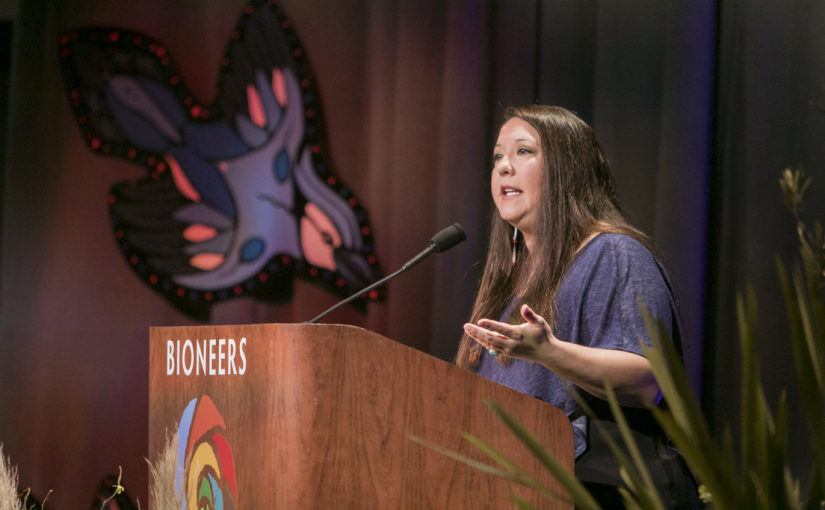
Shannon Dosemagen is a Co-Founder and Executive Director of the Public Laboratory for Open Technology and Science, known as Public Lab. With a mission of “democratizing science to address environmental issues that affect people,” Public Lab is one of the most innovative and cutting-edge organizations focused on leveraging technology for good while, at the same time, setting the bar for what equitable, just and community-based environmental, social and human health work can look like. Practically, this has led to the buildout of a global network focused on developing DIY tools and technologies that allow communities to conduct environmental monitoring directly, an astonishingly important task at a time when regulatory oversight in the public interest, at least domestically, ranges from a status of perpetually underfunded to outright corrupted. Inspired and forced into action by the 2010 BP Oil Spill and the following information blackout in terms of the extent of the spill, Shannon and her team began with a beguilingly simple approach to monitoring the impact of the spill a helium balloon-mounted camera and development of an open source platform to stitch the images into a compelling map of the actual scale of the oil slick.

Shannon Dosemagen

Shannon gave a keynote address at the 2015 Bioneers Conference and was featured on a popular episode of Bioneers Radio (listen at the end of this article). Teo Grossman, Bioneers Senior Director of Programs & Research, recently spoke with Shannon to update the story and find out what Public Lab has been engaged in and accomplished in the past half decade.  

TEO GROSSMAN: Tell us about what’s been happening at PublicLab in the past five years.

SHANNON DOSEMAGEN: We’ve expanded substantially. Over the last year especially, we’ve doubled down on our structural work to give PublicLab.org a much smoother user experience. We’ve also been building up a global open-source software contributor community. We’ve built up a really strong and wonderful community of mentors who are helping people new to open-source coding come into the community, and at the same time, we’ve really increased the resources that PublicLab.org has to offer because of all of these new people. We’ve expanded infrastructure, which has allowed more people to come into the Public Lab ecosystem to use the methods and resources that are being posted.


In terms of topics, we are of course very interested in thinking about climate change and the current impacts of the increasing storm systems across the Gulf Coast and the lower Atlantic region.

We recently held our annual barnraising, which is our Community Science for Action convening. We took our group over to Galveston, Texas, for a day-long session and one of the bayous in Houston where we talked about disaster resilience, being prepared, and how community science and environmental monitoring can support communities that are facing increasing storm systems such as Harvey and all of the others that swept across the Gulf Coast and the Caribbean a couple of years ago.

In a more daily and local vein, we’re also thinking about how we can support communities being more prepared to live and deal with water, especially in places such as New Orleans and Southeastern Louisiana. The challenges that we face in the Gulf Coast region continue to really be a focus of ours and a place from which we expand our work, ranging from climate change and urban flooding to the oil and gas industry issues that have always been at the heart and core of our work.

We’ve been able to support more and more international projects while building out networks around specific topics. We brought on a fellow for the last nine months who’s been building out The Lead (Pb) Data Initiative. The Lead (Pb) project interfaces between DIY environmental monitoring/community science methodologies and applied work focused on influencing policy decisions on these really important human health issues.

One of the other really exciting things that’s just happened in the last six months is that we have started an Environmental Education program, recognizing that the power of the work that the Public Lab community has been doing for almost a decade now has a place in supporting the next generation of youth by getting them out into their own communities, thinking critically about how to form and ask questions, doing observations, and then looking at data, looking at DIY technology and figuring out how it can answer questions and help youth to become a more engaged and activated in these places that they care about.

TEO: That’s great. Congratulations. When I talk to people about Public Lab, I find that the easiest way to explain it is to start with the actual technology, the tools, and then work back from there towards your broader mission. It seems to be the easiest way for people to wrap their heads around it. In your 2015 Bioneers keynote, you talked a lot about the balloon mapping work, and then noted Public Lab was just getting into air sampling devices and water-monitoring tools. I’m curious if you can share anything about some of the DIY tools, if you’re still leveraging the same ones you’ve used in different ways or if you’ve come up with different approaches as the technology keeps getting faster and smaller?

SHANNON: That’s a great question, particularly in the context of the last half decade. I would say the field of open hardware and DIY technology to support environmental and social justice issues has bloomed in a very amazing way. When Public Lab first came into existence about a decade ago, there were not a lot of other people that were really actively thinking about how to apply open hardware to environmental and human health question asking. In recognition of this kind of change in the landscape and change in the field, Public Lab has tried to take on a facilitation role: How do we help and support people who are thinking about new technology to see it all the way through from the initial idea and pilot to the distribution and actual use?

A year ago we ran a kickstarter for our DIY Community Microscope. It’s a really great tool for obvious reasons – water sampling, for instance, but it can also teach you a lot just in the process of making and putting it together.

We are hosting a new DIY marine microplastics trawler, developed by a researcher named Dr. Max Liboiron, called BabyLegs. We’re partnering with her to figure out ways to support wider distribution of this tool. These are some examples of the projects and tools that Public Lab is bringing in and through our system.

One of the other things that’s happened since I spoke at Bioneers in 2015 is that Public Lab, along with several other universities and organizations, put together an annual convening and community called the Gathering for Open Science Hardware. This group represents people working across the sciences, from community and citizen science all the way to the lab sciences, who are really engaged in making tools accessible through open-source licensing. I think the creation of the group and the fact that we get something like 350 applications every year, from 30+ countries is a really good indication of how much the field has grown in the last half decade, which is incredibly exciting.


Public Lab is also really thinking about how we expand and increase the availability of our methods and our resources that don’t require technology. That’s everything from teaching people how to be better facilitators for the difficult conversations that inevitably emerge regarding environmental and social justice topics to how to actually moderate and facilitate an open kind of unconference-type convening such as our barnraisings.

One of the ways that we’re doing this is bringing in fellows to Public Lab so that we can think about who this next generation of leaders in community science is going to be, and how to work with them productively on these projects. We’re working to expand our resources to younger people, building out models and methods for educators who can bring community science into the spaces in which they’re working.

TEO: How has the field of citizen science and technology evolved in the past half-decade? When we first met, I recall the two of us discussing the need to “close the loop” in citizen science, to focusing on the concept of “citizen” as much as “scientist” – the civic responsibility of using science and data in the public interest. Has progress been made there in terms of democratizing the field?

SHANNON: There have been some really amazing strides in the right direction. Public Lab calls our work Community Science and, at the time, it was an intentional move away from the broader field of citizen science, which was quite top-down and scientist-question-asking driven, but also did not adequately represent our community, people would not always agree with the term “citizen.” We started using the concept of Community Science to indicate a form of work in which science is a thing that can support the organizing activities of communities but is not the only thing that is happening there. There really has been an interesting shift in the last few years. Even if they’re not calling it community science, organizations and projects are starting to ask, “How do we make the work that we’re doing much more responsive to the questions that people in communities are asking about their own places?”

That is really something that I’m happy with because Public Lab has been quite influential in making sure that type of shift is able to happen. There are generally a lot more people who are now aware of equitable practices across all of the different functions of their projects even if they’re not to that perfect point of everything being community driven. They’re really trying to figure out stronger ways to bridge and create partnerships that are truly in the interests of people and communities rather than only scientists or institutions.

Public Lab is very interested in social justice and environmental justice, and I think what we’re seeing is when you are engaged in these community science practices where you’re out asking your own questions and figuring out solutions and answers, it can prompt you to be a more civically active person all around, not just in terms of doing these environmental problem-solving projects but really understanding your own agency, your own power, and the ability to participate and change things that need to be changed.

TEO:  When you spoke with us in 2015 for Bioneers Radio we kind of put you on the spot and asked you about your vision for the future. You answered, “I hope that, with the help of projects such as Public Lab, that we’re able to make very simple environmental monitoring as ubiquitous as everyday objects you might find in your home today, such as a smoke detector or carbon monoxide alarms. I’d like to see people able to have that power at their fingertips. I would love to see people being engaged actively and equally as stakeholders, having a place at the table in terms of the decisions that are being made about their communities. And I think we’re going to get there.” Does that still resonate for you? Do you have anything to add? Do you think we’re making good progress along that line? Much can change in five years but in some ways it’s just a drop in the bucket.

SHANNON: The technology angle of what we do still really resonates. There’s just continued growth and youth interest. And open source applies to many different things that fall within Public Lab’s scope, from actual physical hardware devices to opening up data. So I’m happy to see how the world of open source has continued to influence the ability to make these devices, methods and ideas more ubiquitous as we’re thinking about the current and future environmental and human health challenges that we have to face.

The thing I would add that is probably is buried somewhere in there or at least it was buried in my brain as I was saying this, is that we’re really interested in what the human impacts are from many, many different scales. We want to know how a community is impacted by an individual’s ability to be more engaged in the processes that are happening in their neighborhood. We want to know how an individual is changed because they now have a deeper understanding of how science can support the questions that they want to ask in the world.

We’ve really dramatically seen these sorts of changes at all different levels, from individuals we’ve supported to community organizations and nonprofits, to the scientists, journalists and institutionally affiliated academics that we work with. We really have seen a shift in thinking about people-centered science that we’re so passionate about. Open-source hardware ubiquity is fantastic but these kinds of changes within society and how people view their role and their approach, that’s I think really where the cool impact is.
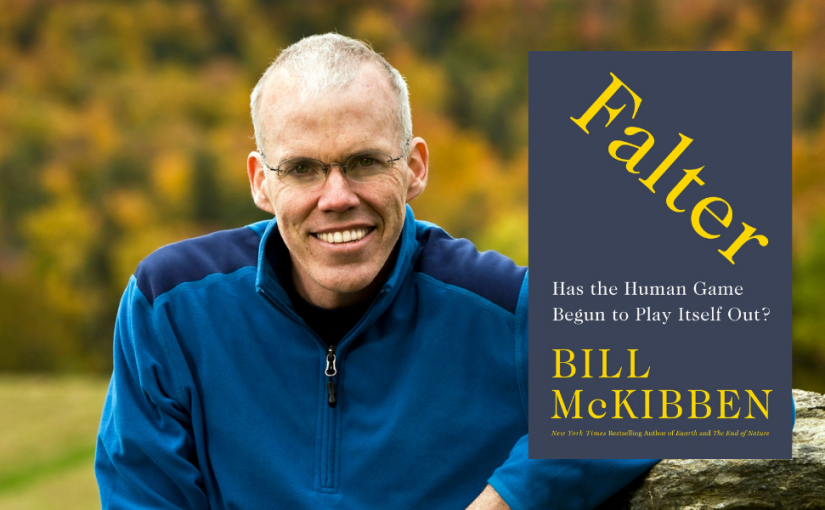

The Human Game: Playing and Winning Against Climate Change

We’ve been playing the human game for centuries. Each individual experience across time and space have culminated in a complex web, with culture, politics and economics as the playing cards of a human game whose stability has come to be taken for granted. In his New York Times best-selling book Falter (Henry Holt and Company, 2019) Bill McKibben warns us that climate change is unraveling this very human game. Our rapid degradation of the environment is moving faster than ever as humans have used more resources in the last 35 years than in all of human history before.

Every decision in this interconnected world holds more risk for the sum of humanity. Even compared to the collapse of Rome, other surviving civilizations were left standing. But with no back-up plan, human development at the cost of our environment is leading to a resounding “Game Over.” The conversation around climate change is more critical now than ever, and McKibben’s book offers a perspective on how we can work together to keep the game going. Following is an excerpt from Falter.

Buy Falter on Amazon or IndieBound.

McKibben has been a regular contributor to the Bioneers Conference over the years, and we’re deeply honored to be hosting him as a keynote speaker at the 2019 Bioneers Conference.

If you viewed Earth from far above, roofs would probably be the first feature of human civilization you’d notice. A descending alien would see many shapes, often corresponding to the local weather: A-frames for shedding snow, for instance. There are gambrel roofs, mansards, hipped and gabled roofs. Pagodas and other Asian temples often sport conical tops; Russian churches come with onion domes; Western churches sit beneath spires.

Palm leaves probably topped the earliest houses, but as humans began to grow grain in the Neolithic era, the leftover straw became a reliable roofing material. Some homes in Southern England have thatch roofs five hundred years old; new layers have been added over centuries till, in some cases, the roofs are seven feet thick. Though it is harder to find good stuff to work with—the introduction of short-stemmed wheat varieties and the widespread use of nitrogen fertilizer have weakened straw—thatch is now growing more popular with rich Europeans looking for green roofs; in Germany, for instance, you can now get a degree as a “journeyman specialist thatcher.” But at least since the third century BC (perhaps beginning with Greek temples deemed valuable enough to protect from fire) humans have been tending toward hard roofs. Terra-cotta tiles spread rapidly around the Mediterranean and to Asia Minor; slate roofs became popular for their low maintenance; where trees are plentiful, wood shakes and slabs of bark work well. Given that the average human being currently resides in an urban slum, it is possible that corrugated iron shelters more sleepers than anything else.


Do you find this a little dull? Good. What I want to talk about is the human game—the sum total of culture and commerce and politics; of religion and sport and social life; of dance and music; of dinner and art and cancer and sex and Instagram; of love and loss; of everything that comprises the experience of our species. But that’s beyond my powers, at least till I’m warmed up. So, I’ve looked for the most mundane aspect of our civilization I can imagine. Almost no one thinks about her roof from one year’s end to another, not unless it springs a leak. It’s a given. And so, it will illustrate my point—even the common and boring roof demonstrates the complexity, the stability, and the reach of this human game.

Consider the asphalt shingle, which tops most homes in the West and is itself, doubtless, the dullest of all forms of roofing. The earliest examples date to 1901, and the first manufacturer was the H.M. Reynolds Company of Grand Rapids, Michigan, which sold its product under the slogan “The Roof That Stays Is the Roof That Pays.” Asphalt occurs naturally in a few places on Earth—the tar sands of Alberta, for instance, are mostly bitumen, which is the geologist’s word for asphalt. But the asphalt used in shingles comes from the oil-refining process: it’s the stuff that still hasn’t boiled at five hundred degrees Fahrenheit. Vacuum distillation separates it from more valuable products such as gasoline, diesel, and naphtha; it then is stored and transported at high temperatures until it can be used, mostly for making roads. But some of it is diverted to the plants that make shingles, where manufacturers add granules of some mineral (slate, fly ash, mica) to improve durability. The CertainTeed Corporation, the world’s biggest shingle manufacturer, has produced a video showing what it rightly calls “this underappreciated process” at its plant in Oxford, North Carolina, one of its sixty-one facilities it operates around the country. The video shows a ballet of pouring and dumping and conveying, as limestone arrives by rail car to be crushed and mixed with hot asphalt and then coated onto hundreds of thousands of miles of fiberglass mat. A thin mist of water is sprayed, and as it evaporates, the sheet cools, ready to be cut and then bundled onto pallets in a giant warehouse, to await distribution.

Marvel for a moment at the thousands of events that must synchronize for all this to work: the oil drilled (maybe deep undersea, or in the equatorial desert); the pipelines and rail lines laid; the refineries constructed (and at each step, the money raised). The limestone and the sand need mining, too, and the miles of fiberglass net must be fabricated on some other production line. The raw materials are all sucked into the North Carolina factory, and then the finished shingles must be spewed back out again, across rail lines and truck routes and into a network of building supply stores, where contractors can haul them to building sites, confident that they’ve been rated for resistance to wind, fire, and discoloration. Think, again, of the sheer amount of human organization required for the American Society for Testing and Materials to produce directive D3462-87 (“Asphalt Shingles Made from Glass Felt and Surfaced with Mineral Granules”) and then to enforce its mandates.

We could, clearly, repeat this exercise for everything you see around you, and everything you hear, and everything you smell—all the infinitely more interesting activities always under way beneath all those roofs. As I write, for instance, I’m listening to Orchestra Baobab on Spotify. It was the house band at a Dakar nightclub in the 1970s, where its music reflected the Cuban beats that came with sailors to West Africa in the 1940s; eventually the group recorded its best album at a Paris studio, and now it somehow resides on a computer server where 196,847 people from across the planet listen to it each month. Try to parse the play of history and technology and commerce and spirituality and swing that make up the sound pouring into my headphones—the colonialisms layered on top of one another; the questions of race, identity, pop, purity. Or consider what I’m going to have for dinner, or what you’re wearing on your back—everything comes with strings attached, and you can follow those strings into every corner of our past and present.

What I’m calling the human game is unimaginably deep, complex, and beautiful. It is also endangered. Indeed, it is beginning to falter even now.

I’ll spend this book explaining that danger and, at the end, pointing to some ways we might yet avert it. But I think it’s best to begin by stressing not the shakiness of the human game but, instead, its stability. For humans, all of us together, have built something remarkable, something we rarely stand back and simply acknowledge. The sum of the projects of our individual lives, the total of the institutions and enterprises we have created, the aggregate of our wishes and dreams and labors, the entirety of our ceaseless activity—it is a wonder. I call it a game because it has no obvious end. Like any game, it doesn’t really matter how it comes out, at least in the largest sense of Our Place in the Universe, and yet, like any game, it absorbs the whole concentration of those involved. And even if it has no ultimate aim that doesn’t mean it lacks rules, or at least an aesthetic: by my definition, the game is going well when it creates more dignity for its players, and badly when that dignity diminishes.

Dignity, in the context of the human game, can be measured in many ways: enough calories, freedom from fear, clothes to wear, useful work. And by plenty of those measures, we’re on a roll. Extreme poverty (life on two dollars a day or less) is far rarer than it used to be. Many of the diseases that poverty helped spread have lessened, too: worms in your gut, say. Even compared to the twentieth century, violence is now far less likely to kill us—of the more than 55 million people who died around the world in 2012, war killed just 120,000 of them. Eighty-five percent of adults can read now, a staggering increase inside two generations. Women, with more education and at least a modicum of equality, have gone from having more than five kids apiece on average in 1970 to having fewer than two and a half today, probably the most rapid and remarkable demographic change the planet has ever witnessed. In the year 1500, humans managed to produce goods and services worth $250 billion in today’s dollars—five hundred years later, that number is $60 trillion, a 240-fold increase. The chorus of affirmation swells, from Steven Pinker insisting we’re in an age of unprecedented enlightenment to Donald Trump tweeting, “There is an incredible spirit of optimism sweeping the country right now—we’re bringing back the JOBS!”

We’re quite accustomed to this idea of progress, so accustomed that some can’t imagine anything else: the former chief economist of the World Bank, Kaushik Basu, recently predicted that, in fifty years, global GDP will be growing 20 percent a year, meaning that income and consumption will be doubling every four years or so. There are, each day, more ideas hatched, more songs sung, more pictures taken, more goals scored, more schoolbooks read, more money invested.

And yet. There are other authorities almost as highly placed as the former chief economist of the World Bank. Pope Francis, in his landmark 2015 encyclical on the environment and poverty, said, “The earth, our home, is beginning to look more and more like an immense pile of filth.” Don’t consider popes sufficiently authoritative? Consider this: In November 2017, fifteen thousand scientists from 184 countries issued a stark “warning to humanity.” Just like Pinker, they had charts, but theirs depicted everything from the decline in freshwater per person to the spread of anaerobic “dead zones” in the world’s seas. As a result, the scientists predicted, we face “widespread misery and catastrophic biodiversity loss”; soon, they added, “it will be too late to shift course away from our failing trajectory.” (Within six months, that warning was already the sixth-most-discussed academic paper in history.) The worries have grown severe enough that a NASA-funded group recently created the Human and Nature DYnamics (HANDY) program to model the fall of the Roman, Han, Mauryan, and Gupta Empires, and when they pushed the button, it spit out a disquieting forecast: “Global industrial civilization could collapse in coming decades due to unsustainable resource exploitation and increasingly unequal wealth distribution.” (The fact that I’d never even heard of the Mauryan Empire gave me a quiet shiver.) In this model, by the way, one of the greatest dangers came from elites who argued against structural change on the grounds that “so far” things were working out.

That “so far” is always the problem, as the man who fell off the skyscraper found out. If you want to fret, you can find plenty of indications that the pavement is approaching with discouraging speed. A third of the planet’s land is now severely degraded, with “persistent declining trends in productivity,” according to a September 2017 report. We’ve displaced most everything else: if you weigh the earth’s terrestrial vertebrates, humans account for 30 percent of their total mass, and our farm animals for another 67 percent, meaning wild animals (all the moose and cheetahs and wombats combined) total just 3 percent. In fact, there are half as many wild animals on the planet as there were in 1970, an awesome and mostly unnoticed silencing. In 2018, scientists reported that the planet’s oldest and largest trees were dying fast, “as climate change attracts new pests and diseases to forests.” The baobab—Africa’s tree of life, in whose shade people first hunted and gathered—can live as long as 2,500 years, but five of the six oldest specimens on the planet have died in the last decade. Before century’s end, climate change may kill off the cedars of Lebanon—plundered by Gilgamesh, name-checked in the Bible—as snow cover disappears and sawflies hatch earlier in the heat.

The baobab tree in Africa can live as long as 2,500 years, but five of the six oldest specimens on the planet have died in the last decade.

Even our arks are leaking: with a burst of foresight, the world’s agronomists designed a Global Seed Vault in an Arctic mountain, an impregnable bank where they could save a million varieties of seed covering all the Earth’s important food crops. Eight years after it opened, during the hottest year ever recorded on the planet, melting snow and heavy rain flooded the entrance tunnel and then froze. The seeds weren’t damaged, but the builders were no longer confident that they’d constructed a stronghold that would last into deep time. “It was not in our plans to think the permafrost would not be there and that it would experience extreme weather like that,” a Norwegian government spokesman said.

And yet nothing slows us down—just the opposite. By most accounts, we’ve used more energy and resources during the last thirty-five years than in all of human history that came before. Every economic assumption our governments make about the future requires doubling the size of the economy again, and then again, and then again during the lives of the youngest people on the planet. So, it’s hard to make the argument that past performance indicates much about the future—it looks like the same game, but it’s on new ground.

In part, that’s because the past is so short. We are the first acutely self-conscious species, so wrapped up in our own story that we rarely stop to remember how short that story really is. Day to day, we forget that if the billions of years of life on Earth were scaled to a twenty-four-hour day, our settled civilizations began about a fifth of a second ago. That short burst covers the taming of fire, the development of language, the rise of agriculture. On the time scale of a human life, these changes seemed to take forever, but in geological reality, they occupied the blink of an eye. And now we see shifts (the development of nuclear weapons, the rise of the internet) that change many of our assumptions in real time. So, the fact that even over this short span we’ve seen the routine and often sudden collapse of one civilization after another might give us pause. And in some ways, it does—books such as Jared Diamond’s Collapse intrigue us with their stories of past calamities, from Greenland to Easter Island.

But these warnings also somehow seem to give us confidence, because, after all, things continued. Rome fell, and something else rose. The Fertile Crescent turned to desert, but we found other places to grow our food. The cautionary tales about transcending our limits (the apple in Eden, the Tower of Babel, Icarus) seem silly to us because we’re still here, and we keep transcending one limit after another.

Sometimes we scare ourselves for a season, but then we shake it off. As the postwar explosion in consumption spread across much of the planet, for instance, modern environmentalism also took shape, questioning whether this trajectory was sustainable. That movement reached its first height in 1972, with the publication of a slim book called The Limits to Growth. Without specifying precisely how and when, the authors of that book, and the computer models they built, predicted that our pell-mell growth would, “sometime within the next hundred years,” collide with many natural limits, and that without dramatic change, “the most probable result will be a rather sudden and uncontrollable decline in both population and industrial capacity.” Alternately, they said, the nations of the world could “create a condition of ecological and economic stability that is sustainable far into the future,” a task that would be easier the sooner we began.

Needless to say, we’ve not done that. Though we’ve taken the environmental idea semi-seriously, passing the laws that cleaned air and water, we’ve never taken it anywhere near as seriously as we’ve taken further growth. On his way to the theoretically groundbreaking Rio environmental summit in 1992, the first President Bush famously declared, “The American way of life is not up for negotiation,” and as it turns out, he was correct—and speaking for much of the world. And so far, we’ve gotten away with it: even as we keep accelerating, the game spins on.

So, why should you take seriously my fear that the game, in fact, may be starting to play itself out? The source of my disquiet can be summed up in a single word, a word that will be repeated regularly in this book: leverage. We’re simply so big, and moving so fast, that every decision carries enormous risk.

Rome’s collapse was, of course, a large-ish deal. But given that there were vast swaths of the world that didn’t even know there was a Roman Empire, it wasn’t a big deal everywhere. Rome fell, and the Mayans didn’t tremble, nor the Chinese, nor the Inuit. But an interconnected world is different. It offers a certain kind of stability—everyone in every country can all hear the scientists warning of impending climate change, say—but it removes the defense of distance. And the sheer size of our consumption means we have enormous leverage of a different sort—no Roman emperor could change the pH of the oceans, but we’ve managed that trick in short order. And, finally, the new scale of our technological reach amplifies our power in extraordinary ways: much of this book will be devoted to examining the godlike powers that come with our rapid increases in computing speed, everything from human genetic engineering to artificial intelligence.

We are putting the human game at risk, that is, from things going powerfully wrong and powerfully right. As we shall see, humans have now emerged as a destructive geologic force—the rapid degradation of the planet’s physical systems that was still theoretical when I wrote The End of Nature is now under way. Indeed, it’s much farther advanced than most people realize. In 2015, at the Paris climate talks, the world’s governments set a goal of holding temperature increases to 1.5 degrees Celsius and, at the very least, below 2 degrees; by the fall of 2018 the IPCC reported that we might go past that 1.5 degree mark by 2030. That is to say, we will have drawn a line in the sand and then watched a rising tide erase it, all in a decade and a half.

And humans have simultaneously emerged as a massive creative force, in ways that threaten the human game not through destruction but through substitution. Robots are not just another technology, and artificial intelligence not just one more improvement like asphalt shingles. They are instead a replacement technology, and the thing’s that’s going obsolete may well be us. If we’re not humans, then the human game makes no sense.

Over our short career as a species, human history has risen and fallen, gotten stuck and raced ahead, stagnated and flourished. Only now, though, have we achieved enough leverage that we can bring it to an end, both by carelessness and by design. As a team of scientists pointed out recently in Nature, the physical changes we’re currently making by warming the climate will “extend longer than the entire history of human civilization thus far.” And as the Israeli historian and futurist Yuval Harari recently wrote, “Once technology enables us to re-engineer human minds, Homo sapiens will disappear, human history will come to an end, and a completely new process will begin, which people like you and me cannot comprehend.” That is to say, the game that we’ve been playing may end with neither a bang nor a whimper, but with the burble of a rising ocean and the soft beep of some digital future being birthed.

The outsize leverage is so crucial because, for the first time, we threaten to cut off our own lines of retreat. When Rome fell, something else was there. We had, to draw on pinball, perhaps the most delightfully pointless of games, another silver ball, another chance. But our current changes are so big that they’re starting to tilt the whole machine, at which point it will fall silent. And as we shall see, because of the radical inequality we’ve allowed to overtake our society, the key decisions have been and will be made by a handful of humans in a handful of places: oil company executives in Houston, say, and tech moguls in Silicon Valley and Shanghai. Particular people in particular places at a particular moment in time following a particular philosophic bent: that’s leverage piled on top of leverage. And their ability to skew our politics with their wealth is one more layer of leverage. It scares me.

It scares me even though the human game is not perfect—in fact, no one gets out of it alive, and no one without sadness and loss. For too many people, it’s much more tragic than it needs to be—indeed, it’s wretched, and often because its rules have been rigged to favor some and damage others. Given that I’ve been in the luckier fraction, the game may seem more appealing to me than to others. And perhaps its loss will not feel as acute to those being born now: certainly, they will not mourn the absence of things they did not know, just as we are not wrenched by the loss of the dinosaurs. If you back up far enough, it’s possible to be philosophical about anything—the sun is going to blow up eventually, after all. But that’s more philosophy than I can manage; for me, and for many others, the loss of this game is the largest conceivable tragedy, if, indeed, we can conceive it.


And so, we will fight—some of us already are fighting. And we can, I think, see some of the ways out, even if the odds of their succeeding are not great. Success would require real changes in thinking from both conservatives and progressives. (Conservatives, oddly, tend not to worry about conservation; progressives tend to think all progress is good.) But if those changes came fast enough, the game could roll on: scientists estimate that we have five billion years until the sun turns into a red giant and expands past Earth’s orbit. I’m neither optimistic nor pessimistic, just realistic—enough to know engagement is our only chance.

I said before that the human game we’ve been playing has no rules and no end, but it does come with two logical imperatives. The first is to keep it going, and the second is to keep it human.

Excerpted from FALTER: Has the Human Game Begun to Play Itself Out? by Bill McKibben. Published by Henry Holt and Company, April 16th, 2019. Copyright © 2019 by Bill McKibben. All rights reserved.

My Adventures as a Fisherman Turned Restorative Ocean Farmer

Part memoir, part manifesto, in Eat Like a Fish (Knopf, 2019) Bren Smith—a former commercial fisherman turned restorative ocean farmer—shares a bold new vision for the future of food: seaweed.

Through tales that span from his childhood in Newfoundland to his early years on the high seas aboard commercial fishing trawlers, from pioneering new forms of ocean farming to surfing the frontiers of the food movement, Smith introduces the world of sea-based agriculture, and advocates getting ocean vegetables onto American plates. He shows how we can transform our food system while enjoying delicious, nutritious, locally grown food, and how restorative ocean farming has the potential to create millions of new jobs and protect our planet in the face of climate change, rising populations, and finite food resources.

Buy Eat Like a Fish on Amazon or IndieBound.

Following is an excerpt from Eat Like a Fish. Check out Bren Smith’s popular Bioneers talk about 3-D ocean farming at the end of this article.

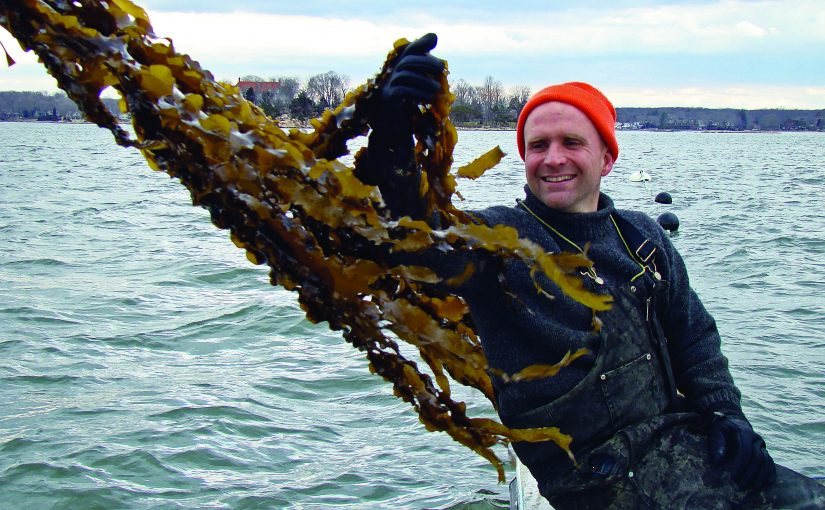
I am a restorative ocean farmer. It’s a trade both old and new, a job rooted in thousands of years of history, dating back to Roman times. I used to be a commercial fisherman, chasing your dinner on the high seas for a living, but now I farm twenty acres of saltwater, growing a mix of sea greens and shell fish.

I’ve paid my debt to the sea. I dropped out of high school to fish and spent too many nights in jail. My body is beat to hell: I crawl out of bed like a lobster most mornings. I’ve lost vision in half my right eye from a chemical splash in Alaska. I’m an epileptic who can’t swim, and I’m allergic to shell fish.

But every shiver of pain has been worth it. It’s a meaningful life. I’m proud to spend my days helping feed my community, and if all goes well, I will die on my boat one day. Maybe get a small obit in the town paper, letting friends know that I was taken by the ocean, that I died a proud farmer growing food underwater. That I wasn’t a tree hugger but spent my days listening to and learning from waves and weather. That I believed in building a world where we can all make a living on a living planet.

Fishermen must tell our own stories. Normally, you hear from us through the thrill-seeking writer, a Melville or Hemingway, trolling my culture for tall tales, or a Greenpeace exposé written from the high perch of environmentalism, or the foodie’s fetishization of artisanal hook and line. When fishermen don’t tell our own stories, the salt and stink of the ocean are lost: how the high seas destroy our bodies but lift our hearts, how anger and violence spawn solidarity and love. There’s more edge to fishermen—more swearing, more fights, more drugs—and we are both victims and stewards of the sea.

So this is my story. It’s been a long, blustery journey to get here, but as I look back over my shoulder, a tale of ecological redemption emerges from the fog. It begins with a high school dropout pillaging the high seas for McDonald’s and ends with a quiet ocean farmer growing sea greens and shell fish in the “urban sea” of Long Island Sound. It’s a story of a Newfoundland kid forged by violence, adrenaline, and the thrill of the hunt. It’s about the humility of being in forty-foot seas, the pride of being in the belly of a boat with thirteen others working thirty-hour shifts. About a farm destroyed by two hurricanes and reborn through blue-collar innovation. It is a story of fear and love for our changing seas.

But, most important, it’s a search for a meaningful and self-directed life, one that honors the tradition of seafaring culture but brings a new approach to feeding the country among the wandering rocks of the climate crisis and inequality.

About this Book

Writing this book was hard. My early years are fogged with drug-fueled violence and adrenaline, and I suspect drenched in over-the-shoulder romanticism. A life seen in reverse is an untidy affair. I struggled with structure. After much wrangling, I decided to weave together five concurrent strands.

First is my evolution from fisherman to ocean farmer. It was a difficult, emotional birth. I had to rewire my nervous system to new tempos of work, grow a blue thumb, hang out with odd breeds of people, even learn a new vernacular of food. It was a bumpy trip: my first brush with aquaculture left me disillusioned, and I’ve made many mistakes along the way to becoming a restorative famer, but in the end I landed on my feet.

The second strand is my rocky romance with sea greens. Like most Americans, I was skeptical about moving seaweed to the center of the dinner plate. Honestly, except for sushi, it sounded kind of gross. But I fell in love with a food lover, and she took me by the hand on a long journey of discovery. We met chefs specializing in making unappetizing food beautiful and delicious, learned about the lost culinary history of Western seaweed cuisine, and tested out kelp dishes on roofers and plumbers. In the book I’ve included a handful of recipes developed by Brooks Headley and David Santos, two of the most creative chefs in the United States, whose work points the way toward a delicious future.

The third strand is instructional: how to start your own underwater garden. It provides the basics for building a farm, seeding kelp and shell fish, and provides tips on farm maintenance and harvesting. It’s not comprehensive, of course, but it might wet your whistle.

Fourth is my journey of learning. I had a long history of struggling in school, but yearned for a way to understand my life on the ocean within a larger context. So I trace my learning curve through the rise of industrial aquaculture and the origins of restorative ocean farming to the secret strategy to convince Americans to eat kale and the emergence of the regenerative economy. There were many surprises along the way. Who knew that the Japanese consider an Englishwoman the birthing mother of nori farming and hold a festival in her honor every year? Or that a shipwrecked Irishman accidentally invented mussel cultivation while trying to net some birds to eat? Or that McDonald’s pioneered a seaweed-based burger in the 1990s?

Finally, there is my tale of passing the baton. This didn’t always go well. I swam with the sharks of Wall Street, drowned in viral media, and failed at building a new processing company. But it was worth the trip, because out of the ashes came GreenWave, a training program for new farmers, partnerships with visionary companies like Patagonia in the era of climate change, and a new generation of ocean farmers to take over the helm and release me back to my beloved farm.

You’ll also hear a lot about kelp in the book. On my farm, we’ve experimented with a few different kinds of seaweed, but sugar kelp has emerged as the most productive, delicious, and viable native species in my area. Most of the book will refer to kelp, but know that, every day, farmers, scientists, and chefs around the world are figuring out new ways to grow and use the thousands of vegetables in the ocean.

What Is Restorative Ocean Farming?

Picture my farm as a vertical underwater garden: hurricane-proof anchors on the edges connected by horizontal ropes floating six feet below the surface. From these lines, kelp and other kinds of seaweed grow vertically downward, next to scallops in hanging nets that look like Japanese lanterns and mussels held in suspension in mesh socks. On the sea floor below sit oysters in cages, and then clams buried in the mud bottom.

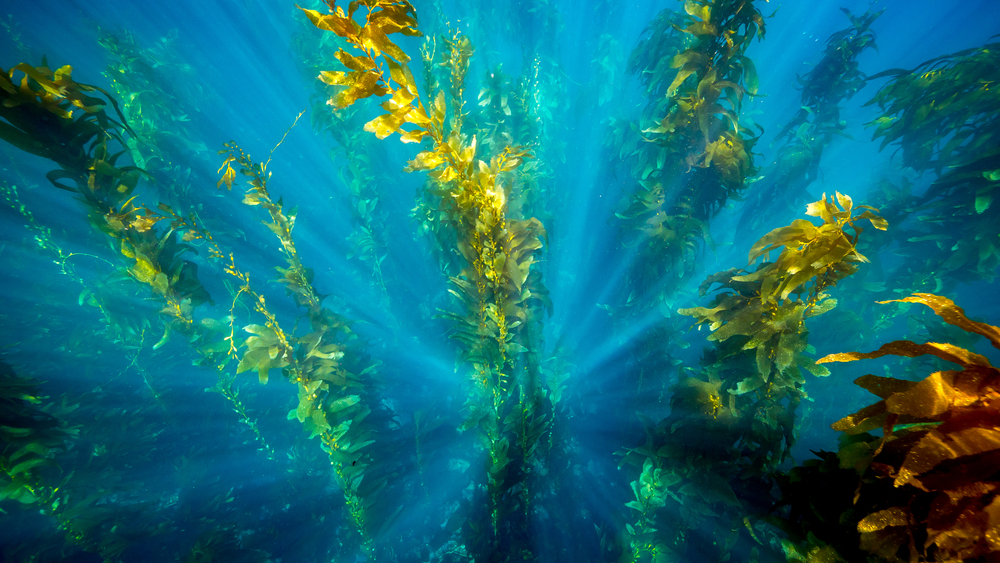
My crops are restorative. Shell fish and seaweeds are powerful agents of renewal. A seaweed like kelp is called the “sequoia of the sea” because it absorbs five times more carbon than land- based plants and is heralded as the culinary equivalent of the electric car. Oysters and mussels filter up to fifty gallons of water a day, removing nitrogen, a nutrient that is the root cause of the ever-expanding dead zones in the ocean. And my farm functions as a storm-surge protector and an artificial reef, both helping to protect shoreline communities and attracting more than 150 species of aquatic life, which come to hide, eat, and thrive.

Shell fish and seaweed require zero inputs—no freshwater, no fertilizers, no feed. They simply grow by soaking up ocean nutrients, making it, hands down, the most sustainable form of food production on the planet.

My farm design is open-source and replicable: just an underwater rope scaffolding that’s cheap and easy to build. All you need is $20,000, twenty acres, and a boat. And it churns out a lot of food: up to 150,000 shell fish and ten tons of seaweed per acre. Because it is low-cost to build, it can be replicated quickly. Best of all, you can make a living: one farm can net up to $90,000 to $120,000 per year.

Finally, the model is scalable. There are more than ten thousand plants in the ocean, and hundreds of varieties of shell fish. We eat only a few kinds, and we’ve barely begun to scratch the surface of what we can grow. Imagine being a chef and discovering that there are thousands of vegetable species you’ve never cooked with or tasted before. It’s like discovering corn, arugula, tomatoes, and lettuce for the first time. Moreover, demand for our crops is not dependent solely on food; our seaweeds can be used as fertilizers, animal feeds, even zero-input biofuels.

As ocean farmers, we can simultaneously create jobs, feed the planet, and fight climate change. According to the World Bank, a network of ocean farms equivalent to 5 percent of U.S. territorial waters can have a deep impact with a small footprint, creating fifty million direct jobs, producing protein equivalent to 2.3 trillion hamburgers, and sequestering carbon equal to the output of twenty million cars. Another study found that a network of farms totaling the size of Washington State could supply enough protein for every person living today. And farming 9 percent of the world’s oceans could generate enough biofuel to replace all current fossil-fuel energy.

Fork In the Road

In 1979, Jacques Cousteau, the father of ocean conservation, wrote: “We must plant the sea . . . using the ocean as farmers instead of hunters. That is what civilization is all about—farming replacing hunting.”

Cousteau’s dream—and mine—of hundreds of ocean farms dotting our coastlines is unsettling to some environmentalists, because it represents a new vision for our seas. I’m sympathetic to these fears, especially given the history of industrial aquaculture in the 1980s. But we face a trinity of crises: the leveling of agriculture yields, skyrocketing global population, and plummeting global fish stocks.

Necessity pushes us to farm the seas, but we can embark on our journey with anticipation and joy. With ocean agriculture still in its infancy, we have an unprecedented opportunity to build a food system from the bottom up. We can avoid the mistakes of industrial agriculture and aquaculture, farm for the benefit of all, not just the few, and weave economic and social justice into the DNA of the blue-green economy, all the while capturing carbon, creating millions of jobs, and feeding the planet.

Just in time, our seas are here to save us. As Jacques Cousteau said: “The sea, the great unifier, is man’s only hope. Now, as never before, the old phrase has a literal meaning: we are all in the same boat.” Indeed.

This is our chance to reimagine our dinner plate by inventing a new “climate cuisine,” not around our industrial palate of salmon and tuna, but around the thousands of undiscovered ocean vegetables and shell fish found right outside our back door. Picture hundreds of small-scale ocean farms dotting our shorelines, surrounded by conservation zones supporting wild fisheries and breathing life back into our oceans. A Napa Valley of ocean merroirs, producing ocean vegetables with distinct flavors in every region. Ocean farms embedded into wind farms, harvesting not only wind but also food, fuel, and fertilizers.

In 1962, President Kennedy reflected on our bond with the sea:

All of us have, in our veins, the exact same percentage of salt in our blood that exists in the ocean . . . Salt in our blood, in our sweat, in our tears. We are tied to the ocean. And when we go back to the sea . . . we are going back to whence we came.

The time has come to return from whence we came. What a beautiful tale this could be about the return of a prodigal nation. We were founded as a maritime nation; more of U.S. territory is located underwater than above. Every other breath we breathe comes from ocean ecosystems. If the pioneering spirit of the nineteenth century was captured by the instruction to “go west, young man,” then this book is a twenty-first century call for our generation to “head out to sea.”

Excerpted from EAT LIKE A FISH by Bren Smith. Copyright © 2019 by Bren Smith. Excerpted by permission of Alfred A. Knopf, a division of Penguin Random House LLC. All rights reserved. No part of this excerpt may be reproduced or reprinted without permission in writing from the publisher.

Bren Smith at Bioneers

How Environmental Literacy and Land Stewardship Could Help Save California for Future Generations

Lead photo credit: Jim Gensheimer/Bay Area News Group

This article was originally published on the Ten Strands website. Ten Strands weaves stakeholders and strategies together into strong, focused education partnerships, with the goal of raising environmental literacy by providing high-quality environment-based learning and hands-on education to all California K–12 students.

BY LUCIA GARAY

For the longest time, I saw climate change only as the melting of ice caps and the clearcutting of rainforests in faraway, obscure parts of the world visible only in documentaries and news reports. My parents always made sure I was aware of the issue, but I was never awake to it. After all, I lived in California where the seasons were never too hot or too cold, my house was always air conditioned, and I always had enough to eat. I cared about climate change, but I was disconnected from it. It seemed to affect me as much as starvation or malaria.

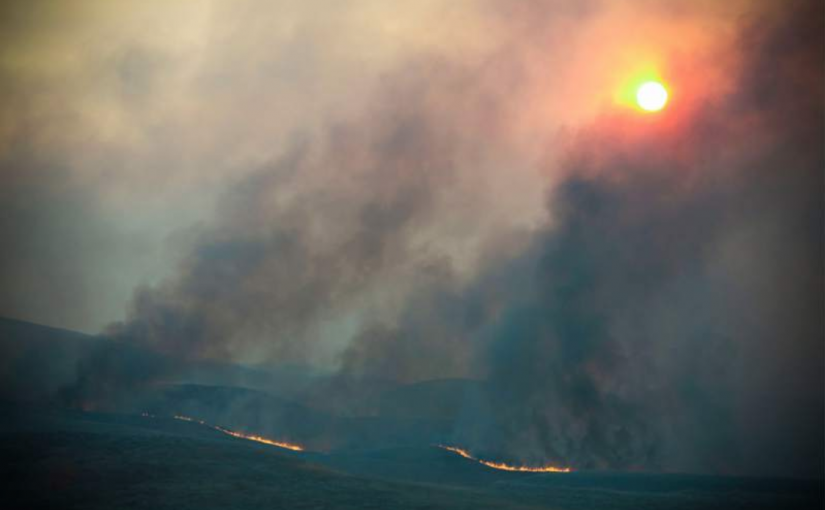
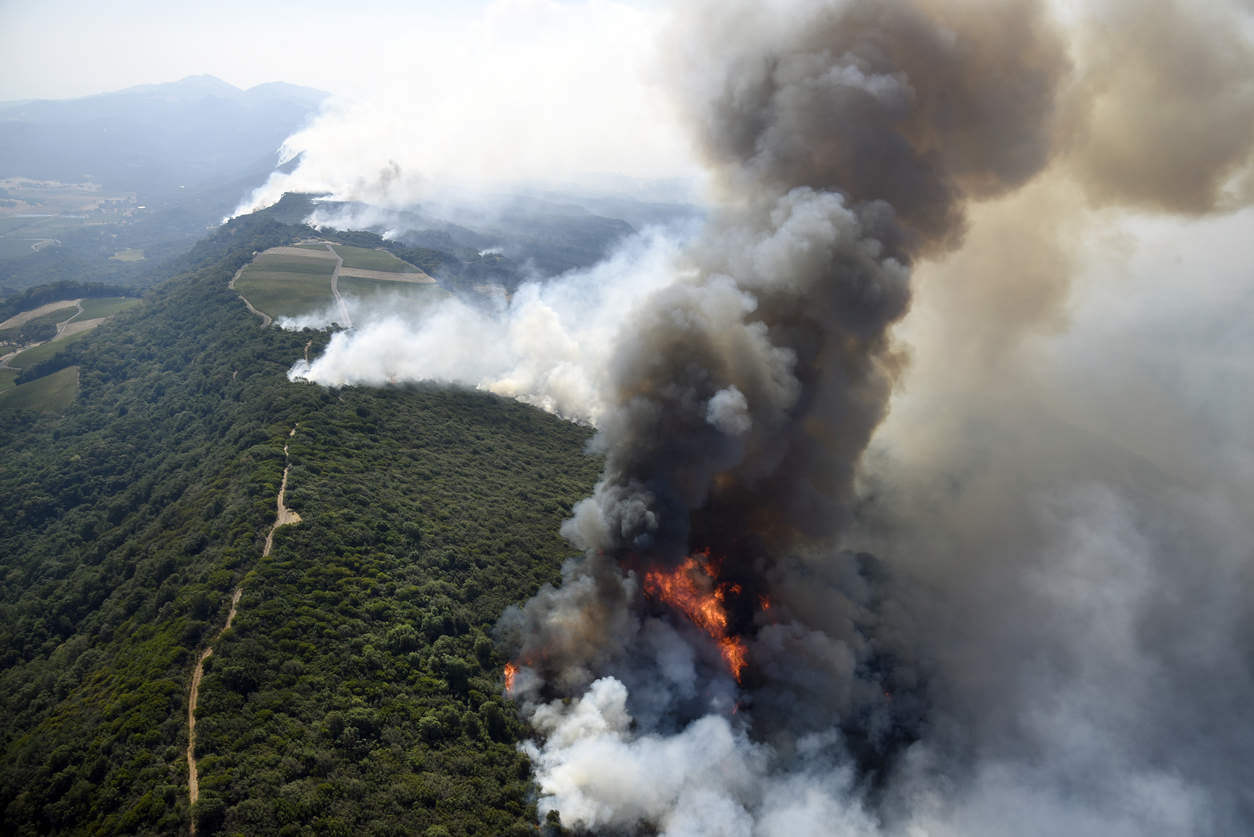
That all changed on Monday, October 9, 2017. That morning I woke up to a world on fire. I couldn’t go outside because the air was thick with toxic ash. I couldn’t see the sun because black smoke masked the sky. I couldn’t breathe without tears coming to my eyes. I couldn’t believe what was happening until I could see the glow of a fire coming over the hill I can see from my house. My home state was burning.

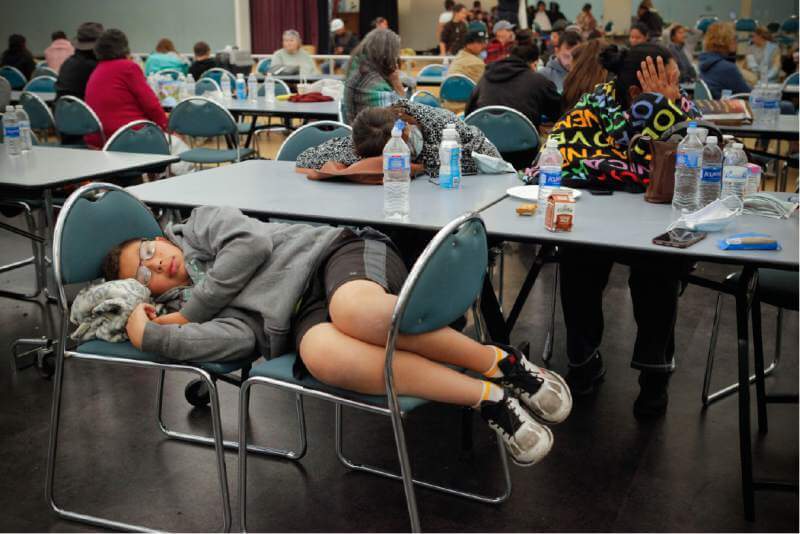
Terrified that the fire would come over the hill and our neighborhood would be the next to burn, my mother moved us to stay with friends at Dillon Beach. Surrounded by the unspoiled California coastline, suntanned surfers, and the rolling waves of the Pacific Ocean, we still couldn’t escape the reality of the fire. Smoke spilled over the blue horizon like a wound ripped open over our lives. Every day my phone buzzed with new alerts. New houses had burned, new lives were lost, further tragedies recorded. After a few days, my mother decided it was safe enough for us to go back home. As soon as we did, we entered a world I had never seen before. We could go nowhere without particulate masks, and the smoke down the street was thicker than the fog that obscures the city of San Francisco. My school was a refugee camp; the gym and classrooms were a temporary shelter for those who had lost everything in the fire. I watched my peers try to console children who had lost everything. I watched my teachers struggle to find medicine and food for the families who had escaped with nothing but the clothes on their backs. I watched my community lose so much, and then rise from the ashes together to rebuild what was lost.

Photo credit: Crissy Pascual/Argus-Courier Staff

The fires brought out the very best of the people in our community, but we should never have been forced to suffer as we did. The wildfires were unnatural, started by human error and fueled by decades of resource mismanagement. The ecosystems of California are built to be balanced and maintained by regular, small-scale fires. The balance is upset by mismanagement and poor land stewardship, and the fires are the price we pay for neglecting our responsibility to the land on which we live and from which we profit. After the first fires I started to research fire ecology, trying to understand if there was a reason behind all of the destruction. What I know now is that the fires that ruined so many livescould have been prevented.

Photo credit: Crissy Pascual/ Argus-Courier Staff

The destruction caused by fires makes many people afraid, and often their first reaction is to suppress fires, including those in the wilderness, started not by people, but by natural causes. Low-intensity fires, fires that burn low to the ground and at relatively low temperatures, increase the environment’s fertility by burning away an overabundance of underbrush and transferring the burned organic matter back into the soil. These low-intensity fires are usually started by natural causes and are much easier to control. In our California ecosystem, fire acts on the environment in a similar way as grazers, like elk and deer, do. Naturally, fires burn at regular intervals in our ecosystems: this keeps vegetation from becoming overgrown and choking out other species, decreasing the biodiversity, and destroying an otherwise healthy system. Many plants in California depend on fire as much as they do on water or air. The knobcone pine needs a fire of over 350 degrees Fahrenheit to open its sealed pine cones and spread its seeds over the forest floor, devoid of competition now that the fire has burned away all the other plants.

Photo credit: Wikipedia

The original land stewards, the Natives of California, knew how to use fire appropriatelylong before Europeans came to America. These Native Americans often started brush fires in strategic places to flush out prey or even to clear space for desirable plants to grow. Early settlers describe California as a beautiful, diverse, and purely wild place. It’s entirely possible that this was no accident, but the result of thousands of years of land stewardship and careful resource management.

We’ve lost the practices that were so artfully employed to cultivate a diverse and resource-rich biosphere in California. We suppress fires, even in the wild, because we build our homes in their path; however, to suppress fires doesn’t mean we prevent them, it merely means we are ensuring a more destructive result later on. The more often we suppress fires, the more biomass is allowed to accumulate, and the stronger and higher the intensity of fires will be in the future. Eventually there will be another fire, and because we didn’t allow smaller, lower intensity fires to burn as they were supposed to naturally, the result will be an even more destructive and higher-burning fire.

Sources: Silvis Labs, OpenStreetMap, Cal Fire

Instead of learning to coexist with the natural forces that surround us, we fear them. The “Smokey the Bear” mindset teaches that fire is an enemy to be conquered. We think of ourselves as separate from the wild, when in fact we are just as animal as the elk, the mountain lion, the hummingbird, and the coyote and therefore just as dependent on our environment, no matter how much we try to change that. Most of today’s conservationists, biologists, and outdoor specialists believe that the best way to conserve nature is to preserve it. We take a hands-off approach to protecting the wild, believing that our best influence on the outdoors is no influence at all. I would argue that this approach fails to take into account that we have already changed the world around us and we cannot separate ourselves from the natural world. Preservation is not the answer to saving our planet and halting climate change. Instead, we must become land stewards, and care for the earth as much as we would our own homes.

Photo credit: Crissy Pascual/ Argus-Courier Staff

I have stood on the front lines of climate change. I believe that the only way to keep California from burning, to keep Antarctica from melting, to keep the Amazon from shrinking, to keep the Middle East from being parched dry from any water is to accept that we are not separate from our world, we are a part of it. With this knowledge, we may be able to cultivate not only a thriving ecosystem, but a better world.

This article was written by Lucia Garay

Lucia Garay, a junior at Casa Grande High School in Petaluma, has been a passionate advocate for environmental justice for most of her life, taking part in local conservation projects and spreading awareness about the connection between a healthy community and a healthy environment. Lucia is also passionate about youth issues and racial inequality. As chair of the Sonoma County Junior Commission on Human Rights, she has helped organize the Sonoma County March for Our Lives for gun sense legislation and her town’s first-ever Women’s March. She is a reporter for her school newspaper, the Gaucho Gazette, and believes in the power of the individual voice to speak up for what is right. Lucia hopes to pursue a career in land stewardship or environmental justice.

14 African American Women Leading Change in the U.S. Food System

This piece was originally published on the Food Tank website. Food Tank is a nonprofit organization focused on building a global community for safe, healthy, nourished eaters.

By Contributing Author: Angie Cerilli

According to the 2018 State of Women-Owned Businesses report, the number of women-owned businesses increased by 58 percent from 2007 to 2018. From this, businesses owned by African-American women grew by 164 percent, which is equal to 20 percent of all women-owned businesses. Not only does this provide a huge boost to the economy, it can create jobs in local communities. Food Tank has compiled a list of 14 African-American female entrepreneurs who have incorporated sustainable food production practices into their business motto.

Lynnette Astaire

Based out of Los Angeles, Lynette Astaire saw a gap that needed to be filled in food education and decided to open Superfood School. As part of the program at Superfood School, Astaire conducts one-on-one consults for meal planning and advice. Additionally, clients are able to attend retreats at LiveLoft, located on the Pacific Coast of Mexico, to undergo a detox, where they receive juices and raw meals made from local produce and items grown on-site.

Tamala Austin

Located in Houston, Texas, Tamala Austin is the founder of J.I.V.E., which stands for Juicing is very essential. What started off as a home-based business is now located in Whole Foods stores in Houston. J.I.V.E. offers organic juices and smoothies, with both vegetarian and vegan options. Austin hopes to educate customers on the transition and maintenance of a healthy lifestyle that is enjoyable and sustainable.

Erika Boyd & Kirsten Ussery

Erika Boyd and Kirsten Ussery are co-owners of Detroit Vegan Soul. Ussery is general manger and in house baker and Boyd is the executive chef. The two saw that there was a lack of accessibility to good, nutritious food available to the people of their community and took it upon themselves to prove that it is possible to eat good tasting comfort foods that are also healthy. What started as a meal delivery and catering service in Downtown Detroit quickly became a full-fledged restaurant, which can now be found at two locations in Detroit. What makes Ussery and Boyd unique is that they are always putting eco-friendly practices at the forefront of their decisions making. For example, all produce used in the restaurant is sourced from local organic farmers and all food waste generated at the restaurant is returned to the farms and used as compost.

Francesca Chaney

What started as a means of creating healthy and nutritious beverages in a pinch became a full-time career for the owner of Sol Sips in Brooklyn, New York, Francesca Chaney. At first, Chaney made organic drinks using a maximum of four ingredients and sold them at pop-up events. She quickly realized that there was demand for healthy, simple and nutritious foods and beverages and made the decision to open her own business. Chaney wants everyone in her community to have the opportunity to enjoy healthy foods, which is why she implemented a sliding scale brunch every Saturday, where customers pay between US$7 and US$15, whatever they can comfortably afford.

Julia Collins

Julia Collins is co-founder and the former President of Zume Pizza located in Mountain view, California, a food company that is best known for its use of robotic technology to create healthy accessible food. Unlike most delivery pizza, Zume Pizza is cooked en-route to its destination, with no added sugars or chemicals. All of the ingredients found in their pizza is sourced from local farmers that use sustainable and ethical farming practices. And although they utilize robots in their production chain to perform the more dangerous jobs, like removing the pizza’s from the oven, Zume Pizza is conscientious of job creation and hopes that by sourcing ingredients from local farms, more companies will follow suite, resulting in more business to local farms. Additionally, although automation is generally associated with job loss, historically, advancements in technology have led to job creation. With the cost savings through the use of automation, Zume Pizza is able to pay their employees liveable wages (US$18/hour) and all of their employees have fully subsidized health insurance plans.

Tanya Fields

As founder and executive director of The Black Feminist Project, Tanya Fields is a food justice activist and educator. And Fields started the Libertad Urban Farm, an organic urban garden in the Bronx, as an effort to address the lack of nutritious food and food education accessible to low-income people, specifically underserved women of color. Additionally, Fields works closely with The Hunts Point Farm Share, connecting city residents to high quality local produce through Community Supported Agriculture (CSA).

Jinji Fraser

Located in Baltimore, Pure chocolate by Jinji was co-founded in 2012 by Jinji Fraser. Fraser sources the cacao used to make the chocolate through growers in Ecuador who she personally met. Knowing who was growing the beans and that they were being treated well was her primary concern, along with knowing that the cacao was grown sustainably by ensuring the region was well suited for cacao growth. Fraser intentionally selects seasonal ingredients from local providers and every chocolate is handcrafted and free from dairy products and all refined sugars.

Kanchan Dawn Hunter

Based in Southwest Berkeley, California, Kanchan Dawn Hunter is co-creator of Spiral Gardens, a nursery, community farm and produce stand. A day in the life of Hunter at Spiral Gardens generally involves educating children and adults in agriculture, from plant identification, growing, harvesting, and preparing, Hunter explains all the steps required from soil to table. Spiral Gardens provides an opportunity for members of the community to grow organic vegetables and then to enjoy their harvest. Every Tuesday Spiral Gardens hosts a “Produce Stand” where they sell fresh organic fruits and vegetables from local family farms to the community at cost. Hunter is most passionate about creating transparency and accessibility of food and farming to people that are most often kept from it.

Cynthia Nevels

Cynthia Nevels is the owner of the Dallas based award-winning food truck SoulGood. The food truck serves vegan and vegetarian dishes with locally sourced organic produce. The reason she decided to start her own business was to honor her son’s life, who lost his battle to cystic fibrosis. The vegan and vegetarian dishes she serves at her food truck are those she would make for her son while he was waiting for an organ transplant. During this difficult time, Nevel felt the one thing that she could control was the delivery of healthy and nutritious food to her son. She hopes to share these nutritious meals with her community and to spread awareness of healthy living.

Jamila Norman

Based in Atlanta, Georgia, Jamila Norman is a world-renowned urban farmer and food activist. In 2010, Norman founded Patchwork City Farms, a certified naturally grown organic urban farm where she is the sole farmer. Norman’s passion for farming is fueled by nature and the ability to feed and educate her community with safe and nutritious foods. Norman is also involved in other organizations within the world of food justice and equity. She is co-founder of EAT Where You Are, an initiative that aims to spread awareness of the importance of including fresh foods in diets, and is a contributing author to OASIS (Oldways Africana Soup in Stories). And Norman is the manager and one of the founding members of the South West Atlanta Growers Cooperative, which supports Black farmers of Atlanta in creating an equitable food system that encompasses environmental sustainability and cultural responsibility.

Leah Penniman

Leah Penniman co-founded Soul Fire Farm in 2011 and, as co-director and program manager at the farm, fills many roles. Penniman is a farmer, trainer, author, speaker, advocate for food justice and winner of the 2019 James Beard Foundation Award. The mission at Soul Fire Farm is to end racism and injustice within the food system. This message is portrayed in Penniman’s novel Farming While Black, a comprehensive manual for small-scale African-heritage farmers in reclaiming their place in the food system utilizing traditional farming practices and regaining their connection to land. Through training of the next generation of food activist-farmers, Soul Fire Farm aims to promote sustainable agriculture and environmental justice while maintaining food sovereignty.

Safia Rashid

Safia Rashid is certified in sustainable urban agriculture and is the owner of Your Bountiful Harvest located in Chicago, Illinois, a sustainable urban farm and garden consultation service. Whether the need is advice, guidance, or to purchase organic seedlings, Your Bountiful Harvest covers it, with on-site visits to home gardens and greenspaces. Rashid’s main goal is to teach people the skills required to increase and improve their food self-sufficiency while using sustainable farming practices.

Gail Taylor

As owner and operator of Three Part Harmony Farm in northeast Washington, D.C., Gail Taylor supplies organic and local produce to her community through a multi-farm CSA, meaning that the share of fresh produce will include produce from partner farms, expanding the array of veggies that one receives. Not only does Three Part Harmony exist to provide nutritious foods to D.C. residents, it also seeks to establish an ethical, robust, and fair food economy while bringing awareness and uprooting the racism engraved in the food system.

Karen Washington

New York Native Karen Washington has dedicated decades of her life to advocating for justice in the food system and has promoted urban farming as a means of generating access to fresh local food for New Yorkers. Karen has been involved in various organizations that promote food justice including Just Food, Farm School NYC, Black Urban Growers (which she co-founded), and NYC Community Gardens Coalition. Currently, Karen owns and operates Rise & Root Farm, a cooperatively run organic farm in Orange County.

Feature Image Courtesy of Nation Swell, Karen Washington.

Kandi Mosset – Indigenous Rising for Mother Earth

Kandi Mosset is a mother and member of the Mandan Hidatsa Arikara Nation of North Dakota. She is known worldwide for her involvement on the frontlines of the protests at Standing Rock and as a leading voice in the fight against environmental racism. subsequent leadership on pipeline and resource extraction activism. Along with fellow water protectors, Mosset traveled from the protests in South Dakota to the 2016 Bioneers Conference to provide an update on Standing Rock that reached millions and returned to share a deeply moving keynote address in 2017. She currently works with the Indigenous Environmental Network (IEN) as Lead Organizer of the Extreme Energy and Just Transition Campaign, and she previously served as the IEN’s Tribal Campus Climate Challenge Coordinator. Mosset is passionate about bringing visibility to the impacts of climate change and environmental injustice, specifically those affecting Indigenous communities throughout the world.

Bioneers was thrilled to interview Kandi Mosset about the significance of the fight at Standing Rock for humanity’s fight to protect Mother Earth. This is an edited excerpt of that interview.

We say Mother Earth because the mother provides and keeps a child alive for the first few years at least. On planet Earth, the food is grown in the soil, the air we breathe. When we say Mni Wiconi, “water is life”, it’s more than just a saying. The very essence of being alive is water, because we are made up of it, it’s all around us, it’s in us. If we abuse the water, we’re abusing ourselves.

All of these things are connected. All of these ecosystems are circular. The problem with the world today is that a lot of things are very square. We like to put things in boxes. We like to label things in boxes. We like to live in boxes. It’s allowed us to be disconnected from the very essence of ourselves, which is that we are part of the system; not above it, not beside it, not over it, under it, we are part of it. Reaffirming and understanding that as humanity is being brought back because of what we’ve been able to show with the fight at Standing Rock.

This moment we find ourselves in was prophesized 200 or 300 years ago. The major fights against Dakota Access Pipeline and the on-the-ground fights were on sacred sites. There are over 380 sacred sites in that corridor, and there’s a lot buried under the ground that people don’t see. Medicine was put there to make sure that diverse nations who were traditional enemies could gather together there and trade. We each had our own skill sets. My tribe, for example, Mandan Hidatsa Arikara, are farming tribes. We lived along the Missouri, and we had water for irrigation. So we would have more of the farming goods – the corn, the squash, the beans – whereas another tribe would have meat. And so we recognize diversity even in ourselves, and recognize that, even as traditional enemies, we relied upon each other for those times of trade. People would tell the stories to the youth, the future generations, about how it was really important to listen and understand each other, because the significance of the medicine would come up again. And here we are. And it is significant.

With the fight at Standing Rock, we’ve been able to show that over 500 tribes can still get together for the same cause, which is for justice and for truth and reconciliation, and for a change of the system. That fight has helped that whole narrative move forward, so that people understand that it wasn’t just about Indigenous Peoples, it was people in general reaffirming your attachment to the sacred, or reaffirming yourself as an individual. It doesn’t matter the color of your skin or whatever, you have to do that as a human living on the planet.

There’s also the Hopi prophecy about how all of the people of the rainbow would again gather and unite, and that’s what would change the world. What they mean by the rainbow is there’s all different colors of people. It’s not just us as Native people. We have our allies that stood and are standing in solidarity with us. It was about more than just the pipeline, it was about capitalism and colonialism, and how we have to decolonize our minds and our bodies and our spirits.

That’s where the theme of Indigenous Rising comes from. We never have changed the narrative, and what we’ve been saying for over 500 years is that capitalism is not sustainable. Greed could be our undoing, and we had to recognize that, not just as Native people, but as humanity.

So to see it actually come alive during that time, personally, gives me goosebumps — when I talk about how it could be the change that the entire world needs to see, that there is a different way.

This 26-Year-Old Native Activist Is Rewriting the Future

Julian Brave NoiseCat (Secwepemc and St’at’imc) is a 26-year-old Indigenous journalist, activist and policy analyst. As Director of Green New Deal Strategy at Data for Progress and Narrative Change Director at the Natural History Museum, his work is largely focused on environmental justice and Indigenous issues — and where the two overlap.

NoiseCat’s writing has appeared in The Guardian, in which he recently covered the highly publicized standoff between high school students and a Native American man in Washington, D.C. (“It appears that a great deal of this nation … is not ready to look at the nasty complexity of racism, power and privilege squarely in the face and tell the truth.”); The Nation, in which he profiled Native Congresswoman Deb Haaland; The Paris Review, in which he wrote about the new Native literature renaissance (“In a cultural moment defined by fear of ecological apocalypse, democratic decline and legitimized white supremacy, newfound interest in Native writers—who speak with the authority of a people who lived through genocide and survived to talk about it—makes sense.”); and several other publications.

We caught up with NoiseCat to discuss the experiences that set him on a pathway toward storytelling, the value of strong leadership within his generation, and what he hopes to achieve by the time he turns 30.


BIONEERS: Tell us a little bit about your pathway toward becoming a media maker and why storytelling is so important to you.

Julian Brave NoiseCat

JULIAN: The reason why storytelling is so important to me is that I grew up believing that, as an Indigenous person, I did not see myself in the stories that I was encountering in the broader culture and definitely in school. But I also believed, because my father is a Native artist and because I had very strong pride in who I was and in my difference, that, as an indigenous person, I had something to say and something to contribute.

Every opportunity I got, I would read the writings, for example, of Sherman Alexie, which were really impactful to me. And I would try to emulate that. Somewhere, stored away, I have a short story that I wrote when I was in fifth grade that was supposed to be in the voice of Sherman Alexie.

I think believing that I had something important to say led me down this path, and also being encouraged by my mom and lots of teachers. I was also fortunate enough to grow up in a place like Oakland, where nobody would scoff at the idea that a young Indigenous guy would have something to say and that people should listen.


All of that gave me a sense that my voice could matter and have an impact. And then, I went to college, and I did some writing for the campus newspaper and got a summer gig with the Huffington Post after I graduated. I just kept pushing for those kinds of opportunities. I’ve been very fortunate to get a lot of opportunities in the writing and journalism world at a younger age. But also, I think I’ve been pretty willing to put myself out there and to keep trying. And I’ve faced a fair amount of rejection as well.

BIONEERS: You mentioned your mom, and you mentioned Sherman Alexie. Who are some other people who you look up to, who influence your work?

JULIAN: I was born in Minnesota. I remember, when I was 11, we went to the opening of the National Museum of the American Indian in Washington, D.C., in part because my dad had a piece that was featured there. We ran into Jim Northrup, the late Indigenous poet from Minnesota, on the National Mall, and he read his poem, “Indian Car,” to me. That moment always has stuck with me as being really powerful.

I also participated in the Martin Luther King Oratorical Fest when I was a kid, which was in the Oakland Unified School District. Being surrounded by that activist culture, and in particular, in Oakland, the black church activist tradition, really emphasized oratory and voice, which had a longstanding impact on my development.

BIONEERS: What are some of the biggest issues you see facing your generation and the people you care about right now?

JULIAN: Climate change is the big one. Also, more broadly speaking, just a sense of precariousness for millennials. We are coming of age in a world that is economically very difficult to be viable in. Rising costs of living and declining wages are very real. We’re seeing way less protection for workers than ever before, and in the media field in particular. There’s a complete destabilization of the business model for journalism, sort of wrought by big tech.

In the last few years, we’ve also seen a real sense of political destabilization, with the rise of proto-fascist and sometimes outrightly fascist movements along with a resurgent right wing.

BIONEERS: All of those things being the case, do you have hope that we can turn this ship around?

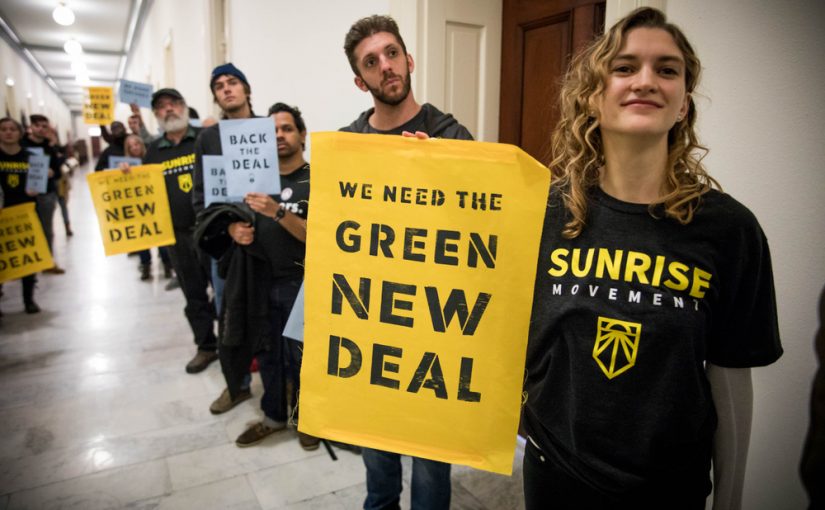
JULIAN: There are some very powerful rising social movements, many of which are being led by young people, as is the case with my friends in the Sunrise Movement. That is incredibly inspiring to me.

In the Indigenous world, the movement at Standing Rock was initiated by the youth of Standing Rock, who met with Barack Obama in 2014. Then, when the Dakota Access Pipeline was threatening their water and their homes, they led a run to Washington, D.C. to raise awareness of this issue. That was really the beginning of the campaign.

Throughout Standing Rock, there was a group called the International Indigenous Youth Council, and they were literally organizing without laptops. All they had were iPhones. Before the Green New Deal, Standing Rock was the headline environmental movement in the United States. In that moment, groups like the International Indigenous Youth Council weren’t even getting the resources to have their own computers.

Whenever I go out and report in Indigenous communities, I am always amazed by how much communities and nations and organizers, governments, social workers, creators, artists, all of these people who are relatives and friends, are doing with so little. That is always incredibly inspiring to me. At the core of it, being part of that is really the reason why I write and work: to hopefully make a contribution to that big picture.

BIONEERS: If one of your peers were to approach you and ask, “What is the biggest action I can take to improve the world for future generations?” what would you tell them?

JULIAN: I think that the biggest action we can take as young people is to stand with the young people out there, who are organizing in their communities, fighting back against climate change, environmental degradation, democratic decline, economic injustice, social injustice, gender injustice, racism. I think the biggest thing young people can do is to join that monumental struggle. I would just encourage young people to look to their left and look to their right at their fellow young people who are already doing amazing stuff, and believe that they can do it.


BIONEERS: What does it mean to you to “stand with” people who are taking action?

JULIAN: First, I think it means to show up, whether that be in person or even online. It means showing up when, for example, our Jewish brothers and sisters or our Muslim brothers and sisters or our black brothers and sisters or our queer brothers and sisters are under threat or being attacked by forces that aim to divide us; showing that we see their wellbeing, their health, and their prosperity as integral to our own health and happiness and prosperity.

Fundamentally, it’s about seeing all of our struggles as interconnected, all of our destinies as interconnected, and therefore seeking to do one of the things that humans are uniquely good at, which is to be compassionate as a species, and then to cooperate, to try to take on these big challenges together to make them a little less scary.

BIONEERS: Tell us about what you’ll be working on in the next couple of years.

JULIAN: I’m hoping to write my first book before I’m 30. I really want to write a book about Indigenous current affairs: pain that endures and is still inflicted upon Indigenous people and communities and bodies, but also the resilience and resurgence of those communities that I’ve seen and reported on throughout North America and beyond.

BIONEERS: What excites you most about coming to Bioneers this year?

JULIAN: The people. For folks who are engaged in environmental work, it’s a gathering place, and it’s an opportunity to see people you might not have seen the rest of the year.

Also, personally, I grew up in Oakland, California, so Bioneers is an opportunity for me to go home, to get out of D.C. I’m always excited to get back to my roots, see my mom and see my friends and girlfriend.

See more from Julian Brave NoiseCat

The Secret to Funding a Green New Deal

By Ellen Brown

This article was originally published on TruthDig.

As alarm bells sound over the advancing destruction of the environment, a variety of Green New Deal proposals have appeared in the U.S. and Europe, along with some interesting academic debates about how to fund them. Monetary policy, normally relegated to obscure academic tomes and bureaucratic meetings behind closed doors, has suddenly taken center stage.

The 14-page proposal for a Green New Deal submitted to the U.S. House of Representatives by Rep. Alexandria Ocasio-Cortez, D-N.Y., does not actually mention Modern Monetary Theory (MMT), but that is the approach currently capturing the attention of the media—and taking most of the heat. The concept is good: Abundance can be ours without worrying about taxes or debt, at least until we hit full productive capacity. But, as with most theories, the devil is in the details.

MMT advocates say the government does not need to collect taxes before it spends. It actually creates new money in the process of spending it; and there is plenty of room in the economy for public spending before demand outstrips supply, driving up prices.

Critics, however, insist this is not true. The government is not allowed to spend before it has the money in its account, and the money must come from tax revenues or bond sales.

In a 2013 treatise called “Modern Monetary Theory 101: A Reply to Critics,” MMT academics concede this point. But they write, “These constraints do not change the end result.” And here the argument gets a bit technical. Their reasoning is that “the Fed is the monopoly supplier of CB currency [central bank reserves], Treasury spends by using CB currency, and since the Treasury obtained CB currency by taxing and issuing treasuries, CB currency must be injected before taxes and bond offerings can occur.”

The counterargument, made by American Monetary Institute (AMI) researchers, among others, is that the central bank is not the monopoly supplier of dollars. The vast majority of the dollars circulating in the United States are created, not by the government, but by private banks when they make loans. The Fed accommodates this process by supplying central bank currency (bank reserves) as needed, and this bank-created money can be taxed or borrowed by the Treasury before a single dollar is spent by Congress. The AMI researchers contend, “All bank reserves are originally created by the Fed for banks. Government expenditure merely transfers (previous) bank reserves back to banks.” As the Federal Reserve Bank of St. Louis puts it, “federal deficits do not require that the Federal Reserve purchase more government securities; therefore, federal deficits, per se, need not lead to increases in bank reserves or the money supply.”

What federal deficits do increase is the federal debt; and while the debt itself can be rolled over from year to year (as it virtually always is), the exponentially growing interest tab is one of those mandatory budget items that taxpayers must pay. Predictions are that in the next decade, interest alone could add $1 trillion to the annual bill, an unsustainable tax burden.

To fund a project as massive as the Green New Deal, we need a mechanism that involves neither raising taxes nor adding to the federal debt; and such a mechanism is proposed in the U.S. Green New Deal itself—a network of public banks. While little discussed in the U.S. media, that alternative is being debated in Europe, where Green New Deal proposals have been on the table since 2008. European economists have had more time to think these initiatives through, and they are less hampered by labels like “socialist” and “capitalist,” which have long been integrated into their multi-party systems.

A Decade of Gestation in Europe

The first Green New Deal proposal was published in 2008 by the New Economics Foundation on behalf of the Green New Deal Group in the U.K. The latest debate is between proponents of the Democracy in Europe Movement 2025 (DiEM25), led by former Greek finance minister Yanis Varoufakis, and French economist Thomas Piketty, author of the best-selling “Capital in the 21st Century.” Piketty recommends funding a European Green New Deal by raising taxes, while Varoufakis favors a system of public green banks.

Varoufakis explains that Europe needs a new source of investment money that does not involve higher taxes or government deficits. For this purpose, DiEM25 proposes “an investment-led recovery, or New Deal, program … to be financed via public bonds issued by Europe’s public investment banks (e.g., the new investment vehicle foreshadowed in countries like Britain, the European Investment Bank and the European Investment Fund in the European Union, etc.).”

To ensure that these bonds do not lose their value, the central banks would stand ready to buy them above a certain yield. “In summary, DiEM25 is proposing a re-calibrated real-green investment version of Quantitative Easing that utilizes the central bank.”

Public development banks already have a successful track record in Europe, and their debts are not considered government debts. They are financed not through taxes but by the borrowers when they repay the loans. Like other banks, development banks are money-making institutions that not only don’t cost the government money but actually generate a profit for it. DiEM25 collaborator Stuart Holland observes:

While Piketty is concerned to highlight differences between his proposals and those for a Green New Deal, the real difference between them is that his—however well-intentioned—are a wish list for a new treaty, a new institution and taxation of wealth and income. A Green New Deal needs neither treaty revisions nor new institutions and would generate both income and direct and indirect taxation from a recovery of employment. It is grounded in the precedent of the success of the bond-funded, Roosevelt New Deal which, from 1933 to 1941, reduced unemployment from over a fifth to less than a tenth, with an average annual fiscal deficit of only 3 percent.

Roosevelt’s New Deal was largely funded through the Reconstruction Finance Corporation (RFC), a public financial institution set up earlier by President Hoover. Its funding source was the sale of bonds, but proceeds from the loans repaid the bonds, leaving the RFC with a net profit. The RFC financed roads, bridges, dams, post offices, universities, electrical power, mortgages, farms and much more; and it funded all this while generating income for the government.

A System of Public Banks and “Green QE”

The U.S. Green New Deal envisions funding with “a combination of the Federal Reserve [and] a new public bank or system of regional and specialized public banks,” which could include banks owned locally by cities and states. As Sylvia Chi, chair of the legislative committee of the California Public Banking Alliance, explains:

The Green New Deal relies on a network of public banks — like a decentralized version of the RFC — as part of the plan to help finance the contemplated public investments. This approach has worked in Germany, where public banks have been integral in financing renewable energy installations and energy efficiency retrofits.

Local or regional public banks, Chi says, could help pay for the Green New Deal by making “low-interest loans for building and upgrading infrastructure, deploying clean energy resources, transforming our food and transportation systems to be more sustainable and accessible, and other projects. The federal government can help by, for example, capitalizing public banks, setting environmental or social responsibility standards for loan programs, or tying tax incentives to participating in public bank loans.”

U.K. professor Richard Murphy adds another role for the central bank—as the issuer of new money in the form of “Green Infrastructure Quantitative Easing.” Murphy, who was a member of the original 2008 U.K. Green New Deal Group, explains:

All QE works by the [central bank] buying debt issued by the government or other bodies using money that it, quite literally, creates out of thin air. … [T]his money creation process is … what happens every time a bank makes a loan. All that is unusual is that we are suggesting that the funds created by the [central bank] using this process be used to buy back debt that is due by the government in one of its many forms, meaning that it is effectively canceled.

The invariable objection to that solution is that it would act as an inflationary force driving up prices, but as argued in an earlier article of mine, this need not be the case. There is a chronic gap between debt and the money available to repay it that needs to be filled with new money every year to avoid a “balance sheet recession.” As U.K. professor Mary Mellor formulates the problem in her book “Debt or Democracy” (2016):

A major contradiction of tying money supply to debt is that the creators of the money always want more money back than they have issued. Debt-based money must be continually repaid with interest. As money is continually being repaid, new debt must be being generated if the money supply is to be maintained. … This builds a growth dynamic into the money supply that would frustrate the aims of those who seek to achieve a more socially and ecologically sustainable economy.

In addition to interest, says Mellor, there is the problem that bankers and other rich people generally do not return their profits to local economies. Unlike public banks, which must use their profits for local needs, the wealthy mostly hoard their money, invest it in the speculative markets, hide it in offshore tax havens or send it abroad.

To avoid the cyclical booms and busts that have routinely devastated the U.S. economy, this missing money needs to be replaced; and if the new money is used to pay down debt, it will be extinguished along with the debt, leaving the overall money supply and the inflation rate unchanged. If too much money is added to the economy, it can always be taxed back; but as MMTers note, we are a long way from the full productive capacity that would “overheat” the economy today.

Murphy writes of his Green QE proposal:

The QE program that was put in place between 2009 and 2012 had just one central purpose, which was to refinance the City of London and its banks. … What we are suggesting is a smaller programme … to kickstart the UK economy by investing in all those things that we would wish our children to inherit whilst creating the opportunities for everyone in every city, town, village and hamlet in the UK to undertake meaningful and appropriately paid work.

A network of public banks, including a central bank operated as a public utility, could similarly fund a U.S. Green New Deal—without raising taxes, driving up the federal debt or inflating prices.

Ellen Brown is an attorney, chairman of the Public Banking Institute, and author of twelve books including “Web of Debt” and “The Public Bank Solution.”

This article was originally published onTruthDig.

Seeds, War and Breeding Crops for Climate Change

By Mark Shapiro

Mark Schapiro is an award-winning environmental investigative journalist whose work has appeared in Harper’s, The Nation, Mother Jones, and The Atlantic Monthly. He is the author of Seeds of Resistance: The Fight for Our Food Supply.

In this transcribed excerpt from his presentation at the 2018 Bioneers Conference, Mark tells a truly fascinating story that weaves together American foreign policy, agricultural heritage harkening back to the birth of western civilization and how an Italian seed breeder working for the United Nations in the Middle East managed to shepherd a refugee seed collection through two wars in hopes of preserving an ancient genetic treasure that could help farmers adapt to climate change.


Investigative Journalist Mark Schapiro speaks at Bioneers 2018 as part of a panel on Evolutionary Plant Breeding, also featuring Cooper Freeman, Occidental Arts and Ecology Center’s Program Manager; Leonard Diggs, Manager of Santa Rosa Junior College’s Shone Farm

When thinking about seeds, it’s important to understand the convergence of a couple of different events. First, we have a very powerful convergence of control over the seed industry. Three companies, all of which are chemical companies, now control over half of all commercially traded seeds. Secondly, you have very dramatic changes happening in the conditions for growing food, which are challenging the current model of agriculture.

In my previous book Carbon Shock, I wrote about climate change and all the ways in which it is putting pressure on our economy, our political systems, and the way we understand resources. I learned, from farmers in the Central Valley of California and all over the world, how conditions were changing from the way that farmers had grown up thinking they would be. Both organic farmers and conventional farmers are experiencing very profound change.

One of the questions that I wanted to ask as a journalist was, “What do those profound changes mean for the types of seeds that people use? And what do those changes mean at a time when the consolidation is increasing and a movement in response to that consolidation is also expanding rapidly.” I tried, in my book, to tell stories about the people that are involved in this struggle that is underway, and how this plays out for people all over the world.

War Zone in the Birthplace of Agriculture

Following the 2003 invasion of Iraq, the city of Abu Ghraib became infamous as the location of the prison where horrible things were done by American soldiers to Iraqi prisoners. Prior to 2003, Abu Ghraib was renowned for being the host to an extremely important seed bank that collected seeds from all over that region. Iraq is the center of the fertile crescent and Abu Ghraib is located in the great Delta, the meeting of the Tigris and Euphrates Rivers, which was the birthplace of domesticated agriculture. Seeds that have been planted for many, many centuries began their journey into our ecosystem in the Delta of the Tigris and Euphrates Rivers, which means these seeds in Abu Ghraib were some of the most ancient domesticated seeds on the planet.

The conditions in that part of Iraq and the Middle East are hot and dry, which means that the seeds that have grown up there have become tolerant to extreme levels of heat and extreme levels of drought. Even during the crazy realm of Saddam Hussein, scientists would come from all over the world to study these seeds, and in some cases, bring them back to their home regions. It was a fantastic center for exchanging seeds.

In April 2003, American troops rolled into Iraq and made their way pretty quickly to Baghdad. As the fighting got more and more intense around Baghdad, the seed bank was hit by a random rocket – it’s unclear whether it was an American rocket or rocket from the Iraqi defenders – and the seed bank was rattled and almost destroyed.

A group of Iraqi scientists went into that seed bank and salvaged whatever seeds they could, threw them into a van and raced them across the border to safety in Syria. They drove the van to a small town called Tal Hadya, which is about 15 miles from Aleppo. In Tal Hadya there is a seed research center called the International Center for Agricultural Research in the Dry Areas (ICARDA). ICARDA, one of the UN’s network of seed research institutions, welcomed the refugee seeds. Some of the staff from ICARDA were familiar with these plants because they spent time training people in Iraq. There had been active exchanges between Tal Hadya and Abu Ghraib. Seeds from Abu Ghraib had been planted and were also preserved in the vault at ICARDA.

Growing a Mix of Seed Varieties

There they grew out many different seed varieties – millet, barley, wheat, numerous varieties of beans, peas, etc. Anyone familiar with the foods of the Middle East knows how much diversity there is and how much tasty food there is, much of which emanates originally from multiple thousands of years ago in the region.

Nobody was paying attention to the ICARDA facility 10-20 years ago. It was just another agricultural institution for dry regions. But now the climate of many places is becoming more like those hot dry areas; large parts of the United States, as well as other parts of the world, resemble the Middle East. The seed bank outside of Aleppo had become an extremely important institution.

For about 10 years the Iraqi seeds were grown out – the whole mix of different related varieties together – at the Syrian seed bank. Syrian farmers traditionally grow wheat with multiple varieties in the same field.

Agriculture, Climate and Conflict

Then war came to Syria. There are many different tensions that contributed to the war, but one was related to agriculture. By 2010, the Syrian government was pursuing an effort to consolidate farms into larger and larger operations that used more uniform seeds. Then a drought hit. The newer uniform seeds were much less responsive to drought than the traditional seeds may have been. The drought decimated the farmer’s crops. There were multiple causes that led to the tensions in Syria, but that is one factor that I’ve seen convincingly argued.

Aleppo was a redoubt of the rebels for many years, and was one of the strongest centers of resistance in a horrible civil war that has been tearing Syria apart. So the rebels took control of the seed bank.

I talked to scientists who were there at that time. The rebel commander who took control of the area around Tal Hadya, just 15 miles from Aleppo, was a farmer. He understood exactly the importance of this seed bank, and he struck a deal with the scientists. He said, “We’ll keep your electricity going and we’ll get you diesel to run the tractors so you can keep growing your plants, I just want you to provide food to help feed the troops.” The UN had lost control of the area, so it was the rebels and the scientists who cut a deal.

That deal lasted until the fall of 2016, when the government forces of Bashar Assad launched attacks on Aleppo. They were horrible and brutal. There were barrel bombs. Many, many innocent people were killed during that time period.

As the war came closer and closer to Tal Hadya, the electricity started failing. So, a group of scientists bundled a whole bunch of seeds from the Tal Hadya seed bank into a van and raced them across the border into Lebanon, where they are being grown out today in the Bekaa Valley, which is controlled by Hezbollah who are completely cool with this enterprise. The scientists affiliated with the UN are now going in and out of this area and trying to keep those seeds from Syria and Iraq alive. The efforts by those scientists to save the seeds illustrates how important the world perceives these seeds to be.  

Saving the Seeds, Continuing the Experiment

Italian scientist, Salvatore Ceccarelli, an ingenious seed breeding pioneer who worked for 25 years at the seed bank outside of Aleppo, took two 20 kilo sacks of wheat seeds that he was responsible for, put them on an airplane and took them to Italy. The seeds in the sacks were a mix of several different varieties. He turned them over to a rural seed NGO in Italy, which then dispersed them to several farmers in Tuscany and Sicily.

What does it mean to grow out a population of seeds? The broad genetics of the different varieties gives the whole mix a greater resilience to varying and extreme weather conditions. Italy has been undergoing a severe drought and severe rise in temperatures, causing extreme stress on commercial wheat and creating a serious crisis in the pasta industry. This mixed population of seeds grown together is evolving over several years and is producing very hardy wheat crops.

It is a fascinating experiment. The Tuscany wheat produces a higher yield than the Sicily wheat because there’s more rain in Tuscany. Both are being called the Aleppo mix in recognition of where these seeds came from.

But the only seeds you can legally sell in the market in Europe and in the United States are seeds that are single varieties, one type of seed that’s repetitive and that guarantees that it will essentially reproduce the same plant characteristics over multiple generations. In contrast, the seed mix evolves and adapts to changing conditions.

While Ceccarelli was doing this experiment, a coalition of agricultural groups lobbied the European Union in Brussels. Based on scientific arguments, they convinced the European Union to wave a set of laws that require that seeds be of a single variety allowing this population of wheat seeds, as well as some barley and millet, to be grown.

The highly successful experiment ran for about five years in Italy until it ended in December of 2018. The thesis of the experiment is that breeding multiple varieties of seeds with a broad range of genetics in the same field leads to crops that are able to respond to a broad set of environmental conditions. Ceccarelli’s argument is that this approach is the best way for farmers to respond to climatic changes.


Editors Note: Our deepest thanks to Mark Shapiro for telling this story at Bioneers – and, as usual, it doesn’t stop here. Learn more about a project in the US inspired by Dr. Ceccarelli’s work. The Occidental Arts and Ecology Center and Shone Farm of Santa Rosa Junior College are conducting an Evolutionary Plant Breeding Project, implementing some of the same techniques in their fields in northern California.

Dr. James Hansen – Global Climate Action

Introduced by David Orr.

As Bobby Kennedy Jr. said, “Dr.James Hansen is Paul Revere to the foreboding tyranny of climate chaos – a modern-day hero who has braved criticism and censure and put his career and fortune at stake to issue the call to arms against the apocalyptic forces of ignorance and greed.” Among the world’s top climate scientists, Dr. James Hansen describes the dire urgency for dramatic global climate action, including the immediate end to new coal plants. Since 1981 he has served as head of the NASA Goddard Institute for Space Studies, and is an Adjunct Professor in the Department of Earth and Environmental Sciences at Columbia University. He will share his personal odyssey into climate action, including civil disobedience.

This speech was presented at the 2010 Bioneers National Conference.

How a Green New Deal in Maine Could Transform Progressive Organizing: An Interview With Chloe Maxmin

Chloe Maxmin represents District 88 in the Maine House of Representatives. She’s the youngest woman in the Maine House of Representatives and won her election running as a Democrat in a district that is one of the oldest in the state and had never elected a Democratic to the state house.

Representative Maxmin has been active in climate organizing and politics since she was barely a teenager. She co-founded Divest Harvard, has been the recipient of numerous awards including a Brower Youth Award, and is a contributor and fellow at The Nation. We first met Chloe when she gave a keynote address to the Bioneers Conference in 2014 and have been witness go the leadership that she’s shown on a regular basis at national and local levels since then. Chloe generously paused her busy schedule to speak with Bioneers’ Teo Grossman about the groundbreaking Green New Deal for Maine, the power of youth movements today, and the big question of whether our current system is capable of dealing with the challenges we face.

TEO GROSSMAN, SENIOR DIRECTOR OF PROGRAMS & RESEARCH, BIONEERS: We spoke with you last year during your primary race. You’ve since won the election and taken office. Congratulations! I’m curious what it feels like now, having won the election, now you are actually representing all the people in your district, which is a different job than campaigning for them, I suppose.

REP. CHLOE MAXMIN (D – NOBLEBORO), MAINE: Thank you! It is a very different job than campaigning. It’s kind of ironic to me how they’re two completely different skill sets but both vital and complementary if done right. It is an honor to represent my community and my home that I love. I represent a very conservative community, even though I’m a Democrat. A lot of people put their faith and trust in me, and that is something that I think about every day and will never take lightly. I am very committed to actually representing my district, which should be obvious but it actually seems to be kind of novel to always be asking, “What does my district think?” whenever we’re going to take a vote in Augusta.

Sign for Chloe Maxmin’s recent campaign.

When I really think about it, I don’t think of myself as somebody who is on the inside of the system. I’ve fought outside the system for so long and been so frustrated at its lack of empathy, urgency, attentiveness, representation. I am really trying to do things differently and to focus most of my energy on how I can bridge what’s happening in Augusta and in these political spaces with the realities in my community and among my constituents, what we’re talking about, and what we’re thinking about.

TEO: You recently introduced, “An Act to Establish a Green New Deal for Maine” (LD-1282). Can you describe what the legislation is, what it’s proposing, and how it’s been received?


REP. MAXMIN: Yes, I sponsored Maine’s Green New Deal. It genuinely came out of conversations I had when I was knocking on doors in my district. I live in a very rural natural resources-based community, and we don’t really talk about climate change, we don’t really talk about green jobs, but everything I heard was, “We want good jobs, we want growing industries, we want to protect our natural resources, we want to lower our property taxes, we want to make sure that we’re really boosting vocational training and technical training.” All these different themes to me are what a Green New Deal mean. It’s an economic revitalization strategy.

I wasn’t really sure if I wanted to push a climate bill or not because I’m just so frustrated with how politics deals with climate change, but I decided to do this and call it a Green New Deal to really call attention to a radically different way of thinking and talking about climate policy in Maine specifically but also in general. What we created is targeted legislation instead of a very broad resolution, and it’s very Maine specific. It leaves out some big things like agriculture and transportation, but that’s because we really focused on economic growth and rural development.

The other unique thing about our bill is that, since day one, the labor community has been involved with crafting it. One of the main purposes of the bill is to build a broad platform so that we can have broad political power instead of a niche political power, which is how it usually works in Maine. As we transition to renewable energy, the bill is asking how we make sure that all Mainers are treated fairly and equitably.

The first part of the bill is the Renewable Energy Mandate, which moves Maine to 80% renewable energy electricity consumption by 2040, about double where we are right now. The second part of the bill creates a task force on a Green New Deal, which is where a lot of these green jobs programs will be fleshed out. These are going to be major programs, and they have to be thought through and researched before we just throw in legislation. The other big part of that task force is creating a subsidy for solar power and heat pumps for low-income homes in our low-income heating program and tax incentives for middle class homes that want to go solar. Again, we are focusing on the most vulnerable folks as we make this transition.

The third part of the bill is Solar on Schools, which will create a voluntary net metering program for public schools in Maine. We’re teaming up with a bond proposal that would increase access to renewable energy for schools. This is an educational opportunity, a labor/economic growth opportunity, but also will lower the costs of operating our schools so that our property taxes aren’t going up.

The last part of the bill is a Commission on a Just Transition, which is a body that will report annually on how/if our renewable energy transition is just and equitable. The task force and the commission both have very unique memberships. The task force has young folks, climate scientists, local energy developers, people from frontline communities, labor voices, people who have an existential stake in making this transition just and rapid. The Commission on a Just Transition includes people who are impacted by this transition. So we’re really bringing to the table all of these voices that have been traditionally left out of this conversation.

I debated whether or not to keep the title of the bill the “Maine Green New Deal” because it’s now become very contentious, and it was not back when I first thought of this. I decided to keep it because I knew that everyone would be excited and would look at the bill. That part has been really successful, and the bill has been received really well. A lot of people are excited to mobilize around it, and the launch of the legislation definitely created the space that I wanted to have this new conversation about climate. Obviously there is some pushback, but this pushback is good because we’re talking about this issue in a different way.

TEO: I’d like to get your take on workforce development, a “Just Transition,” and the costs and economic potential of a Green New Deal. You got your start working on Divestment, which has continued to grow  – Norway’s Sovereign Wealth fund divested recently and the total numbers are upwards of $6 trillion committed to divestment. Now we’re talking about the other side of things: what to invest in. How would this work and what’s the forecast for Maine? Anything you learned from the Divestment movement that applies here?

REP MAXMIN: That’s such an interesting question. I think especially with this bill, since it will eventually be binding legislation, it’s really combining the divestment and the investment conversation. They’re intertwined in this context because, by investing in and requiring renewable energy, we’re divesting from fossil fuels, and part of what this bill does is really draw attention to the impact of that divestment. For example, we’re moving to 80% renewable energy consumption by 2040 instead of 100% because there are lots of folks in Maine who work in the fossil fuel industry. We don’t have any extraction here, but we have a lot of pipelines, compressor stations, oil tankers,and all that kind of stuff. So we’re really looking at the cost of divestment in these communities. It has a real impact.

As we’re making progress, we need to be investing in technical training, apprenticeship programs, green jobs, strategy, and growth programs. We need to be training a whole new workforce and creating economic opportunities like putting solar on schools, for example, or solar on low-income homes, or solar on middle class homes.

Maine is a very rural state, and we’re also one of the poorest states in the nation with one of the highest income tax rates. What we are always seeking here in Maine is sustainable industries. So many of our industries, like our logging industry, for example, or our paper mills, have been declining because the world is changing. We’re always trying to find that next thing and incentivize those folks to come to Maine. Our farming community is a huge part of that, growing hemp and sustainable crops and creating resilient food systems. Our fishing industry is a huge part of that, but we want to make sure that we’re creating an even broader field for people. Because of our previous administration, we have not made much progress towards making Maine a renewable energy industry hub. We have a lot of work to do to really bring people to our beautiful state and make sure we have true vibrant economic development here.


TEO: I was doing a little research prior to our conversation and I was pleasantly surprised by the total amount of renewable energy used in Maine in terms of the overall energy mix.

REP MAXMIN: Yes, right now about 75% of the electricity that is generated in Maine comes from renewable energy, but not all of that energy is consumed in Maine. Right now our retail electricity consumption is about 40% renewable. However, our Renewable Portfolio Standard kind of acts like a cap and there’s absolutely no incentive to consume more than 40% renewable in the retail sector. That’s where this bill comes in.

TEO: That’s a good base to build from. I mean…some of us living in other states would be happy to have that problem.

REP MAXMIN: It is definitely. I think Maine is brilliant and beautiful. I’ve argued that we can be a real climate leader because we’re an extremely purple state, and we’re a very poor state, we’re a very rural state, and our entire economy will collapse if the worst of climate change comes to pass.

TEO: Why is that?

REP MAXMIN: Because the majority of our economy is based on our natural resources and our tourism industry. The things that are bringing people to Maine are disappearing and the things that are sustaining Maine outside of the tourism industry are also disappearing. Our lobstering industry, for example. The lobsters are already moving north. The Gulf of Maine is warming faster than 99% of the world’s oceans. Shrimping, scalloping, fishing, these are multi-multimillion dollar industries in Maine, and they’re at risk of extinction if we don’t do something. Maine is all about our natural resources, our woods, lakes, rivers, oceans, and even in my lifetime living here I’ve seen it change drastically.

TEO: I recently spoke with Vien Truong, CEO of Green For All, about the Green New Deal. Part of our conversation focused on the reality that although much of the conversation is at the federal level,  so much of the actual work that needs to be done will likely take place at regional, state and local levels. Numerous pieces of ambitious clean energy and “Green New Deal” legislation are being introduced at the state and city levels across the country. Are you tracking what’s happening elsewhere on this front? What do states bring to the table in this regard? How do your efforts fit into a much larger movement?

REP MAXMIN: First of all, we need everything. We need federal action, state, local, municipal —  at every level we’re regulating different things, so we need it all. Right now federal action, I think, is hopeless, so the states better get going. Some states already have, but we have not here in Maine.

Speaking from the perspective of a Mainer, we have a very prideful and independent culture here. We do not like anything top-down. When we’re talking about building a climate justice movement that it is very Maine specific, it makes sense to not just take whatever is happening at the national level and just smush it down onto Maine. That would never work, and it would be a losing game. I really believe that each state should have its own comprehensive climate justice energy policy.

I have been talking with a lot of different folks working on labor/climate bills to kind of get a sense of where we’re matching up, and we’re definitely on par with what the other renewable mandates are, and specifically for the efforts that have heavily involved and prioritized labor. I think there are lots of unique parts about our bill, like who we’ve included on these task forces and the commission, our Solar-on-Schools piece, and how we’re using it as an organizing tool statewide. But all the efforts echo each other to some extent.

I think when some people hear about our bill, how we’re “only” 80% or how it establishes a task force, they say, “But climate change is so urgent, we can’t study it anymore!” There is a whole conversation to be had regarding whether our political system is built to deal with a crisis like this. I don’t think it is at all.

It’s frustrating, but this is the point that we’re at. We have to be intentional and strategic with our policy and how we’re thinking about this transition. I don’t think rushing it through, not thinking about it and not bringing all the right people to the table is going to get us anywhere good. It will just replicate the same problems and improper power dynamics that we’re struggling with right now with the fossil fuel industry. We have a chance to do things right, and I think we should take that really seriously.

TEO: That’s fascinating. It must be really different for you to approach the urgency and immediateness of the response required from the perspective of an elected official compared to the thinking that might have come when you were a 20-year-old climate activist in college.

REP MAXMIN: When I was 20 (and I’m only 26, so it’s not like that was that long ago!) if someone had put forward a bill saying anything less than 100% by 2030, I would have been very frustrated. But what I keep saying to people is that, to me, our Green New Deal bill does match the urgency of the crisis. It matches the urgency of the climate crisis because we’re building a platform for action that is creating actual political power that can actually pass this type of legislation with support from the labor community.

It’s a bill that came from the perspective of my community, which has been completely left behind by the Democrats. My whole focus now is rural politics because I don’t think we can achieve the kind of policy that we want on climate, healthcare, anything, if we’re not broadening our base and really involving people who are struggling with our movement. To me, this is bold, and it is exciting. It’s very different. And I think it can change the way that we organize around these issues in Maine and ultimately everywhere, when we get all the rural communities on board.

My goal with this Green New Deal bill was to take something that’s traditionally associated today with hyper liberal politics and translate it to a rural state and a rural community. I think we did that pretty successfully.

TEO: I don’t believe the Sunrise Movement was around while you were in high school and college but clearly they’re cut from the same cloth as the Divestment movement that you were engaged in. How do you feel about the work that young people are doing today to drive action and policy change?

Sunrise Movement Members in Washington D.C. (credit: shutterstock.com)

REP MAXMIN: I’ve always felt so grateful to work with youth organizers because youth is its own kind of expertise. There’s a moral clarity and purpose there that I don’t think exists anywhere else. Unfortunately because of that clarity, youth voices have often been dismissed as naïve, or told “You don’t know what you’re talking about.” And we’ve really listened to different voices, and those voices have not served us well. We keep electing older folks, but we keep having the same problem. I think part of what’s happening in our country is that we’re just fed up with politics as usual, and we’re seeking different ways to influence our political system.

I know all the Sunrise folks, I think what they’re doing is amazing. They have absolutely turned the tide on the national climate conversation. That’s the power of young people.

We have our public hearing for the Green New Deal on the Youth Climate Day of Action in Augusta so that all young folks have an opportunity to come testify and actually have their voices heard in front of the committee. Most of these folks can’t vote because they’re too young. So how are they supposed to have a voice? It’s time.


Follow Rep. Chloe Maxmin on Twitter, Facebook or visit her website.

Sarah James – Indigenous Peoples and Climate Change: Report from the Arctic

Introduced bu Dune Lankard, Alaskan Indigenous Social Entrepreneur

The revered Gwich’in Elder from Alaska, who has won many awards for her work to protect the arctic national Wildlife Refuge from oil drilling, including the Goldman environmental Prize, depicts how her people are being severely impacted on the front lines of rapid climate change, and how they are responding.

This speech was presented at the 2009 Bioneers National Conference.