It’s Official: Clean Energy Is Cheaper

In case you missed this little gem, tucked into the environment section of the New York Times last week, we wanted to share it again.  The big news?

“The cost of providing electricity from wind and solar power plants has plummeted over the last five years, so much so that in some markets renewable generation is now cheaper than coal or natural gas.”

This is a big deal.   For those who doubted the rise of solar and wind energy, the complaints have always been two fold: 1) It’s too expensive and 2) it’s not reliable (or, to use the tech jargon, issues with rapid deployability and intermittency).  #1 is officially gone as a roadblock.   The article goes on to point out that analysts expect this market competitiveness to continue even beyond the coming expiration of the various subsidies currently supporting the renewable energy industry – and there’s movement afoot to extend this support ongoing.   At this point, it’s simply about smoothing out supply & demand – how to ensure that the lights turn on even when the sun isn’t shining.  We’ll get there.

The race is on for solutions.  Major utilities are investing in energy storage solutions – Southern California Edison just signed papers to built the largest battery on earth.  On the flip side, distributed energy and energy efficiency are growing as fast as the price of solar is dropping.  As Billy Parish, founder of Mosaic, the crowd-funded distributed energy start-up, describes it on the Bioneers radio show below, “The transition to a world powered by 100% clean energy is inevitable.   The question is: How fast can we get there and who’s going to control the clean energy infrastructure we’re building?”

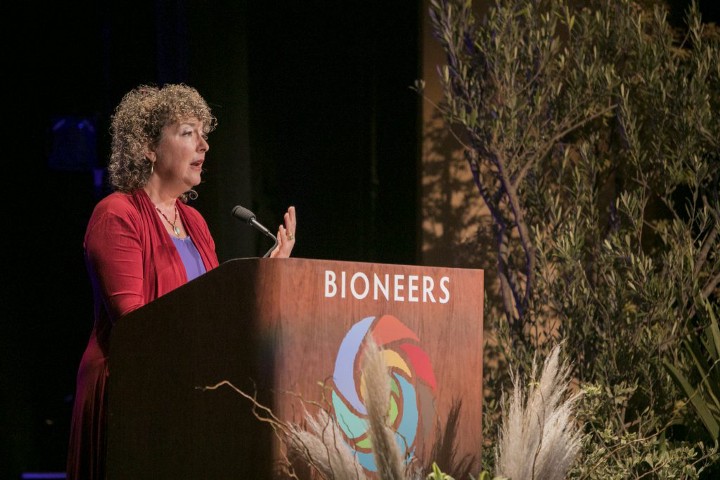
Meanwhile, as the industry matures, the value of a thriving renewables sector continues to prove itself.  At the 2014 Bioneers Conference, Bernadette del Chiaro, Executive Director of the California Solar Energy Industry Association, outlined what this impact looks like in California:

  • More solar installed in the past 18 months than in the past 18 years combined
  • More people employed in the California solar industry than in traditional fossil fuel dependent utilities.
  • On track to hit 2 million solar roofs by 2020.

World leaders are gathering in Lima, Peru this week to hammer out the important pre-work necessary to come to some sort of agreement on a global climate treaty next December in Paris.  They’ll be helped by news like this, the growing cost competitiveness of clean energy.  Regardless of what comes of negotiations at a global level, progress continues to be made on the ground and it’s certainly cause for hope.  As Ms. del Chiaro reminded the audience at Bioneers this year, this will take all of us:

“Through our political activism, through our ingenuity, our entrepreneurialism and our creativity  and by joining with other like-minded regions and countries, we will be both the source of the optimism and the engine of change.

Renewable energy and solar isn’t the entire piece of the pie, but it is a critical component. If we continue to grow, we will get to 100% renewable energy. We will get to it in time that the climate requires, and we’ll do it by small groups of people like this working together one house at a time, one community at a time, one state at a time.”

For more content like this, explore more of the talks given at our California Climate Leadership Summit www.bioneers.org/climateleadership or search for “energy” on our YouTube page.

California: Global Game-Changer for Climate Leadership

On Oct 16, 2014 Bioneers hosted a special one-day summit, California: Global Game-Changer for Climate LeadershipThe event featured visionary policy, government, finance and civil society representatives exploring how the state of California is emerging as a key player and model in the global movement towards a low-carbon, clean energy future.

Since the event, Governor Jerry Brown has been re-elected and momentum continues to gather.  It remains incumbent upon us to keep the pressure up and to take a leadership role in whatever capacity we can to keep moving towards a clean, equitable and low-carbon future.

Please explore the presentations from the plenary as well as an episode from our internationally distributed radio series and podcast, created from talks and interviews with speakers at Bioneers.

For your reference, here is complete program from the day.

Bioneers Digital Media Internship

Are you interested in amplifying the voices of change makers and building community around solutions for a more just and sustainable world? Bioneers is seeking an enthusiastic and tech-savvy intern to support our media outreach and communications program.

This position is perfect for someone looking to gain experience in the fields of communications, marketing, public relations and social media strategy. An interest in environmental justice, food justice, social justice, indigenous rights or women’s leadership is preferred.

Bioneers communications interns possess strong computer, research and writing skills and must have excellent attention to detail.

Primary Responsibilities:

  • Social Media Outreach: Support our digital communications, content creation and weekly reporting with an opportunity to take the lead on Instagram campaigns and contests
  • Press Relations: Research and do outreach to traditional and online publications, coordinate press interviews and track media coverage
  • Digital Media Archiving: Sort and categorize audio and video content, optimize our YouTube and SoundCloud channels

Knowledge, Skills and Abilities

  • Excellent verbal and writing skills
  • Energetic self-starter who can work on projects independently
  • Digital native with experience using Instagram, Twitter, Facebook, YouTube and Google applications
  • Good organizational skills, demonstrated initiative, flexibility and creativity
  • Interest in environmental health, biomimicry, social justice, food system reform, indigenous rights and women’s leadership is strongly preferred; passion around these issues is even better

Bonus:

  • Graphic design skills (Photoshop, Canva.com)
  • Video editing skills (Final Cut Pro, Adobe Premiere)
  • Experience managing social media campaigns
  • Experience with Google Analytics
  • Experience using Hootsuite

A small stipend is paid for this internship. No benefits included. We will work closely with you to translate the skills you learn into résumé language. Our office is located in The Presidio in San Francisco, CA. We are accessible by public transit and have secure bike storage on premises. The length of the internship is three months with the possibility of extension, and we are seeking a commitment of 5-20 hours per week.

About Bioneers: Bioneers is a fertile hub of social and scientific innovators with practical and visionary solutions for the world’s most pressing environmental and social challenges. Our acclaimed annual national and local conferences are complemented by extensive media outreach including an award-winning radio series, book series, and role in media projects such as Leonardo DiCaprio’s film The 11th Hour. Our programs further focus on Women’s Leadership, Indigenous Wisdom, Community Resilience Networks, and Leadership Development and Youth.

Application Process:
Please submit the following to dorothee@bioneers.org with the subject line: Bioneers Digital Media Internship

  • A cover letter indicating your relevant experience and interests, what experience/skills you hope to gain during your internship, your available dates, and number of hours per week you wish to work
  • A current resume highlighting your experience and/or coursework relevant to the position
  • A brief writing sample, preferably online content.
  • Links to any relevant social media profiles: Facebook, Twitter, Instagram, etc.

Bioneers Development Internship

Are you interested in engaging a growing community in solutions for a more just and sustainable world? Bioneers is seeking a passionate and articulate intern to support our Fundraising and Development program.

This position is perfect for someone looking to gain experience in the field of fundraising, and can offer experience in grant research and writing, running online campaigns, donor cultivation, event planning, and strategic development strategies. An interest in environmental justice, food justice, social justice, indigenous rights or women’s leadership is preferred.

Bioneers development interns possess strong computer, research, communication, and writing skills and must have excellent attention to detail.

Primary Responsibilities:

  • Event Planning: Assist in the planning of donor cultivation events, which range from small parties, to educational presentations, to trips
  • Grants: Research grants and foundations in line with our mission and assist in the writing of proposals and reports
  • Donor Communication: Support the Development and Communications Team in donor communications and developing and disseminating engaging materials to donors

Knowledge, Skills and Abilities

  • Excellent verbal and writing skills
  • Excellent organizational skills
  • Energetic self-starter who can work on projects independently
  • Excellent organizational skills, demonstrated initiative, flexibility and creativity
  • Interest in environmental health, biomimicry, social justice, food system reform, indigenous rights and women’s leadership is strongly preferred; passion around these issues is even better

Bonus:

  • Graphic design skills (InDesign, Photoshop)
  • MailChimp or other e-communication platform experience
  • Experience with Raiser’s Edge

A small stipend is paid for this internship. We will work closely with you to translate the skills you learn into résumé language. Our office is located in The Presidio in San Francisco, CA. We are accessible by public transit and have secure bike storage on premises. The length of the internship can range from 2-6 months and from 5-20 hours per week.

About Bioneers: Bioneers is a fertile hub of social and scientific innovators with practical and visionary solutions for the world’s most pressing environmental and social challenges. Our acclaimed annual national and local conferences are complemented by extensive media outreach including an award-winning radio series, book series, and role in media projects such as Leonardo DiCaprio’s film The 11th Hour. Our programs further focus on Women’s Leadership, Indigenous Wisdom, Community Resilience Networks, and Leadership Development and Youth.

Application Process:
Please submit the following to jessica@bioneers.org with the subject line: Bioneers Development Internship

  • A cover letter indicating your relevant experience and interests, what experience/skills you hope to gain during your internship, your available dates, and number of hours per week you wish to work.
  • A current resume highlighting your experience and/or coursework relevant to the position.
  • A brief writing sample (2 pages or less)

Elk River: Looking at the Whole Picture

It’s been several weeks since thousands of gallons of a chemical used to process coal spilled into the Elk River in West Virginia. 300,000 people were told to turn their taps off, nearly 200 people have been admitted to hospitals for treatment and the overall response at a state level has been somewhat short of an A+ grade.

It’s easy enough to point to each problem independently. There’s the oft-maligned and outdated Toxic Substances Control Act (1976), which grandfathered in 62,000 compounds, requiring no further testing for toxicity. There’s the general ineffectiveness of West Virginia’s environmental regulations, which do not require inspection of chemical storage facilities – ever. There’s the impressive incompetence of the official response- when asked whether it was ok for residents to drink the water coming through municipal pipes weeks after the spill, WV Gov. Tomblin responded, “It’s your decision.”

However, the Elk River spill is a poignant reminder of just how interconnected environmental concerns are and why taking a systems approach to these issues is so important. In this case, consider two key root causes:

  • Our reliance on coal for energy (these chemicals are utilized in the manufacture and cleaning of coal)
  • Our reliance on toxic chemicals for so many of our industrial and commercial processes.

(Note: Water privatization is another key consideration and Appalachian Voices has a good piece on the privatization of municipal water supply.)

Much has been made of the unknown toxicity of MCHM, the chemical in question. Perhaps we need to be asking a bigger question – why do industrial chemicals need to be toxic at all?

Paul Anastas and John Warner are responsible for the rapidly growing field of Green Chemistry. They emphasis the upside down reality here in which we are purposefully designing toxic chemicals when the industry has the technology and sophistication to accomplish many of the same processes with much less toxic results. Anastas and Warner have both spoken at the Bioneers Conference about the vision and reality of a much less toxic world. “You ever ask yourself why do we have hazardous materials? Who in their right mind would in- synthesize a red dye that caused cancer? Who in their right mind would develop a plasticizer that causes birth defects? Why are we in the situation that we’re in?” – John Warner


Elk River: Looking at the whole picture

It’s been several weeks since thousands of gallons of a chemical used to process coal spilled into the Elk River in West Virginia.  300,000 people were told to turn their taps off, nearly 200 people have been admitted to hospitals for treatment and the overall response at a state level has been somewhat short of an A+ grade.

It’s easy enough to point to each problem independently.  There’s the oft-maligned and outdated Toxic Substances Control Act (1976), which grandfathered in 62,000 compounds, requiring no further testing for toxicity.  There’s the general ineffectiveness of West Virginia’s environmental regulations, which do not require inspection of chemical storage facilities – ever.  There’s the impressive incompetence of the official response- when asked whether it was ok for residents to drink the water coming through municipal pipes weeks after the spill, WV Gov. Tomblin responded, “It’s your decision.”

However, the Elk River spill is a poignant reminder of just how interconnected environmental concerns are and why taking a systems approach to these issues is so important. In this case, consider two key root causes:

  • Our reliance on coal for energy (these chemicals are utilized in the manufacture and cleaning of coal)
  • Our reliance on toxic chemicals for so many of our industrial and commercial processes.

(Note: Water privatization is another key consideration and Appalachian Voices has a good piece on the privatization of municipal water supply.)

Much has been made of the unknown toxicity of MCHM, the chemical in question.  Perhaps we need to be asking a bigger question – why do industrial chemicals need to be toxic at all?

Paul Anastas and John Warner are responsible for the rapidly growing field of Green Chemistry. They emphasis the upside down reality here in which we are purposefully designing toxic chemicals when the industry has the technology and sophistication to accomplish many of the same processes with much less toxic results.  Anastas and Warner have both spoken at the Bioneers Conference about the vision and reality of a much less toxic world. “You ever ask yourself why do we have hazardous materials? Who in their right mind would in- synthesize a red dye that caused cancer? Who in their right mind would develop a plasticizer that causes birth defects? Why are we in the situation that we’re in?” – John Warner


Sacred Activism: Engaging Communities of Faith in Environmental Advocacy

The Bioneers Conference brings together exciting and cutting-edge innovators tackling the world’s most challenging social, cultural and environmental issues. Here, we bring together two thought-leaders and Bioneers presenters to share their deep wisdom in an intimate, in-depth conversation between peers. In our first conversation between Sufi mystic Llewellyn Vaughan-Lee and theologian Matthew Fox, the faith leaders discuss sacred ecology, unity consciousness, spiritual narcissism and bringing reverence for the earth into today’s ecological debate.

Matthew: Today [Bioneers has asked] us to talk about ecology and spirituality. Who can deny that it doesn’t matter what your particular tradition is, or if you’re an atheist, if your backyard is burning up and you can’t plant food anymore, and the waters are rising? We’re all in trouble. And it can finally bring religions together and get over their narcissism.

Llewellyn: I hope so. Mysticism, as you know, has always held this common thread underneath religion- the union of inner experience. Part of the reason I wrote this book, Spiritual Ecology, was to try to bring that into the ecological debate because I felt that, although it was present, it wasn’t voiced enough.

Matthew: Absolutely. That’s what I’ve been trying to do with the archetype of the cosmic Christ- to awaken at least Christians that crucifixion is not something that happened 2,000 years ago, it’s happening with the killing of the rainforests and the whales and the polar bears and everything else today.

Llewellyn: It’s happening to the earth.

Matthew: To me, that not only can energize spiritual warriors to get work done today, but it also can reinvent our faith traditions themselves, which I think fall into narcissism as distinct from mysticism.

Llewellyn: I have a concern that somehow people who have a spiritual awakening or awareness are somehow too focused on their own individual inner spiritual journey, and to me this is a travesty of real spiritual awakening or spiritual awareness, which has to do with the whole, and this whole includes the earth.

Matthew: I couldn’t agree more. If you’re breakthrough does not lead to transpersonal service, to compassion, to justice, including ecojustice, then I doubt its authenticity. And Jesus said it very simply, that by their fruits you’ll know them. And we can be so taken by our spiritual experiences that we don’t realize this about energizing you to serve.

Llewellyn: In Sufism they actually say after the station of oneness comes the state of servant hood, that one is then in service. Sufis are known as servants.

Matthew: Or as someone else put it, after ecstasy comes the laundry.

Llewellyn: Somehow we have become so focused on our own human journey that we’ve forgotten that this human journey is part of the earth’s journey. There used to be, I’m sure you’re aware of this, a deeper understanding that our soul is part of the world’s soul, the anima mundi, and we’ve lost that connection. We’ve lost that understanding that our spiritual light is part of the light of the world. And we have to regain that.

Matthew: Right. And how the earth story itself is part of the cosmic story.

Llewellyn: It’s all one. It’s all one living, breathing, inter-related, interdependent spiritual organism as much as a physical organism, and I think we have, for some extraordinary reason, forgotten that.

Matthew: I think there are a lot of reasons, and one of them is the anthropocentrism and the narcissism of the modern consciousness. But I also think part of it too is the beating up of matter over the centuries by theologically influential thinkers. That kind of separation, that kind of dualism is so destructive because then you think the body is secondary, and then Mother Earth is secondary, and everything else. To put things in context, we wouldn’t have our imaginations and our breath and our food and our existence without matter. Matter is not an obstacle to spirit.

Llewellyn: I think the early rejection of all of the earth-based spirituality by the Christian church has left a very sad vacuum that we’re now, in a way, seeing the result of.

Matthew: Paying the price for. And I think it goes back, actually, to the 4th century. If you’re going to run an empire- as the church more or less inherited the empire in the 4th century, it behooves you to split matter from spirit, and also to talk about original sin, and get people confused about their own inner nobility and empowerment, and divinity, really. I think that it has served political interests and cultural power trips to split people that way.

Llewellyn: Well, the male domination of nature kind of took the high ground, and now we have to, in a very few years, try to redress this balance and reclaim the sacred nature of creation. And what is central to me is to try to bring that into the ecological debate because I don’t see how we can address this physical devastation of creation, this ecocide, unless we look at its spiritual roots and reconnect ourselves to the sacred nature that is the world around us.

Matthew: And within us. And that’s what makes deep ecology different from ecology.

Llewellyn: Right. My teaching is to say mystics teach simple things, but those simple things change people’s worlds. And how can we re-energize that mystical perspective so we can bring it into this global arena that is calling out to us? I mean, the earth is calling. That’s why I called this book Spiritual Ecology: The Cry of the Earth because the earth is crying, the soul of the earth is crying. We need to respond from our own soul as well as with our hands.

Matthew: And, of course, Einstein said it’s from intuition and feeling that we get values, not from the intellect. He says the intellect gives us methods; it does not give us values. And I think when you look back at it, this is how various traditions of monastic learning also included the heart in some way or other.

Llewellyn: When you say including the heart, I would suggest something even more radical. How can we bring our love for the earth into the center of this concern with the well-being of the earth? In fact, Thich Nhat Hanh recently said real change will only happen when we fall in love with our planet.

As a mystic, I believe in the primacy of love, and we have this love for the earth. It is so generous. It has given us life. It has given us breath. It has given us water. And we have treated it so badly in response. I feel that this mystical center of divine love is really the power behind the planet, because it is really what gives life to us all. I mean, it’s a really radical thought to bring that essential quality into the ecological debate.

And although we have this physical responsibility, how can we bring this love that belongs also to our sense of the sacred? How can we learn once again to live in love with the earth in the way we live, in our daily activities so that everything becomes imbued with this sense of the sacred?

One can educate the mind, but also we somehow have been stripped of the power of love, which is, as a mystic, the greatest power in creation.

Matthew: In our traditions, certainly the Jewish tradition but also the Aquinas, it is said too that the mind resides in the heart. We don’t have to, how should I say, pit one against the other. That real heart knowledge- when you’re really in love with something, you want to learn more about it.

Llewellyn: Also the heart and the mind in the heart see the oneness in things. Sufis say when the eye of the heart is open—the Sufis talk about the eye of the heart—then in each atom there are a million secrets. And we see the unity in life, in everything that we are part of. We need to reclaim that unity, that oneness, because life is dying and it’s dying because we split spirit and matter, we separated ourselves from creation. The analytic mind tries to split everything up into smaller and smaller pieces. We need to return to this oneness, this awareness of the interdependence of all of life, this web of life, which our ancestors knew and revered so deeply.

Somehow we have lost connection with this spiritual dimension of creation, and to me that is the root of our present ecological imbalance because we don’t respect or revere creation as our ancestors and indigenous peoples have always done.

And somehow, as you say, the mystics have held this thread in the West, but a thread is no longer enough. It needs to be a revolution, a revolution of the heart, a revolution of consciousness that sees the oneness that is within and all around us. I suppose the challenge is, how do we give this back to humanity, this forgotten treasure, this secret, this deep awareness of the real nature of creation, that it is not dead matter?

I always say the world is not a problem to be solved, it’s a living being to be related to, and it is calling to us. It needs our attention, not just of our minds, but also of our hearts. It is our own awakened consciousness that can heal the earth.

Matthew: Another dimension, I think, including when it comes to the love, is grief. We don’t deal well with grief in our culture, and that’s one reason I think anger gets battered all over the walls. We don’t deal with anger in a constructive way very often.

I do a lot of grief ceremonies- we need practices and rituals. When grief builds up, when you can’t deal with grief, not only does anger build up, but also that joy, that love gets clouded over, and people feel disempowered then. So I think grief work is a part.

What can I say? Who cannot be grieving today about what’s happening to the earth? You’d have to be extremely busy covering up your grief and putting a lot of energy there.

Llewellyn: But I think we do. We’re a culture of mass distractions. We try to avoid at all costs seeing the real fruits of our actions.

You talk about practices; I would say the most important practice is to listen. Thich Nhat Hanh said to heal the earth, he says to listen to its cry because the earth is crying, but we don’t know how to listen. We’ve forgotten this feminine wisdom of deep listening. If there is deep ecology, there is deep listening. We have to relearn this feminine wisdom of listening to the earth. It is so old, it is so wise, it has been through many crises before, and we need to cooperate.

In fact, Thomas Berry says we are only talking to ourselves; we are not talking to the rivers; we are not listening to the winds and stars; we have broken the great conversation. By breaking that conversation we have shattered the universe. And we have to learn again how to listen to the earth, and how to open that ear of the heart. We have been told this great lie that we are separate from the earth, that it is something out there. It is not out there, we are part of the earth. We are made of stardust.

We need to feel the grief within our own self for the earth and learn to listen to the earth, learn to hear it, learn to re-attune ourselves, just like the shamans did of old, just like the wise people who listened to the wind, who listened to the rivers, who felt the heartbeat of creation. And it might not sound very practical but it has a deep, deep wisdom within it, and I think we need all the help we can get at the moment.

Matthew: Absolutely. And that’s where the world’s spiritual traditions, if they get out of their anthropocentric, reptilian brain dimension of wanting to conquer each other and be number one or something gets shaken down, and as you say, bring this feminine dimension back, the receptivity and contemplation and silence.

Llewellyn: And not to rush for a quick fix, because I don’t think we can quickly fix this environmental crisis. It has been building up for centuries.

Matthew: I do think that the patriarchal mindset feeds the reptilian brain excessively, whereas, I think the real way to treat the reptilian brain is to learn to meditate and be still, because reptiles like to lie low and in the sun… We have to make room for that mammal brain, which is half as old as the reptilian brain in us, which is the brain of compassion and the brain of kinship and family, and also of getting along with the rest of nature.

Llewellyn: This is what Oren Lyons said, when he spoke about our original instructions in the Native American tradition. He said one of the original instructions is we have to get along together. And it’s very simple, but once you realize we are one living community and we can only survive as one living community, it’s very fundamental. It’s not sophisticated, but we seem to have forgotten it, that we are part of this living, interdependent, interwoven organism that is all around us and that we are part of.

I think we have a duty, any of us who have an awareness of this, to bring this into the forefront, to claim it; not to allow this dark side of our civilization to devour all the light. That’s why when you spoke about religious narcissism, and I spoke about my concern that spiritually awakened people are just using their own light for their own inner spiritual journey or their own image of spiritual progress, we have to make a relationship between our light and the world which is hungry for this light. And there used to be always this relationship between the light of the individual soul and the light of the world’s soul, and somehow we need to reconnect with this earth on a very deep, foundational, spiritual basis. We are part of one spiritual journey, one life journey, one evolution, and our soul and the soul of the world are not separate, and we have to reclaim this connection.

And somehow, as you say, human spirituality and religion became narcissistic, and that was never the intention because Christ’s love was for the world; the Buddhist’s peace was for the world. The message is always for the whole.

Matthew: I think today a lot of young people are being caught up in the vocation of, as you say, re-sacralizing the earth, but doing it through everything from the way we eat and farm to the way we do business and politics.

Llewellyn: It’s the attitude that we bring to it. It’s always the attitude. If we come in the deepest sense, with an attitude of prayer or even just respect and reverence for each other, for the earth, for what is around us, then the healing can begin, and the forces of darkness will recede. But we will wait and see.

It’s been a pleasure talking to you.

Matthew: It’s been fun. Thank you.

 

An Indigenous Perspective on Energy Development: Q & A with Darcie Houck

Darcie Houck is a descendent of Mohawk and Ottawa native tribes and an attorney specializing in environment, water resources, energy development and Native American land use. She previously served as staff council at the California Energy Commission, and has taught law at several universities, including UC Davis and San Francisco State.


Bioneers: Where are you from and how did you come to do the work you are doing?

Darcie: I’m from upstate New York, and am Ottawa and Mohawk on my mother’s side. I was very close to my Mohawk/Ottawa grandpa. He used to take me back to the reservation when I was a child, and told me that I needed to be a lawyer when I grew up to defend Native rights (chuckles). It always stayed with me. And that’s what I did. I was originally a political science major, until I wrote a paper on tribal government. I got a horrible grade and when I asked the professor why, he said, “Because tribal governments are not real governments.”  That moment changed my life. I went to the counseling center and was directed to the Native American studies program. I switched majors and ended up with an amazing education I wouldn’t have gotten if that incident hadn’t happened.

Bioneers: What kind of law do you practice?

Darcie: During the energy crisis, I was hired by the California Energy Commission because of my background with Native American law. They were dealing with potential projects on Indian land that they had never dealt with before. I learned a lot about energy law and environmental law. Then I went into practice with the largest private law firm in the US that focuses exclusively on Native American issues. We practice in everything from general counsel to internet gaming issues, cultural resource protection and water law.

My focus is environment, water and energy.  My passion is cultural resource protection, and unfortunately, because of the nature of the business, that work is typically pro bono.

Bioneers: What are the biggest issues you face in cultural resource protection cases?

Darcie: The cultural resource issues that deal with Traditional Ecological Knowledge (TEK) of Indigenous peoples are particularly critical because of what’s happening with climate change, and because many state and federal government decisions-makers base their decisions on western science. However, there has been some realization by these entities that TEK and all of the practices that Indigenous peoples have had forever are really what is going to create truly sustainable development. It’s a slow process. People are starting to listen.

Bioneers: Are your tribal clients resisting energy development or embracing it?

Darcie: Both, and there’s a lot of work trying to combine the two. That wasn’t the case 10-20 years ago. Tribes are really dedicated to improving their economies and looking at their natural resources as one option for development. Tribes want to develop these resources responsibly. You can be a traditionalist, want to have a sustainable way of living that respects and honors Mother Earth and nature, while utilizing modern tools in doing so.

Bioneers: Many environmental laws promise meaningful consultation with tribes for energy development; what is your take on the effectiveness of these consultations?

Darcie: I just sat on a panel at a tribal-sponsored conference in California with a representative from the Governor’s office who was unaware of any law that protected tribal cultural resources. Several laws already exist to protect cultural and historic resources. If decision-makers do not comprehend the importance of the resources that need protection, these resources will not be a priority. So these laws need to be interpreted and implemented in a meaningful way by those with the power to do so. Until this happens tribes will be fighting an uphill battle in the protection of these critical resources.

Also, tribes are often brought in at the tail end of the process. If tribes were brought in at the very beginning of the planning stage, and fully included as meaningful participants, we could probably avoid many of the problems we see with the development of some of the solar projects.

Bioneers: Like down in the Blythe, CA area where there’s a proposal to laser level a huge, magnificent portion of the Mojave for solar? The tribes are screaming, ‘hey wait, that’s a huge culturally significant, sacred area. You can’t do that.’

Darcie: And my perspective is that there’s a cultural disconnect that is so typically European. Throughout history, Europeans have come here and assessed the landscape as unutilized. They then decide to build this and destroy that in the name of progress. It’s the same with the desert- they see it as land that nobody is ‘using’ but in fact, it’s one of the few places left that has an intact ecosystem that is so beautiful and amazing.

There are other places to put solar that would be much more effective like rooftops, parking lots and other places that are already developed. We all hear talk about sustainable development and in-fill projects, but major projects still seem to lean toward green fields for large scale development.

Bioneers: What are some of the misperceptions about tribes and development?

Darcie: The same gentleman from the Governor’s office commented that, “We only hear from tribes that want to develop projects.” It seemed that he was insinuating that tribes only wanted to develop things, not save or protect them.  Just because a tribe has a resource that can be developed to the benefit of the tribe for economic or welfare purposes, does not mean that the same tribe is not concerned about protection of traditional cultural resources. The fact is that state governments don’t hear from many tribes because they often do not include them in the process until its too late.

Bioneers: What are some of the other challenges for tribes, whether it be supporting or opposing development?

Darcie: Oh, there are so many. You have this inherent contradiction where, despite public perception, it can be much more difficult for tribes to develop within their tribal lands than it is for off-reservation private entities to. And for those private entities, protecting cultural resources is often simply an afterthought.

Also as more and more issues face society at large with climate change, society as a whole will have to develop response strategies. In many cases it’s the global Indigenous communities that are facing the most severe impacts in very defined, limited land bases- impacts that they had no hand in the creation of, and often opposed or tried to prevent. These conditions will persist, and likely get worse.  We have to find a way to make sure that Indigenous voices are heard. Those who are facing the worst impacts should have an equal or even greater voice in what decisions are made, and we are not seeing that right now.

Bioneers: How do you make these Western laws mesh with the Indigenous thinking?

Darcie: That is so critical. These laws are made and developed by people who don’t have the same worldview.  The ‘dominant society’ priority is how to use a resource. The end goal is to use it, not preserve it. It’s so counterintuitive to the worldview of Indigenous communities.

Bioneers: Why should a wider audience listen?

Darcie: We, as a society, are in a disaster management stage, and the wisest people are the ones being overlooked because of people’s stereotypes of what a leader is supposed to look or sound like. How mainstream society has educated their children as to who is in charge and who is not- without a shift in that mentality, I don’t know what happens.  But I do think that with projects like Bioneers and other individuals I’ve met in this work, it gives me hope that there will be a shift before it’s too late.

Agriculture and Climate Change: An Interview with Darren Doherty

Darren Doherty has developed a set of ecological agricultural practices for large-scale farming that he calls Regrarianism, based on the work of master agrarians like Rudolf Steiner, Joel Salatin, Elaine Ingham and others. Regrarianism integrates Permaculture, Keyline design, Holistic management and carbon farming to transform farms from their current atrophic condition into regenerative systems that provide ecological profit as well as economic benefit.   

Bioneers: What are the basic principles of Regrarianism?

Darren: Some of the key principles are to produce stable environments with sound watersheds; increase wildlife species and stability of populations; improve water, soil and vegetation resources of cities, industry and agriculture; prevent waste of financial, human and natural resources; utilize Permaculture design principles; and develop viable decentralized energy production systems.

Bioneers: How does Regraranism help farmers mitigate and adapt to climate change?

Darren: One of the things we look at, which might seem like an unusual climate change strategy, is reducing debt, which in an agricultural environment is really crippling because it disempowers farmers from making the land stewardship decisions they would normally make. We try to get the debt out of the way by getting some higher margin activities in the stream of an enterprise so we can start to self-fund the more regenerative practices.

Bioneers: What’s the most important agricultural climate change practice?

Darren: We can start to build more soil carbon into the equation because that’s one of the great buffers against climate change. Not only does it download atmospheric carbon out of the process, but it also creates a resiliency against the biggest problem in a lot of zones where there has been reliable rainfall in the past and now rainfall is unreliable.

Bioneers: How does carbon farming work?

Darren: There’s an amount of carbon right above any landscape that can be utilized, primarily in the form of carbon dioxide and other carbon compounds that soil organisms, plants and others use as nutrients.

We’re looking to create systems that hold more of that carbon in the organisms and the residues of those organisms for the longest possible times, and then take advantage of the benefits that the diversity and the residues provide. Whether that’s residues in the form of humus, which is a very stable carbon-compound, or whether it’s residues in terms of a leaf litter that’s on the soil surface, which reduces evaporation.

We’re trying to increase the retention time of carbon in its solid form in landscapes for as long as possible as opposed to allowing it to become gaseous, that’s when it becomes quite dangerous to us all. That is what carbon farming is all about.

Bioneers: What’s the relationship between carbon and water?

Darren: Every unit of soil carbon holds about eight units of water. Any farmer knows that as their carbon levels grow in their soil, so does the water holding capacity of that soil, and that also happens to increase the nutrient exchange capacity of that soil as well.

Bioneers: Can enough carbon be sequestered in soil to significantly mitigate climate change?

Darren: The only place in the world where there’s more carbon than in the soil is in the ocean and in the sedimentary rocks. ­ We try to build in our system multiple elements with trees, ground cover, canopies of grasses or other plants, that keep carbon in its place for as long as possible, and therefore also hold water in place. ­

Bioneers: What’s the best way to keep carbon in place for as long as possible?

Darren: You have to understand the different kinds of carbon and the states of carbon soils. Let’s look at compost, for example. Depending on the state of compost and how it’s made, it’s largely made up of what are called short-chain carbon molecules. So mulch, compost, leaf litter, cover crops, all of these things aren’t processing carbon into its long-chain form. It’s quite unstable, so as a result a lot of that carbon ends up being put back into the atmosphere.

Compost and cover crops certainly have a conditioning effect on the soil, but a lot of that carbon is being cycled within the top six inches of the soil, which is the highly aerobic zone of the soil, so carbon therefore is in a greater stage of flux.

Bioneers: Are you saying compost and cover crops are not effective ways to sequester carbon?

Darren: You might increase your net soil carbon quite heavily in the first few years by the application of compost, and all of the aforementioned methods, but will that last over the longer term? The answer is quite clearly no. Great techniques, great to do, but what we need more of is long-chain carbon. It’s largely delivered in the form of polysaccharide exudate or nutrients released from plant root systems, particularly grasses.

Where we want the carbon and where farmers can look to increasing their carbon levels overall is in the depth of soil. You can have 10% carbon in the top six inches and 2% in the next 10 inches, and 1½% in the next 10 inches. That’s not going to sustain agriculture over the long term, and the top 6 inches is not where carbon is going to be kept and stored and sequestered. It’s pretty well impossible to get that short-chain carbon down into the depths without a lot of intervention, which requires a lot of fossil fuels. The best way to do that is to get plant roots to penetrate these depths and to put their exudates down in those depths. There are carbohydrates created out of the interaction between water, sunlight and carbon dioxide, and then manufactured by the plants as a residue, and their primary objective is to feed the soil microlife.

Bioneers:  So deep-rooted plants are key to this process.

Darren: What drives the sustenance and the regeneration of the soil life is the plants. The plants are the conduit between the atmosphere and the lithosphere [the Earth’s deep outer layer, which includes soil]. They keep the lithosphere, the soil, and the rhizosphere, the root zone, alive, because they transfer the energy of the sun, manufacture the sugars as carbohydrates, as long chain carbons, and that’s what feeds the economy of the soil.

I’ve been talking a lot lately about the relationship between using perennial systems and annual systems as an analog of our own human economy, and how if I look at an annual plant, for example, it lives fast, it dies young, it’s quite profligate in the use of its resources because it leaves very little of the residue behind, it doesn’t have any savings; its whole objective is to reproduce.

If you look at a perennial plant, particularly a perennial grass, it puts very little energy into being in a nightclub, it has very fibrous, deep root systems, which have long, long term arrangements with the whole suite of soil life, it has all the very cultivated and highly developed and synergistic relationship; it has a carbohydrate starch reserve, which is like a bank where it puts a lot of its capital flows out into the general soil economy over the longest period and often when it’s not raining, and it puts something behind so when disturbance occurs, it can come back. In fact, in many cases, it actually thrives on disturbance.

I think a lot of economists in the financial sector, if they wanted to know what would be a good model to base economies on, they could probably look no further than a tree or a forest or a perennial grass. Much of our agriculture is annual based. We’re living fast and dying young.

Make sure to see Darren’s sessions at the 2013 National Bioneers Conference:

Darren Doherty | Regrarianism: Re-booting Agriculture for the Next 10,000 Years – Saturday – October 19, 2013

Climate Change and Agriculture – Saturday – October 19, 2013

Sandberg’s Lean In & Cultivating Women’s Leadership

By Nina Simons

As I read about Sheryl Sandberg’s new book, Lean In, with recent reviews in the Nation by Katha Pollitt and in the NYT Book Review by Anne-Marie Slaughter, I appreciated how each of them decries the immediate array of attacks on Sandberg from other women, and eschews women’s tendency toward a kind of viciousness any time a new voice for women emerges.

Slaughter notes the value of Lean In acknowledging the self-doubt that is so prevalent among women, and the efficacy of encouraging women to practice overcoming it. Neither she nor Pollitt speaks to where that self-doubt comes from, though I’ll have to read the  book to find out whether Sandberg does. They do note that – although she certainly comes from an extremely privileged perspective, her views encouraging women to get out of our own way and intentionally hold our own value higher are valid. Also, while she begins to address the internalized biases and fearfulness that many women carry, she only speaks minimally to the urgency of systemic changes, to provide greater access to women as leaders in the workplace through flex time and addressing some of the other structural impediments to women’s equity in the corporate world.

For me, though, her book and the ensuing reviews miss a key point that’s necessary to address whole systems change: many women don’t aspire to leadership because we’ve inherited a definition of the word that’s at the least conflicted, and often even an overt turn-off. Around the globe and in various sectors, women – and some men – are reinventing leadership, and unless and until we wrap our arms around a new, emergent definition, we’ll continue to be in conflict with ourselves and slow our own progress in achieving it. Why stretch yourself to reach for a brass ring that you inwardly dislike, and that promises to make your life miserable? This was a core premise of our Moonrise book, as it is of our Cultivating Women’s Leadership Leadership trainings.

In the conventional view – the one many of us have unconsciously inherited – leadership is often based largely upon charisma and luck or achievement, and it often implies aggression, and a top-down or hierarchical approach to others. It is typically conferred through getting a position, advanced degree or receiving inherited wealth or privilege, and is often practiced solo. It implies a degree of commitment to work at the exclusion of all else that’s associated with tremendous sacrifice. It is rare, in the inner story that we carry mostly unconsciously about leadership, that leaders can have a satisfying home life or family. Or a creative life, or take decent care of themselves.  Is in any wonder that few women feel whole-hearted in pursuing it?

After 7 years of offering Cultivating Women’s Leadership Leadership intensives, we’ve surfaced reinventions of leadership that are occurring all over the world, and that exemplify the kinds of flexible, invitational and team-based or rotating leadership models that women have practiced throughout time. Here are what some women have said about this retreat, and how it’s changed their approaches to leadership.

Hope you’ll apply and come join us, and co-create a leadership revolution that’s in service to Earth, Life and Justice for all.

You Have the Power to Empower

“My first Bioneers experience was one of the most emotionally uplifting 72 hours of my life! Bioneers brings solutions to life… in a most electrifying and loving environment.” – Mimi Riley, Sociology Instructor at Butte College

In 2007, after Mimi Riley attended the Bioneers Conference in California for the first time, she began raising funds for and coordinating the attendance of Butte College faculty and students every fall.

Prior to receiving enough funding to get herself and her students to the conference, Mimi used her own money to pay for their registrations – which is not an easy commitment to make living on a teacher’s salary. But thanks to the generosity of Bioneers donors, Mimi’s students and fellow teachers have benefited greatly from the John Mohawk Conference Scholarship Fund, receiving both partial and full scholarships over the years.

Since attending the Bioneers conference, Mimi has designed and disseminated campus-wide sustainability education materials, and aided in the creation of a Sustainability Studies certificate program at Butte College.

Most of the instructors teaching within the Sustainability Studies program at Butte College have incorporated Bioneers plenary videos into their curriculum. Students are well acquainted with what and who the Bioneers are before they enter into Butte’s Capstone Seminar program, which centers on attendance at the conference in October.

Mimi says: “That first year, I was amazed at the effect the 3-day conference had on the students. They were instantly electrified (current sunlight!), inspired, and motivated to make big changes in their own lives, on our campus and in our community as a whole.

“I’ll never forget the words and range of emotions these students expressed as they shared their experience. They were crying, laughing, loving, supporting and bonding with each other in a way that I had never witnessed in my years of teaching. One 24 year-old male student confessed, “ I feel like I have been wasting my whole life up to this point hiding behind video games. Now I have been touched and I know that my life must and can count for something way beyond myself.”

You have the power to empower the next generation of visionary educators and students by donating to the John Mohawk Scholarship Fund today.

Butte Community College’s relationship with Bioneers has transformed its institutional culture to prioritize and focus on sustainability.

  • Every year after attending the conference, students have conceived of and coordinated inspiring campus-wide initiatives.  They designed and gained funding for a restoration project on campus. They instituted a healthy food initiative that incorporates organic gardening and a monthly Eat Local vegan lunch that serves the entire campus. They created a national student sustainability initiative called Camp UBUNTU. And they linked up with the California Student Sustainability Coalition (CSCS), and will be instituting a chapter of CSCS on their campus in 2012.
  • Butte students have advocated for policy changes at the institutional level, calling for change in cafeteria purchasing policies, which culminated in the hiring of a new organic-minded food services director. Perhaps most importantly, the students have pushed to reorganize the structure of the Associated Students council to include a new component, The Student Alliance for Sustainability, to make sustainability the “lens through which everything else on campus is viewed.”
  • Initiating community-based projects has also played an important role for students returning from attending the Bioneers conference. Pathways to Change is a collaborative organic garden project in a low-income minority neighborhood in Oroville.Gleaning Chico gathers volunteers to go to orchards and private yards to gather up unused fruit and vegetables to distribute to the local homeless shelter.
  • Students are also empowered to advocate on behalf of issues about which they are passionate, traveling all over the state and country to make their voices heard within government about fracking, the Keystone XL tar sands pipeline,and other fossil fuel issues.
  • At a time when leadership development remains a critical gap, and many established leaders are aging and becoming invaluable elders, there is little infrastructure to help develop young leaders and connect across generations and interest areas.

As a Community of Leadership and Mentors, Bioneers is filling in the leadership gap. Butte College is proof positive that participating in the Bioneers conference has profound effects on the capacity of both educators and students to collaborate for change on school campuses and in communities.

Won’t you help us fill the leadership gap by making a donation to the John Mohawk Conference Scholarship Fund today? Your contribution will provide full and partial scholarships to dynamic educators, young people, indigenous people, people of color, young and low-income women leaders and other community-based change-makers.

You have the power to empower!

Please give what you can and give generously. Future generations are counting on us. Thank you!

With grateful appreciation,

Nina Simons and Kenny Ausubel

Bioneers Co-Founders & Co-CEOs

************************

2012 Conference Educator scholarships give educators access to a dynamic scope of sustainability materials and opportunities to engage in peer-to-peer learning to support integration into their year-round teaching and curriculum. Highlights include a participatory network formation workshop and evening reception, a session exploring the transformation of education, and the availability of Continuing Education Credits.

Learn more about the education programming at this year’s conference to see how your gift today can transform our educational institutions to prioritize and focus on sustainability.

2012 Conference Youth Scholarships  enable youth to engage for the full three days in skill sharing, leadership development, networking and project collaborations with other youth from across the country. Highlights this year include talks from Brower Youth Award winners, Rhiannon Tomtishen, Madison Vorva, De’Anthony Jones and Rachel Barge. Also, youth will have the opportunity to participate in 12 interactive panels, workshops, campaign connections and special events, including a panel on jobs, an interactive workshop on eco-apartheid, a collective art mural and a slam poetry contest, just to name a few!

Learn more about the youth programming at this year’s conference to see what a difference your gift today will make in the lives of young change-makers from around the country.

Escaping the Tilted Room: Cultivating Relational Intelligence

Nina Simons

This talk is dedicated to everyone who has ever felt powerless, experienced being the dissenting or minority voice, or felt unfairly judged, devalued or dismissed for being different. It is intended for anyone who has experienced a culture that elevates some while denigrating others.

by Nina Simons

As a young woman right out of college, for some years I believed the “feminist movement” had accomplished its goals, and that I was stepping onto a level playing field.

That same naiveté, mixed with idealism and some cultural blindness, also had me imagining that the Civil Rights Movement had largely ended racial bias and injustice in this country.

It wasn’t until much later – after years of being the only woman in business settings, of negotiating biased gender dynamics personally, professionally and politically, that I began to realize how much gender roles and related power dynamics were impacting my experience – and how painful and damaging those impacts were.

And it wasn’t ‘till several years after that, when I began peeling back the layers of my own defensiveness and denial that I began to learn how racialized our society still is, and to discover my own personal and cultural complicity in it.

Gender and race are only two of the ways we rank and compete with each other – benefitting some, and harming others. In this society, we also do it about age, sexual orientation, body shape, class, education and abilities, to name just a few.

As I work to integrate and distill what I’ve been learning, an especially useful metaphor for me is the Tilted Room.

I found it in Melissa Harris Perry’s book Sister Citizen, about the stereotypes that Black women in America encounter as they work to establish a unique identity, and achieve agency and recognition.

She describes a cognitive psychology experiment in which people were placed in a crooked chair within a crooked room, and asked to align themselves vertically.

Researchers were surprised that – even in a room tilted as much as 35°– some people reported that they were perfectly straight, simply because they were in alignment with their surroundings.

Only a few managed to find uprightness. As Harris Perry notes, “It can be hard to stand up straight in a crooked room.

We’re all products of a culture that’s filled with tilted rooms, spaces designed to get us to relate in ways that defy the natural instincts of our bodies, hearts and souls.

Though the room may be tipped according to differing sets of biases, it’s rarely level. Some benefit from a headwind, while many face persistent and systematized obstacles.

Our dysfunctional families, educational institutions, media, cities, food and health care, economic and political systems create and reinforce striated structures of race, class, gender and other “isms” that keep us apart.

Since these biases aren’t conducive to symbiosis, and we all contain both victim and perpetrator within us, we become stuck in win/lose, dualistic and polarizing dynamics.

Tilted rooms keep us divided – preventing collaboration, coalition and movement-building. And, though it may seem otherwise, they damage the ones who benefit from the tilt as much as those who are disadvantaged by it. They hurt us all.

How do we escape the tilted room?

It is no small feat. It requires practice to disengage from those prevalent, insidious beliefs within us that help keep it in place. It asks that we reorient ourselves toward reaching across these divisions of gender, race and class – and be willing to fail, for the sake of learning. It means strengthening that intrinsic relational intelligence that comes from our body’s wisdom, our heart’s guidance and our moral compass.

I believe we escape it by investing in our relational intelligence.

Being white, or male, or heterosexual, or middle class, or highly educated, or rich or successful makes

It particularly difficult to recognize that a tilt exists.

But if you’re on the losing end of the tilt, it’s hard to ever forget, or not feel, the injustice of it, every hour of the day.

One friend, a leader of mixed ethnicity told me she felt as if she is continually climbing uphill on her knees, with broken glass strewn across her path – while white folks have running shoes, a clear walkway, and the wind at their backs.

I realize I previously grappled with injustice principally through my rational analysis and intellect – and from a distance that my privilege afforded me.

But hearing the truth of others’ realities, and feeling how painful they’ve been, trying to listen at the deepest level, while loving and respecting the beauty and power I see in them has changed me.

For centuries throughout Western history, intellect has been lauded, while the value of emotional sensitivity, body awareness and intuition have been devalued or even scorned. They have been seen as indicators of inferiority and of vulnerability.

But I believe they are essential to our resilience, our leadership and our strength.

“The intuitive mind is a sacred gift and the rational mind is a faithful servant,” Einstein noted. “We have created a society that honors the servant and has forgotten the gift.”

When I ask my physical body to tell me what it knows, when I listen to my gut, my body never lies.

When I ask my heart, it has far more strength than my mind, and it expands flexibly to embrace each newfound love.

My intuition, my instincts, and my ancestors – when I’m receiving them clearly – are the most powerful ways of knowing I can access.

Listening to them, I attune to whale song, elephants and the language of crows. To the wisdom of fungi and jungle vine. I gain access to myths, dreams and symbols that offer me guidance and meaning, nectar in this turbulent, transformative time.

As I practice getting better at appreciating these gifts, I recognize and encourage them more, both in myself and others.

I find this freeing me from tilted rooms, and increasing my toolkit toward co-creating the beloved community which is my heart’s deepest yearning.

We can cultivate relational intelligence, thankfully, by choosing it. By practicing it ourselves, and by being mentored by nature’s abundant examples.

In nature, no-one lives in isolation, and the sense of balanced partnership is palpable. In nature, diversity is much more than political correctness – it creates resilience in any thriving ecosystem.

We can opt to be mentored by the mastery (or mistressy?) of our mother, Earth – if we can quiet ourselves long enough to hear, smell, feel and learn from it.

I believe our survival, as well as our fulfillment and joy – may depend on our making this shift, cultivating relational intelligence to escape the tilted room.