For centuries, humans have looked to animals to enrich our understanding of ourselves and of the world we all share, but for a long time we humans forgot that we too were animals totally dependent on the health of the ecosystems we inhabit, and we wrought devastation on the biosphere, a wrong turn we are now desperately attempting to pull out of.
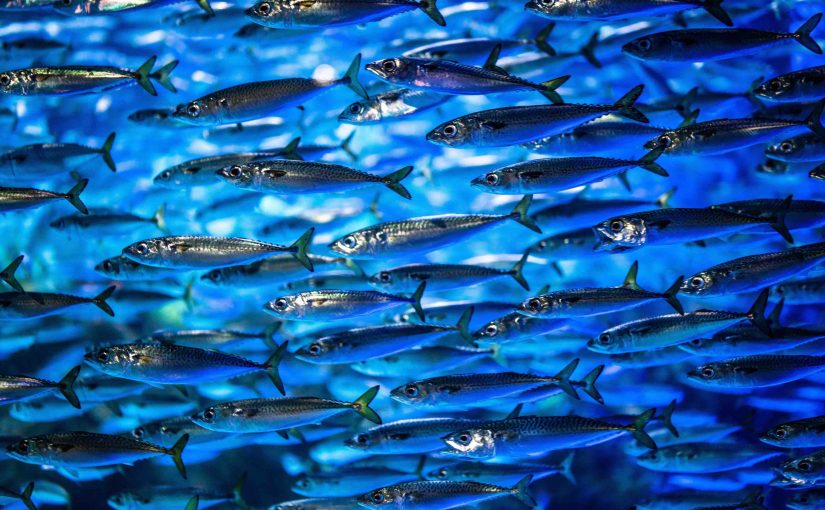
As Earth Day approaches, we’re reminded that our animal relatives have the capacity to inspire us to be far better stewards of our environment and far more empathetic with each other. From insects to whales, the millions of animal species inhabiting our planet with us deserve our attention and compassion.
This week, we highlight work from Frans de Waal, Ben Goldfarb, and Carl Safina as they share what they’ve learned from other animals. And we’ll dive into wild world of underwater soundscapes with the newly launched Global Library of Underwater Biological Sounds.
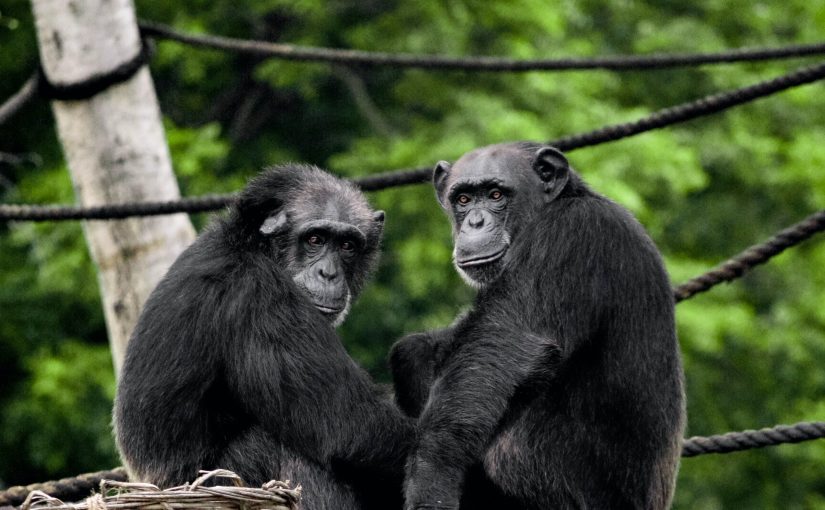
Different: Gender Through the Eyes of a Primatologist | Frans de Waal
World-renowned primatologist Frans de Waal offers key insights into gender in this excerpt from his book, Different: Gender Through the Eyes of a Primatologist, drawing on his decades of experience studying our ape cousins. De Waal courageously treads into very contested debates, but blending rigorous scientific observation and great compassion, he shows us how a close look at our bonobo and chimpanzee relatives can help us become far better hominids.
Underwater Soundscapes: What Can We Learn by Listening? Meet GLUBS
We’re all familiar with the hauntingly beautiful songs that Humpback whales sing and with clicks and beeps that dolphins make as they echolocate schools of fish. But have you ever wondered about the larger sonic landscapes or soundscapes that exist underwater? An exciting new project is being developed bringing together scientists (and citizens) from around the world to understand what we know – and what we don’t know – about the world of underwater soundscapes. In this interview, Audrey Looby, a researcher on marine soundscapes, talks about the Global Library of Underwater Sounds (“GLUBS”) and its potential to transform what we know about our underwater world and has profound implications for conservation, restoration, and our understanding of our fellow water-dwelling animal kin.
Eager: The Surprising, Secret Life of Beavers and Why They Matter | Ben Goldfarb
The consequences of losing beavers were profound: streams eroded, wetlands dried up, and species from salmon to swans lost vital habitat. In his book, Eager: The Surprising, Secret Life of Beavers and Why They Matter, award-winning environmental journalist Ben Goldfarb reveals how our idea of a healthy landscape was distorted by the fur trade that once trapped out millions of beavers from North America’s lakes and rivers.
The New Science of Evolutionary Cognition: Are We Smart Enough to Know How Smart Animals Are?
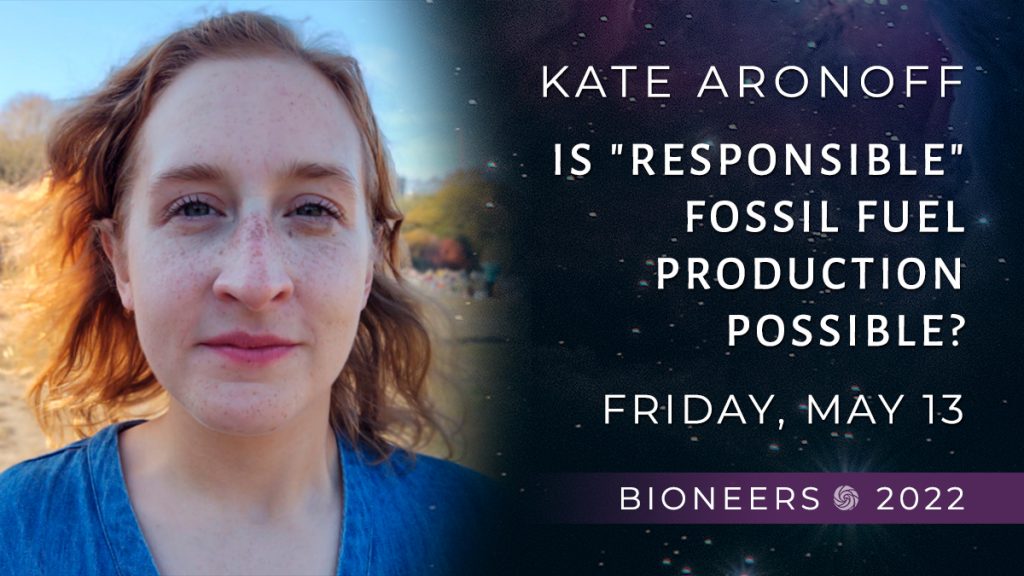
Overwhelming evidence suggests that many animals monitor their own knowledge (“metacognition”) and can reflect on both past and future. It is increasingly clear that our old one-dimensional model of a scale of cognitive capacities that goes from “lower” to “higher” life forms doesn’t fit the data. This year at Bioneers 2022, world-renowned primatologist Frans de Waal will draw from his deep experience studying cooperation and empathy among primates to explore with us the concept of “convergent evolution” and the new science of Evolutionary Cognition. He will offer us a radically expanded vision of how intelligence evolves and is distributed among our planet’s creatures.
Carl Safina – We Are Not Alone: What Animals Think and Feel
Animals possess self-awareness and empathy as much as they imitate, impart knowledge, and grieve. Relationships define them, as relationships define us. Carl Safina, the world-renowned ecologist, author, and expert on animal consciousness, reveals that we’re discovering many non-human minds are far more similar to ours than previously thought.
Mother, Daughter, Collaborators (Plus the Book That Changed the World of Food): The Lappés
Bioneers is excited to be partnering to bring Mother-Daughter duo Anna and Frances Moore Lappé to this year’s Bay Area Book Festival! This is an exciting chance to see the two discuss how parents and children can be there for each other, boost each other’s dreams, and work together for a better world. Bioneers actually hosted Frances and Anna on stage together at Bioneers years ago and are so excited to see them again together.
We’re all familiar with the hauntingly beautiful songs that Humpback whales sing and with clicks and beeps that dolphins make as they echolocate schools of fish. But have you ever wondered about the larger sonic landscapes or soundscapes that exist underwater? Scientists may know more about deep space than we know about the deep sea and we’re only beginning to even understand the right questions to ask. An exciting new project is being developed bringing together scientists (and citizens) from around the world to understand what we know – and what we don’t know – about the world of underwater soundscapes. The Global Library of Underwater Sounds (also known by the charming shorthand “GLUBS”) was announced in the journal Frontiers in Evolution and Ecology in February 2022. According to Audrey Looby, one of the co-authors, the project has the potential to transform what we know about our underwater world and has profound implications for conservation, restoration and our understanding of our fellow water-dwelling animal kin.
Audrey Looby is a PhD candidate at the University of Florida and is currently one of the co-leads on a project called Fishsounds, a quantitative and comprehensive inventory of all known fish sound production.
Bioneers Senior Director of Programs & Research, Teo Grossman, spoke with Audrey about GLUBS, soundscape ecology and the fascinating world of underwater biological sounds.
TEO GROSSMAN, BIONEERS: Let’s start with the basics. What is GLUBS and how did you become involved?
AUDREY LOOBY, UNIVERSITY OF FLORIDA: Through my work with Fishsounds, I got in touch with Miles Parsons of the Australian Institute of Marine Science, who is leading the Global Library of Underwater Biological Sounds effort, or GLUBS for short. He put together a group of researchers from all around the world who have different specialties, including data management, bio-acoustics, eco-acoustics, soundscapes, a community with general expertise in sounds underwater, to start thinking about creating a comprehensive library and integrated network of bio-acoustics or sound repositories, as well as other tools, including creating machine learning applications. This is an idea that many researchers have been talking about for decades.
Audrey Looby in the field.
TEO: Humans are very visual creatures, that’s our best sense, and, as a result, most of us are familiar with ecological landscapes. But your research and the nascent Global Biological Library of Underwater Sounds is looking at soundscapes, basically.
AUDREY: That’s the term used by the field for the past couple of decades now. Basically soundscape ecology encompasses any sounds in the environment around you and, specifically what is contributing to the sounds and what is hearing the sounds.
TEO: What can we actually learn about the world by way of soundscape ecology? What are we hoping to understand?
AUDREY: My main interest is soundscapes underwater, but sometimes it’s easier to talk about terrestrial sounds because that’s just more in our human experience. If you walk out into the forest, you might not be able to see everything that’s living in that forest, so it becomes helpful to use your other senses to be able to find out more about what’s going on.
In the case of birds, because a lot of their songs are species and even individual-animal specific, you can learn a lot about the biodiversity in a forest habitat, as well as sometimes even get abundance estimates, by listening.
For the ecology of it, birds make songs. Why do they do that? How do they do that? What other organisms might be listening in on that song? How does that affect them? What are the other sounds that might be influencing where the birds are singing or that could be hurting their ability to use their songs most effectively? This is when human impacts could come into play as well.
There’s an evolutionary aspect of the research, asking how we, as humans, evolved the ability to use sound for communication. How do other taxa use it? From an applied standpoint, we can use ecological soundscapes to learn more about the status of an area. In some cases we may use that knowledge to reintroduce sounds into a particular area for the purposes of ecological restoration or habitat enhancement, or to regulate the sounds that we put into a particular environment, as there’s more growing attention on the impacts of noise pollution.
While I was just talking about a forest and birds, all of what I just said holds true for underwater environments as well. Along with that, we’re fairly confident all marine mammals use sound for communication underwater. There are roughly 34,000 species of fish that are thought to exist and we know of at least a thousand species that use sound for communication. There are likely thousands more that we just haven’t documented yet. And even invertebrates can produce sound for communication as well.
TEO: As I was preparing for our conversation, my children wanted me to ask about some of the most unique or beautiful sounds that you’ve actually encountered in your research?
AUDREY: One of my favorites that I love to tell to people to make them giggle is that there are certain species of fish in the clupeidae family, like herrings, that create sound by expelling air out of their backsides. They’re essentially farting, and they’re able to communicate information to each other through their farts. They even use it to confuse predators that might be trying to eat them. Fish farting communication is a thing we can confirm. And even beyond those specific fish species, a lot of other fish sounds do kind of end up sounding like farts a little bit.
Recorded Herring Sounds. Wilson, B., Batty, R. S., Dill, L. M. 2003. Pacific and Atlantic Herring Produce Burst Pulse Sounds. Proceedings of the Royal Society B: Biological Sciences, 271(Suppl_3): S95-S97, (taken from FishSounds.net).
Gulf toadfish and other toadfish species have some of the more complex calls that you’ll find in the fish world. They’ll have different components, like a phrase where they’ll start with some grunts and then they’ll create a multi-harmonic call that is more prolonged. Those can vary, depending on the situation, and they can form whole choruses where a bunch of males will be singing and basically competing together. Sometimes you can even have certain species of toad fish do what’s called tagging, where they’ll hear like a subordinate male trying to call for females, and the more dominant male will basically grunt in the middle of the other fish’s call, to try to be like, “Hey, I’m way cooler than this other guy; don’t listen to him.
So there are a lot of quirkiness in fish sounds, for sure, and there’s a lot of variety. Then, of course with marine mammals, and whales in particular, you get these really complex songs that can be broken up into individual components, and then phrases, and then full songs that can evolve and change over time.
TEO: Jesse Ausubel, one of the co-founders of the project, suggests in an article that AI applied to marine animal recordings could yield some level of understanding, “Human song varieties include love and work songs, lullabies, chants, and anthems. Marine animals must sing love songs. Maybe AI applied to the Global Library can help us understand the lyrics of these and many others.”
This is perhaps pushing the boundaries of what we know and what we can interpret in animal science, but that said, I’m aware of research describing humpback whales transmitting different songs to different pods, meeting the human definition of culture by way of song-learning. Are there other examples of this? How much do we know and what are the leading edges?
AUDREY: To summarize that research briefly, whales within individual pods will teach each other songs, and there will be “fads” that come and go over time. I can’t remember exactly what the directionality of this is, but humpback whales in one region of the world will develop melodies or phrases that get passed to other humpback whale pods in other regions. It can even be the case that one of these regional pods is more of like a cultural go-getter that creates the fad that is found a couple of years later somewhere else in the globe. This is because whales develop their songs through learning, through exchange with other whales, and this isn’t always the case with all underwater organisms that use sound.
With fish, we haven’t really found evidence of learning so much yet. There are examples of certain species that exhibit regional dialects, where species in different geographic regions have slightly varied call structure than in other regions. This distinctness is also sometimes used to help provide evidence for speciation or emerging speciation. For example, difference in sounds between two regional populations of the Black Drum fish is being used as an argument in a recent paper to suggest a possible species differentiation. One of the primary pieces of supporting evidence for this is that the difference in sounds between two regional populations would make it hard for them to communicate information to each other.
Audio recording of Black Drum, by James Locascio and David Mann, University of S. Florida College of Marine Science (via from Ocean Conservation Research).
We can also distinguish individuals, depending on the species. Some of them have more complex calls than others, but even an individual fish can sometimes be identified based on its call compared to other individuals. In a lot of ways, marine mammals lead the way on a lot of the underwater acoustics research and we’re increasingly now applying that research to other species as well.
TEO: Can you talk about the conservation and restoration applications of soundscape ecology in general and the GLUBS project in particular?
AUDREY: In the ocean, lakes, streams and other underwater environments, it is really hard to find organisms to study. We have a bunch of different methods including catching them with nets or counting them visually with scuba divers, or putting down cameras, all sorts of active acoustic tracking, but we still have so much that we don’t know and that we can’t detect. So what’s called passive acoustic monitoring or listening to sounds with recorders and other equipment, offers an additional tool to find out what’s going on underwater.
For example, if you have a species of fish that’s invasive, like the Lionfish or Freshwater Drum up in New York that are vocal callers, you can use their sounds to detect the spread of an invasive species. Or on the flip side, you can find an endangered species that might be hard to see or find. There are a lot of specific applied questions that can be asked, like looking at distributions or detecting success in fish spawning,
Marine mammals can be very hard to find, they dive really deep and a lot of those species are increasingly rare because they are in decline, so one of the easiest ways to study marine mammals is through their sounds.
On the conservation/restoration side of things, many species use sound to find suitable habitat, to interact with other organisms. Many fish and invertebrate larvae, for example baby fish, baby corals, baby oysters, swim around in the water and then they have to pick a place to settle to spend like the rest of their life, especially the ones who attach and don’t move after that. One of the big factors in that decision can be sound. If we are trying to restore degraded habitat, say like an oyster reef, suitable habitat can be put down but it can be difficult to attract species to it right away, just because they need other species there. Playing sounds of a healthy reef to help attract species to that particular area can help.
There’s a lot of other work that’s been done for all sorts of reasons detecting habitat complexity and degradation, or looking at the effects of human noise, anthropogenic noise on underwater environments. And all of this research requires information. We need to know what species are making what sounds; what different areas of the world sound like; how they sound different; what species we know a lot about; what species we do not know a lot about. All of this different information is required to make these tools as effective as possible, and so that’s where Fishsounds on the fish side of things comes into play to some extent. GLUBS will help even more by offering more extensive tools and information to get us even better at performing acoustic monitoring or other soundscape-related applications to conservation and restoration.
TEO: I know one of the applications of GLUBS is the community science component. Can you describe how people can engage with both the library and the research as it starts to develop.
AUDREY: One of the biggest successes for birds, amphibians and insects has been using citizen or community science to collect information. There are way more members of the public out there than there will ever be researchers and scientists with time to devote to this stuff. So it’s really, really helpful for people who have an interest in either finding a particular bird ID or things like that to collect information that we can then use to inform the science and the research.
There are so many different smaller efforts that have existed or are up and running now where there are gaps in what we’re able to do, and that’s what GLUBS will serve as, helping to connect us and share information more effectively, as well as create tools that, because of the scale and the way funding can work for these things, smaller efforts like Fishsounds wouldn’t be able to do on their own.
One of the things that I’m most excited about is the community science side of things. If you’ve ever heard of Merlin Bird ID from Cornell or Birdnet or iNaturalist, all of those are projects have provided so much information that I have used myself in my research that we wouldn’t have been able to collect otherwise. It’s only really been recently that underwater recording equipment has become more and more accessible cost-wise. You can buy a couple hundred dollar hydrophone (an underwater microphone) that you can just throw off your boat and listen on your iPhone. Cheaper options are coming out every day. Now is really the time to start creating a platform where people who are interested would be able to contribute and share data and information for their own benefits as well as research.
TEO: That’s fascinating. Given the growth in AI applications, is it conceivable that somebody could drop a hydrophone into the water, flip on an app, and figure out which species are within listening distance? They have fish sonar apps already that can tell the density of fish in the area but not species. Is that like down the road?
AUDREY: That is practically here right now for birds, and it’s only going to be a little bit longer before we’ll have that for marine mammals, and then for fish and invertebrates. It’s definitely happening.
There was a really cool project I got to see in action at Cornell where they had a recorder out in their forest, and there was a machine-learning program identifying the bird species’ call in live time on a computer monitor in their lab. It’s coming.
TEO: That is indeed incredibly cool. Thank you so much for your time and we’re all interested in what comes next.
In what ways do men and women differ? Do we find the same differences in our fellow primates? Do apes learn sex roles or is gender uniquely human? World-renowned primatologist Frans de Waal offers key insights into gender, drawing on his extensive experience observing chimpanzees and bonobos. While some insights appear confirmed in his observations, de Waal unearths several startling discoveries about gender in his work. This surprising look at the nature of primates has a lot to say about what it means to be human.
Below are the first few pages of my book on gender in humans and other primates. The book itself is of course much more detailed and treats topics ranging from dominance and power, the toys young primates like to play with, to sexual orientation and gender diversity. It offers basically a triangular comparison between humans, chimpanzees, and bonobos, each with their own balance and tension between the sexes. Enjoy!
The saddest day of my career began with a phone call telling me that my favorite male chimpanzee had been butchered by two rivals. Having hurried on my bike to Royal Burgers’ Zoo, in the Netherlands, I found Luit sitting in a puddle of blood, leaning his head dejectedly against the bars of his night cage. Normally aloof, he heaved the deepest sigh when I stroked his head. It was too late, though. He died the same day on the operating table.
Rivalry among male chimps can grow so intense that they kill each other, and not only at the zoo. There are now a dozen reports of high ranking males slain in the wild during the same sort of power struggles. While jockeying for the top spot, males opportunistically make and break alliances, betray each other, and plot attacks. Yes, plot, because it was no accident that the assault on Luit took place in the night quarters where three adult males were kept apart from the rest of the colony. Things might have unfolded differently out on the large forested island of the world’s best-known chimpanzee colony. Female chimps don’t hesitate to interrupt clashes among male contenders. While Mama, the alpha female, couldn’t keep the males from politicking, she did draw the line at bloodshed. Had she been present on the scene, she’d no doubt have rallied her allies to step in.
Luit’s untimely death affected me deeply. He had been such a friendly character, who as leader had brought peace and harmony. But on top of that, I was deeply disappointed. Until then, the battles I had witnessed had always ended in reconciliation. Rivals would kiss and embrace after each skirmish and were perfectly capable of handling their disagreements. Or so I thought. Adult male chimps act like friends most of the time, grooming each other, and roughhousing in fun. The disastrous fight taught me that things can also spiral out of control and that the same males are capable of intentionally killing each other. Fieldworkers have described assaults in the forest in similar tones. They seem deliberate enough to speak of “murder.”
The high-intensity aggression of male chimps has a female equivalent. The circumstances that trigger female anger are quite different, though. Even the biggest male knows that every mother will turn into a raging hurricane if he lifts a finger against her progeny. She will become so undaunted and fierce that nothing will stop her. The ferocity with which a mother ape defends her young exceeds that with which she defends herself. Maternal protectiveness is such a universal mammalian trait that we joke about it, such as when U.S. vice-presidential candidate Sarah Palin called herself a Mama Grizzly. Mindful of this reputation, Gary Larson drew a cartoon in which a businessman carrying a briefcase enters an elevator with a large and a small bear standing in the back. The caption reads: “Tragedy struck when Conroy, his mind preoccupied with work, stepped into the elevator—directly between a female grizzly and her cub.”
The greatest fear of fandis in the jungles of Thailand—hunters who in the old days captured wild elephants for timber labor—was not that they’d snare a tusker. A large bull in the ropes posed less acute danger than a small calf captured while its mother was within hearing range. Quite a few fandis have lost their lives to enraged elephant cows. In our species, a mother’s defense of her children is so predictable that, according to the Hebrew Bible, King Solomon counted on it. Faced with two women who both claimed to be the mother of a baby, the king asked for a sword. He proposed to split the baby so that each woman could have half of it. While one woman accepted the verdict, the other protested and pleaded that the baby be given to the other. This is how the king knew who the real mother was. As the British detective writer Agatha Christie put it, “A mother’s love for her child is like nothing else in the world. It knows no law, no pity, it dares all things and crushes down remorselessly all that stands in its path.”
While we admire mothers who take their children’s side, we hold a dim view of human male combativeness. Boys and men often instigate confrontations, act tough, hide vulnerabilities, and seek danger. Not everyone likes men for this, and some experts disapprove. When they say that “traditional masculinity ideology” fuels men’s behavior, they hardly mean it as a compliment. In a 2018 document, the American Psychological Association defined this ideology as revolving around “anti-femininity, achievement, eschewal of the appearance of weakness, and adventure, risk, and violence.” The APA’s attempt to save men from this ideology revived debate about “toxic masculinity” but also triggered backlash over its blanket denunciation of typical male behavior.
It’s easy to see why male and female patterns of aggression are valued so differently: only the first creates trouble in society. Horrified by the death of Luit, I don’t want to depict male rivalry as an innocuous pastime. But who says it’s a product of ideology? A huge assumption is being made here, which is that we are the masters and designers of our own behavior. If this were true, shouldn’t it stand apart from that of other species? But it hardly does. In most mammals, males strive for status or territory whereas females vigorously defend their young. Whether we approve or disapprove of such behavior, it’s not hard to see how it evolved. For both sexes, it has always been the ticket to a genetic legacy.
Ideology has little to do with it.
Sex difference in animal and human behavior raise questions that lie at the heart of almost any debate about human gender. Does the behavior of men and women differ naturally or artificially? How different are they really? And are there only two genders, or are there more?
But before I dive into this topic, let me make clear why I am interested in it and where I stand. I am not here to justify existing human gender relations by describing our primate heritage; nor do I think that everything is fine as it is. I recognize that the genders are not now and have never been equal for as long as we can remember. Women get the short end of the stick in our society and in almost every other one. They have had to fight for every improvement, from the right to education to voting rights, and from legalized abortion to equal pay. These aren’t little improvements. Some rights have been secured only recently, some are still being resisted, and some were achieved but have come under fresh attack. I see all this as highly unfair and consider myself a feminist.
Disdain for the innate abilities of women has a long tradition in the West going back at least two millennia. It’s the way gender inequality has always been justified. Thus the nineteenth-century German philosopher Arthur Schopenhauer thought that all their lives women remain children, who live in the present, whereas men have the ability to think ahead. Another German philosopher, Georg Wilhelm Friedrich Hegel, thought that “men correspond to animals, while women correspond to plants.” Don’t ask me what Hegel meant, but as noted by the British moral philosopher Mary Midgley, when it comes to women, the heavyweights of Western thought have produced extraordinarily silly reflections. Their usual divergence of opinion is nowhere to be found: “There cannot be many matters on which Freud, Nietzsche, Rousseau and Schopenhauer agree cordially both with each other and with Aristotle, St. Paul and St. Thomas Aquinas, but their views on women are extremely close.”
Even my beloved Charles Darwin didn’t escape the trend. In a letter to Caroline Kennard, an American women’s rights advocate, Darwin opined about women, “There seems to me to be a great difficulty from the laws of inheritance in their becoming the intellectual equals of man.”
All this in an era when disparities in education could easily account for the proposed intellectual contrasts. As for Darwin’s “laws of inheritance,” all I can say is that I’ve devoted my entire career to the study of animal intelligence and never noticed a difference between the sexes. We have brilliant individuals and not-so-brilliant ones on both sides, but hundreds of studies by myself and others have revealed no cognitive gaps. While there is no shortage of behavioral contrasts between primate males and females, their mental capacities must have evolved in tandem. In our species, too, even the cognitive domains traditionally associated with one gender and not the other, such as mathematical ability, prove indistinguishable by gender if tested on a large enough sample. The whole idea of one gender being mentally superior receives no backing from modern science.
A second issue that needs to be cleared up is the stereotypical view of our fellow primates that is sometimes used to defend inequalities in human society. In the popular imagination a male monkey boss “owns” the females, who spend their lives making babies and following his orders. The chief inspiration for this view was a baboon study of one century ago that, as I will explain, had major flaws and gave rise to a dubious metaphor. Unfortunately, it hit the public like a barbed arrow that proved impossible to dislodge despite all the contrary information gathered since then. That male supremacy is the natural order was promulgated over and over by a slew of popular writers in the previous century, while a 2002 book, entitled King of the Mountain, by the American psychiatrist Arnold Ludwig still maintains:
Most humans have been socially, psychologically, and biologically programmed with the need for a single dominant male figure to govern their communal lives. And this programming corresponds closely to how almost all anthropoid primate societies are run.
One of my goals here is to disabuse readers of this notion of the obligatory male overlord. The primate study at its origin concerned a species that we are not particularly close to. We belong to a small family of apes (large tailless primates), not of monkeys like baboons. By studying our next of kin, the great apes, a more nuanced picture emerges, one in which males exert less control than imagined.
While it is undeniable that male primates can be bullies, it’s also good to realize that they didn’t gain their aggressiveness and size advantage in order to dominate females. This is not what their life is about. Given the ecological demands, females evolved to be the perfect size. Their bodies are optimal given the foods they gather, the amount of traveling they do, the number of offspring they raise, and the predators they elude. Evolution has pushed males to deviate from this ideal so as to better fight each other. The more intense the competition among them, the more impressive their physical features. In some species, such as the gorilla, the male is twice the female’s size. Since the whole point of male fighting is to get close to females with whom to reproduce, harming them or taking away their food is never the males’ goal. In fact, most female primates enjoy a great deal of autonomy, foraging all day for themselves and socializing with each other, while the males are peripheral to their existence. The typical primate society is at heart a female kinship network run by older matriarchs.
We heard the same reflection when The Lion King was newly released. In the movie, the male lion is depicted as the boss—because most people cannot conceive of a kingdom any other way. The mother of Simba, the cub destined to become the next king, hardly plays any role at all. However, while it is true that lions are bigger and stronger than lionesses, they hold no central position in the pride. The pride is essentially a sisterhood, which does the bulk of hunting and offspring care. Male lions stay for a couple of years before they are kicked out by incoming rivals. As Craig Packer, one of the world’s leading lion experts, puts it, “Females are the core. The heart and soul of the pride. The males come and go.”
While comparing ourselves with other species, the popular media feature a surface reality. The deeper reality, however, can be quite different. It may reflect substantial sex differences but not necessarily the ones we expect. Moreover, many primates have what I call potentials, which are capacities that are rarely expressed or hard to see. A good example is female leadership, such as I described in my last book, Mama’s Last Hug, for the longtime alpha female at Burgers’ Zoo. Mama was absolutely central to social life, even though, measured by the outcome of fights, she ranked below the top males. The oldest male, too, ranked below them but was equally central. Understanding how these two aging apes together ran a large chimpanzee colony requires looking beyond physical dominance and recognizing who makes the critical social decisions. We need to distinguish political power from dominance. In our societies, no one confuses power with muscularity, and the same holds true for those of other primates.
Another potential is the caretaking capacity of male primates. We sometimes get a glimpse of it after a mother’s death, when all of a sudden an orphan whimpers for attention. Adult male chimpanzees in the wild have been known to adopt a little one and lovingly care for it, sometimes for years. The male will slow down his travel for the adopted youngster, search for him if he’s lost, and be as protective as any mother. Since scientists tend to stress typical behavior, we don’t always dwell on these potentials. Still, they bear on human gender roles given that we live in a changing society, which tests the limits of what our species is capable of. There is every reason, therefore, to see what we can learn about ourselves from comparisons with other primates.
Even those who doubt evolutionary explanations, and think that the same rules don’t apply to us, will have to admit to one basic truth about natural selection. No person currently walking the earth could have gotten here if it weren’t for ancestors who survived and reproduced. All our ancestors conceived children and raised them successfully or helped others raise theirs. There are no exceptions to this rule because those who failed to do so are ancestors to no one.
At the core of our civilizational breakdown is an extractive economy that wastes both nature and people, at the same time it is Hoovering extreme wealth up to the billionaire class. But with breakdown comes breakthrough. Professor Manuel Pastor believes we’re living through a moment of profound transformation. It will come down to what we do – or don’t do – at this moment of radical change.
In this episode, we hear from Pastor on how shocks to the system are precipitating a great awakening and growing movements to transform the economy to our economy.
Featuring
Manuel Pastor, Ph.D., Distinguished Professor of Sociology and American Studies & Ethnicity at USC and Director of its Equity Research Institute, has long been one of the most important scholars and activists working on the economic, environmental and social conditions facing low-income urban communities and the social movements seeking to change those realities. He has held many prominent academic posts, won countless prestigious awards and fellowships for his activism and scholarship, and is the author and co-author of many important, highly influential tomes.
Credits
Executive Producer: Kenny Ausubel
Written by: Kenny Ausubel
Senior Producer and Station Relations: Stephanie Welch
Program Engineer and Music Supervisor: Emily Harris
Host and Consulting Producer: Neil Harvey
Producer: Teo Grossman
Production Assistance: Monica Lopez
Special thanks to Status Coup News for use of their interviews with workers on strike
SolidarityEconomics.org | Joint Project of the Equity Research Center (ERI) at the University of Southern California and the Institute for Social Transformation at UC Santa Cruz
This is an episode of the Bioneers: Revolution from the Heart of Nature series. Visit the radio and podcast homepage to find out how to hear the program on your local station and how to subscribe to the podcast.
Subscribe to the Bioneers: Revolution from The Heart of Nature podcast
Transcript
NEIL HARVEY, HOST: When engineers prototype a machine, they run it at high speed and high stress to see what blows out. The aim is to determine where the flaws and weaknesses are, and hopefully to correct them.
These days, it seems like everything is broken. Maybe we need an entirely new and different design.
At the core of this civilizational breakdown is an extractive economy that wastes both nature and people, at the same time it is Hoovering extreme wealth up to the billionaire class.
But with breakdown comes breakthrough. Professor Manuel Pastor believes we’re living through a moment of profound transformation. It will come down to what we do – or don’t do – at this moment of radical change.
One thing is for sure. This time is apocalyptic in the original meaning of the word, which is a revelation or an unveiling.
Manuel Pastor spoke at a virtual Bioneers conference…
MANUEL PASTOR: It’s been a very difficult last couple of years. We have been and are still experiencing the COVID pandemic, and it’s important to realize that this was a shock to our system. COVID was the disease that revealed our illnesses as a society: the racial wealth gap, which meant that communities of color were not able to survive the blows of an uneven economy; inadequate healthcare – black people died at 1.4 times the rate of white folks, and if we look at Los Angeles county and age adjust for that, we’ll see that the black death rates were twice that of white folks, the Latino death rates, three times. So COVID was the disease that revealed our illnesses of economic precarity, of systematic racial disparities, of inadequate healthcare.
However, it also revealed our mutuality. The number of people who stepped up in mutual aid societies, the food kitchens that stepped forward, communities beginning to care for the unhoused amongst them. And of course, people wearing masks, even if not just to protect themselves, but to protect their neighbors.
And we, in fact, need to think about COVID as occurring as part of three big hits to the consciousness. COVID itself revealing disparity, the murder of George Floyd and the reckoning around structural racism in the United States, and of course all of that coming on top of four years of a presidential administration that seemed to have cruelty as its main strategy, that wound up [INAUDIBLE] in xenophobia, racism and hate, and had sought to polarize the society. So where does that leave us now?
HOST: As Manuel Pastor points out, one central pivot of transformation that’s being revealed is to change our societal pronoun from “me me me” to “we.”
Manuel Pastor is a Distinguished Professor of Sociology and American Studies & Ethnicity at the University of California. He’s Director of its Equity Research Institute. He’s long been one of the most astute researchers studying the economic, environmental and social inequities facing low-income urban communities. He’s also worked tirelessly to address these systemic crises through movement building.
But, he says, the upside of the downside is that the concatenation of crises that bedevil us has shaken loose the foundational ideological assumptions about what an economy is for, and who gets to benefit.
I would argue there is no going back to what we had before. People often use the word recovery, but why would we want to go back to a normal that did not work for so many, with so many crowded into jobs that were high-risk and low pay, with so many left without a social safety net, with so many subject to racist policing, racist education, and even racist environmental conditions in terms of climate inequities. Rather than use the term recovery, we need to understand that this is a moment of transformation, and it’s going to require reimagination and restructuring to be able to get forward to a model that both recognizes the disparities that have existed, challenges inequality, and begins to lift up our commonalities.
Traditional economics, often called classical or neoliberal economics, assumes that people are selfish, they act just in their self-interest, and that markets exist to coordinate that too, and actually sometimes on the left, people think folks act in their self-interest and you need the state to constrain people.
But the fascinating thing is that people also act out of mutuality, out of concern. You know, when there’s a disaster like COVID, there are price gougers, but there’s also people who rush to the rescue of other folks. And the question is: Does our system feed the wolf of selfishness or does it feed the spirit of inclusion, and fairness, and mutuality? And that’s a really important thing that I think is wrong, both with the way we theorize and with the way we structure.
HOST: The prevailing ideology of modern capitalist economics arose in the mid-19th Century in tandem with the Industrial Revolution and the Olympian rise of the plutocratic Robber Barons and their bloated monopolistic trusts.
During that Gilded Age, a leading anti-monopoly crusader named Henry Demarest Lloyd described the ideological conflict around the plutocrats’ so-called “survival of the fittest” Social Darwinist ideology in this way:
The golden rule of business is: There is no hope for any of us, but the weakest must go first. There is no other field of human associations in which any such rule of action is allowed. The man who should apply in his family or in his citizenship this ‘survival of the fittest’ theory as it is professed and operated in business would be a monster, and would be speedily made extinct. To divide the supply of food between himself and his children according to their relative powers of calculation would be a short road to the penitentiary or the gallows. In trade, men have not yet risen to the family life of animals. It is a race to the bad, and the winners are the worst.
In fact, what Charles Darwin was referring to with “survival of the fittest” was an ecological paradigm of the survival of those best fitted to their environment, place and time.
Around the same time, the Russian naturalist and philosopher Pyotr Kropotkin reported on his studies of animal behavior in his famous book Mutual Aid. He concluded this:
Happily enough, competition is not the rule either in the animal world or in mankind. It is limited among animals to exceptional periods. Better conditions are created by the elimination of competition by means of mutual aid and mutual support. That is the tendency of nature.
In fact, Kropotkin proved to be correct. It’s cooperation and symbiosis that make the world go ‘round. The classical “survival of the fittest” economic model is less an ideology than a theology – an article of blind faith in the supremacy of the market to solve problems, and in the benevolence of billionaires. Surveying the state of the world, it’s self-evident that the invisible hand of the market has failed catastrophically.
MP: And we know in our heart that when businesses treat people correctly, that those businesses thrive. We know that if low wages and the ability to destroy the environment were the driving factors behind economic growth, Haiti would be the richest country on Earth, but it’s not.
Neoliberalism has hijacked common sense. So you know, people, when they look at their individual situation, they individualize it, like somehow it’s my fault rather than a result of the structures of inequalities. Or that markets will take care of it. Or that a tax cut on the rich will generate prosperity. There’s no evidence of that over the last 45 years that we’ve been trying it. It’s never generated economic growth. What’s generated economic growth is public investment in each other. That’s what generated the long period of economic prosperity between 1945 and 1970.
So we really need to shift our mindset and begin to realize when we work out of a spirit of mutuality, we begin to generate a more prosperous economy.
HOST: Indeed, as the late senator Gaylord Nelson, principal founder of Earth Day, said, “The economy is a wholly-owned subsidiary of the environment.”
Real wealth creation is based on replenishing natural systems and restoring the built environment, especially our infrastructure and cities. It’s based on investing in our communities and workforce. It’s been shown to work best when done all at once. Restoration could become an estimated $100 trillion market. There’s plenty of work to do, plenty of people to do it, and abundant financial incentive.
When we return, more from Manuel Pastor on how to bring mutuality into the economy – and why movements matter.
I’m Neil Harvey. You’re listening to The Bioneers. This is “Building the Solidarity Economy: Awakening to Our Mutuality and Shifting the Terrain of Power.”
HOST: In his book Solidarity Economics: Why Mutuality and Movements Matter, which he co-wrote with Chris Jenner, Manuel Pastor lays out the kinds of mind-shifts and practical applications that can rewrite the rules at this transformative moment. It starts with reframing the term, “the economy.”
MP: When we talk about the economy, it makes it seem like it’s a set of natural laws, things given by God, the market that’s outside of us. But it’s our economy. These are the rules we make about whether to compete or collaborate. It’s a tax system that either lets Amazon go off Scot-free with no taxes or ensures that they pay taxes and treat their workers decently. We should always go back to talking about our economy, the set of rules we set up and use to either protect property or to protect people.
Second big point is that we need to recognize that mutuality actually drives our economy and stress how mutuality, fairness and inclusion can generate prosperity for the many. Now this is a really key point because even progressives sometimes seem like they accept the arguments of conservatives, that inclusion maybe a good thing morally but somehow it’s going to come at the cost of economic prosperity. But you know that when you have a society that’s underinvesting in young people, you’re not going to have more productivity in the future. You know when you’ve got a system of over-policing and over-incarcerating that you’re wasting talent that could contribute. You know when you are not legalizing people who’ve been in this country, perhaps without papers, but for quite a long period of time, you’re not only disenfranchising them politically, you’re disenfranchising them economically and you’re wasting their talent and ability to contribute. And research is showing that those metropolitan areas that are more equal, less residentially segregated, and less fragmented actually tend to grow more sustainably over time.
HOST: Those same metropolitan areas that are more equitable also experience less pollution and environmental degradation.
Manuel Pastor cites compelling statistics that reflect how vital it is to build a solidarity economy. In Los Angeles County, while the median income for white households hovers around $86,000 a year. Latino households plunge to $52,000, and black households to $45,000. It gets even worse. For households with children under the age of 5, the income median for white households is about $124,000 a year. For black and Latino households, it’s about $51,000.
Pastor says that means we’re baking racial inequality into the future – unless we act to change the terms of engagement.
MP: First, we need to center the struggle for racial equity and against racism. We need all of us to have a deep interrogation of how anti-black and anti-indigenous racism has set the terrain for othering, for xenophobia, for hate, for structural inequality that in fact affects all of us. Even immigrants who come to this country, the terrain of an inequality is set by those fundamental dynamics of the taking of land and the taking of labor to amass capital to make this country.
So, if we really want to make a world that is better, we need to center the struggle for racial equity, and take it upon ourselves to understand the deep role of anti-black racism.
But the ground truth of the COVID pandemic is that it radically amplified the Social Darwinism corrupting the economy. The richest Americans raked in the biggest upward transfer of wealth in the country’s history. Concierge service from the U.S. Treasury Department provided them with no-interest cash to capitalize on a fire sale of vulnerable small and medium-sized businesses, while also supporting lucrative stock buybacks and executive bonuses.
While the super-rich got filthy richer, struggling taxpayers received a pittance in direct assistance – and a temporary one at that. Meanwhile companies started complaining bitterly that workers weren’t showing up.
Rather than go back to crappy low-wage jobs that already were often not enough to live on, so-called “essential workers” additionally now faced mortal danger from the pandemic. It’s a nightmare scenario amounting to “Your money or your life.” Thousands of workers staged union and wildcat strikes across the country.
“People are sick and tired of being sick and tired, as Fannie Lou Hamer said, they’re sick and tired of being taken advantage of. They’re sick and tired of the top 5 percent getting all the wealth and those of us on the bottom, you know, are struggling to make ends meet, living paycheck to paycheck.”
“It’s about sticking together as a team to win! These men and women who are standing in line today are really fighting for the new hires and the people of the future.”
“We still deserve human rights and human decency, and I would say that enough pay to pay your rent and get a car to work if you need to and put groceries in your fridge is a human right.”
MP: You know, the business press is calling it the great resignation, because from the point of view of employers, it’s people leaving and not wanting to come to work. But I think it would be better to call it the great rebellion or the great awakening.
What’s going on is that workers are saying, you know what, we’ve just been through this huge existential crisis where we realized what work was essential, and it was not being the manager of a hedge fund, it was being a grocery store clerk or an agricultural worker or a healthcare worker. And yet so many of those jobs are not treated with the pay, respect, a combination that they deserve.
And what I think you’re seeing is that workers are fed up. I mean, restaurant employers used to expect that people would come in for low wages, uncertain hours, and disrespected work. And now people are saying, really? And I have to risk death from COVID too? Later. I’m not coming in. So, you’re really seeing a kind of recalibration of what work means in people’s lives, and a demand for more from it.
But I also think that it’s important to realize that this comes—now it’s about a dozen or so years since the 2008, 2009 financial crisis in which capitalism ran itself into the ground and expected the taxpayers to bail them out at the mistakes they made, even as they left black and Latino homeowners, particularly, in the wind, losing all of their assets, with the racial wealth gap worsening over time.
Young people entered into the labor market in that period of time and they saw Trump get elected and mismanage this last crisis. People don’t trust the system. They know that something is wrong. They know that they deserve better. And even though they don’t quite yet have the collective means for articulating their concerns, they’re articulating them individually by deciding not to go to work, or quitting the jobs they have, or getting together with other people to demand improvements in the conditions at work.
They helped develop a dynamic suite of transformative policies to build the Solidarity Economy Movement. It’s grounded in green infrastructure, education, workforce development, housing, transportation systems, and the Care Economy for the 21st century.
MP: And that is a movement that looks at co-ops, community land trusts, mutual aid societies, everything where people come together to forge institutions, economic institutions, that center collective well-being and provide an alternative to the capitalist orientation of most of our institutions.
So you can imagine making sure that financial institutions lend to communities so that they can start community land trusts. You can imagine making it easier for worker co-ops to form, and also making it easier for them to get the capital finance that they need to be able to move forward. You can see, as happened during the pandemic, government delivering aid, often through these mutual aid societies or community-based organizations in ways that build up that sector of the economy.
That’s going to take some time, and we don’t have a lot of time. We need to scale up quickly. So the solidarity economy vision is kind of a post-capitalist vision. But we also think there’s a lot you can do with currently existing businesses. How do we reward the businesses that are paying taxes, paying decent wages, training their workers, providing paid family leave, and penalize those businesses that are not doing that? How do we take that large part of our economy that exists right now and shift it in the direction of serving mutuality.
HOST: When the pandemic paralyzed the U.S. economy, community mutual aid networks sprang up or leapt into overdrive around the country. They tried to ensure people living alone received the help they needed, such as groceries or rides to the doctor. It’s been civil society – not the invisible hand of the market – that has risen to the occasion to grow and strengthen these networks, and incorporate them into official structures where that’s been possible.
But there have to be some fundamental changes in our economy and our government policies to make a difference that really makes a difference in people’s lives for the long haul. Which is why movements matter, say Manuel Pastor.
MP: That means we need to commit to social movements. There’s a famous quote from Martin Luther King. He actually borrowed it from someone else, which is that the arc of the moral universe is long, but it bends towards justice. Let me add, Bioneers, but it requires that someone bend it. It doesn’t get the justice just on its own. That’s going to require you. It’s going to require you working with others. It’s going to require broad social movements that challenge the constellation of political power, that challenge economic and racial privilege, and insist on mutuality as the guiding principle for our economy, and solidarity economics as our framework for getting forward.
When you see how the one percent has been running away from the rest of us with its share of national income continuing to go up and social distance mounting and mounting, we know that some people do benefit, even though most of us would gain from inclusion and investment in all of us. And so we need movements like the Fight for 15, the fight for immigrant rights, the fight to house the unhoused, to make sure that we can actually change things.
We also know that the other side effect of movements is just as markets make us selfish, they teach us to be self-interested, look out for ourselves instead of someone else, and see the world as zero sum. Just as markets make us selfish, movements make us mutual, they build the habits of solidarity, intersectionality and mutual consideration that are key to make our economy function for all of us.
Solidarity economics insists that we should address the climate crisis, not just because there’s a cost benefit analysis of how that would be good for us in the long run, but simply that we need to move past an extractive relationship with the planet and understand that we must stand in solidarity with the planet, with other species, and with future generations, to make sure that we have a planet that lasts.
Recent years have shown us how fragile our communities are in light of institutional failures highlighted by a global pandemic, systemic inequalities, and climate change. Responding to this moment in history requires an urgent and revolutionary reordering of societal systems and structures. In this article from his book, Transformational Thought: Radical Ideas to Remake the Built Environment, Jason F. Mclennan outlines a blueprint to restructuring societal systems and infrastructure to create resilient communities to mitigate and solve our most pressing issues facing humanity.
Jason Mclennan is one of the world’s most influential visionaries in contemporary architecture and green building, is a highly sought-out designer, consultant, and thought leader. A winner of Engineering News Record’s National Award of Excellence and of the prestigious Buckminster Fuller Prize (which was, during its 10-year trajectory, known as “the planet’s top prize for socially responsible design”), Jason has been showered with such accolades as “the ‘Wayne Gretzky’ of the green building industry and a “World Changer” (by GreenBiz magazine).
The hurricane and flooding in New Orleans. The F5 tornado in Joplin, Missouri. The magnitude 6.2 earthquake in Christchurch, New Zealand and the devasting earthquake in Haiti. The BP oil spill in the Gulf of Mexico. The earthquake, tsunami and subsequent nuclear crisis in Northern Japan.
Disasters happen and people respond, on both individual and societal levels. In recent years, increasing attention has been paid to the notion of community resilience as the size and number of community disasters has increased globally. We seem increasingly resigned to adapting to disasters rather than avoiding them as their inevitability becomes apparent. The good news is that the dialogue is finally becoming more sophisticated, with a focus on how to prepare in advance for the next crisis and how well our systems might withstand what’s to come rather than simply planning to respond after the fact. The word “resilience” is an important word in the context of community planning, yet to truly become more resilient we must take a step back and examine the very fabric of our communities, identifying our vulnerabilities both culturally and physically and replacing them with more robust and elegant solutions.
Understanding Our Fragility
Several realities make our societies inherently less resilient than in the past. Overpopulation literally places more people in harm’s way, particularly in earthquake and flood zones where much of current population growth occurs. With another billion people likely to be added within the next two decades this will become even more of an issue. Increasingly dangerous technologies (nuclear energy and deep-water drilling come to mind) raise the stakes when problems occur. In our insane quest for cheap energy we are greatly increasing the potential for human-based natural disasters with riskier technologies and resource extraction.
The ways in which we have planned and built our cities (especially in North America) also spreads people out over greater distances, creating geographic and cultural separations as well as highly inefficient, expensive centralized transportation, water and waste systems that make potential disruptions harder to fix and put whole communities at risk. Culturally we have become complacent about governments, corporations and technologies stepping in and taking care of us in tough times. As a result we find ourselves more vulnerable – and sometimes helpless in the face of challenges when they do arise.
The topic of resilience comes up frequently in discussions and debates surrounding climate change, among the people that focus on these issues, but is mostly ignored by the public at large. Most experts agree that the rate of natural disasters will continue to rise as the climate continues to change. Yet suddenly it has become politically dangerous to even discuss climate
change and the many threats we face to our well-being in the public sphere. Emotional partisanship has replaced scientific rationality for most Americans. For communities that need to think about resilience – and I think every community in the world should be having vigorous civil discourse on this subject—very little is being done.
Government, corporate and environmental leaders that are up to speed on these issues all agree that the costs to respond to these catastrophes over and over are simply too high and economically untenable. We can not keep insuring the status quo and rebuilding communities that are ill-prepared for the next disaster down the road. The question remains: how can we make all of our communities more resilient to inevitable disasters, whether they are natural or man-made?
Clearly, the overall topic of resilience is massive. For the purposes of this article, I have chosen to focus on those aspects of community resilience that I believe we are still capable of achieving—provided we are courageous enough to make some serious changes.
New Realities Clash with Old Habits
Many climate experts now believe that we have already lost the battle against climate change; that it is already too late to reduce emissions in time to avoid significant catastrophic environmental loss around the world. The debate is turning to how we will adapt and thrive in a vastly altered world. Some anticipate the inevitable collapse of civilization as we know it, where warming temperatures and rising seas will flood coastal areas and result in human tragedy on a hitherto unheard of scale.
Meanwhile, politicians offer their rhetoric (if anything at all) without offering real solutions. And challenging economic times make minor hardships feel considerably more dire. Even a modest spike in oil prices sends a shock wave throughout the already tense economy, reminding us how dependent we are on fossil fuels. We find it difficult enough to endure price hikes in boom times; when money is tight, the effects are much farther reaching. In lean economic times, there is a general shift in the balance of optimism and pessimism. People feel less secure and more afraid because there is less to fall back on, both in our personal accounts and in the public coffers. So if disaster were to strike, we feel less confident in society’s ability to support us if we need help.
The typical scenario following a large-scale crisis in the first or developed world goes something like this: a critical event occurs, experts from elsewhere swarm in to rescue the victims, money comes from outside sources (such as FEMA, non-profit NGOs, religious groups, insurance companies), and the affected community attempts to rebuild itself much like it was before.
However, this pattern makes no sense. When we rebuild exactly what was destroyed, we simply return ourselves to the vulnerability of where we started. Yes, it is what we know, but recreating the past circumstances only places us squarely in the path of future disasters. Will New Orleans ever encounter another hurricane? Will Southwest Missouri endure another tornado? Will Northern Japan continue to be affected by shifts in the earth’s crust? Of course. So why would these communities return to business as usual in the wake of devastation? Why wouldn’t they re-think the way they re-build so that they can be more resilient the next time around?
Third world disasters of any nature typically result in massive human suffering, disease and death – and rarely a return to conditions prior to the event. Things just keep getting tougher for those most disadvantaged around the world. When a disaster is large enough to capture the international stage and media attention, money flows in for a period of time when the story is “hot”, but then quickly recedes to a trickle within a short period of time.
Rethinking Concepts of Power and Strength
I live just across the water from downtown Seattle on Bainbridge Island, a small community where an abundance of trees and a blustery climate combine for relatively frequent power outages. When the lights and heat go out, we patiently wait for outsiders to fix the problem on our behalf. The local power company quickly obliges, but residents have no control over how long we wait before our energy, water and heat is restored. Those of us without generators (which have their own limits) wait in our homes, relying on the candles and blankets we have on hand, until the bulbs miraculously flicker back on. We are not fond of, nor are we accustomed to being in dark, unheated houses, but we adapt because we know it is only temporary.
We’re lucky on Bainbridge Island; we rarely deal with disruptions that last longer than 24 hours and almost never more than a couple of days at worst. Such short disruptions almost become enjoyable, romantic breaks from TV, video games and the constant hum of modern life. But every time it does happen, at the back of our minds looms the question—what if it doesn’t come back on?
And what if true disaster hits, rendering our centralized systems irreparable and the public emergency response teams unmanned? What would we do if nobody were available to help for extended periods—or at all? Would our community have the capacity to help itself? Have we lost our resilience as a people? Deep down I think we all know the answer. We are perhaps the most individually and culturally helpless society in the world if the complex systems we’ve built to support us go down due to some sort of disaster.
In comparison, I often think of the resilience of Amish communities. There, neighbors build structures together, whether they are intended for private or communal use. People learn how to fix the tools they use. They grow their own food. They work in trades that will sustain their families for generations. There is no centralized infrastructure to which all systems are tied—and this is a key understanding that needs to be underscored. The Amish are nothing if not resilient.
Let’s define this clearly as it has huge importance. The following page outlines categories of resilience.
In my book, Zugunruhe, I refer to the growing agitation I see across all pockets of our society as we unconsciously become aware of our vulnerability. People are feeling restless, knowing on some level that something fundamental has to change in our civilization if we are to correct our course toward a way of living that has a chance for long-term prosperity. I believe this unconscious awareness is the first stage for people pursuing individual resilience. More houses are going off the grid, more workers are telecommuting, and more people are growing their own food and supporting local agriculture.
This awareness can not spread quickly enough. We need to resist alarmism while keeping in mind the large-scale consequences of our vulnerability. The longer we take to develop resilience as individuals and communities, the farther-reaching the potentially adverse effects. True, deep, sustainable, community resilience should immediately become a central part of the planning paradigm for cities and towns across every country. I am not just referring to disaster preparedness—I mean fundamental resilience that begins with the individual and reaches across the community and finally to the community’s infrastructure of support.
The Key Ingredients of a Resilient Community
A truly resilient community is based on three distinct elements: a resilient infrastructure, a resilient culture and resilient individuals. Let’s explore the workings of each of these elements in order to understand their contributions to the whole.
Infrastructure Resilience
In order for a community to function without all-out failure in the face of disaster, it must have the physical infrastructure to support its citizens in good times and bad. Cities should be appropriately dense and walkable so citizens do not need to rely on cars to get essentials they need and to reach others they need to find. The walking/biking scale should define the planning module of our communities—distances should be measured in hundreds of feet not dozens of miles.
Property should be developed on a relatable scale so that there is a proper human-based relationship between people and the buildings where they live and work and less reliance on elevators and systems that require energy to work.
Water and waste systems should almost always be gravity fed, and neighborhood scaled—with plenty of redundancy and onsite water storage. Energy systems too should be decentralized, renewable and as simple as possible. The Living Building Challenge provides an overarching vision for truly resilient communities.
If every element of the built environment followed the principles of the Living Building Challenge, the effects of catastrophe would play out on a dramatically smaller scale. Following a storm or earthquake, fewer people would be without power or water because systems would be site-specific and less vulnerable to widespread damage. Repairs can happen more quickly when systems are simple and can be worked on by a few people without special tools. Affected citizens would not require strangers to swoop in from elsewhere to restore the systems that support their way of life; they would have the ability to address their own property- or neighborhood-specific issues. Connections between infrastructure and users would be tighter and more localized, making citizens and communities inherently more resilient. It would be much more difficult for a disaster of any type to shut down a community that relies on a well-planned decentralized infrastructure.
Cultural Resilience
I referred earlier to the independence of Amish communities; a wonderful example of a resilient culture. The Amish know their neighbors, they care for the weak and elderly, they build and fix what they use, they grow what they eat. By no means am I trying to paint theirs as a perfect community, but certainly they know how to take care of themselves and one another. There is a strong cultural expectation of shared conditions and solutions. This is true of most traditional communities around the world and certainly was true of all cultures prior to the rise of empires and the focus on specialization.
I referred earlier to the independence of Amish communities; a wonderful example of a resilient culture. The Amish know their neighbors, they care for the weak and elderly, they build and fix what they use, they grow what they eat. By no means am I trying to paint theirs as a perfect community, but certainly they know how to take care of themselves and one another. There is a strong cultural expectation of shared conditions and solutions. This is true of most traditional communities around the world and certainly was true of all cultures prior to the rise of empires and the focus on specialization.
This is true of most traditional communities around the world and certainly was true of all cultures prior to the rise of empires and the focus on specialization.
We need to interact with our neighbors, check in on those who need extra help, rediscover how to work with tools, and collaborate with one another to get our collective work done.
Each of us should be surrounded, not by strangers, but by a tight circle of people who are aware of our patterns and available to lend a hand when in need. Obviously, our cities need to be designed to facilitate such interactions naturally and effectively.
Attaining cultural resilience requires softening our sometimes fierce commitment to individualism (or at least recast the definition of what it means), which does not serve us as well in the face of hard times. This begs the question: is the Facebook generation capable of caring as deeply for others as it cares for itself? Can we translate greater virtual connections to stronger literal connections?
Individual Resilience
Attaining individual resilience will take more than looking beyond existential soul searching and gazing at our computer screens or doing yoga. It will require a complete shift in the mindset of what makes us valuable members of our communities and our role and responsibility to ourselves and to others around us.
We have established such a habit of outsourcing everything that few of us possess even the most basic survival skills. We have divided labor and mechanized systems to a point where most of us know how to do very little that is practical or useful in trying times. When something breaks, we tend to hire a repairperson or, worse, purchase a replacement and simply discard something that was fixable. Interestingly, the most resilient citizens during disasters are typically not the highest paid “expert” members of a community—but are the blue collar individuals who spend their days getting things done with their hands. In the coming world what we value and celebrate may and should change. Hedge fund managers bring much less value than a plumber or a carpenter in a turbulent world.
I don’t mean to suggest that every member of every community must be an expert in every subject. But I do believe that we’ve de-valued those skills that are useful in hard times and that everyone should have something to contribute when called upon. We also need an informed and up-to-date “reliance network” in each community that maps the skills and talents of people that are around us—a skills inventory that can be called upon. Social media and smartphones are perfect for organizing this democratically and organically— with communities being able to actively monitor what knowledge is missing and what is available. Perhaps this is a “killer” app that can save lives. Having this knowledge as well as a community triage plan for people tied to their skills can make a huge difference in times of need. There is a direct connection between knowledge and preparedness. When we know what to do, we tend to remain calm. Just imagine how effectively entire communities could respond to a calamity if they didn’t require outside assistance to get them back on their feet. Individual resilience requires a healthy balance of skills, knowledge and resourcefulness.
Taking Steps to Get Where We Need To Go
Returning our cities, towns and citizens to a place of resilience will take a great deal of effort and foresight that is not currently in our political DNA. However, I believe the following six actions could get us well on our way:
1. Measure each community’s carrying capacity.
We need to know what we are capable of achieving on our own so that we’re prepared for the coming paradigm shift. Conducting carrying capacity analysis for a community means identifying what local resources exist, what level of population those resources can support, and how the
regional climate enhances or restricts the resilience of the place.
Phoenix, for example, does not offer sufficient local water to accommodate its current population of nearly 1.5 million people. So it pipes water from the Salt Verde and Colorado Rivers to meet municipal needs. In a crisis that cuts off that supply, what contingency plan is in place to provide
water to those citizens? More profoundly, should that many people really live in a place ill-equipped to provide the most basic element of survival?
In the modern age, we tend not to develop cities around whether or not local resources are available to support a community. We’ve discarded the wisdom of nomadic tribes, which settled in areas that offered survivability then moved on before resources could be depleted. In the 21st century, we face the inevitable disappearance of several key resources on which our modern societies depend. It’s time to explore and measure just how vulnerable we are, wherever we are, so we might begin a healthy transition to self-sufficiency.
2. Create models of resilient infrastructure.
Living Buildings, Living Neighborhoods and Living Cities are the answer. The more we shift to this paradigm, the less reliant we will be on outside systems. If the structures where we live and work generated their own power, provided their own water, composted their own waste and gave back to their surroundings, operational disruptions would be less catastrophic. Decentralized solutions that operate at the scale of a district or neighborhood—and sometimes at a building scale—provide much greater resiliency than large centralized systems. Every time a new Living Building takes shape, we show that this approach is possible, affordable and simply more sensible.
3. Learn from the wisdom of others.
Expanding our skills and deepening our self-sufficiency will require that we collect and learn from the wisdom of others. There are plenty of our contemporaries with whom we can trade knowledge; there are even more who came before us whose expertise is documented. We can learn new things by watching our neighbors, or we can educate ourselves by re-
searching what’s been done in the past. This learning relates to the easy transmission of ideas. Technology enables the quick and ecologically friendly transmission of documents, which allows people to share ideas from across the globe. Developing community based knowledge maps is a great first step. Sharing information with other communities will help us create resilient nations throughout the world.
4. Use the power of education.
Community resilience should be discussed at length in the classroom setting. Exposing children to the importance of these ideas will help prepare them to lead future generations into a new era of self-sufficiency. Practical skills should be taught in schools, as should the philosophy of community connectedness. I like to think of this as a modern take on the home economics courses once considered standard for high school students. Once youth culture enthusiastically adopts these ideas, we’re well on our way to engaging in productive resilience discussions.
5. Build strategic reserves.
Each community should assess its distinct needs and build strategic reserves to be used in the event of an emergency. We have set aside federal oil reserves, but shouldn’t we provide the same type of backups at the state and local levels? This action would require an analysis of individual communities’ food supplies, water and energy systems, communications channels, shelter availability, and so on. Going through this process would force us to evaluate exactly what our usage rates are and think through how we might respond to various emergency scenarios. The goal here is to build up each community so that it can sustain itself in the face of isolation.
6. Scale systems appropriately.
In my opinion, any system that is deemed “too big to fail” is a disaster waiting to happen. Communities require a diversity of systems that are built to site and neighborhood scales. The simpler they are, the more fixable they will be within the community boundary if problems do arise. Think passive; think low-tech. This rule should apply to systems designed to deliver energy, water, food, culture—virtually anything required to keep a community strong and safe.
Replacing Panic with Optimism
I want to be very clear. I am not talking about the type of emergency management that starts and stops with a generator hooked up in one’s garage. I am making an argument for true, deep, sustainable community resilience that can strengthen local economies and improve people’s quality of life. I am promoting connection-building more than fear-mongering. I am attempting to elevate our discussions of disasters to focus more on avoidance than on response. I am recommending proactivity, not reactivity.
We will know we’ve been successful in our quest for resilience when there is less of a distinction between normal and emergency procedures. Our present-day cities are no sturdier than a house of cards if a critical input or two is removed. Once they transform into resilient communities with healthy ecosystems and skilled, responsible residents, they will continue to function well even when systems go down. Disruptions will be inconvenient, but not necessarily catastrophic.
One thing that is certain is that significant change to our modern way of life is rapidly approaching. Not acknowledging the vulnerability of our current model leads us down dangerous and delusional paths. Working within a more realistic paradigm that values resilience will allow us to build new, more stable and sustainable communities that will be better prepared to thrive in the face of whatever man or nature throws our way.
One of the only things critics of capitalism and true believers in Adam Smith-style “free markets” agree upon is how destructive monopolies are to economies and social fabrics. It’s been easy in recent weeks to (justifiably) vilify Russia’s kleptocratic oligarchs, but our own American economy can also very fairly be described as plutocratic. Wealth inequality is even higher than in the “Robber Baron” era and perhaps higher than it’s ever been. Tiny handfuls of enormous enterprises that only the most naive fail to characterize as monopolies control most of our communications media and main economic sectors from energy to agriculture to pharmaceuticals to retail to aerospace.
In this newsletter, we highlight some penetrating analyses of our current form of monopoly capitalism and share models of citizen engagement that point the way to a far more dynamic, creative, fair, and humane economy, that inspires us to move from “greed is good” and “greenwashing” to a society based on unbridled creativity and mutual aid.
Owning the Sun: A People’s History of Monopoly Medicine from Aspirin to Covid-19 Vaccines
Through the sharing of discoveries and knowledge, humans have throughout history sought to achieve progress and increase wellbeing, but the ever greater privatization and commodification of knowledge, especially in the domain of medicine, are now drivers of inequality and pose immense threats to public health. In his new book, Owning the Sun: A People’s History of Monopoly Medicine from Aspirin to Covid-19 Vaccines, New Orleans-based investigative journalist Alexander Zaitchik tells the unknown story of Big Pharma and explores the long, contentious fight over the legal right to control the production of life-saving pharmaceuticals.
Democracy v. Plutocracy: Behind Every Great Fortune Lies a Great Crime
The extreme concentration of corporate power and the prevalence of monopoly are indeed inarguable. In today’s new Gilded Age of rule by the wealthy, rising anti-trust movements are challenging the stranglehold of corporate monopoly. In this first part of a two-part program, we travel back and forth in time to explore the battle between democracy and plutocracy that goes back to the very founding of the United States.
Seed Diversity Threatened by Monopolies and Patents
Bill McDorman is the founder of a number of small regional seed companies and seed organizations and the former Director of Native Seeds/ SEARCH. He is currently the co-founder and Director of the Rocky Mountain Seed Alliance working to connect communities with locally adapted seeds. McDorman was interviewed by Bioneers Restorative Food Systems Director Arty Mangan.
The urgency of our present moment calls for a massive civilization transformation. At Bioneers 2022, we’ll dive deep into solutions, visions, strategies, and paradigm shifts to do just that. We’re excited to return to an in-person event this year in San Francisco, CA, at the Palace of Fine Arts, with live virtual access worldwide for those who can’t make it in person.
Ticket prices will increase soon, so register now!
Read more here.Kate Aronoff, a Brooklyn, NY-based staff writer at The New Republic, is the author of Overheated: How Capitalism Broke the Planet–And How We Fight Back. Aronoff is a former Fellow at the Type Media Center whose work has appeared in The Intercept, The New York Times, The Nation, Dissent, Rolling Stone, and The Guardian, among other outlets, and is the co-editor of We Own the Future: Democratic Socialism, American Style.
This Will All Be So Great If We Don’t Screw It Up
As the power, influence, and scale of the major firms that dominate Silicon Valley continue to grow, the collective response might be best described as befuddled. From our mental health to influence on elections to copyright and fair business practices, the impacts are wide-reaching and complex. Bioneers sat down with Cory Doctorow to discuss the overall state of Big Tech at the moment. Doctorow is a prolific journalist, blogger, creative commons advocate, Electronic Frontier Foundation Fellow, and award-winning science fiction writer.
The Chacruna Institute for Psychedelic Medicines is hosting three days of panels and discussions exploring the role psychedelics may have played in the history of religion, as well as the role that religion plays in the modern psychedelic renaissance. Indigenous spirituality, religious freedom, drug policy, and how psychedelics intersect with both Eastern and Western religious traditions. Register now!
Sarah Wentzel-Fisher is the Executive Director of the Quivira Coalition, a network of family ranchers and farmers, conservationists, scientists and public land managers seeking to build economic and ecological resilience on working landscapes in the American West. Founded on the belief that ranch management can be both ecologically sensitive and economically robust, Quivira brings together historically antagonistic constituencies to work together. Prior to joining Quivira, Sarah was the Editor of the publication now called Edible New Mexico, worked for the National Young Farmers Coalition and at the Montanita Food Co-op in Santa Fe, NM, and ran several farmers’ markets. Those eclectic experiences helped her understand the connection between food production and land stewardship. In this interview with Arty Mangan, Director of Restorative Food Systems at Bioneers, Sarah explains how real change on the ground can be accomplished by working at the “radical center.”
ARTYMANGAN, BIONEERS: The work of Quivira takes place at what is referred to as the radical center. How do you define that term?
SARAHWENTZEL-FISHER, QUIVIRA COALITION: The radical center is a term that Quivira founder, Courtney White, and some of his cohorts coined to describe their efforts to bring, environmentalists and ranchers – who are typically antagonistic – together in conversations motivated by their shared love for the land. When I talk about the radical center, I think of it as a practice or a way of working together that champions coalition-building and is about showing up with a lot of inquiry and real commitment to listening. I also think it’s about having a commitment to prioritizing relationships over what you want the outcomes to be, a commitment to a long-term process, and a process that is focused on land restoration and land resilience, but that doesn’t come at the expense of the relationships of the people who are doing the work.
ARTY: When trying to build relationships between people who may look at each other as stereotypes and who have very different political views and worldviews, how do you bring those disparate constituents together?
SARAH: First, you must recognize the reality of people’s differences. As an organization that is engaged in land-based, peer-to-peer education, good facilitation is paramount. Good facilitation is really a skill, and it’s something Quivira has invested a lot of time and energy in. We recognize that there have been a lot of historical traumas in these struggles over land use, and as an organization that works at the intersection of conservation and agriculture, we need to be able to hold space for conversations about those past traumas. We can’t really move forward on land restoration projects if people haven’t been given an opportunity to go through a healing process together. If they don’t do that, they generally can’t develop deep, authentic relationships with one another.
Sarah Wentzel-Fisher. Photo courtesy of Quivira Coalition
ARTY: I heard you say on a podcast that you like to have your ideas challenged. What do you value about that?
SARAH: I love having my ideas challenged because it makes me reexamine what I think is true, and so it keeps me in a mode of inquiry. It also keeps things interesting. There’s value in discovering you’ve been wrong and having to adapt; it builds resilience.
ARTY: I wish more people felt that way. What, in your opinion, are some of the main blind-spots environmentalists typically have in their approach to conservation?
SARAH: The complexity of rural communities and rural economies and understanding how environmental activity is going to have either a positive or negative impact on rural communities is often a blind spot for environmental groups. It’s changed a little bit since the beginning of the pandemic because more folks became interested in living in rural places, but largely rural America has had a decline in its population, and economies there really struggle. Often the things that are economic priorities in those places are either, to a small degree or a great degree, extractive, and that’s where there is often friction with environmentalists.
There are some interesting shifts happening, though. For example, twenty years ago, the National Audubon Society was extremely adversarial with the ranching community, but they started to recognize that that adversarial approach wasn’t getting them the results on the ground that they wanted. They recognized that they needed collaboration with private landowners to maintain or restore critical bird habitats, so they have created a market incentive-based conservation ranching program to support bird habitat. It’s a certification program with a label that goes on beef that says the beef was raised in a way that is bird-friendly. It’s 180 degrees from their previous approach. They realized their blind-spot and understood that if you want conservation work to happen, you have to think about it, not from just an ecological standpoint, but also from a social and economic standpoint.
ARTY: The next question is about language. If you mention the word “organic” to most Midwestern farmers, they will slam the door in your face. Is there a way that you use language that makes sure the conversation stays open? Do you have to stay away from certain phrases, like climate change?
Quivira Coalition workshop at U Bar Ranch in Northern New Mexico. Photo courtesy of Quivira Coalition
SARAH: I think a lot about language, and how the language we use is really important and can be an invitation into collaboration or can become a barrier to it. When I started working with Quivira six years ago, climate change was far more of a taboo in ranching communities than it is now. Today everybody is talking about climate change. Folks are recognizing that there’s not a lot of value in debating the cause, but there is a lot of value in trying to come up with ways we can work together to navigate the intensive variability and the increased temperatures that are a result of climate change.
How we use language comes up in a lot of other places. In the last two years, our organization, like a lot of nonprofits, has been digging a lot deeper and trying to look in the mirror around questions of how racial equity and social justice show up or don’t show up in our work. That’s another place where thinking hard and intentionally about the language that we use can invite people into conversations about the big, deep, systemic issues in our country and in the world, and to do it in a way that folks feel both challenged but also able to show up and be vulnerable and participate in those conversations as an opportunity for learning. I don’t have any good examples of specific vocabulary words, but internally in our organization, we have a lot of conversations about how to begin to introduce some of these concepts and what the words we need to be using might be, so that we can get white ranchers talking about racial equity.
ARTY: There was a radical change in landscape stewardship when colonists came into New Mexico and other parts of the West. Land was usurped from the Native people and fences were put up fragmenting the food-shed of the Indigenous people who farmed but also depended on moving about the land to hunt and gather wild foods. What’s the legacy of those disruptions?
SARAH: That’s such a huge question. There’s no doubt that that was a moment of major disruption that caused a significant shift in land stewardship that has led us to where we are today. There’s a ton of value in Native peoples’ “Traditional Ecological Knowledge,” particularly in the Southwest. It’s important to acknowledge and recognize that when we are talking about things like regenerative agriculture, what we’re really pointing to are practices that Indigenous peoples in this part of the world have been using for a very long time, and that we are in a process of relearning those things and figuring out how to adapt that type of approach to land stewardship in the context of a more variable climate.
But what do those changes to the land mean in more practical terms? It means we have fewer large ungulate herds moving across the landscape. It means that we’ve done things to our water systems that have had a really profound impact on the health of watersheds. I think you can look under any stone and find the consequences. The actual changes are hard to imagine because their scale, both geographically and temporally, have been immense.
Erosion control materials at Comanche Creek are moved to via horse and buggy to reduce impacts of motorized vehicles. Photo courtesy of Quivira Coalition
ARTY: One of Quivira’s legacy projects is Comanche Creek. Where is it located? What’s the ecosystem there? What was it like in 2001 when you started? What does it look like now? What were some of the barriers that you had to overcome? And ultimately, what does success look like?
SARAH: Comanche Creek is a watershed in the Carson National Forest in the northeast corner of New Mexico. In 2001 it was a landscape that had a ton of logging, a little bit of mining, a lot of grazing, and a certain amount of oil and gas exploration. It was sorely abused and very degraded. Quivira started working with Bill Zeedyk who had a career with the forest service and had a deep passion for community-based watershed restoration. He wrote a book called Let the Water Do the Work, which I highly recommend. It’s all about riparian restoration work and letting actual creek and stream flows do the work of restoration. The type of ecosystem that is the primary focus of the work that we have done in Comanche Creek is called a slope wetland. It’s a type of wetland that is unique to high mountain meadows. There are just a few places in the world where those types of wetlands exist. The creeks in that watershed had been tremendously incised by grazing and logging and mining activities.
The work that we did was about slowing water down in those systems and spreading it out. Thousands of linear feet of stream and hundreds to thousands of acres of riparian areas have been rewetted as a result of the work that we did there. When we started working there, one of our biggest barriers to overcome was trying to establish a relationship with the Valle Vidal Grazing Association that has deep roots in land-grant communities in that part of New Mexico. There’s a legacy of land theft there that points back to some intense historical trauma, so they were really reticent about coming to the table, but there were folks in our organization at the time who just kept working on building relationships with those folks.
Finally, in year four or five of our work in the Comanche Creek, they decided to come to the table. It’s now been two years since we’ve done active work there, but over the course of about 15 years of working together, the grazing association has become one of the biggest champions of good stewardship of those wetlands. There was a terrible drought in, I believe, 2018, that caused the elk to come down into those pastures early and graze everything. Quivira went up to do monitoring of some of our work a few weeks before the grazing association was going to put their cows out into those particular pastures. If the grazing association had moved their cattle into those pastures, 15 to 20 years of work would have completely unraveled, but because of our good working relationship, they made a huge effort and figured out a different place to put their cows and thereby saved the work that had been done there.
To me, that is sort of at the heart of what success looks like: when we’ve got multiple stakeholders who recognize how critical these slope wetlands are and they’re working together to come up with solutions, even when situations get really hard, such as in that drought situation.
Shuree Ponds, Comanche Creek Watershed. Photo courtesy of Quivira Coalition.
ARTY: What are some threats to water security for all species in New Mexico. What are some of the conflicts around that?
SARAH: I think that the biggest threat to water security in New Mexico is development. Everywhere in the world is experiencing development pressure. Where I live, we have very finite groundwater, and we don’t have surface water resources, but there’s a lot of unchecked growth. There just aren’t sufficiently robust planning and zoning rules to help regulate how many folks can put in wells. Our political entities are under-resourced and are constantly scrambling to catch up, and they are up against immediate economic needs and often feel that they have to address those rather than think about long-term repercussions.
There’s a lot of complexity around your question about water security for other species. For example, in the Middle Rio Grande Conservancy District, there’s always tension between the City of Albuquerque and downstream irrigators. About 80% of water resources in New Mexico go to agriculture, and while I think that there are opportunities for more efficient irrigation, I think that many urbanites would like to see more water allocated for recreation areas. They often advocate for species such as the silvery minnow and want to make sure that there is enough water in the river for those species, which I too think is critically important, but the Rio Grande corridor is also critical for cranes. The Bosque del Apache Wildlife Refuge is an over-wintering site for thousands of sandhill cranes, and farms in that area south of Albuquerque have essentially become the wetlands and food source for a lot of migrating birds, so when you talk about decreasing irrigation water to farms between Albuquerque and Bosque del Apache to meet other needs, that might help some fish species, but it can have a negative impact on a critical stopover site for migrating birds.
So, when we get into conversations about the tension about where water resources get allocated, it gets very tricky, particularly when we think more broadly about ecosystem health and what the needs of a variety of other species are. We’re in the thick of it right now, and we need a deep and significant cultural change around how we think about water. Potentially, water is going to be a place of a lot of hurt and anxiety even more than it is currently unless we shift what our thinking and relationship to water is.
ARTY: Another crisis Quivira is addressing is the aging of farmers in America.
SARAH: Yes, our New Agrarian Program is an apprenticeship program for young people with the passion and the desire to go into ranching or farming as a career. We place them on working ranches so they can learn how to be good land stewards and how to operate those types of businesses in a way that will enable them to make a living and contribute to their communities. This year we are working with ranches in Montana, Colorado, New Mexico and California.
Quivira values intergenerational knowledge exchange, and the New Agrarians program is where that’s happening. Today less than 2% of our working population practices agriculture as a primary profession, while a hundred years ago it was over 30%. The people producing our food are the frontline folks engaged in land stewardship, and of that 2% of the population engaged in agriculture, 80% of them are 60-years-old or older. That represents the potential for some really critical knowledge loss, because if we’re not passing on the depth and years of lived experience and land management knowledge that that diminishing number of people hold, and really figuring out ways to keep it vibrant and healthy in practice, we stand to have a very steep learning curve in the midst of a climate crisis.
I feel like there’s not a more critically important job that a person could choose. I hope that in the work that we’re doing and the way that we’re championing it, that the apprentices find all the support they need to engage in that work and learn how to be with those landscapes in a way that helps us understand how humans are a part of the ecology.
ARTY: Yes, there is no more critical job, but farming is very hard work, often with low pay. What do you say to young, aspiring agrarians about the challenges and opportunities of a career in farming and ranching?
SARAH: It is extremely hard work and it often doesn’t pay very well. We have consolidated marketplaces that are absolutely at odds with being able to be a family farmer or rancher. What I say to individuals who are interested in doing this is that we need you. We need to tackle the deep structural issues that prevent people from having a meaningful life and livelihood producing food and stewarding land because there definitely are some significant barriers, but if we don’t start to address some of those, everybody will lose.
Daughters for Earth, a new campaign to mobilize women around the world to engage in climate action, launched today at SXSW. The initiative is co-founded by female leaders in women’s rights, climate and philanthropic sectors who recognized that women-led efforts to protect and restore the Earth continue to be undervalued and drastically underfunded.
The founders include Jody Allen, CEO of Wild Lives Foundation and co-founder of the Paul G. Allen Family Foundation, Zainab Salbi, founder of Women for Women International, Justin Winters, Executive Director & Co-Founder of One Earth, and Rachel Rivera, COO of Wild Lives Foundation.
Daughters for Earth is raising $100 million dollars from a movement of women to put more capital into the hands of women working on climate solutions on the ground, recognizing both the disproportionate impact of the climate crisis on women and girls and the powerful, sustainable impact they can have on their communities. Daughters for Earth is made possible through One Earth, an organization driving collective action to solve the climate crisis through groundbreaking science, inspiring storytelling, and an innovative approach to scaling climate philanthropy.
“The latest United Nations IPCC report is clear – we are running out of time to preserve essential ecosystems and change the trajectory of global warming,” said Allen. “A shift in funding is what will truly move the needle and we are confident that with enough capital, women will drive scalable impact across land and marine conservation as well as regenerative agriculture.”
“Women are the most impacted by climate crisis. They have been frontline warriors fighting to protect and restore earth. Yet their voices are not heard, their efforts not supported, and their contributions not seen. We are here to change that story,” said Salbi.
“Science shows that all the solutions to the climate crisis exist today. We must act quickly to radically scale funding for women leaders who are driving the change we need and actively creating the vibrant, just future that’s possible. This is an opportunity we simply cannot afford to miss,” said Winters.
The campaign has already made its first round of grants to over 20 inspiring women-led, and women operated projects that work to protect and restore nature, and regenerate the Earth. Grantees include the Ceibo Alliance, whose Indigenous, women-led efforts resulted in protecting over 280,000 acres of pristine Amazonian rainforest; Akashinga, an all-women anti-poaching effort protecting elephants in Zimbabwe, and Swayam Shikshan Prayog, an organization in India that is scaling regenerative farming practices that build soil health, support biodiversity, and sequester carbon.
With the rise in the global human population, the urban population is growing rapidly alongside new innovations in city design and development. However, with new concepts in urban planning on the horizon, our most vulnerable citizens are being left out: children. In the excerpt below from his book of essays, Transformational Thought II: More Radical Ideas to Remake the Built Environment, Jason McLennan lays a blueprint for designing Child-Centered cities that ultimately benefit the general population by centering designs and concepts good for social, emotional, and environmental health.
Jason F. McLennan is one of the world’s most influential visionaries in contemporary architecture and green building, is a highly sought-out designer, consultant, and thought leader. A winner of Engineering News Record’s National Award of Excellence and of the prestigious Buckminster Fuller Prize (which was, during its 10-year trajectory, known as “the planet’s top prize for socially responsible design”), Jason has been showered with such accolades as “the ‘Wayne Gretzky’ of the green building industry and a “World Changer” (by GreenBiz magazine).
This last year global population crossed the seven billion mark, and within less than two decades another billion are projected to live on planet earth. The hidden statistic is that almost all of the last billion and likely the majority of the next will be city dwellers. It was only in the last several decades that we moved from a predominantly rural civilization to an urban one. As megacities grow, even as small and midsized cities grow around the world, our technologies, especially our cars and other modes of transportation, continue to have the largest impact on the nature of the City: how it looks, functions and is experienced. What’s obvious is that nature is continually being squeezed out of our urban experiences, as are the kind of experiences that are good for people. Especially telling is the lack of attention placed on our most vulnerable and important citizens: our children. We might design communities fit for auto transport and auto storage, but too many cities are cruel and inhospitable to our most impressionable.
I have written previously about the wisdom of designing buildings and communities that deeply consider children first as a way of ensuring that communities are well designed for people of all ages. (See “Our Children’s Cities: The Logic and Beauty of a Child-Centered Civilization” in my first book in this series titled Transformational Thought: Radical Ideas to Remake the Built Environment, 2012.) What can be more important than ensuring that our urban habitats are nurturing and supportive of human development, and that we create environments that maximize human potential?
Recently I returned to my decades-old copy of Christopher Alexander’s seminal work, A Pattern Language, which had a profound influence on the design world (and on me) following its publication in the late 1970s. With child-centered design on my mind, I began to think about how one might apply an Alexander-esque pattern language to plan children-centric cities that are safe, beautiful and enjoyable for children of all ages. After all, if great places share common patterns as Alexander asserts, then great child-oriented communities also should reveal certain patterns that can form the basis of planning. The beauty of planning cities for their youngest inhabitants stems from the idea’s simplicity. Designing places for our most vulnerable citizens allows us to create places that better serve everyone. The focus on the young has particularly strong benefits for the elderly. Rather than constructing communities around the automobile, we should treat our children as our highest priorities. Doing so will keep them safe and keep us sane. What follows is a preliminary list of 40 patterns that I have identified as necessary for a child-centered community to be successful. Over time we hope to expand and add to this list as an important new design tool for architects, planners and community leaders to use wherever civic engagements are happening.
Child-Centered Patterns
The Child Centered Patterns are organized into the following categories. Many of the patterns relate to multiple categories at the same time, and are especially important.
The more children who understand the places where they live, the more committed they will be to celebrating and protecting their regions. In child-centered communities, youth must be taught the social, ecological, climatological and even architectural histories of the areas so that they can fully grasp the complexities–and make the most of the unique offerings–of their homes. Tools such as community weather stations and public interpretive elements will help children place their communities in a global context while rooting them more solidly in place.
Pattern 2: The Child’s-Eye View
Beauty, Safety, Connectedness, Accessibility
Respecting a lower ground plane lets us all see what children see. To enhance visibility, safety and beauty, accommodate individuals who stand 3-4 feet tall rather than following the old standard that assumes everyone walks or wheels 5-6 feet off the ground. Sight lines are clearer, barriers are less restricting, and spaces are more open.
This is another way of thinking how to keep things at a child’s-eye view. Any component of the built environment that is disproportionately scaled can make even a tall adult feel diminished. Imagine how oppressive such elements are to a child. When a community’s infrastructure is outsized, it makes all residents feel insignificant. Retaining a humane scale means that building heights, parking lot footprints, signage square footage and more all stay within reasonable limits. See the Living Building Challenge for more specifics on what constitutes humane scale.
Pattern 4: Safe Crossings
Beauty, Safety, Playfulness, Joy, Accessibility
Painted cement doesn’t do much to keep pedestrians out of harm’s way.
Develop more interactive crossing signals with sounds, colorful flags, visual pattern changes and a host of other features. This will do more to keep people engaged, entertained and protected when crossing the street.
Pattern 5: Finding Home
Safety, Playfulness, Joy, Connectedness
Identify pathways or individual neighborhoods using dedicated iconography or color palettes to help children navigate safely and independently through communities. A certain animal species’ footprints could lead to schoolyards, or certain city blocks could use common front door colors.
The idea is to help children find their way while making them feel celebrated instead of simply tolerated.
When we expose occupants to the systems that power their buildings, we help connect them to their built and natural surroundings. Reveal water, energy and transportation systems within structures and communities to provide living classrooms (that never close) for students of all ages. Don’t hide vital operational functions; show them, study them and celebrate them so that our children can discover how to improve upon them.
Pattern 7: Tamed Commercialism
Beauty, Joy, Biophilia
Children, like all of us, deserve to walk down the street without being barraged by advertising. Cities that cater first to children and prioritize nature over marketing will limit commercial signage that barks at residents about what they should buy, do and prefer. Choosing products and services will then emerge from a more organic decision-making process based on needs instead of manufactured wants.
Since children need and want to sit with greater frequency than other people, their cities must feature a variety of seating options. Such amenities will also serve the elderly, individuals with mobility challenges and anyone who chooses walking as a primary mode of transportation. Offer seating at multiple heights, similar to the way drinking fountains and even urinals are situated in many public spaces. Seating should be located frequently on every street.
Add plentiful opportunities for children and adults to interact with nature, even in the midst of urban settings. Design around fishponds, water features, fountains, climbing trees, sandboxes and anything else that allows citizens to expand on their relationships with the environment, particularly in spontaneous ways. This is one way to protect our children from what writer Richard Louv calls nature-deficit disorder. Children want to get dirty because it’s fun, and it’s good for them. Let’s show them we approve, and then we should join them.
Nothing should stand between children and the natural world. Ensure that they have direct and ongoing access to non-design-based water, sunshine, trees and vistas wherever they live. Give them opportunities to visit the natural world, support their rights to nature and never let the built environment stand in the way.
Pattern 11: The Sense of Danger
Education, Resilience, Safety, Playfulness, Joy
We need to reintroduce elements of “safe danger” to our cities so our children learn how to test and master suitable boundaries. Give them balance beams, zip lines and climbing apparatus that offer them experiential knowledge of what they can and can’t do. Children are better able to distinguish between real and imagined danger when they’re occasionally allowed to fall.
Pattern 12: The Engineering Child
Education, Resilience, Playfulness, Connectedness
Give children opportunities to participate in their cities’ changing systems so that they can observe simple cause-and-effect dynamics. Let them serve as junior hydrologists by experimenting with how a waterway alters its course when dammed. Show them the modulations in a photovoltaic array’s energy draw on sunny versus rainy days. Enrich them with the option to take part in what’s happening around them.
Surround children with edible landscapes so that their cities become agricultural classrooms. Start with urban farms, then extend the concept into all public spaces so that residents are able to pick and snack at any point during a stroll down the street. Plant only edible, non-toxic species, mixing fruits and berries with herbs and hardy plants that are native to the region.
Expanding on Pattern 12, involve children in local food production efforts. Public gardens, p-patches and other resources connect people to the food they eat while also connecting them to one another and enhancing community resilience. Providing children with farming-related roles and responsibilities gives them the gift of sustainability.
Distribute child-friendly amenities throughout a city to ensure that all citizens have ready access to them. Sprinkle bike racks, sport courts, public art, water features, revealed systems and natural playgrounds throughout the community (and not just in concentrated mega-parks). This will keep citizens of all ages healthier, happier and more likely to spend their leisure time in the outdoors rather than in front of a computer screen. If amenities are centralized its more likely that children have to be driven to use them.
Consider placing key community resources at the center of the community. Schools, playgrounds, gardens and other amenities offering the most advantages to the greatest portion of the population should be located in the core, with less critical services and residential structures radiating outward. This pattern stands in contrast to Pattern 15, so planners must determine the ideal approach for each community and balance between a decentralized network with key amenities that are central.
Pattern 17: Non-Toxic World
Resilience, Safety, Health
Eliminate poisonous substances from the built environment that surrounds our children. Adhere to the requirements of the Living Building Challenge’s Materials Petal by using only Red List-approved supplies and substances for all community structures and infrastructure materials.
Pattern 18: Programs for Children
Education, Resilience, Joy, Connectedness
Curate activities and curriculum in schools and community centers that educate and inspire kids. These programs might be overseen by municipal parks and recreation departments and/or private non-profit organizations. Nest them with other initiatives designed to engage and support citizens of all ages as a way to bring the city’s youngest and oldest citizens closer together.
Expand on the concept of universal design, which caters primarily to the elderly and the physically challenged, by thinking first of how to adapt buildings and communities to children’s needs. Just as universal design benefits users of all abilities, universal children’s design makes things easier and more enjoyable for users of all ages.
Pattern 20: Sheltered Waiting Areas
Education, Beauty, Safety, Connectedness
Protect every generation by designing sheltered public waiting areas. Turn these structures into mini classrooms with interpretive historical information on the neighborhood, mini galleries with student art from nearby schools or mini communication centers where people can interact in writing.
Pattern 21: Public Drinking Fountains
Beauty, Safety, Playfulness, Health
Children love moving water, and everybody needs to stay hydrated. Offer this fun and healthy service throughout the city. Drinking fresh water is essential to health and reinforces appropriate hydration over drinks like soda.
Every child knows that there is something uniquely enjoyable and empowering about being on higher ground. Hills of any elevation offer endless opportunities to run, sled, roll, and take in more of the view. Reshape parks to create a modest hill in an otherwise flat region if necessary, but give people an opportunity to climb, toboggan or slide down.
Pattern 23: Swings for All Ages
Playfulness, Health, Joy, Connectedness
Swinging is intoxicating. Cities need places where everyone can experience such dizzying exhilaration, whether for stress relief, family togetherness or just for the sheer fun of it.
Pattern 24: Sound Parks
Education, Beauty, Playfulness, Joy, Biophilia
Help community members hear the music of nature by creating dedicated places where sound is celebrated and multiple senses are engaged. Imagine drums powered by fountains, wind chimes powered by the wind, or simply opportunities for musicians to regularly perform.
Install public art that starts by identifying place and continues by inspiring children to think beyond the ordinary. Instead of creating intersections merely with numbered roads, establish artistic navigational tools that support whimsy such as public clocks, colorful paintings and interactive sculptures.
Pattern 26: Patterned Sidewalks
Beauty, Playfulness, Health, Joy, Connectedness
Encourage childhood games in public places for all community members. Design beautiful patterns of hopscotch squares, sidewalk skipping lines and other modules into the walkways of the city. It will invite sport, encourage rhythmic activities and allow children to lead the way.
Places where children live should be limited in height to six stories. This will keep residents close enough to the earth to allow them to stay connected to the natural and human elements on the ground level. Even from the roof of a six-story building, children can still see and call to their friends who pass by on the sidewalk below and make out facial features, beyond that a distinct human connection is lost. A six-story building is also walkable, children can walk the stairs to the top floors or they can scurry down to join in a street-level activity. They are never far from anything that grows in the soil. And, crucially, all buildings can be net zero living buildings.
Pattern 28: House Size Mix
Beauty, Resilience, Connectedness, Accessibility
Any city celebrating children has to include a reasonable blend of house sizes and types. Plan a mix of residential structures that accommodates every resident and family grouping. Keep all larger ‘family’ style units as close to the ground as possible.
Residential buildings must give children (and the adults who care for them) visual and physical access to the world outside their rooms. While this pattern is particularly important for urban apartments and multistory housing, it is important to consider in any living space. Children need a visual connection to the life of the street so that they can see people and nature in vibrant action. Design bedrooms with views of the street rather than internal courtyards.
In the hustle and bustle of the city, it’s important to have places that are sanctuaries of quiet and personal reflection. Include frequent courtyards linked to public spaces that offer acoustical and visual privacy from the street.
Pattern 31: A Place for Dogs
Joy, Biophilia
Children need dogs! Create places in the city where dogs can safely run off leash. Dog parks bring communities alive. Install dog-walking infrastructure such as bag stations throughout the city and signs to keep pets on leash and safe.
Pattern 32: Small Egg Business
Education, Resilience, Joy, Biophilia
What better job than allowing children to raise chickens and collect and sell eggs? Ensure that local community bylaws allow for a small brood of chickens for each family and designate chicken spots within each development, even if on a rooftop.
Pattern 33: Ground Level Fountain
Education, Beauty, Joy, Biophilia, Accessibility
Having the ability to actually run through water is a sheer delight. Fountains should be active and invite you in rather than being off-limits for play. Design public fountains that are inviting and accessible, even for wheelchairs.
Pattern 34: Neighborhood Treehouse
Joy, Biophilia, Beauty, Playfulness
Every child loves a treehouse. It encourages sociability and activity, and allows for prospect over the neighborhood. Design safe and accessible treehouses into public parks and encourage private treehouses in developments.
Pattern 35: The West Sidewalk
Connectedness, Safety
We’ve all walked along those narrow sidewalks that don’t allow two people to walk side-by-side. Generous sidewalks create valuable urban space for childhood activities and games, compelling street furniture and spaces for trees. Sidewalks should be at least eight feet wide to be truly social.
Pattern 36: Bike Path Network
Connectedness, Safety, Joy, Biophilia
Nothing worries parents more than their child being hit by a car, whether crossing the street or biking on the side of the road. A bike path network separate from the automobile system encourages biking and walking, and changes the pace and enjoyment of being outside. Establish a bike network that allows people to move through a community away from automobiles for long stretches.
Pattern 37: Short Blocks and Short Cuts
Connectedness
Long city blocks diminish the quality of experience of pedestrians especially people who have short strides like children. Designing short blocks or interrupting long blocks with bisecting pedestrian pathways allows for shortcuts and reduces distances to various destinations.
Pattern 38: Clock Tower
Connectedness, Education, Safety
Having a sense of time, even if not wearing a watch, is good for children to orient themselves relative to getting home at the right hour. Perhaps more importantly, creating a local icon that helps to identify a community and provide a place to meet is essential. Meeting ‘under the clock’ can be a great community identifier.
Pattern 39: Community Meeting Place
Connectedness, Education, Playfulness
A children’s center, community center or centralized structure where groups of children can meet for activities, birthdays and events helps to nurture a family-friendly environment. Include at least one classroom-sized building in each neighborhood that can be rented or signed out by the community. The community meeting place should have outdoor covered structures as well as an indoor climate controlled space for greater summertime use.
Pattern 40: Kid Food Vendors
Joy
Ice cream trucks, french fry vendors and other informal and mobile food concessions breathe life and periodic excitement into a neighborhood. Allow for and encourage street-side vendors to frequent neighborhood amenities and parks.
How to Use the Child-Centered Planning Tool
This tool is meant to stimulate thought and reflection when designing any piece of urban fabric. It’s not intended as a ‘checklist’, although it certainly can be used that way. It is more important to be thoughtful in how the various patterns can be used. Each community and place should feature a different mix and proportion of patterns. Intentionality is the key to child-centered planning.
Currently, the International Living Future Institute is involved in master planning the final phase of the UniverCity development at Simon Fraser University in Burnaby Mountain. Our team is using the Child-Centered Planning approach in the design in order to create a positive community for people of all ages. The plan illustrated above shows the master plan where over 1,000 units of housing are being planned as part of a mixed use urban village. Areas where we are integrating the patterns we’ve identified are clearly shown on the diagram. This community, that houses a childcare pursing the Living Building Challenge, will be a pioneering model of a new way to approach community design.
We surround our children with love and do everything we can to protect them from harm. But we tend to dismiss them when we plan the communities where they live, which makes no sense. It’s time to nurture our cities the way we nurture our children. Following a pattern language catering to little ones will yield significant long-range benefits for everyone. Children-centered cities will be more enriching, stimulating, educational, secure, resilient and sustainable. And they will be more likely to remain thriving cities when our grandchildren–and theirs–need places to call home.
California Indians have survived some of the most extreme acts of genocide committed against Native Americans. Prior to the ongoing genocide under Spanish and American colonizations, California Indians were the most linguistically diverse and population dense First Peoples in the United States. We discuss this brutal history and survivance with Corrina Gould, Co-Founder and Co-Director of the Sogorea Te’ Land Trust. She is from the Lisjan/Ohlone tribe of Northern California. We talk about the importance of addressing that historical trauma, which caused deep wounds that still affect Indigenous Peoples today.
Content warning: Some of the material in this podcast may be triggering, especially for those that have experienced trauma and/or intergenerational trauma due to colonialism.
Corrina Gould (Lisjan/Ohlone) is the chair and spokesperson for the Confederated Villages of Lisjan, as well as the Co-Director for The Sogorea Te’ Land Trust, a women-led organization within the urban setting of her ancestral territory of the Bay Area that works to return Indigenous land to Indigenous people. Born and raised in her ancestral homeland, the territory of Huchiun, she is the mother of three and grandmother of four. Corrina has worked on preserving and protecting the sacred burial sites of her ancestors throughout the Bay Area for decades.
Resources
California Indian Genocide and Resilience | 2017 Bioneers panel in which four California Indian leaders share the stories of kidnappings, mass murders, and slavery that took place under Spanish, Mexican and American colonizations — and how today’s generation is dealing with the contemporary implications.
This is an episode of Indigeneity Conversations, a podcast series that features deep and engaging conversations with Native culture bearers, scholars, movement leaders, and non-Native allies on the most important issues and solutions in Indian Country. Bringing Indigenous voices to global conversations. Visit the Indigeneity Conversations homepage to learn more.
Credits
Executive Producer: Kenny Ausubel
Co-Hosts and Producers: Cara Romero and Alexis Bunten
Senior Producer: Stephanie Welch
Associate Producer and Program Engineer: Emily Harris
Consulting Producer: Teo Grossman
Studio Engineers: Brandon Pinard and Theo Badashi
Tech Support: Tyson Russell
This episode’s artwork features photography by Cara Romero, Co-Director of the Bioneers Indigeneity Program as well as an award winning contemporary fine art photographer. Mer Young creates the series collage artwork.
Additional music provided by Nagamo.ca, connecting producers and content creators with Indigenous composers.
Transcript
CARA ROMERO: Hi, Everyone. Welcome to Indigeneity Conversations. I’m Cara Romero, co-host and also Co-Director of the Bioneers Indigeneity Program along with Alexis Bunten.
ALEXIS BUNTEN: Hi Everyone. Today is part one of a wonderful conversation with Corrina Gould. She is from the Lisjan/Ohlone tribe of Northern California. Born and raised in her ancestral homeland, Corrina is the mother of three, grandmother of four and a celebrated leader and activist of the First Peoples of the Bay Area.
Corrina co-founded the grassroots organization “Indian People Organizing for Change” which works to defend and preserve sacred Ohlone shell mounds formed over generations.
She is the Co-Founder and Co-Director of the Sogorea Te’ Land Trust, a Native American land conservancy in the heart of an urban epi-center.
CARA ROMERO: I talked with Corrina about the brutal history of colonization of what is now called California. So much of that history is erased in schools and students aren’t given a real understanding of that legacy. It’s important that we as people indigenous to this land share how that legacy still affects our families and the deep wounds that we are all still experiencing from colonization.
I started the conversation by asking Corrina to talk about the lay of the land in the Bay Area, and to tell us about her tribe and affiliated tribes who call the East Bay and the surrounding area home.
CORRINA GOULD: What happened when colonization occurred in the Bay Area that we were all given the designation of Costanoan. And Costanoan is what the Spaniards called us, thinking we were all kind of the same people with—oh, they all kind of dress alike; they all kind of, you know, eat the same stuff and live the same kind of ways, and so they’re all Costanoan. But actually what people now known as Ohlone, and which is a really generic term as well, is that there was actually multiple tribes within our language base areas.
And so where I’m at is in the East Bay, and our language is Chochenyo. My great-grandfather, José Guzmán, was one of the last speakers of the language. And he introduced himself, when he introduced himself, he says, I am Lisjan. And so our tribe is the confederated villages of Lisjan. We are taking back our traditional names of our areas.
In the East Bay, like in many places in California, there were multiple tribes, and the way I like to explain it today is if you can imagine a county, and within the county there are cities, and all of those cities are their own individual municipalities. They all speak the same language, but they all have control of different areas. The same was with the tribes a long time ago.
So along with the confederated villages of Lisjan in the East Bay, there is the Him’ren and the Muwekma. And so we all have ties to a specific part of our territory that we take care of in the East Bay, and we all have in common the language of Chochenyo.
CR: Thank you for explaining that. And it’s also beautiful to hear the proper pronunciations from an Ohlone person. Can you talk a little bit about life before colonization? Can you kind of lay out an illustration for the audience, because now it’s so metropolitan; it’s so developed. Can you describe the stories that have come through to you about what life was like prior to contact?
CG: Yeah. You know I always dream about what it must have been like in my home territory that’s been totally urbanized. And, you know, we have thousands of people now that come and live in our territory and have no concept of the sacredness of the lands that are here. And, if we just take Oakland, for example, we had over in our territory, in this area, we probably had about 30 different creeks in Oakland that ran all the time, and it was freshwater and still had trout, rainbow trout. Salmon would run up it. So just 200 years ago this abundance was here in the Bay Area. There was no such thing as hunger or homelessness in the Bay Area 200 years ago, and that—to imagine that today, thousands of people living on the streets that are hungry and cold and without enough.
You know, I really believe that my ancestors lay down prayers in the Bay Area around this abundance and for us to really be able to see a vision in a different way. The Bay Area has this magical way of growing technology and ideas and movements, and I really believe that it’s the—that our ancestors put that down.
If we imagine Oakland, its name, was named after a grove, you know, a forest of oak trees that were here. Our ancestors, of course, ate acorns, but we ate tons of stuff. So the Bay Area was full of plains of wild flowers and seeds that we ate as well, tule elk and deer, and rabbit, and quail, all kinds of animals, birds, thousands and thousands of species of birds. I like that Malcolm Margolin beautifully poetically puts in Ohlone Way how at one time that there were so many birds in the Bay Area that when they would lift up off the ground, it would practically blacken out the sky. You know? Grizzly bear lived here and we never talk about our relative, the grizzly, that we lived in reciprocity with. We learned to live with this huge relative and allowed them their space to do what they needed to do. You know? We ate shellfish and we had tons of food that we could eat in the Bay, and nothing was poisoned.
And so, you know, just to think about the beauty and the magnitude that our ancestors lived on with everything that was here that they needed; that there was no worry for anything; that our songs are even filled with gratefulness for the abundance that we had on this land. And I think that that abundance still is here, but we as human beings need to figure out a way to come back to living in reciprocity with the land so that she takes care of all of us in the way that she has for thousands of years.
CR: That’s one of the things that we really try to emphasize through our work is the importance of indigenous leadership when it comes to all peoples, including settler colonials, learning to reindigenize their ways of living, even if they’re in these urban epicenters, because without those ideas of reciprocity that you’re talking about, we’re never going to be in balance, even in our urban areas.
So Corrina, can you talk a little bit about the waves of colonization as you understand them, specifically the Spanish, the Mexican, and the American waves of colonization and how that touched your family and your ancestors?
CG: Yeah. You know, I often talk about in 1776, when they were fighting for their independence on the other side of the country. Here in California we were just beginning to be devastated by the Spanish colonization and mission system that—you know, it was around that time. So our colonization happened differently and in three different waves, consecutively, of these genocide by different people.
And so, you know, the Spaniards got here and they set up the—by holding down land. That’s what they wanted to do. And I think it was 1546, Cabrillo was coming down the coast of California and he saw the land. What I was told was that he saw the land because there was smoke on the land, and it was because our people had set intentional fires in order to clear the underbrush of the oak forests so that—living in reciprocity with the land, that, you know, by clearing it out using fire as a tool would allow for the underbrush to be gone so it wouldn’t cause huge wildfires, that basket materials would come up straight so we would have those materials. It would also bring—those new shoots would bring in deer and Tully elk, so there would be game for us to have. So there was this way of living together in that kind of way. And while he was coming down the coast of California, saw these smoke fires and saw the land, and called dibs on the land.
And really I think that most people understand what calling dibs is. Right? It’s like if I got, you know, a pink box that has one donut in it and you call dibs, that’s your donut. And so without getting off of the ship, coming down the coast at that time, he called dibs on—for Spain and the crown, on our land, without talking to us, without having conversations. And ended up going all the way down to San Diego. And he died about four days later, but not before claiming that land for Spain and the crown. You know, using the Doctrine of Discovery, which I think people think is a thing that’s a really old law that doesn’t actually work today but actually used it against Native people about 10 to 12 years ago in New York when they were getting land returned to them and some—a body of water, and used the Doctrine of Discovery against Native people. And so this isn’t an old law that was used just a long time ago to take land, but it continues to be used today.
They stayed away for about 200 years, and Spain decided that they were afraid they were going to lose the land they called dibs on, and because Russia was doing fur trade with Northern California people, and in order to hold down their land decided that they were going to use the Spanish missions to hold the land down. They had done this already in Mexico with the Indigenous Peoples there, and there was this man from Spain who was a fanatic. His name was Junípero Serra, and enslaved Native people from the bottom of California all the way up to my territory.
And our ancestors built these missions. You know? I know that they brought some people with them, but there was not enough labor to do the work of creating these missions, you know, these missions that are mythologized around how there was this beauty that was brought here, but what those missions brought to us was disease and starvation, an idea of whipping somebody and this cruelty of outright murder and imprisonment, things our people had never seen before, had not conceptualized the cruelty that happened there. You know? And you became the property of the missions once you were baptized, and you couldn’t go home. And pretty soon, home wasn’t even home anymore…
And our ancestors became slaves in these missions, and really died not only of starvation and disease but heartbreak. Imagine living on a land for thousands of years in reciprocity and then having to fall in line with the ideology that you could never even conceive of. There’s no freedom. There’s no abundance anymore. There’s no laughter.
And so for about 99 years, the Spanish missions were here. And then settlerization happened, and Spain lost their control over the lands. And Mexico took the lands that Spain had once held with the missions. And so we think that the Native people would go free and that our ancestors would go back to living the way that they had for thousands of years, but that’s not true because land grants were given to Spanish gentry and officers in the military. And so these huge swathes of land where I am right now, it was San Antonio, and it was the Peralta family that held that land from San Leandro all the way to Albany, a lot of our territories with multiple creeks there
And so our ancestors went quite literally from being slaves at these missions to being slaves on these ranchos – Vallejo and Bernal, and multiple people that—you can see their names that are etched still in the names of streets and places inside of California. These are the gentry that received this land and received our people as slaves.
CR: The truth is that California has one of the most brutal colonial histories of the United States. But instead in fourth grade, we do learn about the mission system. We learned that the Indians wandered to the missions looking for food and shelter. We learn about the Gold Rush and the land of milk and honey, and how the colonial peoples came to — in the academic setting — to an empty landscape, just ready to be settled, and nothing could be further from the truth.
Then there was the Mexican-American War, and during that period, you know, there was a lot of things that happened, but one of the things that happened was that after the war was completed, there was a treaty that was signed. It was the Treaty of Guadalupe de Hidalgo. And in that treaty it said that Native people were supposed to get some of their land back. But in fact, true to its nature, the United States government broke that treaty, as it has broken every other treaty that was signed with Native people, and the first laws in California were laws of extermination. They were not about creating treaties with Native people anymore, it was about extermination laws.
And this is the history that we’re not told when we’re fourth grade learning about history. You know, we hear about the Gold Rush and people rushing into our territories looking for this gold. And what I like to remind people is that Native people knew about gold and left gold alone. It wasn’t something that we were fighting over or dying over, but people, with this greed in their mind, came here.
And we don’t talk about the slavery that happened in California, because California was created as a free state, and so people that had African slaves, with this dream of bringing them here to work mines, wasn’t true. That once they got here with African slaves those slaves were free, but they could enslave Native people, and they could hunt us down legally, and backed by the federal dollars of $1.7 million, they killed off Native people as fast as they could. Not everybody could find gold, but they could find Native people to hunt down – adults, $5 a head, and 25 cents an ear. And they can gather the children up and they can sell them into servitude. About $300 for a little girl, $180 to $200 for a little boy.
And then the destruction and the devastation of our family cultures begin to be pulled apart. There were vagrancy laws, which I’m really afraid of right now because we have so many people that are living on the streets, and how I equate them with our own ancestors that were not living in the same way as this Western ideology. These vagrancy laws allowed white men to pull Native people off the streets and into a court of law where they had no voice. And would take them before a justice of the peace and say that they were vagrant, and the court would allow that rancher, that miner, to take those Native people into their custody as long as they could feed them and clothe them for the next 25 to 30 years. So that was slavery in California that we never talk about.
CR: We never talk about it. And thank you so much for taking us through that history. I think the other thing that people don’t realize is what you were just touching on, about this idea of selling scalps for money, and the idea of selling young girls into indentured servitude was not that long ago. This is something that for me, my great-grandmother lived through, and my grandmother also felt the ramifications of those laws. This was going on up until 1907, the payment for Indian scalps. And my grandmother was born in 1925, and still at that time, in Southern California, actually right on the border of Nevada, when non-Native Peoples would come around, she was to hide in the basement. She was to hide in the cellar and not come out so that nobody could bear witness to a young Native girl there, because the fear was that they could take her and sell her into indentured servitude. This was all the way up until 1930.
I have heard stories from the elders in my tribe in Southern California, not just about those atrocities specifically with young women, but also about the racism.
I think people don’t realize that many of our grandmothers in California were not born US citizens. We did not gain US citizenship until 1924 in California. I think that that shocks people to realize that there was a caste system in California for people of color, and Native American Californians were at the very bottom of the caste system, beneath Mexicans. And often the stories of my grandmother’s generation is that many of them, while simultaneously being sent off to boarding school and residential schools, were also being told not to speak Indian, or not to speak their Native languages, that it was okay to speak Spanish.
And that many of the stories come down to people seeking work, exiled in these urban centers, trying to pass for Mexican. Taking on Spanish last names was very common, and that was in order to pass as Mexican, meant that you were able to get a job. You were able to be a caretaker for kids, perhaps. You were able to be a servant in the home.
But here again, just kind of examining that, for people to understand what they are not taught in academic settings in California. I know that there’s a big movement to begin teaching those things in the academic setting. And so thank you for being here to expand on those.
Can you tell me a few of the stories of your grandmother’s? The things that she endured and the things that come down through oral tradition to you?
CG: Yeah. You know, we share that history of having to take on the Spanish surnames and pretend—it was safer to pretend to be Mexican and to work on ranches. You know, our people that left Mission San Jose, because we were enslaved both at Mission Dolores in San Francisco and Mission San Jose in Fremont, and, you know, we tried to create an Indian township, and we ended up being called—the name that they put us down in the Bureau of Indian Affairs — was the Verona band of Mission Indians, and that was because we lived along the railroad station, the Verona station that the Hearst family had put in so that their friends could come and visit them at the Hearst family place. And so we were really kind of like owned by the Hearst family. When you really think about it, it was like that’s who we worked for, that’s who our families worked for.
My mom was born in 1940. Her sister was born in 1936, and she’s still alive. She’s the matriarch of our family. And they were torn apart as a family very young. My mom was taken away from my grandmother at birth, at the hospital, and was given to a Portuguese family to raise until she was about 8 years old. And then she was sent to boarding school. My auntie and my uncle were sent to boarding school. So they all went to Chemawa boarding school and were reunited there after many years of being separated.
And after a while, my auntie was taken to San Leandro. And she just told us this story a few years ago. We were all sitting in her living room a few years ago, and she talked about leaving Chemawa when she was about 12, and how they taught her to read and write, but really what they were teaching her was how to be industrious and to get a job, and that she would be placed in a home when she was about 12 years old in San Leandro, which is not too far. It’s like a couple of blocks from where I live right now. And, you know, she was talking and telling this story, and she’s like, “You know,“ She goes, “I got placed in this white family’s home. And they were so nice. I washed their clothes, I watched their kids, I cooked for them, and scrubbed their floors.” And she’s just telling this nonchalantly all of a sudden. She goes, “They wanted to send me to school. They were so nice, they wanted to send me to school.” And the city of San Leandro would not allow her to go to school because she was too dark.
And so really, we’re talking about 1948, 1950, around that time. So it’s not like something that was a long time ago. My auntie, she’s gone through a lot of different things. She’s the matriarch of our family, and has had to bear brunts of colonization and historical trauma that happened. She’s lost many of her children because of what happens to our people when there is so much trauma in our lives.
Yeah, colonization continues to destroy the fabric of our families because the healing has to happen. And I think that’s what’s happening now. We’re in this place where during the—And it’s in my lifetime that we’ve been able to stand up and talk about what historical trauma is and how it’s affected our families and how do we find our way back to where our ancestors always wanted us to be.
CR: They give me strength, all of those stories. I’m so thankful for our oral histories that have been passed down. And those generations went through so much, that continue to give us strength to tell the stories, to rewrite our histories so that they’re told accurately. These things were going on, you know, not that long after losing land base and being shuffled around, and disease sweeping through.
My great-grandmother died of tuberculosis when my grandmother was 12 years old. And her and her brother became wards of the state and were raised at Sherman Indian School in Riverside, California, a very common story, and their resilience and their survival comes through in the same way like what you’re talking about, a very nonchalant telling of survival, of what boarding school was like and how they weren’t allowed to study academics only vocational trade.
And so I would ask my grandmother, “What did you go to school for?” And she said, “Well, I went for—” basically commercial cooking and cosmetology were two majors that she had in school. And then moved out to the Los Angeles area. By this time, our tribe had—our reservation had been withdrawn in 1907, but we did not have federal recognition for our tribe.
And just to kind of give people an idea of one history, of one tribe in Southern California, our ancestral territory was so much of the Mojave Desert. Right? It goes from Las Vegas, Nevada out to Victorville and Kern County, which is, you know, really close to the Los Angeles area, and then all the way down to Parker, Arizona. And then this reservation is withdrawn where 10 families from our entire tribe lived. That was where they said, “Okay, well you can’t have all of this ancestral territory, so we’re going to compact it into this area along the Colorado River.” And that doesn’t really jive with the way people were living. We have still in our tribe, like northerners and westerners and southerners, and each family, you know, now living on the reservation or, coming back to the reservation for political or ceremonial gatherings have those stories about where their families are originally from. We still talk about that 100 years later, about where your families are truly from.
But we didn’t gain our federal recognition until the 1960s, 1970 to be exact. So our grandmothers and our aunties were living without land base. They were surviving in boarding schools, in urban centers, and they were still activists. They were existing against all odds. And those stories give me so much strength.
CR: So that’s the first part of our conversation with Corrina Gould. In part two, we talk to Corrina about the critical differences between federally recognized and non-federally recognized tribes. There are historical and contemporary inequities that those differences present when it comes to defending land rights, preserving culture, and having a sovereign nation-to-nation status with the federal government.
AB: Yes, and you can hear and see more from Corrina Gould by going to our website bioneers.org. We have other episodes there to listen to and share, and we offer even more original Indigenous media content. You’ll also learn about the Indigeneity program and all of our initiatives, including curricula and learning materials for students and life-long learners alike.
CR: Thank you for joining us for this episode of Indigeneity Conversations. It’s been a pleasure to share with all of you today. Many thanks and take care!
For centuries, human civilization developed through shared innovation that advances us forward. Through implementing the gifts of shared knowledge, humans have collectively uplifted the abundance of life we share in. Now, privatized commodification of knowledge and medicine threatens our collective existence. Before, knowledge grew and evolved, never depleting in store as it spread to other people. Today big pharmaceutical companies profit off of manufacturing scarcity and building monopolies on restricting access to life-saving medicines.
In his new book, Owning the Sun: A People’s History of Monopoly Medicine from Aspirin to Covid-19 Vaccines, New Orleans-based investigative journalist Alexander Zaitchik tells the story of Big Pharma by exploring the contentious fight over the legal right to control the production of life-saving pharmaceuticals. Detailing how generations of public health and science advocates have attempted to hold the line against Big Pharma and its allies in government, Alexander documents the rise of medical monopoly in the United States and its subsequent globalization.
Alexander Zaitchik is a freelance investigative journalist whose writing has appeared in The Nation, The New Republic, The Intercept, The Guardian, Rolling Stone, Foreign Policy, VICE, and The Baffler, among many other publications.
The following is an excerpt from Alexander Zaitchik’s book, “Owning The Sun: A People’s History of Monopoly Medicine from Aspirin to Covid-19 Vaccines” (Counterpoint Press, March 2022) and is reprinted with permission from the publisher.
In the beginning, there was alchemy, a fusion of metallurgy and magic. The alchemist probed nature in pursuit of the unnatural, of eternal life and the power to make silver from lead and turn copper into gold. The alchemic grail known as the philosopher’s stone was never found. But the foundations of modern chemistry and pharmacy were laid in those discoveries made in failure, and upon them grew an industry that over the last century finally achieved the elusive sorcery of turning base elements into precious gold.
Consider this. Between 2000 and 2018, the thirty-five largest drug companies reported cumulative gross profits of almost $9 trillion. During that same period, the value of the world’s total gold reserves crested at just over $7 trillion. The magic behind this feat has nothing to do with synthesizing common molecules into more valuable ones. The industry’s Merlins aren’t its scientists and technicians but its patent lawyers and lobbyists. The products these companies sell have value, but not so much as to surpass all the gold that’s ever been mined. The science, once released, can be copied, in most cases very easily. The kind of wealth amassed by the pharmaceutical industry can be created only by the political magic of monopoly. If the state ceases to grant, enforce, and extend exclusive rights to the production and sale of drugs and medicines, the power to spin private gold from public investment and human illness combusts and disappears, like the purified bone dust phosphorus of alchemy legend.
This is not a book about how to hasten the combustion of monopoly medicine, or about the many fine alternatives that could take its place to humanity’s benefit. It is the story of how monopoly medicine came to be, from the earliest debates over the morality and practical value of granting monopolies on life-saving inventions, to the globalization of this right by Washington on a basis of forced consent. It is the long prequel to our current age of crowdsourced online medical fundraisers; of hedge funds and Martin Shkreli getting a say in who lives and for how long; of the minting of biotech billionaires during a pandemic while vaccine factories sit idle; and of the lobbying, propaganda, and marketing machines that protect the system from the steaming volcano of a public that understands it to be fundamentally corrupt and unjust.
The drug companies spend heavily on telling and retelling their version of this story. That’s actually their in-house trade name for it—“the drug story.” According to the industry narrative, monopolies and the outsized profits they generate can alone incentivize and deliver innovation. The system is working just fine; any interference will cost humanity dearly. The following account is told from the perspective of the dissenters, critics, and antagonists who see this as a dishonest and dangerous fiction. These figures have shadowed and challenged the development of medical monopoly at every step, issuing democratic echoes of the English king Henry IV, who in 1404 decreed it a felony to “multiply gold or silver, or use the craft of multiplication” by alchemic means. The Act Against Multipliers wasn’t about shutting down pagan rituals or taking a stand against supernatural criminality—it was a preemptive strike against private wealth becoming private power strong enough to challenge the authority of the Crown. Centuries later, the same fear inspired spirited republican opposition to monopoly in the North American colonies. This hostility survived the founding and continues to make cyclical appearances of varying intensity. Since World War II, the pharmaceutical industry has provided a sitting target for the country’s deep if suppressed democratic instinct to favor broad public interests over narrow private ones.
Over the last seven decades, the industry has become a target so fat and unmissable that taking a swing at it unblindfolded almost feels unfair. But its grotesque girth is the very thing that has allowed it to become so devilishly elusive. As Henry IV, Thomas Jefferson, and Louis Brandeis understood, if you allow the unnatural multiplication of private wealth, eventually its power will slip all social constraints. You will wake up one day to find Merlin wearing the crown.
Franklin Delano Roosevelt’s famous speech to the 1936 Democratic convention was a warning against this scenario coming to pass. Though Roosevelt declared war against unnamed “economic royalists,” the New Dealers understood the real targets to be the invisible sources of their awesome power—the weak regulations, bad laws, and corrupted statutes that enabled monopolies to dominate the economy and threaten the country’s experiment in self-government. Patents were a major concern of the late New Deal, but not drug patents specifically, not quite yet. In the 1930s, the pharmaceutical industry was in the final throes of a painful molting process. It was shedding the last vestiges of its own anti-monopoly tradition and assuming the mindset and characteristics of those “new economic dynasties, thirsting for power” fingered in Roosevelt’s speech. Anyone listening to that speech from the worlds of academic research, drug manufacture, corner druggery, or organized medicine must have heard echoes of the sulfurous anti-monopoly sermons that had filled the broad canopy of American medicine for as long as anybody could remember.
The drug industry had mostly severed its connection to this tradition by the end of World War II, when the U.S. government began to nest the biggest bounty of scientific research the world had ever seen. The contest between public and private interests vying for guardianship of this science runs throughout the following pages. That storyline is charged by the inherent tension created by granting medical knowledge, or any knowledge, the same property status as a clarinet or a tractor. We’ve become dulled to the strangeness of it, but the concept of “intellectual property” remains profoundly counterintuitive, if not paradoxical. If you possess a milking cow, and your neighbor steals that cow, you have lost your cow. Consult any culture— East or West, ancient or modern—and some form of revenge or legal remedy would be prescribed. If, however, you discovered a process for making cow’s milk healthier or safer to drink, and your neighbor imitated the method to make his cow’s milk healthier or safer, the balance of opinion would swing against the judgment that a “theft,” or any other punishable crime, had occurred. This is because your neighbor’s possession of your idea does not reduce your store of it. In fact, the opposite is true: scientific knowledge, especially related to food and medicine, is a public good whose benefits— say, maximizing vaccine production at the lowest cost during a pandemic— increase the more broadly the knowledge is diffused. Economists call such goods “non-rivalrous.” In Thomas Jefferson’s formulation, “He who receives an idea from me, receives instruction himself without lessening mine; as he who lights his taper at mine, receives light without darkening me.”
It is often observed that our current social and economic system imbues oppressive feelings of inevitability and permanence. A shrinking historical horizon doesn’t help. If you believe something has always been some way, it is difficult to imagine changing it. This is apparent in the current debate over the waiving of intellectual property rules enforced by the World Trade Organization. Speak to someone born in 1980 and there is a good chance they think the WTO has always been there, a Taj Mahal of global trade. But they and everyone else born in 1980 were alive at a time when U.S. drug monopolies were not only widely condemned but also ignored, and the intellectual property regime imposed through the WTO was considered the twisted fantasy of a few Pfizer executives. If you were born in 1975, you inhabited a world where Switzerland, a pharmaceutical powerhouse, still did not issue drug patents. That changed in 1977. In Italy and Sweden, in 1978. In Spain, not until 1992.
Long before medicines entered the monopoly debate, many countries were hesitant to accept the general Anglo-American concept of “owning ideas.” A debate over the legitimacy and value of monopolies as awards for invention was a tempest across Europe throughout the nineteenth century and into the twentieth. The Netherlands proudly maintained what it called a “free trade in inventions” until 1912. During this long argument, the fiercest denunciations of intellectual property were found not in left-wing journals but in the pages of The Economist, whose editors advocated for the abolishment of the English patent system. The magazine asserted in 1850 that for inventors to “establish a right of property in their inventions,” they first would have “to give up all the knowledge and assistance they have derived from the knowledge and inventions of others . . . That is impossible, and the impossibility shows that their minds and their inventions are, in fact, parts of the great mental whole of society, and that they have no right of property in their inventions.”
The free traders and liberals lost the argument, and in the early twentieth century, patent monopolies were normalized across the industrialized world as a reward for every kind of invention and discovery. With one major exception.
For centuries, Indigenous peoples have leaned on traditional knowledge systems to impart strength, perseverance, and adaptability that have helped them endure the disruptive forces of colonialism. The impacts of colonialism include genocide, land theft, and the destruction of traditional Indigenous science, causing erosion of ecosystems and cultural lifeways that supported balance and harmony with the environment. Despite these hardships, resilient Indigenous peoples show the path toward ecological stewardship using traditions that have survived and been passed down for millennia. Building solidarity with Indigenous communities must be a central part of creating climate justice. Indigeneity is now a concept that unifies people across the globe who share in common goals of restoration of Indigenous lands and lifeways.
This week, we share wisdom from several amazing Indigenous leaders from North and South America, including Clayton Thomas-Muller, Julian Brave NoiseCat, and Nemonte Nenquimo.
Nemonte Nenquimo – Indigenous Guardianship is Key to Halt the Climate Crisis
Having passed down generations of wisdom to maintain ecological balance for millennia, Indigenous people today safeguard 80% of our planet’s biodiversity, which act as crucial mitigators of climate change. Indigenous peoples are the ancestral owners of nearly half of the intact forest left across the entire Amazon Basin. Nemonte Nenquimo, a leader from the Waorani community in Ecuador and a founding member of Indigenous-led nonprofit organization Ceibo Alliance and its partner, Amazon Frontlines, discusses why respecting Indigenous people’s internationally recognized rights to decide the future of their territories, cultures, and lives is critically urgent for the protection of our world’s most important rainforest, our climate, and life on our planet.
Founded in 2008, the Native-led Indigenous Forum at Bioneers is designed as a sovereign space for Indigenous People to bring their vision and message to Native and non-Native allies and to connect. Each year the Indigenous Forum works to amplify Indigenous voices, build networks and movements and enhance cross-cultural dialogue, learning, cultural sensitivity, and informed action. The event is a core part of the Bioneers Conference, bringing together Indigenous activists, scientists, elders, youth, culture-bearers, and scholars to share their knowledge and frontline solutions in dialogue with a dynamic, multicultural audience.
No one has more experience surviving apocalypses and providing models of resilience in the face of dire crises than Indigenous people. Supporting Indigenous climate resistance on the frontlines defending their rights and territories must be central to any credible global climate strategy. Julian Brave NoiseCat, an activist and one of this era’s most brilliant emerging progressive journalists and thinkers, lays out the case for the moral imperative to assure that Indigenous voices have a central role in humanity’s struggle to address the existential climate crisis.
Indigenous Activism NOW: Talking Story With Clayton Thomas-Muller and Julian NoiseCat
Clayton Thomas-Muller and Julian Brave NoiseCat are nationally and internationally acclaimed Indigenous leaders in the fights against climate change and the accelerating destruction of our ecosystems. When they aren’t on the front lines organizing movements to protect the planet, Clayton and Julian work as accomplished writers, penning penetrating analyses of the connections between settler colonial capitalism, broken social and political systems, trauma, and environmental disaster. In this intimate conversation moderated by Bioneers Indigeneity program Co-Director, Alexis Bunten, these two exemplary leaders share the story behind how their lives intersect with their activism.
No More Stolen Sisters: Stopping the Abuse and Murder of Native Women and Girls
Across Indian Country, Native Women and Girls are being kidnapped and murdered at epidemic levels. The perpetrators are commonly White pipeline workers living in transient housing facilities near reservations where oil pipelines are built. Having learned how to exploit the juridical loopholes created by the federal government’s colonial relationship with tribal nations, perpetrators often walk away without consequences. In this podcast program, powerful Native women leaders reveal the crisis of missing and murdered Indigenous women and describe how they are taking action and building growing movements.
Indigeneity Conversations is a project of Bioneers Indigeneity Program, a Native-led Program that promotes Indigenous approaches to solve the earth’s most pressing environmental and social issues. We produce the Indigenous Forum, original media, educational curricula, and catalytic initiatives to support the leadership and rights of First Peoples while weaving networks, partnerships, and alliances among Native and non-Native allies.
Exploring Boundaries to Cultivate Connection: A Live Online Workshop with Minaa B.
If boundaries serve to preserve our relationships, why do so many of us struggle in setting them? Join therapist and wellness coach Minaa B. for an illuminating workshop exploring setting and maintaining boundaries. In this experiential workshop, Minaa invites you to explore your childhood experiences and how the relationship between yourself and authority figures—parents, caregivers, teachers, etc.—plays a role in your ability or inability to be assertive and express your needs due to power imbalances and the fear of repercussions.
The ReGenerative Communities Design Lab (RCDL) is a key project of the ReGeneration Nation campaign, a 3-year program focused on nurturing the development of local, municipal, and (bio)regional efforts to build a more regenerative and just world. This new series hosted by the RCDL is designed to offer a creative and courageous shared learning journey that inspires, energizes, and encourages us to leverage our collective efforts across issue areas and networks to support the emerging “Regenerative Communities Movement.”