Following are Bioneers Co-Founders Nina Simons and Kenny Ausubel’s opening remarks for the Bioneers 2020 Conference.
Since many of you are experiencing a Bioneers conference for the first time, we’d like to share a bit about where we’re coming from and who we are as a community. We are living through a transformative moment of systems crash. We’ve reached the biological high noon of a losing confrontation with our planetary home.
We’ve also reached the breaking point of the clash between democracy and plutocracy. The two are intimately related.
We stand at the threshold of a pivotal passage in the human experiment: To reimagine how to live on Earth in ways that honor the web of life, each other, and future generations.
To move from breakdown to breakthrough, the coming years will be the decisive turning point in the viability of human civilization. The future of life on Earth is at stake. It requires the reinvention of everything.
The good news is that we’re witnessing a profound transformation taking hold around the world. It signals the dawn of a human civilization that honors and imitates the wisdom of nature’s design sophistication. After all, nature has 3.8 billion years of R&D under her belt. Nature has done everything we want to do, but without destroying the planet or mortgaging our future.
This historic shift to become an ecologically literate and socially just civilization heralds a declaration of interdependence. Taking care of nature means taking care of people—and taking care of people means taking care of nature.
It’s a revolution from the heart of nature and the human heart. The solutions residing in nature surpass our conception of what’s even possible.
Nature has a profound capacity for healing, and we can act as healers in a regenerative process of supporting nature to heal itself. It’s a partnership, and we’re the junior partner. Together, we can heal our relationships with ourselves, each other and the Earth.
It’s true that what we do to the Earth, we do to ourselves—but equally important, what we do to each other, we do to the Earth. We will have peace with the Earth only when we practice justice with each other, which is a process that never ends.
This transformation is rooted in values of justice, equity, diversity, democracy, inclusion, mutuality, respect and peace. It is grounded in valuing and bridging our differences.
In the early 1970s, facing the specter of a world on a collision course with nature and each other, we began asking ourselves what we could do about it. Were there real solutions? One, by one, we came across remarkable individuals who appeared to have come up with fundamental solutions to many of our most pressing environmental and social crises.
A pattern emerged. They approached these challenges with systems thinking because, just as everything in the web of life is connected, human systems and natural systems are one interdependent system. They took a “solve-the-whole-problem” approach, spanning the rich arc of the human endeavor.
These people had peered deep into the heart of nature and living systems in search of cues and clues. The most basic question they asked: How would nature do it? They found endless solutions.
We came to call them “bioneers”—biological pioneers who looked to nature as source, not resource. Of course, the original Bioneers are Indigenous peoples – the old-growth cultures who’ve long held this knowledge for how to live on Earth and with each other for the long haul.
Because the only constant in nature is change, resilience is the grail—enhancing our ability to adapt to dramatic change and restructure our ways of living in concert with natural systems and with respect for human dignity.
The heart of resilience is diversity. In nature, diversity is the very fabric of life.
Damaged ecosystems rebound to health when they have sufficient diversity. So do societies. It’s not just a diversity of players; it’s what ecologists call “response diversity” —the myriad strategies for adapting to ever-shifting challenges. Diverse approaches improve the odds. Diverse cultures and ideas enrich society’s capacity to survive and thrive.
Independent of its utilitarian value to people, diversity is also the sacred tree of life with intrinsic value and the right to life.
This journey ultimately led us to found the Bioneers conference and organization in 1990. The intent was to connect and highlight the visionary work of these leading social and scientific innovators with breakthrough solutions for restoring people and planet. When people understand real solutions exist, it leverages the momentum for change.
What quickly became clear was that the solutions to our environmental and social crises are largely present—or we know what directions to head in.
Bioneers became a living co-creative system, a celebration of the genius of both nature and human creativity.
For the past 31 years, we’ve acted as a kind of star search for social and scientific innovators who are both visionary and practical. We’ve provided a platform for them to connect, and we’ve become a media amplifier for their voices. Often these are the greatest people you’ve never heard of, including those who are often the most marginalized and least often heard, including First Peoples, people of color, women, and young people.
In essence, we communicate, connect and catalyze solutions-based work that educates and inspires leadership and engaged action, year ‘round.
Over the years, Bioneers has grown into a community of leadership in a time that we’re all called upon to be leaders. The complexity of the world’s challenges today is so vast that they can be solved only through extensive interdisciplinary and cross-sectoral collaboration and a spectrum of approaches, cultural perspectives, and ideas.
Humility is our constant companion in the recognition of how little we know—or perhaps can know. We’ve served as a trellis on which countless leaders and movements have grown and grown together. We are a network of networks and a big tent featuring diverse movements.
At Bioneers, cross-pollination is a way of life—where the power of connection and collaboration generates engaged action, innovation and greater power to affect change. At the end of the day, it’s about the symphony, not the soloist.
In 1990 when we founded Bioneers, it was a hopeful time of a national and global awakening to the interconnected crises of the destruction of nature and the extreme concentration of wealth and power that are antithetical to democracy and justice. But at this teachable moment of wide awareness and calls to action to avert these looming crises such as climate change, powerful corporate interests stole the slim sliver of time we had to jump-start the transformation and avert the Great Unraveling.
As a result, the world has been slouching toward sustainability—at least until recently. In truth, although it’s one minute to midnight on the ecological clock, and too late to avoid large-scale destruction and disruption, we can still dodge complete cataclysm if we act boldly and quickly.
Around the world, the transition off fossil fuels is irreversibly underway, along with countless other basic changes in how we organize human civilization and relate to one another. From here on, the challenge is to alter the “mindscape” and to shift our structures, cultures and lifeways to fast-forward the transformation. It begins with a change of heart that celebrates the unity and intrinsic value of all life.
Over and over, it’s the story of how great a difference one person can make, and how community makes the difference. In community lies our resilience. As Sarah Crowell of Destiny Arts puts it, “The way we’ll hold it together is to hold it—together.
Perhaps above all, the real story of this time is the power of social movements, which is also the story of Bioneers and of this conference.
In 1990, Bioneers put forth the proposition that in great measure the solutions were becoming visible, if you knew where to look for them. Thirty-one years later, it’s impossible to keep up with the avalanche of strategic and systemic solutions, creative responses, and the dramatic shifts occurring in global consciousness.
Over these 4 days of the Bioneers conference, we invite you to experience a kaleidoscope of solutions, models and innovators with breakthrough solutions for people and planet. We’ll explore the vibrant landscape of transformative social change—a living embodiment of weaving the world anew.
It’s primarily the swelling social movements of the past decades that have valiantly held the line against the doom machine. Now is the time for us to translate these movements into systemic change.
Ideas that may have seemed radical not so long ago now look like a big “duh.” Although it’s not going to happen overnight, there’s much that can happen quickly, especially at local, municipal, state and regional scales—where horizontal alliances from the bottom up are beginning to go to scale.
And, as we tend to our actions in the world—building power, reaching across divides and making real structural change—we need also to tend to our inner states. To shedding the false narratives and identities that limit our best flourishing and that of others.
We can unite ecology and economy, equity and democracy around values founded in the “we” —shifting from a ‘me’ culture to one that lifts each other up, shares power and values all of life. As Heather McGhee says: “We need a ‘we’ to survive.”
The critical human transformation we’re making is from tribalism to pluralism—from anthropocentrism to kinship with the entire web of life. The Mayan people call it “a world where many worlds fit.” In john a. powell’s words, it’s a world that moves from othering to belonging.
These are some of the worlds we’ll be exploring together over these coming days. We are so grateful you’re choosing to join us to explore and co-create this revolution from nature and the human heart.
It’s all alive—it’s all connected—it’s all intelligent—it’s all relatives.
The first day of the Bioneers 2020 Conference, presented science that opened our eyes to new possibilities along with ideas and inspiration for transitioning into a new year with strength, perseverance and an unwavering insistence upon amplifying underrepresented voices in important conversations.
“You have power,” said activist and organizer LaTosha Brown. “How can you use your agency, our collective power, to make the change that we all deserve?”
Following are some of the ideas and takeaways Bioneers introduced on day 1 of the 2020 Conference.
ACTION ITEMS
Lessons, In Their Own Words:
“The complexity of the world’s challenges today is so vast that they can be solved only through extensive interdisciplinary and cross-sectoral collaboration and a spectrum of approaches, cultural perspectives, and ideas.” -Nina Simons; Co-Founder | Bioneers
“What is so extraordinary about these [psilocybin mushroom] medicines is their widespread effects address issues not being addressed by conventional medicines, especially with PTSD and addiction.” -Paul Stamets; Mycologist and Author
“I believe that when it comes to safeguarding and building democracy, most Americans have had the leisure to do the bare minimum. The last four years have revealed that that is no longer enough. We’re now posed with the challenge of getting Americans from all walks of life to roll up their sleeves and step into a different level of engagement.” -Bakari Kitwana; Executive Director | Rap Sessions
“Whenever there is a threat to justice or to democracy for some of us, it makes all of us vulnerable. You cannot advance democracy in our country if you don’t deal with ground zero and places that are impacted most.” -LaTosha Brown; Co-Founder | Black Voters Matter Fund
“Whether we are rich or poor, whether we live in the city or in the forest, we all have one planet.” -Oscar Soria; Campaign Director | Avaaz
“I try to translate progressive values into a different context. There is a way to strip down the framing of policies that have become divisive and rebuild them to be relevant, inclusive and compelling.” -Chloe Maxmin; State Senator | Maine
“Change happens through community organizing. It’s how we treat each other at the dinner table. It’s inside of you already.” -Tia Oros Peters; CEO | Seventh Generation Fund for Indigenous Peoples
Campaigns to Follow & Support:
Sign the petition calling on world leaders to support a Global Deal for Nature that protects and restores half of the Earth’s lands and oceans. (Mentioned in the panel One Earth: Integrating Climate Action and Biodiversity Conservation into a Blueprint for a Livable Planet)
Learn more about (and even participate in) the world’s first mobile microdosing study, which is a correlational study on the effects of microdosing psychedelic substances on cognitive performance and mental health. (Mentioned by Paul Stamets in his keynote presentation, Psilocybin Mushroom Medicines: A Paradigm Shift in Global Consciousness)
Learn more about how Artificial Intelligent technology can be used for the social good with AI for People. (Mentioned in the panel Racial Justice Beyond Trump)
Help make sure that those most excluded from democracy are at the center of transforming it with Groundswell Action Fund, which strengthens U.S. movements for reproductive and social justice by resourcing intersectional electoral organizing led by women of color, low-income women, and transgender and gender non-conforming people of color. (Mentioned in the panel If Women Led the World: Midwifing the World Anew)
Get involved with One Earth, an organization on a mission to stay below 1.5°C in global average temperature by shifting to renewable energy, protecting and restoring nature, and transitioning to regenerative agriculture. (Mentioned in the panel One Earth: Integrating Climate Action and Biodiversity Conservation into a Blueprint for a Livable Planet)
Support our friends at Destiny Arts Center: Founded by Black and Queer dance and martial artists in 1988, Destiny uses movement-based arts to uplift youth voice, supporting pathways for young people to express themselves, advocate for justice and equity, fight against the systemic racism that continues to impact Black, Indigenous, and People of Color (BIPOC), and build a community where everyone feels seen, valued, and free. (The Destiny Arts Youth Performance Company were featured performers today.)
In the words of the great climate scientist James Hansen “We can’t fix the climate until we fix our democracy.” That does not mean, however, a return to some mythical past, but taking a large step toward democratizing society and organizing governance according to the “original instructions” drawn from the best practices of earlier systems and of our own most compelling visions of the future. The Haudenosaunee (Six Nation Iroquois Confederacy) is one example of effective democratic governance. Franklin Roosevelt’s proposal for a “Second Bill of Rights” (1944) is another, one adapted to industrial democracy. We do not lack for powerful ideas and practical examples, but fulfilling the promise of democracy in our time will require systemic changes that: (a) serve the public good, not the interests of the powerful and wealthy; (b) render the economy subservient to society, not its master; and (c) extend unalienable rights and due process of law to future generations and nature.
Monika Bauerlein is the award-winning CEO of Mother Jones, one of the most important and impactful investigative journalism institutions in the U.S. Born in Germany but widely traveled, she had an extensive journalistic career as a writer and editor until coming to Mother Jones in 2000. Under her and now Editor-in-Chief Clara Jeffery’s leadership, MOJO has become one of the rare success stories in contemporary independent journalism, winning three National Magazine Awards.
David W. Orr, a Professor of Environmental Studies and Politics (Emeritus) at Oberlin College, is a pioneering, award-winning thought leader in the fields of Sustainability and Ecological Literacy. The author and co-author of countless articles and papers and several seminal books, including, most recently, Dangerous Years: Climate Change and the Long Emergency, he has served as a board member or adviser to many foundations and organizations (including Bioneers!). His current work is on the state of our democracy.
Oren Lyons, a Faithkeeper of the Turtle Clan who serves as a Member Chief of the Onondaga Council of Chiefs and the Grand Council of the Iroquois Confederacy (i.e. the Haudenosaunee peoples), is an accomplished artist, social and environmental activist, and author; a Professor Emeritus at SUNY Buffalo; a leading voice at the UN Permanent Forum on Human Rights for Indigenous Peoples; and the recipient of many prestigious national and international prizes including The UN NGO World Peace Prize. Oren also serves on the boards of several major nonprofit organizations and social enterprises; is founder and Principal of One Bowl Productions, a purpose driven film and TV production company; and is an All-American Lacrosse Hall of Famer and Honorary Chairman of the Iroquois Nationals Lacrosse Team.
Chloe Maxmin, hailing from rural Maine, is a Maine State Senator just elected in 2020 after unseating a two-term Republican incumbent and (former) Senate Minority Leader. In 2018, she served in the Maine House of Representatives after becoming the first Democrat to win her rural conservative district. Chloe is seeking to develop a new politics for rural America, and she and her campaign manager, Canyon Woodward, are currently writing a book for Beacon Press about their electoral success and political goals.
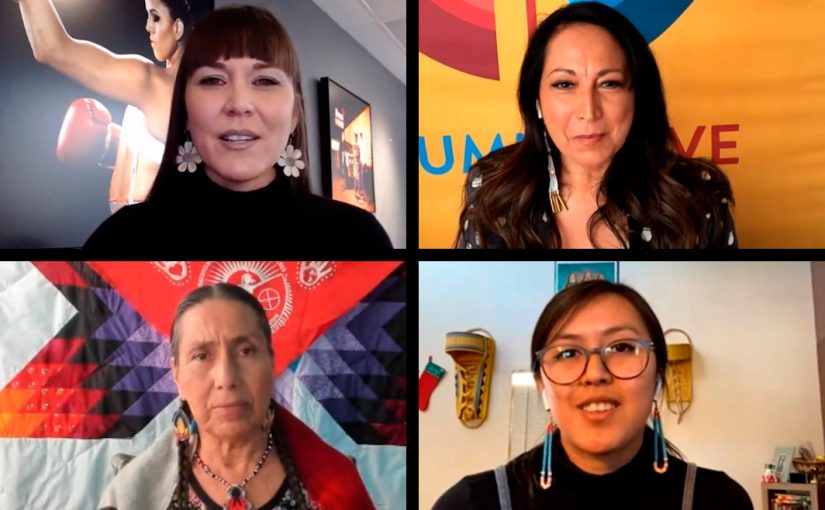
Within most Indigenous communities of the Americas (and of the world) the cultural and societal responsibilities of womxn play a crucially important role in maintaining the wellbeing of the community—including the ecosystem. Their intimate relationship to Mother Earth ranges from the exchange of water in the birthing process to the role of decision-making within families and clans to ensure a healthy future for subsequent generations. In these especially challenging times, the coming together of Indigenous womxn in leadership is more critical than ever for all people and all cultures to re-evaluate their responsibilities to respect and protect the sacredness of Mother Earth. Hear three inspiring Indigenous women discuss how matriarchy, the sacred feminine, and Indigenous ways play an important part in their leadership.
Hosted by Cara Romero, Bioneers Indigeneity Program Director. With: Casey Camp-Horinek (Ponca), Crystal Echo Hawk (Pawnee), and Naelyn Pike (Chiricahua Apache).
Panelists
Casey Camp-Horinek, Environmental Ambassador of the Ponca Tribe of Oklahoma and Hereditary Drum-keeper of its Women’s Scalp Dance Society, elder and matriarch, is also an Emmy award-winning actress, author, and internationally renowned, longtime Native and human rights and environmental justice activist. She led efforts for the Ponca tribe to adopt a “rights of nature” statute and pass a moratorium on fracking on its territory. She has traveled and spoken around the world.
Crystal Echo Hawk (Pawnee), is the founder and Executive Director of IllumiNative, the first and only national Native-led organization focused on changing the narrative about Native peoples on a mass scale. Crystal built IllumiNative to activate a cohesive set of research-informed strategies that illuminate the voices, stories, contributions and assets of contemporary Native peoples to disrupt the invisibility and toxic stereotypes Native peoples face.
Cara Romero (Chemehuevi), Program Director of the Bioneers Indigenous Knowledge Program, previously served her Mojave-based tribe in several capacities, including as: first Executive Director at the Chemehuevi Cultural Center, a member of the tribal council, and Chair of the Chemehuevi Education Board and Chemeuevi Headstart Policy Council. Cara is also a highly accomplished photographer/artist.
Naelyn Pike, a 21-year-old Chiricahua Apache, is a lifelong fighter for the rights of her tribe and other Indigenous peoples. She follows in the footsteps of her renowned grandfather, the founder of the Apache Stronghold, dedicated to the protection of Apache sacred sites and Indigenous rights. Pike, the youngest Indigenous girl ever to testify in front of Congress, continues to fight for environmental sustainability and Indigenous rights at the local, state, and national levels.
The current global pandemic has revealed stark structural injustices embedded deep in our society. Our approach to health has long neglected the relationship between socio-economic conditions, planetary health, and public health. As a virus that was transmitted from non-human animals to humans has placed the entire world on high-alert, it is time we reevaluate the relationship between planetary health and public health. The COVID-19 pandemic has laid bare the injustices that have forced communities of color to bear the brunt of the pandemic. This brings us to the central question: How do we rise to the challenge and radically restructure our entire approach to health?
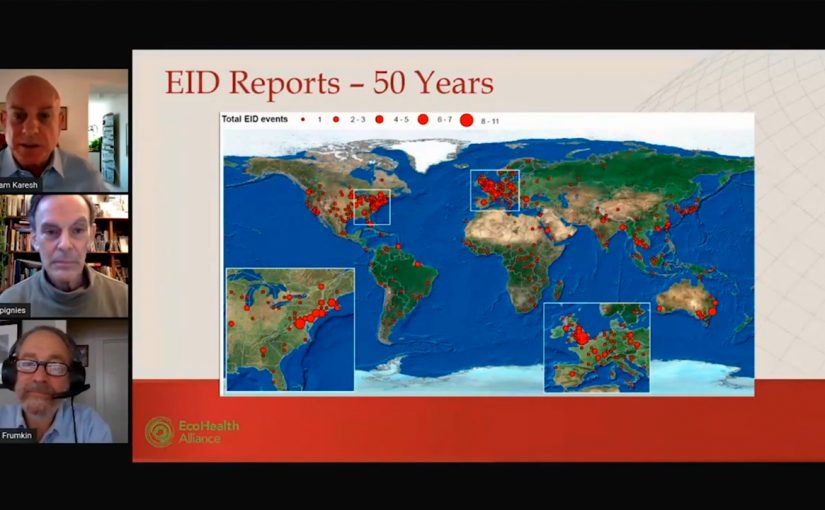
Moderated by J.P. Harpignies, this Bioneers 2020 conversation brings together two prominent leaders in the field of health. William B. Karesh, Ph.D., Executive Vice President for Health and Policy at EcoHealth Alliance, President of the World Animal Health Organization (OIE) Working Group on Wildlife Diseases and chair of the IUCN Wildlife Health Specialist Group. Howard Frumkin, Professor Emeritus, Environmental and Occupational Health Sciences, University of Washington School of Public Health, co-editor of the new groundbreaking collection Planetary Health: Protecting Nature to Protect Ourselves (Island Press).
J.P. HARPIGNIES: Let me begin with something painfully obvious: we’re all currently obsessed with COVID-19, as we have absolutely no choice but to be, given how dramatically that virus has impinged on all our lives. And one of the most painful aspects of this crisis, besides of course the immeasurable amount of death and suffering and economic hardship it is visiting on so many people, is that it’s also starkly revealing some of the most glaring injustices and deep structural flaws in our society.
We all know that we live in a system that’s a weird mix of plutocracy and democracy, and that the rich and the middle class have had better health outcomes and better healthcare as well as better educational opportunities and legal representation if they need it compared to people at the bottom of the social order. But even the most cynical among us have to be stunned by the extraordinarily disproportionate amount of suffering that’s been visited on the most disenfranchised communities, especially communities of color.
One thing this crisis is clearly revealing is the extent to which human health is inextricably linked to social conditions, to the social order, to socio-economic factors. We have to hope that our society will take this as a wake-up call and that we will start addressing these gross injustices in the years ahead, not just in our public health system but in the broader society.
With that said, it is also important to understand that there are broader questions than just the socio-economic ones I just mentioned. This should be painfully obvious because COVID-19 is a zoonotic disease (and we have one of the world’s leading experts on zoonotic diseases here with us today) meaning it is a disease transmitted from animals to humans (as are so many of the epidemics and pandemics in human history, from the Black Plague through Ebola and SARS and MERS, and of course the common flu, etc.). COVID-19 being a zoonotic disease is an indicator that human health is inextricably linked to the health of the ecosystems in which human beings live, to the health of other species, to the health of the entire biosphere. That is part of what we’re going to be discussing today, this broadening of the concept of what human health is.
About 16, 17 years ago, we at Bioneers made an early effort to wrestle with this question. We published a book, a collection called Ecological Medicine in which we attempted to gather a number of voices from disparate fields who were all pointing arrows to this idea of a need to broaden the concept of public health. In that book we highlighted people from environmental justice movements, chemists working on toxicity in the environment, people working on eco-psychology, people working on urban design and architecture as they relate to health, leading advocates of the Precautionary Principle, activists with Healthcare Without Harm, etc. Since the publication of that text, other thought-leaders have come forward to refine and deepen that understanding and to come up with actual plans of action, and we have two of the most illustrious figures in those efforts with us today.
I’ll start with Professor Howard Frumkin, a physician, epidemiologist and Professor Emeritus of Environmental and Occupational Health Sciences at the University of Washington, who has held many major leadership positions: he led the Our Planet, Our Health initiative at the Wellcome Trust and served as Dean of the University of Washington School of Public Health, Director of the National Center for Environmental Health at the CDC, and Chair of Environmental and Occupational Health at Emory University. He’s served on countless boards and advisory committees for all sorts of governmental, scientific, professional, and academic institutions and is the author or co-author of some 250 papers and nine books, including Making Healthy Places: Designing and Building for Health, Well-Being and Sustainability. And one reason that we really wanted Howie on this session is that he co-edited a book, just put out by Island Press called Planetary Health, and in that text we recognized a much more refined and all-encompassing effort at doing what we had attempted in our book Ecological Medicine nearly 20 years before, so we felt we absolutely had to have him here, and I recommend that book highly to everyone.
I’ll now move on to our other interlocutor, William (“Billy”) Karesh, an absolutely legendary figure, one of the leading experts in the world on zoonotic diseases and on the relationship between human health and animal health. He is the one who is credited with coining the term “One Health,” which has become a very important concept, precisely pointing the way at this deeper understanding that human health is inextricably linked to ecosystem health. Billy is Executive Vice President for Health and Policy for EcoHealth Alliance, a leading organization working on zoonotic diseases. He’s also part of the USAID emerging pandemic threats PREDICT-2 program, an incredibly important initiative (which of course the Trump administration defunded as soon as it came to power, simply because it was the most important and most significant group of people working on zoonotic diseases on the planet…)
Billy is also a member of the World Health Organization’s IHR Roster of Experts. He’s the President of the World Organization for Animal Health Working Group on Wildlife, and is involved in more projects than I have time to list. I really want to drive home that Billy is not an armchair theoretician: he is the one who traced the origins of bird flu and collected a sample of a virus from a wild swan that was then later used for the human vaccine worldwide. He has led projects in over 45 countries from Argentina to Zambia. His team proved the connections between Ebola outbreaks and the use of bush-meat in Africa; found the MERS Corona virus in camels in the Middle East; and the closest relative of the COVID-19 virus in bats in Asia. His is truly an extraordinary record.
So I can’t think of two people better suited to helping us expand our understanding of public health. We’ll start with Howie.
HOWIE FRUMKIN: It’s really an honor to be here, and to be here with Billy. I think we’ll do a nice one-two punch. I’ll focus on some broader themes in planetary health, including climate change, and Billy will talk about zoonotic diseases and spillover, and I think this will be a nice comprehensive overview of links between our planet and our health.
I’m going to speak from the perspective of the emerging field of Planetary Health, and I’ll start with some history. I’m going to take you back to the year 1860. England is exploiting coal on a very large scale, and around the same time, the Drake Well, the first oil well in the U.S., was drilled in Pennsylvania, all that helping initiate the Industrial Revolution. Those two places in the mid-19th century mark the beginning of the modern planetary health story. A massive upscaling of the use of energy worldwide began then. Within 50 years, fossil fuel was exploding, and our species was using far vaster amounts of energy than had ever been the case in human history.
That enabled us to do a lot of things. One of them was to reproduce. An extraordinary post-Industrial Revolution population explosion began. We’ve also seen a huge increase in economic activity. GDP, not the best measure of human success and prosperity, but a good measure of throughput of energy and materials, skyrocketed too. In fact, almost any indicator of the human enterprise—water use, transportation, the damming of rivers, travel, the number of McDonald restaurants, you name it—almost any indicator has been skyrocketing in a phenomenon since the second World War called “The Great Acceleration.”
That led to extraordinary improvements in the human condition. On average, this is the best time ever in human history to be alive. During this great acceleration, illiteracy, infant mortality and poverty have gone way down, and life expectancy has gone up, and that is all good, but those gains have come at a high cost. The use of energy and the technologies enabled by that energy have led to major alterations in the Earth. The chemistry of our atmosphere now has far higher levels of carbon dioxide, nitrogen oxide and methane; the pH of the ocean is different; the use of land around the planet is different; the availability of water and soil is different. All in all, the planet we inhabit is not our grandmother’s planet.
40% of the Earth’s ice-free, non-desert surface has been appropriated for agriculture; 46% percent of the world’s original forests have been cut down (and that deforestation is continuing to rise in many parts of the world); about half the world’s freshwater is being appropriated, mostly for agriculture; 60% of the world’s rivers are now dammed; more than 90% of fisheries are exploited beyond sustainable limits; and we are losing species at about a thousand times the baseline rate of species loss. All of that has led to what’s now being called the Anthropocene, a geological epic characterized by human control and influence on the entire planet’s patterns. That has also given rise to the notion of planetary limits, the idea that if we push these limits, if we push climate change beyond a certain point, if we keep pushing ocean acidification and species loss, that will induce irreversible and disruptive changes in Earth systems that will in turn induce immense human suffering.
How do all these planetary changes relate to human health? There are two main frameworks that can help us understand those links. One is the notion of ecosystem services. Natural functions support human well-being in countless ways. To mention only a few, through nutrient cycling and soil formation, they provision us with food and fresh water. They regulate phenomena, such as climate and flooding, that would otherwise threaten us, and they offer us cultural services such as aesthetic and recreation services. So intact planetary systems deliver ecosystem services that protect and advance our health, and disrupted planetary systems threaten us, and as disruptions to planetary systems increase, impacts on human health increase.
This is a reframing of insights that we’ve had for decades and really for centuries if we look back to Indigenous knowledge, but the modern notion of Planetary Health as a field arose in 2014 with a declaration in The Lancet, the prestigious medical journal. The essence of it is that we have to understand the total interdependence of human systems, including health, with natural systems. One example of how this plays out is climate change. Increasing emissions of carbon dioxide from burning fossil fuels have led to planetary disruptions including rising temperatures, sea level rise, weather extremes, and all the other physical features of climate change. And Increasing summer temperatures cause heat stress, cardiovascular problems, diminished work capacity and so on. Sea level rise and severe weather cause a rise in both short-term acute fatalities and injuries and long-term consequences, including on mental health. Warmer weather leads to higher levels of ozone in the air causing respiratory and cardiovascular problems. Allergenic plants such as poison ivy thrive under conditions of high CO2 and warmer weather, so allergy attacks shoot up. Infectious diseases, both vector and water-born, become more prevalent. Disruptions to the water and food supply threaten nutritional status in many parts of the world; etc., etc.
And actually this is an oversimplification of the problem because many of the impacts of climate change occur indirectly through complicated pathways mediated by environmental and social factors, leading to a wide range of disparate challenges, such as, say, increasing food prices and changes in microbial ecology, and all of them generate large-scale health impacts. Seemingly separate things can be completely interrelated and in complex relationships. Take heat: in many parts of the world people are being exposed to levels of heat both acutely through heat waves and long-term through a new, much higher average temperature than that to which they had been accustomed. Heat waves are catastrophically bad: people die, especially the very young, the very old, the poor and socially marginalized, and people with certain medical conditions. The numbers can be frightful—70,000 deaths during the 2003 European heat wave; 54,000 during Russia’s 2010 heat wave; uncounted thousands in India during each of several recent summers. People can adapt to heat, but only to a point, and in many points of the world, the Arabian Gulf as a prime example, levels of heat are reaching the point that exceed human adaptive capacity.
But it’s not just that people die during heat waves. Heat threatens health in numerous, far less obvious ways. During periods of hot weather, episodes of violence increase. Suicide rates increase during hot weather. Kidney disease increases during hot weather, especially among outdoor workers who don’t have access to plenty of fresh water. Food borne and water borne infections increase because it’s very hard to keep food and water sanitary and disinfected when the weather is very hot. Sleep disturbances are more common in hot weather, and sleep disturbances in turn increase the risk of cardiovascular disease, mental health problems, and other health outcomes. Abnormal birth outcomes increase during hot weather. Academic performance among children in schools decreases during hot weather, as does work performance. People exercise less during hot weather, and sedentary lifestyles, as we all know, are a risk factor for cardiovascular disease, cancer, depression, and other conditions. Workers are affected in several ways. One is that the risk of injuries increases during hot weather; workplace injuries rise dramatically. And perhaps more importantly, work capacity decreases, aggravating poverty and all of the health consequences that flow from poverty.
So heat, as you can see, takes very complex multifaceted pathways in its health impacts, but heat is just one of the many ways climate change and environmental degradation affect human health, and very, very deeply embedded in all of this an equity concern. The wealthiest among us globally have much larger carbon footprints than the poorest across the board: the food we eat, the housing we inhabit, the goods we buy, the way we travel. So the responsibility for climate change should rest with those who are well-off and intense consumers of goods and energy, but in fact the consequences of climate change fall disproportionately on those who are poorest. This is a justice issue that exists both within countries and between countries.
This is all grim news to hear, and there is no doubt these are major challenges, but there is also some good news. To preserve planetary systems, combat climate change, stop biodiversity loss and so on, we need a green economy based on clean energy, well-designed cities, healthier diets and green chemistry. If we take steps toward each of these improvements, we will radically improve health as well.
Clean energy reduces air pollution and delivers less heart and lung disease. Well-designed cities with ample green spaces, good public transit including pedestrian and bicycle infrastructure, deliver substantial health improvements. Healthy diets with less meat and more organic food help the planet while resulting in less heart disease and cancer. Green chemistry, i.e. designing chemicals that are not bio-accumulative, not persistent in the environment and not toxic also reduces the incidence of many illnesses, so there is no question that tackling the planetary crisis will also deliver far-reaching, widespread health benefits,
Despair is an occupational hazard for anybody who thinks seriously about planetary changes, but we need to fight despair because it’s immobilizing and doesn’t accomplish anything at a moment when we have to be about accomplishing a lot. We have to embrace hope ourselves and we need to inspire hope in others. Fortunately, there is a lot of basis for hope. Green technologies are advancing. We’re developing better battery storage and ever more efficient and cost-competitive renewable energy sources. Policy is maturing too: we’re seeing carbon pricing and other very far-reaching policies around the world. Activism is blossoming. Public opinion is shifting. Change is happening around the world, and Planetary Health offers us a new, solutions-driven, people and equity-centered, systems-based framework to achieving far better human health and well-being. We are looking to the future to try to design enduring and sustainable solutions. For those who would like to learn more, here are links to the first textbook in this new field we just published (https://islandpress.org/books/planetary-health), and to the Planetary Health Alliance (https://www.planetaryhealthalliance.org/planetary-health).
BILLY KARESH: Some of our work over the years has been looking back at what causes and what drives emerging infectious diseases. A large proportion of these emerging infectious disease are zoonotic (i.e. linked to animals), but not all of them are. We try to do thorough analyses and get an objective look at the distribution of where emerging infectious diseases have happened over the decades, but it’s hard to get really objective data, because a lot of the information is biased: it depends on where research is done, where there are academic institutions and good hospitals that can perform good diagnoses and do solid reporting.
But as we look at the underlying risk factors and at what the correlations with specific diseases are, we are still able to start to tease out what’s behind these emerging infectious disease events. We study non-infectious diseases and antimicrobial resistance patterns globally as well, but right now I’m just going to talk about emerging infectious diseases. One thing we’ve seen is that in the last 50 or 60 years or so land use in many places has changed a lot, mostly due to the expansion of agriculture and the food industry. International travel and commerce have also grown immensely, and that combination facilitates the introduction of new diseases or of old diseases into new places. It’s not our grand and great-grandparents’ planet anymore. What we’re doing now is dramatically different, and the places where there’s been the most disruption and change are the ones at greatest risk for disease emergence and where we need to focus our energy.
Where the greatest risks are is where we need to focus our surveillance activities, so a lot of our efforts have been in hot spots of emerging diseases. I’ll use the current COVID-19 pandemic as an example. In looking at Corona viruses we’ve found that they are related to the first SARS virus. COVID-19 is actually technically SARS COVID-2. These types of viruses are found in bats throughout Asia, so a lot of our work in the last several years has been in China with Chinese colleagues. We’ve so far identified about 500 different Corona viruses in bats in Asia, over 100 of which are closely related to SARS. And these viruses have been circulating in bats for millennia. They’re completely natural.
Our approach is to systematically first look at animals and, in this case, identify the viruses in bats, and then go out and work with local communities to sample people to see if they have been exposed. What we have found is that a significant percentage of people already have been exposed to this group of Corona viruses, and this has been going on for years. Somewhere between a half of a percent to three percent of people in Southern China alone where we were working had antibodies to these viruses—that’s somewhere between 3 and 20 million people we estimate already had antibodies to these groups of viruses before the pandemic began. This exposure had been a long-term, very natural process, but there were more and more people in these regions, and these humans are disrupting habitats and coming into contact with wild animals more and more, and all it took was that in one of those infected people that virus mutated and became transmissible from human to human, just like HIV/AIDS virus, which we knew originated in animals and got into people and at some point became transmissible from human-to-human.
At this point I’d say that COVID-19 is no longer a zoonotic disease. It has zoonotic origins, but it’s now a human disease, and we’re not sure when that happened. It could have been recently or it could have been decades ago. We know that bats have these viruses and where those bats live, and where the most human beings are likely to come into contact with bats, so we map the “hotspots” of the places where the risks are highest of those viruses getting into people. That’s where we focus our efforts to get out there and reduce the risk, reduce the burden of disease and reduce the risk of new pandemics.
One of the things we’ve been doing is getting out into hotspot communities and doing direct education, informing people how to live safely with bats. We can’t just sit here at home and wait for the next pandemic and then wait for somebody to come up with a vaccine, and then wait for somebody to pay for that, and wait for it to be distributed, and then hope people actually will take the vaccine. If we can make more of an investment upstream, in prevention, in community engagement, in teaching people how to reduce their risk, we could save many lives and a lot of money. For example, a lot of people farm bat guano, bat feces, as fertilizer. If people are going to do that, they need to be educated to be able to do it safely to reduce their risk of infection. Some people eat bats. Some people go in caves where bats live for tourism. There are things we can do to reduce exposure through education. We can’t prevent every infection, but we can reduce risk.
We did some work last year about global health security and where the investments go. We looked across a stream of activities at a global scale and broke down health security into prevention, detection, response, and recovery. Nealy all the money goes to response. If you look at all the big organizations in this domain around the world, you see that everybody loves to do response to emerging disease outbreaks. Everybody shows up. Everybody watches the fire. Everybody comes to watch the building burn down. All the firemen are there. Everybody’s there, but there’s very little investment in prevention. There’s a little bit spent in early detection but very little for prevention or for recovery, which is typically ignored too. After the outbreak, after the disease, everybody goes home. The local people are left poorer than they were before, with fewer resources than they had before, and they’re left on their own for recovery. In fact, though, recovery is really the first step for prevention for the next one, the future outbreak, so we’re trapped in a circular pattern.
As Howie mentioned, changes in land use, in the way we’re doing agriculture, ecosystem deterioration and climate change are all linked to negative health outcomes. In the healthcare/medical community we’re kind of at the end of the garbage dump. We’re dealing with the sick people at the end of a process, but it’s always a better idea to try to stop problems at their source instead of always responding when the damage has been done. A solution for traffic fatalities is not necessarily more emergency rooms, it’s better engineering for traffic flows and car safety, better laws and regulations. The way a road is designed can save lives. We need to think that way about planetary health.
There’s been a lot of talk about wet markets and the wildlife trade, which we know are sources of infectious zoonotic diseases, but hundreds of millions to probably billions of people on a weekly basis are getting their food from this type of system, which are without doubt breeding grounds for infectious diseases and can lead to pandemics. We know poultry markets are linked to pandemic influenzas. People buy bats to eat at markets, and we know they’ve been linked to Ebola, henipaviruses and the corona viruses we’ve been talking about. Given how many people depend on these markets globally, closing them is not feasible, so we’ve been seeing what we can do to reduce their likelihood of being sites that spread novel infections. We’ve been working on how to bring refrigeration to these markets in super energy-efficient ways, including with new technologies such as cold storage that uses frozen liquid natural gas that uses zero electricity; and, relatedly, working on radically reducing food waste (which can reach 30 to 40 percent) in this system. These measures are win-wins that combat climate change, boost livelihoods, improve health overall, and reduce the spread of novel zoonotic viruses.
We need more of these sorts of solutions, and now in the 21st Century, we’ve got a new generation of people who are really thinking big about how to solve some of these problems, but we have to understand that these diseases don’t just emerge mysteriously. Their emergence and spread are the result of what we are doing on this planet. We broadly know what their sources are, and we know which industries and economic sectors we need to engage with do something about it.
The world is really different than it was for our great-great-great grandparents. The world used to be a mostly a place covered by vibrant ecosystems filled with wild animals. The planet was mostly covered with forests and grasslands and deserts, while today the planet is mostly covered with humans and livestock, so we should not be surprised that we are seeing changes in disease patterns when our planet is so different than when we humans evolved to live on it.
It doesn’t matter to me whether we frame these efforts as “One Health” or “Planetary Health.” As long as people are trying to do something positive that will have a real impact, I’m happy. On our end, we’ve been doing a lot of work with the World Bank to help people think through how to get different sectors and all the confusing world of intergovernmental organizations and national governments’ various branches and all the planning tools and funding sources and regulatory environments coordinated and aligned enough to get the right projects and initiatives up and running without interfering with each other or duplicating efforts. It’s definitely confusing, but I’ve been really working with the Bank to provide clear roadmaps and a new series of assessment tools that countries and organizations can use to find the right entry points to get engaged in the most productive ways depending on their capacities and domains of expertise.
And countries are doing this. We’ve worked with Zambia and Zimbabwe, for example, to name just a couple, on biodiversity strategies, antimicrobial resistance plans and their national disaster risk assessments, so they can link these strategies and get all the parts of their governments and civil societies and international organizations all working together in a coordinated fashion to achieve their goals.
JP: Thank you Howie and Billy for those thought-provoking presentations. Now we’re going to tackle a few questions from the audience. The first is about the problem of trying to choreograph the type of holistic coordination of many varied fields you both described as being essential to solve our problems in the context of the intense specialization into highly siloed fields that characterizes modern society.
BILLY: Specialization is of course necessary in an advanced society. If I ever needed brain surgery, I would like a really good brain surgeon, not a podiatrist, performing the operation. But to solve bigger, large-scale problems, we need somebody or something to force us to work together. I’m not big on building bigger bureaucracies, so maybe it’s just a heightened awareness and openness about building partnerships, and I do see that happening. When we started with One Health and Planetary Health, we were successful at getting physicians and medical professionals more engaged in these efforts, but we’re still missing the engineering side. I think we need more engineers and designers involved as well as more risk-reduction experts from the insurance industry. Buildings don’t burn down as quickly anymore in developed countries because we designed better materials and smoke detectors and building and fire codes and insurers won’t cover you if you don’t build that way. We need to apply some of that sort of thinking to the problems we’ve been discussing, and I do see it happening. I see this next generation just bubbling up here in the 21st Century that I think is really ready to take on these issues and to work together. They are reaching out to each other and developing new types of networks and partnerships, so I have a lot of hope.
HOWIE: I completely agree. Education matters a lot. I think we ought to be developing educational strategies that help people think upstream, think like systems thinkers and go into whatever specialty they choose, but with a broad appreciation of how what they do can connect with other goals. We need to think about new measurement tools as well. GDP, for example, as a standard measure of prosperity, measures all the wrong things. If we can go toward composite indices that measure things like biodiversity, the quality of air and water, reported levels of happiness among people, life expectancy, etc., those are better measures of societal success, and if you go that way in your measurement, you have no choice but to think like a systems thinker and aim for composite multi-sectoral solutions.
JP: Some audience members are asking what they can do in their own lives, such as avoiding consuming palm oil or hardwoods from tropical forests, or how to go about mobilizing others in their professions or communities, and so on. Can either one of you offer what you think are some of the most tangible things that people at large can do to help contribute to these initiatives?
HOWIE: There’s a very interesting debate going on now in the environmental world, and to some extent in the health world, about whether individual behavioral changes are the right way to go or if they don’t matter because only complete system change can save us. Those who believe we need radical system change sometimes argue that it’s pointless to focus on choosing what you eat and consume or how you travel, because those individual choices at the end of the day won’t be enough to bring about the system change that we need. My own view is it’s both/and not either/or.
People in their personal lives can make a lot of choices: eating less meat; buying renewable and sustainable products and materials; traveling by bicycle or foot instead of by internal combustion vehicle; and so on. Those are choices that if aggregated over entire populations, especially high-consuming populations such as here in the U.S., will make a difference. They’ll drive demand for more virtuous options; they’ll drive innovation; they’ll reduce consumption. But at the same time one of the most important things you can do is to vote (and agitate and advocate) for political and corporate leaders who are more likely to make systems change. 350.org’s campaign to get the banks to divest from fossil fuels and all the campaigns to elect leaders committed to actually addressing climate change, these are extremely important. Each of us exists as an individual making personal choices, but each of us also exists as a citizen obligated to push for system change as well.
JP: Do either one of you have any thoughts about the new administration? Are you hopeful?
BILLY: Yes, many of the people in the new administration were working very seriously on pandemics and the Ebola outbreak in West Africa and on climate issues in the Obama administration. It’s certainly no time to be complacent, but these folks are on it.
HOWIE: There are indeed very good people coming into position in the new administration. I think we can be really confident. That said, you know, government is big and government is siloed, and so it’s difficult to implement cross-cutting solutions. I think one of their biggest challenges will be to bring about action not only in the misnamed Department of Energy (it’s more about nuclear weapons than energy; we could use a real energy department), but we will also need climate action in the departments of Transportation, Agriculture, Health, Housing and Urban Development, etc. One of the big challenges will be getting the whole of government working on coordinated, integrated systems-based solutions to the climate and environmental and health crises.
BILLY: I agree completely. Government has traditionally been very siloed. I’m hoping maybe we get some new thinking this time. Agriculture is a great example of that: agriculture is major generator of carbon emissions and one of the main drivers of both climate change and the spreading of emerging diseases. Traditionally our USDA has been there to support large U.S. agricultural industries and export crops. When our country deals with the UN on agricultural issues, it’s almost completely focused around bolstering domestic farm profits by selling more of our crops abroad, not on climate and food security, let alone emerging diseases or deforestation or overfishing. All that is agriculture and the food system. We are the largest donors to the international agricultural and food agencies, so there’s no reason why we couldn’t ask for better systemic thinking on how funds are used, and to offer some leadership on climate there, instead of just pushing our corn and cows on the global market, but it would require a major change of direction for the USDA.
HOWIE: A related issue is equity, global equity, not dictating what other countries do but sensitively and collaboratively moving towards solutions, and we have to do the same thing domestically. We have to be very aware of the disparities in our society, of racism, of inequities, and of how all of the health impacts we’ve talked about fall disproportionately on those who are least fortunate and suffer discrimination. So solutions must include the engineering solutions Billy mentioned but also social solutions and changes in the way we think, so that we can move toward a society that is lower consuming, more equitable, more future-oriented, and more about stewardship and solidarity than about conquests and profit.
JP: Do you have any thoughts on how to contend with the intense resistance of entrenched interests, be it the fossil fuel industry or agribusiness or big pharma, that have been really Machiavellian in their relentless stymying of progress on so many fronts and have waged enormous disinformation campaigns?
BILLY: I think consumer choices can make a big difference because businesses are in business to make money, and so as consumers start want different products, businesses will have to come around. We’ve seen that with the enormous growth of the organic food in the past 20 years ago. The same will happen with electric cars. I have faith in the new generation, and they are entering the energy field, so I think there’s a lot of hope.
HOWIE: I’m a little less sanguine. I think that the persistent disinformation as we saw in the tobacco industry and then in the fossil fuel industry needs to be countered, not just by increasing consumer demand for better products, but also by direct confrontation. The campaigns to disinvest from fossil fuels, to force investors to reckon with climate risks as they make investments, to stop the construction of fossil fuel infrastructure—those are all in my opinion as important as changing consumer demand for products. We’ve now also seen a lot of disinformation with COVID. The entirely unregulated and remarkably large-scale and rapid distribution of disinformation on such platforms as Facebook and Twitter really is a problem. I don’t know the answer, but I think we will probably need some regulation of social media, maybe even the re-operationalizing of how we protect and defend freedom of speech in a world where speech is a very different process than it was at the time the Constitution was being written. Disinformation will somehow need to be addressed.
JP: Do you have any closing thoughts, any closing words of wisdom to offer?
BILLY: Try to get engaged. Try and contribute a little something, even if it’s not your full-time job. Align your individual behavior and attitudes with your highest ideals and talk with your friends and family, and spread the word about the solutions we all need to work on together to get to. Health, for example, doesn’t belong to the medical community. It belongs to all of us, to society, and we have to start thinking about it with an all-of-society approach, in which everybody gets to participate.
HOWIE: I’d say be hopeful, don’t despair. We need all of our hope. We need to roll up our sleeves and move toward a better future. And there’s reason for hope, so this is not just a fatuous piece of advice, Evidence-based hope is a powerful thing. And think as broadly as you can. If you’re a health professional think about other things than health. If you’re an engineer, think about other things than engineering. All of us ought to be looking for the broadest solutions that we can. Think upstream. Look for cross-cutting co-benefits. Think about the future. Be a good grandparent. Above all, have hope.
Panelists
Howard Frumkin, MD, MPH, Dr.Ph, a physician and epidemiologist, Professor Emeritus of Environmental and Occupational Health Sciences at the University of Washington, previously led the Our Planet, Our Health initiative at the Wellcome Trust. His many other positions have included: Dean of the University of Washington School of Public Health, Director of the National Center for Environmental Health at the CDC, and Chair of Environmental and Occupational Health at Emory University. He has served on the boards or advisory committees of a wide range of leading scientific, professional, academic and governmental institutions and is the author or co-author of over 250 scientific journal articles and nine books, including Making Healthy Places: Designing and Building for Health, Well-Being, and Sustainability; Environmental Health: From Global to Local; and most recently: Planetary Health: Protecting Nature to Protect Ourselves (Island Press, 2020).
William B. Karesh, Ph.D., a leading global expert on infectious diseases, wildlife and the environment, is Executive Vice President for Health and Policy at EcoHealth Alliance, President of the World Animal Health Organization Working Group on Wildlife Diseases, chair of the IUCN Wildlife Health Specialist Group; and serves on the WHO’s International Health Regulations Roster of Experts focused on the human-animal interface and wildlife health. Currently EPT Partner Liaison for the USAID Emerging Pandemic Threats PREDICT-2 program, Dr. Karesh coined the term “One Health” in 2003 to describe the interdependence of healthy ecosystems, animals and people and has pioneered solutions-oriented initiatives with this concept as the guiding principle in programs under his direction in over 45 countries from Argentina to Zambia. He has published 180+ scientific papers and written for broader audience publications, including his highly acclaimed first book for a general audience, Appointment at the Ends of the World.
J.P. Harpignies, Bioneers Senior Producer, affiliated with Bioneers since 1990, is a Brooklyn, NYC-based consultant, conference producer, copy-editor and writer. A former Program Director at the New York Open Center and a senior review team member for the Buckminster Fuller Challenge from 2010 to 2017, he has authored or edited several books, including Political Ecosystems, Delusions of Normality, Visionary Plant Consciousness, and, most recently, Animal Encounters.
Co-sponsored by the Guayaki Yerba Mate‘s “Come To Life” initiative.
Every great movement starts with the individual, expands into communities, and then blossoms into the collective. As Ghandi once said “Be The Change” you want to see in the world. At Guayaki our mantra is “Come To Life.” In the spirit of that vitality we’ve gathered a diverse and dynamic group of creative individuals who have birthed their own movements across genres, gender, and ethnicities. In this digital round table discussion, we explore the unique backgrounds of some of music’s most inspiring innovators while they share their visions for a brighter world, and the pragmatic and passionate steps we can take to make those visions a reality.
Hosted by Dustin Thomas, Artist and Creative Strategist for Come to Life. With: Alfred Howard, a prolific spoken-word artist, writer, and co-founder of The Redwoods Music; Leah Song of the renowned group, Rising Appalachia; Raury, hip-hop artist, founder of “The Woods” movement; Luke Wallace, Canadian activist and singer-songwriter.
Alfred Howard, a prolific spoken-word artist, writer, and co-founder of The Redwoods Music, a San Diego record label and collective, currently pens lyrics for 8 bands and performs homemade percussion with six. In his early 20s he caravanned with musicians all across the county before finally setting roots in San Diego, where he has become a leading figure in that city’s musical community. He is the author of 2 books, including The Autobiography of No One; writes articles for several leading San Diego newspapers and magazines; and has written lyrics for over 30 released albums.
Raury (i.e. Raury Deshawn Tullis) is a 24-year old American singer-songwriter and rapper from Atlanta, Georgia, known for his eclectic, innovative, experimental sound that mixes soul, hip hop and folk influences. His debut mixtape Indigo Child in 2014, put him on the global musical map, and a number of his songs have appeared in the soundtracks of major movies and TV shows and he has collaborated with many major stars, including Lorde and Macklemore. His albums include All We Need and Fervent.
Leah Song, leader/front-woman of the renowned band, Rising Appalachia, as well as a solo artist, is a singer, multi instrumentalist (fiddle, banjo, guitar), and a musical pioneer across genres and mediums who has had great success and impact in the worlds of folk and roots music, including as founder of the “slow music movement.” She and Rising Appalachia are also committed to and widely respected for deeply integrating activism on such topics as the environment, food justice, human rights and prison reform in their lives and work.
Dustin Thomas, an artist, consultant, and creative strategist based in Venice Beach, Los Angeles, has performed hundreds of shows around the world, and, in his consulting work, has advised campaigns and offered creative direction to brands, funds, and executives with an emphasis on environmental stewardship, cultural celebration, and social justice.
Luke Wallace is a Canadian folk-singer known for his politically charged lyrics and his deep engagement in current social movements, including performing at youth climate and other demonstrations. His message-driven songwriting and powerful delivery have landed him slots at Salmon Arm Roots and Blues, Vancouver Island Music Festival, The Vancouver Folk Festival and an opening slot for the global roots band Rising Appalachia. His 5th, most recent album, released in 2020, is What on Earth.
Many Americans sense that fundamental change is occurring in our country. At one level, the Trump era has undeniably brought intense divisions and trauma, but at a very different, deeper level, in communities nationwide there has been a steady but explosive growth of practical new, transformative and reparative economic, ecological and institution-building initiatives. This outline of a “next political-economic system” is quietly building just below the radar of everyday media awareness, just as what became the New Deal was, in fact, built upon new thinking and experiments developed in state and local “laboratories of democracy” in the decades before Franklin Roosevelt’s presidency. This panel with 4 leaders of The Democracy Collaborative, an R&D laboratory for the democratic economy, presents an overview report from the frontlines of this dynamic movement, which promises to usher in a new era of radical, system-altering change.
Hosted by Gar Alperovitz, co-founder. With: Isaiah Poole, Vice President of Communications for The Democracy Collaborative; Johanna Bozuwa, Co-Manager of the Climate & Energy Program; Thomas Hanna, Director of Research and specialist in public ownership.
Gar Alperovitz, Ph.D., co-founder of the Democracy Collaborative and co-chair of the Next System Project, has had a distinguished career as a historian, political economist, professor, scholar, activist, policy expert, and government official. A former Fellow of King’s College, Cambridge University, and a founding Fellow of the Institute of Politics at Harvard, he has served as a Legislative Director in both the U.S. House and Senate, and as a Special Assistant in the Department of State. The author of many critically acclaimed books, including seminal tomes on economic inequality and atomic diplomacy, his articles are widely published in leading news outlets, and he has frequently testified before Congress.
Isaiah J. Poole, who has 30+ years’ experience in journalism and was a founding member of both the Washington (DC) Association of Black Journalists and the National Gay and Lesbian Journalists Association, is the Communications Director for The Democracy Collaborative. He was previously Communications Director for People’s Action and for the Campaign for America’s Future.
Johanna Bozuwa, M.Sc., Co-Manager of the Climate and Energy Program in The Next System Project at The Democracy Collaborative, focuses on the transition from the extractive, fossil-fuel economy to resilient, equitable communities based on climate justice and energy democracy in her work. Her writing has been widely published including in The Nation, The Hill, and Progressive Review. She has organized around climate justice in both the U.S. and the Netherlands, from campaigns to eliminate the social license of fossil fuel companies such as Shell to fights for utility justice and public power.
Thomas M. Hanna, Research Director at The Democracy Collaborative and a leading expert on democratic models of ownership and governance, is the author of several books, including, most recently: Our Common Wealth: The Return of Public Ownership in the United States. A dual U.S./UK citizen, he has advised the UK Labour Party and has served on the advisory boards of several national and international initiatives, including two European Research Council-funded research projects.
Although the New Deal of the 1930s rescued many from poverty and laid the foundation for a social safety net, it was also deeply flawed in that it excluded Black Americans and people of color from many of its programs. As the vision for a Green New Deal to tackle the climate emergency and restructure our economy has evolved, it is imperative we avoid the errors of the past. The rising calls for a Red New Deal inclusive of Native America and a Blue New Deal for our threatened oceans and coastal communities have arisen. In this truly original and dynamic session, we learn about these emergent, interweaving movements with some of their thought leaders.
Julian Brave NoiseCat is Vice President of Policy & Strategy at Data for Progress, and Narrative Change Director for the Natural History Museum. A Fellow of the Type Media Center and NDN Collective, his work has appeared in The New York Times, The New Yorker, Rolling Stone and other publications. Julian grew up in Oakland, California and is a proud member of the Canim Lake Band Tsq’escen and descendant of the Lil’Wat Nation of Mount Currie.
Vien Truong, J.D., one of the country’s leading, award-winning experts and strategists on building an equitable green economy, has helped develop numerous energy, environmental, and economic policies and programs at state, federal and local levels and advised on billions of dollars in public investments for energy and community development programs, including co-leading the coalition to pass the law creating the biggest fund in history for the poorest and most polluted communities in California. Vien currently advises lawmakers, universities, foundations, and organizations on developing inclusive workforces, sustainable economies, and equitable environmental policies; directs the Climate Justice efforts for Tom Steyer PAC; and supports the climate efforts of the California Business and Jobs Recovery Task Force. Previously President/CEO of the Dream Corps and Chair of Oakland’s Planning Commission, she also serves on the boards of the California Endowment and Ceres.
Dr. Ayana Elizabeth Johnson, a Brooklyn native marine biologist and policy expert, is founder and CEO of Ocean Collectiv, a strategy-consulting firm for conservation solutions, and founder of Urban Ocean Lab, a think tank focused on coastal cities. Her mission is to build community around solutions for our climate crisis. She is co-editor of All We Can Save: Truth, Courage, and Solutions for the Climate Crisis, a brand new anthology of wisdom by women climate leaders.
Sikowis(aka Christine Nobiss), a member of the Plains Cree/Saulteaux of the George Gordon First Nation in Canada, grew up in the city of Winnipeg but has been living in Iowa City for 15 years. A dedicated activist who writes, speaks and organizes extensively on Indigenous, climate, environmental, and political issues, she founded Great Plains Action Society in 2015. Sikowis holds a Masters Degree in Religious Studies from the University of Iowa and is a mother of three.
A food sovereignty movement is sprouting on the trail of colonialism and white supremacy, which have unknowingly planted the seeds of their own unmaking. This multigenerational movement is being led by colonized people uprooting global systems of privatized land ownership and environmental degradation. In confronting this system of exploitation, we can transform the underlying relationship of extraction to one rooted in kinship and reciprocity.
In this panel conversation from the Bioneers 2020 Conference, BIPOC leaders share food sovereignty strategies rooted in cultural knowledge, as well as the rematriation of land and dignity to colonized people who overwhelmingly represent the number of exploited laborers working on stolen land. Moderated by Naima Penniman, an artist-activist and educator, with: Rowen White, a Mohawk farmer and seed keeper; Reverend Heber Brown, a community organizer and social entrepreneur; and Leah Penniman, a farmer and food justice advocate.
NAIMA PENNIMAN: Peace and greetings. Welcome to the BIPOC Leaders Share Food Sovereignty Strategies panel. I’m honored to be moderating this conversation with our incredible panelists—Rowen White, Reverend Heber Brown, and my dear sister, Leah Penniman. Before I introduce them, I will share a little about myself and where I think we’re headed.
I am the daughter of Reverend Adele Smith-Penniman, a Haitian/Black American spiritual leader and civil rights activist, and Keith Penniman, an environmental activist and librarian of European descent. And like so many of you, I am a lifelong lover and defender of the Earth, devoted to healing injustice for all her inhabitants, and am giving my all to do my small part. I’m honored to serve as Program Director at Soul Fire Farm, an Afro-Indigenous community training farm, and also a founding member of Wild Seed Community Farm and Healing Village. I’m also an artist and poet. You may have heard my poetry before. You may also have seen my sister Leah Penniman’s soul-stirring keynote earlier today that still has me swirling with conviction and possibility. I’ve been part of Bioneers for several years, and I’m incredibly grateful for this community of visionary “solutionaries,” so I want to give a warm, heartfelt welcome to everyone who is listening and to thank you for taking time to show up and listen in to this important discussion.
I’m thrilled that we’re having this conversation today about strategies for food sovereignty, (which is deeply connected to seed sovereignty and to land sovereignty) because it’s hard to think of anything more important than figuring out how we can nourish all members of our communities in a time of immense food insecurity; how we can feed ourselves without trashing the planet; how we can restore Black and Indigenous land stewardship; how we can create safety and dignity and pathways to leadership for Latinx agricultural laborers who grow the majority of the food we eat in this country; and how we can restore and protect a diversity of seeds for future generations. All these struggles are crucial to our collective survival and the health of our shared planet.
And if there was ever a time where the cracks in our industrial food system were laid bare, it is now. We need to be living into the solutions and taking the lead from Black, Indigenous and other people of color on the frontlines whose labor and brilliance have too often been ignored, exploited, subjugated and co-opted, if we are going to be able to define pathways forward.
I have immense respect and gratitude for each of our panelists for their enduring devotion and leadership in these realms, and I will introduce them now, one at a time, and then pass it to them for brief opening words. Rowen White is a seed keeper and farmer from the Mohawk community of Akwesasne, and a passionate activist for Indigenous seed and food sovereignty. Rowen is the founder and Director of Sierra Seeds, an innovative, California-based organic seed stewardship organization, and the Program Director for the Indigenous Seed Keeper Network, which is an initiative of the Native American Food Sovereignty Alliance.
ROWEN WHITE: Greeting, relatives. My name is Rowen White. My Mohawk name means “She Carries the Snow.” I’m a farmer, seed-keeper, mother, storyteller, and a passionate activist for the dignified resurgence of the relational foodways of Indigenous Peoples. I come from a small community called Akwesasne, which is right on the New York/Canadian border. In fact, the border crossed us, so to speak. We have relatives to the north and south of that medicine line, and we’ve been in relationship with the land here on Turtle Island since time immemorial, so I’ve sought to apprentice myself to the Earth, to my ancestors, my living elders, my children, and to the amazing network of people that I have the honor and privilege of working with to work on finding my way home back to a sense of what it means to be a modern Indigenous farmer and woman who is both a good future ancestor and a responsible descendant. It’s a real honor to be here amongst so many wise visionaries and good people.
NAIMA: Thank you so much, Rowen. Next is Reverend Heber Brown, a multiple award-winning community organizer and social entrepreneur who is the Senior Pastor of Pleasant Hope Baptist Church in Baltimore, Maryland, and the founding Director of Orita’s Cross Freedom School, which works to reconnect Black youth to their African heritage while providing them with hands-on learning opportunities to spark their creativity and build vocational skills. In 2015, Reverend Brown launched the Black Church Food Security Network, a multi-state alliance of congregations dedicated to creating a grassroots community-led food system. Reverend Brown, thank you for your work and thank you for being here.
Rev. HEBER BROWN: Thank you so very much. I’m a third-generation Baptist preacher and returning grower. This year has slowed me down enough to invest in the quality time that I needed, my soul needed, with the land, even as we do the important work of the Black Church Food Security Network, which essentially is working to remember the Black Church to our agrarian and land-based legacies, and in addition organize and marshal the resources of Black church spaces in the direction of food and land sovereignty, which has a long history there. I’m excited about ways that our team can steward that history and also in an Afro-futurist kind of way, look on how to build an additional room onto that legacy as well, so I’m really grateful to be part of this conversation.
NAIMA: Now I have the honor of introducing Leah Penniman, who I can testify is a phenomenal sibling in addition to an incredible mother, daughter, and ancestor-in-training. Leah is the Co-Director and Farm Manager at Soul Fire Farm and has over 20 years’ experience as a soil steward and food sovereignty activist. She’s worked at the Food Project Farm School and Many Hands Organic Farm, Youth Grow, and with farmers internationally in Ghana, Haiti, and Mexico. Leah co-founded Soul Fire Farm a decade ago with the mission to reclaim Black and Brown people’s inherent right to belong to the Earth and to have agency in the food system. Leah’s areas of leadership at Soul Fire include farmer training, international solidarity, writing, speaking, making it rain, and anything that involves heavy lifting, sweat and soil. And her book, Farming While Black is a love song for the Earth and her peoples. Welcome, Leah.
LEAH PENNIMAN: Thank you, dear womb and soul sister, and thank you Reverend Brown and sister Rowen. I have a deep heartfelt respect for both of you and all that you have taught me, both through our relationship and through your example in the world. And Naima, I was going to say pretty much the exact same thing you said about our parents, so I’m going to extend the calling of lineage by inviting in, in this moment, our ancestor Mary Jane Boyd, our grandma’s grandma and her own grandmother, Susie Boyd, who was one of the thousands of women from Dahomey who had the audacious courage to braid seeds of okra, cow pea, millet, black rice, and egusi into her hair before being forced onto a transatlantic slave ship, believing that we would exist to inherit the seed. And I also want to call in our Grandma Mi Brown Lee McCullough, one of the six million Black folks who were refugees during the Great Migration, fleeing white racial terror that dispossessed them of lands. Our grandma held on to the agrarian tradition that she had learned in Rock Hill, South Carolina by keeping a strawberry patch and a crabapple tree in her yard on the outskirts of Boston, and that is where Naima and I first learned to garden, to preserve our own food, and to listen to what the earth had to tell us, so a big shout out and much gratitude to our lineage.
I was reminiscing with Naima yesterday about when we were very, very small children, how we thought that we had invented a religion of Earth reverence, and among our spiritual practices was to go outside and hug Grandmother Pine and imagine that our exhale of CO2 would be absorbed by her and returned to us as oxygen, and that in this embrace, we would have a mutually supportive exchange of life-giving gases. This is, you know, 4 and 5-year-old Naima and Leah, and while our activism has matured, I guess you could say, and become more strategic in terms of the way we engage with policy and institution-building and healing from trauma, and frontlines work, etc.; that fundamental yearning for intimate connection with the earth remains unabated.
NAIMA: Ashe. Thank you, Leah, for drumming up those memories and for calling upon our ancestors. We call upon all of our ancestors to support us in these beautiful and challenging conversations that we’re about to enter into. May they help to guide us. I give thanks to my ancestors, to your ancestors, to all of our ancestors. Ashe.
So I’m going to start it off with a big question for each of you: What is wrong with the food system, and what are some of the strategies and community solutions that you are engaged in to intervene? Rowen?
ROWEN: That is a big question. I think all of us ask big questions here in this circle, which is a blessing and a curse sometimes, but I think we find our way through by the hope that this work brings.
I’m here representing Native American Food Sovereignty Alliance, which is a national organization. There are over 560 unique tribal nations across Turtle Island with so many magnificent and exquisite kin-centric relational foodways, and every single one of these communities has endured the ongoing assault of the violence of settler colonialism that has resulted in catastrophic land loss, cultural memory loss, dislocation, assimilation, acculturation, and genocide. But amidst that there have been countless courageous ancestors and foresighted elders who took seeds into buckskin pouches when they were put on trails of tears and relocated from the lands that held their umbilical cords and their ancestors’ bones and bodies, and they shared this cultural memory and these seeds down the generations in subversive and revolutionary ways. We Indigenous Peoples are woven into a tapestry of story and identity, and we’re nothing without a sense of who we are, which includes the foods we eat and the relationships we have to those who sustain us.
So we’ve endured countless atrocities over the last 500+ years, but these ancestors that I speak of and invoke and call in, they sowed seeds of resilience and vitality into the very blood and bones of our bodies. Some of those memories and those seeds and those prayers have lain dormant inside of us over the last many decades and centuries, and what we all are collectively working on now is a dignified resurgence of those traditions: those seeds are finally sprouting in this time.
We’re seeing a multigenerational movement of Indigenous seed-keepers and fishermen and foragers and hunters coming together, knowing that our strength is in our ability to restore vital kinship and trade routes, our intertribal connections. One of colonialism’s tools was to divide and conquer, to cause us to fight among ourselves, but now we are coming together and rising up. The Native American Food Sovereignty Alliance has been around since 2015, but it is riding upon a movement that has been sprouting for generations, but hidden. Now is the time it’s ready to sprout, and here we are. We have vibrant Indigenous food sovereignty bubbling up all over. We are working with a cartography of kinship and trade routes and connections and relationships in a vibrant seed-to-table approach to help create mentorship opportunities and to grow the vibrant food sovereignty initiatives that are needed.
We use a number of different tools. We seek to support, empower, and uplift emerging multigenerational leadership that draws on the inherent strength of our ancestral wisdom and traditions but also embraces the resilience, wisdom and dynamic capacity of our peoples to adapt. We work with those emerging leaders, by, for example, teaching them how to host community listening sessions and to do seed sovereignty assessments. We create mentorship opportunities for seed-to-table projects in which farmers can connect with Indigenous chefs. We are looking at regenerative Indigenous cooperative economic development models that align with our cultural values instead of having to rely on extractive, exploitative capitalist models. We are reclaiming “Indigenomics,” as my sister Lyla June calls it.
We often say in our circles that we carry our nations as we carry our children. At the very heart of the work that we do, we center culture, spirit, and emotional, mental and physical well-being. We work together to uplift one another. We are catalyzing the inherent resilience and creativity of Indigenous peoples to dream a future of food sovereignty that is in solidarity with our Black and Brown brothers and sisters.
Rev. HEBER: When you asked what was wrong with the food system, my brain did something interesting: it actually inverted the question and asked: What’s right with the food system? And it’s difficult for me to find anything right with it when I think about the exploitation, the pursuit of excessive profit instead of people’s well-being, the model of control over others instead of one of relationship and solidarity with others; when I think about its impact on the Earth and the soil and the ways in which local communities are suffering; when I think about the ways that the food system has been used as a tool of racism and white supremacy both here and around the world. As I have studied this system more and more, I have come to feel that gradualist approaches to tweaking and reforming this system are a dead end.
I’m inspired by so much of what sister Rowen has shared. We at the Black Church Food Security Network seek to honor that part of our story that precedes the enslavement of African people. We have a relationship with land and soil and water that precedes our enslavement by Europeans in this country, and I love being in my position as a pastor so that I can help create space not only for the study of that history, but also for a re-engagement with sacred scripture. So many in the church read scripture with a capitalistic Westernized white lens and miss so much of what is a dynamic agrarian story. We preach about, for instance, the parable of the mustard seed. We’ve been preaching and singing about that parable in Black churches for years, but a whole lot of folks who’ve heard the sermon or sang the song have never seen an actual mustard seed.
We’re in a position with the Black Church Food Security Network to remember and reintroduce and reconnect our folks with that sacred history and to marshal the resources of Black church spaces. Black churches have been in this country for 300 some years, since the late 1700s with the founding of the African Methodist Episcopal Church and other independent Black Baptist churches. We’ve had these spaces that are autonomous, have some economic strength, and are places of culture and advocacy, places that have great distance from the domination of local white power politics and racism, so we just need to see what we can do with the kitchens, the land, the church vans, the classrooms that the Black Church is currently stewarding, and what it looks like when we are pollinators and connecting all of this together.
LEAH: My personal hypothesis is that the food system is working as it was designed, which is to concentrate wealth, power, and resources in the hands of the few at the expense of most of us, and that its DNA is fundamentally stolen land and exploited labor, so we need a complete redesign.
I’m going to share with you a quote from Wendell Berry that I’ve been meditating a lot on: “The white man, preoccupied with the abstractions of the economic exploitation and ownership of the land, necessarily has lived on the country as a destructive force, an ecological catastrophe, because he assigned the hand labor and in that the possibility of intimate knowledge of the land to a people he considered racially inferior. In thus debasing labor, he destroyed the possibility of meaningful contact with the earth. He was literally blinded by his presuppositions and prejudices. Because he did not know the land, it was inevitable that he would squander its natural bounty, deplete its richness, corrupt and pollute it, or destroy it altogether. The history of the white man’s use of the earth in America is a scandal.”
We can’t divorce the way we treat the Earth and the people of the Earth. Farm workers, as they’re called (who are really agricultural experts, i.e. farmers who happen to be employees), are 85 plus percent people of color, mostly Spanish-speaking and born outside the borders of the so-called United States. A lot of them are Indigenous people. And in this time of COVID, when we say that the people who grow food and process food are essential, what the society is saying is that their labor is essential but not actually the lives of those who tend and till the earth. We’ve had over 900 COVID outbreaks in meat-packing and processing plants. We’ve had over 200,000 cases of COVID amongst farm workers. There are high levels of homelessness among farm workers and children out of school going to work in the field with their parents. 50% of farm workers are not authorized to work, so they’re not receiving the unemployment benefits that have been part of the stimulus packages, and they’ve even been excluded from the free COVID testing.
Certainly, we at Soul Fire Farm are engaged in the small and humble ways that we can be engaged: we do doorstep delivery of food, build urban gardens, train farmers, do root cause advocacy for justice for Black farmers, etc., – but to really transform the food system in the ways that we need to, we have to have a holistic picture. There’s a very powerful metaphor for this in the form of the four wings of transformative social justice depicted as a butterfly. Butterflies cannot do what they do without all four of their wings. When we talk about social change and social transformation, these four wings are: resist, build, heal and reform. Resist refers to that direct confrontation of injustice, with boycotts, civil disobedience, protests, non-cooperation, walkouts, strikes, all the forms of non-cooperation with oppression.
Then there’s the wing of reform. Those doing reform work are some of the most courageous folks in some ways, because they’re going into the belly of the beast, into these institutions to do policy change, to transform public schools from the inside out, to run for elected office, to work within the published media with all of its complexities and problematic ways of being, etc. The builders, which is where we at Soul Fire Farms squarely put ourselves, are the ones who are creating institutions that strive to represent the world that we want to create, such as freedom schools, land trusts, seed-saving networks, co-ops, churches, farms, community clinics, sanctuaries. The final wing is healing, because there’s no way we can go through centuries if not millennia of land-based oppression and not be scarred, not to carry this trauma in our DNA, which sometimes results in lateral violence among ourselves, impeding our own progress, so we also need therapy, ceremonies, plant medicines, stories, art, vigils, prayers, all of these aspects of healing. There is no way that one individual or one organization or one strategy is going to win this. We really need to figure out how to collectively make our butterfly fly with all four wings working together.
NAIMA: Reverend Brown, could you share a story of a specific experience that gave you hope around the power of community-owned or community-controlled food systems.
HEBER: I decided to establish a garden on the 1500-square-foot front yard at Pleasant Hope Baptist Church here in Baltimore. The way it happened was that I didn’t know the first thing about growing anything and had never thought of gardening, but I saw members of our church, folks I share a life with, going in and out of the hospital for diet-related reasons. And we were priced out of getting anything that the health food stores had. That made me mad. There was nutrient-rich food not far from us, but we could not get what we needed for our people to stay healthy, so I came back to the church full of divine discontent, and I saw our front yard in that moment, and I said, you know what, if we can’t afford what they’ve got, guess what, we’re going to grow what we need ourselves, so that’s how it started. But I didn’t know the first thing about growing food, and it was a senior member of our congregation, Maxine Nicholas, who said let me help this boy out; he got heart but he don’t know what to do.
Maxine grew up in Roanoke Rapids, North Carolina with a bunch of brothers and sisters on a farm, and she’s the one who transformed that space and helped me to see it was so much bigger than what I thought. She took 1500 square feet and started leading the effort to grow tomatoes, herbs, okra, and so many other things. She showed me that there were people right around us, in our community who had the skills and knowledge. Maxine Nicholas has passed, but she is a dynamic ancestor and a patron saint of the Black Church Food Security Network.
NAIMA: Sister Rowen, could you share a story with us as well?
ROWAN: We’ve been working over the last decade on an intercultural seed “rematriation” project involving Indigenous people and non-Indigenous seed-saving organizations. Many important species that were part of our Indigenous cosmo-genealogies, plant relatives that have been with us since the dawn of time, have, through displacement and acculturation, left our communities. Our food systems were violently dismantled, and a number of these seeds moved outside of our communities, but some of us are hearing the message from our ancestors that the revitalization of our culture is inextricably linked to the revitalization of our foods, so we’re calling on the spirits of these seeds who are like long lost prisoners of war who were taken from our communities, and we are now inviting them to come back home.
We found an old plant relative from the Taos Pueblo at a seed bank in Iowa. It had been there for multiple decades and it had been long gone from the Pueblo. The foundation of food sovereignty is seed sovereignty. It’s having access to culturally significant varieties that nourish our bodies in ways that modern hybrid and genetically modified varieties can’t. So we forged relationships with the folks at Seed Savers and with the Field Museum and with some other entities, including some universities, in refining these seeds and bringing them home. And in October 2018 under a beautiful snow-capped mountain in Taos in the fall, we had a ceremony in which we officially brought this squash variety back home. We presented a bag of seeds to the elders at the Taos Pueblo. In our traditional cultures we’re bound in reciprocal relationship with these plants, these seeds, since time immemorial, and now those agreements are getting rehydrated. Those plants are our relatives. Many of us even see our people as lineal descendants of those foods who give their lives so that we can have life, so we came into an agreement as Indigenous peoples a long time ago, that the seeds would take care of us and we would take care of the seeds. Because of countless adversities, it’s been difficult to be able to uphold those agreements for a few centuries, but this rematriation is a beautiful, magnificent, healing endeavor to purposely restore into our communities the heart, the spirit, and that holy mother of the wild who wants to nourish and feed and sustain her children, and has never forgotten her agreement to do that.
If you’re interested in learning more about our rematriation efforts, we’re going to be launching an action guide and a video this winter in which we will share a little bit more about how people of all different diasporas can start reconnecting to the seeds of their ancestors in this way and begin to rematriate seeds back home.
LEAH: That reminds me, sister Rowen, of a piece of our own cosmology, those of us who are descendants of Yoruba people, of the first plants, including the tete, which is a type of amaranth, being considered the ancestors of all of us.
For so long and continuing, Black farmers in particular have been engaged in a struggle with the US Department of Agriculture around its long legacy of discrimination and exclusion. Pete Daniel writes in his book Dispossession that during the Civil Rights Movement era the USDA programs were sharpened into weapons to punish people for the audacity of registering to vote, so that has led to a new generation of folks deciding to try to create our own institutions.
In the Northeast, there’s this emerging network, Northeast Farmers of Color Land Trusts, which started in 2017 as a collaboration between Indigenous and Black Earth stewards, farmers, and seed-keepers deeply committed to permanently securing land tenure for folks of all backgrounds who’ve been dispossessed. That is a lot harder than it sounds. One of the projects of settler colonialism has been to divide and distract our communities and to convince us that we are each other’s enemy, so lots of relationship-building and learning one another’s histories and traumas and pains is needed to overcome that.
There is the Black Farmer Fund, which is a finance vehicle finding non-exploitative ways to make capital available in the form of non-exploitative loans and grants to farm and food workers in the Northeast who are trying to be land-based entrepreneurs. There are farmer training programs, such as the rural one at Soul Fire Farm and an urban one at Farm School NYC that are supporting thousands of returning generations of Black and Brown people to get back on the land in a good way.
There is the Corbin Hill Food Project, which feeds 80,000 people every single year in the most vulnerable communities in New York City through a food hub model: they’re able to purchase food from our farmers, aggregate it and distribute it to folks who need it. These, and others, are all part of a very nascent network, but what’s so powerful about it to me is that it’s pushing beyond the idea that any one individual or organization needs to have it all figured out. It’s all about how we can all collaborate and put our puzzle pieces together, so that we can build a food system, from sunshine to plate, with our own institutions coming from a land and food sovereignty frame, building those services for our communities.
NAIMA: Another important question from the audience is: “What are some of the main obstacles to your mission? And how can people who are watching this support your efforts?”
LEAH: Well, the Empire is really powerful, so there are many, many obstacles, and I appreciate how Reverend Brown is getting us focused on our asset-based community development because it can be quite overwhelming. People have asked me: “Do you really believe that we’re going to win?” (mostly in the context of climate chaos), and the honest answer is “I don’t know,” but I think we’re all going to live much more honorably on this great blue Earth if we behave as if we will win, so keeping that hope alive, even knowing that we might not get to the mountain or see beyond it in our lifetimes and thinking in generational rather than quarterly returns is really important.
One of the many obstacles that we face is the savior complex, which is rooted in the idea that we, the folks who are most impacted by these issues of racial injustice in the food system, don’t know what we’re doing or how to solve it, so someone outside of our communities needs to come educate and guide us. They somehow think that people of color communities need someone from the outside to come tell us how to make kale salad as part of our kindergarten curriculum, and that’s what’s going to solve our problems, and they’ll write grants and pay themselves to do that in our communities when in fact we have the institutions, we have the answers, and we have the ancestral knowledge. The problem is that our knowledge is mostly ignored, appropriated, or under-resourced. The solution will come when society is willing to transfer power, dignity, and resources to Black, Indigenous and people of color leadership when it comes to solving these food issues.
ROWEN: I think unfortunately and ironically, Indigenous peoples are some of the most invisible to the national eye even though we are the original peoples of this land. What we also have to remember is that Indigenous peoples as well as Black folk already live in a post-apocalyptic reality. We already survived an apocalypse, so in some ways we are already fortified with the resilience and adaptability we need in the face of climate change because we’ve already been through it and are coming back stronger in lots of ways.
Our communities struggle with resources. We lack the financial capital to rebuild facilities and farms to help us reclaim our food traditions. We’re not stuck in a past reality. We are amazing at carrying our ancestral brilliance forward while also integrating modern tools of science and technology. Indigenous peoples have always metabolized new things that came along and “indigenized” them for the benefit of our people, but too often the grants and funding sources we do have access to have many restrictions on how we can spend those funds, not permitting us to use them on capital investments and infrastructure, for example, and that makes it really difficult. We have massive land loss that has impacted our communities’ abilities to hunt, forage, farm and fish.
Please feel free to visit NativeFoodAlliance.org and all of our social platforms to see what we’re doing. If you have visibility and can help amplify our efforts, if you have access to resources or funds, if you have volunteer skills and you want to get involved, we welcome you, but what we don’t need, as sister Leah said, is saviorism. Our communities understand our vision; we just need the resources to nourish our dreams and visions.
Those of you who are listening to this who inhabit white, cis, hetero male bodies in agriculture, it’s time for you to pass the mic. It’s time for you to listen now, and it’s time for BIPOC people to be able to center our vision and thought leadership on what the future of food can be, because we have this radical remembering of what it was before and we have this amazing capacity and creativity to dream what’s possible on the horizon.
Rev.HEBER: So, you know, it’s not lost upon me how centrally the ancestors have factored into this conversation. One obstacle I encounter is that there are times when I and those I share community with have to resist the driving impulse to consistently push, do, go, out of recognition of how gargantuan the challenges are, but I’m recognizing that this never-ending urgency is one of the characteristics of white supremacy culture that only values productivity. Reflection upon the ancestors is helpful to get away from that mindset. The more we can sit with them and glean from the dynamic wisdom that they have to share with us, the better off we’ll be. Let me invoke a few ancestors whose wisdom I seek to draw upon—Reverend Albert Clay, Jr., Thomas Sankara (editor’s note: influential socialist revolutionary President of Burkina Faso in the 1980s), Kwame Nkrumah (editor’s note: leader of independence movement and first President of Ghana in the 1950s), Queen Nanny of the Maroons (editor’s note: 18th Century military leader of Jamaica’s Windward Maroons, i.e. a community of rebels formed of escaped, formerly enslaved people). These ancestors know the way.
In terms of how to help support our work: BlackChurchFoodSecurity.net is our website. I ditto everything that my siblings have shared about not needing a savior, and I’m not sure if we all want your support. We need to have a relationship first. We need to sit together first. I don’t want to invite somebody in who might have the right check, but they’ve not done some work on themselves. We’ve got to do some journeying together first. If you can commit to do that work and come alongside us, fine, but I’m not here to do that work for you. None of us can do that work for one another.
NAIMA: Is there a lesson or a teaching from your work that you want to pass on that feels especially relevant for these times? Sister Rowen, why don’t you start us off.
ROWAN: What I want to do in this moment is really just call us all in. I want us to all remember that not a single one of us is untouched by the great disconnection of this time but that all of us in this circle, both on the panel and those of you listening, have ancestral brilliance and agreements and memories that run like wild rivers in our blood and our bones. So many of us have ancestors who have endured incredible adversities and prayed that we descendants would have good foods to nourish us and an understanding of the relationships that we need to sustain us, so the time to start is now. It can be something like a tiny little seed. It doesn’t have to be big. If each one of us apprentices ourselves to the land, to a seed that fed our ancestors, to that deep inner knowing, to carve out that space, as the Reverend said, to listen to that ancestral brilliance that is inside of us, then we will spark the revolution that’s needed for us to be able to hand a bundle down to our children that’s better than the one that we received. That’s the call of these times, to become those good future ancestors and those responsible descendants.
Every single one of us in this circle, no matter our skin color or cultural background, has ancestral brilliance inside our body, but there’s been this spiritual virus of selfishness, what some Indigenous people call Wetiko, that has been working its way throughout the globe, getting us to disconnect and think that we can be self-sufficient without working for collective care. Now, on this edge of incredible transformation that we’re in, is the time to reconnect and to remember what really matters.
HEBER: Colonial Christianity has done such damage to the globe and to African people. Christianity has been a handmaiden to white supremacy in so many ways, a perverting of the followers of the way of Yeshua, but it’s important to me to make sure y’all know that I’m not alone, that there are many other pastors, religious leaders, ministers in churches who recognize and acknowledge the historical harm done by Christianity and the Church. This is a time for that acknowledgement, and it’s the time for reconnecting with our great ancestor Yeshua in a way that is not a partner to legacies of domination and exploitation as well. So one lesson I’m learning is that as faith-based organizations, whether churches or synagogues or mosques, as we acknowledge the ways that there’s been harm in the legacies of our churches, that this is an opportunity to be transformed. We preach about repentance and baptism, and this is that opportunity, and I’m inspired by that opportunity and the lessons that I’m seeing and learning from pastors all over the country, and from Black farmers and Black pastors who are pointing to another way that we can pursue.
LEAH: Amen. I have tears in my eyes, Reverend Brown. Naima and I have two preacher parents. And I’ve never said this in public, but one of the reasons I left Christianity is because of exactly what you’re talking about. If I had had a reverend like you in my life who was willing to take accountability for that history and willing to really look at what is that true gospel, I think I would have been in a different relationship with the church.
I had a conversation with our mother recently. She was just heartbroken by the lateral violence in our movement, and she said that the biggest difference she sees between the Civil Rights movement and the movements that we have right now is that she doesn’t see where the love is in our current movement, so I’m going to read a poem that I think speaks to this yearning for us to do our work with love.
This is a Khalil Gibran poem: “And what is it to work with love? It is to weave the cloth with threads drawn from your heart, even as if your beloved were to wear that cloth. It is to build a house with affection, even as your beloved were to dwell in that house. It is to sow seeds with tenderness and reap the harvest with joy, even as if your beloved were to eat the fruit. And it is to charge all things you fashion with a breath of your own spirit, and to know that all the blessed dead area standing about you and watching. Often have I heard you say, as if speaking in sleep, he who works in marble and finds the shape of his own soul in the stone is nobler than he who plows the soil; and he who seizes the rainbow to lay it on a cloth in the likeness of a person is more than she who makes the sandals for our feet. But I say not in sleep but in the over-wakefulness of noon tide that the wind speaks not more sweetly to the giant oaks than to the least of the giant blades of grass. And she alone is great who turns the voice of the wind into a song made sweeter by her own loving. Work is love made visible. And if you cannot work with love but only with distaste, it is better that you should leave your work and sit at the gate of the temple and take alms of those who work with joy, for if you bake bread with indifference you bake a bitter bread that feeds but half a person’s hunger, and if you grudge the crushing of the grapes, your grudge distills a poison in the wine. And if you sing though as angels and love not the singing, you muffle a person’s ears to the voices of the day and the voices of the night.”
NAIMA: A question from the audience asks how we can integrate food sovereignty and justice into our jails and prisons. Food is medicine, and access to nourishing food is often not an option for our incarcerated siblings, so how do we work to change this while also working for total abolition?
LEAH: Mass incarceration is very much rooted in the history of oppression of Black people. The 13th Amendment has a loophole that allows people to be enslaved if they’ve been convicted of a crime. If you go back to 1865, new laws made it illegal to loiter, which is basically to hang around if you’re Black. They made it illegal to be a vagrant, which is to not have a job if you’re Black; they made it illegal to be not industrious and honest, the punishment for which was to have your children taken away; and, of course, there’s a parallel, horrible genocidal history with Indigenous communities having their children stolen. But this is not over. There are many, many examples of corporations taking advantage of neo-slavery, of prison labor, for example. We need to end that system of neo-slavery. We need to end penal farms and the exploitation of labor. Also, a lot of the food that goes to reservations, to schools in poor communities, to prisons, is throwaway and highly processed food. Changing that is going to require a restructuring of the Farm Bill, of the USDA and of the entire food system.
ROWEN: I’ll just speak to that question from a little bit of a different angle, which is through the lens of healing. Many of our Indigenous and Black and Brown relatives have fallen victim to a very carceral system that’s cruelly unjust. One of my original seed uncles who really took me under his wing and helped me uncover the foods and seeds of my ancestors, actually works in a federal prison across the border in Canada, and he works with Indigenous inmates to restore their connection to their cultural and spiritual lineage, working with them to get their hands in the earth, getting them invigorated to carry those skills and that way of moving in the world once they can move beyond those walls. So I think about creating healing spaces that enable those brothers and sisters to connect in meaningful ways to their cultural inheritance, so that as they move into the world, they’ll be strong in spirit and heart.
NAIMA: (going through audience questions) Folks are really wanting to know how they can support this BIPOC-led movement for food, land and seed sovereignty, and folks want to know if there is an Indigenous-led or land-back organization they can support, and folks who are white and cisgender and want to support these movements, want to know how to go about that without venturing into white savior mode.
ROWEN: NDN Collective is one Indigenous-led group that comes to mind, and NEFOC (Northeast Farmers of Color) is co-led by an Indigenous woman, Stephanie Morningstar. There are a lot of different angles. I grew up in the land sovereignty movement because my father’s an attorney who does work for land and water rights for Indigenous peoples, so there also are legal defense funds such as the Native American Rights Fund and other entities that help to restore Indigenous treaty rights, fishing rights, land rights, and water rights. There’s a lot of advocacy that needs to happen on that federal level to reclaim broken treaties, etc.
HEBER: Regarding how to help without falling into “saviorism,” Leah earlier talked about how, if you are trying to learn about an issue, you go to the affected community, and you sit and you listen. And I think that could be a good start right there: just showing up and establishing relationship, be invited into spaces where your only agenda is to listen, and really listen to what’s already going on in that community. Don’t bring your agenda, don’t bring your project, don’t bring your research, nothing you’re trying to do. That community is already working on stuff. If you are fortunate enough to be invited into circle, listen, and then where your hands can get behind what it is that’s already been established, you can, if invited to, then try to pump some wind into the sails that have already been erected. Start there. And it takes a lot for those who are used to being in control, those who’ve succumbed to the illusion and the fallacy of white superiority, to show up in a different posture, but the more you show up in that posture, where you are not the expert, you are not the thought leader, you are not the person resourcing, supporting, none of that, you’re showing up to listen first and then take instruction, I think more and more those muscles start to get stronger and stronger, and that can ripple out into other aspects of your life as well.
NAIMA: I want to uplift a really incredible resource that Soul Fire Farm developed. It’s the result of hundreds of conversations with Black, Indigenous and other people of color formations, land stewards, agricultural workers. It’s a multi-page document of action steps that are divided into categories from reparations and rematriations to dignity for farm workers, to policy actions, to institutional purchasing power, and things that we can do for our continued self-awareness and education. It’s available at SoulFireFarm.org/take-action. And as Leah said earlier, the food system is the sum of everything it takes to bring sunshine onto our plates, which means that there are so many ways that we can intervene, so many opportunities to really make a difference in healing the food system and redistributing the land, agency and power.
We have time for a couple more audience questions. Here are two: If someone doesn’t have a significant trace of Native blood in their ancestry and feels a sense of loss when it comes to connecting with ancestors, or feels anger knowing their ancestors were probably colonizers, what do they do? So how is it that we can define ancestry, especially for people struggling to connect to theirs? And the other question is how we can best cultivate “beloved community.”
ROWEN: We’re all in a time of reckoning with violence, and not one of us is untouched by the evils of empire and imperialism. BIPOC people don’t get a free pass either. We have plenty of [oppression and things we need to work through because trauma begets trauma. For some white folks you can start by changing and breaking intergenerational curses, working to begin to unpack that superiority and that supremacy inside yourself so that you can become a descendant worth descending from. We have to work on ourselves to digest and metabolize trauma like compost. We have to compost those past failures so seeds can sprout from the soil that runs beneath our feet. We all have some ancestors that were problematic and some that were wise and amazing, and we just have to reckon with that, all of us.NAIMA: Yes. We’re in partnership with the Earth every day to compost and transmute it into something new. Ashe. Thank you all so much. This was incredibly deep, powerful, enlightening, illuminating. I’m so grateful that we’re in this work together, and in this time of intensifying violence and climate calamity, we know every seed saved will set us free. Thank you. Deep, deep gratitude to each of you.
Panelists
Rev. Heber Brown, a multiple award-winning community organizer and social entrepreneur, is Senior Pastor of Pleasant Hope Baptist Church in Baltimore, MD, and founding Director of Orita’s Cross Freedom School, which works to reconnect Black youth to their African heritage while providing them with hands-on learning opportunities to spark their creativity and build vocational skills. In 2015 he launched the Black Church Food Security Network, a multi-state alliance of congregations dedicated to creating a grassroots, community-led food system.
Leah Penniman is a Black Kreyol farmer, mother, Vodun Manye (Queen Mother), and award-winning food justice activist who has been tending the soil and organizing for an anti-racist food system for over 20 years. She currently serves as founding Co-Executive Director of Soul Fire Farm in Grafton, New York, a people-of-color led project that works toward food and land justice, which she co-founded in 2010. She is the author of: Farming While Black: Soul Fire Farm’s Practical Guide to Liberation on the Land.
Rowen White, a seed keeper and farmer from the Mohawk community of Akwesasne and a passionate activist for Indigenous seed and food sovereignty, is founder/Director of Sierra Seeds, an innovative California-based organic seed stewardship organization; and Program Director for the Indigenous Seed Keeper Network, an initiative of the Native American Food Sovereignty Alliance.
Naima Penniman, an artist, activist, healer, grower and educator committed to planetary health and community resilience, is the co-founder of WILDSEED Community Farm and Healing Village, a Black and Brown-led intentional community focused on ecological collaboration, transformative justice, and intergenerational responsibility. She is also: Program Director at Soul Fire Farm, dedicated to supporting the next generation of B.I.P.O.C. (Black/Indigenous/people of color) farmers; the co-founder/co-artistic director of Climbing PoeTree, an internationally-acclaimed performance duo; a Thai Yoga Massage practitioner; and a member of Harriet’s Apothecary, a collective of Black women-identified healers.
This conversation covers groundbreaking new developments in the effort to recognize the legal rights of nature, including in Indigenous communities now drafting and adopting such laws. The panelists discuss why communities and countries around the globe are considering this bold step and why treating nature as a living entity with legal rights can revolutionize life on Earth in a system in which courts can be used to enforce rights of rivers, mountains, and forests. Hear stories from communities on the front lines, as they mobilize to build a new environmental law system that actually protects the planet.
Mari Margil, Executive Director of the Center for Democratic and Environmental Rights, leads its International Center for the Rights of Nature. Previously Associate Director of the Community Environmental Legal Defense Fund, she assisted the first places in the world to secure the Rights of Nature in law, including Ecuador. She works internationally as well as with Indigenous peoples and tribal nations to advance Rights of Nature legal and policy frameworks. Mari is a co-author of: The Bottom Line or Public Health and Exploring Wild Law: The Philosophy of Earth Jurisprudence.
Thomas Linzey, Senior Counsel for the Center for Democratic and Environmental Rights (CDER), co-founded the Community Environmental Legal Defense Fund and the Daniel Pennock Democracy School (which has graduated over 5,000 lawyers, activists, and municipal officials nationally to fight to elevate the rights of their communities over corporate rights). He is the author of several books, including: Be The Change: How to Get What You Want in Your Community; On Community Civil Disobedience in the Name of Sustainability; and co-author of: We the People: Stories from the Community Rights Movement in the United States.
Anahkwet (Guy Reiter), a traditional Menominee from Wisconsin, member of the Menominee Constitutional Taskforce and Executive Director of the grassroots community organization, Menikahnaehkem, is a local organizer, activist, author, amateur archaeologist, and lecturer. He has organized a wide range of events on Menominee culture, spoken at a number of universities, and written articles for Environmental Health News and other publications.
This conversation explores some of the physical, ethical and spiritual ecosystems of our time and considers their interconnections. How might the connective tissue linking nature’s wisdom, quests for social equity and justice, and reverence for the numinous inspire us to co-creatively re-imagine our communities and landscapes, both human and wild? Savor stories that illuminate such inquires, stories arising from the creative life paths that these women have woven to express their unique callings.
Nina Simons, co-founder of Bioneers and its Chief Relationship Strategist is also co-founder of Women Bridging Worlds and Connecting Women Leading Change. She co-edited the anthology book, Moonrise: The Power of Women Leading from the Heart, and most recently wrote Nature, Culture & The Sacred: A Woman Listens for Leadership. An award-winning social entrepreneur, Nina teaches and speaks internationally, and previously served as President of Seeds of Change and Director of Strategic Marketing for Odwalla.
Terry Tempest Williams, a genre-defying, award-winning writer, is the author of some sixteen books, including the environmental literature classic: Refuge—An Unnatural History of Family and Place; and: Red—Passion and Patience in the Desert; Finding Beauty in a Broken World; When Women Were Birds; The Hour of Land; and most recently: Erosion—Essays of Undoing. Her work has been published and translated worldwide. A member of the American Academy of Arts and Letters and a Guggenheim Fellow, she is currently Writer-in-Residence at the Harvard Divinity School. Ms. Williams also has a long history of engagement in a range of environmental, social justice, peace, and women’s rights struggles.
Rachel Bagby, an award-winning vocal and social healing artist with a Stanford law degree in social change, has mentored women leaders and thousands of audience members world-wide to unleash their voices as instruments of transformation. She is the bestselling author of Daughterhood and Divine Daughters: Liberating the Power and Passion of Women’s Voices.
Alixa Garcia, born in Colombia, is an award-winning poet, musician, visual-artist, filmmaker, educator, and activist. Her performance work with the duo Climbing PoeTree has been featured in hundreds of universities, conferences and festivals, including at the United Nations and T.E.D.’s Ideas Worth Spreading. Her visual work has been exhibited in major museums and public spaces, including in Times Square and at the Los Angeles Contemporary Museum of Art. Her latest work is currently being exhibited in the Kunsthal Kade Museum, Netherlands.
In 2018, leading scientists worldwide projected that we have until 2030 to cut global emissions in half, or risk hitting climate tipping points that may be impossible to stop. That same year, Exxon promised its shareholders that it aims to increase oil and gas sales by 25% by 2030. Obviously the Exxons of the world must fail if the world is to avoid catastrophic climate change. In this panel, we learn about three astute strategies targeting the oil majors where it hurts— their bottom line and their social license to operate. The goal is an orderly wind-down of the fossil fuel industry within the next twenty years, while creating the political space for a clean energy economy’s rapid spinning-up.
Hosted by Rick Reed, Philanthropic Advisor. With: Sarah Thomas, Senior Advisor to the Funder Collaborative on Oil and Gas; Rebekah Hinojosa, Sierra Club’s Gulf Coast Campaign Representative.
Panelists
Rick Reed, founder/Principal of BeeLine Associates, has been working to advance the common good in groundbreaking ways with a wide range of philanthropic foundations and NGOs for three decades. In the food systems arena, he co-created the Lighthouse Farm Network and the Biologically Integrated Farming Systems Initiative. In the climate domain, he co-conceived and co-established the Re-Amp clean energy network spanning eight states in the upper Midwest focused on ending the region’s carbon pollution, and is currently focused on holding the oil and gas industry accountable for creating the climate crisis.
Rebekah Hinojosa, an artist and organizer from the Rio Grande Valley of Texas currently serving as the Sierra Club’s Gulf Coast Campaign Representative, works with communities along the Texas coastline to stop crude oil export terminals, associated pipelines, and three LNG fracked gas export terminals that would predominantly harm people of color and Indigenous populations.
Sarah Thomas, Ph.D., is co-founder of and Senior Advisor to the Funder Collaborative on Oil and Gas, a philanthropic initiative housed at the Rockefeller Family Fund, which seeks to accelerate an economically and environmentally responsible shift away from fossil fuels. She conducts strategy development and policy research for foundations, private individuals and nonprofit organizations and has assisted multiple collaboratives aimed at enhancing strategic alignment and coordinated action on climate change and social justice.
Keep Your Finger on the Pulse
Our bi-weekly newsletter provides insights into the people, projects, and organizations creating lasting change in the world.