
Daphne Miller, MD, had long suspected that human wellbeing and how our food is produced are intimately linked. She visited and studied seven innovative family farms around the country on a quest to discover the hidden connections between how we grow our food and our health, and she published her findings in “Farmacology: Total Health from the Ground Up” (also the basis for the award-winning documentary In Search of Balance). (Daphne begins speaking at 44:00.) Joining Daphne to discuss how farming techniques from seed choice to soil management have a direct impact on our health will be: Timothy J. LaSalle, Ph.D., co-founder and Co-Director of the Regenerative Agriculture Initiative at CSU Chico and first CEO of the Rodale Institute (Tim begins speaking at 3:50); and Josh Whiton, a highly successful eco-tech entrepreneur whose most recent project is MakeSoil.org (Josh begins speaking at 25:35). Hosted by Arty Mangan, Director of Bioneers’ Restorative Food Systems Program.
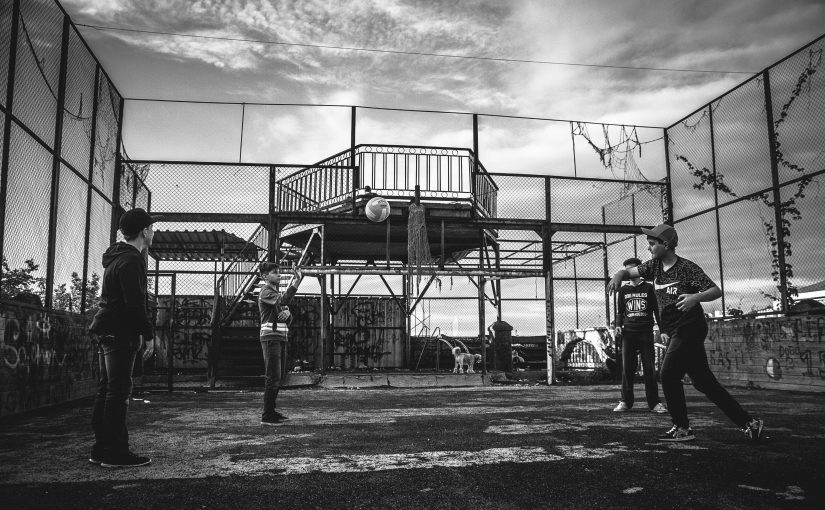
Kevin Powell On Moving Beyond His Own Toxic Masculinity
Raised in the inner city by a single mother, Kevin Powell grew up steeped in the macho norms of a tough environment, compounded by an absent father and severe poverty. After having to face his demons in young adulthood, he embarked on a remarkable journey, emerging as a great writer and activist, and a leading advocate of a new form of redefined manhood — one anchored in nonviolence, love, and healthy self-expression.
Kevin’s story is powerful, and he’s written about it extensively in the 13 books he’s authored, including The Education of Kevin Powell: A Boy’s Journey into Manhood. His latest book, My Mother. Barack Obama. Donald Trump. And the Last Stand of the Angry White Man., is an emotionally naked and deeply engaging autobiography of America, by tracing the influence of his remarkable single mother, a woman who shaped his entire life, threaded with his lived experience. Powell strips away symbols and pretensions to get to the root of who and what this nation really is, and how it came to be, and why we are struggling so mightily in these times.
That’s also how he approached his 2018 Bioneers keynote address. He boldly and bravely discusses his experiences with toxic masculinity and his journey to redefine what it means to be a man. He touches on the importance of gender equity, ending sexual abuse and redefining manhood to address the ways that violence has been baked into our cultural understanding of masculinity.
Watch the full video of his keynote address here.
View more keynotes, transcripts, and more from the 2018 Bioneers Conference.
Moving Beyond Toxic Masculinity
KEVIN POWELL:
I was born and raised in Jersey City, New Jersey. I’m the product of a single parent household, a single mother. My mother, like many African Americans, migrated from the South, from Texas, from Alabama, from Louisiana, from South Carolina, where she’s from, to places like Oakland, California, like Richmond, San Leandro and Hayward, or Brooklyn or Jersey City, where I was born and raised. She was in her early 20s. Being born in 1943, she had already survived the racism and the sexism and the classism of the American South, where her birth certificate said colored, not black, not African American — colored.
She dealt with sexism growing up because only her brother was allowed to graduate from high school. All the girls had to work. My mother started working when she was 8 years old in cotton fields. She only got to the eighth grade. She was basically groomed not to have a career other than being the help for the privileged and powerful in her community.
So she got on a Greyhound bus, as many black women did during those times, and she packed her life into suitcases and she and two of her sisters came up north, and they shared one bed in a one-room apartment in Jersey City.
At some point, my mother met my father. She was in her early 20s. He was in his 30s. She fell in love with him, and he fell in lust with her. e manipulated my mother and he got her pregnant. When it was time to give birth to me, my mother was forced to call a taxi cab because she’s was poor, black woman in America. There’s no resources. There’s no cars. There’s no drivers. There’s nothing. he had to go to the hospital in a cab, and that’s how I was born.
I only saw my father — my first introduction to manhood — three times in my life, between the time I was born and when I was 8 years old. My father pretended several times that he was going to marry my mother. He would play games with her. He’d say, “Well, let’s get married.” And then he would pull back. My mother would call him periodically to ask, “Can you help us?”
He was a truck driver, so he had money. He actually lived in a house that he owned, but we were living in a rat and roach-infested tenement. The one time I went driving with him in his truck, I was 6 or 7 years old, there were images of naked women. When he saw my discomfort at the nudity of these women, he started laughing and basically said what I heard from older men throughout my adolescence and youth: “This is what it is to be a man.”
When I was 8 years old, it was a rainy day and my mother said we were going to go to the drugstore down the street to a payphone – we didn’t have a telephone in the house – and she called my father. She asked him, again, “Can you help us?” On this particular day, his toxic manhood said, “You lied to me. He’s not my son.” And I look like my father. He said, “I’m not going to give you another nickel for him ever again,” and hung up the phone on my mother. My mother was devastated. She shared with me what my father had said. Right then and there, this 8 year old Kevin Powell had a father hole, a manhood hole that was as wide as the Grand Canyon, emotionally, spiritually, and every which way you can imagine.
Confronting a Flawed “Masculinity”
Whether you have a father or father figure in your life, or no father at all like I did, the reality is most of us who grew up in this society, whether we’re white, black, Latino, Latinx, Asian, Native American, Christian, Jewish, Muslim, atheist, agnostic, most of us who identify as males are still bombarded with the same images. This is what boys do. We wear blue. This is what girls do. They wear pink.
Boys don’t cry. Boys have to be tough. Boys, from early age – 5, 6 years old – start to police each other. We start to use sexist or homophobic or transphobic terms to describe boys who might be a little different than the so-called norm.
That was me, in this hyper-masculine culture. I played sports growing up. I loved football. I loved baseball. You better believe that I fought every chance I got; “Meet us in the lunchroom if you want to settle this.” It’s this right of passage many of us go through in our families, in our communities, all over the country and around the world — unless you have a parent or parents or an adult who checks you as a boy and says, “This is unacceptable to refer to girls in this way, it’s unacceptable to police boys this way, and it’s unacceptable to learn that to be a man is to be violent.”
We would run around school, in fourth or fifth grade, boys grabbing girls’ body parts, not realizing that we were learning rape culture at 8 or 9 years old. Not realizing that when we used terms like gang bang, that’s what we were saying. I remember in my neighborhood there was a girl — and I’m embarrassed to admit this – but the boys made a decision very early on with this girl that she was sexually promiscuous, and so her name became “Whorey Dory.”
Meanwhile, the boys can do anything we want. But the girls, if it was even thought they had done something, we twisted it around as if there was something wrong with them, just like what we did with Anita Hill and Dr. Christine Blasey Ford.
It’s not just our families and communities that shape us, it’s also the schools that we go to. It doesn’t matter if you go to a public school or some elite private school. My mother went to school through eighth grade. I was raised in the first generation after the Civil Rights movement. I went to the so-called best public schools in Jersey City — integrated schools. I was an A student. My mother did not tolerate bad grades.
When I think about it, I didn’t learn anything about Black history or Latinx history, or Native American history, or Asian history, or queer history, or poor people’s history. In my 13 years of school, I learned about Betsy Ross sewing the flag. I learned about Florence Nightingale, vaguely. Helen Keller, even more vaguely. And then Rosa Parks because she served double duty with Black history and Women’s history. Now we’re laughing about this, but if you want to understand patriarchy, sexism, misogyny, rape culture, ask the average male in your life: Name me five to 10 women in American and world history, and see how silent most of us go.
Even though I was raised in a single mother household and it was a matriarchal family, the reality is, the things that we were studying — whether it was math, science, history — were all through the lens of men, as if women didn’t exist. I knew from the time I was 11, 12 years old that I wanted to be a writer because I discovered this very hyper-masculine male writer named Ernest Hemingway. In my 13 years of school, the only woman writer that I even remember was Emily Dickinson.
It’s not just there, it’s also pop culture and the mass media culture. I grew up loving TV shows like I Dream of Jeannie, where she called Major Nelson “Master” and he would put her back in a bottle. I’m thinking to myself, years later, “Wow. Boy was that reinforcing patriarchy and sexism.” Or I’d watch Happy Days. The Fonz would snap his fingers and women would just fly out of the ceiling. As a boy taking this in, think about the devastating effect of these images, just like the devastating effect of black folks seeing images of ourselves only in certain stereotypical ways.
This is how I was socialized. Fighting was normalized. Violence was normalized. Respecting women and girls as our equals was not part of it.
I get to college at Rutgers University in New Jersey. First year, first semester, probably the first week, an upper class male student said to me, “There is so much sex on this campus, we don’t need electricity to keep the lights on.” I realize there’s a whole kind of pimp mentality going on. There are student leader pimps, there’s fraternity pimps, there’s athlete pimps, there’s even faculty and staff pimps, where the men were running amok with women and girls. I would hear stories about domestic violence. I would hear stories about rape.
Unfortunately, I began to become like my father — irresponsible sex, reducing women to two things, caretakers or sexual objects. Because I grew up in a violent environment meant I was violent in my early life, sometimes towards males, sometimes toward women in college.
Owning Up & Moving On
It hit a crucible for me after college. I was living in Brooklyn, New York, in 1991. A girlfriend and I were living together and we got into an argument. My male rage, my anger, my fragile masculinity, when she challenged me, pushed her into a bathroom door. I’m not proud of it. Years later I would apologize to her and she would accept my apology. But here’s what happened in that summer of 1991: There were women and a few men, who said to me, “Kevin Powell, you are a hypocrite. How can you talk about injustice in the world when you’re participating in the oppression of half the country and the world’s population?” That was devastating to me. This is why we need to have honest, open conversations with one another. When I look at a Bill Cosby, a Woody Allen, a Roman Polanski, a Matt Lauer, a Charlie Rose, a Harvey Weinstein, I’m saying to myself, “No one ever checked these very damaged human beings as they were doing damage.”
Equally devastating was when some women said to me, “You need to read bell hooks.” Not only did I grow up not learning anything about women and girls in our history, but in my four years at Rutgers University, the only woman writer I read was Zora Neale Hurston, Their Eyes Were Watching God. That was it. And here I was, thinking I was this brilliant young man, but when women leaders at Rutgers University would challenge us on our sexism, we would say disparaging, disrespectful things to them, because what men like to do who are engaged in toxic manhood is silence women and girls.
I was told, after that incident, “You need to own your mistake.” I was told that men must get help. What did that look like for me? It meant therapy. All those traumas that I grew up with, I was now passing along and taking out on other people, including women.
Men, we need to start listening to the voices of women and girls. I was in my 20s, taking all of this in. What was said to me was, “You need to become a consistent ally to women and girls.” How do you become an ally? You must read: bell hooks, Gloria Steinem, Eve Ensler, Audre Lorde, June Jordan, Sonia Sanchez, Nikki Giovanni. I’ve realized I was completely ignorant about women, like many of us are.
It was hard to read things where women were saying what they had experienced at the hands of men. But we don’t have the kind of transformation that Bioneers represents if we as people, no matter how we identify ourselves, are not willing to take a hard look in the mirror.
The last thing is that you have to do the work. For us, as men, that doesn’t mean being around women all the time. You’ve got to do that work with men and boys. For me, it began in 1991 with a terrible experience. I never engaged in that kind of behavior again. It was a journey to move from toxic manhood towards trying to figure out what healthy manhood looks like.
Here I am trying to figure this thing out, and there’s all these wacky definitions out there about manhood, in rock’n’roll, in jazz, in hip hop, in movies, on TV, in books — I had to question everything. That’s how you begin to redefine manhood. You’ve got to ask yourself: “What’s wrong with love? What’s wrong with peace? What’s wrong with nonviolence?”
In my humble opinion, 27 years later, I’ve written about it in essays like The Sexist in Me, Confessions of a Recovering Misogynist. These are the different periods of my life. I wrote a piece in my new book called “Harvey Weinstein and His Toxic Manhood is Our Toxic Manhood” — because it is. Bill Cosby is us. Woody Allen is us. Roman Polanski is us.
It’s not just writing about it, it’s speaking about it, doing workshops. I’ve worked in prisons, colleges and universities, communities, community centers, religious institutions. This is an ongoing conversation. What I’m happy to say to you all is that over the last 27 years, I’ve seen more men get involved, but we still are a very small part of the solution.
The New York Times magazine said a few years back that ending violence against women and girls is one of the major human rights issues on the entire planet. Even if you are not the kind of man who would ever call a woman a disrespectful name, touch her inappropriately, touch her without an invitation, rape her, molest her, assault her, God forbid stab her, shoot her, murder her. Even if you’re the kind of man who would never engage in those things but you have men around you engaging in toxic manhood and in destructive language and behavior toward women and girls and say nothing about it? You — we — become just as guilty.
My great hope, in spite of all this happening right now, is that #MeToo will not only empower women like the Civil Rights movement empowered black people — my hope for us as men is that we understand that as women are using their voices, it should be the wind behind us in saying, I want to be a different kind of man and human being.

Decolonizing Healthcare: Addressing Social Stressors In Medicine
What does it mean to have a healthcare system that serves everybody? And what can physicians do to address the ways in which societal challenges impact our diagnoses?
Rupa Marya, M.D., is exploring these concepts through numerous projects aimed at researching our current medical climate and collaborating with marginalized populations to make healthcare more effective and compassionate.
Following is a transcript from Marya’s 2018 Bioneers keynote presentation, in which she discusses her research and vision for the future of medicine. Watch the full keynote video here.
View more keynotes, transcripts, and more from the 2018 Bioneers Conference.
Rupa Marya:
I am the daughter of Punjabi immigrants who came to this country in 1973, with little money but plenty of caste privilege. We grew up with family vacations driving a VW van around the Western lands. My father would stop at the reservations. He would make us get out and listen and learn and look, and see what had happened to the original people of this land. He would talk to me about colonization, because we are also a people who had been colonized by Europeans.
I am a mother of two beautiful mixed heritage boys, and I am a farmer’s wife. I’m a physician who works in adult medicine, and who witnesses society’s ills manifest in my patients’ bodies, and a doctor who sees racism and state violence as an urgent public health issue. I’m a touring musician who has played in 29 different countries, singing in five different languages with the band Rupa and the April Fishes. To use a phrase taught to me by a Miwok elder, Wounded Knee, I am an Earth person.
What I’m going to describe for you is a system of domination in which we live, and what I believe are the direct health consequences of that system for all of us. I’ll begin with a description of how we have come to understand disease in a modern post-industrial context. In the 1850s, the germ theory was developed, which described how organisms such as bacteria and viruses made us sick. That led to the development of antibiotics and vaccines and systems to limit the spread of infectious disease.
In the 1960s, with the elucidation of DNA, we entered the molecular genetic era, where we are today. Here the gene creates a protein that can cause or protect from disease. How sick or well you were was thought to be preordained somehow by your genetics. This understanding has led to many powerful diagnostic tools and targeted therapies for specific diseases.
In 2004, with the discovery of the role of RAS gene mutation in the development of colon cancer, exactly 2,000 years after Roman physician Celsus described the cardinal signs of inflammation, we are entering the era of inflammation. Instead of a reductionist approach to understanding disease, we are seeing how many pathways lead to chronic inflammation, which in turn creates the conditions for illness.
Today we will be talking about the impact of social stressors, which have been shown to cause chronic inflammation. These diseases require more systemic approaches, not simply focusing on the individual, but rather moving our gaze to the structures of society, helping us see how the individual pursuit of health is actually futile in a system that makes health impossible.
How Colonization Affects Health
To understand the root causes of pathologies we see today, which impact all of us but affect black, brown and poor people more intensely, we have to examine the foundations of this society, which began with colonization. To me, to be colonized means to be disconnected and dis-integrated from our ancestry, from our Earth, from our indigeneity, our Earth-connected selves. We all come from Earth-connected peoples, people who once lived in deep connections with the rhythms of nature. I believe it is not a coincidence that the colonization of this land happened at the same time Europeans were burning hundreds of thousands of witches, those women who carried the traditional indigenous knowledge of the tribes of Europe.
Colonization is the way the extractive economic system of capitalism came to this land, supported by systems of supremacy and domination, which are a necessary part of keeping the wealth and power accumulated in the hands of the colonizers and ultimately their financiers.
In what we now know as the United States, this system of supremacy is expressed in many ways and with many outcomes. Today, we will focus on specific ones. First, white supremacy, which created a framework that legitimized slavery and genocide. Slavery created cheap labor, which is necessary for a functioning capitalist system. Genocide created unlimited access to resources in the form of land, animal parts, minerals, and raw materials, which are also necessary for a fully functioning capitalist economy. As capitalism functions, it further entrenches these systems of supremacy.
We all know that white supremacy is the scary guy with the swastika and the hood. But it can also look like any place where there is an abundance of white people in exclusive contexts, where power and access is not readily ceded to others.
Please remember, lest you get caught up in a tsunami of guilty feelings, that as I talk about these things, I’m talking about systems of oppression that we are actually all a part of and that we all recreate, and these systems are what need to be dismantled.
There’s white supremacy and then there’s male supremacy, also known as patriarchy, which leads to the invisibilization of women’s labor, like creating the entire human race out of our bodies. Or in this context, reproducing the entire workforce and suppressing our wages, which further supports capitalism.
Patriarchy also leads to femicide, domestic violence and child abuse, which we see across all groups. We also see human supremacy, where people feel superior to the rest of living entities, thereby subjecting living soils, seeds, animals, plants, and water to horrific treatment in the name of exploiting resources, which in turn feeds the capitalist need for ever-increasing profits.
While this wheel of domination, exploitation, generation, and sequestration of wealth continues, we experience trauma as the byproduct and common pathway. Many studies show us that chronic stress and trauma create chronic inflammation. When we look at the top ten causes of death in occupied Turtle Island, we see diseases that have been described to us as diseases of lifestyle or ones that come about because of poor choices. Maybe we eat too much fried food. Maybe we don’t exercise enough. Maybe we have a genetic predisposition. What these diseases have in common in their pathogenesis is a component of inflammation, and we are just starting to parse out how the social stressors and the very structures of society contribute to and exacerbate this chronic inflammatory state.

It is short-sighted to see these diseases as caused by individual poor choices in the context of a genetic predisposition. I see them as diseases that are virtually impossible to avoid because of the system in which we live, which generates a biological milieu of inflammation through trauma, chronic stress, environmental degradation, and damaged food systems. I see these as diseases of colonization.
If you’re a Native person, you’re like, duh. It takes science and medicine a long time to catch up with Native knowledge. This is not news to Native people. When I met Oglala Lakota elder Candace Ducheneaux in Standing Rock, she talked to me about how these diseases that are so common in modern society and more heavily so in Indian Country are diseases that were brought by the colonizers.
We talked about diabetes, which I had been taught in medical school is a disease of insulin resistance. Either your pancreas doesn’t make enough insulin or your body’s cells are not sensitive to the insulin. These are both ways of seeing things that are based in a sense of individualism and predetermination.
On the Standing Rock reservation, before the damming of Mni Sose or the Missouri River, diabetes was rare. Actually across Turtle Island, diabetes was virtually nonexistent. Once the river was dammed, it ended up flooding nearby cottonwood forests. By shifting the ecology through a colonizing force, the people became more dependent on the cash economy for their food and medicine, and they lost the essential cultural connection to their traditional ways. This tragic loss of the commons is a hallmark of capitalist society, and the impact is felt in the individual body.
After the damming of the river, rates of diabetes skyrocketed. This story is similar for tribes all over Turtle Island. It is important to recognize this didn’t happen simply because people became more sedentary and consequently more obese. This happened because of colonization, not by changing the indigenous body, but by changing the social structures around that body, which in turn creates disease.
One powerful study from Alberta demonstrated that First Nations tribes that had maintained their cultural continuity specifically through language had lower rates of diabetes. Just imagine that.
This is what is protective. It’s not the low carb, paleo diet. It’s not exercise. It’s not the latest fad or trend. This study also showed that self-determinism has a powerful protective effect from diabetes for Indigenous People. These same factors had a protective effect against suicide for Indigenous People in Canada, who experience rates two to five times the national average. This example, to me, demonstrates how disease is a complex manifestation of social and biological influences on groups of individuals that results in a common expression – here, diabetes.
While we can understand this clearly from a Native American experience, we must be aware that these social structures of domination produce trauma and inflammation for all of us. We are all affected.
So what can we do in the face of this knowledge that can seem so overwhelming? Simple things can have huge effects.
To heal the diseases that are caused by the trauma of colonization, we must decolonize. If colonization represents a dis-integration and a disconnection, we must reconnect. Our work is two-pronged: to reintegrate and to dismantle. We must reintegrate what has been divided and conquered in our societies, between our peoples, between us and the natural world around us, and within ourselves. We can do this in many ways: by promoting acts that increase local autonomy and self-determinism, by exposing the myth of treating the individual as limited in its ability to actually address root causes of diseases, by reconnecting to who we were before our respective colonization – through songs, traditional knowledge, reawakening our food and medicine ways, and reawakening our relationships to each other, to the Earth around us, and to other beings. We must dismantle those systems of domination that create and recreate cycles of trauma and inflammation, those systems that work in service of capitalism.
This is my vision of holistic healthcare.
Integrated, Holistic Healthcare
What does that look like for my work? How do I use my whitecoat privilege to address things systemically? Aside from starting to address diseases with my patients in the hospital as directly related to these phenomena, I’m doing these things:
With regards to integration, I have been invited to help create a clinic and farm to develop the practice of Decolonizing Medicine at Standing Rock, together with tribal members and healers Linda Black Elk and Luke Black Elk, great-grandson of Black Elk medicine man. We have been developing a framework for how to offer care that centralizes Lakota cosmology, an understanding of disease and health, and to create a model that can be replicable to other places and in other specific contexts.
We have incredible partners, including Mass Design Group and National Nurses United, as well as the Do No Harm Coalition at UCSF, who are over 400 healthcare workers committed to ending systems of oppression as a way of insuring health for all. We have raised over a million dollars so far, thanks to generous gifts from the Jena & Michael King Foundation, Colin Kaepernick, and crowdfunding, and seek five million more to break ground on this exciting project.
The Justice Study
With regards to dismantling systems of oppression, I have been working on a national study of the health effects of law enforcement violence or terrorism, called the Justice Study. We were asked by the community fighting for justice for 26-year-old Mario Woods, who was gunned down by SFPD in 2016, to create a study that would answer this question: If the wound is police violence and the medicine is justice, what happens to our health when the medicine is not given?
We gathered a team of public health workers and researchers, and we are currently actively compiling data. It’s already illuminating, showing how many areas of people’s lives are affected by police violence. We know that Native Americans, Black and Latinx people experience disproportionate rates of police violence, and we can see that they are most impacted by the long-standing effects of violence. How does this reality contribute to the health disparities that we see?
Across all races, we are being traumatized, with black, brown, and Indigenous people being affected more intensely. We are continuing to collect data, and we’ll be offering it to policy makers who wish to shape community safety away from models that uphold white supremacist frameworks into ones that create safety and mitigate harm for all of us.
What I want you to remember is this:
- Health is impossible when living in systems of oppression.
- We cannot effectively treat diseases like diabetes with a drug without addressing the systems that make diabetes so prevalent.
- We must redefine the scope of healthcare workers and the work of healthcare to include not only care at the bedside of the individual, but dismantling the systems of oppression that create the conditions for illness.
- And finally, we must reintegrate with the Earth, with each other, and within ourselves. We must decolonize.

Nature, Culture and the Sacred: A Woman Listens for Leadership
Bioneers co-founder Nina Simons offers inspiration for anyone who aspires to grow into their own unique form of leadership with resilience and joy.
Sign up for our newsletter and receive a free download of the introduction to Nina Simons’ books, Nature, Culture and the Sacred: A Woman Listens for Leadership and Moonrise: The Power of Women Leading from the Heart.

Informed by her extensive experience with multicultural women’s leadership development, Simons replaces the old patriarchal leadership paradigm with a more feminine-inflected style that illustrates the interconnected nature of the issues we face today. Sharing moving stories of women around the world joining together to reconnect people, nature and the land—both practically and spiritually—Nature, Culture and the Sacred is necessary reading for anyone who wants to learn from and be inspired by women who are leading the way towards transformational change by cultivating vibrant movements for social and environmental justice.
Nature, Culture and the Sacred: A Woman Listens for Leadership, recipient of a Gold Nautilus Award for Women in the 21st Century and the recipient of a Silver Nautilus Award for Social Change & Social Justice, is now available for purchase on Bookshop.org.
As part of Nina’s free gift offering for her appearance on Saturday Night Live for the Global Peace Tribe with Co-hosts: Debra Giusti and Scott Catomas, sign up for our newsletter and receive a free download of the introduction to both Nature, Culture and the Sacred: A Woman Listens for Leadership and Moonrise: The Power of Women Leading from the Heart.
The world seems to be divided into two kinds of people—those who divide everything into two, and those who don’t. Reading Nature, Culture and the Sacred is a step toward melting this false division into “feminine” and “masculine,” and allowing each of us to become fully human again and at last.
— Gloria Steinem, co-founder of Ms. Magazine
In Nature, Culture and the Sacred Nina Simons has woven a compelling and honest tapestry of hard-earned personal and collective wisdom, honoring the earth and igniting the revolutionary ways of women. It’s a book as much about the inside as it is about the outside, exploring where and how they can meet for a sustainable future.
— Eve Ensler, founder of V-Day and author of The Vagina Monologues
This is the time when the power of women returns to us, as we reaffirm our relationships to each other and to our Mother Earth. Together we will doula the next economy into being, re-birthing ourselves and this world. Nina’s writing explores the path forward on this journey that we will make together.
— Winona LaDuke, Executive Director, Honor the Earth
NINA SIMONS, co-founder and Chief Relationship Strategist of Bioneers, is a social entrepreneur passionate about reinventing leadership, restoring the feminine, and co-creating a healthy and equitable future for all life on Earth. An advocate for social and environmental healing, she speaks and teaches internationally on leadership and transformational social change and is dedicated to the value of creating truly diverse collaborations and connections among issues, leaders and movements.

Following in Nature’s Footsteps: Tracking the Wild with Doniga Markegard
By Doniga Markegard
Doniga Markegard, as a teenager, trained as a tracker of wild animals, which ignited a lifelong passion for the natural world. On the trail of a mountain lion on the California coast, she met a rancher with a deep reverence for nature, fell in love, got married, started a family and together they run Markegard Family Grass Fed, a pastured livestock operation in which Doniga blends her tracking, permaculture and holistic grazing knowledge to regenerate coastal prairie lands. In this excerpt (Pg. 183-186) from Doniga’s recent book Dawn Again: Tracking the Wisdom of the Wild, Doniga and renowned Permaculturist Penny Livingston are sharing notes on their observations of the landscape from a tracker’s perspective and a Permaculture perspective, deepening each other’s understanding of nature’s phenomenal complexity and how to mimic nature in systems domesticated by humans.
 As we entered the grassland, we started sharing our observations with each other. She pointed out the trail of water gaining velocity as it traveled across the land. The trail was worn smooth from the water picking up any small pebble that may have lain there. Penny said the traveling water could be captured or routed in a way that would allow it to penetrate the soil or be stored for later use. She pointed out that once the water hit the road, it picked up even more speed until it gushed out along the downward-sloping edge, causing the erosion she showed me. She was tracking water!
I stopped to part the grass and noticed a bobcat trail that led along the edge of the water trail. I pointed it out to Penny. The bobcat had been using the edge of the water trail but was hidden by the tall grass.
As we traveled along, Penny was looking at the soil types. She would point out the clay soils. “Those would be perfect for natural building materials!” she exclaimed.
We continued to drive down the road on the edge of the grassland. The ocean appeared in the distance. Penny pointed out the trees flagged by the winds, indicating the prevailing wind direction. I spotted a well-used game trail and asked her to pull over. There before us were tule elk tracks crossing the road, filing in one behind the next to travel through the grasslands. They looked fresh, lacking moisture on the disturbed surface, indicating they were not weathered from the morning’s fog. I asked if she wanted to follow the tracks and she eagerly agreed.
The tracks led us over a rise in the grasslands. Quietly we walked until we got up to a ridge. There before us stood a massive bull elk surrounded by five cow elk. With his neck outstretched and muzzle turned up, he sounded an eerie whistle out of his slightly open mouth. His dark brown neck, with long hairs reaching out from chin to chest, flared as he bugled to communicate with the cow elk as well as any bulls that may have been lurking nearby. The dark neck transmuted into a light brown body with a whitish rump. The small group did not compare to the one-thousand-head-strong herds of the past, but still held the magnificence of a species communicating with each other in a way that each individual understood and vocalized in response. The small group sounded high-pitched calls in response to one another, keeping their group together and communicating any alarm. It was an orchestra that needed no rehearsals.
As we stood in amazement in the presence of these magnificent creatures, I could see Penny’s eyes scanning the grasslands. I asked her what she was seeing and she pointed out the types of grasses the elk were feasting upon. The native perennial bunch-grasses dotting the trail looked delicate and wispy amongst the non-native annual grasses. The grasses had already dispersed their seeds, leaving a protective shell opened and exposed, like a mother without a child. She said next year she would come back to that patch once the grass was ready to harvest and collect the seed for her land. I would never have registered that patch of productive purple needle grass or noticed that it would be a site to collect the seeds to propagate elsewhere. Aside from working on the organic farm, I had never focused on propagation of anything in the wild. That day I was walking with Penny, I was focused on propagation of observations and collection of data. Collecting wild seeds was a new concept.
The things Penny focused on showed me how she perceived the world. I had seen the trail of the bobcat in the grass and parted the grasses because I knew there was a good chance I would find the tracks of a bobcat traveling along the edge of the trail, seeking cover in the tall grass. The bobcat could stalk up on the small mammals living in the cover of the plants while at the same time remaining hidden from larger predators or people. I knew what to look for, after having followed the tracks of that species for countless hours. Penny had focused on the movement of water and the types of soil with similar intensity. She had spent her own countless hours observing the way water traveled, was directed or dissipated, absorbed or shed. She applied all of that information to her landscape.
As we drove along, we buzzed like honeybees after being so close to those majestic elk. Our observations were flowing as if our brains had opened up to each other. I realized I had been viewing the earth through the eyes of a non-human animal—I’d worked immensely hard to understand how to get in the mindset of a bobcat, a beaver, a deer, a wolf. And now it was time for me to view the land through the eyes of a human animal—a responsible one, holding all living beings as my kin and relatives. I had learned, as Gilbert Walking Bull prophesized, how to live like the wild animals. I felt I needed to relearn, or perhaps even reimagine, what it meant to be human.

Intrinsic – A Performance by Climbing PoeTree (2018)
These two Brooklyn-based poets-artists-activists-educators-musicians-performers may be the most brilliant socially engaged spoken word duo in the known universe. They perform material from their recent album, “Intrinsic”.
Climbing PoeTree (Alixa Garcia and Naima Penniman) are award-winning multimedia artists, organizers, educators and a spoken word duo who have independently organized 30 tours, taking their work from South Africa to Cuba, the UK to Mexico, and 11,000 miles around the U.S. on a bus running on recycled vegetable oil, presenting alongside powerhouses such as Vandana Shiva, Angela Davis, Alicia Keys, and Alice Walker, in venues ranging from the UN to Harvard to Riker’s Island Prison.
Learn more about Climbing PoeTree at their website or explore all their performances over the years at Bioneers.
This Performance took place at the 2018 Bioneers Conference.
View more keynotes, transcripts, and more from the 2018 Bioneers Conference.
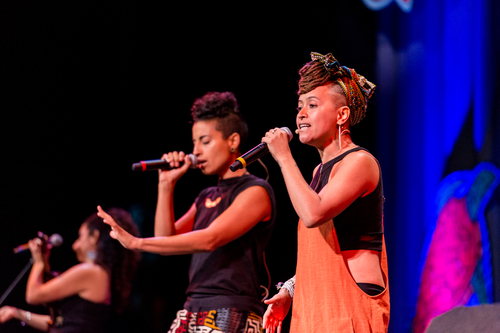
Intrinsic – A Performance by Climbing PoeTree
This Performance by Climbing Poetree took place at the 2018 Bioneers Conference. These two Brooklyn-based poets-artists-activists-educators-musicians-performers may be the most brilliant socially engaged spoken word duo in the known universe. They perform material from their recent kickass album, “Intrinsic”.
Climbing PoeTree (Alixa Garcia and Naima Penniman) are award-winning multimedia artists, organizers, educators and a spoken word duo who have independently organized 30 tours, taking their work from South Africa to Cuba, the UK to Mexico, and 11,000 miles around the U.S. on a bus running on recycled vegetable oil, presenting alongside powerhouses such as Vandana Shiva, Angela Davis, Alicia Keys, and Alice Walker, in venues ranging from the UN to Harvard to Riker’s Island Prison.
To learn more about Climbing PoeTree, visit climbingpoetree.com
View more keynotes, transcripts, and more from the 2018 Bioneers Conference.
Farming in the Radical Center
America has never felt more divided. But in the midst of all the acrimony comes one of the most promising movements in our country’s history. People of all races, faiths, and political persuasions are coming together to restore America’s natural wealth: its ability to produce healthy foods.
In Food from the Radical Center (Island Press, 2018), Gary Nabhan tells the stories of diverse communities who are getting their hands dirty and bringing back North America’s unique fare: bison, sturgeon, camas lilies, ancient grains, turkeys, and more. These efforts have united people from the left and right, rural and urban, faith-based and science-based, in game-changing collaborations. Their successes are extraordinary by any measure, whether economic, ecological, or social. In fact, the restoration of land and rare species has provided—dollar for dollar—one of the best returns on investment of any conservation initiative.
Following is an excerpt from Chapter 2 of Food from the Radical Center.
Read Bioneers’ Arty Mangan’s review of Food from the Radical Center here.
 Have you ever savored the ripe fruits or fresh vegetables from land that you yourself had begun to restore perhaps just a few years before? If not, does land restoration seem like an abstract concept with which you have no hands-on experience? Do habitat restoration and species recovery feel like things that happen off in the distance, beyond your sight, your earshot, your taste buds, and your nostrils?
Ironically, the fruits of restoration are already all around you, though they may not be explicitly presented to you in that manner.
In North America today, you can partake of some 628 species of cultivated food plants and 14 species of livestock, in addition to at least 4,000 types of wild plants and species of fish and game. Your increased access to this diversity of foods is largely due to the collaborative conservation and restoration efforts of a variety of farmers, fishers, foresters, foragers, ranchers, chefs, orchard keepers, and discerning eaters on this continent.
Over the course of the following stories, I’ll be encouraging you to savor some of that great diversity of foods, but I’ll also be inviting you to taste and see the world from which those foods spring in an entirely different manner: Tasting the huckleberries with a sense of when fire last moved through that patch of berry bushes . . . Digging for camas after seeing their wet prairie habitat freed from the competition of invasive species . . . Hooking a Chinook salmon and smoking it over alder wood after learning how stream restoration allowed it to migrate up into the headwaters from the sea . . . Grilling a bison burger after helping bring down the fences to let the buffalo roam, creating wallows that other creatures and plants use along the way . . .
Such place-based foods may begin to bless your table more frequently than they did in the past, but the fruits of restoration do not appear all at once, nor are all of them edible. Some of the rewards, in fact, are social, for the roots of the trees we plant with neighbors begin to bind us together. Most importantly, these efforts can break down our stereotypes, as a woman from a salmon restoration project once brought home to me.
I encountered her in a workshop of the Society for Ecological Restoration, and although I no longer remember her name, I will never forget how humbled I felt by her message. This middle-aged woman came into our workshop to offer a twenty-minute talk after half of the session was over. She sat down in a crowded room among a couple dozen young environmentalists excited by the fact that President Clinton and Forest Service director Jack Ward Thomas had just put twenty-four million acres of old growth forests in their region under ecosystem management. It was not long after the federal listing of northern spotted owls had forced the closure of industrial-scale logging in many national forests, and thousands of loggers had lost their jobs. The youth in the room were not only jazzed that “their side” had won a major environmental victory. They were also hopeful that now forest restoration would be funded on an unprecedented scale—the equivalent land area of four Connecticuts.
As this latecomer stood up to be introduced and offer the next talk, the mood in the room shifted. I perked up. Perhaps it was because the next speaker looked so different from many others at the conference. While the vast majority of participants wore Teva sandals, khaki shorts, green fleeces, and brightly colored T-shirts with outrageous drawings and in-your-face slogans in defense of mother earth, she wore a pastel, Western-style pantsuit, a silk blouse, and boots. As she spoke her very first word to us, I could sense male attendees dismissing her because of her dress, her beauty-parlor hairdo, and her vaguely rural Western accent.
She started off by explaining that she was there because her husband had been one of the loggers who had lost his job when the FEMAT logging closures began to go into effect. Just hearing that she was from a family of loggers made the group uncomfortable. Their collective body language grew irritated, even hostile. Even when she began to describe how she and her husband had recruited jobless loggers to join them in restoring salmon streams, most of the men in the room were tapping their pencils, looking out the windows, or staring at their laptop screens.
But then this “stranger in a strange land” did the most flabbergasting thing, right in the middle of the twenty minutes allotted to her. She asked if we could take a two-minute break so that she could use the women’s room and suggested that because she could still finish her talk in the allotted time, we should all stay put. When she abruptly left the room, there were curses, barbs, and wisecracks that do not bear repeating. And yet everyone stayed in the room as they had been politely asked to do.
When the woman returned, she was dressed in a fleece, T-shirt, khaki shorts, and Tevas; her hair was pulled back into a ponytail. She moved out in front of the podium, and to the best of my recollection, said something like this:
“Listen up. A few minutes ago, you dismissed me on the basis of my dress and my accent. But I’ll tell you what: I will not let you dismiss the work that the fine men that my husband and I have recruited are doing in this region. They are healing the very streams and wildlife habitats that some of you in this room have worked to protect! You need their work as much as they need yours. But to join forces on behalf of the fish and wildlife we all want to see survive, you have to first acknowledge the value of the men and women who care about the same things you do but who don’t talk about them with the same words you do.”
To say that I was appalled and embarrassed by my own prejudices is an understatement. My colleagues and I had hardly offered this courageous, compassionate, and intelligent woman the time of day, let alone any deeper listening. She simply did not look like a member of our “club” of conservationists. That was the day I decided that I needed to quit the club I had been in—consciously or unconsciously—for most of my life. To this day, I remain grateful to this performance artist who had found a novel way to speak truth to power—in this case, the power of the expertocracy.
In memory of that moment, I encourage all of us to imagine something other than the infamous zero-sum game that is stalemating our country. We need to interact with each other differently, taking a more inclusive approach to decision-making and restoration.
In Stitching the West Back Together, my old friends Tom Sheridan, Nathan Sayre, and David Seibert explain why it’s time we engage rather than alienate the diverse voices in our rural and urban communities. They want us to regard everyone—farmworkers and loggers, cafeteria cooks and wild foragers, hunters and fly-fishers, teachers and preachers, ranchers and career professionals in agencies—as equal partners in collective efforts to “stitch back together” our damaged landscapes and communities.
Each time such diverse players come together, we should get in the habit of asking six fundamental questions:
- Do you sense that this restorative work might address the deepest practical needs that you, your family, and your neighbors must fill to continue living with dignity in your community?
- Might it build toward some moral common ground that will allow your community members to be better lasting stewards of the resources in your home place?
- Does it strengthen your community’s overall capacity to collectively solve problems, reduce disparities, and resolve conflicts with novel solutions?
- Will working together through more equitable processes foster you and your neighbors’ own well-being, intellectual growth, neighborliness, and organizational capacity?
- Will it help all of you to better safeguard what makes your place unique and offer you more lasting solutions in the face of uncertainty?
- Will being engaged in this collaboration be pleasurable for you, allowing you to taste, see, smell, and hear the fruits of your collective labors? Or will it simply be another tedious obligation to attend seemingly endless meetings and hearings where no one really listens to anyone else?
If you choose to ask such questions, they may help you move toward some immediate reduction in conflicts. But you cannot count on pat answers or flash-in-the-pan solutions to carry you very far. Be cautious of instant claims of success, like We planted three hundred trees today and now the forest (or orchard) looks like it is restored!
A sequoia forest cannot be restored in a single a day, nor can a diverse pollinator guild be reassembled merely by sowing nectar-rich plants on a single farm. It takes efforts across administrative and property boundaries so that changes ripple out through an entire foodshed and patient capital can be invested over decades.
In the end, the benefits of restoration will be far more than what you grow on your farm, what you harvest from a nearby forest patch, or what ends up on your plate. Being part of collaborative restoration involves the slow-growing fruits and steady dividends of long-term social engagement. It is ultimately about place-making and peace-making—in your community’s meeting rooms and council halls, on farms and ranches, around forests and lakes, and at many tables. Its goal is that all may reap the many tangible and intangible benefits of community-based collaborations.

In the past, many of us who wanted to restore landscapes or help species recover were obsessed with outcomes; in other words, we were emphatically content-driven. We only began to pay sufficient attention to social process when our neglect of it began to trip us up and undermine our goals. Count me among the ranks of those content-driven geeks who must have seemed narrowly focused and marginally collaborative to members of the first few communities I worked within.
In fact, I initially missed the significance of a landmark event that occurred near my desert home in October 1999, when the Community- Based Collaborative Research Consortium was founded. Forty funders, facilitators, researchers, activists, and community members met in Tucson, Arizona, just a few miles from where I was working at the time. Did I even catch wind of their proximity?
How could I have neglected such an extraordinary convergence happening on my home ground? Well, it is probably because I was (and still am) a recovering “content geek.” As a matter of fact, if I had tried to write this story for you even a half dozen years ago, I would have led it off in a completely different manner that I am attempting today.
Perhaps I would have tried to baffle you with scholarly bullshit . . . or numb you with impressive numbers . . . or entangle you with technical assertions to convince you of how bright and right I was about how to conserve land, recover species, and farm sustainably.
But after suffering from a rash of concussions and various other personal setbacks a few years ago, I no longer “feel” that I was ever that bright or particularly right about anything at all . . . at least not when
I compare my insights to those of the many good people around me.
Instead, I feel grateful to still be alive during this precious moment on earth, when I can rub shoulders, fins, and wings with lives quite different from my own.
I am stunned and humbled by the capacity for innovation found in every heterogeneous community where I have had the chance to work. I no longer assume that I personally have some unique ability to provide answers to the nagging problems plaguing my community, our society at large, or the food-producing landscapes we depend on.
It’s not that I have lost complete confidence in all my old environmental values, skills, and convictions. It’s more that I have gained deep respect for the validity of values, skills, and convictions quite different from the ones I grew up with. And in this case, by “growing up,” I mean the maturation process that those of us who were involved in the environmental movement have undergone since that first Earth Day in 1970.
From Food from the Radical Center: Healing Our Land and Communities by Gary Nabhan. Copyright © 2018. Reproduced by permission of Island Press, Washington, D.C.
A Review of “Food from The Radical Center: Healing Our Land and Our Communities”
“Have you ever stumbled into a place where you were bowled over by an abundance of wildlife?” So begins the chapter Bringing Back the Bison in Gary Paul Nabhan’s latest book: Food from the Radical Center: Healing our Land and Communities (Island Press, 2019).
The question brought to mind a time in 2013 when there was an unexpected spike in anchovies in the Monterey Bay and massive schools were swimming by the mouth of the Santa Cruz Harbor. There were dozens of sea lions in formation, diving down to grab a mouthful of anchovies and coming up for air over and over again while hundreds of pelicans were dropping from the sky with seagulls in hot pursuit trying to steal some of the small, iridescent, nutrient-dense fish that overflowed from the pelican’s pouch. I was spellbound and felt genuinely renewed at what Gary Nabhan calls the “lure of life.”
Nabhan begins each chapter with a “Have you ever” question that leads to an experience full of appreciation for the diversity of the natural world and how it contributes to human culture and sustenance. Through these inquiries, he introduces the reader to people who are stewarding urban gardens in Querétaro, Mexico; Bison stocks on the plains and woodlands of North America; Atlantic sturgeon in the Delaware River; Navajo churro sheep; rare fruit in Phoenix, AZ and California, and many more stories. These efforts are not just about salvaging a single species on its way to extinction – as important as that is – they are also about revitalizing the culture, economics, ecosystems and communities that these plants and animals have had, and can still have, a prominent role in.
Community Collaboration and Empowerment
In the face of intractable societal schism, Nabhan makes larger points to help bridge the divide that obstructs progress in conservation. He first names what is painfully obvious, “Americans appear to be at war with one another rather that at work with one another.”
But where most people see division and isolation in today’s acrimonious political and social environment, he sees community and cooperation. “We must be willing to take a step toward consensus, even when it means risking criticisms from mud-slingers on the far extremes. This fertile ground is what rancher Bill McDonald began to refer to in the mid 1990’s as the radical center.” A concept that Courtney White successfully applied as an organizing principle to ameliorate antipathy between ranchers and environmentalists in the Southwest when he founded the Quivera Coalition to create a framework for productive collaboration.
Nabhan cites another systemic problem – the failed top down approach that has driven much environmental policy. Science, rather than ignoring culture, should respect and consider it when designing solutions. Studies have found that plans that are imposed without community participation or that don’t build community capacity to solve problems and resolve conflict, fail. Resource protection programs that don’t develop understanding and caring within the affected communities tend to be abused.
The remedy that Nabhan provides multiple examples of is practical grassroots community engagement – the inclusion of diverse and even conflicting factions to find common ground and solve serious local problems.
Bringing Back Bison
At one time 25 to 30 million bison, a keystone species that sustained the biodiversity and fertility of prairie grassland ecosystems and were a major food source for indigenous communities, roamed the North American plains and woodlands. Bison were nearly eradicated in a matter of decades reduced to, as wildlife historian Dale Lott said, “a carpet of whitening bones and a few hundred scattered survivors.”
It’s hard to overstate the role bison played in developing the grasslands, with assistance from Native American fire management practices that stimulated the growth of fresh forage, into some of the most fertile topsoil in the world, an asset that Midwestern farmers have been exploiting ever since. Buffalo wallows started as temporary shallow pools that were sealed by bison hair and oils when bison drank and bathed in them turning them into larger more permanent watering holes that support a variety of wildlife. Tragically, bison were brought to the brink of extinction by habitat loss, government policy and the industrial scale massacre that brought the population to less than 100 by the late 1880’s.
In the 1990’s, the InterTribal Buffalo Council of 58 tribes were managing over 15,000 bison, Nabhan writes, “in ways that nourish their culture and spirits as well as the ecology and economy of the region.”
Hugh Fitzsimmons, of Shape Ranch near Carizo Springs, Texas, who wanted to develop a free-range herd of bison on private lands, attended the Intertribal Buffalo Council. As a non-Native, he was not sure that he would be welcome, but he ultimately made friends and connected with Native American mentors who have taught him everything he knows about raising bison and with whom he now exchanges breeds. Hugh has a vision to increase bison herds in Texas to restore degraded ecosystems and regenerate deep-rooted native grasses to make the region more drought resilient.
Kent Redford of the Wildlife Conservation Society organized multicultural gatherings to listen to the priorities of Native American bison managers and to ensure their voices were a major part of the vision for bison recovery and prairie restoration of the Great Plains. Through these kinds of efforts, bison have rebounded to a population of 450,000 across the three nations of North America. Most of that work has happened on private and tribal lands.
The successful recovery of such an iconic species whose presence shaped the rich ecology of the Great Plains and the culture of Native people has, as Nabhan points out, a wider implication than the increasing numbers indicate. “The sense of place matters. That open space matters, that free ranging game matter, and that access to untrammeled land for recreational or spiritual rejuvenation matter.”
Revival of an Ancient Fish
Another example of community driven conservation involves an endangered anadromous fish that can grow to 16 feet long and weigh up to 800 pounds. Atlantic sturgeon have been on Earth as a species for around for 70 million years. Millions of Atlantic sturgeon once inhabited the Delaware River, now one of the most contaminated waterways on the Eastern Seaboard. This bony-ridged fish, one of the largest and longest lived in North America, was once a key part of Native American diets – tens of thousands of pounds were harvested a month. But by the late 1800’s industrial fishing practices using gill nets to sell the sturgeon as pet food, fertilizer, caviar, bait and oil depleted the stocks to about 180,000. In modern times the numbers crashed even further, with only a few hundred remaining in the Delaware River watershed.
Since 2012, The William Penn Foundation Delaware River Initiative has funded $140 million to 130 organizations to support collaborative grassroots conservation to clean up the river – an important drinking water source for local low-income communities – and restore wildlife habitats along streams and the river. As a result, Atlantic sturgeon populations are bouncing back from historic lows.
Conservation You Can Taste
Whether it be preserving the remaining Black Sphinx date trees in Metro Phoenix, stewarding Native seeds of the Southwest, raising awareness and taking action to halt the demise of pollinators who perform eco-services for $30 billion worth of food crops, or the revival of heirloom grains, Gary Nabhan is not merely a dispassionate reporter of these endeavors, but often a catalyst and an active participant who brings diverse constituencies together in what he refers to as “conservation you can taste. His decades long efforts to coalesce disparate groups to restore working landscapes has focused on revealing common ground and fulfilling the ambitions of scientists, environmentalists, farmers and ranchers alike. These are not just one-off projects for Gary, but rather the tapestry of his life’s work.
In this book, he celebrates the local heroes who labor on the frontlines of food species extinction, cultural restoration and community empowerment. The lessons learned are that success comes from community-based collaboration, turning adversaries into partners, and finding an alternative to the failed approach of top down environmentalism. Regulations and policies need a more inclusive approach to decision making “to stitch together our damaged landscapes.” Nabhan advocates for a humbler approach, admitting that we may not have all the answers, and shifting the driving force of environmentalism from guilt to the “reverence of restoration.”
Gary Paul Nabhan has been a hugely influential food writer; books like Enduring Seeds and Coming Home to Eat are ethnobotany masterpieces. His writings, teaching and activism have helped raise awareness of the environmental and cultural degradation of industrial agriculture and have cultivated a renewed appreciation and celebration for the elegance and importance of the relationships among land, water, soil, plants, people, animals and the cultural continuity of place.
In Food from the Radical Center, Gary Paul Nabhan provides a number of rich and detailed accounts from across the country illustrating that, in a world of ecological and social crisis, ideological differences can be put aside to work together for the common good around basic human needs – clean air and water, biodiversity, food security and community.
Learn more! Read an excerpt from Food from the Radical Center here.

Tom Hayden – A Global Green New Deal: History, Context and Future
In 2014, the legendary activist, progressive movement strategist and long time California State Senator Tom Hayden (1939-2016), gave a poignant, moving and incredibly prescient address as part of a Climate Leadership symposium that Bioneers hosted. In his remarks, Hayden delved into the history of the New Deal, the movements and drivers that presaged its development and the pressing need for a modern version, a Green New Deal, to be enacted to deal with climate change, the major existential crisis of our time.
His remarks below are essential contextual reading for understanding how we’ve reached the moment we’re in today, where a Green New Deal is making national news, lead primarily by an active and engaged youth movement of newly elected, next-generation policymakers along with vibrant movement activists.
Watch a video version of this talk or listen to Spirit in the Air: Reform, Revolution and Regeneration, an award-winning episode of the Bioneers: Revolution from the Heart of Nature podcast featuring Tom Hayden.
I learned during a couple of experiences in my life a kind of an answer to the complicated question of where ideas come from. In this movement we’re prone to think ideas come from scientists, and that is correct up to a point. I’ve always thought that ideas came from listening. A lot of people listening to each other is what we’ve been doing today, and it’s not easy to immediately synthesize what you’ve heard, because the listening is a process. We have to be open-minded and remember to not tell people your story unless you’re willing to hear theirs. From an organizer’s viewpoint, you’re always trying to detect: What are people feeling, thinking? What words do they use? It’s a very unscientific approach to language, but it’s been a very powerful force in social movements like liberation theology in Latin America.
The Port Huron Statement
The first of the two experiences I want to discuss is the Port Huron statement, the founding document of Students for a Democratic Society, which the history books say I wrote. It was 27,000 words long. It tried to express a vision of our generation in 1961-1962. We had come through the freedom rides and the beginning of what would become the Free Speech movement. About 62 people gathered in Port Huron, Michigan, thanks to the UAW that gave us a room. I wrote the document, it’s true, but in order to write the document, I interviewed tons of people. I wrote it and then it was somehow rewritten in a five-day period. Looking back, I certainly get credit for having set the typewriter and pounded it out and made sure that it was in the mail and all that, but the way I feel about it in retrospect is that the Port Huron statement wrote us – that there was a spirit in the air, it was a consensus in the air. James Joyce said the same thing about his writing 50 years earlier. James Joyce said that what he was trying to write was the unwritten consciousness of his generation.
So, the knowledge, the feeling, the mix is in the generational experience. It’s not in the writer’s head. That’s an old left model where the organizer comes and tells you the line and tries to make it narrow enough to rally you to a certain demand and then moves on. This is more about attempting to get at the actual feelings that people have not yet articulated. I think we’re in the process of articulating those feelings.
Today is one day, a few hours in a process that has been going on since I first heard of solar energy from someone in the Brown administration 40 years ago. It goes way back. It’s deep. There are many ancestors and many previous attempts to express it. I’ve learned that these things do take time and there’s no rushing them even though we have to do things urgently.
The New Deal
The other example that I think is a good one is my reading of the New Deal. The reason I think of the New Deal is because I am a writer first and foremost, a movement activist, a twenty-year participant in the legislative process and I was born at a moment when the New Deal saved my family.
What happened is that my grandfather died in a cannery accident, the fault of the Carnation Milk Company in Milwaukee, Wisconsin. He fell in a vat and was chopped up. He left my grandma with eleven kids. This was during the Depression and she survived and took care of those kids. During that time she was sustained by a $5,000 check from the company with regret for the death of her husband. There was no pension, there was no Social Security, there were no rights for organized labor. Her world fell apart in the late ‘20s, early ‘30s, and I don’t remember all that much about her, but I remember her as being sort of the quintessential nanny, the grandmother and all these kids.
What they were doing in the Depression was huddling up together like students do today, five to an apartment, living through a semester at NYU or wherever. They were selling apples and they were doing odd jobs together and pooling what little they made every day in order to buy food and pay the bills to get to the next day.
They were not political. This is a key point in my sharing with you. I believe, along with C. Wright Mills, that we have to reach people who are in their personal milieu and their problem is that they’re detached from history and social structure; they don’t know what has happened to them; they are in a catastrophe and they are prone, if they’re working people, to think there’s something wrong with them – their ethnicity, their class, their lack of education. They’re not prone to automatically blame an outside aggressor. That would take a level of pride and insolence and insubordination, so to speak, a mutinous mentality that they don’t have. They’re survivors, and they know a lot. I’m not saying they lack knowledge. They know a lot. I learned that too, after leaving the university and going to Mississippi and Georgia and Newark. I learned that poor people know a lot that middle class people do not know unless they come from that background.
In the middle of this process of the collapse of capitalism, the collapse of what government we had, there were the stirrings of the New Deal. There were social movements, Communist Party-led organizing drives in manufacturing plants. Got nowhere. People got fired, got clubbed down, beat up, shot. Anarchists tried to do it in their horizontal way, to borrow the current language of the current movement. Trotskyists kept attacking everyone on both sides for not following the correct line. Farmers – I don’t remember if they picked up pitchforks – but they went to work against the banks and the grange.
This started a period of turbulent working class expression and middle class expression at having been sold out by somebody. It began with finding ways to make enough to buy food to eat, and it ended up with doing everything possible to obstruct the business as usual unless they were fed, unless their children were fed, unless they could go to school, unless there was somebody to say there was hope on the horizon, to borrow a more recent phrase.
I remember my mom went through this, the orphan of a father she hardly knew. When I was growing up at the end of the ‘30s and the beginning of the Great War, I remember sitting on her lap a lot, and she’d always talk to me about how she loved Roosevelt. I didn’t know who Roosevelt was. I just thought, “Roosevelt, that’s God. My mother loves God and Roosevelt is taking care of us.” She would keep saying that, because by that time, after the revolutionary inciting of working people and average everyday people, they had achieved Social Security. I can’t tell you what that would have meant for my mother when she was thinking about Grandpa.
They achieved bargaining rights for organized labor. Unheard of. Seemingly impossible. They achieved pensions and all the rest of it, and they had achieved what was known as the New Deal. Now, at the time it was being built, they did not call it the New Deal. They called it the movement. It didn’t have a name. They didn’t announce, “Now we are starting a movement for a New Deal.”
What happened was this strange mix of a revolutionary impulse on the one hand, a liberal impulse from do-gooders who wanted a better government, people in the center who were very frightened at the possibility of social disorder and were timid about raising their head, and then people on the right like my priest, Father Charles Coughlin, who was busy organizing an anti-Semitic response to the very same conditions, working closely with Henry Ford on the idea of a new Nazi party based in my hometown of Royal Oak or Hamtramck.
The people on the far right thought Roosevelt was a Communist. I don’t remember if they questioned his place of birth. But he was leading us to a Soviet America. Some of the people on the left thought that was a great idea – a Soviet America – and they were in little discussion circles constantly reading textbooks from Marx and Engels about the future of Soviet America. Most people that I would identify with were organizers. They were selfless people who didn’t work for much money, didn’t think far ahead, to the careers that they would hold as future labor bureaucrats or Democratic party administrators. They wanted to know if they’d have their heads crushed by a policeman’s baton. They were willing to do that. There’s sort of a lost generation there in history.
There was another group, maybe a little like some people you know or today’s climate scientists. They were known as the brain trust of the New Deal and they were a very eclectic group of people who were brainy intellectuals. They were probably part of the most important American tradition that I’ve ever studied and I consider myself part of, the American pragmatic tradition. I know that pragmatism is now a dirty word, but if you look under it, it means: listen first, see how far people are willing to go, and improvise a step forward, a program that will take you a little bit towards survival or a little bit towards a better life as rapidly as you can.
The New Deal brain trust invented all these amazing programs. One parallel today would be like if somebody said, “We need a Renewables Work Administration, like the National Recovery Administration. We need to put every person in this country and on this planet who’s out of a job or under-employed into a great employment project, publicly funded, privately funded, but it has to happen, because there’s a great work to be done.” The great work was to save us from the Depression in those days. The great work today is to save us from climate catastrophe and the end of civilization as we know it. No one had the idea for The New Deal in 1929. They were gripped with that idea by 1937.
The whole idea of industrial workers being organized, the whole idea of old age pensions, of delivering people Social Security, having to sit at a table and argue about whether we could also do healthcare, being told by the president we don’t have the votes, we can’t do that, some future generation will fight for healthcare – that’s how the New Deal was pounded out.
It was improvised by very creative people who dared to take it on and who simply believed that their current lives were unlivable and they didn’t have to be poor to know that. It was just an unlivable situation with fascism approaching and with the Depression never seeming to end. And out of that pragmatic determination they decided the government had to hire people, the government had to protect people, the government is what saved my mother, and why she loved Franklin Roosevelt.
It was a close call. We could have gone to the right. We could have gone into chaos. The answer to what might have happened we’ll never know because then came World War II, and everybody thought, “Problem solved.” Everybody’s working down the street in the empty plant. They’re building planes and tanks and trucks and jeeps and cars. The car industry was formed out of that experience.
My father went to work as an accountant for a car company. Detroit was booming. My mother loved Roosevelt for those reasons, not ideological. When we come to that point when people aren’t trapped in ideology but are willing to do what works, that’s the time when I think we’ll have the equivalent of a New Deal for the climate catastrophe.
From A New Deal to A Green New Deal
There are people who argue that there’s no climate problem. There are people who are fascistic in their inclinations. There are people who, unfortunately, are ideologically driven – they believe in a market even though there really is no pure market, it’s all government supported through incentives or taxes or mandates. They’re mad. They’re really angry, but there’s a madness that’s ideological; they don’t have a picture. And I’m talking about the Tea Party and people that I thought would fade away, but seem to get more ferocious as the threat grows.
There were people who said, “Okay, we’re going to invest in the rebuilding of America and, after the war, in a Marshall Plan for the world.” They cut a deal without a handshake, as far as I know. The finance capitalists were divided over whether their obligation was to reform the system in order to stabilize their profit or crack down on these insurgents and stop them in their tracks and go all the way to drive them off the political map towards God knows what kind of system we would have had.
On the other hand you had labor and social movements and populist movements where the argument was, “Should we take the right to collective bargaining or go all the way to Socialism?” It was kind of like 1919 when the Socialists told the Suffragists, “All the way with Socialism first, then you women will get your right to vote.” And the women said, “Not taking that offer, thank you very much; some of us are Socialists, some are not, but we all want the right to vote.” And we’re at a similar crossroads. If you read Naomi Klein’s excellent new book, This Changes Everything, she outlines a similar debate today.
I come from experience, not ideology, not theory. I do my reading. I try my best. But my sense is the most we’re going to accomplish here is a global Green New Deal, which is quite a lot when you think of the state of the planet. We need the green billionaires and we need the younger generation.
However, somebody has to cut a deal. Unless you believe that we have to have revolution first and then save the planet. If you believe that, I advise you to listen. Just go to meetings in your community, in your PTA, in your neighborhood and ask—get up, actually, and say, “I want a revolution first, what do you people think?” You’ll see that they’re not there now. They might be thinking about it, but it’s a simple fact that we need to have this green infrastructure, a green financing mechanism, and at the same time, just as labor needed to be organized and respected in their dignity, we need all the people of color, the disenfranchised communities of California to feel that they have been invited to the table and that they’re going to get somewhere.
We need to double the rate of reducing greenhouse gas emissions by 2030. We need to get the brain trust to understand that that is necessary because if we don’t do it, it will even get worse. We need to go to at least 50% or 60% solar and renewables as part of our electrical system. We need to reject the idea that the grid is some holy place like a medieval church that needs to be respected.
Remember that it took people power to knock out the nuclear plant in Sacramento. We were told if there was no nuclear plant built in Sacramento we’d be dead, because it’s so hot there. Go to Sacramento now. Last time I was there it was one-hundred and ten degrees and they had an electricity surplus. A surplus. Why isn’t that model a larger part of our story? One-hundred and ten degrees and running an energy surplus through a publicly owned utility whose board members are elected, with investors still making lots of money off it.
We need to put out of commission this infernal Dracula of the nuclear power lobby that seems to continue running on fumes. Where is capitalism when it comes to nuclear power? They never stop. They say we have to have a robust nuclear industry to achieve our climate goals. It comes from madness, arguing that it’s either a Chernobyl future or a climate catastrophe future.
California’s a very precious place, not because somebody designed it that way originally but be- cause we are an advanced economy with 199,000 jobs in the clean energy industry, and we’re getting rid of coal and getting rid of nuclear. There are a lot of people that don’t want to see that. They used to say, “Well, Governor Moonbeam, who listens to him?” They can’t call him Moonbeam any longer, but they can wait him out. He’s only got one more term, and they can try to avoid the California model, the idea that you can have an advanced economy run on 100% renewables, step by step, without nuclear and without coal. They don’t want this idea floated out there, because some of them think their interests would be harmed. They don’t know that it may really be in their best interest.
Nobody knows what the California story is. It could be because people in California are too busy with their projects to identify where they’re going or the governor’s afraid of Republicans. It’s not that the story is perfect. We know from today that we need to be on all out alert to stop fracking, and we need to tell the governor if he wants climate leadership on the planet, fracking will be his Achilles heel.
I think it’s a complicated course that we have to navigate, and we need organizers. We need people to drill down on this. I think we have had enough of the science elite. They have delivered us such great material on how to get to 100%, but they don’t know how to get to it politically. You know, the desert is covered with giant parabolic collectors, and the Sierra Club is worried about birds, and you say that’s the only way we can get to 100% renewables? By destroying a desert and the wildlife? That leads you into endless committee hearings and litigation and the only thing that can avoid that confusion is more consensus, more dialogue. How are we going get there?
We have precious little time to get there, but we know from the science that it is inevitable that things will get worse. It is also inevitable based on my experience that people will fight back. It’s all one step at a time. The starting point is to combine the notions of reducing emissions and achieving jobs and environment justice. The finance capitalists will have to accept the jobs argument and the empowerment of poor people. That’s not in their normal picture. The environmental justice advocates will have to convince themselves that this emissions catastrophe is real and is really going to wipe us out, and that we have five or ten years to get through it as safely as we can.
There are 33 states that are controlled by coal interests. There’s only about 25, 26, 27 states where we’ve got a shot. But that’s the green bloc that has to be organized state by state, community by community, to have such power that they can push back until the inevitable gets worse and we see the investments flowing. The investments have to flow in an equitable way, in a fair way. That’s what happened with the New Deal. The poor got better off. The workers got rights. Business got rich by stabilizing capitalism. That’s where we are and I think that’s where we probably have to go.
If you read Thoreau’s book of essays that was published after his life, The Dispersion of Seeds, it’s about the growth of communities and the rise of new generations. At one point, Thoreau says, and I’m quoting: “We find ourselves in a world that is already planted, but is also being planted as at first.” That’s the transition we’re in. That’s the planting and cultivating that we’re doing. We see in these panels today, we see in these presentations, a new world rising that has been cultivated but is again being planted as at first.
The title of Thoreau’s essay was I Have Faith in a Seed. So do I.

Closing Performance by Oakland’s Thrive Choir (2018)
The Thrive Choir, an Oakland-based singing group affiliated with Thrive East Bay, a purpose-driven community focused on personal and social transformation, is composed of a diverse group of vocalists, artists, activists, educators, healers, and community organizers directed by musicians Austin Willacy and Kyle Lemle. They have performed their original fusion of gospel, soul and folk in a wide range of settings, including: marches, conferences and festivals across California.
Learn more about Thrive Choir at thriveeastbay.org/thrivechoir
View more keynotes, transcripts, and more from the 2018 Bioneers Conference.
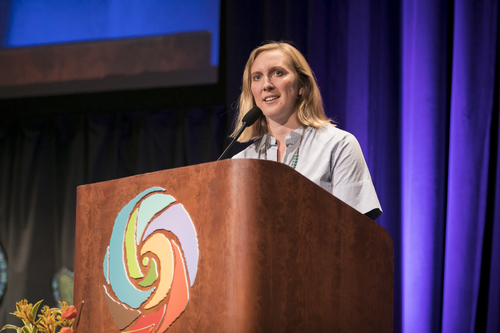
May Boeve: Climate Change is Changing the World – Now We Too Must Change
“We are witnessing the dying gasps of the fossil fuel industry and the tyrants they support. We are witnessing the unfolding of a just transition, a new way of making energy. And we may be witnessing a new way of being with and among each other.” – May Boeve
As Executive Director of 350.org, the groundbreaking grassroots international climate change campaign whose innovative organizing and mass mobilizations have uniquely helped generate a mass global sense of urgency and action, May Boeve shares her eagle’s-eye perspectives on the current state of the climate struggle. She illustrates 350.org’s learnings and strategies moving forward, including ways of learning about and incorporating justice and equity. She illuminates pathways our species must take to keep 80% of known fossil fuel reserves in the ground and radically accelerate the shift to 100% clean energy.
Previously, May cofounded the Step It Up 2007 campaign, and prior to that was active in the campus climate movement while a student at Middlebury College. She is co-author of Fight Global Warming Now. Learn more about May Boeve’s work at 350.org.
Read a full transcript of these remarks here.
Introduction by Clayton Thomas Muller, Stop It At The Source Campaigner for 350.org.
This speech was delivered at the 2018 National Bioneers Conference.
View more keynotes, transcripts, and more from the 2018 Bioneers Conference.