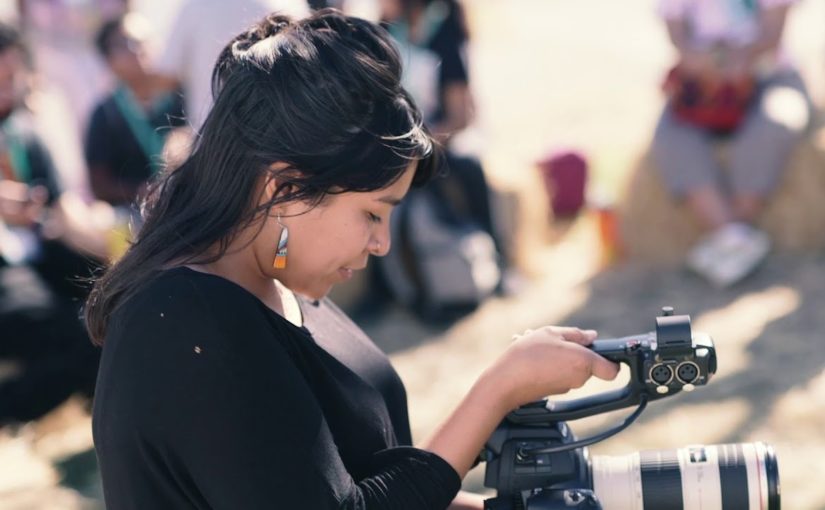
Indigeneity is a Native-led Program within Bioneers that promotes Indigenous knowledge and approaches to solve the earth’s most pressing environmental and social issues through respectful dialogue. By fostering a broader understanding of indigenous perspectives, we are building a network of allies to protect and restore traditional homelands. We do this by bringing people together, making original Indigenous-content media, fostering Native youth leadership, and developing learning materials for students and lifelong learners.
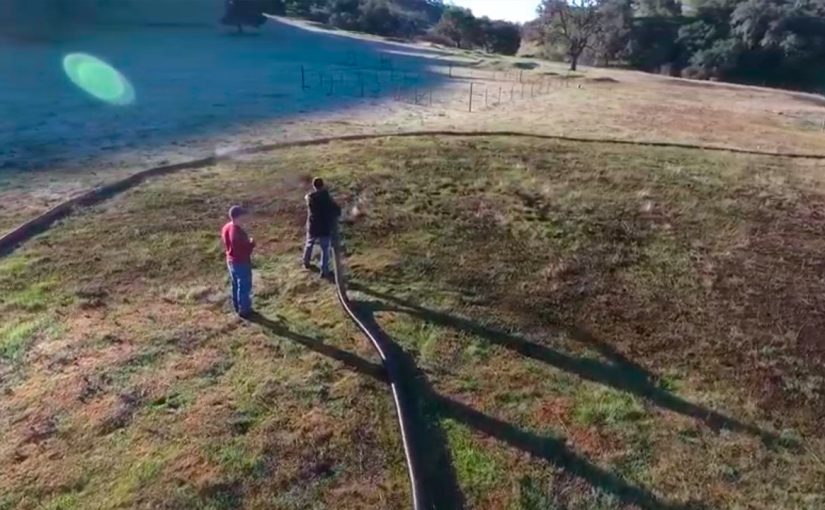
Cooling the Planet with Carbon Farming
John Wick and the Marin Carbon Project are developing innovative carbon farming practices based on their research of the carbon cycle’s impact on soil. These practices draw down dangerous levels of atmospheric carbon and sequester that carbon in the soil where it becomes an agricultural asset. More carbon in the soil increases fertility and yields and make farms more resistant to droughts. If adopted on a global scale, carbon farming can make agriculture a driving force that will help solve the climate crisis and cool the planet.
Explore the Bioneers Carbon Farming Series >>
Videography: Guido Lois and Brenda Manookin
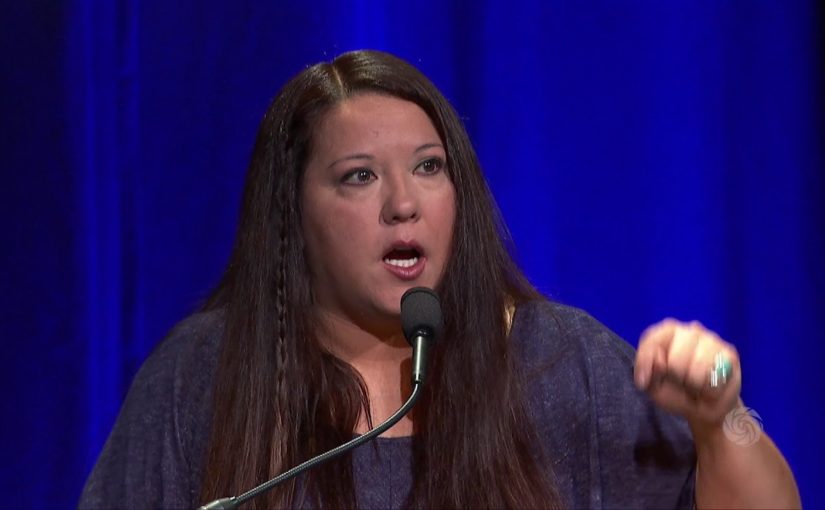
Kandi Mossett: Decolonizing the Mind (Short Clip)
Kandi Mossett of the Indigenous Environmental Network delivers a powerful address on First Nations, fossil fuels, and decolonization of the mind. In this short clip, Mossett dives into the concept of neurodecolonization through mindfulness as described by Dr. Michael Yellowbird and reminds us, “We have to get to the very heart of the problem of this broken system, which is capitalism and colonization.”
Bioneers 2018 Presenter Preview: Author & Herbalist Kami McBride
For more than 25 years, Kami McBride has worked to harness the power of the natural world. She’s taught experiential herbal programs focused on sustainable wellness practices and revitalizing our relationship with the plant world and also teaches popular online courses that empower people to use herbal medicine in their daily lives. In 2010, McBride committed some of her herbal knowledge to paper and published her book The Herbal Kitchen: 50 Easy-to-Find Herbs and Over 250 Recipes to Bring Lasting Health to You and Your Family, which aims to make cooking with herbs and other home-grown ingredients simple.

At this year’s Bioneers conference, McBride will host an Earth Connection Herb Walk during which she’ll help participants learn how to connect to the Earth in order to live more sustainably. She’ll not only discuss how to use what grows around us as medicine, but will also practice some simple, everyday ways of tuning in and listening to what the Earth has to teach us.
Ahead of the conference, the author and herbalist shared with us what she sees as our biggest challenge right now, and two of her must-read books.
What she’s most excited for within the next year: “Helping thousands of people deeply connect with the Earth through reviving the art of home herbalism.”
Her biggest reason to have hope right now: “The Earth is so beautiful. Every day I listen to her guidance and the solutions that she has for us to carry on. We can do this.”
Our biggest challenge to overcome right now: “Our biggest challenge is that we forgot that the Earth is our Mother, so we are acting like motherless children, fighting, squandering….. When we deeply experience the interconnectedness and relatedness, we can change.”
The number one thing individuals can do to have a big impact on the world in a positive way: “Tune into the song of their own heart: What is it that you truly came here to do at this time?”
The two books she recommends to our audience:
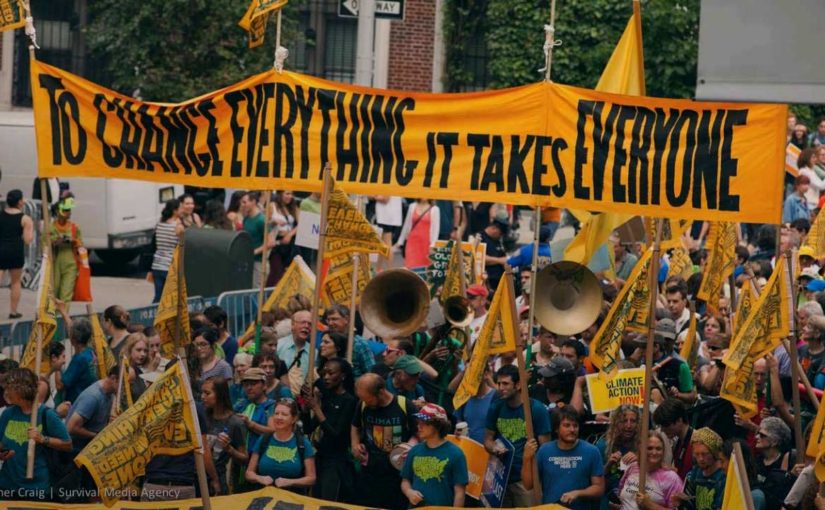
A Conversation about Climate Activism with May Boeve, Executive Director of 350.org
In 2007 May Boeve was a student at Middlebury College when she and several peers teamed up with one of their professors, a journalist named Bill McKibben, to launch an organization aimed at catalyzing a global climate movement: 350.org. It feels almost hyperbolic to describe the impact that 350.org has had on the global climate movement in the time since. With a truly global reach and influence, 350.org has helped to catalyze literally millions of people and thousands of direct actions, campaigns, marches and protests, all aimed at increasing awareness of and taking action on climate disruption. May is now the Executive Director of 350.org, a role she’s held since she was 27, and under her leadership (along with many others, as she’d certainly be keen to note), the organization has remained relevant and vital as the climate movement has evolved and transformed, expanding to incorporate and acknowledge other essential movements for environmental justice, indigenous rights and more.
May spoke with Teo Grossman, Bioneers Senior Director of Programs and Research about 350.org, international climate action, her own personal approach to this work and more.
Teo Grossman, Senior Director of Programs & Research, Bioneers: 350.org has accomplished a huge amount since its founding and has really been essential in describing and mobilizing action (along with other key groups, obviously). Do you have a sense of the overall size of the climate movement at this point? How many are we? In how many countries does 350.org have staff and affiliated networks at this point?
May Boeve, Executive Director, 350.org: We are many! We take a very expansive view of who is in the climate movement—not just individuals or organizations who have a specific focus on climate action, climate policy, climate organizing, climate communications, but also those who see themselves as impacted by climate change or who are working towards its solutions. In that sense we comprise a movement of movements—from farmers who are rebuilding healthy soils that also sequester carbon, to teachers who are instructing a new generation of students in the science of atmospheric change, to organizers advocating for 100% renewable energy in their communities as part of economic development. Climate change has many intersections, and powerful connections exist between the climate movement and movements for social justice, economic justice, human rights, etc.
In terms of 350.org, we have staff in about 28 countries, based on some of the hotspots in the world where lots of fossil fuel projects are being built but can be stopped, where there is financing for these projects, or where there is a vibrant movement we are tied into. We also work where climate impacts are already directly threatening front line communities. This list includes but is not limited to the United States, Canada, Brasil, Australia (through our partners at 350 Australia), the UK, Germany, South Africa, Japan, India, the Pacific Islands, and in Indonesia. Crucially this list does not include many other places where there are vibrant movements—this is what it means to be part of a larger movement. We work with partners in many other countries where there aren’t 350 staff, like Argentina, China, and Nigeria. There are also hundreds of other 350 affiliates and close partners.
TG: Internationally, there are ongoing campaigns across Europe, growing efforts throughout Africa and much more. What are U.S.-based climate activists unaware of that’s happening globally and how can we get involved?
MB: How much time do you have or pages to print?! There are tens of thousands of important fights taking place to prevent the worst effects of climate change. At times a particular campaign takes on particular prominence in the news and there are calls for global solidarity—like the #StopAdani fight in Australia where activists have effectively convinced numerous banks to refuse to fund the world’s largest proposed mine or the fight to stop the Rampal coal project in Bangladesh, located in a UNESCO world heritage site.
I would highly recommend plugging in on social media to keep track of these fights—you can follow us at @350 and we often post specific ideas about how to get involved. [Editors Note: See the map below for 350.org campaigns near you.]
Another way to think about involvement is that people in the US may be implicated without knowing it. This is a large part of why we are so committed to the fossil fuel divestment movement: because you may have your retirement savings invested in a mutual fund that is invested in, say, the Adani or Rampal projects. “Following the money” is often a very powerful way of being an ally to fights around the world, since so much of the funding comes from financial institutions with ties to the U.S.
All of the work happening globally is aimed at ending the age of fossil fuels as fast as possible ensuring a just and fair transition to 100% renewable energy for all. The Fossil Free campaign outlines the three demands we believe need to happen simultaneously if we are to have a good chance at averting the worst impacts of the unfolding climate crisis. We have campaigns all over the world pushing for the following three demands:
- 100% renewable energy for all. Activists in 14 cities across the Ukraine held “solutions fairs,” celebrating what a fossil free world could like in an effort to help spark more climate movement work in the region.
- No new fossil fuel projects anywhere. The DeCOALinise Africa platform is linking the fight to stop coal with the long-term struggle to stop colonization and linking liberation and climate movements together
- Not a penny more for dirty energy. Numerous cities continue to divest, not to mention the first country ever to do so: Ireland!
TG: What’s the biggest challenge in front of us? Where is your energy going these days? What are you most excited about in terms of opportunities for the movement?
MB: There are many. It’s the most challenging time I can recall since becoming active in the climate movement as a student. The number of global leaders (the Trumps, Putins and Dutertes of the world) advocating a militaristic, anti-people and pro-fossil fuel agenda is on the rise, and they are regularly sacrificing families, even children, to their agendas. They are restricting who can participate in politics, making more space for corporations and less for communities. Abhorrent and immoral decisions are taken regularly, and all of them take time and considerable courage and conviction to resist and then undo.
The times are indeed dark. Finding and looking for hope and motivation to fight back and pursue a proactive agenda is an increasingly essential practice.
There does seem to be a formula emerging in many corners of the globe. Community members have found ways to put their bodies on the line, to convince their global neighbors to divest, to lobby their governments, and ensure that the path they are on points solidly to 100% renewable energy for all and away from the polluting energies of the past.
Therefore, my energy is going into envisioning what it would look like to expand and inspire the amount of community-based Fossil Free fights around the world. Much of this is about the culture we create as a movement, that helps us work together to solve problems, to build and nourish and sometimes re-build relationships, and to sustain ourselves in these fights that often last years. The pressure of all this takes a personal toll on people, which is where solidarity with others and within our own communities is essential. It is a very natural response to the world we’re living in, but gratefully many people can see and recognize this and can help us stay connected. Connection is an act of resistance when our elected leaders work so hard to divide us. If our connection—particularly across the divisions of race, ethnicity, gender, religion, sexual orientation—weren’t so powerful we’d not be seeing this level of attempted division.
TG: Climate change is such a massive challenge – it’s such a complex issue with so much at stake and we’re arguably nowhere near where we need to be globally in terms of responding to it effectively. Are you hopeful?
MB: Yes. And I have to work at hope, as a practice, every day. I’m deeply distraught and paying close attention to the science and seeing people suffer and learning about ecosystems collapsing.
Our work is about building an increasingly larger movement that can build a Fossil Free world. I am not able to engage in that work without hope; because of what it means to build relationships and win campaigns with the energy hope provides. But I am also hopeful because of who I get to surround myself with: passionate and hard-working and kind people who accomplish things that sometimes feel impossible. Like the people of 350 Colorado who are working to pass a set-back on fracking after suffering a defeat last year; the people of Ireland forcing their entire country to divest; they are not backing down, they are learning and they are moving forward.
I have been very inspired by Rebecca Solnit’s work on hope—it’s an action, it’s a muscle, and it’s very much a choice. Especially for me, born with many privileges: to give up hope and give in to despair, seems an abuse of those privileges, when so many people who are living in targeted communities remain hopeful and vigilant in their own struggles. I recommend reading or re-reading Hope in the Dark every few months. My colleague and 350’s Programme Director, Payal Parekh, recently wrote a piece about “Overcoming Despair,” which I also recommend.
TG: What’s your experience with Bioneers? I think you attended first as a Brower Youth Award winner and have been back since. Has the event and network impacted you personally or professionally?
MB: I first attended a satellite conference in Fairfield, Iowa in 2004, when I was traveling across the country on a veggie oil bus. Twelve Middlebury students and I were part of Project BioBus, speaking to students about climate change and alternative fuels. We were in Iowa for Bioneers and our bus was on display. I felt at home there, and it was part of a discovery at that time about who else was out there. So much of my experience in the climate movement has been like that—the sense of awe and relief to learn just how much is going on out there. It gets to your first question: we are so many.
I also remember being very inspired at Bioneers in San Rafael years later. I learned about Wiser Earth at Bioneers from a talk by Paul Hawken, and the 350 team invited everyone listed in that database to participate in our first global day of action. I first heard Naomi Klein at Bioneers and bought her book Shock Doctrine. Now she’s on the Board of 350, a real dream come true to have your own hero in your midst.
Lastly, I am very inspired by the cross-movement view Bioneers has taken, increasingly bringing a wider equity lens to the work, and expanding the sense of who’s involved. I was glad to see my friend Heather McGhee, President of Demos, speak last year about a new “We The People” for as sustainable future. And perhaps most importantly, Bioneers has been an early champion of the full recognition of the leadership of indigenous peoples in the movement, including my colleague Clayton Thomas-Mueller, long time Board member and Bioneers change agent.
TG: What are you reading at the moment? Do you have 3 books to recommend to our audience?
MB: Democracy in Chains by Nancy McLean, Sing, Unburied, Sing by Jesmyn Ward, The Farm by Hector Abad
The Eagle Hoop Prophecy by Anita Sanchez
The following is from the introduction to The Four Sacred Gifts: Indigenous Wisdom For Modern Times by Anita Sanchez, Ph.D.
“The hoop is an evolving symbol for humanity, as its wisdom and presence reminds us of how to be and how to do.”
—DON COYHIS, MOHICAN ELDER AND KEEPER OF THE HOOP
In 1994, a vision came to a Mohican man as he slept in his house tucked into the large pine trees on the edge of the Rocky Mountains. An eagle flew above his sleeping self, dropping a beam of light upon the man’s head. This ray of light began to expand, reaching from the sky to the earth. Within the light, a very small sprout sprung forth, becoming a tree, growing through each of the four seasons—the spring, summer, fall, and winter.
 Then the leaves of this tree began to fall off. And then soon, the branches began to fall off. What remained was a single stem of the tree, which rose up vertically and then turned horizontally, bending and forming itself into the perfect shape of a circle to represent the earth and the universe.
When the circle or hoop was completed, a single dot of light formed in the sky, coming down to the hoop. The dot of light transformed into an eagle feather attaching itself to the hoop. Then more and more dots of light came from all the four directions—north, east, south, and west—becoming eagle feathers, attaching themselves to the hoop until there were one hundred eagle feathers in all.
When an indigenous person seeks guidance, being in right relation with their community, they will naturally seek out the wisdom of the Elders, who are in communication with spirit and Mother Earth. So, with this dream, Don Coyhis, Mohican messenger, and members from his Turtle Clan took this vision to seventeen Elders in South Dakota, who said, “You need to build that hoop.” They saw this vision as a prophecy of the coming together of the human race: “There is only one race, the human race.” The Elders said, “We walk around on earth in our earth suits. Some come in red earth suits, some white, yellow, and black. Take these four colors of ribbon and wrap each around the hoop, bringing them together in the middle, and joining them with one eagle feather in the center.”
Listening to the Elders, they began to build the sacred eagle hoop. A willow branch was made smooth and gently shaped into a circle. They took the colored ribbon—red, white, yellow, and black—praying and wrapping each one around the hoop. They took their collection of one hundred eagle feathers, praying and attaching each one to the hoop.
Then there was a sacred gathering and hoop ceremony. Twenty-seven indigenous Elders from the four colors and directions—Elders from the North American tribes representing the red and south direction, a Buddhist Elder from Tibet representing the yellow and east direction, a Sami Elder from Finland representing the white and north direction, and two Elders from African tribes representing the black and west Direction responded to the call.
During the ceremony, there was no man-made notion of time—past, present, or future; there was only the Now, one spirit, calling forth through the human beings, through their different languages, through their sacred chants, prayers, blessings, and meditations. There was no separateness, only one mind, one heart, one spirit connecting these Elders and their sacred traditions from the four directions.
The twenty-seven Elders, with joy and solemnity, took cedar planks, laying them in the four directions, placing the hoop on top, and saying, “We have come together. We will put into this hoop four gifts that are necessary for this coming together . . . this healing time.
“The first gift we place is the power to forgive the unforgivable.
“The second gift is the power to heal.” The Elders prayed their healing medicines into the hoop.
“The third gift is the power of unity. The power to come together.
“And the fourth gift is the power of hope. The ability to dream, to see wellness and the powers to attain it.”
After the sacred eagle hoop was built and blessed by the twenty-seven Elders with their four gifts, the hoop began a great land journey, traveling through thirty-five states in the U.S. and to Canada. Don Coyhis took the hoop and traveled to cities, communities, colleges, reservations, and homes. He traveled through many seasons, climates, and environments in this land of our ancestors.
And on this journey, an awakening began. A healing time of prayers, tears, hopes, and a creating time of dreams from all the people, indigenous and non-indigenous alike. Standing in a central place, the hoop is both symbol and catalyst to our awakening, which continues to unfold in magical ways as it makes its journey, touching so many lives.
The four colors, the four directions of the hoop, symbolize harmony and interdependence between the different peoples around the world. The hoop is meant to support all people to discover and trust the four sacred gifts, so that each of us can be a life-giving connection to others: all beings, earth, and spirit. The hoop is a powerful force, a powerful medicine, a coming together of the human race.
Momentum is building. A movement is building across our great lands. We are seeing with a clearer vision the strength and wisdom of our Oneness, and the gifts of the hoop are needed now more than ever to help us realize that vision of life…
THE PROMISE OF THE FOUR SACRED GIFTS
The prophecy of the sacred eagle hoop is an urgent message for these urgent times. And, being an indigenous prophecy, it does not revolve around a single person, prophet, or hero. The focus of the prophecy is not on the messenger but rather on the message itself, and the collective community or tribe that holds the message. This is good news.
You and I, all of us, indigenous and non-indigenous, are meant to fulfill the message of the hoop with its four sacred gifts. The hoop prophecy does not predict the future; rather, it presents the probable positive or negative consequences of not heeding the original instructions from spirit. This is what is needed to joyfully fuel our hearts, thoughts, and actions in order to deepen our understanding, to live the truth, the reality, that we are all connected.
So, if you do not remember where you came from, your culture, or your tribe, you have now found your Home. Welcome to this community, the community of human beings who accept these four gifts from the Pan-Indigenous Collective of Elders, and who will use their power to create harmony and connection with all other beings.
Excerpted from The Four Sacred Gifts: Indigenous Wisdom for Modern Times by Anita L. Sanchez, PhD, Excerpted by Permission of Simon & Schuster – Atria Books. All rights reserved. No part of this excerpt may be reproduced or reprinted without Permission in writing from the publisher.
For more information visit www.FourSacredGifts.com
Intellectual Ecology: Green Chemistry and Biomimicry | John Warner
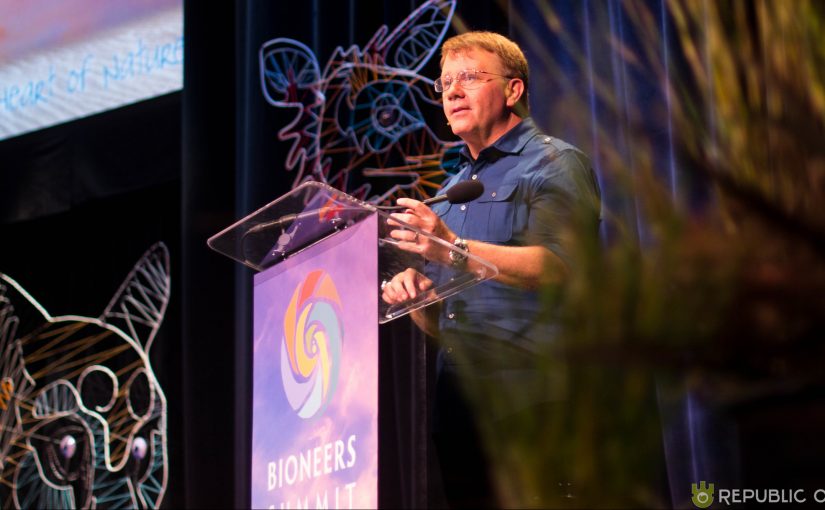
As the president of the Warner Babcock Institute for Green Chemistry as well as the non-profit Beyond Benign, John Warner is on the forefront of designing chemical products inspired by nature and designed to do no harm to people or the planet.
John Warner examines the toxic character of chemistry and reflects on his own path into the field of industrial chemistry and then asks why we don’t look to nature, the most brilliant chemist there is, for the chemical solutions to our modern problems.

Bioneers 2018 Presenter Preview: Author & Medical Historian Victoria Sweet, M.D., Ph.D.
Victoria Sweet, M.D., Ph.D., recognizes the benefit in taking her time. An Associate Clinical Professor of Medicine at UCSF and a prize-winning medical historian, her more than 20 years of practicing medicine at Laguna Honda Hospital in San Francisco have given her amazing insight into how the medical field has changed over the years—for better and for worse. Sweet recently published her second, highly acclaimed, book Slow Medicine: A Way to Healing, which discusses those changes, including incredible advances in technology, and the most important thing we often push aside when dealing with health: the time it takes to find effective treatment.

Sweet will take the stage at Bioneers 2018 alongside Rupa Marya, MD, Associate Professor of Medicine at UCSF, for their talk, Revisioning Healing and Public Health in the 21st Century. Both extraordinary physicians will deliver radical critiques of the current medical paradigm and share their strategies and visions of what an effective, equitable, truly compassionate medical system would look like around the world.
In advance of the conference, Sweet shared with us some of things on her mind, including what she sees as our biggest reason to hope right now, and how we can all benefit from slowing down.
What she’s most excited for within the next year: “Getting to spread the word about Slow in general and Slow Medicine in specific.”
Her biggest reason to have hope right now: “The new generation coming up is an amazingly open, respectful group of people, of all kinds and natures.”
Our biggest challenge to overcome right now: “The seductive power of pessimism. Looked at historically we are living in an amazing time. There are no World Wars going on. No major worldwide plagues. Our biggest medical problem regarding food is not starvation but obesity, and this even in third world countries.”
The number one thing individuals can do to have a big impact on the world in a positive way: “Slow Down. Focus. Be digital and do one thing at a time. As Dante wrote almost a thousand years ago, ‘Haste mars the dignity of every action.’ Every action has a dignity, and falling into the trap of multitasking destroys the present moment.”
The Bioneers 2018 talk she’s most excited to see: “Rebecca Moore’s Using Big Data to Map Solutions and From the Ground to the Cloud: New Solutions and Mapping Tools. She is changing the world.”
The two books she recommends to our audience:
- The Road to Wigan Pier by George Orwell
- Wars I Have Seen by Gertrude Stein
Decolonizing Wealth: On Kinship
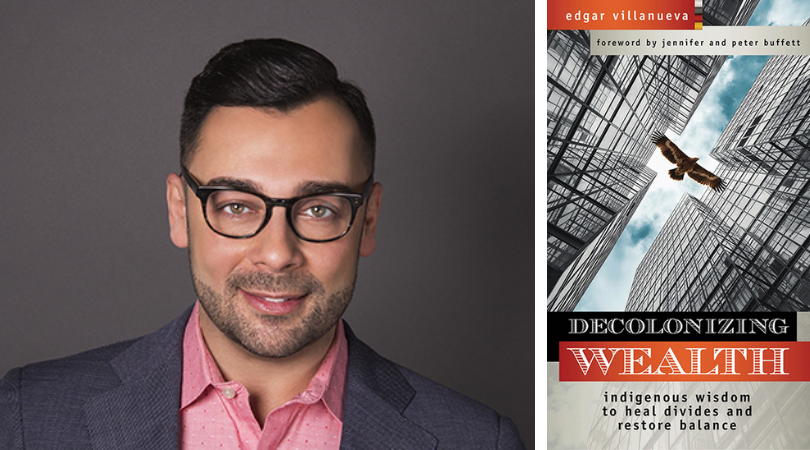
By Edgar Villanueva
The following is an excerpt from my forthcoming book, Decolonizing Wealth (release date October 16, 2018 with Berrett-Koehler Publishers). The book offers not just a provocative analysis of the dysfunctional colonial dynamics at play in philanthropy and finance, but also a potential road to transformation guided by Indigenous wisdom: Seven Steps to Healing. I hope this little appetizer makes you hungry for the book.
My central metaphor for the subject of colonization is the body, because we each instinctively understand our body’s sense of sovereignty and the sense of violation. Unfortunately, almost every one of us alive on earth has experienced some kind of trauma. So chances are you know what I am talking about.
The initial phase of colonization—the conquest— is like a rape, causing the first wave of trauma. Later—when the colonizers set down roots and become settlers—colonization becomes more like a virus that every human institution and system as well as every human being carries inside. The collective body—the nation and culture of settlers and surviving colonized people—adapts, passing down these adaptations in their genes over generations. Yet the adaptations don’t constitute healing. The virus remains: the original seeds of separation—fear of the Other—that lead to ongoing acts of control and exploitation.
The colonizer virus inside culture and institutions is especially dangerous. Our education system reflects the colonizer virus. So does our agriculture and food system. So does our foreign policy. So does our environmental policy. So does the field of design. And, the subject of this book, the realms of wealth: investment, finance, and philanthropy.
There is no quick fix for the complexity of colonization: decolonization is a process with roles for everyone involved, whether you’re rich or poor, funder or recipient, victim or perpetrator.
All my relations—Mitakuye oyasin, as the Lakota say, meaning: we are all related, connected, not only to each other humans, but to all the other living things and inanimate things and the planet, and also the Creator. The principle of All My Relations means that everyone is at home here. Everyone has a responsibility in making things right. Everyone has a role in the process of healing, regardless of whether they caused or received more harm. All our suffering is mutual. All our healing is mutual. All our thriving is mutual.
Author Bio
An enrolled member of the Lumbee Tribe of North Carolina, Edgar Villanueva has directed the flow of hundreds of millions of dollars for over a decade as a philanthropy professional. In his new book, he diagnoses the dysfunction in the institutions, systems and people that deal with money: it’s 21st century colonialism. Integrating traditional indigenous wisdom with savvy financial experience, Villanueva explains how money can be used to facilitate relationships, to help us thrive, and to bring things back into balance.
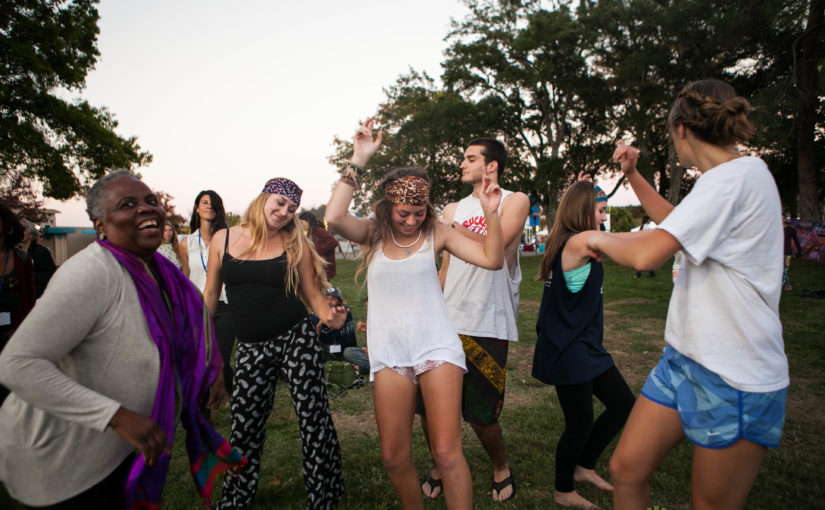
Launch of the Youth Leadership Crowdfunding Campaign!
Greetings Fellow Bioneers!
The Bioneers Youth Leadership Program is thrilled to announce the launch of the Youth Leadership Crowdfunding Campaign! This program inspires and nurtures the next generation of visionary leaders through skill-building, mentoring and networking. The Bioneers Youth Leadership Program (YLP) offers over 400 young leaders and activists the opportunity to listen, create, express themselves, ask hard questions and get real answers in an open-hearted, brave space. If you’ve been to Bioneers, you know first hand how powerful and passionate our youth participants are!

This year we are offering an inspiring set of programs for youth including conversations about restorative justice, queer identities and immigration policy, as well as workshops on storytelling through spoken word and embodied drama performance! It’s going to be a powerful experience for the youth who attend. Learn more about this year’s program.
Bioneers is committed to making our conference accessible to young people from all backgrounds. We recognize that communities who are on the frontlines of environmental crises must be included and centralized in building solutions to climate change and social injustices. It is our intention to make the Youth Leadership Program accessible to young climate leaders and activists, many of whom have limited resources, which is why we are asking for your help!
We invite you to contribute to developing leadership in our youth so they can help guide a graceful transition into our shared futures. You can support our campaign in a number of ways!
- Contribute to our campaign on our crowdfunding page
- Ask close friends and family members to also contribute!
- Share the campaign with your own personal networks via email and social media.
- If you’ve had a first hand experience with the Youth Leadership Program, share a testimonial — written or video — about why it was powerful to you.
Please partner with us and help young leaders connect with the information, networks and inspiration that will support their activism.
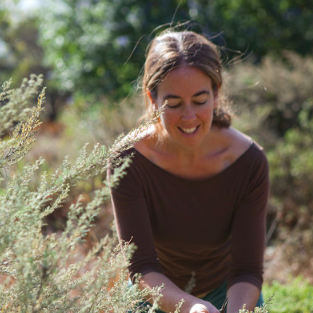
Creating a Carbon-based Local Economy
by Rebecca Burgess
How can local economies value carbon farming practices in finished consumer goods? Fibershed represents a 160-member producer community, spanning from the Oregon border to San Luis Obispo and from the Pacific Ocean to the Sierra foothills, that is managing working landscapes strategically to sequester carbon. Burgess gave this talk, transcribed and edited below, as part of the Bioneers Carbon Farming Series.
How do basic human needs – food, fuel, flora, fiber – get met within an economically and ecologically strategic geography?
There are 25 million hectares of rangelands in California and a key question is whether we can manage them to help lower Earth’s temperature. Most rangeland systems have very low amounts of carbon. California has lost around 40% of its carbon in its rangelands due to the loss of perennials. These soils are in a massive carbon debt.
Fibershed is organizing place-based economies around carbon. As Carbon Farming practices become implemented, it becomes apparent how heterogeneous soils are. Organizing your farming system for carbon is specific to place.
You can look at local places through the lens of carbon, through the lens of watershed health, through the lens of fiber systems, and food systems. Pick your immediate organizing principle and you can start to focus on the restoration of your community.
I wore clothing for one year–underwear, bathing suits, socks– everything was made from animal fibers and plant fibers, including the dyes, that came from 150 miles from my front door. I used myself as a guinea pig to find out if I could I live in a fibershed. Could I be comfortable physically and socially? The reality was an affirmative yes. There was nothing more visceral then getting rid of everything I owned and boxing it up to experience the necessity of clothing.
We can’t go many days without water, we can’t go many days without food, but how many of us would even survive a night or two in the winter outdoors without any form of shelter? Its function is so fundamental, just as the necessity of clothing is so vital to our ability to survive. So fibersheds are about survival, but they are also about thriving. Fibershed’s intention is to have a thriving, regional and regenerative fiber system.
Connecting Urban Consumers to Rural Working Landscapes
The principle I based the local wardrobe on is about connecting urban communities with rural communities. Part of how we’re going to see carbon farming take hold on the landscape is by generating conscious urban communities that know how to compost, that care about the fate of their materials, and care about what they’re consuming from working lands. Are they consuming from regenerating and restored landscapes? Is the material that they consume going back to these landscapes at the end of use?
Are food scraps going back to the landscapes? Can you compost your clothes and return that compost to the landscape? We are looking at all of these questions about the cycle of carbon systems. The urban connection is so critical. You need the cooperation of urban and rural communities to make these place-based economies work.
Fibershed works with one hundred sixty producers who are land managers, contract grazers, farmers both in annual and perennial systems. They are artisans who actually metabolize the materials coming off of these farms and ranches. They are small manufacturers. All these people networked together can produce clothing.
Everything that we are growing in this fiber system is on farms and ranches that are primarily making their money from food. 99% of the income for a sheep rancher is the meat and, in today’s economy, the wool is considered a by-product. Even in the cotton industry, 20% of the farmer’s income is from the seed. Cotton seeds go into the feed for dairy cattle and make cottonseed oil that goes into fast food. These systems are intertwined. We have to consider a whole vision of agriculture as we’re rebuilding these local economies.
Agriculture is a food, fiber, fuel and flora system. As we re-envision local economies, let’s not discount the capability that working lands have for generating biosphere-based economies. They’re very much designed to do so and if we’re going to re-envision, we need to stack a lot of functions within these working lands.
Wool and the Carbon Cycle
Managing grasslands for carbon requires adaptive managed grazing, planting windbreaks, and developing silvopasture. A lot of the people who are going to be doing the work to sequester carbon are the people who manage flocks of sheep. We have to build a bridge between the science and the people on the ground.
The grass that sheep eat is approximately 40% carbon by weight. That’s carbon dioxide that grass turned into a carbohydrate. Sheep are able to metabolize the carbohydrate, and turn it into a protein. That’s a protein you wear.
We conducted an analysis that quantitatively and qualitatively mapped all of California’s wool – the first analysis of this type in the US. We learned that California has quite a lot of wool that’s not being utilized at all and about a third of it is highly underutilized. All the sheep are on grass systems and therefore wool is a grass-fed and finished fiber. The sheep are often integrated onto crop stubble. They’re in pear orchards. They’re in vineyards. They’re part of an integrated crop system. Without having to change very much, sheep already fit into this contract-grazing system very nicely. A lot of young people are able to get into agriculture by having flocks of sheep that they contract-graze into perennial systems. Sheep already fit into a positive agricultural narrative in California.
Sheep’s wool cycles through the carbon pools very nicely. Have you ever had a wool sweater that goes back to the soil by way of moths or some other kind of deterioration? I cleaned out a storage bin recently and moths had gotten into pretty much all of my historic wool pieces. But that’s a beautiful thing. That wool is temporal. It doesn’t last. We need to think about our material culture as not being impenetrable. We’ve been trying to create material culture that lasts forever and it’s actually what’s killing us. We need things that decompose back into the cycle. People ask me, “Do natural dyes last as long as synthetic dyes?” My answer is “No, and that’s in your best interest.”
Re-Localizing the Economy
The model that we’re working with is a soil-to-soil model, meaning we’re thinking a lot about the whole system. Who are the rangeland managers? Who are the farmers? How are we going to get carbon farming implemented? How are we going to build these regional economies that support these land managers to revalue the materials coming off their farms and ranches?
We can wear nettle, we can wear hemp, we can wear ramie, we can wear flax. We can blend these with sheep’s wool to take the scratch out of the wool. We can do an incredible amount with biodynamic organic cotton.
Fibershed focuses on fiber and dye processing. We do economic feasibility studies because since 1994, NAFTA and CAFTA and FTAA, all those fun trade agreements, have left our country bereft of manufacturing. California produces 3.1 million pounds of wool, but how many people wear a California wool-based layer? California grows 200 million pounds of cotton, but how many people wear a California cotton T-shirt? How many people wear leather boots that came from a grass-fed and finished operation?
There is a lot of work being done on access to food, but not much of a focus on access to fiber. Part of the reason is that the capital costs of bringing manufacturing back are real and present, just like when people tried to reform the food system and bring back abattoirs and slaughterhouses. The dirty, messy stuff that’s between the farm and your plate is something a lot of people have a hard time investing in. It doesn’t have to remain that way, but historically manufacturing is a difficult thing to bring back.
The other segments we work with are designers and makers. This is the urban sector. How do we get young people in the making culture focused on local materials? We spend a lot of time with fashion students to figure out how they can work with a farmer.
Garments are where you come in as the wearer. We need you to start wearing compostable clothing, we need you to buy local when you can, we need you to buy less and higher quality. We need you to think about your clothes as a necessity and not just a statement. Public consciousness is the hinge for all these other pieces to be implemented.
Investors and philanthropists can drive the value-chain by giving farmers and ranchers low-interest loans and investments to help build carbon in their soil. Investors and philanthropists can invest in the mills where they make local clothing, places where the farmers can send their goods for a higher value. Consumers buy it because of the higher value, and the money cycles through the local economy.
It will take about $100 million to revitalize fiber systems in California. It’s a one-time investment that could last for many hundreds of years. The Schmidt Family Foundation helped with a public-related investment to the first weaving mill in California since 1892. This mill opened its doors in May 2017. The Foundation wrote into the loan contract that the mill had to work with climate beneficial wool and organic cotton.
We are working with a Carbon Farm Plan for a 40,000-acre ranch. This ranch can sequester enough carbon to offset the emissions of the wool production, so every pound of wool represents nine pounds of carbon sunk into the ground. If we implement the practices of the Carbon Farm Plan, we can have climate beneficial clothing production with a net-negative carbon impact.
We can do this. We can wear clothing that has a net-negative impact on the climate and we can also support our local producers in the process.
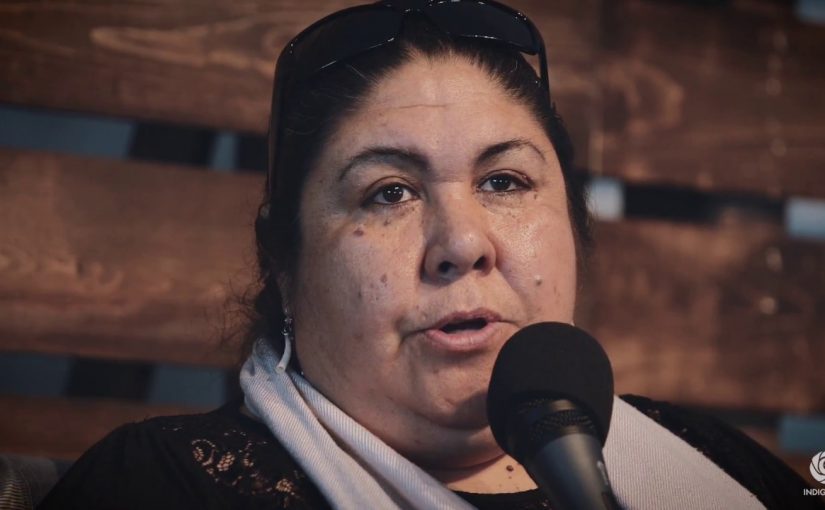
California Indian Genocide and Resilience
California Indians have survived some of the most extreme acts of genocide committed against Native Americans. Prior the ongoing genocide under Spanish and American colonizations, California Indians were the most linguistically diverse and population dense First Peoples in the United States. In this historic panel, four California Indian leaders share the stories of kidnappings, mass murders, and slavery that took place under Spanish, Mexican and American colonizations — and how today’s generation is dealing with the contemporary implications.
This presentation took place in the Indigeneity Forum at the 2017 National Bioneers Conference.