Rupa Marya: Decolonizing Medicine for Healthcare that Serves All

Rupa Marya, M.D., Associate Professor of Medicine at UCSF, Faculty Director of the Do No Harm Coalition and a leading figure at the intersection of medicine and social justice, investigates the health effects of police violence on communities through The Justice Study and is helping set up the Mni Wiconi free community clinic under Lakota leadership at Standing Rock. She is also the leader of the internationally touring band Rupa and the April Fishes.

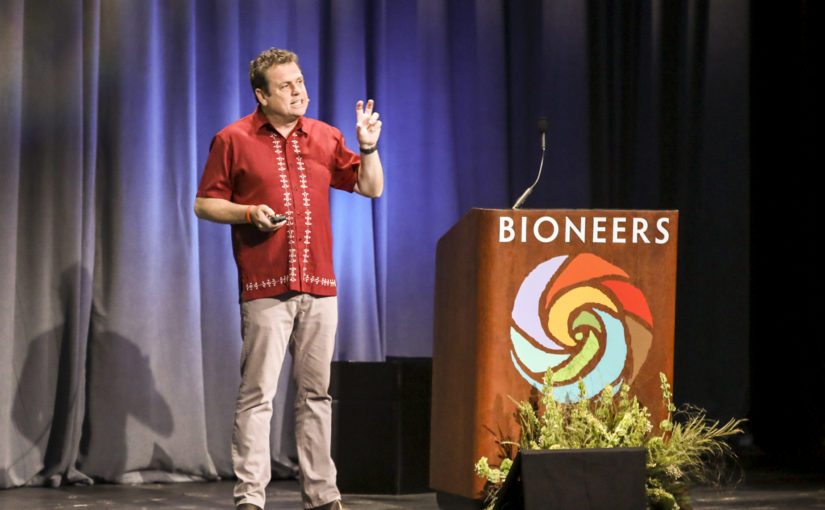
Following is a transcript from Marya’s presentation at Bioneers 2017, where she discussed her work to understand how societal influences impact the health of communities and what medicine and medical practitioners can do to take those influences into account.

Watch Rupa Marya’s 2018 Bioneers keynote talk on health and justice.

My work in hospital medicine, I believe, has exposed me to the frontlines of the diseases of our society. Disease is a great democratizer. Everyone gets sick. Everyone gets ill. And I’ve seen my position in the hospital as a very privileged space to be able to witness the leading edge of society’s problems, from how undocumented people are affected by pesticide application in the Central Valley and the diseases we see coming out of there, to people not seeking healthcare because they’re undocumented, to issues around racism and state violence.

So I started organizing with the Do No Harm coalition. I started organizing with a group of medical students when we were taking care of a group of five people who were protesting police violence in San Francisco: the “Frisco Five.” They went on hunger strike and sat out in front of the Mission Police Department protesting the killing of black and brown and mentally ill people in San Francisco by the San Francisco Police Department with no accountability, no transparency in the investigation, and basically no justice for the killings.

We started organizing around this idea that police violence is a public health issue, and that racism and state violence are public health issues. They not only affect the bodies of our patients and the people who are left behind, but also, when there is no accountability for this violence, it erodes the very civic fabric that we rely on: the trust between governance and individuals. As a society right now, we’re seeing so much distrust between different communities and the state institutions.

We’re working on articulating what happens when there are disparities in health because of race. How can we look at the issue not as an intrinsic quality to a person’s body? Being black doesn’t make you somehow biologically inferior with a worse life expectancy, higher rates of diabetes, higher rates of heart disease, and higher rates of infant mortality. The social structure around it is what is causing these dysfunctions. Race isn’t the issue that we need to look at, it’s the racism. It’s the social structures that are creating the underlying diseases and the disease differences that we’re seeing.

We’re starting to articulate a language around this. Then we use this language in the hospitals as we’re seeing patients and also out in the communities that we serve.

One of the things we’re doing is providing medical support for community groups that are engaging in direct actions, confronting racism and state violence. … We’re also advocating for greater transparency and accountability, and currently we’re also helping to develop a free clinic at Standing Rock for the practice of decolonized medicine. …

I went out to Standing Rock, and what I experienced there as a healthcare provider was striking, because it gets at the heart of what I’m interested in in medicine: the intersection of society and the human body and our health, and how we can see social structures directly leading to poor health outcomes for different groups. I had always known about the genocide of Native people growing up in this land. I was born in Ohlone territory. But it wasn’t until I was at Standing Rock, witnessing the violence of the police, that I understood how this is actually an ongoing process. Genocide is continuing, and it has these very deep ramifications, not just for Native people who are experiencing it after several centuries, but also for those of us who are standing with them. And also for the perpetrators of the violence.

Through this work at Standing Rock and meeting with different Lakota/Dakota health leaders, we started to ask questions about how to heal from this legacy of genocide; how can we create structures; how can we create systems that can help improve health outcomes for Native American people?

For two years, a website run by a group of journalists in the UK was the only way we here in the U.S. could get real-time data on how many people were being killed by the police. They did that in 2015, in 2016, and then they stopped. And they made a statement that due to our excellent work, now the FBI and the federal government wants to be doing a better job with counting. But right now, this is my area of active research, and we have no data. We have no data for 2017. We don’t know how many people have been killed in the U.S. by cops.

What was great about The Counted website is it gives a photo of every person killed. It talks about their race, it talks about the circumstance: were they mentally ill; were they armed; were they unarmed. In 2016, of the almost 1,100 people that were killed, Native Americans were targeted disproportionately. For being 2% of the U.S. population, the group that was killed at the highest rate was Native Americans followed by blacks and Latinos.

The state violence toward Native people is ongoing. Near many of the man camps that grow up around placing these pipelines or being involved in these extractive industries, many women have gone missing. For many of the women who are missing, the local law enforcement doesn’t really go investigate.

The Standing Rock people, the Lakota/Dakota people, are broken up into several different reservations. If we compare their life expectancy and health outcomes to everybody else in the U.S., we can find that they have the lowest life expectancy anywhere in the United States. It is interesting to me to think about the health and disease of the Lakota/Dakota people in relation to the fact that these were the last Indigenous people in the U.S. to go into reservation status. They were the fiercest fighters of colonization in the U.S. The largest mass execution in the United States was the Dakota 38 ordered by Abraham Lincoln. I do think that these things are related.

Young Native people are twice as likely to die in a suicide attempt as other people here in the United States. Studies have shown that Amazonian tribes that have been contacted within the last 50 years and colonized within the last 50 years, their rates of suicide go through the roof. There’s an experience of colonization that is actually somehow directly tied to suicide.

I also think of the farmers in India after the Green Revolution, with Monsanto going into these farms and developing relationships with farmers whereby they lose their ancestral lands within two or three cycles of crop rotation. A lot of these farmers have drunk the pesticides and committed suicide. Hundreds of thousands of farmers have enacted suicide like this. There’s a very interesting social experience that we’re witnessing of loss of self and identity to Earth placement, that triggers a suicidal impulse.

So we were asking: What can we do to confront this legacy of genocide? What can we do to give resilience to our people? And in meeting with health leaders and community leaders there, we’ve decided that we would like to create a partnership to create a clinic and farm. Our mission is to support the Lakota and Dakota people in decolonizing medicine and diet to improve their physical, mental, emotional, and spiritual health. For me, this clinic is the greatest example of social medicine, because I believe that we cannot move forward as a society until we address our primary violence, which is against the Native people.

The clinic will be based in Fort Yates, which is in the Standing Rock reservation, and it will serve all the Plains people. It will be a free clinic. The site that we have donated to use is a 3.5 acre parcel, and it’s surrounded by water. This is an island that is in the middle of the Missouri River.

In order to decolonize medicine in this space, we absolutely want to have a kitchen, traditional round structures, a waiting area. There will be a pharmacy that will have a formulary that’s developed by Tyson Walker, who’s a white Mountain Apache UCSF pharmacy student. It will be the first formulary of its kind.

Interestingly, they wanted to have private exam rooms big enough to fit a family. The concept of privacy is very different in Lakota culture. They want everyone in the exam room having the dialogue with them. Because illness is often seen as a system issue, they want to have a spiritual and ceremonial space integrated, not as a side offshoot but in central to the way this physical space will be. They also want a children’s area and an elder’s area. These are things we don’t commonly think of in a clinic. They would like to have a birthing center eventually. They want to have classrooms. They want to have housing. They want to be off the grid. They want to have water recycling. They really see that this clinic could be a vision for how they could be building and how they could be taking care of themselves.

Our role from UCSF will be in witnessing and in serving. For us, decolonizing medicine doesn’t mean putting the doctor in the center of the doctor/patient interaction. It’s allowing the Lakota practitioners, the Lakota cosmology of understanding and health, to dominate, and to be present to witness, to learn, and to support as needed and when needed, which is very, very unusual for doctors.

We’ll also be putting our values of diversity and dignity into action, contemplating our roles as healthcare workers. What does it mean to serve Indigenous communities, especially ones where doctors have been the agents of genocide? And then bringing home those lessons here to UCSF and thinking about how we can serve our Indigenous communities and underserved communities here.

Right now, we are developing an educational curriculum around decolonized medicine together with the Naha students, and we’ll be providing a launchpad for careers in healthcare to the under-represented minorities who are there. We’ll be partnering with Sitting Bull College, which is there on campus, right across from where the health campus will be, and giving those students who want to volunteer in the clinic UCSF credit for their participation in learning about how to run a clinic.

I want to briefly explain how we’re formulating this concept of decolonizing medicine. In traditional medicine, we have what I think of as the paternalistic approach to healthcare, where the doctor is bigger, smarter and knows more, and you are the little patient. The doctor tells you what health is. Or maybe they won’t tell you and they’ll just do a procedure and not really clearly explain it.

Now we’re in an era of the patient-centered approach, where you have a doctor and patient and they’re equal. They’re in a partnership, and health is something they discuss together. Then you have all these things around the social history. You might incorporate some herbal medicine. You have nurses, you have some acupuncture. Still in the center, it’s dominated by the Western medical perspective.

With decolonizing medicine, at the center of the interaction is that person’s concept of health. That’s something that the patient and the doctor come together to understand. And it’s influenced by the socio-political environment. It’s influenced by your family and your community, by your diet, your access to healthy foods. It’s influenced by traditional healers and spiritual practices. If you’re living in a place where they’re putting a pipeline through your clean drinking water, that’s going to have an effect on your health, whether it’s an effect on your spiritual health, your sense of your sovereignty, your autonomy, your dignity, or your sense that genocide is still an ongoing thing. These elements all impact the concept of health. At the Mni Wiconi clinic, this is how—this is how we’re conceptualizing everyone’s involvement.

Bioneers 2018 Presenter Preview: Ecologist Jason Turner

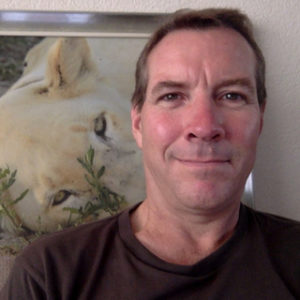
With more than three decades of experience in wildlife conservation management and research, Jason A. Turner, MSc, has become a world renowned lion ecologist. Based in South Africa, Turner is Director of Ecology for the Global White Lion Protection Trust, which he established alongside conservationist Linda Tucker in 2002. Turner, who is also Chairman of the Wilderness Security and Anti-poaching Forum, has led groundbreaking studies on white lions, including the impact of lion predation on South Africa’s large herbivore population and an effort to rewild and study an integrated pride of white and tawny lions in the country’s Greater Timbavati Region.

At this year’s Bioneers Conference, Turner will join Tucker on stage for their presentation, What We Can Learn from South Africa’s Legendary White Lions. The duo will explain how this rare species has helped bring together cutting-edge modern ecology with Indigenous ancestral wisdom to help heal ecosystems and divides of race, tribe, gender and culture, and they’ll also share what these extraordinary creatures can teach us about our own capacity for leadership.

Bioneers 2018 speaker Jason Turner

In advance of the 2018 conference, Turner shared with Bioneers a few of the things that are on his mind, from the challenges our planet is currently facing to the top three books he recommends reading.

What he’s most excited for within the next year: “First, collaboration for the 1st time by several other conservation and animal welfare organizations to motivate the South African Government to stop unethical hunting and trade in lion body parts to save lions, and particularly white lions, from going extinct. Second, progressing my Ph.D. and doctoral study on the ecological importance of the white lion as a flagship and capstone animal in the UNESCO declared Kruger to Canyon Biosphere in South Africa.”

His biggest reason to have hope right now: “The level of collaboration by other like-minded organizations, and the integration of different disciplines—science and indigenous knowledge, for example.”

Our biggest challenge to overcome right now: “Stopping the global exploitation of nature, its inhabitants (human and nonhuman; tangible and intangible; fauna and flora) and all that comprises the Earth.”

The number one thing individuals can do to have a big impact on the world in a positive way: “If every individual recognizes that they can make a difference, and do their part to stop the exploitation of the Earth, no matter how seemingly small—like recycling in their kitchen at home or stop buying straws—irrespective of age, career path, or social standing. Every individual has a voice and a right to say how the planet is treated, and collectively we have the ability to effect change.”

The Bioneers 2018 talk he’s most excited to see: Monica Gagliano & Michael Pollan: Plant Intelligence and Human Consciousness – Into the Mystery

The three books he recommends to our audience:

Bioneers 2018 Award Recipients

Every year Bioneers hosts a special evening on the Saturday night of the conference during which awards are given to a small handful of environmental and social leaders whose work we especially admire or consider particularly relevant. The recipients vary widely in age, ethnicity and fields of action. Some awardees are especially promising young activists just beginning their trajectories but already demonstrating outstanding leadership potential; others are Bioneers allies with decades of experience, long renowned in their fields. Some are well known public figures; others less known to the mainstream but doing vitally important work. Some are U.S.-based; others come to us from around the world.

Bioneers hosts this event because we feel the need to acknowledge in a more festive and intimate way some of the extraordinary leaders from a broad swath of communities, movements and areas of interest who grace us with their participation in the conference, and who are all, in their own ways, working for the common good and to help birth a new, far greener, fairer and more compassionate society. To be clear, this description fits practically all speakers (and many attendees) at the Bioneers Conference, but we annually try to recognize a select few for their contributions and work.

We honored these true Bioneers sheroes and heroes in 2018 at a rousing celebration with fresh and food provided by local conscious companies.

Patrisse Cullors
Artist, exemplary activist/organizer, co-founder of Black Lives Matter.


Jacqueline Garcel
CEO of the Latino Community Foundation, a groundbreaking leader in the movement to mobilize Latino political power and rethink philanthropy


Gar Alperovitz
Renowned economist, historian, activist and visionary thinker on transforming our economic system


Ecuador’s Indigenous Ceibo Alliance leaders
Emergildo Criollo, Hernan Payaguaje, Alicia Salazar and Norma Nenquimo, uniting to fight for their collective land and human rights along with ally and partner, Mitch Anderson, founder of Amazon Frontlines


Kevin Powell
Author, major voice in “conscious” hip-hop culture, groundbreaking leader in the movement to end violence against women and transform masculinity


Edna Chavez
The remarkable Los Angeles teenage organizer and anti-gun violence activist who burst into national attention with her passionate talk at the March for Our Lives

In the midst of a weekend filled with intense talks, deep emotional responses and vibrant cogitation and debate, it is important to be able to let our hair down a bit while gathering and celebrating with old and new friends, supporters and allies as we honor shining exemplars of the types of solutions we will need to generate and scale up if we are going to have any hope of nudging human civilization away from its current destructive trajectory and onto a saner, more equitable, inclusive and loving path.

This Chair Rocks: Ashton Applewhite’s Manifesto Against Ageism

In our youth obsessed culture, we’re bombarded by media images and messages about the despairs and declines of our later years. Beauty and pharmaceutical companies work overtime to convince people to purchase products that will retain their youthful appearance and vitality. Wrinkles are embarrassing. Gray hair should be colored and bald heads covered with implants. Older minds and bodies are too frail to keep up with the pace of the modern working world and olders should just step aside for the new generation.

Ashton Applewhite once held these beliefs too until she realized where this prejudice comes from and the damage it does. Lively, funny, and deeply researched, her book This Chair Rocks (Celadon Books, 2019) traces her journey from apprehensive boomer to pro-aging radical, and in the process debunks myth after myth about late life. The following is an excerpt from This Chair Rocks.

Ashton Applewhite spoke on ageism at Bioneers 2018, watch her keynote address here.

I’ve learned that most of what I thought I knew about the aging process was wrong. That staying in the dark serves powerful commercial and political interests that don’t serve mine. And that seeing clearly is healthier and happier. Yet, despite the twentieth century’s unprecedented longevity boom, age bias has yet to bleep onto the cultural radar—it’s the last socially sanctioned prejudice. We know that diversity means including people of different races, genders, abilities, and sexual orientation; why is age typically omitted? Racist and sexist comments no longer get a pass, but who even blinks when older people are described as worthless? Or incompetent, or “out of it,” or boring, or even repulsive?

Suppose we could see these hurtful stereotypes for what they are—not to mention the external policies and procedures that put the “ism” after “age.” Suppose we could step off the treadmill of age denial and begin to see how ageism segregates and diminishes our prospects. Catch our breath, then start challenging the discriminatory structures and erroneous beliefs that attempt to shape our aging. Until then, ageism will pit us against each other; it will rob society of an immense accrual of knowledge and experience; and it will poison our futures by framing longer, healthier lives as problems instead of the remarkable achievements and opportunities they represent.

A good place to start is by jettisoning some language. “The elderly”? Yuck, partly because I’ve never heard anyone use the word to describe themselves. Also because “elderly” comes paired with “the,” which implies membership in some homogenous group. “Seniors”? Ugh. “Elders” works in some cultures but feels alien to me, and I don’t like the way it implies that people deserve respect simply by virtue of their age; children, too, deserve respect. Since the only unobjectionable term used to describe older people is “older people,” I’ve shortened the term to “olders” and use it, along with “youngers,” as a noun. It’s clear and value-neutral, and it emphasizes that age is a continuum. There is no old/young divide. We’re always older than some people and younger than others. Since no one on the planet is getting any younger, let’s stop using “aging” as a pejorative—“aging boomers,” for example, as though it were yet another bit of self-indulgence on the part of that pesky generation, or “aging entertainers,” as though their fans were cryogenically preserved.

It always drove me nuts when some clown called me “young lady” and expected me to feel complimented, but I didn’t know why until I started thinking deeply about it. Made to our face, comments like these are disguised as praise. We tend to ignore them because the reference to being no-longer-young is embarrassing. And it’s embarrassing to be called out as older until we quit being embarrassed about it. Well, I’m not anymore. When someone says, “You look great for your age,” I no longer mutter an awkward thanks. I say brightly, “You look great for your age too!” When it dawned on me that one of the reasons older women are invisible is because so many dye their hair to cover their gray, I bleached mine white to see what it was like. When my back hurts, instead of automatically blaming it on my osteo-you-name-it, I stop to think whether shoveling or weeding could be to blame. I started a Q&A blog called Yo, Is This Ageist? where people can ask me whether something they’ve seen or heard or done is offensive or not. And I wrote this book.

Although we age in different ways and at different rates, everyone wakes up a day older. Aging is difficult, but few of us opt out, and the passage of time confers very real benefits upon us. By blinding us to those benefits and heightening our fears, ageism makes growing older in America far harder than it has to be. That’s why I’ve embarked on a crusade to overturn American culture’s dumb and destructive obsession with youth, and challenge the way people at both ends of the age spectrum are devalued and disrespected.

As I’ve gone on this journey from the personal to the political, it’s become clear that ageism is woven deeply into our capitalist system, and that upending it will involve social and political upheaval. Ageism, unlike aging, is not inevitable. In the twentieth century, the civil rights and women’s movements woke mainstream America up to entrenched systems of racism and sexism. More recently, disability rights and gay rights and trans rights activists have brought ableism and homophobia and transphobia to the streets and the courts of law. It is high time to add ageism to the roster, to include age in our criteria for diversity, and to mobilize against discrimination on the basis of age. It’s as unacceptable as discrimination on the basis of any aspect of ourselves other than our characters.

If marriage equality is here to stay, why not age equality? If gay pride has gone mainstream, and millions of Americans now proudly identify as disabled, why not age pride? The only reason that idea sounds outlandish is because this is the first time you’ve encountered it. It won’t be the last. Longevity is here to stay. Everyone is aging. Ending ageism benefits us all.

Why add another “ism” to the list when so many, racism in particular, call out for action? Here’s the thing: We don’t have to choose. When we make the world a better place to grow old in, we make it a better place in which to be from somewhere else, to have a disability or be queer or non-white or non-rich. Just as different forms of op- pression reinforce and compound each other—that’s intersectionality, a term coined by feminist and civil rights activist Kimberlé Crenshaw—so do different forms of activism, because they chip away at the fear and ignorance that all prejudice relies upon. Ageism is the perfect target for compound advocacy because everyone experiences it. And when we show up at all ages for whatever cause tugs at our sleeve—save the whales, the clinic, the democracy—we not only make that e ort more effective, we dismantle ageism in the process.

This book is a call to wake up to the ageism in and around us, embrace a more nuanced and accurate view of growing older, cheer up, and push back. What ideas about aging have each of us internalized without even realizing it? Where have those ideas come from, and what purpose do they serve? How do they play out across our lives, from office to bedroom, in muscle and memory, and what changes inside us once we perceive these destructive forces at work? What might an age-friendly world—friendly to all ages, that is—look like? What can we do, individually and collectively, to provoke the necessary shift in consciousness, and catalyze a radical age movement to make it happen?

Let’s find out.

Excerpted from Ashton Applewhite’s This Chair Rocks (Celadon Books, 2019).

Bioneers at the Global Climate Action Summit

The Global Climate Action Summit is descending on the Bay Area during the middle of September. Conceived of and hosted by California Governor Jerry Brown, the official event is designed to be a momentum builder towards 2020, a major milestone for the Paris Climate Commitment. Of course, since Paris in 2015 much has changed. The election of Trump and the subsequent withdrawal of the US from the Paris agreement has made other entities all the more important in the quest to take immediate action on climate. Subnational action on climate change by states, cities, regions and businesses is more essential than ever — and citizen mobilization at all scales continues to be among the most important drivers of action. Without being held to account, the most ambitious of intentions are at risk of remaining just that: ambitious intentions. We are all needed. The world is full of ambiguity but one thing that we can be absolutely certain of is that there is no place for unrealized ambition when it comes to climate change.

The week of events in the Bay Area will be an important opportunity to push for effective and immediate action. While the “Official Summit” is a credentialed event taking place Sept 12-14, the entire region and calendar will literally be bursting at the seams with vibrant and important actions, events and conversations. We’ve highlighted a number of key events and resources below. If you’re in the area, come out, show up and make a difference. And then join us at the Bioneers Conference in October to continue the conversation.


September 8: Global Day of Action & Climate March: RISE FOR CLIMATE

If you do one thing this week, hit the streets with thousands and thousands more to demand action on climate change. The climate movement would not be where it is today without citizen action and, for better or worse, it’s needed now more than ever.

Comprehensive Event Listings:

Bioneers Sponsored/Partnered Events:

  • Sept 12 & 14: Invoking the Pause and The Climate Solutions Group: Climate Action Summit Speaker Series. A two-day event featuring many Bioneers speakers including Joshua Fouts, Brock Dolman, Erin Axelrod, Calla Rose Ostrander, Dr.Jeff Creque, Frijtof Capra, Janaki Jagannath and more.
  • Sept 12: Ten Strands: Education: Key to Long-Term Climate Action Success
    A full day event focusing on the vital but frequently overlooked role of education in successful climate action featuring a number of Bioneers allies and coordinated by Ten Strands along with a number of key partners.
  • Sept 13: USF: Climate Change, Extractive Industries, and Indigenous Land Rights: An Emerging Discussion
    An evening event co-sponsored by Bioneers featuring Corinna Gould, Valentin Lopez and others in an essential conversation about Indigenous Land Rights.
  • Sept 14: Pathway to Paris Concert
    Bioneers is thrilled to partner with Patti Smith, Bob Weir, Flea and many other artists for a Climate Action celebration and benefit concert for 350.org and UNDP.

Events Featuring Bioneers Allies and Speakers:

Forgive us (and let us know!) if we’ve missed some.

How to Unleash Our Collective Genius: Appreciative Inquiry

Something is trying to be born. We can feel it. The old ways of the industrial growth society are crumbling, and the new ways of a life-sustaining civilization are emerging like grass through cracks in the concrete.

Everything we need is already here.

Kate Sutherland’s latest book, We Can Do This! 10 Tools to Unleash Our Collective Genius, is about unleashing our immense potential by harnessing the power of “group work” through tried-and-true frameworks for working together better.

Following is an excerpt from the book’s first chapter.

See Kate Sutherland speak at Bioneers 2018, where she’ll discuss Navigating Emergence: Perspectives and Practices for Responding in Real Time.

I love each of the frameworks in this book, so it has been like planning a delicious meal for much loved friends to choose which “dish” to serve first. I have picked Appreciative Inquiry because it offers a brilliant entry point to virtually every context, and because it is simple and stunningly transformational. I also welcome how it infuses everything with a joyous sweetness. When we appreciate something, not only does it help us amplify what we have appreciated, we, the appreciators, are uplifted and energized and connected to our wisdom and passion.

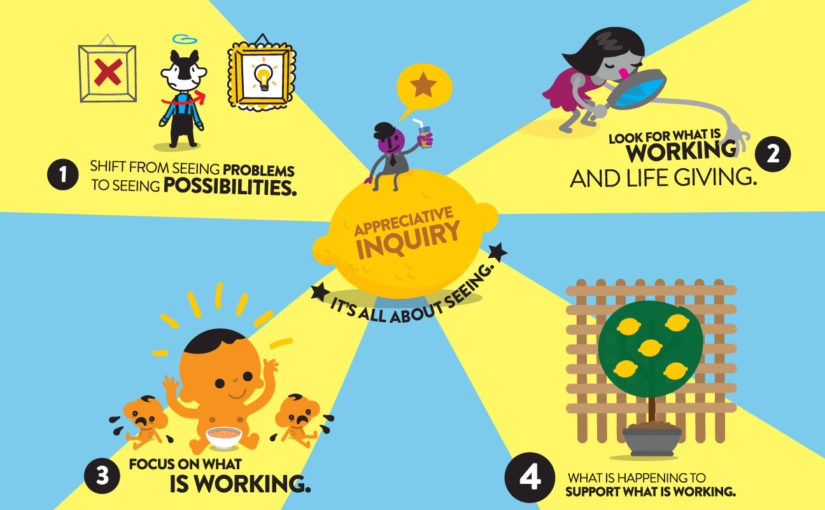
At the core of Appreciative Inquiry’s transformational power is one of the most fundamental inner shifts we can make: from seeing problems to seeing possibilities.

Most of us, and most groups, tend to focus on what is wrong. We relish cataloguing what is not working and we glory in analyzing root causes and how things might get worse.

The same is true for the voices in our heads. “You didn’t do that very well.” “Don’t be so stupid.” “Who do you think you are?” Seldom does our self-talk affirm our strengths or honor our accomplishments.

All this negative focus is debilitating. The bigger the problems we face and the more overwhelmed we are by the weight of what is wrong, the more important it is that we shift our focus to seeing what is right.

Appreciative Inquiry is an approach to life and to working in groups that turns our default setting on its head. Instead of fixating on problems, the focus is on what is life-giving. The shift is that simple, and the implications are profound – for morale, innovation, creativity, getting things done, and more. See the following Bright Spots sidebar for one vivid example.

Appreciative lens

Appreciative Inquiry focuses on the “positive core” – the factors and characteristics that are present when an individual, group, organization, or community is at its best.

By asking, “what do you value?,” or “what works well here?” – even in the most toxic of communities, workplaces, or teams – the conversation changes in profound ways. The appreciative focus surfaces people’s wisdom and goodwill. In place of negativity, despair, and overwhelm, people’s latent decency, wisdom, and engagement are unleashed. Authentic appreciation, and its close cousin, gratitude, shift the energy. For both individuals and groups, that energy shift is like wind in the sails for positive change.

Energized by having discovered something to appreciate, the next questions become, “What are the conditions that supported this wonderful thing to happen? How can we have more of what is working? Can we translate what is working here to help us over there?”

Inquiry helps us understand how the “bright spots” came to be, and points the way to having many more.

What conditions, for example, contributed to the best meet- ing you have ever had with your team or board or staff? Was the agenda framed in a positive and inspiring way? Was everyone comfortable to say what was real, thanks to a high level of trust? Was there a dynamic cross-section of people participating? Did it start on an upbeat note?

Looking back at times when your company or organization was performing at its best, was there excellent information flow between sub-groups, or a compelling sense of shared purpose, or people supported to try new things?

If your goal is to help team members to be more punctual, or better informed, or more engaged, get curious about the people who are already punctual, informed, and engaged. Or ask team members to reflect on their best experiences of whatever you want to cultivate. The wisdom on how to have more will be in the group, and when people come up with their own solutions, they are far more likely to implement them.

At the personal level

Over time, working appreciatively becomes a way of being. We change our default setting from focusing on what is wrong to seeing what is right. The more we do this in our personal lives, the better we are able we to respond appreciatively in our relationships, groups, and organizations.
In our personal lives, an appreciative focus can include how we see:

• ourselves;
• our parents and siblings;
• our children;
• our neighbours;
• our circumstances;
• our potential;
• and so on.

Take a moment right now to reflect briefly on some aspect of your personal life from an appreciative perspective. Pick something that is challenging or difficult, and let yourself “rip” with complaining, blaming, or negativity. Then choose to shift from seeing problems to seeing possibilities. Do you notice a shift in your energy and outlook? For example, I recently shifted feeling overwhelmed by my workload into feeling excited by and grateful for emerging possibilities and all that I am learning.

Similarly, in the group and organizational aspects of our lives, bringing an appreciative lens has profound impact. Consider framing issues appreciatively when:

• defining the agenda for a meeting, workshop, conference or social movement;
• conducting a performance review;
• setting strategic goals;
• building capacity in teams and organizations;
• creating collaborations and partnerships;
• dealing with crises.

The list of potential applications is endless because focusing on what is life-giving is a stance we take toward all of life. It is a way of being as much as it is a way of doing. As such, we can bring an appreciative lens to virtually everything!

Since most of us are conditioned by the prevailing negativity and problem focus in society, it takes a bit of practice to strengthen the appreciative “muscle.” If you want to be more focused on what is life-giving, you might ask for help from your spouse or a workmate, or you could put a note in your daytimer to explore using the appreciative lens on a daily or weekly basis until you have formed a positive habit.

______________________
Excerpt from Chapter 1 (Appreciative Inquiry), We Can Do This! 10 Tools to Unleash Our Collective Genius by Kate Sutherland. Other chapters introduce nine other similarly potent frameworks including Theory U, Process Oriented Psychology, and Integral Theory. For more info, see www.wecandothistools.com

Agriculture Can Help Meet Climate Action Targets in San Diego

By Elly Brown and Puja Batra, PhD

In 2016, San Diego County began developing a climate action plan consisting of a set of legal commitments to reduce greenhouse gases with specific targets, ultimately adopted in 2018. The same year Elly Brown, Director of San Diego Food System Alliance and Dr. Puja Batra of Batra Ecological Strategies first met at the Montado Ranch in San Diego where the Marin Carbon Project was putting in a test plot to see how compost applications on Southern California soils could sequester carbon from the atmosphere. At the Montado Ranch, Elly and Puja began a conversation about the opportunity for agriculture to play a significant role in meeting county climate action targets. That conversation developed into a partnership to develop a strategy linking climate action to Carbon Farming. Brown and Batra gave this talk, transcribed and edited below, as part of the Bioneers Carbon Farming Series.

Agriculture is one of the largest industries in San Diego County, a unique agricultural region with the highest number of organic farms of any county in the nation as well as a large number of conventional farms. The San Diego Food System Alliance (SDFSA) views Carbon Farming as an opportunity to support the small farms in the region because, like many other communities, development pressure, cost of water, cost of land and disconnected consumers are all driving small farmers out of business. The vision is to include the agricultural community as part of the climate change solution and to support the long-term sustainability of farming in San Diego County.

Puja Batra and Elly Brown (photo by Jan Mangan

Carbon Farming at the community level requires collaboration. We were able to bring together stakeholders from different organizations that can play a role in support of Carbon Farming from the financial perspective as well as the ecological perspective. We brought together county agencies – agriculture, solid waste, watershed protection planning, public health, regulators, air pollution control district – as well as the Farm Bureau, resource conservation districts, financing agencies, farmers and ranchers, private sector parties engaged in sustainable sourcing and others.

The ultimate goal is to catalyze a coordinated and comprehensive Carbon Farming program in our region that is embedded within our existing government institutions and supported by the nonprofit partners in the community. SDFSA, with support from ecological strategist, Puja Batra, is developing a road map for carbon farming in the region.

The Marin Carbon Project put a test plot in at Montado Farms, in San Diego County, to look at the effects of rangeland compost application in Southern California soils. At about the same time the County of San Diego was starting to develop a climate action plan, which is a set of legal commitments that the County makes outlining how to reduce greenhouse gas emissions.

Agriculture presents a big opportunity for the county to meet some of its climate action targets with respect to reducing greenhouse gases, but also with respect to building resilience, because in addition to needing to reduce our greenhouse gas emissions, we’re facing a lot of climate resilience challenges that are already happening and we have to start addressing them. Carbon Farming is one of the few tools available that addresses both mitigation and adaptation to climate change. SDFSA developed strategies to highlight the fact that farmers and ranchers have a big role to play by employing Carbon Farming practices, providing a service to the rest of us.

The resilience value of Carbon Farming brings in synergies among different players and different government agencies and other organizations and may open up some new resource and funding possibilities. By putting our heads together, getting more people at the table and finding new ways to pool resources, we can, hopefully, begin to develop some incentives for farmers and ranchers to employ the practices and then scale them up.

The San Diego Foundation funded SDFSA to ask a few questions: Just how big a carbon sink is soil? How much can our soils help us with our greenhouse gas emissions problems? Where do some of those local and state policy and program synergies exist? How can we find ways to creatively come up with resources to develop incentives to scale up the practices?

In seeking answers, it is important to understand the existing nature of agriculture in San Diego and what challenges and opportunities exist. The median size farm in San Diego County is four acres. The average age of a farmer in San Diego is sixty-two, which is consistent with the rest of the country. This, of course, poses some troubling uncertainty about the future of agriculture in our country. Incoming farmers are often first-time, first generation farmers. That presents both some challenges and some opportunities. Some of the barriers to entry are access to capital and education and training. How can we use this as an opportunity over the next decade to make a wholesale transition from conventional farming to farming practices that are necessary and relevant for the challenges of future decades? Can we make a wholesale transition to carbon sequestering practices, and do that by addressing some of these barriers?

We made a general recommendation that the county focus on training and facilitating the new generation of farmers to succeed in regenerative agricultural practices.

Agricultural Carbon Storage and Sequestration in San Diego

Having the largest number of organic farms per county in the nation gives us some baseline knowledge on how important it is to build soils. The return per acre for ranching is low and is declining. We have very few full-time ranchers. Almost 70% of local agriculture is in orchards, so there’s already a lot of carbon sequestration going on. It’s not perfect, but it’s a very solid foundation. We need to recognize these strengths and understand how we can make improvements while recognizing our farmers and ranchers for their contributions.

The nursery and cut flower industry is the second largest type of agriculture in San Diego. This industry presents some challenges in terms of carbon sequestration. Much of that growing is done in containers and very often the containers are filled with non-soil media. We don’t know what the sequestration value of that approach is, but nurseries are a growing part of our agricultural system because they are, economically, a little more viable than growing food. On the one hand, it’s not contributing to food production or contributing to carbon sequestration, but it is holding a space for agriculture and helping us keep down the rate of sprawl. We don’t have very much row crop agriculture, with only 7% of San Diego agriculture in vegetables. This implies a relatively low amount of tilling, a farming practice that releases greenhouse gases. All this taken together provides a solid foundation for discussing Carbon Farming moving forward.

San Diego has lost about 25% of its orchards over the last ten years. The loss of these orchards can be thought of in terms of the loss of the molecules of stored carbon in those trees as well as the lost sequestration potential that never happened because of the removal of those trees. Summed up, this amounts to over 300,000 metric tons of CO­2 over the last decade. This attrition rate is quite high; 25% in ten years is significant.

That number isn’t accounted for in the way that climate action plans estimate current baseline emissions. The fact that we lost all that sequestration is invisible. We had to point that out to the County climate action team so they would recognize that if you don’t count it in the baseline, you are ignoring the net higher emissions that result from agricultural land being converted to any other land use. There’s almost no other land use that’s going to be lower emissions than an orchard with one hundred trees per acre. Even if you let it convert back to natural habitat, it’s not going to have that kind of sequestration rate initially.

Pointing that out to the County resulted in a recommendation to conserve the existing carbon storage and future sequestration by addressing the root drivers behind orchard loss, which is the price of water along with some fire-related loss. The price of water is a huge problem in our area. We made recommendations about the use of recycled water in the county for agriculture. We are talking to the County climate action team about this to make the point that investments in water are not just investments in resilience, they are also investments in mitigation.

Food Waste

SDFSA is focused on many different issues in the food system and food waste is one of them. The aim is not only to reduce food waste, but also to develop a system in which food waste can be directed to benefit the whole social and environmental hierarchy: people, animals and soil. By looking for connections between different issues, we realized that food waste can be used to make compost to support Carbon Farming.

The Department of Public Works solid waste management team has developed plans for reducing the amount of organic waste and food waste that goes into landfills. They estimated how much is being thrown away that could be composted, and how much compost it could produce. We posed the question, “If all of that compost were used on farms and rangelands, how much carbon could it sequester?” Estimates were made using the online Compost Planner and COMET Planner tools that California’s Healthy Soils program has been involved in developing. We feel the county will be comfortable with the numbers that we came up with because those models are state sanctioned tools. The question is how can we get the people that deal with these problems at the table to find ways to promote those specific practices that build synergies with other departments, and really make this a multi-agency effort?

Looking at the Whole System

Our last recommendation was to convene a taskforce to start looking at these questions in a very detailed way, and make sure that we develop a Carbon Farming program that can be absorbed by existing institutions in the county, government and non-government. There are many players that are engaged in some way in agriculture and we want them to adopt the science, the philosophy, the economics of local needs and to institutionalize Carbon Farming as an essential standard operating practice.

The role of the taskforce will be to build a Carbon Farming program that is grounded in science, economic needs, regulation and the needs of the region, and to catalyze a coordinated program within the existing institutional matrix. We hope that over the next decade, we’ll transition to a situation in which San Diego’s agricultural community is a key partner in developing a resilient and climate-friendly region.

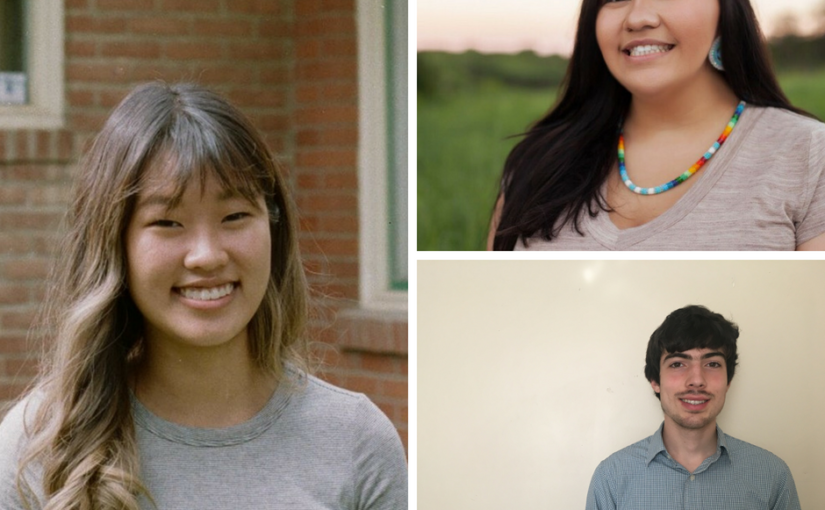
Introducing this year’s exceptional winners of the Brower Youth Awards for Environmental Leadership

Every year, Earth Island Institute’s New Leaders Initiative selects six young people from North America for their outstanding work in activism, campaigns, organizing and leadership in the environmental movement. They are awarded the Brower Youth Award, the premier environmental ceremony honoring young environmental activists in North America. Brower Youth Award winners demonstrate excellent leadership in the communities that they serve. Bioneers has been honored to feature numerous Brower Youth Award winners on our stage over the years. Without exception, these awardees have been inspiring and visionary, exemplifying the power and necessity of youth taking leadership roles. This year’s theme is “Grow the Movement,” focusing on the momentum of the youth-led campaigns that have made waves in 2018.

Below, a first look at this year’s winners.

Rose Whipple, 17
Speaking up against oil pipelines on Indigenous lands

For Rose Whipple, the Line 3 pipeline project represents a direct threat to the land of her ancestors. The project — which would expand pipeline company Enbridge’s existing Line 3 pipeline allowing it to carry twice as much crude oil from Canada’s tar sands mines to Lake Superior’s western tip near the Minnesota-Wisconsin border — will transect Indigenous territories and threaten the way of life of the Anishinaabe and Dakota people.As an Indigenous organizer from the Isanti Dakota and Ho-Chunk Nations, Whipple has been speaking at high schools and colleges, as well as organizing local events to raise awareness of how the pipeline would harm the Great Lakes, rivers, treaty territories, and sacred Ojibwe sites, and fuel further climate change. The 17-year-old is also one of the 13 youth climate intervenors who were granted legal standing in the Line 3 permitting process in Minnesota, which allowed them to contest the project before the Minnesota Public Utility Commission. Despite fierce opposition, the commission approved the controversial project in June. Tribes and environmental groups filed three lawsuits in early August challenging the decision. Meanwhile, Enbridge has already commenced construction work on the pipeline in Canada. But Whipple is committed to keeping up her fight against project. “It is really important that I bring my voice into this since it is going into my territory,” she says. “I am determined, I follow through, and am in it for the long haul.”

Whipple’s activism also extends beyond opposing Line 3. She has been actively involved in other intersectional issues, including the fight against the Dakota Access Pipeline at Standing Rock and raising awareness about the epidemic of Missing and Murdered Indigenous women in North America.

Tina Oh, 21
Amplifying narratives of frontline communities

Tina Oh’s family immigrated to Canada from South Korea when she was just two years old and her environmentalism is shaped by being raised near one of the world’s largest, messiest oil-mining projects — the Alberta tar sands. Like many Albertans, Oh’s father worked in the tar sands industry until 2014 when oil prices tanked. Oh was a freshman at New Brunswick’s Mount Allison University (MTA) at the time, and as she watched her family, friends, neighbors, and peers lose their jobs, she understood clearly that true climate justice requires taking into account the impacts of the transition from fossil fuels on working class people. Through her work as a divestment organizer and youth delegate at the UN climate negotiations, the 21-year-old activist hopes to amplify stories and narratives of people on the frontlines who are demanding climate justice.

Oh has worked with DivestMTA, which is pressuring the university to withdraw its investments in fossil fuel companies, and Ottawa Climate 101, a youth-led protest on Parliament Hill that called on the Trudeau government to reject the Kinder Morgan Trans Mountain pipeline. (She was among 98 people arrested for participating in the non-violent protest in 2016.) She is also part of the coordination team of the Canadian Youth Delegation to the UN climate negotiations (COP 24) in Katowice, Poland. In 2017, Oh was named one of Canada’s Top 25 Environmentalists Under 25 for her activism and divestment work, and in April 2018, the Canadian Broadcasting Corporation named her one of “13 Canadian environmentalists and innovators changing Earth for the better.” Oh strongly believes “that youth voices on the topic of climate change will be essential to moving our communities towards a safe, habitable, and just world.”

Stephen O’Hanlon, 22
Communicating the need for political action

Stephen O’Hanlon began organizing five years ago after he went to West Virginia with a student group to see the impacts of mountaintop removal coal mining. During the trip, he heard stories from families similar to his who had watched their loved ones suffer and die because they grew up drinking polluted water or breathing toxic air. He had very recently lost his older sister, Tara, to cancer, and he could see how fossil fuel development threatens to put millions of working-class families through the same pain his family went through. So he made a decision to save as many people as possible from that pain.

O’Hanlon started by organizing at Swarthmore College in Pennsylvania, where for three years he led a fossil fuel divestment campaign that received widespread media attention. During summer breaks, he organized to stop fracked gas pipelines in Massachusetts, and to stop the expansion of an oil refinery in a working-class black community in Philadelphia. Last year, O’Hanlon co-founded Sunrise Movement, an organization that is mobilizing a grassroots army of young people across the country to be politically active and combat the corrupting influence of fossil fuel executives and lobbyists. The organization — which is bringing together direct action and issue-based campaigning with electoral politics — has already trained over 300 young people and is currently hosting, Sunrise Semester, a six-month long training for 75 young organizers who will help make climate change matter in the midterm elections. The plan is to have conversations with over 250,000 voters about climate change, push hundreds of candidates to sign the “No Fossil Fuel Money” pledge, and develop hundreds of young climate movement leaders.

“It won’t be easy,” says O’Hanlon, “but I do what I do because I believe in youth leadership and I believe that the youth climate movement, along with other movements, can change the balance of power in the halls of government.”

Mishka Banuri, 17
Intersectional organizing for climate justice

Ever since she was a little child, Mishka Banuri has felt a connection with the natural world, but it wasn’t until she started learning about the “problems humans were afflicting on it” that she realized how deep that connection was. And once she learned about how economically depressed communities and people of color tend to be affected disproportionately by climate change and other environmental hazards, she was determined to do something to address these inequities.
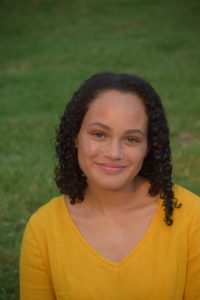
In 2016 when Banuri was in 10th grade, she lobbied for Utah to adopt a “Climate Resolution” written by high school students. The effort failed. Undeterred, she went on to help organize a People’s Climate March in Salt Lake City in 2016, and in 2017, along with two other students, Banuri launched Utah Youth Environmental Solutions — an organization designed to keep young people engaged with environmental issues, and inspire them. Earlier this year, her organization revived the push for the Utah Climate Resolution, hosting an event where students, legislators, and business people started a dialogue on the issue of climate change. After months of hard work, the resolution passed the legislature successfully in March, making it the first resolution of its kind in a traditionally conservative state.

Banuri, whose negative experiences in Utah as a Muslim, woman of color has been one of the driving factors of her work towards justice, believes in the intersectionality of movements. She is also an active advocate for reproductive justice, anti-Islamophobia, and gun control, and seeks to make room for conversations about climate change within these movements as well. “My drive for justice also comes from my religion,” says the 17-year-old. “In Islam, we are taught of peace and justice for communities … I fully believe that it is my duty to help others when I can because it is the right thing to do.”

Jade Sweeney, 18
Supporting our key pollinators

In 2015 the Green Team, a student-led, environmental awareness club at White Oak High School in Jacksonville, North Carolina, started a pollinator park, putting in hours of work to transform a junky, overgrown courtyard into a bee-friendly garden. Jade Sweeney, who was a club member, spent two years helping maintain the garden and learning about the many challenges facing our key pollinators, including colony collapse disorder, pesticides, and loss of habitat. In her final school year, Sweeney decided to take the pollinator park idea one step further by bringing bees on to the school campus. She founded The Pollinator Initiative and proposed the idea of constructing an apiary on campus to school officials. Once they agreed, Sweeney sought the advice of local apiarists on the project and raised the funds required for the Green Team to maintain a beehive and train 13 students to become certified beekeepers. The bees arrived on campus last April and have since been buzzing around school sipping nectar from the pollinator park’s pesticide-free flowers.
White Oak is the first school in North Carolina to have an on-campus apiary, but Sweeney, who will be starting her freshman year at University of North Carolina at Chapel Hill in the fall, wants to replicate her work at other schools in the area and across the East Coast by encouraging students, teachers, administrators, and school boards to see the benefits of apiaries on school campuses.

The 18-year-old envisions a world where the “environment doesn’t need protecting” and she believes education is the key to making that world possible. “For me, bees were the way to start,” she says. “They touch upon the issue, are easily identifiable, and most people can easily help by starting a garden or not squashing [a bee] when it flies by.”

Valeree Catangay, 21
Advocating for a more inclusive environmental movement

Valeree Catangay grew up in North Long Beach, California, a predominantly working-class neighborhood in the greater Los Angeles metropolitan area surrounded by some of the busiest freeways in the country that are used to move goods to and from the Los Angeles and Long Beach ports. The area suffers some of the worst air pollution in the United States due to diesel exhaust from ships, trains, and trucks, and some of the poorest water quality due to urban runoff.

Catangay has witnessed first-hand how this kind of pollution impacts the health and wellbeing of communities. The emerging visual artist and environmental science student decided to advocate for environmental justice when she learned that many other working-class communities of color face similar or worse issues. As a Filipino-American woman of color, “my ambitions in the environmental field both shape and are shaped by my identity,” she says.

Catangay started with her college, the University of California at Los Angeles. As a UC Carbon Neutrality Initiative Fellow, she had used visual communications to engage students in the UC system-wide goal of net zero greenhouse gas emissions by 2025, an experience that gave her the leadership training she needed to get started. Earlier this year, she co-founded the Environmentalists of Color Collective at UCLA, an organization that prioritizes the voices of black, indigenous, and people of color environmentalists and aims to bring industry professionals, artists, students, faculty, and other community members together to find sustainable solutions for our future. One of the collective’s first initiatives was a Climate Justice Forum for the UCLA community and general public. This was followed by the release of mini-documentary highlighting unheard stories of sustainability and the concept of environmental racism. Ultimately, the 21-year-old wants to serve as a liaison between pollution and climate-affected communities and the corporate world.

Restorative Justice: Healing the Cycles of Violence, Incarceration and Wasted Lives of Youth of Color

Jodie Geddes is helping shift the focus of justice from punishment to healing. As the Community Youth Organizing Coordinator for Restorative Justice for Oakland Youth (RJOY), she is using a framework that meets the needs and responsibilities of all involved so that relationships and community can be repaired. RJOY’S work in West Oakland Middle School has eliminated violence and expulsions and reduced suspension rates by 87%. Jodie will be leading a workshop at the 2018 Bioneers Conference for youth entitled Tell Your Story to share strategies to interrupt the tragic cycles of violence, incarceration and wasted lives. Jodie talks about her work in this Bioneers interview.

BIONEERS: How did you get involved in restorative justice work?

JODIE: My work involves truth-telling, racial healing, and reparations coordination based on a national truth and racial healing process for the United States. All of that grounds my work as a healer. Telling the truth about our nation’s history with race and oppression, and ultimately to be able to shine a spotlight on ourselves as a nation is an example for others because there are so many relationships between violence and oppression in the US and around the world.

My personal journey began in Jamaica, West Indies where I was born. At age 6, I came to the United States. I didn’t know where I was going. I arrived in a new world where there was an energy in the atmosphere that made me realize that oppression existed.

I received a lot of messages about being different. There are a lot of cultural differences between Jamaica and the U.S. Race does exist in Jamaica, but more in a form of colorism and shadism and not these clear distinctions between black and white because in Jamaica the national identity is a primary marker. I began to shift my understanding and became more nuanced in my intersectional identity – being Jamaican living in America and seen as American as my accent went out the window.

I started out from a place of anger because I wanted the world to see the blackness that I saw. I wanted people to see the joy that I saw in my community, despite the stories being told about it. I also wanted folks to see the real pain that was happening and how that manifested as a result of the racial history of the country.

Where I grew up in Crown Heights, Brooklyn, gentrification is putting additional pressure on the Black and Hasidic Jewish communities who have a history of tension and separation between them. Many of the properties are owned by Hasidic Jews. It’s interesting to think about the kind of trauma that we perpetuate on each other, even when there are similarities of historical oppression and genocide.

I was an angry organizer who wanted to flip the system on its head. I’d been organizing in high school for different parties and groups, but the anger persisted. The organizing action would feel good, but I was still angry. There was a deep rage towards white people. It was quite problematic, honestly, and could have been dangerous.

I found a justice class with an incredible professor who really challenged us. There were a lot of women of color sharing, for the first time, their stories that were deep and traumatic. I realized that many people don’t recognize oppression and don’t see these incidents through an equity lens. That’s when I decided to get into justice work.

I did a justice circle on my college campus with refugees and immigrants, young folks from places like Cameroon that I worked with in North Carolina. I did it in a selfish way, for my own healing, for my own sake so that I could take off many of the masks that I wear. I wanted to be able to hold that space for all people especially the most marginalized.

BIONEERS: What does restorative justice means to you?

JODIE: It’s hard to talk about restorative justice because there are so many ways it has shown up in community. Restorative justice is a process of how we look at harm and how we lean into healthy relationships in our community. The deeper relationships we have, the less disposable we become to each other. It doesn’t mean that we won’t get into arguments. I will get into an argument with my best friend and say we’re no longer best friends, but there’s a pathway for us to get back to who we used to be in relationship with each other.

Often in our social and justice systems, there isn’t a pathway. Emotion can fester and we could dwell in a place of hatred or disagreement and not recognize that often it’s miscommunication more than anything else. In my work, I’ve come to understand that restorative justice is a process of remembering that there’s a way to create a sacred space and be with each other in community in that sacred space.

One way we can use the process of remembering, particularly when working with youth, is when we lose someone, we build an altar outside. People walk by the altar who didn’t even know that person. So, restorative justice is a process of remembering what it means to be in community.

It is also being able to hold the nuances of who we are in the emotions that we carry. There are waves in society that we have to choose one or the other. If you identify Indigenous, somehow other identities don’t exist. If you identify black, you can’t be Indigenous. So, I would say it’s a process of remembering what it means to be in deep relationship and community with each other in a way that centers our voices, and centers our story, that doesn’t just center on harm, but centers on joy. It’s okay to hold onto joy, and to also speak of it. I think there’s something about the way that restorative justice is being used now that isn’t joyful enough. Yes, harm exists, but what can come from that? What kind of joy can be tapped into?

BIONEERS: What are some of the ways that you’ve brought restorative justice into West Oakland and other communities?

JODIE: First I want to acknowledge that I don’t think the community needs us to take care of them. I think it’s important to acknowledge that out loud. There’s a way West Oakland takes care of itself.

I had a meeting with Reverend Curtis Flemming. He’s also originally from the East Coast. One of the things he talked about was leaning into the wisdom that existed here when he arrived. I think that’s critically important. I thought about the way that he made his ministry, his church, a place that he could be unapologetically Christian, but also build up youth leaders in the community to the point where his voice wasn’t the one that was the loudest. People know him, but it’s not like he’s the one that’s leading everything or he’s the one that’s doing everything.

What does it mean to build multiple leaders and not just have one person leading who everyone is looking at and saying, “This is the one person who’s saving us?” But instead to recognize the wisdom in the way that folks have always taken care of each other.

That affected our approach at RJOY. Anytime we go into a community to do an event or to host a circle, we always make connections beforehand. We never just go in and pop up with an event. We find out who the elders and the key people are in the community. We invite and connect with local organizations so that they can say to their community that this is an opportunity that they can tap into.

Honoring that wisdom and sacred power of the community is really important to us. So even in West Oakland, East Oakland, and North Oakland, where we’re doing restorative justice circles, that is a huge part of it. Are we asking folks to come to the table? Are we bringing the table to them? All of that is a part of a process of remembering and being in community.

Continuing to center on young people is critical. We’re always asking, “Who are the youth? Are youth coming? How are they going to get here? Do they need bus passes?”

We bring radical hospitality, which was named for us by some folks in Chicago at the Restorative Justice Hub. We’re always greeting people, hugging people, even when they don’t want hugs. I used to be the type of person who didn’t want hugs. Now, we’re going to love on you.

And have food, that’s essential. Sometimes people are going to meetings not having food or a place to live. How are we meeting people’s essential needs? I think all of that is the way that we engage in community. If a youth needs something because they’re preparing for a child, we ask, “Do we need to do a baby shower?” It’s asking a lot of those essential questions. All of that affects our approach into community; we’re not trying to do to folks, we’re trying to be with folks.

Our community restorative justice work throughout Oakland is about tapping into the capacity of folks in the community to hold space for and with each other. Not so much to build their capacity, because that’s there, but tapping into it to recognize the realities of the everyday lives people are living. Also, we want to name the dreaming that can happen. For all of us, there’s a way that our dreaming can stop. You can feel hopeless, especially in this political climate. You can be the most awake organizer, and then you see a report on CNN and you’re like, “Oh my God, it’s doom and gloom.” So, continuing to hold a space for people to dream and to begin to come alive, a lot of that happens with our community.

BIONEERS: What are some of the ways that RJOY empowers young people?

JODIE: We have justice circles every second and fourth Thursday. It’s a youth-led and youth-owned space. There’s always going to be food. We also have our Sisters Rising circle, which is our intergenerational circle with young women. It’s really important to continue to elevate multiple narratives, because there’s often just one narrative about men of color. There’s a way that that erases the narrative of women who are being pushed out of the system, particularly in a hyper-sexualized way. That’s why we have our Sisters Rising circle. We have a Black Male circle as well. All of that can be found on our social media sites – SnapChat, Facebook, Instagram, and Twitter @RJOYOakland.

If people are interested in being an intern or just volunteering, they can just reach out to me through our website or volunteers@RJOakland.org

Youth are a part of all of the processes. Letting a young person know that their voice is valued if they are interning with us, that we don’t want to use you; we want to be in community, in relationship with you until you’re a part of all of our decision-making practices.

We also want to know what young people are interested in and what they want to give. What they think RJOY should be doing and why. We open the door to that, to listen, and to be in relationship with young people in community.


Jobs and Clean Energy – Danny Kennedy


The great energy transition is underway. Renewable electricity build-out is outpacing dirty projects. Global greenhouse gas emissions have flatlined, but the transition isn’t happening fast enough to significantly arrest climate change. Danny Kennedy, founder of Sungevity and Managing Director of the California Clean Energy Fund, draws from lessons learned over decades as an activist and entrepreneur on the frontlines of the global energy transition. In this excerpt from his 2016 keynote address, Kennedy highlights the overwhelming employment and economic opportunity that solar energy development is providing right now and moving forward.

Watch Danny Kennedy’s complete talk here.

Vice To Virtue: From Carbon Crisis to Carbon Farming

How does a virtue become a vice? How does a basic building block of life turn into a threat to life? And how do you turn that vice back into a virtue? In this half-hour we visit with two unlikely pathfinders who are helping to revolutionize farming. Calla Rose Ostrander and John Wick of the Marin Carbon Project are taking carbon out of the atmosphere and putting it back where it belongs: in the soil. In so doing, they’re also revitalizing the soil, conserving water, and building agricultural resilience. Scaling up these revolutionary regenerative methods can offset the climate destabilization, which that threatens to confound agriculture and endanger our food supply.

Carbon Farming: Agriculture’s Answer to Climate Change

Ranchers, farmers, scientists, and food system activists share solutions, practices and the latest research on how carbon farming can play a preeminent role in addressing climate change and ensure food security by stewarding working landscapes to sequester carbon. Part of the Bioneers Carbon Farming Series.

Huge thanks to Kiss the Ground and The Marin Carbon Project

Videography: Guido Lois, Kiss the Ground
Editing: Guido Lois and Stephanie Welch