The pop culture story of the First Thanksgiving, often told to children in grade school, is a myth. For the true story of what happened at the First Thanksgiving, and how Indigenous lives have been affected ever since, Bioneers’ Indigeneity Program’s Alexis Bunten (Aleut/Yup’ik) hosted a conversation with Chris Newell (Passamaquoddy), the Akomawt Educational Initiative’s Director of Education.
ALEXIS: I’m really happy that you’re joining me today, Chris, to talk about Thanksgiving as a tradition, as a myth, and what happened on the real Thanksgiving. First, could you tell me a little bit about the Akomawt Educational Initiative?
CHRIS: Sure. That word, Akomawt, is from my language. I’m a Passamaquoddy, coming from Maine originally. Akomawt translates to “the snowshoe path,” and it’s the symbol driving the mission of what my partners and I are doing at Akomawt. We’re trying to change the way Native people are talked about in all levels of education.
The snowshoe path, in my territory, was the common way that people made their way out into the woods to collect things like firewood and look for places to hunt. They would spread themselves out from a snowshoe path to get their work done. As they had to find their way back home, they would return to the snowshoe path.
In that way, we’re creating new learning paths for the world in general, not just Native Peoples but non-Native folks as well, to engage Native content. One of the things this comes out of is our observances at the Pequot Museum.
We work with a lot of non-Native educators who come to that museum asking us how they can teach Native culture better. We can do a great job inside the walls of the museum, but not every school can come there. What this means is that we need to take the onus on ourselves to bring this education outside of the walls of the museum in a way that is culturally competent, but is also respectful of Indigenous perspective, especially when it comes to issues of history and contemporary issues.
We use the word “decolonize” a lot, and that has a lot of application in what we do. But really what we do at Akomawt is re-indigenize history. History in America has always included Native Peoples. We’ve been there through every piece of American history: World War I, the American Revolution, World War II, the Industrial Revolution. Native Peoples were there for each and every part of that. Yet we’re not very well talked about in American history education, and that needs to change. It’s rendered us into a relatively invisible culture.
We need to make Native Peoples once again human in the history of this country, to add our perspective of how this country was formed. There’s a whole different side that’s not being told. We teach kids myths. We teach them lies sometimes, not always knowing that we’re doing it. Students grow up, and they take this with them.
There’s so much that needs to be done, and Akomawt is trying to answer that need in a regional sense, but also in a larger, national sense, to change the conversation. Let’s go beyond the myths that have been told. Let’s expose those for what they were and what they are, and let’s start teaching truth. When we teach even the very young the truth about how this country was formed, with Indigenous perspectives included, they actually grow up to become better citizens of this country. They understand all aspects of how we arrived where we are today.
We’re doing a disservice to our children by not giving them all of the facts when it comes to things like Thanksgiving. There is some truth to the widely told story of the First Thanksgiving. But there are a lot of mistruths as well. By exposing that, we change the story of colonialism from one of sanitization, as represented in the modern First Thanksgiving story. We provide a Native perspective.
–
ALEXIS: I totally agree with you that re-indigenizing our knowledgebase and worldviews is important, no matter what our backgrounds are. Whether we’re Indigenous, settler descendants, or a little bit of both. It has so many benefits for being a responsible citizen and understanding what this country stands for, and what our responsibilities are to change it and shape it in the direction that’s inclusive and upholds our values for equality in this country.
There is no bigger time of myth making and telling lies in the public educational system, and private, in America, than Thanksgiving. It’s such a big moment every year. I was wondering if you would share with me the real story of the First Thanksgiving.
CHRIS: The narrative of the First Thanksgiving doesn’t really appear in America until the 19th century. The first claim of a First Thanksgiving was in 1841 in a publication by a gentleman named Alexander Young. He had found a letter from somebody who was there at Plymouth in the 1600s: a man named Edward Winslow, who was one of Bradford’s men. The letter described the harvest that took place in 1621 between Massasoit’s people, the Wampanoag, and the Bradford’s people of the Mayflower, English settlers who had just arrived there.
This was an actual event that happened in history. There’s no doubt that there was a feast between Massasoit’s people and Bradford’s people. But while the 19th century narrative called it the First Thanksgiving, the 17th century ideas of Thanksgivings on the Native side and the English side were very, very different than our modern-day interpretation of what a Thanksgiving is.
On the English side, a Thanksgiving was a day of fasting and prayer. It was a very solemn occasion. Sometimes they took place as celebrations of harvest, so it’s not completely divorced from the modern idea of Thanksgiving, but it wasn’t uncommon for the English to declare days of Thanksgiving after a victory in a battle or a war.
In fact, one of the first declarations by the English of a day of Thanksgiving actually happened after the Pequot massacre in 1637 in Connecticut. After that massacre, John Winthrop, who was governor of the colony of Massachusetts Bay, declared that day in May an English day of Thanksgiving.
These folks were Calvinist reformers. They were very religious and very much into interpreting the scripture in a very personal way. The idea of making merry on a day of Thanksgiving, which is supposed to be a solemn day of prayer and fasting, would’ve been looked down upon.
The idea of Thanksgivings as celebrations of harvest is more along the lines of what the Wampanoag and other tribes in this region did. They would have continual, year-long Thanksgivings in celebration of the harvest of different foods as they became available. And they would typically celebrate them with feasts.
–
ALEXIS: I think one thing that most Americans don’t realize is that a lot of tribes across North America were very successful farmers. People often don’t realize that the people of the region in the Northeast farmed, and that the harvest they were eating was the Native foods. The Pilgrims were farmers coming from England, but they didn’t even have the right kinds of seeds to grow here.
CHRIS: Right. The English arrived in Plymouth in 1620. They set up a settlement there, but that first winter, half of them died. Before the feast, the English were starving and searching the area for any food they could find. They disturbed several Wampanoag graves. They also stole a cache of dried corn to survive. This all made Wampanoags wary of these folks that they had never met.
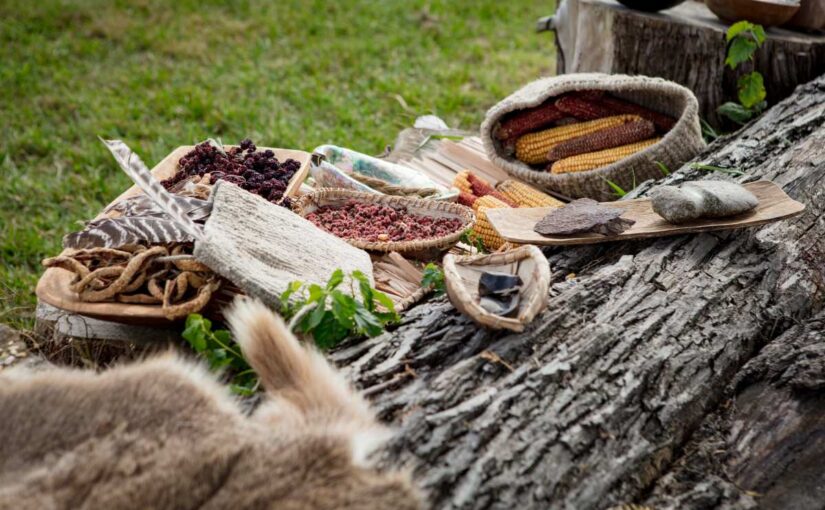
The English had grown vegetables back in England, but what they grew there didn’t grow as well in the soil conditions and weather conditions that we had here. They would have had to learn horticulture from the tribes. All over the continent, tribes had started to grow corn, beans, and squash as complementary farming. If you grow them together, not in straight rows as we do nowadays, but in bunches, they will actually help each other grow. They will feed each other, and you will get bigger vegetables than if you grew them separately. That first feast would’ve been a lot of corn, beans, and squash. Especially corn. Corn is the staple food of Native Peoples all across the continent.
So Massasoit was weary of Bradford’s people. They were cutting down the trees. They were building permanent structures. They were changing the landscape. So he sent in a group of 90 warriors. This is a fighting force, which threatened the English, of course, in a way. They didn’t come with a specific threat, but they showed up with 90 men.
The English had guns. They had new technologies that were very interesting to Massasoit’s people, who became engaged in trying to figure out how to use them. The English decided to showcase their guns, and were doing military drills at this feast. The feast lasted three days, and the English contribution was, according to Bradford’s account, waterfowl. Not turkey, but ducks and things like that. Massasoit’s people brought five deer.
Really, that was a very tense encounter. It wasn’t the happy time that the narrative of the First Thanksgiving that’s been told in the 19th century and onward depicts.
–
ALEXIS: It all sounds like women and families weren’t very present.
CHRIS: 20th century paintings depict the First Thanksgiving with a lot of women. Even though the real account that we have from Edward Winslow says that on the Native side, there were no women. But depictions of it will look very friendly, with a lot of women.
The first Thanksgiving as illustrated by Jean Louis Gerome Ferris, 1932
ALEXIS: Always serving food. Patriarchal, always doing the serving role.
What are some ways that people today, once they’re educated about Thanksgiving and where it comes from, can decolonize or re-indigenize Thanksgiving to make it better fit the kind of America they want to live in?
CHRIS: Well, first off, let’s throw out the First Thanksgiving narrative. Let’s just get rid of that story and stop teaching it as fact.
Now, let’s talk about where the actual Thanksgiving holiday came from. This is how we can work on decolonizing it. It was first declared a national holiday by Abraham Lincoln. Over the years, states had started to celebrate Thanksgiving as a celebration of harvest. They were borrowing, once again, from the Wampanoag. These were happening in different states at different times. Most of them were in November.
A very important woman who has been totally written out of history was named Sarah Josepha Hale. She was the first woman to publish a book, Northwood, in the English language in the Americas. She wrote a little ditty called “Mary Had a Lamb,” which we all know these days as “Mary Had a Little Lamb.” And she was also the editor of a magazine called Godey’s Lady’s Book, which was the precursor to Ladies’ Home Journal. Godey’s Lady’s Book, under her editorship, raised from a distributorship of 5,000 to close to 500,000. In the 1800s, this magazine had a humongous sphere of influence on American culture. Sarah Josepha Hale made it her mission to create a national holiday to bring together all of these holidays that were happening around the country.
The idea of the typical Thanksgiving dinner came from her description of a New England Thanksgiving dinner in Northwood, which involved turkey and also a lot of major meats. That became the popular picture of Thanksgiving dinner. And for years, she wrote editorials saying, ‘We need to create this national holiday.’
Eventually Sarah Josepha Hale became friends with Abraham Lincoln’s Secretary of State, and through that friendship, she became a friend of Abraham Lincoln. Through her influence with this magazine, she was able to get Abraham Lincoln to agree with her, and that’s how we ended up with that First Thanksgiving proclamation: a national holiday on the last Thursday of November. It was done by proclamation for years after that, and then finally Congress created the national holiday using the First Thanksgiving narrative that had became popular.
So it became a myth of how this country was founded. It was a way for people to get their minds around a great story of the creation of this country. To build nationalism amongst them.
–
ALEXIS: How do we effectively teach young people about the history of colonization and Native Americans? I’ve heard a lot of parents say they don’t want their kids to hear about all this brutality.
CHRIS: Young people can handle more than we give them credit for. The Pequot War was the first time a European power took on a Native power here in the Americas and won. This was an attempt at a genocide. The English intended to wipe out the Pequots completely. I’m teaching that to third graders, and guess what? They can handle it. They can understand it. They can digest it. They can realize that it’s not their fault that this happened. They don’t feel guilt about it.
It broadens their understanding of how their state and country came to be, beyond the fairytale. It includes all the good, the bad, the ugly, because if we don’t include that, we’re not going to learn from it. That’s such an important takeaway for our educators and our children: When we teach these things, we don’t teach them as a way to make people feel guilty. The idea is to expose that this happened, to expose that it was probably the wrong decision, and to discuss how we, going forward, can avoid making the same mistakes.
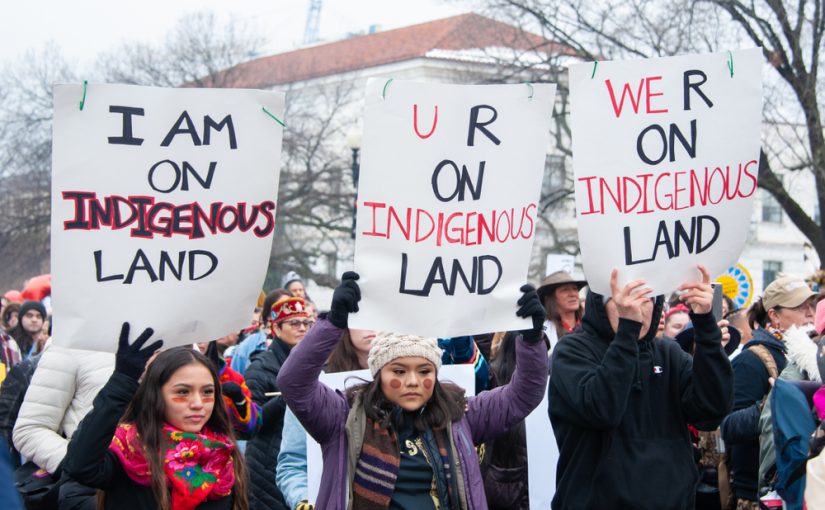
As Cara Romero and I reflect on what it means to be Indigenous in America, 2019 has certainly been a year of extremes. From the swearing in of the nation’s first two Native American women to the House of Representatives in January, to the Trump Administration’s recent rebranding of November as “Native American Heritage Month” to “National American History and Founders Month,” we are reminded that the 518-year, ongoing land grab in this country is rooted in rhetoric. A simple phrase, “Make America Great Again,” can normalize a massive push to offer up sacred Native lands for drilling to the highest bidder.
On the other hand, the simple phrase, “Rights of Nature,” can ignite a revolution, as you can see through Casey Camp’s powerful keynote speech, Aligning Human Law with Natural Law, at Bioneers last month, and Congressperson and Laguna Pueblo tribal member, Deb Haaland’s commitment to the Indigeneity Program’s “Rights of Nature Tribal Governance” initiative to support US federally-recognized tribes in self-determining the well-being of their ancestral territories for future generations.
Three years ago, I shared “3 Ways to Decolonize Your Thanksgiving,” and two years ago, “How to Indigenize Thanksgiving.” At this time last year, I had a fascinating conversation with my friend, Chris Newell, Passamaquoddy tribal member, and co-founder and Director of Education of Akomawt Educational Institute. (By the way, we showed the Emmy Award winning film he advised, “Dawnland,” at Bioneers this year.) Chris explained to me how the Thanksgiving Holiday was “invented” by a prominent New England woman writer, who lobbied Abraham Lincoln’s administration to proclaim Thanksgiving as a National Holiday to unify a Nation recovering from the Civil War.
Chris and I also talked about complex tribal relations in the area, that perhaps the Wampanoag –who had already an estimated 80%+ of their tribal members to war and disease– allied with the Pilgrims as part of an effort to protect themselves against other tribes in the area. So for Thanksgiving this year, I’m thinking about the Wampanoag, whose tribal member, Tisquantum, showed the Pilgrims how to raise corn, making it possible for the Pilgrims to settle permanently.
Also last year, the Trump Administration reversed a decision to return 321 acres of land in trust to the Mashpee Wampanoag to self-determine their future on land they have tended for 12,000 years. Given this state of affairs, I’m feeling a little more deliberate about how I will celebrate Thanksgiving this year. It is in this spirit that I’d like to share some events taking place around the country for Thanksgiving that you might join, or simply reflect upon as you gather with your family for the Holiday.
New Englanders can join the 50th National Day of Mourning at Coles Hill in Plymouth Massachusetts at 12 noon hosted by the United American Indians of New England. Tribal member, Danielle Hill, who shared her insights on the connections between food sovereignty and traditional birthing practices in the 2019 Indigenous Forum panel, “The Circle of Life—Women as Life-Givers and First Responders” will be there.
West Coasters can attend the annual Indigenous Peoples’ Sunrise Gathering at Alcatraz Island. Many of our friends will be there, including organizer, Morning Star Gali, who offered powerful and moving words at the 2019 Indigenous Forum Panel, “MMIW – Native Women on the Mother Earth Road from Violence to the Sacred.”
Those of you living in the Southwest are invited in peaceful prayer to join former Chairman of the San Carlos Apache tribe, Wendsler Nosie, in a march from San Carlos to Oak Flat, a sacred ceremonial site awaiting a death sentence of copper mining in 2020. Wendsler’s granddaughter, Naelyn Pike, gave a powerful keynote, “Youth Leadership for a More Just Future” at the Bioneers mainstage in 2017 as a part of the Apache Stronghold movement. Wendsler will return to live in his ceremonial ground in an invitational prayer.
As fellow Bioneers, we call on you to be aware of these events taking place, as the endless assault on Native American lands, religions, and lifeways continues today. We know that you reading this are allies, and that we will win the fight to protect our ancestral territories for all of our future generations of Americans.
November 18, 2019
Alexis Bunten, Co-Director, Bioneers Indigeneity Program
Indigenous Peoples are often on the frontlines of environmental justice movements. As original caretakers of the land, these communities have not only sought to protect their own livelihoods, but also to preserve humanity’s harmony with the Earth.
Below, three leaders on Indigenous issues discuss current events.Journalist and activist Julian Brave Noisecat explores how Indigenous communities are rising in a global renaissance; Ponca tribal Councilwoman, actress and activist Casey Camp-Horinek explains why aligning human law with natural law will help humanity regain balance with the world around us; and Leila Salazar-López, Executive Director of Amazon Watch, urges us to stand with Amazonian Indigenous Peoplesto protect and restore the bio-cultural integrity of the “lungs of the Earth.”
Julian Brave Noisecat
At 6 in the morning on Monday, Indigenous Peoples Day, I stood on the sandy shoreline of San Francisco’s Aquatic Park, as a 30-foot ocean-going canoe, hewn from cedar and crewed by a dozen members of the Nisqually tribe of Washington, pulled out into the breakwater, its bow pointed for Alcatraz Island. The Bay glistened in the first light of the sun as Nisqually voices rose in unison above the din of the waking city, their paddles stroking the water to the rhythm of their song.
On the beach, I hugged my dad and then my mom. We’d envisioned and organized and fundraised and planned for this moment for more than two years. On Monday, our vision became reality.
The Nisqually canoe was the first to depart on the Alcatraz canoe journey, an indigenous voyage around Alcatraz Island to honor and carry forward the legacy of the 1969 occupation led by Indians of all tribes 50 years later. The Nisqually were followed close behind by the Northern Quest, its hull crafted from strips of cedars and painted with the crest of the white raven. Its crew hailed from the Shxwhá:y Village in British Columbia, Canada. They were soon joined by an umiak, pulled by an intertribal group from Seattle, as well as a dozen other ocean-going canoes from the Northwest and outriggers from Polynesia, representing people as far flung as the Klahoose First Nation in Canada and the Kanaka Maoli in Hawaii. At final count 18 vessels representing dozens of tribes, nations, and communities pulled out into San Francisco Bay that morning.
One of the last canoes to depart was a tulle boat, fashioned from reeds gathered from local marshes. It represented the Ohlone, the First Peoples of these waters. Antonio Moreno, the captain and artist, who made the canoe, paddled his craft and canoe out into the open water, the tulle reed sidewalls of his vessel barely rising above the waves. Antonio and his courageous crew pulled to Alcatraz and touched the craggy shore. His was the only vessel to make landfall that day.
The visiting canoes meanwhile circumnavigated the island, paddling counter clockwise, from south to north and back to Aquatic Park. A local ABC station captured the scene from high overhead.
The late Richard Oaks, one of the leaders of Alcatraz, once said Alcatraz is not an island, it’s an idea. The idea was that when you came into New York harbor, you’d be greeted by the Statue of Liberty, but when you came through the Golden Gate, you’d encounter Alcatraz, a former federal prison reclaimed by Indians of all tribes as a symbol of our rights, our pride, and our freedom.
The Alcatraz occupation lasted 19 months, by the time it was over, the United States had shifted its official Indian policy from one of assimilation, relocation, and termination to one of self-determination and sovereignty.
It’s possible to draw a line from Alcatraz to Standing Rock, Bears Ears, Mauna Kea, and much more. But today the occupation, if it is remembered at all, remains an afterthought. Every year over 1.4 million people flock to Alcatraz, more than any other national park in the country, to peer inside jail cells that once held notorious criminals like the Bird Man and Al Capone. The island has become a monument to carceral nostalgia, to the Mafiosos and lawmen and convicts and fugitives, not to Native Americans.
But for a day, or maybe even just a morning, the canoes made it possible to see Alcatraz as what it could be, a symbol of indigenous rights, resistance, and persistence, an island reclaimed by our elders 50 years ago, an idea, a story, and a moment of organized action that changed history.
On Monday, Courtney Russell, skipper of the Northern Quest, was the first to return to San Francisco. She stood in her canoe and said, “We are the original caretakers of this land. We are still here. We will not be forgotten, and we will continue to rise.”
Ashore, 85-year-old elder Ruth Orta, Ohlone elder, Ruth Orta welcomed her and all the canoes. Orta later told KQED that she was so proud to see the young people, to see the young generation participate in learning what the older generation did, she said. I love it.
Then we gathered in Aquatic Park to share songs, dances, gifts and stories about what Alcatraz meant to our families and our people. Hanford McCloud, skipper of a Nisqually canoe spoke of his auntie, Laura McCloud, who joined the occupation when she was just a senior in high school. Sulustu Moses of the Spokane tribe shared the story of one of his ancestors, a warrior imprisoned on the island after an 1858 war. When he finished, he stood and sung the war chiefs death song.
Alcatraz is not an island, it’s an idea. And with a little imagination and a lot of work, that idea moved bodies, pulled hearts and changed minds. As our people and all people face devastating crises, catastrophic climate change, growing inequality, revanchist hate, maybe the power of audacious and enduring Indigenous ideas like Alcatraz are exactly what we need.
And at this time of imbalance, when humans have gotten their egos so berserk that they think because we speak a particular language that we share, we’re the boss. Yeah. That shows you just how stupid we are. We’re still that little child. We haven’t even hit adolescence. We’re still those little guys that say, “No, no, no, no, no! I want it my way! I want creature comforts! Give me something to eat. Give me something to drink. Take care of me right now!” And she does. And she does.
And those green things that taste our breath as we breathe out oxygen and they breathe it in and shoot that oxygen back to us, they take care of us. Those sacred things in the ocean that have the same pH level and the same saline solution as the womb of the woman still tries to care for us. Those relatives, whether they are of plant life, whether they are of rock, whether they have four legs or whether they have fins, or creepy crawlers that live way underneath the earth, they still take care of us.
So now what? Now what? If you realize that you’re this embodiment, if you take responsibility because you ate this morning, because you drank this morning, because you breathe, what further responsibility will you take? We are beyond the seventh generation, but we haven’t gone so far as to step out of our creature comforts, like that 3 year old. What will do next?
The Ponca Nation has chosen to follow the rights of nature, the immutable rights of nature by recognizing those rights of nature, and recognizing that we as human beings are not separate from but part of this sacred system of life. And so what we have to do, and we cannot wait, is we have to allow ourselves to grow to the point to take chances, to believe that there is a just transition away from fossil fuels, and that we can say that, we can demand that, we can vote people into office, or just kick them out and do it ourselves.
Not yesterday, not tomorrow, but today. We need to make that difference. And within our community, we do it in the kitchen-table way. All of our conversations looking for native rights to be upheld and environmental rights, which are one, was begun around our mama’s kitchen table, being taught. All of my daughters and granddaughters go to MIT. I myself am a graduate of Matriarch in Training. Two fists for that one! And down to the babiest one. They know how to listen to our Mother and to receive instructions from her, and to follow through with those fearlessly, as you must do.
We have strong, strong men in our family, and they’re beautiful warriors. They stand around us. Have you ever seen a herd of buffalo protecting the weakest in the center? They stand facing out taking on any obstacles. That’s my family. I’m proud of them. I didn’t even know this word called activist and environmentalist was something separate from what being a human entails.
And that’s what I’m here asking you to do: Take responsibility. Pay back to the Earth herself what she has gifted to you. Take responsibility today. Gather your family around your kitchen table, talk to them about what is going to happen in the next seven generations. Do you want to breathe? Do you want to eat? Do you want to drink? If you do, do something. Go to your state government. Go to your local government. Go to your federal government and say: We are part of nature. We want you to enact these laws, like in New Zealand with the Whanganui River. And if they don’t do it, you do it. You do it. And if you want to look in the mirror this evening, in the morning, any day, see yourself, really see yourself, you have the capabilities, you have the innate understanding, you have the spirit living within you that’s connected to all. Honor that. Honor yourselves. Honor all of creation.
In reference to the Amazon fires: A lot of people ask us, Well, who’s responsible? Who’s doing this? And it is the government. It is the Bolsonaro government. Let’s not make light of it. The Brazilian government has a policy, has not only the rhetoric, but the policies to destroy the Amazon to make way for economic development, to make way for agribusiness, to make way for soy and cattle, to make way for mining. It is their policy to destroy the Amazon for economic development. So it’s not a mistake. It’s not a wildfire. It’s intentional and malicious, and destructive. And not only are they intentionally setting fire to the forest, they’re intentionally rolling back rights of Indigenous Peoples. The moment Bolsonaro got in office, he rolled back the rights of Indigenous Peoples, merged environmental and agribusiness ministries to intentionally destroy the lands and the rights of Indigenous Peoples.
And so we have been standing strong with Indigenous Peoples, APIB, the Indigenous movement of Brazil, to say no, to stand up for rights, to stand up for lives, to stand up for territories. And the Indigenous movement of Brazil, actually just on Friday, embarked on a trip to Europe, a 20-city tour for six weeks, to go to Europe to go to companies, to go to banks, to go to European governments, to the EU parliament to say don’t trade with Brazil. Don’t trade in high-risk commodities with Brazil. Because that is what’s destroying the forest. If you care about the forest, if you care about human rights, if you care about Indigenous rights, if you care about the climate, then don’t trade in high-risk commodities. No government, no corporation, no retailer, and no bank should be doing this.
And that’s why we actually joined together with APIB to put out a report called Complicity In Destruction to highlight and expose these corporations, big agribusiness traders like ADM, and Bunge, and Cargill, and retailers like Costco and Walmart, and banks, financial institutions like Chase and Santander, and BNP Paribas. And asset managers, very, very big banks, like BlackRock, and—How many of you all have heard about BlackRock? So thank you for those of you who know about BlackRock’s big problem. The rest of you look up BlackRock’s big problem and you’ll know that they are the biggest investor in climate destruction, whether it be agribusiness or fossil fuel.
And speaking of fossil fuel, these are the fossil fuel reserves in the Amazon. You may have heard about Chevron in Ecuador or Occidental Petroleum in U’wa territory or in northern Peruvian Amazon. That’s in the Western Amazon, that’s in the most biodiverse part of the Amazon, an area that we call the sacred headwaters region. It is the most biodiverse, culturally diverse part of the Amazon, and it’s in the Western Amazon. And these are the fossil fuel reserves across the Amazon that these companies and these governments would like to get their hands on.
There are many protected areas throughout the Amazon and Indigenous Peoples’ territories that are protected in the Amazon. In Ecuador, for example, Indigenous Peoples have rights to their ancestral territories, but they don’t have rights to the subsurface minerals. So the government can still go in and drill, and concession off territories like this. These are Indigenous Peoples’ territories overlapped with oil concessions. And this has been the model for decades.
And as I mentioned, I was just in Ecuador last week with some of my colleagues, and standing with Indigenous Peoples in meetings, actually. We were in meetings to talk about the alternative—alternative solutions to oil development. And it was very hard to be there last week because we were in meetings but we were also standing with Indigenous Peoples as they were rising up, rising up against the continued policies that would cause this, that would cause the destruction of Indigenous Peoples lands and the rainforest to cause massive oil spills like this. This is what it looks like. This is just a very small picture of what it is. We’re talking billions and billions and billions of gallons of oil and toxic wastewaters that have been spilled into the Ecuadorian/Peruvian Amazon as a result of oil development.
And for what? For a few weeks’ worth of oil? This is why people like Sarayaku, who are very close allies, have said no. We’re not. We’re not going to ever allow fossil fuel companies onto our land. We want to be free from oil development. We want to keep fossil fuels in the ground.
And it’s Indigenous People, it’s Sarayaku, it’s women, Women Defenders of the Amazon Against Extraction, it’s Indigenous movements that we’re working with to protect the Amazon, to restore the Amazon, to advance Indigenous solutions, to advance and support climate justice. And we’re doing this together. We’re doing this as NGO allies, we’re doing this as movements in the climate justice movement and Indigenous rights movement, in the women’s movement. We’re doing this together. And this is what we have to do at this time.
The youth have called upon us to stop talking and take action. How many of you were out in the climate march, climate strike? I was out there with my kids in San Francisco marching for climate justice, and I have to say that it restored my hope. After the fires, it was pretty daunting and devastating to come to work, and just get up in the morning, but seeing the youth stand up for climate justice and demanding that we take action really restored my hope.
Being in Ecuador last week, seeing Indigenous Peoples stand up to the IMF and to their government who is imposing policies on them without their consent gave me hope and re-inspired me to really do everything possible to stand up to forces like BlackRock for our children, because like the sign says, we have to act as if our house is on fire, because it is. It’s the Amazon. It’s the Arctic. It’s the Congo. It’s Indonesia. All of these ecosystems have been on fire, and we have to put out the physical fires and we have to put out the political fires, and we have to come together like we did in this ceremony last week. We have to come together, all of us. We have to get out of our silos and we have to come together for our future, for our collective future.
So I want to ask you all to please come together, unify. That’s what we’re doing here at Bioneers. We come together. We share ideas. We inspire each other. We challenge each other. We cry together. And what I want to ask you all to do is to take action for the Amazon.
My time is up, but I want you to go to AmazonWatch.org and take a pledge to protect the Amazon, and stand with Indigenous Peoples. And just—If you remember anything of what I’ve said today, I want you to remember that the best way we can protect the Amazon is by standing with Indigenous Peoples. And if we protect the Amazon, we will protect our climate, and we will not reach that tipping point, and we will have hope for our future generations. So will you stand with me?
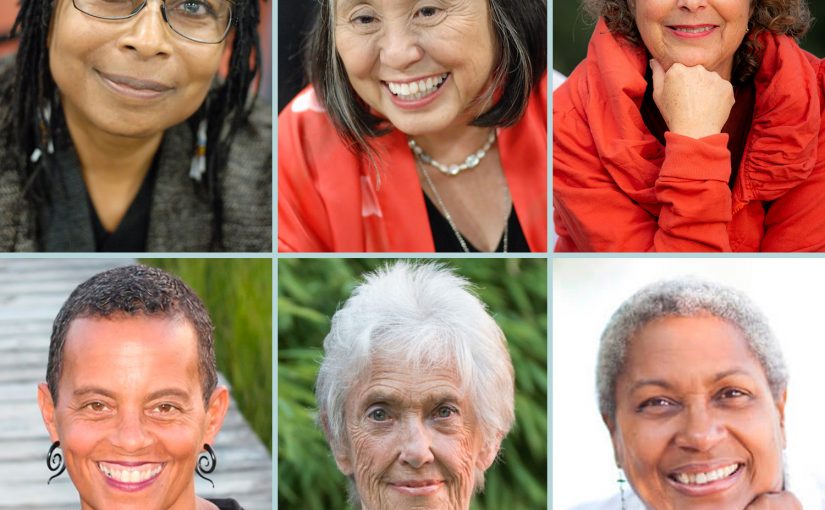
Transformational women leaders are restoring societal balance by showing us how to reconnect relationships – not only among people – but between people and the natural world. This astounding conversation among diverse women leaders provides a fascinating window into the soulful depths of what it means to restore the balance between our masculine and feminine selves to bring about wholeness, justice and true restoration of people and planet. In this one hour special, join Alice Walker, Jean Shinoda Bolen, Nina Simons, Sarah Crowell, Joanna Macy and Akaya Windwood to imagine a future where women, children, men and the planet can thrive.
Credits
Executive Producer: Kenny Ausubel
Written by: Kenny Ausubel
Senior Producer: Neil Harvey
Managing Producer: Stephanie Welch
Production Management: Aaron Leventman and Chuck Castleberry
Station Relations: Creative PR
Interview recording engineer: Jeff Wessman
Original Recordings provided by Reference Media Group
This is an episode of the Bioneers: Revolution from the Heart of Nature series. Visit the radio and podcast homepage to find out how to hear the program on your local station and how to subscribe to the podcast.
Our theme music is taken from the album “Journey Between” by Baka Beyond and used by permission of Hannibal Records, a Rykodisc label. Additional music was made available by Sounds True at Soundstrue.com.
Subscribe to the Bioneers: Revolution from The Heart of Nature podcast
Transcript
NEIL HARVEY, HOST: Imagine a gathering of women. Feisty, fierce women, young and old, determined to make the world a radically better place.
This group of women shares more than gender. Studies show that women really do approach the world differently from men. Women share a biological compass that, in stressful times, orients them to “tend and befriend” – rather than the male reaction/response of “fight or flight”.
In most parts of the world, women continue to live with the oppression and violence related to male-dominated power structures. It’s true that some women have far more power, opportunity, equality and rights than in the past. Yet even where women have gained ground, there’s usually a long way to go before reaching parity. The word “patriarchy” may sound polemical to some, but women everywhere nod knowingly when they hear it.
SARAH CROWELL: I think men take it really personally when we talk about why women re-imagining the world. I don’t even know if it’s re-imagining. I guess it’s remembering the world, and then recreating it. So it’s holding the balance. It’s bringing us back into balance.
HOST: Some believe that the environmental crisis can be seen as an expression of that power imbalance between men and women – and of the internal imbalance between the masculine and feminine qualities within each of us and throughout our culture and institutions.
JOAN BLADES: I want women in leadership. I want mothers, specifically, in leadership. I want people that understand, you know, the full breadth of the challenges we face in this society. And it’s a very important voice that’s being excluded.
HOST: Could restoring that balance restore not only justice, but also the Earth?
Join us for a wide-ranging exploration from a woman’s-eye view – MoveOn co-founder Joan Blades and sustainability advocate Annie Leonard speak about activism powered from the experience of motherhood. And author Alice Walker, social entrepreneur Nina Simons, psychologist Jean Shinoda Bolen, teacher Joanna Macy, youth arts director Sarah Crowell and leadership executive Akaya Windwood together ponder the global benefits of a truly egalitarian society.
This is “They Don’t Call Her Mother Earth For Nothing: Women Re-Imagining the World”.
I’m Neil Harvey. I’ll be your host. Welcome to this one-hour special from the Bioneers: Revolution From the Heart of Nature.
Akaya Windwood
AKAYA WINDWOOD: I’ve prepared some questions and these women haven’t seen them yet, so what we’re going to do is allow for what I call emergent woman’s wisdom to happen here, and we’ll trust that what gets said is exactly what needs to be both said and heard.
HOST: At a recent Bioneers conference a remarkable circle of women gathered for a free-wheeling, wide-angle conversation led by professional facilitator Akaya Windwood.
AKAYA WINDWOOD: So, we’re re-imagining the world, and we’re women. Imagine that!
My first question is a simple one. Why women? [AUDIENCE LAUGHS]
JOANNA MACY: Because it’s the age of patriarchy that is dying.
JEAN SHINODA BOLEN: Because women have unique, as a gender. We’ve got compassion. We use conversation to bond. And we look after the kids.
ALICE WALKER: I think it’s just time to give women the opportunity in this period of history or after history to show what we can do in terms of protecting the planet, which is being destroyed so rapidly just in front of our eyes.
NINA SIMONS: I think that one of the greatest gifts we could all bring to the world is restoring the feminine in all of us, and I think that, as women, we have a certain leg up on understanding what that might look and feel like.
AKAYA WINDWOOD: Thank you.
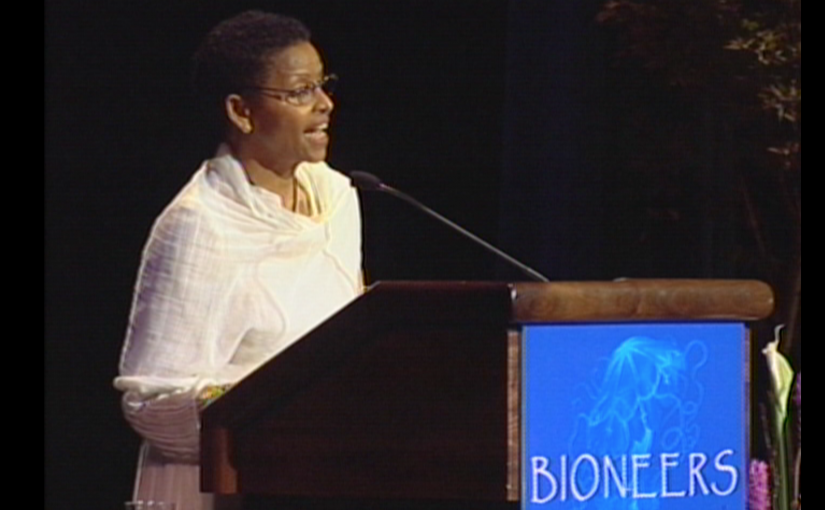
HOST: Akaya Windwood is President and CEO of the Rockwood Leadership Institute. Previously, she served as an executive leadership coach and organizational development consultant in the San Francisco Bay Area.
AKAYA WINDWOOD: Mary Oliver writes, You do not have to be good. You do not have to walk on your knees for a hundred miles through the desert repenting, you only have to let the soft animal of your body love what it loves. That’s from her poem “Wild Geese.”
The line between women and animals has often been drawn to shame us or keep us in line. As we re-imagine this world, what is the rightful relationship between women and our animal bodies?
JOANNA MACY: We will call our brothers and sisters to celebrate animals and our animal bodies.
HOST: Teacher and author Joanna Macy conducts workshops to train environmental and social activists worldwide. She combines Buddhist practices, systems theory, and an irrepressible love for life in what she calls the “Work That Reconnects.”
Joanna Macy
JOANNA MACY: The terrifying thing that is happening to our culture, to our global culture now, is that the instinct for the preservation of life has been cut. There has been a rupture,– so that we are actually able, as a civilization with the most well-trained minds, to plot how, with our weapons, we can shatter flesh or breathe in flames to be burned that you can’t put out; that we can go off and turn a desert into radioactive hell for thousands of years.
We have lost our connection, our erotic connection to life, and this is what our greatest task perhaps is, the greatest task– this we have to do and do it fast, and to relieve ourselves of the terrible loneliness that makes us crazy when we cut ourselves off from the rest of the web of life.
Chief Seattle warned us of that. He said without the beasts you will perish of a great loneliness. And we’re cutting ourselves off from each other as well as our own bodies because of this.
So we can praise be that we have bodies, that they can make you sane again.
AUDIENCE: Amen! [clapping]
AKAYA WINDWOOD: What is the rightful relationship between women and our animal bodies?
ALICE WALKER: Well, I think Mary Oliver is right to say that we should let these bodies love what they love…
HOST: Alice Walker is one of the most important writers of our time. She is a self-declared “womanist” who won the Pulitzer Prize for her book The Color Purple.
ALICE WALKER: …because when you do that, you break every possible law, and that’s always very energizing. [AUDIENCE LAUGHING/CLAPPING]
SARAH CROWELL: That’s so succinct. (laughing) I love to sit at a table with my mentors.
HOST: As artistic director of the renowned Destiny Arts Center in Oakland, California Sarah Crowell has supported the growth of diverse inner city young people through dance, theater, martial arts, violence-prevention and youth leadership workshops for more than 20 years.
SARAH CROWELL: I think about the young people that I work with, I teach hip hop and modern dance, mostly to teenagers now, and they’re exposed to a lot of sexuality through the media. Even though it’s really messed up, some of it is good because it’s just- at least it’s there. It’s not like hidden.
And then I am able to have the conversation with them because they’ll bring these dances and they want to choreograph them, and it’s all to this booty-shakin’ stuff, and all of it is booty, booty, booty, shake, shake, shake, pussy, pussy, pussy right? And I’m like, okay, sexuality is all good. Your body is beautiful, as it is, and it’s yours. It’s your temple. And you own it. And so when you come from that, when you shake that, when you shake what you have, shake it for you. You know what I’m saying? Because then when you shake it for you, there’s something empowering about it rather than giving away the power to somebody else. Right?
And so my whole chant last year was Sexy & Strong, Sexy & Strong.
NINA SIMONS: I want to echo what Sarah said. It’s amazing to sit at a table with so many mentors…
HOST: Social entrepreneur Nina Simons is co-founder and President of Bioneers. She speaks and teaches about women’s leadership, cultivating relational intelligence, and organizations as living systems.
Nina Simons
NINA SIMONS: What I’m reminded of is lessons that I’ve learned from several of you about the value of grieving and darkness. And it’s come to be a real, sort of, guidepost for me to help me orient myself toward the places that are painful and difficult.
I think I read an interview with Alice where she talked about how we- when we encourage ourselves to go deeper, we expand our capacity for joy at the same time, and it feels to me like that’s part of reinventing how we understand ourselves to be human is to expand our capacity at both ends.
And the other thing that your questions raises for me, Akaya, is that we all have the disease of modern American culture, which lets us think that our minds are so smart. And actually, I’ve been struggling to find my own voice in writing and speaking, and one of my favorite teachers keeps telling me that if I stop trying to sound like a smart, white man I’ll be fine. [AUDIENCE CLAPS]
And I realize how scary it is to me to believe that I have within me what I need. And I think that that’s part of us re-imagining the world is to know that we have within us everything we need, and some of that is about recognizing the wisdom that’s in our bodies and that’s in our hearts and our spirits, and not imagining that our minds have to solve it all, ‘cause they can’t and they won’t. [AUDIENCE CLAPS]
ALICE WALKER: I’ll add to that. I think that, for me, the journey lately has been getting closer to the other animals and understanding that is a path to myself.
HOST: Alice Walker.
Alice Walker at the 2007 Bioneers Conference
ALICE WALKER: Because about a year ago, I- it occurred to me that I had married early on, and- sort of early, and I’ve been in many long relationships with people, but I had only truly started to feel married with my dog and my cat. (laughter) And so I decided that I felt really married to them and that I wanted to make it official. (laughter) And so I asked, you know, the local priestess to come and all of our friends, or a lot of our friends, with lots of flowers and lots of kitty treats (more laughter), and dog biscuits and German chocolate cake for the rest of us, and we had our wedding.
And so that is really how I feel now, that the closer we can get to the other animals, the better for us, the more we will understand that we actually do have these animal bodies, because I’ve learned from my cat and my dog just what it is to really love being alive in the sun, feeling the wind on my face, having really good food, having a nice place to sleep. You know.
So that is, you know, that is really, for me, getting more and more free to feel myself as just another one of the animals on the planet. [AUDIENCE CLAPS]
HOST: Again, host Akaya Windwood.
AKAYA WINDWOOD: In an all-or-nothing dichotomous world, which is where we’re living, inclusion has meant allowing for everything, including war and rape and greed. What’s your wisdom about boundary setting, about limits, and how women can do that? How do we say yes and no within a framework of inclusion that’s also creates a space for other?
JOANNA MACY: Well, that’s an important question because our species and probably complex life forms are all threatened with extinction because we don’t recognize limits. There are limits to this Earth and the resources we can draw from it. There are limits to the waste we can dump.
When I look at what’s taught me a lot about limits, which has been the anti-nuclear movement and nuclear waste and nuclear power, I see that women have really stepped forward and taken amazing leadership there over the last quarter century or more. And maybe it’s because there’s something about being anchored in the body, being child bearers, being washers of the dead. We- our minds are anchored to our bodies, we know that, so we know that we can’t just go spin off and think that we can draw those lines of exponential growth and think things’ll be okay, and- because we have always noticed that somebody has to take out the garbage, I’m really proud to see how women have recognized the limits we must set to the way we are treating the Earth and what we can extract from the Earth and dump on the Earth. [AUDIENCE CLAPS]
JEAN SHINODA BOLEN: You know, we changed the world in the late ‘60s and ‘70s. It was just women sitting in circles talking, but talking about what was true and supporting each other to do what each woman, individually, was moved to do. And it usually started with going home and bringing about an egalitarian relationship with a significant other or not. But it also involved marching. It involved doing what you felt you could do and wanted to do.
JEAN SHINODA BOLEN: And I think that the whole notion of, when a critical number of people change their way of viewing things, humanity changes. And the natural form that women have is actually to be in circle and to talk and to reduce stress by speaking about what’s true and then supporting each other to do whatever it is. And I think that the boundary stuff, whether it’s with a significant other or to- or it’s with some major whatever, corporation, government, that to do it together, to have sisters at your back, so to speak, makes it a lot easier to do.
And now it’s time for a third wave of the women’s movement that has to do with bringing peace to the world. [AUDIENCE CLAPS]
NINA SIMONS: I need to reveal something of the inner workings of my brain here, which is that this question about boundaries has me goin’.
HOST: Nina Simons.
NINA SIMONS: I realize that because I’m much more comfortable, generally, and have been through most of my life, in a kind of boundary-less space where we all feel each other, because I tend to feel other people without trying, and I often assign internal gender properties to what I notice in myself.
So, I noticed this boundarylessness as sort of unity and sort of feminine, and I’ve noticed that my struggle to define limits and to befriend boundaries feels to me like something of the healthy masculine in it, that part of the legacy of this time is that we not only are learning and reclaiming what it means to be a healthy feminine, but what’s a healthy masculine.
And so I really want to have both of them in me.
And one more thing I was gonna add is that another little piece from a teacher of mine who’s here this weekend, Jeanette Armstrong, who said, you know, there’s something very healthy and very needed in this time about the anger that flows up through your feet. And I’ve been sort of exploring that because I grew up thinking anger was bad. You know? And had no place in my world. And I’ve been beginning to understand, like when I hear you talk, Joanna, about the anti-nuclear movement, that’s the outrage and the anger that comes up through the soles of our feet that says No, this cannot be; we have to stop this; we have to take a stand. And I think, actually, for me, I’m wanting to encourage that in my life, because it feels like a strengthening of limits for myself that’s about what I really want to take a stand for, and how much I want to encourage everyone else to join me. [AUDIENCE CLAPS]
HOST: From our relationship to animals and our animal bodies, to each other and to planet Earth, Joanna Macy says we are in the midst of a “huge and necessary revolution”. Nina Simons points to our need to restore value to the “feminine”–those qualities of compassion, caring, collaboration and emotional intelligence, qualities that have been systematically devalued in all people and our civilization, to the detriment of our collective future.
When we return, the experience of motherhood inspires profound change for two global activists.
I’m Neil Harvey. You are listening to “They Don’t Call Her Mother Earth For Nothing: Women Re-Imagining the World.”
HOST: You are listening to a one-hour Bioneers special program.
I’m Neil Harvey. This is “They Don’t Call Her Mother Earth For Nothing: Women Re-Imagining the World.”We will return to the Bioneers conference panel discussion featuring Alice Walker, Nina Simons, Jean Shinoda Bolen, Joanna Macy, Sarah Crowell and Akaya Windwood in a moment.
But first Social network innovator Joan Blades and sustainability advocate Annie Leonard speak about activism that comes from each of their experiences of motherhood.
Recognizing the power of women’s leadership means recognizing the need to integrate the best of the ‘feminine’ and ‘masculine’ capacities within each of us. We all carry both.
Joan Blades says the culture is ready to shift now. As co-founder of MoveOn.org she helped revolutionize web-based political organizing. Through her own experience with motherhood she found a way to effect positive change for the vast majority of Americans – women, men and children.
JOAN BLADES: There’s deep discrimination against mothers in our country. And none of us really expect that. I didn’t. I only realized this a couple years ago.
HOST: Joan Blades is an artist, attorney, writer and businesswoman, building on her web-based organizing successes to right another injustice that’s very personal to her.
Along with Kristin Rowe-Finkbeiner, she founded MomsRising to bring together millions of people who all share a common concern about the need to make the world more family-friendly.
Joan Blades
JOAN BLADES: A mother is going to get paid on average 27 percent less than a man, who is equally educated and has an equivalent job. A single mother’s gonna get paid 33 to- 33 to 44 percent less than a man in equivalent education and job. Well, all of a sudden that explains a whole lot to me.
It explains why there’s so many women and children in poverty really easy. Yeah. But it also explains to me why there’s so few women in leadership.And so I really want to have both of them in me.
If you look in the board rooms, you look in the halls of power in politics, women are under-represented. They’re- we’re lucky if they’re 20 percent. Often it’s five percent. Well, what’s happening?
You have a career path that’s traditional and linear. And 82 percent of women become mothers. Well, having a baby is, for many women, not a linear experience. It requires, certainly, a little time off, and fact is if a woman want to take a year off, say, or two years off, or a father does, they should be able to do that. That’s a good thing. But, with our traditional expectations, too often those mothers and those fathers that make those choices are put on a mommy track or a daddy track where they never get to the top of their field, wherever that may be. And that’s bad for us.
It’s bad for us for a couple reasons, one of which, I want women in leadership. I want mothers, specifically, in leadership. I want people that understand, you know, the full breadth of the challenges we face in this society. And it’s a very important voice that’s being excluded.
Our belief is that the reason there’s so much bias against mothers in the United States is we don’t have the kind of support that the vast majority of industrialized countries do for parents. And that starts with leave, you know, paid leave when a woman has a child.
Out of 168 countries there are four that have nothing. That would be the United States, Papua New Guinea, Swaziland and Lesoto. Okay. That’s jaw dropping. You gotta be kidding. What are we thinking?
You know, we have women that are making the choice between taking care of their infants and having a roof over their head.
HOST: Moms Rising is promoting policies that support America’s working women, the majority of whom already hold the job of “mom”. Women, and mothers, are in the workplace to stay. Yet appropriate public policies and workplace structures in the United States lag far behind most other countries. This mother saw the situation as a kind of mother of all issues. It led her to co-create the Motherhood Manifesto.
JOAN BLADES: We’ve taken the word MOTHER and made it into the manifesto points because, yeah, you want this to be memorable. M is for maternity/paternity-leave paid. O is open, flexible work, and that means the ability to adjust your schedule to be able to take care of kids. T – TV and other after-school programs, The after school programs, for Pete’s sake, this is proven to be a good investment because kids that have good after school programs have much better academic outcomes; they ultimately do much better in society. Health care. Every kid should have health care. Frankly, all Americans should have health care, but first give health care to all kids and stop messin’ around. Excellent child care. That means, you know, staffing, education, really respecting childcare as the huge community value it is. Finally, Realistic and fair wages. Someone that’s working full time, more than full time should be able to support themselves and support their family.
HOST: Since 2006, MomsRising has gained over 150,000 citizen members and keeps growing. More than 85 national and state organizations have aligned with the aims of MomsRising.
Social networking strategies developed at moveon.org have been put to use raising awareness and catalyzing action on motherhood and family issues. As part of the digital menu, members can download chapters of the Motherhood Manifesto online. It’s also a multimedia organizing tool: available as a documentary film for screening at house parties, and in book form.
JOAN BLADES: One of the stories in Motherhood Manifesto is about a business owner, Jim Johnson, who’s a conservative. But he heard Joan Williams talking about the issues of work and family and that somehow our society has got our values transitioned. It used to be God, family, work. That organization doesn’t seem to be coming through. And he heard that and he said, well, I don’t mean to be making things harder on women and mothers, and he went back and he checked in his company and he found that, yeah, mothers were impacted the most by not getting benefits for part-time and were most likely to be part-time, and that vast majority of the company would like flexibility.
And we’re talking about Johnson Moving & Storage, an- over a hundred-year-old organization, but he changed it. And he found it was good for his bottom line. You know, there was much less turnover, people were happy there. They were productive. He could attract new people that were, you know, very excellent too because he had such good policies. It was a win-win.
But, somehow, this understanding has not permeated the business community in general yet. It’s sneaking in here and there, and we need to make it stop sneaking in and just be a tidal wave. It’s time. You know? (laughs) We’re all paying for- it’s a real big payment we’re making because of this because we’re not taking care of kids.
In 20 years from now, these kids are the engine of our economy, and they’re not gonna be as able as they should be because we didn’t invest in them now.
HOST: Moms Rising change-maker Joan Blades joins a world full of women who are acting on behalf of women, children, and families.
Environmentalist Annie Leonard polled a group of her colleagues to get a sense of how women themselves are faring in the midst of working so hard to make the world a better place.
ANNIE LEONARD: The women I talked to, when I asked them about the activism work that they felt most comfortable with and most proud of, the- all of the women felt most excited about and most comfortable in organizational structures or in activist settings that were based on collaborations and relationships, rather than traditional, positional power hierarchical kind of dominant, centralized organizations. And the excitement was about this- this model of organizing that is spreading, that’s about networks of organizations and movement-based work rather than individual issue or individual organization.
HOST: Annie Leonard is a leader in the global movement to reduce waste and end over-consumption. “The Story of Stuff”, a film written and hosted by Leonard and produced by Free Range Studios, has been viewed on her Website over 6 Million times and counting. She’s traveled the world advocating that we all make a life-affirming shift in our values, away from possessions and towards family, friends and community.
Annie Leonard speaking at the 2015 Bioneers Conference
ANNIE LEONARD: Now, a number of the friends that I talked to, women friends, talked about an incredibly strong connection to life and connection to connection itself. Now, in terms of life, I recognize that not all women can or choose to have kids, but still, I believe that the ability to bear life is a very strong unifying thread among many, many women. For me, it was an incredible experience. I- I’m the mother of an 8-year-old daughter, and I always thought of myself as, you know, a very strong-willed, powerful woman. When I had this baby, it was the first time that I felt like a mammal. I- I- I literally felt like a mammal. I felt like a mother lioness when I was pushin’ that stroller down the street or feeding my child. I felt if anyone threatens her, I will rip their head off. (audience laughter) This- this incredible power. And I’ve been an activist for 20 years, and I have had a- moments of incredible anger, outrage, courage, hope, I have never had any feeling, in my 20 years of activism, that came near that mammalian, lioness protecting my child, force from within me. And I was like, whoa! Where is that coming from? It was an incredible power. And I wondered, what is this power? And where does it come from? And, can women, through this- this, um, unifying experience, is there some way to harness that energy and use that to transform the world towards sustainability and justice, because that was a hell of a power.
HOST: In motherhood Annie Leonard found an unexpectedly fierce new source of power for her activism. When women redefine leadership in “feminine” terms, they often find, like Leonard, that that power to act on behalf of themselves, their community and the Earth, actually comes from within.
ANNIE LEONARD: I think that this- this has profound implications for how women work if we want to make the world a better place.r.
If it’s true that women are more inclined towards seeing the world through relationships and through community rather than individuals, then does it follow that we can more aptly nurture about a culture of communal care or an ethic of care? And will nurturing and encouraging women’s voices in the political arena and in the activist arena, will that lead us more quickly to a culture that’s grounded in social democracy and ecological sustainability and justice? Can we replace this more domination-based, individual-based, um, society that we’re now operating in? And if that is true, then it seems to me a primary goal and role of women activists, in addition to whatever activist work that we’re doing, is to develop organizational structures and cultures that really encourage women, and especially young women, not to silence that voice, but to really nurture it.
And I just want to close with one quote that I just loved from this In A Different Voice. She says that staying in connection, then, with women and girls, in teaching, in research, in therapy, in friendship and motherhood, I would add, in our activist work, is potentially revolutionary.
HOST: Annie Leonard.
When we return more from Akaya Windwood, Joanna Macy, Nina Simons and Alice Walker.
HOST: This is “They Don’t Call Her Mother Earth For Nothing: Women Re-Imagining the World” – a one-hour special program. I’m Neil Harvey.
Now back to our Bioneers panel of imaginative women. Alice Walker, Joanna Macy, and Nina Simons spoke with host Akaya Windwood.
AKAYA WINDWOOD: Down in my belly is a place of deep despair and sitting underneath it is my greatest hope and desire for this wonderous and amazing world…So what’s under your despair and what wisdom can you offer us from that place?
HOST: Joanna Macy.
JOANNA MACY: Well, you know the work that I do in groups is originally was called despair work, despair and empowerment, then it was called deep ecology work because we found that by honoring our despair and not trying to cement it over or talk it away or privatize it into some personal pathology, we found that that was- that pain for our world was a gateway into our full vitality and to our connection with all life.
So the other side of that pain for our world is a love for our world that is bigger than you would ever guess from looking at what this civilization posits as the good life. A love so raw, so ancient, so deep that you know that if you get in touch with that, you can just ride it; you can just be there and it doesn’t matter. Then nothing can stop you. But to get to that, you gotta stop being afraid of hurting. The price of reaching that is tears and outrage, because the tears and the power to keep on going, they come from the same source. It’s like two sides of the same coin. I do believe that. [AUDIENCE CLAPS]
HOST: Alice Walker.
ALICE WALKER: What I find underneath my despair is actually ecstasy because I am so incredibly happy that I’m here now, not in the future, not in the past, but somehow lucky enough to be born just right now, to be here right now. It’s such a gift.
Because the despair is, for me, that- is that mile-thick covering of ice that Al Gore tells us about in his film, and when I think of our planet, which is so glorious and so alive and so colorful and so warm and with so many birds and all kinds of things, when I think all of that under the ice, I feel such sadness, it’s almost unbearable. But the joy of actually being here, to somehow to have made it here, and I feel this very intensely at times when I allow myself the space to experience eternity.
We actually have eternity. We can have it in our lifetime. It’s not something somewhere else. It’s not something in the future. It is in the moment. And so when I rest enough to give eternity back to myself having foolishly squandered it looking at my watch. Then I know, you know, I know that it’s really okay, you know. Ultimately it really is. That Mother has all the time there is. That’s all she gives, Mother, is time. And she will melt this ice ball many times.
I’m very sorry that seems to be the future of the planet, but I also feel that she will be fine. She will be fine, and she has somehow managed to leave me here now, to have me witness, to be a witness to her magnificence, her beauty, and her generosity and her grace. And that’s the ecstasy. [AUDIENCE CLAPS]
HOST: Again, host Akaya Windwood.
AKAYA WINDWOOD: So many of us can taste and see and feel this world that we are re-imagining. Arundati Roy tells us another world is not only possible, she’s on her way. On a quiet day, I can hear her breathing. Tell us how we can get from here to then. What practical, everyday actions can ordinary women like me do to move us along?
HOST: Alice Walker.
ALICE WALKER: I think that sometimes it’s very hard to know where you will serve next, because the place that you’re standing is not holding or you don’t see the effectiveness. For instance, all of those marches and all of those speeches and all of that anguish to try to stop the war, the last big war against Iraq and before that against Afghanistan, and it’s not that I personally gave up on that, and I still do that, but I also realize that we have to change the consciousness of our children about war, that they don’t know what war is, and how could they because their parents give them camouflage diapers and they buy them toys that they use to harass and hurt each other, and they think war is a game.
So, it was necessary to move on to writing children’s books about war – or a children’s book about war – to help shift the consciousness of our children. It seems to me maybe a very, very long shot, but it certainly seems worth doing, and I think in my own life, the now and the distant yonder is held together by hard work. And sometimes it’s too hard, and sometimes, you know, I feel like I have, you know, eighteen or nineteen arms as Durga has, and all of them are whirling. And then someone comes along and they want me to use a 20th arm, and I don’t have it.
So that is very possible, but it reminds me of what my friend Gloria Steinem used to say. When we worked together on Ms. magazine, I would see her, you know, frantically going around trying to raise money to keep the magazine going, then she’d come in in the middle of the night and try to write articles. And then there were always people wanting this and wanting that. And then they were kvetching, you know, so she’s doing all of these things, and somebody would say, well, why don’t you speak up about, I don’t know, whatever, and she used to say, she said, you know, I feel like a sitting dog being told to sit. (laughter) And this is how it is. This is how it really is often for the people who are showing up to hold up the hoop. You know? Everybody really should be showing up to hold up the hoop and if everybody showed up, the hoop wouldn’t be so heavy.
But those of us who feel like we have to hold up the hoop, we’re there and we are often being told, you know, to sit. You know, we’re already sitting.
So, hard work and understanding that, at this point, it really has to be about service. It’s not about career, you know, it’s not about hardly anything else but where can you serve the people and where can you serve the planet, and where can you, you know, serve humanity and all of the rest of the animals, and finding the joy of that. I find it, actually, when I’m not myself, wanting to take to my bed, just really, really joyful and happy. So that’s what I would say, Akaya.
NINA SIMONS: For me, one of the things that I’ve wrestled with for a long time has been this idea of reconciling a false dichotomy that I had between self and service.
HOST: Nina Simons.
NINA SIMONS: And I grew up believing that service was good and service was how I was going to get my strokes and prove my worth, and so I spent a lot of years serving things outside myself that I knew were important. And some things changed for me in the last ten years, and- through a lot of teaching, that included some guidance to pay exquisite attention, internally, to see what made my flame grow brighter, and really noticed what my specific assignment was, is. And what I’ve been discovering is there is absolute ecstasy in service that’s connected to what makes your flame grow brighter, and that there’s no dichotomy and there is no difference, and it’s the most joyous work I know to do.
And so it feels to me like, you know, part of what we’ve lost in this sort of plowing under of the feminine is the respect for the work of cultivating our inner gardens, and doing our inner work, and for a time, you know, around our house, we call the folks who do inner work to the exclusion of outer work the naval academy (laughter) ‘cause it’s naval gazing, right? And- but there is immense, immense power in connecting up our inner work with the call to serve what so greatly needs us out here.
And, so, that’s what I think, is to notice where your flame grows brighter and see how you connect up what you most love with what’s most needed out there, because it’s all needed and there’s no lack, and there’s so much creativity in it and uniqueness, and each of us has our own very specific thing to bring, and it’s- now’s the time. [AUDIENCE CLAPS]
HOST: Joanna Macy.
JOANNA MACY: Yes, yes to all that. Service. Finding your passion. Doing what’s right in front of you.
I would only add- take a moment or build it into your attitude the way you look at the sky, the way you breathe the air, up to the larger context. And I’m thinking, actually, about the context of time.
I have just returned a couple of days ago, from 30 days, on a wild stretch of the Oregon coast with 60 people. And we called that Seeds for the Future, an immersion in deep time. Now, all these people who came were right up to their elbows, their shoulders, over the head active in causes for the healing of our world and the welfare of all beings, and we were deliberately taking time to look at the larger context in which we live, knowing that our culture has a very peculiar and I believe unprecedented experience of time, which is accelerated and fragmented, hurrying up the kazoo. You hardly have time to think a thought two inches long. You’re just pushed and driven and, so we were looking at teachings during our time together, and putting them into practice, that would be somewhat similar to what the Buddhists call the Fourth Time in Tibetan Buddhism. They’re the beings of the three times, past generations, current generation, future generations, and then there’s the fourth time that we can access by a choice we make in the present moment to expand our temporal context and include them.
This has the most- so we were inventing ways to do this. We were looking at what it would teach us. And it is remarkable to be able to learn to see what you’re doing within a context that is actually larger than your lifetime. Now, right away, it’s sort of like a poor man’s enlightenment, because immediately you do that, you know that you won’t be able to see the results, you can’t be dependent on observing the results of your own actions. It’s very liberating. And you can feel an enormous support coming in to you. Our ancestors have it, a support coming from knowing that the ancestors are with you, and of knowing that the future generations are within you also.
As my teacher, nuclear activist, sister Rosalie Bertell says, every being who will ever live on Earth is here now. Where? In your ovaries and in your gonads and in your DNA. And the choices that you make now have a lot to do with whether they’ll have a chance to be born, sound of mind and body.
We were practicing these last five weeks how to live and work, particularly now that we’re coming back to good old speedy usual time with an expanded sense, a timeframe, and it gives a sense of buoyancy and a sense of deep companionship, and furthermore, I’ll close with this, it helps us act our age, because we are- well, if only you think of your age as Gaia, there you are four billion years, but when you think of every particle and every atom and every cell of your body goes back to 13.7 billion years, to the primal flaring forth, so it’s time we acted with the full authority as well as grace and beauty and perhaps unexpectedness of our true age. [AUDIENCE CLAPS]
AKAYA WINDWOOD: I’m taking a breath of deep gratitude for women. And I invite you to join me in that. I love women. I’m also taking a breath of deep gratitude for these particular women. Please join me in that. I love these women.
HOST: Akaya Windwood in conversation with Jean Shinoda Bolen, Joanna Macy, Sarah Crowell, Nina Simons and Alice Walker. Joined by Annie Leonard and Joan Blades. Wise women, imagining together how we might live on Earth in ways that honor the web of life, each other and future generations… a revolution from the HEART of nature – and the human heart.
The environment in countries of the global South has often suffered most, and how these nations relate to the environment from here on is a make-it-or-break-it factor in planetary survival for all of us. Ethiopian visionary Bogaletch Gebre depicts how the interconnecting forces of environment, economy, women, health and ecological technologies are creating a future environment of hope.
Daphne Miller is an author and a practicing physician who spent time on seven innovative farms around the country to explore the connections among soil, how food is grown and personal health. Dr. Miller is a Clinical Professor at the University of California San Francisco, and a Research Scientist at the University of California Berkeley School of Public Health. Her most recent book is Farmacology: Health from the Ground Up. Bioneers Restorative Food Systems Director Arty Mangan interviewed Dr. Miller at a past Bioneers Conference.
ARTY: What was it that made you realize that conventional medicine doesn’t have all the answers for health?
DAPHNE: I was working in Salinas, CA as a medical intern and realized that most of my patients had been harmed by the environment and by the agricultural systems that surrounded the hospital, either from toxins in the soil or in the air, or from labor conditions that were unjust, or from eating foods that were too high in calories and didn’t have enough nutrients. I realized that although I had been in medical school for four years and done all this training, that I didn’t have the tools to help address those issues of the environment, the food system, diet and unjust working conditions.
ARTY: What turned your attention to soil?
DAPHNE: I realized that if I was going to trace all of the disease that I was treating to one thing, it was soil and mistreatment of soil. It was either planting the wrong things in the soil or spraying the wrong things on the soil or using the wrong mechanized practices for treating the soil or having policies that were affecting both farm workers and even the local economy in an adverse way. Everything, in a way, traced back to soil.
ARTY: You actually worked on some farms.
DAPHNE: I started to realize that our food system was broken. It was not a system that was nurturing us or protecting us, but rather was a system that was making us sick and harming us. I started to look to the medical literature to understand what the models were for growing food and for distributing and processing food that could actually be healthy. I remember the day I went to PubMed, which is one of the premier medical research search engines, and I put in the words “soil health” and “human health” to see what studies would come up. I was hoping that I’d find preventive medicine studies on agriculture and health. Pages and pages of studies came up, but they were all about toxins, lead, heavy metals, tetanus, sewer sludge, etc. Reading these studies, it seemed like soil was a horrible dangerous place. Certainly not a place that you would want to eat from, or let your child play in or stick their hands in or a place where you would spend your profession digging in soil. There had to be another model, a model that actually created healthy soil and healthy farms to protect us, and yet there was absolutely no research on the health-promoting impact of agriculture.
Dr. Daphne Miller
That’s when I decided to go out and learn from farmers who were farming in a regenerative or sustainable way so I could start to understand from the farm perspective what these models looked like and begin to ask questions that span between the soil and agriculture and ourselves. I wanted to research how farming in a healthy way influences personal health.
ARTY: What did you learn on those farms that informed your medical practice?
DAPHNE: I would say it gave me more of a systems approach or a holistic approach to treating patients because good farmers are not reductionist in the way they think. They think about using many different tools and different natural systems together to farm in the best way possible to protect the soil and protect the microbes in the soil and generate healthy food. I started to borrow from that model in terms of thinking of treating my patients. What are the ways we can actually use the natural system to promote health?
A lot of the work I do is not in the clinic; it is as a healthy farming advocate working on issues around policy, pushing research, and thinking about how hospitals and the medical system can actually support healthy agriculture, both through aggregate purchasing and through advocacy and policy. The clinical piece is only one slice of the pie, but there’s a lot of ways to connect health and farming.
I also learned, from family farmers around the country that farmers are using practices, like tilling and spraying chemicals, that are destroying soil and directly destroying our health.
ARTY: How does tilling or plowing the soil affect our health?
DAPHNE: Tilling puts particular matter or PM10 into the air. When farmers till, there are much higher rates of asthma and allergy and chronic obstructive pulmonary disease. But tilling also destroys the unpaid workers – the soil microbes – whose job it is to scavenge nutrients from organic matter in the soil, and pass it on to the rootlets of the plants. These nutrients then go into the plants and ultimately nourish people. We have a lot of evidence that when you lose biodiversity in the soil, you lose the nutrient value of those plants. By tilling, we are basically stealing our own nutrition.
ARTY: Is there is a relationship between a healthy soil biome and a healthy intestinal biome?
DAPHNE: We understand the links theoretically and there are even some studies showing that the bacteria that are in the soil might influence the bacteria in our gut, but the science is not well established yet. But there are lots of plausible connections, including the fact that if you use a lot of herbicides and pesticides in the soil, they actually get transported via the food into our gut, and can kill off our own bacteria, much the same way that antibiotics do.
But I don’t want to make false claims. You are asking about exactly the area where we need a lot more research. Unfortunately, to do that research requires human microbiologists and soil microbiologists collaborating together and asking questions that span both environments, but it is very challenging to get researchers to move outside their comfort zone and ask questions that are a little more expansive.
ARTY: There is more science that supports the idea that a healthy soil biome will deliver better minerals to the plant.
DAPHNE: Yes. Now that is something that, once again, we still need to do more research on in order to establish exactly what a healthy soil looks like. We haven’t even come to a universal definition of how to measure soil for health. What does soil health look like? The USDA’s Soil Initiative is trying to publish standards for healthy soil. Obviously, we know it’s going to look different in Kansas or in California, but at least we need some principles and some basic criteria that have to be met in order to call a specific soil a healthy soil.
We do know that plants will get a better uptake of nutrients from a very alive, biodiverse soil with a good ratio of fungi to bacteria. That’s because the higher the diversity of these fungi and bacteria, the more likely it is that there will be the right bug to do that specific job of harvesting that nutrient and passing it on to that specific plant, kind of a lock-and-key relationship that exists.
DAPHNE: This research is really exciting for me and it is an example of that kind of discipline-spanning research that is needed. It initially started with allergists in Germany who were trying to understand why it was that their patients, who grew up on sustainable Bavarian farms, had such low rates of asthma and eczema and even certain chronic autoimmune diseases, especially when compared to kids living in urban areas in Germany, but also compared to kids living on more conventional farms. What they found through their research was that it looked like it was the biodiversity of microbes on those farms and in the soil and in the milk and in the cowsheds and on the mattresses and everything else that seemed to make a difference. The kids on those sustainable farms were exposed to a much larger diversity of microbes. The microbes, in some way, were helping to stimulate their innate immune system. Maybe even early on when those kids were developing in utero in their moms, they were being protected. The microbes were sort of training the immune system so that it was able to distinguish friend from foe and not to overreact to allergens and so on.
Most autoimmune processes, even allergies, are just our immune system overreacting to things that it shouldn’t. It looks like having that early exposure to a diversity of bacteria really made a difference. Studies in the US have similar findings.
ARTY: More and more, there’s a growing awareness about the risks of the use of antibiotic soaps in the home. How does that relate to this conversation?
DAPHNE: Oh, it truly does. For generations people were really paranoid about germs and did everything they could to sterilize, and for with good reason. People used to die in scores from things like polio, tetanus, you name it. In the 1950s we really went overboard and started to lead unbelievably sterile lives, where we had absolutely no contact with bacteria. Everything was sealed and packaged and pasteurized and boiled and so on, which corresponds to when we started to see an uptick in a lot of autoimmune diseases.
I think what’s happening now is there is a recognition that you need a healthy profile of bacteria in your life; it doesn’t matter if you live in an urban or a rural area, you need it. There’s much more of an effort to expose kids to it, with playgrounds where they’re encouraged to play in healthy dirt, and the idea that urban farming and getting your hands in the soil, no matter where you are, is really important.
Doctors are getting on board too and prescribing antibiotics a lot less. Of course, they’re still prescribing it for pneumonias and kidney infections and things where you absolutely need it, but we used to prescribe it for things that you’d think maybe at some point might develop into an infection, maybe. You’d send someone home with 20 days of antibiotics. It was just completely overboard. Now they’re giving shorter courses of antibiotics that are less broad spectrum and are more specific for what’s needed. I think that there has been a big change in the medical profession.
Where there hasn’t been enough of a change is in agriculture, and we use way too many antibiotics in agriculture. We use it basically as a growth promoter in conventional agriculture for livestock and chickens and so on. There is research to suggest that a lot of antibiotic resistance in humans might be coming from agriculture. So, that is a place that still very much needs to change. I think that San Francisco is going to become one of the first cities in America to require antibiotic labeling on meat, so you’ll understand whether that meat was treated or not with antibiotics so that consumers can really demand antibiotic-free products.
As the first African American, first female, and youngest mayor of Greenville, Mississippi, Heather McTeer Toney has seen firsthand how people of color and low-income communities are some of the most vulnerable populations to the consequences of climate change. She advocates embracing climate justice as the social justice issue of our time. Toney is now leading an environmental inclusivity movement in her work as National Field Director of Clean Moms Air Force, an organization of more than one million parents united in the fight against pollution to leave the next generation a healthy planet.
Following, McTeer Toney discusses what it means to be an environmentalist today.
What is an environmentalist? Think about it for a moment. What is an environmentalist to you? I did a Google search earlier this week: “What is an environmentalist?” On the first page under images, this is what it came up with.
I don’t see any color. I see trees, I see people hugging trees, I see whiteness.
This is important to note. When we think about what an environmentalist is, if this is the general image and lens through which we see environmental engagement — and it’s a lens of privilege, a lens of singularity, a lack of community — then it’s no wonder words like “environmental justice” or “climate justice” create dissention.
In 2009, The Washington Post ran a story on my city. I was mayor of Greenville, Mississippi, and they’d been working with us for some time. Being young and energetic and ready to solve all the world’s problems, I figured I was going to tackle brown water in my community. So at the ripe old age of 27, I decided that running for mayor and focusing on this as one of many issues in my community would attract some attention. And it certainly did; it got the attention of The Washington Post.
On a Monday morning, above the fold, people saw the face of a child in a bathtub full of brown water. And right below that fold, they saw a picture of me, looking serious about rectifying this issue in my community.
After that, I was visited by Lisa Jackson. She was the first African American administrator for the U.S. EPA. She said, “You know you’re working on environmental justice issues, right?” She said, “You know the mission statement of the EPA is to protect human health and the environment, right?” That was my advent into eventually working for the EPA. I became the regional administrator for the Southeast region to do community-facing work for community problems on climate and the environment.
But herein lies the problem. Because if the lens that people see the environmental work through is colored, then it doesn’t allow for solutions grounded in things like cultural competency and realistic outcomes.
If there’s anything that being a mayor and a regional administrator has taught me, it’s that you had better have an answer for the people, and you have to have solutions. You must be solution-minded, and there’s not a lot of time to sit around and have meetings when the people need a solution. That’s the same thing that we have an issue with right now.
I know you know the results from the IPCC report, and you know what’s going to happen in terms of global climate change and crisis and emergency. There are all of these solutions out there. But then we talk about the solutions in ways that people cannot grapple with and embrace.
Perfect example: The IPCC report has said that one of the things we should do to help reduce carbon emissions is to not eat as much meat. It is a solution that has been touted and that a lot of people have gotten behind. I am a black Southern Baptist woman from Mississippi. I cannot go into my church and say we are not going to have chicken and bacon. It’s not going to work. I’m from Mississippi — you can’t tell me how to grow food. My ancestors did it. You can’t talk to me about what I should be doing with respect to the soil, because I taught you.
It is critically important that we have these conversations through the lens of the people who have lived these experiences. Privilege keeps us from doing that because it doesn’t allow us to listen to one another. And that’s what we must begin to do. We have to begin to listen to one another.
This is one of the things that I love so much about Moms Clean Air Force, an organization that I’ve been blessed to now be a part of. It’s because mothers do what mamas do. We are going to protect our babies to no end. Whether we are protecting them from the impacts of climate, or we are protecting them from gun violence, we are protecting all of our children, and we recognize that climate has something to do with all of it. It’s called bringing people to the table. If you’re a mother, you know how to make children play together. You know what’s happening when they’re fighting. If you’re a mother, a grandmother, play cousin, auntie, you know how to do this. This is not rocket science.
We have to realize the natural things that we have within ourselves tell us what to do. It’s the reason we are finding that moms are becoming more engaged on a political level, where they’re being appointed to office. And as I have said repeatedly, if you can be the secretary of the EPA, you can be the secretary of the Department of the Interior.
We’re realizing that our voices are required at this moment. It’s not an option. It’s a requirement. It’s like when you hear the kids in the back room, and they’re making a whole lot of noise. That’s all right. But when you hear something break, and it gets eerily silent, you know you have to get up and go into that room. What we’re saying as mothers is that we are now getting up and going into the room.
Those are the rooms that we sit in. We go into the rooms where the policymakers are, where we are testifying before Congress, where we are saying this is what is happening in our communities. This is not an option. We shall be on record because we have something to say, and we recognize fully that if it is not said by us then it will not be said and shared. These are the places where we feel strongly that all of our mothers and grandmothers and grandfathers and aunties and play cousins, anyone who has an interest in seeing the welfare of our children be protected from the impacts of climate change and air pollution, they must be in these places.
And we see an amazing impact. Sometimes you just need things to be done in the language that you understand. And we do that.
We make sure our children are given the microphone to say what they need to say. That’s why this work is important. I do this work because I’ve been doing it for years, and I understand that there are a lot of places that we could be, but this is the social justice movement for our time. This is it. And it’s now.
This talk was given at the 2019 Bioneers Conference.
Mary O’Mara of Marin Link and Marin Arts introduces Marin County Leaders, including Congressman Jared Huffman, who sends a video greeting to Bioneers.
Also featured: Carol Mills from Senator Mike McGuire’s District Representative’s Office, Henry Simons from Assemblymember Mark Levine’s office, District Supervisor Damon Connolly, and San Rafael City Council Kate Colin.
This keynote talk was delivered at the 2019 Bioneers Conference.
Our society is experiencing profound levels of stress and anxiety, a public health crisis that’s triggering unresolved traumas in many people, resulting in widespread uneasiness, poor public health, social dysfunction, and alienation, as well as high levels of violence, suicide, and substance abuse. Through traditional stories and personal reflections, Jerry Tello, raised in South Central Los Angeles, co-founder of the Healing Generations Institute, a celebrated leader in the field of the transformational healing of traumatized men and boys of color, shares his approach to generating the “medicine” necessary to shield ourselves from this toxic energy, and offers us pathways to discover, uncover and recover our sacredness and return to health and wellbeing.
Jerry Tello, of Mexican, Texan and Coahuiltecan ancestry, has worked for 40+ years as a leading expert in transformational healing for men and boys of color; racial justice; peaceful community mobilization; and providing domestic violence awareness, healing and support services to war veterans and their spouses.
Buenos días. Good morning and afternoon, as we get started here. My name is Héctor Sánchez-Flores and I represent the National Compadres Network. I’m humbled to be here to introduce your next speaker, a man that I have known for nearly 25 years but whose work is approaching over 40 years of dedication to community.
Maestro Jerry Tello. If you’ve never met him, I’ll share with you a few items that I think that rarely get highlighted about his work, who he’s connected to, and what drives his passion and his mission as I’ve observed over 25 years.
He’s connected to a wonderful partner, Susie Armijo, and together they cultivate and support work about healing across this country. Together, if you ever have the chance to see them work together, you will see magic happen as they help us uncover, help me uncover, those things that I’ve overlooked, the medicine that I carry.
But the other parts of Maestro Jerry Tello that are critical to understand is that he is a father to Marcos, Renee, Emilio and grandfather to Amara, Naiya, Greyson and Harrison. And if you ever want to see him light up, hear him tell the stories of how those grandchildren truly manipulate the best of him. [LAUGHTER]
What he’s reminded many of us along the way is that within us we carry medicine. And his stories and the narratives that he creates are powerful reminders of the things that we overlook about ourselves. And I always am grateful of the things that he discovers about himself through his stories because it usually illuminates those corners of our lives that remain dark and sometimes unseen.
I’m grateful for everything he does for the community to remind us that our culture here’s La Cultura Cura, and I look forward to hearing his words today as I have for the last 25 years because every time I hear him I am slightly different and walk away with a new understanding of the teachings and lessons.
Without further ado, I’d like to introduce Maestro Jerry Tello. [APPLAUSE]
JERRY TELLO:
Ometeotl, Noxtin, Nomecayetzin. Good morning, relatives. [AUDIENCE RESPONDS] I want to begin by thanking Creator, another day of life. Thank our native relatives of this land for the privilege, the blessing of us being here. I want to thank you all for showing up, for choosing to bless us with your presence this morning. Thank you, Hector, who in himself is a wonderful teacher.
My people, I come from—My father’s name is Jorge Perez-Tello. He’s Tampilan Coahuiltecan from Yanaguana, commonly known today as San Antonio. [LAUGHTER] Our people have been there for many generations, and my daddy was the oldest at 15. My mom comes from Chihuahua. She’s Mexican Tarahumara, and she came from a smaller family, not as big as my dad, and she was the oldest of 14. [LAUGHTER] That’s not like we didn’t believe in family planning, we just plan big. Right? [LAUGHTER] My grandma said every kid’s a blessing. We had a lot of blessings. You know? [LAUGHTER]
But we ended up, after all the travel back and forth, I was ended up—even though I was born in those areas, I ended up being raised in Compton, so I’m straight out of Compton. [LAUGHTER] I grew up in a barrio neighborhood, black/brown neighborhood. And I guess they would consider it high risk, delinquent, impoverished. But in that neighborhood, in that neighborhood, the one I grew up in, that I didn’t know we were poor, because my mama never said we were poor. She just said eat those beans. Right? [LAUGHTER] And I would complain, “Why do we gotta eat beans again, Mom? Why can’t you make something else?” “Ah, be quiet, just eat the beans.” “But why can’t you make something else? …those beans…” “Ah, you ought to be glad you have beans. People in other countries don’t have nothing but…Kneel down.” “Why?” “Ask for forgiveness for…” “I’m sorry, God, for complaining about beans.” [LAUGHTER]
You know, my mom’s crossed over a number of years ago, and I miss my mama’s beans. [AUDIENCE RESPONDS] Didn’t realize it when she was making those beans. She got those beans, and she had us sit with her, and take out the little rocks in those beans, and she’d say, “You’ve got to pray. You’ve got to pray when you take out those beans, because that’s part of what you’ve got to do in your life. You’ve got to take out those parts that are not going to feed you.” She’d get those beans and put them in the water, and put the onion, and the garlic, and all of that, and she’d say a little prayer. I didn’t realize that that was a recipe that her mama gave her, that her mama gave her, that her mama gave her. I didn’t realize in that little bowl of beans that she gave me were generations of medicine.
But what happens sometimes when you live in this world, you don’t appreciate those things. We don’t recognize in those traditions, those ways. And I lived in Compton, in a crazy neighborhood, a lot of things going on. I guess you consider a lot of risk factors. My house, a lot of kids, always a baby crying [MIMICS BABY CRYING] all the time. [LAUGHTER] I would trip when the teacher says go home and find a quiet place to study. I’m like, where? [LAUGHTER] If you’re really motivated, you’ll find—Like where? [LAUGHTER] If you really want to do well in school…Like where? [LAUGHTER] And I guess that’s why my daddy talked loud.
I had a loud talking dad. [MIMICS FATHER YELLING] My friends go, “Is your dad mad?” I said, “No, dude, that’s the way he talks all the time.” [LAUGHTER] Kind of a trip for a social worker to come to my house. You better send them to—anger management’s developmentally inappropriate for these kids. No. [LAUGHTER] That’s when my dad was fine when he talked loud. He especially talked loud when he saw relatives come over. When people came to him that saw him, embraced him, and honored him.
I also saw what happened to my dad when he was in places where people did not honor him. And as a little boy, it confused me, because we were taught to honor everyone. I was taught by my grandma. And in that house I lived with grandmas. My mom’s mom and my dad’s mom, not both at the same time. You don’t put two grandmas together, I don’t care how old they are. [LAUGHTER] No, no, no, no. They got their ways and they want you to be their favorite.
But my little grandma, my mama’s mama, she was about that tall, and I thought she was kind of crazy because she did strange things to me. One of the strange things she did, she’d get up every morning at 4:00 in the morning. To me that’s crazy, grandma. Why don’t you sleep later? You don’t got to go to school. You don’t got to go to work. Why don’t you sleep? No, she would get up at 4:00 and I didn’t understand. She’d go out and talk to her plants. “Good morning. How you doing? Buenos días.” And then she would give them water. “I’m going to feed you water. Please, I’m going to take a little bit of you.” She would talk to these plants, ask for permission. She says, “I need to take a little bit of you, because my grandson is sick. Will you help me heal him.” I thought my grandma was crazy. Why do you talk to plants? Why do you ask for permission, just take it. [LAUGHTER] And then she’d take it and make this yukky tea and give it to us, and…[LAUGHTER] And it’d make us better. I didn’t understand. I thought my grandma was crazy. She got up at 4 in the morning. Didn’t understand at that time, but that’s a sacred time, that at 4 in the morning is when grandmother moon and grandfather sun comes together. They sing that song together, that rhythm, their vibrations together. That’s where creation happens again. That’s regardless what happened the day before, we have another day.
So my grandma would get up at 4:00 in the morning. And she’d go in that crowded house where all of us lived. And there’s a little hole in the wall, and in that little hole in the wall, my grandma had her sacreds, had her candles. And she had all kinds of things from her sacred natives to her Catholic—she put them all there. She used anything that would get her closer to that sacred. The little pillow on the ground and she’d kneel down right there on that pillow. And you could almost tell how many problems we had because the more problems we had, the longer she’d stay right there. [LAUGHTER]
But after she finished, after she finished praying, sometimes an hour, and hour and a half, sometimes two hours, she’d come to the room where all of us kids were sleeping. And my grandma would bless us up. She’d bless us all up.
And I used to hate it. 5:30 in the morning, “Grandma, why are you waking me so early? I was having a good dream.” [LAUGHTER] “You messed up my dream, Grandma. Why? You blessed me last night before going to sleep. Is it still good for now?” [LAUGHTER] “And you’ve got to bless me when I go to school? Why do you always got to bless me? Do I got the devil in me or what?” [LAUGHTER]
I didn’t understand. I didn’t understand the significance of blessing. I didn’t understand the significance of someone that was connected to the sacred saying to you every day, “You’re a blessing. You’re a blessing. You’re a blessing. You’re a blessing.” My grandma would bless up the kids that were good in school, the ones that weren’t good in school, the skinny kids, the fat kids, the stinky kids. She didn’t care. She’d bless us all up.
And I didn’t understand why my grandma needed to inoculate me with the spirit of our ancestors, with the message of great, great ancestors that says Creator doesn’t make junk. Creator only makes blessings. And so she would inoculate me and bless me up before I left.
My grandma knew something that I didn’t know. She knew that I would go in the world that was not going to see me as a blessing. That many times just because of the color of my skin or how I was dressed or my hair, or how I looked, they already had a plan to lock me up or deport me or put me out of—take me out. That when I went in classrooms, they were already going to put me in the back of the room and expel me and suspend me. My grandma knew that this world was wounded and didn’t appreciate what we call in my language In Tloque Nahuaque which means interconnected sacredness. My grandma knew that just a look of people I could feel their energy. So she blessed me up. And she blessed me every day and as many times as she could.
And so I want to take a moment here, because we’ve got a lot of work to do, but we can’t do the work unless we’re grounded. We can do the work but it may not be sacred work, it may be angry work. And it may be work that divides us and doesn’t bring us into that In Tloque Nahuaque. We have to be grounded. So I want to just take a moment, and I want to invite your ancestors in the room.
I can’t imagine what my great-great grandmothers, great-great grandfathers did, what they had to go through, what they had to deal with, what they had to put up with, and they didn’t give up. And your ancestors did the same thing. All of your ancestors struggled, they had difficulty, and they didn’t give up. But like your grandmother and my grandmother, they all had a dream. And I’m a grandfather now. My dream for my grandkids is that they’re going to have a better world, they’re going to have more blessings and less pain, and less struggle.
So inviting your ancestors in the room, and maybe you didn’t have a grandma like my grandma, maybe you didn’t even know your grandma, maybe your grandma or grandpa were wounded, they were so wounded they could barely just survive and just live another day where they didn’t have the energy to reach back to those traditions and pull them out. Or maybe they were so ashamed of who they were that they left those traditions behind, and so they didn’t give you that blessing tradition. Maybe your grandparents were separated from you because of racism and discrimination and deportation, and all of those things, so you didn’t even know them. Maybe you never got the blessing.
So I want to stop for a moment. And I want to say to you on behalf of your ancestors, on behalf of your great grandmothers, on behalf of your great grandfathers, that you are a blessing just the way you are, as you sit there today. You don’t have to know any more, you’ve got to lose weight, you’ve got to color your hair, you’ve got to do none of those things. The sacredness lies within all of us.
And my grandma would show that in her food. She would cook. And I lived in Compton so I had friends. My best friend was Tyrone Mosley, and he would come over usually right around when my grandma was cooking. [LAUGHTER] Say, “Jerry, you want to play?” [LAUGHTER] “Oh, I know why you want to play right now, because my grandma’s going to cook, huh?” “No, I just want to play.” And then my grandma would come out and say Quien Quiere comer which means who wants to eat. Tyrone would raise his hand like that. I don’t know where he learned Spanish from. [LAUGHTER] She would say Pasale mojo which means come in my son, and he walked in. Where did he learn Spanish? There were no spanish classes back then, no ESL classes. [LAUGHTER] And she called him mijo, which means my son. My grandma called the same thing to Tyrone as she called to me, because in our traditional way, all the children are your children.
In my family, we were all related. In second grade they told me to draw my family, I’d draw six grandmothers. “How do you have six grandmothers?” “I don’t know, I just call them all nana.” [LAUGHTER] I said, “All the great people are my grandparents.” [LAUGHTER] Anybody my parents’ age, my uncle and aunt, anybody my age was my cousin. And that was cool, except I have a fine cousin named Monica at 13. I wish she wasn’t my cousin, but she was my cousin. [LAUGHTER]
And the thing is, when people are related to you, you treat them different. My daughter goes to a school, my granddaughter goes to a school in Hawaii. Her native Hawaiian relatives. And they start the day when the elder comes and brings them into a circle all together and sings a chant and brings all their spirit together. And my granddaughters call their teachers auntie. Those traditions of us being related.
So my grandmother would take Tyrone and sit us together and bless him up too. Blessed him in that way too. And then, as in every family, there are kids that sometimes cooperate and some that don’t, some that cry a lot, and I had responsibility, you take care of your nephew. And one of my nephews, Ronnie[ph], was a crybaby. I don’t know if you had cry—you might have been the crybaby, I don’t know, but he cried for everything. And I was supposed to be watching him. He’s in his crib. I can hear him. [MIMICS BABY CRYING] And my grandma says, “What’s wrong with Ronnie?” “Nothing, it’s just Ronnie.” [LAUGHTER] “Well, go see.” “Grandma, it’s just Ronnie, it’s nothing.” And how many times do we play off when people are hurting? Do we just want to diagnose them and medicate them?
We work with a lot of kids that get expelled and suspended because they’re acting out their pain. A lot of what we’re seeing today is children younger and younger with more anxiety, more depression, suicidal. Elementary school kids. The work we do. Who’s healing the children?
And so my grandma gets mad at me because I’m not going to see Ronnie. And she comes and says, “Why don’t you—” “Grandma, it’s just Ronnie.” And she grabs me by the ear, “Come on, come on! You’re going to go help me.” And my cousins laugh, “Grandma’s got you, grandma’s got you.” And we go in the room, and as soon as we go in the room, I know why Ronnie’s crying. We walk in, I said, “Grandma, he’s got caca, he’s got poo poo. That’s why he’s crying.” And she goes up, “Come here my pretty baby.” I go, “He’s not pretty, he’s stinky, Grandma. He’s stinky.” “Come here my pretty. Come here, come here.” And she’d grab him. “Don’t grab him, Grandma. You’re going to get the caca all over you.” “Come here. No, no, no, come here, mijo, come here.” “Don’t pat him, you’re going to squeeze it out! It’s going to get on your dress, Grandma, it’s getting on your dress!” [LAUGHTER] And she gets—she says, “Come here, come here, mijo, come on, my pretty baby.” “He’s not pretty, he’s stinky—“ “Come here, my pretty baby. Mi precioso.” “Grandma, you’re squeezing it out!” Roo, roo, roo, roo, heya, heya… And Ronnie calmed down.
She’s never been to a parenting class in her life. Doesn’t know about self-esteem, about bonding, about ages and stages of development, doesn’t know about developmental…[LAUGHTER] But my grandma knows what you do with somebody that is disconnected. You don’t throw them away. You don’t disconnect them. You don’t ostracize them. You don’t minimize them.
My grandma also knows when someone’s hurting. I mean, Ronnie knew he was stinky. You didn’t need to remind him. [LAUGHTER] What he’s wondering is, Will somebody hold me in my stinkiness; will you embrace me; will you remind me of my sacredness when I’m not in balance, when I’m not good, when I’m hurting; will somebody embrace me?
How courageous are we to embrace those that are looked at as unembraceable? But in order to do that you’ve got to be willing to get it on you. And be willing to stand and sometimes kneel, because the problems sometimes are too big. For our Western mind, for our Western psychology, for our Western ideology, that sometimes we have to look up and say, Ancestors, come help me. We invite you to come in and help bless us up.
And life goes on. And my life went on. And my dad died when I was 13. My dad, that always wore a hat. He didn’t have a good hat like this. He had working hats. But he died. But I’d already been indoctrinated that I wasn’t supposed to cry. Boys don’t cry. Suck it up. The neighborhood, you know? So I didn’t cry. I forgot how to cry. How many of us have forgotten how to cry?
And when you forget how to cry, when you forget how to release, when you forget how to heal in your traditional way, not in the Western way, not in that, in your traditional way, it eats you up. Now I’m a freshman in high school and I’m not doing good in school. I’m trying, I’m trying. I’m going to school every day. I’m trying, but I’ve got an F in algebra, F in history. History I didn’t like because it didn’t say anything about me or my people, and so I wasn’t interested. And the algebra, I just couldn’t get algebra. I don’t know if you like algebra, but I mean they gave me a tutor, and when the tutor was there, I got it, but when she left she like took the knowledge with her or something. I don’t know. [LAUGHTER] So I got two Fs and I didn’t want to take it home to my mom who’s a single mom, who’s trying to raise us and doing everything. And I don’t like to see my mom cry.
So I’m walking home and I’m at the park, and I’m saying what am I going to do. And I think, well, maybe because I’ve gotten these messages that I’m not worth anything, that I’m expendable and all of that, maybe it’s better if I just take myself out. And in my neighborhood I don’t have to do too much. I just[?] walk two blocks over, claim up another neighborhood, they’ll take me out. They’ll call it gang violence. It’s not really gang violence, it’s really that I’m hurting. All I have to do is go to the corner, get some drugs, take a little bit too much.
But at that moment that I was thinking and decide I’m going to take myself out, the weirdest thing happened. I smelled something. I smelled maha. That’s what my grandma wore, that powder. She wore maha. I’m saying, Dude, why am I smelling maha. I’m not high. Whoa. And I smelled my grandma. And I felt her spirit. And I heard her say, “You’re a blessing, that life will be hard, but call to the ancestors. Call to me, I will walk with you. Your grades don’t define you. Your sacredness is defined by your lineage, by your ancestors.”
And I decided to go on, and I walked around the tree, and there was a $20 bill. And I said, “Dang, Grandma, you’re deep, man. Whoa!” [LAUGHTER]
So I challenge you to acknowledge your sacredness. But remember anyone you deal with has a lineage. You must call to that lineage, to our traditions, to our customs, to our spirits. We must recognize that En Lak Ech in the Mayan language means Tu Eres Mi Otro Yo or you are my other me; when you hurt I hurt, but when you heal, I heal. And we must take the opportunity where we can bless each other up.
The work we do is about healing. That’s what my grandma sent me to do, to share the blessing, to share the healing. And I want to acknowledge my companion, Susannah, who really is really the healer. She blessed me up before I left. She gives me the medicine. And what I recognize is that first teaching where healing comes from is the feminine. And if we don’t come back to a place where we honor the feminine in everything that we do, but even in our relationships – this month is domestic violence prevention month – and we work a lot with men, to have them to speak up and stand up, and if you’ve got wounds you’ve got to heal, we’ll be doing a workshop later on on that. But it’s part of that feminine that we all have to heal. And we all have to go forward together in that sacred way.
Again I want to thank you very, very much for who you are and all you do. And remember, if you see somebody, bless them up. Thank you very much. [APPLAUSE]
This keynote talk was delivered at the 2019 Bioneers Conference.
The brilliant young writer, journalist and activist Julian Noisecat offers his insights into how, around the world, Indigenous peoples are rising in a global renaissance that holds untapped promise for a world in peril.
Julian Brave NoiseCat, Director of Green Strategy at the think tank Data for Progress, and “Narrative Change Director” for the Natural History Museum artist and activist collective, is also a correspondent for Real America with Jorge Ramos and a Contributing Editor at Canadian Geographic.
To learn more about Julian Noisecat, visit his website.
Read the full verbatim transcript of this keynote talk below.
Transcript
JULIAN BRAVE NOISECAT:
Tsecwinucw-kp, which means good morning. [AUDIENCE RESPONDS] It actually literally translates as “you survived the night.” [LAUGHTER]
So at 6:00 in the morning on Monday, Indigenous Peoples’ Day, I stood on the sandy shoreline of San Francisco’s Aquatic Park, as a 30-foot ocean-going canoe, hewn from cedar and crewed by a dozen members of the Nisqually tribe of Washington, pulled out into the breakwater, its bow pointed for Alcatraz Island. The Bay glistened in the first light of the sun as Nisqually voices rose in unison above the din of the waking city, their paddles stroking the water to the rhythm of their song.
On the beach, I hugged my dad and then my mom. We’d envisioned and organized and fundraised and planned for this moment for more than two years. On Monday, our vision became reality.
The Nisqually canoe was the first to depart on the Alcatraz canoe journey, an indigenous voyage around Alcatraz Island to honor and carry forward the legacy of the 1969 occupation led by Indians of all tribes 50 years later. The Nisqually were followed close behind by the Northern Quest, its hull crafted from strips of cedars and painted with the crest of the white raven. Its crew hailed from the Shxwhá:y Village in British Columbia, Canada. They were soon joined by an umiak, pulled by an intertribal group from Seattle, as well as a dozen other ocean-going canoes from the Northwest and outriggers from Polynesia, representing people as far flung as the Klahoose First Nation in Canada and the Kanaka Maoli in Hawaii. At final count 18 vessels representing dozens of tribes, nations, and communities pulled out into San Francisco Bay that morning.
One of the last canoes to depart was a tulle boat, fashioned from reeds gathered from local marshes. It represented the Ohlone, the First Peoples of these waters. Antonio Moreno, the captain and artist, who made the canoe, paddled his craft and canoe out into the open water, the tulle reed sidewalls of his vessel barely rising above the waves. Antonio and his courageous crew pulled to Alcatraz and touched the craggy shore. His was the only vessel to make landfall that day.
The visiting canoes meanwhile circumnavigated the island, paddling counter clockwise, from south to north and back to Aquatic Park. A local ABC station captured the scene from high overhead.
The Swisaloh from Squaxin Island paddles the Salish Sea. Photo credit: Patrick Braese
The late Richard Oaks, one of the leaders of Alcatraz, once said Alcatraz is not an island, it’s an idea. The idea was that when you came into New York harbor, you’d be greeted by the Statue of Liberty, but when you came through the Golden Gate, you’d encounter Alcatraz, a former federal prison reclaimed by Indians of all tribes as a symbol of our rights, our pride, and our freedom.
The Alcatraz occupation lasted 19 months, by the time it was over, the United States had shifted its official Indian policy from one of assimilation, relocation, and termination to one of self-determination and sovereignty.
It’s possible to draw a line from Alcatraz to Standing Rock, Bears Ears, Mauna Kea, and much more. But today the occupation, if it is remembered at all, remains an afterthought. Every year over 1.4 million people flock to Alcatraz, more than any other national park in the country, to peer inside jail cells that once held notorious criminals like the Bird Man and Al Capone. The island has become a monument to carceral nostalgia, to the Mafiosos and lawmen and convicts and fugitives, not to Native Americans.
But for a day, or maybe even just a morning, the canoes made it possible to see Alcatraz as what it could be, a symbol of indigenous rights, resistance, and persistence, an island reclaimed by our elders 50 years ago, an idea, a story, and a moment of organized action that changed history.
On Monday, Courtney Russell of the […] and Haida Nations and skipper of the Northern Quest was the first to return to San Francisco. She stood in her canoe and said, “We are the original caretakers of this land. We are still here. We will not be forgotten, and we will continue to rise.”
Ashore, 85-year-old elder Ruth Orta, Ohlone elder, Ruth Orta welcomed her and all the canoes. Orta later told KQED that she was so proud to see the young people, to see the young generation participate in learning what the older generation did, she said. I love it.
Then we gathered in Aquatic Park to share songs, dances, gifts and stories about what Alcatraz meant to our families and our people. Hanford McCloud, skipper of a Nisqually canoe spoke of his auntie, Laura McCloud, who joined the occupation when she was just a senior in high school. Sulustu Moses of the Spokane tribe shared the story of one of his ancestors, a warrior imprisoned on the island after an 1858 war. When he finished, he stood and sung the war chiefs death song.
Alcatraz is not an island, it’s an idea. And with a little imagination and a lot of work, that idea moved bodies, pulled hearts and changed minds. As our people and all people face devastating crises, catastrophic climate change, growing inequality, revanchist hate, maybe the power of audacious and enduring indigenous ideas like Alcatraz are exactly what we need.