How Seeds from War-Torn Syria Could Help Save American Wheat

This blog post and all media within were re-posted with permission from Mark Schapiro. For the original article Visit: e360.yale.edu

Stories arising from reporting by Mark Schapiro for his new book, SEEDS OF RESISTANCE: The Fight for our Food Supply, to be published by Skyhorse Publishing/Hotbooks in September 2018.

As temperatures rise, pests and diseases are moving north into the U.S. heartland, killing crops and diminishing yields. To combat this, researchers are turning to a wild grass variety whose seeds were smuggled out of Syria as the bombs fell.

When a team of researchers set loose a buzzing horde of Hessian flies on 20,000 seedlings in a Kansas greenhouse, they made a discovery that continues to ripple from Midwestern wheat fields to the rolling hills that surround the battered Syrian city of Aleppo. The seeds once stored in a seed bank outside of that now largely destroyed city could end up saving United States wheat from the disruptions triggered by climate change — and look likely to, soon enough, make their way into the foods that Americans eat.

According to the National Climatic Data Center, from 2000 to 2015, average temperatures in the Midwest rose from 1 to 2 degrees Fahrenheit above what had been the 20th-century average. Periods of time between rainfalls are lengthening, according to a 2016 assessment by the EPA. In other words, conditions in some areas of the Midwest are starting to resemble conditions in the Mideast.

Rising temperatures are already leading to drops in Midwestern crop yields that could, under current medium and high emissions scenarios, lead to further drops of as much as 4 percent per year. In the heart of U.S. cereal and grain country, new pests and diseases are following the hot and dry conditions northward — and frequently overwhelming the ability of agricultural chemicals to battle them off. In response, scientists are seeking sources of natural resistance — and finding them in Syria, in the heart of the Fertile Crescent, the birthplace of domesticated agriculture.

As Aleppo was being bombed, U.S. researchers were receiving reports from Midwestern farmers of crops damaged by the Hessian fly.

One of the world’s most important seed banks used to be located in Syria, about 25 miles west of Aleppo in the town of Tal Hadya, and was run by the International Center for Agricultural Research in the Dry Areas (ICARDA). That UN-affiliated center specializes in preserving and researching seeds in hot, dry areas — conditions now being faced by many of the earth’s food-growing regions.

It’s also the place of origin of today’s domesticated wheat, and thus the seeds that were stored there benefit from germplasm embedded with survival strategies developed over thousands of years of changing conditions and evolving pathogens. Now, diseases and pests long familiar to Middle and Near Eastern farmers are moving north from the southern U.S. and Mexico and are surging across Kansas and surrounding states — Oklahoma, Texas, Colorado, and Nebraska and in some instances up to Illinois and the Dakotas.

The Hessian fly has been around for more than two centuries — since, in fact, the birth of the U.S.. It’s thought by entomologists to have come to North America with the straw bedding of Hessian mercenaries who fought on behalf of the British during the Revolutionary War, hence the name. It’s been a menace ever since, but mostly in warmer climates in the South.

Even as forces supporting Syrian President Bashar al-Assad were bombing Aleppo in the spring of 2016, researchers at Kansas State University (KSU) in Manhattan, Kansas, were receiving increasingly urgent reports from U.S. Midwestern wheat farmers of devastating attacks by the Hessian fly, leading to an average 10 percent yield loss per year, according to the Feed the Future Innovation Lab for Applied Wheat Genomics at KSU. That’s a significant bite out of the earnings of farms already operating on shaky margins, and it’s just one among several mounting threats to the vast, monochromatic fields of Midwestern wheat.

Ming-Shun Chen, a professor of molecular entomology at KSU, explained that the flies’ larvae used to be killed off by the cold of winter. But that cold is coming later in the season, and the larvae survive to turn into flies. Their devouring of wheat seems drawn from science fiction: The flies don’t have teeth, so they inject a protein-based substance into the plant which transforms it into a kind of nutritious slurry they can suck up and digest. “They transform the leaf into something they can eat,” explained Chen. The substance has the effect of stunting the plant’s growth and accelerating the metabolization of chlorophyll — an infested plant becomes more green, a surefire sign of the presence of the fly. “The plant’s metabolic pathway is changed,” said Chen. “It no longer produces nutrients for its own growth, but produces nutrients for the insects.” Darkening green in a field of golden wheat is now a scary color in Kansas.

From November through April, Chen collaborated with plant scientist Jesse Poland, director of the Lab for Applied Wheat Genomics, to run a sequence of experiments that unfolded in the university’s greenhouses with brutal Darwinian efficiency: They planted commercial U.S. wheat seedlings from Kansas and surrounding states along with an assortment of wild wheat-related grasses obtained from the seed vault in Syria, as well as random other assorted plantings. The seedlings grew for two to three weeks, and then the flies were unleashed to attack. The results were clear: A wild relative of wheat, known as Aegilops tauschii, a common grass in Syria, was the sole variety that could withstand the Hessian fly onslaught to any significant degree.

Wheat has the most complex genome of any of the world’s major crops, one of the reasons efforts to genetically engineer wheat traits have thus far not succeeded, as they have with corn, soybeans and other crops. It also means it has multiple genetic relatives. Those so-called ‘crop wild relatives’ are turning out to be critical tools for breeders as food-growing areas around the world face an unprecedented spectrum of new conditions.

“Wheat’s relatives are closely related to what was domesticated,” says Jesse Poland. “The difference is that domestication selected for genes and traits that increase productivity, but during that process they lost qualities of resistance to diseases and insects.” Those hyper-productive varieties, dependent on agrichemical boosters, are showing their weakness in the face of new diseases and pests. So breeders are reaching deep into the history of wheat, as they are for other crops, to bring back some of those lost characteristics.

“Wild [crop] relatives are by definition hardier,” says one scientist. “They’ve survived on the margins of our pampering.”

“Wild relatives are by definition hardier. They’ve survived on the margins of our pampering,” comments Maywa Montenegro, a recently minted PhD in Environmental Science, Policy, and Management at the University of California, Berkeley, who has devoted years of study to wild relatives of crops. “On a farm, the farmer does everything to favor his crops, he pulls out competitor plants, weeds, gives water. But the wild relatives haven’t been getting assistance for thousands of years. They’re dealing with drought and flooding and salt. By definition these are hardy species.” She said that indigenous farmers have for millennia encouraged wild species to grow along the edges of their farms in order to encourage inter-breeding between the wild and domesticated species to confer those strengths — a practice that has been long-neglected on massive industrial farms, for which wild species look simply like tangles of unnecessary plants.

One of those plants is the indomitable ancient grass Aegilops tauschii, which grows wild in Syria in the hills surrounding Tal Hadya and Aleppo, and all the way up to the Caucasus — the breadth of the Fertile Crescent, and the birthplace of wheat. Poland cites a litany of diseases to which the grass is resistant, with names like a lineup of underground rock bands: barley yellow dwarf, mosaic virus, wheat rust. A further list of pest-resistance traits published last year by a collaborative team of scientists from the Institute of Crop Germplasm and Biotechnology in China and the Land Institute, which has been conducting long-term research on resilient grasses and cereals in Kansas, concluded that tauschii shows resistance traits to more than half a dozen common insect pests, including the cereal leaf beetle, the root lesion nematode, stem rust, yellow rust, and, as the team at Kansas State also discovered, the Hessian fly. Seventy percent of the Syrian Aegopolis tauschii, said Chen, resisted the fly attacks, and no pesticide was needed to do the job. “It seems to have the ability,” he said, “to detect one of the components of the substance injected by the fly and mount a defense. The fly is unable to get nutrients from the plant, and so it starves to death.”

The tauschii and thousands of other seed varieties once stored at ICARDA’s Tal Hadya seed bank have a dramatic recent history, intertwined with the Syrian civil war. The area around Aleppo was a rebel stronghold until 2016. The rebel commander in Tal Hadya, according to one of the veteran scientists who used to work at the ICARDA facility, was himself a farmer and understood the importance of the seed bank. The scientists and the rebels struck a deal: The rebels protected the seed bank and, equally important, ensured that the generator kept running to keep the stored seeds cool — in return for the scientists providing the rebels with food grown from the center’s experimental fields. That lasted until the spring of 2016, when Syrian President Bashar al-Assad’s military started bombarding Aleppo and the surroundings towns, including Tal Hadya. The remaining scientists loaded up the seeds in a truck and raced across the Lebanese frontier, where Ahmed Amri, director of genetic resources at ICARDA, was waiting on the other end to receive them.

“You know you don’t need a big truck for seeds, they’re small,” recalled Amri, on a Skype call from Beirut. “Nine boxes, 6,000 accessions, on one small truck.” Small, but each box was loaded with the potential to help the world navigate the tumultuous times ahead. Amri now oversees growing some of the Syrian seeds in the Bekaa Valley in Lebanon, as well as at an ICARDA center on the outskirts of his home city of Rabat, Morocco. “We’re trying to reconstruct those Syrian and Iraqi varieties before they disappear,” he said. Amri received his PhD decades ago from KSU, which is now planting seeds — many of them obtained before 2016 — that he once oversaw at Tal Hadya in Syria.

A U.S. study found diversity in seed varieties has dropped in almost every region of the country, most dramatically in the Midwest.

Other seeds emanating from Syria are helping farmers contend with climatic changes elsewhere in the Midwest. In Illinois and the Dakotas, for example, the combination of increasing temperatures with brief but intense rainfalls is leading to the proliferation of a virulent fungus, Fusarium head blight, which thrives in hot, moist conditions and destroys wheat plants by attaching itself to roots and stems. “The modern wheat varieties are not doing well with climate change and our crazy rain events,” said Bill Davison, who has been working to devise responses to the accelerating spectrum of environmental stresses faced by Illinois farmers at the University of Illinois Extension Service in Bloomington. Once again, Syrian seeds seem to be performing strongly in the Midwest’s stressed circumstances. “The Fertile Crescent varieties are withstanding these conditions well,” he said. Similarly, efforts are underway at the University of North Dakota, Bismarck, to introduce Syrian germplasm, showing high resistance to the Fusarium fungus, into the breeding stock.

Such varieties promise to be increasingly valuable “as climate stresses create increasing environmental instability,” says Charlie Brummer, who runs the Center for Plant Breeding at the University of California, Davis, and has overseen many breeding experiments with wild relatives of crops. “As those stresses recur more frequently and become more prevalent, I think that wild relatives like tauschii will be increasingly important to deal with the problems induced by climate change.”

An ironic twist to the saga of wheat’s wild relations is that the agriculture they’re intended to save could be partially responsible for destroying entire communities of wild relatives that are critical to their future and that of other crops in the turbulent times ahead. “If Midwestern monoculture farming practices are ever adopted in Syria, Iraq, or wherever in the Fertile Crescent,” says Brummer, “that will push more of those wild relatives off the land. Then we have a problem. Another source of variation, and all the traits of selective advantage, will be lost… Germplasm banks are just a sampling of the wild. If the wild goes away, we can’t go back and get another sample.”

The U.S. has been losing diversity at an alarming rate for more than three decades: An assessment by scientists at Kansas State and North Dakota State, in collaboration with the U.S. Department of Agriculture, found that after three decades of consolidation in the seed industry, and the steadily expanding size of farms, diversity in seed varieties has dropped in almost every region of the country, most dramatically in the lower Midwest. Globally, the UN’s Food and Agriculture Organization has declared that three-quarters of all the world’s crop varieties that were around in the early 1900s had become extinct by 2015. “You may be using wild crop relatives to boost industrial agriculture, while industrial agriculture itself is one of the greatest pressures on their existence,” commented Maywa Montenegro. “They’re threatened from the usual pressures — pollution, land-cover changes — but also from turning diverse fields into monoculture plantations.”

Poland says that the latest round of Hessian fly experiments, completed in early April, affirmed KSU’s plan to incorporate the tough survivors of the fly onslaught into the breeding of commercial American wheat varieties. After undergoing formal certification and USDA approval, the Aegilops tauschii will be dispersed to U.S. breeders to make their way into the besieged fields of the Midwest.

This article was produced in collaboration with the Food & Environment Reporting Network, a non-profit investigative journalism organization.

Earth Day author conversation: Radical Joy for Hard Times

This blog post and all media within were re-posted with permission from Trebbe Johnson and North Atlantic Books. you can find the original article here. For More from North Atlantic Books Visit: www.northatlanticbooks.com

by Julia Sadowski

As we approach Earth Day 2018, many of us here at NAB have environmental issues on the brain and are in the midst of planning our own Earth Day agendas. Whether picking up trash at a beach, volunteering at a local farm or even visiting a place affected by climate change, there are so many ways to show up for the environment. Writer and activist Trebbe Johnson, author of the upcoming book Radical Joy for Hard Times: Finding Meaning and Making Beauty in Earth’s Broken Places, took a moment to talk about her work using art and ritual to honor Earth’s wounded places.

What is your definition of a “wounded place” and why do you think it is so important that we spend time with them?

A wounded place is any place we feel attached to and that is now damaged or endangered. A wounded place might be a wilderness trail you hiked once that was littered with trash, or it might be the ash tree in your own backyard that had to be cut down because it was infested with the emerald ash borer. It might be a farm that’s been industrialized by the gas fracking industry or an urban community where a hazardous waste incinerator is about to be built. We have a deep emotional connection to the places in our lives. As the Australian philosopher Freya Mathews writes, these places “hold” us. When something happens to them, we feel grief, outrage, fear, stress. Often, the tendency is to hide those feelings, because, “Is it even appropriate to cry over a place?” Or we begin to ignore them. Deep down, we feel that this beloved place has abandoned us, and so we, in turn, abandon it. But a deep emotional connection remains with this place, and by actually going to visit it, as we would to a sick friend—which is what the places we love are—we discover that—surprise!—we strengthen the connection in a new, more creative way. Giving attention and beauty to wounded places is especially important now, when we are all dealing with both local ecological assaults and the huge threat of climate change. There are many ways of resisting and of working to develop important, sustainable ways of living under these challenges. But ultimately, what better way is there to assure not only our survival, but what I like to call our thrival, than to cultivate new relationships with these places that have given so much to us, as well as with ourselves and one another, than by giving back to them our creativity, attention, and sense of play and adventure?

When people think about a decimated forest or a former zinc smelter, “beauty” is often not what comes to mind. How do people create beauty in a devastated place that is so different from the place they originally fell in love with?

In my new book, I talk about different kinds of beauty. And, actually, the quest to find beauty in devastated places is a whole new kind of practice, a whole new discipline. Often, our judgment gets in the way of our ability to see beauty, like: “This is an old-growth clear-cut forest! What’s wrong with me that I am finding the silvery color of the stumps beautiful?” Sometimes, too, the damage itself is weirdly lovely, for example the luminous colors of the toxic water in the Gulf of Mexico after the BP oil spill in 2010. Sometimes we see humans or animals doing their touching best to thrive under difficult conditions, and that is beautiful. And when we actually make beauty for the place—that’s when we feel truly uplifted and, yes, joyful.

You discuss the importance of accepting places how they are now, not just remembering them for what they once were. Why is this acceptance so crucial to your work and in what way is it radical?

This question of acceptance has been a controversial aspect of the work! Some people claim that to accept a damaged place for what it is is to take a passive stance in the face of all that’s happening in the world. But really, it’s just the opposite. You have to accept the reality of any situation before you can truly be in a vital, engaged relationship with it—or act to change it. That’s true of accepting a scary medical diagnosis or the end of a love affair or the decreased beauty and vitality of the place you love. When I accept a place as it is, looking for the beauty it holds even now, and then express my consolation or gratitude by giving back some physical token of appreciation, several things happen. I realize what I can change and what I can’t change. I see the place for what it is, not what I wish it were or how I remember it. And, to go back again to the comparison with a sick friend—when your friend is ill, you don’t (hopefully you don’t) turn away from her. You go and sit with her, find out what her life is like now, and tell her about your life, hold her hand, just be with her. We can do the same kind of thing for places that are ailing. This approach is radical because it’s such a departure from how much of modern culture has been dealing with environmental damage over the past 50 years. We’ve concentrated on cleaning up the messes and staving off even worse situations, and we have not been attentive to the living places among us and our living relationships with them. Even as we work to change our current circumstances into something better, we can always find and make beauty in the here and now.

In the book you talk about holding Earth Exchanges. Can you explain what these are? Who can hold them?

An Earth Exchange is a simple way of exchanging gifts with a place. The place reveals itself to us in its current state—clearcut, polluted, overdeveloped—and we give back to it through sharing our stories with friends while we’re there and creating a simple gift for the place. The great thing about an Earth Exchange is that you can do it alone or with a large group. You can do it spontaneously or plan it for weeks in advance. You don’t need any kind of expertise, and you don’t have to haul in a lot of equipment. Plus, the place itself provides all the materials you need for your gift: sticks, stones, flowers, sand, driftwood. Many people make beauty out of trash which they then remove from the site. As I mentioned earlier, on June 16, we’ll have our annual Global Earth Exchange, when people all over the world do this practice, each in their own way. In Kabul, Afghanistan, a group of young peace activists take care of their permaculture garden. In Bali, members of a mountain village do a road clean-up or hold a traditional ceremony. In Oregon a group visits a clear-cut forest, in Missouri they make a mural for a town that was damaged by floods, in Texas a woman makes beauty for a neighborhood bordered by a lot of refineries. It’s a very inspiring, empowering event.

You lead workshops internationally. Is there a particular “wounded place” that inspires your work?

Our organization empowers and encourages others to go to the hurt places they love and give them gifts of spontaneous creativity. I myself live in a rural, conservative county in northeastern Pennsylvania, where there is a lot of gas drilling activity. But I am constantly noticing wounded places wherever I go, and my heart always goes out to them. And I find that, when I pause long enough to give them even the least little bit of attention and some simple offering, that I fall in love with the place. People all over the world—people with very diverse backgrounds, religions, cultures—have written us the same thing, that they tend to love their place even more when they’ve attended to it a bit. Every year in June—this year it’s June 16—we hold the Global Earth Exchange, a day when people around the world go to places that have fallen on hard times and make simple gifts of beauty for them. We put the stories and photos on the website and social media, and there’s a tremendous sense of camaraderie among all these diverse people who have taken some time to express their love for a place in fun, collaborative ways. There’s more information on our website—radicaljoyforhardtimes.org.

Do you think your work mourning environmentally devastated places is aligned with the broader environmental activism movement? Radical Joy for Hard Times is not directly about fighting carbon emissions, per se, but are the efforts at all interrelated?

Well, I want to emphasize that mourning is only part of what we do, and that may not even be a response for every person or in every circumstance. What we’re focused on is getting reacquainted with these loved, hurt places, spending time with them without busily trying to fix them, listening to them and to our own responses to them. The human relationship with nature is very rich, textured, ever unfolding. It’s emotional and physical and spiritual and practical. Radical Joy for Hard Times takes into account all these many aspects of our relationship to places. Personally, I think that all efforts to protect, love, and serve the Earth are aligned. I also think it’s possible to practice finding and making beauty for a place no matter what your particular focus or approach is. A large demonstration at an open-pit coal mine, for example, could include all the participants joining together in a song for the land or working together to create a mandala out of natural objects.

How are you celebrating Earth Day 2018?

This year I’ll be participating in Stephen Blackmer’s Earth Day service at his Church of the Woods in Canterbury, New Hampshire. Stephen was named “Priest of the Trees” in an article in Harper’s a couple of years ago. His congregation meets not in a building but in the woods and wetlands, the natural places that were the very first temples of all our ancestors and that continue to evoke awe and a sense of interconnectedness for so many of us. I’ve written about the link between spirituality and nature in the past, so I’m very excited about this opportunity to do a service with Stephen’s congregation. For the past few Earth Days, we’ve been having a clean-up in my little village of just under 300 people, so we’ll probably keep up that good tradition sometime during the week before the official Earth Day.

Radical Joy for Hard Times: Finding Meaning and Making Beauty in Earth’s Broken Places by Trebbe Johnson, published by North Atlantic Books, copyright © 2018 by Trebbe Johnson. Pre-order your copy here.

This article was written by Julia Sadowski

Julia is a Massachusetts native who thoroughly enjoys living on the west coast. After graduating from Mount Holyoke College with a BA in Politics, she spent time living in Baton Rouge, Louisiana, where she supported in a third grade classroom as an AmeriCorps member. She eventually made her way to California, and before joining NAB, was the Event Coordinator at Books Inc in Berkeley. She loves working at NAB, and in particular enjoys helping to spread the word about new and exciting books! She also enjoys practicing yoga, reading advance copies of books long after their publication dates, and eating all of the delicious food Berkeley has to offer.

California’s Champions: Remarks by Terry Tamminen, CEO of the Leonardo DiCaprio Foundation

This blog post and all media within were re-posted with permission from Ten Strands. you can find the original article here. For More from Ten Strands Visit: Tenstrands.org/news

The following are excerpts from the keynote address Terry Tamminen, CEO of the Leonardo DiCaprio Foundation, gave at the California Science Teachers Association 2017 Conference in Sacramento on Friday, October 13, 2017.

BY TERRY TAMMINEN

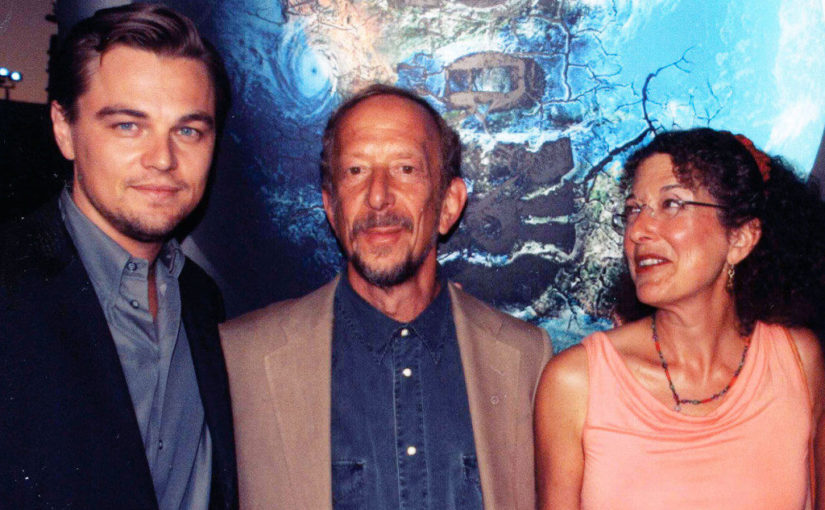
The Leonardo DiCaprio Foundation (LDF) is working around the globe on species protection and conservation issues, climate change, and empowering indigenous and local activists. But nothing we do is more important than advancing the cause of ecoliteracy.

All of the environmental challenges we face have one thing in common: they are caused by environmental illiteracy. But I also believe that these problems can be fought with a secret weapon: all of you!

Since the first Earth Day in 1970, governments and non-governmental organizations have spent countless hours and billions of dollars to try to educate the public via the news media and other information channels, field trips outside of the classroom, documentaries, and museum exhibits. Yet so far, this investment has made very little difference in slowing down the march of devastating climate change impacts and the loss of natural habitat and species. In part this is because up to now great environmental education efforts and programs have been very well researched, documented, and scientifically sound, but overall remain uncoordinated.

To get lasting and large-scale change, we need to turn the tide in America and beyond. We need to combine these programs—like so many oars rowing the boat in the same direction to make it go faster and not just in circles—and take them directly to the decision-makers of the future: our students in public schools. There are no shortcuts.

That’s why LDF has chosen to invest in organizations working with the State of California, because we believe California has unique tools to assist teachers in teaching science using the environment for context and we know that environmental literacy and science are inextricably intertwined. Moreover, science teachers in California have influence beyond their classrooms and even beyond their state. I have seen first-hand how California is an environmental leader in the US and around the world. As you know, California is the sixth-largest economy in the world with the largest population of any US state—over 12% of the entire country lives here—and the biggest school system with over 6 million public school students, producing about 400,000 graduates each year who go out into the world and begin to influence others.

We believe, as I’m sure you do, students who are environmentally literate will make informed decisions as consumers and voters, be better stewards of their own environment, and will be equipped to take advantage of green STEM-related job opportunities.

One example of this is Leonardo DiCaprio. He was inspired as a young boy by the things he learned about nature in science class at school in Los Angeles. He credits his childhood teachers with helping instill in him a passion to protect the environment (oh yes, and to go into acting).

And my connection to science education and environmental literacy in California is also personal. Supporting the implementation of former Senator Fran Pavley’s Education and the Environment Initiative law is how I met my wife Leslie, one of the architects of that law!

The importance of environmental literacy may best be illustrated by the level of illiteracy that exists around climate change, and the very real impacts to the planet and economy that result. California teachers are especially critical in helping students understand climate change and to fundamentally alter this dynamic. Today only 45% of American adults think climate change is a “very serious problem” and in China, which is the world’s top greenhouse gas polluter after the US, barely 18% classify climate change as an issue.

But who can blame people who have not been educated about how these issues relate to them and their families—and if they are motivated to take action how to be good stewards of the environment, how to make informed choices, or how to elect leaders who understand science and will base their policies on facts?

I need not tell you that climate scientists warned us for decades that increased warming of the planet caused by our carbon emissions would result by the early 21stcentury in things such as more severe and damaging storms, longer-lasting droughts, and year-round wildfires. Indeed, 2017 will set new records for all of those predictions and the breathtaking toll on human life ecosystems and the economy—all because we failed to heed the science and take action sooner.

Which raises the question of why? In addition to a general lack of climate science taught in schools or to decision-makers in all walks of life, we are also up against the climate-denial industry that is pouring millions of dollars into the education system in states across the country—a denial industry that is emboldened by the Trump administration which is empowering people and policies that openly question the truth and urgency of climate science predictions.

It’s therefore more important than ever that California continues to lead the nation in its commitment to having a science, civics, and environmentally literate population, especially as coordinated anti-science policy across the country is a growing threat which is the result of a very simple three-part strategy by climate deniers: Money + Media = Laws.

  • Money: A 2013 study by Drexel University found that 140 foundations funneled $558 million to almost 100 climate-denial organizations from 2003 to 2010. I recommend you read Dark Money by Jane Mayer for much more information on the resources lined up against science and common sense.
  • Media: Money is pumped into conservative-leaning news media like Breitbart and National Review to question the consensus science of climate change.
  • Laws: And that combination of deep, dark pockets plus misleading media leads to voters and lawmakers who are fooled or emboldened to take the nation backwards. For example, the fossil-fuel funded American Legislative Exchange Commission, better known as ALEC, has been drafting anti-science bills for decades—such as the dubiously named “Environmental Literacy Improvement Act.” Language from these sample pieces of legislation has been used by biased lawmakers around the country.

Perhaps the most terrifying aspect of the laws drafted from these examples is their vagueness. The language of bills in Oklahoma, Indiana, Alabama, Idaho, and Texas includes terms like “academic freedom” and “controversial subjects” to disguise the true purpose of these laws, which is to give educators permission to stray from established peer-reviewed science on climate change and evolution toward theories that align more with their personal ideologies but are not based in science. If passed, these types of laws undo much of the hard work being done in states to get the Next Generation Science Standards adopted.

And lest you think that legislative templates don’t become actual laws let me give you just two examples.

  • Last May the Alabama Senate voted to adopt House Joint Resolution 78 which empowers state and local education authorities to promote the “academic freedom” of science teachers in the state’s public schools to say that “Biological evolution, the chemical origins of life, global warming, and human cloning” are considered “controversial.”
  • And New Mexico’s Public Education Department recently unveiled a proposed replacement to its statewide science standards, including guidelines to minimize teaching of the rise in global temperatures, remove references to human activity as the primary driver of climate change, remove or weaken the mere mention of evolution, and remove references to the actual age of the Earth as being 4.6 billion years.And now this blending of money and media has gone in another direction even more direct and insidious. This year the climate misinformation movement is directly contacting teachers. Here’s a recent mailing by the Heartland Institute, its report entitled, “Why Scientists Disagree About Global Warming,” sent to 200,000 teachers across the US. Of course there is no real disagreement when the world’s scientists under the Intergovernmental Panel on Climate Change have concluded with more than 99% certainty that climate change is real and humans are the primary cause. In fact it’s hard to find almost any other scientific endeavor that has more consensus around those facts except perhaps that the world is no longer thought to be flat!It’s worth spending a few moments on the disinformation campaign of the Heartland Institute because you need to recognize the difference between propaganda and valuable supplemental materials you might receive. The Heartland Institute is spending an estimated $3 million to $6 million on a direct-mail marketing campaignto get this professionally-produced junk science publication into the hands of public school teachers who teach science in the US. The look and feel of this bogus report is very similar to the front covers of science instructional materials, even California’s own Education and the Environment Initiative Curriculum.But while I’m sure you are all too smart for that, unfortunately many of your peers in other states are led astray. An independent report commissioned by Scholastic on the preferences of teachers in using supplemental education materials states that a whopping 8 out of 10 teachers will open and evaluate unsolicited teaching materials. A report last year in Science showed that just barely half of US science teachers teach that humans are responsible for climate change, and at least a third give mixed messages to students suggesting that scientists believe that natural factors are responsible.Why? Well, one answer might be found in a new study published in the Proceedings of the National Academies of Science which says that religious and political beliefs override education when it comes to accepting the mainstream science of climate change.Given all this, what can we do? What can you do to teach science in the face of such well-funded misinformation? There are many reasons for hope in California:
    • The National Science Teachers Association encourages science teachers to send them the unsolicited propaganda from the Heartland Institute and they will recycle it! In return teachers will receive free access to their ebook, Ocean’s Effect on Weather and Climate. And, we commend CSTA for its position on Climate Change.
    • To further combat misinformation, the Alliance for Climate Education has resources and plans to roll out lesson plans and in-class activities to accompany new video resources to support teachers in this area, as well as a “rapid response” curriculum to support teachers to teach climate in areas of the country that were recently hit by hurricanes and other climate-related events as they unfold.
    • And even more significantly, California’s Next Generation Science Standards (CA-NGSS) support climate change education, and this position is further reinforced by the presence of California’s Environmental Principles and Concepts (EP&Cs) in the new Science Framework. This means that as educators you do not need to hold back on teaching students about how human activities affect global warming, and that decisions to reduce the impacts of global warming depend on understanding climate science, engineering capabilities, and social dynamics.
  • These EP&Cs are unique to California and were created as a result of the 2003 passage of California’s Education and the Environment Initiative Law. They examine the interdependence of human societies and natural systems and appreciate systems thinking and the connection and interdependence between humans and their environment.
  • These EP&Cs have been integrated into the 2016 Science Framework and 2016 History–Social Science Framework, and will significantly be integrated into the science and history–social science instructional materials during the next adoption. The California Department of Education also engaged a multiyear, multistakeholder process to develop California’s Blueprint for Environmental Literacy.

Superintendent Tom Torlakson appointed the Environmental Literacy Steering Committee to implement the Blueprint statewide. LDF knows that EP&Cs, committees, and you educators won’t accomplish the goal of ecoliteracy alone, so that’s why we are proud to work with non-government organizations like Ten Strands, TreePeople, and others who are partnering with state agencies and state public schools.

It’s also why we have committed $3 million over three years to help all of you achieve the vision for true, widespread environmental literacy. Those funds support teaching science in the context of the environment by providing professional development focusing on school districts as the unit of change, linking nonformal providers of environmental education and green employers to schools, and helping districts access funding.

Does this approach work? Take for example Katherin Konomi (4th Grade Teacher), from the Burlingame School District, who said, “My biggest accomplishment as a teacher was learning how to take students outside of the classroom to work on science. It is the biggest learning experience you can offer your students. I was able to comprehend that you don’t need a big and elaborate lesson to take students outside. Taking students into their environment to observe dirt and rocks can have such a huge impact on fostering the relationship of your students to the world of science.”

Or Jose Flores, a high school teacher at Brawley Unified School District, who reports how students might use this education: “Students can truly have a voice, and express that voice by attending school board and city council meetings to engage in civil discourse with their elected officials to enact positive change in their community in addressing social and environmental issues.”

Those testimonials are validation of both the California Common Core State Standards and the CA-NGSS which emphasize the importance of student-centered instruction, hands-on learning, and real-world learning experiences. Environment-based science and history–social science education using engaging local contexts offer a powerful entry point for such experiences that students never forget.

In sum, we know this is hard work even without the misinformation campaigns working against us or the fact that we’re starting all of this too late to educate the last generation of voters, consumers, educators, and activists who might have prevented some of the impacts of climate change and species extinction that we are already witnessing. There are no shortcuts, but California and LDF have given you tools, and we hope you will use them.

Shakespeare wrote, “There is a tide in the affairs of men, which, taken at the flood, leads on to fortune.” I pose to you that we are upon such a sea at this moment and it is only ecoliteracy that can help everyone understand this tide and shape our future…before it shapes us. And I believe that you are our champions who will teach the next generation to do just that. Thank you!

This article was written by Terry Tamminen

From his youth in Australia to career experiences in Europe, Africa, China, and across the United States, Terry has developed expertise in business, farming, education, non-profit, the environment, the arts, and government. Governor Arnold Schwarzenegger appointed him Secretary of the California Environmental Protection Agency and later Cabinet Secretary, the Chief Policy Advisor to the Governor, where Terry was the architect of many groundbreaking sustainability policies, including California’s landmark Global Warming Solutions Act of 2006, the Hydrogen Highway Network, and the Million Solar Roofs initiative. In 2010 Terry co-founded the R20 Regions of Climate Action, a new public-private partnership, bringing together sub-national governments, businesses, financial markets, NGOs, and academia to implement measurable, large-scale, low-carbon and climate resilient economic development projects that can simultaneously solve the climate crisis and build a sustainable global economy. Since 2007 he has provided advice to Pegasus Capital Advisors and numerous global businesses on sustainability and “green” investing. In 2016, Terry joined the Leonardo DiCaprio Foundation as CEO. An accomplished author, Terry’s books include “Cracking the Carbon Code: The Keys to Sustainable Profits in the New Economy” (Palgrave Macmillan). In 2011, Terry was one of six finalists for the Zayed Future Energy Prize and The Guardian ranked Terry No. 1 in its “Top 50 People Who Can Save the Planet.”

Lyla June: Warrior for Peace

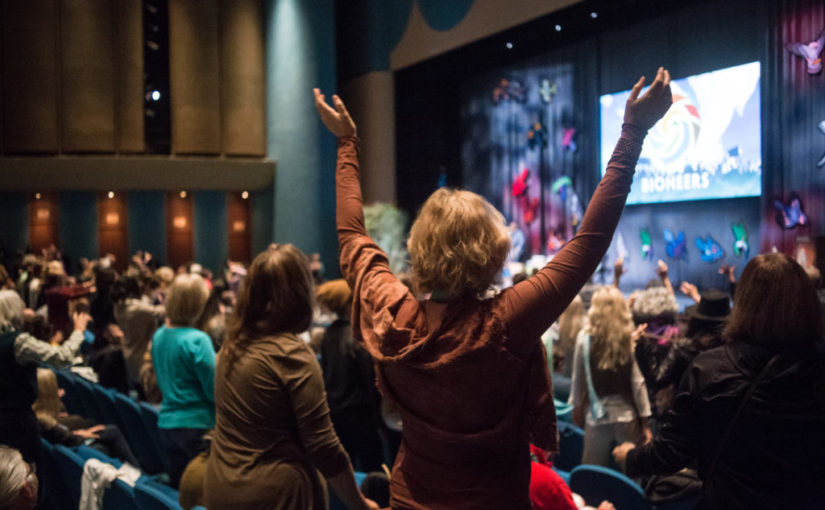
Lyla June is a Native American (Dine´/ Cheyenne) poet, peacemaker, musician and activist dedicated to revitalizing spiritual relationships with Mother Earth and cultivating forgiveness and reconciliation. We’re pleased to be hosting her on the main stage at the 2018 Bioneers Conference for a keynote address this fall. However, this year will not be Lyla’s first appearance at Bioneers…


In 2011, I organized the first annual Poetry Slam at the Bioneers Conference Youth Unity Center, which has evolved into a brave space where youth challenge the system, reveal personal trauma in search of healing and articulate their aspirations for a better world.

My original vision was a much smaller one, a competition among poets with audience members deciding who would advance to the next round with one winner emerging from the final round.

The Thursday before that first poetry slam, I met Lyla June at Just Us for Food Justice (JU4FJ), a one-day Bioneers event where young food justice activists meet, build the movement, learn inner resilience skills and share stories. Gerardo Marin, whose big heart and clear thinking make him a close ally to many Bay Area front line activists, invited Lyla to lead the spoken word session at JU4FJ. Lyla kicked off the session with a poem she wrote called Dawn that begins with:

“It’s dawn

the sun is conquering the sky

and my grandmother and I

are heaving prayers at the horizon”

The poem interprets the complex meaning of the word “hozho” from her Native Dine´ language, and is an awe-inspiring blend of traumatic history, sacred worldview and transformation. The power and beauty of Lyla’s words blew me away. I immediately invited her to the Poetry Slam.

Two days later at the Slam, not surprisingly, Lila was chosen as the winner. When she was being presented the $75 prize money, she said, “Screw winning, screw hierarchy!” and she began to share the money with all the other poets. This spontaneous act of revolt against the competitive structure ignited the audience. Without any prompting, audience members dug into their pockets to contribute to the purse, swelling the prize money to more than double its original amount, which was equitably distributed among all the poets.

I was delighted to see my original idea dismantled to have something much more elegant, respectful, and acknowledging take its place. Now at the Slam, it is common for seasoned poets, as well as first time poets, to rip open people’s hearts with their raw emotion and authenticity. It is a dynamic spontaneous place of celebration, hard truths, and healing.

On the Writing for Peace website Lyla wrote, “Writing for peace means: Praying before each line is written that the Great Spirit’s message comes through. The root word of genius is, ‘genie,’ or spirit. And so, the true genius does not take credit for her/his work. Rather s/he celebrates the fact that they were able to move out of the way enough for Spirit’s masterpiece to flow through them.” Lyla’s poetry is one way she expresses her dedication to forgiveness and fuels her passion as a non-violent warrior for peace.

At the 2017 Geography of Hope conference, Lyla spoke about the power of forgiveness, recalling her time as a Water Protector at Standing Rock when police fired rubber bullets; threw tear gas grenades; sprayed mace; attacked with dogs; and, in 20 degree temperatures, used fire hoses against non-violent protesters who were trying to protect the water supply and cultural artifacts of the Standing Rock Sioux Tribe from the construction of the Dakota Access Pipeline.

She described how she participated in a circle of forgiveness at the Morton County Jail where other Water Protectors were being held and where women were being strip searched. A thousand people surrounded the jail and “sang songs of forgiveness, of life, and beauty and healing.”

Lyla said, “We must forgive… but forgiveness does not mean you stop fighting for what is right. On the contrary, forgiveness allows you to fight more effectively for what is right and it cleanses you of the same hatred you are fighting against.”

We are excited and honored that Lyla June will be giving a keynote presentation at the 2018 Bioneers Conference, October 19-21.

The Redd on Salmon Street: Portland’s Local Food Hub

Traveling through Salmon Nation on my way to British Columbia, I stopped in Portland. Unlike the shabby, worn-out, warehouse districts in many cities, Portland’s Central Eastside seems lively and up-and-coming, filled with a variety of light industry serving local needs. Recently several coffee roasting operations, cafes and restaurants have opened up. Part of this entrepreneurial renaissance is The Redd, a food hub on Salmon Street developed by Ecotrust.

Salmon Nation, whose boundaries are defined as “where ever Pacific Salmon have run,” is a concept conceived by Ecotrust as a way for people to live in meaningful relationship with their ecoregion and to have life-affirming engagement with their neighbors, as is modeled by the lifecycle of salmon. The tagline is “People, fish and our common home.

Elizabeth Woody, Ecotrust’s Director of Indigenous Leadership, in the essay, Simple Customs of Salmon Nation,wrote “Salmon were the first to teach us of wealth… Their die-off generated the most biologically diverse forest on earth. For millions of years, salmon came and left this way. For eons, this monumental Giveaway brought us health and renewal.”

Trying to mimic those qualities of cooperation, renewal, generosity, and health within the contemporary economic system is akin to salmon swimming upstream against the current, nevertheless, Ecotrust is committed to building a restorative, equitable, regional, food system.

Emma Sharer once directed a national supply chain, and worked for a consumer packaged goods company and a granola bar company, but became disillusioned with global food export practices and found herself attracted to the idea of building regional economy. As The Redd’s Operation Manager, she is on a quest to figure out how to get everyone to work together and to identify the intersections that trigger new opportunities.

Ecotrust refurbished an old marble warehouse and redesigned it for mixed use space with shared offices for small to mid-size food companies who are getting started in Portland. There are about 100 small food companies using the warehouse and distribution space, everything from producers of nut butters, salads, seafood, and soup as well as FoodCorps, a national non-profit that provides nutrition education and school garden programming in schools.

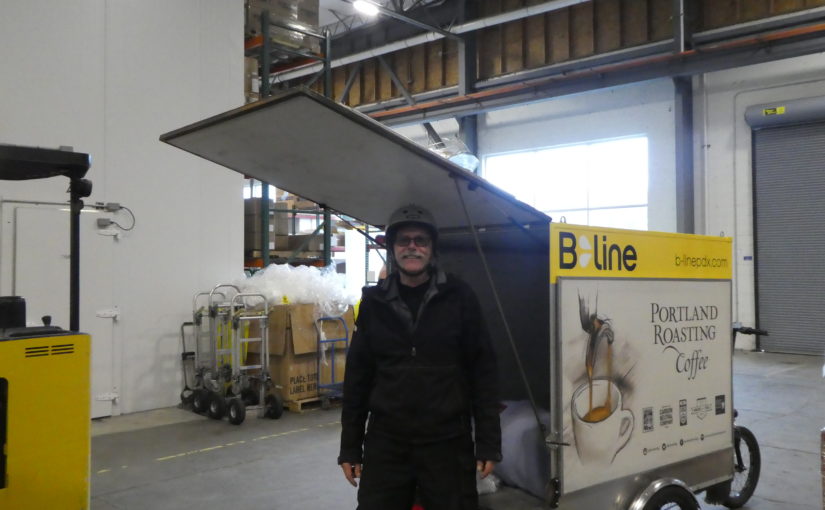
B-line Sustainable Urban Delivery, one of the five anchor tenants, manages The Redd facility. Sharer said, “We told B-line, here’s the space, you guys pay us rent and run it. Figure it out and we’ll help you. We come in and play the activator/support role.” B-line distributes locally produced food products throughout the city on fourteen electric trikes.

“B-Line,” Sharer said, “has partnered with New Seasons, the biggest food retailer in Oregon, in a program called Green Wheels. Instead of having many small entrepreneurs load their Subarus and deliver them to New Seasons individually, they drop their inventory off here, B-Line aggregates it and distributes product.”

Fourteen patient private investors provided capital for the purchase and renovation of the building. They are willing to accept a slow, steady, modest return on investment as long as their money is having a positive environmental or social impact.

“Using business as a force for good” is an ethos held not only by the investors, but also by the small business owners at The Redd. After working as a psychiatric nurse in Oregon’s prison system, Betsy Langston became interested in Restorative Justice, a process that brings all parties together—victim, offender and community—to promote reconciliation and healing. A percent of Betsy’s Bar None business profits are donated to the Insight Prison Project to help their efforts in healing trauma, preventing violence and repairing broken lives. Emma Sharer used her supply chain expertise to help Betsy source more local ingredients. Now 95% of the ingredients for Betsy’s Bar None products are sourced from North America.

70% of Oregonians who live below the poverty line are women and children. Ground Up, another one of the The Redd’s businesses, is a nut butter company that has a six-to-nine-month program that hires and trains homeless women, providing job skills and building their confidence to help them transition out of homelessness.

The full vision for The Redd includes a second building, an old metal manufacturing plant next door that will be remodeled into be a public event space.

Sharer said that buying both buildings “is a really critical real estate investment because the value of the real estate has doubled in the last three to four years. We could make money and build apartments, but we don’t want to do that; we truly want to be a part of the Central East Side industrial community. How do we bring back the industry that was once here, but recreate it in an equitable, prosperous, regenerative way?”

But challenges exist, “Warehouse space in Portland,” Sharer explained, “is a whole lot more expensive than warehouse space outside of the city. Even though we’re charging below-market rates to our tenants, it’s really hard to pay rent, because rent here is a lot more expensive than if B-Line was out of the center of the city.”

Amanda Oborne, Ecotrust’s Vice President of Food and Farms, conducted an18-month- Infrastructure Gap Analysis to answer the question: Where could investment catalyze regional food system growth and development? That analysis led to the development of The Redd.

“It’s easy to get overwhelmed,” Oborne said, “with the magnitude of change required to meet the hopes and dreams many of us hold for our food system, but the surest antidote feels like digging in on a practical local solution, and connecting with others doing the same. The Redd is a space that invites and facilitates long-term collaboration by farmers, ranchers, fishers and entrepreneurs who hold a vision for an equitable, restorative food system on one hand, and provides a platform to engage regionally or nationally on the other. It feels both radical and practical, in a way that offers a pathway toward optimism and hope.”

Ten Strands Reflects on Their Bioneers 2017 Experience

This blog post and all media within were re-posted with permission from Ten Strands. For More from Ten Strands Visit: Tenstrands.org/news

By Kim Moon

Western societies will, in the end, be subservient to the land and what it can provide and teach. . .we will never know ourselves until we know where we are on this land. ~Paul Hawken

I was travelling, was halfway across the country when the Tubbs fire started in Northern California. The most destructive wildfire in California history, they say. Preceded by Hurricane Maria. Preceded by the Central Mexico Earthquake. Preceded by Hurricane Irma. This describes only this part of the globe. This describes only a one-month timeframe. This does not describe the devastating impact to landscapes that were levelled. This does not describe the people who lost their lives, nor those who survived and are currently struggling to continue doing so. In Puerto Rico alone there are 3.4 million American citizens in the midst of a humanitarian disaster, they say.

Apocalyptic is used by people on the ground, in all instances, to describe the places they had previously referred to as Home.

“At the end of the 1960s there was a huge backlash to the civil rights movement, and in that backlash the modern environmental movement emerged. Many of the white people who were involved were looking for ways to have some distance from the experience of the civil rights movement. It’s been more than 45 years, and the reintegration of the issues of the environment, and the issues of social and racial justice have been taking on a fierce new form. It’s one of the reasons that we have, now, the business of emerging social and racial justice movements coming together with environmental justice.” ~Carl Anthony

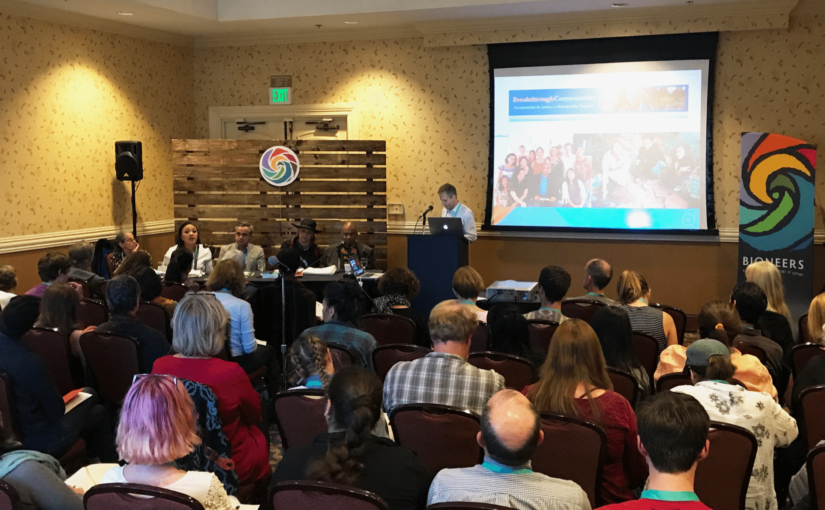
I returned to the place I call home to be present at the 2017 Bioneers Conference. This year Ten Strands, in collaboration with State Superintendent Tom Torlakson’s Environmental Literacy Steering Committee (ELSC), was invited to submit a session proposal. This is how we chose to show up in this space, described by Paul Hawken as, “central to the re-imagination of what it means to be human”:

ENVIRONMENTAL LITERACY FOR ALL: The benefits of environmental and outdoor science education have been widely known for decades, but the cultural relevance of these experiences and access to them remains elusive for low-income communities, communities of color, and English language learners. This session introduces environmental literacy as an inclusive, relevant strategy within the K–12 public education system to help students learn to solve problems, improve their lives and communities, and make the world a better place. We will explore success stories and the possibility of bringing environmental literacy efforts to scale by cultivating community partnerships, meeting mainstream educational goals, and providing students with the capacity to act individually and with others to build ecologically sound, economically prosperous, and equitable communities for present and future generations.


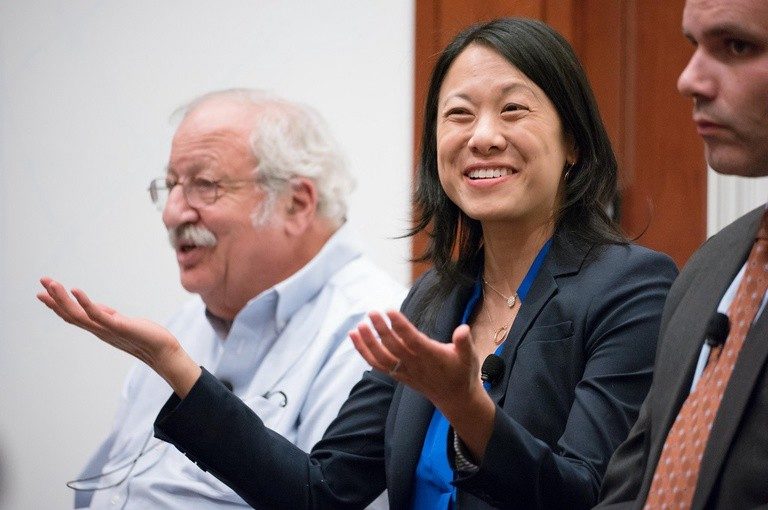
Our panel discussion was moderated by ELSC Co-chair Craig Strang, Associate Director of the Lawrence Hall of Science, and included:

  • Carl Anthony (ELSC Member, Urban Habitat, Breakthrough Communities Project, Earth Island Institute, architect; oft referred to as Grandfather of the Environmental Justice movement);
  • Paloma Pavel, PhD (ELSC Member, President Earth House Center, Co-founder Breakthrough Communities Project);
  • Raquel Pinderhughes, PhD (Professor and Chair of Urban Studies and Planning Department at San Francisco State University, creator of the Roots of Success Curriculum);
  • Jose Flores (ELSC Member, Presidential Award-winning Brawley Union High School District teacher and committed student advocate); and
  • Juanita Chan (District Science Lead, Rialto Unified School District and passionate champion of student-centered learning).

Saturday morning’s keynote speakers included Bioneers Co-founders Nina Simons and Kenny Ausubel, Amy Goodman (Democracy Now!), and Heather McGhee (President of public policy organization Demos). In addition to her work with Demos, Ms. McGhee helped shape key provisions of the Dodd-Frank Wall Street Reform and Consumer Protection Act. It was her talk, A New “We the People” for a Sustainable Future, that expressed so clearly and impactfully the issues that are—especially in rooms where economic and racial privilege (and all that word carries with it) are predominant—often avoided, sidelined, or otherwise left inadequately addressed.

“Our challenge today is to find the language that can link cultural diversity to a broad social movement that reflects the majority of the population in California—60% of whom are people of color. This is the challenge we all face as we pass the torch to the next generation who set out on this journey of making history for all of us.” ~Carl Anthony

This is a good time to pause and acknowledge the importance of language. There are words, words, and more words; they form and transform as we attempt to communicate, to reach common understanding with those with whom we hope to connect. Or influence. Or control. Ms. McGhee uses the term “hierarchy of human value” to speak about a deep truth about this country of ours, whose ascent to dominance would have been impossible without one particular group of people devaluing several others, from its inception all the way up to the present day. So when we, Ten Strands and the ELSC, speak of community, it is as students of the communities we seek to accompany.

“Accompaniment” is actually an umbrella term that includes a family of related practices: equality, listening, seeking consensus, and exemplary action. ~Staughton Lynd

Accompanying requires us to distinguish between frontline communities and impacted communities; to understand how referring to particular communities as ‘underserved’ or ‘vulnerable’ may be perceived as failing to recognize the power of people taking action within communities while perpetuating the language and intent of colonialism. It requires us, if we are outsiders, to listen carefully to what people with direct experience are saying, to respect how and when they want outside support, and to be sincere and consistent while doing so.


The Steering Committee’s work is organized around school districts as ‘units of change’, as a school district is one type of community. Teachers, students, school administrators, parents, governing boards, local businesses, and community-based organizations function together in a place, their place, in an effort to meet the social contract of free public high-quality education for our country’s youth. This is achieved to varying degrees, for a variety of reasons. Ms. McGhee effectively addresses the progressive retreat from public support, and traces it to the ways in which the word public has become a thinly-veiled trope for not-white:

Beginning in the 1970s, conservatives deployed a highly racialized strategy that relentlessly linked public institutions to undeserving minorities in order to undo the country’s social contract—one grounded in good government, strong unions, and regulated capitalism. In the New Deal and Great Society years, white majorities broadly supported activist government because they perceived it as helping people like themselves—hardworking, deserving, decent. But as government programs became available to people of color, conservatives saw that they could gain ground by dog whistling about welfare and criminals, using racially coded terms to invoke the specter of liberal government coddling people of color—the very groups whose fortunes seemed to be rising just as life was getting harder for the white working class in the 1970s. ~Ian Haney López & Heather McGhee

The nation’s public school system has felt the impact of this withdrawal, but State Superintendent Torlakson, himself a former classroom teacher, has convened a number of special task forces (including one that the ELSC evolved from) in an effort to fulfill the promise of quality public education for California’s 6 million K–12 students. Besides the Blueprint for Environmental Literacy, there also exists Revitalizing K–12 Civic Learning in California: A Blueprint for Action. Taken together in a larger context, they represent a necessary paradigm shift in public education in California. As funding for the state’s school districts moves to local control, districts are increasingly empowered to make decisions about how to provide the best education for their students locally, in and with their communities. Superintendent Torlakson’s Blueprints highlight practices that include integrated learning, hands-on learning, service learning, learning beyond school walls, community partnerships, and equity of access for all students to a variety of educational experiences:

For all students in California to have access to a continuum of civic learning experiences starting in kindergarten—and to effectively respond to equity issues—we must embed robust civic learning throughout the K–12 experience, both within and beyond school walls. To this end, the Task Force makes the following system-wide recommendations to improve civic learning in every district, in every school, for every child.~Revitalizing K–12 Civic Learning in California: A Blueprint for Action

We must invest our very best thinking, our very best efforts, and—above all—our very best people in improving the quality and reach of student education for environmental literacy in California. We must do so for the future of our students and for California’s prosperity, equity, and resource sustainability…The central approach for achieving environmental literacy proposed by the Blueprint for Environmental Literacy is to integrate environmental literacy efforts into California’s increasingly coherent and aligned K–12 education landscape so that all teachers are given the opportunity to use the environment as context for teaching their core subjects. ~A Blueprint For Environmental Literacy: Educating Every California Student In, About, and For the

Environment


Two of our Bioneers panelists live and breathe the intent and implementation of the recommendations expressed above, on-the-ground, every day.

Jose Flores is a civics teacher, and powerful advocate for his students at Brawley Union High School, his alma mater (read more here). Collaborating with school administrators, the school district board of directors, EPA Region 9, state and local governing bodies, and the community-based nonprofit Comite Civico del Valle, Mr. Flores’ students participate in a variety of experiences, both in school and out, tailored to be relevant, engaging, and enriching. The goal is to empower student voices, encourage civic participation, and expand awareness, access, and opportunity:

“You have to have a voice. For the most part, our students are from ethnic groups that withdraw from democracy because they don’t see themselves as having a voice. I have 180 students; 90% of them attend all school board meetings and all city council meetings. They have a voice. They have buy-in. Having a voice, and going to these meetings, they can push back on issues of the economy, which in our area directly tie into environmental issues. The focus that we emphasize is college, career, and civic readiness. We need students and teachers to understand that you truly don’t civically engage unless you’re environmentally literate. And you’re not truly environmentally literate unless you’re civically engaged—it works both ways.

Juanita Chan is a former classroom teacher, now the District Science Lead at Rialto Unified. There, she has inspired a core group of over 50 teachers dedicated to illustrating that science and the environment can provide the real-world context that gives flavor to all other subjects. She has worked vigorously to infuse environmental education into all levels of K–12 curriculum, advocating for access to experiential learning for all Rialto students. Her passion and vibrance is palpable—the people on both sides of me lean forward in their seats, returning her enthusiasm via eye-contact and nods of agreement whenever she speaks. The model for success Ms. Chan shares finds its foundation in the Next Generation Science Standards (NGSS). From there, valuing local context and the community’s unique perspective and skills fosters a culture of cooperation to create opportunities for students. The district prioritizes and supports teacher professional learning to integrate science and environment, and collaboratively strategizes with community stakeholders around identifying Local Control Accountability Plan (LCAP) goals and pathways to achieve them. Ms. Chan highlights the importance of responsiveness, flexibility, and ensuring that the focus remains on serving students:

“We have educational reforms in place, primarily the NGSS, and so we are using the NGSS to have these really tough conversations with our teachers—and not just our teachers but our administrators and our councillors as well—about social justice. About what is the intention of school. And if the intention of school is to really, truly serve all standards for all students then does our system set it up for every student to have that success? And if it doesn’t then we need to fix it.

“All our students, to a person, are curious critical thinkers…but most have not completed high school. They are typically at 4th grade math, 7th grade reading [levels]. Many of our students are illiterate—even students that have a high school degree—and most of them have pretty negative associations with traditional schools and classrooms.” ~Raquel Pinderhughes

Dr. Raquel Rivera Pinderhughes has taught at San Francisco State University for the past 25 years, where she serves as Professor and Chair of Urban Studies & Planning. An activist scholar, her work focuses on improving quality of life and economic empowerment opportunities for low-income people and inner-city communities. She has directed urban and environmental education programs for incarcerated youth and adults, and developed green job training for low-income youth and adults throughout the country. In other words, Dr. Pinderhughes serves those who are direct evidence that a hierarchy of human value is still very much functioning in our society, and by default, our educational system. In other words, disproportionately people of color.

Her curriculum, Roots of Success, is used in 36 states and three countries, in sectors that run the gamut from universities, government, and nonprofit organizations to prisons and reentry programs. During the panel discussion, she informs us that the youth her programs serve are already experts on environmental issues. That folks from low-income communities are facing environmental problems and injustices every day, and know more than anybody sitting in this room. That it is the people with lived experience that are best equipped to name the most urgent problems and identify solutions. And that we are accountable to those who have been left out, left behind, let down. At some point while she’s speaking I notice I’m crying; I’m pretty certain it started between her first and second sentences.

“Our teachers provide students with material that is directly relevant to their lived experience, so that we front-and-center the experiences of low-income communities, communities of color, frontline, and fenceline communities. We get students excited about learning and about being in the classroom. We also strengthen academic skills, help people acquire new knowledge and skills, provide them with opportunities to apply what they’re learning in the classroom to real-world situations and challenges in a range of settings, and inspire them to become activists who want to improve conditions in their communities. We connect their education to employment. We are primarily preparing people for work because they are economically very insecure. We prepare them for over 125 different environmental careers.”

“As we face a serious threat to the survival of life on the planet, we are actually facing a new reality, which is: how do we bring all these movements together? Because we can’t afford to have 15 or 20 Earths to support our social activities. We have to come together and we have to manage to find new ways to bridge the gaps. I would say that as painful as this period has been with separate identities, we need to hold onto these separate identities—but to do it in a new way which is to bring the strength of our separate understandings of who we are together with a social movement that can unite the people as a species.” ~Carl Anthony

Somewhere between 10:00–11:00am on a sunny October Saturday morning in Northern California, the smoke was no longer in the air. The rain had come the day before. The dull orange smell of fire fed well on trees and our manufactured shapes, mixed with the chemicals dropped from the sky to contain the burning, was replaced by the smell of moist earth. In the morning I listened to Heather McGhee eloquently and powerfully call-out America’s long-standing system of racial oppression as the inspiration for Hitler’s Nuremberg Laws (read Whitman’s Hitler’s American Model: The United States and the Making of Nazi Race Law). But I also heard her clear and impassioned hope for a version of this country where, in a nation of ancestral strangers, it is more possible, more likely than anyplace else on the planet that “here today, there is someone in this country claiming citizenship who has a tie to every single community on the globe. That is the ‘We the People’ that I can believe in.”

The movement has three basic roots: environmental activism, social justice initiatives, and indigenous cultures’ resistance to globalization, all of which have become intertwined. Collectively it expresses the needs of the majority of people on earth to sustain the environment, wage peace, democratize decision making and policy, reinvent public governance from the bottom up, and improve their lives—women, children, and the poor. Throughout history, armies, corporations, religious rulers, and political zealots have overpowered the majority world, which in our upside-down world we consider to be minorities. ~Paul Hawken

Tom Goldtooth (Dine’ and Dakota, Executive Director of the Indigenous Environmental Network, Recipient of the Gandhi Peace Award) has shared the Dakota concept of Mitkuye Oyasin—meaning we are all related. You are somewhere, right now, reading these words. Someplace close by, there are people working with passion and purpose to transform difficulty into opportunity; many communities have been doing this work for generations. We at Ten Strands and the ELSC do this work with deep appreciation and respect for this planet and all its inhabitants, with a focus on transforming education for California’s young people.

And there is a standing invitation to be involved, to listen, support, to practice exemplary action—to accompany.

This article was written by Kim Moon

Kim Moon has a background in communications, and over 20 years of experience in the education and nonprofit sectors. At the East Bay Community Foundation, she oversaw the creation, marketing, and management of the James Irvine Foundation’s Conference Center, which provides sliding-scale meeting space to community-based nonprofits. She later joined a small family fund where she oversaw project management, program development, securing funds for San Francisco Unified School District classrooms, and creating and supporting school gardens. She believes deeply in the power of young people, and is grateful for everything she has learned from them in her volunteer roles as mentor and tutor.


Elevating Nature: Milan’s Bosco Verticale

By Reid Coffman, MLA PhD

This piece was originally published by the Biophilic Cities Journal.

Finding nature in a high-rise apartment seems quixotic, but it may be just the biophilic injection dense cities need. After centuries of practice distinguishing the urbane from wilderness, a pair of residential high rises in Milan, Italy has flipped the paradigm by proposing a new social ecology within its building façade, and is providing an option for ultra-urban access to nature.

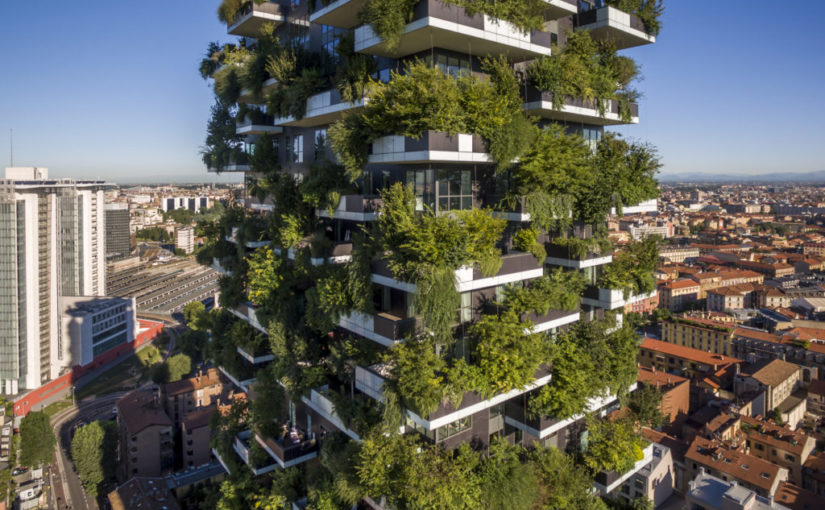
Bosco Verticale, designed by architect Stefano Boeri, opened in 2014 to provide residents with an alternative to suburban single-family neighborhoods. Boeri envisioned public exchange with neighbors occurring through a terrace-scape on the building’s exterior façade. In this space, residents would have views of nature, direct access to vegetation, and the opportunity for neighborly exchange about the pleasantries of gardening, plants, and wildlife. Relying on a compact intimacy of the gardening tradition, Bosco Verticale expands Milan’s cultural habits of terrace gardening into a community level asset that occurs as a forest on a building within the city.

View from the 20th floor
Photo Credit: Reid Coffman

The eighteen and twenty-six story tree-covered towers emerge from the historic stone and brick city as an aberration to the sculptured glass buildings flourishing today in Milan’s Porta Nuova district. Taking a closer look at the neighborhood, it is easy to see how Bosco’s 800 trees, 4,500 shrubs and 15,000 plants are an unfolding evolutionary adaptation of the local balcony gardening tradition.

New opportunity comes from how the terraces connect trees and people. By looking at the façade from the city, the overall terrace layout breaks regimented uniformity common in high-rise balconies to create a seemingly random visual condition. This design offers spaces that accommodate tree canopies while echoing the mysteries of larger systems that are at play.

The selection and arrangement of trees and vegetation creates neither landscape nor garden. It is a novel environment, a sort of phyto-scape or terrace-scape, if you will. More than simple balcony gardening, the setting provides an exposure to plants and wildlife inside and outside the building while delivering a shared set of ecological benefits including: beauty; mystery; light filtration; and air and temperature regulation.

View through neighbors’ trees
Photo Credit: Reid Coffman

It is rare to have an intimate experience with plants in a high-rise building, let alone one that is so exposed to the public. Through the windows, residents are continuously oriented at varying distances from trees and plants creating a feeling of being cloaked in nature. Yet, in the background, the city is alive with activity, creating an extremely uncommon association of nature in its context. For example, residents can sit at the kitchen table within a few inches of glossy green foliage and beautiful warm colored branches while, through the canopy, they can enjoy the view to the city streets filled with motorists, bicyclists and pedestrians. This comforting prospect is enriched with the realization that the vegetation being enjoyed is not one’s own, but a neighbor’s.

The plants enjoyed through the windows are part of a much larger interdependent social experience. The tree canopies visible through windows are actually growing from a downstairs neighbor’s terrace and the tree planted on one’s terrace is enjoyed primarily by the upstairs neighbors. This overlapping creates a one-of-a-kind social ecological setting that exceeds anything found in the single-family home suburban garden.

The neighborhood context
Photo Credit: Stefano Boeri Architetti

The experience is magnified when standing outside on the terrace. Every terrace is more than an extension of private real estate. Stepping outside, one notices very few terraces align on the same floor creating a nice sense of privacy. Instead, diagonal views downward and upward offer views that prioritize the vegetation while composing a casual environment of chance encounter common in the city. These staggered, off-set terraces are where the neighborly discussions of plants, weather, and local community can begin.

The engineering systems that provide support, water, and nutrients to the trees and plants are equally unique. Structural planters contain light-weight designer growing media, irrigation tubing, and drainage pipes that service the plant roots while wires stabilize tree trunks to withstand extreme winds. All the plant material is maintained and stewarded by a team of professionals that is governed by a residential board making the entire façade a public space organized and operated by the community.

Photo Credit: Stefano Boeri Architetti

The settings at Bosco Verticale begin to defy current categorization. Using the term “garden” to describe these places is inaccurate, because gardens have traditional practices, orders, and narratives that fail to properly translate in these new settings. Bosco Verticale places humans in contact with nature, and subsequently other people, in a novel way to reveal the innovative potential of biophilic architecture. Other speculative projects offer similarly compellingly experiences that require translation and definition. At the building scale, Torre Rosewood by Ateliers Jean Nouvel (Sao Paulo, Brazil), Solaris at Fusionopolis by T.R. Hamzah & Ken Yeang (Singapore), and the M6B2 Tower of Biodiversity by Eduardo Francois (Paris, France) each aggressively address social and vegetative dynamics in the exterior façade and are far from being categorized as gardens. Meanwhile, at district scale, New Government City by Balmori Associates (Sejong, South Korea) is exploring how living architecture engages urban culture and politics and, if expressed beyond convention, could offer a larger language of urban nature. In creating innovate ways to engage nature, we must develop new verbal expressions and terminology to help explain the value and benefits of such experiences.

It turns out that growing a vertical forest on a building façade is a visionary, workable, and realistic form of biophilic architecture that can be a refreshing way of accessing nature in the densifying city.

Looking up from the public park
Photo Credit: Elijah Less

Reid Coffman is the Editor of the Journal of Living Architecture and an Associate Professor at Kent State University.

This piece was originally published by the Biophilic Cities Journal.

RESOURCES:

Journal of Living Architecture. Research. https://livingarchitecturemonitor.com/research.

M6B2 Tower of Biodiversity. Eduardo Francois. http://www.edouardfrancois.com/en/projects/towers/details/article/58/m6b2-tour-de-la-biodiversite/#.WplTKejwaUk.

New Government City. Balmori Associates. http://www.balmori.com/portfolio/new-government-city.

The Vertical Forest. Stefano Boeri Architetti. https://www.stefanoboeriarchitetti.net/en/portfolios/vertical-forest.

Torre Rosewood. Ateliers Jean Nouvel. http://www.jeannouvel.com/en/projects/torre-rosewood.

T. R. Hamzah & Ken Yeang (April 2014). Solaris at Fusionopolis. Greenroofs.com. http://www.greenroofs.com/content/articles/126-SOLARIS-at-Fusionopolis-2B-From-Military-Base-to-Bioclimatic-Eco-Architecture.htm#.WplVaejwaUk.

10 Incredible Activism, Justice & Human Rights Presentations Coming to Bioneers 2018

We’re looking forward to gathering some of the brightest minds and most groundbreaking changemakers at Bioneers 2018. This year, our Activism, Justice & Human Rights programming will bring to our stages discussions on everything from climate change and the rights of nature to ageism and medicine.

Here are 10 sessions we can’t wait for you to see.

1. Climate Change Is Changing the World-Now We Too Must Change

As Executive Director of 350.org, the groundbreaking grassroots international climate change campaign whose innovative organizing and mass mobilizations have uniquely helped generate a mass global sense of urgency and action, May Boeve will share her eagle’s-eye perspectives on the current state of the climate struggle. She’ll illustrate 350.org’s learnings and strategies moving forward, including ways of learning about and incorporating justice and equity. She’ll illuminate pathways our species must take to keep 80% of known fossil fuel reserves in the ground and radically accelerate the shift to 100% clean energy.

2. Bridging ‘ism’ Schisms: Reaching Out Across Divides

Our race, faith, gender, orientation, age and ability often shape where we live, whom we know, the resources to which we have access, and how people perceive us. The stories we tell ourselves about our similarities and differences shape our life choices, and, far too often, different “isms” are used to divide us. How can we use our differences to make us all stronger? What strategies can we use to build bridges and work together for positive change? The future of our society depends on how we address those questions. Hosted by: Connie Cagampang Heller, co-founder of the Linked Fate Fund for Justice. With: Patrisse Cullors, co-founder of Black Lives Matter, founder of Dignity and Power Now; Ashton Applewhite, author of This Chair Rocks: A Manifesto Against Ageism.

3. One Word: “Plastics”

The pace, scale and impact of plastic pollution have exploded. Half of all plastic ever created has come into existence in the past decade. The impacts on ocean life, human health and the entire biosphere are vast and growing. Solutions need to be surfaced, rapidly researched and scaled. Join representatives from three of the world’s leading groups actively engaged in mounting a response equal to the size of the challenge. With: Anna Cummins, co-founder and Global Strategy Director of 5 Gyres; Conrad MacKerron, Senior Vice President of As You Sow; Shilpi Chhotray, Senior Communications Officer for the global #BreakFreeFromPlastic campaign.

4. How to Be a Good Ally

White “ally-ship” with Indigenous Peoples is confusing to the point that we don’t know if we should even use the word “ally” anymore. Through open and honest dialogue between Indigenous and non-Indigenous partners, this workshop provides a pathway for building successful cross-cultural collaborations in: philanthropic giving, environmental campaigns, and the advancement of Indigenous rights. For non-Indigenous attendees, this workshop will explore the relationship between ally-ship with Indigenous groups and one’s own “re-indigenization.” For Indigenous people, this workshop offers practical guidelines to help you manage collaborations, coalitions and alliances with outsiders.

5. Health and Justice: The Path of Liberation Through Medicine

Health visionary Rupa Marya, Associate Professor of Medicine at UC San Francisco and Faculty Director of the Do No Harm Coalition, urges us to radically re-envision and expand our concept of medicine to encompass and address the health impacts of poverty, racism and environmental toxicity. She has been working to make visible the health issues at the nexus of racism and state violence through: her medical work; The Justice Study (national research investigating the health effects of police violence on Black, Brown and other disenfranchised communities); helping set up a free community clinic for the practice of decolonized medicine under Lakota leadership at Standing Rock (the Mni Wiconi Health Clinic); and international outreach with her band, Rupa and the April Fishes.

6. Art, Power and Social Change

Drawing on the modalities of theater, play, writing, storytelling and collaboration, this experiential workshop will offer community members, educators, activists and organizers the tools for engaging their constituencies and leveraging the stories that so often go untold in our communities. Sourcing the collective wisdom and collaborative power in the room, this workshop will use art and embodiment to create a safe space for radical self-reflection, systems analysis, community building and articulating visions for change. Led by: Samara Gaev, activist/educator/performer, founder of Truthworker Theatre Company; and friends.

7. Re-Defining Manhood: A Message to Men, to Boys, to Us All

In this brutally honest and provocative talk, Kevin Powell offers his own life journey to illustrate how we can transform our concepts of manhood. Raised by a single mother in the inner city, Kevin’s rites of passage were typical of many heterosexual males: sports, violence, and viewing women and girls as mother figures or sexual objects, and nothing more. This view of women and girls exploded when, in his early 20s, he pushed a girlfriend into a bathroom door during an argument. Decades later, thanks to years of therapy, study, healing, and a commitment to growth and change, Kevin has become a solution-oriented writer, activist and speaker seeking to re-define manhood around nonviolence, peace, love, healthy self-expression, and as an ally to women and people of all gender identities.

8. How to Build an Alternative to Our Current System

Drawing on the experience of organizers working across the country to create the institutions of the next system, this panel, hosted by Gar Alperovitz, co-founder of the Democracy Collaborative and co-chair of its Next System Project, will explore the connections between environmental action and the democratic economy. How can local efforts at different scales—the workplace, the community, the city, state, and beyond—be knitted together into a powerful movement to build towards a truly systemic national and global alternative? With: Kali Akuno, co-founder and Co-Director, Cooperation Jackson (Jackson, Mississippi); Niki Okuk, founder of Rco Tires, one of California’s largest sustainability enterprises; Aaron Tanaka, Director of the Center for Economic Democracy; Ellen Brown, founder of the Public Banking Institute, author of Web of Debt and The Public Bank Solution.

9. Guardians of the Forest on the Frontlines of the Amazon

In response to catastrophic assaults on their lands and cultures by corporate industrial civilization, the First Peoples of the Amazon have formed unprecedented alliances to protect lands and peoples. These four extraordinary Indigenous leaders, who help guide the Ceibo Alliance of several ancestral peoples of Ecuador’s northern Amazon, have traveled far from their homes to share their stories of resistance and solutions. They will offer guiding wisdom from their elders to show what’s at stake for their rainforest territories, what it means to the future of our planet, and what we can all do as allies to protect the Amazon, its First Peoples and life on Earth.

10. Women at the Frontlines of Climate Justice: Integrated Global Strategies

In many parts of the world, women are often the ones hardest hit by climate change’s destructive effects, but they are also very often the ones taking the leading roles in the struggles to mitigate and adapt to climate change. Leaders from three of the most significant global networks on the frontlines of these efforts — the Women’s Earth and Climate Action Network, Indigenous Climate Action and the Climate Justice Alliance — will share their inspiring stories about how women-led movements are doing cutting-edge organizing that advances climate stability, social justice, and gender and economic equity. Hosted by Anneke Campbell, author/activist. With: Eriel Tchekwie Deranger, Executive Director of Indigenous Climate Action; Osprey Orielle Lake, co-founder/ Executive Director of the Women’s Earth and Climate Action Network.

Register for the Bioneers 2018 conference to see these and many other inspirational sessions.

Building a Movement for Worker Health, One Nail Salon at a Time: Interview with Julia Liou

By Lindley Mease

Lindley Mease will speak on climate change, natural disasters and community resilience at Bioneers 2018. This article was originally published by Blue Heart.

Julia Liou is a force, both on the streets organizing workers and inside the walls of congress. She is part of the California Healthy Nail Salon Collaborative, Blue Heart’s June partner organization. The Collaborative is building a base of nail workers fighting for safe working conditions and worker rights across the state.

Lindley Mease: Thank you for sitting down with Blue Heart and sharing your vision and work with us. To start off, can you tell us about the collaborative and how you got into the work?

Julia Liou: The California Healthy Nail Salon Collaborative was established back in 2005. Asian Health Services, a community health center here in Oakland, started doing outreach in the Vietnamese community. The community health outreach worker noticed that almost everyone to whom she had conducted health education was experiencing some type of health concern. It seemed strange. At the time, this was over a hundred people, and I thought “wow- that’s a lot of people.” Workers complained of a multitude of issues- miscarriages, asthma, respiratory illness to chronic rashes and cancer.

At the time, my cofounder and myself were in the Women’s Foundation of California Policy Fellowship and we were working on a bill to ban two toxic chemicals from personal care products, including in nail products. During that time, I came to the realization that there was a silent epidemic that was occurring- workers were handling products that contained toxic chemicals day in and day out for long hours and were experiencing chronic and cumulative chemical exposures that were impacting their health.

When I saw that lobbyists were being flown in from out of state to oppose the chemical ban bill, which ultimately resulted in the demise of the bill, I realized that policy was not going to be the answer to addressing Nail Salon workers health issues. It was really frustrating and it made me angry that the community’s voice and needs were drowned out by these high paid lobbyists who were passing out free make up kits to legislative staffers in order to influence legislative committee votes. I went back to the drawing board and started gathering local organizations and policy wonks interested in addressing nail salon worker health and safety and toxic chemicals in products together. From there, we started to have a conversation. Out of that group we established the California Healthy Nail Salon Collaborative, which brought together organizations with expertise in community organizing, academics interested in research, and groups interested in policy advocacy. We started doing retreats together and formulated our vision and mission, and that’s how we really came to grow and become a statewide collaboration. Our mission is to ensure the health, safety and rights of the salon community.

Lindley: Who is the California Healthy Nail Salon Collaborative? Paint the picture for us: who is part of it and where do they come from?

Julia: The Collaborative is over 20 different organizations from across the state. We also have a regional nail salon workforce group that meets every two months. Basically we implement a multi-tier approach of base building, policy advocacy and research to address issues concerning Nail salon worker health and safety in the salon community. We ensure that those who are impacted develop leadership skills to be able to voice their concerns and address the issues they face, which requires building tremendous trust in the community.

When we first started there was very little research out there. We established a Research Advisory Committee to spur and advance a research agenda. We now have studies which have helped document the health issues and impacts nail salon workers experience, which has helped propel our policy advocacy. We have been able to pass a multitude of local initiatives and two state bills with one currently pending in the legislature all related to Nail Salon worker health, safety and rights.

The central core of our work is to empower nail salon workforce members- To have the right to a healthy workplace; to ensure workers have the right to raise a healthy family; to not have to sacrifice their health for their livelihood.

Lindley: What have you learned this far and what comes next for your campaigns?

Julia: We embarked on a Healthy Nail Salon initiative -an initiative that has established key partnerships with counties and cities to implement the Healthy Nail Salon Recognition Program. This program certifies nail salons at the county or state level who successfully meet healthy nail salon criteria as Healthy Nail Salons. Broadly, the criteria requires the use of safer alternative products without chemicals such as nail polish without formaldehyde, removers that don’t have ethyl or butyl acetates, thinners without methyl ethyl ketone, etc, and having an appropriate ventilation unit, wearing nitrile gloves, and going through a very comprehensive training on best workplace practices.

Working with back then-San Francisco Board Supervisor David Chiu, we were able to help pass the first Healthy Nail Salon ordinance in the nation. From there, we worked closely with the San Francisco Department of Environment who was instrumental in developing the Healthy Nail Salon criteria. The model was very successful; in fact, so successful that we were able to replicate Healthy Nail Salon Recognition Programs in different counties throughout the state: San Mateo, Alameda, Santa Clara, San Francisco and the city of Santa Monica. From there, we worked on taking this model to the state level. In 2015, we worked with now Assembly Member David Chiu to successfully pass the Healthy Nail Salon Act. This legislation has now just been implemented and the Department is Toxic Substance Control will now help to expand healthy nail salons recognition programs around the state. While it’s voluntary, it’s an important incremental step.

As a result of our efforts at the state level, Senator Kamala Harris has put forth an environmental justice bill which builds upon California’s Healthh Nail Salon Act. The federal bill is focused on nail salon workers, hair salon workers, and also farm workers. It is called the Environmental Justice Right To Know Act. The nail salon part of the bill replicate California’s Healthy Nail Salon bill, but scales it up for Healthy Nail Salon models to be implemented on the federal level!

The bill also helps to address the loss of funding streams we experienced as well. When the new Administration was elected, the Heritage Foundation, a conservative think tank that puts out recommendations to its constituents, specifically called out our Nail Salon Program, and made a recommendation to cut federal funding to support our progeam stating that our work was a waste of taxpayer money. As a result, the very funding we successfully advocated for at the federal level through the occupational health and safety administration was eliminated. But this environmental justice bill would put these funding streams back in. It is in a committee right now, so if folks would be willing to let her office know you are in support of this bill, we would appreciate any support! We have postcards for people to express support for this bill if folks are interested!

Lindley: For folks who are not organizers and don’t have a background in what base building is, I would love for you to help connect the dots. Why is building trust and building power in your base important for policy wins?

Julia: Base Building and leadership development is so important. We want to build the leadership skills with those impacted to be able to actually address the issues that they face. And this takes time as nail salon workers are the majority-low income, immigrant women who are limited english speaking. They have entered into this industry because entry into the profession is facilitated by a relatively short process to obtain a license or open a nail salon, the tests are translated into languages most spoken by the workforce, and you don’t have to speak much english.

It’s important to build trust. A lot of the workers were scared. Owners were scared. Because there is this fear that if knowledge and awareness is out there that there are all these toxic chemicals in their products, then no one will want to patronize and support nail salon services. We have to build enough trust for them to want to speak out about it.

First, we do trainings to build awareness. Unfortunately, the industry still polices itself, which is why our personal care products, including nail products still contain toxic chemicals. So we start with education so women understand the potential impacts the use of products with toxic chemicals can have on their health and best workplace practices to reduce their exposure. They also learn that there are actually safer product alternatives out there. Our trainings have helped spur the understanding of how one can take action to help create a healthier and safer workplace that prioritizes worker health. And when you prioritize worker health you are prioritizing consumer health.

Then we build workforce leadership: building skills so that those workers impacted can practice sharing their story with their colleagues, family members. They learn how to take notes in community meetings. They build skills to testify and speak with their legislative leaders, with the media. They build skills to conduct outreach in their own community. We constantly continue to improve and evolve our leadership model to make sure that solutions are rooted in the community.

Lindley: It would great to hear a story of the kind of change you hope to inspire in your work. Do you have a specific story of someone who through your programs was able to create political change?

Julia: One of our workforce members was the feature of a documentary that came out two years ago. We had recruited her to be part of our regular regional meetings and when she joined our group, she was quite shy. She had had several miscarriages. She also was experiencing acute health concerns. She works everyday, 8 to 10 hours alongside the rest of her workers.

I remember her saying, “ I didn’t know that the products I was working with and the chemicals in these products could be dangerous for my health. I had no idea.” I remember our program coordinator had encouraged people to share their stories with each other and she said, “No no no, women are not supposed to be out there speaking their voice and stirring up conflict, that is not my place.” But as she came to more and more meetings, trainings, I saw a light bulb come on. She began to understand and , see that others were facing the same issues she was experiencing..

When she began going through our leadership training series, she slowly gained more confidence and saw there other people who feel like her were afraid to say anything and she felt she needs to do something about it. She began to understand the need to educate our policy makers about the issues she was facing, that others in the community and industry were facing. At the time, we were planning a congressional hearing in DC with our national partners to highlight the need for greater product manufacturer accountability for safer products. We put the ask out at our regional workforce meeting that we were looking for someone to tell their story who could really urge our legislators to activate important federal change. She actually said “I think I am absolutely the right person that should go. I need to go share my story and represent my community..” It was such a beautiful thing to see that over 3 years she really transformed into a powerful advocate. She did such an amazing job testifying in her own language of Vietnamese. She put everyone into tears from her testimony. She never had been to DC and she was really anxious to travel so far, but she said “this is my community, I have to do this.” It was inspiring for me as well as so many others.

Lindley: What are some of the things you are struggling with in your work?

Julia: Manufacturer accountability related to the safety of nail care products, in fact, all personal care products, is still a significant challenge. We have estavlished an important foundation and infrastructure by which we have begun initiating concrete change, as evidenced by the Healthy Nail Salon model, but the root issue of the presence of toxic chemicals that are endocrine disrupters, carcinogens, etc still remains. The manufacturers and beauty industry are a very powerful entity. What we need now is for consumers to engage and help us create a culture shift that demands safer Nail products and healthy nail salons.

The anti-immigrant sentiment that has arisen is also a challenge. Workers are afraid right now because they don’t want to be targeted, and are fearful of raising their voices. They are often scared that it would bring an un-wanted spotlight on them as an immigrant workforce. Some even fear accessing public benefits and the healthcare services they need.

Lindley: What are the best ways for folks to show up in solidarity with the movement you are building and have built?

Julia: We want to encourage consumers to patronize officially designated Healthy Nail Salons. Please get online to identify where Healthy Nail Salons are locates, and join on our listserve and be part of our movement. We are always looking for people to push for healthy nail salons and if there are nail salons that people go to and they are not designated as healthy to encourage their favorite local salon to think about becoming a Healthy Nail Salon.

Thank you to Jefferson Fellows for help transcribing and editing this interview. For more about Blue Heart and to support organizations like the Collaborative, visit www.blueheartaction.org

This article was originally published by Blue Heart.

See more from our Everywoman’s Leadership Program >>

The Leonardo DiCaprio Foundation: History and Future With Bioneers

Activist and actor Leonardo DiCaprio (left) with Bioneers co-founders Kenny Ausubel and Nina Simons.

Though we’re honored to work with some of the world’s most groundbreaking, progressive people and groups, we rarely encounter an organization as closely aligned with the Bioneers vision and mission as the Leonardo DiCaprio Foundation. Collaboration with our community—from the thought leaders who stand on our stage each year to the organizations with which we partner to the incredible people who participate in our annual conference—is what makes Bioneers a success.

This October at Bioneers 2018, we’re thrilled to feature an inspiring keynote by the DiCaprio Foundation’s passionate Executive Director Justin Winters. She’ll be unveiling One Earth, the Foundation’s bold and visionary new global initiative designed to avert a climate crisis and protect our biosphere. She’ll describe this stunning and highly practical game plan to conserve Earth’s threatened biodiversity, developed in concert with a strategic global consortium of scientists, Indigenous peoples, change-makers and luminaries.

Watch Justin Winters’ kind words about Bioneers from the 2016 main stage:

The Leonardo DiCaprio Foundation supports “projects around the world that build climate resiliency, protect vulnerable wildlife, and restore balance to threatened ecosystems and communities.” Its namesake, the award-winning actor, has been an environmental change-maker since he was a child, and a supporter of Bioneers.

Through innovative programs, the Foundation works to protect and preserve forests, oceans and wildlife. Its Indigenous Rights program supports Indigenous communities throughout the world as their land, waterways and culture are increasingly threatened. The Foundation’s Media & Technology program aims to support scientists, NGOs and think tanks working to create solutions and innovations that will foster a more harmonious future for humanity, other Earthlings and the planet.

Clearly, Bioneers and the Leonardo DiCaprio Foundation are kindred. Our collaboration has helped us both grow. Bioneers co-founder and CEO Kenny Ausubel worked closely with Tree Media on Leonardo’s breakthrough feature documentary “The 11th Hour” and we supplied about half the interview subjects in the movie, including Kenny. Leonardo invited Kenny as a spokesperson with him to speak with the press and media at the Cannes and Hollywood premieres.

As Justin Winters observes, “Needless to say, without [Bioneers’] incredible expertise at finding the best, most humble, biggest change-makers on the planet, who know how to break down those silos of thinking and know about really needing a paradigm shift … without Bioneers, we wouldn’t have found all those folks. We are deeply, deeply grateful.”

The Leonardo DiCaprio Foundation has gone on to provide Bioneers with invaluable funding and challenge grants, reinforcing our ability to produce paradigm-shifting programming, reaching millions.

Join Bioneers and Justin Winters this October to support the ongoing work that brings us all together in developing the breakthrough solutions that give us the pathways to a restored world.

Urban Farming Through a Foods Justice Lens: An Interview with Young Farmer Johnny Bootlace

Johnny Bootlace is making connections between organic gardening and food justice working with young people at Berkeley Youth Alternatives (BYA). Former Bioneers Youth Program Manager Victoria Hernandez spoke with Johnny about what influenced him to become an urban farmer.

VICTORIA: What has been your journey that brought you to BYA?

JOHNNY: I grew up in the Central Valley in California in Bakersfield. I was around a lot of monocrop agriculture. I had gardens up until I was about 10 years old, but had kind of gotten away from that in my teenage years. When I went to college in San Francisco, I had the opportunity to attend the Bioneers conference on scholarship when I was 19 years old. It was really a pivotal time for me because I was so impressionable coming from Bakersfield–the middle of nowhere–to San Francisco. All of a sudden the world opened up.

Being at the Bioneers Conference reconnected me with agriculture and farming. I started Woofing doing volunteer work on organic farms. From that I started working on farms, and then ran my own farms in the Northwest. I started a farm in Olympia that I rented for a few years, and was also working with a group called Stonewall Youth, a queer youth program. Teen youth from a queer rock camp were coming and working on our farm.

About three years ago, I had gotten to a point where I was feeling socially isolated. I was living in Olympia and having this idyllic dream of being on this beautiful land, on this farm raising my own animals, and being in connection with nature and growing all this food. But I felt disconnected from a larger sense of culture and a larger sense of diversity, and got feeling really dissatisfied there. I wanted to move to the Bay Area to do more social work and advocacy. I thought I was going to have to give up farming to do more social work, but I found a job doing both, doing reentry internships on an urban farm in San Leandro.

I moved back to the Bay to do that. Since then I have been working in farming and education and training as opposed to running my own farms. I have gotten more connected to a diverse group of people and diverse ideas and knowledge. It feels a lot more sustaining to me.

I came to BYA looking for a similar job doing social advocacy and social work within the realm of food justice and gardening and urban farms. It’s amazing. This place is doing really beautiful things with youth.

VICTORIA: As someone who is also from the Central Valley, from Fresno, I definitely agree with being really grounded in that environment, and then all of a sudden kind of jumping into the city and being opened up into a greater world.

JOHNNY: I think growing up in that kind of environment in the Central Valley around industrial farming, and seeing it directly really pushed me into organic and more sustainable agriculture. I was like 10 years old driving a little truck around spraying pesticides, and got to see my stepfather’s farm just collapse because the ground was so desolated. We would chase crop dusters. It was just full-on gnarly industrial farming. Being around that and seeing the impact in a more direct way gave me a lot more of an impetus to do something else, and go towards organic farming. It struck me more because I saw the impact of the opposite of organic.

VICTORIA: What led you to find the opening to bridge the intersectionality between social work and food justice? I think that’s a huge misconception that we are trying to deconstruct for the youth, that there’s not really a place for youth to express their activism and their passions in a way that will sustain their authentic path.

JOHNNY: As I grew up and grew out of my upbringing and learned about all the different things in the world, I started gaining more of an awareness about social injustices, and racism and oppression in a variety of forms. I learned about how food and growing your own food have been systemically stripped from communities of color. That empowerment and that knowledge have been taken away. The younger generation of organic farmers are mostly straight white couples on the land doing their sort of insular thing, and mostly selling to other white families. The racism and the division of diversity is really palpable in the organic farming movement. I got to see that being a young white person participating in that movement. Around the time of the Black Lives Matter movement, I was doing a little bit of organizing around prison systems, and was feeling really disconnected from the social values I had in relation to racial oppression and injustice, and what I was doing and where I was living in Olympia, which is a very white place. Living on the land with white people, farming for white people. I felt I was sort of perpetuating this system that I didn’t believe in.

I wanted to do more work that was geared towards social justice issues, and that was when I thought I was going to have to step away from farming. Being able to find a job doing those two, and continuing to work in that field where I feel like I’m bridging those two worlds feels really important to me because communities of color have such a strong history of working the land and being in conjunction with their own food systems, and I’ve seen that taken away from them in an urban environment.

A lot of the folks I work with say, “Oh yeah, my grandma had a garden.” But their parents didn’t have a garden, and they don’t have a garden, so the historical knowledge has slipped away. As a white person, I gained my knowledge through a lot of white privilege, like being able to go volunteer on farms or work on farms that pay horribly.I really think it’s important to re-disseminate that knowledge back into communities of color to empower people to be able to have connection to land and connection to their own food and their own health and security.

I wanted to go back to a city and back to a diverse population and back to people who don’t have access to this kind of food. There aren’t farmers’ markets right down the road. They don’t have CSAs. I wanted to take those things that I had learned within the organic farming movement and bring them into communities that weren’t just my own.

VICTORIA: I commend you for bridging the gap and working towards a new vision that that grounds itself on equity and justice. I’m curious to hear more about BYA and some of the programs.

JOHNNY: At BYA we work with youth from 14-24. At those ages, I feel like youth are very impressionable and very curious, and are kind of deciding who they’re going to be in the world. To expose them to issues around alternative food movements, food literacy, cooking, growing their own food, taking their JAY-Z off and putting on some boots and moving a bunch of manure around kind of blows their mind.

It’s really amazing, doing education specifically around urban farming and agriculture. The impact it has on people comes quick, unlike other social movements and educational structures that I’ve worked within. You see youth come in stressed. A lot of the times the they come in after school and they’re just amped and crazy. We start talking about pruning, and we make them slow down, and they start looking and asking if this is a fruiting bud or is it a leaf bud? You see the shift happen quickly, it’s really profound.

We also have younger kids, K-5, who are in our afterschool program. They go in the garden and just want to grab everything and touch everything and smell everything, and make games out of every little nook and cranny in the garden. To expose anyone, but specifically youth, to natural spaces and reconnect them with that is really healing and really powerful.

BYA being a community center and having access to the land and the garden, we’re able to provide paid internships to youth to work in green energy jobs and to create a career pathway. It’s hard for youth to think that you can have careers working in sustainable movements or in the social work nonprofit world. So, we try to create career pathways, and point kids in that direction in terms of self-empowerment and actualization.

VICTORIA: Do you have any advice for youth who are curious about exploring this type of path, any encouragement? Any wisdom, any guidance, or any opportunities for youth who want to get involved in the movement.

JOHNNY: First, I want to rep the Bioneers a little bit because that conference was really a big deal for me when I went. I was taking a holistic health class and our teacher got us scholarships for six of us to go. I had never seen anything like that at all. It blew my world open. I got to be in these lecture halls listening to people like Michael Ableman talk about organic farming and sustainable agriculture, and Janine Benyus talk about biomimicry, and Bernice Johnson Regan talk about faith and spirituality in activism. There were just all these different people, and I realized there was this whole movement happening that was so vast, and I had never seen anything like it before. I had sort of dabbled or heard little bits of it, but to see it all in one place just rocked my little 19-year-old brain. It really did open up a lot for me, having that experience. I would never have chosen to go there or been able to afford to go. To be able to go as a teen for free because somebody that wanted to help me knew about it, and just have my world blown open was a really, really profound experience for me. It had a big impact and played a big part in me going in the direction I was going. So definitely Bioneers, awesome!

Advice to kids wanting to be on a similar path is just to constantly learn from people who are different from you is really important.

BYA offers urban agriculture internships. We have four programs throughout the year that are based in seasonal agriculture. They’re structured through the food justice framework. We talk about alternative food movements, health and nutrition, food justice, and food sovereignty. We also work in the garden and grow food for our monthly farm stands. We have a couple of farm stands outside two different churches, a monthly food giveaway where we organize a bunch of food from the food bank and our garden, and people from the community come in and get access to fresh food. The youth get to participate directly in the local food system and get to tangibly witness how their work impacts their community.

Michael Pollan: How to Change Your Mind

Psychedelics are experiencing a historic renaissance of serious research into the science behind how they work and their potential healing powers. Perhaps no author is better positioned to bring that renaissance into the homes of millions of readers than Michael Pollan. Well-known for his research, talks, and best-selling writings on food, its effects on the body, and its place in society, Pollan enters new territory with How to Change Your Mind: What the New Science of Psychedelics Teaches Us About Consciousness, Dying, Addiction, Depression, and Transcendence (Penguin Press, 2018).

“Steady sanity, sensitivity and centeredness make Michael Pollan the ideal candidate to explore the highly contentious but re-emergent topic of the potential value of psychedelic drugs, which he has done in his newest tome,” writes Bioneers’ J.P. Harpignies in his review of the book. “Many books have been penned about various aspects of psychedelics (scientific, medical, cultural, anthropological) over the decades, some of them excellent, but their readership has, for the most part, been limited to hard-core ‘psychonautic’ subcultures. Those few works on the topic that have broken out and reached a more mainstream audience over the last 60 years or so have tended not to be—to put it mildly—the most grounded and sober examples of the genre.”

Below is an excerpt from the book’s prologue, courtesy of Penguin Press.

Watch Michael Pollan talk about his research in this fascinating presentation.


Midway through the twentieth century, two unusual new molecules, organic compounds with a striking family resemblance, exploded upon the West. In time, they would change the course of social, political, and cultural history, as well as the personal histories of the millions of people who would eventually introduce them to their brains. As it happened, the arrival of these disruptive chemistries coincided with another world historical explosion—that of the atomic bomb. There were people who compared the two events and made much of the cosmic synchronicity. Extraordinary new energies had been loosed upon the world; things would never be quite the same.

The first of these molecules was an accidental invention of science. Lysergic acid diethylamide, commonly known as LSD, was first synthesized by Albert Hofmann in 1938, shortly before physicists split an atom of uranium for the first time. Hofmann, who worked for the Swiss pharmaceutical firm Sandoz, had been looking for a drug to stimulate circulation, not a psychoactive compound. It wasn’t until five years later when he accidentally ingested a minuscule quantity of the new chemical that he realized he had created something powerful, at once terrifying and wondrous.

The second molecule had been around for thousands of years, though no one in the developed world was aware of it. Produced not by a chemist but by an inconspicuous little brown mushroom, this molecule, which would come to be known as psilocybin, had been used by the indigenous peoples of Mexico and Central America for hundreds of years as a sacrament. Called teonanácatl by the Aztecs, or “flesh of the gods,” the mushroom was brutally suppressed by the Roman Catholic Church after the Spanish conquest and driven underground. In 1955, twelve years after Albert Hofmann’s discovery of LSD, a Manhattan banker and amateur mycologist named R. Gordon Wasson sampled the magic mushroom in the town of Huautla de Jiménez in the southern Mexican state of Oaxaca. Two years later, he published a fifteen-page account of the “mushrooms that cause strange visions” in Life magazine, marking the moment when news of a new form of consciousness first reached the general public. (In 1957, knowledge of LSD was mostly confined to the community of researchers and mental health professionals.) People would not realize the magnitude of what had happened for several more years, but history in the West had shifted.

The impact of these two molecules is hard to overestimate. The advent of LSD can be linked to the revolution in brain science that begins in the 1950s, when scientists discovered the role of neurotransmitters in the brain. That quantities of LSD measured in micrograms could produce symptoms resembling psychosis inspired brain scientists to search for the neurochemical basis of mental disorders previously believed to be psychological in origin. At the same time, psychedelics found their way into psychotherapy, where they were used to treat a variety of disorders, including alcoholism, anxiety, and depression. For most of the 1950s and early 1960s, many in the psychiatric establishment regarded LSD and psilocybin as miracle drugs.

The arrival of these two compounds is also linked to the rise of the counterculture during the 1960s and, perhaps especially, to its particular tone and style. For the first time in history, the young had a rite of passage all their own: the “acid trip.” Instead of folding the young into the adult world, as rites of passage have always done, this one landed them in a country of the mind few adults had any idea even existed. The effect on society was, to put it mildly, disruptive.

Yet by the end of the 1960s, the social and political shock waves unleashed by these molecules seemed to dissipate. The dark side of psychedelics began to receive tremendous amounts of publicity—bad trips, psychotic breaks, flashbacks, suicides—and beginning in 1965 the exuberance surrounding these new drugs gave way to moral panic. As quickly as the culture and the scientific establishment had embraced psychedelics, they now turned sharply against them. By the end of the decade, psychedelic drugs—which had been legal in most places—were outlawed and forced underground. At least one of the twentieth century’s two bombs appeared to have been defused.

Then something unexpected and telling happened. Beginning in the 1990s, well out of view of most of us, a small group of scientists, psychotherapists, and so-called psychonauts, believing that something precious had been lost from both science and culture, resolved to recover it.

Today, after several decades of suppression and neglect, psychedelics are having a renaissance. A new generation of scientists, many of them inspired by their own personal experience of the compounds, are testing their potential to heal mental illnesses such as depression, anxiety, trauma, and addiction. Other scientists are using psychedelics in conjunction with new brain-imaging tools to explore the links between brain and mind, hoping to unravel some of the mysteries of consciousness.

One good way to understand a complex system is to disturb it and then see what happens. By smashing atoms, a particle accelerator forces them to yield their secrets. By administering psychedelics in carefully calibrated doses, neuroscientists can profoundly disturb the normal waking consciousness of volunteers, dissolving the structures of the self and occasioning what can be described as a mystical experience. While this is happening, imaging tools can observe the changes in the brain’s activity and patterns of connection. Already this work is yielding surprising insights into the “neural correlates” of the sense of self and spiritual experience. The hoary 1960s platitude that psychedelics offered a key to understanding—and “expanding”—consciousness no longer looks quite so preposterous.

How to Change Your Mind is the story of this renaissance. Although it didn’t start out that way, it is a very personal as well as public history. Perhaps this was inevitable. Everything I was learning about the third-person history of psychedelic research made me want to explore this novel landscape of the mind in the first person too—to see how the changes in consciousness these molecules wrought actually feel and what, if anything, they had to teach me about my mind and might contribute to my life.

This was, for me, a completely unexpected turn of events. The history of psychedelics I’ve summarized here is not a history I lived. I was born in 1955, halfway through the decade that psychedelics first burst onto the American scene, but it wasn’t until the prospect of turning sixty had drifted into view that I seriously considered trying LSD for the first time. Coming from a baby boomer, that might sound improbable, a dereliction of generational duty. But I was only twelve years old in 1967, too young to have been more than dimly aware of the Summer of Love or the San Francisco Acid Tests. At fourteen, the only way I was going to get to Woodstock was if my parents drove me. Much of the 1960s I experienced through the pages of Time magazine. By the time the idea of trying or not trying LSD swam into my conscious awareness, it had already completed its speedy media arc from psychiatric wonder drug to counterculture sacrament to destroyer of young minds.

I must have been in junior high school when a scientist reported (mistakenly, as it turned out) that LSD scrambled your chromosomes; the entire media, as well as my health-ed teacher, made sure we heard all about it. A couple of years later, the television personality Art Linkletter began campaigning against LSD, which he blamed for the fact his daughter had jumped out of an apartment window, killing herself. LSD supposedly had something to do with the Manson murders too. By the early 1970s, when I went to college, everything you heard about LSD seemed calculated to terrify. It worked on me: I’m less a child of the psychedelic 1960s than of the moral panic that psychedelics provoked.

I also had my own personal reason for steering clear of psychedelics: a painfully anxious adolescence that left me (and at least one psychiatrist) doubting my grip on sanity. By the time I got to college, I was feeling sturdier, but the idea of rolling the mental dice with a psychedelic drug still seemed like a bad idea.

Years later, in my late twenties and feeling more settled, I did try magic mushrooms two or three times. A friend had given me a Mason jar full of dried, gnarly Psilocybes, and on a couple of memorable occasions my partner (now wife), Judith, and I choked down two or three of them, endured a brief wave of nausea, and then sailed off on four or five interesting hours in the company of each other and what felt like a wonderfully italicized version of the familiar reality.

Psychedelic aficionados would probably categorize what we had as a low-dose “aesthetic experience,” rather than a full-blown ego-disintegrating trip. We certainly didn’t take leave of the known universe or have what anyone would call a mystical experience. But it was really interesting. What I particularly remember was the preternatural vividness of the greens in the woods, and in particular the velvety chartreuse softness of the ferns. I was gripped by a powerful compulsion to be outdoors, undressed, and as far from anything made of metal or plastic as it was possible to get. Because we were alone in the country, this was all doable. I don’t recall much about a follow-up trip on a Saturday in Riverside Park in Manhattan except that it was considerably less enjoyable and unselfconscious, with too much time spent wondering if other people could tell that we were high.

I didn’t know it at the time, but the difference between these two experiences of the same drug demonstrated something important, and special, about psychedelics: the critical influence of “set” and “setting.” Set is the mind-set or expectation one brings to the experience, and setting is the environment in which it takes place. Compared with other drugs, psychedelics seldom affect people the same way twice, because they tend to magnify whatever’s already going on both inside and outside one’s head.

After those two brief trips, the mushroom jar lived in the back of our pantry for years, untouched. The thought of giving over a whole day to a psychedelic experience had come to seem inconceivable. We were working long hours at new careers, and those vast swaths of unallocated time that college (or unemployment) affords had become a memory. Now another, very different kind of drug was available, one that was considerably easier to weave into the fabric of a Manhattan career: cocaine. The snowy-white powder made the wrinkled brown mushrooms seem dowdy, unpredictable, and overly demanding. Cleaning out the kitchen cabinets one weekend, we stumbled upon the forgotten jar and tossed it in the trash, along with the exhausted spices and expired packages of food.

Fast-forward three decades, and I really wish I hadn’t done that. I’d give a lot to have a whole jar of magic mushrooms now. I’ve begun to wonder if perhaps these remarkable molecules might be wasted on the young, that they may have more to offer us later in life, after the cement of our mental habits and everyday behaviors has set. Carl Jung once wrote that it is not the young but people in middle age who need to have an “experience of the numinous” to help them negotiate the second half of their lives.

By the time I arrived safely in my fifties, life seemed to be running along a few deep but comfortable grooves: a long and happy marriage alongside an equally long and gratifying career. As we do, I had developed a set of fairly dependable mental algorithms for navigating whatever life threw at me, whether at home or at work. What was missing from my life? Nothing I could think of—until, that is, word of the new research into psychedelics began to find its way to me, making me wonder if perhaps I had failed to recognize the potential of these molecules as a tool for both understanding the mind and, potentially, changing it.

Here are the three data points that persuaded me this was the case.

In the spring of 2010, a front-page story appeared in the New York Times headlined “Hallucinogens Have Doctors Tuning In Again.” It reported that researchers had been giving large doses of psilocybin— the active compound in magic mushrooms—to terminal cancer patients as a way to help them deal with their “existential distress” at the approach of death.

These experiments, which were taking place simultaneously at Johns Hopkins, UCLA, and New York University, seemed not just improbable but crazy. Faced with a terminal diagnosis, the very last thing I would want to do is take a psychedelic drug—that is, surrender control of my mind and then in that psychologically vulnerable state stare straight into the abyss. But many of the volunteers reported that over the course of a single guided psychedelic “journey” they reconceived how they viewed their cancer and the prospect of dying. Several of them said they had lost their fear of death completely. The reasons offered for this transformation were intriguing but also somewhat elusive. “Individuals transcend their primary identification with their bodies and experience ego-free states,” one of the researchers was quoted as saying. They “return with a new perspective and profound acceptance.”

I filed that story away, until a year or two later, when Judith and I found ourselves at a dinner party at a big house in the Berkeley Hills, seated at a long table with a dozen or so people, when a woman at the far end of the table began talking about her acid trips. She looked to be about my age and, I learned, was a prominent psychologist. I was engrossed in a different conversation at the time, but as soon as the phonemes L-S-D drifted down to my end of the table, I couldn’t help but cup my ear (literally) and try to tune in.

At first, I assumed she was dredging up some well-polished anecdote from her college days. Not the case. It soon became clear that the acid trip in question had taken place only days or weeks before, and in fact was one of her first. The assembled eyebrows rose. She and her husband, a retired software engineer, had found the occasional use of LSD both intellectually stimulating and of value to their work. Specifically, the psychologist felt that LSD gave her insight into how young children perceive the world. Kids’ perceptions are not mediated by expectations and conventions in the been-there, done-that way that adult perception is; as adults, she explained, our minds don’t simply take in the world as it is so much as they make educated guesses about it. Relying on these guesses, which are based on past experience, saves the mind time and energy, as when, say, it’s trying to figure out what that fractal pattern of green dots in its visual field might be. (The leaves on a tree, probably.) LSD appears to disable such conventionalized, shorthand modes of perception and, by doing so, restores a childlike immediacy, and sense of wonder, to our experience of reality, as if we were seeing everything for the first time. (Leaves!)

I piped up to ask if she had any plans to write about these ideas, which riveted everyone at the table. She laughed and gave me a look that I took to say, How naive can you be? LSD is a schedule 1 substance, meaning the government regards it as a drug of abuse with no accepted medical use. Surely it would be foolhardy for someone in her position to suggest, in print, that psychedelics might have anything to contribute to philosophy or psychology—that they might actually be a valuable tool for exploring the mysteries of human consciousness. Serious research into psychedelics had been more or less purged from the university fifty years ago, soon after Timothy Leary’s Harvard Psilocybin Project crashed and burned in 1963. Not even Berkeley, it seemed, was ready to go there again, at least not yet.

Third data point: The dinner table conversation jogged a vague memory that a few years before somebody had e-mailed me a scientific paper about psilocybin research. Busy with other things at the time, I hadn’t even opened it, but a quick search of the term “psilocybin” instantly fished the paper out of the virtual pile of discarded e-mail on my computer. The paper had been sent to me by one of its co-authors, a man I didn’t know by the name of Bob Jesse; perhaps he had read something I’d written about psychoactive plants and thought I might be interested. The article, which was written by the same team at Hopkins that was giving psilocybin to cancer patients, had just been published in the journal Psychopharmacology. For a peer-reviewed scientific paper, it had a most unusual title: “Psilocybin Can Occasion Mystical-Type Experiences Having Substantial and Sustained Personal Meaning and Spiritual Significance.”

Never mind the word “psilocybin”; it was the words “mystical” and “spiritual” and “meaning” that leaped out from the pages of a pharmacology journal. The title hinted at an intriguing frontier of research, one that seemed to straddle two worlds we’ve grown accustomed to think are irreconcilable: science and spirituality.

Now I fell on the Hopkins paper, fascinated. Thirty volunteers who had never before used psychedelics had been given a pill containing either a synthetic version of psilocybin or an “active placebo”—methylphenidate, or Ritalin—to fool them into thinking they had received the psychedelic. They then lay down on a couch wearing eyeshades and listening to music through headphones, attended the whole time by two therapists. (The eyeshades and headphones encourage a more inward-focused journey.) After about thirty minutes, extraordinary things began to happen in the minds of the people who had gotten the psilocybin pill.

The study demonstrated that a high dose of psilocybin could be used to safely and reliably “occasion” a mystical experience—typically described as the dissolution of one’s ego followed by a sense of merging with nature or the universe. This might not come as news to people who take psychedelic drugs or to the researchers who first studied them back in the 1950s and 1960s. But it wasn’t at all obvious to modern science, or to me, in 2006, when the paper was published.

What was most remarkable about the results reported in the article is that participants ranked their psilocybin experience as one of the most meaningful in their lives, comparable “to the birth of a first child or death of a parent.” Two-thirds of the participants rated the session among the top five “most spiritually significant experiences” of their lives; one-third ranked it the most significant such experience in their lives. Fourteen months later, these ratings had slipped only slightly. The volunteers reported significant improvements in their “personal well-being, life satisfaction and positive behavior change,” changes that were confirmed by their family members and friends.

Though no one knew it at the time, the renaissance of psychedelic research now under way began in earnest with the publication of that paper. It led directly to a series of trials—at Hopkins and several other universities—using psilocybin to treat a variety of indications, including anxiety and depression in cancer patients, addiction to nicotine and alcohol, obsessive-compulsive disorder, depression, and eating disorders. What is striking about this whole line of clinical research is the premise that it is not the pharmacological effect of the drug itself but the kind of mental experience it occasions—involving the temporary dissolution of one’s ego—that may be the key to changing one’s mind.

As someone not at all sure he has ever had a single “spiritually significant” experience, much less enough of them to make a ranking, I found that the 2006 paper piqued my curiosity but also my skepticism. Many of the volunteers described being given access to an alternative reality, a “beyond” where the usual physical laws don’t apply and various manifestations of cosmic consciousness or divinity present themselves as unmistakably real.

All this I found both a little hard to take (couldn’t this be just a drug-induced hallucination?) and yet at the same time intriguing; part of me wanted it to be true, whatever exactly “it” was. This surprised me, because I have never thought of myself as a particularly spiritual, much less mystical, person. This is partly a function of worldview, I suppose, and partly of neglect: I’ve never devoted much time to exploring spiritual paths and did not have a religious upbringing. My default perspective is that of the philosophical materialist, who believes that matter is the fundamental substance of the world and the physical laws it obeys should be able to explain everything that happens. I start from the assumption that nature is all that there is and gravitate toward scientific explanations of phenomena. That said, I’m also sensitive to the limitations of the scientific-materialist perspective and believe that nature (including the human mind) still holds deep mysteries toward which science can sometimes seem arrogant and unjustifiably dismissive.

Was it possible that a single psychedelic experience—something that turned on nothing more than the ingestion of a pill or square of blotter paper—could put a big dent in such a worldview? Shift how one thought about mortality? Actually change one’s mind in enduring ways?

The idea took hold of me. It was a little like being shown a door in a familiar room—the room of your own mind—that you had somehow never noticed before and being told by people you trusted (scientists!) that a whole other way of thinking—of being!—lay waiting on the other side. All you had to do was turn the knob and enter. Who wouldn’t be curious? I might not have been looking to change my life, but the idea of learning something new about it, and of shining a fresh light on this old world, began to occupy my thoughts. Maybe there was something missing from my life, something I just hadn’t named.

Now, I already knew something about such doors, having written about psychoactive plants earlier in my career. In The Botany of Desire, I explored at some length what I had been surprised to discover is a universal human desire to change consciousness. There is not a culture on earth (well, one) that doesn’t make use of certain plants to change the contents of the mind, whether as a matter of healing, habit, or spiritual practice. That such a curious and seemingly maladaptive desire should exist alongside our desires for nourishment and beauty and sex—all of which make much more obvious evolutionary sense—cried out for an explanation. The simplest was that these substances help relieve pain and boredom. Yet the powerful feelings and elaborate taboos and rituals that surround many of these psychoactive species suggest there must be something more to it.

For our species, I learned, plants and fungi with the power to radically alter consciousness have long and widely been used as tools for healing the mind, for facilitating rites of passage, and for serving as a medium for communicating with supernatural realms, or spirit worlds. These uses were ancient and venerable in a great many cultures, but I ventured one other application: to enrich the collective imagination—the culture—with the novel ideas and visions that a select few people bring back from wherever it is they go.

Now that I had developed an intellectual appreciation for the potential value of these psychoactive substances, you might think I would have been more eager to try them. I’m not sure what I was waiting for: courage, maybe, or the right opportunity, which a busy life lived mainly on the right side of the law never quite seemed to afford. But when I began to weigh the potential benefits I was hearing about against the risks, I was surprised to learn that psychedelics are far more frightening to people than they are dangerous. Many of the most notorious perils are either exaggerated or mythical. It is virtually impossible to die from an overdose of LSD or psilocybin, for example, and neither drug is addictive. After trying them once, animals will not seek a second dose, and repeated use by people robs the drugs of their effect. It is true that the terrifying experiences some people have on psychedelics can risk flipping those at risk into psychosis, so no one with a family history or predisposition to mental illness should ever take them. But emergency room admissions involving psychedelics are exceedingly rare, and many of the cases doctors diagnose as psychotic breaks turn out to be merely short-lived panic attacks.

It is also the case that people on psychedelics are liable to do stupid and dangerous things: walk out into traffic, fall from high places, and, on rare occasions, kill themselves. “Bad trips” are very real and can be one of “the most challenging experiences of [a] lifetime,” according to a large survey of psychedelic users asked about their experiences. But it’s important to distinguish what can happen when these drugs are used in uncontrolled situations, without attention to set and setting, from what happens under clinical conditions, after careful screening and under supervision. Since the revival of sanctioned psychedelic research beginning in the 1990s, nearly a thousand volunteers have been dosed, and not a single serious adverse event has been reported.

It was at this point that the idea of “shaking the snow globe,” as one neuroscientist described the psychedelic experience, came to seem more attractive to me than frightening, though it was still that too.

After more than half a century of its more or less constant companionship, one’s self—this ever-present voice in the head, this ceaselessly commenting, interpreting, labeling, defending I—becomes perhaps a little too familiar. I’m not talking about anything as deep as self-knowledge here. No, just about how, over time, we tend to optimize and conventionalize our responses to whatever life brings. Each of us develops our shorthand ways of slotting and processing everyday experiences and solving problems, and while this is no doubt adaptive—it helps us get the job done with a minimum of fuss—eventually it becomes rote. It dulls us. The muscles of attention atrophy.

Habits are undeniably useful tools, relieving us of the need to run a complex mental operation every time we’re confronted with a new task or situation. Yet they also relieve us of the need to stay awake to the world: to attend, feel, think, and then act in a deliberate manner. (That is, from freedom rather than compulsion.) If you need to be reminded how completely mental habit blinds us to experience, just take a trip to an unfamiliar country. Suddenly you wake up! And the algorithms of everyday life all but start over, as if from scratch. This is why the various travel metaphors for the psychedelic experience are so apt.

The efficiencies of the adult mind, useful as they are, blind us to the present moment. We’re constantly jumping ahead to the next thing. We approach experience much as an artificial intelligence (AI) program does, with our brains continually translating the data of the present into the terms of the past, reaching back in time for the relevant experience, and then using that to make its best guess as to how to predict and navigate the future.

One of the things that commends travel, art, nature, work, and certain drugs to us is the way these experiences, at their best, block every mental path forward and back, immersing us in the flow of a present that is literally wonderful—wonder being the by-product of precisely the kind of unencumbered first sight, or virginal noticing, to which the adult brain has closed itself. (It’s so inefficient!) Alas, most of the time I inhabit a near-future tense, my psychic thermostat set to a low simmer of anticipation and, too often, worry. The good thing is I’m seldom surprised. The bad thing is I’m seldom surprised.

What I am struggling to describe here is what I think of as my default mode of consciousness. It works well enough, certainly gets the job done, but what if it isn’t the only, or necessarily the best, way to go through life? The premise of psychedelic research is that this special group of molecules can give us access to other modes of consciousness that might offer us specific benefits, whether therapeutic, spiritual, or creative. Psychedelics are certainly not the only door to these other forms of consciousness—and I explore some non-pharmacological alternatives in these pages—but they do seem to be one of the easier knobs to take hold of and turn.

The whole idea of expanding our repertoire of conscious states is not an entirely new idea: Hinduism and Buddhism are steeped in it, and there are intriguing precedents even in Western science. William James, the pioneering American psychologist and author of The Varieties of Religious Experience, ventured into these realms more than a century ago. He returned with the conviction that our everyday waking consciousness “is but one special type of consciousness, whilst all about it, parted from it by the filmiest of screens, there lie potential forms of consciousness entirely different.”

James is speaking, I realized, of the unopened door in our minds. For him, the “touch” that could throw open the door and disclose these realms on the other side was nitrous oxide. (Mescaline, the psychedelic compound derived from the peyote cactus, was available to researchers at the time, but James was apparently too fearful to try it.)

“No account of the universe in its totality can be final which leaves these other forms of consciousness quite disregarded.

“At any rate,” James concluded, these other states, the existence of which he believed was as real as the ink on this page, “forbid a premature closing of our accounts with reality.”

The first time I read that sentence, I realized James had my number: as a staunch materialist, and as an adult of a certain age, I had pretty much closed my accounts with reality. Perhaps this had been premature.

Well, here was an invitation to reopen them.

If everyday waking consciousness is but one of several possible ways to construct a world, then perhaps there is value in cultivating a greater amount of what I’ve come to think of as neural diversity. With that in mind, How to Change Your Mind approaches its subject from several different perspectives, employing several different narrative modes: social and scientific history; natural history; memoir; science journalism; and case studies of volunteers and patients. In the middle of the journey, I also offer an account of my own firsthand research (or perhaps I should say search) in the form of a kind of mental travelogue.

In telling the story of psychedelic research, past and present, I do not attempt to be comprehensive. The subject of psychedelics, as a matter of both science and social history, is too vast to squeeze between the covers of a single book. Rather than try to introduce readers to the entire cast of characters responsible for the psychedelic renaissance, my narrative follows a small number of pioneers who constitute a particular scientific lineage, with the inevitable result that the contributions of many others have received short shrift. Also in the interest of narrative coherence, I’ve focused on certain drugs to the exclusion of others. There is, for example, little here about MDMA (also known as Ecstasy), which is showing great promise in the treatment of post-traumatic stress disorder. Some researchers count MDMA among the psychedelics, but most do not, and I follow their lead. MDMA operates through a different set of pathways in the brain and has a substantially different social history from that of the so-called classical psychedelics. Of these, I focus primarily on the ones that are receiving the most attention from scientists—psilocybin and LSD—which means that other psychedelics that are equally interesting and powerful but more difficult to bring into the laboratory—such as ayahuasca—receive less attention.

A final word on nomenclature. The class of molecules to which psilocybin and LSD (and mescaline, DMT, and a handful of others) belong has been called by many names in the decades since they have come to our attention. Initially, they were called hallucinogens. But they do so many other things (and in fact full-blown hallucinations are fairly uncommon) that researchers soon went looking for more precise and comprehensive terms, a quest chronicled in chapter three. The term “psychedelics,” which I will mainly use here, does have its downside. Embraced in the 1960s, the term carries a lot of countercultural baggage. Hoping to escape those associations and underscore the spiritual dimensions of these drugs, some researchers have proposed they instead be called “entheogens”—from the Greek for “the divine within.” This strikes me as too emphatic. Despite the 1960s trappings, the term “psychedelic,” coined in 1956, is etymologically accurate. Drawn from the Greek, it means simply “mind manifesting,” which is precisely what these extraordinary molecules hold the power to do.

This excerpt has been reprinted with permission from How to Change Your Mind by Michael Pollan, published by Penguin Press, 2018.

Watch Michael Pollan talk about his research in this fascinating presentation.