The US Government kneecapped the federally recognized Mashpee Wampanoag tribe by de-establishing their reservation trust land in the midst of the COVID-19 pandemic.
This decision is especially poignant because 2020 marks the 400 year anniversary of the arrival of the pilgrims, who settled on top of an empty Wampanoag village, abandoned because up to 90% of the tribe had died of a similar epidemic introduced by European traders that ravaged the community from 1616-1620.
Despite this devastating loss, the Wampanoag still helped the Pilgrims to survive, and they still remain on their ancestral homelands, now threatened by the US Department of the Interior.
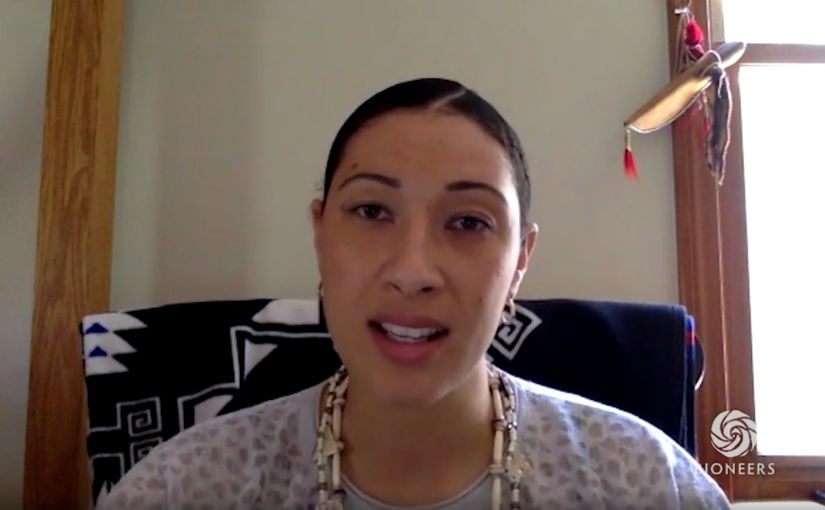
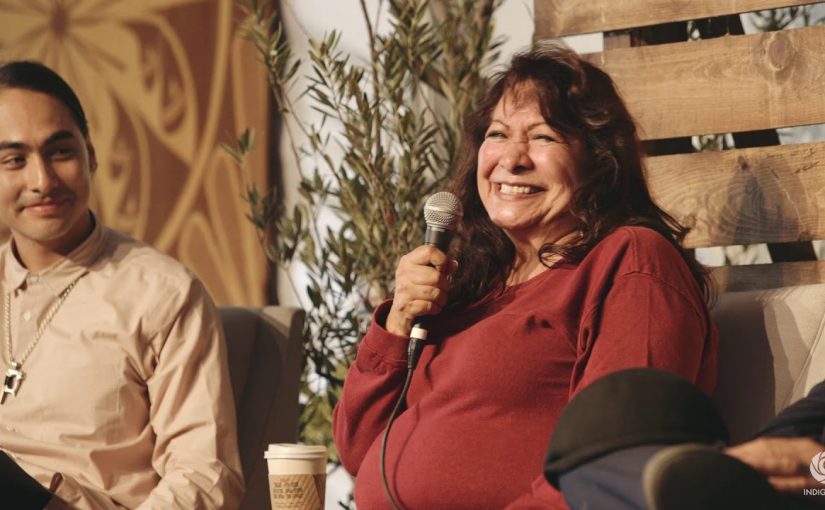
Listen in on a fascinating conversation with Alexis Bunten, Co-Director of Indigeneity for Bioneers and Danielle Hill, co-founder of Wisconsin’s Singing Trees Farm Collective and Mashpee Wampanoag tribal citizen. In this 35 minute conversation, Alexis and Danielle discuss how this decision connects to a broader legacy of tribal termination, how capitalism and racism figure into this tragic decision, and much more.
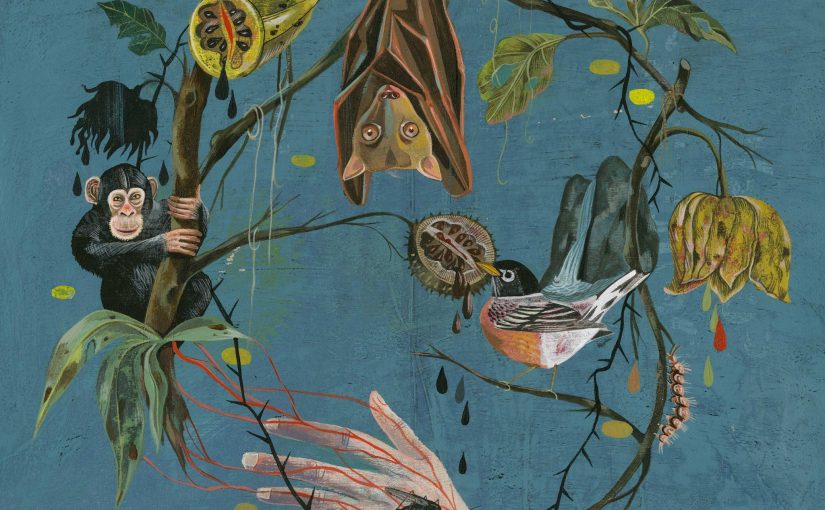
In this interview, science writer David Quammen, author of Spillover: Animal Infections and the Next Human Pandemic, speaks about the root causes underlying the current pandemic and explores the ways in which viruses are embedded in the same systems of ecology and evolutionary biology that we are. As we disrupt wild ecosystems and shake these viruses free, COVID-19 offers an opportunity to reimagine our relationship with the natural world.
Emergence Magazine: David, thank you very much for joining us this morning. The coronavirus is what is known as a zoonotic virus. Could you start off by explaining what a zoonotic virus is and how it ended up infecting humans in a market in Wuhan, China?
David Quammen: Well, a zoonosis is an animal infection that’s transmissible to humans. That can be a virus or a bacterium or any other sort of infectious bug, but a zoonotic virus is one that comes out of a nonhuman animal and somehow passes into humans. If it takes hold and can replicate and cause disease and transmit, then we call that a zoonotic disease. Sixty to seventy percent of our infectious diseases fall into that category, some of the old plagues and some new plagues like this one.
How does it happen? Well, all animals, including wild animals, carry their own, in some cases, unique viruses, a great diversity of viruses. We don’t have any idea really how many viruses are out there. Animals, plants, fungi, all those cellular creatures, carry viruses. Viruses are not cellular. They’re just little capsules containing genetic information that can replicate themselves in the cells of other creatures.
When a virus passes from a nonhuman animal into a human, we call that moment “spillover.” Hence the title of my book.
The animal from which it comes, in which the virus lives sort of inconspicuously, we call that the reservoir host or the natural host. I usually call it the reservoir host. So you’ve got a reservoir host in China, probably a horseshoe bat. It’s carrying a coronavirus that has never been seen in humans before.
That bat is captured, probably, live and put in a cage and taken to a wet market in the city of Wuhan, China. I think now we know that was the Huanan Wholesale Seafood market, but it was selling much more than seafood. I’ve been in some of these markets and I’ve seen that they sell wild animals. They sell domestic animals. They sell seafood. There are live animals in cages, sometimes stacked on one another, all kinds of wild birds, as well as domestic poultry. There are reptiles, turtles, sometimes snakes, bats, pangolins, civets, pigs, all in a great mixing bowl.
What seems to have happened in Wuhan—we don’t know for sure—but what seems to have happened is that a virus from a horseshoe bat spilled over into probably some other kind of an animal, got amplified in that animal, and then that animal was sold, was butchered, somehow infected maybe a few dozen people, and those people became the primary contact cases. And then, from them, it found itself with the ability to spread from one human to another and spread out into the community of Wuhan.
This was all going on in December of last year and on New Year’s Eve the alarm bells rang at the WHO, the CDC, and elsewhere for some friends that I know in the scientific world, and the word was that there was a new disease, an infectious disease, spreading in Wuhan, China, suspected to be a virus. The virus was not yet known. The origin was not yet known, but it could be a big one. That was New Year’s Eve, and we have seen it unfold from there.
EM: As far as I understand, the virus was actually detected in a cave in Yunnan, a thousand miles from Wuhan, back in 2017, and you’ve written about this. If it was detected back in 2017, why wasn’t something done about it?
DQ: Well, because lots of viruses are detected in other creatures. Some of them look dangerous. Some of them look innocent. There are scientists who do that. There are not many; there are not enough. There’s not enough funding for them to do it as much as would be good. I’ve recently talked to a scientist who is organizing a global initiative called the Global Virome Project to try and do more of that.
But when scientists spot a new virus and there’s reason to suspect that it could be dangerous, then they publish that, and they alert people to that. And that happened. I think the virus was detected maybe in 2015. In 2017, the scientists publish a paper saying, here’s a new coronavirus. We found it in horseshoe bats in a cave in Yunnan. It could be dangerous. It’s not identical to the original SARS coronavirus from 2003. It’s distinct from that, but it has characteristics, judging from its genome and judging from the fact that it is a coronavirus—it could be dangerous.
So the scientists did their job. They published that paper. What happens then? Well, essentially nothing happens then. What should happen? Well, there should be a system for people responding to that threat. There should be closures of the wild animal markets in China. There should be preparedness around the world. There should be a readiness to take the genome of that virus and turn it into test kits quickly, produced en masse, available around the world. That’s all expensive stuff for something that might happen and might not happen and because it’s expensive and it might not happen, policy makers, leaders, legislators are reluctant to pay for it.
EM: Right, and once a virus leaves its reservoir host, as far as I can understand, it can mutate and mutate quickly. Could you talk a bit about this?
DQ: That’s right. And that’s especially true of coronaviruses and several other groups of viruses. Some viruses evolve much more quickly than others. Some people don’t even know: a virus, is it alive or not? Well, that’s a philosophical and semantic discussion, but does it evolve? Yes, it replicates itself. It carries either DNA or RNA and replicates itself using the same genetic code that the rest of the world uses. So, in that sense, it’s closely connected to life, even if it’s not alive. Viruses evolve, but some viruses evolve much more quickly than others, and the reason for that is differences in their genomes.
Some viruses carry a genome composed of the DNA double-helix molecule that everybody knows about, which replicates itself rather accurately and stably. And when it makes a mistake with the letters of the genetic code while replicating itself, there is a proofreading mechanism so it can correct itself. So double-strand DNA, double-helix viruses tend not to evolve very quickly.
There are several other different kinds, one of which is a single-stranded RNA virus. RNA is another genetic molecule, closely related to DNA, but a little bit different. And a single strand of it, when it replicates itself, tends to make a lot of mistakes, and those mistakes are not corrected. So as a virus replicates, it is producing imperfect copies of itself. It’s producing a population of variant offspring that differ from one another. So you’ve got a population of variant individual virus particles inside a host, and they’re competing with one another for resources, for the opportunity to replicate further.
What do you have when you have a population of variant individuals competing with one another with differential success of reproduction? That’s called evolution by natural selection. Darwin 101. And that’s what leads to fast adaptation of coronaviruses, because they are single-stranded RNA viruses.
EM: Zoonotic viruses can often live within their animal hosts without causing any harm, but it is when they spill over into an amplifier host, an animal amplifier host and/or humans, that they manifest as diseases. Why is this?
DQ: Well, it’s because the virus gets a new opportunity in a new environment, and if it’s lucky, and if it’s adaptable, it finds that it can replicate abundantly in that new environment, that new host, and if it evolves further it can even transmit from one individual of that new host to another.
Maybe the old host has an immune system that has adapted to that virus over time and that virus has adapted to the immune system, so that in the old host, the reservoir host, it lives chronically at low levels of replication, but over long periods of time. That is a type of genetic strategy, not a conscious strategy, but it is a strategy, and it works. The virus maintains itself in the reservoir host population over long stretches of time.
Then, suddenly, it gets a new kind of opportunity, a new kind of host, and it finds that it can replicate abundantly in this new host, and hey, look, with a few more adaptations, a few more mutations, a little bit more natural selection, it can jump from this new reservoir host, individual number one, into individual number two, number three, number four. If it does that, it is seizing an opportunity. It doesn’t have purpose. It just has the ability to seize opportunity. If the new host is Homo sapiens, if it’s us humans, then that virus has seized a huge opportunity for vast evolutionary success because it can replicate quickly, spread from individual to individual, ride on airplanes, get around the planet in twenty-four hours, spread to more people and become possibly the most successful and abundant virus in the world. And that’s what happens with pandemics.
That’s what happens with the pandemic flu. That’s what seems to be happening with this, and that’s what happened with the primary virus that causes the AIDS pandemic, a virus called HIV-1 group M, that results from a single spillover from one chimpanzee into one human, in the southeastern corner of Cameroon back in 1908, give or take a margin of error. All of this is known from good molecular work, and I’m jumping around here, but it’s worth following this through.
That virus—infecting one human from one chimpanzee—has spread around the world now and killed thirty-three million people, going on thirty-four, and infected millions more. That’s a very successful virus.
EM: You’ve talked about how human beings as a relatively young species are more susceptible. Can you talk a little bit about this?
DQ: We are more susceptible because these viruses are new to us. As I say in the book, everything comes from somewhere. Our viruses that cause our infectious diseases generally come from animals in the relatively short term, because we are a relatively young species. There are a few viruses that have been in humans for so long that they have evolved away from their origins, and they are now distinct from whatever animal virus they originally descended from.
Smallpox is one example, and polio is another example. And it’s no coincidence that those are two of only very few, severe infectious diseases that we have been able to eradicate or very nearly eradicate from humans. We’ve eradicated smallpox from humans. There are no current smallpox cases on the planet. It’s not circulating. Smallpox virus only exists frozen in a few laboratories.
The last I’ve heard we have nearly eradicated polio from the human population, but there are a few places, like Afghanistan, I think possibly Nigeria, where there are difficult political and military situations, where there are still little flare-ups of polio and it hasn’t been eradicated yet, but almost. Why can we do that? Well, because there is no animal host for polio or for smallpox anymore. Those are purely human viruses now.
EM: In Spillover you write about how zoonotic diseases exist within, and are part of, a broader ecosystem than just their hosts. Can you talk about why this is so important?
DQ: Do you mean the ways in which human disruption of ecosystems brings us into contact with these viruses?
EM: Yeah, it seems like that’s what you were talking about as one of the main causes that we’re dealing with.
DQ: Absolutely, so the spillover of these diseases into humans and the spread into pandemics, it’s essentially an ecological and evolutionary process. That’s actually one of the reasons why I wrote Spillover. It’s my usual beat, ecology and evolutionary biology.
I got interested in infectious diseases, emerging viruses like Ebola, and then I found, lo and behold, this is all about ecology and evolutionary biology. On the ecology side, there are many, many diverse species of animal, plant, bacteria, fungi, and other creatures living in our diverse ecosystems. Each of those carry viruses. Each of those may carry its own unique viruses. Scientists are just trying to find out how many viruses are out there.
When we humans come in contact with those animals and plants and other creatures, we expose ourselves to those viruses, in particular when we come in contact disruptively, when we go into those diverse ecosystems, those tropical forests and those savannahs where there is great diversity, and we start killing animals for meat. We start cutting down trees for timber. We build timber camps. We build mining camps. We harvest the wild animals further to feed the laborers in the timber camps and the mining camps. Or we capture the wild animals and ship them away live, or dead, to be consumed by other people elsewhere.
Doing all that, we disrupt those wild ecosystems. We essentially—this is sort of a metaphor—we shake those viruses loose from their natural hosts and give them the opportunity to seize on a new host. And there we are: humans. In some cases then, those viruses seize a new ecological situation, a new environment, namely a human body, and then comes evolution. If they have a high intrinsic capacity for evolution, then they are all the more likely to adapt to us and become our diseases and sometimes our epidemics and pandemics.
EM: I think you said a virus is interconnected with other organisms at the scale of landscapes. That really struck me, because it forces us to think about a virus not just contained within a creature, say bats, which seems to be the culprit here in the coronavirus, but in relationship to a much broader web of life.
DQ: Right, yes. I mean, they are ecological creatures with niches and with the capacity to evolve, and generally they have their natural environments, but all of those creatures are connected to one another in intricate webs of interaction. We humans are part of those ecosystems too. I mean anciently we have been. I’m not saying that these wild ecosystems have been wilderness in the sense that we used to think about it, the absence of humans.
All of these places, or almost all of them have had human populations too, but living with very low impact, at very low population densities, living, to some extent, in harmony with the rest of the ecosystem, living off of it, harvesting animals and plants for food or for medicine, but not causing great disruption, and living in small groups of people that are not closely interconnected with big groups of people elsewhere.
So what has changed in the modern world is that there are more of us, more interconnected, causing more disruption. Everything has been scaled up. Now we’re the most dominant animal on the planet, arrogating to ourselves a huge proportion of all the resources, all the energy, all the protein, and making ourselves important and strong, but also making ourselves a huge target for these creatures that need habitat, that need environments, that need ecological niches in which to continue living.
EM: Zoonotic viruses have been around for a very long time, as you’ve said, but in the last fifty years we’ve really seen an emergence of many, many more in a short amount of time. You said that we’ve always been existing in spaces, but not to the level of disruption that we’re dealing with right now, and so this emergence of so many viruses is directly in correspondence with the increase of disruption to many environments in terms of ramp and scale.
DQ: Right, and as I say in my book, there’s been a drumbeat of these new emergences of viruses from animals that infect humans. Mapucho in Bolivia 1962, coming out of rodents. Marburg in 1967 in monkeys that were shipped from Uganda to Marburg, Germany, for use in medical labs. Ebola emerging for the first time we know of in 1976. AIDS, HIV, getting recognized for the first time in 1981.
It goes on. In the late 1980s, there was something. In the early 90s, 1992, we became aware of hantavirus coming out of rodents in the Southwest, the Four Corners area of the US. Bird flu emerging in Hong Kong in 1997. In 1998, it was Nipah virus in Malaysia, coming out of bats, getting into pigs, and then getting into people, killing people.
On and on. SARS, 2003, also coming out of a bat. MERS, 2012, another coronavirus in the Arabian Peninsula, coming out of bats, getting into camels, going from camels to humans. Zika virus, another new one in 2014.
On and on, and now here we are with COVID-19 in 2020.
EM: One thing that really struck me when I was reading Spillover is how you talk about the fact that these viruses are really part of a larger pattern that reflect what we’re doing and aren’t just happening to us. It seems like, in the last few weeks, with all the news about the coronavirus swamping everyone’s world, there hasn’t necessarily been a discussion that looks to any of these root causes that you’re describing, the discussion generally suggests that we are the victim here rather than playing an active part.
DQ: Right, there hasn’t been enough discussion of that. People are alarmed. People are scared. People are angry at one another. Some people are angry at the Chinese. Other people are angry at public health services. We’re all angry at Donald Trump.
There’s not enough time. There’s not enough bandwidth or air in the room for discussion of root causes. With the hospitality of people like you, Emmanuel, I’m talking about it to whoever I can. The fact that these things are part of a pattern, I just described that pattern, and that, yes, we need to flatten this curve. We need to deal with this pandemic. We need to take the public health measures that will bring this thing under control. And that’s still some ways off.
We need resources. We need money. We need will to do all the things that are necessary. And I hope we will. I think we will eventually get this thing under control and put this fire out. But as I’ve said before, when we get this thing under control, when we get the fire put out, we should celebrate for five minutes, and then we should start thinking about and planning for the next one, because there will be a next one.
EM: Your op-ed in The Times back in January—when this was mostly confined to China and a few other countries, or at least appeared to be—talked about this, the short-term response and then the longer term mortal challenge. In that piece, you outlined a list of all the long-term challenges we’re dealing with that, in a sense, were many of the major ecological issues of our time, as well as issues related to poverty and inequality.
So as much as this virus may wake people up to our interconnectedness and vulnerability, it seems like it’s a monumental challenge that we’re facing to address a potential next big one that might come up in a few years or continue to come up year after year.
DQ: It is a monumental challenge, and there are things on the scientific and public health side that I listed in that op-ed and that one can list: better viral discoveries so we know what’s out there and might come into us, better diagnostics so that we can produce test kits very quickly, better public health reactions, more resources, more excess capacity for our hospitals, et cetera, that prepare us to respond to these things. Coherent, internationally collaborative plans for assessing to what extent you want to cut down air travel and to what extent you want to continue to let expertise flow between one country and another. All of that.
But even beyond that—which is very expensive, and all that stuff, and will require really taking this kind of threat seriously—all of that is essentially reaction, and there needs to be pro-action too. And that’s even more difficult because it involves essentially reimagining, rethinking, and re-feeling our relationship with the natural world.
All of the things that we do that cause the disruption, that shake loose these viruses, that give them the opportunity to get into us, all the draw that we put on resources around the world. It’s not just Chinese people who want to eat bats or pangolins. We can’t just demonize them.
There is enough responsibility to go around. Anybody that has a cell phone or a laptop is a customer for minerals such as coltan, which is essential for making tantalum capacitors in computers and cell phones. Where does coltan come from? One of the major sources is in the southeastern corner of the Democratic Republic of the Congo, where there are mining camps dragging coltan out of the earth, laborers working there adjacent to rich tropical forests that contain Eastern lowland gorillas and all kinds of species of bats and other creatures.
What are those people in the mining camps eating? Well, they’re probably eating bushmeat. So, if we buy a cell phone, we’re purchasing coltan, and therefore we are drawing tighter this web of disruption. We are pulling viruses toward ourselves, maybe not as obviously and directly as consumers of bats in China, but nonetheless we’re part of it. We’re part of that intricate web of responsibility, and therefore we need to think about all of our consumer choices, all the choices we make: what we buy, what we eat, how much we travel, how many children we have, all of those things.
We need to be thinking deeply about them, not just for getting control over climate change, which is the other huge problem looming there, but also dealing with this problem of zoonotic diseases and bringing all of these things closer to ourselves by our patterns of dominance and consumption.
EM: It also sounds like, yes, this is a disease stemmed from a bat transferring the disease to other animals and being eaten by those animals or being eaten itself. But even if that didn’t occur, if this disease was discovered in a cave years earlier, it would have found another way to get out.
DQ: It may well have found another way to get out, yes. I haven’t been to that particular cave. My friend, Peter Daszak, who’s president of EcoHealth Alliance in New York, one of the important organizations working on this, he is a co-author on that paper in 2017. He may have gone to that cave, or some of his colleagues from the Wuhan Institute of Virology clearly went to that cave to research, to sample bats, to find out what was there.
Humanity, generally, is bound to be moving closer and closer to that cave. China’s population is not growing very quickly anymore but it’s huge and it’s consuming resources. Our population in the US is not growing quickly anymore but our consumption continues to grow. And the global population does continue to grow. So even a population of bats in a cave in Yunnan—it’s only a matter of time before we come knocking on their door, wanting what they have.EM
You talk a lot about population growth in the book and that being one of the big factors pushing all of this forward at such a quick pace.DQ
Yes. I mean that’s the 800-pound gorilla in the room, population growth. It’s not just a matter of population growth. It’s certainly not a matter of demonizing some parents in Mozambique or Angola who have eight children. People tend to do that. “Oh, you know, there are people in Africa still having eight children.” But those eight children that may be living in a village in Mozambique, maybe only five of them are going to survive to adulthood and those five will consume less of the earth’s resources in their lifetimes, probably by a large factor less, than a single American child growing to adulthood and consuming much more.
So it’s not just sheer population. The impact of humans is population multiplied by consumption equals impact, and so we all own a share of that chain of responsibility too.
EM: There was a line toward the end of your book that really struck me. You talk about the fact that human population growth is itself an outbreak, and that all outbreaks come to an end.
DQ: Yes, that’s when I go into the analogy of populations of certain kinds of forest insects that break out into huge abundance, population outbreaks. In this sense, the word outbreak is not a disease term, but it’s a term that ecologists use to describe one of these sudden, huge population explosions of an insect, usually a forest lepidopter, a moth—for instance, tent caterpillars. Tent caterpillars are the larval form of a particular kind of moth, and they live in forests, including forests around here where I am, in Bozeman, Montana, and they’re invisible for years at a time. They’re there in very low population abundance.
But then suddenly there’s a good year or two years in a row that are good. The temperature is right, the moisture is right, the winter is not too harsh, and they’re laying maybe 200 eggs. A female lays 200 eggs. Maybe she has two clutches in a season. Maybe most of those survive, so suddenly there’s a huge population outbreak of tent caterpillars, and you see these silk tents on the limbs and branches of all your trees, and the caterpillars are out there defoliating the trees. The trees look like they’re in the middle of winter. These are mostly hardwood trees and the leaves are all gone. You can hear the crunch, crunch, crunch of the chewing and the pooping caterpillars, raining down their poop on your town and taking away the foliage from your trees. People say, “Let’s get some insecticide and stop this and poison them before they kill all our trees.”
The smart people that work on these, the entomologists who study forest insect outbreaks like this, say, “Listen, don’t worry about it. Just relax, because this population is going to crash, if not this year, next year, because it always happens.” And they’re right. The populations do crash, and they disappear almost magically. But what causes the crash? We now know that it’s viral plagues.
They carry their own kinds of viruses at low endemic levels, but when their population explodes and they live at such high densities, then they pass the virus from one to another, and the virus kills them and explodes out of them and infects another caterpillar, and pretty soon the whole population has crashed and they disappear.
I met a scientist who studies this, a wonderful guy named Greg Dwyer at the University of Chicago, and I asked him, “First of all, are we humans an outbreak population?”
And he said, “Oh yeah, we are.” And other ecologists agree.
We don’t multiply as fast as tent caterpillars, but a hundred years ago there were only about two billion humans on Earth, now there are almost eight billion, so in a hundred years we have quadrupled our population. That’s an explosion. That’s an outbreak. And we’re taking so much in the way of resources. Our population is still increasing. So, “Yes,” he said. “We are an outbreak population.”
I said, “Okay, question two. Does that mean it’s inevitable that we’re going to crash? A viral plague is going to eliminate ninety or ninety-nine percent of us from the planet just the way it happens with tent caterpillars?”
And he thought about it very carefully, and he looked at his mathematical models. And then he said to me, “No, I don’t think it’s inevitable.”
Why? Because we have something called heterogeneity of behavior, and that’s a very important parameter in his models. If the insect population has some kind of heterogeneity of behavior, some flexibility, some ability to respond differently to different conditions, to avoid danger, then the population, according to his models, doesn’t crash. It gradually tapers off as fewer of them get sick and die as they replicate, but not so quickly, and they just sort of die back to the level at which they were living, essentially, in harmony with the forest.
He said, “Because we humans have heterogeneity of behavior, I don’t think we’re going to crash. I think we have the opportunity for a slower response to the threat of pandemic.”
Heterogeneity of behavior in humans, of course, means that we can think, we can respond differently, we can create scientific solutions, vaccines, and therapies. We can adjust our behavior. We can consume less. We can pass regulations. We can adapt to the situation. We can do that. So essentially what he was telling me is that the good news, from him, is that humans are smarter than tent caterpillars, and therefore we’re not doomed, necessarily, to a total population crash.
EM: In the book, you say that Zoonotic diseases “remind us, as St. Francis did, that we humans are inseparable from the natural world. In fact, there is no ‘natural world,’ it’s a bad and artificial phrase. There is only the world. Humankind is part of that world,” as are all the viruses and carriers.
It seems like there’s a tremendous opportunity to think about how we can transition out of this outbreak as a human population to a space that lives in harmony. I’m really curious to hear your feeling about that, what your take is on that. How optimistic are you?
DQ: There is an opportunity. I am not an optimist by disposition, but I’m stubborn when it comes to hope. I think that hope is not a psychological condition. Hope is an act of will. And therefore I think we have a responsibility to be hopeful that we can do things that will make the final result at least not quite as bad as it might have been otherwise.
And with this thing, this hideous pandemic that we’re in right now, this scary thing that may take many, many lives, but in the meantime is also destroying people’s jobs, disrupting cultures and economies around the world, it’s a bad thing. The former mayor of Chicago, back when he was chief of staff for Bill Clinton, that guy named Rahm Emanuel, when he was working for Clinton, he famously said, “We should let no crisis go to waste.”
There’s wisdom in that, and I think that’s the case here. We should not let this crisis go to waste. We should use it as an opportunity to demand from ourselves and demand from our leaders substantive change, real, drastic change in the way we live on this planet, while we still have time.
EM: Well, David, thank you so much for joining us today.
DQ: You’re very welcome, Emmanuel. It’s good to talk with you.
Sara Kuo and Kalpana Narlikar are members of Sunrise Movement Bay Area involved in organizing online trainings and actions around the 50th Anniversary of Earth Day taking place on April 22-24th, 2020. Sara Kuo (age 25) is temporarily sheltering-in-place in Oakland, though typically works in Richmond and lives in El Cerrito. Kalpana Narlikar (age 14) is sheltering-in-place in San Francisco where she lives with her family. They were interviewed by Maya Carlson, the Bioneers Youth Leadership and Education Manager.
Maya, Bioneers: How did you get involved in Sunrise Movement?
Sara, Sunrise Movement Bay Area: I heard about Sunrise through my friend Abby. We did a fellowship together, and went to art builds with Sunrise. It wasn’t until Sunrise held a Leaders of Color Training that I found that Sunrise cares about frontline communities and folks of color. That was really demonstrated by the community they had built. I fell in love with Sunrise ever since.
Maya: What is your role within Sunrise Bay Area?
Sara: I run trainings, doing outwardly-focused presentations either in high schools or in our general orientation teaching Sunrise theory. I’m actually doing my fourth week of Sunrise School, which is an online community-building experience. It’s completely free for youth who are feeling uncertain about what’s happening right now. We have a crash course on what’s happening with the Green New Deal in the time of Covid-19, Movement Building 101, and Deep Organizing in the Face of Uncertainty. There are many tracks and it’s super interactive. I’ve built really fulfilling relationships there with folks all across the country.
Before Covid-19 happened, I was doing a lot of solidarity relationship building with other organizations as well.
Virtual Zoom Interview, April 17th, 2020
Kalpana, Sunrise Movement Bay Area: I found out about Sunrise when my dad sent me an article about Alexandria Ocasio-Cortez going to their sit-in outside of Pelosi’s office, and then I hovered on the national mailing list for a while. When I visited family in India, I was looking at all the inequality there and I got really sad. I had been angry for a long time, but that was the first time I got really sad and I wanted to do something. So when the December Climate Strike came up, I emailed Sunrise Bay Area and asked how I could help. They sent me the membership form and I signed up!
Maya: How have you been involved since joining?
Kalpana: I’ve gotten people from my school to come to actions, and recently I’ve been involved in the Earth Day planning team.
Maya: What are some of the actions Sunrise Bay Area organized around Earth Day this year?
Sara: We had a bunch of lead-up events to Earth Day. One was the last in a series with #CAYouthvsBigOil, which is the youth leg of the Last Chance Alliance. This was supposed to be a physical tour. We were going to put folks in buses, starting from Los Angeles and the Empire region, driving up into the Central Coast and Central Valley, then the Bay Area and Richmond, ending up in Sacramento. But we came together and still made it work [online]. We’ve had a really good turn out virtually, still having those regions hold workshops and panels, talking about environmental justice and how this crisis has affected folks regionally. The workshop was on the Green New Deal and a Just Transition in the time of Covid. It focused on Richmond, CA with organizers from labor movements, Asian Pacific Environmental Network (APEN) and Communities for a Better Environment. This was a lead-up event into Earth Day actions.
Kalpana: We also had an art build over Zoom. One of the art team leads was Bob Ross who taught everyone how to paint banners with materials they have at home. Then folks dropped them from their windows and posted pictures on social media. This is something Megan and I brainstormed a few weeks ago.
We have three events on Earth Day, one on each of the days of the [Future Coalition] national livestream, starting on Earth Day, April 22nd, 2020. The first event of ours is a panel on a Green New Deal for Public Health, which looks at how a Green New Deal would be beneficial for public health. This is important because clearly we’re in a pandemic. The second one, which Sara can speak more to, is about the Green New Deal and a Just Transition.
Sara: The Green New Deal and a Just Transition event on April 23rd will be a rerun of the conversation hosted by CAYouthvsBigOil about Richmond, CA. The culminating ask of CAYouthvsBigOil is a letter to Gavin Newsom asking him to Stop Drop and Roll.
Stop new fossil fuel projects at this time. California needs to lead the way by ending new permits for oil and gas extraction, as well as fossil fuel and petrochemical projects.
Drop existing fossil fuel production and set a national and global precedent by becoming the first oil-producing state to announce a phase-out of existing production in line with the Paris Climate Goals, and with a just and equitable transition that protects workers, communities, and economies.
Roll out a set-back limit by creating a 2500-foot health and safety buffer zone between fossil fuel infrastructure and homes, schools and other sensitive areas.
In addition to Stop Drop and Roll, this petition is asking Governor Newson what his plan is for a Just Transition. During this call, we’re going to have a couple of interactive breakout rooms to ask folks what a Green New Deal looks like in their communities, as well as what a just transition needs to look like, especially in frontline communities. Then we’re going to have them write that in a letter to Governor Newsome
Kaplana: There is one last day, which will be our action on Friday, April 24th, Calling For Change. We will be calling and emailing representatives like Nancy Pelosi, Diane Feinstein, and Gavin Newsom, as well as local state representatives asking them to support a People’s Bailout because we need to bail out people, not corporations, particularly people who are being hurt the most at the moment. We’ll be doing this in shifts all day from 9am – 5pm.
Maya: These actions are so relevant all of the time, and particularly so during a pandemic when we’re collectively in a massive public health crisis and we’re seeing corporations getting billion-dollar bailouts. Are there particular overlaps that you are seeing between Covid-19, climate change, and the Green New Deal?
It’s also scary that the EPA has stopped enforcing environmental laws and fossil fuel industries are carrying on unabated. That’s why we have to actually invest in people and not corporations!
I do feel hopeful though. Covid-19 is forcing us to go into a recession in which millions of people will lose their jobs, and we’ve seen that the only real way to get out of a recession is through economic stimulus. The Green New Deal is what we need to get out of the depression we’re heading into. It has never been clearer for us to fight for what we’ve been fighting for. As devastating as these effects have been, my hope is that we rebuild better. What we were before was not working for so many people. We need to rebuild in a way that prioritizes frontline communities and actually creates a livable future.
Maya: Has this pandemic changed the way that Sunrise is approaching its tactics or audiences?
Kalpana: At least for Earth Day the audience that we’re targeting has been broadened because a webinar has a wider potential audience than an action where people are marching with us. We are not changing our values or our goals, we’re just trying to communicate them to more people.
Sara: We were planning a strategy retreat right before lockdown and this was a really big question of ours – how [Covid-19] changes our goals. It does shift a lot. Sunrise’s north star is mass non-cooperation and it’s been sad to see a lot of our big actions dampened by this. One of the lead organizers in CAYouthvsBioOil said that in another timeline, he would be getting arrested in Sacramento on Earth Day!
But having things online does make actions more accessible to everyone. There are plenty of folks who just can’t show up physically and there is a place for them in our movement as well.
I would agree with Kalpana that shelter-in-place doesn’t change our baseline goals, but it does change how we’re going to get things done. We do so much community building, modeling of an interdependent organism, and caring for one another. Some of those things just can’t be conveyed over the internet like cooking for people, making art with people, and singing with each other.
We’ve rethought a lot of our tactics. We can still go to actions like the drive-through actions, not just [Sunrise] but other folks showing up at Santa Rita jail and jails in San Francisco. There are absolutely still things you can do! We can’t go door knocking, but we can still phone bank. We just have to think more creatively.
Maya: Why, on a personal level, do you both feel that being a part of a mass movement for climate justice is important to you and your community?
Kalpana: As a young person thinking into my future and not being certain about whether there will be one that will be livable, is something that’s weighed on me. I’ve been thinking about this since I can remember. Something amazing about Sunrise, not just any mass movement but Sunrise, is the human connection. I’ve really found a family of people who can understand my fear, because they have the same fear. They understand my pain because they have the same pain. To be able to connect with people who feel the same way, want to do something about it – and are actually very good at doing something about it – has been an amazing and beautiful experience. I think there is an immense relief that comes out of acting when you’re really afraid or angry or sad because then you feel like you’re actually doing something. Even if we don’t get out of this, I can feel like I did my best and I know people who did their best. That’s something that’s really important to me.
Sara: That spoke so beautifully to how I feel. Before Sunrise, I didn’t really think that there was a lot of hope. I was already organizing in frontline communities, doing infrastructure equity and working with unincorporated “disadvantaged communities” there. I grew up in an unincorporated “disadvantaged community” in Southern California where we experienced fires and my brother had severe asthma. It always felt like we were doing stuff, but for what? We were an organized community, but to what end? I would still be doing it, showing up, doing community meetings, going door to door, and getting people involved in civic engagement. But I didn’t really know until I heard Sunrise Movement’s theory of change that we’ve done this before. It’s super possible! That was wild to me! I still remember the first day I was sitting in that training like “Oh my god! We could actually do this, and that’s wild!” That hope is what keeps us going and what is the underlying fabric of this community.
Maya: Thank you both for those answers, I could feel the heart-felt care in both of them! It was great to talk to you both and I look forward to seeing you online for Earth Day!
This article contains the content from the 4/21/2020 Bioneers Pulse newsletter. Sign up here to get the newsletter straight to your inbox!
Tomorrow marks the 50th anniversary of Earth Day.
In 1970, 20 million Americans demonstrated in the streets for greater protections for our planet, spurring (among other things) the modern environmental movement along with the creation of some of the most influential bipartisan national environmental policy ever enacted. Was it “successful”? It’s a real question, but it may not be the right question. Fifty years later, the legacy of the movement to launch the first Earth Day and the influence of that movement, culturally and politically, still reverberate.
In this edition of the Bioneers Pulse, we’re honored to feature the voices of several elders from that original Earth Day movement alongside some of the inspiring and active next generation frontline activists we’ve seen.
Solving the Dual Crises of COVID-19 and Climate Change
“Nearly every aspect of our lives has been affected by the coronavirus,” writes Molly Morabito, a member of Sunrise Movement’s Bay Area chapter. “But although the societal and economic effects of coronavirus are severe, they are likely to be temporary. The existential threat posed by climate change, on the other hand, will continue to worsen. Responding to this moment as a movement requires us to understand the link between these crises — and how by responding to one, we can help solve the other.”
Listen to Newly Released Edition of “Four Changes” by Gary Snyder
In July 2016, Jack Loeffler recorded Gary Snyder reading his updated version of ‘Four Changes’ in his home. This recorded version was prepared for and included in a major exhibition held at the History Museum of New Mexico at the Palace of the Governors in Santa Fe.
The exhibition was entitled ‘Voices of Counterculture in the Southwest’, and Snyder’s rendering of ‘Four Changes’ aptly conveyed how deeply the counterculture movement helped nurture the emerging environmental movement. The impact of this manifesto is as powerful today as it was a half century ago and could not be more timely.
Mishka Banuri: A First Generation Immigrant’s Perspective on Youth Climate Justice
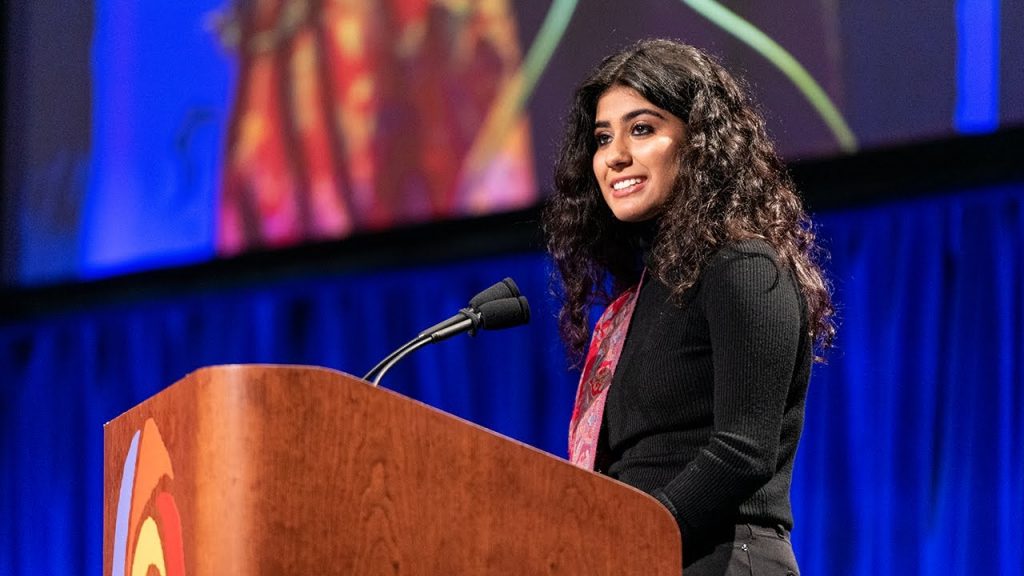
A first generation Pakistani immigrant, Mishka Banuri moved to Utah when she was 12 years old and fell in love with that state’s wondrous mountains, aspen trees and red rocks, but she saw many of those sacred lands despoiled by the greed of extractive industries.
In this keynote address, she talks on the importance of preserving natural lands and her experience as a youth organizer.
Earth Day, White Privilege and Decolonizing the Mind
Arturo Sandoval, founder of The Center of Southwest Culture, was a member of the first national Earth Day organizing team. He was a leader in the Chicano civil rights movement in the 1970’s and continues today to work for environmental justice, human rights and community-based economic development. Sandoval was interviewed by Arty Mangan, Bioneers Restorative Food Systems Director.
Erosion and Evolution: Our Undoing Is Our Becoming
Erosion and evolution. Shadow and light. Death and rebirth. These are some of the strands that acclaimed author, naturalist and activist Terry Tempest Williams weaves together in the face of today’s broken world. Standing in the lineage of the greatest nature writers, she links her deepest inner experiences with the state of the web of life. In this podcast, Williams asks: How do we find the strength to not look away at all that is breaking our hearts?
From April 22 to 24, youth and adult activists are coming together for Earth Day Live, a three-day live stream focused on climate action. The live stream will include training sessions, performances, and appearances to keep people engaged, informed, and inspired, with speakers including celebrities, politicians, scientists, and youth activists.
How the Tale of Finnegas Can Help Guide Us Through the Global Pandemic | In the time of this great, strange plague, writer Paul Kingsnorth returns to the Celtic tale of Finnegas, the woodland hermit who devoted his life to catching and eating the salmon that contained the wisdom of the world.
A Message of Wisdom from the Elders in the Time of Pandemic | Ilarion Merculieff, an author and Indigenous activist of the Unangan people, draws on his elders’ knowledge to offer encouragement and empowerment during the difficult times of the coronavirus pandemic.
Defeating the Pandemic Means Confronting Ageism and Ableism | Author Ashton Applewhite touches on how our social biases — especially ageism and ableism — can affect how we operate during the pandemic, especially when determining who gets life-saving care.
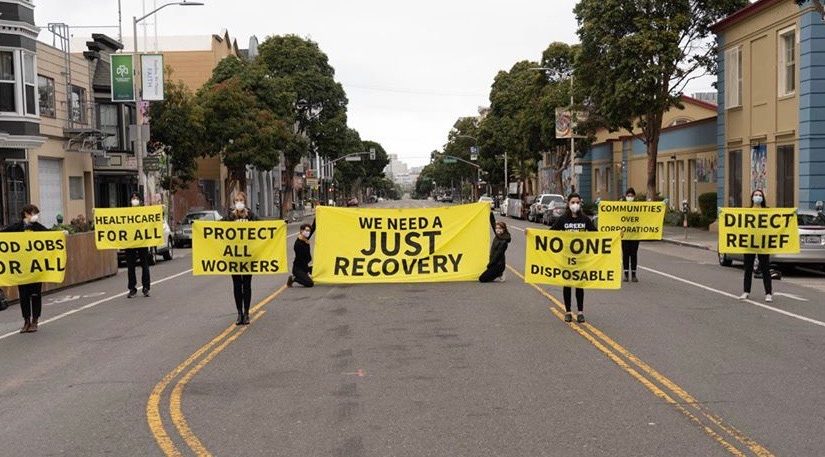
Principles for a #JustRecovery from COVID-19 | Bioneers is proud to have signed onto the following open letter, launched by our friends at 350.org, which demands a Just Recovery as the nation and world consider how to rebuild systems and economies.
Bioneers Indigeneity Now on Free Speech TV!
Free Speech TV is now airing a collection of Bioneers videos featuring Indigenous activists, voices and knowledge from around the world. In celebration of Earth Day, these segments will revolve around issues of climate change for the next week.
2019 commemorated the 50-year anniversary of the 19-month Native American student occupation of Alcatraz. This video presents Indigenous activists from three generations who were on the frontlines at Alcatraz, Standing Rock, and other Indigenous Rights struggles, as they discuss their visions for the next 50 years of Indigenous activism.
Featuring Julian Noisecat, LaNada War Jack, Clayton Thomas Muller and Ras K’Dee.
Indigeneity is a Native-led Program within Bioneers/Collective Heritage Institute that promotes indigenous knowledge and approaches to solve the earth’s most pressing environmental and social issues through respectful dialogue. Visit the Indigeneity Program homepage.
Arturo Sandoval, founder of The Center of Southwest Culture, was a member of the first national Earth Day organizing team. He was a leader in the Chicano civil rights movement in the 1970’s and continues today to work for environmental justice, human rights and community-based economic development. Sandoval was interviewed by Arty Mangan, Bioneers Restorative Food Systems Director.
ARTY: You were part of Denis Hayes’ team that produced the first Earth Day in 1970. What was that experience like?
ARTURO: It was my first time organizing on a national level. I worked with a very bright team. It was lots of work. It was very exhilarating. It completely exceeded anything we hoped to achieve. It was like holding onto the tail of the tiger. We were basically just trying to stay out of the way of a freight train coming down the tracks because the response to the first Earth Day was so overwhelming. It was huge. It was just unbelievable, and took everything we had to just try to connect the dots and get information out to the people and not get in their way.
ARTY: In conjunction with your national organizing, you led a march in Albuquerque.
ARTURO: I wanted to make sure that people of color were featured in some way in the national coverage. So I worked with my colleagues at United Mexican-American Students at the University of New Mexico (UNM). We organized a march to South Barelas, which is a Mexican neighborhood where they had built the solid waste plant. Every day a film of dry material from the plant would cover everything, and it smelled really bad. I thought it would be great if we could get national coverage to focus on that issue.
We marched to the plant, and we were successful in getting the City of Albuquerque to move the plant much further south into the valley. People tell me that that was the first national environmental justice march led by people of color in the U.S.
ARTY: As a leader in the Chicano civil rights movement in the ‘60s and ‘70s, how were you received by white activists? Did you come up against white privilege or even overt racism?
ARTURO: I don’t think I ran into overt racism, but I do think there was a very East-West Coast culture that emerged. I think the conservation movement is also very classist in that the majority of environmental activists that I interacted with were middle-class and upper middle-class. I came from a working-class background. As a Chicano, I was definitely a fish out of water. Basically, I did feel clear class differentials. I felt the class difference, and I did feel marginalized.
I wanted to engage people in action for the health of the planet and hoped that they would also include people in that concern. I saw that it was the same basic enemy that we were fighting in both areas. I believed, and I still do, that the people who are racist and who exploit the working people, who exploit black people, Chicano people and Mexicans are the same people who were/are dumping heavy metals into our rivers and our lakes and polluting our air. I saw Earth Day as an extension of my civil rights work and as an opportunity to bring Chicano rights to a national audience. I thought maybe through the lens of environmental action and conservation that we could open the door to a broader discussion about the impacts of exploitation – not just of the planet, but also of people – and to help people see it was basically one in the same issue. That was my hope.
But generally, Chicano activists and black activists were not drawn to the first Earth Day because they were so deeply engaged in their own local issues. They were fighting for survival, so it was difficult for them to add Earth Day activities to their existing workloads.
Arturo Sandoval (3rd from the left) with the first Earth Day organizing team in 1970
ARTY: What do you think needs to happen in the environmental movement today to make it more inclusive?
ARTURO: After Earth Day, there was a succession of a lot of national federal legislation – maybe 20 or 30 federal acts – enacted specifically to protect the environment, Clean Air and Water Acts. That success in many ways ended up causing a long-term issue for environmental groups. It led them to believe that being primarily composed of white middle-class and upper middle-class citizens was enough to get the job done, that they did not need to change their approach or their tactics. Nor did they need to reach out to working people, to rural people, to Chicanos and Mexicanos, and African-Americans. They really never made it a fundamental value of their work or strategy to try to include these groups. We’re paying the price for that now under the current regime in Washington, because we do not have the connections to the vast majority of these working people to get them to support us against what’s happening right now, which is a complete dismantling of all the victories we had in the 1970s.
I think that was a failure of the environmental movement. I engaged enough with the Environmental Grantmakers Association, and I know enough about national conservation groups to know that they’re still, unfortunately, over 90%-95% white middle-class. They’re a very East-West Coast-oriented culture, and they have done very little to broaden their base to working-class people and to African-Americans and Mexicanos. They have not done enough to get the message out on how the environment impacts us all as humans. That’s why they are really getting hammered in the national political arena at this time. They don’t have the deep, broad based coalition they need to fight off what’s happening in the Trump administration.
ARTY: You’ve said that racism, environmental justice, and colonization are connected.
ARTURO: I work with indigenous communities and Chicano communities in the greater Southwest. I believe that the reason that poor people and working people are poor is because they’re at the center of the current capitalist system. Without them, we couldn’t have extremely wealthy people. They’re not on the margins of what’s happening in this country, they’re at the very center of it. Because we train them through education and we fill their heads with a colonial model that puts them in a one-down position, they come to believe it. They internalize the belief that they are poor because of their own shortcomings.
Frantz Fanon, the French-trained psychiatrist, wrote about this in the 1950’s when the Algerian revolutionary movement was underway. It’s not easy reading, it’s all about colonization and how to decolonize yourself. We were reading him in the ‘60s in the Chicano movement as a way to begin that process of decolonizing ourselves and to understand how colonization works and how colonization also dehumanizes the colonizer.
People of color, working people need to decolonize their minds, and they have to ultimately own their own lives, to take active steps to take control of their own lives. The only way they can do that is through study, reflection, and work.
Education teaches us not to passively accept the current status quo and the economic system, and to challenge the idea that the political system is the best system in the world. The reality is it’s one of the worst systems because it depends on exploiting the planet and the planet’s resources and ultimately destroying the planet. It also destroys people and cultures while it’s doing that.
You can’t separate issues of colonization and environmental justice from each other. Everything is tied together. People have to be engaged in these conversations. It’s not easy, but it’s necessary. Until people like me, who offer themselves as community organizers, are constantly questioning what we’re doing and until we continue to learn and decolonize ourselves and become better humans, we’re never going to transform our communities, nor the larger society.
ARTY: About 10 years ago, I invited you to address the Bioneers staff on issues of diversity and oppression. One thing that you said that really stuck with me was, “The system is set up for the average white guy to succeed, but not for the average brown guy.”
ARTURO: The system in the U.S. is set up so that within all the systems – the economic system, the social network system, education, the churches – if you’re a white man or white woman in society and you have average intelligence and you can spell your name correctly, you can have a pretty good life by just being very average. You can have a career. I’ve seen this over and over again where white people end up making really good money with a bachelor’s degree. It’s easy for them to get degrees, they can afford college. Everything’s set up so that if you’re just an average white boy and you’re just average going through the system – you just show up at school, take a bath every day, pack a lunch, or your mom packs you a lunch and you go through the process – your odds of having a very high-quality life and a good life are almost guaranteed.
But if you’re a working class Chicano or an African-American, you have to overcome incredible obstacles that are not there for the average white person, because the system is set up to exclude you. You have to put in extra effort. As a result, we have high levels of failure in our communities, not because we’re dumber, not because we’re inherently inferior, but because the system is set up on purpose to make sure that we don’t succeed and that the average white guy does. That’s still true.
ARTY: Most white people are blind to the advantages the system gives them.
ARTURO: I experience microaggressions everyday and in every way. I’ve had a couple of conversations just in the last two weeks with white friends of mine, who I love dearly. I’ve known them for 30 or 35 years, maybe. But they don’t see me. They do not see what my capabilities are, even when I offer my services to them. They don’t see my talent. They see a Chicano guy that they like and that they hang out with, but is really not serious or does not have enough skills or talents to be taken seriously. And these are people who I consider very good, long-time friends of mine. But it’s that blindness that occurs to middle-class white people. They literally don’t see me. They are examples of a systemic issue.
ARTY: How does your work today integrate environmental and social justice?
ARTURO: We’re working on four major fronts now at the Center. Through our community development center, we’re trying to create economic parity for indigenous and Chicano/Mexicano communities through a number of economic models that don’t require mainstream capital because we don’t have access to it. So, we’ve been doing a lot of organic farming co-ops especially in New Mexico where Native Americans are in a unique position of having aboriginal rights to irrigation, and the long-term Chicano-based land communities are second in line for use of that water. The downside is we’ve let that land go fallow or we’re growing small-scale alfalfa, which will not bring you a 21st century income. So people aren’t interested in doing that work if it’s not going to give them enough money to send their kids to college.
We’re getting them to convert what they’re doing from alfalfa to organic produce because organic produce can generate a 21st century income. That’s number one. Number two, we want them to be healthy. You can’t be healthy intellectually if you don’t start out healthy physically. I read a Harvard study way back in 1967 that stuck with me. It said if the human body doesn’t get the right nutrients in the first three years of life, it doesn’t matter what happens after that, they won’t be able to develop intellectually. Our organic farming co-ops are selling 100% of our produce to local schools. We’re trying to feed our kids to keep the brains in shape physically so hopefully they can develop them academically as they grow older.
We’re trying to create justice by creating income and also by providing the most basic necessity – healthy food. We just started doing some of that work in Northern Mexico in Chihuahua.
The Story Riders program works with urban indigenous, Chicano, and Mexicano fifth-graders. We teach them bicycle safety and repair. We provide bicycles and they ride along the Bosque trail. They meet cultural elders, they meet artists, Latino and Native American scientists from Sandia Labs. They meet all kinds of people that in a cultural context give them STEAM and STEM education programming in the Bosque. That’s a way to build their self-esteem and also start building their capacity to be academic.
I want to make sure that we assume 100% responsibility for our own communities, and that we are responsible for our own well-being. We have to build capacity in a co-intentional way with our community to find our own liberation, to build our own smaller-scale internal structures, and to define our own economic, spiritual, and political independence. I think we can do it through developing co-ops.
Most of the economic models that we use for organic farming are all cooperatives because co-ops are communal models and they spread the wealth out horizontally instead of vertically. I also think cooperatives are really back to the future. Indigenous communities are used to clans and kinship, and that’s how they still operate. In the land-based traditional Chicano communities, land grants and acequias are our communal models. Finally, co-ops are pre-figurative models for a post-capitalist society, if we’re thinking far enough into the future, and that’s what we’re trying to do.
In the time of this great, strange plague, writer Paul Kingsnorth returns to the Celtic tale of Finnegas, the woodland hermit who devoted his life to catching and eating the salmon that contained the wisdom of the world.
I would like to tell you a few things about this virus and the lessons it should teach us, all the things we should be learning. I would like to add my voice to the crowd and be heard above it.
I would like to say: fish have returned to the Venetian canals now that humans have stopped polluting them.
I would like to say: the clouds of air pollution over Italy and China have dissipated since people were prevented from causing them with their cars, planes, factories.
I would like to say: up to 80,000 premature deaths which would have been caused this way have probably been prevented in China by the shutdown of the economy.
I would like to say: carbon monoxide levels in the air above New York have collapsed by 50 percent in a single week.
I would like to say: Nature recovers swiftly when we stop our plundering of Her bounty.
I would like to say: lift your gaze, humans.
I would like to say: we can learn from this, we can change.
I am squatting in the sun on this day of the spring equinox, it is a cold sun, I am down by the pond with my children, we are watching the tadpoles squirm free of their jelly under the leafing poplars. The world is turning.
Today is the day when shafts of dawn sunlight illuminate the passages of the old Neolithic tombs at Carrowkeel, at Loughcrew, at Newgrange. Today at Stonehenge, at Wayland’s Smithy, at West Kennet, all across these Atlantic islands—today is the day the light of Sky pierces the darkness of Earth. Today is the day that aérios meets chthón.
Neolithic : we think we know what this word means, but it is just another one of our categories. When we say Neolithic, we mean: forgotten people, unknown people, the first farmers. When we say Neolithic, we mean: who were they and what was their world and how was it so different from ours under this same sky?
Their world, the world of those people long supplanted, was a world of tombs; a world of great barrows raised on high downs, barrows that became the pregnant belly of Earth, barrows into which, each equinox, a shaft of sunlight would pierce, enter the womb of the Mother, seed new life each spring.
I am writing this on the day of the equinox in the time of the great, strange plague.
I would like to say, as if I could tell you: This was what they knew. That each spring, Sky must meet Earth, that there is no life without both Sky and Earth, without both chthón and aérios. That if you live without one or the other, you will build a world that is bent on its axis, and that world may seem whole but will be only half-made, and one day it will fall over and you will fall with it.
I would like to say: well, we had it coming.
The Irish writer John Moriarty wrote a lot about chthón. His life’s search was for ways to re-embed us in what we have lost, to take us around and down again, to correct the Western Error. In his autobiography, Nostos, he writes:
Chthón is the old Greek word for the Earth in its secret, dark, depths, and if there was any one word that could be said to distinguish ancient Greeks from modern Europeans, that word chthón, that would be it. Greeks had the word, we haven’t. Greeks had the pieties and beliefs that go with the word, we haven’t. Greeks had the wisdom that goes with the word, we haven’t. Greeks had the sense of spiritual indwelling that goes with the word, we haven’t. In the hope that they might continue in the goodwill of its dark but potentially beneficent powers, Greeks poured libations of wine, of honey, or barley-water sweetened with mint down into this realm, we don’t.
I would like to say that we forgot all about chthón, we with our space stations and our stellar minds, our progress and our clean boots, our hand sanitizers and our aircon units, our concrete vaults and our embalming fluid; that for a short period we escaped into aérios, or thought we had, and now we are going to have to go underground again, and you can be sure we will be dragged there by the Hag against our will, and we will fight and fight as the sun comes down the shaft and we see again what is carved on the stones down there.
You can forget about chthón, but chthón won’t forget about you.
I would like to say that I know what to do about all this, or what to learn. I would like to teach it to you so that you may learn too. I would like to be a prophet in a time when prophets are so sorely needed.
Unfortunately, I am not qualified for this role. I don’t know anything at all, and I am learning, painfully, that this was my lesson all along.
I don’t know anything at all.
My society does not know anything at all.
All the things I was brought up to label as learning : my A-levels, my Oxford University degrees, all the books I have read and written, all the arguments I learned how to formulate, all the ideas I learned how to frame, the concepts I learned how to enunciate. All this head-work, all these modern European ways of seeing, understanding, controlling, managing, directing the world:
Nope.
None of that was it.
One of the best-known myth cycles of Celtic Ireland is the life story of the great warrior Finn McCool. Finn, in his boyhood, was apprenticed to an old woodland hermit by the name of Finnegas. Finnegas had spent his life fishing for an elusive salmon which dwelt in a pool under a group of hazel trees. The hazel trees contained a great old magic, and when their nuts dropped into the pool and were eaten by the salmon, they imparted to it all the knowledge and wisdom of the world.
Up from the earth the wisdom came, through the trees, down into the water, and Finnegas knew that if he could catch and eat the salmon then all that wisdom would be his.
One day, to his great joy, Finnegas finally caught the salmon. He laid it upon the ground and instructed Finn, his apprentice, to cook it for him while he took a walk in the woods to collect himself, to prepare for his great moment.
Cook the salmon, he instructed Finn, but eat none of it.
Yes, master, said Finn.
When Finnegas returned and looked into Finn’s eyes, he saw immediately that everything had changed. He saw that the catastrophe had occurred.
Did you eat the salmon? he demanded. No, master, replied Finn. But …
Cooking the salmon, Finn had seen a blister appear in its flesh. Perhaps wanting the meal to be perfect for Finnegas after his years of labor, he had pressed the blister down with his thumb and in the process had scalded his hand with hot oil from the cooking fish. Instinctively, he had raised his thumb to his mouth to suck away the pain.
In Finn’s eyes now, Finnegas saw all the wisdom of the world, and he saw too that it was Finn, and not he, who was destined for greatness. Finnegas saw that his life’s dream, his life’s work, was not what he had thought it was. Everything he had learned, the moment he thought he had prepared for:
Nope.
Eat, master, said Finn, offering the fish to Finnegas, for this was your work. But Finnegas refused. No, he said. No, the fish is yours, Finn, and some part of me always knew it would be so. Yours is the work, Finn. My work was to prepare for it. Eat the fish, and use well what you learn.
Maybe we thought we would one day eat that salmon, you and I. Maybe we thought that if we worked hard enough, learned enough, we could catch it and learn from it, we could save the world, change the world, teach the world some lessons.
I thought that once. I probably learned it at university. Now I think that I, we, our generations, those of us brought up within the machine, brought up to breathe with it, rely on it, those of us tamed and made by it, those of us who crushed the world without thinking—the wisdom to come is not ours.
We will never escape what we have made and what made us. We are not equipped.
We are not the people who will eat the salmon. We are not Finn.
But perhaps, if we’re lucky, we could be Finnegas.
Perhaps, if we’re lucky, we could lay some ground for what is to come.
Yours is the work. My work was to prepare for it.
You cannot use the master’s tools to dismantle the master’s house. You cannot use your arguments and your concepts to access the chthón. You cannot use your Oxford University degree to build a world which regards Oxford University degrees with the bafflement they deserve to be greeted with.
It is good to learn how little I know, and how little we matter.
Now I will say what I believe: that this civilization will not learn anything from this virus. All this civilization wants to do is to get back to normal. Normal is cheap flights and cheap lattes, normal is Chinese girls sewing our T-shirts under armed guard, normal is biblical bushfires and barrels of oil, normal is city breaks and international conferences and African children poisoning their bodies sorting the plastic we have dumped on their coastlines, normal is nitrite pollution and burning stumps and the death of the seas.
We made this normal, and we do not know how to unmake it, or—whisper it—we do not want to.
But Earth does, and it will.
It turns out that we were never in control at all.
Control is what civilizations do. Perhaps it is what they are. Perhaps it is their central story. If we can control the world, we can protect ourselves from the darkness it contains. We can protect ourselves from what lies under the ground, in the tombs. Who doesn’t want to be protected? But who, in the end, can ever be?
Later in his autobiography, Moriarty writes that he is attempting to walk into culture. Into a culture so sure of itself that it wouldn’t ever need to become a civilization.
Cultures like that have existed before. They will again. But not yet. And when they come, people like us will not make them. We can’t. It is not our work.
Who knows what happens next? Maybe the virus will come and carry me away, me with my weak chest, me with my winter coughs, deepened every year by the damp Atlantic land I am grounded in, and there will be nothing to be done about this. Then my atoms and light will go back where they came from, or forward to somewhere else, and this is the way of things, and when exactly did we forget that? When exactly did we decide that our tiny little temporary mass of atoms, named and suited and given a role, pumped up with words and stories, should have any right at all to persist in its small form when all else is change and motion?
Nothing matters at all, and this is why everything does.
Look: the sun pierces the tunnel; the belly of the Mother is seeded again as another year begins. Something will be born when the summer comes. You do not need to catalogue it, understand it. You do not need to learn anything at all from it.
You can just watch it come.
Cultures that last are cultures that do not build. Cultures that last are cultures that do not seek to know what cannot be known. Cultures that last are cultures that crawl into their chthón without asking questions. Cultures that know how to be, that look at the sun on the mountain, and say, yes, this is the revelation.
People last when they do not eat apples that were not meant for them, when they do not steal fire they do not understand. People last when they sit in the sun and do nothing at all.
Let us learn from this! we say. Let us take this crisis and use it to make us better! Better people, more organized people, wiser people. Sleeker people, more efficient people. Let us become sustainable! Let us learn to tell new stories, for the old ones are broken now!
We should be saying: stories were the problem. We should be saying: no more stories, not from us.
We should be saying: break the stories, break them all. Nothing of this should be sustained.
We should be saying: no more normal. Not now, not ever.
We should be saying: we could die any moment, and this has always been true. Look at the beauty!
We should be saying: see the sunlight crawl down the passage of the tomb.
We should be saying: something is about to be illuminated.
This letter is reposted with permission from Wisdom Weavers of the World. It features the words of Ilarion Merculieff, an author and Indigenous activist of the Unangan people, who draws on his elders’ knowledge to offer encouragement and empowerment during the difficult times of the coronavirus pandemic.
Ilarion Merculieff
As the whirlwind grows and gets stronger… stay in your center, because when you get caught up in the whirlwind, it will be difficult to get out of it. Stay in your center, no matter what happens around you.
We are seeing the emergence of a virus, which is something that always existed in nature, but nature has been so disturbed by humans, that what was unnoticeable before, becomes noticeable.
It is a warning from Mother Earth that what we are doing has reached a point that humans need to wake up from this deep sleep of unconsciousness.
The Elders say that we live in a reverse or inside-out society, where the mind now tells the heart what to do, when traditionally we had the heart tell the mind what to do.
Today, the world is focused on the use of one’s mind as the source of all intelligence, when we know that the intelligence lies not only in the head, but the entire body, which is informed by one’s heart.
Logic and reason does not work where the spiritual is concerned…only the heart works. And yet the world is trying to solve illnesses, fears, wars, injustices, destruction of Mother Earth and many other similar things using logic and reason, the source of these great imbalances we face as humans.
This is why things are getting worse instead of better if we look at our history as human beings. We cannot solve problems with the same consciousness that created these problems in the first place.
This pandemic is an opportunity, a challenge, and a warning – to stop what we have been doing… to find real answers.
It is causing us to slow down in many ways in order to listen to the inner, not the outer voice. This pandemic is causing us to slow down to Mother Earth-based pace so that we can hear what she is saying.
The Indigenous peoples of the world have predicted what we are experiencing now and ask that the world change to listen to one’s heart now. The heart is the only place that guides us impeccably and the place to find one’s own answers and act on them.
Stop listening only to the outside and give priority to what your own heart tells you. The heart never acts out of fear, and it is the only place that exists in the infinite present moment. It is the place that the world’s sages have spoken of time and time again, a place of truth.
Know that fear will only fuel the pandemics of the world and anything else that we choose to focus on in reaction to events in our lives. The Elders say fear is the most powerful form of praying for things you DON’T want.
We must dream the world we wish to see, not in reaction to anything. To do this will require great courage to trust in ourselves, our fellow humans who dare do the same, in life, in the universe, and the Great Spirit that Lives in All Things.
Trust completely, not with the mind, but with the heart. If you are present in this moment, in your heart, and trust, all will take care of itself. This is part of what nature has taught Indigenous peoples.
Aang waan (hello my other self),
“Kuuyux” Ilarion Merculieff on behalf of the Wisdom Weavers Heart-Council Team
This article was written by Molly Morabito, a member of Sunrise Movement’s Bay Area chapter. Republished from Medium with permission from the author.
We need a Green New Deal now more than ever to address the short and long term crises our country is facing together.
As a climate activist, I’ve spent a lot of time thinking about a global crisis that would upend the world.
I pictured a planet ravaged by floods, superstorms, and catastrophic fire. I imagined a global economy disrupted by food shortages and the devastating costs of climate-caused disasters. I questioned the ability of societies to respond to forced migration and climate refugees, the increasing loss of homes and livelihoods. I knew that climate change would be the defining global crisis of my lifetime. I just hadn’t really expected there would be another.
The moment I got the first news notification about COVID-19 on my phone back in January — ‘Officials report outbreak of highly contagious virus in Wuhan City, China’ — my stomach dropped.I remembered the devastating Ebola outbreak, the terror and loss from avian flu and SARS. But those outbreaks had been contained, I told myself. This would be the same. I live in the Bay Area, working in clean energy research and organizing in my free time with the Sunrise Movement. A virus in Wuhan City, China seemed so far away. I put my phone down and went back to work, dismissing the strange feeling in my gut that something about this was different.
A mere two months later, the entire world is now reeling from the new strand of the coronavirus and the dangerous disease it causes. World governments have varied in their response, but most have now enacted unprecedented measures in an attempt to slow transmission of the highly contagious virus — including travel bans, school and business closures, and orders to physically distance from others for the foreseeable future.
This is a moment of great uncertainty, fear, and sorrow. Global stock markets have seen huge declines since the outbreak began, as multiple industries around the world grind to a halt and as trade and manufacturing slows. The world’s economy is projected to grow at its slowest rate since 2009, and experts predict the unemployment rate could skyrocket to 30 percent by the end of the second quarter, which starts next week. A global recession that will rival the economic downturn during the 2008 financial crisis has been predicted to start this year.
This is also a moment of unprecedented opportunity. Our country will recover from this pandemic and the economic crisis it is causing — but we have to decide as a people what that recovery will look like. We can use this moment to lead the country out of difficulty in a direction that ensures a better future for our families, our country, and our planet. Or we can let the wealthy and powerful rebuild the same systems of inequality and environmental degradation that helped exacerbate it in the first place.
Nearly every aspect of our lives has been affected by the coronavirus. But although the societal and economic effects of coronavirus are severe, they are likely to be temporary. The existential threat posed by climate change, on the other hand, will continue to worsen. Responding to this moment as a movement requires us to understand the link between these crises — and how by responding to one, we can help solve the other.
In many ways, the COVID-19 crisis is a wake up call for how devastating the effects of the climate crisis might be.
The climate crisis has far-reaching impacts on the natural world that is putting key social and economic systems at the risk of collapse. ( Image source: edie newsroom)
The link between climate change and COVID-19 may not be obvious at first. Though climate change has been declared a global emergency, the world has largely failed to respond in the same way it has to the COVID-19 crisis. While the effects of climate change are also devastating, they are somewhat slow-moving, allowing us to psychologically adjust even as the situation worsens, making it feel like less of a threat. In contrast, the visible effects of coronavirus escalate every day, increasing our understanding of the risks involved.
Despite this difference in our perception of risk, the climate crisis threatens the very same things that are threatened by COVID-19 — the health and safety of our loved ones and our communities and the stability of our economic and political systems. If left unmitigated, climate change may even exacerbate both the likelihood and severity of future pandemics.
A warmer climate can dampen immune responses and changing seasonal patterns make it harder to predict the impact of viruses. Viruses that originate in animals and insects (including COVID-19, Zika, Ebola, SARS and MERS) can also be expected to spread as global warming drastically alters natural migratory patterns and human-caused habitat destruction forces wildlife into closer contact with human beings. Climate change contributes to the further spread of airborne diseases that travel great distances by changing weather patterns. And there is very real potential for melting permafrost to unleash terrible pathogens into the world, some of which may be even more deadly than what we’re facing now.
In addition to increasing our vulnerability to pandemics, the main causes of climate change — extracting and burning fossil fuels for energy — pose their own significant public health risks. Extracting fossil fuels leads to chronic health disorders in workers, in addition to releasing toxins into the air and water. 12.6 million Americans are exposed daily to toxic air pollution from active oil and gas wells, and air pollution from burning fossil fuels causes 8.8 million deaths each year. These impacts are disproportionately concentrated in communities of color, making them more vulnerable to the risk of respiratory illnesses such as COVID-19.
Climate change is also likely to disrupt the global economy on a scale equal to or worse than what we’re seeing with the COVID-19 crisis. According to the World Economic Forum’s Global Risk Report 2020, which surveyed 750 financial and economic experts worldwide, climate-related issues dominated all of the top-five long-term economic risks in terms of likelihood and impact. The Department of Defense calls climate change a ‘threat multiplier’ because its impacts increase the risk of political and economic instability, leading to a higher chance of global conflict.
Responding to the COVID-19 crisis is also an opportunity to make us more resilient to the threat of climate change.
This is a huge political moment. Responding to COVID-19 and the disruptions it has caused will require a monumental response from federal and state governments. We need a mass mobilization of resources that can regenerate our economy while also ensuring a just recovery that supports the most vulnerable among us first. To have any chance of withstanding the global crises to come, we need a stimulus and relief package that addresses the intersecting issues of environmental degradation and economic inequality. And that’s exactly what a Green New Deal can provide.
The Green New Deal is not just a response to climate change. It is a crucial step to ensuring that we build an economy that works for everyone — prioritizing investments that put people back to work in high-paying union jobs, rebuilding our country in a way that ensures it can continue to thrive for generations to come. This begins with a just recovery, putting those who have been hit hardest by the COVID-19 crisis (including workers who have spent their lives working in the fossil fuel industry and are now facing severe layoffs) at the front and center.
It also represents a chance for our country to enact a massive (and long overdue) build-out of renewables and energy storage, focused on distributed generation, that will help us better withstand the climate crisis while also putting people back to work. During the Great Depression, the Civilian Conservation Corps employed hundreds of thousands of Americans working together to pull our country out of an equally devastating economic downturn. Now is a perfect time to build out a similar program, providing livable wages and benefits for people to help build affordable housing, improve green infrastructure in local communities, and retrofit and electrify old buildings.
To ensure that our country doesn’t backslide into an unsustainable dependency on fossil fuels, the climate movement and its allies must work to ensure that our lawmakers don’t cut any breaks for polluting industries. Money from government bailouts should serve fossil fuel workers, not their executives. Any government aid to other sectors that contribute to climate change — airlines and cruise lines, for example — should come with conditions to reduce greenhouse gas emissions (e.g., new efficiency rules, speeding up the retirement of older, more polluting crafts) and increase sustainability practices. This is an precedented moment for lawmakers to redefine ‘business as usual’ in some of our most polluting sectors. We can’t let them miss it.
And just like the climate crisis, our response to COVID-19 must acknowledge that not all communities are impacted the same way. The coronavirus has exposed the inequities in our socioeconomic systems, the weakness of our safety systems, and the tendency to leave the most vulnerable exposed to the greatest risk. Communities made vulnerable through practices of racial segregation, forced migration, and other forms of oppression and discrimination should be the first to receive economic relief and the resources they need to rebuild their communities. The Green New Deal is about rebuilding our economy in an equitable way, and it is our job as a movement to make this a key tenet in responding to both COVID-19 and the climate crisis.
Even at the personal level, this moment has shown us there is power and impact to be made in how we respond individually. Physical distancing has forced millions of us to significantly change our lifestyles and consumption habits. This is really, really difficult — and it can be a really good thing for our planet. Many of the practices people are enacting around the world in response to COVID-19 — shopping local, buying and wasting less, restricting how often we travel — are ones that climate activists have been advocating for a long time. Suddenly, millions around the world have altered their daily routines in ways that seemed unthinkable mere weeks ago. Though motivated by tragic circumstances, this rapid shift is a testimony to people’s ability to act in the interest of the collective good. It’s also proof that individual actions and consumption patterns do matter — they scale up to powerful, transformative social change.
I can certainly acknowledge that these changes were not wanted, and we will all experience them differently based on our personal circumstances. But for those to whom this represents a slight difficulty (rather than a devastating consequence), perhaps there is room to find some value in these new changes. Spending time close to home may help us get to know our neighbors and local business owners, how to show up in new ways for our communities. We may start thinking more carefully about how much food we buy, what we use it for, and whether we let it go to waste. Perhaps we finally take up gardening, start growing our own food, and become more resilient to any future disruptions to global supply chains.
For me, this time is teaching me to find new appreciation for a slower pace of life: long, aimless walks through a deserted neighborhood; the sound of birdsong. I know that the social disruptions caused by COVID-19 will eventually end. But the new habits and appreciations we form now could continue to last. And maybe that would be a good thing for the planet.
This is a painful moment for all of us. But our collective response to the dual crises of COVID-19 and climate change doesn’t need to be alienating or scary — it can be an opportunity to come together to fight for a livable present and livable future for us all.
Here are five things you can do right now to help make that a reality:
This article was originally published on the PBS site Next Avenue and This Chair Rocks.Click here to learn more about Ashton’s anti-ageism message.Featured photo credit: Adobe.
Author Ashton Applewhite
Why is coronavirus spreading across the US? Not because a virulent virus jumped from an animal into a human. Not because of China, or selfish youngers and clueless olders. COVID is spreading because the virus is new and contagious and because we live under a system that picks profit over people at every turn. The pandemic has exposed our shredded social safety net as never before, and a hospital system crippled by decades of cost-cutting, underfunding, and chronic understaffing by underpaid workers to benefit profiteering corporations.
This is playing out nakedly on Twitter at the moment. The hashtag #NotDying4WallStreet is trending as people recognize the implications of President Trump’s calls to end the lockdown soon, which infectious disease experts strongly recommend against. #GrandparentsShould is trending too, in response to the suggestion that grandparents should sacrifice themselves for the good of the economy. (Sample tweet: #GrandparentsShould stop voting for Nazis who want to kill them off to give the stock market a boost.)
Never have ageism and ableism been so glaringly exposed.
We olders are more at risk from COVID19. That’s biology, not bias. Our immune systems are weaker, our lungs less elastic, and we’re more likely to have underlying conditions—such as heart disease, lung disease and diabetes—that make us more vulnerable to other illnesses and slower to recover. This doesn’t mean that the day someone turns 65, they’re at higher risk. It also says very little about what any given individual is up against when it comes to getting sick or getting better. Underlying health plays a much bigger role than age does. And while older people do have more health issues, plenty are in excellent health and plenty of young people are immune-suppressed and/or live with chronic disease.
The most dangerous manifestation of ageism during the pandemic is the suggestion of an age limit for medical treatment, so it won’t be “wasted.” A public health emergency can indeed make it necessary to allocate resources by health status. That’s triage. I wrote earlier, “Allocating resources by age, under any circumstances, is not triage. It is ageism at its most lethal.” I’ve since come to understand that when hospitals get completely overwhelmed, as has happened in Italy and is likely in the US very soon, people on the front lines have to make hideous decisions, very fast, about which of the many people in dire condition are likely to benefit most from getting, say, the only available ventilator. These decisions involve a complex ethical calculus, delineated in this Ars Technica article and this GeriPal podcast. Age is way quicker to assess than health status, and advanced age is a clear disadvantage under these circumstances. Boom. Such decisions are tragic, horrible, wrong, and—under these conditions—sometimes necessary. I sure don’t envy the heroic people making them in hospitals today.
In every other context, it’s up to the rest of us to push back against every form of social bias. Are testing and outreach prioritizing men over women, white people over people of color, youngers over older, cis people over trans? Are we including the most exposed—not just olders but people with disabilities and those who are homeless or incarcerated—in our efforts? We are engaged in a massive collective experiment to protect the vulnerable, whoever they turn out to be. It’s high-stakes, and it’s as intersectional as it can get. We are truly all in this together.
Let’s also ditch the generational finger-pointing and place the blame where it belongs. If we didn’t have a government controlled by corporate interests like Big Pharma and insurance companies, and it had invested in decent healthcare for all, supported public hospitals, not fired the scientists trained to deal with outbreaks, gave a damn about the most vulnerable, and not ignored the coronavirus threat for months, there might be enough ventilators to go around.
This article was originally published on the PBS site Next Avenue.Click here to learn more about Ashton’s anti-ageism message.
Kenny and Nina and the entire staff and board of Bioneers send our deepest heartfelt wishes for you and your family and community health, safety and well-being during this time.
For the health and safety of us all, we’ve concluded that we
need to suspend the 2020 Bioneers conference. Between the unknown timelines of
both the coronavirus and the current economic reality, postponing the event
sooner rather than later feels like the right thing to do. For so many of us,
the gathering is the most inspiring, soul-nourishing and catalytic moment in
our yearly cycle, and we most certainly aim to be back in 2021 for a powerful
reunion. And the work does not stop in between, to say the least.
At this inflection point of transformative systems crash
that, as Bioneers, we all knew was inevitable, now more than ever it is vital
that we spread the voices of the Bioneers far and wide. As it turns out, we’re
well fitted to meet this moment.
Bioneers at heart has long been a media company. We were
already in process to expand our digital presence to include new live and
interactive online events, and now we’re accelerating that process. We’re also
exploring adaptive versions of an online “conference” later in the year.
There’s no one-to-one replacement of the live act but there are creative and
innovative ways to maintain and deepen our connections virtually that hold
great promise and may well expand the reach of the conference experience far beyond
the thousands who gather in California each year.
In reality, our media reaches exponentially more people than the conference. Over the past three years, because of your generous support, we’ve dramatically expanded our distribution and reach. The Bioneers Radio Series is on nearly 200 stations with 100,000 listeners weekly and passed half a million podcast downloads last year. Our keynote videos regularly feature on two national TV channels and on social media with an estimated 4 million viewers weekly. We’re moving strongly into video, having launched a short video series, “Seeding the Field,” that went viral, with more on the way. Bioneers.org traffic has exploded as we continue to publish between 3-5 new pieces a week. We encourage you to check out our current series focused on coverage of the COVID-19 pandemic and check out the free download of the Ecological Medicine e-book, which couldn’t be more timely.
Over the coming weeks and months, we’ll let you know as
specific projects and events crystallize. We invite your participation and
support to amplify our collective efforts. We’re tripling down on disseminating
the most groundbreaking solutions, initiatives and ideas from so many of our
greatest visionary leaders from diverse communities, fields of endeavor, and
walks of life.
In this vortex moment of massive change, we need to
radically magnify our influence with the medicine the Bioneers community
brings. And above all, we wish all of you as much resilience, fortitude and mutual
aid as humanly possible to ride out this head-spinning swerve.
With Our Deepest Love and Gratitude,
Kenny Ausubel and Nina Simons and the entire Staff and Board
of Bioneers
In July 2016, Jack Loeffler recorded Gary Snyder reading his updated version of ‘Four Changes’ in his home. This recorded version was prepared for and included in a major exhibition held at the History Museum of New Mexico at the Palace of the Governors in Santa Fe.
The exhibition was entitled ‘Voices of Counterculture in the Southwest’, and Snyder’s rendering of ‘Four Changes’ aptly conveyed how deeply the counterculture movement helped nurture the emerging environmental movement. The impact of this manifesto is as powerful today as it was a half century ago and could not be more timely.
Four Changes at Age 50: A Celebration on the Environmental Movement’s First Manifesto of Contemplative Ecology
Introduction by Diana Hadley, Jack Loeffler, Gary Paul Nabhan and Jack Shoemaker
In the months before the first Earth Day in April 1970, mention of a prophetic manifesto seemed to crop up in nearly every serious discussion of what the nascent environmental movement should be and what values it should embody. That manifesto was conceived and shaped in the summer 1969, as poet Gary Snyder toured a number of college campuses around the United States and then entered into deeper discussions with a number of other poets, visionaries and activists in the San Francisco Bay area. Affectionately called “Chofu” by other radical environmentalists during that time, Snyder gradually refined their collective vision into a ten page draft document that became what we now know as Four Changes.
Several features of this manifesto were then, and still are, unique in the canon of writings considered foundational to the environmental movement. Snyder’s literary gifts shine through the manifesto with prescient, poetic and playfully comic qualities to them. The tone seemed as fresh and as “out of the box” as Leaves of Grass must have sounded when Whitman first sowed it onto the American earth a century earlier. The manifesto called for a radical shift in our relationship with the planet through changing the way we perceive population, pollution, consumption, and the transformation of our society and ourselves. In this manner, it foreshadowed later expressions of ecological thought that we now call contemplative ecology and deep ecology.
While it was in many ways anchored in Buddhist teachings, it was also precise in its understanding of modern ecological science and respectful of the place-based wisdom of the traditional ecological knowledge of the many indigenous cultures of the world. It did not privilege Western science over other ways of making sense of the environment, but welcomed dialogue and integration of many distinctive expressions.
Four Changes was also rooted in a mature understanding of the political ecology of power dynamics and disparities in access to resources that were ravaging our planet, its biological and cultural diversity. Parts of it were so pertinent to these issues that it was read into the Congressional Record onApril 5th, 1970— two and a half weeks before Earth Day flags were unfurled all around the world. In that sense, it was perhaps the first robust articulation of what we now call a yearning for environmental justice. Still, the tone was hopeful—that humankind could learn to respect, learn from and embrace the other-than-human-world. As Snyder later paraphrased one of the tenets of Four Changes, “Revolutionary consciousness is to be found among the most ruthlessly exploited classes: animals, trees, water, air, grasses.” It is time to heed the call of the prophetic Four Changes.
Audio Transcript +
POPULATION: THE CONDITION
Position: Human beings are but a part of the fabric of life — dependent on the whole fabric for their very existence. As the most highly developed tool-using animal, we must recognize that the unknown evolutionary destinies of other life forms are to be respected, and we must act as gentle steward of the Earth’s community of being.
Situation: There are now too many human beings, and the problem is growing rapidly worse. It is potentially disastrous not only for the human race but for most other life forms.
Goal: The goal would be half of the present world population, or less.
ACTION
Social/Political: First, a massive effort to convince the governments and leaders of the world that the problem is severe. And that all talk about raising food-production — well intentioned as it is — simply puts off the only real solution: reduce population. Demand immediate participation by all countries in programs to legalize abortion, encourage vasectomy, sterilization (provided by free clinics), and try to correct traditional cultural attitudes that tend to force women into childbearing, remove income tax deductions for more than two children above a specified income level, and scale it so that lower-income families are forced to be careful too, or pay families to limit their number; take a vigorous stand against the policy of the right-wing in the Catholic hierarchy and any other institutions that exercise an irresponsible social force in regard to this question; oppose and correct simple-minded boosterism that equates population growth with continuing prosperity; work ceaselessly to have all political questions be seen in the light of this prime problem.
In many cases the governments are the wrong
agents to address. Their most likely use of a problem or crisis is another
excuse for extending their own powers. Abortion should be legal and voluntary.
Great care should be taken that no one is ever tricked or forced into
sterilizations. The whole population issue is fraught with contradictions, but
the fact stands that by standards of planetary biological welfare, there are
already too many human beings. The long-range answer is a steady, lower
birthrate, area by area of the globe. The measure of optimum population should
be based on what is best for the total ecological health of the region,
including its wildlife population.
The Community: Explore other social structures and marriage forms, such as group marriage and polyandrous marriage, which provide family life but many less children. Share the pleasure of raising children widely, so that all need not directly reproduce in order to enter into this basic human experience. We must hope that no one woman would give birth to more than one child or two children, during this period of crisis. Adopt children. Let reverence for life and reverence for the feminine mean also a reverence for other species, and for future human lives, most of which are threatened.
In Our Own Heads: “I am a child of all life, and all living beings are my brothers and sisters, my children and grandchildren. And there is a child within me waiting to be born, the baby of a new and wiser self.” Love, lovemaking, seen as the vehicle of mutual realization for a couple, where the creation of new selves and a new world of being is as important as reproducing our kind.
POLLUTION: THE CONDITION
Position: Pollution is of two types. One sort results from an excess of some fairly ordinary substance—smoke, or solid waste—that cannot be absorbed or transmuted rapidly enough to offset its introduction into the environment, thus causing changes the great cycle is not prepared for. (All organisms have wastes and by-products, and these are indeed part of the total biosphere: energy is passed along the line, refracted in various ways. This is cycling, not pollution.) The other sort is powerful modern chemicals and poisons, products of recent technology that the biosphere is totally unprepared for. Such are DDT and similar chlorinated hydrocarbons—nuclear testing fallout and nuclear waste—poison gas, germ and virus storage and leakage by the military; and chemicals that are put into food, whose long-range effects on human begins have not been properly tested.
Situation: The human race in the last century has allowed its production and scattering of wastes, by-products, and various chemicals to become excessive. Pollution is directly harming life on the planet: which is to say, ruining the environment for humanity itself. We are fouling our air and water, and living in noise and filth that no “animal” would tolerate, while advertising and politicians try to tell us “we’ve never had it so good.” The dependence of modern governments on this kind of untruth leads to shameful mind-pollution through the mass media and much school education.
Goal: Clean air, clean clear-running rivers, the presence of Pelican and Osprey and Gray Whale in our lives; salmon and trout in our streams; unmuddied language and good dreams.
ACTION
Social/Political: Effective international legislation banning DDT and other poisons — with no fooling around. The collusion of certain scientists with the pesticide industry and agri-business that is trying to block this legislation must be brought out in the open. Strong penalties for water and air pollution by industries — “Pollution is somebody’s profit.” Phase out the internal combustion engine and fossil fuel use in general, do more research into non-polluting energy sources such as solar energy and the tides. No more kidding the public about nuclear waste disposal: it’s impossible to do it safely. So nuclear-power generated electricity cannot be seriously planned for as it stands now.
Stop all germ and chemical warfare research and experimentation; work toward a safe disposal of the present staggering and stupid stockpiles of H-Bombs, cobalt gunk, germ and poison tanks and cans. Provide incentives against the wasteful use of paper, and so on, which adds to the solid waste of cities, develop methods of re-cycling solid urban waste. Recycling should be the basic principle behind all waste-disposal thinking. Thus, all bottles should be re-usable; old cans should make more cans; old newspapers should go back into newsprint again. Establish stronger controls and conduct more research on chemicals in foods. A shift toward a more varied and sensitive type of agriculture (more small scale and subsistence farming) would eliminate much of the call for blanket use of pesticides.
The Community: DDT and such – don’t use them.
Air pollution – use fewer cars. Cars pollute
the air, and one or two people riding lonely in a huge car is an insult to
intelligence and to the Earth. Share rides, legalize hitchhiking, have hitchhiker
waiting stations along the highways. Also — a step toward the new world – walk
more; look for the best routes through beautiful countryside for long-distance
walking trips: San Francisco to Los Angeles down the Coast Range, for example.
Learn how to use your own manure as fertilizer if you’re in the country, as the
far East has done for centuries. There is a way, and it’s safe.
Solid waste – boycott bulky wasteful Sunday
papers which use up trees. It’s all just advertising anyway, which is
artificially inducing more energy consumption. Refuse bags at the store and
bring your own. Organize park and street clean-up festivals. Don’t work in any
way for or with an industry that pollutes. Don’t be drafted into the military.
Don’t waste.
(A monk and an old master were once walking
in the mountains. They noticed a little hut upstream. The monk said, “A
wise hermit must live there” — the master said, “That’s no wise
hermit, you see that lettuce leaf floating down the stream, he’s a
Waster.” Just then an old man came running down the hill with his beard
flying and caught the floating lettuce leaf.) Carry your own jug to the winery
and have it filled from the barrel.
Our Own Heads: Part of the trouble with talking about DDT is that the use of it is not just a practical device, it’s almost an establishment religion. There is something in Western culture that wants to totally wipe out creepy-crawlies, totally, and feels repugnance for toadstools and snakes. This is fear of one’s own deepest inner-self wilderness areas, and the answer is, relax. Relax around bugs, snakes, and your own hairy dreams. Again, we all should share our crops with a certain percentage of bug life as “paying our dues.” Thoreau says, “How then can the harvest fail? Shall I not rejoice also at the abundance of the weeds whose seeds are the granary of the birds? It matters little comparatively whether the fields fill the farmer’s barns. The true husbandman will cease from anxiety, as the squirrels manifest no concern whether the woods will bear chestnuts this year or not, and finish his labor with every day, relinquishing all claim to the produce of his fields, and sacrificing in his mind not only his first fruits but his last fruits also.”
In the realm of thought, inner experience,
consciousness, as in the outward realm of interconnection, there is a
difference between balanced cycle, and the excess that cannot be handled. When
the balance is right, the mind recycles from highest illuminations to the muddied
blinding anger or grabiness that sometimes seizes us all. That is the
alchemical “transmutation.”
CONSUMPTION: THE CONDITION
Position: Everybody that lives eats food and is food in turn. This complicated animal, the human being, rests on a vast and delicate pyramid of energy transformation. To grossly use more than you need to destroy is biologically unsound. Much of the production and consumption of modern society is not necessary or conducive to spiritual and cultural growth, let alone survival; and is behind much greed and envy, age-old causes of social and international discord.
Situation: Humanity’s careless use of “resources” and its total dependence on certain substances such as fossil fuels (which are being exhausted, slowly but certainly) are having harmful effects on all the other members of the life-network. The complexity of modern technology renders whole populations vulnerable to the deadly consequences of the loss of any one key resource. Instead of independence we have over-dependence on life- giving substances such as water, which we squander. Many species of animals and birds have become extinct in the service of fashion fads — or fertilizer — or industrial oil. The soil is being used up; in fact, mankind has become a locust-like blight on the planet that will leave a bare cupboard for its own children — all the while in a kind of Addict’s Dream of affluence, comfort, eternal progress — using the great achievements of science to produce software and swill.
Goal: Balance, harmony, humility, growth that is a mutual growth with Redwood and Quail — to be a good member of the great community of living creatures. True affluence is not needing anything.
ACTION
Social/Political: It must be demonstrated ceaselessly that a continually “growing economy” is no longer healthy, but a cancer. And that the criminal waste which is allowed in the name of competition — especially that ultimate in wasteful needless competition, hot wars and cold wars with “communism” (or “capitalism”) — must be halted totally with ferocious energy and decision. Economics must be seen as a small sub-branch of Ecology, and production/distribution/consumption handled by companies or unions or cooperatives with the same elegance and spareness one sees in nature. Soil banks; open space; logging to be truly based on sustained yield (the US Forest Service is sadly now the lackey of business). Protection for all predators and varmints. “Support your right to arm bears.” Damn the International Whaling Commission which is selling out the last of our precious, wise whales! Ban absolutely all further development of roads and concessions in National Parks and Wilderness Areas; build auto campgrounds in the least desirable areas. Initiate consumer boycotts of dishonest and unnecessary products. Establish Co-ops. Politically, blast both “Communist” and “Capitalist” myths of progress, and all crude notions of conquering or controlling nature.
The Community: Sharing and creating. The inherent aptness of communal life — where large tools are owned jointly and used efficiently. The power of renunciation: If enough Americans refused to buy a new car for one given year it would permanently alter the American economy. Recycling clothes and equipment. Support handicrafts — gardening, home skills, midwifery, herbs — all the things that can make us independent, beautiful and whole. Learn to break the habit of acquiring unnecessary possessions, a monkey on everybody’s back — but avoid a self-abnegating anti-joyous self-righteousness. Simplicity is light, carefree, neat, and loving — not a self-punishing ascetic trip.
(The great
Chinese poet Tu Fu said, “The ideas of a poet should be noble and
simple.”) Don’t shoot a deer if you don’t know how to use all the meat and
preserve that which you can’t eat, to tan the hide and use the leather — to use
it all, with gratitude, right down to the sinew and hooves. Simplicity and
mindfulness in diet are the starting point for many people.
Our Own Heads: It is hard to even begin to gauge how such a complication of possessions, the notions of “my and mine,” stand between us and a true, clear, liberated way of seeing the world. To live lightly on the Earth, to be aware and alive, to be free of egotism, to be in contact with plants and animals, starts with simple, concrete acts. The inner principle is the insight that we are interdependent energy-fields of great potential wisdom and compassion expressed in each person as a superb mind, a handsome and complex body, and the almost magical capacity of language. To these potentials and capacities, “owning things” can add nothing of authenticity. “Clad in the sky, with the Earth for a pillow.”
TRANSFORMATION: THE CONDITION
Position: Everyone is the result of four forces — the conditions of this known-universe (matter/energy forms, and ceaseless change); the biology of his or her species; individual genetic heritage; and the culture one is born into. Within this web of forces there are certain spaces and loops that allow to some persons the experience of inner freedom and illumination. The gradual exploration of some of these spaces constitutes “evolution” and, for human cultures, what “history” could increasingly be. We have it within our deepest powers not only to change our “selves” but to change our culture. If humans are to remain on Earth they must transform the five-millennia-long urbanizing civilization tradition into a new ecologically-sensitive, harmony-oriented, wild-minded scientific/spiritual culture. “Wildness is the state of complete awareness. That’s why we need it.”
Situation: civilization, which has made us so successful a species, has overshot itself and now threatens us with its inertia. There is also some evidence that civilized life isn’t good for the human gene pool. To achieve the changes, we must change the very foundations of our society and our minds.
Goal: nothing short of total transformation will do much good. What we envision is a planet on which the human population lives harmoniously and dynamically by employing various sophisticated and unobtrusive technologies in a world environment that is ‘”left natural.” Specific points in this vision:
A healthy and spare population of all races,
much less in number than today.
Cultural and individual pluralism, unified by
a type of world tribal council. Division by natural and cultural boundaries
rather than arbitrary political boundaries.
A technology of communication, education, and
quiet transportation, land-use being sensitive to the properties of each
region. Allowing, thus, the Bison to return to much of the high plains. Careful
but intensive agriculture in the great alluvial valleys; deserts left wild for
those who would live there by skill. Computer technicians who run the plant
part of the year and walk along with the Elk in their migrations during the
rest.
A basic cultural outlook and social
organization that inhibits power and property-seeking while encouraging
exploration and challenge in things like music, meditation, mathematics,
mountaineering, magic, and all other ways of authentic being-in-the-world.
Women totally free and equal. A new kind of
family — responsible, but more festive and relaxed is implicit.
ACTION
Social/Political: It seems evident that there are throughout the world certain social and religious forces that have worked through history toward an ecologically and culturally enlightened state of affairs. Let these be encouraged: Gnostics, hip Marxists, Teilhard de Chardin Catholics, Druids, Taoists, Biologists, Witches, Yogins, Bhikkus, Quakers, Sufis, Tibetans, Zens, Shaman, Bushmen, American Indians, Polynesians, Anarchists, Alchemists . . . the list is long. Primitive cultures, communal and ashram movements, cooperative ventures.
Since it
doesn’t seem practical or even desirable to think that direct bloody force will
achieve much, it would be best to consider this change a continuing
“revolution of consciousness” which will be won not by guns but by
seizing the key images, myths, archetypes, eschatologies, and ecstasies so that
life won’t seem worth living unless one’s on the side of the transforming
energy. We must take over “science and technology” and release its
real possibilities and powers in the service of this planet — which, after all,
produced us and it. More concretely, no transformation without our feet on the
ground.
Stewardship
means, for most of us, find your place on the planet, dig in, and take
responsibility from there. The tiresome but tangible work of school boards,
county supervisors, local foresters, local politics, even while holding in mind
the largest scale of potential change. Get a sense of workable territory. Learn
about it and start acting point by point. On all levels, from national to
local, the need to move toward steady state economy, equilibrium, dynamic
balance, inner growth stressed must be taught – maturity, diversity, climax,
creativity.
The Community: New schools, new classes, walking in the woods and cleaning up the streets. Find psychological techniques for creating an awareness of “self” that includes the social and natural environment. “Consideration of what specific language forms — symbolic systems — and social institutions constitute obstacles to ecological awareness.” Without falling into facile interpretations of McLuhan, we can hope to use the media. Let no one be ignorant of the facts of biology and related disciplines; bring up our children as part of the wildlife. Some communities can establish themselves in backwater rural areas and flourish — others maintain themselves in urban centers, and the two types work together — a two-way flow of experience, people, money, and home-grown vegetables. Ultimately cities may exist only as joyous tribal gatherings and fairs, to dissolve after a few weeks. Investigating new lifestyles is our work, as is the exploration of ways to explore our inner realms — with the known dangers of crashing that go with such. Master the archaic and the primitive as models of basic nature-related cultures — as well as the most imaginative extensions of science — and build a community where these two vectors cross.
Our Own Heads: are where it starts. Knowing that we are the first human beings in history to have so much of our past cultures and previous experiences available to our study, and being free enough of the weight of traditional cultures to seek out a larger identity – the first members of a civilized society since the early Neolithic to wish to look clearly into the eyes of the wild and see our selfhood there, our family there. We have these advantages to set off the obvious disadvantages of being as screwed up as we are — which gives us a fair chance to penetrate some of the riddles of ourselves and the universe, and to go beyond the idea of “human survival” or “survival of the biosphere” and to draw our strength from the realization that at the heart of things is some kind of serene and ecstatic process that is beyond qualities and beyond birth and death. “No need to survive! In the fires that destroy the universe at the end of the kalpa, what survives?” — “The iron tree blooms in the void.” Knowing that nothing need be done is the place from which we begin to move.
Keep Your Finger on the Pulse
Our bi-weekly newsletter provides insights into the people, projects, and organizations creating lasting change in the world.