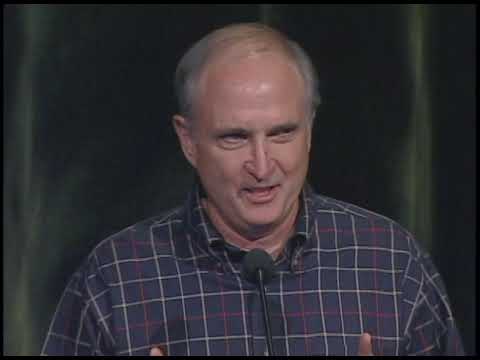
This article was written by Mari Margil, executive director of the Center for Democratic and Environmental Rights. For years, Margil has dedicated her work to upholding environmental protections internationally and advocating the rights of nature.
Republished from Common Dreams with permission. Featured image by Banaras Khan/AFP for Getty Images.
Mari Margil speaking at a Bioneers conference
I first traveled to Nepal in 2012 to meet with members of the Constituent Assembly drafting the country’s new constitution. The central question we discussed was how to tackle global warming from a Rights of Nature perspective.
Home to Mt. Everest, Nepal has witnessed the Himalayas become the fastest warming mountain range on earth. The kind of change that is needed is obviously significant, and over the years, our discussions have shifted from what the United States should do (“get your country off our back” was a common refrain), to what smaller nations like Nepal must do in the wake of the growing climate crisis.
Toward the end of that first stay in Kathmandu, a taxi strike took place. It was only then, as the heavy air pollution cleared, that I was able to see the Himalayas from my hotel room.
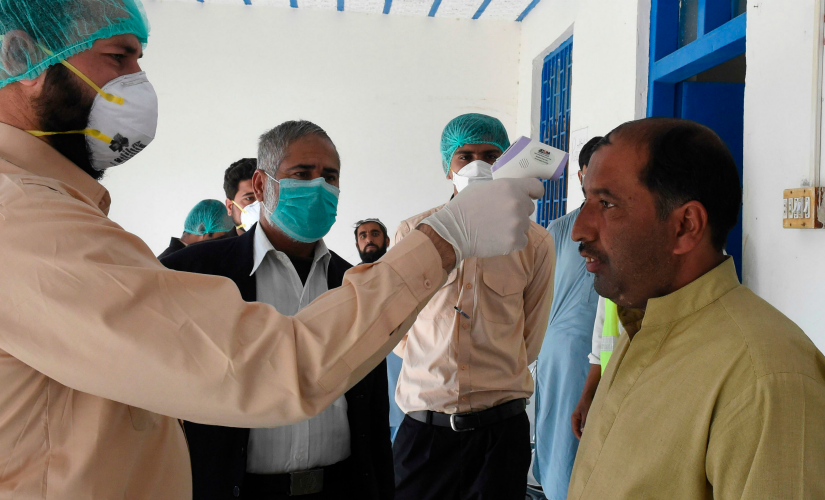
Today we are witnessing something similar in India, China, and elsewhere. With the disruption of everyday life occurring from coronavirus, air pollution rates are dropping fast.
Without the disruption of a taxi strike or the coronavirus, something that shifts our perspective, it can be difficult to see the world differently. What’s right in front of us can seem so concrete that it can be challenging to imagine that another reality is possible.
However, in these pandemic days (daze?), our reality seems to shift daily—even hourly. As we read more headlines about falling pollution levels and other environmental effects, what seemed impossible becomes imaginable.
Thus, disruption—in our individual lives, such as moving or getting a new job—and in our collective lives, such as a global pandemic—can provide a window of opportunity to change our habits and make positive change.
The courage to go first
The pandemic notwithstanding, times of great disruption are not always brought about so abruptly. People on the frontlines of social justice movements struggle for years, decades, even longer, to make the great changes in society that are needed to expand freedom, rights, and protections. They mobilize to create the conditions for significant shifts in society and law.
In social change movements those who “go first” often show the rest of us that a new reality is possible.
We can glimpse that new reality in something as simple as sitting on a stool. In 1960, four young black men sat at a segregated Woolworth’s lunch counter in Greensboro, North Carolina. Their refusal to give up their seats helped reveal to the nation the injustice of Jim Crow segregation.
Their willingness to “go first” led others to follow. Within two months, sit-ins had taken place in over 50 cities in 13 states. The Greensboro Four—Ezell Blair Jr., David Richmond, Franklin McCain, and Joseph McNeil—together made visible a path that others could then walk.
In 2008, I went to Ecuador to meet with the elected delegates to the Constituent Assembly who were drafting the country’s new constitution. We discussed the Rights of Nature—this need to change how nature is treated under the law—from something whose use and destruction is to be regulated, to a living entity in need of protection and respect unto itself.
Ecuador is home to remarkable, biodiverse ecosystems, from the páramo high up in the Andes to the Galapagos islands.
When the people of Ecuador approved the new constitution in September 2008, it was a landmark moment in the budding Rights of Nature movement. For the very first time anywhere in the world, a country had enshrined constitutional protection of nature—or Pacha Mama.
In the face of overlapping environmental crises—including extinction rates far beyond natural background rates, to climate change—this brave willingness of a nation and its people to “go first” revealed that it is possible to change how we treat nature, from an object of human exploitation to a subject with legal rights of its own.
Within weeks, I spoke with people in India, Nepal, and other countries who were interested to find out how they could follow in Ecuador’s footsteps.
Today, many of us did not envision that we would ever be under “stay at home” social distancing orders. Maybe the shutdown in Wuhan was too distant to seem a possibility. Perhaps it was measures first taken in northern Italy that brought that idea a little more into focus. By now, the cascading events that have led to a practical global shutdown have brought into view a different world, at least for a while.
Social movements often bring into sharp relief prejudice and destruction that is otherwise camouflaged. In so doing, such movements force our realities to shift, and we are left to wrestle with what we do with that new understanding.
At this moment, in this time of disruption, as we are able to see the possibility of change, the question before us is what we will do.
A Special offering from Bioneers – for this, our time.
The world has entered a period of radical creative destruction — of breakdown and breakthrough. The very fate of human civilization hangs in the balance. Where have we gone so wrong? Could it be our cosmology itself, our view of our place in the natural and cosmic order? As author Richard Tarnas observes, “World views create worlds.” Is a fundamental transformation of our civilization’s world view the gateway to our survival and flourishing as a species? In this Bioneers audio special, we take an experiential journey into cosmology, consciousness and change, with: Chief Oren Lyons, Native American leader from the Onondaga Nation of the Iroquois Confederacy; Richard Tarnas, the author of Cosmos and Psyche: Intimations of a New World View; and featuring music from Shaman’s Dream and Blue Tech.
Featuring
Chief Oren Lyons, Faithkeeper of the Wolf Clan, Onondaga Council of Chiefs of the Hau de no sau nee, or Six Nations — Onandaga, Seneca, Cayuga, Oneida, Mohawk, and Tuscarora. He has been very active defending indigenous rights in U.N. forums around the world, and is a principal figure in the Traditional Circle of Indian Elders, a council of grassroots leaders of North American Indian nations.
Music by Shaman’s Dream and Blue Tech, from the CD Prana Pulse.
This is a Bioneers Audio Special. Visit our radio and podcast homepage to find out how to hear our regular program on your local station and how to subscribe to the podcast.
Subscribe to the Bioneers: Revolution from The Heart of Nature podcast
Transcript
CHIEF OREN LYONS: The Question: How do you teach seven billion people to respect their relationship that they have with the Earth? Soon, now…
NEIL HARVEY, HOST: The world has entered a period of radical creative destruction — of breakdown and breakthrough. The very fate of human civilization hangs in the balance – an unprecedented planetary emergency. Has the apparent success of the modern project of “human progress” also precipitated our downfall?
As the wheels of the modern project of “human progress” come to a halt, we MUST contemplate this dawning age of biology and carefully reconsider “Who are we? What are we here for?” – our cosmology. Where have we gone so wrong? Could it be our cosmology itself, our view of our place in the natural and cosmic order?
As author Richard Tarnas observes, “World views create worlds.” Is a fundamental transformation of our civilization’s world view the gateway to our survival and flourishing as a species?
In this Bioneers audio special, we take an experiential journey into cosmology, consciousness and change – with Richard Tarnas, the author of Cosmos and Psyche: Intimations of a New World View – and Chief Oren Lyons, Native American leader from the Onondaga Nation of the Iroquois Confederacy.
I’m Neil Harvey. This is Thanksgiving in the Cosmos: The Next Enlightenment.
Richard Tarnas
RICHARD TARNAS: Why is cosmology important? Cosmology is important because it is the container for everything that happens in a civilization. Our understanding of ourselves as human beings in the cosmos, our…our psychology, our strategies for how we relate to the larger community of life, all this is shaped by our cosmology in very fundamental ways.
And it’s been characteristic of our cosmology since the extraordinary convulsion of the birth of the modern era, the scientific revolution, the enlightenment, that there has emerged a fundamental separation of the human being from the cosmos, from the rest of nature, a sense of a separation between what in philosophy we call like the Cartesian subject, the monotheistic rational heroic solar ego in the larger matrix of nature.
And that separation has created what can perhaps best be summarized as a disenchanted cosmos, that is a cosmos that has been neutralized of all—of all spirit and soul, of all interiority.
Chief Oren Lyons
CHIEF OREN LYONS: Talking here about cosmos, cosmology, …and I represent the Onondaga Nation so I speak rather specifically, you know, about the Iroquois, the Hau de no sau nee. Yeah, it’s Hau de no sau nee, which means the people of the long house. It’s…it’s a league—called the great league of peace. It’s old compared to other nations. It’s over a thousand years old. And the structure that we use today is the same structure that was given to us a thousand years ago.
So, it’s Indian country. We talk about Indian country, and it’s a big country.You know, on this whole Turtle Island that you’re sitting on right here. It’s all Indian country. And old, old people. Been here a long time, still here, and still carrying on ceremonies. Thanksgiving and the cosmos. What is the cosmos? You know? We all have our stories. Everybody has their stories. And I just always wanna hear a nation’s story. And when I hear the story, it’s amazing what it says. You know, if you’re talking to the Coast Salish people up there along the coast, they’ll talk about the clams, it’s in their cosmology. Salmon, or Lakota talk about the buffalo—[Lakota term]. Or the Hau de no sau nee will talk about peace.
RT: Imagine that you’re the universe and you’re being approached by two suitors, that is two ways of knowing you. And one suitor looks upon you, the universe, as being intrinsically incapable of any spiritual depths or of any meaning or purpose, of any conscious intelligence. All of that is see—the suitor looks upon himself as being the only being capable of that, and looks upon you as being something that is best understood in such a way that he can better exploit your resources for his own self enhancement. And so, the purpose of knowledge is prediction and control.
The second suitor looks upon you, the universe, as being at least as intelligent and spiritually profound as he might be capable of—he or she, and in this perspective this approach, this suitor looks upon you as being…a being that is best approached not through a narrow rationalism but through a capacity for an empathic, imaginative aesthetic, intuitive somatic, as well as reason and sense. All of this has to be brought, not to predict and control but rather to better overcome the barrier between self and world, human and nature, so that a larger creative potentiality can emerge out of this coniunctio, out of this sacred marriage.
If you’re the universe, who would you open up your deepest being to?
OL: Our story begins beyond the stars, way beyond the stars, before there was an Earth here, when this planet was a ball of water. That’s how our story starts in the sky world, when things were over there. Beautiful story—sky woman, Turtle Island. Strong cosmology.
And we were always relating, you know, our story is always about relationship. And so, as it goes, how the Earth came about on the back of a turtle, and how we got our names, and how we got our designations. Identity is so important, to have an identity, to have and know who you are. Fundamental peace to know who you are.
Our families, large extended families were named after the natural world here. See? This is my family right here. You see it? Othahyǫnih. The wolf. My family is the wolf. And things going pretty hard for my family out there these days in Minnesota and Montana, Canada and Alaska. Yeah, pretty hard for…And we have other families—the turtle, the eel, deer, bear, snipe, hawk, beaver—these are families. And why? Why? Well, it’s quite simple. We’re related. We’re closely related. So, just by the designation we’re tied to the Earth. We’re reminded all the time that this is our relation, this is our relative. We have a very large family, a very extended family. It goes around the world.
RT: But our civilization has by and large entirely bought into the first suitor’s approach that has brought about the reality that we see before us today, because a disenchanted, objectifying cosmology essentially empowers the utilitarian mindset whose highest value is profit and power.
And as a result, there’s a kind of spiritual emptiness in a disenchanted universe that the people attempt to fill that spiritual void with whatever they can, and if all they know is a materialistic universe, then consumerism is the strategy to fulfill that emptiness. So, we have a kind of techno-consumerist frenzy that is cannibalizing the planet…and because we can never get enough of what we don’t really need, we have this situation that we see before us today.
OL: …We’re tied to the Earth.
You’re included. Human species. We’re a species, we’re not races. We’re black, we’re white, we’re red, yellow and everything in between. We can exchange blood. We’re family. We’re brothers and sisters. And we have intellects. It’s why we talk about psyche and cosmology. We have intellect. We kind of bounce it around a lot, you know.
But our cosmology tells us how we’re related and how we came about, and how important it is to maintain this relationship.
And so my question to you, ponder and think about and come back with an answer, how do you teach seven billion people to respect their relationship that they have with the Earth? Soon, now…why? Well, we’re facing a crisis.
HOST: Onondaga Chief Oren Lyons and author Richard Tarnas, recorded at a Bioneers conference. This is “Thanksgiving in the Cosmos: The Next Enlightenment”, an audio special from Bioneers.
RT: So, in the modern cosmos, if you perceive any meaning and purpose, whether it’s in something that’s happening outside of you in nature, whether it’s a—if you see meaningful patterns that perhaps nature is representing and communicating to the human being through the flights of birds or the movements of the planets or the cycles of the sun and moon, from the modern perspective you’re simply projecting human meaning onto the non-human world. That’s what disenchantment is. It’s a way of turning the world into an object. It’s having an I:it relationship with the universe rather than an I:thou relationship.
That’s been very empowering in certain respects for the human being. Suddenly the world is ours to manipulate and rationally comprehend, predict, explain, control, exploit. But at a huge price, a price of spiritual alienation, but also at a price that can be seen in the external world in our time, and that is the great ecological catastrophe that we are grappling with.
OL:How do you teach seven billion people to respect their relationship that they have with the Earth?
RT: The world is deep, deeper than day can comprehend, as Friedrich Nietzsche said so eloquently. There’s more going on than just that one light of the solar egoic consciousness might be seeing. The night sky with the many lights, the night sky ruled by the moon that allows us to see the whole of space rather than just the very clarified part that’s visible during the day. That larger whole allows us to entertain other possibilities.
I think we, today, are recognizing that a profound change is taking place, and I want to argue that what we have seen in the last century in particular is not just a horrific, tragic error, ’cause after all, so much that is noble and precious has taken place, that is also connected to the modern project and to the autonomy, that has been part of what has emerged in the modern world, the autonomy, even the spiritual freedom, as well as intellectual and moral. Many positive qualities are there, and…I believe that in some sense we can look at what has taken place as a so many of the symptoms of our time and of the last century resemble a kind of initiatory crisis.
OL: We have good relations with the Maya. We have old relations. We’ve known them for a long time. So, I asked one of the leaders one time. I said, Well, what’s happening in 2012? And he says, The calendar’s coming to an end. I said, And then what? He said, Well, we’ll make another one. [LAUGHTER]
He says, However, there’ll be a period of enlightenment. And I thought about that. I said, What do you mean by that period of enlightenment? He’s talking about Long Island, and here is this businessman who works in New York, and beautiful day, and decides he’s going to take his boat, go out and do some fishing instead of go to work. So he does. It’s right there, way out in Montauk, tip of Long Island, sitting out there fishing. Bright sun, hot day. I’m gonna go swimming. So, he jumps off the boat and swims around—pretty big boat, you need a ladder to get back up. There it was, the ladder’s there and he’s floating around the water. Beautiful. And he drifts a little ways from the boat, but not far. And turns around and he sees a fin, a gray fin coming directly towards him about three feet out of the water. Oh, shit, he says. I shoulda went to work. That’s a period of enlightenment. [LAUGHTER] [APPLAUSE]
RT: The dark night of the soul, the sense of a deconstruction of the old identity, the crisis of meaning, the encounter with mortality on a planetary scale, all these resemble closely what happens in indigenous rights of passage, in the death/rebirth mysteries, in what Jung would call the individuation process, what often happens spontaneously in near-death experiences.
The separation from the community in our case, in the modern human case, it’s been a separation from the entire community of being itself, from the universe, from the cosmos. And it’s as if the universe itself is putting us through some kind of initiatory death/rebirth process, even as we ourselves are co-creating it, helping to constellate it.
OL: Here we are. It is a period of enlightenment, calendar’s changing, and things are happening, as you well know. So, here we are gathered,… and it means you gotta bear down now. And all you kids out—all the young people out there, gonna need your legs, gonna need your strength, and…ourselves, we have to take a good look at ourselves and say, How are we gonna manage these next years coming? And what about the kids, and seven generations, as our leaders have been told?
The instructions we got, one of the instructions, one of many, “when you sit and you counsel for the welfare of the people, think not of yourself, nor of your family, nor even your generation. Make your decisions on behalf of the seven generation coming. Those faces looking up from the ground, layer upon layer…make your decisions on their behalf. You yourself will have peace.”
How do you teach seven billion people to respect their relationship that they have with the Earth?
RT: I think in some sense the universe may have been constellating painstakingly and painfully a partner to reconnect with the soul of the universe in a new way, not only rediscover that soul of the universe, but to reconnect with it. Not only to reconnect with it but to forge a new relationship to it that builds upon everything that has been learned in these thousands of years and in the period of the modern and post-modern.
OL: So, we have to be adults, don’t we? We have to grow up, get rid of your toys, trim down. Talked to Ted Turner one time and I said, Ted, we’re headed for a storm. I said, What do you do? He says, “Trim your sails, Man; trim your sails and head her into the wind and ride it.” And that’s where we’re going. So, learn to trim your sails, and we’ll see how good sailors we are. Thank you. [APPLAUSE]
Indigenous leaders from islands across the Pacific Ocean share first-hand observations of the effects of climate change and explore how Indigenous traditions and knowledge can launch innovative solutions and inform policy.
Featuring Maui Solomon (Moriori/Kai Tahu), Indigenous Rights Lawyer and Indigenous Rights Activist, and Executive Chair of Hokotehi Moriori Trust; Sven Haawkanson Jr. (Sugpiaq), Associate Professor of Anthropology and Curator of North American Anthropology, Burke Museum, University of Washington; and, Kupuna M. Kalani Souza (Hawaiian) Executive Director, Olohana Foundation, National Distaster Preparedness outreach specialist, and certified FEMA instructor.
This presentation took place in the Indigeneity Forum at the 2017 National Bioneers Conference.
Indigeneity is a Native-led Program within Bioneers/Collective Heritage Institute that promotes indigenous knowledge and approaches to solve the earth’s most pressing environmental and social issues through respectful dialogue.
Indigeneity is a Native-led Program within Bioneers/Collective Heritage Institute that promotes indigenous knowledge and approaches to solve the earth’s most pressing environmental and social issues through respectful dialogue. Visit the Indigeneity Program homepage.
Bioneers is proud to have signed onto the following open letter demanding a Just Recovery as the nation and world consider how to rebuild systems and economies. Launched by our colleagues at 350.org, the campaign emphasizes an intersectional view of the root causes and effects of this crisis, demanding a systemic response.
The COVID-19 pandemic demands swift and unprecedented action from national governments and the international community.
Choices being made right now will shape our society for years, if not decades to come.
As decision-makers take steps to ensure immediate relief and long-term recovery, it is imperative that they consider the interrelated crises of wealth inequality, racism, and ecological decline – notably the climate crisis, which were in place long before COVID-19, and now risk being intensified.
This is a time to be decisive in saving lives, and bold in charting a path to a genuinely healthier and more equitable future through a Just Recovery.
We, the undersigned organisations, call for a global response to COVID-19 to contribute to a just recovery. Responses at every level must uphold these five principles:
1. Put people’s health first, no exceptions.
Resource health services everywhere; ensure access for all.
2.Provide economic relief directly to the people.
Focus on people and workers – particularly those marginalised in existing systems – our short-term needs and long-term conditions.
3.Help workers and communities, not corporate executives.
Assistance directed at specific industries must be channeled to communities and workers, not shareholders or corporate executives, and never to corporations that don’t commit to tackling the climate crisis.
4.Create resilience for future crises.
We must create millions of decent jobs that will help power a just recovery and transition for workers and communities to the zero-carbon future we need.
5.Build solidarity and community across borders – don’t empower authoritarians.
Transfer technology and finance to lower-income countries and communities to allow them to respond using these principles and share solutions across borders and communities. Do not use the crisis as an excuse to trample on human rights, civil liberties, and democracy.
This article contains the content from the 4/9/2020 Bioneers Pulse newsletter. Sign up here to get the newsletter straight to your inbox!
Humanity is at a crossroads. As we transition into a society led by equity and compassion rather than hate and fear, we must challenge antiquated beliefs that have led us to repress our true identities.
We’re beginning to lean into the elemental truths of sacred masculinity and divine femininity. By honoring this balance in ourselves, we can truly embrace our emotions, realize our interconnectedness, and find compassion for one another.
This week, we explore new and evolving perspectives on gender identity.
The Radical Inclusion of All Genders and Sexualities
Current debates about the standing of LGBTQIA+ persons have raised new awareness around gender and sexuality. People whose sexualities and gender identities cannot be contained within hetero-normative (and binary/cisgender) culture have always existed, but oppression, discrimination, and violence against them have long been the norm and continue.
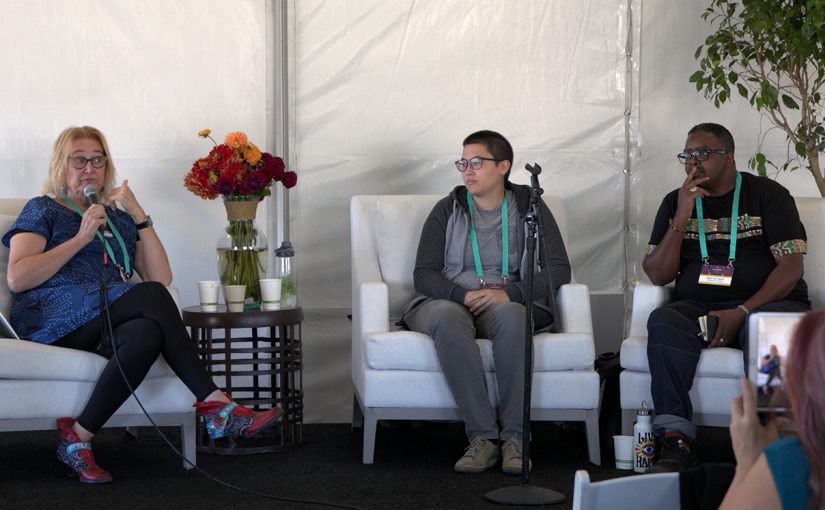
In this panel, three leaders in gender and sexuality fields discuss the systemic oppression of gender and sexual minorities in the context of intersectionality and explore how to achieve the full inclusion of all genders to help bring humanity to its full potential.
The panel discussion was followed by a Q&A session with the audience. Click here to read more from these leaders about gender creativity, community support, and other issues around gender and sexuality expression.
Re-Imagining Manhood: Four Leaders Discuss the Sacred Masculine
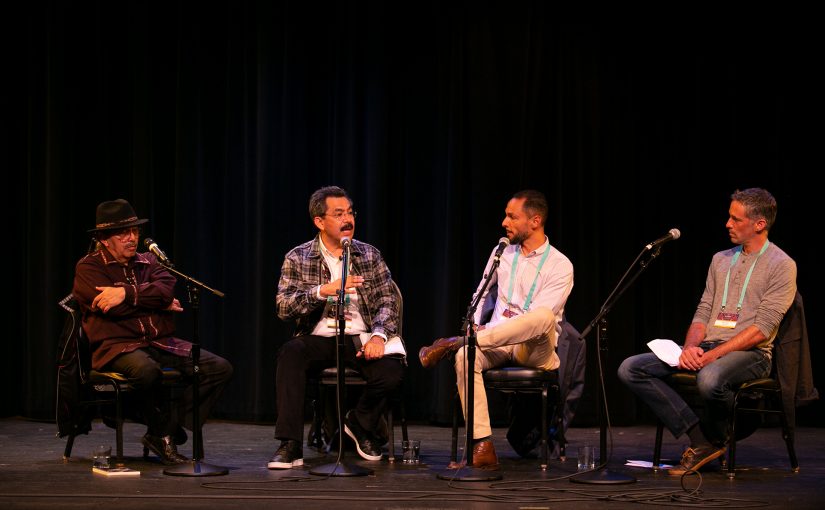
Sacred masculinity helps men turn toward their authentic selves and break free of the rigid, repressive definition of manhood prescribed by larger society. In this panel, four leaders discuss their work to help men connect with their sacred masculinity. Featuring Jerry Tello, co-founder of the Healing Generations Institute; Jewel Love, CEO of Black Executive Men; Hector Sanchez-Flores, Executive Director of the National Compadres Network; and Will Scott, co-founder of the Weaving Earth Center.
I Am Because I Am: The Expansion of Gender Identity
This guest podcast from the producers at Making Contact explores the expansion of gender identity and presumed roles in our society. Diverse perspectives provide a look beyond the socially constructed ideas of what is male, female, masculine or feminine.
This show traverses questions like: What does it mean when individuals challenge specific societal expectations of gender? In the spectrum of “queer identity” how does one embody masculinity, femininity, or neither? And how are communities responding to the potential threat of erasure?
In her new book, Nature, Culture and the Sacred (Green Fire Press, 2018), Bioneers Co-Founder Nina Simons offers inspiration for anyone who aspires to grow into their own unique form of leadership with resilience and joy. It features stories of women who are leading the way towards transformational change by cultivating vibrant movements for social and environmental justice.
The following poem is from the book’s final essay.
Join Us for This Webinar to Support the Wampanoag Nation
Lyla June — a Diné artist, activist, scholar and Bioneer — is working with her colleagues to organize a webinar in support of the Wampanoag Nation. This webinar training, “How to Be in Solidarity with the Wampanoag Nation,” is a response to the tribe’s reservation having recently been “disestablished” in a unilateral and nefarious act by the US Department of the Interior.
Join us for this Zoom conference call on Sunday, April 12 from 2-4 p.m. PST as Wampanoag tribal member Danielle Hill teaches participants how to stand behind the Wampanoag at this time and protect their lands and people from further government swindling and colonization.
Donations are suggested on a sliding scale from $25-$70, and all registration fees will go to 440+ families from various Indigenous Nations who have asked for assistance. Donate through PayPal to nativefund1680@gmail.com.
Find your local number: https://zoom.us/u/abkKvYAzb6
The Latest from Bioneers.org About COVID-19:
A Case of the Pandemic Blues | Author and Bioneers Senior Producer J.P. Harpignies reminds us that even during the COVID-19 outbreak, we can put an end to post-disaster trends of elite, corporate profiteering.
In Case of Emergency, Break Class | Bioneers co-founder Kenny Ausubel writes about how massive cooperation is the only way to solve a pandemic. As a society and civilization, we are being forced to change our pronoun from “me, me, me” to “we.”
Politics and Consequences: How to Fix Democracy in the Face of COVID-19 | In the following essay, Orr explains how the deterioration of our democracy has precipitated crises like climate change and the spread of COVID-19, and what we can do in the face of this reality. Will we take charge in this opportunity for change?
Honey, We Shrunk the Planet: Regime Change and Resilience Thinking | In this excerpt from his book, Dreaming the Future, Kenny Ausubel outlines “resilience thinking” — a solve-the-whole-problem approach that can help us achieve our wildest dreams for the future of the environment and society.
Get Your FREE Download of Our Ecological Medicine eBook!
In light of the pandemic, we’re releasing a free downloadable PDF of our 2004 Bioneers book: Ecological Medicine: Healing the Earth, Healing Ourselves, which could hardly be more relevant right now.
Modern medicine’s separation from nature is at the root of many tragedies, both human and environmental, and the current pandemic is an object lesson in how disastrous that disconnection is to us as a society and civilization.
Dana Perls, the Senior Food and Technology Campaigner for Friends of the Earth, leads the Food and Agriculture team’s international and national regulatory and market campaigns on biotechnology and genetic engineering. Perls was interviewed by Bioneers Restorative Food Systems Director Arty Mangan at the Eco Farm Conference.
Arty: Since the DARK Act (Denying Americans the Right to Know) for GMO labeling was passed, not as much has been written about genetic engineering in the mainstream press. What’s the update?
Dana: The field of genetic engineering has evolved a lot. Genetic engineering has gone beyond GMO corn, soy and cotton. Now, rather than targeting commodity crops, there are genetically engineered flavors, fragrances, animals, insects, pesticide sprays, and soil microbes. The field has expanded to the point where genetic engineers are looking at engineering nature. It’s critical to know that we are at a point where we need to make a decision as to whether or not we want a food system and an ecosystem that are genetically engineered or we want to prioritize organic agriculture and agro-ecological farming practices, which are going to be healthy for people, healthy for the soil, and which protect biodiversity.
There is a whole new generation of GMO techniques that include
turning on and off genes to affect what genes are expressed. It includes gene
silencing, creating unique DNA sequences that don’t exist anywhere in nature,
genetic extinction technologies like gene drives, and gene editing
techniques like CRISPR. Some of these
techniques aren’t necessarily new, but the applications to insects, animals and
soil are new. Other new applications are not yet on the market. They’re not yet
in the environment, which is why it’s so important that we learn about these
techniques and these applications, and that collectively as a society we decide
what direction we want to move within our food system.
Arty: What are some of the specific applications that are in trial and what is already in the market?
Dana: There are lots of applications already in the market. Scientists have genetically engineered a simple organism like yeast or algae, and, through a fermentation process, feed the yeast genetically engineered corn. The yeast is designed to produce things like vanilla or saffron, or the heme [the molecule that gives blood its red color] found in the Impossible Burger. Flavors, fragrances and compounds produced by genetically engineered yeast are entering into the market very quickly through food, beverages and supplements.
There are also applications that are made using gene editing. Gene
editing is a type of genetic engineering that has entered into the market in
fewer places. There’s gene-edited corn and soy. There have been several
applications for products that have been approved for the market like the GMO
apple – designed for cosmetic purposes – that does not turn brown. There’s the
GMO
potato that uses the same gene silencing technique. There’s a gene-edited mushroom, but I’m not clear
if it is on the market yet.
Unfortunately, because of the USDA labeling laws, we won’t
necessarily be able to know where these new GMOs are in the market. The USDA
has developed very antiquated definitions of GMOs that exclude some of the new
applications, like the genetically engineered yeast, or like CRISPR corn,
CRISPR soy, and mushrooms. Those may not be labeled, which is why it’s really
important for consumers to track the Non-GMO Project label or the USDA
Certified Organic label, if people want to be sure they’re not eating
genetically engineered foods.
Arty: What distinction does the USDA make between the old style transgenic organisms where a gene from one species is inserted to another species and the new form of gene editing where they are cutting and changing the genetic sequence in one species?
Dana: The USDA recognizes that gene editing is a type of genetic
engineering, but, under the labeling law, they are splitting hairs and have
made a distinction between GMOs and gene editing. They have decided that GMOs
need to be labeled and gene-edited organisms don’t. But when it comes down to
it, it’s all genetic engineering. With gene editing, we’re seeing the same
risks and concerns. I would say that there are more risks and concerns with
these gene-edited organisms than the transgenic GMOs.
We need to be regulating, assessing and evaluating all genetically engineered organisms, whether they’re transgenic or gene-edited. Everything needs to be evaluated, assessed, regulated and labeled because the thing that we keep learning through science is how little we actually know about genetics. Every time there’s a study sharing that we’ve learned something, it’s only a matter of weeks or months before another study comes out saying that what we thought we knew was wrong. The thing that’s most consistent with gene-edited organisms is the surprise mutations, the unexpected consequences, both at the cellular level and at the organism level. We don’t understand how gene-edited organisms work, how they’re going to play out in the environment or on an agricultural field, let alone in a human body.
Arty: What are some of the specific risks?
Dana: The unintended effects of genetic engineering can be pretty severe. One scientific study found the potential for mice that have been gene-edited to be more susceptible to cancer, or cows genetically engineered to be born without horns carried genes for antibiotic resistance. Plants that are being engineered to be herbicide tolerant are impacting insects that weren’t meant to be impacted. There are so many risks that science is finding, particularly at the cellular level. When scientists try to delete a certain number of genetic sequences in an organism, instead large segments and many different deletions that were not intended happened. Given how little we understand about gene expression and how genetics work, we need to hit the pause button and work with food in the way that’s proven safe by using organic techniques.
There’s been a lot of studies on gene editing showing major
problems at the molecular level, but there have been few studies looking at the
impacts on human health long-term, and there have been fewer studies done on
what the impact is on the organism. For example, when you genetically engineer
a pig to be resistant to a virus, first, it isn’t likely going to work because
we’re putting that pig into a problematic CAFO system. We need to
change the system, not the pig. And second, we haven’t done the studies on what
is the impact on the organism itself. We know that there’s a large amount of
genetic havoc at the molecular level. How does that play out for the whole
plant or for the whole animal or for the ecosystem in which they live?
Much of these gene-edited organisms may be irreversible. We don’t
know how to undo genetic engineering. We don’t know how to recall organisms
that spread through the environment, which puts us on a treadmill trying to fix
one mistake with another genetically engineered organism. When there is a
problem, the biotech answer is to keep genetically engineering our ecosystem
until what’s around us is no longer nature.
Arty: Doesn’t the process actually interfere with evolution?
Dana: At the United Nations, we talk about that. We need our plants, animals and insects to have their full genomic genetic experience to be as resilient as possible to respond to climate conditions and environmental stressors. This is the wrong time to be crippling their natural ability to adapt.
For example, genetically engineering the GMO apple, which inhibits
browning, affects the apple’s natural immune system. It affects the
apple’s natural ability to fight pests and viruses, which means that you’re
going to need to use more pesticides. Even the applications that are cosmetic
end up putting us on the pesticide treadmill as one of the unintended consequences.
With the GMO animals, there’s research suggesting that it messes
with the animal’s protein production, which has an effect on the animal’s
immune system; they may be sick more often. That results in the need to use
more antibiotics in those animals. It perpetuates all the problems that people
are trying to fight within the CAFO system. Genetically engineering cows to
withstand more heat, or genetically engineering hornless cows so they don’t
poke each other, or pigs that are resistant to disease, all of these are just
trying to redesign an animal to better fit into the industrial system, to
create something which allows us to continue our industrial food system as is.
It just perpetuates all the problems that we’re trying to solve.
We really need to take a precautionary approach, and that is where
the United States is failing. The United States doesn’t take a precautionary
approach to genetically engineered organisms, whereas in Europe they do. In
Europe, gene editing is going to be regulated as genetically engineered
organisms, the same as GMOs, and they are going to assess, regulate and label
new genetically engineered organisms.
The American regulators are viewing gene editing as a magical new
type of genetic engineering that solves and accounts for all the problems that
we had with the first round. In fact, we’re seeing all the same problems. The
regulators are not looking at the science. The science is showing that gene
editing is not precise, that there are significant problems with it, and there
are still large gaps in the science. We need to look at the impact of gene
editing on insects that aren’t being targeted, the impact on soil health, and
the impact on other animal species that eat the plants, or humans that eat the
gene-edited plants. There’s a dearth of information on some very critical
areas. The areas that there is research on are raising all sorts of red
flags.
What the regulatory agencies need to be doing is hitting the stop button on these new technologies. We need to be focusing on the data which we have on what works, which is regenerative organic agriculture.
Arty: There isn’t much solace in counting on the regulators. Haven’t they pretty much given GMOs a green light? Even if they required gene-edited organisms to go through the GMO regulatory process that really wouldn’t solve the problem.
Dana: Currently, our regulatory agencies are putting in place very dismal and inadequate regulations. At this point, the regulations are essentially voluntary self-assessment. It’s the fox guarding the henhouse. Which is why there’s been a lot of movement in the market space. The polls are very clear that consumers do not want genetically engineered food and beverages or GMOs in general. Consumers are very concerned about pesticides in their products. The organic industry is growing very quickly. The non-GMO industry is growing very quickly. Consumers have an opportunity to put pressure on companies to say that we don’t want to be eating genetically engineered ingredients in our food, and we want non-toxic food.
At a time when we don’t have a lot of opportunity with our federal regulatory agencies, we do have the opportunity to put pressure on food companies and on the natural and organic product industry to make sure they’re giving people what they want. A lot of the work that I do is to share with companies that this new generation of GMOs 2.0 have a lot of risks and concerns, and people don’t want them.
Arty: It seems like even the mainstream press is ignoring the science and promoting the talking points are of the biotech industry.
Dana: Unfortunately, we’re seeing a significant trend attacking both organic and the non-GMO movement. We’ve seen a lot of excellent investigative journalists be attacked for exposing the influence of corporations and the agro-chemical companies like Monsanto on the EPA. The court victories by people who got cancer caused by their exposure to round up and the Monsanto papers showed very clearly that there is an unfortunate backdoor influence of big ag on our regulations.
It’s unfortunate that the trend we’re seeing is for journalists to
play down the merits of organic, or to attack organic. We’ve seen media make
claims that GMOs are safe. The same trend of corporate influence in our
government is playing out in mainstream media where people who choose to do a
deeper exposure of the dirty politics involved in our food system and in
genetic engineering and pesticides, those individuals are very quickly
attacked, silenced and moved off their beat. It’s become a dangerous place in
the United States to speak out against the agro-chemical industry.
It becomes even more critical therefore for us as advocates for
organic and non-GMO to make sure that we are getting information to people
through as many places as possible, finding those journalists who aren’t afraid
to speak out, using independent media, putting out shoppers’ guides in grocery
stores, hosting talks. It’s becoming more and more challenging, and it’s
becoming more anti-democratic. We need a democratic food system where people
have the right to know what they’re eating, and have a right to know what the
risks are for various ingredients. Our food system shouldn’t be determined by
the profit of one company. We need to get back to a time where people
prioritized personal health and the health of our environment rather than the
profit of companies.
It’s an incredible challenge to get balanced information into the
media. If there’s an article about genetic engineering, oftentimes there will
just be one sentence mentioning that there may be opposition, but never
actually diving into what the risks and the concerns are. Mainstream media
often portrays people concerned with the risks as hyper-fearful and
ill-informed when that’s not true. People are demanding more science and more
information and more exposure around genetic engineering. It’s the opposite of
anti-science. It’s actually very pro-science that we want to understand what
the environmental and health impacts of toxins are on our bodies and our
planet.
Arty: One of the perverse legal logics with genetic engineering and patents is the corporate ownership of DNA. If a farmer’s field becomes contaminated with pollen from a patented crop, the corporate patent holder has a legal ownership claim on that farmer’s crop.
Dana: The risks of contamination are becoming greater with some of the new applications of genetic engineering, particularly with gene editing. For example, there is a proposed application for a DNA spray. It would be a pesticide spray made up of many tiny strands of RNA with the goal of silencing certain gene expressions. What that means is if you apply this DNA spray on your field, whatever that DNA touches ultimately becomes protected by the patent of the company that owns that spray. So, when a farmer is using these new technologies, the seeds, plants and trees that are genetically engineered aren’t actually the farmer’s anymore. They become owned by the company.
The question of corporate consolidation and the right to own and
the right to farm are really called into question with this new wave of genetic
engineering.
It is really urgent that we make a decision together as to what
direction we want to take our agricultural system. Either we can get on a
treadmill of genetically engineering nature and our agricultural systems
combined with the pesticide treadmill, or we can move in the direction of
organic agriculture. With these new types of genetic engineering that are
designed to spread into environments and have a higher likelihood of spreading
into nearby farms, it begs the question of whether two different agricultural
systems can coexist. I would argue that they can’t. As genetic engineering
becomes riskier with higher rates of contamination, then organic farmers and
farmers who are using regenerative farming practices are at risk of not being
able to continue those practices.
We really need to stand up together to make it clear which
direction we want to take our food system, particularly at a time of climate
chaos and biodiversity loss. We need to be using agricultural farming
techniques that are going to protect biodiversity and are going to be resilient
in the face of climate change.
With Erica Anderson, Ph.D., President of USPATH, the newly created affiliate of WPATH, the World Professional Association for Transgender Health; Fresh “Lev” White, CEO of Affirmative Acts Consulting; Salgu Wissmath, a non-binary photographer whose work explores the intersections of mental health, queer identity, ethnicity, and faith.
ERICA: Until about three or four years ago, I used to hear from younger queer people all the time: Why do we need pride? We’ve got marriage equality, we’ve got protections here and there, why do we need pride?
Erica Anderson, Ph.D.
I came out in high school. I’m accepted by everybody I care about. And then we had an election, and now we know why we need pride, and why we need to be together, and why we need community, and why we need to empower each other, and why we need to love and accept each other.
The gains that had been made can be quickly lost, and we’re in jeopardy of losing them now, from the forces on the right and the people who are repressing. And I deliberately included that word denial in what I talked about because I think there’s a similar dynamic at work with people who are denying climate change and the science around climate and the environment, and the people who are denying the beauty of gender diversity.
Salgu Wissmath
SALGU: Right now there’s a big movement in the journalism and photojournalism world to make sure that there’s diversity and representation – not just the photographers that are hired, but the type of work that we’re doing that gets published. I think that can be translated to any industry. So if it’s environmental work, social work, I think it’s important to be inclusive and intersectional in anything you do. As queer people, trans people, I think that we have a unique life experience and unique perspective that probably shapes the way that we approach our work, whether that is faith work or journalism work or social justice work. Being present, being seen and visible allows our full selves to come to whatever movement it is that we’re involved in.
LEV: I really appreciated you saying queer and trans, because not everybody’s both. Some people are queer identified, but not part of the trans community and vice versa. So thank you for calling that out. When I was here 19 years ago, it was a lonely place, so some of it is about just seeing that there are other people of color who are clued into some of the environmental injustices or experiences that are happening, especially in our communities, and that we can do something about it. And then the part about visibility, thank you so much for doing that.
Fresh “Lev” White
The safety part comes in that we have an impact in numbers. I can say that I’m being harmed, but when 50 of us say that we’re being harmed, it helps people who are simply ignorant. Maybe they have the best intention, but simply ignorant of their harms to decide that they need to do something, because like us they are overwhelmed. Not to make an excuse, but it’s what happens.
Q: What does it means to be gender creative?
ERICA: When you’ve seen one transgender person, you’ve seen one. So I think gender creative means someone who is really thinking about who they are and what their gender is. I see a lot of young people who are experimenting, who are thinking about who they are in a very deep and abstract way – way deeper and more abstract than you’d expect based on their chronological age. I take great comfort in and am inspired by that, because these kids are really thinking deeply about some important things, and that’s great. So gender creative, I think, just means you’re thinking about who you are, and maybe it’s fluid and dynamic.
Q: What are your perspectives on community support?
LEV: I don’t know if there’s anything more valuable. I’ve been a healer and a counselor and a coach, and I didn’t reach as much out as I could have. Part of it is because of my age, part of it is my personality. At that time, I didn’t know how to lean in. But now I do, and I advise everybody to do that when they can. I have communities now everywhere, globally. This morning, one of my 16-year-old friend/client folks wanted to know about top surgery. I can reach out to 500 people on my mailing list that I know fairly well. Connecting with people, especially spiritually, as well as around gender and ideals is important.
SALGU: I think community is important. I’ve traveled a lot in the last 10 years, I’ve lived in a lot of different places, and every time I go somewhere, I try to connect with community, and especially the queer community. Some people find it hard to make new friends. When you’re older in life and you’re not in school anymore, it’s hard to make new friends. But I think it’s so important, because if you live in a new place, if you don’t know anyone and you don’t have community, it can be really hard to be your full self and enjoy life.
I found Meetup to be a really great way to create community. There’s always queer meet-ups in any town that I’ve ever been. I’m very active in the LGBT center community in the town I’m in, but there’s also a Meetup group that I go to that’s a board game night. I just love going there. There’s always ways to find community, and I think it’s really important.
ERICA: I have also kind of an international community. I’ve been to Sweden a number of times, and I have Facebook friends all over the world. Some of those singular experiences for me have been connecting with people in other places who share some of my experiences as a transgender person. I’ve been to Brazil and been embraced by the trans community there, and that was really breathtaking in a way. They are really under duress now in the current political situation. They’re in my heart all the time.
I do some speaking in Sweden. Last year I spoke at EuroPride, which is in Sweden, and there was a human rights conference there about LGBTQ rights in Europe, and I really value hearing what’s going on in other countries. So there’s varying level of acceptance of trans identities all over the world. In Poland, you can get your birth certificate changed if you’re trans, but the people who signed your birth certificate have to sign an attestation that they lied on the original one.
Q: Coming out can be painful, how can we navigate awkwardness with family and friends?
SALGU: I can definitely relate. I mean, family’s awkward. I am out to my family, but they’re not necessarily the best about using my pronouns or things like that. But at least they kind of know who I am. And it’s still awkward.
I only came out four years ago, so I’m kind of a newbie at this, but as I’ve become more confident in my own identity, just as I’ve become more confident with the people around me. I find solace in my chosen family – really close friends, my career community that I lean on to accept all my identities and talk about the nuances, and debate about all the ins and outs about queerness. Those are not conversations I have with my family on a day-to-day basis. We eat dinner, we hang out.
Even though my parents don’t use my pronouns, it doesn’t bother me as much as it did when I first came out to them. It’s more about finding confidence in my own identity, which is always changing, and finding other people in my community like friends, family, chosen family, that I can really hash that out with, and that kind of helps with the awkwardness a little bit. I hope that helps.
ERICA: I’ll give you a handle that I use. I’m a psychologist for 40 years, and I’ve been through my own issues with this in terms of getting people to accept me. I hear all the time people saying to me, “Well, so and so in my family doesn’t understand, and they keep asking me, How do I understand? How do I understand this?” And here’s what I say about that: It’s not so important that you understand, just accept. If you accept, you’ll start to understand.
LEV: One of the things that I encourage is that whenever it is possible, allow our families to mourn. So, for example, I took 10 years learning about testosterone before I took it, so I had time to process my transition. Allow some time for your family to grieve who they’ve lost. At some point, hopefully they accept who you are and call you that.
I’m an adoptee. I’ve actually divorced my adoptee family. I gave them plenty of time, many years, in order to accept me as a queer and trans person. And just this past February, with lots of love and compassion, I just released them from my life, and let them know that I have no hard feelings – you’re having your experience and I’m having mine. I’m not recommending that for anyone, but just sharing my experience. I will not allow anyone in my life who can’t respect and honor me, especially when I’m doing that for them as well. [APPLAUSE]
Q: To recognize awkwardness & discomfort is a rebellious act in changing the world. What does it mean to be radically included?
SALGU: Any time I go to a conference and the pronoun’s already on there, or the speakers are intersectional, I can see myself represented. Not just queer stuff but also like people of color, brown, native, black— be totally as intersectional as you possibly can. Earlier this year, I went to a conference, and it was the most queer and intersectional conference I’ve ever been to, and it wasn’t even a queer conference. It was just so intersectional, I felt so seen there. I think every conference should be like that.
Put pronouns in your email signature. When you go to meetings, introduce yourself with your name and pronouns. Things like that can really make people feel seen, because microaggressions make you feel not radically included.
Make sure there are multiple gender options on any kind of form. So even though California has a third gender on their license – which I have – when you sign up for insurance or you go to the doctor’s office, or any other kind of bureaucratic form, there’s only two options. So they haven’t caught up yet.
I was asked to be on this panel, and I’m really blessed to be here. There’s two people of color on this panel that are queer, and that’s pretty awesome. Not every panel is like that. So just be mindful of the speakers that you choose, people that you invite to be part of any kind of organization, all of those things make people feel seen.
LEV: Being on a panel with an older trans woman who’s white and done her work so that she reached out to people of color to be with her, that’s radically inclusive. Because she could have reached out to lots of white trans men and white trans women. [APPLAUSE] So just want to call that out.
Earlier this year there was a conference called Soul Play, which is like the hippie event in the woods, and I went to speak there. Before I went they called me up. In the first conversation I asked them about restrooms, and of course they didn’t have any gender neutral restrooms. And unlike in Erica’s story, this white-run, straight-run organization called me back in two days and said all the bathrooms are now gender neutral.
We have to ask for what we want, to look around to see who and what is missing. We have to look for our own scarcity around if there’s enough, making sure we’re not excluding anybody. We have to learn how to say yes more, and figure out how to make that yes work so that people feel included.
ERICA: I’ve been a professor, and I teach about gender. One of the things I say is that humans are hard-wired to detect differences between other human beings when they encounter them, and the first detection, which isn’t even conscious, is of threat. Is this other person a threat to me? And then very quickly on after that is: What’s the gender of this person? Okay? And to some extent, those are sort of intertwined. They’re not mutually exclusive, because of course we know that in urban society, males are more of a threat than females. Or here in the suburbs.
I think we want to take people off the hook and say, okay, you were wired this way, okay, but you’ve got to get over it. You’ve got to learn to accept other people and their differences. And there’s so much inflammation of divisions in the last few years, and we are here in this beautiful community to try to change that.
Q: What about the expression “you guys”?
LEV: We actually use it less and less because people call it out. So please, continue to call it out. I don’t know, less and less certainly in this lifetime in this experience, more and more people are learning not to use that term. So it used to be used a lot more, believe it or not.
SALGU: Not everyone knows that that could be offensive to some people, or that it’s something you might want to be mindful of. If you hear someone saying it, by all means, let them know, and educate them, help them by offering other phrases, like “y’all” or “everyone”, or whatever it is.
You want to be as gender neutral in our language as possible to be respectful of everyone’s identities. Even “ladies and gentlemen” is outdated. But you have to learn an alternative, you can’t take something away if you don’t replace it with something.
ERICA: Having great empathy for people over 50, I want to say if you’ve overlearned something for many decades, it’s really hard to retrain yourself. Thank you, we need to get called out and offered alternatives very much. Even in our community, largely, the word gay used to be a slur. It was embraced by those who themselves decided that being gay was something they could be proud of. Queer was also a pejorative term. Language itself is very fluid, that’s why I include that comment about please be kind, be forgiving. If we have that spirit, and we say let’s be inclusive, let’s be respectful, let’s try things, I think we’re going to continue to move things in the right direction.
Q: What pronouns are triggering?
LEV: I don’t ask anybody without sharing mine first, and then I don’t expect that they’re going to tell me theirs. My introduction is: “Hi, I’m Lev. My pronouns are they.” Then if the person decides they want to share their pronoun, that’s great, otherwise I get used to using their name. My other pronoun is just my name. Be consistent, so you’re introducing yourself the same way to everybody.
SALGU: I also think it depends on the context. Any time I’m in any queer setting, I always ask people’s pronouns because it’s I know it’s safe to, and I don’t have to worry as much. But I think Lev had a good example, you can always introduce with your pronouns so it leaves it open, like if they want to share theirs, they can, and if they don’t, they don’t have to.
I help at my kid’s school a lot, so when I approach young people, I say: Tell me something about yourself, or tell me what makes you you. That way some of them say like, “My name’s Kyle and I’m a boy”, or “My name’s so and so, my favorite color’s pink”. Like I know that that’s the answer that they have and what they want to share with me about who they are.
ERICA: I have kind of a complicated life because how I do this varies setting to setting. I’m in the Child and Adolescent Gender Clinic at UCSF, so I’m seeing trans youth, gender creative, non-binary youth and their families, and more often than not I, upon meeting a child, will say, Oh, and what is your name? And what pronouns would you prefer? I’m almost always the first doctor who’s ever asked them. I’m kind of making a point that we’re here, we’re going to embrace you for being you, and we want to be respectful, whether they’re 5 years old or 15 years old. And it works pretty well. Believe it or not, I’m kind, so kids are happy about it generally. And very rarely does a kid seem to be very uncomfortable. If they do, I’m completely backing off, I’m trying to say something reassuring to them.
Q: What advice do you have for people in professional settings who want to be inclusive, but don’t know how to be?
LEV: Number one, invite me in to do a training. I was on retreat and found out that one of the people in my community who’s a trans gender woman committed suicide. We’re not talking about, oh today this is my gender and I’m playing around, but to actually take it seriously. At least 19 trans women of color have been killed this year, and suicide. It’s actually a life and death is what we’re talking about.
It’s not just about who we want to be called and how we want to be recognized, but that this is about our life and our life experience. We know we’re supposed to be here, and we know that people can make space for us if they can get over their own insecurities. This is the importance of why we’re here, not just to educate a few people who are clueless, but to let people know that it’s a critical thing.
SALGU: I do a lot of work with the Sacramento LGBT Center, and they have a specific branch that’s just for outreach and training. I’m sure whatever city you’re in, there’s a local center or other organization that will offer training to educate people.
ERICA: I’m at UCSF currently, and I’m actively involved in training future health professionals – doctors, nurses, psychologists. I spend time every week with people at varying levels of training, and who are trying to learn about all of this, accepting LGBTQIA+ youth, especially. I’m really encouraged personally by what I’ve seen in the last five years. In fact, the whole field has moved a lot. My college human sexuality textbook didn’t have transgender in it. It had transsexual in it, and said that people who are transsexual have a deep-seated psychiatric disorder. That has radically changed.
There is an organization worldwide that’s devoted to the science and the practice of transgender healthcare – WPATH – and I’m very active in that. I think that we’re moving in the right direction. Today’s professionals, whatever profession it is didn’t get this in their school, in their training, and so they’re coming from way far behind, I’m afraid.
Everyone has their own individual pathway. There’s no rule book here for LGBTQIA+ identities or life courses. And we all have to make our own decisions. I happen to be very out in public about the fact that I’m transgender. But, I know a lot of transgender people who still are really preferring to be just kind of blending in and kind of quiet and private. That’s fine.
Everybody comes to their own awareness of themselves in different ways, some very quickly, maybe early, some over a long period of time. I’m the kind of slow learner that way. It took me a long time to sort of figure out who I was. But it’s okay. We’re all individuals, and that’s one of the beauties of what we can do in the LGBTQIA+ community is recognize the differences, but the similarities, that we’re all trying to be ourselves and authentically so.
LEV: I run meditation groups and day-longs for trans and gender queer people, and some gender queer people have felt uncomfortable because they “pass” as cigender people, and they feel they don’t belong there. My work is to help expand the human experience. So that means showing up as you are in whatever form that you show up in, and then being held and respected. And then holding particular space so that when I’m with young trans people and trans women who may be targeted, I’m not trying to push myself forward. I’m being an ally, and putting trans women of color first, putting trans women in general, putting young gender queer people first, doesn’t erase me. Right? I still get to show up as me, and they honor me as me.
Q: What about when no box really fits, and someone could like anybody, but has fear of getting involved in the community due to lack of experience?
LEV: Oh my god, youth. It’s real. People will tell you you’re fake or you’re not this, and you have to show up that way or else you’re not that. I totally feel you and hear you. I want to encourage you to be yourself, because the community is there. There are people there who don’t care about who you sleep with, and the people who don’t care about how you identify, they care about all the other gifts that you bring as much or primary. You will find your tribe.
SALGU: Before I came out, I spent a lot of time on YouTube and Tumbler, and it was a great community. It really helped me come out, I learned a lot about all the identities. But there’s all sorts of communities out there, online communities, in-person communities, and microcosms of each community. There’s a place for you. On Tumbler, there’s a lot of that negativeness like, “well you’re not really part of the community because of this or because of this”. But then you go to Meetup in person and nobody really cares if you’ve dated someone or if you haven’t dated someone. They don’t know, they’re not going to ask you. It’s not a question when you go to a queer meetup, they’re like, “excuse me, like how many people have you dated in your life?” No one asks you. You just say what you are and they’re okay. So don’t be afraid to go and meet the community because, and they’re there for you, and they will accept you.
Current debates about the standing of LGBTQIA+ persons have raised new awareness around gender and sexuality. People whose sexual attractions and gender identities cannot be contained within hetero-normative (and binary/cisgender) culture have always existed, but oppression, discrimination, and violence against them have long been the norm and continue. In the U.S. transgender people have been especially singled out for targeted abuse. We must re-envision a radically inclusive society that gives full permission to individual sexualities and identities. This discussion looks at the systemic oppression of gender and sexual minorities in the context of intersectionality and explore how to achieve the full inclusion of all genders to help bring humanity to its full potential.
With: Erica Anderson, Ph.D., President of USPATH, the newly created affiliate of WPATH, the World Professional Association for Transgender Health; Fresh “Lev” White, CEO of Affirmative Acts Consulting; Salgu Wissmath, a non-binary photographer whose work explores the intersections of mental health, queer identity, ethnicity, and faith.
ERICA ANDERSON: Good afternoon. I’m Erica Anderson and this is Salgu Wissmath, and Fresh “Lev” White, and we are here to share with you about gender. We hope you’ll keep in mind that when you’ve seen one transgender person, you’ve seen one transgender person. And we each are speaking for ourselves.
Please be kind. I may use language, we may use language that’s different than the language that you prefer. This is a big challenge for us, I think, in society in understanding each other around these issues. I’m trying to be respectful, and I hope you cut me some slack. We’re here to be involved in a heart-centered change, and all of us want to share our experiences and our observations, and engage you.
I’m going to set the context a little bit. We’ve never been here before in this society, and we could elaborate on that in a lot of ways. It’s not just because we’re on the cusp of the third decade of the 21st century, but this society hasn’t ever existed before. The threats to humanity are real and dire, both the environmental threats and the social threats. And the need to evolve to create sustainable solutions to our environmental challenges and our social and cultural challenges is real and significant.
A lot of people at Bioneers are talking about what’s sustainable. Certainly not environmental degradation and exploitation. And there’s a social version of that as well. What is sustainable is not colonialism, racism, sexism, ageism, classism, ableism, homophobia and transphobia, or cisgenderism. That may be a new one for some of you. These are also social degradation and exploitation.
The threats to the environment are better known, I think, to most of you. I like to talk about the fact that nature loves variation, and that when the variation decreases, that we have a problem – the exploitation of the environment, the change in the distribution of wildlife and so forth.
As far as threats to environment and humanity, obviously the Trump administration, which ignores science and attempts to bend it in the direction of moneyed interests by releasing public lands, suspending environmental regulations, instructed the CDC (Center for Disease Control), to not use the term transgender, eliminating data collection about violence to transpersons, and argued very recently to the Supreme Court – in a case around having to do with sex discrimination – that the Civil Rights Act has nothing to do with sexual orientation or gender identity.
Erica Anderson
Can we create a better society? As Martin Luther King observed years ago, the arc of the moral universe is long, but it bends towards justice. I had an occasion recently to test that justice. I was invited to the 68th UN Civil Society conference. It was the first time it had ever been in Salt Lake City. They wanted me to do a session on gender, and after we went round and round about it on a conference call, I said, “So in the Salt Palace, where the event is going to be held, there will be gender neutral bathrooms, won’t there?” And what happened then was silence, stammering, and a lot of pretext. And then later – surprise, surprise – I received a form letter disinviting me. The CEO didn’t know it had happened. She got on the phone with me. I said, “Well, this is interesting you’re calling me; I’ve been disinvited.” She said, “Why?” I said, “Well, you better find out.”
Until recent years, few people knew about gender identity differences, and most gay and lesbian people were closeted. We didn’t refer to a spectrum of genders until very recently. I’ve been a psychologist for 40 years, so I can say something about the training of health professionals, who subscribe to the dominant, binary construction of gender, so-called “men are from Mars and women are from Venus”. A lot of bunk.
Here’s some language for us in our conversation today. This is our version of “Trans101”. Sex or gender as designated at birth on the birth certificate has historically been binary, and in most states there still are only two choices. But that’s the sex as designated at birth. Sexual identity attractions or sexual orientation, as we say it, is different than sex. Gender identity is the felt identity someone has about who they are and, according to us, is a spectrum. Gender expression can be very individual and different, but we generally think of things like masculine and feminine or neither, androgynous.
What’s the difference between non-binary, gender queer, and gender non-conforming? Think about it. The Merriam-Webster dictionary just added “they” as an acceptable pronoun to refer to a single person. Generally, we think of someone using “they” as someone who might be non-binary. California has a third gender for driver’s license applications, now. So my question is, in terms of inclusion: How big is the trans tent?
I was on a TV show in Sweden three years ago, and I came out to two million people. It was the first time an openly transgender person was on primetime television. I was also on the cover of a Swedish psychiatric journal. They wanted to do a special issue on gender – that’s what [SWEDISH WORD] with the two symbols – and they wanted me on the cover. That’s a pretty bold move. I wouldn’t have done it in the USA. I probably would have lost my license, or certainly been soundly criticized. But Sweden is Sweden.
The presidential election of 2016 kind of blew a hole in a lot of my plans, and really created havoc in terms of our progress towards inclusion in our society. But resisting the cultural backlash has further emboldened me. Has it been hard? Damn right it’s been hard. I’ve been discriminated against in housing, healthcare, employment, and public accommodations. I’ve been roundly criticized by my own community, including those most marginalized. There’s cross-sectional, cross-generational trauma in the trans community, and a lot of hurt. And I have to remember from time to time that I have my hurt, but I also have privilege. And I try to use that privilege in a constructive way.
I have found my voice, literally, for speaking out about injustice, and particularly about gender inclusion through working on a song about being gendered, called Man, and performing a shtick that I call My Neo-Vagina Monologue – thank you to Eve Ensler.
But we’re in a society that exercises denial every day – of climate change, of the spectrum of genders. In my own work with trans youth, there’s a disinformation campaign about the work that we’re doing in gender-affirming youth. One of the publications says, “Medication used to block puberty in transgender youth is associated with thousands of deaths.” That would be alarming if it’s true. How did they get to that statement? Well, one of the medications used for blocking puberty is also used in a different formulation for males who have prostate cancer as a palliative to slow down the rate of growth of a cancer. And the deaths are all associated with that use.
We have a lot of disinformation. There’s a lot of fear-mongering about trans persons being sexual predators. In the red states, the so-called bathroom bills. And just recently the Supreme Court, when it heard arguments about these cases before it, heard from our federal government that it should be legitimate, in effect legal, to discriminate against gay and trans people.
We’re at a crossroads in the plight of gender minorities, transgender creative, non-binary persons. Coming out and transitioning is hard. Often it means that someone has had decades of self-torture. We call it in the trade “gender dysphoria”. It’s really self-torture. Facts about self-harm of transgender creative and non-binary are very alarming. A significant portion of the majority have had suicidal thoughts, and 40% are reporting as attempting it. The long struggle for acceptance is illustrated in a study I became aware of from Los Angeles which looked at people who had transitioned in mid-life. They said they came to terms with who they were and their identity 20 years before they stepped forward to talk to anybody about it – 22 years for trans men and 27 years for women.
The divisions among people in the last few years have spiked. We need truth and reconciliation in so many ways. But imagine a society, if you will, in which every person feels free to be themselves, and every child feels loved and accepted; that no one is marginalized or discriminated against, and that everyone feels free and empowered to be themselves authentically. This would, in my judgment, constitute evolutionary consciousness. We’re quite a ways away from that, but everyone in this room has a place to play and contribute to this emerging society. We all have our given opportunities. If everyone recognizes the legitimacy of others’ identities, including the complexities of their identities, no one is “less than”. Others different than ourselves are not abnormal, since we are normal. That’s been a paradigm used by many.
What if we stopped arguing whether Title 7, Discrimination on the Basis of Sex, included sexual orientation and gender identity – that in this society there is no permissible discrimination based upon someone’s identity. None. Imagine. And what if sincere religious beliefs did not trump (pun intended) individual rights? Individual differences are often cast as the question “Is it nature or nurture that contributes the most to an individual’s identity?” That’s the time-honored paradigm in psychology. Arguably this question lies at the heart of psychology, and the raison d’etre is how does one person differ from another. But here’s what I say. The new answer must be it’s neither nature nor nurture, it’s nature through nurture in culture. It’s the culture that must change in order for us to evolve.
I’m sure you’re here because you want to be part of the solution, recognizing that a great deal must change. So let’s be the change that we want. Thanks. [APPLAUSE]
SALGU WISSMATH: Hi. My name is Salgu. I identify as non-binary, and I use “they, them, their” as pronouns. I’m a photographer based in Sacramento, and I freelance right now for editorial publications, nonprofits, and just other odds and ends.
A lot of my personal work is about identity – my own and others – and it’s focused a lot on the queer community. I started this project Without Disguise about four years ago while I was figuring out my own coming out journey, and my gender identity, and also dealing with depression.
One of the first things I did when I came out is go to the thrift store and buy a tie. And I just remember that feeling of gender euphoria when I first got to wear a tie. It just really fit. So a lot of the images are just me dealing with a lot of emotions, a lot of depression, a lot of fear, a lot of shame. As you know, coming out can be a really hard experience, and I think for a lot of people who do come out, they say that the hardest part is coming out to yourself, and that was definitely one of the things that I found.
Salgu Wissmath
After that project, I was living abroad at the time teaching English in South Korea, and I knew I wanted to go back into photography full time. So I applied to grad school and I got in. I went to Ohio University and worked on my master’s project called “Documenting Dysphoria”. It’s a photographic project trying to illustrate what dysphoria feels like.
For those who do not know, gender dysphoria can be defined as the distress a person experiences as a result of the disconnect between their internal gender identity and the sex or gender they were assigned at birth. For many people who identify as trans or non-binary or anywhere on the spectrum of gender, this is often a way that they figure out their own identity.
Some of the images are just illustrations of each individual’s own journey with dysphoria. I had conversations with them, asked them how gender dysphoria felt to them, what situations made them experience it. So based on their own lived experience, we created an illustration of that feeling. It was a gallery show, so along with the photographs, there was text along with the images from their own words answering these questions and describing their own journeys.
This first picture is Megan. She describes what gender dysphoria feels like to someone who maybe doesn’t know what it is. She says, “First, picture in your mind someone you dislike. Then imagine tomorrow, when you wake up, every single person on the planet insists you have to act just like them; you have to dress like them; you have to like the types of movies and TV shows they like; you have to read the kind of stuff they do; and all the stuff that you want to do you are absolutely not allowed to do it without being extremely ridiculed, mocked, and ostracized by society. That’s basically how it feels to suffer dysphoria.”
This is Cricket. She described an experience to me that she had when she was a kid. She was playing with some other children in the neighborhood – some boys, some girls – and didn’t really feel like she fit in with either of them. She says. “I remember going over to the other side of the street, sitting on the bridge overlooking the brook that fed the lake, and just wondering, What am I? Am I an alien? I was about 5.”
This is Taylor. He uses he/him pronouns, and he shares: “I think visibility of transgender people is incredibly important. Without it, I probably would have never come out, and I wouldn’t have had the multitude of opportunities I do now.”
That’s one of the reasons why I wanted to share this project, is just to increase visibility and representation. There’s a lot of negative representation of trans people in the media, and there are so many people that don’t discover their identity until later in life, or maybe they discover their identity early in life, but they keep it hidden for years and years, as was mentioned earlier. So this project is just a way to increase that visibility, both for people that are not part of the LGBTQ community, but those who are, and so that they can see themselves represented.
This is Danny. Danny uses he and they pronouns, and he describes an experience going to the bathroom, which is kind of a trigger point for a lot of transgender folks. Danny says: “I got hit with a purse once, and I was like, ‘I’m just trying to pee,’ because she thought I was a boy. I was like, “That’s fair, but where am I supposed to pee?”
This is Skylar. She uses she/hers pronouns, and she described the feeling of seeing her other friends have children and not being able to. So she says: “I really wanted to be a mother and have that physical and emotional connection with my child. Because I can’t have that, it’s very devastating.”
This is Bea. Bea uses he and they pronouns. Bea answers the question: What do you hope people come to understand through these images? “The idea that trans doesn’t look a certain way, and that it’s expressed in so many different ways.”
That’s another kind of point I wanted to share through these images is that I think, as was mentioned at the beginning, when you meet one trans person, you meet one trans person. There’s such a range in the spectrum of identities, of gender identities, and experiences also with gender dysphoria. So a lot of people experience gender dysphoria in different ways. Some people who identify as trans or non-binary may not experience gender dysphoria. Not everyone chooses to transition medically or socially. Some people prefer to kind of challenge gender-normative expression and they might identify a certain way but not conform to like what it looks like to be a girl, what it looks like to be a boy.
This is Delfin. Delfin uses they/them pronouns. They identify as non-binary. I asked them: What are some examples of types of situations where you are more aware of gender dysphoria? When it comes to what does it mean to dress professionally. What does it mean to enter into spaces where there are very rigid gender norms, especially around professional dress. So Delfin was the LGBT Center Director at my school in Ohio, and they shared an example once, kind of snarkily. “They said I had to wear a tie, but they didn’t say what I had to wear a tie with.” I think this was an outfit they had worn to a wedding. But this image especially is really important to share, because they were actually fired from their job a year later without cause. In Ohio, they didn’t have to have cause to fire them. That’s a really important thing to keep in mind, given the Supreme Court case questioning whether we can have a right to have jobs as LGBT people in this world.
These images are intended to affirm and offer visibility to the trans and non-binary experience from a queer lens. First and foremost, this project is for the trans community for us to hear and see fellow trans people’s stories, for us to recognize parts of ourselves in the experiences of others. Ultimately it is to empower us to embrace our own skin. For everyone who is trans, non-binary, gender non-conforming are questioning their gender identity, this project is for you.
That’s my work. In case you’re interested, I have a few zines of this project. And you can find me online – Twitter, Instagram. If you are interested in learning more about this project, participating, or you need a photographer.
FRESH “LEV” WHITE: So my name is Fresh “Lev” White. I go by Lev. My pronouns are “he” and “they”. How many people, when you were a little kid, did your parents ask you what your gender was? Who did that happen for? Yeah. It didn’t happen, did it? So somebody decided that based on your sex, that’s what your gender was. I want to talk a little bit about what that means.
Fresh “Lev” White
They ended up putting us in particular clothing, and deciding what kind of games we can play, and toys we can play with. So what we’re talking about up here is deconstructing the gender construct. Before the ‘40s, boys wore pink here and in Europe, and girls wore blue, based on the virgin Mary. It wasn’t until society pages decided to switch it. There’s literally a line in the newspaper that says: “Boys shall no longer wear pink”. Right?
There was a time when women couldn’t drive cars, own homes, vote, right? Those are social constructs. It’s not real. They made it up. It was illegal for men to go topless until the late ‘40s. Their bathing suits looked like a tank top with shorts, and they fought that in court. So the idea that women’s bodies are indecent and men’s bodies are decent is a social construct and a lie. It’s just got passed on that way.
These are the best of times and the worst of times. In the worst of times, we are living with legacies of scarcity that support racism, sexism, classism. The whole idea that there’s not enough is the only reason that we experience these kinds of -ism experiences – transphobia – trying to keep people down, because we need to make space for us. That’s a lie. You can actually be your full self, and the person next to you gets to be their full self, and the person next to them gets to be their full self. There’s enough for all of us, and we can actually thrive.
It’s the best of times, because we’ve never been in a time in human existence where violence has been so low, believe it or not. Our ancestors could not have dreamed of the tools that we have in order to live good lives. And we have to break out of the constructs and get past the -isms in order to step into our power and see where we can have impact, and move there, and have impact there.
In respect for Salgu’s and Erica’s reference to dysphoria, me as a spiritual being, that’s not my experience. My experience is that gender is a social construct, and dysphoria is anyone who believes that there are only two. As human beings we’ve always walked this planet in expanded genders. If you look back to the histories from Asia to Africa to Native Americans to Europe, you will find people of various genders.
By the time I was 6, I was really clear that there was more to my gender than I was allowed to express. I didn’t know how to express it, but I still played into it whenever I could. Being labeled female at birth, having to wear a dress and patent leather shoes to church on Sundays – that was a problem that I worked out on the streets with the boys playing stick ball or whatever I had to do. I used my body in a way as a defense. I was sort of the bully’s bully person, and grew up to be butch identified, very much honoring the fact that I was born female, and honoring as well that I’m a masculine person. Take away this beard, add some breasts, I don’t look much different than I looked 10 or 11 years ago when I transitioned. I am in this body again having a spiritual experience. What I am and what all of you are is much bigger than our society ever lets us know.
As a meditation instructor, but more importantly my title is love and compassion activist, I just want to remind you that are you loved, and that you were meant to be here, and your impact matters, and you are worthy of everything that you dream and desire, so thank you.
Humanity is at a crossroads, and what happens next will be determined by our ability to work together. Visionary leaders are rethinking the social constructs that keep us divided, like traditional gender roles, so we can reconnect with ourselves and recognize our place as part of a cohesive whole.
In this panel, four leaders discuss their work to uplift sacred masculinity, which helps men turn away from social conditioning to embrace their authentic self. By pairing the “action” of masculinity with the flexibility of feminine compassion, men can break free of the rigid, repressive description of manhood prescribed by larger society.
WILL: My name is Will Scott, and I’m one of the co-founders of the Weaving Earth Center for Relational Education here in the North Bay area. Today, we’re going to talk about a deeply personal topic that I hope will be a piece of a bigger conversation around what it is to re-imagine manhood, what it is to remember this energy of the sacred masculine. I hope that we can contribute something to that, and heal what is needed with regard to the long, deep legacy of patriarchy.
Let’s introduce ourselves.
Jewel Love
JEWEL: Thank you for that introduction. My name is Jewel Love and I’m bi-racial, Scottish-Canadian on my mother’s side and African American on my father’s side. So for me, starting with a brief story and introduction relevant to this topic, I dropped out of USC film school at 26 years old. I was just devastated, and that was one of the first times that I really contemplated not being here. So I called upon wise spiritual teachers for guidance… and I ended up with Babalao, an African diviner from the lfá tradition, in his South LA apartment. I remember being really soft spoken, like my essence and my spirit was barely there. I remember saying to him, “I think I need to be initiated by a group of men.” Just out of nowhere. And the advice he gave back was, “I think you need to initiate yourself.” I’ve been dancing with that riddle of both the need for mentors and initiations, and needing to figure things out on my own.
I do have some experience, with the Mankind Project and as founder of Urban Healers and Black Executive Men, but I’m still very much a student. I’m looking forward to learning from the dialogue today.
Héctor Sánchez-Flores
HÉCTOR: Buenos tardes. Good afternoon. So I’m privileged to represent some families that I am still attached to, like my grandparents and parents, and in my home I saw many examples to follow and some to question. Because I come from a family, it was not uncommon to have dinner in our home in Mexico, and have doctors, priests, murderers, abusers all around the table having dinner. If you walked in, you wouldn’t know who is who. My father was able to inform me, and to cultivate in me a sense of responsibility to my family and community. I used to view this as a deficit and I view this now as his greatest gift. At that time, he only received a third-grade formal education but remains the wisest man I’ve ever known.
He gave me an image of what it was that I should aspire to be, which is important now as a father myself.
Jerry Tello
JERRY: Good afternoon. So I grew up in an indigenous, native, Mexican family but in Compton during the ‘50s and ‘60s. I was in high school during the Civil Rights movement and remember walking to school with National Guard tanks. One of my memories and nightmares that I still have is having to talk my your friends about how to get home, and having to walk the girls home because the National Guard would be standing there with rifles and ready to sexually harass them. This all defines that feeling of having to act like nothing was bothering me, and even though we were scared, we’d have to put up like we weren’t. And sometimes that gets stuck.
My journey here started by becoming a therapist, and when I was the first male hired at the East LA Rape Hotline in the early ‘70s, I began working in sexual assault and domestic violence. But I didn’t find a lot of programs related to the folks I was working with, so I got together with some people and we decided to do something. We couldn’t wait for government or anyone to make a change, we had to do it. We wanted to work with other men to help them heal and help them be better.
We started our meetings with 19 men. And one of them really opened up, saying, “I was abused as a kid and I don’t know how to love my wife, or my kids, and I just don’t know how to love.” He began to cry, and when he opened up, it opened us all up. It shifted this narrative and dialogue, so everyone went around and shared their heart, and we realized the most revolutionary thing we could do was to heal ourselves.
That’s how our journey began into this work, and I’m still healing myself to break the cycle for my children and grandchildren.
WILL: Thank you, Jerry. Thank you all. A little more about me: I grew up not far from here, actually, in Coast Miwok territory. My ancestry comes from all over Europe, and part of my identity here is as a cis, heterosexual man, and to recognize the legacy of colonization of which I’m part. And just as it’s important to unpack and uncover the way we’re socialized as men in this patriarchal society, I think part of that is reckoning with our stories and history.
My work is about reconnecting people to the natural world, and remembering ourselves as part of a cohesive whole. And I believe that the old roots of patriarchal thinking began when humans started to domesticate and separate themselves from the natural world, at least in European lineages.
The intersections of social and environmental realities are not separate from one another, and when we’re talking about re-imagining manhood and healing different communities and healing our relationship to food or water or place, eventually we’re in one conversation. And I have a lot of thoughts about our discussion today, but I really want to look to the three of you and uplift: is there anything you want to make sure we do here this afternoon?
JERRY: It draws me that these young men are sitting right there. I want to thank you for coming and sitting right here in front of us like that. Because I think that’s why we do this. It reminds me of how my father was a loud-talking man with a look that could make us kids shake, but I also remember him crossing to the middle-class part of town where people didn’t look like us, and he would shrink and become more passive. How do we get taught how to pass over that bridge?
The work I do with young men is about how to cross that bridge in a good way. Part of my journey has been to honor the four sacred directions: the feminine, the masculine, the child and the elder directions. There has to be a time when you can embrace all of them and be strong in compassion. What I’m beginning to understand is that sacred manhood is the ability to be flexible and to move in whatever direction is needed for the good of all your relations.
JEWEL: Beautiful to hear you speak. It’s soul food, so thank you for that.
People always talk about the hero’s journey, and how we all have this unique journey or arc toward discovering something within ourselves that’s better for the world around us. It usually happens through a few stages, and so for me, this really low point I mentioned after dropping out of USC… I couldn’t share that with my family or friends. It was just so crushing but soul awakening at the same time.
I really discovered that path of men’s work, around emotional and psychological healing, and maturing through those stages of development — youth, adult, elder, ancestor — and moving though the life cycle. When I think of manhood, it’s responsibility for my own emotions, for my family, career, and society. The ability to respond to energy that’s coming my way, personally but then socially.
And I think one of the biggest kickoffs of these men’s group, initiatory work, healing practices, was the Me Too movement. It woke people up and really pushed men to ask, “How am I relating with women, trans people, gender non-binary?” And one of the key ones is: “How am I relating with other men?”
And for me that’s really the core in my work is, as a man, relating to other men, and finding authentic ways to do that. And something I’m constantly watching out for are: What are those structures? What are those communities that can both build a bridge between honoring these traditional roles of manhood and masculinity, and so-called newer roles of tapping into emotion, healing, things of that nature?
HÉCTOR: Thank you for sharing, Jewel. I just want to add, Jerry talks about that first gathering of men… I came to that gathering probably around five years later. And when I walked in that first day, I started to notice many aspects of manhood that the broader community says doesn’t exist within the Latino community.
When we walked into a room, there were presumptions made about us as Mexican or Latino men — before we were using terms like Latinx and “they.” But when I was in that círculo, none of those presumptions were true. I recognized in those men the same things I saw in my uncle and father, but also in my mothers and grandmothers.
I realized that a real man is a man that’s not stuck in only one role. In those círculos, I saw men that were shapeshifting, if you will, into whatever was appropriate for that moment, and sharing their struggles in a candid way, and offering the prayer of what it is they aspire to be, so they could be better fathers, sons, husbands, partners.
To this day, I’m privileged to be working to amplify that message, and in the meetings I go to across the country, I see men doing what men can do, being real in their struggle, being real in their gifts, being real in the things they want to work on and improving, and also being real on the incredible talents that they possess. When I look at these young men, I want to share one thing that I wish somebody would have shared with me: being or working or striving to be who you are means that you’re not stuck. Use everything at your disposal to be what you need to be in a given moment, so that the people you claim to love get the best of you. To demonstrate the love you have for the people you care about.
WILL: This is rich, and I love that we’re somehow we’re beginning where I thought we might end, with these young people here and the question of, “What are the things we want to impart to the next generation moving forward?”
There’s a reorientation toward a quality of the sacred, a quality of relationship and interdependence and connection. Our responsibility to those relationships is part of healthy adulthood, and it’s important to view our lives as part of an ecology of sacred relationships. Do you all have anything to say about how we move forward with male solidarity and understanding there’s an alternative meaning of what we’ve been led to believe?
JERRY: A couple of thoughts come to mind. We’ve been doing this work for a long time, it’s just we’re men of color doing this work, and we don’t get acknowledged. Right? We’re recovering the sacredness of relationships that always should have been there. Part of that is the detoxification and decolonization, but it’s also about re-grounding. It’s about learning and re-learning.
When my oldest son Marcos turned 13, we had a ceremony for him. We brought the family together, put him in the middle, and we talked about our interconnectedness. I said, “Look around this circle. Everything that you do will affect everyone here. But any time you need something, you have all these people too.” And he spoke on that too.
When the party was finished and everyone went home, something hits me as I’m walking into his room. I said, “Marcos, you did a great job. You spoke well and we’re really proud of you. But I don’t know what to do after this. My dad died when I was 13. I don’t know how to guide you from here.” And he responds, “That’s okay, Dad, we’ll learn together.” See? It’s that openness to recognize that we don’t have to know everything, or be everything — we just have to be open to the journey.
JEWEL: On that note, there are a few pieces that came to mind. You’re talking about the larger questions here, and I’m always wondering how we speak to that scope. There are a lot of solutions and solutionaries out there that work on these issues, but on large scales.
One thing that comes to mind is concerts and festivals. There’s this huge issue at festivals of primarily women getting groped. It’s a common thing. So earlier this year, Urban Healers put on this workshop called Consent Kings. What it did was invite men to have a conversation around consent, but in a framing that men have already been brought into, which is a king. Most guys want to be a king — seen as one, treated like one — we love that. That framing works. So we got onstage at a music festival to talk about how important consent is. How it’s the duty of a king to ask if you want to dance with a woman or engage with her, and that’s the role of a king. Where are my consent kings at? The hands were all going up. Because the other option is a scumbag. Right? You’re a king or you’re whatever.
It leverages that work with the psyche of where men are at, then get them into pro-social behavior. And there are tricks to work with large crowds of people to get the behavioral outcome you want, and that was one.
WILL: Closing comments?
HÉCTOR: So I work within an organization that does this every single day. The National Compadres Network does this in communities across the country – 14 states, 40 cities. And everywhere we go, we discover men that are working to live their sacredness. I frequently say that you’ll never discover a more fortunate man than myself. I get everything reflected to me that is beautiful, and I’m indebted to those thousands of men that I’ve come across, that are struggling for goodness.
Yes, along the way, I’ve uncovered some that are earlier in the process, but that beacon is still there. And my hope is that as you go out, that you train your eye to pick up on those beacons, because it may not be what we were trained to see in men. But it’s there. And I’m very hopeful of the future, that we are moving the starting line a bit closer to that sacredness.
JEWEL: I think the thing that comes to mind is to answer the call. If you got a call that’s pulling from you on the inside and you’ve been thinking about it, there’s no waiver for this, just answer the call.
The other practical, logistical thing, is that Black Executive Men provides therapy and coaching. We’re based in Oakland. Don’t have to be a black man, but you can definitely give me a buzz for that. Also, Urban Healers is going to be taking in new men. It’s a men’s healing program that’s looking to bring healthy masculinity and emotional literacy to Oakland. You’re welcome to reach out to me about that.
WILL: I think from my perspective, what’s with me now is the richness and the complexity of the conversation here with these cultural differences.
When men or masculine-identified people get together like this and have these conversations, the question I sit with — especially as a white man — is who am I accountable to in my conversations? Who am I checking myself with? I want to just take this moment, especially for people who hold significant privileges like I do, that we need to be double accountable when we’re holding those kinds of privileges and power positions that are unearned. And how do we make ourselves worthy of the unearned privileges that we have been given? And if we aren’t worthy of them, how do we give them back? That’s a question I leave with.
From the perspective of the sustainability of human life on the Earth, what does it mean to be intelligent? And what does the answer imply for education, learning and research? David Orr, professor and chair of the Environmental Studies Program at Oberlin College, is an award-winning scholar and leader in the sustainability movement, renowned for his seminal work on environmental literacy in higher education and on ecological design.
This speech was presented at the 2005 Bioneers National Conference.
There’s a supreme poetic justice in a virus hacking runaway capitalism. It’s a stress test that’s monkeywrenching a civilization on a collision course with nature and the human experiment. The natural truth of biological interdependence disrupts a fantasyland spun from delusions of hyper-individualism, separation from nature, and the hungry ghost of insatiable greed.
The only way to solve a pandemic is through massive cooperation. As a society and civilization, we’re being forced to change our pronoun from “me, me, me” to “we.”
Author and Bioneers CEO/Co-Founder Kenny Ausubel
The contagion is apocalyptic in the original meaning of the Greek word: “A revelation, an unveiling or unfolding of things not previously known and which could not be known apart from the unveiling.”
It’s unveiling many things. Although they’re not entirely previously unknown, they’re making the invisible visible for all to see.
It’s revealing how huge the “precariat” is – the masses of humanity who live on the precarious edge – one step ahead of freefall. It’s revealing the extraordinary kindness and compassion of most people. Frontline health workers and everyday people alike are stepping up with mutual aid networks, a gift economy, and an expanded circle of concern for the most vulnerable – which this time around is most of us.
It’s unveiling the essence of Ecological Medicine: Our human health is dependent on the health and integrity of our ecosystems. In this case, a zoonotic disease that blew up in horrific wildlife markets in China likely originated from horseshoe bats whose habitats have been disturbed as well as being sold as food in markets, and possibly through another intermediary species that’s widely trafficked. The contagion radiated from a misconceived food system and voracious market economy. Like previous epidemics such as Ebola, it’s tied to the relentless human incursion into wildlife habitats that has caused interspecies contact where it had largely not occurred before. In nature, it’s all connected, but not all of it is directly connected. Nature is built on boundaries and limits. Unfamiliarity breeds contempt.
It’s revealing Ecological Medicine’s First Principle, The Precautionary Principle: “better safe than sorry” – “an ounce of prevention is worth a pound of cure” – “a stitch in time saves nine.” The byword is foresight. We know that $1 spent on disaster prevention saves $7 in later damages. Instead, a regime driven by short-term profit and future blindness disregarded and dissembled what scant public health resources and national security measures the federal government had managed to scrape together against the inevitability of pandemics.
It’s unmasking the terminal logic of a for-profit health care system, which is more accurately a disease treatment cartel. Tying Wall Street profits to human health is a prescription for failure. Corporate science is market science. At least one startup company two years ago was working to develop an analog Corona-related vaccine but stalled because it wasn’t sufficiently profitable for drug companies to invest or produce. No sale. So much for the “we.”
It’s unveiling the idiocracy piloting a misbegotten system that exalts the economy over the wellbeing of people and the natural systems on which all life depends. As Hazel Henderson quipped, contemporary economics is “a form of brain damage.” As the late senator Gaylord Nelson, principal founder of Earth Day, observed, “The economy is a wholly owned subsidiary of the environment.”
Real wealth creation is based on replenishing natural systems and restoring the built environment, especially our infrastructure and cities. It’s based on investing in our communities and workforce. It’s been shown to work best when they’re done all at once.
It’s unveiling the end of the growth economy. As the revered historian J.R. McNeill wrote:
“Like an exotic intruder invading disturbed ecosystems, the growth fetish colonized ideological fields around the world after the dislocations of the Depression: It was the equivalent of the European rabbit. After the Depression, economic rationality trumped all other concerns except security. Those who promised to deliver the Holy Grail became high priests. One American economist in 1984 cheerfully forecast five billion years of economic growth—only the extinction of the sun could cloud the horizon.”
It’s revealing the terminal psychosis of the techno-consumerist mania that’s cannibalizing people and planet. In this case, the upside of the downside is that fossil fuel consumption, pollution and carbon emissions have fallen off a cliff. Fleets of swans revel in the Grand Canal of Venice where the water is more clear than at any time in memory. Blue skies are visible over Beijing. It’s as if the world stopped smoking for a moment, a reminder of how quickly and powerfully nature regenerates, how temporal our human impact is. It’s a glimmer of what a restored world could look like when we change our way of living. Yes, when.
It’s revealing the fiscal truth of the fossil fuel industry, whose business model was already heading for the last roundup. It has been setting the table for exactly this moment. The fury of deregulation, subsidies and tax cuts were just the foreplay for the inevitable super-size bailout they’re angling for. Get ready for the full-on corporatization of catastrophe while doubling down on the catastrophic practices that got us here. It’s a business model that’s a suicide bomb.
It’s unveiling the extreme structural inequality that was already at the breaking point. Forty percent of Americans do not have $400 for an emergency. Most people live paycheck to paycheck, one step ahead of eviction, bankruptcy or homelessness. When Jared Diamond examined the demise of the Mayan civilization in Mexico, he teased out the final thread from the unraveled tapestry: political leadership. “Their attention was evidently focused on the short-term concerns of enriching themselves, waging wars, erecting monuments, competing with one another, and extracting enough food from the peasants to support all these activities.” Sound familiar?
It’s unveiling the crowning psychopathic miasma of Naomi Klein’s “disaster capitalism” and its Shock Doctrine: Never let a crisis go to waste. Shock and Awe meets the Art of the Deal. When a sudden shock convulses society, exploit it to accumulate ever more wealth and power by forcing the most radical measures that would never otherwise fly. The line forms to the far right.
It’s unfolding an extinction-level event of small and medium-size businesses, with cascading dis-employment likely exceeding the Great Depression. Corona capitalism just engineered the biggest heist in history: a hostile takeover amounting to between $4 to $10 trillion, with corporate concierge service from the Fed. For everyone else, it’s busy signals and crashed web sites, endless dysfunctional bureaucratic hoops and life-threatening delays. When it’s finally safe to go out again, we will find a very different world: Giants and dwarves, Lords and serfs.
Paradoxically, terminal capitalism has become a retrograde Ouroboros – the serpent that eats its tail. In its senescence, it’s rebirthing feudalism for the post-modern – gangsters and warlords – tribal chieftains and drunken baby gods. They have their cake and want to eat yours too.
But make no mistake. Above all what it’s unveiling is a preview of what climate chaos is going to unleash – an extended extinction event in slo-mo that will dwarf Corona. A homeless planet.
This is the transformative moment of system crash. We’ve reached the biological high noon of a losing confrontation with our planetary habitat. We’ve reached the breaking point of the obscene inequality of plutocracy. They are intimately connected.
It’s mainly the swelling social movements of the past decades that have valiantly held the line against the doom machine. Large majorities of Americans want the same basic things. We are the majority, and we need to start acting like it. A new system is ready to be born, and it’s going to be a hard labor. Although it’s not going to happen overnight, there’s much that can happen quickly, especially at regional, state and municipal scales. As the empire strikes out, we may start seeing rolling insurrections at the sub-national level as communities, cities, states and regions forge horizontal alliances from the bottom up.
Initiatives that may have seemed radical not so long ago such as Medicare For All, the Green New Deal, Rights of Nature legal frameworks, and revoking corporate constitutional rights now start to look like a big “duh.” Using a “solve-the-whole problem” approach, they unite ecology and economy, equity and democracy around values founded in the “we.” That “we” now has to encompass the natural world, including viruses.
As Heather McGhee sums it up: “We need a ‘we’ to survive.” The critical human transformation is from tribalism to pluralism, from anthropocentrism to kinship with the web of life. It’s a world that moves from othering to belonging, in john a. powell’s words. The Mayan people call it “a world where many worlds fit.”
In case of emergency, break class.
In the year 2000, the UN invited the people of the world to share their views of what is wrong in the world. From across the globe, stories of woe poured in. The people at the UN realized they needed a way to organize this flash flood of tears.
The devised four categories. “Culture” ranged from loss of languages to uprooted refugees. “Political” spanned loss of freedom and abuses of power. “Economic” included poverty, joblessness and the chasm between have-nots and have-a-lots. “Environment” covered climate change, water shortages and the grievous litany of environmental harms.
Then the UN group decided to keep on distilling the stories to pure essence: one word. Cultural problems boiled down to “rootless.” Political problems to “powerless.” Economic problems to “ruthless.” And environmental problems to “futureless.”
Finally, they crystallized these four bleak words into just one word that encompassed all the woes of the world: “meaningless.”
They then turned the podium over to Michael Meade. “Actually,” he recalls, “the UN people apologized to me and they said we’re sorry we’re handing you the stage when we just convinced everybody the whole world is meaningless. And I said, ‘Well, don’t apologize. I’m a mythologist and I happen to know one essential thing, which is that myth makes meaning.’ When the culture collapses, when the things that everybody believed in turn out to be hollow, what’s left are the regular folk. The folk are the people of the Earth, the people that kept close to the Earth. They survived the collapses and they continue to tell the stories. There are collections in all cultures of the stories of survival. I call them ‘re-creation’ stories.”
We’re living the re-creation story. May it be so.
Keep Your Finger on the Pulse
Our bi-weekly newsletter provides insights into the people, projects, and organizations creating lasting change in the world.