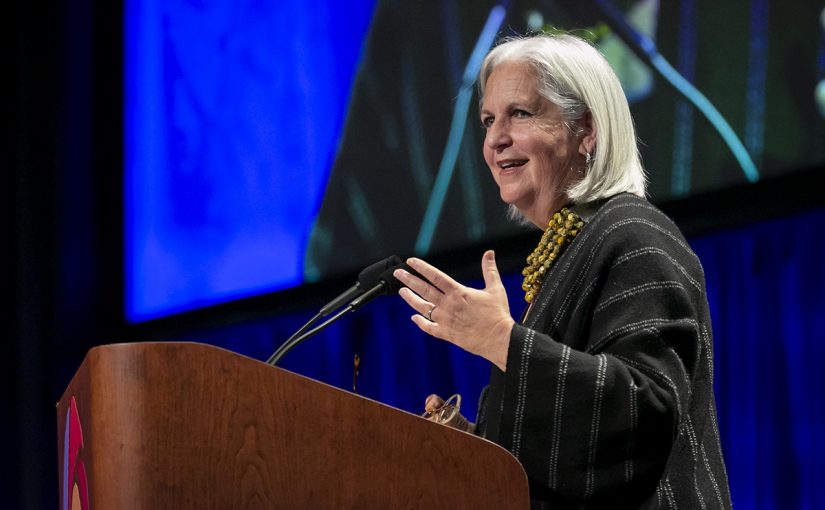
Erosion and Evolution: Our Undoing is Our Becoming

Erosion and evolution. Shadow and light. Death and rebirth. These are some of the strands that the acclaimed author, naturalist and activist Terry Tempest Williams weaves together in the face of today’s broken world. Standing in the lineage of the greatest nature writers, she links her deepest inner experiences with the state of the web of life. In this program, Williams asks: How do we find the strength to not look away at all that is breaking our hearts? Hands on the earth, we remember where the source of our authentic power comes from. We have to go deeper. She also explores histories of privilege, religion, and identity in Utah, and how reconciling her experiences with these cultural strands have helped unleash and shape her voice as a storyteller who translates the voice of nature and speaks for justice.

Featuring

  • Terry Tempest Williams, one of the greatest living authors from the American West, is also a longtime award-winning conservationist and activist, who has taken on, among other issues, nuclear testing, the Iraq War, the neglect of women’s health, and the destruction of nature, especially in her beloved “Red Rock” region of her native Utah and in Alaska.

Credits

  • Executive Producer: Kenny Ausubel
  • Written by: Monica Lopez and Kenny Ausubel
  • Senior Producer and Station Relations: Stephanie Welch
  • Host and Consulting Producer: Neil Harvey
  • Producer: Teo Grossman
  • Program Engineer and Music Supervisor: Emily Harris

Music

Our theme music is co-written by the Baka Forest People of Cameroon and Baka Beyond, from the album East to West.  Find out more at globalmusicexchange.org.

Additional music was made available by:

This is an episode of the Bioneers: Revolution from the Heart of Nature series. Visit the radio and podcast homepage to find out how to hear the program on your local station and how to subscribe to the podcast.

Subscribe to the Bioneers: Revolution from The Heart of Nature podcast


Transcript

NEIL HARVEY, HOST: Erosion and evolution. Shadow and light. Death and rebirth.

These are some of the strands that the acclaimed author, naturalist and activist Terry Tempest Williams weaves together in the face of today’s broken world.

Standing in the lineage of the greatest nature writers, she links her deepest inner experiences with the state of the web of life. She plumbs connections: art and ecology – women and politics – democracy and social healing – wild lands and First Peoples – family and faith. 

Terry Tempest Williams is fierce in her determination to hold paradoxes and contradictions. Destruction and creation, love and loss are of a piece.

She seeks to reconcile her family’s deep ancestral roots from the earliest days of Utah’s Church of Latter Day Saints with a poignantly modern and refined sensibility for the sacred. On one day, she can testify passionately yet respectfully before Congress, and get arrested on the next in an act of principled civil disobedience. 

Through it all, Terry Tempest Williams has shown her readers how to transcend polarities. In her ferociously honest, clear-eyed quest for healing and regeneration, she shows how to dance with duality to reclaim wholeness.

This is “Erosion and Evolution: Our Undoing is Our Becoming”. I’m Neil Harvey. I’ll be your host. Welcome to The Bioneers: Revolution from the Heart of Nature.

TERRY TEMPEST WILLIAMS: I come from an erosional landscape in the Red Rock Desert of Southeastern Utah. To the south rise the La Sal mountains 12,000 feet high. To the north is the Colorado River running red carrying the sediments of sandstone downriver. To the west is Porcupine Rim, that holds the last light of day. And to the east is Castleton Tower, rising from the ground floor 400 feet tall. Wingate sandstone, one of the largest free-standing towers in the world, eroding.

HOST: Terry Tempest Wiliams explores this theme in her book Erosion: Essays of Undoing. She spoke at a Bioneers conference.

TTW: This past summer, geologists from the University of Utah detailed the natural vibration of this sandstone tower. They enlisted two climbers to place a seismometer at the bottom of the tower and then climb and place another seismometer at the top. They wanted to listen to stone. What they found surprised them. This from Science News and the bulletin of the Seismological Society of America was published last month, “At about the same rate that your heart beats, a Utah rock formation called Castleton Tower gently vibrates, keeping time and keeping watch over the sandstone desert, swaying like a skyscraper, a red rock tower taps into the deep vibrations of the earth – wind, waves, and even far off earthquakes.”

“We often view such grand and permanent landforms as permanent features of our landscape when in reality they are continuously moving and evolving,” says Riley Finnegan, a graduate student and co-author of this paper.

Lastly, “Most people are in awe of its static stability in its dramatic free-standing nature, perched at the end of a ridge overlooking Castle Valley,” said the geologist Jeff Moore, who led the study. It has a kind of stoic power in its appearance. Moore and his colleagues study the vibrations of rock structures, including arches and bridges. So this isn’t unique to Castleton Tower, they just chose to focus on Castleton Tower, to understand what natural forces act on these structures. They also measure the rock’s resonance, the way the structures amplify the energy of the earth that passes through them. Castleton Tower has a pulse.

For those of us living in the valley, what we have intuited has been confirmed. Castle Rock is alive. And I just want us to listen to the pulse of earth – Castleton Tower. [RUMBLING NOISE] The earth has a pulse, as do we. No separation.

Our pulse, the pulse of Earth, Castleton Tower, is relational, born out of love and grief, disturbance and stillness at once. “There are no beautiful surfaces without a terrible depth”. Nietzsche

HOST: Terry Tempest Williams listens to understand the language of nature and to be its messenger to a world that has largely turned a deaf ear. 

Castleton Tower is 400 feet tall.  As the tower sways, like a guitar string, it resonates with human and natural activity from vast distances and depths. University of Utah researchers are trying to determine how much these vibrations contribute to erosion over the long term.

Castleton Tower

They are listening. On the other hand, according to Terry Tempest, the damming of the Colorado River has created a paradox. As she writes: “A free-flowing river should have its say at the end, the mouth, and it doesn’t. It’s silenced by development, by water rights, by dams,” she says.

But whether it’s running a river or listening in stillness to an ancient desert landscape that holds the ancestral memory of generations of Indigenous peoples, Terry Tempest Williams invites us to hear the voice of nature and to face up to the consequences of our blindly destructive actions.

We are running evolution in reverse, shattering the very mirror of nature that can show us who we are and how to live in this place in a way that lasts. The jagged shards are so dreadful to contemplate that most people don’t want to go there. The problem is, we’re there. Denial and neglect will only seal the deal.

TTW: To commit to a place is to commit to the shadow side of our own home ground. Sometimes we see it, sometimes we don’t, but when we do, we must speak.

On December 28th, 2016, Barack Obama established Bears Ears National Monument, protecting 1.3 million acres of fragile desert lands. He heard the voices of the Diné, the Navajo, the Hopi, the Ute, the mountain Ute, to the Ouray Ute and Zuni Nations. He heard them. These lands are sacred, where their prayers are spoken, where their ancestors are buried, where their ceremonies are performed. It was a handshake across history, a renewal, a commitment of trust

Less than a year later, Donald Trump by executive order eviscerated Bears Ears National Monument, by 85%, and cut Grand Staircase Escalante National Monument in half. Those protected lands, sacred lands, are now open for business to oil and gas development, to coal mining, to uranium mining, a boon to the fossil fuel industry in the midst of the climate crisis. This is my home.

What is beauty if not stillness? What is stillness if not sight? What is sight if not an awakening? What is an awakening if not now?

The American landscape is under assault by an administration that cares only about themselves. Working behind closed doors they are strategically undermining environmental protections that have been in place for decades, and they are getting away with it in practices of secrecy, in deeds of greed, in acts of violence that are causing pain. Like many, I have compartmentalized my state of mind in order to survive. Like most, I have also compartmentalized my state of Utah. It is a violence hidden that we all share.

This is the fallout that has entered our bodies, nuclear bombs tested in the desert. Boom. These are the uranium tailings left on the edges of our towns where children play. Boom. The war games played and nerve gas stored in the West desert. Boom. These are the oil and gas lines, frack lines, from Vernal to Bonanza in the Uinta Basin. Boom. This is Aneth and Montezuma Creek, the oil patches on Indian lands. Boom. Gut Bears Ears. Boom. Cut Grand Staircase Escalante in half. Boom. And every other wild place that is easier for me to defend than my own people and species. Boom. The coal and copper mines I watched expand as a child, Huntington and Kennecott. Boom. The oil refineries that foul the air and blacken our lungs in Salt Lake City, our children’s lungs. Boom. And the latest scar on the landscape, the tar sands mine in the Book Cliffs closed, now hidden, simply by its remoteness. Boom. Add the Cisco Desert where trains stop to settle the radioactive waste they carry on to Blanding. Boom. Move the uranium tailings from Moab to Crescent Junction, then bury it, still hot, in the Alkaline Desert, out of sight, out of mind. Boom. See the traces of human indignities on the sands near Topaz Mountain left by the Japanese internment camps. Boom.

President Donald J. Trump can try to eviscerate Bears Ears and Grand Staircase Escalante monuments with his pen and poisonous policies. He will stand tall with other white men, who for generations have exhumed, looted, and profited from the graves of ancient ones. They will tell you Bears Ears belongs to them. Boom. [APPLAUSE] Consider Senator Orrin Hatch’s words regarding the Bears Ears Intertribal Coalition, support of the Bears Ears National Monument. The Indians, he says, “They don’t fully understand a lot of things that they are taking for granted on these lands; they won’t be able to do it if it’s made clearly into a monument.” And when he was asked to give examples, the Senator said, “Just take my word for it.” Boom.

HOST: In February 2020, the federal Interior Department announced plans to allow drilling and mining on about a million acres of these lands, despite ongoing litigation to prevent the government from moving forward. 

It was the first national monument to be created at the request of a coalition of Native American tribal governments. The Navajo Nation, Hopi, Ute, Ute Mountain Ute, and Pueblo of Zuni all have ancestral ties from time immemorial to the Bears Ears and Grand Staircase-Escalante landscapes. These are ancient sacred lands.

Over many decades, Terry Tempest Williams has taken a courageous stand to stop harms, including above-ground nuclear testing and the extractive destruction of nature, especially in her beloved “Red Rock” region of her native Utah.

When we return, Terry Tempest Williams explores histories of privilege, religion, and identity in Utah, and how reconciling her experiences with these cultural strands have helped unleash and shape her voice as a storyteller who translates the voice of nature and speaks for justice. 

This is “Erosion and Evolution: Our Undoing is Our Becoming.”  I’m Neil Harvey. You’re listening to The Bioneers: Revolution from the Heart of Nature.

As time and the elements carve the natural world around us, so too do they transform our bodies and our societies. Destruction and creation. Erosion becomes evolution to create something at once entirely new and deeply ancient.

TTW: This is a story, a patronizing story, a condescending story. I see my politicians and frontier Mormons discounting the tribes once again, calling them Lamanites, the rebellious ones against God, dark-skinned and cursed. That is their story. Racism is a story. The Book of Mormon is a story. [CHEERS] Boom.

Perhaps our greatest trauma living in the state of Utah is the religiosity of the Mormon patriarchy that says you have no authority to speak – women, Indians, black people, brown people, gay people, trans people. It is only the chosen ones who hold the priesthood over us and council us that their only way to heaven is through them. Boom.

All my life I was told I could not speak, that I had no voice, no power except through my father or my husband, or my bishop, or the general authorities. And then there was the prophet. Boom. I refused to perpetuate this lie, this myth, this abuse called silence. If birds had a voice, so did I. [APPLAUSE] I would tell a different story, one of beauty and abundance, and what it means to be alive.

Environmental racism is the outcome of bad stories, a byproduct of poverty. In Utah, yellow cake has dusted the lips of Navajo uranium workers for decades who are now sick or dead. Boom. There is no running water in Westwater, a reservation town adjacent to Blanding. Local municipalities refuse to provide Navajo families with a basic right, a human right. Boom. But we are not prejudiced. Boom.

If you speak of these cruelties, we, as Mormons, I am a Mormon, are seen as having betrayed our roots and our people. These are my people. Boom.

This is who I am. Boom. A white woman of privilege born of the covenant. I am not on the outside, I am on the inside. Boom. It is time to look in the mirror and reflect on the histories that are mine, that are ours. Boom. We are being told a treacherous story, that says it is an individual’s right, our hallowed state’s right, our nation’s right to destroy what is common to us all.

The earth has a pulse. We have a pulse. No separation. The land beneath our feet, the water we drink, the air that we bring gifts, breathe. Our bodies and the body of the state of Utah are being violated. Our eyes are closed. Our mouths are sealed. We refuse to see or say what we know to be true. Utah, this nation, is a beautiful violence. Boom.  

Do we dare to see ourselves for what we are, broken and beautiful?  Do we dare to see Utah for what it is: an elegant, toxic landscape where the power of oppression rules by repression, our proving grounds of fear? What are we afraid of? Exposure. Boom. Our denial is our collusion, our silence is our death. The climate is changing. We have a right and responsibility to protect each other. Resistance and insistence before the law. We are slowly dying. We are ignoring the evidence. Awareness is our prayer. Engagement is our prayer. Beauty will prevail. Native people are showing us the way. It is time to heal these lands and each other by what, by calling them sacred.

May wing beats of raven cross over us in ceremony. May we recognize our need of a collective blessing by Earth. May we ask forgiveness for our wounding of land and spirit. And may our right relationship to life be restored as we work together toward a survival shared. A story is awakening. Many stories are awakening. We are part of something so much larger than ourselves, an interconnected whole that stretches upward to the stars. Coyote in the desert is howling in the darkness, calling forth the pack, lifting up the moon.

HOST: A story is awakening. Listen to stone. The Earth has a pulse. We have a pulse. The Earth is alive. What is an awakening if not now?

TTW: We are eroding, we are evolving together. This is the place we create from, with love, with courage, in grief, and with anger. What do we do with our anger? With a name like Tempest, I can tell you I don’t have a lot of hope. [LAUGHTER] But I have sought wisdom from my elders, the elders that we live near – Willie Gray-eyes, a community organizer who now is a county commissioner in a Navajo majority in San Juan County Utah. [APPLAUSE] When he was told that he was not a resident of the state of Utah, that it was an illegitimate election from an illegitimate candidate, whose family have lived in Navajo mountain for generations, when they asked what right he has to the state of Utah, he simply said, “My umbilical cord is buried here.” When I asked Willy, what do we do with our anger, he said, “Terry, it can no longer be about anger. It has to be about healing.” Going to the source of our pain, and recognizing it, owning it, apologizing for it, embracing it with a commitment to change.

And when I asked Jonah Yellowman, a medicine person among the Diné what he was seeing, he said, “Terry, we have to go deeper.” And so I ask us today, together, what does that look like for each of us, each of us in our own places with our own gifts, in the places we call home.

And Evangeline Gray, a medicine woman, who’s been fighting for water rights for her people in San Juan County for 30 years, still no water, she says to dwell is to see things as they are. And then you stay and fight for those things that you see for your community. It is a privilege, she said.

We are eroding and evolving at once. Perhaps Jonah’s call to go deeper is a call to acknowledge the power that resides in the Earth itself. The organic intelligence inherent in deserts and forests, rivers and oceans, and all manner of species beyond our own, even within our own bodies. We cannot create wild nature, we can only destroy it, and in the end, in breathtaking acts of repentance and renewal, try to restore what we have thoughtlessly removed at our own expense, be it wolves in the Yellowstone or willow flycatchers along the Colorado River.

We are eroding and evolving at once. How do we find the strength to not look away at all that is breaking our hearts? Hands on the earth, we remember where the source of our authentic power comes from. We have to go deeper. What has been weathered and whittled away is as beautiful as what remains – erosion, essence. We are eroding and evolving at once. Shinran, the 14th century Buddhist poet said, This happened. Now something else can occur.

We need not lose hope, we just need to locate where it dwells. To dwell is to see things as they are, and then you stay and fight for the things you love in your own community. Castleton Tower has a pulse. We have a pulse. The pulse of the planet is in our hands. Engagement is a prayer. Boom.

Politics and Consequences: How to Fix Democracy in the Face of COVID-19

The COVID-19 pandemic in the United States — and our lack of preparedness for it — has highlighted the need for democracy reform. We can’t just fix the symptoms, says David W. Orr, Paul Sears Distinguished Professor at Oberlin College; we must rethink how we perform democracy in order to fix the systemic inequalities that are fiercely apparent in this moment.

In the following essay, Orr explains how the deterioration of our democracy has precipitated crises like climate change and the spread of COVID-19, and what we can do in the face of this reality. Are we satisfied with the status quo? Or will we take charge in this opportunity for change?

To read more from David Orr, check out this excerpt from his recently released book, Democracy Unchained: How to Rebuild Government for the People.


As the coronavirus sweeps across the country, we have good reasons to ask why we were so unprepared. Why warnings went unheeded, scientists ignored, and budgets cut at the Centers for Disease Control. We should ask the same questions about the climate crisis. In both cases the causes are political, the result of a forty-year war waged against government and science. That war explains a great deal about why we had no plan to deal with COVID-19 and why we have no plan to deal with a growing climate emergency that will dwarf the pain and suffering of the COVID-19 pandemic. In both cases collective foresight and preventive action required an alert, transparent, and effective government and an engaged and accurately informed citizenry.

Whoever wins the 2020 election, we the people must begin now to repair and strengthen democratic institutions. The timing, however, could hardly be worse. It will occur as the COVID-19 pandemic still rages and the effects of climate change become more severe. These are only the most urgent challenges ahead but there are others. We face not just a single crisis, but a convergence of crises and not just an emergency but “a long emergency” that will persist through this century and beyond.  

As the situation becomes clearer, demands for action could take either of two forms: one authoritarian and, frankly, fascist, the other for a stronger and improved democracy. The first promises quick, simple, fake solutions to complex problems and appeal to our worst tribal instincts, mostly by scapegoating vulnerable populations. On the other hand, building a stronger democracy would allow us to address the roots of our problems that go back to deceit, secrecy, corruption, demagoguery, voter suppression, gerrymandering, inequality, and invertebrate leadership. 

The democracy we need, in other words, is not a slightly improved version of the status quo, but one that is more just, inclusive, stronger, competent, transparent, and accountable. It also requires us to understand our history.

The authors of the U.S. Constitution laid the foundation for a limited democracy. That system has been reinvented twice since, once to end slavery and again in the 1930s to avoid economic collapse. Neither was entirely successful. Jim Crow laws undid most of the gains of emancipation and the hijacking of the 14th Amendment by corporate lawyers did the rest. In the second instance, the patchwork reforms of the New Deal, worked well enough for a time, but inequality is now about what it was in 1929 and the system is otherwise failing in potentially catastrophic ways.

The differences from the reconstruction era to the present are striking. We are at the threshold of irreversible and irrevocable global changes that will jeopardize civilization. No one in previous generations could say that with the authenticity and urgency with which we assuredly can. No change in consumer behavior or market response alone will be effective unless they occur as a part of changes in the larger structures of governance, politics, economics, and values. This is a systemic crisis and must be met with systems-level changes not haphazard, piecemeal reforms conjured by anti-government ideologues.

The upshot is that we must create a coordinated set of policies to counter the forty-year assault on governance and the underlying institutions of democracy. The goals include:

  • reforming our democracy by protecting the right to vote in fairly drawn electoral districts, and curtailing dark money in our politics;
  • educating and empowering a public committed to defend the rules of accountability, transparency, and fair play that allow democracy to exist;
  • building the capacity of government to protect public health and the global commons of air, oceans, biological diversity, forests, soils, and waters;
  • creating a fair economy in which “prices tell the truth” about the full ecological and social costs of what we buy; and
  • ensuring justice for all, including future generations.

The coronavirus pandemic and the climate emergency combine to make this a teachable moment—a good time to ask larger question and challenge outworn assumptions.

For example,

If the founders knew in 1787 what we know now about how the earth works as a physical and biological system, how would they have written a Constitution for a complex world of leads and lags, positive and negative feedbacks, and long delays between action and consequence—all governed by biology, ecology, and thermodynamics not by simple Newtonian mechanics?

Calibrating our political system with how the Earth works as a physical system will be difficult, but much easier than contending with the consequences of a dysfunctional democracy on a planet with a biosphere and lots of viruses.


Read more from David Orr in his recently released book, Democracy Unchained: How to Rebuild Government for the People.

Plastic Planet: Stopping Big Oil, Big Plastic, and Big Misdirection

After World War II, the U.S. government worked with industry to create a single-use, disposable consumer culture as a way to ensure ongoing market prosperity.  Who benefited? Consumer product companies like Coca-Cola, and the fossil fuel industry, whose petrochemicals are at the source. The result? Plastic pollution is now found in virtually every living organism – including humans – and is one of the worst threats to ocean ecosystems. Now, a global resistance movement is rising to abolish petrochemical plastics and to shift to a zero-waste, circular economy. With: Anna Cummins, Deputy Director and Co-Founder of the Five Gyres Institute.

Featuring

  • Anna Cummins, Deputy Director and Co-Founder of the Five Gyres Institute. With more than 20 years experience in environmental non-profit work—including marine conservation, coastal watershed management, community relations, and bilingual and sustainability education—Anna is an expert in the field.

Credits

  • Executive Producer: Kenny Ausubel
  • Written by: Monica Lopez and Kenny Ausubel
  • Senior Producer and Station Relations: Stephanie Welch
  • Host and Consulting Producer: Neil Harvey
  • Producer: Teo Grossman
  • Program Engineer and Music Supervisor: Emily Harris

Music

Our theme music is co-written by the Baka Forest People of Cameroon and Baka Beyond, from the album East to West.  Find out more at globalmusicexchange.org.

Additional music was made available by:

This is an episode of the Bioneers: Revolution from the Heart of Nature series. Visit the radio and podcast homepage to find out how to hear the program on your local station and how to subscribe to the podcast.

Subscribe to the Bioneers: Revolution from The Heart of Nature podcast


Transcript

NEIL HARVEY, HOST: Life magazine celebrated the glorious coming age of plastics in a 1955 article cheerfully titled, “Throw-Away Living”.

The magazine’s glossy imagery is painfully ironic from a 21st century perspective.

Picture a smiling family gazing skyward with arms joyfully outstretched as plastic plates, fake flowers, and diapers float around them like dreams coming true.

The caption reads: “In this picture, the objects flying around would normally take 40 hours to clean, except no housewife need bother, because it’s all designed to be thrown away.”

Plastic fantastic! A single-use, disposable consumer culture by design. It was the realization of post-war goals set by government and industry to create – in the words of a White House economist at the time – “the need for ever-increasing consumption” so that the U.S. might ensure its ongoing prosperity.

Today some scientists are suggesting that plastics comprise a new geologic age where future archeologists will find an Earth coated with a geological layer of plastic. Call it the Cellophane Prophecy – the time when Earth shall be shrink-wrapped. Not to mention the fact that plastic is now found in virtually every living organism – including us humans.

As for prosperity, who benefits is the giant corporations – from consumer product companies to the fossil fuel industry – whose petrochemicals are at the source.

Over the past decade, a global resistance movement to abolish petrochemical plastics has risen to meet the challenge and to transition to truly biodegradable nontoxic plastics and a zero-waste economy.

Advocates are organizing to hold corporations accountable, while pushing for circular economic systems that mimic nature’s no-waste approach.

In this program, we hear from pathfinder Anna Cummins, Deputy Director and Co-Founder of the Five Gyres Institute. This is “Plastic Planet: Stopping Big Oil, Big Plastic, and Big Misdirection”.

I’m Neil Harvey. I’ll be your host. Welcome to The Bioneers: Revolution from the Heart of Nature.

ANNA CUMMINS: I want to start by focusing on one word, one single word that I think illustrates some of the challenges we’re up against in this plastics issue, and that is the word “accountability”. In the 1960s in the United States, lung cancer rates were skyrocketing while doctors and scientists were proving the source of the problem – smoking. But the tobacco industry managed to mislead the American public for years. And it wasn’t until the ‘90s that scientists, lawyers, and advocates teamed up to finally hold the corporations accountable for the damage they had done to the American public.

HOST: Anna Cummins is the Co-Founder and Deputy Director of the nonprofit 5 Gyres Institute. Its bold mission is to empower action against the global health and environmental crisis of plastic pollution. She spoke at a Bioneers conference.

AC: In the same way that the tobacco industry managed to blame consumers for their choices in smoking, the plastics industry is working to shift the blame to we the people for littering or for not recycling enough, instead of taking accountability for profiting tremendously and making ever-increasing amounts of unrecyclable and frankly toxic plastic products.

HOST: In fact, the connection between big tobacco and beverage container companies isn’t an abstraction. In the 1950’s, Big Tobacco and Big Plastic joined forces to emulate the tobacco model to shift responsibility for throwaway packaging from producers to consumers. Like Big Tobacco, Big Plastic developed an insidious ad campaign of classic misdirection.

AC: Now at the time, we were celebrating the advent of this miracle material, fossil fuel-based, lightweight, cheap, durable, you can’t break it. And most importantly, it was designed to last forever. Well, these same qualities are the ones that are coming back to haunt us.

Plastics really enjoyed an advent of incredible, exponential growth back then, and it didn’t take long for the effects of that to be seen. As early as the ‘50s and ‘60s, people were starting to see beverage containers littering our roadsides.

Well it didn’t take long before people started saying we need to fix this problem with policy. And as soon as the first piece of legislation to mandate returnable, refillable beverage containers came into the sphere, this group came into being – Keep America Beautiful. And this was their signature crying Indian campaign that some people may remember from the ‘70s. Well, the fact that the Indian here was actually an Italian-American actor named Iron-Eyed [actually Iron-Eyes] Cody is not the only disingenuous thing about this campaign.

The whole point of this campaign was to create the concept of litter, because people make litter, corporations don’t make litter. It’s your fault. It’s our fault for littering. Don’t be a litterbug. Give a hoot, don’t pollute. All of these things that we’ve all been inundated with our entire life absolves corporations from their responsibility in making products that are designed to be part of a linear economy.

HOST: Today, science has documented where plastic begins and ends, and how it ends up everywhere on Earth including in your body. And no, it’s not fundamentally your fault.

Enter gyres. In oceanography, the term refers to a large global system of ocean currents. As Anna Cummins organization’s name suggests, there are five major gyres in the oceans. She spoke with us at a Bioneers conference.

AC: We kind of call it like a toilet bowl that never flushes. It’s the spinning of the Earth, its currents, and prevailing winds. And it creates a huge vortex in the ocean. So plastics that enter our oceans every single day, from rivers, from our watersheds that flow from land to sea, get swept up into these currents. They can circulate for decades. For example, the North Pacific gyre, which is between California and Asia, that entire region, if you were to chuck a bottle into the water, which you wouldn’t do, it could take six to ten years to do that whole circulation, from California to Japan and back.

So I got deeper involved in just researching, and eventually got myself invited on a research trip out to Guadalupe Island. And there I saw it firsthand. This was 2004. And Guadalupe is just at sort of the beginning of the gyre. There’s a healthy population of Laysan albatross, and every single stomach sample we collected from these birds – they were all full of plastic, and this really drove it home for me. 

HOST: When Anna Cummins was a grad student in environmental policy, she went on a fateful research expedition to study plastic pollution in the Pacific Ocean. There, she met the group’s lead researcher – and her future husband – Dr. Marcus Eriksen.

AC: So the two of us went on board a trip from Hawaii to Los Angeles. Every single day we pulled up samples that were full of microplastics. But when you were standing on the bow of the boat, it was blue water everywhere you could see. So there was no island, there is no patch of garbage the size of Texas. It’s really more like a plastic smog.

HOST: Cummins and Eriksen became curious about how widespread the issue was, and whether it was a global phenomenon. They used their wedding money to found a new organization called the 5 Gyres Institute. 

Anna Cummins and Marcus Eriksen

AC: So we went to all five gyres. We collected samples, and we published that data in 2014 as the first global estimate on plastic in the world’s oceans – roughly 270,000 metric tons from 5.25 trillion particles. What that really tells us – those are big numbers to wrap your head around – is that the solutions to ocean plastic are not in the ocean. The solutions are upstream with policy change, with design change, with corporate engagement. 

We spent a lot of time as a movement banning this, banning that, banning straws, banning bags, and it’s exhausting. We wanted to look at what are the problem products, and can we start to not look at the top problem products only, but also the brands associated with that. So that was the basis for doing the ban list, coming up with a list of the top 20 products that have no place in a zero-waste society, and then looking at who are the brands responsible.

HOST: Those brands and their parent companies are identified through brand audits.

In 2016, Filipino activists in Manila came up with the idea to combine beach cleanups with a careful cataloguing of the brands and package types for each piece of waste collected. It was on-the-ground evidence gathering. The tactic soon spread from the Philippines to other countries in Asia and around the world.

In 2018, member groups of the #breakfreefromplastic movement conducted brand audits in over 50 countries in Asia, Africa, the Americas, and Europe.

The results? Coca Cola, Nestlé, and Pepsi-Co were the world’s top three plastic polluters. The activists used this data to create a series of global campaigns designed to return attention to the real culprits: the corporations producing plastic.

In the U.S., Cummins and 5Gyres realized that focusing exclusively on oceans and coastlines was leaving out the vast numbers of people needed to build the kind of movement necessary to transform the system. They traveled to the Midwest to conduct the largest investigation to date into inland plastic pollution.

AC: So we went to the Great Lakes in 2012 and 2013, and there we found our largest samples of plastic by count in Lake Erie. More plastic in Lake Erie samples than any of the 50,000 miles we’d surveyed before. And what we found there was microbeads from personal care products. 

Well, this leads to some good news, and really leads into the story of why we’re here – the power of collaboration. So we took that science in hand, we went to Procter & Gamble, and they basically said more research needed. So as a coalition we worked together. We passed a bill in California with many groups working together – Story of Stuff and NRDC, and on and on and on – passed a bill in California. And if you can pass significant legislation in California, which is a major economy, you’ve essentially passed a federal bill. And that’s what happened. 

HOST: In 2015, California passed a landmark ban on the pervasive plastic microbeads in so-called “rinse-off” cosmetics such as shower gels and toothpaste.

Meanwhile, other states had actually loosened restrictions on microbeads used in rinse-off products. But in 2015, Congress enacted a ban like California’s that superseded those less restrictive state laws.

By July, 2019, billions of microbeads were no longer delivered via “rinse-off” products to the U.S. market. Other countries have followed suit. Eleven nations and eight U.S. states have enacted their own microbead bans.

But these microbead bans still do NOT apply to “leave-on” cosmetics and other products such as lipstick and household cleansers.

When we return… Anna Cummins reveals how much of the plastic we diligently separate at home is actually recycled into new products, plus more steps people can take to produce less plastic in the first place.

This is “Plastic Planet: Stopping Big Oil, Big Plastic, and Big Misdirection” on the Bioneers: Revolution from the Heart of Nature.

You can explore more Bioneers radio programs, podcasts and videos online at bioneers.org. For information on attending the National Bioneers Conference and Bioneers events in your area, please visit bioneers.org or call 1-877-BIONEER.

Reduce, reuse, recycle… with an emphasis on “recycle.” It’s been the mantra of good citizenship for decades.

But what we once thought was the answer for removing the inconceivable quantities of single-use plastics from incinerators and landfills is turning out very differently.

In 2017, a recycling crisis exploded when country after country including China stopped accepting the literal mountains of used plastics shipped by the US and other countries in the global north.

In some cases, even the term “recycled” has come to be a misnomer.

AC: So there’s been this myth for a long time that the ultimate solution to plastic and our consumption is recycling, and that is a myth that we have bought hook, line, and sinker. It’s a very convenient narrative for industry to really push consumers as responsible for what to do with their waste, and abdicate themselves from the responsibility for making products that have some value at the end of their life cycle. The problems with recycling have just really heightened lately with China’s recent decision to stop taking our dirty plastic.

The truth of the matter though is that we’ve created products, especially when you think of plastic bottles and beverage containers, that had no design in mind for recycling. We’ve gotten really, really good at making tons and tons of cheap plastic water bottles, but we have not gotten good at how do we recover and how do we “recycle” those products. The vast majority go to landfill or escape in the environment. 

HOST: After the international market for recyclables shut down, cities across the U.S. – from California to Idaho and New Hampshire – started either burning or burying plastics and other recyclables in landfills. This manufactured, throwaway economy has long since busted past its expiration date. Now we’re in overtime to close the loop A.S.A.P. One way to do that is to change the rules.

AC: So another approach to this glut in this increase in plastic production would be to actually mandate recycled content thresholds. So if we demand that companies by 2025 or by 2050 incorporate 75% or even up to 100% of post-consumer recycled content in their packaging, then they’re going to have to get much better at getting their products back. So that’s an example of producer responsibility where you’re really mandating that companies innovate their packaging and that would also reduce the artificial cost of virgin plastics. Virgin fossil fuels and virgin plastics are artificially cheap, because no ones paying for those externalities, but if we demand that recycled content hit a really significant threshold, then that kind of evens the playing field out a little bit and makes recycled materials more competitive with virgin.  

HOST: “The polluter pays” has long been the legitimate public and legislative demand. When you hear the economic term “externality,” it means the public pays. Not to mention animals and the web of life.

Another proposed solution is the development of alternative materials, such as bioplastics. According to Cummins, while there are some promising approaches, once again, the industry is selling us a bill of goods about just how “degradable” these biodegradable materials actually are.

AC: Well, let me preface it by saying we absolutely will need new alternatives that are not made from fossil fuels. That’s a given. Of course we could learn a lot from the way nature designs products. There is no waste.

So there are bioplastics. You can make plastic out of biological materials – corn and starch, and I’m sure you’ve seen some of these at green events. There’s PLA, which is a corn-based plastic, and there’s PHA, which is made from a sugar-based bacteria.

Some of the bioplastics that are currently on the market, though, won’t break down in the ocean, and they give people a false sense that it’s okay to use this, because I can just throw it in the compost bin.

Ideally, we’d go beyond this idea of replacing one disposable product with another less bad disposable product, and we start looking to systems of delivery. That’s a ways off yet, so in the meantime, yes, we can make alternatives that are compostable, that are fiber-based, that are made from trees, that are made from plants.

We’ve gotten really good at making synthetic franken materials that need to be taken apart and most of which are wasted. But we’re talking about some really valuable natural materials – petroleum and fossil fuels – that we’re just turning into throw-away materials every single day. So it’s a crazy system when you think about it, and I think part of the reason we’re having this explosion of interest is that the externalities, the impacts, and the pollution from that flawed system are really catching up with us big time.

HOST: So what to do? First, we have to really know what we’re up against.

According to the World Economic Forum, in 2014, companies manufactured a mammoth 311 million metric tons of plastic. Picture 800 Empire State buildings. And just 2% of that is recycled in a closed loop fashion.

Now toss in some twists of fate. The technological breakthrough of fracking in 2008 created a vast surplus of natural gas, driving down the price of oil. At the same time the onset of climate change and competitive costs of renewable energy made the steady market decline of fossil fuels inevitable.

Naturally, the ever-adaptive fossil fuel industry decided to use all that excess natural gas to pump hundreds of billions of dollars into petrochemicals to make and sell MORE plastics and chemical fertilizer.

AC: The increases in production are terrifying. And this brings up a whole other issue in terms of the connections between plastic, fossil fuels, and climate change. So right now there are predictions coming from the Center for International Environmental Law that the industry is investing upwards of $200 billion in ramping up the production of plastic by 40% in the next decade through building 300 new petrochemical facilities in the U.S. alone, or expanding some of the existing facilities. Plastic is really what’s driving that increase. So if we don’t get a handle on stopping the production of plastic, then no bag ban, no straw ban, no amount of single-product bans are going to make a dent. 

HOST: A 2018 report informed by the petrochemical industry estimated that over a third of all plastics were produced to make food and beverage packaging. Fifteen percent were used to make textiles like polyester, which has surpassed cotton as the largest mass-produced fiber in the world.

In the face of these powerful forces, what would success look like in 10 to 15 years to move society toward a circular economy that ultimately produces zero waste?

AC: We shut down the expansion and the building of new petrochemical plants in the U.S. and stop making so much plastic. There’s no reason we should be drilling for new sources of materials to make more plastic. So that would be a huge success, that we’d get away from fossil fuel-based materials, period – which we need to do not just for packaging, but we need to do for our transportation and for so many of the things that we do, and move to renewable sources of energy.

There’s a lot of talk of going out to the ocean to clean up plastics. My husband has been working on a lot of research with ocean modelers, and showing that it gets kicked back out, and it washes back up on shorelines, it sinks to the sea floor, it gets eaten by fish and sequestered in fecal pellets. So it doesn’t stay in the ocean. If we could actually stop the amount of plastic flowing to sea, we could see a huge difference in our ocean environment.

HOST: One part of the solution to protecting the ocean is to get serious about moving to a circular economy.

According to the Ellen MacArthur Foundation, which has been promoting and researching this model for many years, “A circular economy is based on the principles of designing out waste and pollution, keeping products and materials in use, and regenerating natural systems.”

So how would nature run a manufacturing economy? In nature, there is no such thing as waste. Everything is someone’s lunch of food or energy and it starts from the bottom up.

Using circular economic principles, some cities are moving forward by enacting zero-waste policies.

AC: We’re seeing some really, really encouraging results from some of our partners in Southeast Asia working on community participation in zero waste. We have a partnership with some groups – the Global Alliance of Incinerator Alternatives, Gaia, the Mother Earth Foundation. They’re really scaling up some of these zero waste techniques in cities, and getting huge reductions in the amount of plastic that’s either going to landfill or escaping out into the environment. And it’s a good counter to this idea that we should burn plastic to produce energy.

HOST: Anna Cummins and 5 Gyres are supporting one U.S. city in charting a path toward zero waste by identifying hotspots of plastic pollution and figuring out how that pollution arrived there.

AC: So looking not just at shoreline and sea surface, but inland and air borne, and rivers, to get a sense for where are the priority problems in a city, and then how can we translate that into policy. We’ve been doing something like that here in San Francisco through a two-year project called the San Francisco Microplastics Project, looking at sediment, sea surface, biota, looking at fish stomachs, to find out what are all the primary problems with microplastics in the San Francisco Bay, and then how can we use that data to inform solutions at the city level.

Say, for example, in the San Francisco Bay we find that microfibers are the most prevalent contaminant. That’s really useful information we can provide to the city to say we need to get a handle on how microfibers are getting into our waterways.

You know, there’s no one single solution to this issue. We’re going to need to change textiles. We’re going to need to change our washing machine infrastructure to actually filter out these microfibers. But that’s just one example of how we can use data to drive upstream solutions and figure out where the policy approaches are going to be most effective.

HOST: In other words, it’s all connected.

One harbinger of this “solve-the-whole problem” approach is visible in the strategic collaborations among diverse groups and movements – intersectional alliances among environmental, scientific, and advocacy groups which all hold a piece of the puzzle.

From a systems viewpoint, one fact is crystal clear: The same 50 companies worldwide responsible for the massive carbon emissions causing the climate emergency are responsible for the plastic pollution damaging the health of people and nature on whose health our human health depends.

So many groups are mapping out what’s called a “just transition” off fossil fuels entirely, which is both inevitable and imperative.

AC: I went to a meeting that was a coming together of plastic pollution groups who work on more consumer-facing and environmental justice groups that work on toxics issues and fracking and things like that. And it was an incredible coming together where we realized that there are all these connections, there are all these synergies, and that we’re ultimately all fighting for a just transition off of fossil fuels.

We’re seeing the movement becoming much more organized and starting to engage in more intersectional collaboration, so connecting with the fracking movement, connecting with the justice movement, really looking at how plastic is really not just about downstream impacts – plastics getting into fish and us eating fish – but it is an entire pipeline and there are potential human health impacts along that whole pipeline.

HOST: It’s all connected and we’re all connected. In nature, the surest way to heal an ecosystem is to connect it to more of itself. As this movement of movements gets more connected to itself, Anna Cummins is showing how we can heal both nature and ourselves.

As Coronavirus Ravages Businesses, Small Farms and Independent Restaurants Rally for Economic Relief

This piece was originally published on the Civil Eats website on March 24, 2020. Civil Eats is a daily news source for critical thought about the American food system, sustainable agriculture, and the shift to economically and socially just communities. The featured photo for this article is CC-licensed by Tim Dennell.


BY LISA HELD

March 27, 2020 update: The U.S. House of Representative overwhelmingly passed a $2.2 trillion coronavirus recovery and stimulus bill today, sending it to President Trump’s desk, where he is expected to sign it.

On March 19, Jill Tyler, the co-owner of popular Washington, D.C. restaurants Tail Up Goat and Reveler’s Hour, posted an emotional video to Instagram. Her exhaustion—after weeks of uncertainty, scrambling to implement delivery options, and letting employees go—was apparent.

With her businesses completely shut down, Tyler pleaded with viewers to demand that their legislators raise unemployment benefits for millions of laid-off hospitality workers and that government relief packages offer ways for small businesses to have access to that relief. “Without it, the future of small businesses looks very different,” she said. “Without help, we will not all be able to come back.”

Tyler tagged her video with #toosmalltofail, a hashtag that has been used more than 7,000 times on Instagram and is part of a growing online political movement calling for federal assistance for independent restaurants in the wake of the coronavirus pandemic. At the same time, organizing has also sprung up to advocate for government relief for small farms—many of which depend on now-shuttered restaurants and farmers’ markets, some of which are closing, to sell their fresh produce and pastured meats.

With most of the country staying home, American food purchasing has significantly shifted from restaurants to grocery stores and the larger growers and food manufacturers that typically supply them. The National Restaurant Association predicts restaurant sales will decline by $225 billion over the next three months, leading to a loss of 5 to 7 million jobs.

Meanwhile, an analysis of the impacts of COVID-19 on farms that sell into local markets predicts a $689 million decline in sales from March to May 2020, leading to a payroll decline of up to $103 million and a total loss to the economy of up to $1.3 billion.

Individuals, businesses, and nonprofits have launched numerous efforts to raise funds for impacted workers, restaurants, and farmers—but advocates say real, lasting relief will only come from bold government action.

“What we’re seeing right now is community leaders coming in and filling that gap [left by ineffective government leadership],” said chef and restaurateur Tom Colicchio on CNN; he has so far laid off 300 workers and also helped create the Independent Restaurant Coalition (IRC), a collaboration with chefs across the country aimed at rallying relief for small restaurants. He wrote on Twitter, “This is not the time for a tip cup. Massive government intervention is needed. (Disclosure: Colicchio serves on Civil Eats’ advisory board.)

However, with Congress battling over the next economic relief package, interventions that restaurateurs and farmers are calling for remain uncertain, and large questions remain about what relief will actually end up getting signed into law—and who it will benefit.


Farm Aid?

On the farming front, the National Sustainable Agriculture Coalition (NSAC) and its many member groups are leading a charge to call attention to the impact of the pandemic on small farms. The organization asked a team of regional food-system experts, including university researchers and former U.S. Department of Agriculture (USDA) employees, to run the numbers and get a sense of the impacts ahead. .

Dawn Thilmany, a professor at Colorado State University and the president-elect of the Agricultural & Applied Economics Association, was part of that team, and she said they had access to a wealth of reliable data on farmers selling into local markets from the USDA Agricultural Census and food hub surveys conducted by Michigan State University.

They identified a $689 million decline in sales over three months based on projections of losses from farm-to-school sales, food hubs that aggregate food from small farms to sell to restaurants and other institutions, and shuttered farmers’ markets. The larger economic loss of $1.32 billion came from estimating how those financial losses would trickle outward, especially given the fact that data shows small farms tend to spend more of their money locally, so losses impact the U.S. and regional economies more acutely.

“[It’s a combination of] how farmers spend their money, what sales were lost, and how that would reverberate through the economy,” Thilmany explained. “It’s like a jigsaw puzzle. We just kept finding other pieces to connect the dots.”

Thilmany said that if trends continue, small producers in local markets will likely face much bigger impacts than larger-scale commodity farmers that sell into national and international markets. And while commodity growers may be impacted by disruptions in international trade, Thilmany and others noted that those farmers had already benefited from Trump’s massive trade bailout program in 2019.

Representative Chellie Pingree (D-Maine) made note of that fact in a letter sent to Speaker Nancy Pelosi (D-California) last week, asking for emergency disaster payments and other aid for small farms.

“The Administration has provided more than $23 billion to farmers since 2018 for the loss of export markets. Some districts, including my own, did not benefit from trade mitigation payments because it is more common for farmers to sell products through local and regional markets,” she wrote. “I hope that as farmers lose local and regional markets due to the COVID-19 pandemic, we will make sure that these farmers…are also supported.”

NSAC is calling for emergency payments to farmers who have lost income as well as expanded access to credit for farmers. The Farmers Market Coalition, a nonprofit that supports local markets across the country, is also pushing for those payments and is asking for a federal declaration that farmers’ markets across the country be allowed to continue to operate as essential services, regardless of local shelter-in-place orders.

Executive Director Ben Feldman said Congress or the Trump administration should introduce new flexibility into programs that support small farms, like the Value-Added Producer Grants and the Farmers’ Market and Local Food Promotion programs, by removing matching fund requirements, extending deadlines, and expediting the review and approval of applications that have already been filed.

“There’s so much uncertainty for [farmers] right now,” he said. “So the idea that they’re going to be able to plan for these grants at the same time that they’re having to reorganize their whole business in order to even sell their products…it’s just too much for them to think about.”

Many similar requests to support farmers selling into local markets have been included in a draft of policy demands compiled by a new coalition advocating for rural America in the wake of COVID-19. Made up of groups including Farm Aidthe Heal Food Alliance, and former staffers from Senator Elizabeth Warren’s (D-Massachusetts) presidential campaign, the groups’ demands include credit and debt relief for farmers and access to emergency grants and loans.

All of this action led to a sense of growing momentum last week, and in addition to Rep. Pingree’s letter, other members of the House indicated support for local farm relief efforts.

However, the most recent draft of the Senate economic relief package did not include any of the provisions for small farms that advocates had hoped for. In fact, Politico reported that one draft raised the annual borrowing limit for USDA’s Commodity Credit Corporation, the agency that facilitated President Trump’s farm bailout program, potentially indicating more economic relief would flow to commodity farmers rather than specialty growers in local markets.

The House version of the bill, introduced on March 23, does not include direct payments for small farms, either, but it does specifically name “family farm” as a type of small business eligible for emergency loans and loan forgiveness. It also includes one program advocates hoped for: It gives the USDA $300 million to purchase agricultural products that were intended for sale into foodservice before COVID-19 wiped out the market and to donate those products to food assistance programs; $150 million is designated for purchasing specialty crops.


Dining Dollars

A similar tension exists in the restaurant world. While chefs and workers were already speaking out about their dire financial situations weeks before, their political movement gained momentum after high-profile chefs sounded an alarm on social media about a White House call with representatives from the industry. All of the participants on the call represented large corporate chains, such as Domino’s Pizza, Chick-fil-A, and McDonald’s.

“Not even Danny Meyer was on that call,” said Katherine Miller, Vice President of Impact at the James Beard Foundation (JBF), referring to a high-profile restaurant CEO who might have been seen as bridging the gap: Meyer now runs Shake Shack, a national fast food chain, but also owns restaurants many would consider to be neighborhood institutions. “There was a real sense from the smaller restaurant community, like, ‘Oh wait, are we going to be represented?’”

Eater, the national dining publication that has also been covering COVID-19’s impact on the industry closely, encouraged readers to call their representatives and offered a sample script. “Do not let a bailout happen that only lets giant fast-food companies survive,” the site’s restaurant editor wrote. “McDonald’s has deep pockets. Your favorite neighborhood restaurant doesn’t.”

JBF surveyed restaurants beginning last week, and quickly landed 1,500 responses from independent restaurants. The results suggest that 75 percent of restaurants that had been forced to close would not be able to reopen if the shutdown lasted two months. Restaurateurs also reported they had already let 78 percent of their hourly workers and 58 percent of their salaried employees go.

In light of those statistics, JBF began ramping up both its philanthropy and policy activities, Miller said. On the advocacy side, it helped organize online efforts that chefs across the country had already initiated, such as the Independent Restaurant Coalition (IRC). “The purpose of the IRC was to bring all of those actors together in one band, so that the sound could be louder in Congress,” Miller said.

Among the IRC’s policy demands include a request for specific wording to ensure restaurants of different sizes are eligible for zero- or low-interest loans, and also to make sure that relief programs include restaurants that had already shut down and laid off staff before relief programs were enacted. The National Restaurant Association, which represents many of the bigger corporate chains as well as some small businesses, also sent Congress a letter with policy requests, including a $145 billion restaurant and foodservice industry recovery fund and various loan and tax abatement programs.

In addition to federal policy support, there is also significant policy advocacy on behalf of restaurants and workers happening at the state level. JBF created gubernatorial tool kits for groups to use, and more than 35,000 people have signed a petition in New York calling for actions like doubling state unemployment benefits for furloughed and laid off workers and providing rent abatements.

While these groups have been lobbying Congress and states, support for the various relief efforts have exploded on social media. In addition to #toosmalltoofail, Instagram also now has thousands of posts tagged #saveamericanhospitality and #saverestaurants. Chefs and restaurants in every impacted city are joining the chorus, but are legislators listening?

Miller said that she was encouraged by indications that a House version of the most recent bill would name restaurants specifically as a severely impacted industry and would include some of IRC’s requested changes related to business size and the timing of shut downs. But a draft of that bill introduced on Monday didn’t appear to live up to those expectations. Both the House and Senate bills do include various relief measures that could help small businesses of all types access loans and loan forgiveness.

The House version also includes extra unemployment funds, paid sick leave extensions, and increased SNAP benefits that would benefit the industry’s workers. But neither bill names restaurants as an industry, although each designates significant funds for airlines: the Senate bill includes a $50 billion fund for air carriers and $8 billion for air cargo carriers.

Overall, what’s missing, Miller said, is “cold, hard cash. Given everything else that’s happening in the world, restaurants are going to need a lot of money. That money is going to have to come from customers, private investors, philanthropy, and the government.”

Now, with two disparate bills in the Senate and House and negotiations still ongoing, the future of all of these legislative relief efforts is even more uncertain, but what is clear, Dawn Thilmany said, is that the fate of the industries—independent restaurants and small farms—are inextricably linked.

“The fast food chains that have already nailed delivery and takeout are very rarely contributing to local food systems,” she said. “If it’s Taco Bell and Burger King and McDonald’s that stay open, that’s not going to help small, local farms.”


This piece was originally published on the Civil Eats website on March 24.

How the COVID-19 Pandemic Is Challenging Our Destructive Habits

This is a guest blog written by Suez Jacobson, executive producer of “Wild Hope” and a member of the Great Old Broads for Wilderness board of directors.

For Suez, the COVID-19 pandemic reminds her of many of the ideas in “Wild Hope,” particularly the fundamental truth of our interconnectedness to the natural world.


Early – 6AM – sitting in front of a computer screen of little boxes, half populated with participants’ faces, half not, I had an eerie feeling, wondering if the dark boxes with small names but no faces, those of people with their video connections turned off, might represent the global toll of COVID-19. The gathering of almost 200 people, hosted by FutureEarth, was convened to share ideas about the implications for sustainability that might come from the global pandemic. There were lots of questions, many fewer answers. Would staying at home teach us we didn’t have to fly, didn’t have to commute every day, especially at rush hours, could enjoy more time with family instead of more consumption? Would we localize rather than relying on the high-carbon globalized world for immediate gratification? Would we be pulled into less resource-intensive ways to live?

Things have changed in ways we could never have imagined let alone predicted. We’ve been smacked with our vulnerabilities to natural phenomena that’s out of our direct control. We’ve known, if not overtly at least in our deepest of guts that we don’t have complete control over the natural world even though we are part of it. Fires, floods, hurricanes – the ravages of climate change – remind us of our limitations. But this is the first time in our lifetimes that millions of people’s lives, all around the globe have been dramatically altered all at the same time.  The response is also one we could never have predicted. From “shelter in place” to corporate bailouts to checks for all — radical ideas accepted and legislated even by some people who believe in rugged individualism and a libertarian free for all.

The not-so-silver silver lining is that carbon output has been cut by unimaginable magnitudes, especially in China. (It’s important to remember that much of China’s carbon output is generated satisfying US demand.) But the big question is, “What will happen when we get past this?” Will there be a rebound like no other, a meteoric release of “pent-up” demand, a three-cruise year to make up for lost time? Optimists hope that we’ll realize we can live much lower-carbon-intensive and more satisfying lives. But is that realistic? I don’t know. I’m not that optimistic. We even hear talk from the White House that the economy will get going again, on a schedule, by Easter, regardless of lives that might be lost to the virus. Sounds like a calculated trade, lives of older people in exchange for jobs and rising stock prices. Importantly, this is not a call for a “green reboot,” but for getting back to business as usual – dirty, earth-destroying business. If our priorities are economic growth and stock prices, there will be no long-term future for us as part of the web of life on this amazing planet. Fundamentally, until our relationship with the natural world changes, becomes one based on ethics not exploitation, we won’t behave differently, and we won’t survive.

In 1949 in Aldo Leopold’s “The Land Ethic,” he argued, “A land ethic changes the role of Homo sapiens from conqueror of the land-community to plain member and citizen of it. It implies respect for his [sic] fellow-members, and also respect for the community as such.” We’re a long way from 1949 and from thinking of ourselves as part of, rather than m/patriarchs over Mother Earth. But even in 1949 Leopold wrote, “Despite nearly a century of propaganda, conservation still proceeds at a snail’s pace.” Can a pandemic change the trajectory?

If COVID-19 pushes us to establish familial relationships with our natural world, there will be real change. We will protect what we love, and that will mean permanent positive changes in our destructive lifestyles that have been interrupted by this global pandemic. If not, we’ll be in for more to come. As David Quammen wrote in a New York Times opinion piece referring to population and consumption “… one consequence of that abundance, that power, and the consequent ecological disturbances is increasing viral exchanges — first from animal to human, then from human to human, sometimes on a pandemic scale.”


Read more of the latest Bioneers articles on the COVID-19 pandemic:

Honey, We Shrunk the Planet: Regime Change and Resilience Thinking

The following excerpt is from Bioneers co-founder Kenny Ausubel’s book Dreaming the Future (Chelsea Green Publishing, 2012) and is reprinted with permission from the publisher.


The nature of nature is change. Sometimes it hurtles into fast-forward, tripping radical shifts. Think of it as nature’s regime change. For the first time, people are causing it on a planetary scale.

Andrew Revkin reported in the New York Times that “the physical Earth is increasingly becoming what the human species makes of it. The accelerating and intensifying impact of human activities is visibly altering the planet, requiring ever more frequent redrawing not only of political boundaries, but of the shape of Earth’s features themselves.”

Mick Ashworth, former editor-in-chief of the annual Times Comprehensive Atlas of the World, said his staff of fifty cartographers updated their databases every three and a half minutes. Commented the editor, “We can literally see environmental disasters unfolding before our eyes.”

Environmental disasters are almost always human disasters as well. Satellite pictures of Myanmar over the past few decades have recorded the displacement of over three thousand villages of the indigenous Karen, Kachin, and other peoples, dislodging a half million people. The main culprit is the corporate hunger for oil and gas, backed by the ruling murderous military junta (which mercifully seemed to soften its grip on power in 2012).

Google Earth can leave you google-eyed. An overrun resource base is visibly shrinking at the same time our population keeps growing. Honey, we shrunk the planet. The bottom line, of course, is that we’re living beyond our means. Nearly two-thirds of the life-support services provided to us by nature are in decline worldwide and the pace is quickening. We can’t count on the ability of the planet’s ecosystems to sustain future generations. This is new territory.

The big wheels of ecological governance are turning. “Regime shift” is the technical term some ecologists use—for instance, when the climate flips from one state to another. It can be irreversible, at least on a human time frame. These evolutionary exclamation points unleash powerful forces of destruction and creation, collapse and renewal. During these cycles of large-scale creative destruction, we do have a sort of compass. As Charles Darwin observed, “It is not the strongest of the species that survive, nor the most intelligent, but the ones most responsive to change.”

Change is not linear, and sudden shifts sometimes remake the world in the blink of an eye. We know we’re approaching mysterious thresholds that mark the tipping points of ecological regime change, and we may have already crossed some. The closer we get to each threshold, the less it takes to push the system over the edge, where the degree of damage will be exponentially greater. Societies slide into crisis when slammed by multiple shocks or stressors at the same time. Climate change is propelling both natural and human systems everywhere toward their tipping points.

When huge shocks transform the landscape, structures and institutions crumble, releasing tremendous amounts of bound-up energy and resources for renewal and reorganization. Novelty emerges. These times belong to those who learn, innovate, and adapt. Small changes can have big influences. It’s a period of creativity, freedom, and transformation.

The name of the game is resilience.

It means the capacity of both human and ecological systems to absorb disturbance and still retain their basic function and structure. Resilience does not mean just bouncing back to business-as-usual. It means assuring the very ability to get back. But if ecological regime change happens, resilience means having sufficient capacity to transform to meet the new management. A network of ecologists and social scientists called the Resilience Alliance outlined some of the rules of the road in their book Resilience Thinking.

The first principle of resilience thinking is systems thinking: It’s all connected, from the web of life to human systems—“You can only solve the whole problem,” says Huey Johnson of the Resource Renewal Institute. Manage environmental and human systems as one system. Taking care of nature means taking care of people, and taking care of people means taking care of nature. Look for systemic solutions that address multiple problems at once. Watch for seeds of new solutions that emerge with changing conditions.

Resilience thinking means abandoning command-and-control approaches. We’re not remotely in control of the big wheels of ecological governance or complex human systems. Greater decentralization can provide backup against the inevitable failure of centralized command-and-control structures. Think decentralized power grids, more localized food systems, and the Internet. Redundancies are good fail-safe mechanisms, not the waste portrayed by thinking focused on industrial efficiency.

The heart of resilience is diversity. Damaged ecosystems rebound to health when they have sufficient diversity. So do societies. It’s not just a diversity of players; it’s “response diversity,” the myriad adaptive strategies for responding to myriad challenges. Each one does it slightly differently with specialized traits that can win the day, depending on which curveball comes at you. Diverse approaches improve the odds. Diverse cultures and ideas enrich society’s capacity to survive and thrive.

Ecological governance is also operating on much grander time frames than quarterly reports and midterm elections. Think dozens, hundreds, even thousands of years. Sustainability means staying in the game for the long haul.

We know some other keys to resilience.

  • Build community and social capital. Resilience resides in enduring relationships and networks that hold cultural memory the same way seeds regenerate a forest after a fire.
  • Empower local communities to solve their own problems. Governance usually works best when it’s closest to the ground and includes all stakeholders across all levels.
  • Beware of systems being too tightly connected, because one shock to a system can cause multiple ones to crash at once.
  • And above all—learn, experiment, and innovate.

The one non-negotiable is to face our vulnerabilities clearly and collaboratively. Windows of opportunity are finite and fleeting. As Yogi Berra said, “I knew I was going to take the wrong train, so I left early.”

With any luck, we may be able to avoid catastrophic ecological regime change by embracing societal regime change.


Learn more from Bioneers co-founder Kenny Ausubel:

At Home Together: Confronting COVID-19 with Solidarity

This article contains the content from the 3/26/2020 Bioneers Pulse newsletter. Sign up here to get the newsletter straight to your inbox!


The COVID-19 outbreak has forced us apart physically, but it has also brought our communities together in ways we could never imagine. People around the world are supporting their neighbors, connecting digitally in the search for solutions, and shifting to new perspectives.

In the coming weeks and months, Bioneers will be increasingly covering different aspects of the current pandemic, the root causes, systemic impacts and pathways forward via our brilliant community of leaders. Stay tuned to this newsletter, Bioneers.org and our social media channels for articles, videos and announcements about live content. 

Also, from our small Bioneers staff to you, we hope you’re taking care of yourself, your family and loved ones. We hope this newsletter and our content moving forward can provide inspiration, information and connection in this crazy moment. One breath at a time.


What Bioneers Are Saying About COVID-19

For decades, the Bioneers community has been sharing solutions and inspiring movements for a more just world. The recent COVID-19 outbreak has posed a unique challenge: How can we bring people together while keeping them apart?

Following is a collection of what the Bioneers community is saying about COVID-19, featuring leaders in diverse fields, such as climate activist Bill McKibben, ecologist Carl Safina and Dr. Rupa Marya. This is the first edition of our “regular round-up,” and we will continue to share news and information from our community.

Read more here.


COVID-19 is a Wake-Up Call; Don’t Hit Snooze

Ecologist and award-winning author Carl Safina points out the true cause of this pandemic — wildlife markets — and how they represent our broken relationship with the rest of the living world. Safina originally published this piece on Medium.

Read more here.


Community Resilience in Light of the Coronavirus

Carolyn Raffensperger, a lawyer and archaeologist, is the executive director of the Science and Environmental Health Network. She is best known for her work on the precautionary principle, an essential tool for public health that mandates precautionary action to prevent harm in the face of uncertainty.

In this guest post, Carolyn calls on us to face the coronavirus pandemic by empowering our communities, helping others, and caring for our neighbors during this turbulent time.

Read more here.


A Case of the Pandemic Blues

The following essay was written by author and Bioneers Senior Producer J.P. Harpignies about the COVID-19 pandemic. While calling on the history of past crises and the following trends of elite, corporate profiteering, he reminds us this form of “disaster capitalism” is not inevitable. What happens next is up to us.

Read more here.


More from Bioneers.org:


What We’re Tracking:

  • From Yes! Magazine: “Why Coronavirus Relief Needs to be Permanent” | We need to mitigate the economic impacts caused by COVID-19, but what will that system look like? New, sustainable examples are already emerging.
  • From Bitch Media: “Immunocompromised Teachers Are on the Frontlines of Coronavirus” | COVID-19 is disrupting so much in the world, but life must go on. Those providing essential services, like teachers, are risking their own wellbeing to keep our youngest generations educated and empowered.
  • From Grist: “Why Don’t We Treat Climate Change Like an Infectious Disease?” | The COVID-19 outbreak, which threatens the lives of millions across the planet, has been met with a swift response from governments worldwide. The stakes are just as high for the climate crisis, so why aren’t we treating it as such?
  • From Mother Jones: “Why Coronavirus Misinformation Is Out of Control” | News about COVID-19 seems to be changing by the hour, and this urgency is pressuring people to contribute what they know…even if it might be wrong. Here’s why this trend is so harmful.

This article contains the content from the 3/26/2020 Bioneers Pulse newsletter. Sign up here to get the newsletter straight to your inbox!

A Case of the Pandemic Blues

The following essay was written by author and Bioneers Senior Producer J.P. Harpignies about the COVID-19 pandemic. While calling on the history of past crises and the following trends of elite, corporate profiteering, he reminds us this form of “disaster capitalism” is not inevitable. What happens next is up to us.


Author J.P. Harpignies

I was in a bar/music club long ago (so long ago cigarette smoke filled the air and no one thought anything of it) when the musicians on stage introduced their next tune as an old song from the 1920s or 30s called The 1919 Influenza Blues. I still remember some of its striking lyrics: “It killed the rich, killed the poor, and it’s gonna kill, kill some more.” At that point I had never heard of the 1918/1919 “Spanish Influenza,” but, stimulated by the reference, I found some books on the topic, and I was stunned to discover what an extraordinarily devastating global epidemic it had been. I was surprised that such a massively impactful event, one that had killed perhaps a hundred million people, more than any such previous episode, had been largely erased from the collective memory. It had killed far more people than World War I, but that war was still widely taught in high school history curricula while the outbreak was at best a footnote.  

That episode is of course far more widely known now; epidemiologists always hold it up as the reason for their anxiety and hypervigilance when a new flu strain emerges. It is the specter that hangs over every new disease outbreak, because if such a lethal and contagious strain emerged and spread once, it is likely that at some point it will happen again. It’s why Swine and Bird flu and SARS and MERS, not to mention Marburg and Ebola and Zika, Dengue, and Lassa Fever, beyond their very real horrors, elicit even deeper fears initially; the fear that one of them could be the one to unleash a new 1919.  

So while this current pandemic is shocking and bound to have enormous effects on our society, it’s certainly not a surprise. For one thing epidemics have been with us since at least antiquity, from the Antonine Plague in ancient Rome, to The Plague of Justinian that wiped out nearly half of Europe’s population in the 6th Century, and of course the one most etched in our historical memory, the infamous 14th Century’s Black Death, to hundreds of more localized episodes such as the 1616 New England Epidemic that killed up to 90% of the Wampanoag People, to countless outbreaks or endemic diseases around the world, including malaria, smallpox, measles, cholera, yellow fever, and typhus, that have killed millions and millions for centuries, as well as HIV (which has killed more than 30 million globally).

This COVID-19 crisis also wasn’t a surprise because U.S. governments in recent decades have done scenario planning for just such a possibility. From 2005 to 2017 an office in the Department of Homeland Security working with analysts and supercomputers at a number of national laboratories have repeatedly generated detailed analyses of what was likely to happen to transportation systems, hospitals, and social cohesion, if a pandemic hit the country. This even continued the first year of the current “administration” when some civil servants ran a simulation called “Crimson Contagion,” but of course Trump’s hatred of expertise and science led his clique to ignore that work and discontinue the government’s longstanding efforts in this domain.

All that said, there is no denying that this is an immense crisis that will have profound impacts on nearly all of us. While we in the industrialized world have far better medical systems and social infrastructure in place than our ancestors who had to deal with earlier outbreaks did, we are perhaps not as well psychologically equipped to deal with this type of upheaval, because we in the U.S. and Europe and Japan and some other “developed” economies, have, by and large, lived since WWII in an abnormally tranquil period. Yes, there have been a number of brutal wars, but they’ve been on the periphery of the power centers not in their core. Yes, there has been plenty of injustice and inequality and racism and sexism and poverty and alienation and social strife, and the whole thing has completely depended on the unsustainable, perhaps ultimately suicidal burning of fossil fuels, but still, for those relatively privileged populations of the industrialized world, the past 70+ years have been atypical of most human history. It’s been a period free of foreign invasions on home soil, of bloody civil wars, of major famines or plagues.

This led some analysts a few decades back to declare that we had reached “the end of history,” the final triumph of “bourgeois democracy,” a hybrid of “free” markets and at least somewhat of a social safety net, a model that would surely now spread globally and usher in a golden era of peace and prosperity (yes, feel free to snicker). But History, for better or worse, doesn’t seem to have taken kindly to being told it was over. We are now in a position in which we had best try to shape some history or we will just be its victims, because while the climate emergency is without question more existentially threatening to the human enterprise in the medium and long term, this crisis may be the most jarring in a very short amount of time of any in most of our lifetimes. 

There are still many things we don’t know about COVID-19, and I’m not a virologist or public health expert, so I don’t dare make any predictions about its ultimate toll, the number of possible spikes or “waves” of infection. What is clear is that its economic and social impacts are likely to be immensely consequential. This is likely to be far more destabilizing than the financial crisis of 2008/9, and how we react to it will determine the shape of our social order for decades to come. 

One thing is certain: many of the richest and most powerful corporations, financial institutions and individuals will attempt relentlessly and tirelessly to profit handsomely from the crisis, in what Naomi Klein calls “disaster capitalism,” the use of a major social disruption to swoop in and, in Baron Rothschild’s phrase, the core creed of Wall Street: “buy when there’s blood in the streets.” We saw this in the outcomes of the financial crisis as the biggest banks and companies emerged stronger, with ever more concentrated wealth and power, while many working and middle class homeowners were evicted, and hedge funds bought large swaths of the housing stock in quite a few locales. You can’t really blame capitalists for being capitalists. That’s what the system is predicated upon: “buy low, sell high;” profit from “creative destruction”. It’s the nature of that beast…if it’s not properly reined in and domesticated.  

We have already been seeing the hollowing out of the retail economy as Amazon and online commerce have driven countless mom and pop stores and small and medium-sized companies out of business; and the new indentured servitude of the “gig economy” has further disempowered the workforce. This crisis is poised to radically exacerbate these trends. People in lockdown are ordering more and more food and products online, which may be desirable short term during the epidemic, but many are likely to maintain that pattern, which was already growing exponentially. Unless there is enormous grassroots resistance, when the viral tsunami has passed and the dust settles we are very likely to find ourselves living in a radically altered, drastically impoverished landscape: one with far fewer independent stores and businesses, far fewer small and medium sized cultural organizations, far fewer activist non profits; and ever more obscene wealth and power disparities. 

It is possible, though, that enough people across the political spectrum, already hyper sensitized to the injustices of the bailouts a decade ago, will react strongly enough in this situation to push back against the most blatant of these profiteering attempts. The outcry, even by some on the right, of the horrible optics of Senators Burr and Loeffler’s dumping of stocks just before the epidemic started to spike here in the U.S. while they were downplaying its severity to mirror the Trump party line, may be a hopeful sign that the public is attuned to these issues and will push back hard. I can’t say I’m overly hopeful, but it’s conceivable. It’s also possible that while Biden is of course far from the shining leader one would aspire to in this dire historical moment, if he were to win, a push from below could force him to include figures in the Warren/Sanders wing of the Democratic Party in key economic roles, helping perhaps use this historical opportunity for at least some fundamental structural changes that might start to roll back some of the wealth concentration and monopolistic domination of the economy, the way the great Frances Perkins pushed Franklin Roosevelt’s government to the left on many key issues. Again, I wouldn’t bet on it, but it’s worth agitating for in whatever ways we can muster. 

Another existing trend that is absolutely certain to be accelerated, and is in fact already happening, is the use of this crisis to drastically increase governments’ efforts to build out their AI-augmented surveillance, tracking, monitoring and censorship capabilities. For example, using the excuse of the epidemic, the Netanyahu administration in Israel is permitting cell-phone tracking techniques hitherto used by Mossad for specific “anti terrorist” operations to be used on any and all citizens (not to mention that Netanyahu has shut down the courts as a “public safety” measure as they were about to try him for corruption…). Governments around the world see the opportunity to use this public health emergency to fend off threats to their power or to consolidate their grip. Putin seems positively gleeful about the opportunity to use the COVID-19 moment to emulate in Russia the level of control of information the Chinese Communist Party has achieved. In Bolivia elections slated for May have been postponed supposedly because of the virus but really because the interim right wing government is afraid of being voted out of power. This is sure to be only the beginning. We will have to be vigilant here because it is not impossible to imagine Trump trying to pull off such a stunt this coming November. 

I don’t want to sound like a complete pessimist. These trends are very powerful, but they are not inevitable. Major crises tend to have paradoxical effects. I do think the crisis has reduced Trump’s re-election chances, which would be perhaps the only positive outcome of all this (besides the temporary drop in fossil fuel use and pollution globally). I have also heard from some of my family members in northern Italy that support for the far right has decreased somewhat (at least for now) because people suddenly understand that good governance is actually critically important. This epidemic is likely to boost authoritarian regimes in some places, but it could also undermine some authoritarian governments in other regions, as people decide they desperately want dedicated civil servants and competent governance. 

How people respond in a given upheaval is hard to predict and will depend on the duration of the sacrifices they have to make as well as the preexisting social and political patterns in their societies. In general it’s harder to maintain social cohesion if the level of suffering and fear linger for too long. Still, crises also often bring out the very best in people: our capacities for solidarity, mutual aid, compassion and gallows humor come to the fore. Perhaps we can sustain some of those impulses into our struggles to prevent the worst power grabs in the near future. It isn’t going to be easy: many of us will have been severely impacted financially and in precarious situations, and our enemies are deeply entrenched and ruthless, but there’s no excuse not to try.

One irony for those of us who have been working on eco issues and climate for so long is that politicians, even supposed “deficit hawks,” are all on board without any hesitation to print trillions of dollars to avoid a deep depression (which may indeed be the right course IF it’s targeted fairly and intelligently), but they were unwilling to spend even chump change on climate change, ultimately a far more existential crisis for the survival of human civilization and the health of the biosphere’s web of life. This moment is a good time for us to remember that as Bioneers founder Kenny Ausubel loves to say: “Nature bats last, the saying goes. Even more importantly, it’s her playing field. We would be wise to learn the ground rules and how to play by them.” As the biologist and evolutionary theorist Lynn Margulis, originator of the groundbreaking Endosymbiosis Theory, used to say, human beings will ultimately be likely to have only been a small footnote in the history of microorganisms on this planet. Each one of us is host to several trillion of them on and in our bodies (or they are host to us…).

In H.G. Wells’ 1897 classic, highly influential, early science fiction book, The War of the Worlds, alien invaders from Mars, vastly superior militarily to earthlings, are on their way to fully taking over the planet and wiping out the human race when they are felled by microorganisms on our planet that they have no resistance to and that are fatal to them. Our biosphere’s microbiome winds up saving the day. This pandemic is causing tremendous suffering and is bound to claim quite a few more lives, including, inevitably, some people we are close to and perhaps even a few of us reading this. It will also threaten many of our livelihoods, but perhaps if those of us still standing when it subsides can dig deep to unearth our most primal courage and resilience, mobilize our most noble impulses and work together intelligently, we might perhaps find a way to use this opportunity to start reversing some of the dark trends that have been infecting our body politic in recent years. I can’t say I’m wildly confident, but I hope we surprise me and rise to the occasion.  


More from J.P. Harpignies:

What Bioneers Are Saying About COVID-19

For decades, the Bioneers community has been uplifting solutions and inspiring movements for a more just world. But the recent COVID-19 outbreak has posed a unique challenge: How can we bring people together while keeping them apart?

Following is a collection of what the Bioneers community is saying about COVID-19, featuring leaders in diverse fields, from medicine to animal cognition to climate justice. This is the first edition of our “regular round-up,” and we will continue to share news and information from our community ongoing.


Naomi Klein in The Intercept: Coronavirus Capitalism – And How to Beat It

In this video, author and activist Naomi Klein explains how this time of crisis can — and is — exploited by governments around the world “to push for no-strings-attached corporate bailouts and regulatory rollbacks.” She calls on working class people to pressure politicians for meaningful change, and bailouts not only for big business, but for the people.

“This crisis — like earlier ones — could well be the catalyst to shower aid on the wealthiest interests in society, including those most responsible for our current vulnerabilities, while offering next to nothing to the most workers, wiping out small family savings and shuttering small businesses. But many are already pushing back — and that story hasn’t been written yet.”

Watch Naomi Klein speak about her book The Shock Doctrine and marveling at the Earth.


Bill McKibben in The New Yorker: What Can the Coronavirus Teach Us?

Bill McKibben, climate activist and founder of 350.org, reflects on the economic disruption, human toll and physical shock of the COVID-19 pandemic. Working and home

While people are home, planes are on the ground and cruise ships are docked at bay, the Earth is slowly healing, but what are less destructive means to that same end? The ability of communities to adapt to new circumstances proves an optimistic reminder of humanity’s resilience.

Read more from Bill McKibben about best-selling book Falter, the magic of nature, and what we’ve learned about climate change in the last 30 years.


Carl Safina on Medium: COVID-19 is a Wake-up Call; Don’t Hit Snooze

Carl Safina is an ecologist and award-winning author whose work revolves around humanity’s relationship with the natural world. In this essay, he points out how the “driving forces of this pandemic include our broken relationship with the rest of the living world.” The deadly source of zoonotic diseases such as COVID-19, often contracted in wildlife markets and through other methods of capturing and killing animals, is just as much of a wake-up call now as it has been numerous times before.

“What’s needed to reduce the frequency of new diseases adapting to humans from wildlife, farmed wild animals, and farmed domesticated animals is, basically, to stop farming and eating them.”

Read more from Carl Safina about intelligence in nature and what animals think and feel.


Rupa Marya on Medium: List of Personal Things You Can Do to Stay Well in a Time of CoVID19

Rupa Marya is a doctor, professor and leading activist whose work connects medicine with social justice. As a medical provider on the frontlines of the COVID-19 outbreak response, she’s sharing her knowledge in this guide.

These tips cover how to take care of yourself, strengthen your immune system against the threat of the virus, and protect your loved ones.

Read more from Rupa Marya about social medicine and decolonizing healthcare.


Saru Jayaraman featured in FOX 47 News: One Fair Wage Campaign Launches Emergency Fund To Support Tipped Workers and Service Workers Affected

The COVID-19 outbreak has forced many employees to transition to working at home, but some workers — like those in the hospitality and service industries — don’t have the choice. As restaurants and bars close across the country, thousands of workers are being abruptly left without income. Saru Jayaraman, co-founder and president of One Fair Wage, is launching an emergency fund for these workers who may not have a safety net to pay their bills or afford the cost of living day-to-day.

“Nationwide, many service workers are paid the federal sub-minimum wage of just $2.13 — which hasn’t been increased in almost three decades,” the article reads. “Seven states have moved to One Fair Wage with tips on top, but everywhere else in America, restaurant workers and other tipped workers rely on tips to feed their families and pay their bills.”

Read more from Saru Jayaraman about fair wages for workers and women in the service industry.


Climate Justice Alliance: Climate Justice Alliance Demands An End to Trump’s Xenophobia and Negligence

Outbreaks of infectious diseases like COVID-19 will become the new norm as the climate crisis worsens, and time is running out to address this root cause and prevent more disasters. In this press release, the Climate Justice Alliance is demanding urgent action from the government in transitioning to a more sustainable society that works for all, noting how the COVID-19 crisis is revealing glaring inequities in our healthcare system, energy infrastructure, and economic protections for workers.

“Coronavirus is here and is a litmus test for how the climate crisis will destabilize markets, open opportunity for disaster capitalism, disrupt global supply chains, and expose inadequate or failing systems like our healthcare system. … Frontline communities have been here before and we know how corporations and special interest groups use people’s suffering for profit.”

Read more about how the Climate Justice Alliance puts community rights above corporate rights.

As We Spatially Separate We Must Also Stay Connected

The following letter was written by Bioneers board member and the Othering and Belonging Institute’s Director, john a. powell, on March 18, 2020. It was originally posted on the Othering and Belonging Institute’s website.


Dear friends,

We hope you are staying healthy and safe during this period of uncertainty as governments around the world take dramatic and unprecedented measures to try to contain the pandemic currently disrupting life on our planet. As has been pointed out in many commentaries on the current situation, the pandemic exposes the inadequacies of our health care system in its ability to respond quickly, effectively, and without consideration to an individual’s insurance coverage, wealth, shelter, or legal status. Disparities in access to critical support services are never more apparent than in times of crisis.

The response to this crisis can easily slip into two opposing narratives. The first narrative is of a deep othering, and the second, of belonging. I am concerned about the language around the calls for social distancing and/or social isolation. There is certainly a public health need for physical distance. But this is not the same as social isolation. What is needed is social solidarity along with spatial separation. There have been more than a few stories stating that isolation comes with a different set of costs.

Before going into some of the things that are being done and not done, I want to thank all of you for what you have contributed and will likely contribute as the situation continues to evolve. Thank you for not simply caring about yourselves, your family, and friends, but for caring more broadly. A part of the challenge with this pandemic is that there are so many uncertainties. Some of this will change as we learn more. It would be helpful if we in the United States understood that we belong to a larger community and we need to learn from each other and share with each other. Despite these challenges, there are things we can do at the Institute. I will come back to some of these later. But first I’ll address what is happening, what is not happening, and what should be happening.

john a. powell

Temporary emergency measures like waiving testing costs for those who feel ill, paid leave from work, and placing moratoria on evictions and utility shutoffs help cushion the impact of the current crisis on everyday people, especially those who are poor. But it is not enough to rely on the good will of employers or government officials to do what is required when a pandemic hits, especially when such measures are piecemeal, insufficient, and exclude many people.

The current situation also underlines the interconnectedness between all of us and our planet. It reveals, as we have been trying to show for many years, that when one person suffers, we all experience the effects of that suffering. We do belong to each other and to the earth. Now more than ever we see how it is in everyone’s best interest, including those who are more privileged, to ensure the well-being of all. Our collective health is only as strong as the weakest and most vulnerable members of society.

As an institute working towards the transformation of our societies into places where all people belong, we [the Othering and Belonging Institute] have since our inception advocated that support mechanisms be built into our systems and structures so that there’s not even a question or debate as to whether people will receive care and protection when they need it most. While our immediate attention is focused on protecting those most at risk during the current pandemic, our larger, long term efforts remain to create structures that respond to the needs of all people facing dire circumstances, including forced migrants and refugees, people who are incarcerated, those without shelter, and yes, even those who have some privilege.

In the coming days and weeks, the Othering and Belonging Institute will periodically provide resources, analysis, or recommendations relating to the unfolding nature of this crisis and the response. For example, we are launching a set of maps showing where K-12 students in California who rely on free and reduced-price lunches reside, and another set of maps on seniors in poverty who, depending on the duration of this crisis, may be most acutely in need of nutritional support or access to food. We will also suggest things those of us who are better off, but still not out of the woods, can do for ourselves and others.

Before ending, I want to suggest some things that might be useful for all of us to consider. Our lives and routines have been disrupted, and for how long this will continue, we don’t know. This is likely to come with considerable stress and anxiety, even if we do not get sick. What we do know is that it is important to have habits and routines that are healthy and help us connect to each other. There are things we can do alone like walking or meditation, but we also need contact with others and to engage in activities to take our minds off the constant dread. In short, we need each other. Examples of activities where we can maintain physical distance, but not isolation, could include video chats to discuss good books, movies, and joyous events. There may be large, open physical spaces where people can interact from a distance. For example, this Friday at 6:15pm, residents in my neighborhood have agreed to step out onto our respective porches to say hello. Another idea could be to organize a virtual movie date with your friends.

While self care is important, it is not enough. We need to care for each other. I know we all agree on this principle, but how do we put it into practice? What are some habits and routines that work for you? What can the Othering & Belonging Institute do to facilitate those practices? What do you need to make them happen? We’d love to hear your ideas, stories, and learn about your contributions.

Let’s all do what we can to stay safe, healthy, and take care of each other.

Warmly,

john a. powell
Director, Othering & Belonging Institute
Professor of Law, UC Berkeley

COVID-19 is a Wake-up Call; Don’t Hit Snooze

This piece was originally published by Carl Safina on Medium. Safina is an ecologist and award-winning author whose work revolves around humanity’s relationship with the natural world. Read more from Carl Safina here.


The current coronavirus event — this most globally disruptive pandemic of our lives — is only the latest warning. Luckily, most people who get infected will recover. But we cannot afford to hit the snooze button again. There are good reasons to think that if we get comfortable, something aggressively deadly may, next time around, cause unimagined lethal chaos.

It’s not entirely clear how exactly this virus got into humans. Horseshoe bats harbor a similar type of coronavirus virus that cannot infect humans. Getting from the bats to humans seems to have required an intermediary creature, possibly civets or the strange little scaly mammals called pangolins. But that’s not the point.

The point is: bats, civets, pangolins, and humans have never before been all tangled up. They are now. Humans bring them into wildlife markets where they are killed for table fare and prescribed in baseless medicinal uses. As you know, COVID-19 appears to have originated at a live-animal market in Wuhan, China. There, a newly self-reinvented version of coronavirus stumbled upon a novel way of infecting dozens of workers, in effect striking the match that ignited the current world-rocker. In other words, driving forces of this pandemic include our broken relationship with the rest of the living world.

Humans caused the pandemic by putting the world’s animals into a cruel blender and drinking that smoothie. Playing with fire. COVID-19 underscores, in a very threatening way, the extreme ways the world is hyper-connected, yet so out of touch. Out of touch because this has happened before. Various times. We’ve had various other wake-up calls, and hit snooze.

The coronavirus that causes SARS is thought to have spread from bats to civet cats before the first human patient was infected in 2003. Sounds familiar. Before that, coronaviruses were known to cause, in humans, only the common cold. SARS was the first coronavirus to cause severe symptoms in humans. The kill rate of this coronavirus was around ten percent of people infected. There’s no treatment. After appearing in southern China in 2002, spreading to 26 countries, and killing several hundred people, it mysteriously seems to have gone away. Except — SARS-CoV-2, alias COVID-19 when it infects people, the current pandemic. It has a current kill rate around (a luckily low) two percent. Most lethal of the known coronaviruses is the strain that causes MERS, which seems to have made a hop from bats to camels and then to humans before breaking out in Saudi Arabia in 2012 and South Korea in 2015, with kill rates between 30 and 40 percent. No treatment. No vaccine.

“So the fact that a new SARS-like virus has emerged to cause severe respiratory disease in people,” says University of North Carolina epidemiologist Timothy Sheahan about COVID-19, “tells me this is likely going to happen again in the future.”

Let’s take a quick, horrifying, but partial look at how capturing and killing free-living species has turned lethal for humans as well. An analysis by researchers in the U.K. determined that six out of ten of all infectious diseases affecting people are zoonotic, meaning they can be transmitted between humans and other animals. Of emerging infectious diseases, three out of four are zoonotic. The following examples are only a few of the virus-caused diseases.

Ebola. Several strains exist. Some are benign, others cause hemorrhagic fever; high fevers and bleeding throughout the body, often leading to shock, organ failure and death. Kill rates of the deadly strains have varied from half to ninety percent of victims. The U.S. Centers for Disease control say, they believe that “the virus is animal-borne, with bats or nonhuman primates (chimpanzees, apes, monkeys, etc.) being the most likely source.” Marburg virus also got into humans from captured monkeys. Different Marburg hemorrhagic outbreaks have had a kill rate of 25 to 80 percent. Human Immunodeficiency virus — HIV, which was essentially unknown when I was young — causes the disease AIDS that has killed more than 30 million people and infects many millions more who suffer untold, anonymous misery (it can now be managed with drugs, but not everyone can get or afford them).

Hunting and eating sooty mangabey monkeys and chimpanzees is, “the simplest and most plausible explanation for the cross-species transmission of SIVs to become HIVs.” SIV stands for simian immunodeficiency viruses (though they don’t usually make the monkeys and apes sick). SIV virus strains are closely related to the viruses which, in humans, are called HIV and cause the disease AIDS. In parts of Africa where eating monkeys and apes is common, humans carry SIV infections at rates ranging from two percent of the general population to over 17 percent of people who butcher and handle fresh primate meat.

Those people, one might say, are test tubes for viruses experimenting with a new and potentially very rewarding host: all of humanity.

The 2009 H1N1 “swine flu” pandemic killed hundreds of thousands of people worldwide, most of them younger than 65 years old. It’s kill rate was one one-hundredth the rate of COVID-19’s. To give you some idea of how complicated and strange viruses are, the 2009 H1N1 virus contained genes from North American swine flu viruses, Asian and European swine flu viruses, North American bird flu viruses, and one gene segment originated from a human flu virus. Bird flu in humans, by the way, has several versions. The H7N9 version, from poultry, first sickened humans in 2013. Its kill rate of 20 percent prompted the World Health Organization to call it “an unusually dangerous virus for humans… one of the most lethal.”

And let’s not forget — though we have — that the 1918–1919 flu pandemic, an H1N1 bird flu, infected 500 million people or one-third of the world’s population, killing “at least” 50 million people.

What did we do differently in the wake of these wakes? Mostly we went back to dreaming, assuming that the next pandemic would go away, would be mild.

Virologist Arnaud Fontanet, of France’s Pasteur Institute says that coronavirus is just the latest example of the potentially disastrous consequence of humans consuming virus-carrying wild animals. Francois Renaud, at France’s National Centre for Scientific Research said, “Each time, we try to put out the fire, and once it’s out we await the next one.”

I would prefer that humans find themselves capable of something a little more insightful. Wildlife markets are both horrendous and extensive. Many of the animals have been born in captivity and have known only miserable conditions. Nearly 20,000 farms raise wild animals for slaughter in China. It’s unclear whether making them illegal would make them disappear. The hundreds of thousands of pangolins are all wild-born and their import and sale has been illegal for several years. That doesn’t seem to have made a dent in demand or the rate of their precipitous declines. China has announced a temporary ban and Vietnam has announced closure of wildlife markets. Given the extent, the demand, and the money, will it stop or just go underground? And industrial farming runs constant risk at high volume while creating miserable lives for animals.

What’s needed to reduce the frequency of new diseases adapting to humans from wildlife, farmed wild animals, and farmed domesticated animals is, basically, to stop farming and eating them. That won’t happen any time soon, even as meat-mimicking substitutes gain market share.

Fortunately these diseases seem to sweep through in waves, and many subside. Sometimes “herd immunity” kicks in; when enough people have survived infection and become resistant, the pathogens have fewer opportunities to find new victims. Some of those strains that have gotten out of control have had high rates of infection but low rates of fatality. Others were aggressively brought under control. That’s as luck would have it. But we don’t do enough to change, and we like our snoozing. I wonder what will happen when luck gets bored.


This piece was originally published by Carl Safina on Medium.

More from Carl Safina:

Community Resilience in Light of the Coronavirus

Carolyn Raffensperger, a lawyer and archaeologist, is the executive director of the Science and Environmental Health Network. She is best known for her work on the precautionary principle, an essential tool for public health that mandates precautionary action to prevent harm in the face of uncertainty. Carolyn coined the term “ecological medicine” to encompass the broad notion that both health and healing are entwined with the natural world.

See Carolyn’s Bioneers Conference talk on the precautionary principle here and learn more about Ecological Medicine via the Bioneers book on the topic.

In this guest post, Carolyn calls on us to face the coronavirus pandemic by empowering our communities, helping others, and caring for our neighbors during this turbulent time.


The Germans have a beautiful concept called fore-caring. It was literally translated into English as “the precautionary principle.” The underlying idea of fore-caring is that we can plan ahead for what might be a difficult future. When I lived on our farm in North Dakota, I worked hard to prepare for the difficult winters. We had several. The winter of 1996-1997 we had blizzard after blizzard, flooding and then the fire in Grand Forks that leveled the town.

A series of dreams by Indigenous friends of mine in January and early February of this year sounded a warning that difficult times are ahead. Most of the warnings were about famine. Other warnings told of coming disease or civil unrest—and that was before we knew much about the Coronavirus.

At the same time, I had been in conversations with neighbors about community resilience as well as how we might recover from the political nightmare we are living now. I’d been looking at patterns in the weather and climate both regionally and nationally. My state and many others faced climate related disasters last year. Northern California is now in drought. Disruption of the food supply seemed like a good possibility and, again, that was before Coronavirus.

A difficult future is heading our way. There is a high probability that the effects of the Coronavirus on public health will be amplified by food supply chain disruptions and climate catastrophes such as fires in California or flooding in the Midwest.

We now know (as of this writing) that imports from places like China are down significantly. The ports have seen about a 25% decline in traffic. Pharmaceuticals made in countries like India and China are in short supply. Any further disruption in food supply chains from the Coronavirus could result in food shortages. Couple this with climate disasters and we could be in trouble.

As I look at the likelihood of either crop, garden or food supply chain disruption, it seems possible that the winter of 2020-2021 may be a period of vulnerability.

We can prepare now. We can create community resilience. We can do this by using the precautionary principle: taking action in the face of uncertainty to prevent suffering.

Most cultures have some experience with times of famine. In the United States we had the Dust Bowl which is less than 100 years ago. However, we don’t have many people alive who remember the lessons of that time.

I’ve long collected stories about famine. A Great Plains tribe tells of a people that were starving in winter. A mother sends her daughter to ask a bear for food. The girl travels to the bear’s den and awakens the sleeping the bear. He slashes her hand but she does not give up. She asks him for food. He gives it to her but makes her promise to bring food for him in the spring. The food he gives her keeps the village alive. In the spring she goes back and tends the bear, feeds him. This tale is fundamentally about the reciprocity between us and nature. We will survive if we care for the natural world.

Similarly, the story of Joseph in Genesis 41 of the Bible. “Pharaoh had a dream that no one could interpret for him. His chief cupbearer then remembered that Joseph had interpreted a dream for him when he was in prison two years earlier. So, Joseph was “brought from the dungeon” and shaved and changed his clothes. He then came before Pharaoh and told him that his dream meant there would be seven years of abundance in the land of Egypt followed by seven years of famine. Joseph recommended that “a discerning and wise man” be put in charge and that food should be collected in the good years and stored for use during the famine. This seemed like a good idea to Pharaoh and Joseph ended up with the job (Genesis 41).”

One project I did working as an archaeologist in the 1980s was to investigate the food processing and diet of the ancient Pueblos from 650 to 900 AD. The Pueblos had robust strategies dealing with drought and the long hunger months of winter. Their diet evolved over those hundreds of years. The Puebloans taught me that there is a land ethic and etiquette, a reciprocity with nature that protects both the land and the people. That reciprocity provides the humans with guidance about when to harvest and when not to harvest, how relate to water so you don’t get sick, and so on.

There is a difference between the hunger of poverty when food is abundant but unequally distributed and famine when food is not available for an extended period of time. 

My commitment is to community sufficiency and resiliency rather than self-sufficiency. I am operating under the philosophy that making sure I have enough basic medicines and food to share will reduce the threat of violent civil unrest. My hope is that like-minded people with the money or gardening or other skills will become nodes in our community that can share with their neighbors and friends. This increases the chance of getting through hard times with as little suffering as possible.