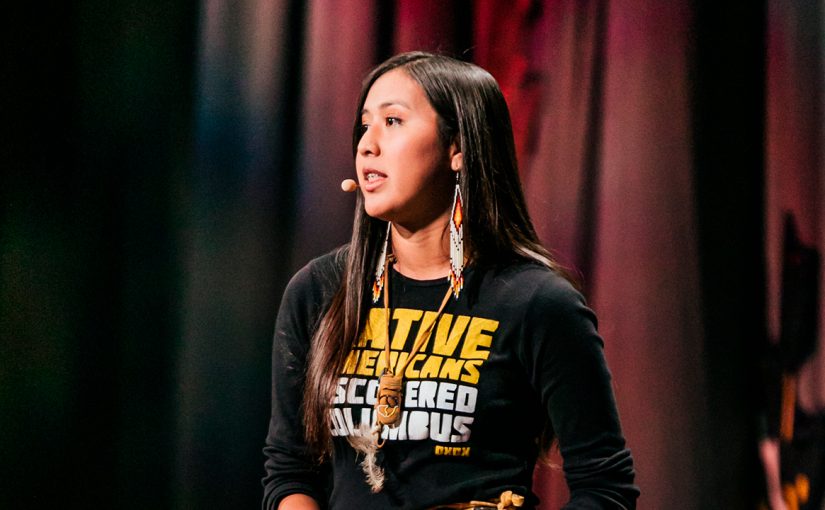
Kandi Mossett: Standing Against Big Oil to Defend the Earth, Water and Indigenous Communities

Kandi Mosset is a mother and member of the Mandan Hidatsa Arikara nation of North Dakota. She is known worldwide for her involvement on the frontlines of the protests at Standing Rock.

With a Masters in Environmental Management, Mosset joined the Bioneers Indigenous Forum in 2014. Joined by fellow water protectors, Mosset returned to the 2016 Bioneers Conference to provide an update on Standing Rock that reached millions. She currently works with the Indigenous Environmental Network (IEN) as Lead Organizer of the Extreme Energy and Just Transition Campaign, and she previously served as the IEN’s Tribal Campus Climate Challenge Coordinator.

Mosset is passionate about bringing visibility to the impacts of climate change and environmental injustice, specifically those affecting Indigenous communities throughout the world.

Bioneers was thrilled to have Kandi Mosset return for the 2017 conference. Below is the video and transcript of her keynote speech on defending indigenous lands and communities from the negative impacts of the fossil fuel industry.

Kandi Mossett:

The Mandan Hidatsa Arikara nation is in North Dakota, which is made of three separate and distinct tribes that were put together on the same reservation in 1860 by this federal government, because we were similar enough, and because many of us were decimated by smallpox that we were really small in numbers by the time that happened. But we have our separate languages and cultures and traditions.

We’re earth-lodge dwelling tribes. It’s not like the Western movies where you see teepees and horses and buffalo and that’s it. We had those things for sure, but we were farming tribes. We grew corn, squash, beans, tobacco, and as such always lived along the waterways and the bottom lands of the Missouri River for a really, really, really long time.

One of the first threats after the reservation in 1860 was something called the Flood Control Act of 1944, also known as the Pick Sloan Act, where they came up with the brilliant idea to build this series of dams along the Missouri River. Incidentally, every single one is below a reservation — flooded us, and that dam, the Garrison Dam, created our reservoir of Lake Sakakawea, which we have come to embrace as our waterway, as our life blood, but we also had a moment where we were forced into a cash economy as a result.

My grandma says it’s like we were forced through a door and could never look back again. We had to go to the toplands because that dam flooded all of our Class 1 and Class 2 agricultural lands on the bottom lands, and all of the towns and villages that we had to come to accept, that were forced upon us by the federal government.

When our chairman, at the time, George Gillette, signed onto that deal, he cried because they were already $60 million into building the project by the time we “agreed” to do it.

So then North Dakota was like, “Oh, well we have this lignite coal here. It’s a beautiful thing.” But it’s not. Lignite coal is the dirtiest coal that you could possibly imagine that comes from North Dakota. Seven coal-fired power plants, several mines that we have impacting our air. That has been happening for a very long time.

I remember going to the coal plants in seventh grade. Our whole class fit into the back of a shovel, one shovel that they used to dig it up. And they were telling us about how great it was. How we could get jobs in the coal industry, and it was going to be a wonderful thing. I remember, I was like: I’m too cool to wear these goggles that they gave us, so I took them off, and I was like, Oh crap, there’s all these particles going into my eyes. So I put them back on.

But they didn’t tell us about what it was doing to our watersheds. They didn’t tell us that every single bit of our over 11,000 miles of rivers, lakes, and streams in North Dakota would eventually be contaminated with mercury as a result of that industry. That is before the fracking you may have heard of. This is all before we have the nation’s only commercial scale coal gasification plant. We have uranium mining. We have over 8,000 acres of underground nuclear warheads stored in North Dakota. Okay? And then enter fracking and the Bakken shale formation that exists where I’m from.

They call my reservation the sweet spot because at least one-fifth of the oil that comes out of there comes from under our feet. So instead of seeing fields, we started seeing these popping up all over the place. Rigs everywhere. On my reservation there’s no setbacks. Zero. They’re right behind apartment buildings where children ride their bikes and play. So we see these things that say for sale, industrial zoned, leased to the industry.

North Dakota is full of sunflowers, as my daughter is showing you here. We have wheat, canola, corn, barley, oats. We’re known as the breadbasket of the country. And yet, this is what the wheat fields are starting to look like. This one was four years ago, and it’s still not cleaned up because this spill was so toxic in this wheat field, which this farming family hopes to be able to put into production again.

We started seeing truck traffic coming into my community and just tearing up our roads. Roads that actually used to be roads are now just gravel. And nobody is fixing them. State of North Dakota’s not because we’re sovereign nations.

These trucks take liberties. They fill up their frack trucks with pristine water where our families used to fill up their cisterns, families that have to haul water. So the next person that comes along has no idea whatever flow back was in that truck.

This is Main Street, Newtown, North Dakota, little tiny town where I grew up – 1,500 people in my community until the oil boom. Boom, all of a sudden 5,000 people, probably three times as many trucks. They dump those frack fluids — toxic, never again used for human, animal, any consumption — right onto the roads because they can get away with it in Indian country. Whenever there’s an accident, traffic gets backed up for miles and miles, and hopefully people aren’t hurt. But sometimes…

This is my uncle’s truck. He was moving my cousin. Him and my brother were riding. A semi decided they were going to take over the whole road, and they either had to hit the ditch or have a head-on collision with a semi. They hit the ditch and they were okay. They had cuts, bruises, scrapes. Not everybody is always so lucky.

In 2008, when I really started fighting back against this industry it was because I had a friend who was killed by those semis, and she was 23 years old. Literally crushing her. Nothing was ever done. Since that time over 40 people in my community have died just running on the road, taking their kids to school.

That is some of the social. What about environmental?

This spill in 2014 still hasn’t been cleaned up. We live in the Badlands of North Dakota. It’s not all flat, like some people might think. We have beautiful areas called the Badlands, and they tell us time and again that it’s not getting into the water when spills happen. Don’t worry about that frack water. When it touches stuff, it’s not that toxic. They said — the EPA and others — that this is clean. There’s still heavy mercury, heavy metals, heavy toxins, arsenic sitting on top of this soil, from 2014, and it’s “cleaned up.” They tell us don’t worry when there’s a spill because we’re going to have these sand bags here that are going to take care of everything. It’s not going to get into Lake Sakakawea.

Well, this was taken out of Lake Sakakawea when my sister was swimming. This water came out of the lake, so I took it to the North Dakota State Health Department, charged $200 out of my own pocket to see what the heck this was. They’re like, “Oh, don’t worry. It’s a blue-green algae bloom.” I was like, “Okay. What does that mean?”

It’s toxic. You’re not supposed to be swimming in it. You’re not supposed to drink it. This was taken one mile from the water intake plant for our community.

In addition to the water, our air is being polluted. How many have you been to North Dakota? Raise your hands. How many big, huge cities like New York have you seen in North Dakota? None. Because there aren’t any.

This circle you’re looking at is not from the lights like you see in the eastern part of the country. It’s from the flares. You can literally stand in one area and do a 360 and feel like you’re in a war zone. I can’t tell you how hard it is to be home with my daughter in the back seat, and I don’t even want us to have to breathe, but we don’t have a choice. So we thought.

We’re going to fight back against this industry because look at this…Just a few years ago, you could see for miles and see the buttes, all of the compounds that are in there. All I wanted you to notice about this was where the little red arrows are because those are carcinogenic, which means cancer-causing. As a cancer survivor, who shouldn’t be standing here today because I was diagnosed with a Stage IV sarcoma tumor when I was 20 years old, this is really triggering to me. And this is just 652 of the 2,000 possible chemicals that can be in that frack water, and every single one of those is of concern.

They don’t care where they put these things. My grandmother used to fast here. She used to go out and collect juneberries, ground-berries, chokecherries, turnips, and now signs say, do not enter; you cannot be here.

And then came the man camps. Did you know that in the past nine months alone there were close to 100 people rescued from the sex trafficking industry, the youngest one was 3 months old?

Crime came with the industry. It’s inevitable. These are just headlines I took from my local papers that you’re not going to see in mainstream media. Every single one of these has a story. I don’t have enough time to share with you today. But imagine, the worst thing that used to happen when I was little was that the bad kids — us — used to egg our teachers’ houses on Halloween. That was the crime in our community. And now this.

With that came drugs, came heroin, something we never had in our community before, and when people got addicted to heroin, the industry, the police, “Oh, they’re just druggies.” There were no services for the people.

So when people like Ashley got addicted to heroin there was nowhere for her to turn. She laid in a hospital bed for three days while her hands and her feet turned black, while her internal organs shut down before she died at 28. In the last year we buried Lisa, same thing. No one to turn to because she was just a druggy. No, she was a person that left behind five children.

My cousin Daniel went missing in 2013. We knew that he was with MS-13, a known organized crime gang, that originated out of Venezuela. We knew the night he went missing, he was with those kind of people. We searched and searched for Daniel for months, and we found him — in Lake Sakakawea, under the bridge. And because of there were no stab wounds, there were no gunshot wounds, it was open and shut. We never knew, and we’ll probably never know who killed Daniel. And that happens all the time as a result of the oil industry.

And what do we get? What’s our thanks for allowing these people to come into our communities? Written on our dumpsters for our kids to find? Racism, as if it’s our fault that they’re there.

We fought against the semis. We fought against the trains. Because then that bright idea was to bring these bomb trains and send them out all over the country. And it hurt every time one of those blew up, because they came from my community. In Canada, 47 people were killed, including two kids under the age of 5 when ones of these trains blew up. Then, what was the next brainchild? Pipelines.

You’ve probably heard of the Dakota Access Pipeline. You might know how it ended at the time. Yeah, we were forced out by gunpoint from our US military for trying to protect our water. When we say the frontlines, people get triggered because they say, “Oh, that connotes war.” Well, if you don’t think we’re at war then you’re sorely mistaken and you need to wake up, because we are on the frontlines.

We stood there with our sage and our sweetgrass and our medicine against armed military — to protect water and tell people water is life. It doesn’t matter that the camp was physically forced out because they can never take away the fires that are burning in our hearts from that, and we’re never going to quit. We are going to continue to fight, because it’s not just about one pipeline.

Raise your hand if you heard of Dakota Access. Okay, now, raise your hand if you heard of Sakakawea Pipeline. Hmm…That one quietly went under the water at the same time. You see, it’s not just about the symptoms. It’s about stopping it at the source. And I want to show this video of what we’re continuing to do at home.

So 3 years ago that we have have gotten our Mandan, Hidatsa and Arikara nations elders and representatives together in 20 years, to work together and do a water blessing.

You know, these industries, they won’t return here, they are only here for the money, they want to extract as fast as they can.

We have a lot that is at stake here, there’s a big battle going on right now and we’re in the battlefield.

What we’re doing here is bringing folks from all over the United States and making sure that people understand that the legacy here, the legacy of extraction, ultimately goes downstream towards other communities in the United States, especially in the South.

So making those connections from the extraction point through the pipelines, you know, all the processinging and refinement, and how we’re all in this struggle together. I think it’s just really important to bring people together and understand we’re not alone when it comes to these extractive industries and how they’re impacting us. And the whole message of the day is, “Just keep it in the ground. Stop it at the source.” Then, all of the negative symptoms that negatively impact everybody else won’t have to happen.

Right? It seems like common sense to me. Just because you don’t see us in the media fighting at Standing Rock doesn’t mean we went away, or that we’re not going to continue to fight in the Bakken. You can bet that we’re in our communities fighting and pushing back.

We’re making those truck drivers feel uncomfortable when we put our up signs telling them that we don’t want them there. We’re going to continue to bring people to North Dakota and have these toxic tours, just like the one we just had this past August to show that the symptom — the pipeline is still there — but we’re going to fight to stop it there, because fracking is a problem in this country. It’s also a problem worldwide, and that’s just one of the problems of the fossil fuel industry that threatens life.

Mni Wiconi is so much more than just a slogan or a saying. Water of life is literally when we’re pregnant, we carry our babies in that water. In that moment, that moment when you understand what that means is so powerful. And I like to share it with people. Because we have a responsibility to protect that life, to show them that they can be the future power shifters, and to get them ready to do it because these things take a really long time. But we’re strong and we’re smart, and we know that we can do things like decolonize our own minds. Yes, you can.

Look up Dr. Michael Yellow Bird. I don’t have time to go into the whole thing right now, but neurodecolonization through mindfulness, you watch one of his things, pow! Yeah, it’s amazing. That’s what we can do as individuals if we want to right the wrongs in the world.

Sure, renewable energy is great. It is good to have those things. It is good to transition. But that’s not what’s going to save us. We have to get to the very heart of the problem, of this broken system, which is capitalism and colonization. We need to do it and we can.

You can get the book if you’re not indigenous. I don’t know how much sense it’ll make, but it’s pretty good. It explains what that means. Don’t be afraid of decolonization. It can be as simple as planting a garden, honestly. Start there.

Our little kids, our children should be allowed to continue our culture and practice our way of life.

This is one of our Earth Lodges in a modern-day spin that we’re building in our community right now. Because our country, our world, is addicted to oil. We have to admit it. We have to admit the foundation that we’re built on is a bad foundation, and it has to crumble so that we can rebuild it.

If we have to go to DC and leave our communities and march and say, “Hey, No. 45, you’re insane, and we’re going to do everything we can to get you out,” then we will! Yes! Don’t be afraid. Don’t be afraid and don’t sit on your couch and wait for somebody else to decolonize your own mind because you’re the only one that can decolonize your own mind. I’m sorry. But you have to do some homework.

Please support the Dakota Resource Council, who supports our local Ft. Berthold power group. Please don’t forget about the people on the ground. Dakota Resource Council is in North Dakota trying to do good things, and they need support. And please support us at the Indigenous Environmental Network because it’s for the next seven generations.

If not us, who? If not now, when? We can do this, people. We can do it together.
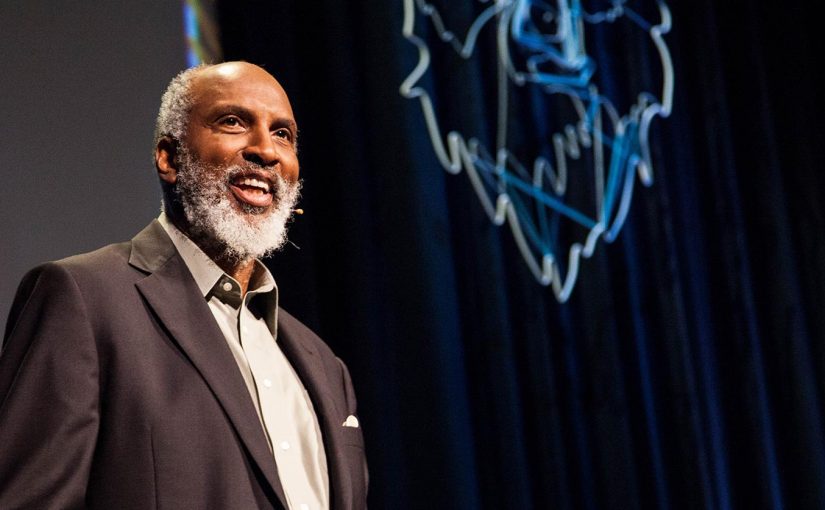
john a. powell: Celebrating Diversity to Create an Inclusive Society

john a. powell is a professor of law and African-American and Ethnic Studies at the University of California Berkeley, where he is also the Director of the Haas Institute for a Fair and Inclusive Society.

Before joining the faculty at Berkeley, john was the Executive Director of the Kirwan Institute for the Study of Race and Ethnicity at Ohio State, and founded the Institute on Race and Poverty at the University of Minnesota. He has previously served as the Director of Legal Services in Miami, Florida, and National Legal Director of the ACLU.

He currently serves on the board of a number of philanthropic nonprofits, including Bioneers, and is the author of several books, including Racing to Justice: Transforming Our Concepts of Self and Other to Build an Inclusive Society.

Bioneers recently spoke with powell about his long, mutually beneficial relationship with our organization. We were lucky to host him as a returning keynote speaker in 2017. The video and an excerpted transcript of that keynote follow.

john a. powell:

My talk is about co-creating an alternative space to heal. So where’s that alternative space to heal? I think it’s called the Earth.

So the Earth belongs to all of us. We have to respect it. It supports us. And if healing is going take place it has to be on the whole Earth, not just a corner someplace, not a place just to hide. We have to make the Earth a safe place for life.

And I am, because you are. We are profoundly, profoundly interconnected. We don’t always live that way. We don’t always acknowledge it, but if we’re going to heal, we have to live it, experience it and create institutions that celebrate it.

Instead we’re in a situation where the country and the world is more divided. We’re seeing right-wing ethnic nationalism blow up all around the world. We’re seeing every day, every week, crazy things coming out of the White House. I mean like, crazy. And by most accounts we’re more divided as a country than we’ve been since the Civil War. That’s the bad news.

Let me give you some good news: There are more people who oppose white supremacy than any time in U.S. history.

So we’re in a battle. And it’s a battle of those who believe in love and life, and those who think that’s only for a narrow few.

These are two authors. On the left is Samuel Huntington, who wrote a book called Clash of Civilizations, which really is an attack on most of the world who are not white and Christian. And he worries that the United States is becoming too diverse, that there are too many people coming here who are not white and Christian. And he suggests that we need to go back to some glorious past when America was white again or great again or whatever they’re saying. Of course, there was never such a time when America was white. They sort of skipped over the fact that the country was occupied when they got here, but Huntington, despite being a noted scholar sort of skips over that. But he actually looks at the past. So people who are afraid of what’s happening in the world are constantly trying to take us back to some imaginary past.

And then, there’s Jeff Chang, who looks at the changing world, the change in diversity, and he’s written a book called, Who We Be. He looks at an imaginary future, a future where all of us belong, where the world is very diverse, where there is no supremacy. And that’s the battle that we’re in right now. Do we actually embrace Jeff Chang or do we embrace Samuel Huntington?

The country itself has been fighting this since its very beginning. The Declaration of Independence, “we the people.” But then again, we the people, who are the we? Who constitute the we in we the people?

Of course, at the beginning of the Constitution, black people weren’t in that we. Women weren’t in that we. Native Americans weren’t in that we. White people without property were not in that we. So even though it had this glorious-sounding term, it then defined this we very narrowly.

So, to some extent, that’s still the battle we’re in. Can we define the we so it’s inclusive and not exclusive?

So I talk about this in the context of “othering and belonging.” And it takes on all different types of forms. And I hope many of you will actually come to our conference on othering and belonging. And othering is a wonky word, so I got this technical definition to help you out. So one person says, Stop othering me. What’s othering? Well, your kind wouldn’t understand.

So othering happens at all different kinds of levels. And this cartoon suggests an interpersonal level, and that’s bad enough. We’ve all had experience of going someplace and feeling like this is not my place, these are not my peeps. But what happens when the country, when the government, when the police say you don’t belong. It takes on a much more pernicious and dangerous form. What happens when the President of the United States, we call him “45” in my house, What happens when 45 says that these people don’t belong? That’s a very dangerous space. And we have to reject that space.

And most liberals, and I would dare say that many of you are probably at least liberal, if not progressive, and most people who embrace some concept of spirituality, my guess would be many of you do, would actually reject the notion of othering. And unfortunately though, many liberals, when they reject othering, they actually adopt something called saming. That is, they say we’re all exactly the same. There is no difference. But the opposite of othering is not saming. It’s belonging. And belonging actually embraces differences and learns from them. It’s not afraid of difference, and yet it doesn’t make those differences infinite.

As the United States grows in diversity, and it’s growing in diversity across a number of important axes, the country becomes more nervous, becomes more anxious. And this is not just the United States. It’s all around the world. So you see, all of these ethnic national movements are organized against, around some imagined identity. They might be Muslims. They might be people of a different language. They might be Latinos. They might be gays and lesbians. They might be transgender. But there’s always this fear of the other.

And again, the liberal’s response to that is to try to address that fear just by saying they’re just like us. And both of those are problematic.

So there’s two major responses to this anxiety, and change produces anxiety. That’s the natural human phenomena. If you were to get married, move your residency, and change your job within a two-year period, your chances of having a heart attack goes up about 50%. If you are one of those unfortunate people who marries someone you don’t like, it goes up to 75%. So even when positive things are happening, the human organism can only process so much change over a short period of time.

But there’s two major ways to sort of deal with this change. One is called bridging and the other one’s called breaking. And bridging, actually, it’s about connecting to the other. The other is always imaginary. There’s no natural other. There’s no natural community. We are constituting these constantly. But bridging actually invites a sense of empathy, deep listening, and connection.

Breaking sees the other as a threat, sees the other with fear, as somehow attacking who we are. And most of the stories, most of the practices that we engage in in our society, even in progressive communities, are breaking. We’re constantly defining ourselves in opposition to the other. We’re constantly defining the “we” in a narrow way.

And so again, that’s the big fight, not just in the United States, but throughout the world. Do we bridge or do we break?

Now, for of those of you who are bridgers—and I hope before the day is out, if not already, you’re all bridgers—I have a word of caution for you from my good friend, bell hooks. She says, “Bridges are made to walk on. So when you first become a bridge between two communities that see themselves in opposition, you will be walked on and occasionally, hopefully not too often, you will be stomped on.” But I say this, “If the world is not bridged, if we do not have more bridges in the world, if we continue to break, we won’t have a world.” So your work as bridgers, even though sometimes you’ll be walked on, occasionally stomped on, is critical for the survival of a planet.

And we see the rise of hate in the United States. And there’s another slide I didn’t include. We also see the rise of love. Both things happening at the same time. There’s in fact a book by a friend of mine, Sheryll Cashin called Loving, about it’s about the Loving family from 1967.

Othering in America, it’s not just done by people. It’s done by corporations. It’s done by the religious right, and it’s done by the “alt right.” Now, it’s actually interesting, when I say the religious right, who was the religious right that engaged in othering? When you think of evangelical Christians, there was one of the most powerful groups that supported Trump, but actually that’s not quite right. The evangelicals that supported Trump were white. Black evangelicals, Latino evangelicals, Native American evangelicals did not support Trump. So it’s, again, it’s defined largely about this fear of the racial other.

Now, this may—You may wonder why am I dwelling on this. So, some of you remember the one-drop rule. Remember the one-drop rule? The one-drop rule is that if white blood gets mixed with one drop of black blood, it’s destroyed. I mean, black blood is powerful stuff. Well, maybe it’s not so powerful. Maybe the thing is white blood is really fragile.

Of course, I’m not talking about blood at all. We’re really talking about the ideology of exclusive whiteness. That’s what’s fragile. Not white people. White people are heterogeneous just like any people, and some of them are bridgers and some of them are breakers, but it’s the fragility of this white purity that Bannon and others represent that’s fragile. Any time you’re talking about something that’s pure, you’re also talking about something that’s fragile.

The world is not pure. Diversity is not pure. The biology, the environment is not pure. It’s constantly engaged with other parts of itself and that’s what makes us strong.

Now, I don’t know. My father’s a Christian minister. I’m not going to show him this slide. He would be very confused. How did Trump and Jesus end up in the same…I’ll just let you dwell on that for a while.

So again, part of thing that we have is that the left is actually afraid of difference. And so in that sense, the left engages in saming. And I would argue to you that saming is a weak version of breaking.

There’s a wonderful book by James Baldwin called The Price of a Ticket. When James Baldwin was at the height of his literary career, the white establishment finally said, “Okay this Negro can write,” and they invited him to join all these literary clubs, and they said, “But don’t remind us that you’re gay, and don’t actually bring any of your black friends with you.” And James Baldwin said, “No thanks. He said the price of the ticket, leave who you are and you can be like us.” So saming is not really that good.

Now it’s better than the right wing, which actually believes that the other has to be destroyed or is in some way inferior. But let me suggest this, that when we worry on the left about identity politics, we say that the things that’s actually messing up creating a progressive movement in this country is that people are focused on gender, they’re focused on their sexual orientation, they’re focused on their race. They should focus on something that’s universal, that we all share, like the white working class.

The problem with identity politics is not the identity and it’s not the politics. The problem with identity politics, when it’s a problem, is that it’s actually breaking. It’s not identity politics that’s the problem, it’s breaking that’s the problem. But we can actually focus on gender. We can focus on LGBTQ. We can focus on Black Lives Matters in ways that bridge. But the liberals haven’t learned that. And so they say to those groups stay away; we’re going to focus on real issues like the working class, which really means white. And people find that offensive. So we have to actually move beyond breaking and realize that again the opposite of othering is not saming.

So who’s in the circle of human concern?

And being here at Bioneers, I’m sure you will catch this and correct me, it’s why are we only concerned about humans? We’re not. We’re concerned about life.

And this is a tricky thing because I’m going to talk a little bit about narrative in the little time I have left. The stories we tell matter. We’re all multiple selves. We’re all fluid people. So when we talk about intersectionality, when we talk about the other, the other is actually inside of us. There’s a part of us that we haven’t claimed. There’s a part of us we haven’t celebrated. How do we begin to claim that? And narratives help with that.

But in a story, in a narrative—and Jonathan and I were talking about this yesterday—there always needs to be, or people say we need a villain. Can we create a “we” where no one is on the outside of it?

Maybe except one or two people. No, I’m just joking.

So, that’s not Trump’s “we.” His “we” is very small and getting smaller all the time.

So how do we bridge? We bridge by deeply listening. We bridge by suffering with others, listening to others suffering. We bridge by engaging. We bridge by organizing. And we bridge by love. It’s not easy. It’s hard stuff. But it’s rewarding stuff. And so as we bridge, we move from an exclusive society to an integrated society, to an inclusive society, to a belonging society.

Now notice that in a belonging society the structure itself actually changed. So when we talk about belonging we’re not talking about belonging into something that’s structurally exclusive and misogynistic. We’re talking about changing the structures themselves. So belonging is not just how do we treat each other, belonging is how do we actually organize our economy, our structures, our schools, our faiths so that everyone belongs, and recognizing we still have differences. Where do we find such a space? Well, Bioneers is starting to lean into that space. Bioneers is about belonging.

And yet, as important as it is to recognize each other, just recognizing each other is not enough. As I said, we have to think about those structures, too. So we focus on empathy. Empathy is actually just another way of talking about love. Focus on recognizing that we are deeply related already. But then how do we actually acknowledge that, not just interpersonal stuff but also in our communities?

Grace Lee Boggs, a fellow Detroiter, and she reminds us even if the people of our respective communities or our countries are acting in ways that we believe are unworthy of human beings, we must still have enough—we must still care enough for them so their lives are in ours. Their question and ours become inseparable.

It’s not easy to do. But no one said life was going to be easy.

So we have examples of efforts to create an inclusive society, to create a belonging society, and we have to deepen those examples. We have to celebrate them. We have to talk about them.

You’ve heard about Standing Rock, and everybody that I know who had any engagements with Standing Rock was talking about not only was this something important led by indigenous people in our society but it was belonging. Everybody that went there came back talking about love, talking about this sort of “rainbow effect.” So it’s a wonderful example that belonging already happens in our society. We just have to punch it up.

And finally, as our friend Naomi Klein reminds us, “No is not enough.” It’s not enough just to be against something. We have to be clear what is it we’re for. And Connie Heller, which you’ll hear from later today, has this on her website, “fear less, love more.” Fear less, love more. And, yes, we have to get to “yes.” Thank you.

A Guide for Authentic Leadership Toward Sustainability

Dana Pearlman—co-founder of the Global Leadership Lab—is dedicated to designing and facilitating conversations and participatory processes to unearth deeper wisdom at the individual and collective levels. The guidebook she co-authored along with Christopher Baan and Phil Long is called The Lotus: A Practice Guide For Authentic Leadership Toward Sustainability. In this excerpt from the Guide, find practical tips and tools to foster authentic leadership within yourself and others.

Cultivating Your Authentic Self

In order to address the complex sustainability challenge facing society today, leaders must cultivate their own authenticity and presence. We understand authenticity as being true, open and honest with who you are. The more adaptable and developed a leader becomes, the greater they are able to steer through complex, participatory planning processes. Through their personal development, facilitators and leaders are more able to utilize hindsight, hold multiple worldviews and perspectives, and sit with current reality while simultaneously aiming toward a desired future. The adaptability achieved by facilitators and leaders honing these capacities lends itself to enhancing collaborative group processes and outcomes in Strategic Sustainable Development.

This is a continuous path toward using more and more of your authentic self in facilitation processes. This path helps facilitators and leaders improve the quality of relationships in a team while engaging people cognitively, mentally, physically, emotionally, and spiritually. Facilitators and leaders bringing their authentic selves into the facilitation process are more likely to guide a team towards successful, lasting and sustainable results that have ownership among the stakeholders. Authentic leaders and facilitators that hold the ‘container’ for collaborative processes more personally, are better able to engage people in multi-dimensional ways, resulting in more embodied and empowered outcomes. The developed sense of awareness inherent in personal leadership capacities can be critically valuable in enabling facilitators and leaders to know when and what to do during a group process by ‘sensing’ what is happening with the group in the present moment. In this practice guide we present 9 personal capacities that leaders find essential in their work to facilitate complex and transformational change towards sustainability. These personal capacities by their very nature cannot be learnt only on a cognitive level; they must be embodied.

Our research has shown that one important path to the embodiment of these capacities is through personal and collective practice. The implication of this is clear; as one expert put it, “no real transformation can take place without personal and collective practice”. The simplest dictionary definition of practice is “to do repeatedly to acquire or polish a skill” (Szpakowski 2010). We distinguish here between personal (individual) and collective practices. An example of a collective practice is dialogue or Aikido, something you do in a group of people where interaction is key. In addition to the personal capacities identified in our research we found conditions for success for developing your capacities through practice:

Conditions of success for developing your personal leadership capacities

• A combination of personal and collective practice is a pathway to the development of your leadership capacities;
• A combination of contemplative, physical and spiritual practice helps you align body, mind, spirit and shadow, in order to maximize personal development;
• The integration of practices both in your personal and professional life helps you take the learning from the practice back into the facilitation process.

Conditions of success for choosing a practice

• The practice must have a mirroring quality, to help the participants observe themselves and enhance self-awareness;
• The practice has to provide ‘a container you can’t manipulate’ with structures that are adhered to;
• The quality of your attention in the practice is more important than the type of practice performed;
• The practice must be something you are willing to do repetitively and consistently.

The continuous mastery of personal capacities not only improves your leadership performance; it also helps you get in touch with your own authenticity. When you are more in touch with your authentic self, your actions are easier to embed in your life and thus lead to stronger follow-through in a facilitated engagement process. The literature on leadership development highlights the importance of self-mastery in leaders and through “increased self-awareness, self-regulation and positive modelling, authentic leaders foster the development of authenticity in followers” (Avolio et al. 2005). Authenticity is about “owning one’s personal experiences, be they thoughts, emotions, needs, wants, preferences, or beliefs, processes captured by the injunction to ‘know oneself’ and further implies that one acts in accord with the true self, expressing oneself in ways that are consistent with inner thoughts and feelings” (Harter 2002, 382; in Avolio et al. 2005). Leaders modelling awareness and authenticity invite participants to do likewise, and if one is engaged on an authentic level, engagement processes are likely to result in more desirable outcomes.

Authentic leadership development offers facilitators and leaders a foundation from which to engage groups beyond the cognitive level. It includes the emotional, physical and spiritual dimensions to increase congruence between outcomes created collaboratively with participants’ authentic selves, resulting in stronger and more successful outcomes. Facilitators and leaders bringing their authentic selves into an engagement process benefit outcomes. However, it is not enough in order to successfully address the sustainability challenge. One must have the ability to plan in a strategic manner within the confines of the Earth’s carrying capacity. The sustainability principles introduced previously define such boundary conditions. Combining an authentic and holistic leadership approach along with knowledge and skills in Strategic Sustainable Development, we contend, will benefit collaborative engagement processes and outcomes that help move organizations and society toward sustainability.

Whole Self-Awareness

What is it? Whole Self-Awareness is the continual, lifelong process of paying attention to knowing one’s self; it involves consciously and intentionally observing various dimensions of the self (including the physical, mental, shadow, emotional and spiritual realms). It is the capacity to observe how one is thinking, relating, feeling, sensing, and judging. Whole Self-Awareness includes perceptions beyond the rational mind, such as intuition.

Principles: Pay attention to all the dimensions of yourself (physical, emotional, spiritual, shadow and mental dimensions). Your body is not a transporter for your head, you are a whole system.

Self-reflection questions

• How would others describe you? What do you tell yourself about yourself?
• Think of someone you admire, what do you admire about them? What does this tell you about your values? What can you learn about yourself from this admiration?
• Think of someone that irritates you, why do they irritate you? What does this tell you about your values? What can you learn about yourself from this irritation?
• When something is physically challenging to you, how do you respond?
• Are you aware of how you are feeling throughout the day?
• What emotions are acceptable, what emotions are not acceptable?
• How do you feel physically, emotional, spiritually, energetically and mentally right now?

Reflection questions during facilitation

• What reactions are you having with this group that need to be explored or shared now or later?
• What do you perceive to be occurring within this group beyond your cognition?
• How can you invite the group to be engaged beyond cognition? How are you inviting the mental, physical, emotional, and spiritual dimensions of this group to participate?
• Is your whole self (body, mind, spirit, emotion, and shadow) in alignment? Is your head agreeing to do something and another dimension of yourself not in agreement?

Practices for developing your Whole Self-Awareness

Concentration meditation practice. These practices focus your thoughts on a particular object (such as the chakra system or visualizing white light moving through the body) to shut out the outside world and prevent the mind from wandering. For example, focus upon the inhale and the exhale breath. On the inhale breath your posture elevates and on the exhale breath your posture settles. Repeat for a few minutes and extend this time with practice. This helps calm the parasympathetic nervous system to help you relax. Once calm from the concentration breathing, an awareness meditation practice like Mindfulness (See Being Present Practices) helps you see the nature of your mind. With compassion move toward embracing all of yourself and seeing the patterns of thinking including judging, planning, yearning and fearing that show up. This enables you to begin to discern between unconscious material surfacing in your thoughts from the past and accurately receiving information in the present moment.

‘Core Qualities’ practice (by Frank Heckman). Tell a story to a peer or mentor about a time when you were doing something challenging in which you persevered by stepping up and being courageous. Have the other person listen to your story and take note of the qualities you displayed in that situation to feedback to you. These qualities are your core qualities of personal strength you embody in your life. Repeat with another story. This practice also helps you become aware of your Personal Power.

Giving and receiving feedback. Intentionally ask others (peers, co-workers, mentors, family members) for feedback on your behavior to see areas for your growth in order to increase the quality of your work, relationships and self-understanding. Being open to feedback and listening is key. Start this process with someone you trust most. Notice if and when you feel defensive, refrain from responding, and explore how receiving feedback impacts you. Use specific examples and reflect back to the person what you think you heard them say for accuracy and clarity. Use an actual experience. Ask the person giving feedback to focus upon:

• What behaviors they observed you doing?
• What was the outcome of the situation and how did it impact them?
• What feelings did they feel?
• Now ask yourself, what future opportunities for new actions are available to you now given the feedback? And remember to have compassion with yourself.

A physical practice such as yoga, Thai Chi, martial arts to integrate a holistic approach and address more dimensions of yourself.

Shadow work. Facilitators work with all kinds of people and situations and are bound to be irritated or triggered sometimes. If you focus your energy on the ‘outer’ trigger, you are missing the gem in the lesson from self-reflection; by being angry at the person triggering you, you are really just shooting the messenger. When in process, try to notice when an irritant or trigger or dislike arises and write it down, suspend it temporarily and return to it for exploration when appropriate. Describe the event, how you felt, what reaction you normally would have had if you had not suspended your reaction, and how that situation may represent a repressed part of yourself from long ago. Seeing irritations as shadows that need to be explored helps you gain acceptance, compassion and awareness of yourself and others, it teaches you to suspend when an irritation occurs.

Whole Self-Awareness: Resources for further exploring, practice, and reading

• The Johari Window: mapping personality awareness: http://kevan.org/johari.
• Goleman, Daniel. 1996. Emotional Intelligence.
• Goleman, Daniel; Richard E Boyatzis; Anne McKee. 2004. Primal Leadership: Learning to Lead with Emotional Intelligence.
• Self assessment tools such as Myers-Briggs Type Indicator, Enneagram Test, Temperament Assessments, Emotional Intelligence Tests, Action-Logic Assessment, or Spiral Dynamics Value Meme.

Personal Power

What is it? Personal Power is the ability to use energy and drive to manifest wise actions in the world for the greater good, while being aware of one’s influences on a situation.

Principles: Step up, be courageous, acknowledge your influence in this system, and know when to give space for others to step up.

Self-reflection questions

• Imagine a time when you felt powerful/powerless/afraid and ask yourself how did you respond/feel/ act in that situation?
• Have you ever agreed to do something you did not want to do? Did you ever compromise your own ideas/plans when someone else had a different plan, or vice versa?
• Are you willing to take risks and do things others may not approve of? Who do you try to get approval from?

Reflection questions during facilitation

• How much power do you have in this situation or with this group? Are you okay with having this amount of power? If not, what do you need to do?
• What powerful mentors, images or experiences can you call upon to support you in this facilitation process?
• How is power manifesting within this group? Who has power? Who does not have power? What power shifts are possible within this group for the greater good for all?
• What steps do you need to take to empower this group, so they can continue their work after you are done, without depending on you as an external intervener?

Practices for developing your Personal Power

Aikido or other martial arts. Using simulations eliciting fear or feelings of power or powerlessness helps you gain self-awareness of your relationship to power and how you respond to these types of experiences. For instance, by practicing Aikido you are confronted with moments of being ‘attacked’ and dealing with personal reactions to aggression. The practice helps participants see their responses, helps them suspend them and be mindful about how to proceed. When facilitating collaboration, facilitators oftentimes must confront fear and power within groups.

Use mentors or archetypes. To embody the power and support needed during facilitation work. One example includes calling upon the wisdom of the Dalai Lama to come through your mind, the love of Mother Theresa to come through your heart and the courage of Martin Luther King, Jr. to come through your gut. Imagine their energy, determination and personal power being channelled through you to support your work. See for more information: ConsciousEmbodiment.com (Wendy Palmer).

“If you want to work with power in the world you have to work with your own power, however you perceive power to be, either in hierarchies or in the hearts of people, probably both… Meditation has given me the realisation that I have a fundamental mistrust of power. I have consistently seen power abused in my life, by people in schools as I grew up. I have rarely seen power held with integrity, so the story I live in and how I relate to the world, that’s where I am trying to put power back in the hands of people most affected by it.” (Anon. 2011)

Personal Power: Resources for further exploring, practice, and reading

• Kahane, A. 2010. Power and Love: A Theory and Practice of Social Change. Berrett-Koehler Publishers.
• Nhat Hanh, T. 2008. The Art of Power. HarperSanFrancisco
• Palmer, W. 2001. The Practice of Freedom: Aikido Principles as a Spiritual Guide. Rodmell Press.
• Palmer, W. 2008. The Intuitive Body: Discovering the Wisdom of Conscious Embodiment and Aikido. Blue Snake Books.

This excerpt has been reprinted with permission from The Lotus: A Practice Guide for Authentic Leadership Toward Sustainability by Christopher Baan, Phil Long and Dana Pearlman.

When we fight, we win

This piece was originally published on the Community Environmental Legal Defense Fund (CELDF) website. The CELDF is building a movement for Community Rights and the Rights of Nature to advance democratic, economic, social, and environmental rights – building upward from the grassroots to the state, federal, and international level.

The Community Environmental Legal Defense Fund in 1995

In the 1990’s, CELDF was a conventional environmental law firm. We believed that if only there were more environmental lawyers willing to work for free for communities fighting to stop harmful projects, then justice would get done. We did that work for a number of years.

In the process, we found that the environmental law system is rigged against communities and against the environment. It is a “permitting” system, after all, designed to permit environmental harms rather than prohibit them. It is a regulatory law system, but the only thing it really regulates is how the people try to defend ourselves from the corporate state.1

The Roots of a Rigged System

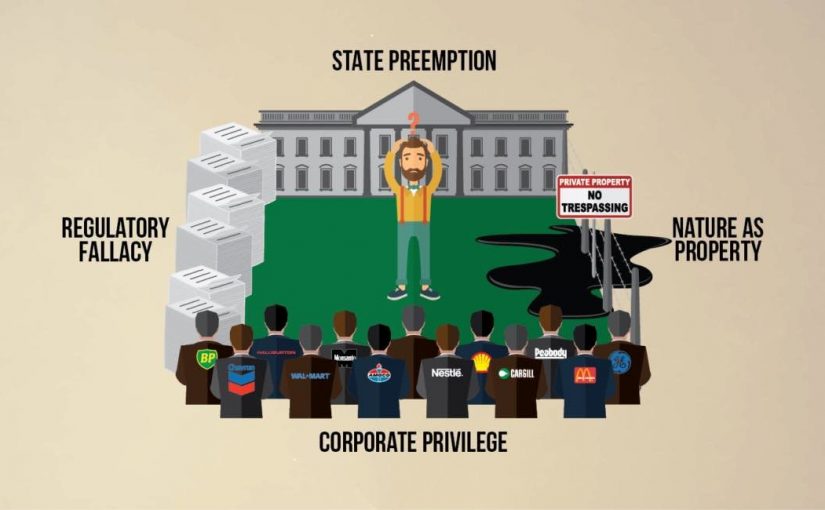
So we went deeper. We worked with others who were trying to expose the roots of this rigged legal system and understand why it works for corporations rather than for the people. We identified several deeply entrenched legal doctrines that stop people from protecting their health and safety from corporate harms because they prevent community self-government. Those key doctrines are:

  • Ceiling preemption2
  • Dillon’s Rule3
  • Corporate constitutional “rights”4
  • Dormant Commerce Clause5
  • Contracts Clause protection for corporations6
  • Nature as property7

There are other deep seated legal constructs that keep the system in place. Some are buried in impenetrable legal codes, while others are hiding in plain sight. We decided to start with these.

Importantly, all of these legal rules are created and expanded upon by judges.8 Part of our work with communities to defend their rights has been to share this with judges so they understand the system they built. In understanding it, they can voluntarily dismantle it.

Changing the System

As we educated people about how the system works, people asked us to help them change it. Communities who had reached the end of their ability to get any remedy from the regulatory environmental law system asked for our help in creating new law. They wanted to prefigure a more democratic legal system whereby human rights and ecological rights are superior to corporate interests.

CELDF has helped many communities do this.

From the Corporate State Ignoring Communities…to Fighting Them

In most of these communities, there was a proposed harmful project spurring them to action. However, when the corporation that sought to harm the community saw the organized opposition – including a local law – the corporation walked away.

[The Community Rights movement] is the beginning of a social movement that is greater than just the oil and gas industry, it is a potential game changer for all of corporate America.
— The Independent Petroleum Association of New Mexico

But over the course of a decade, some corporate actors came to see the threat that this growing movement posed to the corporate state. The Independent Petroleum Association of New Mexico saw the threat. That organization published an article in its newsletter attacking the Community Rights movement, and CELDF in particular. The authors ended with this prophetic sentence:

“While industry, the media and the public might ignore all the commotion created about the hydraulic fracturing discussion, this issue is the beginning of a social movement that is greater than just the oil and gas industry, it is a potential game changer for all of corporate America.”9

By this point, we were no longer being ignored, nor merely laughed at. The fight was on. Corporate lawyers, particularly those working for clients in the oil and gas industry and in industrial agriculture, organized to challenge in court every new law that communities put forward to dismantle the corporate state.

The Oil and Gas Industry Strikes Back

In Pennsylvania, the Pennsylvania Independent Oil and Gas Association (PIOGA) decided to go directly after CELDF, in an erroneous belief that they could stop this social movement by destroying our organization.10 This isn’t hyperbole. A lawyer for PIOGA said to the media that he wants to bankrupt us.11

One of PIOGA’s tactics is to get a judge to award attorney fees against CELDF for defending Grant Township against Pennsylvania General Energy Company’s (PGE) proposed frack waste injection well. That means that PIOGA and PGE want us to pay for their litigation costs because we are defending Grant Township from PGE’s toxic and radioactive frack waste.

The Judiciary as a Weapon Against People’s and Nature’s Rights

On January 5, 2018, Magistrate Judge Susan Paradise Baxter obliged the oil and gas industry by granting PGE’s sanctions motion, holding two attorneys representing Grant Township liable for $52,000 – ten percent of PGE’s attorney fees.

There are a lot of problems with Judge Baxter’s ruling, but for our purposes here, we need to understand her ruling as part of an attempt by extraction corporations to stop the democracy movement of which CELDF is a part.

The Gist of Judge Baxter’s Ruling

Judge Baxter ruled that these attorneys were on notice that certain arguments are “legal implausabilit[ies].” Namely, they cannot argue that:

  • corporate claimed “rights” are invalid,
  • a regulated corporation is created by the state and is thereby a “state actor”12
  • the right to local community self-government is elevated above long-standing constitutional rights, federal and state laws, and regulations that allow unwanted harms into communities, and that
  • “Dillon’s Rule” is invalid “to the extent it applies to limit a municipality’s ability to enact ordinances in conflict with state and federal law.”13

Judge Baxter basically told the two attorneys that these arguments are frivolous, and they can’t challenge in court, on behalf of their client, the building blocks of the corporate state. They can’t advocate for a more democratic legal system. If they do, she’ll fine them.

[The sanctions are] a win for the Community Rights movement, revealing the seriousness of the threat we pose to the corporate state.

The Buck Stops Here

Judge Baxter’s opinion also makes clear where the buck stops with maintaining the corporate state. Remember, judges built this system. They created the legal structures that Judge Baxter sanctioned these attorneys for arguing against. Over the last 200 years, judges recognized corporate “rights,” narrowly prescribed the “state actor” doctrine, abolished the right of local community self-government, and created Dillon’s Rule. Judges made this system (for corporations). Judge Baxter shows us that not only will judges maintain this system, but they will now fine lawyers who represent clients who question its legitimacy.

The sanctions appear as a huge win for the corporate actors who identified this social movement as “a potential game changer for all of corporate America.” In fact, it’s just the opposite – it’s a win for the Community Rights movement, revealing the seriousness of the threat we pose to the corporate state. Industry is willing to go to great lengths to try and dispose of this democracy movement.

The Next Step

The next step is ours. Not CELDF’s; but ours as a social movement.

In the face of catastrophic climate change, now is not the time to hunker down for our personal security. Instead, it is the time to accelerate our work beyond addressing climate change, to addressing fundamental system change.

Black Panther Rally 1970 by Winston Vargas, Flickr Creative Commons

Black Panther Rally 1970 by Winston Vargas, Flickr Creative Commons

In the face of expanding inequality and corporatism, now is not the time to cower. Instead, it is the time to step into bold local action for people power, and against the corporate state.

In the face of a federal judicial system that itself created many of the doctrines upon which the corporate state depends, now is not the time to shy away from politicizing their actions. Instead, it is time to call out – loud and clear – that we will continue to fight to dismantle the legal structures that subordinate human rights and ecological rights to the interests of corporations.

As many of the new social movements today have found: when we fight, we win. We won’t back down now just because the corporate state has taken its gloves off.

This piece was originally published on the Community Environmental Legal Defense Fund (CELDF) website. The CELDF is building a movement for Community Rights and the Rights of Nature to advance democratic, economic, social, and environmental rights – building upward from the grassroots to the state, federal, and international level.


1 See, e.g., Jane Anne Morris, Help, I’ve Been Colonized and I Can’t Get Up (1998) (“What Regulatory Law regulates is citizen input, not corporate behavior. So when we cooperate in regulatory law proceedings, we are following the script that corporation representatives wrote for us. We’re either colonized, or we’re collaborators.”), available at http://democracythemepark.org/help-ive-been-colonized-and-i-cant-get-up/.

2 “Ceiling preemption” is when state law (or federal law) sets a “ceiling” on environmental or human rights protections. For example, a state Oil and Gas Act that permits frack waste injection wells “conflicts” with a local law that prohibits frack waste injection wells. Under the judge-made rules of ceiling preemption, this “conflict” makes the local law invalid. Instead of ceiling preemption, we need a legal system that recognizes local governments can protect people’s health, safety, and welfare by prohibiting harmful corporate activities, and that these local laws can be more protective of human rights and environmental protections.

3 Named after the 19th century judge John Dillon, “Dillon’s Rule” is judge-made law that says local governments are mere “creatures of the state,” entirely subordinate to the state, and capable of doing only the things the state authorizes them to do. Dillon’s Rule won out over the right to local self-government. The people rebelled against Dillon’s Rule, enacting “home rule” provisions in their state constitutions at the end of the 19th century and beginning of the 20th century. However, the courts constricted the meaning of “home rule” to re-subordinate local governments.

4 The courts claim that corporations are protected by the federal Bill of Rights, namely the 14th amendment to the U.S. Constitution. Instead, we need to remember that corporations are creatures of the state, created by the state (ostensibly) for the public good, and they should be controllable by law.

5 The Dormant Commerce Clause is another judge-made law. The courts interpret the U.S. Constitution’s authorization of Congressional lawmaking over interstate commerce to also have an “inverse” or “dormant” meaning, such that when Congress has not acted to regulate an area of “commerce” (interpreted very broadly), then state and local governments are prohibited from enacting laws in that area that burden interstate commerce. It is constitutional protection for laissez-faire economic policies.

6 In 1819, the U.S. Supreme Court said in Trustees of Dartmouth College v. Woodward that corporate charters had constitutional protection under the U.S. Constitution’s Contracts Clause. This made corporations co-equals with states, rather than subordinates to governments.

7 In our legal system, a property owner has the right to destroy their property. Our legal system treats earth, ecosystems, and nature, as property. That means it can be destroyed. Instead, earth, ecosystems, and nature should have rights unto themselves. For example, the right to exist.

8 Judges didn’t write the U.S. Constitution, but they chose to interpret the Contracts Clause, Commerce Clause, 14th Amendment, and other provisions, in order to grant immense power and rights to corporations, thereby subordinating the people’s rights to corporate interests.

9 Independent Petroleum Association of New Mexico, Why Corporate America Needs to Pay Attention, in Energy New Mexico 2014, page 16, available at https://web.archive.org/web/20140626093851/http://www.ipanm.org/images/library/File/Energy%20New%20Mexico%202014.pdf.

10 CELDF represents Grant Township PA, which is targeted for a toxic frack waste injection well.

11 See Laura Legere, ‘No is no is no’: A tiny township’s fight against oil and gas waste disposal, Pittsburgh Post-Gazette,(Nov. 13, 2017) (“’We’d rather bankrupt CELDF, to be honest,’” he said, referring to the Community Environmental Legal Defense Fund.), available at http://www.post-gazette.com/powersource/policy-powersource/2017/11/13/Grant-Township-Indiana-County-Pennsylvania-fight-oil-gas-waste-disposal-underground-shale-fracking/stories/201711120039.

12 The “state actor” doctrine in law says that corporations don’t have to respect people’s constitutional rights, except under certain circumstances (like when a corporation takes on a government function, like running a prison).

13 Magistrate Judge Susan Paradise Baxter, Opinion and Order in Pennsylvania General Energy Company, LLC v. Grant Township, C.A. No. 14-209ERIE, Western District of Pennsylvania US District Court, Case 1:14-cv-00209-SPB, Dkt. 290, page 22 (filed Jan. 5, 2018).

Jeremy Narby: “Nature” is a concept

Jeremy Narby describes his quest around the globe to chronicle how leading-edge scientists are studying intelligence in nature and how nature learns. He uncovers a universal thread of highly intelligent behavior within the natural world, and asks the question: What can humanity learn from nature’s economy and knowingness? Weaving together issues of animal cognition, evolutionary biology and psychology, he challenges contemporary scientific concepts and reveals a much deeper view of the nature of intelligence and of our kinship with all life.


Biomimicry: What Would Nature Do Here?

In the book Nature’s Operating Instructions, Bioneers Co-Founder Kenny Ausubel writes of Janine Benyus:

If nonhuman nature could speak with a human voice, she’d sound a lot like Janine Benyus. Of course, human beings are a part of nature, not apart from it, and that has long been Janine’s most essential message. Her work as an ardent naturalist eventually led her to get under nature’s skin sufficiently to ask what is perhaps the most basic question people need to address to live sustainably on the land: What would nature do here? That deceptively simple query resulted in her momentous exploration of an emerging revolutionary approach to science and design chronicled in her landmark book, Biomimicry: Innovation Inspired by Nature.

Janine is an educator and life sciences writer who has degrees in forestry, natural resource management, and English literature. She combines a deep appreciation of science with an abiding love of the natural world. And she is no armchair naturalist: she has written three great regional field guides and a sly animal behavior guide, Beastly Behaviors. She’s been a backpacking guide and is active in protecting wildlands in her home state of Montana.

In the following excerpt from Nature’s Operating Instructions (Sierra Club Books, 2004), Benyus writes about why humans should learn from nature rather than merely about it—taking cues from complex systems that have developed over millions of years and applying these lessons to manmade systems.

Watch a video of Janine Benyus’ 2016 Bioneers keynote at the bottom of this article.

It has been a wonderful fall in the Rockies, with cottonwoods and aspens more brilliant than I’ve seen them in years. When you duck into the groves, the air itself is golden. Quaking aspen has a great name: Populus tremuloides. It describes on the tongue what the aspen does, which is to tremble in the slightest breeze, with a sound like bones rattling.

My Native American friends say the trembling started because the Great Spirit asked all organisms to bow their heads in humility, and the aspen refused. “From now on,” said the Great Spirit to the aspen, “you will quake whenever the wind blows.”

My scientist friends have another explanation. The stalk of the aspen leaf is flat, so that when the wind hits it, the leaf tilts, spilling the wind like a sail. It doesn’t build a rigid structure. It yields to the wind, and this yielding allows it to live on absurdly steep slopes where winds would pick other broad-leaved trees clean.

Both stories are about humility and adaptation, about yielding when it’s good to yield.

There’s something else going on in the Rockies these days, and it’s similar to what happens here each year in October at the Bioneers Conference. It’s called interspecies flocking. It’s fall, and a tough winter is coming. Everybody needs to put on a nice layer of fat, so birds that normally would not associate with one another—different species, such as chickadees and warblers and woodpeckers—flock together and fly in ensemble through the canyons.

They lay down their arms and hook up in their diversity, in their difference. They hook up because they know that the berries are scattered and together they can spread out and find more than one bird could alone. If you think of berries as ideas, that’s what we’re like. Different people get together and say, “I’ve found an idea over here that may lead to sustainability,” and we that idea. We’re a mixed-species flock and winter is coming. One of the ideas in that mosaic is biomimicry.

Biomimicry is innovation inspired by nature, looking to nature as a teacher. One language caveat: Inherent in the phrase “looking to nature” is the lonely idea that we are not nature—that we’re peering in from the outside. But that’s not what I believe. I see us as biological organisms, and that means we are nature. There’s no separation. So forgive the awkward rhetoric, but when I say “nature,” I’m referring to what writer David Abrams calls “more than- human” nature—our biological elders who have been here much longer than we have. Compared to them, we just arrived and have everything to learn about how to live gracefully on this planet. If the age of the earth were a calendar year beginning on January 1, and today were a breath before midnight on December 31, it would mean that Homo sapiens sapiens got here fifteen minutes ago and all of recorded history blinked by in the last sixty seconds. It’s an eyelash on that timeline.

Bacteria bootstrapped themselves up out of the chaos in March of that theoretical year, and in the 3.8 billion years since, life has learned to do some amazing things—to fly, circumnavigate the globe, live at the top of mountains and the bottom of the ocean, lasso solar energy, light up the night, and make miracle materials like skin, horns, hair, and brains. In fact, organisms have done everything we humans want to do but without guzzling fossil fuels, polluting the planet, or mortgaging their future. So yes, we are part of nature, but we’re a very young species still trying to get it right. When I look at technology these days, I don’t say “yes” or “no.” I ask how well adapted a particular technology is. How well adapted is that product, that process, that policy to life on earth over the long haul? That’s the key question. Ninety-nine percent of species that have been on earth are now extinct because their products or their processes were not well adapted.

Together, life’s adaptations spell out a pattern language for survival. Think of the wood frog that can freeze solid in winter and hop away unharmed in the spring. Or the much maligned garden snail that builds its own highway of slime, a lubricant that absorbs 1,500 times its weight in water almost instantly, allowing the snail to climb up and over a thorny branch without hurting itself. Banana slugs can do the same thing. We humans don’t have anything close to that in terms of an effective lubricant. Rhino horn surprises us by healing when cracked, even though the horn has no living cells in it. We don’t know how it manages to do that, but what a great model for self-healing materials that wouldn’t have to be thrown away.

Up on the northern California coast is the western hemlock, a denizen of our northwestern rain forests, each tree with sixty million needles that tilt like Venetian blinds to catch the sun and then comb moisture out of the fog, so that 30 percent more moisture lands on the ground around a western hemlock than anywhere else in the forest. The breathing pores of those needles are deeply embedded, tucked away in the wax, so the wind can’t wick their water vapor away.

Now why is it that a tree that receives up to a hundred inches of rainfall a year has all those adaptations for drought? It’s because there are two glorious rain-free months in summer, and that’s a long, dry time if you’re a tree. So well-adapted species have done the obvious—they’ve acknowledged the limits and evolved adaptations for drought, even though they’re in a rain forest.

Another of my favorite examples is the hummingbird, an organism about the size of my thumb. It flies up to 35 miles an hour (faster than you can get around most cities in a cab) and migrates about 2,000 miles a year. Those journeying down the eastern flyway reach the lip of the Gulf of Mexico and then pause for a while, fueling up on 1,000 blossoms a day. Finally, they burst across 600 miles of open water without stopping, on a whopping 2.1 grams of fuel. And that’s not jet fuel: it’s nectar.

But here’s what amazes me even more. In the process of fueling up, the hummingbird manages to pollinate its energy source, ensuring that there will be nectar next year—for itself, for its offspring, or for completely unrelated species of nectar feeders. Imagine doing that at your gas station. And of course, when it dies, its body decays and nurtures the roots not only of flowers, but of mushrooms, grasses, trees, and shrubs. There’s nothing special about it; no government regulations are behind it, it’s simply part of the system that keeps us all alive. In the process of meeting their needs, organisms manage to fertilize the soil, clean the air, clean the water, and mix the right cocktail of atmospheric gases that life needs to live.

What life in ensemble has learned to do is to create conditions conducive to life. And that’s what we have to learn. Luckily, we don’t need to make it up. We need only step outside and ask the local geniuses that surround us. The key question for a biomimic is “What would nature do here?” And that’s a rare question, even for ecological designers. We tend to puzzle instead over how to tweak our conventional solutions. For instance, when we want to clean a surface, we get hung up on questions such as “What’s the least toxic detergent to use?” or “How can I reduce the energy involved in sandblasting?” A more helpful question might be “How does nature stay clean?” Other organisms don’t use detergent or sandblasters at all, and yet many of them depend on staying clean for their survival.

A leaf, for instance, has to stay dirt-free so it can breathe and gather sunlight. Botanists in Germany looked to the lotus, a symbol of purity in Asia because it rises from muddy swamps yet remains dry and pristine. Under a microscope, they saw that instead of being smooth, for easy cleaning, the leaf surface is incredibly mountainous. Dirt particles teeter on the peaks instead of adhering strongly, and raindrops ball up instead of spreading out. As the drops roll, they lift the loose dirt particles, like a snowball lifting leaves from your lawn. And it’s not just lotus; many leaves are like this, it turns out. The question then becomes not which detergent to use but how to keep things from getting dirty in the first place. A German company called ispo makes a building façade paint called Lotusan based on the lotus effect. The dried paint has the structure of the lotus leaf, and rainwater cleans the building. The deep design principle is that life surfs for free. Plants use the kinetic or motion energy in falling rain to keep themselves clean. Simple. Wondrous.

And how does nature power itself? Obviously, not the way we do. Of course we all rely on photosynthesis, on sunlight captured by plants. But in our case, it’s ancient sunlight trapped 65 million years ago by plants that we now dig up and ignite in a huge bonfire. We burn 100,000 years of ancient plant growth every year. That’s not a normal decay pattern. It’s like taking all the furniture in your house, piling it up, closing your windows, and lighting a match. We’re fueling our bonfire with ancient sunlight. What we need to do is learn how to tap into the current sunlight streaming down all day long. So at last we’re turning to the masters of sunlight capture—green plants— and asking them, “How are you powering yourself?”

A leaf has tens of thousands of tiny photosynthetic reaction centers. They’re like molecular-scale solar batteries operating at 93 percent quantum efficiency, which means that for every hundred particles of light that strike the leaf, ninety-three are turned into sugars. That’s stellar in terms of effectiveness. The best part is that these solar cells are manufactured silently, in water, and without toxins. So plant biologists and engineers are finally looking to leaves to help them make a smaller, better solar cell.

One of the many gifts of biomimicry is that you enter into deep conversation with organisms, and this student-elder dialogue absolutely fills you with awe. Seeing nature as model, measure, and mentor changes the very way you view and value the natural world. Instead of seeing nature as warehouse, you begin to see her as teacher. Instead of valuing what you can extract from her, you value what you can learn from her. And this changes everything. As Land Institute founder Wes Jackson says, “When we begin to see nature as mentor, gratitude tempers greed and the notion of resources becomes obscene.” My fondest hope is that this gratitude will blossom into an ardent desire to protect the wellsprings of locally evolved wisdom. When we finally realize that unencumbered evolution is more precious than any vein of oil, the rationale for protecting wild places will become self-evident.

A lot of the research in biomimicry is years and years from fruition, but it is a path, an approach. It requires us to visit wild places and keep asking, How does nature teach? How does nature learn? How does nature heal? How does nature communicate? Quieting human cleverness is the first step in biomimicry. Next comes listening, then trying to echo what we hear. This emulating is hard and humbling work. When what we learn improves how we live, we grow grateful, and that leads to the last step in the path: stewardship and caretaking, a practical thanksgiving for what we’ve learned.

The practice of biomimicry requires community, not just with other organisms, but with people in other disciplines. We need to bring together fields of study that have been kept separate. As it stands now, we educate biologists to learn how life lives, how life has managed to find out what works and what lasts here on the earth. We educate a different set of people to find out how we should feed ourselves, power ourselves, make our materials, and run our businesses. I’ll call these people the engineers, for want of a better word: people who design human systems. So we have the biologists and the engineers, and, very sadly, few people get to work in the fertile crescent between those two intellectual habitats. Yet the rest of nature revels in these in-between places. In fact, abrupt boundaries are rare in nature, and some of the most fertile habitats are commingled edges—like estuaries, where freshwater and salt water come together. I’ve been on a quest to find people who are living in that fertile commingling place, the estuary between biology and human systems design.

I’ve long had fantasies of gathering experts from many fields who rarely interact to see what they could learn from one another. An agricultural engineer might put forth the first problem: “With our industrial agriculture, we grow annuals in a monoculture, but we have to dig up the soils each year. When we do that they lose fertility and bleed off into the rivers, so we have to feed them with nitrogen fertilizers, a petroleum product. And because we have one species for miles, it’s sort of an all-you-can-eat restaurant for pests, so we have to use pesticides (also a petroleum product), and it’s gotten to the point where we’re using ten kilocalories of oil to grow one kilocalorie of food on our industrial farms.” A prairie ecologist might chime in, “Let me tell you how the prairie did it in the Midwest. The original pre-Columbian prairie was composed of 99.9 percent perennial plants, hundreds of species in four categories: cool-season grasses, warm-season grasses, legumes, and composites. They held the soil, so not only didn’t it bleed away, it was actually enriched over the years, and because the prairie was a mixture of species, it resisted pest attacks.” And the agricultural engineer might then think, “Wouldn’t it be wild if we could redesign our agriculture in the prairie’s image in this part of the world, and then look at other parts of the world and see what grows there naturally and follow that wisdom?”

In another scenario a materials scientist might complain, “We make materials the ‘heat, beat, and treat’ way. For instance, we take petroleum products, heat them at high temperatures, subject them to high pressures, and then treat them in chemical baths—a very toxic and expensive way to do things. It’s also excessive: after using a plastic fork for fifteen minutes, we toss it in a landfill, where it endures for thousands of years.” An arachnologist might offer some help: “A spider makes silk (they make six kinds, and I’m talking about dragline silk that frames the web) that is five times stronger, ounce for ounce, than steel. It’s resilient and tough—a true miracle fiber. Even more incredible, a spider uses flies and crickets as raw material and creates the fiber at body temperature (a life-friendly temperature), because the manufacturing plant is the spider’s body. Furthermore, the fiber is biodegradable so the spider can eat the web to make more web.” This gets the materials engineer thinking: “We make Kevlar, our strongest material, by taking petroleum, boiling it in sulfuric acid at 1,400 degrees Fahrenheit, and drawing it out under enormous pressure, and when we’re done, we have flak jackets that will repel bullets and microbes for thousands of years. What if we could emulate spiders and figure out how to take carbon-based, abundant raw materials and allow them to self-assemble in a silent manufacturing process that operates in water at room temperature and produces a biodegradable fiber?”

In another of my fantasy meetings of the minds, an engineer from the energy industry could sit down with a plant biologist and admit, “We’ve been burning a finite fossil resource, and we know we can’t go on.” His companion replies, “Every fern frond, grass blade, and leaf out there right now is producing energy more effectively than we do, with benign solar collectors, and we’re beginning to understand how the process works. Within each leaf, a wishbone-shaped reaction center absorbs the sun’s energy, sending a negative charge to one side of a membrane and a positive charge to the other side; it’s essentially a tiny battery. Wouldn’t it be great if we could mimic that molecular battery to split water and make storable hydrogen?”

A pharmaceutical researcher knows that plants are chock-full of medically important compounds and worries that by conservative estimates, four species go extinct with each passing hour. She wonders if there’s a more sensible way to screen plants for potentially useful medicines or foods. A primate researcher might tell her about animals that are thought to self-medicate in sophisticated ways. For instance, chimpanzees with intestinal problem swill leave the troop and travel to find a particular plant, swallow a few choice leaves, and recover within twenty-four hours. It turns out that animals are selecting plants to treat illness, influence their own fertility, and even prevent illnesses. Plants chemists find secondary compounds in these plants that have antibacterial and antiparasitic qualities, and some even show activity against human cancer tumors. So what if we actually followed animals and took notes about what they have found to be useful in the pharmacies of the jungle?

Well, here’s the surprise. The hypothetical cross-disciplinary encounters I just described have already occurred, and more are happening every day in field after field. Cell biologists, for example, now realize that every cell in our body is, in a sense, a sophisticated computer, responding appropriately to signals and information from enzymes, antibodies, antigens, and so on, that attract or repel one another, that scan one another and then hook together and self-assemble. Computer scientists are starting to take note of this, and it may lead to a whole new paradigm for computing, because what our computers can’t do very well right now is pattern recognition, and what three-dimensional molecules do so well is pattern recognition, adapting, and learning.

On the broader, macroeconomic level, some leading-edge planners, industrialists, and entrepreneurs, concerned about the prodigious waste generated by our economy, are starting to look at ecosystems where densely interconnected species fill every niche you can possibly imagine and eat every crumb before it even falls off the table. They are trying to envision how we could shift our economy from a linear, throughput kind of model to a closed-loop, diverse, highly interconnected system in which only solar energy is coming in, all the “nutrients” are juggled forever in a loop, and very little waste results. The discipline has a name that I hope will someday not be such an oxymoron: industrial ecology.

It’s important news that this type of work is actually happening, that some bench scientists are starting to move into that estuary between biology and engineering. I’ve traveled and gone to their labs and spent time with them. They’re trying to pulp wood like a fungus, adhere like a gecko, create color like a peacock, grow ceramics like an abalone, cool a building like a termite, make green plastics like a bacterium, and wick water from air like a desert beetle. It’s very exciting to see the fruits of these cross-pollinations.

It’s also gratifying to see metaphors from biology flowing in the direction of human technology, instead of the other way around. For too long we’ve been trying to understand our bodies and our world as if they were machines and studying them in a reductionist way, as if the parts could tell us everything about the whole. Several centuries later, we’re discovering that cogs and gears aren’t adequate to explain the real world. Lo and behold, industrial PCBs somehow wound up in the Antarctic because it’s not Newton’s mechanical machine world—it’s a web. In order to deal with that kind of complexity, we need to start paying attention to how organisms live in context. We need to throw a party where people who are asking, “How does life operate in a way that enhances place?” can get together with people who are asking, “How shall we live?”

In writing books about adaptive organisms, I often ask myself what adaptive traits humans have. One thing that seems to make us different from other creatures, as far as we know, is our ability to act collectively—as a whole species—on our understanding. We can decide as a culture to listen to life, to echo what we hear, to not be a cancer on the earth. Having this will and the inventive brain to back it up, we can make the conscious choice to follow nature’s lead in living our lives. The good news is that we have plenty of help. We’re surrounded by geniuses. They are everywhere with us, breathing the same air, drinking the same water, moving on limbs built from blood and bone. Learning from them will take some stillness on our part, so we can hear their symphony of good sense. What biomimicry offers us, in learning from nature instead of just about nature, is the opportunity to feel a part of, rather than apart from, this genius that surrounds us.

I do want to sound a note of caution. Biomimicry can’t just be about clever design. We are extremely aware now that we are a single species on a single planet, watershed earth. The earth is abundant and resilient, but she is not endlessly abundant nor endlessly resilient. Our most important work right now is to figure out how to share our global commons equitably, and how to treat it with infinite justice and care. We must learn to lighten our footfall. We in the United States take up about thirty acres of bioproductive land and sea per capita right now, and there are only five acres per person available globally. Our ecological footprint is a clown’s shoe compared to that of the rest of humankind. I believe that by consciously emulating life’s genius, we can start to reduce that footprint and live in better-adapted ways.

So mimicking natural form is only the first part of becoming better adapted. We can mimic the self-opening and -closing hooks on an owl feather, say, to get a backpack that opens anywhere without the need for a metal zipper. But if we make that backpack out of petroleum-based nylon, and we make it in a sweatshop, and we put it on a cross-continental truck spewing diesel fumes, what’s the point? Mimicking natural form is a start, but really learning from nature means remembering that the feather is part of an owl that self-assembles on that owl through nature’s chemistry. A deeper mimicry has to do with mimicking not just form, but also nature’s processes and ecosystem strategies.

That owl is fit because it fits its context. It’s part of the forest, which is part of a watershed, which is part of a biome, and it follows rules that are consistent at each level of that nested system. Until we create products that, in their manufacturing, use, disposal, and marketing, are part of an economy that mimics a living system rather than a machine, we haven’t reached the full extent of biomimicry.

I’m going to end with a biomimicry story, an episode that brought some of my most exciting fantasies of cross-disciplinary explorations to life. After attending a workshop I gave at the 2000 Bioneers Conference, a woman named Mary Hansel, who works for a conventional wastewater treatment and water purification firm, proposed that we take the company’s lead engineers to the Galapagos Islands to see if biomimicry could stimulate them to think in new ways. A boat trip to Darwin’s islands was a dream come true for me as a biologist—they were at the top of my life list of places to go. And the Galapagos are extraordinary. This series of islands came up out of the sea 600 miles west of Ecuador as completely uninhabited lava cones, until critters started to raft in on the twelve ocean currents that converge there. Critters who showed up exhausted on the shore woke up the next morning to a whole new world. The landmass was smaller than many of these animals were used to, there was different food, if food at all, and most important, there were many different critters there that they weren’t used to. But eventually, over a long period of evolution, they knitted together a society. They tuned themselves to place and placed themselves in community. And most amazingly, they built soil, cleaned the water, filtered the air, and sweetened the Galapagos; they created conditions conducive to life, as life does.

When we got there on the boat, I asked the engineers, “Why don’t you tell me what it is that’s keeping you from purifying water in a sustainable way, and then we’ll go snorkeling to find organisms that are solving those same problems.” Initially, I got blank stares and an arms-folded-across-the-chest kind of resistance. The first day was a cacophony of whirring cameras, because they were attempting to take nature’s face home; nature was scenery. But then there was a shift, and after that we could hardly get them to come back to the boat. They stayed underwater for hours and crawled through the mud on their hands and knees, cameras forgotten. They kept calling me over, marveling at how creatures were doing what they, the engineers, had been trying to do for years.

Here we were, surrounded by filter-feeding organisms with membrane gills, barnacles and mussels secreting underwater glues, and mangroves desalinating water with the sun as their only energy source. Every fish that swam by had the kind of streamlined fluid dynamics they dream of in pipe design. We looked at leaves that were cleaning themselves with microscopic bumps the way the lotus does, and the engineers thought about how that would improve the inside of pipes, where sewage buildups now require flushing with toxins.

Another problem these engineers deal with is scaling, the buildup of minerals like calcium carbonate, which they remove with harsh chemicals. To find a better way, we went walking on a beach with thousands of calcium-carbonate shells. I described the intricate shell-making process: “Organisms release proteins into seawater. These proteins self-assemble into scaffolds that attract floating minerals, which land in particular spots on the scaffold and crystallize into shells. “Then they asked the obvious question: “But why aren’t shells huge—why don’t they just keep mineralizing?” You could have heard a pin drop. I told them that shelled organisms know how to release “stop proteins” that adhere to the surfaces of the growing crystal and stop the growth. They actually stop the scaling without toxic chemicals. Now that got their attention.

Suddenly they realized that these organisms were no different than they are—engineers trying to solve problems in ways that are life-friendly. The only difference is that these organisms have had about 400 million years of R&D. Could a mimicked version of such stop proteins be used to end calcium accumulation in pipes without toxic chemicals or excessive energy use? they wondered. That’s when I told them about the shell biologist and the engineer who have already created a bio-inspired product that will do what they hoped.

This was a whole new way for them to think about living things. For once, they weren’t thinking about how they could use the organisms—they wouldn’t be farming bacteria, or harvesting the barnacles for their glues, or planting the mangroves to filter water. Instead they would be borrowing the barnacle’s recipe and trying to mimic the mangrove’s root membrane design to make a solar desalination device. The change came when they realized that their design challenges—things like better filters, membranes, sealants, and adhesives—had already been solved, in ingenious ways, by other life forms. In a few short days, their stance toward nature changed from that of voyeuristic conqueror to that of admiring, respectful student.

Once they got the hang of it, they were positively exuberant and at the same time increasingly respectful of the organisms around them. The change of heart that I saw take place on that boat is what’s really important about this work, even more important than the eco-friendly technologies that might come from it.

When they went home, the engineers starting hiring biologists to join their design teams. We are seeing this more and more—companies and local governments inviting biologists to the design table when creating buildings, transportation systems, products, manufacturing processes, and so on. If you are involved in any kind of design, whether of a product, a process, or a policy, go to your university or your natural history museum and ask for a biologist, someone who has broad knowledge of the natural world, amoeba through zebra. (If you think this whole discussion is simply an advertisement for the importance of fusty, old-fashioned natural historians and zoologists— you’re right. Folks with this breadth of knowledge are usually driving taxis nowadays and would love to come to the design table and talk about the smartest problem-solvers they know, which are plants and animals, fungi and microbes.)

One project we’ve been working on is creating a huge web-based database of nature’s solutions that will be catalogued by engineering and design search terms, so that people can type in questions such as “How does nature thermoregulate?” or “How does nature package?” and find thousands of biological research papers, pictures, and experts. We want to put this out in the public domain, so that nature’s ideas are never patented. We also hope to create university courses in which people can study biology functionally. Right now, many engineering, architecture, and design students take no biology classes, so this would be a welcome change.

Of course, don’t forget that the wellspring of good ideas is readily available to all of us. We’re all designers and we all have an innate knowledge of the biological world. So when you are designing something and you want to ask, “How would nature do this?” go right ahead: Turn the doorknob, step outside, and enjoy the quaking golden light of the aspen grove.

After all, it’s not a new gadget that’s going to make us more sustainable as a culture; it’s a change of heart and a new set of eyes, a new way of viewing and valuing the world in which we are embedded and on which we depend. We’re a young species, but we’re very adaptable, and we’re uncanny mimics. With the help of our ten to thirty million planet-mates, I believe we can learn to do what other organisms have done, which is to make of this place an Eden, a home that is ours but not ours alone.

This excerpt has been reprinted with permission from Nature’s Operating Instructions, edited by Kenny Ausubel with J.P. Harpignies, published by Sierra Club Books, 2004.

Janine Benyus’ 2016 Bioneers keynote address:

Naelyn Pike: Youth Leadership For a More Just Future

“It can be difficult, especially for young people, to find positive and regenerative examples of people resisting and overcoming such challenging circumstances,” wrote Bioneers’ Ernesto Reyes in a 2017 blog post. “There are, however, examples of youth who are leading the charge toward justice, inclusivity, empowerment, and the right to simply be recognized. Naelyn Pike is one shining example.”

Naelyn Pike (Chiricahua Apache), is a 17-year-old high school senior from San Carlos, Arizona. Passionate about her culture, identity, and tribal sovereignty, Pike has become an internationally renowned Indigenous Rights and environmental leader. She co-leads (with her grandfather Wedsler Nosie Sr. and mother, Vanessa Nosie) the Apache Stronghold, which is fighting to stop a mining project that would desecrate Oak Flat, an Apache sacred site.

At Bioneers 2017, Pike addressed a keynote explaining why young people must take up the fight against racial and environmental injustice. Watch her impassioned presentation and read excerpts from the transcript below.

Naelyn Pike:

Hello, my name is Naelyn Pike. I am enrolled in the San Carlos Apache tribe, but I’m Chiricahua Apache.

I’m going to tell you my story and where I come from and who I am. I’m fighting to protect our sacred lands. Those lands are my homes. Those lands are who I am and where I come from. The place where I can feel free, as being Nde, as being Apache. That was taken away from me and the generations before me. That freedom to believe in anything, that freedom to be who we are, that freedom to pray, to sing the songs, to live on the land and to be who we are. That right was taken away.

And that’s what I’m fighting against. That’s what we’re doing here today. That’s what this generation is doing here today — we’re fighting against these dirty politicians and these corporations that want to desecrate our sacred land, that want to desecrate who we are and strip our identity away. That’s the generational fight. My great grandmother was told she couldn’t be who she was, and she was stripped of her identity because that was “savage.” “Kill the Indian, save the man.”

My grandfather grew up fighting and contemplating the idea of why someone would want to take away who he was. And my mom stood behind him. And now it’s my turn to stand up too. It’s my turn to take on this fight and to understand and to teach my little sisters, my little cousins, to teach my future children that who we are is powerful, is resilient, is strong, because we are a beautiful people.

We have the right to go back to these places because San Carlos is where we were placed as prisoners of war after the Apache wars in the 1800s. That’s not my home. It’s a place called “Hell 40 Acres” because it was a place where no human beings could live. That’s why I’m fighting for my home, Oak Flat and Mount Graham, because those places — you can be born there, you can live there, take the medicinal plants, eat the food and drink the water, and be free, and live that essence of life of who we are, that God-given gift our creator has given us. They want to destroy that. A block cave mining corporation wants to destroy that land — wants to take it and use the money and put it in their pockets.

But I’m saying no! And many people, millions of people in this world, are saying no! We have so many sacred lands that are going to be desecrated, so many fights to protect Chaco Canyon, to protect Bears Ears, to protect Indigenous land, food, water, the right to live, our identity. We’re fighting against so many pipelines. And the thing is that these generations behind us had told us this prophecy.

But there’s another prophecy: That the youth is going to stand. And that’s us today. That’s us here and now.

I cannot let this world be gone, and I cannot be a bystander because I’m afraid or I don’t want to talk about the truth or I don’t understand. In order to create change and make change for the people, we must unify. True unity is accepting one another’s diversity, because each and every one of you in this room is beautiful. We all have a story. I have my own story. My mom has her story. But as long as we understand each other’s stories and we accept that beautiful diversity in all people, because we are human beings in this world, the one thing we can understand is that we all have one issue on which we can relate. And that’s that we need to protect this Earth.

It is up to us to make that stand now, here, today — to stand up and take that path because you can stand up, but it’s if you walk it every single day of your life. If you walk that life, if you take that action. After this conference, that’s what is important: what you’re going to do next. You may go to all these vendors and you may go and look at the panels and you may watch me now, but it’s what is in your heart, that fire lit inside you, and that fire is rising in the youth. You can feel it. You can feel it in the ground. You can hear it in the trees. You can feel it in the air as you breathe it. Because this change is here and now and it’s up to you to make that change too. To stand with us because it is important that we unify. It is important that we help and support one another. It is important that we protect this Earth and our right to be human being and believe in anything that we want to believe in. It’s up to us here and now. It’s up to you.

Brain Drain At the EPA


By Lisa Friedman, The New York Times, and Marina Affo and Derek Kravitz, ProPublica

This article is a collaboration with The New York Times.

More than 700 people have left the Environmental Protection Agency since President Donald Trump took office, a wave of departures that puts the administration nearly a quarter of the way toward its goal of shrinking the agency to levels last seen during the Reagan administration.

Of the employees who have quit, retired or taken a buyout package since the beginning of the year, more than 200 are scientists. An additional 96 are environmental protection specialists, a broad category that includes scientists as well as others experienced in investigating and analyzing pollution levels. Nine department directors have departed the agency as well as dozens of attorneys and program managers. Most of the employees who have left are not being replaced.

The departures reflect poor morale and a sense of grievance at the agency, which has been criticized by Trump and top Republicans in Congress as bloated and guilty of regulatory overreach. That unease is likely to deepen following revelations that Republican campaign operatives were using the Freedom of Information Act to request copies of emails from EPA officials suspected of opposing Trump and his agenda.

The cuts deepen a downward trend at the agency that began under the Obama administration in response to Republican-led budget constraints that left the agency with about 15,000 employees at the end of his term. The reductions have accelerated under Trump, who campaigned on a promise to dramatically scale back the EPA, leaving only what he called “little tidbits” in place. Current and former employees say unlike during the Obama years, the agency has no plans to replace workers, and they expect deeper cuts to come.

“The reason EPA went down to 15,000 employees under Obama is because of pressure from Republicans. This is the effort of the Republicans under the Obama administration on steroids,” said John O’Grady, president of American Federation of Government Employees Council 238, a union representing EPA employees.

ProPublica and The New York Times analyzed the comings and goings from the EPA through the end of September, the latest data that has been compiled, obtained under the Freedom of Information Act. The figures and interviews with current and former EPA officials show the administration is well on its way to achieving its goal of cutting 3,200 positions from the EPA, about 20 percent of the agency’s work force.

Jahan Wilcox, a spokesman for the EPA, said the agency was running more efficiently. “With only 10 months on the job, Administrator Pruitt is unequivocally doing more with less to hold polluters accountable and to protect our environment,” he said.

Within the agency, science in particular is taking a hard hit. More than 27 percent of those who left this year were scientists, including 34 biologists and microbiologists; 19 chemists; 81 environmental engineers and environmental scientists; and more than a dozen toxicologists, life scientists and geologists. Employees say the exodus has left the agency depleted of decades of knowledge about protecting the nation’s air and water. Many also said they saw the departures as part of a more worrisome trend of muting government scientists, cutting research budgets and making it more difficult for academic scientists to serve on advisory boards.

“Research has been on a starvation budget for years,” said Robert Kavlock, who served as acting assistant administrator for the Office of Research and Development before retiring in November. Under earlier buyouts, Kavlock said, the agency later hired nearly 100 postdoctoral candidates to help continue critical agency work.

“There wasn’t a reinvestment this time around,” he said. “There’s a hard freeze.”

Hardest Hit Departments

These EPA departments had the highest departure-to-hire ratios from January to September 2017. (Lucas Waldron/ProPublica)
Scientists, for the most part, are also not being replaced. Of the 129 people hired this year at the EPA, just seven are scientists. Another 15 are student trainee scientists. Political appointees, however, are on the rise. The office of Scott Pruitt, the agency administrator, is the only unit that saw more hires than departures this year.

In addition to losing scientists themselves, the offices at the EPA that deal most directly with science were drained of other workers this year. The Office of Research and Development — which has three national laboratories and four national centers with expertise on science and technology issues — lost 69 people, while hiring three. At the Office of Chemical Safety and Pollution Prevention, responsible for regulating toxic chemicals and pesticides, 54 people left and seven were hired. And in the office that ensures safe drinking water, one person was hired, while 26 departed.

By contrast, Pruitt’s office hired 73 people to replace the 53 who left.

“I think it’s important to focus on what the agency is all about, and what it means to lose expertise, particularly on the science and public health side,” said Thomas Burke, who served as the agency’s science adviser under Obama. “The mission of the agency is the protection of public health. Clearly there’s been a departure in the mission.”

Wilcox disputed that assessment and said the agency remained an attractive workplace for scientists. “People from across EPA were eligible to retire early with full benefits,” he said in an emailed statement. “We currently have over 1,600 scientists at EPA and less than 200 chose to retire with full benefits.”

The impact of losing so many scientists may not be felt for months or years. But science permeates every part of the agency’s work, from assessing the health risks of chemical explosions like the one in Houston during Hurricane Harvey to determining when groundwater is safe to drink after a spill. Several employees said they feared the departures with few replacements in sight would put critical duties like responding to disasters and testing water for toxic chemicals in jeopardy.

As of Dec. 6, there were 14,188 full-time employees at the EPA By comparison, there were 17,558 workers at the end of the first year of the George W. Bush administration and 17,049 by the end of the first year of President Obama’s term. The EPA offered two major buyouts during the Obama administration, losing 900 employees in 2013 and an additional 465 the following year. Hundreds of other workers left through attrition and were not replaced.

Pruitt’s office has described the current buyout process as a continuation of Obama administration efforts to ensure that payroll expenses do not overtake funding for environmental programs.

Agency staff said they believed the Trump administration was purposely draining the EPA of expertise and morale.

Ronnie Levin spent 37 years at the EPA researching policies to address lead exposure from paint, gasoline and drinking water, most recently working as a lead inspector at the agency’s regional office overseeing New England. She retired in November after what she described as months of low morale at the agency. And with the lead enforcement office targeted for elimination as part of Trump’s proposed budget, she said, “It was hard to get your enthusiasm up” for the job.

“This is exactly what they wanted, which is my biggest misgiving about leaving,” Levin said. “They want the people there to be more docile and nervous and less invested in the agency.”

Lynda Deschambault, a chemist and physical scientist who left the EPA at the end of August after 26 years, said her office in Region 9, based in San Francisco, had been hollowed out. The office saw 21 departures this year and no hires. “The office was a morgue,” she said.

Conservatives who helped lead the Trump administration’s transition and prepared for eliminating vast parts of the agency said scientists’ worries were misplaced.

“To me it’s not necessarily a sign of catastrophe,” said David Kreutzer, a senior researcher at the Heritage Foundation who advised Trump on the EPA during the transition. He said the agency under President Obama was engaged in “phenomenal overreach” and that the Trump administration’s efforts were aimed at correcting that.

In proposing this year to slash the EPA’s budget by 31 percent, Mick Mulvaney, director of the White House Office of Management and Budget, called the effort part of Trump’s plan to eliminate entrenched government workers. “You can’t drain the swamp and leave all the people in it,” Mulvaney said. “So, I guess the first place that comes to mind will be the Environmental Protection Agency.”

Jan Nation, who works in EPA’s Region 3, based in Philadelphia, where 46 people either retired or took a buyout this year, lamented the administration’s approach to federal workers. “We are not the swamp. The swamp are all the people who don’t have a specific function to make our government work,” Nation said. “If you have a swamp to drain, I know people in the Army Corps of Engineers who can do it.”

Talia Buford and Lisa Song contributed reporting to this article.

How Bioneers and the Iroquois White Corn Project Brought Native Crops to New Markets

In 2006, John Mohawk — Seneca author, historian, and professor — spoke on a Bioneers panel about traditional Indian knowledge and nutrition. Before Columbus, said Mohawk, Indian nations made choices about their food crops not based on profit potential, but on sustainability and nutrition. Often inhabiting the same locations for hundreds of years, these Indigenous Peoples became experts in the medicinal qualities and nutritional potential of native plants. Among the most important of these was corn.

The corn that Indian nations ate pre-1492 wasn’t the same as the corn we buy at grocery stores today. Because it was intended to be as nutritionally fulfilling as possible — rather than as easy to propagate as possible — the corn grown by Mohawk’s ancestors was dense in nutrients, protein, and fiber. Moreover, the corn was slow to digest, making it particularly filling, and it was a low-glycemic index food, making it a smart staple food for preventing diabetes. In practically every way, the corn grown and consumed by Indigenous Peoples was superior to most modern, widely consumed varieties found in stores and restaurants today.

“When you look at Indigenous foods, the food value in heritage foods is far greater than the food value in commercial food,” said Mohawk. “The food value in commercial food is weighed in dollars, and the food value in heritage foods is weighed in something we might call life force. Subsequently, you could live on heritage foods and thrive on heritage foods, actually eating quite a bit less vegetable matter than you needed to have the same life if you’re going to have on the commercial foods.”

Colonization and Declining Nutrition

Among the many terrible effects of the European colonization of North America was the gradual degradation of Native agricultural practices. Vast stretches of Native farming lands were destroyed by white colonists, who were threatened by the potential market competition of Indigenous corn. Seeds and stores of corn were destroyed, too, making any future farming — and, in fact, living — extremely challenging for the people who once owned and inhabited North America.

The European colonization slowly but dramatically changed the way Indigenous Peoples interacted with food. Unable to grow their own crops, their relationship with and understanding of the plants they once cultivated began to dwindle. European farming practices optimized agriculture for financial gain, prioritizing yields over nutrition. The type of high-quality crops once prevalent in North America became hard to find.

The development of processed convenience foods in the 20th century took an additional toll on Native communities. Diabetes rates sky-rocketed. Government agents convinced Indigenous people that traditional farming practices and native crops that sustained them for centuries were inferior, and that they could trust industrially produced food.

Though Native diets and environments had changed, Mohawk was determined not to give up on tradition. “People left stories, and they left records about how they did things, what they did, what they ate, how they prepared their food and where they got their food from,” he said. “How they used medicine and everything, it’s available to us. It’s not lost, it’s just not used.”

The Creation of the Iroquois White Corn Project

In 1997, Mohawk sowed the seeds of what would become known as the Iroquois White Corn Project in the Cattaraugus Reservation in Irving, New York. Mohawk, along with his wife, Yvonne Dion-Buffalo, began cultivating and harvesting the Iroquois White Corn his ancestors grew and processing it using traditional techniques.

Bioneers’ Arty Mangan, Director of the organization’s Restorative Food Systems program, began working closely with Mohawk and Dion-Buffalo to make large-scale cultivation of the crop possible. Together, they turned Mohawk’s parents’ cabin into a processing facility, producing cornmeal, roasted cornmeal and hominy.

Mangan headed up the task of creating a large market for the White Corn. By connecting Mohawk with well-known names in the restaurant industry, Mangan helped Iroquois White Corn reach new, discerning customers. Eventually, Mohawk’s corn was being served at Chicago’s Charlie Trotter’s, a two-star Michelin restaurant; Bobby Flay’s Mesa Grill in New York; Judy Wick’s White Dog Café in Philadelphia; and even once at the Environmental Media Awards celebration. The project itself received significant press, and after Gourmet Magazine described “the rich, toasty flavor” of Iroquois White Corn flour, more than 100 readers called to order 10-pound bags for the holidays.

Both Mohawk and Dion-Buffalo passed away more than ten years ago, but their work with the Iroquois White Corn Project lives on. The Project no longer focuses on selling crops to high-end customers. Instead, White Corn products are produced for sale locally and online. Bioneers raised the funds needed to work with Mohawk to streamline the Iroquois White Corn Project in such a way that it could be easily turned over to Native employees.

The Iroquois White Corn, sometimes referred to as “Tuscarora White,” grown by Mohawk and his ancestors has been added to Slow Food USA’s Ark of Taste, “a living catalog of delicious and distinctive foods facing extinction,” which aims to keep endangered, historical foods in production.

Watch a video of John Mohawk speaking at Bioneers 2006 below:

Trump and the Humane Treatment of Animals

Behind the daily distractions of Trump’s fitful presidency, his administration is wielding power and making radical changes and it is nowhere more evident than in the regulatory agencies: FDA, EPA, Department of Energy, USDA, etc. It should be said that even before Trump, these agencies had many deficiencies in their often-weak efforts to fulfill their mission of protecting the public’s interest, but now any ability to serve that mission is under full frontal assault.

Even organic agriculture is not safe from the administration’s destructive overreach. The USDA wants to withdraw the Organic Livestock and Poultry Practices rule (OLPP), which was unanimously approved by the National Organic Standards Board (NOSB), widely supported by the organic industry and gained the approval of over 99% of the 47,000 responses from the public.

The rule is meant to distinguish organic animal husbandry practices from the gross inhumane way that livestock are treated in conventional concentrated animal feeding operations (CAFOs) where thousands of animals are crammed into confined space, living in their own waste, and eating an unnatural diet.

The innovative Virginia farmer Joel Salatin, who has pioneered the gold standard of animal welfare on Polyface Farm, said that a chicken has a right to express its “chickeness.” In other words, animals produced for food still have a right to express their instinctual habits and fulfill their biological destiny. Cows graze in pastures, chickens should have room to peck, scratch and roam in the sunshine, and when allowed to express their indigenous behavior in a proper environment free from industrial distress, animals grow to be vigorous, content, fulfilled beings that provide healthier food and also perform ecosystem services like enhancing soil fertility.

But as the OLPP tries to codify some life-promoting practices, the USDA prefers to favor the degenerative inhumane practices of the worst players who regard living sentient animals as nothing more than machines while economically disadvantaging producers who treat their animals with respect and compassion.

Mark Lipson, Senior Policy and Program Specialist for the Organic Farming Research Foundation was the Sustainable and Organic Agriculture Policy Advisor at the USDA under the Obama administration. According to Lipson, there are a few very large and influential organic egg producers who are taking advantage of some of the vague aspects of the organic standards on animal welfare by running huge animal confinement operations; they do not want to operate under a stronger more humane rule. Ironically, these entities are joined in their opposition by some non-organic producers who oppose any constraint on the CAFO system; so, the arguments against the new rule are based, in part, by companies that aren’t even organic.

Lipson said, “The withdrawal of the rule is probably illegal and an abuse of power by USDA and the Secretary of Agriculture. It’s not the end of organic, but it is problematic in terms of the efforts of the organic industry’s consensus to raise the bar on animal care and welfare. The Organic Trade Association (OTA) is suing the USDA. The court case will be crucial and people should be grateful that OTA has the resources and the commitment to take this to court. The comment period goes for a week from today, there should be a massive public response to say no to the withdrawal of what is one of the most strenuously worked on rules in the history of organic. It’s probably not perfect, but it does codify the best practices that many producers are using now, whether it’s the rule or not.”

Don’t let the Trump administration ignore the public’s interest and compromise organic standards. The organic industry has worked hard to create a healthy alternative to industrial practices that disregard the earth, people’s health and the welfare of animals. Make your voice heard, protect organic standards. The deadline is Jan 16.

Business That Works for Everyone: A Declaration of Interdependence

Paul Phillips, an employee of B Corp Rhino Foods, improved his life’s finances through the company’s income-advance program. Photo by Ned Castle.

By Jay Coen Gilbert

This article was published in B the Change, which exists to inform and inspire people who have a passion for using business as a force for good in the world.

A version of this article was originally published on Forbes.com.

Ten years ago, a small group of business leaders stood together to make a “declaration of interdependence.” They declared the simple truth that business should work for everyone.

They weren’t leaders of big businesses. Few, if any, of these businesses were — or are — household names. They were leaders of the kinds of small businesses that make up the vast majority of businesses in the world.

What these business leaders declared wasn’t especially controversial. They declared that they cared about the people who worked for them, the communities in which they did business, and the environment they would leave for their grandkids. They declared they wanted their businesses, and business as a whole, to work for more than just themselves and their shareholders — they declared that business should work for everyone.

While what these business leaders declared wasn’t anything special, what these business leaders did, however, was — they backed up their talk with action. They were the Founding B Corporations.

Here are just a few examples of what it looks like when business works for everyone:

A business that works for everyone looks like Rhino Foods, whose income-advance program helps employees like Paul Phillips who live paycheck to paycheck manage unexpected expenses. Did you know that 63 percent of Americans don’t have enough savings to cover a $500 emergency? Ted Castle from Rhino Foods knows, and that is why he is working to help other businesses across the country replicate Rhino’s income-advance program.

A business the works for everyone looks like Greyston Bakery, whose open-hiring program gives returning citizens like Dion Drew and other hard-to-employ workers a chance to build their futures with a quality job that offers them dignity, respect and a pathway to a securer life. Did you know that 70 million Americans — that’s one in three adults in the United States — have criminal records? Mike Brady from Greyston Bakery knows, and that is why he has offered to teach other leaders how to build an open-hiring model into their business.

A business that works for everyone looks like My Strong Home, whose innovative financing and construction business helps families from New Orleans to Alabama to South Carolina afford the basic roofing upgrades that can prevent storms from displacing and devastating families. It also saves them money on their insurance premiums. Did you know that more than 10 million Americans living in coastal communities are threatened by increasingly frequent and powerful storms like those we’ve seen recently in Houston, Florida, and Puerto Rico? Margot Brandenburg* from My Strong Home knows, and she knows that prevention is less costly for communities and taxpayers. That is why My Strong Home is working to secure growth capital so their needed services can reach more families before they are in desperate need.

It may surprise you that there already more than 2,000 B Corporations across 130 industries and 50 countries. It may surprise you even more that there are already another 20,000 businesses are following their lead to conduct business as if people mattered. These businesses are using free tools like the B Impact Assessment to manage their positive impact on workers, communities, and the environment with as much rigor as their profits. These leaders are redefining success in business by competing not only to be best in the world, but to be best for the world.

It doesn’t surprise me.

It doesn’t surprise me because a growing number of people recognize the simple truth that if business doesn’t work for everyone, eventually it’s bad for business. And, not incidentally and more importantly, it’s bad for society. It’s not just B Corps, Harvard professors and foundation presidents who agree; increasingly, we’re hearing the same from global economists and some of the biggest investors in the world.

B Corp Declaration of Interdependence

We envision a global economy that uses business as a force for good.

This economy comprises a new type of corporation — the B Corporation — which is purpose-driven and creates benefit for all stakeholders, not just shareholders.

As B Corporations and leaders of this emerging economy, we believe:

That we must be the change we seek in the world.

That all business ought to be conducted as if people and place mattered.

That, through their products, practices, and profits, businesses should aspire to do no harm and benefit all.

To do so requires that we act with the understanding that we are each dependent upon another and thus responsible for each other and future generations.

More than 200 years ago, a Declaration of Independence was made to declare the simple truth that all humans are created equal. Living into that simple truth catalyzed the spread of freedom as never before. Ten years ago, a Declaration of Interdependence was made to declare the simple truth that all humans are connected. Living into that simple truth will catalyze the spread of prosperity and security as never before.

As business leaders, it’s time to roll up our sleeves and get to work. Earlier this year, in the face of rising insecurity, fear, hate speech and violence, and in the absence of trust in our economic and political systems, the B Corp community issued a call to all business leaders to join us in building a more inclusive economy that will create a more shared and durable prosperity for all.

To lead by example, the B Corp community launched an Inclusive Economy Challenge that resulted in nearly 300 concrete, measurable actions being taken to move us 300 steps closer towards an inclusive economy. Some businesses replicated Rhino’s income-advance program; some businesses increased the diversity of their teams, management and boards; some businesses created more inclusive supply chains; some businesses created worker-ownership opportunities.

In early October 2017, the B Corp community gathered in Toronto for their annual gathering under the banner of Interdependence and redoubled their efforts for Year 2 of the Inclusive Economy Challenge. And they’ve created all kinds of resources for any business who shares their vision of an inclusive economy to join them.

A shared and durable prosperity for all is the unfulfilled promise of capitalism, but the current economic system isn’t yet delivering on that promise. Only by recognizing the fundamental truth of our interdependence — and taking concrete, measurable action to build an inclusive economy — can we put out the fires of populism that threaten our political and economic systems.

It’s simple really. We need business that works for everyone.

Let’s get to work.

#TIMESUP at the Golden Globes

Photo by Art Streiber

If you caught the Golden Globes last night, you may have seen that there were a few Bioneers faculty in the audience. On Sunday Meryl Streep and Amy Poehler took, as their plus-ones, Bioneers speakers Ai-Jen Poo and Saru Jayaraman.

Along with Poehler and Streep, several other actresses including Emma Watson, Laura Dern, Susan Sarandon and Emma Stone were accompanied by female activists at the awards show. The activists included Tarana Burke, the founder of the “me too” movement and

Marai Larasi, the executive director of Imkaan, a Black-feminist organization. This coordinated effort was to draw attention to the #TIMESUP campaign whose goal is to draw attention to violence against women and girls and to fight against sexual harassment and abuse.

This is a watershed moment, a golden opportunity to help leverage increased visibility into movement for change.

Help amplify the issues and campaigns that Saru Jayaraman and Ai-Jen Poo are engaged in; movements for workers rights, equal pay and against sexual harassment by sharing their work widely with your network and taking action. Links to their campaigns, along with their Bioneers talks, podcasts and articles are below. Make Meryl Streep and Amy Poehler’s actions matter by getting engaged today.

Saru Jayaraman was a keynote speaker at this year’s Bioneers gathering, touching on wage equality, the history of tips, and fighting harassment in the service industry. Her work with ROC United is to ensure all people who work in restaurants can achieve financial independence and improve their quality of life by engaging people who work in the industry, employers and consumers. You too can take action through their #1FairWage campaign. Saru has also been featured on Bioneers radio:

Raced and Classed: The Journey From Diversity to Equity
http://bit.ly/2pesjQY

A new generation of visionary change-makers is reframing the race conversation, and designing new tools to transform our unconscious biases and create justice. With: Racial justice pathfinders Rinku Sen, Saru Jarayaman and Malkia Cyril.


Ai-Jen Poo is the director of The Domestic Worker’s Alliance and was a keynote speaker at the Bioneers 2012 Conference. Her organization works on developing policy and networks to protect and empower domestic workers. You can help the DWA’s efforts on the #TIMESUP campaign by adding your name to their statement.

Speaking with the Women’s Leadership Panel
https://youtu.be/x3VJh8fce3I

Ai-Jen Poo offers a view into the ways in which we are all increasingly connected at Bioneers Women’s Leadership and Economics, which was hosted by the Bioneers Everywoman’s Leadership program as a supplement to the Bioneers 2012 Annual Conference.

Please be sure to help amplify the work of these inspiring women through your network by joining their campaigns and sharing the videos and pieces that resonate with you.